Facebook fails to remove Corbyn death threat as it ‘doesn’t go against standards’
RT | March 29, 2018
Facebook has refused to take down a post calling for Labour leader Jeremy Corbyn to be assassinated. The threat was posted on a Tory-supporting Facebook page, Evolve Politics reports.
The post from the page ‘Conservative memes for Tory Teens’ reads: “I think we should order hits on Russia’s spies,” before going on to say “let’s start with Jeremy Corbyn.”
Evolve Politics signaled the post to Facebook, which got back to them with a generic message saying the post does not contravene its ‘Community Standards.’
The post had already been reported to the police and the social media giant, but was not removed. When one user commented that the post had been reported to authorities, one administrator dismissively said: “It was just a joke, chill.”
He then added: “Why do you hate freedom of speech?” – to which the original commentator said: “Free speech is great as long as it is not advocating violence. When it does advocate violence it breaks the law. Anyway must be nearly your bedtime. Nite nite.”
One of the administrators then told the news outlet that he had mental health issues, and that the page had helped him through. He added he would be taking the page down due to “threats” directed at him, his family and fellow Tories.
“Hay yeah I would like to say that this fb page as it lasted really helped with my depression, I have been struggling with it for a while and this page really helped me, I was a big fan of politics and enjoyed taking part, unfortunately due to threats to myself, my family and Torys [sic] in general I am taking down my meme page, idk what I’ll do now, maybe I’ll find happiness maybe I won’t and do something stupid, but that doesn’t matter does it? As long as you got a kick out of it that all that matters, especially from a page run by 1 person posting crappy memes with no where near 1000 followers but I’m glad u think it’s a big deal.“
Facebook is still to reply to Evolve Politics request for comment over whether it is an accepted policy to keep posts which carry a menace to politicians.
READ MORE:
Top barrister claims to have ‘unambiguous’ confirmation that BBC codes negative Corbyn messages
Why did UK court say “limited evidence” Skripals have relatives while cousin interviewed in UK media?
Why did the UK Home Office make no attempt to contact the Skripals’ relatives in Russia? Why does High Court judgment imply they may not even exist when they have appeared on UK TV? More bizarreness in this already very bizarre case
By Catte | OffGuardian | March 28, 2018

Viktoria Skripal, Sergey’s niece, interviewed by the BBC March 28 2018
The Skripal case has been a strange one, even by current standards. The persistent lack of basic information that extends way beyond anything that could seem to be justified by security considerations. The conflicting accounts, the unprecedented government and media hysteria, the complete rejection of due process, and the demands for international reprisals against a sovereign country based on absurdly scant and inadequate evidence continue to be as baffling as they are dangerous.
We’ve already covered the absence of evidence and the various lies and/or misconceptions or confusions on the part of the UK government, including some of the further puzzles, raised by the High Court judgment made by Mr Justice Williams on March 22, about how much it currently knows about the alleged “nerve agent”
But there are other glaring oddnesses in Williams’ Judgment as well.
One, discussed today by James O’Neill, is the contradiction between Russia’s claims to have tried to make contact with the Skripals through formal channels and having been denied or evaded by the UK, and the UK claim to have received no such requests.
Another, related to the above, is the question of the Skripals’ relatives in Russia. This is what the Judgment says about this:
“… Neither Mr Skripal nor Ms Skripal appear to have relatives in the UK although they appear to have some relatives in Russia. The SSHD have not sought to make contact with them. Discussions have taken place with the OPCW TS about precisely what enquiries they wish to undertake. In summary the main issues are
And
“… Given the absence of any contact having been made with the NHS Trust by any family member, the absence of any evidence of any family in the UK and the limited evidence as to the possible existence of family members in Russia I accept that it is neither practicable nor appropriate in the special context of this case to consult with any relatives of Mr Skripal or Ms Skripal who might fall into the category identified in s.4(7)(b) of the Act.
Firstly, these statements seem to contradict each other and themselves. Do the Skripals “appear” to have relatives in Russia, or is evidence for this so “limited” it can be safely ignored? How can such a basic question be subject to such misty uncertainty?
But odder than that is the fact these allegedly theoretical and possibly non-existent or distant relatives consist of at least one niece/cousin and a mother/grandmother. Second and first degree relatives respectively.
And one of them has been interviewed by at least two different UK news outlets.
Viktoria Skripal, allegedly niece of Sergey and cousin to Yulia was interviewed by the Sun on March 14, one week before the court judgment, and again by the BBC today.
These interviews suggest this particular relative is pretty real, and not very hard to locate. If the Sun could find her on March 14, it’s hard to see how she could still be a mere thought experiment and “limited” theory for the Home Office eight days later.
So, since the implication in the judgment that these (very close) relatives are quasi hypothetical is obviously untrue, why has the Home Secretary (SSHD) not “sought to make contact with” the Skripals’ mother/grandmother and niece/cousin?
Is it because they don’t “fall into the category identified in s.4(7)(b) of the Act”
No. The “Act” being referred to is the 2005 Mental Capacity Act. S.4(7)(b) stipulates that before determining what is in an incapacitated person’s “best interests”, the person ruling (in this case Mr Justice Williams) must:
take into account, if it is practicable and appropriate to consult them, the views of anyone engaged in caring for the person or interested in his welfare
Had Mr Justice Williams not been informed that one of these relatives was so “practicable” to consult she’d recently been featured in the Murdoch press? Surely, if he knew how easy to locate they were, his judgment would have reflected the assumption a mother/grandmother, niece/cousin would at very least be “interested” in the “welfare” of Yulia and Sergey?
Do such close and easily contactable relatives really warrant being passed over simply because of “the absence of any contact having been made with the NHS Trust by any member of the family”?
I mean look, these people are in Russia. It’s possible – shocking – they don’t speak English. It’s possible they aren’t clear how to get in contact directly with a rural hospital in Wiltshire. It’s possible they tried but failed.
Would it hurt someone at the Home Office to get on the phone and check things out before assuming they just don’t care and taking the matter to court?
What’s more, far from being indifferent, Viktoria tells her interviewer she is worried about her uncle and cousin and is anxious to get information:

“I would just like to know how [Yulia and Sergey] are. Where they are.“

“If you were offered the chance to go the the UK would you go?”

“Yes, yes”
If this is the case, can we take it as pretty unlikely the Skripals have really made no attempt to contact the UK about their family members?
And, if you look at the wording again:
Given the absence of any contact having been made with the NHS Trust by any family member
It doesn’t actually say no contact has been made does it? It says no contact has been made with the NHS trust. This leaves the undeclared possibility there has been contact made by the Skripals with other departments of the UK state. This would broadly dovetail with claims made by the Russian foreign ministry, which, until at least March 19, has maintained its attempts to gain access to or information about the Skripals have been stonewalled.
If the Skripals have tried to gain information, either directly or through their embassy or consulate, why aren’t they being given any? Why aren’t they being consulted about the medical interventions being performed? Why has Viktoria been told so little since the poisoning, that she tells the BBC she still holds out a fanciful hope the victims may not even be Julia and Sergey?
Altogether, it seems this part of the official narrative is as confused and as hard to reconcile with reality as the clearly unwarranted claims about “novichoks.”
NOTE: The Guardian’s version of the BBC interview with Viktoria is shockingly deceptive. It omits all mention of the main point of the interview – that Viktoria is desperate for information and has received none – and contrives through this omission, and its headline (“Sergey and Yulia Skripal have slim chance of survival says niece”) to give the absolutely opposite impression – that Viktoria has been well informed, may even have seen her relatives and is predicting their small chance of survival from first hand observation. Even in the Guardian’s recent history of poor ethical choices and lies by omission, this is egregious in the extreme.

UK to launch anti-Russian propaganda war as ‘Fusion Doctrine’ defense plan unveiled
RT | March 28, 2018
Britain is preparing for a counter-propaganda war against Russia amid allegations that the Kremlin is spreading fake news regarding the poisoning of Sergei Skripal.
Intelligence services will now be tasked with identifying trolling social media platforms in a bid to clamp down on what is deemed by the UK government as ‘misinformation.’ The new instructions are included in the Fusion Doctrine, unveiled as part of the National Security Capability Review, to be published on Wednesday. It seeks to tackle the perceived threat from Islamic State (IS, formerly ISIS), Russia and North Korea.
Increased efforts to tackle fake news come amid security experts alleging, in the Telegraph, that Russia put out more than 20 stories “trying to confuse the picture and the charge sheet” over the poisoning of ex-double agent Sergei Skripal and his daughter, Yulia, in Salisbury earlier this month.
It follows reports of Britain sharing “unprecedented levels of intelligence” with countries in a bid to persuade them of Russia’s involvement in the Skripal attack. The material provided includes evidence from the chemical weapons facility at Porton Down, just outside the Wiltshire town. The information was cited as being key to 23 states and NATO expelling dozens of Russian diplomats. The UK usually only shares highly classified documents with fellow ‘Five Eyes’ countries, namely the US, Australia, New Zealand and Canada.
Labour leader Jeremy Corbyn received widespread criticism after failing to squarely point the finger at Russia over the Skripal case in the aftermath of the poisoning. He requested that more evidence be made available and that the channels of international law be utilized before people make allegations against the Kremlin.
While expelling three diplomats from the Czech Republic, President Milos Zeman echoed such calls, saying: “I want to see the facts. I will certainly welcome if the United Kingdom presents some evidence that the Russians wanted to kill the double agent Skripal,” Blesk news outlet reported on Tuesday. Zeman has also ordered the Czech counter-intelligence services to investigate whether the A-234 nerve agent, also known as Novichok, could have been produced in his country.
Russia has vehemently denied any wrongdoing and has hit out at the UK’s refusal to allow it to assess the agent. It has also criticized Britain for failing to disclose information relating to the case.
Russian Foreign Ministry spokeswoman Maria Zakharova responded to the diplomatic expulsions, saying: “An adequate response will be given to all steps of the United States and the European Union, which we see. This refers to the expulsion of Russian diplomats and the closure of the consulate-general [in Seattle].”
“We demand that the UK provide all available information on this case,” Zakharova added. “To date, Russia has received zero information on what happened. Perhaps this data is not being made public because it includes nothing but political slogans.”
Some Further Thoughts on the Skripal Affair
By James O’Neill | OffGuardian | March 28, 2018
Let the jury consider the verdict” the King said. “No, No” said the Queen: “sentence first, verdict afterwards”. “Stuff and nonsense” said Alice.
The furore surrounding the alleged nerve gas poisoning of Sergei Skripal and his daughter Yulia shows no signs of abating. It continuously puts one in mind of the quote from Lewis Carroll’s Alice in Wonderland at the head of this article.
For those of us with fond of memories of some of the traditional virtues of common-law justice, such as the presumption of innocence, the onus of proof upon the accuser, a verdict based upon evidence beyond reasonable doubt, and a prohibition on prejudicial pre-trial comment, it all seems like a very distant past.
The latest development has been a group of nations, largely in the European Union, but also including United States, Canada, Australia and European minnows like Albania and Macedonia, joining the collective hysteria and expelling, at the time of writing, more than 100 Russian diplomats.
That action will achieve nothing, other than to the poison the cold war atmosphere eagerly promoted by the intellectual lightweights so prominent in the governments from United Kingdom to the United States to Australia. The few sane voices in this cacophony of nonsense, such as those of the governments of Portugal, Greece and Austria, or Die Linke’s Andreas Maurer in Germany who noted in various ways that not jumping to conclusions and actually waiting for the results of the now extant OPCW’s Technical Committee investigation, might be preferable to rushing headlong to a possible nuclear confrontation with Russia, are scarcely heard.
British Labour leader Jeremy Corbyn made similar remarks, only to be savagely attacked by members of his own party, as well as Tory leaders such as May, Johnson and Williamson.
The careful and cautiously worded judgement of Mr Justice Williams released on 22 March 2018 has been largely ignored by the politicians and the mainstream media alike.
Justice Williams was delivering the judgement on an application by the Secretary of State for the Home Department for permission to be given for the taking of blood samples from the Skripals for analysis by the OPCW experts in accordance with the terms of the Convention on the Prevention of Chemical Weapons.
The Skripals were admitted to Salisbury Hospital on 4 March 2018 and it took until 14 March for the British government to invite the OPCW to assist in the technical evaluation of what had caused the Skripal’s illness.
The Judge did not comment on why it took 10 days for this invitation to issue, particularly as the Russian government had correctly pointed out that it should have been done much earlier in accordance with the article 9 of the Convention.
Indeed, May had issued peremptory demands for Russia to, in effect, prove its innocence within 36 hours. The application by the Home Department was necessary as the Skripals, because of their stated medical condition (in a coma, but stable) were unable to give an informed consent. The Judge presumed, probably correctly, if they were able to give consent they would do so. They have a greater interest than anyone else in determining who was responsible and holding them (or their government) to account.
The Russian government, which clearly was an interested party as among other reasons Ms Skripal was a Russian citizen, was not a party to the proceedings, nor, it seems, were they even advised that the application was being made. The Russian government have certainly stated that, and the British government has made no denial.
The absence of the Russians from the application would ordinarily have invited a query from the Judge. He may well have done so, but as the proceedings were held in camera, we cannot establish that. His Honour appears to have accepted a submission from Mr Sachdeva QC, acting for the Skripals, that the Russian authorities had made no attempt to seek access to the Skripals or their medical records.
This is prima facie highly improbable, particularly given the case’s high profile. The Russian government to the contrary has claimed that all their requests for access, medical details and related evidence were ignored or refused by the British government.
It is not possible to definitively resolve that conflict, but the weight of logic, common sense and the evidence we do have would tend to support the Russian position.
There is no reason at this point to question the integrity of the OCPW technical evaluation. It seems likely however, that they may well not be able to ascertain precisely what substance was used to affect the Skripals. Almost certainly, neither will they be able to specify its precise origins, much less who administered it. More than three weeks after the attack we still have no clear idea as to how the poison, if that is indeed what it is, was administered.
That qualified conclusion, which is surely known to the British government, may be a major reason why such a huge propaganda effort is currently being made before the likely inconclusive results are published. It may also account for the meaningless terminology used in statements by the UK government and others that the poison was “of a type developed by Russia.”
That statement in itself is inaccurate. It has zero evidential value, but is clearly seen as having a powerful propaganda effect. Most casual readers of the mainstream media or viewers of the BBC and their foreign equivalents will be unaware of any of the history of nerve agents, or their possession and use by multiple countries, not least the United Kingdom itself.
Perhaps the most depressing conclusion to be drawn from this saga is the one expressed by the commentator known as the Saker (What Happened to the West I was born in? 26 March 2018). He argues that during the previous Cold War, although the West was hardly a knight in shining armour, the rule of law did matter, as did some degree of critical thinking. Now, the West is ruled by an “ugly gang of ignorant, arrogant psychopaths”.
Their hubris will lead to making fatal miscalculations about the degree of Russian resolve, and the ability of Russia, (as was demonstrated so effectively by Putin in his address to the joint sitting of the Russian Parliament on 1 March 2018), that rather than “shutting up and going away”, as Williamson hoped, the simple fact is that Britain will be a heap of radioactive ashes long before Russia “goes away”.
It is significant that China’s Global Times, an official voice for the thinking of the Chinese government, sees the current attack on Russia as a prelude to a similar assault upon China as the crumbling Anglo-American Empire tries to maintain its hegemony. China has not joined the Western chorus of condemnation of Russia. Instead it sees what it describes as the “Russia China comprehensive strategic collaborative partnership” as the best safeguard against Western attack. It is for this reason that the Saker is probably too pessimistic. For the sake of our grandchildren one hopes that he was indeed wrong.
West Wants Total Partition and Defeat of Russia – Analyst
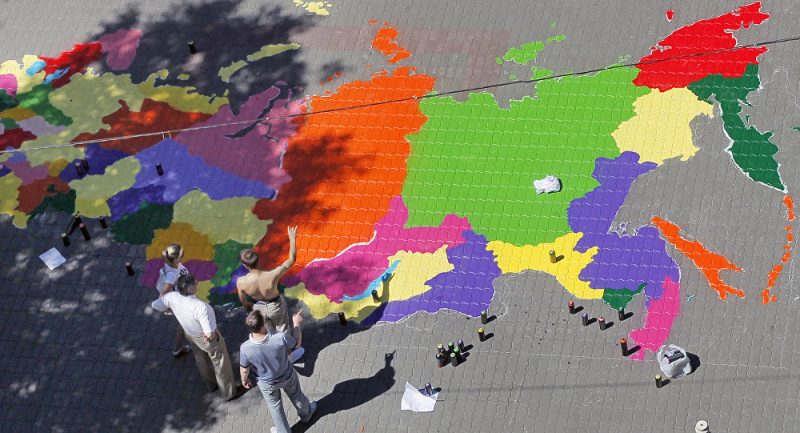
© Sputnik/ Vitaliy Belousov
Sputnik – March 27, 2018
On Monday, a number of European countries, as well as the United States and Canada, announced they were expelling Russian diplomats over the Skripal case. Radio Sputnik discussed the significance of the diplomatic response by the Western powers with Srdja Trifkovic, a US journalist and writer on international affairs.
Sputnik: What is your overall assessment about what has happened with this diplomatic response by so many countries? How significant is it?
Srdja Trifkovic: The overall impression is that rational discourse has given way to collective hysteria and that it is indeed remarkable. The extent to which the bandwagon has successfully started rolling while we don’t even have elementary answers to the questions concerning the case itself.
The second important and discouraging aspect is that continental European countries have followed the Anglo-American lead in Russophobia and this represents a further trial of the Atlanticist domination over Europe. It is indeed remarkable when both Germany and France, the putative leaders of independent European foreign policy, have been reduced to the status of automatic followers of the lead supported by Washington especially when we bear in mind that the initial round of sanctions in 2014 against Russia was dictated by the United States which had nothing to lose in the proceedings and to the detriments of Europeans’ interests.
So overall I think that, one we have the hysterical phase of Russophobic discourse in the West which is not amenable to any rational arguments and two, we have a successful degradation of European diplomacy to the status of pliant satellites comparable to East Germany and Bulgaria vis-à-vis Brezhnev.
Sputnik: Do you think there was some classified evidence that was presented that proves beyond a shadow of doubt that Russia was involved or do you think that the fact that there are 11 countries who have not joined in the protest perhaps hints at the fact that this was not the case?
Srdja Trifkovic: Well, first of all, I would say that President Putin, Foreign Minister Lavrov and others would not have made such categorical denials of Russian involvement if there was any possibility of a smoking gun which could effectively show to the world that they were not telling the truth.
And secondly, it is always possible to present some equivocal evidence in the form that even if that indicates the modus operandi of intelligence agencies nevertheless does not disclose outright state secrets. In fact, we’ve seen that in the past and I don’t think that it would be possible for such confidential information to be disclosed to the diplomats and foreign ministers of EU countries as divergent as the 27 are, without risking these very sources.
So I really believe that if you look at the countries which have taken measures against Russia, they almost read like who is who of those who are prepared to follow the US lead and if you look at those reluctant to do so, including Austria, Hungary, Cyprus, Greece, we are looking at those who actually have a more independent foreign policy. So I don’t think it’s a reflection of the quality of possible intelligence, it is simply a reflection of the determination of decision-makers of those countries to preserve a modicum of independence.
Sputnik: What would you say about the level to which the actions that were actually taken by individual countries? What can you say about the numbers game that’s being played? What do you think determined the number of diplomats?
Srdja Trifkovic: Some of these countries are absolutely insignificant countries like the Former Yugoslav Republic of Macedonia, which also expelled one Russian and it’s just a pathetic non country. On the other hand in the United States obviously it is a matter of regret that President Trump’s initially stated intention to have detente with Russia has been subverted by the deep state, it is a long story but now we have really reached the end of the road with the appointment of Pompeo to State Department and Bolton as the national security adviser.
So we can really look at Trump as the would-be drainer of the swamp who has been swallowed by the swamp. And I think that we are in for a long haul. I was in Moscow two weeks ago and coming again next week and sometimes I am surprised that some of my Russian interlocutors are insufficiently aware of the animosity or end of the rule Russophobic sentiment that currently prevails among the Western elites, both political and academic and media. It’s almost pathetic when some Russians still use the term “our Western partners,” because for partnership you need to have a modicum of mutual respect and trust and these people really seriously want to destroy Russia.
They want to delegitimize the Russian political system and process as we have seen with the public commentary on President Putin’s re-election and they want nothing short of regime change, which would then lead to a permanent and irreversible change of Russia’s national character and possibly the country’s partition along the lines allocated by Zbigniew Brzezinski. With these people partnership is impossible and Russia needs to be prepared for a long and sustained period of confrontation.
Enough is More Than Enough!

By Gilad Atzmon | March 27, 2018
Jewish power, as I define it, is the power to suppress criticism of Jewish power.
For the last few days the Brits have been shown a spectacular display of that power and the manner in which it is mobilised. Without any attempt to hide their behaviour, a bunch of Jewish leaders have chosen to slander Europe’s biggest party and its popular leader in the name of ‘Jewish sensitivities.’
This blitz attack was sparked by Labour leader Jeremy Corbyn’s reaction to a mural back in 2012. The mural was painted by US street artist Kalen Ockerman. Apparently, at the time Corbyn defended the public display of the painting on the grounds of freedom of speech.
The Labour leader was heavily criticised by Jewish institutions for supporting a mural “depicting Jewish bankers playing Monopoly on the backs of the poor.” The clumsy British media didn’t do its homework and failed to actually examine the mural, but instead immediately delved into the hookedness of the noses of those alleged Jewish bankers.
Embarrassingly for them, Ockerman has came forward and identified the men he depicted in the mural. They are from left to right, “Rothschild, Rockefeller, Morgan, Aleister Crowley, Carnegie & Warburg.” Of the six men, only Rothschild and Warburg were Jewish. In fact, Aleister Crowley was noted for his antisemitic views. The take home message for the BBC & co is that maybe capitalists of all races share similar shaped noses.
I am left wondering if the British Zionist league was offended by the mural because it is they, the Zionists, who see the capitalist as the Jew and vice versa. After all, Labour Zionism began as an avowed attempt to liberate Diaspora Jews of parasitic capitalist traits. Zionism promised to cleanse the Jew of gluttony by means of a ‘homecoming.’
Yesterday 1,500 British Jews took to the streets outside Parliament. They protested Corbyn’s “systematic failure to deal with antisemitism.”
If you wonder what ‘systematic antisemitsm’ means, the Jewish Chronicle provides the answer. In his speech at the protest Jonathan Arkush, the leader of the ardent Zionist Board of Deputies of British Jews, cited Labour’s failure to take proper action on the claims of antisemitism against former London mayor Ken Livingstone and other Labour Party members.
Zionists do not like Ken Livingstone. This is understandable. The man is a legendary icon of ethical thinking. Despite their protests, it is still not easy for the Labour party to expel one of its legends simply for telling the truth about Hitler’s collaboration with Zionism. Maybe Arkush should just give it more time.
Arkush told the crowd that the “the Labour Party must go back to being the enemy of racists – not the refuge.” Of course Corbyn doesn’t have a drop of racism in his entire body, but maybe Jonathan Arkush can meet his own standards and tell us how many Blacks or Muslims are members of his own Jews-only Board of Deputies of British Jews.
The Jewish Leadership Council’s chair Jonathan Goldstein said that Mr Corbyn had become the “figurehead for an antisemitic political culture based upon obsessive hatred of Israel, conspiracy theories and fake news.”
Maybe the Jewish community leader could try to remember that obsession with justice is not a bad thing and also that interfering with freedom of speech can easily backfire.
It is clear why some Jews are upset by Corbyn. The Labour leader treats the Jews as ordinary people. He fails to respect their choseness and ignores their sense of exceptionalism. Perhaps he believes that Jewish politics like all other politics, ought to be subject to criticism. And now it is clear that Corbyn’s approach to Jewish politics is not acceptable to Britain’s Zionist Jewish establishment.
MP John Mann who has operated as a Zionist mouthpiece within the Labour party for more than a while, bemoaned to the Jewish gathering about his Labour comrades that “Some of them glory in being called anti-Zionists – racists that is the word for them.”
Does Mann think that opposing a political movement is ‘racism?’ Is opposition to Britain or the USA, or even North Korea also to be castigated as racism? And then, in an uber-Orwellian manner Mann added “we have to drive these people (the anti Zionists) out of the Labour Party.”
Maidenhead Synagogue Rabbi Dr Jonathan Romain told the JC that this ‘antisemitism crisis’ was Mr Corbyn’s “Watergate moment.” I suggest the Rabbi learn some Jewish history. This tsunami of Jewish self-love and empowerment could turn into a total disaster as it has time after time in the past.
British Jewish leadership is panicking. It has declared open war against a mainstream British political party. This is far from a reasonable move and if it is intended to oppose antisemitsm, its effect will inevitably be the opposite. Maybe gestalt psychology offers us the tools to understand such silly behavior. Jewish history teaches us that attitudes toward Jews resemble a gestalt switch. So that, for instance, once you see Israel for what it is you just can’t un-see it. Once you grasp that the Jewish State is a racist oppressive force no one will be able to uproot that perception in you. Jewish Zionists do face a growing wall of resentment. Instead of dealing with it by means of self reflection, they repeat Israel’s mistake and adopt the most oppressive authoritarian agenda. They are desperately trying to turn Britain into an Orwellian dystopia.
Left open is the question of how it is possible that the Jewish elite, despite its sophistication and education, never learn from the Jewish past. How is it possible that Jews keep repeating the same mistake time after time? I guess one possible answer is that Jewishness (יהודיות) is a form of severe blindness—and that this may be the dark side of choseness.
Expulsion of Russian diplomats portends troubled times
By M K Bhadrakumar | Indian Punchline | March 27, 2018
The mass expulsion of Russian diplomats by some countries of the European Union and North America on Monday is an unprecedented and intriguing development. First, the US alone accounts for some two-thirds of the expulsion – 60 diplomats. Curiously, even Britain, which is apparently the aggrieved party in the Skripal affair, expelled less than half that number – 23. Broadly, however, this is an Anglo-American move with which a number of EU countries and Canada display solidarity.
Second, President Trump is apparently more loyal to Her Majesty in the Buckingham Palace than Prime Minister Theresa May. This gives an intriguing twist to the tale. Why is there such an excessive interest on the part of Washington, especially at a time when the fervor of the Anglo-American kinship has significantly dampened during the Trump era? (President Trump is yet to visit the UK.)
Is it a massive diversionary tactic by the White House the day after porn star Stormy Daniels took Trump’s pants off in her TV interview on ’60 Minutes’? Or, is this yet another attempt by Trump to flaunt that he isn’t ‘soft’ on Russia? Or, is it the Deep State in action – as the closure of the Russian consulate in Seattle might well suggest? There are no easy answers.
Third, only less than half the 28 member countries of the EU have signaled support for the Anglo-American campaign over the spy incident. There is much reluctance or skepticism within the EU about what is going on. Surprisingly, though, Germany, which had voiced skepticism at an early stage, has now joined the pack. Which probably shows that there has been immense pressure from Washington and London.
Nonetheless, curiously, the EU countries by and large made only ‘token’ expulsions. As many as 7 EU countries simply moved on by expelling one Russian diplomat each. Having said that, the pressure campaign is continuing and the likelihood of more EU countries joining the expulsion cannot be ruled out. Austria has point-blank refused to join. (So has Turkey, which virtually rules out a NATO stance, which requires unanimous support from all member countries.)
What is truly extraordinary is that the circumstances surrounding the alleged poisoning of an MI6 double agent of Russian extraction are still shrouded in mystery. The British Labour Party leader Jeremy Corbyn openly cautioned against rushed judgment in a piece in the Guardian. By the way, even PM May claims only that it is “highly likely” that there was Russian involvement (not excluding rogue elements.) Yet, a cardinal principle in Anglo-Saxon jurisprudence is that no one is deemed guilty unless proven guilty.
Indeed, a range of explanations is possible as to what really might have happened in Salisbury. Read an excellent analysis by the respected British scholar on Russia Richard Sakwa, Professor of Russian and European Politics at the University of Kent and Associate Fellow of Chatham House, titled THE SKRIPAL AFFAIR.
Even in America, there are voices of scepticism. An enterprising columnist drew up 30 questions that beg an answer. (See the column by Bob Slane featured on the website of the Ron Paul Institute for Peace and Prosperity, titled 30 Questions That Journalists Should Be Asking About the Skripal Case.)
To my mind, this entire controversy snowballed into a litmus test of the Euro-Atlantic partnership – in particular, the US’ trans-Atlantic leadership – at a defining moment when Britain is giving up EU membership. This is one thing. But, more importantly, does the build-up portend something far more sinister than one would anticipate? One particular passage from Prof. Sakwa’s essay becomes a chilling reminder about what may be lying in the womb of time:
“The only question is whether the confrontation will dissipate, as it did over Agadir in 1911, or whether this is the Sarajevo slow-burning crisis that could explode into flame at some later point… Will it be another case of the sinking of the Maine in 1898, where the subsequent public hysteria provoked war against Spain only to be discovered later that the ship’s ammunition stores had accidentally exploded; or a Gulf of Tonkin incident in 1964, which was also a false flag operation but provoked the escalation of the Vietnam War. The West may be ‘uniting’ against Russia, as The Times put it on 16 March, but to what purpose.”
Bolton the Doors, Mind That Johnson, the Neocons Are Coming
By Robert BRIDGE | Strategic Culture Foundation | 27.03.2018
The designation of John Bolton as US National Security Advisor, in addition to the State Department being taken over by the CIA, sends an unmistakable signal that the Trump administration is gearing up for some serious mischief in the Middle East.
In an ongoing administrative shakeup that has witnessed a number of controversial Trump appointees of late, including former CIA chief Mike Pompeo as the new Secretary of State, and Gina Haspel, who ran a CIA ‘black site’ prison in Thailand that used ‘enhanced interrogation techniques’ (torture), as the new CIA chief, the most ominous is undoubtedly the decision to replace HR McMaster with John Bolton as the National Security Adviser.
At a time of high dudgeon in international affairs, Bolton is not the fire extinguisher the world so desperately needs, but rather an incendiary. Indeed, the former UN ambassador has had a direct hand in some of the most egregious US foreign policy moves in recent history, including appeals for regime change in Iraq, Libya, Iran and Syria. According to the warped worldview of Mr. Bolton, the best form of diplomacy is to be found at the sharp end of a missile strike, and to hell with the atomic fallout.
In a March 2015 opinion piece in the New York Times, with a headline that says it all (“To Stop Iran’s Bomb, Bomb Iran”), Bolton rebuked former US President Barack Obama for his “frantic efforts to reach agreement with Iran.” One need not read between the lines in what comes next to understand that Bolton is diametrically opposed to any sort of diplomacy with Tehran.
“The inescapable conclusion is that Iran will not negotiate away its nuclear program. Nor will sanctions block its building a broad and deep weapons infrastructure. The inconvenient truth is that only military action … can accomplish what is required,” Bolton wrote.
Then, speaking about “rendering inoperable” the Natanz and Fordow uranium-enrichment centers, he boasted that the US military “could do a thorough job of destruction, but Israel alone can do what’s necessary.”
Incidentally, that comment is frightfully similar to how Mike Pompeo, the new secretary of state, blithely spoke about an attack on Iran in 2014.
“In an unclassified setting, it is under 2,000 sorties to destroy the Iranian nuclear capacity,” Pompeo, then serving as House member, told a group of reporters. “This is not an insurmountable task for the coalition forces.”
Destroying Iran’s nuclear facilities, according to Dr. John Strangelove Bolton is just the first step of a program that would include “vigorous American support for Iran’s opposition, aimed at regime change in Tehran.”
Bolton also paid lip service to a conspiracy theory, based on a “leaked” UN document (which has yet to see the light of day, by the way), which promotes the idea that North Korea is sending chemical weapon material to Syria in a program that is being financed by Iran. Thus, in one fell swoop, three of the West’s newest candidates for regime change Syria, North Korea and Iran, are scooped up in a net stitched out of the yarn that Syria has an addiction to chemical weapons. If the charges sound preposterous, that’s because they are.
To believe for an atomic nanosecond that Syrian President Bashar Assad, who oversees a relatively respectable military complex, would have anything to do with chemical weapons at this crucial juncture in his political career – especially with the Russian military on his side – is patently absurd. Moreover, why does the West rush to blame Damascus for every chemical attack that happens in Syria (with the White Helmets conveniently on-site to film the aftermath) when it is the rag-tag rebels and terrorists who, bereft of any modern military arsenal, would be the ones most expected to resort to such barbaric, desperate tactics, and not least of all for the purpose of drawing the Western powers into the fray on their side? As some famous Greek once said, ‘To ask the question is to answer it.’
Meanwhile, even before the unholy triumvirate of Pompeo, Haspel and Bolton have been formally embedded into Team Trump, the world must endure the pitiful spectacle of US Ambassador to the UN, Nikki Haley, regularly screeching about obliterating anything that bears the slightest resemblance to a sovereign state.
She even had the supreme audacity to speak about Washington’s readiness to “bomb Damascus and even the presidential palace of Bashar Assad, regardless [of the] presence of the Russian representatives there.”
But these fiercely aggressive birds known as hawks are not just native to the febrile climate of Washington, D.C. This arrogant bird of prey can also be found as far east as the United Kingdom where it has perched in the House of Commons ever since Tony Blair made a hellacious pact with George W. Bush to join the jolly little fight known as the ‘war on terror.’
Just this month, Sergei Skripal, a former Russian double agent, was the target of a suspected assassination attempt in Salisbury, UK the military town where he moved following a spy-swap in 2010. After a brief investigation, UK British PM Theresa May swiftly blamed Russia for Skripal’s illness. Her argument was that since Mr. Skripal had been targeted by a nerve agent called ‘novichok,’ a chemical that had been produced in the Soviet Union, specifically in Uzbekistan, then it stood to reason that Russia was the culprit. Such an argument would be laughed out of any court of law.
Moreover, when Moscow requested samples of the agent from London, which, as a member of the Organization for the Prohibition of Chemical Weapons (OPCW) it was required to do, London balked. At the same time, no good motive can be found to explain why Russia would want to remove a has-been spy – with a traceable nerve agent, of all things – just a few weeks before presidential elections and the opening of the World Cup.
“He was handed in to Britain as a result of an exchange, said Dmitry Peskov, President Putin’s press-secretary, in an exclusive interview with RT. “So, why should Russia hand in a man that is of any importance or that is of any value? It’s unimaginable. If he’s handed in – so Russia quits with him. He’s of zero value or zero importance.”
Amid this outright mockery of the justice system, the buffoonery of Boris Johnson, the UK Foreign Secretary looked right at home. Instead of producing something the West no longer defers to in criminal cases known as ‘evidence,’ the best Johnson could do was conjure up warmed over clichés and compare Russia with Nazi Germany.
“I think the comparison with 1936 is certainly right. It is an emetic prospect to think of Putin glorifying in this sporting event,” he told the Foreign Affairs Committee.
After he was done with his Hitler rant, Johnson speculated as to why Russia would do such a thing.
“The timing (of the Salisbury attack) is probably more closely connected with the recent election in Russia,” he said. “And as many non-democratic figures do when facing an election or facing some critical political moment, it is often attractive to conjure up in the public imagination the notion of an enemy.”
With Putin’s popularity higher than any Western leader, Johnson’s explanation was wide of the mark.
One last word in closing with regards to the Skripal case that many observers seem to have overlooked. Around the time Mr. Skripal was targeted for assassination, purportedly by the Russians, back in the United States the House Intelligence Committee was announcing there had been no collusion between the Trump administration and Russia. Such an announcement was anticipated as early as February. Aside from this being an unacceptable embarrassment for the Democratic Party, not to mention the establishment, which some have taken to calling the ‘deep state,’ it also meant that Russia, as well as Donald Trump, would be cleared of the egregious charges. Clearly some kind of diversionary tactic would have been welcomed.
Was the attack on Sergei Skripal in fact an effort to deflect attention away from the faltering ‘RussiaGate’ case, as well as to keep the anti-Russia propaganda ball bouncing? As for a motivating factor, one need look no further than Russia’s gas contracts with European countries, a lucrative business that at least one global superpower would like more than anything to control. If there is one thing the Neocons like more than war it’s money. Follow the money.
Poll Shows More Britons Favoring Brexit Than Keeping Northern Ireland
Sputnik – March 27, 2018
Opinion surveys have shown British attitudes becoming increasingly fragmented and polarized, with radically different views about the country’s future.
A poll commissioned by the London-based LBC Radio station and published on March 26 has shown that a greater proportion of the British population support prioritizing the United Kingdom’s exit from the European Union than retaining Northern Ireland as part of the UK. The survey was conducted over two days from March 21 to 22.
36 percent of the 1,630 adults in Great Britain said Brexit was of chief importance to them, with 29 percent giving priority to the union with Northern Ireland and 22 percent said that neither was of any importance to them. Residents of Northern Ireland itself were not included in the poll.
Brexit negotiations between London and Brussels have brought an unprecedented level of concern over how to preserve the unity of the UK, as Ireland has threatened to veto an agreement that creates a hard border with the UK and the Democratic Unionist Party which shares power with Theresa May in London has refused to back any separate status for Northern Ireland that might weaken its links to the rest of the country.Northern Ireland, like Scotland and London, voted to remain in the EU in the June 2016 referendum, with at least 56 percent backing the Remain campaign. Despite also backing Remain, the DUP has since come to support the UK leaving the EU’s Customs Union and the Single Market, so as to keep the country bound to London.
Under the terms of the Good Friday Agreement, which ended the decades-long period of conflict known as The Troubles in 1998, the question of whether the country remains united with Britain or joins with the Republic of Ireland must be made solely by the people of Northern Ireland.
British accusations against Russia for Skripal poisoning not only unproven, but absurd!
By Tom Stanford | The Duran | March 24, 2018
The British government claims to have overwhelming evidence of Russia’s responsibility in the Salisbury poison attack on Sergei Skripal and his daughter. In his Washington Post article of March 14, Foreign Secretary Boris Johnson went so far as to claim that there was “only [one] plausible conclusion: that the Russian state attempted murder in a British city, employing a lethal nerve agent banned under the Chemical Weapons Convention”. He even connected this with Russia “covering up” the alleged use of “the nerve agent sarin against the town of Khan Sheikhoun in April 2017” by Syrian forces. In a separate statement, the Foreign Secretary tells us it is “overwhelmingly likely” that Vladimir Putin personally ordered the attack. What evidence is there to support such serious accusations?
According to the British government (see e.g. Boris Johnson’s article) and the mainstream media, the following elements are sufficient to incriminate the Russian state with near certainty: the weapon used, the motive, Russia’s past record, the lack of another explanation.
Use of novichok is no proof of Russian involvement
The nerve agent reportedly used in the attack, named novichok, was developed by the Soviet Union in the 1970s and 1980s. The fact that Russian stockpiles of novichok were destroyed under supervision of UN bodies after the collapse of the Soviet Union and that the OPCW (Organisation for the Prohibition of Chemical Weapons) has seen no reason for suspecting any country of continuing to store this deadly agent does not seem to bother the incriminators. Of course, it can be speculated that Russia may have kept the weapon secretly, as does Vil Mirzayanov, the Russian scientist who revealed the existence of the project in 1992 and has lived in the US since 1995.
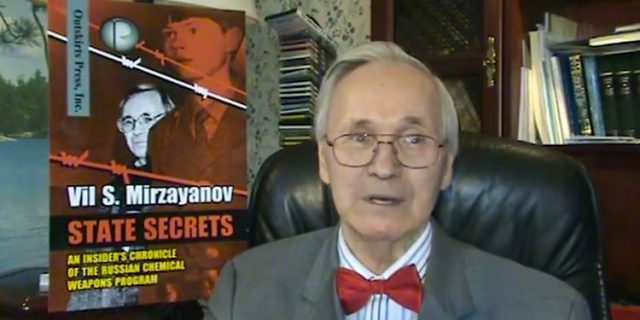
Russian ex-counter intelligence officer Vil Mirzayanov defected to the United States. Now 83 years old, he comments on the Skripal affair from Boston. (Photo credit: Business Insider)
Boris Johnson has announced that over the last ten year Britain has gathered evidence of Russia creating and storing novichok. We are given no detail of what kind of evidence this may be. It could turn out to be nothing more than isolated, unsubstantiated claims made by Mirzayanov and other opponents of the Russian government.
Not only Russia, but other former members of the Soviet Union, or the US, could have secretly stored or recreated the poison. In 1999 US defence officials helped Uzbekistan dismantle a former Soviet facility which had tested chemical weapons such as novichok. Samples, as well as the knowledge required to produce the nerve agent, are highly likely to have become available to countries other than Russia.
Did Russia have a motive?
Russia supposedly had an obvious motive. The argument goes as follows: Sergei Skripal, while still officially working for the Russian military intelligence service, the GRU, had been secretly recruited by the British MI6, and handed over to his new paymasters the names of all Russian agents he knew to be working in the West. Even after serving a few years in a Russian prison and being allowed to emigrate to the UK as part of a spy swap, he would have remained on an official Russian hit list for his act of treason. His murder would serve as a deterrent towards any other Russian agent who may consider switching sides. And to make things even clearer to would-be defectors, the attack would leave some kind of signature pointing to the Russian state as the perpetrator.
On the face of it, the argument sounds reasonable. However, it makes no sense to consider motives as evidence for doing something if we ignore counter-motives, i.e. reasons for refraining from doing it. Suppose you are in your doctor’s waiting room and have been sitting there for quite some time when suddenly an elderly lady, who arrived there just before you, collapses and is rushed to hospital. You had never seen her before. Now imagine the police later suspect some foul play and discover that the incident allowed you to have your own waiting time shortened by ten or fifteen minutes. You had a clear motive for harming the poor lady. Luckily for you, it then occurs to the investigators that your motive for doing so (saving a few minutes of your time) pales into insignificance compared with the reasons that would have held you back, such as the idea of spending years in jail, not to mention your moral conscience or feelings of human compassion.
In other words, motivation is the result of weighing out costs and benefits.
Putin had a clear motive… for NOT doing it
In the case of the Salisbury attack, the foreseeable costs to Russia, and more specifically to President Putin, are enormous. The Russian government spends considerable effort trying to convince the world that it firmly abides by the rule of law, especially international law and agreements between states. Its own statements, as well as the foreign-policy analyses appearing in the Russian state-owned media, all go towards highlighting Russia’s perceived superiority to the US in terms of respect for international law. Such efforts have greatly intensified in the context of the renewed tensions with the West over the last few years.
Russia’s current leaders believe in ending the current US-dominated unipolar world and are striving to recover some of the influence over world affairs that was lost with the collapse of the Soviet Union. This requires having allies, not only state allies, but also Russia-friendly organizations and individuals within states. Any damage to Russia’s international reputation does considerable harm to such prospects.
President Putin himself cultivates the image of a highly principled, responsible and law-abiding person – not that anyone would guess by reading the Western mainstream media! Whatever Russia’s state representatives and media may argue, the Salisbury attack has put many weapons in the hands of Putin’s detractors. In this light, it is absolutely inconceivable that Russia’s president ordered the attack himself. Boris Johnson’s personal accusation not only shows his total misunderstanding of the Russian leadership, but is also utterly irresponsible on the part of Britain’s top diplomat.
Russia had long been hoping that the EU may gradually put to an end its sanctions policy. It is still very dependent on trade with the block. It would be insane for Russia to do anything that could threaten the current Nord Stream 2 gas pipeline project, especially given that the US, with the support of a number of EU countries mainly from Eastern Europe, has been putting pressure on the EU to abandon the project. But Germany, determined to ensure its supply of cheap gas, has so far resisted such calls.
Predictably, the EU has sided with the UK and is officially demanding explanations from Russia concerning its novichok programme – which only makes any sense if Russia was in some way involved in the Salisbury attack, definitely not if it genuinely ceased the production and storage of the nerve agent in the 1990s, as documented by the OPCW!
Could other agents of the Russian state be responsible?
It is also entirely unrealistic to imagine that leading members of the Russian secret service agencies may have acted autonomously and ordered the Salisbury attack without consulting their superiors and not realizing how much damage it would have on Russia’s and Putin’s international reputation. They live in the world of the Russian state elite, continually exposed to its way of thinking, and not cocooned in some fantasy world of their own – unlike many Western politicians and journalists who apparently still live with the image of James Bond-like characters fighting against evil Russian agents!
Any significant agent of the Russian state would be fully aware of the displeasure that a Salisbury-type attack would trigger among the leadership. Supposing players within the Russian state did carry out the attack, it could only be construed as a hostile act towards President Putin and his team.
No sense for Russia to kill Skripal abroad rather than in Russia
This is not a simple case of a former spy-turned-traitor being “executed”. The attack leaves a deliberate Russian “signature” (there is no other reason for using novichok rather than a more discreet or classical weapon) and was carried out on the soil of a foreign country, the United Kingdom, which in spite of the Brexit process remains a highly significant player on the international stage. Whoever the perpetrators may be, they would have foreseen that any improvement in relations between Russia and its Western neighbours would be seriously jeopardized as a consequence.
But what makes Russian involvement even more absurd is the fact that Alexander Skripal was officially released and allowed to emigrate as part of a spy swap. Why would the Russians have waited another eight years before killing him in another country, with the terrible diplomatic consequences that would ensue, when he could have been much more easily liquidated while still in Russia, in a manner that would give would-be defectors an even clearer warning that there is “no way out for traitors”.
Would Russia give up the chance of other spy swaps?
Furthermore, a spy-swap deal implies that the parties involved agree to give up all claims pertaining to the released individuals. In other words they will not try to recapture or kill them, which would amount to a breach of the agreement. A country reneging on such a deal would no longer be trusted for any similar arrangements in the future. Is it reasonable to believe that the Russian government, or any top secret service official in Russia, would be prepared to sacrifice Russia’s chances of making any new spy-swap deals with its Western partners in the future? This is not just unlikely, it is the pinnacle of absurdity! Sadly, Western political leaders and mainstream media are quite happy to believe and propagate such nonsense.
Goal of attack: outrage against Russia
The attack itself does not seem to bear the mark of professional Russian agents. The daughter of the former double agent suffered the same fate as her father. It is only a matter of circumstances that many others were not seriously injured. It is like using a sledgehammer to crack a nut! And the main target, Sergei Skripal, is – weeks later – still reported to be alive! Either it was some very sloppy attack carried out by non-professionals, or the attack was deliberately not confined to Mr Skripal in order to provoke even greater outrage against Russia.
Boris Johnson has apparently recently adapted his interpretation of Russian intentions to take account of these facts. He now claims it was probably specially timed just before the presidential election, “to conjure up in the public imagination the notion of an enemy”. So the Russian president supposedly deliberately provoked British outrage to help him win the election! The Foreign Secretary seems to be completely out of touch with reality. It has long been common knowledge that Vladimir Putin would win with a landslide anyway. Would he wish to cause himself and his country enormous trouble for absolutely no gain at all?
What is Russia’s past record?
We are told there is “a pattern” of state-sponsored assassinations or deaths in unusual circumstances of political opponents, critical journalists and secret service defectors. Deaths attributed to President Putin have included the journalist Politskaya, the political opponent Nemtsov, the accountant and lawyer Magnitsky, the former agent Litvinenko and even the oligarch Berezovsky. In all these cases, the incrimination of the Russian state is based on rather flimsy evidence. The argumentation here is circular: in each case the belief in the Russian government’s responsibility is strengthened by the existence of the other stories. But if none of the stories are true, then the whole argument collapses.
The Litvinenko case does bear a similarity to the current one. Instead of the nerve agent novichok, Litvinenko was poisoned by radioactive polonium, a substance very difficult to obtain and produced only by a few countries – such as Russia – with a nuclear weapons industry. In both cases, it is highly unlikely that the Russian state would choose to leave a “made in Russia” signature on the poison used, with only one major outcome – the poisoning of Britain’s relationship with Russia.
If not Russia, then who did it?
Russia’s accusers claim there are no alternative explanations for the attack: nobody, apart from the Russian state, is understood to have had a motive for the attempted murder. This argument can only make sense to those who believe in the world of an evil, criminal Russia whose only opponents are pure, honest, angelic fighters for freedom and justice.
The main consequence of the Salisbury attack – undoubtedly one that would have been predicted by whoever planned it – is to further damage relations between Russia and the West, or at least prevent their improvement. A long list of countries (Ukraine, Poland, the US and many others) or organizations may believe they have an interest in this – at least they have been doing their best to spoil Western Europe’s relationship with Russia. Of course, the existence of a possible motive does not constitute sufficient ground to suspect anyone in particular. However, on the basis the motives involved, to quote British former Member of Parliament George Galloway, “Russia must be near the bottom of the list of suspects.”
How to get away with murder: blame Russia!
It can also not be excluded that the attack was the work of some rogue “ultra-patriotic” group within Russia (whether within or outside Russia’s state institutions) wishing to undermine Putin’s attempts to mend relations with the West by killing a “traitor” on British soil. In this case, the Salisbury attack would clearly be an act of aggression against the Russian government more than against the UK. And Britain’s refusal to cooperate with Russia would make the UK unwittingly guilty of helping the perpetrators avoid the course of justice.
Another aspect is that we do not know what personal enemies Aleksander Skripal may have had. There may be motives involved that nobody suspects. If, for whatever reason a person or organization with sufficient power wished to have him killed, there was a simple way to get away with the crime: a highly effective cover-up the crime would involve using a weapon that points towards Russia, with the knowledge the British authorities would be unlikely to seriously explore other avenues, especially in the current international climate. The same can be argued in the case of Litvinenko’s murder in 2006.
There is something particularly disturbing about the Western international community rushing to accuse Russia for any crime showing the slightest hint of a Russian connection: it provides criminal organizations and terrorists with assurances that they can avoid being held accountable. All they need to do is to leave some kind of “Russian signature”.
UK reckless attitude is dangerous
The words of Theresa May and Boris Johnson, accusing Russia for crimes it did not commit with astoundingly aggressive and hostile language, will naturally lead the Russian population and their decision makers to believe their country is the victim of an orchestrated attack. Hostility towards the West will increase dramatically as a result. British, European and North-American leaders may have convinced themselves of Russia’s guilt, but have they reflected on the possible consequences of their reckless attitude?
It is urgent to stop the escalation in the Russia blame game, which has taken a momentum of its own. It may be of benefit for the media, who can publish stories that make a good read, with an evil bogey man that everyone loves to hate, or for politicians who, when confronted with problems at home – such as the UK government with its current Brexit troubles – can take the opportunity to look strong in the face of an enemy. However, it is an extremely dangerous game which could have disastrous consequences for the entire world.
Featured Video

AIDS Inc. by Gary Null (2007)
or go to
Aletho News Archives – Video-Images
From the Archives
Clash of Civilization, Iran Part II
By Jamal Kanj – Intifada-Palestine.com – January 14, 2011
Israel’s survival kit is: perpetuate conflict, insecurity to rationalize collective hate and finally playing victim.
Devoid of conflict, Israel implodes internally; without hate, Zionism loses its justification; and playing eternal victim to continue blackmailing the West. Absence of this holy trinity, Israel ceases to exist.
From its inception, the house of Zion has mastered exploiting adversarial powers to advance Israel’s cause. For instance, their influence over the Democratic Party in the US began with President Truman’s bid for 2nd term election in 1948.
Responding to strong opposition from Secretary of State General George Marshall and Department experts urging against recognition of Israel, President Truman replied: “I’m sorry gentlemen but I have to answer to hundreds of thousands [Jewish voters] who are anxious for the success of Zionism. I do not have hundreds of thousands of [voting] Arabs among my constituents”
Zionists influence over liberal American politics was matched with the doctrinal school of Conservative theoreticians aligning the Republican Party’s platform with Israel’s objectives. The Neoconservative Zionists, coined Zioncons, invented the “Clash of Civilization” concept to fight Israel’s wars. … continue
Blog Roll
 Aletho News
- Merck Virologists Admitted to Falsely Certifying Vaccine Efficacy
- Mandatory Folic Acid for every man, woman & child
- Pro-Palestine protesters arrested outside UK’s ruling Labour Conference in Liverpool
- Mauritius denies landing permit to flight from Israel, forcing cancellation: Tour operator
- Israeli finance minister calls for genocidal war on West Bank, annexation of south Lebanon
- 12 Things Your Psychiatrist Was Trained Not to Tell You
- From Unipolar Universalism to Multipolar Civilizational Distinctiveness
- RSF military group defects, joins Sudanese army: State media
- Ireland goalkeeper refuses to play ‘Israel’ as squad weighs boycott
- China pushes back against US on Cuba, Iran
- If Americans Knew
- Israel forces Gazans to live in constant peril – Daily Update
- Deconstructing Netanyahu’s pants-on-fire UN rant – Daily Update
- Trump betrayed voters with his campaign lies and prioritized a foreign country once he took office
- Netanyahu calls Israel’s war in Gaza ‘opposite of genocide’ in UN speech to near-empty hall
- Settler Kidnappings: Torture, Sexual Abuse and Terrorisation of Palestinian Abductees as Israel Deepens Annexation of West Bank
- Gaza winter nears as 162,000 tents become unusable, raising fears of humanitarian crisis
- Netanyahu says, “It’s the opposite of genocide”; UN says Gaza economy is world’s ‘most severe crisis on record’ – Daily Update
- Israel’s US-Backed Assault on Gaza Has Created the ‘World’s Most Severe Economic Crisis on Record’: UN
- ‘Protecting U.S. Citizens’… From Israel
- ‘This is where I live now, the back of a truck’: a day in the life of a grandmother in Gaza
- No Tricks Zone
- New Study: Earth And Venus Surface Warmth Largely Explained By Convection And Lapse Rate, Not CO2 Or Radiation
- 2025 Nature Paper Claiming Worsening Global Drought Gets RETRACTED …Heavily Flawed
- New Study: ‘Global Drought Shows No Detectable Recent Acceleration Under Climate Warming’
- Economic Masterminds: German Socialists Suggest Taxing Productivity Gains Stemming From Using AI
- The South China Sea Has Not Been Cooperating With The Climate Change Narrative
- Energy Crisis: Germany Enters Heating Season With Historically Low Gas Reserve Fill Levels
- New Study: The Antarctic Ice Sheet Gained Mass From 2020-2024 Due To Staggering Snow And Ice Accumulation
- Study: Ocean Heating Rates From Thousands Of Years Ago ‘Dwarf’ Modern Ocean Heating Rates
- Climate Extremists Target, Attack Large-Scale Power Grid Infrastructure In Germany!
- New Study: Antarctic Ice Melt Has Contributed Less Than 1 Centimeter To Sea Level Rise In The Last 30 Years

