When Dealing with a Bear, Hubris Is Suicidal
The Saker • Unz Review • March 15, 2018
Assuming mankind finds a way not to destroy itself in the near future and assuming that there will still be historians in the 22nd or 23rd centuries, I bet you that they will look at the AngloZionist Empire and see the four following characteristics as some of its core features: lies, willful ignorance, hypocrisy, and hysterics. To illustrate my point I will use the recent “Skripal nerve-gas assassination” story as it really encompasses all of these characteristics.
I won’t even bother debunking the official nonsense here as others have done a very good job of pointing out the idiocy of that narrative. If you are truly capable of believing that “Putin” (that is the current collective designator for the Evil Empire of Mordor threatening all of western civilization) would order the murder of a man whom a Russian military court sentenced to only 13 years in jail (as opposed to life or death) and who was subsequently released as part of a swap with the USA, you can stop reading right now and go back to watching TV. I personally have neither the energy nor the inclination to even discuss such a self-evidently absurd theory. No, what I do want to do is use this story as a perfect illustration of the kind of society we now all live in looked at from a moral point of view. I realize that we live in a largely value-free society where moral norms have been replaced by ideological orthodoxy, but that is just one more reason for me to write about what is taking place precisely focusing on the moral dimensions of current events.
Lies and the unapologetic denial of reality:
In a 2015 article entitled “A society of sexually frustrated Pinocchios” I wrote the following:
I see a direct cause and effect relationship between the denial of moral reality and the denial of physical reality. I can’t prove that, of course, but here is my thesis: Almost from day one, the early western civilization began by, shall we say, taking liberties with the truth, which it could bend, adapt, massage and repackage to serve the ideological agenda of the day. It was not quite the full-blown and unapologetic relativism of the 19th century yet, but it was an important first step. With “principles” such as the end justifies the means and the wholesale violation of the Ten Commandants all “for the greater glory of God” the western civilization got cozy with the idea that there was no real, objective truth, only the subjective perception or even representation each person might have thereof. Fast forward another 10 centuries or so and we end up with the modern “Gayropa” (as Europe is now often referred to in Russia): not only has God been declared ‘dead’ and all notions of right and wrong dismissed as “cultural”, but even objective reality has now been rendered contingent upon political expediency and ideological imperatives.
I went on to quote George Orwell by reminding how he defined “doublethink” in his book 1984:
“To know and not to know, to be conscious of complete truthfulness while telling carefully constructed lies, to hold simultaneously two opinions which canceled out, knowing them to be contradictory and believing in both of them, to use logic against logic, to repudiate morality while laying claim to it (…) To tell deliberate lies while genuinely believing in them, to forget any fact that has become inconvenient, and then, when it becomes necessary again, to draw it back from oblivion for just as long as it is needed, to deny the existence of objective reality“
and I concluded by saying that “The necessary corollary from this state of mind is that only appearances matter, not reality”.
This is exactly what we are observing; not only in the silly Skripal nerve-gas assassination story but also in all the rest of the Russophobic nonsense produced by the AngloZionist propaganda machine including the “Litvinenko polonium murder” and the “Yushchenko dioxin poisoning“. The fact that neither nerve-gas, nor polonium nor dioxin are in any way effective murder weapons does not matter in the least: a simple drive-by shooting, street-stabbing or, better, any “accident” is both easier to arrange and impossible to trace. Fancy assassination methods are used when access to the target is very hard or impossible (as was the case with Ibn al-Khattab, whose assassination the Russians were more than happy to take credit for; this might also have been the case with the death of Yasser Arafat). But the best way of murdering somebody is to simply make the body disappear, making any subsequent investigation almost impossible. Finally, you can always subcontract the assassination to somebody else like, for example, when the CIA tried and failed, to murder Grand Ayatollah Mohammad Hussain Fadlallah by subcontracting his bombing to its local “Christian” allies, killing over 80 innocent people in the process. There is plenty of common crime in the UK and to get somebody to rob and stab Skripal would have probably been the easiest version. That’s assuming that the Russians had any reason to want him dead, which they self-evidently didn’t.
But here is the important thing: every single criminal or intelligence specialist in the West understands all of the above. But that does not stop the Ziomedia from publishing articles like this one “A Brief History of Attempted Russian Assassinations by Poison” which also lists people poisoned by Russians:
- Skripal by nerve gas
- Litvinenko by polonium
- Kara-Murza poisoned not once, but TWICE, by an unknown poison, he survived!
- Markov poisoned by ricin and the Bulgarians with “speculated KGB assistance”
- Khattab by sarin or a sarin-derivative
- Yushchenko by dioxin
- Perepilichny by “a rare, toxic flower, gelsemium” (I kid you not, check the article!)
- Moskalenko by mercury
- Politkovskaya who was shot, but who once felt “ill after drinking some tea that she believed contained poison”
The only possible conclusion from this list is this: there is some kind of secret lab in Russia where completely incompetent chemists try every poison known to man, not on rats or on mice, but on high profile AngloZionist-supported political activists, preferably before an important political event.
Right.
By the way, the gas allegedly used in the attack, “Novichok”, was manufactured in Uzbekistan and the cleanup of the factory producing it was made by, you guessed it, a US company. Just saying…
In any halfway honest and halfway educated society, those kind of articles should result in the idiot writing it being summarily fired for gross incompetence and the paper/journal posting it being discredited forever. But in our world, the clown who wrote that nonsense (Elias Groll, a Harvard graduate and – listen to this – a specialist of “cyberspace and its conflicts and controversies” (sic)) is a staff writer of the award-winning Foreign Policy magazine.
So what does it tell us, and future historians, when this kind of crap is written by a staff writer of an “award winning” media outlet? Does it not show that our society has now reached a stage in its decay (I can’t call that “development”) where lies become the norm? Not only are even grotesque and prima facie absurd lies accepted, they are expected (if only because they reinforce the current ideological Zeitgeist. The result? Our society is now packed with first, zombified ideological drones who actually believe any type of officially proclaimed of nonsense and, second, by cowards who lack the basic courage to denounce even that which they themselves know to be false.
Lies, however ridiculous and self-evidently stupid, have become the main ingredient of the modern political discourse. Everybody knows this and nobody cares. When challenged on this, the typical defense used is always the same: “you are the only person saying this – I sure never heard this before!”.
Willful ignorance as a universal cop-out
We all know the type. You tell somebody that his/her theory makes absolutely no sense or is not supported by facts and the reply you get is some vaguely worded refusal to engage in an disputation. Initially, you might be tempted to believe that, indeed, your interlocutor is not too bright and not too well read, but eventually you realize that there is something very different happening: the modern man actually makes a very determined effort not to be capable of logical thought and not to be informed of the basic facts of the case. And what is true for specific individuals is even more true of our society as a whole. Let’s take one simple example: Operation Gladio:
“Gladio” is really an open secret by now. Excellent books and videos have been written about this and even the BBC has made a two and a half hour long video about it. There is even an entire website dedicated to the story of this huge, continent-wide, terrorist organization specializing in false flag operations. That’s right: a NATO-run terrorist network in western Europe involved in false flag massacres like the infamous Bologna train station bombing. No, not the Soviet KGB backing the Baader-Meinhof Red Army Faction or the Red Brigades in Italy. No, the US and West European governments organizing, funding and operating a terrorist network directed at the people of Western, not Eastern, Europe. Yes, at their own people! In theory, everybody should know about this, the information is available everywhere, even on the hyper-politically correct Wikipedia. But, again, nobody cares.
The end of the Cold War was marked by a seemingly endless series of events which all provided a pretext for AngloZionist interventions (from the Markale massacres in Bosnia, to the Srebrenica “genocide”, to the Racak massacre in Kosovo, to the “best” and biggest one of them all, 9/11 of course). Yet almost nobody wondered if the same people or, at least, the same kind of people who committed all the Gladio crimes might be involved. Quite the opposite: each one of these events was accompanied by a huge propaganda campaign mindlessly endorsing and even promoting the official narrative, even when it self-evidently made no sense whatsoever (like 2 aircraft burning down 3 steel towers). As for Gladio, it was conveniently “forgotten”.
There is a simple principle in psychology, including, and especially in criminal psychology which I would like to prominently restate here:
The best predictor of future behavior is past behavior
Every criminologist knows that and this is why criminal investigators place so much importance on the “modus operandi”, i.e. the particular way or method a suspect or a criminal chooses in the course of the execution of his/her crimes. That is also something which everybody knows. So let’s summarize this in a simple thesis:
Western regimes have a long and well-established track record of regularly executing bloody false-flag operations in pursuit of political objectives, especially those providing them with a pretext to justify an illegal military aggression.
Frankly, I submit that the thesis above is really established not only by a preponderance of evidence but beyond a reasonable doubt. Right?
Maybe. But that is also completely irrelevant because nobody gives a damn! Not the reporters who lie for a living nor, even less so, the brainwashed zombies who read their nonsense and take it seriously. The CIA tried to kill Fidel Castro over 600 times – who cares?! All we know is that the good folks at Langley would never, ever, kill a Russian in the UK, out of respect for international law, probably…
That willful ignorance easily defeats history, facts or logic.
Here is a simple question a journalist could ask: “would the type of people who had no problems blowing up an large train station, or bringing down three buildings in downtown New York, have any hesitation in using a goofy method to try kill a useless Russian ex-spy if that could justify further hostile actions against a country which they desperately need to demonize to justify and preserve the current AngloZionist world order?”. The answer I think is self-evident. The question shall therefore not be asked. Instead, soy-boys from Foreign Policy mag will tell us about how the Russians use exotic flowers to kill high visibility opponents whose death would serve no conceivable political goal.
Hypocrisy as a core attribute of the modern man
Willful ignorance is important, of course, but it is not enough. For one thing, being ignorant, while useful to dismiss a fact-based and/or logical argument, is not something useful to establish your moral superiority or the legality of your actions. Empire requires much more than just obedience from its subject: what is also absolutely indispensable is a very strong sense of superiority which can be relied upon when committing a hostile action against the other guy. And nothing is as solid a foundation for a sense of superiority than the unapologetic reliance on brazen hypocrisy. Let’s take a fresh example: the latest US threats to attack Syria (again).
Irrespective of the fact that the US themselves have certified Syria free of chemical weapons and irrespective of the fact that US officials are still saying that they have no evidence that the Syrian government was involved in any chemical attack on Khan Shaykhun, the US is now preparing to strike Syria again in “response” to future chemical attacks! Yes, you read that right. The AngloZionists are now announcing their false flags in advance! In fact, by the time this analysis is published the attack will probably already have occurred. The “best” part of this all is that Nikki Haley has now announced to the UN Security Council that the US will act without any UN Security Council approval. What the US is declaring is this: “we reserve the right to violate international law at any time and for any reason we deem sufficient”. In the very same statement, Nikki Haley also called the Syrian government an “outlaw regime”. This is not a joke, check it out for yourself. The reaction in “democratic” Europe: declaring that *Russia* (not the US) is a rogue state. QED.
This entire circus is only made possible by the fact that the western elites have all turned into “great supine protoplasmic invertebrate jellies” (to use the wonderful words of Boris Johnson) and that absolutely nobody has the courage, or decency, to call all this what it really is: an obscene display of total hypocrisy and wholesale violation of all norms of international law. The French philosopher Alain Soral is quite right when he says that modern “journalists are either unemployed or prostitutes” (he spoke about the French media – un journaliste français c’est soit une pute soit un chômeur – but this fully applies to all the western media). Except that I would extend it to the entire Western Establishment.
I would further argue that foreign aggression and hypocrisy have become the two essential pillars for the survival of the AngloZionist empire: the first one being an economic and political imperative, the 2nd one being the prerequisite for the public justification of the first one. But sometimes even that is not enough, especially when the lies are self-evidently absurd. Then the final, quasi-miraculous element is always brought in: hysterics.
Hysteria as the highest form of (pseudo-)liberalism
I don’t particularly care for the distinction usually made between liberals and conservatives, at least not unless the context and these terms is carefully and accurately defined. I certainly don’t place myself on that continuum nor do find it analytically helpful.
The theoretical meaning of these concepts is, however, quite different from what is mostly understood under these labels, especially when people use them to identify themselves. That is to say that while I am not at all sure that those who think of themselves as, say, liberals are in any way truly liberal, I do think that people who would identify themselves as “liberals” often (mostly?) share a number of characteristics, the foremost of which is a very strong propensity to function at, and engage in, an hysterical mode of discourse and action.
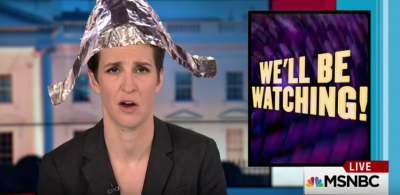 The Google definition of hysteria is “exaggerated or uncontrollable emotion or excitement, especially among a group of people (…) whose symptoms include conversion of psychological stress into physical symptoms (somatization), selective amnesia, shallow volatile emotions, and overdramatic or attention-seeking behavior”. Is that not a perfect description of US politicians, especially the (putatively) “liberal” ones? Just think of the way US Democrats have capitalized on such (non-)issues as “Russian interference” (externally) or “gun control” (internally) and you will see that the so-called “liberals” never get off a high-emotional pitch. The best example of all, really, is their reaction to the election of Donald Trump instead of their cult-leader Hillary: it has been over a year since Trump has been elected and yet the liberal ziomedia and its consumers are still in full-blown hysteria mode (with “pussyhats”, “sky-screams” and all). In a conversation you can literally drown such a liberal with facts, statistics, expert testimonies, etc. and achieve absolutely no result whatsoever because the liberal lives in an ideological comfort zone which he/she is categorically unwilling and, in fact, unable, to abandon, even temporarily. This is what makes liberals such a *perfect* audience for false-flag operations: they simply won’t process the narrative presented to them in a logical manner but will immediately react to it in a strongly emotional manner, usually with the urge to immediately “do something”.
That “do something” is usually expressed in the application of violence (externally) and the imposition of bans/restrictions/regulations (internally). You can try to explain to that liberal that the very last thing the Russians would ever want to do is to use a stupid method to try to kill a person who is of absolutely no interest to them, or to explain to that liberal that the very last thing the Syrian government would ever do in the course of its successful liberation of its national territory from “good terrorists” would be to use chemical weapons of any kind – but you would never achieve anything: Trump must be impeached, the Russians sanctioned and the Syrians bombed, end of argument.
I am quite aware that there are a lot of self-described “conservatives” who have fully joined this chorus of hysterical liberals in all their demands, but these “conservatives” are not only acting out of character, they are simply caving in to the social pressure of the day, being the “great supine protoplasmic invertebrate jellies” mentioned above. Again, I am not discussing real liberals or real conservatives here (regardless of what these terms really mean), I am talking about those who, for whatever reason, chose to place that label upon themselves even if they personally have only a very vague idea of what this label is supposed to mean.
So there we have it: an Empire built (and maintained) on lies, accepted on the basis ignorance, justified by hypocrisy and energized by hysterics. This is what the “Western world” stands for nowadays. And while there is definitely a vocal minority of “resisters” (from the Left and the Right – also two categories I don’t find analytically helpful – and from many other schools of political thought), the sad reality is that the vast majority of people around us accept this and see no reason to denounce it, never mind doing something about it. That is why “they” got away with 9/11 and why “they” will continue to get away with future false-flags because the people lied to, realize, at least on some level, that they are being lied to and yet they simply don’t care. Truly, the Orwellian slogans of 1984 “war is peace, freedom is slavery, ignorance is strength” perfectly fit our world. However, when dealing with the proverbial Russian bear, there is one lesson of history which western leaders really should never forget and which they should also turn into a slogan: when dealing with a bear, hubris is suicidal.
Labour divided after Corbyn refuses to condemn Kremlin without more evidence
RT | March 15, 2018
The Labour Party is facing internal rupture over the actions of leader Jeremy Corbyn after he refused to condemn Russia. The party leader asked that international law be followed before attributing blame to Moscow.
Theresa May and the Tories labeled the Kremlin as “culpable” over the poisoning over ex-double agent Sergei Skripal and his daughter Yulia, claiming it was “likely” the alleged attack had been ordered by Moscow. However, Corbyn asked the prime minister what proof she had to suggest Putin’s men were behind the incident.
By not supporting the PM’s condemnation, the Labour leader deepened divides in his front bench, and received widespread criticism from his MPs. Corbyn asked: “If the government believes it is still a possibility that Russia negligently lost control of a military-grade nerve agent, what action is being taken through the OPCW [Organisation for the Prohibition of Chemical Weapons]?”
Politicians from all sides have been angered by the comments in the wake of the scandal in Salisbury. One shadow cabinet member told The Telegraph : “Not only did Jeremy misjudge the mood of the chamber, he misjudged the mood of the country. People think this attack is an outrage, they think Putin is a bastard and they want a strong response.”
Labour backbenchers overwhelmingly supported May’s statement, which introduced the toughest sanctions on Russia for decades. Next week, 23 diplomats described as “undisclosed agents” will be expelled, while extra checks will be introduced on Russian private jets.
Some 20 Labour backbenchers signed a debate motion, tabled by John Woodcock, stating that the Commons “unequivocally accepts the Russian state’s culpability” and “fully supports” the statements made by May. Another MP said they were horrified by Corbyn’s comments, and others said privately that they could not back him ever becoming prime minister.
Corbyn had called for any action to be “decisive and proportionate, and based on clear evidence.”
Nia Griffith, shadow defence secretary, quickly came out to support the Tory stance on removing diplomats from the UK, risking her job. The Welsh MP, 61, said: “Looking back, perhaps it would have been easier for us if he had made it clear at the beginning of what he said just how much we support the expulsion of the diplomats.”
However, the heat quickly moved to Corbyn spokesman Seumas Milne, who is Labour’s director of communications. The former-Guardian columnist irked the British press when he raised the possibility that someone other than the Russian state was responsible for the Salisbury attack, including a different former Soviet state.
He also drew parallels between the jump to blame Moscow and previous issues with international threats, including the Iraq war. History of information from UK intelligence agencies was “problematic,” he said.
However, senior party sources said Corbyn’s stance was unchallenged at a shadow cabinet meeting this week. Instead, it has been suggested that one-on-one meetings were called with angered MPs. Emily Thornberry, the shadow foreign secretary, is understood to have stressed that ultimate responsibility was hard to determine, while the shadow Brexit secretary Sir Keir Starmer urged Mr Corbyn to condemn the attack – which he did, following May’s statement. Corbyn called the attack “abominable” in his statement and condemned the use of chemical weapons.
May blatantly misleads Parliament about Russian “terrorist” law
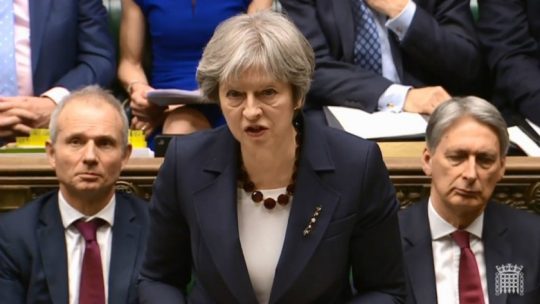
Theresa May following a tradition of being less than exact in Parliament about a casus belli
OffGuardian | March 14, 2018
When Theresa May said this in the House of Commons today:
While the extra-judicial killing of terrorists and dissidents outside Russia were given legal sanction by the Russian Parliament in 2006.
she was either disgracefully uninformed or was intentionally misleading Parliament on the nature of the Russian laws in question.
Her words completely misrepresent the known and understood facts of the case.
Not only have two experts in Russian law given their view that the laws do not permit the extra-judicial killing of “dissidents” in the manner described, but a British judge ruled in agreement with this conclusion during the Litvinenko Inquiry.
These are the judge’s own words:
The only legal route to extra-territorial action against Mr Litvinenko was therefore under the Terrorism Law. However, action could only have been taken against Mr Litvinenko under this law had he been involved in, or no doubt suspected of involvement in, some form of terrorist activity. Article 3 of the Terrorism Law contains definitions of terrorism and terrorist acts that are broadly conventional, and certainly not as expansive as the definition of ‘extremism’ in the second of the 2006 laws. Mr Batmanov’s letter (above) states that, “Alexander Litvinenko did not make part of a terrorist organization and was not accused by Russian law enforcement bodies of having committed a terrorist crime.” That accords with my understanding of the evidence
On the basis of the evidence currently before me, and in light of the considerations set out above, I am therefore not persuaded that any action could have been taken by the FSB against Mr Litvinenko in 2006 under the terms of either of the 2006 laws.
Put simply, this means the two laws would not have legalised the killing of Litvinenko on foreign soil. And, by extension would not legalise the poisoning of Skripal either.
Alexander Mercouris, a former UK barrister and author of a lengthy study of the Litvinenko Inquiry (published by OffG here and cited above) had this to say to us about May’s words in Parliament today:
Theresa May…was the Home Secretary who – somewhat unwillingly – set up the Litvinenko inquiry, and to whom the inquiry report was formally addressed. It is difficult to believe therefore that she is unaware that there is a British judicial finding that the two Russian laws which were passed in 2006 do not authorise extra judicial assassination attempts such as the one the British say was carried out in 2006 against Litvinenko, or the one which the British say was recently carried out against Skripal – who had of course been previously pardoned for his crimes by the Russian state.
The question arises – if this part of May’s statement contained such a blatant inaccuracy, how much weight can be given to her other as yet unsubstantiated claims of Russian guilt?
Those currently excoriating Jeremy Corbyn for asking for evidence before endorsing what amounts to indirect declarations of war on a nuclear power, might want to consider this fact before continuing on their chosen path.
The Novichok Story Is Indeed Another Iraqi WMD Scam
By Craig Murray | March 14, 2018
As recently as 2016 Dr Robin Black, Head of the Detection Laboratory at the UK’s only chemical weapons facility at Porton Down, a former colleague of Dr David Kelly, published in an extremely prestigious scientific journal that the evidence for the existence of Novichoks was scant and their composition unknown.
In recent years, there has been much speculation that a fourth generation of nerve agents, ‘Novichoks’ (newcomer), was developed in Russia, beginning in the 1970s as part of the ‘Foliant’ programme, with the aim of finding agents that would compromise defensive countermeasures. Information on these compounds has been sparse in the public domain, mostly originating from a dissident Russian military chemist, Vil Mirzayanov. No independent confirmation of the structures or the properties of such compounds has been published. (Black, 2016)
Robin Black. (2016) Development, Historical Use and Properties of Chemical Warfare Agents. Royal Society of Chemistry
Yet now, the British Government is claiming to be able instantly to identify a substance which its only biological weapons research centre has never seen before and was unsure of its existence. Worse, it claims to be able not only to identify it, but to pinpoint its origin. Given Dr Black’s publication, it is plain that claim cannot be true.
The world’s international chemical weapons experts share Dr Black’s opinion. The Organisation for the Prohibition of Chemical Weapons (OPCW) is a UN body based in the Hague. In 2013 this was the report of its Scientific Advisory Board, which included US, French, German and Russian government representatives and on which Dr Black was the UK representative:
[The SAB] emphasised that the definition of toxic chemicals in the Convention would cover all potential candidate chemicals that might be utilised as chemical weapons. Regarding new toxic chemicals not listed in the Annex on Chemicals but which may nevertheless pose a risk to the Convention, the SAB makes reference to “Novichoks”. The name “Novichok” is used in a publication of a former Soviet scientist who reported investigating a new class of nerve agents suitable for use as binary chemical weapons. The SAB states that it has insufficient information to comment on the existence or properties of “Novichoks”. (OPCW, 2013)
OPCW: Report of the Scientific Advisory Board on developments in science and technology for the Third Review Conference 27 March 2013
Indeed the OPCW was so sceptical of the viability of “novichoks” that it decided – with US and UK agreement – not to add them nor their alleged precursors to its banned list. In short, the scientific community broadly accepts Mirzayanov was working on “novichoks” but doubts he succeeded.
Given that the OPCW has taken the view the evidence for the existence of “Novichoks” is dubious, if the UK actually has a sample of one it is extremely important the UK presents that sample to the OPCW. Indeed the UK has a binding treaty obligation to present that sample to OPCW. Russa has – unreported by the corporate media – entered a demand at the OPCW that Britain submit a sample of the Salisbury material for international analysis.
Yet Britain refuses to submit it to the OPCW.
Why?
A second part of May’s accusation is that “Novichoks” could only be made in certain military installations. But that is also demonstrably untrue. If they exist at all, Novichoks were allegedly designed to be able to be made at bench level in any commercial chemical facility – that was a major point of them. The only real evidence for the existence of Novichoks was the testimony of the ex-Soviet scientist Mizayanov. And this is what Mirzayanov actually wrote.
One should be mindful that the chemical components or precursors of A-232 or its binary version novichok-5 are ordinary organophosphates that can be made at commercial chemical companies that manufacture such products as fertilizers and pesticides.
Vil S. Mirzayanov, “Dismantling the Soviet/Russian Chemical Weapons Complex: An Insider’s View,” in Amy E. Smithson, Dr. Vil S. Mirzayanov, Gen Roland Lajoie, and Michael Krepon, Chemical Weapons Disarmament in Russia: Problems and Prospects, Stimson Report No. 17, October 1995, p. 21.
It is a scientific impossibility for Porton Down to have been able to test for novichoks, without possessing some to develop the tests. As Dr Black has revealed Porton Down had never seen any Russian novichok, they cannot have a test for it unless they synthesised some themselves to develop the tests. And if they can synthesise it, so can many others, not just the Russians.
And finally – Mirzayanov is an Uzbek name and the novichok programme, assuming it existed, was in the Soviet Union but far away from modern Russia, at Nukus in modern Uzbekistan. I have visited the Nukus chemical weapons site myself. It was dismantled and made safe and all the stocks destroyed and the equipment removed by the American government, as I recall finishing while I was Ambassador there. There has in fact never been any evidence that any “novichok” ever existed in Russia itself.
To summarise:
1) Porton Down has acknowledged in publications it has never seen any Russian “novichoks”. The UK government has absolutely no “fingerprint” information that can safely attribute this substance to Russia.
2) Until now, neither Porton Down nor the world’s experts at the Organisation for the Prevention of Chemical Weapons (OPCW) were convinced “Novichoks” even exist.
3) The UK is refusing to provide a sample to the OPCW.
4) “Novichoks” were specifically designed to be able to be manufactured from common ingredients on any scientific bench. The Americans dismantled and studied the facility that allegedly developed them. It is completely untrue only the Russians could make them, if anybody can.
5) The “Novichok” programme was in Uzbekistan not in Russia. Its legacy was inherited by the Americans during their alliance with Karimov, not by the Russians.
With a great many thanks to sources who cannot be named at this moment.
Corbyn challenges May’s ‘evidence’ of Russian ‘culpability’ in ex-spy poisoning
RT | March 14, 2018
Jeremy Corbyn believes there is not enough proof to conclude Russia was behind the poisoning of ex-double agent Sergei Skripal and his daughter Yulia, according to his spokesman. Corbyn also challenged the evidence in Parliament.
Corbyn’s spokesman told reporters: “The government has access to information and intelligence on this matter which others don’t. However, there is also a history in relation to weapons of mass destruction and intelligence which is problematic, to put it mildly.”
Asked if Corbyn believed Russia was responsible for the attack, the spokesman said Prime Minister Theresa May continued to leave open the possibility that Russia lost control of its nerve agent. He also suggested the poisoning might have been a carried out by a “mafia” or another former Soviet state, rather than orchestrated by the Kremlin.
“I think the right approach is to seek the evidence to follow international treaties, particularly in relation to prohibitive chemical weapons,” the spokesman said. “The breakup of the Soviet state led to all sorts of material ending up in random hands,” they said.
May said she was “surprised and shocked” by the Labour leader’s statement and said most Labour MPs will be “equally surprised” by the spokesperson’s comments.
Speaking in the House on Wednesday, Corbyn was met with jeers as he suggested May should continue dialogue with Russia in the wake of the alleged poisoning of a former double agent and his daughter in Salisbury.
In parliament the Labour leader asked whether the prime minister had provided samples of the nerve agent Novichok as requested by Russia over allegations it was used in the “attack.” Traces were reportedly found during the investigation into the unexplained poisoning.
Corbyn said there must be “robust dialogue” with Russia, rather than a slashing of all ties. He raised a number of questions, including asking what information there is about where the nerve agent came from. There were cries of “shame” from some MPs, unhappy at his decision to question the evidence.
“The attack in Salisbury was an appalling act of violence,” Corbyn said. “Nerve agents are abominable. Our response as a country must be guided by the rule of law, support for international agreements and human rights. It is essential the government works with the UN.”
Corbyn also took aim at Foreign Secretary Boris Johnson, who was jeering during his response to the prime minister’s statement. He said: “I didn’t understand a word the foreign secretary said but his behavior demeans his office. It is in moments such as these governments realize the importance of strong diplomacy.
“The measures we take have to be effective not just for long-term security but to secure a world free of chemical weapons.”
A furious May hit back in the political ping pong, claiming she expected her actions to be supported across parties. She said: “I am only sorry the consensus does not go as far as the right honorable gentleman. He could have taken the opportunity to condemn to culpability of the Russian state.”
The government should work with the Organization for the Prohibition of Chemical Weapons, Corbyn said. He also asked what is being done through the OPCW if the government still believes this material could have been obtained due to Russian government negligence.
“It is a matter of huge regret that diplomatic capacity has been cut,” he said, after the expulsion of Russian diplomats was announced.
His comments came after Theresa May fired warning shots to Russia insisting the country has shown “complete disdain” for Downing Street by refusing to meet a response deadline.
The PM had given the government until yesterday to react to claims it used the nerve agent Novichok to try and murder ex-double agent Sergei Skripal and his daughter Yulia, last week.
May announced a new range of sanctions including the expulsion of 23 diplomats and further checks on Russian private planes entering the UK. This represents the biggest expulsion of what the government has described as “undeclared agents of Russia” in 30 years.
No royal family member or politician will attend the football World Cup in Russia, May told the Commons, and Russian Foreign Minister Sergey Lavrov will have his invitation to visit the country withdrawn. May said: “Either this was a direct act by the Russian state against our country or the Russian government lost control of a military-grade nerve agent.
“They have provided no credible explanation. No explanation as to how this came to be used in the UK. The Russian state was culpable for the attempted murder of Mr Skripal and his daughter. This represents unlawful use of force by the Russian state against the UK.”
Read more:
Moscow on Expulsion of 23 Diplomats From UK: ‘Unacceptable, Unjustified’ Move
Sputnik – March 14, 2018
Prime Minister Theresa May has announced the largest expulsion of Russian diplomats from the UK since the Cold War over the alleged attack on a former spy. Moscow has denounced May’s claims as baseless.
The Russian Embassy in London called the expulsion of 23 Russian diplomats announced by UK Prime Minister Theresa May over the poisoning of former intelligence officer Sergei Skripal “unacceptable, short-sighted and unjustified.”
In a statement, the Embassy confirmed that the diplomats had been declared persona non grata, adding that London was to blame for the harm caused to Russian-UK relations by this “hostile step.”
The Russian Embassy’s reaction followed UK Prime Minister Theresa May’s address to the House of Commons, where she announced a response to the alleged attack on Skripal.
Biggest Expulsion of Russian Diplomats Since Cold War
Reiterating a claim she made Monday about Russia’s alleged culpability in the Skripal case, the prime minister accused Russia of an “unlawful use of force against the United Kingdom,” saying this crime was part of a well established pattern of “Russian state aggression” in Europe, and accused Moscow of “sarcasm, contempt and defiance” in its response to London’s ultimatum to provide further information.
May announced that 23 Russian diplomats “identified as undeclared intelligence officers” will be expelled and given one week to leave.
Second, she vowed the creation of new legislative powers against “hostile state activity,” as well as possible new counter-espionage powers.
May promised the freeze of Russian assets in cases where they threaten UK citizens, adding there was no place for those seeking to do harm to the UK.
The prime minister also said that “criminals” and “corrupt elites” from Russia were not “welcome” in the UK. She informed lawmakers that “led by the National Crime Agency, we will continue to bring all the capabilities of UK law enforcement to bear against serious criminals and corrupt elites. There is no place for these people – or their money — in our country.”
May also confirmed that her government will be looking to strengthen Magnitsky Act-type, human rights-based amendments to existing sanctoins.
Suspension of High Level Contacts
London will suspend all high level contacts with diplomatic officials from Moscow, including during the upcoming FIFA World Cup in Russia, which British ministers and members of the royal family will skip.
May accused Russia of “flagrantly” breaching its international obligations, and said it was “tragic” that Russian President Putin “has chosen to act in this way.”
The prime minister stressed that the London and its allies will coordinate its actions, and welcomed support received from NATO and the EU. A NATO Council meeting will be held to discuss the matter on Thursday. The UK is also pushing for a debate at the UN on the Skripal case, and has asked the Organization for the Prohibition of Chemical Weapons to to help verify its claims against Russia.
Skripal’s attempted murder was not just an act of aggression against the UK, but an affront to the prohibition of chemical weapons, May said.
Opposition Responds
Opposition leader Jeremy Corbyn called the events in Salisbury “abominable,” adding that the Labour Party supports the prime minister in taking firm, multilateral action to ensure chemical weapons are never again used in the UK. He asked whether May agrees on the need to maintain dialog with Russia.
Responding to a lawmaker’s question about whether she will respond to any Russian response with an even firmer response, May said there were “other measures” that London stands ready to deploy should it face “further provocations” from Moscow.
May accused Russia of having a “pattern” of aggression, from Syria to Crimea and Eastern Ukraine, to meddling in elections in other parts of the world to “propaganda” and “misinformation campaigns.”
Asked about whether the UK will seek to further diversify away from the delivery of Russian gas, May confirmed that “we are indeed looking” to other countries for supplies.
Asked whether Russian English language media including RT would be targetted, May said that this was not a matter for the government, but for media regulator Ofcom. She added that the UK would continue to support the efforts of BBC’s Russian language service. Moscow had previously warned that UK media would be expelled from Russia if Russian media was expelled from the UK.
What Happened
Moscow has dismissed all accusations of involvment in the Skripal incident and requested access to the case. Russian Foreign Minister Sergei Lavrov has characterized London’s accusations as “propaganda,” and complained that Russia wasn’t provided with any evidence regarding the crime, in spite of the accusation of Russian involvement, and the fact that Russia had made a request for information regarding a crime which affected Yulia Skripal, who is a Russian citizen.
Ex-GRU officer and MI6 double agent Sergei Skripal and his daughter were hospitalized on March 4 following what London claims to have been an attempted poisoning.
UK intelligence may be complicit in Skripal’s poisoning – ex-FSB head
RT | March 13, 2018
A former FSB director suggested British intelligence agencies may be complicit in the attempt on the life of former double agent Sergei Skripal, adding the incident has actually caused “enormous harm” to Russia.
Nikolay Kovalev, former director of Russia’s Federal Security Service (FSB), told RIA Novosti on Tuesday it is mainly the UK and its ally the US who benefit from Skripal’s poisoning. The former military intelligence officer was exposed as a British spy back in the early 2000s.
“It looks like British secret services are complicit in it,” Kovalev went on. “[Defectors] are fully under surveillance … the secret services are monitoring them, they know their whereabouts and schedules. And then you have such strange events happen in a row.”
Kovalev, who led the FSB from 1996 until 1998, said he believes that a series of assassination attempts targeting defectors in the UK makes him think that the British “scapegoat this or that traitor after having utilized him to the maximum extent, and then say the Russians did it.”
Skripal, 66, and his 33-year-old daughter Yulia were found unconscious on a bench outside a shopping center in Salisbury last week, prompting London to pin the blame on Moscow.
On Monday, British Prime Minister Theresa May said the poisoning was either “a direct act by the Russian state on Britain,” or the Russian government had allowed the alleged nerve agent, ‘Novichok’, to get into the wrong hands.
“The government has concluded that it is highly likely that Russia was responsible,” she said.
Kovalev dismissed the claim, saying the nerve agents could have been stored in any post-Soviet country, including Ukraine.
“Given that [such substances] were stockpiled in former Soviet Union republics – sorry, but Ukrainian involvement can’t be ruled out,” he said.
His assessment has been echoed by another former security official who suggested the nerve agent allegedly used in the attempt on Skripal’s life was produced in the UK. General Vladimir Mikhailov, a former high-ranking FSB officer, told RIA Novosti that if Vil Mirzayanov, a Russian chemical weapons expert who defected to the West in the early 1990s, had disclosed the formula, MI6 “could have synthesized the agent and used it for political purposes.”
UK TV regulator writes to RT, says it may consider whether channel’s license is ‘fit and proper’
RT | March 13, 2018
Britain’s media regulator Ofcom says it will “consider the implications for RT’s broadcast licenses” if it’s determined there was “an unlawful use of force by the Russian state against the UK” in the poisoning of Sergei Skripal.
In a statement, Ofcom said: “As the independent UK broadcasting regulator, Ofcom has an ongoing duty to be satisfied that broadcast licensees remain fit and proper to hold their licences.
“We have today written to ANO TV Novosti, holder of RT’s UK broadcast licences, which is financed from the budget of the Russian Federation. This letter explained that, should the UK investigating authorities determine that there was an unlawful use of force by the Russian State against the UK, we would consider this relevant to our ongoing duty to be satisfied that RT is fit and proper.”
“The letter to RT said that we would carry out our independent fit and proper assessment on an expedited basis, and we would write to RT again shortly setting out details of our process.”
RT said in a statement that it disagreed with the position taken by Ofcom. “Our broadcasting has in no way changed this week from any other week, and continues to adhere to all standards.
“By linking RT to unrelated matters, Ofcom is conflating its role as a broadcasting regulator with matters of state. RT remains a valuable voice in the UK news landscape, covering vital yet neglected stories and voices, including those of the many MPs and other UK public figures who have been shut out of public discourse by the mainstream media.”
When the threat of having its license revoked first came to light, RT said the banning of the channel would do “away with any concept of press freedom in the UK.”
British Prime Minister Theresa May gave Moscow one day on Monday to explain the alleged use of a military-grade nerve agent, which the UK claims came from Russia to poison ex-double agent Skripal and his daughter Yulia. May says it’s “highly likely” Moscow was responsible.
She alleges the attack was either a direct act by the Russian state on Britain, or the Russian government allowed its nerve agent ‘Novichok’ to get into the wrong hands. “The government has concluded that it is highly likely that Russia was responsible,” she said.
READ MORE: ‘What about freedom of speech?’ Twitter fury over MPs’ calls to ban RT
After the statement in the House of Commons, Labour MP Chris Bryan asked May: “Can we just stop Russia Today [RT] broadcasting its propaganda in this country?” The PM responded by saying she would update MPs on “further measures” later this week.
The threat of banning RT led to a backlash from some on Twitter. RT contributors, viewers and members of the public speaking out against the proposal with some calling it an attack on “freedom of speech.”
Gaslighting about the realities of “state-sponsored murder”
OffGuardian | March 12, 2018
Theresa May has just semi-officially pronounced the Skripal case a Russian state-sponsored hit. No evidence was presented for this conclusion of course, but we are getting used to that now. Belief is the new evidence. And in this case we do seem to have belief in large quantities.
Russia now effectively is being called upon to prove its innocence by tomorrow (Tuesday) or face Theresa’s wrath.
We’ll see how that goes over.
Of course there’s the immensely handy fact the “nerve agent” allegedly used is “Russian” too. Novichok no less, a Soviet-era toxin from the 1980s, described on Wikipedia as “the most deadly nerve toxin ever made.”
Though it wasn’t only produced in Russia, but in Uzbekistan.
And by the way the US has been “helping” Uzbekistan clean up its chemical weapons sites since 1991.
And of course Russia had destroyed all its chemical weapon stockpiles by 2017.
But the US still hasn’t (see MoA link above).
Still, so, as far as the state machine is concerned the alleged use of Novichok about clinches it for Putin. He dunnit. Verdict pronounced, let’s hurry on to the sentencing. What will it be? More sanctions? A Skripal Act to rival Magnitsky’s? Moving UK troops closer to Russia’s borders? Driving Russian money out of London? Messing with the World Cup?
While the UK establishment shoots its wad fantasising about all these glorious possibilities, let’s take a quick reality check.
Russia has absolutely nothing to gain from initiating the poisoning of Skripal, and even less to gain from leaving a calling card made of Novichok.
This is so obviously true even spokespeople for the UK establishment admit it openly, for example Andrew Wood, former UK ambassador to Moscow, is quoted in the Guardian saying
it’s very hard to see what profit they can get from this
Though of course this hasn’t stopped the same people who admit this to be true also claiming to be absolutely sure Russia did it.
Absent sane motives they have had to invent insane ones instead. Russia are just crazy, bent on vengeance, spoiling for a fight. Their blatant and self-destructive action, says Wood:
advertises the fact that they are vindictive and dedicated to pursuing revenge.
Reliably deluded and fact-defying Luke Harding adds his own pulp spy-thriller spin:
The use of novichok in Salisbury not surprising but remarkable. Developed by Soviet Union in 70s and 80s, and more deadly than VX nerve agent. A brutal calling card that would inevitably be discovered. Conclusion: Putin and FSB wanted this row now
— Luke Harding (@lukeharding1968) March 12, 2018
You see? Russia must have done it (even though they had no motive), so they must be driven by crazy notions of revenge or wanting a “row” that defy self-interest.
That’s logic.
The obvious consideration – if they had no motive maybe they didn’t do it has no place in this mad little universe.
This is simply gaslighting.
Motive is a first consideration in solving any crime. Absence of motive is also a primary argument for innocence. Cui bono? is a legal as well as a rational question. But it’s one the Western powers do not want anyone asking in this case.
Because the answer is obvious.
The timing of the alleged poisoning – the day before a prime mover in promoting UK Russophobia, Bill Browder, was due to testify at the Parliamentary Inquiry into alleged Russian “fake news”, and two weeks before the Russian election – is enough of itself to make the UK and its security agencies prime suspects.
Will be testifying tomorrow at the British Parliament on Russia’s use of fake news and propaganda at 10:30am U.K. time. Lots of examples from the Magnitsky case to educate lawmakers on Putin’s modus operandi https://t.co/lsI9tMXLJ2
— Bill Browder (@Billbrowder) March 5, 2018
And who can deny this tragic event is being fully exploited by the state machine? In just the last three days the poisoning of these two people in still murky circumstances has been used to
- add fresh weight to the push to have RT blocked in the UK
- justify moves against Russian holdings in the UK
- reinforce calls for implementation of new sanctions
- increase UK defence spending
In contrast, what has Russia or Russia’s narrative gained from this?
Absolutely nothing.
To bring a small amount of balance and sanity to the current situation we’re going to be reminding readers of some of the mysterious and possibly politically motivated deaths that have occurred in the UK. Unlike the Skripal and Litvinenko cases the media never claimed any of them were “state-sponsored murder”, because the only state they could possibly have been pinned on was our own.
Skripal case: Theresa May now demands Russia prove itself innocent
British government lacking evidence of Russian guilt reverses the burden of proof
By Alexander Mercouris | The Duran | March 12, 2018
After a week of speculation and allegations British Prime Minister Theresa May has finally spoken about the murder attempt on the former British spy Sergey Skripal, which has left both him and his daughter critically ill.
This how the Guardian reports her statement:
Based on the positive identification of this chemical agent by world-leading experts at Porton Down, our knowledge that Russia has previously produced this agent and would still be capable of doing so, Russia’s record of conducting state-sponsored assassinations, and our assessment that Russia views some defectors as legitimate targets for assassinations, the government has concluded that it is highly likely that Russia was responsible for the act against Sergei and Yulia Skripal….
Either this was a direct act by the Russian state against our country. Or the Russian government lost control of this potentially catastrophically damaging nerve agent and allowed it to get into the hands of others…
Should there be no credible response, we will conclude that this action amounts to an unlawful use of force by the Russian state against the United Kingdom……
This attempted murder using a weapons-grade nerve agent in a British town was not just a crime against the Skripals.
“It was an indiscriminate and reckless act against the United Kingdom, putting the lives of innocent civilians at risk. And we will not tolerate such a brazen attempt to murder innocent civilians on our soil. I commend this statement to the House….
The first thing to say about this statement is that it is essentially an admission that the British authorities have not been able to identify any suspects who might have carried out the attack on Skripal.
No person or persons have been identified as suspects in the case, and the only conclusion one can draw from Theresa May’s statement is that the British authorities either do not have the names of any suspects, or are uncertain about any names they do have..
I say this because if the British authorities did suspect any person or persons of carrying out the attack, Theresa May would presumably not be publicly speculating about whether this person or these persons might or might not have acted on the Russian government’s instructions.
The second thing to say about this statement is that the Russian attribution the British government is making is entirely based upon a scientific assessment that the nerve agent used in the attack was one of the agents developed by the USSR in the 1970s and 1980s as part of the so-called Novichok programme.
On the face of it this seems an uncertain basis upon which to attribute responsibility.
Details of the Novichok programme were disclosed by the Russians to the West decades ago, and the properties of the nerve agents developed as part of this programme are well known. That presumably is why it was possible to assess that the nerve agent used in the attack on Skripal was one of the nerve agents developed as part of this programme.
Given that this is so, it is not obvious how it is possible to say that because the nerve agent used was of a type which was originally developed in Russia as part of the Novichok programme, that must mean that the Russian government or Russians were definitely responsible for the attack.
That seems to me a little like saying that because sarin was originally developed decades ago in Germany, that means that any chemical weapons attack which uses sarin is attributable to Germany.
The danger involved in using the supposed origin of a poison to identify the perpetrator is in fact shown by what happened in the Litvinenko case.
At the time of the murder in 2006 of Alexander Litvinenko Britain was awash with claims that the polonium with which he was poisoned was extremely expensive, was only made in Russia, and had been positively traced back to Russia. These claims were widely treated as providing the proof that the Russian authorities were responsible for Litvinenko’s murder.
In the event, the public inquiry into Litvinenko’s murder, after hearing from a range of scientific witnesses, concluded that all the claims which had for a decade been made about polonium were untrue: it is not expensive, it is not produced only in Russia, and it is scientifically impossible to trace the point of origin of any polonium sample, whether to Russia or to anywhere else.
The Judge who headed the inquiry could not conceal his disappointment, making the extraordinary statement in his inquiry report that though it could not be proved that the polonium had come from Russia, it nonetheless might have done so.
The result was that with the polonium evidence – the evidence which supposedly “proved” Russian state involvement – having collapsed, the Judge could only say that the Russian authorities were “probably” involved, and could only do so by speculating at length about possible but in fact unlikely connections between the Russian authorities and the two men who were Litvinenko’s likely murderers spiced up with further speculations about the possible motives the Russians might have had for wanting Litvinenko dead (see my detailed discussion of the Litvinenko inquiry here).
It is therefore alarming to see Theresa May in the Skripal case in effect doing the same thing as the Judge did in the Litvinenko inquiry: gingering up a case against the Russian authorities which is nowhere near proved by making general assertions about Russian conduct which have no direct bearing on the case itself.
How else to explain such comments as her comment about “Russia’s record of conducting state-sponsored assassinations, and our assessment that Russia views some defectors as legitimate targets for assassinations” and her utterly gratuitous reference to Crimea in another part of her statement?
That the British authorities actually know very little about the attack on Skripal, and are perfectly aware that the case they are making against Russia is nowhere near proved, is shown by the bizarre way they are now approaching Russia.
Instead of sharing with the Russians their conclusions about the nerve agent that was used to poison Skripal, and asking the Russians for their cooperation in a case where the victim was a former Russian citizen and where the nerve agent used is of a type that was developed in Russia, the British government has instead given the Russian authorities an ultimatum, saying that they must prove their innocence by tomorrow or the British government will assume they are guilty.
I say that because that is what these words in Theresa May’s statement amount to:
Either this was a direct act by the Russian state against our country. Or the Russian government lost control of this potentially catastrophically damaging nerve agent and allowed it to get into the hands of others…
Should there be no credible response, we will conclude that this action amounts to an unlawful use of force by the Russian state against the United Kingdom……
That this is a way of proving guilt by reversing the burden of the proof – something which is both wrong and absurd in a criminal investigation in a modern European country – ought to be obvious.
What this ultimatum in fact actually shows is that the British government is determined to declare the Russian government guilty, but cannot prove its case, so it has to use an ultimatum to provide proof of guilt which ‘proof’ is however actually a sham.
The Russians have in fact previously offered their cooperation to solve the case.
Perhaps that offer is also a sham. However if the British authorities really were serious about finding out the truth of what happened or – better still – were really intent on making a case that could stand up in a court of law, they would accept this offer.
If it turned out that the Russian offer was a sham then in that case – but not before – the British government would be entitled to make public inferences from it.
Where does all this leave the case?
I do not know how Sergey Skripal and his daughter Yulia came to be poisoned. I have a completely open mind about that and about who may have been responsible. At this very early stage in the investigation when few facts are known so should everyone else.
The fact that the nerve agent used to poison Skripal apparently has a Russian origin – which is not the same as saying that it was made in Russia – is suggestive and important, but without much more knowledge about the other facts of the case it is impossible to say what weight should be placed on it.
I would refer again to the mistaken way the polonium evidence was initially assessed in the Litvinenko case (see above) and the way that mistaken assessment came to distort the whole conduct of that case.
Which brings me directly to the problem.
Now that the British government right at the beginning of the investigation has publicly declared that the attack on Skripal originated in Russia, with all the indications being that the British government will say tomorrow that the Russian authorities were directly responsible, the future conduct of the investigation has been irredeemably prejudiced.
It is now all but impossible for the British courts and the British police – who are ultimately officials of the British state – to come to any conclusion other than the one the British government has now publicly made for them.
The result is that what might be other promising lines of enquiry in the case will not now be followed up.
Again the lesson of the Litvinenko case is instructive. Having predetermined Russian guilt on the strength of an assessment of the polonium evidence which turned out to be wrong, it became impossible for the British authorities to draw back, so that the Judge who headed the inquiry into Litvinenko’s death came to the inquiry with his mind made up.
The result was that when the polonium evidence collapsed it was impossible for him to change his mind, so that instead of doing so he hunted around for other ‘evidence’ in order to find a way to make a verdict of Russian guilt, which he came to the inquiry already believing in.
Once upon a time the dangers of rushing prematurely to conclusions about guilt or innocence in a case were well understood in Britain.
Prior to a change in the law in 1981, which effectively abolished the sub judice rule, the sort of speculations that were made in 2006 in the Litvinenko case, and which are being made in the Skripal case today, would have been impossible.
Certainly it is inconceivable that the British government before 1981 would have publicly interfered in a case in the way that Theresa May has just done.
The fact that the British government is now doing so is in some respects even more concerning than the fact and manner of the attack on Skripal.
Featured Video

AIDS Inc. by Gary Null (2007)
or go to
Aletho News Archives – Video-Images
From the Archives
Clash of Civilization, Iran Part II
By Jamal Kanj – Intifada-Palestine.com – January 14, 2011
Israel’s survival kit is: perpetuate conflict, insecurity to rationalize collective hate and finally playing victim.
Devoid of conflict, Israel implodes internally; without hate, Zionism loses its justification; and playing eternal victim to continue blackmailing the West. Absence of this holy trinity, Israel ceases to exist.
From its inception, the house of Zion has mastered exploiting adversarial powers to advance Israel’s cause. For instance, their influence over the Democratic Party in the US began with President Truman’s bid for 2nd term election in 1948.
Responding to strong opposition from Secretary of State General George Marshall and Department experts urging against recognition of Israel, President Truman replied: “I’m sorry gentlemen but I have to answer to hundreds of thousands [Jewish voters] who are anxious for the success of Zionism. I do not have hundreds of thousands of [voting] Arabs among my constituents”
Zionists influence over liberal American politics was matched with the doctrinal school of Conservative theoreticians aligning the Republican Party’s platform with Israel’s objectives. The Neoconservative Zionists, coined Zioncons, invented the “Clash of Civilization” concept to fight Israel’s wars. … continue
Blog Roll
 Aletho News
- Merck Virologists Admitted to Falsely Certifying Vaccine Efficacy
- Mandatory Folic Acid for every man, woman & child
- Pro-Palestine protesters arrested outside UK’s ruling Labour Conference in Liverpool
- Mauritius denies landing permit to flight from Israel, forcing cancellation: Tour operator
- Israeli finance minister calls for genocidal war on West Bank, annexation of south Lebanon
- 12 Things Your Psychiatrist Was Trained Not to Tell You
- From Unipolar Universalism to Multipolar Civilizational Distinctiveness
- RSF military group defects, joins Sudanese army: State media
- Ireland goalkeeper refuses to play ‘Israel’ as squad weighs boycott
- China pushes back against US on Cuba, Iran
- If Americans Knew
- Israel forces Gazans to live in constant peril – Daily Update
- Deconstructing Netanyahu’s pants-on-fire UN rant – Daily Update
- Trump betrayed voters with his campaign lies and prioritized a foreign country once he took office
- Netanyahu calls Israel’s war in Gaza ‘opposite of genocide’ in UN speech to near-empty hall
- Settler Kidnappings: Torture, Sexual Abuse and Terrorisation of Palestinian Abductees as Israel Deepens Annexation of West Bank
- Gaza winter nears as 162,000 tents become unusable, raising fears of humanitarian crisis
- Netanyahu says, “It’s the opposite of genocide”; UN says Gaza economy is world’s ‘most severe crisis on record’ – Daily Update
- Israel’s US-Backed Assault on Gaza Has Created the ‘World’s Most Severe Economic Crisis on Record’: UN
- ‘Protecting U.S. Citizens’… From Israel
- ‘This is where I live now, the back of a truck’: a day in the life of a grandmother in Gaza
- No Tricks Zone
- New Study: Earth And Venus Surface Warmth Largely Explained By Convection And Lapse Rate, Not CO2 Or Radiation
- 2025 Nature Paper Claiming Worsening Global Drought Gets RETRACTED …Heavily Flawed
- New Study: ‘Global Drought Shows No Detectable Recent Acceleration Under Climate Warming’
- Economic Masterminds: German Socialists Suggest Taxing Productivity Gains Stemming From Using AI
- The South China Sea Has Not Been Cooperating With The Climate Change Narrative
- Energy Crisis: Germany Enters Heating Season With Historically Low Gas Reserve Fill Levels
- New Study: The Antarctic Ice Sheet Gained Mass From 2020-2024 Due To Staggering Snow And Ice Accumulation
- Study: Ocean Heating Rates From Thousands Of Years Ago ‘Dwarf’ Modern Ocean Heating Rates
- Climate Extremists Target, Attack Large-Scale Power Grid Infrastructure In Germany!
- New Study: Antarctic Ice Melt Has Contributed Less Than 1 Centimeter To Sea Level Rise In The Last 30 Years


