MI5 Poisons Another Russian Asset to Smear Putin in Ongoing Propaganda War
By Joe Quinn | March 6, 2018
As you may have noticed from the title, I’m cutting to the chase on this one. Context is everything these days when attempting to understand major geopolitical events.
Sergei Skripal is a former Russian army colonel who worked for Soviet military intelligence during the Cold War. In the late 1990s he was recruited by MI6 as a double agent. In December 2004, Skripal was arrested and charged with “high treason in the form of espionage”, convicted and sentenced to 13 years in prison. In July 2010, he was released as part of a spy exchange for ten Russian agents who had been arrested in the United States as part of the ‘Illegals Program’. Skripal was then settled in the UK by MI6 in the town of Salisbury. Yesterday he was found on a public bench with his 33 year old daughter, Yulia. Both were incoherent and/or incapacitated. When medical personnel arrived, some of them also allegedly became ill.
Within a few hours of the discovery of the pair, the British media and politicians had decided that they had been poisoned at the behest of Vladimir Putin himself, with some as yet “unknown substance”. British newspapers said it, so it must be true. British Foreign Secretary, Boris Johnson, threatened fresh sanctions against Russia if it is proven to have poisoned a Russian double agent and branded the country “a malign and disruptive force”. No evidence was cited to back up any of these allegations, because everyone ‘knows’ that Putin is a ruthless dictator who just loves to bump off people that he doesn’t like. British newspapers and politicians said it, so it must be true.
For the unfortunate cretins who still refuse to swallow the anti-Russia narrative, the British government and media duly require you to remember the case of Alexander Litvinenko, another former Russian intelligence agent who became a British intelligence asset. Litvinenko was, ‘everyone knows’ murdered in 2006 by polonium that was given to him by two Russian spies on the ‘direct orders of Putin’. The problem is that there was, and is today, no hard evidence for this claim. But who needs evidence when you have a propaganda bullhorn to addle the public brain. Mush-for-brains are highly averse to evidence anyway. It’s much better to quote the words of people like Alexander Goldfarb, long term anti-Putin activist, author of Litvinenko’s death bed testimony accusing Putin, and promoter of the activities of ‘Pussy Riot’. On the Skripal situation, Goldfarb, who was (coincidentally) a close friend of Skripal, said:
“Any reasonable person would think immediately that Russia had the opportunity, motive and a prior history of this kind of crime so it is reasonable to think it was involved in this attack. This is the Kremlin’s modus operandi. There are plenty of precedents. ‘What’s interesting now is that this happens just before Russia’s presidential election.”
The Skripal event, and the way it is being reported, cannot be understood except in the context of the vicious and persistent defamation and slander campaign that Western governments and media have waged against Russia over the past several years. To put it another way, the Skripal event is simply one more chapter in that defamation campaign. The reasons for the West’s anti-Russia hysteria have everything to do with the fact that, over the past 10-15 years, Russia has re-emerged as a powerful independent player on the world stage, capable of pushing back long-standing Anglo-American designs on global control. Exceptional nations with a serious megalomaniacal streak (and their lackeys) don’t like being pushed back, not even an inch. When they don’t get their way, and lack the cojones to engage in a fair fight, they resort to dirty tricks and smear campaigns, at which they are very adept.
But really, is there NO evidence? Well, the UK Independent informed its readers today that, while there is still no word on any toxicology reports, ‘some experts’ suggest that Skirpal and his daughter may have been poisoned by ‘nerve agents’ because a witness described Mr Skripal and his daughter vomiting, twitching and unable to move. The Indy hacks then informed us that among the most powerful nerve agents is VX, “a toxin developed at the British Ministry of Defence Porton Down facility, which was used to assassinate Kim Jong-nam – the brother of North Korean leader Kim Jong-un, at Kuala Lumpur International Airport in February 2017″.
Without a hint of irony, Salisbury MP John Glen told the BBC today: “Fortunately just down the road in my constituency at Porton Down defence, science and technology labs exist and they will have taken the substance and will be trying to evaluate what they can, no doubt.” Indeed, Porton Down is about 5 miles from the bench where Skripal and his daughter were found. Very fortunate indeed, and more than a little coincidental.
The name of the research facility at Porton Down has undergone many changes over the years, although the words “chemical” and “defence” have been consistently used, giving the impression that…well….that it is used only for research into “defence” against “chemical” weapons. In 1991, however, the UK “Centre for Applied Microbiology and Research” moved to the Porton Down facility and its name was changed to the “Chemical and Biological Defence Establishment”, reflecting the addition of biological warfare agent research to the list of “services” that Porton Down offered. In 2004, with PC culture in full bloom in Western nations, the name was sanitized somewhat to ‘Defence Science and Technology Laboratory’.
Some of the known highlights of the Porton Down facility include:
When the foot-and-mouth virus ravaged British cattle in 2002, it was later revealed that the outbreak was likely caused when a phial of the virus ‘went missing’ from the facility.
Between the 1950s and 1980s, 20,000 ‘volunteers’ were unwittingly involved in a chemical and biological weapons trials at Porton Down that left them with long-term ill health.
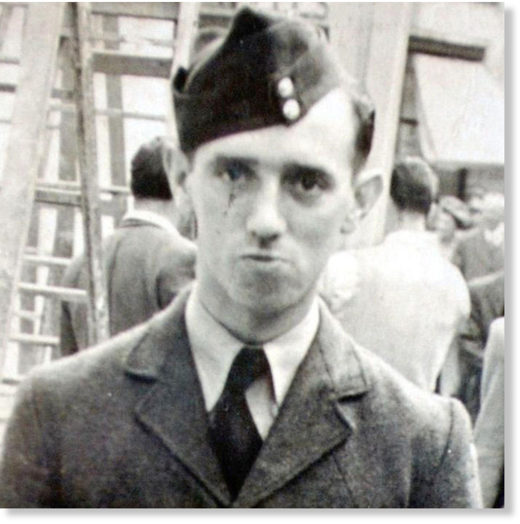
Ronald Maddison
20-year-old Ronald Maddison died 45 minutes after 200mg of the deadly nerve agent sarin was dripped onto a patch of uniform taped to his arm at Porton Down. He was told he was testing a flu vaccine.
Thousands of British orphans who were regarded as “feeble-minded” were allegedly used for trialing drugs for use in the Cold War
While no official source has confirmed it (for obvious reasons) it’s highly likely that Skirpal was settled by MI5 in Salisbury because his new job was five miles away at Porton Down. Perhaps the most dangerous part of working for Western intelligence agencies in the 21st century, particularly if you are a Russian double agent, is that your life is implicitly forfeit in service to the West’s new great game of ‘stop Russia at all costs’. Litvinenko and now (most likely) Skirpal and his daughter found that out a little too late.
The spin machine behind Saudi Arabia’s ‘humanitarian aid plan’ for Yemen
By Dan Glazebrook | Middle East Eye | March 2, 2018
On 22 January, the Saudi-led coalition in Yemen unveiled a new plan to deliver “unprecedented relief to the people of Yemen”.
The Yemen Comprehensive Humanitarian Operations (YCHO) is a new “aid” programme with the ostensible aim of “addressing immediate aid shortfalls while simultaneously building capacity for long-term improvement of humanitarian aid and commercial goods imports to Yemen”.
This will primarily be done through increasing the “capacities of Yemeni ports to receive humanitarian as well as commercial imports” – and all sealed with a whopping $1.5bn in aid contributions. What could possibly be wrong with that?
Starvation politics
The problem here is not only that the funding required to meet the needs created by the Saudi-led coalition is estimated by the UN to be twice that amount. The real problem is that the plan will not, in fact, increase the imports on which Yemen is utterly dependent, but reduce them still further.
This is because the much-vaunted “improvements in port capacity” will apply solely to “coalition-controlled ports”, excluding the ports outside their control – Hodeidah and Saleef – which, between them, handle about 80 percent of Yemen’s imports.
For these, absolutely critical, ports, the plan explicitly states that it wants a reduction in the flow of cargo they handle: by around 200 metric tons per month, compared to mid-2017 levels. Yes, you heard correctly: cargo levels in mid-2017 – when 130 children were dying each day from malnutrition and other preventable diseases largely caused by the limits on imports already in place – are now deemed in need of further, major, reductions.
This plan is nothing less than a systematisation of the starvation politics of which the Saudis were accused by the UN Panel of Experts on Yemen in relation to their closure of Hodeidah and Saleef in November.
Back then, noted the panel’s final report, all Yemen’s ports had been closed following a Houthi missile attack on Riyadh airport. But while coalition-controlled ports were quickly reopened, Hodeidah and Saleef remained closed for weeks.
“This had the effect,” said the panel, “of using the threat of starvation as an instrument of war.” Today, the “Comprehensive Operations” plan envisages making permanent the juxtaposition of wilful starvation of Houthi-controlled territory (in which the vast majority of Yemenis live) and “generous” aid deliveries into coalition-controlled territories.
Spin masters
These are the same “methods of barbarism” as were employed by the British in the Boer war – when Boer-controlled territories were subjected to scorched earth policies of torching farms and destroying livestock – and then revived for Britain’s colonial wars in Malaya, Kenya and, indeed, Yemen in the 1950s-60s. Small wonder Britain is so deeply involved today.
But such a strategy will surely be hard to sell in this day and age. Certainly, the Saudis seem to think so, which is presumably why they have employed a plethora of PR agencies to help them do so.
An exceptional investigation by the IRIN news agency reported that “the press release journalists received announcing the [YCHO] plan came neither from the coalition itself nor from Saudi aid officials”.
It came, along with an invitation to visit Yemen, straight from a British PR agency. The investigation also revealed that the PowerPoint presentation used to introduce the YCHO to high-level UN officials was authored by Nicholas Nahas, of Booz Allen Hamilton, a US management consultancy with long-established links to the US government (including involvement in the illegal SWIFT and PRISM mass surveillance programmes). The consultancy currently has, says IRIN, “35 job listings in Riyadh on its website, including ‘military planner'”.
This role requires the applicant to: “Provide military and planning advice and expertise to support the coordination of joint counter threat operations executed by coalition member nations and facilitate resourcing to enable operations.”
Another PR company involved in “selling” the YCHO, long on the Saudi payroll, is Washington DC-based Qorvis MSLGroup. According to IRIN’s report, the company “booked US revenue of more than $6m from the Saudi Arabian embassy [in the US] over a 12-month period up to September 2017”.
These masters of spin have certainly been busy: their work on the plan has been delivered to “the offices of major INGOs in the UK as well as to members of the UK parliament”, and YCHO accounts have been set up on Facebook, Twitter, Instagram, Youtube and Gmail.
The YCHO Twitter account has around 10,000 followers; but, says the IRIN investigation, “almost half of YCHO’s followers have less than 10 followers themselves, while some 1,000 followers were accounts created on the same day in 2016 – signs that a significant number of bots or fakes are inflating YCHO’s popularity”.
“All of this,” concludes IRIN, “has fed suspicions that rather than a genuine attempt to help the people of Yemen, the plan is really intended more to gloss over the Hodeidah issue and improve Saudi Arabia’s battered image, or at least a bit of both.”
You would think a strategy aimed at starving the world’s most starved population still further would be a hard sell. But, then, money not only talks, it silences. And $1.5bn is a lot of money.
The UN response
The UN’s own Humanitarian Response Plan for Yemen, issued just two days before the YCHO, on 20 January, had noted that: “Al Hudaydah port, which accounts for 70-80 per cent of commercial imports in Yemen, remains a critical lifeline, despite operating at reduced capacity after being hit by an air strike in August 2015.”
The UN statement added that “the extended blockade imposed on Al Hudaydah and Salif ports on 6 November 2017 significantly threatened this lifeline of Yemenis” and that “only a sustained flow of imports of essential basic goods can avert further catastrophe”.
Yet the cash-strapped UN, facing dramatic budget cuts from the Trump administration, and presumably nervous of saying anything that might jeopardise Saudi-Emirati money as well, officially welcomed the announcement, despite its clear commitment to essentially tightening the very blockade of Hodeidah and Saleef ports which the UN had denounced just days earlier.
Politicising humanitarian aid
Thankfully, the aid agencies do not seem to have been fooled. A joint statement on the YCHO by a number of international NGOs, including Oxfam and Save the Children, stated that:
“We remain concerned that the blockade on Red Sea ports has still not been fully lifted and about the insufficient volume of fuel reaching these, which has led to an increase in the price of basic goods across the country.
“As a result, we are seeing families pushed into preventable disease and starvation because they cannot afford to buy food and clean water. Hodeidah port handles the majority of the country’s imports and cannot be substituted. It is vital that the warring parties commit to keep Hodeidah port fully open and functioning, including unfettered access for both humanitarian and commercial supplies.”
Save the Children’s Caroline Anning explained that the plan “is a misconception – in the publicity around this new plan they say the blockade around Hodeida port has been fully lifted but actually what we’re seeing is that fuel is still being blocked coming into that port which is having a really horrendous knock-on effect around the country.”
And the International Rescue Committee (IRC)’s scathing response – issued with the title “Yemen: Saudi ‘aid’ plan is war tactic” – is worth quoting at length:
“The Yemen Comprehensive Humanitarian Operations (YCHO), announced on January 22, 2018, is neither comprehensive, nor reflective of clear, shared humanitarian priorities… The YCHO politicizes aid by attempting to consolidate control over access and transit points. Rather than endorsing a parallel plan, which was created without broad input from humanitarian actors, the Saudi Led Coalition (SLC) and its supporters, notably the US and UK, should work to ensure the full implementation of the existing UN humanitarian response plan.
“A meaningful response to the world’s largest humanitarian crisis requires more access – not less. At best, this plan would shrink access and introduce new inefficiencies that would slow the response and keep aid from the neediest Yemenis, including the over eight million on the brink of starvation,” said Catanzano.
“At worst, it would dangerously politicize humanitarian aid by placing far too much control over the response in the hands of an active party to the conflict.”
Essentially, this is a plan to tighten the blockade while monopolising access to aid in the hands of the aggressors, presented as a great humanitarian effort, and unveiled just as the coalition begins an attack on the country’s “vital lifeline” which will lead to “a complete horror show” and “near-certain famine”.
Tighten the blockade
On 9 February, the UN announced that 85,000 people had been displaced in 10 weeks due to “surging violence”, particularly on the Red Sea coast, where the coalition have mounted a new campaign to capture the country’s strategically important Hodeidah port.
With the Hodeidah campaign now entering a new phase, this war on the Yemeni population is set to escalate still further. Since it launched in early December, the coalition and its Yemeni assets have taken several towns and villages in Hodeidah province, and are now poised to take the battle to the city itself.
On 20 February, Emirati newspaper The National reported that, in the coming days, “more forces will be committed to Hodeidah as a new front is to be opened in the next few days by Maj Gen Tariq Mohammed Abdullah,” nephew of the deceased former president Ali Abdullah Saleh.
This attack would put the almost completely import dependent country’s most essential port out of action for months, leaving millions unable to survive. “If this attack goes ahead,” Oxfam chief executive, Mark Goldring, told the press when a similar attack was proposed earlier last year, “this will be a deliberate act that will disrupt vital supplies – the Saudi-led coalition will not only breach International Humanitarian Law, they will be complicit in near certain famine.”
His colleague Suze Vanmeegan added that “any attack on Hodeidah has the potential to blast an already alarming crisis into a complete horror show – and I’m not using hyperbole.”
The Yemen Quartet
There is no doubt the war’s British and American overseers have given their blessing to this escalation. In late 2016, the “Yemen Quartet” was formed by the US, the UK, Saudi Arabia and the UAE to co-ordinate strategy between the the war’s four main aggressors.
Throughout 2017, they met sporadically, but since the end of the year their meetings have become more frequent and higher-level.
At the end of November, just before the launch of operations in Hodeidah province, British Foreign minister Boris Johnson hosted a meeting of the Quartet in London as British Prime Minister Theresa May simultaneously met with King Salman in Riyadh, presumably to give the go-ahead to this new round of devastation for Yemen’s beleaguered population.
They met again two weeks later, and then too on 23 January, also at Johnson’s instigation, where the meeting was attended, for the first time, by US Secretary of State Rex Tillerson. The “economic quartet” – also attended by officials from the IMF and World Bank – convened on 2 February in Saudi Arabia, while Johnson and Tillerson once again met with their Saudi and Emirati counterparts to discuss Yemen in Bonn on 15 February.
Of course, these meetings do not carry out the nitty-gritty of strategic war planning – civil servants in the military and intelligence services do that. The purpose of such high level forums is rather for each side to demonstrate to the other that any strategic developments carry the blessing of each respective government at the highest level.
That the “quartet” met just days before an announcement that the long-planned attack on Hodeidah port was imminent, then, speaks volumes about US-UK complicity in this coming new premeditated war crime.
In the twisted minds of men like Saudi Crown Prince Mohammed bin Salman, Rex Tillerson and Boris Johnson – for whom even the liquidation of an entire people is apparently a noble cause in the pursuit of containing Iran – this is what passes for humanitarianism today.

– Dan Glazebrook is a political writer and editor of stopstarvingyemen.org. He is author of Divide and Ruin: The West’s Imperial Strategy in an Age of Crisis and blogs at danglazebrook.com.
This article is available in French on Middle East Eye French edition.
READ MORE:
Culture of concealment: The UK government’s brazen duplicity in Yemen
UK, US De Facto Confirmed Support of Syria Terrorists – Russian Diplomat
Sputnik – 05.03.2018
The United Kingdom and the United States de facto confirmed their support of terrorists in Syria by rejecting Russian amendments for the UN Human Rights Council resolution on the situation in Eastern Ghouta, Russian permanent representative to the UN Office in Geneva Gennady Gatilov told Sputnik.
“The amendments which we introduced should have been supported by all states which do not want the conflict to escalate, and those who sincerely want to achieve the resolution of the Syrian crisis and elimination of the terrorist threat. But the conclusion may be drawn that those who initiated this resolution are not interested in the resolution of the Eastern Ghouta crisis, and de facto continue supporting militants turning a blind eye to their crimes,” he said.
In a separate comment, Aleksei Goltiaev, a Senior Counselor at the Russian mission to the UN Office Geneva, said Monday that Moscow considers the UN HRC statement on the situation in Syria’s Eastern Ghouta “disconnected from the situation on the ground.”
The council voted in favor of adopting the UK-proposed draft resolution, rejecting amendments proposed by Russia. As many as 29 members of the council voted in favor of adopting the document, four officials voted against and 14 abstained.
Moscow proposed adding clauses to the resolution that states condemn all terrorist acts in Syria, including those in East Ghouta, and refuse to provide any support for terrorists on the territory of the country. Therefore, the refusal of the HRC members to accept Russia’s amendments shall be regarded by Moscow as an outright demonstration of support for terrorists.
In addition, Moscow had appealed to the states participating in the vote to add to the text of the resolution a paragraph on the crimes of militants against civilians in East Ghouta and to include a clause on humanitarian corridors to ensure the safe evacuation of civilians.
The draft resolution set forth by the UK condemns the massive violation of human rights in Syria. In particular, London proposed condemning attacks on medical facilities and civilian infrastructure, “airstrikes against civilians,” and the “alleged use of chemical weapons in East Ghouta.”
The vote in the HRC on the UK-proposed draft comes after, on February 24, the UN Security Council unanimously adopted resolution 2401 introducing a 30-day truce on the entire territory of Syria to ensure the safety of humanitarian aid and the medical evacuation of those injured. However, the ceasefire regime does not cover military operations against the Daesh, al-Qaeda, and Jabhat Fatah al-Sham (formerly known as al-Nusra Front) terrorist groups.
The humanitarian situation in the suburb east of the Syrian capital has drastically deteriorated since February 18, when Syrian government forces launched an operation codenamed “Damascus Steel,” in a bid to clear the region of militants. According to the Russian military, the terrorist groups in the region are purposely struggling to escalate the situation in East Ghouta, preventing civilians from leaving the area and provoking retaliatory fights against the Syrian government.
READ MORE:
Who Loves Ya, Saudi?
Just the UK’s Theresa May and her deluded Foreign Office, and the callous death merchants of Washington and Tel Aviv
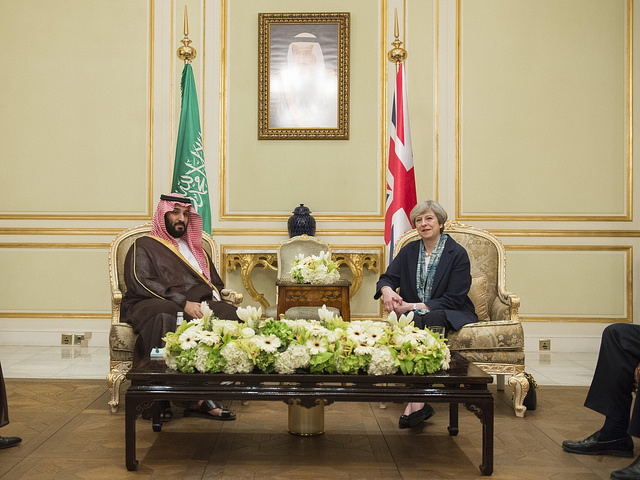
Prime Minister Theresa May met with Deputy Crown Prince Mohammad bin Salman Al Saud on her visit to Saudi Arabia. Image credit: Number 10/ flickr
By Stuart Littlewood | American Herald Tribune | March 3, 2018
It’s amazing what unprincipled people will admit to when goaded. A petition has been posted on the parliamentary website calling on prime minister Theresa May to withdraw her invitation to the Crown Prince of Saudi Arabia, Mohammad bin Salman, to visit the UK. It reads:
“The Saudi Arabian regime has one of the worst human rights records in the world. Torture and arbitrary detention are widely documented. In 2017 alone, over 100 people were executed.
“The Crown Prince has directed the bombardment of Yemen. Tens of thousands have been killed or injured. There is widespread famine and cholera, creating the worst humanitarian crisis in the world. Yet, the UK still sells arms to Saudi Arabia.
“The Saudi regime has supported repression in Bahrain, where its military intervened to end peaceful protests in 2011.”
An Early Day Motion (EDM865) has been tabled in Parliament also asking for the visit to be cancelled. It notes that the Saudi regime actually executed 142 people last year.
Bin Salman arrives in London on 7 March. He’ll be met by angry protesters.
The petition has well over 11,000 signatures so far. Of course, their request will be ignored. The UK Government is a great admirer of terror regimes such as Saudi Arabia and Israel, which are now bosom-pals. They share many ambitions, such as the de-stabilising and overthrow of countries they don’t happen to like with the help of their useful idiots in Washington and Westminster. Prime targets are Iran and Syria. And they are itching to annihilate resistance groups like Hezbollah and Hamas, and any others that get in their way.
They also share utter contempt for human rights and international norms of behaviour.
Successive British governments have gone to extreme lengths to invent preposterous reasons why they adore and support the criminals who run Israel, slaughter the Palestinians and menace the region (and indeed the rest of the world) with their undeclared and unsafeguarded nuclear arsenal. Now Westminster ties itself in knots trying to explain why we continue to snuggle up to the Saudis who are eager to join the US-UK-Israeli axis.
Wouldn’t it be nice if our mainstream media, instead of wringing their hands and broadcasting disinformation about the Middle East, investigated and named the evil warmongers who recruit, bankroll and arm the corrupt regimes, rebel militia, mercenaries and assorted hoodlums who started and now perpetuate the horror and devastation in Syria and Yemen?
Saudi Arabia a partner for “tackling international terror and extremism”? Seriously?
Responding to the petition, the ever-inventive Foreign Office says our strong relationship with Saudi Arabia “is important for mutual security and prosperity” and includes meaningful discussion on reform and human rights. The statement says it has helped make both of our countries safer and more prosperous. “We have vital national security and economic interests in maintaining and developing our strong relationship, including how we can work together to tackle international challenges such as terrorism and extremism.”
And Saudi intelligence “has saved potentially hundreds of lives in the UK”, according to Mrs May.
What’s more, the Crown Prince has embarked on a series of reforms to modernise society and the economy such as allowing women to drive and attend football matches, reopening cinemas and a commitment that women will make up one third of the Saudi workforce by 2030. “The visit will usher in a new era in bilateral relations focused on a partnership that delivers wide-ranging benefits for both the United Kingdom and the Kingdom of Saudi Arabia.”
As for the apalling state of affairs in Yemen, the Government says the UK “is committed to securing a political solution that ends the humanitarian disaster” and will continue to play a leading role in “supporting the UN to find a peaceful solution through close engagement with our regional and international partners”.
We’ve heard this claptrap many times before, especially in relation to never-ending crimes against the Palestinians.
What else does our upstanding Government say? “The UK supports the Saudi-led Coalition military intervention [in Yemen]…. We regularly raise the importance of compliance with International Humanitarian Law with the Saudi Arabian Government and other members of the military Coalition. Saudi Arabia has publicly stated that it is investigating reports of alleged violations of IHL, and that lessons will be acted upon.”
So why not wait for real evidence of that before rolling out the red carpet and infuriating decent people by allowing the Crown Prince of this obnoxious regime to pose on the steps of Downing Street for the world’s media and be filmed poncing around with our Royal Family? From his track record Bin Salman understands only too well the value of PR, which he exploits for all its worth, while precious little changes beneath the elaborate ‘modernising’ veneer.
Guilty as hell of complicity
Since Bin Salman’s bombing campaign in Yemen started three years ago the UK, instead of condemning such murderous aggression, has showered Saudi Arabia with £billions worth of aircraft and other weaponry to help deliver death and destruction. All principles are jettisoned, it seems, and all concerns for human suffering forgotten so that greedy business can milk the obscene wealth of that part of the world.
Last summer the Campaign Against Arms Trade (CAAT) brought a legal action against the Secretary of State for International Trade for continuing to grant export licences for arms to Saudi Arabia, arguing that this was a breach of UK policy which states that the Government must refuse such licences if there’s a clear risk that the arms might be used to commit serious violations of International Humanitarian Law.
It was, by then, undeniable that Saudi forces had used UK-supplied weaponry to violate International Humanitarian Law in their war on Yemen. According to the United Nations, well over 10,000 people had been killed up to that point, the majority by the Saudi-led bombing raids that had also destroyed vital infrastructure such as schools and hospitals and contributed to the cholera crisis. 3 million Yemenis had been displaced from their homes and 7 million were on the brink of dying from famine. UNICEF were reporting that a child died in Yemen every ten minutes from preventable causes including starvation and malnourishment.
A crippling naval blockade aided and supported by the US had been a key cause of the humanitarian crisis. The European Parliament and numerous humanitarian NGOs had condemned the Saudi air strikes as unlawful. And 18 months earlier a UN Panel of Experts had accused Saudi forces of widespread and systematic targeting of civilians.
The UK Government at that time had licensed £3.3 billion worth of arms such as aircraft, helicopters, drones, missiles, grenades, bombs and armoured vehicles to the Saudi regime and refused to suspend this lucrative trade even when the horrors stared them in the face. It was claimed that the Government ignored warnings by senior civil servants and its own arms control experts, and that some records of expressed concern had gone missing.
Despite the glaring facts, the High Court decided to allow the UK Government to carry on exporting arms to Saudi Arabia for use against Yemenis.
The CAAT website today reports that the UK has licensed over £4.6 billion worth of arms to Saudi Arabia since the bombing began in March 2015:
£2.7 billion worth of ML10 licences (Aircraft, helicopters, drones)
£1.9 billion worth of ML4 licences (Grenades, bombs, missiles, countermeasures)
£572,000 worth of ML6 licences (Armoured vehicles, tanks)
And the UK government admits that Saudi Arabia has used UK weapons in its attacks on Yemen. Typhoon and Tornado aircraft, manufactured by BAE Systems, have been central to the attacks. The Government confirms that they have been deployed on combat missions in Yemen and further Typhoons have been delivered. Meanwhile, BAE and the UK government are pushing for a new contract, so who knows what triumphant announcement compounding these crimes against humanity will be made during the Crown Prince’s visit?
The Government has also admitted that UK-supplied precision-guided weapons have been used in Yemen and that it “accelerated delivery of Paveway precision-guided bombs” in response to Saudi requests.
At the start of the conflict in March 2015 former Foreign Secretary Philip Hammond said:
“If we are requested to provide them with enhanced support – spare parts, maintenance, technical advice, and resupply – we will seek to do so. We’ll support the Saudis in every practical way short of engaging in combat.” [emphasis added]
In September 2016 the House of Commons Business, Innovation & Skills and International Development Committees commented:
“Given that the UK has a long history of defence exports to Saudi Arabia and its coalition partners, and considering the evidence we have heard, it seems inevitable that any violations of international humanitarian and human rights law by the coalition have involved arms supplied from the UK.” [emphasis added]
And in December 2016, the UK government finally admitted that UK-made cluster bombs had also been deployed in the conflict.
How sick is that?
Facebook: No Russian trace in pro-Brexit campaigning
RT | February 28, 2018
Facebook has not found any indications that Russia interfered in the UK’s withdrawal from the European Union referendum.
Experts from the social media giant did not find any evidence of active advertising initiated by Russian accounts during the Brexit vote.
A letter from Simon Milner, Facebook’s director of policy in the UK, to Conservative MP Damian Collins, who heads the parliamentary committee on digital culture, media and sport, said investigators failed to find a shred of evidence that Russia tried to influence the referendum.
“The investigative team did not find additional and coordinated Russian-linked accounts or pages supplying advertising in the UK within the framework of the referendum on the EU during the relevant period, in addition to the minimal activity that we reported earlier,” Milner’s letter reads.
A previous investigation by Youtube also found no evidence of Russian interference in the Brexit campaign.
Both of the companies carried out the probes in the aftermath of a report from PR firm 89up, which found that Russian media outlets RT and Sputnik were a major influence on the outcome of the referendum.
UK has spent $2.4bn on bombing Iraq, Syria: Official data
Press TV – February 27, 2018
The British government has spent over $2.44 billion (£1.7bn) to carry out airstrikes in Iraq and Syria since 2014, the year the US and its allies formed a so-called coalition to allegedly counter terrorist groups wreaking havoc in the two Arab countries, according to official data.
The larger chunk of the money, around $2 billion (£1.5bn), has gone into flying the Royal Air Force (RAF)’s Tornado and Eurofighter Typhoon fighter jets as well as Reaper attack and surveillance drones for more than 42,000 hours.
The figures, revealed on Monday in response to a Freedom of Information requests by anti-war group Drone Wars UK, seemed to be a fraction of what London has spent over the course of its unauthorized intervention dubbed Operation Shader.
The British air force has also dropped over 3,500 units of various munitions in over 1,700 airstrikes on Syrian and Iraqi targets at a cost of around $375 million (£267mn) over the past three and a half years.
That includes Paveway IV laser-guided bombs that cost an estimated $98,000 (£70,000) apiece for the older version and $140,000 (£100,000) for the enhanced ones.
RAF pilots have also fired no less than 8 Storm Shadow cruise missiles that are said to cost around $1,100,000 (£800,000) per unit, the activist group said.
The costs would grow if besides fuel, which is included in official figures, undisclosed data such as crew payments, aircraft maintenance and capital data are also included.
Drone Wars UK estimates that it costs the RAF $112,000 (£80,000) to keep the multi-role Typhoons airborne for an hour, while the figure drops to $49,000 (£35,000) and ($4,900) £3,500 for Tornado and Reaper aircraft respectively.
However large, the numbers are still a fraction of what the US-led coalition has collectively spent during the campaign, which has seen 105,000 bombs and missiles used in some 29,000 airstrikes. Drone Wars said the military campaign has cost around $10.5 billion (£8 bn).
The sheer number of US-led airstrikes since 2014 has alarmed rights activists about the possible civilian casualties.
While the US has only admitted to killing 841 civilians in the strikes, Drone Wars UK said it had recorded over 6,000 civilian deaths as a result of the military campaign. Neither Syria nor the United Nations have authorized the attacks.
The coalition forces have on many occasions air-dropped weapons and equipment for terrorists while targeting Syrian and Iraqi government forces who fight them.
Russia vetoes anti-Iran UNSC resolution
Press TV – February 26, 2018
A UK-drafted resolution aimed at pressuring Iran over alleged weapons supplies to Yemeni fighters has failed at the UN Security Council.
On Monday, the resolution gained 11 favorable votes at the 15-member Security Council but was halted by Russia’s veto.
“We cannot concur with uncorroborated conclusions and evidence which requires verification and discussions within the sanctions committee,” Russian Ambassador Vassily Nebenzia told the council.
Earlier in the month, Britain circulated a draft resolution that would renew sanctions on Yemen for another year and also “condemns” Iran for allegedly breaching the 2015 arms embargo on the country by “failing to take the necessary measures to prevent the direct or indirect supply, sale or transfer” of short-range ballistic missiles, UAVs and other military equipment to Yemen’s Houthi Ansarullah movement.
The Houthi movement has been defending Yemen against a bloody Saudi-led military campaign, which was launched in 2015 with the help of the US and the UK to reinstall the country’s former Riyadh-friendly government.
The draft resolution, backed by France and the US, called for unspecified measures in response to the UN report about Iran’s alleged role in Yemen, stressing that the UNSC will take “additional measures to address these violations,” and that “any activity related to the use of ballistic missiles in Yemen” is a criteria for sanctions.
A group of UN experts monitoring the sanctions on Yemen reported to the Security Council in January that it had “identified missile remnants, related military equipment and military unmanned aerial vehicles that are of Iranian origin and were brought into Yemen after the imposition of the targeted arms embargo.”
The UN experts, however, said they were unable to identify the supplier.
Both Tehran and Sana’a have repeatedly rejected the allegations as a fabricated scenario, and said the armed forces of Yemen have strengthened their missile power on their own.
After the veto, the UNSC unanimously adopted a Russian-drafted measure to extend for one year the sanctions regime against Yemen.
Jaafari: Ending Civilians’ Suffering Requires Implementing UN Resolutions
Al-Manar | February 25, 2018
Syria’s Permanent Representative at the UN Bashar al-Jaafari said that ending the suffering of Syrians doesn’t require showboating sessions or forming UN committees; it only requires applying the 30 resolutions issued by the UN.
In a speech after the Security Council voted on a resolution calling for the cessation of combat activities in Syria for at least 30 days, Jaafari said that the people in Damascus are truly suffering due to the acts of the terrorists positioned in the Eastern Ghouta, adding “the appeals of 8 million Syrians do not reach the General Secretariat or the mailboxes of Britain and France’s representatives, but the appeals of terrorists do reach them.”
He noted that the Syrian Arab Red Crescent HQ in Damascus was targeted by 10 shells fired by the so-called “moderate” terrorists located in Ghouta, killing and injuring people including a doctor.
Jaafari stressed meanwhile, that the Syrian government has dealt in a serious manner with all initiatives and was committed to them due to its care for the lives of Syrian citizens, and that the government has called on armed groups in the Eastern Ghouta to lay down their weapons and provided safe corridors for civilians to exit it.
Syria’s Representative said that the Astana agreement had stipulated for committing the armed groups to break any ties to ISIL and Nusra Front terrorist groups, and gave the Syrian government the right to retaliate to any attack.
“We practice a sovereign right of self-defense and we will continue to fight terrorism wherever it is found on Syrian soil,” Jaafari affirmed, adding that the Syrian government reserves the full right to retaliate against armed terrorist groups if they target civilians with even a single shell.
The Syrian diplomat asserted that the new resolution should be applied to the entirety of Syrian territory, including Afrin, and areas occupied by US forces, and the occupied Syrian Golan.
He also said that what is required is for the governments of the United States, Britain, and France to stop holding meetings and making strategic plans that bring to mind the age of colonialism and that seek to divide Syria and change the governing system in it by force.
US-Russia rivalry surges in Syria
By M K Bhadrakumar | Indian Punchline | February 20, 2018
A major speech by Russian Foreign Minister Sergey Lavrov on Monday at an international conference on the Middle East turned into the strongest Russian denunciation to date of the shift in the US policies under the Trump administration towards Syria, where the Pentagon now intends to keep a military presence indefinitely. (here and here)
The overall impression Lavrov conveyed is three-fold. One, in immediate terms, a spurt in fighting in Syria can be expected, as the US attempts to create new facts on the ground by using local proxies — Kurdish militia plus al-Qaeda affiliates and ISIS fighters — as well as to push back at Russia, Iran and the Syrian government.
Two, Russia concludes that the shift in the overall US strategy aims at balkanizing Syria. (Later on Monday, while speaking to the media in Moscow, Lavrov also drew attention to the presence of mercenaries and the Special Forces of France and Britain in northeastern Syria working in league with the US forces in implementing the American agenda to create zones of influence.)
Three, the conversation between Moscow and Washington regarding Syria is at a dead end. Lavrov specifically warned Washington that it is “playing with fire” in Syria, implying that the US strategy will run into resistance.
Two other features of the Moscow conference in Moscow are that, first, Iran’s Foreign Minister Mohamad Javad Zarif took part in it, and, second, the event also talked up a Russian mediatory role to calm down the tensions between Iran and Saudi Arabia.
Zarif told Lavrov at a meeting in Moscow on Monday that Tehran seeks Russia’s help in resolving the intra-regional rifts in the Muslim Middle East. Later, Zarif posted on his official Tweeter account: “With Russia’s sober strategic perspective and its growing influence in West Asia, it can play an instrumental role to help a paradigm shift in the Persian Gulf to one based on dialogue and inclusion.”
The conference was attended by non-official delegates from several Middle East countries, including Saudi Arabia. Meanwhile, King Abdullah of Jordan had paid a ‘working visit’ to Moscow on February 15 and met Putin. On the previous day, Lavrov had spoken to his Egyptian counterpart Sameh Hassan Shoukry on phone. Yesterday, Putin also telephoned Turkish President Recep Erdogan. The focus was on Syria in all these exchanges.
The Russian strategy will be to persuade important regional states who have been the US’ key regional allies – Saudi Arabia and Jordan, in particular – not to rejoin the conflict in Syria by fueling a new round of fighting. If the approach succeeds, the US may find itself at a disadvantage in lacking regional support for pressing ahead with the military track.
However, although Russia’s ties with Saudi Arabia have appreciably strengthened in the recent years, Moscow’s capacity to mediate a Saudi-Iranian rapprochement remains to be seen. Syria continues to be a major source of rivalry between Saudi Arabia and Iran. And, the irony is that, finally, the Trump administration is doing what Saudi Arabia had wanted the previous Obama administration to do by pushing upfront the ‘regime change’ agenda in Syria through coercive methods.
In the Saudi perception, Russia suffered a series of setbacks in Syria recently. Summing up the Syrian situation, Ghassan Charbel, editor-in-chief of the influential Saudi establishment daily Asharq Al-Awsat wrote on Monday, “ Never before have all these flags, interests, dangers, armies, militias, internal divisions and regional and international clashes come together on its (Syria’s) territories. From the South to Idlib to Hmeimem to Afrin, Syria is like a powder keg. It is at the heart of a complex and vast geo-strategic conflict that is impossible to resolve with force and where losses and rewards will be difficult to predict… The regional and international circumstances do not appear ripe for… talks to happen. The Syrian tragedy is open to the most dangerous possibilities.”
The Saudi inclination will be to wait and watch which way the winds are blowing. On the other hand, the war in Yemen remains Saudi Arabia’s number one priority today and Riyadh seeks a Russian role in ending the war in Yemen by leveraging its influence with Iran.
Iran strongly rejects claims of delivery of missiles to Yemen
Press TV – February 20, 2018
Iran has once again rejected the allegations about the Islamic Republic’s provision of missiles to Yemeni forces, saying such claims are lies and a foolish scenario.
“Iran’s missile program is for defensive and deterrent [purposes] and claims about the dispatch of missiles to Yemen despite the all-out blockade on this country are lies and a foolish scenario designed to exonerate the aggressors,” Iranian Foreign Ministry Spokesman Bahram Qassemi said on Tuesday.
He added that Britain and France have expressed their concern over Iran’s defensive missile program without providing any reason or wise justification.
A group of so-called independent United Nations experts monitoring the sanctions on Yemen reported to the Security Council in January that it had “identified missile remnants, related military equipment and military unmanned aerial vehicles that are of Iranian origin and were brought into Yemen after the imposition of the targeted arms embargo.”
British Foreign Secretary Boris Johnson in a statement on Monday called on Iran to stop taking actions which could lead to further escalation of the Yemeni conflict.
“I call on Iran to cease activity which risks escalating the conflict and to support a political solution to the conflict in Yemen,” Johnson said.
His remarks came on the same day that the French foreign ministry also said in a statement that Paris was concerned about Iran’s ballistic missiles program and its activities in the region, mentioning its support for the Houthis in Yemen.
In reaction to the allegations, Qassemi said the Islamic Republic has designed its defensive missile program based on its military doctrine and valuable experience it obtained during the eight-year war imposed on it by Iraq backed by major global powers in the 1980s.
He added that Iran’s missile program aims to deter any aggression by extremist powers against the country.
“In this clear path that is completely in conformity with international principles, we will never accept other countries’ intervention and regard as irresponsible and suspicious the adoption of such unprincipled stance and strongly reject them,” Qassemi said.
He emphasized that the Yemeni army and people have no need for foreign countries’ weapons, saying the Yemenis’ defense of their country’s dignity with minimum facilities has led to the defeat of aggressors.
The chief commander of Iran’s Islamic Revolution Guards Corps (IRGC) in January dismissed the allegations leveled by the US and its allies about the Islamic Republic’s provision of missiles to Yemeni forces.
“Missiles fired at Saudi Arabia belong to Yemen which have been overhauled and their range have been increased,” Major General Mohammad Ali Jafari said.
Iran’s Parliament Speaker Ali Larijani also said in December that the Islamic Republic is not providing military assistance to Yemen and all claims to this effect are false.
“We are not a country that would deny providing military assistance to anybody,” Larijani said.
Qassemi further called for an immediate end to the sale of European and US arms to Saudi Arabia and other aggressors and warmongers who are killing innocent Yemeni people on a daily basis.
A Saudi Arabian-led coalition launched a war against Yemen in 2015 and has ever since been indiscriminately hitting targets in the country. Yemeni Houthi fighters have been firing missiles in retaliatory attacks against Saudi targets every now and then.
The US State Department in January approved a possible $500-million sale of missile system support services to Saudi Arabia in defiance of global calls for Washington to stop providing Riyadh with military support due to the regime’s war crimes in Yemen.
The potential sale follows a request by Saudi Arabia for continued technical assistance for Patriot Legacy Field Surveillance Program (FSP), the Patriot Advanced Capability 3 (PAC-3) and the Patriot Engineering Services Program (ESP).
During his first trip to Saudi Arabia last year, US President Donald Trump signed a $110 billion arms deal with the Saudis, with options to sell up to $350 billion over a decade.
Iranian Foreign Minister Mohammad Javad Zarif said in December the United States is complicit in Saudi war crimes in Yemen amid Washington’s baseless claim that Tehran is providing supply of ballistic missiles to Yemen’s Houthi Ansarullah movement.
“No amount of alternative facts or alternative evidence covers up US complicity in war crimes,” Zarif said in a post on his official Twitter account.
He added that the US has sold weapons to its allies enabling them to “kill civilians and impose famine,” in reference to Washington’s arms deal with Riyadh in its aggression against Yemen.
Featured Video

AIDS Inc. by Gary Null (2007)
or go to
Aletho News Archives – Video-Images
From the Archives
Clash of Civilization, Iran Part II
By Jamal Kanj – Intifada-Palestine.com – January 14, 2011
Israel’s survival kit is: perpetuate conflict, insecurity to rationalize collective hate and finally playing victim.
Devoid of conflict, Israel implodes internally; without hate, Zionism loses its justification; and playing eternal victim to continue blackmailing the West. Absence of this holy trinity, Israel ceases to exist.
From its inception, the house of Zion has mastered exploiting adversarial powers to advance Israel’s cause. For instance, their influence over the Democratic Party in the US began with President Truman’s bid for 2nd term election in 1948.
Responding to strong opposition from Secretary of State General George Marshall and Department experts urging against recognition of Israel, President Truman replied: “I’m sorry gentlemen but I have to answer to hundreds of thousands [Jewish voters] who are anxious for the success of Zionism. I do not have hundreds of thousands of [voting] Arabs among my constituents”
Zionists influence over liberal American politics was matched with the doctrinal school of Conservative theoreticians aligning the Republican Party’s platform with Israel’s objectives. The Neoconservative Zionists, coined Zioncons, invented the “Clash of Civilization” concept to fight Israel’s wars. … continue
Blog Roll
 Aletho News
- Merck Virologists Admitted to Falsely Certifying Vaccine Efficacy
- Mandatory Folic Acid for every man, woman & child
- Pro-Palestine protesters arrested outside UK’s ruling Labour Conference in Liverpool
- Mauritius denies landing permit to flight from Israel, forcing cancellation: Tour operator
- Israeli finance minister calls for genocidal war on West Bank, annexation of south Lebanon
- 12 Things Your Psychiatrist Was Trained Not to Tell You
- From Unipolar Universalism to Multipolar Civilizational Distinctiveness
- RSF military group defects, joins Sudanese army: State media
- Ireland goalkeeper refuses to play ‘Israel’ as squad weighs boycott
- China pushes back against US on Cuba, Iran
- If Americans Knew
- Israel forces Gazans to live in constant peril – Daily Update
- Deconstructing Netanyahu’s pants-on-fire UN rant – Daily Update
- Trump betrayed voters with his campaign lies and prioritized a foreign country once he took office
- Netanyahu calls Israel’s war in Gaza ‘opposite of genocide’ in UN speech to near-empty hall
- Settler Kidnappings: Torture, Sexual Abuse and Terrorisation of Palestinian Abductees as Israel Deepens Annexation of West Bank
- Gaza winter nears as 162,000 tents become unusable, raising fears of humanitarian crisis
- Netanyahu says, “It’s the opposite of genocide”; UN says Gaza economy is world’s ‘most severe crisis on record’ – Daily Update
- Israel’s US-Backed Assault on Gaza Has Created the ‘World’s Most Severe Economic Crisis on Record’: UN
- ‘Protecting U.S. Citizens’… From Israel
- ‘This is where I live now, the back of a truck’: a day in the life of a grandmother in Gaza
- No Tricks Zone
- New Study: Earth And Venus Surface Warmth Largely Explained By Convection And Lapse Rate, Not CO2 Or Radiation
- 2025 Nature Paper Claiming Worsening Global Drought Gets RETRACTED …Heavily Flawed
- New Study: ‘Global Drought Shows No Detectable Recent Acceleration Under Climate Warming’
- Economic Masterminds: German Socialists Suggest Taxing Productivity Gains Stemming From Using AI
- The South China Sea Has Not Been Cooperating With The Climate Change Narrative
- Energy Crisis: Germany Enters Heating Season With Historically Low Gas Reserve Fill Levels
- New Study: The Antarctic Ice Sheet Gained Mass From 2020-2024 Due To Staggering Snow And Ice Accumulation
- Study: Ocean Heating Rates From Thousands Of Years Ago ‘Dwarf’ Modern Ocean Heating Rates
- Climate Extremists Target, Attack Large-Scale Power Grid Infrastructure In Germany!
- New Study: Antarctic Ice Melt Has Contributed Less Than 1 Centimeter To Sea Level Rise In The Last 30 Years

