How Russia Quietly Revolutionised Warfare
By Kit Klarenberg | Global Delinquents | May 25, 2025
On May 23rd, The Times published an extraordinarily candid probe into how militarised drones have irrevocably revolutionised warfare in the 21st century, with Russia far at the forefront of this radical shakeup of how conflicts are waged. Meanwhile, there is little indication NATO members even vaguely comprehend this battlefield reality, let alone a single one of them is undertaking any serious measures whatsoever to prepare for conflict such as that currently unfolding and evolving daily throughout Ukraine’s eastern steppe.
The Times piece is a first-person report of a visit to the assorted headquarters of Kiev’s 93rd Mechanised Brigade, in basements of abandoned buildings and homes throughout the Donetsk city of Kostiantynivka. It’s a devastating picture of the realities of war in the era of drones, which has “[altered] the physical make-up of the front line, the tactics of the war and the psychology of the soldiers fighting it,” while “having a devastating impact on Ukraine’s logistical ability.”
At one stage, The Times reporter was warned they were standing nine kilometres – 5.5 miles – from the nearest Russian position, and thus “well inside the kill range.” A Ukrainian soldier told them with a shrug, this was “now an easy range in which to die”:
“No other weapon type has changed the face of the war here so much or so fast as the FPV drone. Almost any vehicle within five kilometres of the front is as good as finished. Anything moving out to ten kilometres is in danger. Drone strikes at 15 or 20 km are not that unusual.”
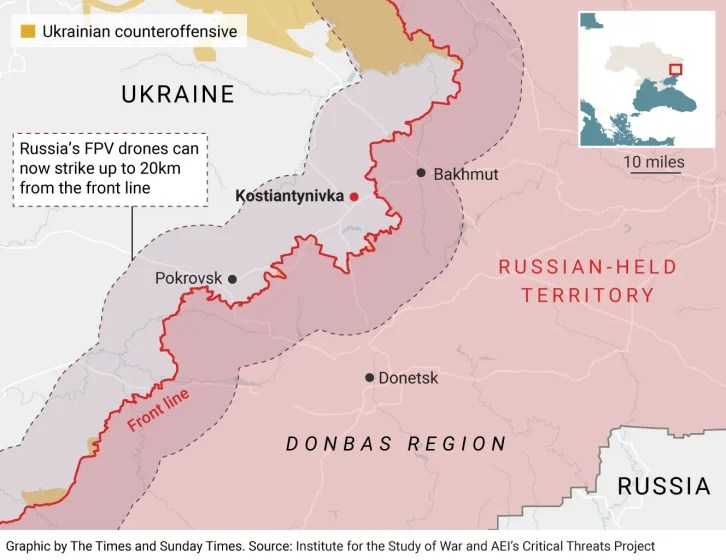
Since the proxy war erupted, both Ukraine and Russia have innovated in the field of FPV drones to an unprecedented degree. Kiev has become so reliant on drones, they are her “weapon of choice.” Yet, as The Times records, Russia has now decisively “taken the lead in the drone race, outproducing Kyiv in the manufacture and use of medium-range FPV drones and fibre optic variants that have changed the shape of the entire 1,200 km front line.”
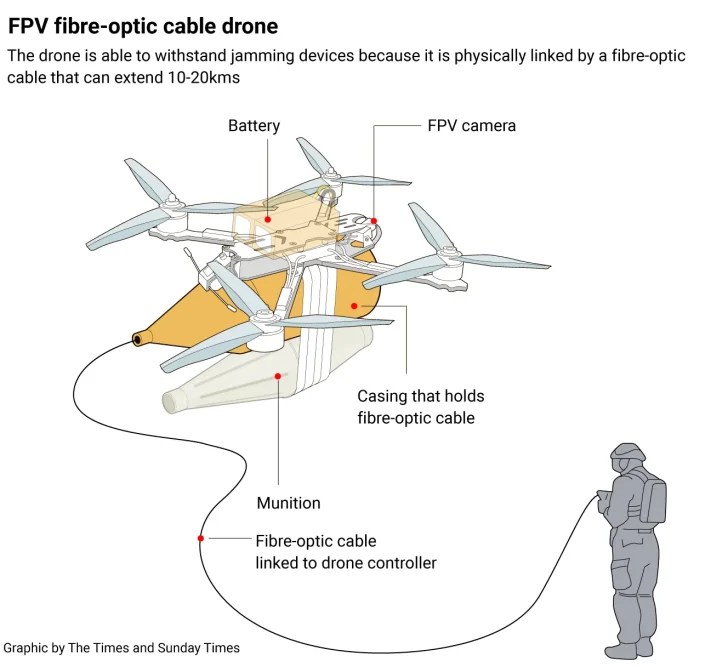
Not only are FPVs “dramatically” striking ever-deeper into Ukrainian territory, but fibre optic FPV drones have gained “dark prominence over the killing fields.” While emulating the quadcopters equipped with munitions typically deployed by both sides previously, this “highly manoeuvrable killer drone” is connected directly to pilots by “a gossamer thin fibre optic thread.” This makes the contraptions difficult to track, and impervious to electronic jamming. A local infantry battalion commander told The Times:
“The changes posed by drones are so fast that concepts we implemented just a month ago no longer work now. We live in a space of perpetual fast adaptation. In the past week alone, Russian drone strike ranges have increased by four kilometres.”
These developments have sent Ukrainian forces scurrying en masse to regroup at regular, abrupt intervals ever-further away from the front line (also known as “zero point”), while logistical convoys to Kramatorsk – “long considered the bastion of Ukraine’s defence of the Donbas region” – have been repeatedly struck. One lieutenant recorded how Russian drones “swarm our armoured vehicles whenever they get near the zero point,” obliterating them and their crews. He believes drones represent such a world-changing military hazard, “the days of the tank are truly over.”
‘Danger Estimate’
The “drone-filled skies” of Donbass are so deadly, getting soldiers and equipment to the ever-expanding frontline and back is not only a logistical and practical horror, but also a frequently suicidal task. The Times reports that until late 2023, Ukrainian infantrymen “were usually carried to a position near the front in armoured personnel carriers, walking the last few hundred metres on foot.” Today, they are dropped off up to eight kilometres away at night, walking “meandering routes through trees to avoid detection, just to take up their positions.”
Rotations from the frontline have also vastly extended in length. While at the start of 2024 Ukrainian soldiers spent “a week or two” at zero point, now they’re routinely trapped there for months at a time, “often devoid of almost any other human contact, resupplied with water, rations and ammunition by agricultural drones.” Resultantly too, “casualty evacuation has become a nightmare.” Wounded fighters are “commonly” rescued at night, and “even then the operation is fraught.” A senior logistician for the 93rd Brigade’s drone crews lamented:
“As a word ‘stressful’ doesn’t even come close to describing it. Every mission I think, ‘God forbid we get a casualty and have to work out how to get them back’.”
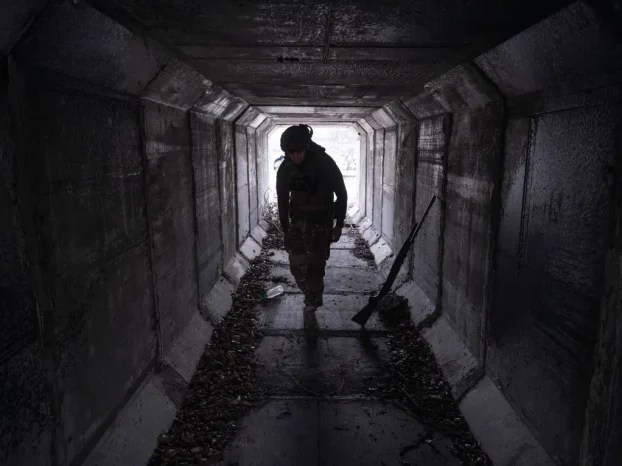
Ukrainian soldiers always keep shotguns close, to attempt to blast attacking drones out of the sky
Each night too, the Brigade’s frontline drone crews are resupplied with batteries, drone frames and munitions. Logistics teams are dropped off up to seven kilometres from the frontline, then carry up to 36 kilograms of equipment forward on foot. The risk to these crews is “enormous”. One driver was quoted as saying he conducted three missions nightly, “and I never know if each one will be my last, if I’m going to make it there and back in one piece.”
The Times records how a logistics vehicle was recently struck by a Russian drone while returning from a resupply mission. The driver lost an arm, but there were so many drones buzzing nearby, he couldn’t be evacuated from the position for five hours, so bled to death. Five Ukrainian armoured vehicles were destroyed by drones in the same sector the next day. However, none of this is seeping out to the world via the mainstream media, which once published videos of Ukrainian strikes on Russia daily.
As The Times notes, drones have adversely affected a core component of Kiev’s war effort – “media communications”. The 93rd Brigade was once “renowned for allowing reporters good access to…the war from the front.” Now though, “access for journalists has been dramatically reduced,” with “many media organisations…reluctant to commit reporters into areas within 15 km of the front.” Ukrainian brigades are likewise “wary” of the risks “they expose their own troops to in taking journalists by vehicle to the front.”
The Times reports that in 2023, the 93rd Brigade’s press officer “organised hundreds of visits to the front by reporters.” The number of visitors has now “dwindled to a trickle”. Since the proxy war’s eruption, the psychological field of battle has been where Ukraine has performed most effectively, eagerly assisted in its propaganda efforts by a media apparatus reflexively reporting the fantastical claims of officials in Kiev and their Western proxy backers as fact. Now, those days are long over. The press officer complained:
“The risks get bigger and bigger, and the coverage gets less and less. We get a journalist’s request to go to the front now and we wonder how rational is it? What is the danger estimate? What is the benefit?”
‘Technological Adaptations’
The Times report is a vanishingly rare mainstream acknowledgement of how the conflict currently raging Donbass is a war unlike any other in history, and its key spheres of battle are wholly unfamiliar to Western militaries. Despite this media omertà, the proxy conflict’s unparalleled operating environment, and obvious lessons, have not gone entirely unheeded in certain elite quarters. Nonetheless, despite alarm bells ringing accordingly, they are clearly falling on deaf ears in American and European centres of power.
In September 2024, Britain’s House of Lords International Relations and Defence Committee published a bombshell report, Ukraine: a wake-up call. It found the proxy war had “exposed fundamental weaknesses” in the “military strength” of both Britain and NATO, concluding London was effectively defenceless, with its “small” military reliant on unaffordable “status symbols” such as non-functional aircraft carriers. The country lacks the ammunition, armour, equipment, industrial capacity, personnel and vehicles to withstand a Donbass-style conflict for more than a few weeks at absolute most.
Amidst relentless condemnation of the state of Britain’s armed forces, the report contained a dedicated section on how “the use of drones in Ukraine” had “exposed the sheer variety of possible drone threats in a conflict scenario, ranging from disposable and commercially available drones to high-end, sophisticated ones.” It noted the development has “inserted an extra layer of weaponry between the land and air domains” and augmented “existing capabilities that both sides have, particularly offering new defensive options in the absence of air superiority.”
As such, the House of Lords Committee called for London to “invest in research and development to maintain a strategic edge in drone technology (including amphibious drones), and support the rapid development of new technologies that can compete in contested environments.” It urged decisionmakers to constantly consider and monitor “the pace of technological adaptations on and off the battlefield,” and the Ministry of Defence “to support continuous adaptation,” such as “[incorporating] learning on the use of drones in Ukraine across all domains.”
The report went entirely unremarked upon by the media contemporaneously, and today there is no sign of its multiple urgent calls to action having produced any meaningful results in any tangible regard in Britain’s armed forces. Similarly, despite NATO officials warning the alliance is wholly dependent on US electronic warfare capabilities, which in any event are woefully inferior to Russia’s own, public indications of Western leaders or militaries taking the drone warfare revolution seriously are unforthcoming. Should they end up in direct conflict with Russia, they’ll be in for quite a shock.
London Times Condemns Shadow Censorship While Quietly Endorsing Selective Speech Control
By Cindy Harper | Reclaim The Net | May 25, 2025
The London Times editorial board recently delivered a pointed critique of groups like the Global Disinformation Index (GDI), accusing them of acting as “self-appointed censors” who operate “in the shadows” and pose a “threat to free speech.”
Yet, in the same breath, the Times reveals its own willingness to endorse a selective approach to censorship, so long as the targets align with its own criteria.
While the editorial draws a firm line between malicious falsehoods and legitimate dissent, it doesn’t reject censorship outright.
Instead, it carves out an exception: “harmful disinformation, such as a doctored video designed to cause distress or inflame tensions, is one thing; legitimate journalism seeking to question the status quo is quite another.”
That distinction may sound reasonable on the surface, but it hinges entirely on who gets to decide what counts as “harmful.” In practice, this gives room for silencing speech under subjective definitions, provided those definitions align with elite sensibilities.
The Global Disinformation Index, a little-known nonprofit founded in 2018, has taken it upon itself to grade news organizations based on vague notions of “trustworthiness.”
Its reports, which have been used to influence online advertising decisions, can financially strangle outlets by placing them on exclusion lists. Once flagged, a publication can see its ad revenue evaporate as advertisers steer clear, often without the public, or the publication, ever knowing why.
Their influence far exceeds that of traditional editors or publishers, largely because they operate through algorithms and financial incentives, targeting revenue rather than content directly.
The Times editorial stops short of fully embracing the principle of open inquiry. While decrying the secrecy and self-importance of outfits like the GDI, it leaves the door open to censorship, provided it’s targeted at the content they believe crosses an undefined line into “harm.”
This undermines the editorial’s own warning about the chilling effect of selective enforcement. Once any authority is granted the power to judge truth in service of suppressing it, the essential freedom of press and expression is already compromised.
By calling for protection of “legitimate journalism” while conceding the need to crack down on “harmful disinformation,” the Times falls into the same trap it criticizes. It grants a moral and editorial license to define acceptability, not based on transparency, accountability, or open debate, but on perceived intent and potential impact. The risk, as always, is that this standard will be wielded not to protect the public, but to shield the powerful.
From Betar to Shomrim, re-emergence of Zionist private militias in the West

By David Miller | Press TV | May 25, 2025
In April of this year, anti-Zionist Jewish writer Alon Mizrahi claimed that Israeli Prime Minister Benjamin Netanyahu and his network of international Zionists are working to establish a policing force with powers surpassing those of national law enforcement agencies.
Mizrahi described this as the beginning of overt Jewish-Zionist policing of Western societies.
He was referring specifically to the ever more egregious statements from Betar in the US, an ultra-Zionist group affiliated with the far-right Revisionist Zionist movement founded by Vladimir Jabotinsky.

They have threatened to compile lists of Jews to be banned by the Zionist entity across North and South America, as well as Britain and France.
Mizrahi warned, “They start with Jews as a deception: all of you are next.”
However, the situation may already be far worse than what Mizrahi suggests.
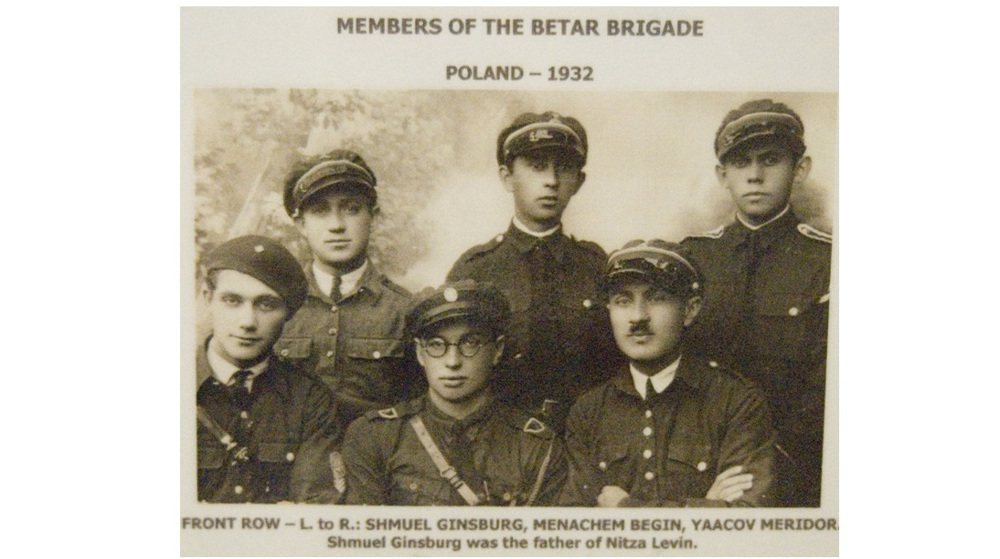
Since its founding in 1923, Betar has trained as a paramilitary force. The photo below shows Menachem Begin wearing a Betar uniform in Poland in 1932.
Below it is another photo from Berlin in 1936, taken after the Nazis enacted laws outlawing other political groups in 1933.
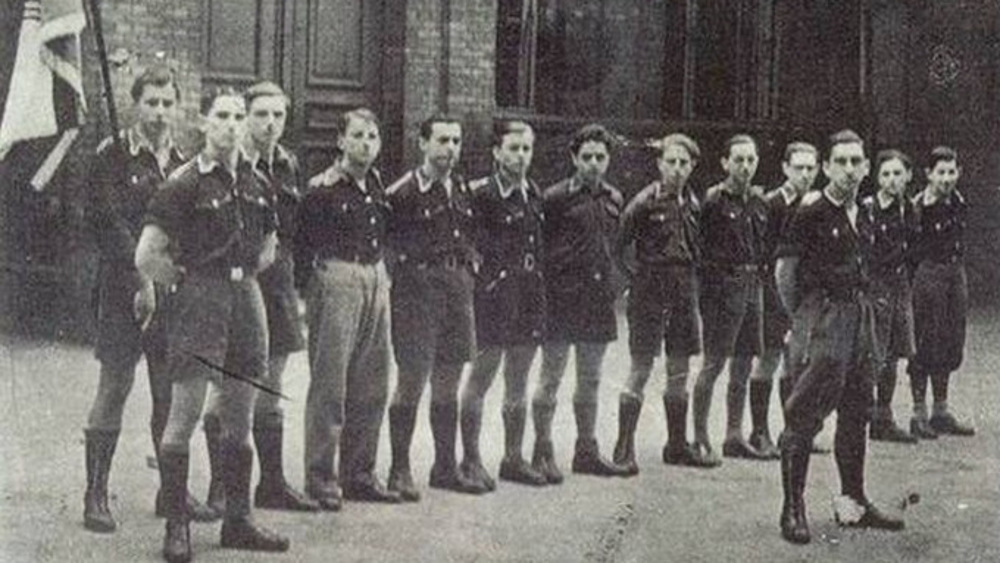
Betar was so closely aligned with the Nazis and Mussolini’s fascists that they were regarded as collaborators. By 1934, Jabotinsky and his Betar youth movement had reportedly “allied with Il Duce,” establishing a naval base north of Rome.
Late that year, Mussolini reportedly expressed support for Zionism and Jabotinsky in particular, stating: “For Zionism to succeed, you need to have a Jewish State with a Jewish flag, and Jewish language. The person who understands that is your fascist, Jabotinsky.”
This remark was made “during a private conversation with Nahum Goldman, founder of the World Jewish Congress, in November 1934,” as reported by Lenni Brenner in Zionism in the Age of Dictators.
Many senior Betar members served in the collaborationist police overseeing the Vilna Ghetto in Lithuania and were involved in betraying Jews in hiding to the Nazis.
One such member, Lotek Salzwasser, was eliminated by Jewish partisans in 1943 for his collaboration, according to Israeli press reports.
Betar and military training
One of the seven core principles of the Betar “Oath” is Magen, meaning “Protection.”
One of Betar’s ideological principles is military preparedness. Betar demands that all its members complete military seminars and know how to use weapons, in order to be ready at any time and to respond personally to a call for defense.
Betar has functioned as a militia since its inception. Here is a film of one of the French branches recorded in 2014 conducting paramilitary training exercises.
In the UK, Betar operated as a registered charity (Brit Tumbledor of Great Britain – Betar) between 1984 and 2004. It was closed down by the Charity Commission in 2004, on the grounds that it had been “Registered in error.”
In March 2025, Betar threatened to murder UN Special Rapporteur Francesca Albanese. On the very same day, the group relaunched its UK branch with a post on Instagram, claiming London “has become, with the time, an epicenter for radical Islam, for hate, for terror.” Their proposed solution?
Today, after more than 30 years, a bunch of strong young leaders stand up to say HERE WE ARE, to defend the Jewish population and to tell them that now we have a solution for the current situation, JEWS ARE NOT AFRAID ANYMORE!
Make no mistake – these threats are part of a deliberate effort to revive Jewish supremacist militias in the UK and the US.
Magen Am
The term Magen also appears in the name of a US-based private Zionist militia called Magen Am, which is currently active in Los Angeles, Orange County, and Phoenix.
Magen Am played a notably violent role in attempts to dismantle the student encampment at UCLA. The group frequently boasts about its close ties to the LAPD, sharing numerous photos of friendly interactions with police officers.
Reports indicate that Magen Am has collaborated directly with law enforcement, including working closely with the LAPD to intimidate and attack student protesters on the UCLA campus.

Magen Am, of course, recruits veterans of the occupation forces’ Lone Soldier programme and some then return to “serve” in the genocide as they proudly boast.
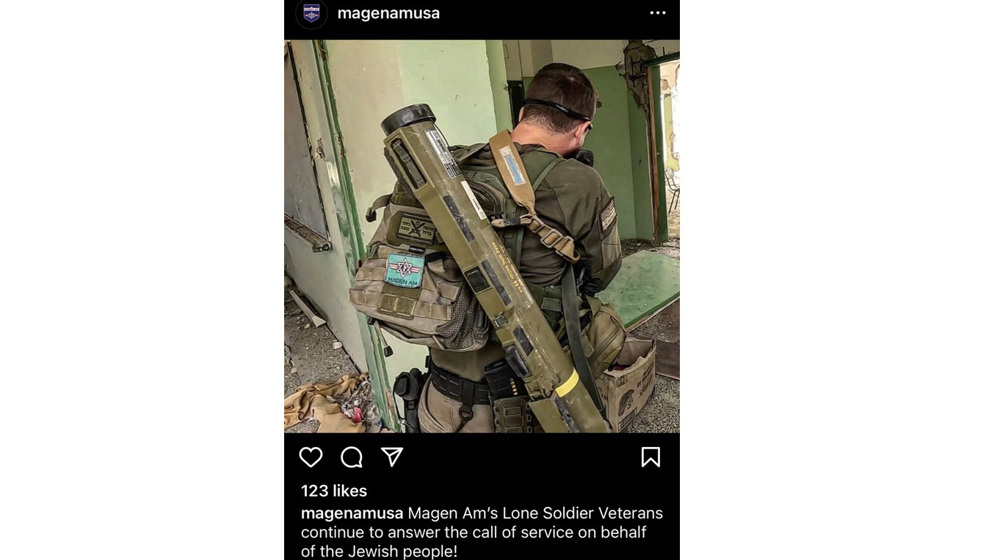
Magen Am was founded in 2017 by Yossi Eilfort, an MMA fighter-turned-Chabad rabbi. The flag of the genocidal Chabad cult was flown by the attackers on campus in Los Angeles.
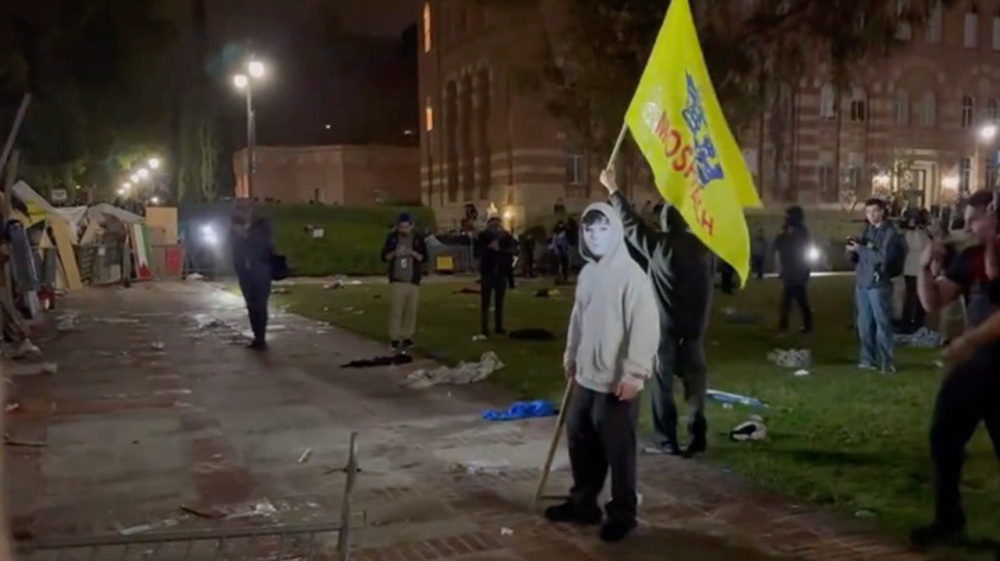
Chabad has many followers in the so-called Hilltop Youth in occupied Palestine, which the Zionist intelligence agency Shin Bet says are responsible for the overwhelming majority of so-called ‘price-tag’ revenge attacks on Palestinians.
The rise of Jewish supremacism in Western societies is becoming increasingly visible, though many continue to deny or downplay its existence.
While Zionist militias and private security firms openly collaborate to suppress student protests in the US, there is a more subtle infiltration of police forces by Zionist Jewish supremacists.
Shomrim: The Private Jewish Patrol
Shomrim is a private Jewish police force operating in parts of the US, UK, Australia, and Belgium. It is reported that “over 20 Shomrim organisations exist worldwide.”
In London, the Shomrim North West Community Patrol operates in the Borough of Barnet. Founded in 2008 by Gary Ost as a registered charity, it acts as a “mobile neighbourhood watch” and acts as eyes and ears for the Metropolitan Police.
Shomrim claims that all “Volunteers have completed training from the Metropolitan Police Counter Terrorism Command (SO15) in assisting to identify potential security threats and suspicious activity. “
One blogger notes that the genocidal cult Chabad also has a ‘nasty tendency to normalize sexual abuse and protect serial sexual predators in its ranks.” But it’s not only Chabad; there is a similar tendency throughout the Zionist movement.
No surprise, then, to find that the founder of Shomrim in London has been implicated in this.
In 2013 Police dropped their investigation into Ost, who had been arrested on suspicion of perverting the course of justice in relation to an investigation of an alleged child sexual abuser, Rabbi Chaim Halpern.
Indeed, charges against the alleged sexual predator were dropped back then, too. Yet new allegations against Rabbi Halpern have resurfaced a decade later, and the trial for these offences is still pending.
Shomrim abuses
In New York, Shomrim has faced criticism for “using excessive force against non-Jewish suspects.”
In 2014, two Shomrim members were charged as part of a group of five Hasidic men for assaulting 22-year-old Black student Taj Patterson as he walked home from a party.
Additionally, Shomrim organizers in New York have reportedly withheld information on suspected Jewish criminals. The NYPD has openly criticized the group for not always notifying police when calls come in, raising concerns about accountability and cooperation.
Given Shomrim’s protected status with law enforcement and the documented culture of sexual abuse in some ultra-Orthodox communities, credible allegations of abuse within these groups are unsurprising.
On October 11, 2023, the United States Department of Justice issued a press release that Jacob Daskal, former head of the Boro Park Shomrim Society—a private Orthodox Jewish crime-patrol group associated with the NYPD—was sentenced to 210 months in prison and fined $250,000 for transporting a minor with intent to engage in criminal sexual activity.
Daskal pleaded guilty to the charge in July 2023. As part of the sentence, Daskal is required to register as a sex offender.” The statement notes that Daskal was introduced to a 15 year old girl “as a result of his position with the Shomrim”, who he then “groomed” for sexual abuse. According to the Department of Justice statement:
“Throughout the abuse, Daskal instructed the victim to delete their communications and warned her not to tell anyone about their sexual relationship. He also used his position as a community leader to silence the victim, bragging about his law enforcement connections and warning her that disclosure would ruin her life. The victim was expelled from her religious school after revealing the relationship to the school principal.”
This case raises troubling questions: How many other abusive situations are currently unfolding within Shomrim and other Jewish militia groups?
Shomrim protects genocide
What is it that Shomrim are protecting? One illustrative example is the Crown Heights Shomrim branch, which in January this year provided security protection for the genocidal President of Israel, Yitzchak Herzog and for the leadership of the genocidal cult Chabad, as shown in the image below.

If Shomrim really wants to protect Jews in the US and UK, they should start by apprehending the entire leadership of Chabad and members of the genocidal Zionist regime.
Police reluctance toward Shomrim in the UK
Initially, UK police were resistant to Shomrim’s activities. In 2008, Chief Superintendent Steve Bending, then Hackney’s borough commander, stated, “I do not support the concept of any community having its own form of patrol service. There is a risk of other communities feeling intimidated by this course of action.”
As late as 2015, Metropolitan Police Commissioner Sir Bernard Hogan-Howe expressed his preference that Shomrim volunteers avoid uniforms resembling those of official officers.
Shomrim, however, rejected this, saying “its volunteers should not drive marked cars or wear uniforms similar to those of the police.” Gary Ost, chief executive of Shomrim in Golders Green, north-west London, stated, “Our uniforms look nothing like the police and are marked from every angle with clear wording saying ‘Shomrim’.”
Yet a glance at their uniforms and liveried vehicles often gives a very different impression.
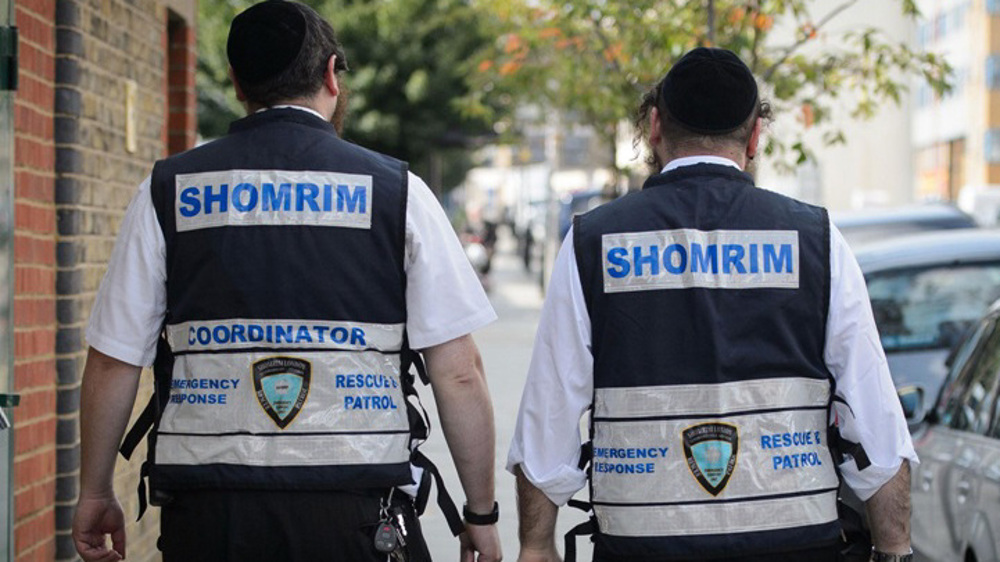

But the penetration of the police is now much more advanced and cooperation is the name of the game. There are numerous examples of apparent cordial relations between the two on the internet.
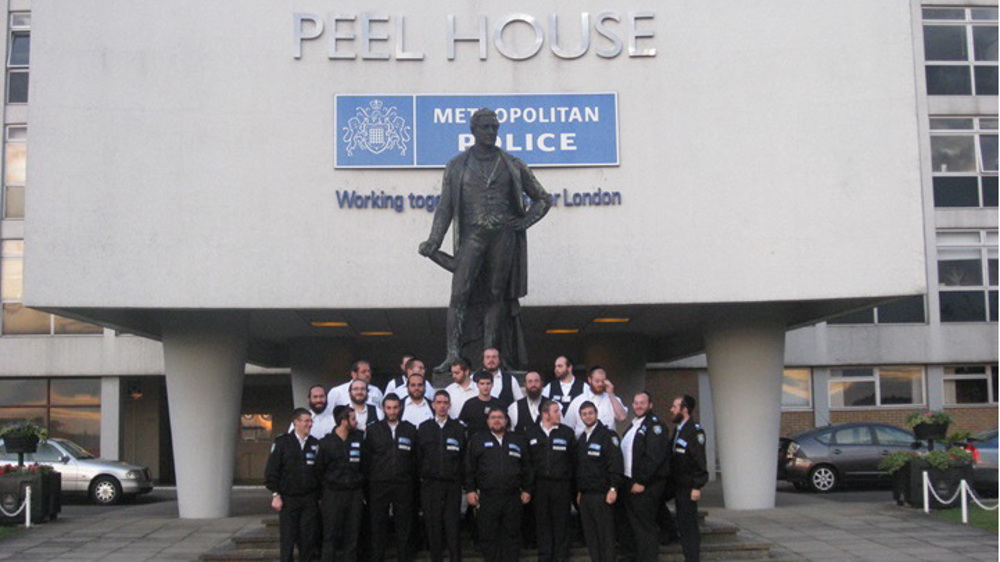
Shomrim members even posed outside Peel House, the headquarters of the Metropolitan Police.
Below is a photo of a prize giving for Shomrim members commended for their “bravery” and “exemplary service to the community” in 2020.
Shomrim chief executive Gary Ost, the one arrested in 2013, is one of the three.

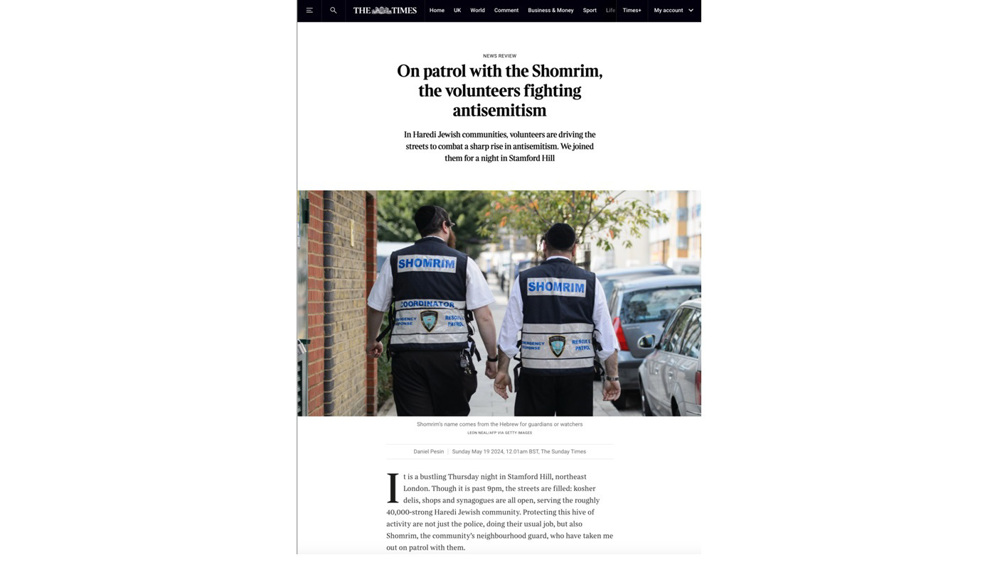
Shomrim plays a key role in shaping the narrative around the widespread antisemitism claims that Israel relies on to justify its genocidal actions.
The pressing question is: What happens when members of Shomrim break the law or commit wrongdoing? Would the police be able—or even willing—to enforce the law against them?
Alon Mizrahi, whom we cited earlier, shared his perspective in a conversation with me:
“They are pretending to be defending themselves in the most friendly country to Jews in history. While committing genocide. In a country that is so hateful of Jews that we need a private police force for Jews only in the US.
“And I have no doubt that if they can normalise this, with the kind of status that Zionist Jews have managed to create for themselves in the US; If this Jewish police force uses violence against black people, black organisers in communities who oppose the genocide, or other migrant groups or any other group, are American police going to be able to charge them?
“To use the law against them? I don’t think so. If you are in the American system, if you have a role in any part of the American system of government, in the police or any other agency, I think that at this point it is clear to you that Zionist Jews are above the law.
“The law doesn’t apply to them. So they don’t have the philosophical or legal means to deal with this. And the Zionists know this.”
Given the current climate, his assessment may well be accurate.
Russian Ambassador Slams UK-German Missile Scheme As Militarization of Europe
Sputnik – 23.05.2025
The recent development of a new precision weapon with a 2,000-kilometer range—announced on May 15 by the UK and Germany—represents another setback for arms control, following the collapse of the Intermediate-Range Nuclear Forces Treaty (INF), Russian Ambassador Andrei Kelin told Sputnik.
“This is part of a new wave of militarization in Europe under the pretext of a threat from Russia. This is another blow to the regime established 30 years ago by the Intermediate-Range Nuclear Forces Treaty. This treaty was destroyed by the Americans,” Kelin said.
The high-precision weapon development plan, it was noted, seeks “to strengthen NATO’s deterrent capabilities.”
“When these missiles were banned, Europe’s security as a whole was at a much higher level. Now, unfortunately, another blow will be struck by the Europeans,” the ambassador emphasized.
In July 2024, the British press reported that London was considering a joint missile development project with Berlin, featuring a range of up to 3,200 kilometers. It is believed that these missiles could eventually replace American cruise missiles stationed in Germany.
In early 2019, the United States announced its unilateral withdrawal from the INF Treaty, accusing Russia of violations, a claim Moscow rejected. In July 2019, the Russian president signed a law suspending the treaty, and by August of that year, the pact officially ceased to be in effect. Russia has consistently maintained that it fully complied with the INF’s terms.
Meanwhile, Moscow emphasized that Russia has serious concerns regarding Washington’s implementation of the treaty and pointed out that the allegations of Russian violations are baseless.
Europe must bear consequences of forcing return of UN sanctions against Iran: FM
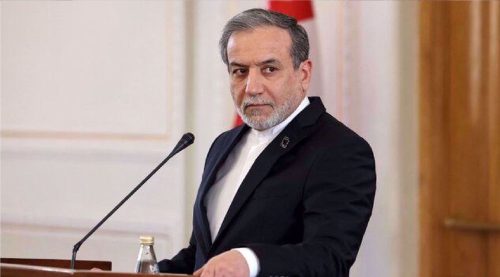
Iran’s Foreign Minister Abbas Araghchi
Press TV – May 21, 2025
Foreign Minister Abbas Araghchi has cautioned the US’s European allies in a 2015 nuclear agreement with Iran against invoking the so-called “snapback mechanism” to re-impose the United Nations sanctions against the Islamic Republic.
Speaking to Saudi Arabia’s Asharq News network on Wednesday, the top diplomat emphasized that such a move would end participation by the European parties — the UK, France, and Germany — in the deal that is officially known as the Joint Comprehensive Plan of Action (JCPOA).
He added that the trio’s potential recourse to the mechanism would lead to significant consequences and potential irreversible escalation of tensions, referring to the likelihood of strong retaliatory steps that the Islamic Republic could take in response.
Araghchi reiterated Iran’s readiness to engage in diplomacy, expressing hope that the European parties too would demonstrate determination to resolve the current impasse.
The deadlock occurred when the United States ditched the JCPOA in 2018, and returned the illegal and unilateral sanctions that the agreement had lifted.
This was followed by the European trio’s failure to return the US to the accord, as they had said would do, as well as their walking in Washington’s footsteps by returning their own sanctions.
In response to the betrayal, Iran began a number of legitimate and gradually escalating nuclear countermeasures.
“The situation we’re in is by no means Iran’s fault. It is the fault of the United States, which withdrew from the JCPOA, and the fault of the European countries that failed to compensate for the US’s withdrawal,” Araghchi added.
‘Uranium enrichment absolutely non-negotiable’
Addressing the topic of Iran’s peaceful uranium enrichment activities, the foreign minister said the activities were a principled and fundamental issue for Iran.
He emphasized that the enrichment program was a major scientific achievement developed by domestic scientists and held immense value for the Iranian people.
The official, meanwhile, paid tribute to the seven-strong Iranian nuclear scientists, who were assassinated amid their invaluable contribution to the Islamic Republic’s peaceful nuclear energy program.
According to Araghchi, the victims’ sacrifices towards advancement of the program had made the nuclear issue “absolutely non-negotiable.”
Exposing Hypocrisy: Palestine, the ICJ, and the Collapse of Liberal Legitimacy
By Taut Bataut – New Eastern Outlook – May 20, 2025
ICJ has recently postponed the hearing of South Africa’s case against Israeli war crimes to January 12, 2026, providing it more time to annihilate Gaza. This marks the collapse and failure of the international system.
The Ongoing Humanitarian Crisis in Gaza
Since October 7, 2023, the Palestinians have been facing one of the worst genocidal operations in the world. More than 50000 Palestinian civilians, mostly women and children, have been intentionally killed by the Israeli Defense Forces (IDF) under the pretense of eliminating Hamas. However, this war has exposed the self-proclaimed champions of human rights and liberalism. The United States and the European Union have constantly been providing military, diplomatic, and financial aid to Israel.
The latter has emerged as the largest recipient of the US aid since its illegitimate inception. Moreover, the US government has vetoed multiple United Nations resolutions seeking to establish humanitarian peace in the region. U.S. President Donald Trump also reiterated his country’s support for Israel after his re-election. He also proposed a plan to relocate the native people of Gaza to the neighboring countries and occupy the region for the long term.
The Zionist state has intentionally targeted aid workers, mosques, churches, hospitals, schools, and other civilian infrastructure in violation of international law. In an unprecedented move, the Netanyahu administration is using starvation and hunger as a weapon of war against the innocent civilians of the Gaza Strip. Several heart-wrenching images of starved children from Gaza have emerged on social media during all this time. Amnesty International and the different international humanitarian agencies have condemned these Israeli policies and declared them a war crime.
Global Legal Responses and the Case at the ICJ
While most of the Muslim nations hesitated even to utter a single sentence against the ongoing Israeli war crimes and genocide in Israel, South Africa filed a case against the Zionist state in the International Court of Justice (ICJ) in December 2023 under the 1948 Genocide Convention. This Convention, established to halt the recurrence of Holocaust like events, defines genocide as “acts committed with intent to destroy, in whole or in part, a national, ethnical, racial or religious group.” More than 10 countries, including Turkey, Ireland, Egypt, the Maldives, Chile, Belgium, and Mexico, have joined the case against Israel.
The petition demanded urgent actions to prevent further Israeli war crimes in Gaza. However, despite the presence of numerous evidence and reports by international human rights organizations, the ICJ failed to halt the genocide of innocent civilians of the Gaza Strip. The court was also commissioned to determine whether the Israeli Defense Forces were committing genocide in Gaza. Since 2023, the court has made no considerable decision against the Israeli war crimes.
Exposing Hypocrisy and Seeking Alternatives to Western Hegemony
The world, especially the Gazans, is waiting for the international community to stand against the atrocities and the war crimes of the IDF and the Netanyahu government. However, the Western world and its puppet Arab nations are constantly ignoring the plight of the innocent Palestinians. This has exposed the international organizations, the OIC, and the Western liberal values. The ICJ’s recent decision to postpone the hearing till January 2026 demonstrates its apathy towards the citizens of Gaza in particular and towards the citizens of Third World countries in particular.
Israeli war crimes and apartheid in Palestine date back to the former’s inception in 1948. Since then, the Zionist groups in Palestine have been occupying the properties of the native peoples. Israel’s history is replete with rapes, torture, and killing of innocent children and women in Palestinian territory. The Zionist leaders have always supported sexual assault by the Israeli Defense Forces.
However, the international community remains indifferent to the plight of the Palestinians. The ICJ’s postponement of the hearing till next year demonstrates its commitment to justice and peace in the world. This move has once again revealed that the US-backed unipolar liberal world order has failed. It has also exposed the reality of the so-called champions of human rights. The United States and other Western nations have always echoed their concerns about the Ukrainian people. However, their nonchalance to the plight of the Palestinians exposes their hypocrisy.
Although the Palestinians and their supporters around the world were hopeful about the ICJ, this is the time to realize that all the international institutions were made merely to prolong the US hegemony and serve the Western interests. It is improbable that the ICJ would declare Israeli operations as genocide. However, even if it does so, it would be too late, as hundreds more Palestinians would have been killed by then. Nonetheless, South Africa’s case against the ICJ has further exposed the Western world order and its institutions. It is the right time for third-world countries to look for an inclusive and egalitarian world order. BRICS provides the best alternative to the developing countries pursuing their ambition of following independent foreign policies and mutual development.
EU and UK impose more sanctions on Russia despite US concerns
RT | May 20, 2025
The EU and UK imposed new sanctions on Russia on Tuesday, escalating their campaign to pressure Moscow while ramping up support for Kiev.
The sanctions were announced shortly after a call between Russian President Vladimir Putin and his US counterpart, Donald Trump. Following the conversation, Trump warned that imposing additional economic restrictions on Moscow could hinder efforts to achieve peace in the Ukraine conflict.
The European Council, comprising leaders of EU member states and top officials, approved the bloc’s 17th round of sanctions, targeting what foreign policy chief Kaja Kallas called “nearly 200 shadow fleet ships.” Kallas, a vocal critic of Moscow, stated that further measures “are in the works” in Brussels.
Western officials claim that the targeted fleet enables Russia to evade G7-led efforts to enforce a price cap on its crude oil exports. In a coordinated move, the UK added 18 vessels from the same network to its sanctions list on Tuesday.
In addition, the UK imposed sanctions on the St. Petersburg Currency Exchange and Russia’s state deposit insurance agency, citing efforts to sever critical financial lifelines. Foreign Secretary David Lammy said the measures are intended to hold Putin accountable for supposedly “delaying peace efforts.”
Last week, delegations from Russia and Ukraine met for the first time since 2022, when Kiev abandoned negotiations in favor of pursuing victory on the battlefield, as advised by the then-UK Prime Minister Boris Johnson.
European backers of Ukraine initially supported Kiev’s demand for a 30-day unconditional ceasefire before resuming talks, and threatened additional sanctions if Russia refused. Zelensky later backtracked after the Trump administration supported Putin’s proposal for renewed diplomatic engagement.
Zelensky insisted, however, that Putin meet him in person in Türkiye to demonstrate his commitment to peace – an idea that the Russian president had not proposed. Ukrainian officials continue to call for expanded sanctions over what they describe as Moscow’s non-compliance with peace overtures.
The Putin-Trump call on Monday was characterized as productive by both leaders. Trump said he believes Putin is interested in ending the conflict and warned that additional economic pressure could obstruct US mediation efforts.
Putin has said Moscow and Kiev should negotiate a formal memorandum outlining a detailed path to a broader peace agreement, adding that a ceasefire could be part of the proposed road map.
Russia bans Amnesty International
RT | May 19, 2025
The Office of the Russian Prosecutor General has banned Amnesty International, the London-based non-governmental organization (NGO), accusing it of Russophobia and support for the Ukrainian military.
An official statement on Monday said that while the “organization positions itself as an active champion of human rights throughout the world,” its headquarters in the British capital have turned into a “center for preparing global Russophobic projects, paid for by accomplices of the Kiev regime.”
“Members of the organization support extremist organizations and finance foreign agents’ activities,” the Prosecutor General’s Office claimed.
Amnesty has been actively working toward “increasing military confrontation” since the escalation of the Ukraine conflict in February 2022. Russian prosecutors have accused the NGO of whitewashing Ukrainian war crimes, calling for more financial support for Kiev and the economic isolation of Moscow.
Last month, Moscow banned US-based NGO Hope Harbor Society for providing financial support for the Ukrainian military as well as the coordination of anti-Russian protests in the US and other countries.
In early April, the Elton John AIDS Foundation was designated as ‘undesirable’ in Russia after being accused of promoting pro-LGBTQ agenda in the country.
Organizations with such a designation are banned from operating in Russia, and residents or companies may face legal penalties for providing financial or other forms of support to them.
The Russian Justice Ministry currently lists more than 200 such entities, including major Western influence groups such as George Soros’ Open Society Foundations, the US-based German Marshall Fund, and the pro-NATO Atlantic Council.
Another fictional ‘Iranian plot’ in London?
By Robert Inlakesh | The Cradle | May 18, 2025
The arrest of a group reportedly consisting of Iranian nationals, accused of planning an attack on the Israeli embassy in London, has coincided with an aggressive lobbying campaign to classify Iran’s Islamic Revolutionary Guard Corps (IRGC) as a terrorist organization in the UK. While details of the case remain sparse, previous such allegations suggest that linking this plot to Tehran without substantiated evidence is politically motivated.
On 7 May, The Telegraph claimed that five individuals were detained in what the UK Home Secretary described as one of the “biggest counter-terrorism operations in recent years.” According to the report, four of those arrested were Iranian nationals, apprehended under Section 5 of the Terrorism Act 2006, allegedly for plotting an assault on the Israeli embassy in London.
A confused arrest, a convenient campaign
Yet, contradictions in the report raised significant public skepticism. While The Telegraph asserted that “the suspected terror cell was hours from unleashing the attack when the men were arrested,” it also noted that the suspects were detained in cities across England – three of them located around a four-hour drive from London, and another an hour away. The disparity sparked a wave of theories and doubts among the British public.
As these logistical inconsistencies drew scrutiny, right-wing media outlets in Britain seized the moment to stir anti-immigrant sentiments. On Talk TV, Kevin O’Sullivan descended into hysteria, warning, “We are going to have a Southport 2 unless we are careful,” invoking a racially charged incident that had ignited riots. The immigration status of the suspects became the focal point for many conservative commentators.
Simultaneously, the pro-Israel lobby began exploiting the incident to reinvigorate its campaign for the IRGC’s designation as a terrorist organization. On 28 April, Progressive Britain—a group aligned with the Blairite wing of the Labour Party – published an article titled “Why the UK Should Proscribe the IRGC.” Its author, Jemima Shelley, is not only a non-resident fellow at Labour Friends of Israel (LFI) but also a senior analyst at United Against Nuclear Iran (UANI).
UANI has played a recurring role in previous efforts to influence British policy against the Islamic Republic. Masquerading as a neutral non-profit, the group is chaired by Jeb Bush and features an advisory board packed with pro-Israel operatives.
Former Mossad Director Meir Dagan was a member until his death, and the US Secretary of Defense Pete Hegseth currently sits on its Veterans Advisory Council.
Nigel Farage, leader of the far-right Reform UK Party, opportunistically called on the Labour government to proscribe the IRGC, bizarrely claiming that “friends of mine who live in the Middle East are astonished we haven’t done it.”
Terror claims as political leverage
On 8 October 2024, MI5 Director General Ken McCallum delivered a speech at London’s Counter Terrorism Operations Centre, stating:
“Since the killing of Mahsa Amini in 2022 we’ve seen plot after plot here in the UK, at an unprecedented pace and scale. Since January 2022, with police partners, we have responded to twenty Iran-backed plots presenting potentially lethal threats to British citizens and UK residents.”
Although McCallum insisted that the intelligence agency does not politicize terrorism cases, his speech disproportionately emphasized threats from Russia, China, and Iran – the UK’s designated strategic adversaries. Commentators quickly seized on his remarks to bolster narratives of Iranian culpability.
Despite referencing 20 “Iran-backed” plots, British authorities have failed to provide concrete evidence linking Tehran to any of them. Officials argue that such ambiguity is strategic, offering “plausible deniability.” But in most cases, their accusations rest on tenuous associations, such as Tehran’s political animosity toward the individuals in question.
Consider the highly publicized case of Austrian national Magomed Husejn Dovtaev, who was convicted in February 2023 after recording video footage of the offices of Iran International, a Saudi-funded Persian-language news outlet based in London.
Dovtaev claimed he had been defrauded of €20,000 and was seeking those responsible at the location. Despite denying any connection to Iran, he was convicted of collecting information likely to be useful for terrorism.
On 4 March, Britain’s Security Minister Dan Jarvis repeated the claim of 20 terror plots and that “the Iranian regime is targeting dissidents.” He also told parliament that “The Iranian Intelligence Services, which include the Islamic Revolutionary Guard Corps, the IRGC, and the Ministry of Intelligence and Security, or MOIS, direct this damaging activity.”
However, Jarvis clarifies that “rather than working directly on UK shores, they use criminal proxies to do their bidding. This helps to obfuscate their involvement, while they sit safely ensconced in Tehran.”
While the existence of Iranian intelligence operations abroad cannot be ruled out, the recurring claims tying Tehran to every suspicious activity lack transparency and verification.
A precedent of manipulation
The current frenzy echoes the Israeli embassy bombing in London in 1994. Initially blamed on “pro-Iranian extremists” allegedly tied to Lebanon’s Hezbollah, the attack resulted in the arrest of five Palestinians. Two of them, Jawad Botmeh and Samar Alami, were convicted of conspiracy despite no direct evidence or allegation that they planted the bomb.
At the time, human rights group Amnesty International issued a statement raising concerns that neither Botmeh nor Alami had been granted “their right to a fair trial because they have been denied full disclosure – both during and after the trial – of all information.”
“There was no direct evidence connecting either of them to the attacks and both had alibis. The appeal was based on the grounds that the convictions were unsafe, including due to the failure of the prosecution to disclose evidence to the defence, and on the length of the sentences.”
When the late veteran journalist and long-time West Asia correspondent Robert Fisk wrote on the case for the Independent in 1998, he described it as follows:
“The trial was, to put it mildly, a very puzzling affair. Even before it began, the case developed unusually. First of all, the police charged Nadia Zekra, a very middle-class Palestinian lady, with planting the bomb outside the embassy. Explosive traces had supposedly been found on a table in her home. Then, once the trial began, all charges against Zekra were dropped. Another Palestinian, Mahmoud Abu-Wardeh, was charged, but the jury acquitted him on all charges. And in the pre-trial period, the judge allowed both Alami and Botmeh to go free on bail.”
Fisk noted that Alami and Botmeh had expressed their belief that a shady figure known as Reda Moghrabi was an Israeli agent and had set them up. Yet, following the bombing, Moghrabi disappeared. The claim of responsibility for the attack was also strange, anonymously submitted by the “Jaffa Team” of the “Palestinian resistance,” a group that never existed prior to, nor since, the attack.
On top of this, the pair were released early. Botmeh was set free in August of 2008, and Alami was released in April 2009 and deported to Lebanon. Their early release, combined with the fact that the two were allowed to walk the streets of London on bail until their conviction, raised even more questions about the nature of the bombing incident.
Even more damning were later revelations by former MI5 agents. David Shayler disclosed that British intelligence “hid” documents related to the bombing. Annie Machon, another ex-MI5 officer, revealed that an internal assessment concluded that Mossad itself had staged the explosion to justify demands for increased security at its embassy. The sophisticated device caused no fatalities, and the real perpetrators were never apprehended.
Keeping all of this information in mind, there is currently not enough evidence to draw any conclusions regarding the arrests of Iranian nationals and the alleged plot to attack the Israeli embassy. However, British media outlets and several members of parliament were quick to seize on the incident, using it to push the agenda of designating the IRGC as a terrorist organization.
Politics trumps evidence
With all this context in mind, the latest arrests of Iranian nationals – and the unsubstantiated claim of a planned embassy attack – must be scrutinized. Iran’s Foreign Minister Abbas Araghchi has categorically denied involvement, asserting that “Iran stands ready to engage to shed light on what has truly transpired, and we reiterate that UK authorities should afford our citizens due process.”
Meanwhile, The Guardian has spun the case to highlight fears among Iranian dissidents in the UK, presenting the arrests as validation of threats from Tehran.
By rushing to implicate the IRGC, British media and officials are once again politicizing an unverified security incident. This tactic mirrors accusations they often level at Iran: weaponizing arrests for political ends. Regardless of who was truly behind the supposed plot, its timing conveniently serves those advocating for the IRGC’s proscription.
What is clear is that claims of Iranian-linked terrorism continue to surface whenever Tel Aviv or its allies seek to ramp up pressure on the Islamic Republic.
Diplomatic Chess, Ukraine the Pawn
By Patrick Lawrence | Consortium News | May 16, 2025
As was universally expected, little came out of Istanbul this week, where Ukrainian and Russian delegations met with the ostensible purpose of exploring a negotiated settlement of the proxy war the U.S. provoked three years ago.
It is an odd state of affairs when even the people doing the talking did not anticipate anything useful to emerge from their talking.
After less than two hours of negotiation, the two sides agreed only to future talks on subsidiary questions: a prisoner exchange and a 30–day ceasefire — a ceasefire Kiev and its Western backers refused for years but are now desperate to implement.
There was no discussion of an accord to end the war and no final agreements other than one to continue negotiations. And the encounter was not without its acrimonious moments.
Talks to negotiate more talks are not much but not nothing. The two sides have met for the first time since March 2022, when, a month into the war, they previously convened in Istanbul and negotiated a draft document that would have ended the fighting — this until Boris Johnson, then the British prime minister, arrived to scuttle the accord so as to keep the war going.
There is no feigning surprise or disappointment. It was evident during a week of incessant posturing that the Kiev regime and the European powers that have lately assumed the task of manipulating it, have no desire to begin substantive negotiations with the Russian Federation.
No, for the British, the French, the Germans, and their client in Kiev, the imperative in the run-up to the Istanbul encounter on Friday was to appear earnestly dedicated to talks across a mahogany table while preventing even nascent progress toward a diplomatic settlement.
In this effort the Europeans have failed, at least for now.
Trump Takes Over
President Donald Trump effectively overruled them when, earlier this week, he responded, positively and vigorously, to President Vladimir Putin’s unexpected offer to open talks. Trump insisted, in all caps as is his wont, that Volodymyr Zelensky, Ukraine’s president, should forget the ceasefire and open negotiations “IMMEDIATELY!”
This appears to have pushed to the margins the British, French, and Germans, who have taken over as Zelensky’s hands-on minders since Trump assumed office in January. But I see little chance Friday’s talks will mark the end of their effort to keep the war going and a settlement at bay — even as they pretend to stand for precisely the opposite.
U.K. Prime Minister Keir Starmer, French President Emmanuel Macron and German Friedrich Merz set things in motion last weekend when they flew to Kiev for a hastily arranged summit with Zelensky. On their arrival, the British, French and German leaders grandly issued an ultimatum: Moscow must accept a 30–day ceasefire by Monday, May 12, or the Europeans would impose a punishing set of new sanctions on the Russians.
So did the curtain rise on a lot of poor theater. As John Whitbeck, the international attorney resident in Paris, remarked on his privately circulated blog, this appeared to be an offer Moscow was bound to refuse in order to convey the impression the Europeans were doing their best for peace — but the Russians remained committed to war.
The fun began then, too. Putin, in a late-night nearly immediate response from the Kremlin, gave the Starmer–Macron–Merz ultimatum all the attention it merited — none — and wrong-footed the Europeans and Kiev by proposing Kiev and Moscow open negotiations in Istanbul on Thursday.
At this point — the chronology has been well-reported — Zelensky began several days of carrying on. The Russian proposal was mere theater: This was his opener. (See what I mean by fun?) O.K., I agree to talks in Istanbul, but I insist on a summit with Putin himself. Putin ignored this, too — as Zelensky and his sponsors knew he would. There must be a ceasefire first — another idea that Kiev and its sponsors dropped.
It was Trump’s intervention that brought the European follies to an end. After the U.S. president’s statements to the press and on social media, the Ukrainian TV–actor-turned-president finally agreed to send a team of Kiev officials, led by Defense Minister Rustem Umerov, to meet with a Russian delegation headed by Vladimir Medinsky, a prominent adviser to the Russian president.
Late Friday afternoon the Russian and Ukrainian delegations both announced that they had agreed to resume talks, but for now only on the ceasefire question. “We are ready to continue contacts,” Medinsky said at a post-session news conference.
There was a little more to this encounter than that. In a report Friday evening The Telegraph quoted Medinsky telling the Ukrainians across the U–shaped negotiation table, “We don’t want war, but we’re ready to fight for a year, two, three, however long it takes. We fought Sweden for 21 years. How long are you ready to fight?”
Medinsky’s reference was to what Russians call the Great Northern War, which Russia waged against the Swedish Empire during the reign of Peter the Great, from 1700 to 1721.
And that is it, a door pried open after a soap opera’s worth of chicanery in London, Paris, Berlin, and Kiev.
Remember the Minsk Protocols
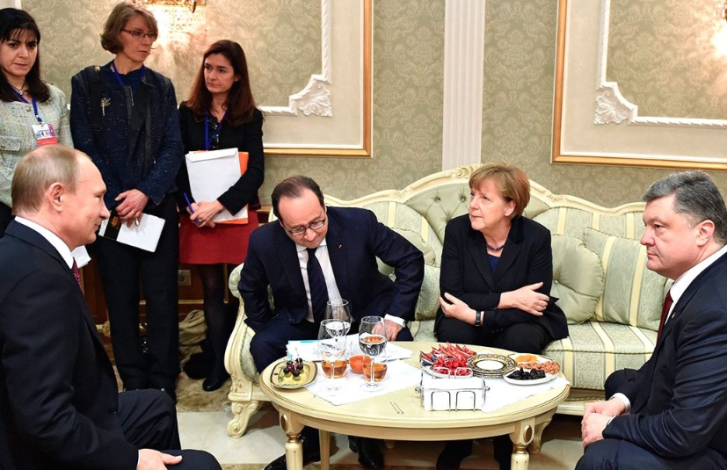
Putin, French President Francois Hollande, German Chancellor Angela Merkel, Ukrainian President Petro Poroshenko at the Normandy format talks in Minsk, Belarus, Feb. 12, 2015. (Kremlin)
My take on the week’s events takes me back to the Minsk Protocols, which Moscow negotiated a decade ago with Kiev, Paris and Berlin.
Signed in September 2014 and February 2015, these committed Ukraine to a new constitution whereby the Russian-speaking provinces in the nation’s east would be granted a considerable degree of autonomy. Kiev and Moscow signed, France and Germany serving as co-signatories backing the former.
Kiev ignored the Minsk accords from Day 1. And, as well-reported at the time, the French and Germans later acknowledged they co-signed only to allow Ukraine time enough to rearm so as to continue attacking the eastern provinces and prepare for the war that eventually broke out three years ago.
This pencil-sketched history is useful to understanding this week’s events and what preceded them. Putin got his fingers burned in Minsk, having personally negotiated the two protocols. I do not know when the Russian president decided the European powers could not be trusted, but he has certainly not trusted them since the Minsk debacle.
Last week’s events proved this a sound judgment. In an improvised game of diplomatic chess, Moscow got the Europeans in check this time, making dexterous use of Kiev as its pawn.
Post–Istanbul, it appears now that the best chance of a settlement of the Ukraine conflict resides in the prospect of a Trump–Putin summit. This, if it comes to pass, would define the Ukraine crisis — altogether properly — as a subset of Trump’s project to restore relations with Moscow.
And it would disarm, not to say humiliate the Europeans who have been leading the Continent to continue its support for the Kiev regime and the war.
A couple of caveats are in order here. One, as earlier suggested, it is not at all clear we have heard the last of the European triumvirate who took center stage for a few days this week. Starmer, Macron and Merz, the last just appointed Germany’s new chancellor, are heavily invested in the Ukraine project and the Russophobia that propels it.
Two, as Putin and other Russian officials have made plain numerous times, and very pointedly this past week, substantive negotiations of a settlement of the Ukraine crisis must begin with mutual recognition of “root causes,” to take the phrase the Kremlin now favors.
This is why Moscow nominated Istanbul as the venue for these new talks. In the draft Boris Johnson disrupted three years ago, these concerns were addressed.
“We view these talks as a continuation of the peace process in Istanbul, which was unfortunately interrupted by the Ukrainian side three years ago,” Medinsky said at a press conference as he set out of Istanbul Thursday. “The aim of direct negotiations with the Ukrainian side is ultimately to secure lasting peace by addressing the fundamental root causes of the conflict.”
The phrase is too ubiquitous in the Russian discourse to ignore. The question now is whether Donald Trump, in any summit he may have with Vladimir Putin, will be at all equipped to address Russia’s concerns.
If he does, he will fundamentally alter relations between the Western powers and Russia for the good — a diplomatic triumph. If he does not, he is unlikely to get anything more done than negotiators accomplished in Istanbul this week.
UK Labour approved more weapons to Israel in three months than Tories did in four years
MEMO | May 17, 2025
The UK’s Labour government is reported to have approved approximately $160 million worth of arms exports to Israel between October and December 2024, more than the total approved during the entire four-year term of Conservative leadership preceding it. The figure, drawn from newly released strategic export licensing data, reflects an unprecedented rise in UK military support to Israel as the occupation state continues its genocide in Gaza
By comparison, from 2020 to 2023, UK arms export licences to Israel totalled approximately $144 million, including $39 million in 2020, $30 million in 2021, $52 million in 2022 and $23 million in 2023.
The stark figures, compiled by the Campaign Against Arms Trade (CAAT), come amid mounting criticism of the UK’s ongoing military support for Israel as the occupation state continues its devastating war on the besieged Gaza Strip.
“This is the Labour government aiding and abetting Israel’s genocide in Gaza,” said Emily Apple, CAAT’s media coordinator. “It is sickening that instead of imposing a full two-way arms embargo, Keir Starmer’s government has massively increased the amount of military equipment the UK is sending to Israel.”
The revelations coincide with a High Court case in which the UK government is defending its decision to continue supplying F-35 fighter jet components used by Israel in Gaza. Under international and domestic law, the UK is obliged to suspend arms exports where there is a clear risk they could be used to commit serious violations of international law.
However, government lawyers have argued that the available evidence does not support the conclusion that a genocide is occurring or has occurred in Gaza. This, despite the government’s own insistence that any determination of genocide is for the courts to decide.
In response, CAAT challenged the government’s claims, highlighting what it described as contradictions in the official narrative. “The UK government is arguing that ‘the impact of suspending F-35 components on operations in Gaza is likely to be minimal’ because the ‘IDF is one of the most significant and well-equipped militaries in the world’,” CAAT said. “However, the claim that the impact would be ‘minimal’ is contradicted by the facts.”
According to CAAT, Israel is operating its fleet of 39 F-35s at five times the usual rate, creating a surge in demand for spare parts. Freedom of Information disclosures show that the UK’s open licence for F-35 components was used 14 times more frequently in 2023 than in any previous year.
The arms export disclosures come as Israel continues its siege on Gaza, blocking food, medicine, and humanitarian supplies for over ten weeks, measures that have compounded an already catastrophic situation. According to the Integrated Food Security Phase Classification (IPC), nearly half a million Palestinians are enduring “catastrophic” levels of hunger, with another one million facing emergency conditions.
The crisis has escalated since Israel broke a ceasefire agreement with Hamas in March and announced its intention to occupy the entirety of the Gaza Strip. The UN has warned that these actions may amount to war crimes and has repeatedly called for a ceasefire and unrestricted humanitarian access.
Despite these warnings, the UK continues to supply weapons to Israel, a move legal experts say could render British officials complicit in the atrocities being committed. Human rights groups have condemned the UK’s position as morally indefensible and legally precarious.
Declassified files expose secret Western support for Israeli assassinations
MEMO | May 16, 2025
Newly declassified documents have revealed that Western intelligence services secretly collaborated with Israel’s Mossad in the 1970s, providing critical intelligence that enabled the assassination of Palestinian activists across Europe, without any parliamentary oversight or democratic scrutiny. The revelation has fuelled concerns that similar clandestine intelligence-sharing arrangements are likely facilitating Israel’s ongoing genocide in Gaza today.
According to a detailed exposé by the Guardian, a covert network known as “Kilowatt”—comprising at least 18 Western intelligence agencies including those of the UK, US, France, and West Germany, was established in 1971 to share sensitive intelligence on Palestinian groups. The information shared included personal details, safe house locations, and vehicle registrations of Palestinian individuals who were subsequently targeted by Mossad hit squads.
Dr Aviva Guttmann, the historian who uncovered the encrypted cables in Swiss archives, confirmed that the intelligence shared was granular and critical to Israel’s covert killings, many of which took place in Paris, Rome, Athens, and Nicosia. “At the very beginning, perhaps officials were unaware of the extrajudicial assassinations, but later, they certainly knew and continued sharing intelligence,” Guttmann told the Guardian.
This covert support, the paper reported, operated entirely beyond the purview of elected officials, and would likely have triggered public outrage had it been exposed at the time. Indeed, some of those assassinated were publicly disputed as innocent, such as Wael Zwaiter, a Palestinian intellectual gunned down in Rome in 1972, whom Israel accused of being linked to the Black September Organisation. Evidence supporting such claims was largely based on intelligence fed through the Kilowatt system.
The revelations, while historical, have sparked urgent comparisons to the present day, where Israel is prosecuting what rights experts and genocide scholars widely describe as an ongoing genocide in Gaza, once again behind a wall of secrecy and political impunity.
Dr Guttmann herself underlined the relevance of these disclosures, warning that the shadowy practices of intelligence-sharing without political oversight remain largely unchanged: “International relations of the secret state are completely off the radar of politicians, parliaments, or the public. Even today, there will be a lot of information being shared about which we know absolutely nothing,” she stressed to the Guardian.
Critics argue that such secrecy underpins the UK’s and other Western states’ complicity in Israel’s Gaza genocide, which since October 2023 has killed over 53,000 Palestinians, mostly women and children. Despite the International Court of Justice opening a genocide case against Israel, British intelligence cooperation with Israeli agencies continues in the dark, with no democratic accountability or transparency. The UK government has also refused to clarify the purpose of more than 500 Royal Air Force surveillance flights over Gaza, raising fears these may be contributing to targeted killing.
Featured Video
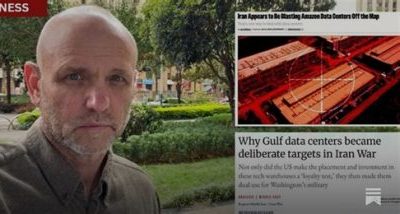
Iran spent $1 million to wipe out $30 billion in data center plans, and take down Amazon in the ME
or go to
Aletho News Archives – Video-Images
From the Archives
Clash of Civilization, Iran Part II
By Jamal Kanj – Intifada-Palestine.com – January 14, 2011
Israel’s survival kit is: perpetuate conflict, insecurity to rationalize collective hate and finally playing victim.
Devoid of conflict, Israel implodes internally; without hate, Zionism loses its justification; and playing eternal victim to continue blackmailing the West. Absence of this holy trinity, Israel ceases to exist. … continue
Blog Roll
 Aletho News
- China Rejects Outside Pressure on Trade Ties After New US Russia Sanctions Bill
- Houthis Keep Advancing as the Red Sea Crisis Deepens
- Iran spent $1 million to wipe out $30 billion in data center plans, and take down Amazon in the ME
- Zionist billionaire pressure to silence Macklemore sparks exodus from Ed Sheeran tour
- House Votes to End Iran War for Third Time
- North Korea Slams US Plan for ‘AUKUS 2.0’ with South Korea and Japan
- Prolonging US-Iran Conflict Not Meeting Interests of Int’l Community – China’s Wang Yi
- EU bans former Zelensky aide from parliament
- NATO-backed Kosovo separatist ‘responsible for war crimes’
- US destroying international space law
- If Americans Knew
- Israeli Forces Detain Journalist Alaa al-Rimawi amid Widespread West Bank Raids
- Even a pro-Israel Congress member has put a hold on 40,000 one-ton bombs to Israel
- As Gaza crumbles, Israel preps new ground invasion – Daily Update
- ‘We are not like everyone else’ laws that bind other nations do not apply to Israel, says Likud lawmaker
- Trump’s govt makes ‘treasonous’ claim of weapons shortages
- Palestinian-American Journalist Naqaa Hamed Imprisoned by Israeli Forces After Settlers Targeted Her
- U.S. Makes, Israel Takes: The Real Story of U.S.-Israeli Military Cooperation
- Night raids rise in Palestine
- Tucker Carlson interviews Norman Finkelstein about Gaza
- Groups urge Americans to support Van Hollen legislation on Israel’s killing of Americans & Palestinians
- No Tricks Zone
- New Study: ‘Global Drought Shows No Detectable Recent Acceleration Under Climate Warming’
- Economic Masterminds: German Socialists Suggest Taxing Productivity Gains Stemming From Using AI
- The South China Sea Has Not Been Cooperating With The Climate Change Narrative
- Energy Crisis: Germany Enters Heating Season With Historically Low Gas Reserve Fill Levels
- New Study: The Antarctic Ice Sheet Gained Mass From 2020-2024 Due To Staggering Snow And Ice Accumulation
- Study: Ocean Heating Rates From Thousands Of Years Ago ‘Dwarf’ Modern Ocean Heating Rates
- Climate Extremists Target, Attack Large-Scale Power Grid Infrastructure In Germany!
- New Study: Antarctic Ice Melt Has Contributed Less Than 1 Centimeter To Sea Level Rise In The Last 30 Years
- Fear Of Debate: Alarmist German Climate Scientist Calls On Mainstream Media To Discredit Skeptic Voices
- End-Of-August Arctic Sea Ice Extent Hasn’t Fallen In 20 Years, Official Data Show!
 Aletho News