Russia sent Su-35 jet after bid to detain ‘shadow fleet’: Estonia
Al Mayadeen | May 15, 2025
Estonia’s foreign minister said Thursday that a Russian military jet was deployed as the Estonian Navy attempted to intercept a Russia-bound oil tanker, the Jaguar, which had been placed under British sanctions and was accused of sailing without a flag.
The incident unfolded near Naissaar Island, off the coast of Tallinn, where Estonian forces identified the Jaguar as part of Russia’s so-called “shadow fleet,” a term Western governments use to describe vessels allegedly used by Moscow to bypass international sanctions.
Estonian Foreign Minister Margus Tsahkna stated in Antalya, Turkey, ahead of a NATO foreign ministers’ meeting, that the Russian Federation sent a fighter jet to “check the situation,” adding, “We need to understand that Russia has officially tried and connected itself to the Russian ‘shadow fleet’.”
He added, “The Russian Federation is ready to protect the ‘shadow fleet’… The situation is really serious,” calling for faster and tougher sanctions against Moscow.
The Jaguar was added to the UK sanctions list last Friday.
When contacted by the Estonian Navy at 15:30 GMT on Tuesday, the vessel refused to comply with a boarding attempt. According to the Estonian Navy, the operation was carried out under legal obligations to verify the ship’s documentation and status, as it appeared to be sailing without a recognized nationality.
Commander Ivo Vark of the Estonian Navy said, “The vessel denied cooperation and continued its journey toward Russia… Given the vessel’s lack of nationality, the use of force, including boarding the vessel, was deemed unnecessary.”
According to reports, the vessel was then escorted to Russian waters. Moreover, marine traffic data on Thursday showed the Jaguar anchored near the Russian port of Primorsk, listed under the flag of Gabon.
NATO response and air patrol deployment
According to the report, the deployment of the Russian jet triggered a response from NATO, with military aircraft based in the Baltic taking off to monitor the situation.
A video, which circulated on social media, showed Estonian naval vessels, a helicopter, and a patrol aircraft surrounding the Jaguar. A voice can be heard in English commanding, “This is Estonian warship… follow my instructions, alter your course to 105 immediately.”
A Russian speaker responds, noting that helicopters are demanding the ship’s anchor.
Estonia has not confirmed if this incident is related to a previously reported “airspace breach” involving a Russian Su-35 jet earlier in the week, which prompted a diplomatic protest from Tallinn.
Margarita Simonyan, head of Russia’s state media outlet RT, claimed the Su-35 was dispatched to prevent the Jaguar’s seizure.
The incident comes after Estonia detained another Russia-bound oil tanker, Kiwala, on April 11, also allegedly sailing without a valid flag.
Western governments have said Russia’s shadow fleet is central to maintaining its oil exports despite sanctions. That said, Britain asserts that sanctioning these vessels limits Russian President Vladimir Putin’s ability to finance the war in Ukraine.
BBC’s May 14 interview with Gaza aid chief was shameful
By Jonathan Cook | May 14, 2025
There was yet more shameful reporting by BBC News at Ten last night, with international editor Jeremy Bowen the chief culprit this time.
He prefaced an interview with Philippe Lazzarini, head of United Nations refugee agency UNRWA, with an utterly unwarranted disclaimer – as though he was talking to a terrorist, not a leading human rights advocate who has been desperately trying to keep the last aid life-lines open to the people of Gaza as they are being actively starved to death by Israel.
The only time I can remember Bowen prefacing an interview in such apologetic terms was when he interviewed Hamas’ deputy political chief, Khalil al-Hayya, last October.
That was shameful too. But at least on that occasion, Bowen had an excuse: under Britain’s draconian Terrorism Act, saying or doing anything that might be viewed as favouring Hamas can land you with a 14-year prison sentence for supporting terrorism.
But why on earth would Bowen imply that Lazzarini’s remarks – on the intense suffering of Gaza’s population in the third month of a complete Israeli aid blockade – need to be treated with caution, in the same manner as those of a Hamas leader?
For one reason only. Because Israel, quite preposterously and for completely self-serving reasons, claims UNRWA is a front for Hamas. Since January, Israel has outlawed the organisation from operating in the Palestinian territories it continues to illegally occupy. As ever, the BBC is terrified of upsetting the Israelis.
Israel has long wanted UNRWA out of the picture because it is the last significant organisation to uphold the rights of Palestinian refugees enshrined in international law. It is, therefore, a major obstacle to Israel ethnically cleansing Palestinians from what is left of their homeland.
Before airing the interview with Lazzarini, Bowen cautioned: “Israel says he is a liar, and that his organisation has been infiltrated by Hamas. But I felt it was important to talk to him for a number of reasons.
“First off, the British government deals with him, and funds his organisation. Which is the largest dealing with Palestinian refugees. They know a lot of what is going on, so therefore I think it is important to speak to people like him.”
Bowen would never consider prefacing an interview with Benjamin Netanyahu in a similar manner, even though the following would actually be truthful and far more deserved:
“The International Criminal Court has issued an arrest warrant for the Israeli prime minister, accusing him of crimes against humanity. But I felt it was important to talk to him for a number of reasons.
“First off, the British government deals with him, and sends weapons to his military to carry out the crimes he is accused of. As its leader, he obviously knows a lot about what Israel is up to, so therefore I think it is important to speak to someone like him.”
Can you imagine the BBC ever introducing Netanyahu in that way? Of course, you can’t – even though, in journalistic, ethical and legal terms, it would be fully warranted.
But in the case the Lazzarini, there are absolutely no grounds for such a prologue – except to promote an Israeli pro-genocide agenda. Bowen’s remarks suggest he needs to explain why, in the midst of an Israeli-engineered famine in Gaza, the BBC would choose to speak to one of the most knowledgeable public figures about that starvation.
Bowen’s resort to an explanation instantly paints Lazzarini as problematic and controversial. It aligns with, and reinforces, Israel’s entirely bogus conflation of UNRWA and Hamas.
Even were Israel’s claims about UNRWA true of local staff in Gaza – and Israel has supplied precisely no evidence they are, as Lazzarini makes clear in a longer edit of the interview that aired on the BBC’s Six O’Clock News – that would in no way implicate Lazzarini. His remarks in the interview, on the catastrophic suffering of Gaza, are echoed by all aid agencies.
Bowen’s apologetic tone not only served to undercut the power of what Lazzarini was saying, but bolstered Israel’s ridiculous smears of UNRWA. That will have delighted Israel, and given it a little bit more leeway to carry on the starvation of Gaza, even as the first establishment voices tentatively start calling time on the genocide – 19 months too late.
Notice this from Bowen too. He asks Lazzarini: ‘When people look back on what’s been happening in the future, will they see, actually, a big international failure?”
Lazzarini responds: “I think in the coming years we will realise how wrong we have been, how on the wrong side of history we have been. We have, under our watch, let a massive atrocity unfold.”
Bowen jumps in: “Would you include the 7th of October in that?”
Lazzarini answers: “I would definitely include the 7th of October.”
But the set-up from Bowen is entirely unfair. He asks Lazzarini a question about “international failure” in relation to Gaza, and Lazzarini responds about the failure by the West to do anything to stop an atrocity – more properly a genocide – unfold over the past 19 months.
The events of 7 October 2023 are irrelevant to that discussion. There has been no “international failure” to support Israel. The West has armed it to the hilt and prioritised the suffering caused to Israelis by Hamas’ one-day attack over the incomparably greater suffering caused to Palestinians by 19 months of Israel’s slaughter and starvation.
Bowen’s interjected question about 7 October is a nonsense. It is levered in simply to cast further doubt on Lazzarini’s good faith in the hope of placating Israel, or at least providing the BBC with a defence when Israel goes on the offensive against Bowen for speaking to UNRWA.
The atrocities carried out on October 7 occurred in the context of decades of brutal and illegal Israeli military occupation of the Palestinian territories, of settlement expansion and apartheid rule, and of a 16-year siege of Gaza.
The international community was certainly on the “wrong side of history”, but not in the sense Bowen intends or Lazzarini infers from Bowen’s question. The West failed because it did precisely nothing to stop Israel’s brutalisation of the Palestinian people over those many decades – in fact, the West assisted Israel – and thereby guaranteed that Palestinians in Gaza would seek to break out of their concentration camp sooner or later.
Lazzarini’s remarks on the catastrophe in Gaza should be seen as self-evident. But Bowen and the BBC undermined his message by framing him and his organisation as suspect – and all because Israel, a criminal state starving the people of Gaza, has made an entirely unfounded allegation against the organisation trying to stop its crimes against humanity.
This is the same pattern of smears from Israel that has claimed all 36 hospitals in Gaza are Hamas “command and control centres” – again without a shred of evidence – to justify it bombing them all, leaving Gaza’s population without any meaningful health care system as malnutrition and starvation take hold.
Israel struck another hospital yesterday, the European Hospital in Khan Younis, as medics there were waiting to evacuate sick and injured children. The attack killed at least 28 people and injured many more, including a BBC freelance journalist who was conducting an interview there as the missiles hit.
Notably, BBC News at Ten blanked out its journalist’s face, adding: “For his safety, we are not revealing his name.” The BBC did not explain who the journalist needed protecting from, or why.
That is because the BBC rarely mentions that Israel has assassinated more than 200 Palestinian journalists in Gaza, as well as banning all foreign correspondents from entering the enclave, in its attempts to limit news coverage and smear what does come out as Hamas propaganda. Israel understands it is easier to commit genocide in the dark.
You might assume a major news organisation like the BBC would wish to be seen showing at least some solidarity with those being murdered for doing journalism – some of them while working to provide the BBC with news. You would be wrong.
We shouldn’t pretend that it was Bowen’s choice to attach such a disgraceful disclaimer to his interview. We all understand that he is under enormous pressure, both from within the BBC and outside.
BBC executives have appointed and protected Raffi Berg, a man who publicly counts a former senior figure in Israel’s spy agency Mossad as a friend, to oversee the corporation’s Middle East coverage.
And as the late Greg Philo reported in his 2011 book More Bad News from Israel, a BBC News editor told him at that time: “We wait in fear for the telephone call from the Israelis”. Things are far, far worse 14 years on.
Excuses won’t wash any longer. We are 19 months into a genocide. Helping Israel to launder its crimes is to become complicit in them. No journalist should be allowing themselves to be pressured into this kind of moral and professional failure.
Florida Rejects Controversial Encryption Backdoor Bill
By Didi Rankovic | Reclaim The Net | May 13, 2025
Legislators in the US state of Florida have shot down a bid to introduce a law that would have mandated encryption backdoors.
The outcome of the effort – known as SB 868: Social Media Use by Minors – means that the backdoors would have allowed encryption to be weakened in this fundamental way affecting all platforms where minors might choose to open an account.
As the fear-mongering campaign against encryption is being reiterated over and over again, it’s worth repeating – there is no known way of undermining encryption for any one category of users, without leaving the entire internet open and at the mercy of anything from government spies, to plain criminals.
And that affects both people’s communications and transactions.
Not to mention that while framing such radical proposals as needed for a declaratively equally large goal to achieve – the safety of youth online – in reality, by shuttering encryption, young people and everyone else are negatively affected.
If anything, it would make everyone online less secure, and, by nature of the world – young people more so than others.
And so, Florida’s Senate on announced that SB 868 is now “indefinitely postponed and withdrawn from consideration.”
The idea behind the proposal was to allow law enforcement access to communications on a social platform – by forcing a company to build in backdoors any time law enforcement came up either with a warrant – or merely a subpoena.
The focus of the bill was “ephemeral” messages – as in, preventing those defined as minors from using the associated features. At the same time, their parents or guardians would have “full access” to their online activities.
“Dangerous and dumb” – is how the digital rights groups Electronic Frontier Foundation (EFF) earlier summed up and alliterated the proposal.
The US, and its individual states, are not the only ones attempting to create a chink in the armor of global online security by repeatedly attacking online encryption.
Thus far, cooler heads seem to be prevailing, but the battle is far from over, as this fundamental piece of online security continues to be in the crosshairs of, most of the time, authorities hungry for ever-easier ways to conduct ever more invasive mass surveillance.
Let’s just get on with the planned Istanbul peace talks on Thursday, whether or not Putin and Zelensky meet
By Ian Proud | Strategic Culture Foundation | May 14, 2025
As we gear up for the first direct talks between Russia and Ukraine since the failed Istanbul talks of March 2022, a complex game of brinkmanship is underway.
Not surprisingly, in my view, President Putin ignored the coalition of the willing’s ultimatum to Russia to embark on an unconditional ceasefire for thirty days or face massive new sanctions. Instead he proposed what the Americans have been pushing for since Trump assumed office, direct bilateral talks with Ukraine in Istanbul on Thursday 15 May.
I have long argued that the only route out of the war in Ukraine is through talks. Compromise was offered by both sides in the first round of Istanbul talks in March 2022. Any new negotiations will require compromise from both sides, but the difference today is that the cards are more heavily stacked in Russia’s favour than they were in 2022.
Against this backdrop, President Zelensky has called on President Putin to meet him personally in Istanbul on Thursday. From my perspective, this appears an attempt to call off talks if Putin doesn’t show up.
Usually, when Heads of State meet, officials will have hammered out the negotiation for some time before hand. The leaders can then arrive and either sign on the dotted line or tackle the most difficult issues one on one. It’s now Tuesday 13 May. There is simply no way that Russian and Ukrainian officials will have lined up the framework for a deal for both leaders to sign in Istanbul on Thursday.
Even if Putin showed up on Thursday, Zelensky isn’t going to announce unilaterally that Ukraine is giving up its NATO ambition before the full negotiations have even started. Whether you agree or not, this is self-evidently Russia’s core ‘root cause’ of the war. The new German Foreign Minister, Johann Wadephul recently repeated the line that Ukraine’s path to NATO is irreversible, even though the Trump administration disagrees.
A form of words on Ukraine’s NATO aspiration that is agreeable to both sides in the war will take time to draft. And there’s a huge list of other detailed points that have to be addressed, including the line of control, the role of military forces from other states, the return of Ukrainian children, the protection of minority languages and so on.
Every statement that Zelensky has made since the war started has emphasised the need for the west to pile more pressure on Russia to ensure ultimate victory. He would meet Putin in Istanbul without the back slapping adulation that he receives in western capitals and with no pressure cards in his back pocket.
That doesn’t mean I think a meeting shouldn’t happen, because I do. The image of both war times leaders meeting in Istanbul, however awkward and uncomfortable, could be deeply symbolic in announcing the commencement of long overdue peace talks between officials. They could agree, face to face, to maintain a ceasefire for as long as those peace talks continued.
But no leader likes to turn up to any international meeting without the preparatory ground work in place. There is deep enmity between Putin and Zelensky for obvious reasons. Given Zelensky’s penchant for publicity stunts, the Russian side would want to be absolutely sure that the choreography of any meeting and the deliverables – what they would announce, however limited – had been agreed.
Putin will know that if he does not now turn up to Istanbul that Zelensky will hit the international airwaves calling for massive sanctions. But that if he meets Zelensky and a comprehensive deal isn’t agreed there and then – a frankly impossible feat it seems to me – then the same calls for massive sanctions against Russia will be made.
Of course, Putin will also know that Europe can’t muster new sanctions massive enough to make a difference at this late stage in the process, having exhausted most avenues since 2014. On Victory Day, Britain unilaterally announced the ‘biggest ever sanctions package’ against Russia’s so-called shadow fleet of oil tankers. The idea that unseaworthy hulks are carrying illicit Russian oil into Britain is obviously fanciful. But in any case, with the global oil price now close to the G7 oil price cap on Russian oil, the idea of a shadow fleet, delivering oil at its market rate, has fallen away. Britain’s February sanctions package against 107 persons and entities was labelled the largest sanctions package since 2022. Let’s be clear, the biggest sanctions package against Russia was imposed in February 2022, and everything since that time has offered diminishing marginal returns.
But that’s not really the point. By trying to force a showdown in Istanbul, Zelensky may want to continue to paint Russia as the aggressor and to press the case for more military aid, having asked for three million new artillery shells during his recent trip to Prague. However, this war really must now end, having blighted over one million lives already.
Boris Johnson was wrong in March 2022 to discourage Zelensky from accepting the first Istanbul peace deal precisely because he could not back up the promise that he made; to support Ukraine for as long as it takes. Even though Britain continues to pump £4.5bn in yearly military aid into Ukraine, that sum pales against the free aid that the U.S. offered under Joe Biden.
Trump is offering nothing more now than to plunder Ukraine’s resources so that it can buy American weapons, and Europe cannot afford to make up the difference, for as long as it takes. Ukraine is still losing on the battlefield and now, apparently, treating its traumatised troops with ketamine to help them deal with the PTSD.
Despite significant risks around inflation and high interest rates caused by the enormous fiscal splurge on its war economy, Russia is still growing at a respectable rate. Europe is not.
For now, President Putin is keeping his powder dry by not responding to Zelensky’s relentless press stunts. It’s clear to me that Russia’s initiative of a second round of Istanbul peace talks from Thursday is essential in edging both sides closer to a cessation of the killing that should have ended over three years ago. Whether or not both leaders meet at the start or at the end of those negotiations, let’s just please get down to the business of talking.
Ian Proud: Ukraine Peace Talks or Political Theatre?
Glenn Diesen | May 13, 2025
Ian Proud was a member of His Majesty’s Diplomatic Service from 1999 to 2023. Ian was a senior officer at the British Embassy in Moscow from July 2014 to February 2019, at a time when UK-Russia relations were particularly tense. He performed a number of roles in Moscow, including as Head of Chancery, Economic Counsellor – in charge of advising UK Ministers on economic sanctions – Chair of the Crisis Committee, Director of the Diplomatic Academy for Eastern Europe and Central Asia and Vice Chair of the Board at the Anglo-American School.
Ian Proud’s Substack: https://thepeacemonger.substack.com/
Follow Prof. Glenn Diesen:
Substack: https://glenndiesen.substack.com/
Are UK Atrocities in Afghanistan a Smokescreen for IDF Defenders?
Sputnik – 13.05.2025
Emerging reports about atrocities perpetrated by British special forces against civilians in Afghanistan may be a part of a “preemptive defense” of the IDF, former Pentagon analyst Ret. Lt. Col. Karen Kwiatkowski told Sputnik.
If and when stories of “the incredibly disturbing activities of the UK- and US-supported IDF in Gaza” come out, the public would already be taught beforehand that “war is awful, civilians and sleeping children are always killed and it’s just a few bad apples.”
Regarding the UK soldiers and officers involved in illegal activities in Afghanistan, Kwiatkowski believes they should be placed on unpaid leave and “tried in a legal court.”
Any key eyewitnesses and whistleblowers “need immediate protection from suicide or accidents,” Kwiatkowski adds.
Cover-ups, lies, smears and fake news from Ursula could be EU’s own suicide pill
By Martin Jay | Strategic Culture Foundation | May 12, 2025
Previous disparaging comments about the past of European Commission chief Ursula von der Leyen and her grandparents’ role in the second world war might have seemed truculent by Russian commentators. And yet, as each month passes, we seem to be witnessing VDL’s political identity – and her vision of the role of the EU – more and more in line with Nazi Germany. The total annihilation of the free press in Brussels was not her doing, as she inherited the draconian system when she took office. But her efforts to broaden the silencing of journalists right across Europe is telling as it becomes even more an act of desperation to stamp out any free and feral reporting while her own team are pumping out these entirely fake narratives every day. The Russians are planning on invading Baltic states. Russia is the new threat to a democratic Europe. And the latest blag, EU is a bastion of peace and democracy “which doesn’t invade other countries”.
The lies and hypocrisy are at an all-time high and so it seems fitting that the draconian measures of arresting or detaining journalists, like Chay Bowes attempting to cover the Romanian elections, is understandable.
And yet there is no evidence at all to back up the preposterous claim that Moscow has eyes set on invading Baltic countries; there is also no evidence to back up the claim that Russia is the real threat to European democracy, which, in fact is being destroyed each day by the EU and its elites themselves. And as for the EU being this example of a peaceful trading bloc which doesn’t have any intention of attacking its own members… that might have been true. Until now.
These days the EU elite in Brussels are panicking about losing their relevance. It is looking at though the anti-EU candidate in Romania might well win the presidential elections there. If that happens, this means an alliance of three rebels in the pack – Hungary, Romania and Slovakia – are going to give the EU, let alone NATO a real headache. It might be overzealous to say it could be the end of the EU, but it may well certainly be the end of the EU as we know it. The extraordinary elitist dictatorship which has no accountability to its own mercurial ambitions and acts, might have to learnt a thing or two about democracy and start respecting a few of its principles. NATO, arguably, might be hit even harder as three members holding back the EU’s dream of organizing an EU army in Ukraine will have longer-term ramifications to the prestige and relevance of both those Brussels based institutions.
Have the cracks already started? Are these elitists like VDL losing their grip with reality? The threat by Estonia to “shoot down” any planes flying from Slovakia to Moscow is a good sign of the lunatics running the asylum as this WTF moment naturally is not reported by mainstream media and so the Slovakian PM himself had to stream a piece to camera for X just to confirm the madness.
Yet Ursula is really losing her mind. She’s out of control and this obsession with fighting Russia at any cost may well provide the defining moment where she and the EU project falls on its own sword. The election meddling, arrests of journalists and sheer scale of the fake news coming from the EU is starting to get noticed and seen for what it is – not only in these three recalcitrant EU member states but right across Europe. This is evident in the rise of far-right movements in France, Britain and Germany. It’s plain to see. More and more people are simply no longer buying the BS that comes to their TV screens by these leaders in Brussels on immigration, COVID, LGBT and of course boosting EU defence budgets to new giddy heights. In the UK for example, the government is looking at how to cut disability benefits to its own citizens as the national coffers are empty due to 7.5 illegal migrants receiving state benefits, free housing and health care.
The hypocrisy is staggering. Just recently we read that the EU accuses Hungarian populist leader of pouring cash into a number of media outlets to boost his popularity. And yet HUNDREDS of journalists in Brussels each day working for all of Europe’s main broadcasters, even the BBC when the UK was a member, receive free productions services saving them possibly hundreds of millions of euros each year. We don’t know the figure because it’s all shrouded in secrecy, naturally, but the laughable accusation made by the EU must be noted for the pot calling the kettle black.
Hungary, Slovakia and soon Romania will all be targets for smear campaigns by Brussels-based so-called journalists as part of the new objective of VDL and her cronies. This is coming on a grand scale and the more this is intensified, you can literally watch the popularity of the far-right parties in ‘Old Europe’ rise each day. The model has an autodestruct facility built into it which fools like VDL can’t even see as they are too fixated with power grabbing and the dirty tricks which are needed therein. But the whole machinery is fed on lies which still too many gullible Europeans believe whether it be about Russia’s “threat” or electric cars, alternative energy and of course vaccines. All these areas represent hundreds of billions of euros being transferred from the public coffers to the private ones and there are still, sadly, a good number of ignorant Europeans who can’t join up the dots.
Europe’s Security Plans Are Taking it Nowhere
By Salman Rafi Sheikh – New Eastern Outlook – May 11, 2025
Over the past few weeks and months, European leaders have changed their plans from sending troops to Ukraine to offering ‘air support’ and, finally, to bolstering Ukraine’s military forces and defence capability as a means to protect European security.
This whimsical switching exposes a lack of internal coherence and the continent’s inability to act autonomously and decisively to shape the course of events.
Europe’s Many Plans
Immediately after the Trump administration began its peace talks with Russia and Ukraine to end the military conflict, Europe decided to take a different route. This was supposed to be the first major manifestation of Europe’s strategic autonomy ever since its decision in 2003 not to support the US war on Iraq. The first route involved sending European troops from within the so-called “coalition of the willing” to Ukraine as a ‘peacekeeping’ force. This plan was the brainchild of the UK Prime Minister Keir Starmer. But, as the Telegraph, a leading UK-based newspaper, reported at the end of March, the UK’s military officials dismissed the plan, calling it a “political theatre”. Needless to say, President Trump’s special envoy, Steve Witkoff, had already dismissed the plan as “a posture and a pose” only. The second plan turned to offering air and naval support. But defence sources in the US and elsewhere in Europe reportedly found no military sense in this plan too, considering that this deployment will be hundreds of miles away from the frontline. In fact, one defence source told the media this support will not only be meaningless, but it will not be able to defend itself in the wake of any escalation.
The “Porcupine strategy”
This has led Europe to contemplate an altogether different strategy. The new plan is to arm the Ukrainian military to its teeth to prevent any deal between Russia and the US. It also includes upgrading Europe’s own defence capability. This strategy was released earlier in April as a “Joint White Paper for European Defence Readiness 2030”.
The White Paper is interesting for several reasons, one being that it is critical of Washington as well. For instance, the reason why Europe needs to upgrade its defence readiness is that it is being “coerced by external actors” who are “threatening our way of life and our ability to choose our own future through democratic processes. They believe that we are politically unable to summon a meaningful and strategically enduring response.” The paper squarely places these threats against the backdrop of the massive changes to the “political equilibrium that emerged from the end of the Second World War and then the conclusion of the Cold War”. Called the “Porcupine strategy”, the underlying objective of this plan is to help Ukraine boost its overall military capacity so that it can ‘resist’ Russia and protect Europe from any possible Russian expansion. It involves providing “large-scale artillery ammunition”, “air defence systems”, “drones”, “train and equip Ukrainian brigades”, “direct support to Ukraine’s defence industry”, and, among other things, “enhances access to EU spaces and services”.
The elephant in the room, however, is whether the EU actually has the ability to boost Ukraine. A lot of this is based upon the hope that the EU will be able to deliver this. The paper says, “Member States need the European defence industry to be able to design, develop, manufacture and deliver these products and technologies faster and at scale. In the context of substantially increased defence expenditure, a higher share needs to be invested in defence research and development and technology, concentrating efforts and resources on common European projects”.
A good part of this strategy, in fact, depends upon securing and providing loans. The White Paper proposes that the EU should “provide Member States with loans backed by the EU budget. With up to EUR 150bn, the Security and Action for Europe (SAFE) instrument will strongly support a significant increase in Member States’ investments in Europe’s defence capabilities, now and over this decade.”
Of course, it does not include, at present, any assurances and commitments from member states that they will be able to either secure these loans and/or be willing to invest this much in the defence industry immediately. For many in Europe continue to hope that transatlantic ties could still return to ‘normal’ in the post-Trump era.
While this is understandable as to why Europe, facing a different and unpredictable administration in the US, would want to chart a new course for itself – and doing so might, in the long run, help multipolarity as well – its rapid shifts between several plans based upon wrong strategic and financial calculation is unlikely to take it anywhere.
Salman Rafi Sheikh, research analyst of International Relations and Pakistan’s foreign and domestic affairs.
Russia is not afraid of Western sanctions – Kremlin
RT | May 10, 2025
Russia is used to Western pressure and is not concerned about new sanctions, Kremlin spokesman Dmitry Peskov has said.
He was commenting on a new round of sanctions recently imposed by the UK.
”We already know what we will do once the sanctions are announced and how we will minimize their effect,” Peskov told journalist Pavel Zarubin on Saturday. Russia has learned effective ways to counteract Western pressure, he said. “Therefore, scaring us with sanctions is pointless.”
On Friday, the British government announced what it called the “largest-ever” sanctions package against Russia, targeting its oil transportation network in order to deliver a blow to the country’s energy revenues.
The new measures blacklisted up to 100 oil tankers that the West claims are part of a Russian ‘shadow fleet’, older vessels operating outside Western insurance systems. Since the escalation of the Ukraine conflict over three years ago, successive British governments have introduced more than 2,000 sanctions on Russian individuals and entities.
Moscow has said the move will not harm Russia’s economy and will instead increase energy costs and inflation in Europe.
Earlier, US President Donald Trump called for an “unconditional ceasefire” between Moscow and Kiev, threatening punitive measures if the truce is not observed. “The US and its partners will impose further sanctions” if it is violated, he said.
In March, Russian President Vladimir Putin said that a total of 28,595 sanctions were imposed on Russian companies and individuals in recent years – more than the total number on all other countries combined. According to the president, the West sought to eliminate Russia as a competitor but its economy has only grown more resilient under pressure.
Iran categorically rejects involvement in alleged plot to attack Israeli embassy in UK
Press TV – May 8, 2025
Tehran has categorically rejected Western media reports about Iranian nationals being involved in an alleged plot to target the Israeli embassy in London.
In a post on his X account on Thursday, Iranian Foreign Minister Abbas Araghchi said Tehran has not been informed of any allegations via “proper diplomatic channels”.
“Iran stands ready to engage to shed light on what has truly transpired, and we reiterate that UK authorities should afford our citizens due process,” he wrote.
The United Kingdom has arrested eight men, including seven Iranian nationals, as part of two investigations regarding alleged threats to national security.
London’s Metropolitan Police confirmed the arrests on Sunday, saying five men, including four of the Iranian nationals, were detained on suspicion of “preparation of a terrorist act” while the other three were being held under national security legislation introduced in 2023 to counter the actions of hostile states.
They were arrested as part of a “pre-planned” investigation into an alleged plot to “target specific premises,” the Metropolitan Police said, adding that the “affected site” was made aware and is being supported by police.
As part of a separate investigation led by the Met, three other Iranian men were arrested in London on Saturday.
The Met said three men — aged 39, 44 and 55 — were arrested under section 27 the National Security Act at separate addresses in north-west and west London, and had been taken into custody while searches continued.
In his post, Araghchi pointed to the stories in the media about the alleged involvement of Iranian nationals in a supposed plot to target the Israeli embassy in London and urged the UK to engage so that Tehran may assist any probe into credible allegations.
The top Iranian diplomat warned that third parties are resorting to desperate measures, including false flag operations, to derail diplomacy and provoke escalation.
“Timing and lack of engagement suggest that something is amiss,” he said.
In a post on his X social media account on Tuesday, the Iranian foreign minister called on the UK to respect the rights of Iranians arrested in Britain, underscoring Tehran’s readiness to assist investigations in the incident.
“Disturbed to learn that Iranian citizens have reportedly been arrested by UK security services,” Araghchi wrote.
Featured Video
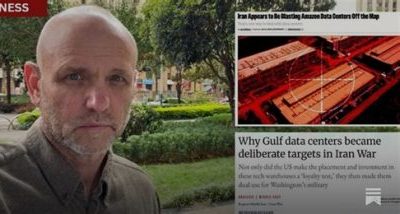
Iran spent $1 million to wipe out $30 billion in data center plans, and take down Amazon in the ME
or go to
Aletho News Archives – Video-Images
From the Archives
Clash of Civilization, Iran Part II
By Jamal Kanj – Intifada-Palestine.com – January 14, 2011
Israel’s survival kit is: perpetuate conflict, insecurity to rationalize collective hate and finally playing victim.
Devoid of conflict, Israel implodes internally; without hate, Zionism loses its justification; and playing eternal victim to continue blackmailing the West. Absence of this holy trinity, Israel ceases to exist. … continue
Blog Roll
 Aletho News
- ‘Bucha massacre’ a false flag orchestrated by UK – Moscow
- China Rejects Outside Pressure on Trade Ties After New US Russia Sanctions Bill
- Houthis Keep Advancing as the Red Sea Crisis Deepens
- Iran spent $1 million to wipe out $30 billion in data center plans, and take down Amazon in the ME
- Zionist billionaire pressure to silence Macklemore sparks exodus from Ed Sheeran tour
- House Votes to End Iran War for Third Time
- North Korea Slams US Plan for ‘AUKUS 2.0’ with South Korea and Japan
- Prolonging US-Iran Conflict Not Meeting Interests of Int’l Community – China’s Wang Yi
- EU bans former Zelensky aide from parliament
- NATO-backed Kosovo separatist ‘responsible for war crimes’
- If Americans Knew
- Israeli Forces Detain Journalist Alaa al-Rimawi amid Widespread West Bank Raids
- Even a pro-Israel Congress member has put a hold on 40,000 one-ton bombs to Israel
- As Gaza crumbles, Israel preps new ground invasion – Daily Update
- ‘We are not like everyone else’ laws that bind other nations do not apply to Israel, says Likud lawmaker
- Trump’s govt makes ‘treasonous’ claim of weapons shortages
- Palestinian-American Journalist Naqaa Hamed Imprisoned by Israeli Forces After Settlers Targeted Her
- U.S. Makes, Israel Takes: The Real Story of U.S.-Israeli Military Cooperation
- Night raids rise in Palestine
- Tucker Carlson interviews Norman Finkelstein about Gaza
- Groups urge Americans to support Van Hollen legislation on Israel’s killing of Americans & Palestinians
- No Tricks Zone
- New Study: ‘Global Drought Shows No Detectable Recent Acceleration Under Climate Warming’
- Economic Masterminds: German Socialists Suggest Taxing Productivity Gains Stemming From Using AI
- The South China Sea Has Not Been Cooperating With The Climate Change Narrative
- Energy Crisis: Germany Enters Heating Season With Historically Low Gas Reserve Fill Levels
- New Study: The Antarctic Ice Sheet Gained Mass From 2020-2024 Due To Staggering Snow And Ice Accumulation
- Study: Ocean Heating Rates From Thousands Of Years Ago ‘Dwarf’ Modern Ocean Heating Rates
- Climate Extremists Target, Attack Large-Scale Power Grid Infrastructure In Germany!
- New Study: Antarctic Ice Melt Has Contributed Less Than 1 Centimeter To Sea Level Rise In The Last 30 Years
- Fear Of Debate: Alarmist German Climate Scientist Calls On Mainstream Media To Discredit Skeptic Voices
- End-Of-August Arctic Sea Ice Extent Hasn’t Fallen In 20 Years, Official Data Show!
 Aletho News