Houthis Refute Claims They’ve Sabotaged Underwater Cables in Red Sea
By Ilya Tsukanov – Sputnik – 27.02.2024
Israeli media reported on Monday that the Yemeni militia had targeted “four submarine communication cables” in the area between Jeddah, Saudi Arabia and the Republic of Djibouti.
The Houthis’ Telecommunications Ministry has denied reports by “Zionist-linked media” claiming that they have sabotaged major underwater telecommunications cables connection, Europe, Africa and Asia.
“The Ministry of Telecoms and Information Technology denies what has been published by the Zionist-linked media outlets and also what has been published by other media outlets and the social networks, on allegations as to what [has] been caused to Red Sea submarine cables,” the militia said in an English-language statement Tuesday, a day after an Israeli Hebrew-language newspaper reported that the militia had caused “serious disruption” to internet cables between Europe and Asia.
“Yemen Telecom affirms its pivotal role to continue and build up and develop the international and regional telecom and internet networks which are provided by the submarine cables running within the Yemeni territorial waters and will keep up to facilitate the passage and implementation of the submarine cables projects through the Yemeni territorial waters, inclusive the projects into which the Yemen Republic participated, by Yemen International Telecom Co – TeleYemen,” the statement added.
The Ministry pointed to recent statements by Houthi movement leader Abdul-Malik al-Houthi committing the militia to keeping underwater cables and its relevant services “away from any possible risks,” and said the militia’s campaign “to ban the passage of Israeli ships” through Red Sea waters “does not pertain [to] the other international ships which have been licensed to execute submarine works within the Yemeni territorial waters.”
Houthi Politburo member Khuzam al-Assad told Sputnik that the militia undertook “no actions… aimed at damaging internet cables, and we have repeatedly confirmed this.”
Al-Assad said the claims of Houthi attacks on the cables were insinuations being pushed by Tel Aviv, Washington and London to try to turn global public opinion against the Houthis instead of “stopping the crimes of genocide committed by the Israeli Army with the support of the United States and the West against Gaza residents.”
The Israeli media report said four major cables, including AAE-1 (connecting East Asia to Europe via Egypt), Seacom (linking Europe, Africa and India), EIG (linking India and the Gulf to Africa and Europe) and TGN (linking France to India) had been hit, with most of the immediate damage expected to be felt by India and the Gulf States.
Western reporting on possible Houthi operations to sabotage underwater internet cables began to surface in January, with the BBC running a story in early February saying the Houthis “almost certainly would” target the cables “if they could,” while admitting that “the fiber cables, which carry 17% of the world’s internet traffic, lie on the seabed mostly hundreds of meters below the surface – well below the reach of divers.” Only a handful of countries, including the US and Russia, have the capability to sabotage this infrastructure using deep sea submersibles, the outlet said.
The Houthis began a months-long maritime campaign of ship hijackings, drone strikes and missile launches targeting Israel-affiliated commercial vessels in the Red Sea in November in solidarity with Gaza amid Israel’s ground assault into the enclave. The US announced the creation of a naval ‘coalition of the willing’ against Yemen in December, and started bombing the country in January to try to degrade the militia’s missile and drone capabilities. The Houthis responded by banning all American and British ships from passing through the strategic waterway, and launching attacks on US and British warships operating in the area.
The Yemeni militia has effectively shut the Red Sea down to up to 40 percent of its normal commercial traffic, adding tens if not hundreds of billions of dollars to global shipping costs and disrupting supply chains worldwide.
China lashes out at latest Russia sanctions
RT | February 26, 2024
Beijing firmly opposes restrictions placed on its companies as part of the latest sanctions imposed on Moscow by Western countries, the Chinese Commerce Ministry said on Monday.
The US announced a new batch of sanctions against Russia on Friday, ahead of the second anniversary of the Ukraine conflict. The measures include trade curbs which target 63 entities from Russia, and 30 companies from China, Türkiye, the UAE, Kyrgyzstan, India, and South Korea for allegedly supporting Russia’s military operation in Ukraine.
According to the statement published on the Chinese Commerce Ministry’s official website, Washington’s new measures “damage the security and stability of global industrial and supply chains.”
“The US approach is a typical example of unilateral sanctions, ‘long-arm jurisdiction’ and economic coercion, which undermines international economic and trade rules and order. China is firmly opposed to this,” the ministry said, adding that Beijing will take steps to “safeguard the legitimate rights and interests of Chinese enterprises.”
In a separate statement, the ministry commented on the latest sanctions imposed by the EU and UK, warning that they would also have a “negative impact” on global economic and trade ties. Brussels came up with its own Russia-linked sanctions package last week, which included restrictions on four Chinese companies, while the UK sanctioned three Chinese electronics firms.
The sanctions targeting non-Russian entities are designed to prevent companies around the world from aiding Moscow in circumventing Western restrictions adopted in previous packages. Moscow has criticized the sanctions policy as a whole, while noting that they have failed to destabilize the Russian economy, and have instead backfired on the countries that imposed them.
According to the latest official figures, Russia’s GDP expanded by 3.6% in 2023, outpacing both the US and EU. The sanctions have resulted in the country reorienting most of its trade to Asia, while many Western states have lost access to cheap Russian energy, facing soaring inflation and cost-of-living crises as a result.
UK Government Minister Shuns Concerns About “Anti-Disinformation Unit”
By Didi Rankovic | Reclaim The Net | February 25, 2024
Critics of the contentious, and some would say at times unlawful, work of UK’s Counter Disinformation Unit (CDU) are expectedly unimpressed by it getting a “rebrand” – that is, a new name.
It remains to be seen if the National Security Online Information Team (NSOIT – née CDU), will continue with activities of the kind that highly likely got the image of the CDU so tarnished that it needed a “rebrand.”
But government officials continue at the same time to deny there was any wrongdoing on the part of CDU to begin with – or that there will be any done by NSOIT.
The controversy over CDU goes back to the “heyday” of the pandemic and censorship of Covid-related content. The accusation – that continues to be rejected by the government – is that individuals, including senior figures from across the UK’s political spectrum, were targeted.
And, their online activity was first surveilled by CDU, which would then flag some posts for removal merely for criticizing the government, rather than “spreading disinformation.”
But, responding to questions about all this in the British Parliament’s House of Lords earlier in the week, an official from the Department for Science, Innovation and Technology – NSOIT’s parent agency, said there was no merit to such claims, or fears, going forward.
“I can confirm not only that it is not the role of NSOIT or the CDU to go after any individuals, regardless of their political belief, but that it never has been,” junior minister Jonathan Berry told the lords, adding that the unit supposedly only looks for “threats from foreign states” – while the form of domestic political persecution it was accused of is something that is “categorically false.”
However, Liberal Democrat Paul Strasburger continues to press the matter, specifically seeking answers as to how NSOIT will be controlled in the future, particularly given what he says was CDU’s “worrying overreach.”
And – why the government “refuses to allow the Intelligence and Security Committee” to do that oversight.
Berry’s response essentially amounted to revealing that NSOIT will – oversee itself.
“As part of the civil service, NSOIT would have robust internal measures to verify and check its own work, and indeed it reports regularly across government and to ministers,” the junior minister is quoted as stating.
Other than that, Berry could offer “reassurances” to the House of Lords regarding the unit’s role, and he at the same time would not speak about either how NSOIT is staffed, nor how many people it employs, referring to it as “a national security institution.”
US, UK sacrifice international security for Israel’s interests: Tehran
Press TV – February 25, 2024
Iran’s foreign ministry spokesman has strongly condemned fresh “arbitrary” airstrikes by the United States and Britain on Yemen, saying the raids proved once again that the pair sacrifice international security for Israel’s interests.
Nasser Kan’ani made the remarks on Sunday after American and UK forces carried out a series of aerial assaults against positions across Yemen, including the capital Sana’a.
“Such arbitrary and adventurous attacks contravene the internationally recognized rules and principles and violate Yemen’s sovereignty and territorial integrity,” he said.
“The US and the UK once again proved that they fully support the Zionist regime’s war crimes and genocide in the Gaza Strip and the West Bank, and that they put the illegitimate security and interests of the occupying regime ahead of international peace and security.”
In a statement, the US Central Command (CENTCOM) said that the strikes were conducted with the support of Australia, Bahrain, Canada, Denmark, the Netherlands, and New Zealand in a bid to “degrade” Yemen’s capabilities to conduct naval pro-Palestine operations.
Kan’ani said that the US and Britain showed that they breach all moral and humanitarian principles, as well as international law and the UN Charter.
He added that the two countries are seeking to escalate tensions in the region, expand the scope of the Gaza war and divert public opinion from Israel’s war crimes, and buy an opportunity for the continuation of the ongoing genocide against Palestinians.
“Instead of taking effective and immediate action to eliminate the main cause of insecurity and instability, which is the Zionist regime’s warmongering and its daily killing of hundreds of Palestinians…, the US and the UK are waging military attacks on a country that is trying to somehow put pressure on this killer regime and stop its killing machine,” the top diplomat said.
In recent months, the US and its allies have launched illegal attacks on Yemen amid their frustration in the face of an anti-Israel maritime campaign by the Yemeni armed forces.
Israel waged a US-backed genocidal war on the besieged Gaza Strip on October 7 following a historic operation by the Palestinian Hamas resistance group against the occupying regime.
In support of Gaza, Yemeni armed forces have targeted ships going to and from ports in the occupied territories, or whose owners are linked to Israel, in the southern Red Sea, the Bab el-Mandeb Strait, the Gulf of Aden, and even in the Arabian Sea.
The US-led attacks on Yemen prompted the country’s military to declare American and British vessels to be legitimate targets.
Saudi-backed Yemeni forces make inroads with Ansarallah
The Cradle | February 24, 2024
Officials in Yemen announced an initiative to open the Sanaa–Sarwah–Marib road on 22 February.
The strategic road has been closed since 2015. It links Yemen’s capital, Sanaa – administered by the Ansarallah resistance movement – to the country’s energy-rich province of Marib, part of which is controlled by the Saudi-backed Islah Party.
The initiative aims to improve ties between Ansarallah and forces loyal to the Saudi-led coalition, as well as alleviate the suffering of citizens living under blockade.
“The initiative comes as a goodwill from the leadership of the local authority … and is a first stage that will be followed by stages to open the rest of the roads,” said Ali Muhammad Taiman, an Ansarallah-affiliated governor in one of the Marib province’s several governorates.
Sultan al-Arada, an influential tribal leader in Marib and member of the Saudi-backed Islah Party, confirmed the initiative on the same day.
“In consultation with political and military leadership, a security checkpoint was established today on the road linking Marib and Sanaa,” Arada said, adding that the initiative to open the road has been discussed with the UN. Arada expressed hope that “the other side” will take similar steps.
A local source confirmed to The Cradle that the initiative signifies the recent warming up of ties between Ansarallah and the Saudi-backed Islah Party, who were periodically at odds with one another throughout the nine years of war in the country.
“The Islah Party controls [parts of] Marib. They have become more supportive of Ansarallah. Many members of Islah previously defected [to Ansarallah]. Now, it is coming within the context of the peace deal with Saudi Arabia … The Saudis do not want to be a part of this war anymore,” the source said.
He added that Marib has become “closer” to Ansarallah and that this road-opening initiative signals increasing “closeness” between them and the Islah Party, particularly after the Gaza war – which has boosted Ansarallah’s local popularity due to its pro-Palestine naval operations in the Red Sea.
Ansarallah was close to advancing militarily in Marib toward the end of 2021. However, peace talks began not long after, which halted their offensive.
The peace agreement between Saudi Arabia and the Ansarallah-led government in Sanaa, which has been in the works for the past two years, was recently revealed as completed and ready to be signed.
Saudi Arabia has not taken part in Washington’s military campaign against Sanaa – which comes as a response to the Yemeni naval blockade on Israeli shipping in the Red Sea – so as not to compromise peace efforts.
The kingdom’s foreign minister Faisal bin Farhan announced this week that Riyadh is “fully committed” to the Saudi-Yemen peace deal, which will be “ready to sign as soon as possible.”
The road opening initiative comes as Ansarallah and the Yemeni Armed Forces’ attacks on Israeli-linked vessels and ships bound for Israeli ports are garnering significant amounts of popular support for Ansarallah in Yemen.
According to a January report by Responsible Statecraft, the Islah Party has recently been providing Ansarallah with material support and has praised its operations in support of Gaza.
Sanaa’s pro-Palestine position and subsequent popularity boost have weakened what remains of Saudi and UAE-led coalition forces in Yemen, according to Yemeni writer Mohammed Moqeibel.
Yemenis have also become more unified since the brutal US–UK military campaign that began against Yemen last month.
Scientists warn against ‘miracle’ Alzheimer’s drugs
RT | February 20, 2024
Drugs hailed as game-changers in the treatment of Alzheimer’s disease, a type of dementia, carry risks that may outweigh any benefit, scientists warned UK media on Sunday.
UK regulators are expected to decide next week on whether or not to approve the drug lecanemab, which was greenlit by US regulators last year, and donanemab, which is currently awaiting approval.
However, the drugs, which manufacturers say slow cognitive decline by clearing out amyloid protein in patients’ gray matter, are also known to shrink patients’ brains, and as many as a third of those who receive them also experience side effects classified as “amyloid-related imaging abnormalities” (ARIA) – a catch-all term that includes the swelling and bleeding of the brain.
About 1% of patients have side effects so severe they are fatal or require hospitalization, and the US Food and Drug Administration has required lecanemab’s manufacturer Esai to include a “black-box warning” on its label signaling the possibility of serious adverse events.
“When I look at an MRI scan that shows ARIA, it reminds me of looking at MRI scans of patients who’ve had strokes or some sort of traumatic brain injury,” University College of London Institute of Mental Health Professor Rob Howard told reporters, adding that imaging data shows patients receiving the drugs “are actually losing probably slightly more than a teaspoon full of brain.” According to Dr. Madhav Thambisetty, a senior clinical investigator at the US National Institute on Aging, patients receiving the largest dose have lost up to three teaspoons of brain volume.
While the drugs’ manufacturers hail their supposed potential to slow cognitive decline in Alzheimer’s patients by 27% (lecanemab) and 35% (donanemab) compared to a placebo, this translated to just a 0.45 point improvement on the 18-point Alzheimer’s symptom assessment scale – where improvements under one point are unlikely to be felt by either doctor or patient, according to Thambisetty. Even the drugs’ own publicity materials acknowledge they cannot restore memory or cognitive function that has been lost already.
Meanwhile, brain shrinkage is considered an indicator of Alzheimer’s itself, raising questions about the utility of a “treatment” that may worsen the underlying pathology. Some patients with ARIA have experienced deteriorations in cognitive ability five times that of an unmedicated Alzheimer’s patient, according to clinical trial data, and one woman in the Lecanemab trial died in hospital with a 7cm brain hemorrhage.
A similar drug also hailed as a miracle treatment for Alzheimer’s when it was approved in 2021, aducanumab, is set to be discontinued by its manufacturer this year. A review of the clinical data showed patients receiving the drug in high doses were more than 15 times as likely as those receiving a placebo to experience brain swelling and almost three times as likely to experience brain bleeding.
Fresh aggression: US, UK launch five strikes on Yemen’s Hudaydah
Press TV – February 22, 2024
The United States and Britain have conducted fresh aerial assaults on Yemen’s strategic western province of Hudaydah.
The al-Masirah television network reported three airstrikes on Ras Issa area in Hudaydah’s a-Salif district late on Wednesday.
Earlier in the day, it added, four similar air raids also targeted al-Jabana and al-Arj areas in Hudaydah.
Meanwhile, the US Central Command (CENTCOM) said in a statement that its forces had carried out four strikes on areas in Yemen, targeting “seven mobile anti-ship cruise missiles and one anti-ship ballistic missile launcher” in the act of aggression.
It claimed that the targets “presented an imminent threat to merchant vessels and to the US Navy ships in the region.”
CENTCOM also said that its forces had shot down a “one-way attack unmanned aircraft system.”
In recent months, the US and its allies have launched illegal attacks on Yemen amid their frustration in the face of an anti-Israel maritime campaign by the Yemeni armed forces.
Israel waged a US-backed genocidal war on the besieged Gaza Strip on October 7 following a historic operation by the Palestinian Hamas resistance group against the occupying regime.
In support of Gaza, Yemeni armed forces have targeted ships going to and from ports in the occupied territories, or whose owners are linked to Israel, in the southern Red Sea, the Bab el-Mandeb Strait, the Gulf of Aden, and even in the Arabian Sea.
The US-led attacks on Yemen prompted the country’s military to declare American and British vessels to be legitimate targets.
The Black Sea Straits: Turkey balances between the US and Russia
By Alexandr Svaranc – New Eastern Outlook – 22.02.2024
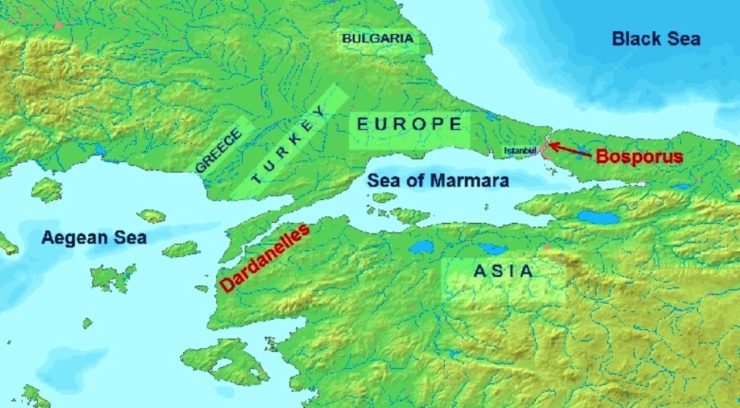
The territory of modern Turkey has economic-geographical and military-strategic advantages due to its control over the Black Sea Straits of Bosporus and Dardanelles. Control of the Black Sea Straits has always been strategically important to the great powers in world geopolitics and trade.
Great Britain and Russia often clashed over the right to control the Straits. In August 1914, German ships, including the cruiser Goeben and light cruiser Breslau, attacked Russian ports after passing through the Black Sea Straits. This led to the Ottoman Empire joining World War I on the side of Germany against Russia. One of the tasks of the Nazi German Ambassador to Ankara, Franz von Papen, in the late 1930s was to obtain Turkish consent for the passage of German ships through the Straits to the Black Sea to participate in the war against the USSR. Stalin later described Turkey’s policy during World War II as “hostile neutrality.”
In the 19th century, Russia’s successful wars against the Ottoman Empire enabled Russian control over the Black Sea Straits. However, Emperor Nicholas I of Russia, for some reason, decided to let in Britain and France in resolving the fate of the regime of shipping in the Black Sea Straits, while this issue could have become a subject of relations between solely Russia and Ottoman Turkey.
As a result, on July 3, 1841, the Straits Convention was signed in London, with the consent of the Russian Tsar, between Turkey, on the one hand, and Russia, Great Britain, Austria, Prussia, and France, on the other. It stipulated that as long as Turkey was not at war, the Straits would be closed to military ships of any nation. During the war, Turkey was granted the right to let ships through the Straits belonging to states with which it wished to reach an agreement. The London Straits Convention in fact buried the decisions of the Russian-Turkish Treaty of Hünkâr İskelesi of 1833, according to the secret articles of which Turkey undertook not to allow warships of any European countries to enter the Black Sea. Russia’s political and military positions have been significantly strengthened by the latter.
Following the results of the First World War, the Versailles Conference of the victorious countries again returned to the topic of the Black Sea straits, which continued with long negotiations, sharp discussions and ended with the signing of the Treaty of Lausanne on July 24, 1923, based on a project of Great Britain. The representatives of the Soviet delegation were actually blocked, and the head of the Russian delegation, Vatslav Vorovsky, was not even officially informed about the resumption of the conference and was not allowed to take part in the negotiations (on May 10, 1923, Vorovsky was assassinated in Lausanne by Russian White émigré named Maurice Conradi).
The Lausanne Treaty was signed between Great Britain, France, Italy, Japan, Greece, Romania, Bulgaria, the Kingdom of Serbs, Croats and Slovenes and Turkey. The USSR did not ratify the convention because its terms violated legal rights and did not guarantee the security of Black Sea countries. In particular, this convention provided for the demilitarization of the Straits Zone, with the Straits themselves coming under the control of a special international commission. In other words, the right to station military units near the straits was taken away from Turkey, through whose territory the straits passed. Simultaneously, all commercial and military vessels from any country in the world were granted free passage through the Bosporus and Dardanelles, with only minor restrictions. The latter created problems for the Black Sea countries, especially for the main Black Sea powers – Turkey and Russia.
The events of 1936 in Spain, the growth of Fascist militarism in Italy and Germany reopened the issue of the Black Sea Straits. Britain was concerned about losing control over Turkey, its naval bases, and its broad interests in the Mediterranean and the Arab East, including the restoration of the German-Turkish alliance. Therefore, London considered it appropriate to make concessions to Ankara on the issue of changing the regime of the Black Sea Straits and replacing the International Special Commission with Turkish control, including the abolition of Turkey’s demilitarization in the Straits Zone.
Consequently, following months of discussions, a new convention on the Black Sea Straits regime was signed on July 20, 1936, in the Swiss city of Montreux. This convention is seen as a compromise in international practice. In times of peace and war, merchant ships of all nations were granted the right of free passage through the Straits. Warships of non-Black Sea states are restricted in transit through the Bosporus and Dardanelles by class, total tonnage, total number and period of stay in the Black Sea not exceeding three weeks. In the case of Turkey’s taking part in a war, and if Turkey considers itself directly threatened by war, it is given the right to authorize or prohibit the passage of military ships through the Straits. Accordingly, the demilitarization regime was abolished, and Turkey was granted the right to station its military garrisons in the Straits Zone. The USSR’s demands for limitations on the military presence of non-littoral states in the Black Sea were mostly taken into account. London and Paris obtained the right to adjust the ratio of naval forces between Turkey and the USSR in the Black Sea.
Overall, the Montreux Convention can be viewed as a compromise that helped stabilize the situation in the Straits Zone. The Convention has been extended twice for 20 years. It remains in force as of now. The issue of the Black Sea Straits is currently being discussed in international diplomacy. This is especially true in times of crisis, when relations between major Black Sea countries, such as Russia and Turkey, become contentious.
With the start of the Russian Special Military Operations in Ukraine, hostilities have been resumed in the Black Sea basin waters. The Collective West, led by the United States, is attempting to alter the international legal norms that regulate the passage of warships through the Bosporus and Dardanelles.
According to US Assistant Secretary of Defense for International Security Affairs Celeste Wallander, Washington plans to collaborate with Ankara regarding shipping in the Black Sea. The Pentagon spokesperson emphasized the need to create a favorable environment in the region, ensuring that the Black Sea is fully accessible for commercial shipping.
Meanwhile, the United States is attempting to use merchant shipping as a cover to alter the regulations for the passage of non-Black Sea NATO warships through the Dardanelles and Bosporus to the Black Sea. For this purpose, the Black Sea Grain Initiative became a convenient opportunity.
The United States and the United Kingdom assert that Russia’s decision to withdraw from the agreement violates international humanitarian law. They propose the formation of an operational group under the convoy of NATO air and naval forces to transport Ukrainian grain through the Straits to foreign markets.
Retired US Navy Admiral James Stavridis announced in July 2023 that a convoy would be created under the control of the United States or NATO. A year earlier, The Wall Street Journal reported that Joe Biden Administration was considering new rules for the passage and navigation of warships in the Black Sea. The North Atlantic Alliance plans to deploy more military aircraft and ships to the Black Sea, according to NATO Secretary General Jens Stoltenberg.
In November 2023, US Congressmen Mike Rogers and Mike Turner urged President Joe Biden to deploy US military forces in the Black Sea to provide military support to Ukraine. Meanwhile, Commander Brian Harrington of the US Navy stated that conducting military exercises outside the scope of the Montreux Convention would undermine Russia’s dominance in the Black Sea. Perhaps these appeals and statements are intended more for the Turkish president.
The British and Norwegians have initiated a program to enhance Ukraine’s capabilities in the Black Sea. However, Turkey refused to allow two Sandown-class minehunters which were conditionally transferred by Great Britain to the Ukrainian Navy in June 2021, to pass through the Bosporus. According to Article 19 of the Montreux Convention, Turkey considers the ships of Russia and Ukraine as belonging to belligerent powers and therefore, they are not permitted to pass through the Black Sea Straits. London officials attempted to pressure Ankara, but were unsuccessful.
As for the warships of the US and other extra-regional countries that used to regularly enter the Black Sea using the right of peaceful passage, Turkey has announced within NATO that it will not allow naval exercises or visits for other purposes as long as the conflict continues. Ankara argues that violating the provisions of the Montreux Convention in the current situation will inevitably trigger retaliatory actions by the Russian Navy, leading to a new military escalation. Despite the dissatisfaction of NATO allies with Turkey’s position, Ankara does not intend to change it, showing the firmness and stubbornness typical of Turks.
The Montreux Convention does not allow the unimpeded passage of warships of non-littoral states in the Black Sea. However, after the collapse of the USSR and the Warsaw Pact, NATO gained an advantage in the Black Sea. In other words, prior to 1991, all Black Sea countries except for NATO’s Turkey were members of the Warsaw Pact and allies. Right now, the situation in the Black Sea is reversed. Namely, Russia on the one hand and NATO members Turkey, Bulgaria, Romania and the North Atlantic Alliance candidates Georgia and Ukraine on the other.
The US is not a signatory to the Montreux Convention at all and can therefore afford to violate its terms. Every five years since the signing of this convention in 1936, changes to its provisions may be proposed, provided that the initiative is supported by a two-thirds vote of the Montreux signatories. However, currently, all signatory countries except Russia are NATO members, and Japan and Australia are strategic partners or allies of the United States.
In this situation, Turkey’s opinion remains key as it still holds the role of “host of the Straits” under the Montreux Convention and maintains an independent policy. A change in the provisions of the convention would be a change in Turkey’s own status quo in the region. This is obviously not what Ankara wants. Crimea is now under Russian control, which could pose a threat to the same straits.
Russian Foreign Minister Sergey Lavrov stated that the Turkish authorities will not change the rules of entrance in the Black Sea for NATO warships under Pentagon’s pressure. However, Russia cannot rely on Turkey’s guarantees forever, as Ankara has shown a willingness to make sudden political reversals.
The US and Turkey are discussing the issue of closing the Bosporus to Russian warships, according to Iranian journalist Hayal Muadzin. In particular, there is information circulating that the US has offered to cede some areas in northern Syria, apparently Kurdish-populated provinces, to Turkey as a gift to Recep Tayyip Erdoğan, in exchange for active cooperation against Russia in the Black Sea.
In January, Turkey ratified Sweden’s NATO status in exchange for the delivery of 40 modernized F-16 fighter jets from the US. Washington is prepared to address the matter of F-16 Block 70 fighter jets for Turkey. Additionally, Deputy Secretary of State Victoria Nuland stated in Ankara that the US is willing to involve Turkey in the production program of fifth-generation F-35 fighter jets and provide them with a Patriot air defense system. This offer is contingent upon Turkey’s refusal to use the Russian S-400 Triumf SAM system. The Americans may be willing to provide soft loans to support the struggling Turkish economy, but only if Turkey refrains from actively cooperating with Russia in trade and economic matters and strictly adheres to the sanctions regime.
It is evident that Turkey faces numerous temptations. However, Recep Tayyip Erdoğan is aware that excessive improvisation towards Russia could jeopardize Turkey’s Great Turan project and its access to Azerbaijan and Turkic countries in Central Asia through the Zangezur corridor. For the time being, therefore, Ankara is trying to keep the “Russian side” of the fence. Turkey refuses to revise the provisions of the Montreux Convention in exchange for the “Swedish case.”
Turkish Foreign Minister Hakan Fidan confirmed that Ankara will continue to use the Montreux convention and stated that it is not up for debate. With the outbreak of the crisis in Ukraine, Turkey exercised its powers under the Montreux Convention and prohibited the passage of warships through the Black Sea Straits. The Turkish Defense Ministry aims to prevent further escalation of military tensions in the Black Sea basin, especially in the Straits area. The Straits pose not only an economic issue for Turkey, but also a security concern. Ankara has the right to charge for the passage of ships through the Bosporus and Dardanelles, which covers expenses for lighthouses, evacuation, and medical care.
In the rapidly evolving situation of the Ukrainian conflict, it is crucial for the Turks to maintain their key positions. There is a domestic political consensus on this issue: the provisions of the Straits Convention must remain unchanged. Turkey’s accession to Western sanctions against Russia is inadmissible; otherwise, Turkey will lose the opportunity to play a mediating role.
Met Office Fails to Retract False Claim of “More Intense” Storms Due to Climate Change
BY CHRIS MORRISON | THE DAILY SCEPTIC | FEBRUARY 22, 2024
The Met Office is refusing to retract a claim made by a senior meteorologist on BBC Radio 5 Live that storms in the U.K. are becoming “more intense” due to climate change. This is despite admitting in Freedom of Information (FOI) documents that it had no evidence to back up the claim. The Global Warming Policy Foundation (GWPF) noted the “false” claim seriously misled the public and demanded a retraction. The Daily Sceptic covered the story last Thursday and has since contacted the Met Office on three occasions seeking a response. “False information of this kind does much to induce climate anxiety in the population and I am sure you would agree such errors should be corrected by any reputable organisation,” it was noted. No reply was received – no retraction has been forthcoming.
The storm claim was made by Met Office spokesman Clare Nasir on January 22nd and led to an FOI request for an explanation by the investigative journalist Paul Homewood. The Met Office replied that it was unable to answer the request due to the fact that the information “is not held”. Interestingly, the Met Office’s own 2022 climate report noted that the last two decades have seen fewer occurrences of maximum wind speeds in the 40, 50, 60 knot bands than previous decades. The Daily Sceptic report went viral on social media with almost 3,000 retweets on X, while GWPF’s demand for retraction was covered by the Scottish Daily Express.
The lack of action by the state-funded Met Office is very interesting. Extreme weather is now the major go-to explanation for the opinion that humans largely control the climate, despite a general lack of scientific evidence. Backing away from this ‘settled’ narrative risks damaging a potent tool nudging populations across the world towards the collectivist Net Zero political project. Mainstream media usually take care to fudge their reporting of any direct link, using phrases such as ‘scientists say’ and sprinkling words ‘could’ and ‘might’ in the copy. The mistake Nasir made was to forget this basic requirement of broadcast fearmongering.
There appears to be an arrogance around the Met Office, an arrogance it shares with many other organisations and scientists promoting Net Zero. At the heart of this assumed superiority is the ludicrous claim that the science around human-caused climate change is ‘settled’. As a result of this, it seems many have lost the ability to debate their work with anyone taking an inquiring position. The scientific process has largely broken down in the climate science world. Secure in the knowledge that it will not be challenged, almost anything can be said on legacy media from a ‘consensus’ narrative point of view to promote the supra-national aims of Net Zero. On the legal front, this arrogance was in evidence in the summing up in the recent Mann v Steyn defamation trial in Washington D.C. The jury should award punitive damages to Michael Mann, inventor of the temperature ‘hockey stick’ graph, “so that in future no one will dare engage in climate denialism”, said Mann’s defending lawyer.
It is possible that if the Met Office is obliged to explain or retract what was after all just a routine scare broadcast on a tame state-reliant media outlet, it might be forced into more substantial scientific debate. How it abolished the global temperature pause from 2000-2014 by adding 30% extra warming on a retrospective basis to its HadCRUT5 record, and why it insists on promoting temperature records from busy U.K. airbases, are two subjects that spring immediately to mind.
Ineffable superiority was certainly on display when the Daily Sceptic recently reported that the Met Office was considered ditching the measurement of changes in temperature using data from the past 30 years in favour of a measurement compiled with 10 years’ past data and 10 years’ future modelled estimates. This was designed to promote a possible earlier breach of the political 1.5°C threshold. Lead author Professor Richard Betts, Head of Climate Impacts at the Met Office, tweeted a ‘rebuttal’ on X, noting we had taken three weeks to review the paper. “Or are they just very slow readers? I suppose our paper does use big words like ‘temperature’ so maybe they had to get grown-ups to help,” he added.
Why is the Met Office struggling to come up with any evidence to back up its claim that bad weather is caused by climate change? Because there is precious little of it. “People are going absolutely nuts these days about extreme weather,” writes the distinguished academic and science writer Roger Pielke Jr. “Every event, anywhere, is now readily associated with climate change and a portent of a climate out of control, apocalyptic even. I’ve long given up hope that the actual science of climate and extreme weather will be fairly reported or discussed in policy – nowadays, climate change is just too seductive and politically expedient,” he notes.
In its latest ‘Sixth Assessment Report‘, the Intergovernmental Panel on Climate Change (IPCC) reports that attempts to discern human involvement in severe storms outside natural variation remain of “low confidence”. In fact, it is unable to find human involvement in a wide range of weather-related events, not just in the past but out to the turn of this century.
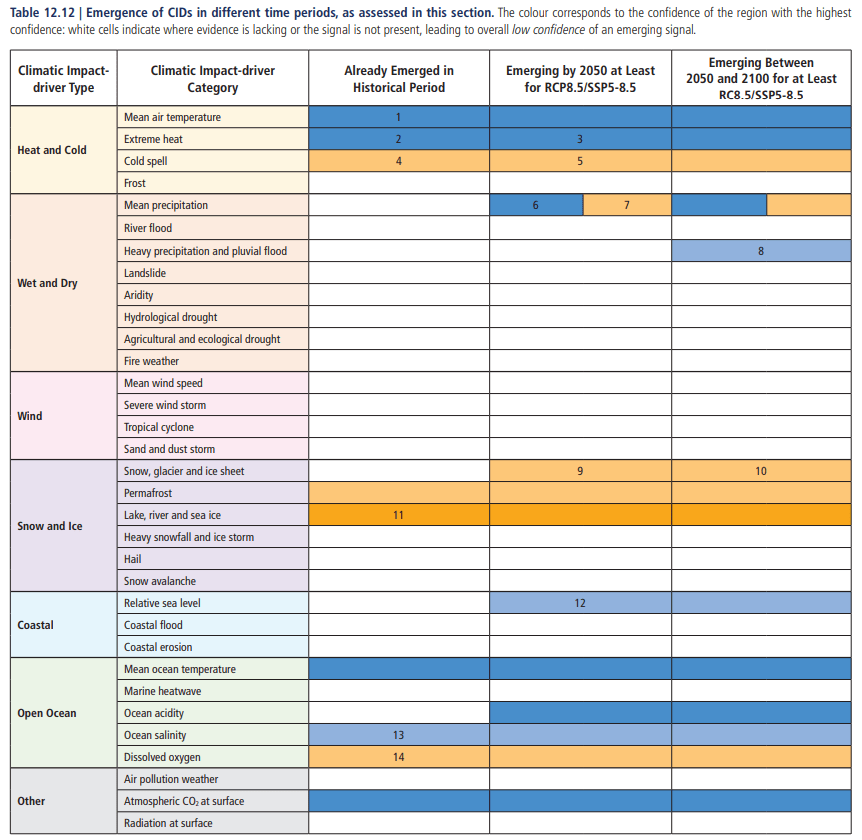
Beyond natural variability, the IPCC, much to the disappointment of alarmists, has concluded there is little or no evidence that the following events (table above) are or will be affected by human-caused climate change: river floods, heavy rain and pluvial floods, landslides, drought (all types), fire ‘weather’, severe wind storms (Met Office please note), tropical cyclones, sand and dust storms, heavy snowfall and ice storms, hail, snow avalanche, coastal flooding and erosion, and marine heatwaves.
Perhaps the Met Office doesn’t want to apologise for misleading the public over winter storms – it might put down an unwelcome marker for mea culpas becoming general across the entire media and climate front.
Chris Morrison is the Daily Sceptic’s Environment Editor.
London high court rejects legal challenge against UK arms sales to Israel
Press TV – February 21,2024
The High Court in London has rejected a legal challenge against UK weapons exports to Israel, despite growing concerns over human rights violations in war-torn Gaza Strip.
The court refused the appeal against the UK Department for Business and Trade (DBT) on Tuesday, saying the criteria requiring the DBT to consider whether there is a risk the weapons might be used in a violation of international law must be “clear” and has to be “of a serious violation”.
The court refusal said there was a “high hurdle” to overcome to establish the government’s conclusion was “irrational,” adding that “There is no realistic prospect of that hurdle being surmounted here.”
Palestinian human rights organization Al-Haq and UK-based Global Legal Action Network (GLAN) applied for a judicial review of the government’s export licenses for the sale of British weapons capable of being used in Israel’s war on Gaza.
They warned that the UK government is ignoring its own rules in the Israeli war on Gaza, saying they are seeking to overturn the court’s decision.
The legal challenge stated that the government has granted licenses for the sale of British weapons to Israel under a wide range of categories in recent years.
Existing UK arms export criteria say that if there is a “clear risk” that a weapon might be used in a serious violation of international humanitarian law (IHL) then an arms export should not be licensed.
Shawan Jabarin, general director of al-Haq, said the UK government’s decision to continue supplying Israel with weapons for offensive against men, women, and children in Gaza is effectively arming the occupying regime to “completely decimate” the Gaza Strip, reducing the besieged enclave’s vital civilian infrastructure to rubble.
GLAN also said the high court’s decision is out of step with the growing international consensus that Israel’s actions in Gaza amount to genocide.
The International Court of Justice (ICJ) has issued a preliminary ruling on a genocide case brought by South Africa against the Israeli regime, ordering Tel Aviv to take all measures necessary to prevent genocide in the Gaza Strip
Last week, a Dutch court ordered the government of the Netherlands to stop supplying F35 fighter jet parts to Israel within seven days, citing violations of international and humanitarian law. Italy and Spain also blocked all arms exports to Israel as soon as the attacks in Gaza started.
Israel waged the devastating war on Gaza on October 7 after the Palestinian resistance movement Hamas carried out a surprise retaliatory attack, dubbed Operation Al-Aqsa Storm, against the occupying entity over its intensified violence against Palestinians.
The Israeli aggression has so far killed more than 29,000 Palestinians, most of them women and children, and injured about 70,000 others in Gaza.
The Tel Aviv regime has imposed a “complete siege” on the territory, cutting off fuel, electricity, food, and water to the more than two million Palestinians living there.
According to the Campaign Against Arms Trade (CAAT), between 2015 and 2022, the UK licensed more than half a billion dollars worth of weapons to Tel Aviv.
Yemen says in talks with EU over Red Sea shipping safety
Press TV – February 21, 2024
Yemeni authorities have held “constructive talks” with the representatives of the European Union (EU) to ensure the safety of shipping in the Red Sea, Deputy Foreign Minister Hossein al-Ezzi says.
The Yemeni minister said on Wednesday that his country had ensured EU authorities during bilateral talks that the Red Sea is safe for international transit.
“We once again reiterate that the Red Sea is absolutely safe. Only passage to ships linked to three parties, namely the US, Israel and Britain, are blocked,” al-Ezzi was quoted as saying by Yemen’s al-Masirah TV channel.
Yemeni forces started carrying out attacks on Israeli-linked ships weeks after the regime launched the bloody hostilities in the besieged Gaza Strip in early October.
The strikes later expanded to target ships linked to the United States and Britain. The two countries have carried out airstrikes and naval attacks on Yemen’s territory in the recent past.
Yemen’s Ansarullah movement says attacks on ships will continue until Israel ends the campaign in Gaza, which has killed more than 29,000 people since early October.
The Yemenis have sought to ensure international shipping companies that their vessels can safely sail in three major regional waterways of the Red Sea, the Bab al-Mandab Strait and the Gulf of Aden if they have no connection to Israel, the US or Britain.
Ezzi said some 283 commercial ships had sailed in the Red Sea with complete safety this week despite claims by Washington that the waterway is not safe for commercial shipping.
“Unfortunately, shipping companies have been deceived by the US propaganda and reduced passage through the Red Sea because of US efforts to militarize the region,” he said.
Russia tears up Soviet-era fishing agreement with UK
RT | February 21, 2024
British fishermen will be banned from operating in the Barents Sea, one of the world’s largest fisheries for cod and haddock, under new legislation passed by the lower house of Russia’s parliament, the State Duma, on Wednesday.
The bill, which rescinds an agreement signed between the governments of the USSR, the UK, and Northern Ireland in 1956, was passed in its third reading.
The so-called Fisheries Agreement had allowed British ships to fish in the Barents Sea off the north coast of the Kola Peninsula. It was initially signed for a period of five years and automatically renewed every five years since neither party ever withdrew from the agreement.
“The agreement was unfortunately one-sided giving the authority and right to fish only to our partners at the time,” Deputy Agriculture Minister Maksim Uvaidov said, clarifying the details of the treaty. He added that the agreement didn’t provide Soviet fishermen with similar rights.
Taking into account the UK’s decision to strip Russia of ‘most favored nation’ status in 2022, which led to a 35% tariff hike on Russian goods, Moscow says that ending the Soviet-era agreement “will not cause serious foreign policy or economic consequences” for the country.
Commenting on the legislation, Duma Chairman Vyacheslav Volodin said that by tearing up the agreement Russia was returning to its own possession the fish that the UK had been consuming for decades.
“He [President Vladimir Putin] returned our fish to us, because the English, shameless, had been eating it for 68 years. They have imposed sanctions on us, while they themselves make up 40% of their diet, their fish menu, from our cod. Let them now lose some weight,” Volodin said.
A Sky News report from last year claimed that up to 40% of the cod and haddock consumed in the UK comes from Russia.
Featured Video

ARE PATIENTS BEING PROPERLY INFORMED ABOUT OZEMPIC?
or go to
Aletho News Archives – Video-Images
New Book
Breast Cancer: Before You Consent
A new Unbekoming paperback
Lies are Unbekoming | September 18, 2026
Peter Gøtzsche reviewed every randomised mammography screening trial ever conducted for the Cochrane Collaboration. Cochrane’s headline is that, assuming a 15% mortality reduction, one woman in 2000 avoids dying of breast cancer over ten years. Ten are overdiagnosed and treated. Two hundred experience false alarms.
But that headline assumes the reduction. When Gøtzsche looked only at the trials with adequate randomisation — the higher-quality ones — the reduction disappeared. No effect on breast cancer mortality. No effect on all-cause mortality.
This is the Cochrane finding, published in the establishment’s own database of systematic reviews.
No woman being asked to consent to a mammogram this week knows it.
That is why the new Unbekoming paperback exists. … continue
Blog Roll
 Aletho News
- ARE PATIENTS BEING PROPERLY INFORMED ABOUT OZEMPIC?
- US lawmaker blocks $2.8 billion weapons sale to Israel: Report
- Yemeni army claims responsibility for strikes on sensitive sites in Saudi capital, Aramco facilities in Yanbu
- Iran Judiciary issues indictments against 159 US, Israeli officials for assassination of Leader, commanders
- Turkiye revokes Iranian bank license under US sanctions campaign
- US-Denmark Agreement on Greenland Is ‘PR Stunt’ Ahead of Midterms
- Araghchi: Military intervention cannot create security; coercion cannot bring peace
- Fraud Squared
- Breast Cancer: Before You Consent
- Iran’s Plan to Shut Down AI in the Persian Gulf
- If Americans Knew
- Inside Gaza’s death trap of collapsing, bombed-out buildings
- The everyday items Israel bans from Gaza every day
- Inside the siege, the ruined buildings of Gaza – Daily Update
- Debunking The Claim That Macklemore Has A “History Of Antisemitism”
- CPJ demands release of arrested Palestinian-US journalist near Bethlehem
- Robert Kraft: The Billionaire Friend of Netanyahu Pulling The Strings Behind the Macklemore/Ed Sheeran Blow Up
- Columbia Administered Fund Gives Big Money to Pro-Israel Groups
- Deportation Case of Palestinian Activist Salah Sarsour Tests First Amendment
- ‘We Will Not Forget’: Palestinians Mark 44 Years since Sabra and Shatila
- Why do we let Zionists decide what we can and can’t say?
- No Tricks Zone
- New Study: ‘Global Drought Shows No Detectable Recent Acceleration Under Climate Warming’
- Economic Masterminds: German Socialists Suggest Taxing Productivity Gains Stemming From Using AI
- The South China Sea Has Not Been Cooperating With The Climate Change Narrative
- Energy Crisis: Germany Enters Heating Season With Historically Low Gas Reserve Fill Levels
- New Study: The Antarctic Ice Sheet Gained Mass From 2020-2024 Due To Staggering Snow And Ice Accumulation
- Study: Ocean Heating Rates From Thousands Of Years Ago ‘Dwarf’ Modern Ocean Heating Rates
- Climate Extremists Target, Attack Large-Scale Power Grid Infrastructure In Germany!
- New Study: Antarctic Ice Melt Has Contributed Less Than 1 Centimeter To Sea Level Rise In The Last 30 Years
- Fear Of Debate: Alarmist German Climate Scientist Calls On Mainstream Media To Discredit Skeptic Voices
- End-Of-August Arctic Sea Ice Extent Hasn’t Fallen In 20 Years, Official Data Show!
 Aletho News