Gaza is paying the ultimate price for decades of media pandering to Zionist bigotry
By Jonathan Cook | March 6, 2024
The Guardian and other media continue to prioritise the ‘sensitivities’ of an ideological minority over the public’s right to protest against a genocide in which our elites are complicit
We all understand that, shamefully, a number of Zionist Jews and non-Jews identify so completely with Israel that they are not only willing to excuse the mass slaughter and starvation of civilians in Gaza but think others should not even be allowed to express disquiet at the slaughter.
Hardline Zionists tell us they find concern for the welfare of Palestinians “offensive”, and that they feel “unsafe” when others raise such concerns or call for a ceasefire to end the bloodshed.
The question for the rest of us is: How do we deal with those “sensitivities”, and how much do we prioritise the “offence” taken by hardline Zionists?
Not unreasonably, most ordinary people place very little weight on the “sensitivities” of those who believe mass slaughter and the starvation of children should be allowed to proceed, at least when weighed against the sensitivities of those opposed to mass death.
What’s so weird is the way, as far as official bodies and the western media are concerned, those priorities have been turned upside down.
Here, in typical fashion, the Guardian falls over backwards to indulge the “feelings” of a few Jewish Arsenal fans because they “felt unsafe” and “betrayed” by their club for not more aggressively stopping protests last weekend at a Women’s Super League game by other fans over the complicity of the UK government in Gaza’s genocide.
No evidence is produced by either the fans or the Guardian that any Jewish fan was in any danger whatsoever. Just that a few Palestinian flags were smuggled into the stadium, that leaflets and stickers were handed out, and that some protesters tried to “engage” with fans as they arrived at the stadium – presumably in that dangerous tradition of trying to persuade others of the validity of one’s position.
But the Guardian sympathetically dedicates a great deal of space to relaying the concerns of the handful of Jewish fans who “believe their safety was compromised by security staff not curtailing the protest” – that is, those who wanted to prevent an entirely peaceful demonstration taking place in a public space outside the ground.
The story is risible. It is news as therapy for Zionists and gaslighting for the rest of us.
But it is decades of nonsense journalism about Israel and its apologists of precisely this kind that has led us to the dismal place we are today.
The constant indulgence by the political and media class, the constant elevation of these kinds of ugly, ignoble “feelings” – feelings that dehumanise and vilify Palestinians, as well as anyone acting in solidarity with their suffering – the constant treatment of Zionist bigotry as warranted, as justified, as normal, that has gotten us to a position where Israel can commit genocide and its western allies and parts of their Jewish populations can treat it as “offensive” to raise the matter.
If we had not got so entirely used to it, we would immediately understand how completely nuts – and catastrophically inhumane – the coverage is.
Germany and NATO Caught Red-Handed in War Planning
By Finian Cunningham | Strategic Culture Foundation | March 6, 2024
German military leaders may have bungled foolishly over their private discussions regarding operational plans against Russia. However, the security of their incompetent communication – while laughable – does not lessen the seriousness of what was being discussed.
Lt. General Ingo Gerhartz and his aides were earnestly weighing up the technical and propaganda means by which to strike Russia with long-range ballistic missiles. In short, a NATO member was caught red-handed hatching an act of war against Russia.
After Russian media published the audio of the conversation, the German reaction has been to dismiss it as a cerebral war-gaming exercise and as an attempt by Russian disinformation to undermine the government of Olaf Scholz.
This obfuscation by Berlin will not wash. The incontrovertible fact is that the German commanders were deliberating on how to “optimize” the Ukrainian offensive capability to hit Russian targets with the long-range German Taurus cruise missile. The weapon has supposedly not yet been supplied to the Ukrainian regime due to concerns among some German politicians that doing so would escalate the war with Russia. It is clear from the audio tape that the German military chiefs are frustrated by the politicians not ordering the supply of the Taurus.
Gerhartz, the head of the German air force, tells his subordinates in no uncertain terms: “We are now fighting a war that uses much more modern technology than our good old Luftwaffe.”
There you have it: the top German commander says unequivocally, “We are now fighting a war”.
He also goes on to disclose that the American, British, and French militaries are deeply involved in the logistics and planning of attacks by the Ukrainian forces.
We know from numerous other sources that the NATO militaries are involved on the ground in Ukraine fighting against Russian forces. American HIMARS and Patriot missile systems, and the British Storm Shadow and the French Scalp cruise missiles are operated with military expertise from these NATO members.
Still, what is highly damaging from the German military leak is the extent to which the commanders endeavor to conceal the involvement of Germany in a war with Russia. The tortuous conversation about how to avoid the imputation of the German military makes it clear that the German high command knows full well the gravity of what they are organizing. They are discussing the conduct of a covert war against Russia. This is tantamount to the crime of aggression and it runs the risk of starting a full-on war which would no doubt escalate into a nuclear conflagration.
At one point in the discussion with his interlocutors, Lt Gen. Gerhartz talks about the need to conceal direct military involvement by Germany in supplying the Taurus missiles to Ukraine.
He says: “I understand what you are talking about. Politicians may be concerned about the direct, closed connection between Büchel [German air base] and Ukraine, which could become direct participation in the Ukrainian conflict. But in this case, we can say that the exchange of information will take place through MBDA [the German manufacturer of Taurus], and we will send one or two of our specialists to Schrobenhausen. Of course, this is a trick, but from a political point of view, it may look different. If information is exchanged through the manufacturer, then this is not associated with us.”
This is self-incriminating evidence that the German high command is participating in a conspiracy to expand the war against Russia. The only reservation is not to be identified publicly in waging war acts. With utmost cynicism, the German military leaders are looking for a way to claim plausible denial after the crime.
Former Russian president Dmitry Medvedev, now deputy chairman of the National Security Council, called it correctly when he said of the leaked audio tapes that they show Germany is planning war against Russia.
Berlin dismissed Medvedev’s claim as “absurd”. Berlin is the one being absurd if it thinks that the conversation of its military leaders can be palmed off as simply idle banter and theoretical war gaming.
In the 38-minute discussion, the Luftwaffe commander and his underlings explicitly talk about supplying up to 100 Taurus missiles for Ukrainian regime forces to strike deep into Russia. The German top brass refer to the Taurus as a “super tool” and they specifically identify the destruction of an important bridge in the east, which is presumably the Kerch Bridge linking the Russian mainland to Crimea.
The German missile has a range of over 500 kilometers which is twice that of the British or French weapons.
It looks like the German military is taking on the task of leading deep strikes into Russia. London is reportedly urging Berlin to supply the Taurus missiles despite the embarrassment of the leaked private conversation.
This week it is reported that a railway bridge was destroyed in Russia’s southwest Samara province near the city of Chapaevsk. The location is further east than Moscow and is around 1,000 km from the NATO-backed Kiev regime’s front lines in Ukraine. The attack appears to have been a precision strike.
As the German commanders noted in their discussions, collapsing a bridge is one of the most difficult aerial operations that requires precision capability and sophisticated radar evasion. Their conversation took place on February 19. The leak was published last weekend. Media reports say the German government is opposed to signing off on supplying the missiles. But with so much going on behind the public’s back who knows if and when these weapons are released? Have they been already?
If it is confirmed that the bridge near Chapaevsk was hit by a missile then it would appear that the NATO war against Russia has reached a new ominous threshold.
Some Western media outlets commented that the Russian publication of the Luftwaffe audio tape last weekend was aimed at embarrassing the German Chancellor Olaf Scholz into definitely ruling out any supply of Taurus missiles to Ukraine. However, such speculation assumes that Scholz is in control of his military commanders. Most likely they don’t answer to him; they answer to the occupying power in Germany – the United States.
Latest European Propaganda: Russia Is Flooding Europe With Illegal Migrants
By Robert Bridge | Strategic Culture Foundation | March 5, 2024
Western media is in full-blown hysteria mode, asserting that Vladimir Putin is ‘weaponising’ the flow of migrants in an effort to destabilize upcoming European elections.
Right up there with ridiculous claims of “little green men” and “tractor protests from Moscow,” Europe is now accusing Russia of fielding paramilitary forces and private mercenaries for the purpose of directing waves of migrants from Africa across the Mediterranean Sea and into the heart of Europe, an apparent effort to ratchet up the spring fever just in time for general elections across the continent.
With no loss of irony, Western propagandists are disseminating allegations that the Kremlin is in the process of agitating those African nations that for so long suffered from European colonial rule, namely Burkina Faso, Mali, Sudan, Ghana, Central African Republic and Libya, a formerly highly developed country that was destroyed by a U.S.-led attack in 2011.
The Telegraph would have its British readers believe it has “seen” intelligence documents detailing plans for “Russian agents” to create a “15,000-man strong border police force” comprising former militias in Libya to control the flow of migrants. Anyone hoping to review something like photographic evidence of this massive army would be advised not to hold their breath. Apparently, the thousands of Russian recruits are so technologically advanced they are invisible to spy satellites.
While it stands to reason that millions of desperate refugees from these turbulent nations would seek shelter in Europe, or possibly even in the United States, risking a trans-Atlantic journey to reach the wide-open U.S.-Mexican border, Brussels simply hopes to deflect attention away from its immigration failures onto Moscow, a sham that is transparent to anyone with even a half-functioning brain.
Let’s not forget that we’ve heard such allegations before.
Without so much as a single apprehended trespasser, Moscow was accused of trying to foment a refugee crisis by transferring asylum seekers to its border with Finland, thus prompting the new NATO lackey to close its land crossings with Russia in contravention of all diplomatic norms. The truth of the matter is that Helsinki was aggravating Russophobia to make the bitter pill of increased spending on Western-made (read: American) armaments go down smoother for Nordic voters.
Belarus, Russia’s closest ally, has also been accused – once again, without a shred of evidence – of sending immigrants from the Middle East and North Africa to its borders with Poland, Lithuania and Latvia.
The latest wave of Russophobia to strike the European capitals comes at a time when migration is set to be a key issue in general elections on the continent, as well as in the UK, where the drumbeat about Russian-sponsored migrant invasion parties resonates the loudest.
An unidentified security source reportedly told the Telegraph : “If you can control the migrant routes into Europe then you can effectively control elections, because you can restrict or flood a certain area with migrants in order to influence public opinion at a crucial time.”
“A failure to control the number of migrants coming to the UK is already seen as a major weakness for Rishi Sunak who is struggling to push through a scheme to deport illegal migrants to Rwanda to stop the flow of small boats across the Channel,” the British daily continued.
Sunak made “stopping the boats” one of his top priorities as Prime Minister, though a survey of British sentiment earlier this year showed that three-quarters of voters believe the pledge has not gone well.
Since June 2023, over 52,000 illegal migrants were recorded as entering the UK, up 17 percent on the previous year. Data released last month revealed that the number of illegal migrants granted asylum in the UK hit a record high in 2023 as border guards waved through thousands of applications “in an attempt to clear a huge post-pandemic backlog.” What is even more laughable, albeit totally predictable, is that the people doing the “waving through” were British border officials, not secret “Russian agents.”
With EU elections in June, the European parliament looks set to shift hard to the right, with migration already proving to be a key issue for voters. Who best to blame for this approaching debacle? Certainly not Angela Merkel, who is personally responsible for much of the mess. Once again, Russia serves as a convenient bogeyman for the blockheaded decision-making processes coming out of the EU, and we’ve heard such accusations before.
In February 2016, one year after Merkel opened the floodgates to some 2 million migrants, many of them Muslims from Syria, U.S. General Philip Breedlove, Head of NATO forces in Europe, blamed Russia for working to exacerbate the refugee flows in a dastardly ploy to destabilize and destroy the EU. In a testimony before the House Armed Services Committee, he said, “Together, Russia and the Assad regime are deliberately weaponizing migration from Syria. In an attempt to overwhelm European structures and break European resolve.”
Nearly a decade later, the same reckless utterances are being made, although this time around the European public, more skeptical about ‘Russia the enemy’ narrative following the Nord Stream fallout, is prepared to express its anger at the ballot box come June during elections for European Parliament. Far-right populist parties are polling well in several EU countries, notably in Austria, Germany, Italy and the Netherlands. This terrifies Brussels, as the threat of a right-wing takeover appears imminent, and Europe has only itself to blame for that.
The conflict in the Red Sea and the reaction of the world community
By Viktor Mikhin – New Eastern Outlook – 04.03.2024
During the discussion that took place on 14 February 2024 at the UN Security Council meeting, questions were raised about the unlawful shelling by the US and UK in Yemen in violation of all international laws and regulations. This serious issue was discussed in detail due to the violations of international law and human rights that accompany these shellings. The UNSC participants condemned these actions by the US and the UK as illegal and unacceptable. Despite demagogic statements about the fight against terrorism and alleged support for international security, such shelling by Western powers located tens of thousands of kilometres away from the Red Sea basin only exacerbates the humanitarian situation in Yemen and causes irreparable harm to the lives of civilians, including primarily children and women. At the meeting, the panellists rightly raised the need to put an urgent end to this shelling and to return to negotiations for a peaceful resolution of the conflict. It was noted that another wave of violence by Western countries would only exacerbate the situation in that poor Arab country and hinder the achievement of sustainable peace in the region.
Russia’s and China’s opinion
Russia and China have deemed the US and UK bombing of Yemeni territory illegal and contrary to the United Nations Charter, accusing them of illegally attacking Yemen, whose residents support the Palestinians of the Gaza Strip in the face of the Israeli regime’s bloodbath. Russia’s Deputy Ambassador to the UN Dmitry Polyansky and China’s representative to the UN Zhang Jun stressed that the UN Security Council has never authorised military action against Yemen. For his part, the UN special envoy for Yemen, Western representative Hans Grundberg, said that the US and UK attacks and the American declaration of the Ansar Allah resistance movement in Yemen as a “specially designated terrorist group” were merely “of concern.” And what exactly could this so-called envoy, who is entirely on Washington’s payroll and receives all instructions from White House officials, have said.
Mr Polansky correctly emphasised that the root cause of the current situation is Israel’s war crimes in Gaza, which have provoked angry reactions in West Asia, including from Yemenis. “An immediate ceasefire in Gaza will help stabilise the situation in the Red Sea, and de-escalation will in turn unblock the efforts of Special Envoy Grundberg,” he said. The Chinese envoy also expressed concern over the escalation of tensions in the Red Sea region, in particular “the continuation of military operations by certain countries” against Yemen. He called for an immediate halt to the Yemeni hostilities against merchant shipping and stressed the fact that the UN Security Council has not authorised the use of force against Yemen.
“At this critical moment, China hopes that all parties in Yemen will put the interests of the people first, show determination and resolutely push the political process forward to achieve final results,” Zhang Jun added. He also emphasised that “the most urgent task is to immediately promote a ceasefire in Gaza and take responsible measures to prevent further escalation in the region.”
Aggressive actions of the US and UK
For weeks, the United States and Britain have been waging a fierce bombing campaign on Yemeni territory. The reason is well known – this Arab country has boldly declared its open support for the Palestinians in the besieged Gaza Strip against the Israeli carnage since 7 October last year, in which some 30,000 civilians, especially the elderly, women and children, have already been killed. The US, being one of the leading superpowers and a global factor, has stated its brazen stance on the issue of shelling Yemen. They deny their direct involvement in the conflict, claiming that they are only supporting military assistance and supplies to Saudi Arabia, which in turn is conducting operations to defeat the Houthis. However, human rights advocates and humanitarian organisations have raised accusations of US involvement in human rights and civilian violations during these operations.
Despite strong condemnation of its brutal and aggressive actions, the United States has again “conducted five strikes in self-defence” against areas of Yemen controlled by the Houthi militia, the US Central Command said. It struck three mobile anti-ship cruise missiles, one unmanned underwater vessel and one unmanned surface vessel on 17 February, the statement said. “This is the first observed use of an unmanned aerial vehicle by the Houthis since the attacks began on 23 October,” CENTCOM said in a statement on its X website. Central Command said it had determined the missiles and ships posed “an immediate threat to U.S. Navy ships.” The Houthi attacks in the Red Sea area have been one of the signs of spreading conflict in the Middle East since war broke out between Israel and Hamas after 7 October.
Unlike the US, the UK, its closest ally and most likely a country once with a solid international reputation, chooses not to explicitly support Saudi Arabia, but also does not actively oppose it. Instead, London claims to be providing military assistance centred on training and advice to prepare the Saudi army for its tasks. In these statements, the British demagogically point to the importance of maintaining the stability of the region and fighting terrorism. However, in doing so, they forget to recall that it is they, together with their overseas partners, who are the main disturbers of peace and tranquillity and the main “creators” of the atmosphere of terrorism in the region.
Alongside these states, some delegates from US satellite countries expressed support for the US and UK, arguing that the shelling was in response to acts of terrorism and extremism that threaten world security. They emphasise the need for action to ensure the safety of their citizens and partners. The UN Security Council meeting was by all accounts very tense and controversial, reflecting the complexity of the situation in Yemen and the multifaceted challenges faced by the parties to the conflict. But it was nevertheless called for further discussion and for finding ways to end the violence and restore peace. In conclusion, the UN Security Council meeting emphasised that violators of international law and human rights, including the systematic shelling of Yemen, must be brought to justice and those responsible must be punished accordingly. The decision on further steps and investigations was postponed until all the arguments made during the discussion are recorded, and a relevant document is prepared for further voting.
Ways and means of resolving the conflict in the Red Sea
Human rights advocates and humanitarian organisations object to this position and allege US and UK complicity in human rights and civilian violations in Yemen. Critics also point out that US and UK military aid could be used to commit crimes against humanity and military operations could be disproportionate and indifferent to civilians. The need to resolve the conflict in Yemen is integral to upholding international law and protecting human rights. The world community must continue dialogue, find a political solution and provide humanitarian assistance to end the exclusively military approach and eliminate civilian suffering. So, the position of the US and UK on the shelling of Yemen is causing disagreement and concern among human rights supporters and humanitarian organisations. It is necessary to continue the international discussion in order to achieve peace and stability in the region, calling for respect for international law and the protection of human rights.
Yemen continues to actively target American and other ships that deliver supplies to Israel. The Yemenis’ main argument in favour of shelling ships delivering supplies to Israel is the destruction of Palestinian civilians in the Gaza Strip. In their view, the situation in Palestine remains tense due to Israeli occupation and state policies, leading to regular conflict and violence. In turn, by supporting trade with Israel, American and other ships become indirect contributors to Palestinian suffering. Yemen’s weakened economy and infrastructure put the country in a difficult position. Regular new sanctions and the blockade of the country by international allies make Yemen’s economy extremely vulnerable. For Yemen, the shelling of ships delivering supplies to Israel may be an attempt to gain international attention and launch a dialogue on the Palestinian issue.
In today’s world, the Red Sea remains a key region of geopolitical importance. Along with issues of security and economic stability, emerging conflicts between states and factors in the region regularly attract international attention. However, there are different ways and factors that can play an important role in resolving and preventing conflicts in order to achieve peace and tranquility in the Red Sea.
Above all, the States in which the Red Sea is located must take an active part in finding a way to resolve conflicts peacefully. They should seek dialogue and international cooperation rather than the use of force and military action. Instead of creating tension and threatening security, states should seek common interests and co-operation in the fields of economy, trade, transport and combating international terrorism.
However, in addition to the active role of states, international organisations and forums can play an important role in resolving conflicts in the Red Sea. For example, the United Nations can mediate negotiations and facilitate agreements between states in the region. It can propose mechanisms and strategies to resolve disputes and support dialogue between parties. Also, regional international organisations such as the Arab League or the African Union can contribute to conflict resolution and stability in the Red Sea.
In addition, the role of civil society and non-governmental organisations should not be forgotten. They can play an important role in planting peace and tranquility in the region through engaging in diplomatic efforts, supporting dialogue between the parties and publicly highlighting conflicts. Civil society can give a voice to peace and help to shape public opinion in favour of the peaceful resolution of conflicts.
It is quite clear that conflicts in the Red Sea can and must be resolved in the interests of peace and tranquillity in the region. To that end, the active participation of States, international organisations, civil society and non-governmental organisations is essential. Only through cooperation and dialogue can sustainable peace and tranquillity in the Red Sea be achieved, which will benefit all States and peoples living in the region.
Victor MIKHIN is a Corresponding Member of the Russian Academy of Natural Sciences.
UK Has Only Itself to Blame for Red Sea Attacks, Houthis Say as They Vow to Ramp Up Campaign

© Photo : Ansar Allah Media
By Ilya Tsukanov – Sputnik – 03.03.2024
The Yemeni militia began a campaign of hijackings, missile and drone attacks against commercial ships operating in the crucial Red Sea global trade chokepoint in November, vowing to target any vessel thought to be affiliated with Israel, and subsequently shutting down a good chunk of global trade.
London has only itself to blame for attacks targeting its commercial vessels in the Red Sea, and the strikes will continue, officials from Yemen’s Ansar Allah (Houthi) militia said in a series of statements over the weekend.
“Yemen will continue to sink more British ships, and any repercussions or other damages will be added to Britain’s bill,” Houthi deputy foreign minister Hussein al-Ezzi said in an X post Sunday.
“[The UK] is a rogue state that attacks Yemen and partners with America in sponsoring ongoing crimes against civilians in Gaza,” al-Ezzi wrote, referencing the joint US-UK campaign of airstrikes inside Yemen which the Pentagon says are aimed at degrading the Houthis’ missile and drone capabilities.
The official’s comments came hours after United States Central Command confirmed that the UK-owned M/V Rubymar cargo ship carrying 21,000 tons of ammonium phosphate sulfate fertilizer had sunk in the Red Sea after being targeted by the Houthis on February 19.
Houthi Supreme Political Council member Mohammed Ali al-Houthi took to X Saturday night to address the UK prime minister directly.
“We say to [Prime Minister Rishi] Sunak: you and your government bear responsibility for the M/V Rubymar, and responsibility for supporting the genocide and siege in Gaza,” al-Houthi wrote in an Arabic-language X post.
“You have a chance to salvage the M/V Rubymar by sending a letter of guarantee signed by George Galloway that the relief trucks agreed upon would enter Gaza,” al-Houthi added, referencing the Workers Party of Britain MP elected in a landslide in the Rochdale by-election on February 29.
Galloway has been an outspoken critic of British support for Israel amid the Gaza crisis, and an outspoken critic of American and British policy in the Middle East going back to the 2003 invasion of Iraq.
The Houthis kicked off a months-long maritime campaign of ship hijackings, drone strikes and missile launches in November in solidarity with Gaza amid Israel’s ground assault into the besieged Palestinian enclave. The US announced the formation of a naval ‘coalition of the willing’ against the Houthis in December, and began bombing Yemen in January together with Britain. The Houthis responded by barring all commercial and warships belonging to British and American “losers” from operating in the Red Sea, the Gulf of Aden and the Bab al-Mandab Strait, repeatedly firing at Western warships deployed in waters adjacent to Yemen.
Shipping through the Red Sea has declined precipitously by as a much as 40 percent from its normal levels, with the Houthis adding tens of billions of dollars in global shipping costs, disrupting supply chains linking Europe and Asia, and resulting in a rise in energy prices.
A Third of U.K. Met Office Temperature Stations May Be Wrong by Up to 5°C, FOI Reveals
BY CHRIS MORRISON | THE DAILY SCEPTIC | MARCH 1, 2024
Nearly one in three (29.2%) U.K. Met Office temperature measuring stations have an internationally-defined margin of error of up to 5°C. Another 48.7% of the total 380 stations could produce errors up to 2°C, meaning nearly eight out of ten stations (77.9%) are producing ‘junk’ or ‘near junk’ readings of surface air temperatures. Arguably, on no scientific basis should these figures be used for the Met Office’s constant promotion of the collectivist Net Zero project. Nevertheless, the state-funded operation frequently uses them to report and often catastrophise rises in temperature of as little as 0.01°C.
Under a freedom of information request, the Daily Sceptic has obtained a full list of the Met Office’s U.K. weather stations, along with an individual class rating defined by the World Meteorological Office. These CIMO ratings range from pristine class 1 and near pristine class 2, to an ‘anything goes’ or ‘junk’ class 5. The CIMO ratings penalise sites that are near any artificial heat sources such as buildings and concrete surfaces. According to the WMO, a class 5 site is one where nearby obstacles “create an inappropriate environment for a meteorological measurement that is intended to be representative of a wide area”. Even the Met Office refers to sites next to buildings and vegetation as “undesirable”. It seems class 5 sites can be placed anywhere, and they come with a WMO warning of “additional estimated uncertainties added by siting up to 5°C”; class 4 notes “uncertainties” up to 2°C, while class 3 states 1°C. Only 13.7%, or 52 of the Met Office’s temperature and humidity stations come with no such ‘uncertainty’ warnings attached.
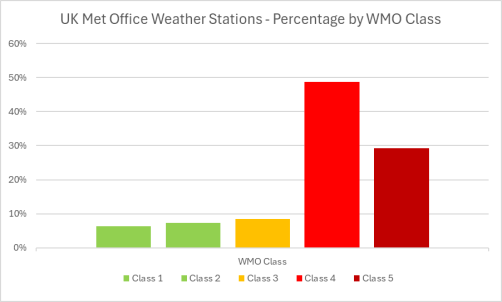
The above graph shows the percentage totals of each class. Class 1 and 2, identified in green, account for just 6.3% and 7.4% of the total respectively. Class 3 identified as orange comes in at 8.4%. The graph shows the huge majorities enjoyed by the darkening shades of red showing classes 4 and 5. It is possible that the margins of error identified for classes 3, 4 and 5 could be a minus amount – if for instance the measuring device was sited in a frost hollow – but the vast majority are certain to be pushed upwards by heat corruptions.
Last year, the investigative journalist Paul Homewood sought FOI information from the Met Office about the Welsh weather station Porthmadog, which often appears in ‘hottest of the day’ listings. He was informed that the site was listed as class 4 and “this is an acceptable rating for a temperature sensor”. Hence, continued the Met Office, “we will continue to quote from this site”. In short, observes Homewood, the Met Office is happy to use a class 4 site for climatological purposes, “even though that class is next to junk status”. It is bad enough that the Met Office is using this site, but it is even worse that they know about the issues but still plan to carry on doing so, Homewood continued. “How many other weather stations are of such poor quality?” he asked.
Now we know.
Using these figures with a precision to one hundredth of a degree centigrade, the Met Office declared that 2023 was the second hottest in the U.K., coming in just 0.06°C lower than the all-time record. Cue, of course, all the Thermogeddon headlines in mainstream media. In 2022, the Met Office said that five sites in the U.K. on July 19th went past 40°C, with a record of 40.3°C at RAF Coningsby. Kew Gardens is termed a class 2 site, although it is very close to one of the largest tropical glasshouses in the world. St James’s Park and Northolt airport are class 5 sites, Heathrow is class 4, while RAF Coningsby is class 3. At the time, the Met Office declared that the records set a “milestone in U.K. climate history”. A national record was also set on July 18th at Hawarden Airport in Wales (class 4) and on July 19th at Charterhall in Scotland (class 4).
Always alive to a popular headline catastrophising the weather, the Met Office declared a warmest St. Valentine’s night English record this year of 11.5°C at class 4-rated St. Mary’s airport on the Isles of Scilly. Earlier in the year, the Met Office declared the highest January temperature in Scotland at 19.6°C at Kinlochewe, a class 4 site. Interestingly the previous, much promoted, U.K. record was set on July 31th 2019 at the Cambridge Botanic Gardens, a class 5 site. Even more interesting is that in the Homewood FOI disclosures, the Met Office stated that class 5 data “will be flagged and not quoted in national records”.
The Met Office is between a rock and a hard place with these surface temperature measurements. Many of its long-standing stations have been encroached by urbanisation and corruptions seem to have become endemic across the entire system. In the past, this didn’t matter as much since margin of error allowances could be accepted along with less accurate local and national weather forecasting. Measuring surface temperatures across countries and then the planet is always going to be difficult, but a more accurate reading would be obtained by only using data from WMO classes 1 and 2. However, national and global temperatures have become politicised by the global warming scare and the proposed Net Zero solution. Alarmists often state that climate ‘tipping’ points will be reached with very small increases in temperature measured in tenths of a degree.
Using data from just classes 1 and 2 would likely crash the claimed rises in national and global temperatures. Something similar would likely occur if the Met Office moved the majority of its stations to more suitable spots. A number of scientists have tried to measure the urban heat bias in temperature records with estimates suggesting a general problem of warming corruption around the 20-30% mark. Last October, two scientists working out of the University of Alabama in Huntsville (UAH), produced a paper noting: “The bottom line is that an estimated 22% of the U.S. warming trend, 1895 to 2023, is due to localised UHI [urban heat island] effects.”
Under our FOI request, it can now be seen that the problems with corrupted U.K. weather stations are similar to those discovered in the United States by meteorologist Anthony Watts. In work compiled over a decade, Watts found that 96% of temperature stations used by the U.S. weather service NOAA were “corrupted” by the localised effects of urbanisation. Sites in close proximity to asphalt, machinery and other heat-producing or heat-accentuating objects, “violates NOAA’s own published standards, and strongly undermines the legitimacy and magnitude of the official consensus on long-term climate warming trends in the United States”, he observed.
Both the U.K. and U.S. temperature datasets are important constituents of global totals compiled by a number of weather operations including the Met Office and NASA. The Met Office runs HadCRUT, where over the last 10 years two retrospective revisions have added about 30% extra warming to recent global temperatures. This had the effect of removing all traces of a pause around 2000-2014. Meanwhile, Professor Ole Humlum has noted that the GISS database run by NASA increased its surface air temperature between 1910 to 2000 from 0.47°C to 0.67°C, a boost of 49% over this period. “Frequent and large corrections in a database unavoidably signal a fundamental uncertainty about the correct values,” commented Humlum.
Pristine temperature data is available. In 2005, NOAA set up a 114 nationwide network of stations called the U.S. Climate Reference Network (USCRN). It was designed to remove all urban heat distortions, aiming for “superior accuracy and continuity in places that land use will not likely impact during the next five decades”.

The graph above shows nothing more than very minor, gentle warming since 2005, slight warming that might be expected in the small and continuing natural rebound from the depths of the pre-industrial Little Ice Age. A reliable source of global data is to be found in the UAH satellite record, which shows less overall warming since 1979 than the surface datasets. Both these datasets are rarely mentioned. In fact one of the compilers of the satellite data, along with the UAH paper on urban heat, is Dr. Roy Spencer. In 2022 he was kicked off Google AdSense for publishing “unreliable and harmful claims”. The move demonetised Dr. Spencer’s widely consulted monthly satellite temperature update page by removing all Google-supplied advertising. Google is on record as stating that it will ban all sites that are sceptical of “well established scientific consensus”.
Chris Morrison is the Daily Sceptic’s Environment Editor.
US, UK accused of hindering investigation into UN chief’s plane crash in 1961

UN secretary general Dag Hammarskjöld, who died in a plane crash in Africa in 1961 en route to talks with Katangan rebels. (Photo by REX)
Press TV – March 2, 2024
Scholars have accused the United States and the United Kingdom of impeding a United Nations investigation into the 1961 airplane accident that resulted in the death of UN chief Dag Hammarskjöld.
Hammarskjöld, a Swedish national, was killed in a plane crash, which was allegedly taken down intentionally on September 18, 1961, while en route to mediate a ceasefire between UN peacekeepers in the Congo and separatists from the breakaway Congolese region of Katanga.
During a conference in London, attendees were briefed by Stephen Mathias, the UN assistant secretary general for legal affairs, on the latest developments in the investigation, which aims to obtain archived documentation from member states.
The attendees expressed concerns that both the US and UK were delaying the transfer of potentially crucial information.
“While Belgium, Sweden and Zimbabwe demonstrated serious efforts, the US and UK responses were wholly inadequate and showed contempt for the UN inquiry,” said the organizers of Thursday’s conference, the Institute of Commonwealth Studies at the University of London and the Westminster United Nations Association.
“The most recent general assembly resolution to renew the investigation was co-sponsored by 142 UN member states out of 193 – but not by the US and the UK,” said Susan Williams, a researcher whose 2011 book “Who Killed Hammarskjöld” contributed to the reopening of the UN inquiry.
Paul Boateng, the former UK high commissioner to South Africa, said: “The work must continue because it is part of a wider struggle to support democracy, the international rule of law, and the UN, all under increasing threat.”
“There must be no stone unturned to get at the truth. The suspected murder of a UN secretary general is a crime too grave to be obliterated by time.”
The crash resulted in the death of 15 other passengers, and its first inquiry, which was carried out by Rhodesian authorities, concluded that the crash was the result of a pilot error, but the finding was controversial.
People who witnessed the crash on the ground had claimed that they saw another aircraft apart from the chief’s.
At that time, French and British intelligence officers were reported to be near Ndola, Northern Rhodesia (now Zambia), where the crash took place, while US intelligence officers were monitoring communications from Cyprus and reported hearing communications consistent with the UN plane coming under fire.
Hammarskjöld was killed amidst a contest for resources in Africa during the post-colonial era, during his last journey, he was en route to a clandestine gathering aimed at mediating an end to the civil conflict in the newly liberated Congo, a nation abundant in minerals and teetering on the edge of collapse.
In the year before, the eastern province of Katanga had declared independence in 1960. While being a major contributor to the country’s economy, this region is renowned for its vast ore deposits, including uranium ore used in the atomic bomb, which was dropped on Hiroshima.
MPs smear Gaza protestors, while others invent scare stories
By Yvonne Ridley | MEMO | March 1, 2024
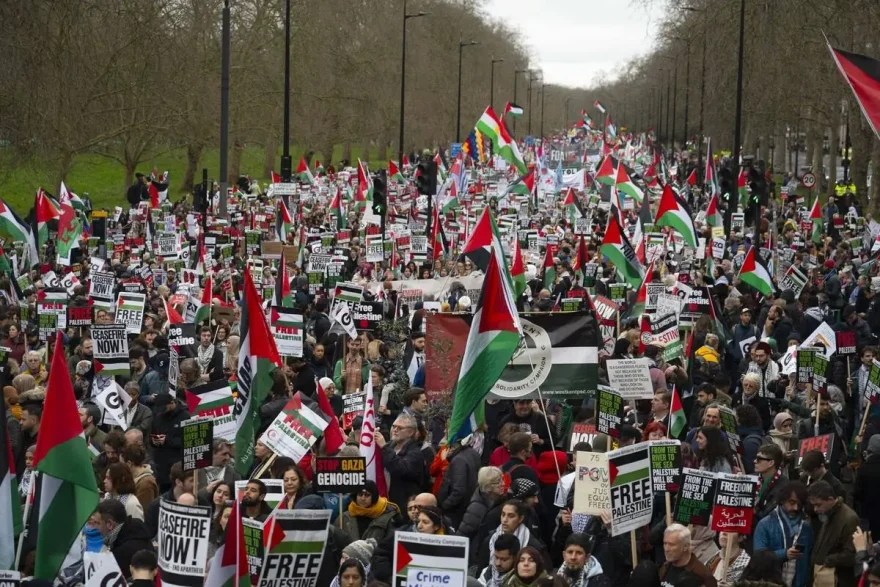
Are the massive pro-Palestine marches in Britain being deliberately targeted and smeared as part of a concerted Zionist effort to use the law to stop people from joining the ranks of the growing anti-war movement? That would certainly explain the furore over MPs’ safety which came to a head last week when Sir Lindsay Hoyle, the Speaker of the House of Commons and a member of the Labour Friends of Israel lobby group, cited threats to politicians in his disastrous handling of a debate on calls for a ceasefire in Gaza.
I pose the question after some extraordinary events have been picked up and anchored in a media campaign which has collectively shown nothing but hostility towards Palestinians in favour of the Zionist Israeli state as the genocidal onslaught in Gaza continues. Throw in some decidedly Islamophobic comments by prominent Conservative MPs, and there is a really toxic atmosphere brewing in advance of this year’s General Election, with Muslims — “Islamists” — cast as the bad guys.
Today, my suspicions were fuelled by none other than British Prime Minister Rishi Sunak who resorted to shameless smears and scare tactics as he warned police chiefs of a “growing consensus that mob rule is replacing democratic rule”. Calling for more robust police action, Sunak used inflammatory language to insist that politicians need to be protected from intimidatory protests outside their homes.
However, the Home Office has nevertheless announced a £31 million package aimed at protecting MPs. It is said to be in response to the impact of the ongoing “Israel-Hamas conflict”.
Meanwhile, in Scotland police were called to investigate bizarre claims that the Glasgow constituency office of Labour Members of the Scottish Parliament was “stormed” by 30 pro-Palestine protesters, with MSP Paul Sweeney criticising officers for taking 27 minutes to respond even though the office staff were left “distressed”.
Police Scotland insist that the storming of the politicians’ shared office never happened as described, and rejected the claims made by Sweeney. According to him, campaigners forced their way into the office that he shares with party leader Anas Sarwar, and fellow MSPs Pam Duncan-Glancy and Pauline McNeil.
“It may well be that this entire furore over alleged threats by protestors is confected,” said Mick Napier, a co-founder of the Scottish Palestine Solidarity Campaign, whose members took part in the protest. Certainly, the example of Sweeney caught flagrantly inventing threats to the staff suggests that this might be the case. Sweeney supports a party leader who endorses Israel withholding water, food and fuel from the entire population of Gaza — not only cruel, but also collective punishment, a war crime — while he complains that people opposing such barbarism raise their voices.
“Although in this case voices weren’t even raised,” explained Napier. “There seems to be something new in the shamelessness with which our politicians lie to the public. Could it be because the mainstream media have given up any pretence of investigating such fabrications?”
Despite repeated attempts to contact Sarwar, McNeil, Duncan-Clancy and Sweeney, none were prepared to offer a comment to me about the incident.
European political analyst Kevin Ovenden wrote about the incident on 22 February: “Two elected politicians have been exposed today for simply lying that they faced violent intimidation when they merely had to deal with democratic lobbying and political pressure. One is the Labour Member of the Scottish Parliament Paul Sweeney. Police in Glasgow refuted his highly charged claim that anti-war protesters stormed his office and intimidated his staff. They did no such thing, as the police concluded, having been present throughout for an orderly protest, without even any civil disobedience, by a small group of middle-aged or older women and men.
“That has not stopped the Speaker of the House of Commons, Lindsay Hoyle (for years a nodding-donkey Labour MP) today smearing the entire anti-war movement as in some way incubating terrorism as justification for his anti-democratic manoeuvres on behalf of [Labour Party leader] Keir Starmer.”
Ovenden blames craven support for Israel by the two main establishment parties, Conservative and Labour, for “not only leading to authoritarianism against public protest and free speech. It is now even crushing the limited democratic avenues available through parliament.”
The streets of London have witnessed some of the largest, peaceful, pro-Palestine demonstrations in the capital’s history, but that did not stop Sunak from calling an urgent meeting in Downing Street for police chiefs on Thursday. He urged them to use all of their existing powers to crack down on the alleged intimidation, disruption and subversion.
“We simply cannot allow this pattern of increasingly violent and intimidatory behaviour which is, as far as anyone can see, intended to shout down free debate and stop elected representatives doing their job,” insisted the prime minister.
Without a hint of irony, the man who has so far given his unconditional support to Israel, currently under investigation for genocide by the International Court of Justice, added: “That is simply undemocratic… I am going to do whatever it requires to protect our democracy, and our values, which we all hold dear.”
Del Babu, a former chief superintendent in London’s Metropolitan Police, said language like “mob rule” was not “helpful”. He told BBC Radio 4’s Today programme that appealing to people to demonstrate less could have “unintended consequences” and potentially lead to more people protesting.
“We will continue to march until there is an immediate ceasefire,” said Shamiul Joarder of Friends of Al-Aqsa. The organisation is part of a coalition of groups organising the marches which have brought world attention to London’s streets.
Members from all six groups, along with Labour MP and former shadow chancellor John McDonnell, and the campaign group Liberty, held a press conference earlier this week in parliament criticising unhelpful language used by politicians. They claim that anti-Muslim “hysteria” and pressure from the government had provoked the Metropolitan Police into heavy-handed and “discriminatory” policing of “peaceful mass protests”.
Home Secretary James Cleverly, meanwhile, told the BBC: “I genuinely don’t know what these regular protests are seeking to achieve. They have made their position clear, we recognise that there are many people in the UK that hold that position.”
Hours later, 104 starving Palestinians in Gaza were massacred — witnesses say that Israeli troops opened fire on them — as they gathered around an aid convoy distributing food. If Cleverly doesn’t understand the point of the street demonstrations then he has the emotional intelligence of a brick and a surname which doesn’t quite match his IQ.
Calls for a ceasefire will continue until Israel’s genocide of the people of occupied Palestine is stopped in its murderous tracks. Which bit of “Stop Killing Civilians” do our politicians not understand?
Ex-UK Army Chief Nick Carter, Once In Charge of “Misinformation” Surveillance Army Unit, Joins Tony Blair Institute
By Didi Rankovic | Reclaim The Net | February 28, 2024
A new noteworthy instance of what can be described as the UK-style revolving door policy, where those working for the government and private entities switch employers in both directions, has happened in that country.
A former chief of the British Army, under whose watch the 77th Brigade was spying on citizens during the pandemic, has now joined Tony Blair’s organization.
General Nick Carter is therefore a new recruit at the Institute for Global Change (globalist not in name only, either) – which the former British prime minister set up to supposedly create “open, inclusive and prosperous countries for all.”
Carter previously “distinguished” himself at the peak of the pandemic for allowing a unit under his command to hunt down “bad” speech on the internet – that of citizens skeptical of Covid measures and related contentious issues, whatever was treated as “Covid misinformation.”
Carter’s fellow new recruit at the Institute is former Government Chief Scientific Adviser Sir Patrick Vallance. Another new hire is Finnish Prime Minister Sanna Marin. They will act as members of a team of “expert strategic counselors” in what critics might call Blair’s elitist globalist group – his own version of WEF, even.
Before becoming Blair’s private adviser, Carter, a decorated officer, served as the principal military advisor to the prime minister (reports don’t say which ones), as head of the Armed Forces, and finally the chief of the Defense Staff for the United Kingdom.
Back in the spring of 2020, reports cited Carter, then at the helm of the Defense Staff, saying that the 77th Brigade was “countering coronavirus misinformation online.”
Not a traditional deployment of a country’s military potential, even if it is one set up to carry out physiological warfare, like 77th Brigade had been.
And it didn’t make things better that the target of this warfare was free speech on the UK’s citizens – on Twitter, Facebook and the like.
No less than 2,000 military personnel were involved in this, with a dubious to say the least goal of what looks like a straight-forward attempt to sway opinion among the population.
This was at the time phrased as delivering “means of shaping behavior through the use of dynamic narratives.”
Related:
Tony Blair Institute Calls For a Digital ID For All British Citizens, Calls It The “Great Enabler”
Scholz slammed for revealing UK troop presence in Ukraine
RT | February 29, 2024
German Chancellor Olaf Scholz has come under fire from the UK after he suggested that there were British troops operating in the Ukraine conflict. Explaining why Berlin would not supply Kiev with long-range Taurus missiles, Scholz said it would require German military personnel on the ground providing assistance.
He went on to say that Taurus “is a very long-range weapon, and what was done on the part of the British and French in terms of target-control and target-control assistance can’t be done in Germany.”
Commenting on Scholz’s remark, Tobias Ellwood, the former chair of the British Commons defense committee, said it was “a flagrant abuse of intelligence deliberately designed to distract from Germany’s reluctance to arm Ukraine with its own long-range missile system,” as quoted by The Telegraph. The British lawmaker was also sure that the statement would be “used by Russia to rachet up the escalator ladder.”
“German soldiers can at no point and in no place be linked with the targets that this system reaches,” Scholz insisted, even if operating from German soil, according to the DPA news agency.
The German chancellor stated that it would be “not very responsible” for his country to risk becoming a “party to the war.”
Meanwhile, on Tuesday, the Financial Times quoted an anonymous senior European defense official as saying that “everyone knows there are Western special forces in Ukraine – they’ve just not acknowledged it officially.”
Addressing the press following a summit of Kiev’s backers in Paris on Monday, French President Emmanuel Macron noted that “in terms of dynamics, we cannot exclude anything,” referring to a potential ground deployment of Western militaries.
NATO Secretary-General Jens Stoltenberg however hastened to clarify that there were “no plans for NATO combat troops on the ground in Ukraine.” This was followed by similar assurances by the leaders of Germany, Poland, the Czech Republic, Sweden and Finland.
Kremlin spokesman Dmitry Peskov warned that such a development would mean that “we have to talk not about the probability, but rather the inevitability” of an all-out military confrontation between NATO and Russia.
Featured Video

ARE PATIENTS BEING PROPERLY INFORMED ABOUT OZEMPIC?
or go to
Aletho News Archives – Video-Images
New Book
Breast Cancer: Before You Consent
A new Unbekoming paperback
Lies are Unbekoming | September 18, 2026
Peter Gøtzsche reviewed every randomised mammography screening trial ever conducted for the Cochrane Collaboration. Cochrane’s headline is that, assuming a 15% mortality reduction, one woman in 2000 avoids dying of breast cancer over ten years. Ten are overdiagnosed and treated. Two hundred experience false alarms.
But that headline assumes the reduction. When Gøtzsche looked only at the trials with adequate randomisation — the higher-quality ones — the reduction disappeared. No effect on breast cancer mortality. No effect on all-cause mortality.
This is the Cochrane finding, published in the establishment’s own database of systematic reviews.
No woman being asked to consent to a mammogram this week knows it.
That is why the new Unbekoming paperback exists. … continue
Blog Roll
 Aletho News
- ARE PATIENTS BEING PROPERLY INFORMED ABOUT OZEMPIC?
- US lawmaker blocks $2.8 billion weapons sale to Israel: Report
- Yemeni army claims responsibility for strikes on sensitive sites in Saudi capital, Aramco facilities in Yanbu
- Iran Judiciary issues indictments against 159 US, Israeli officials for assassination of Leader, commanders
- Turkiye revokes Iranian bank license under US sanctions campaign
- US-Denmark Agreement on Greenland Is ‘PR Stunt’ Ahead of Midterms
- Araghchi: Military intervention cannot create security; coercion cannot bring peace
- Fraud Squared
- Breast Cancer: Before You Consent
- Iran’s Plan to Shut Down AI in the Persian Gulf
- If Americans Knew
- Inside Gaza’s death trap of collapsing, bombed-out buildings
- The everyday items Israel bans from Gaza every day
- Inside the siege, the ruined buildings of Gaza – Daily Update
- Debunking The Claim That Macklemore Has A “History Of Antisemitism”
- CPJ demands release of arrested Palestinian-US journalist near Bethlehem
- Robert Kraft: The Billionaire Friend of Netanyahu Pulling The Strings Behind the Macklemore/Ed Sheeran Blow Up
- Columbia Administered Fund Gives Big Money to Pro-Israel Groups
- Deportation Case of Palestinian Activist Salah Sarsour Tests First Amendment
- ‘We Will Not Forget’: Palestinians Mark 44 Years since Sabra and Shatila
- Why do we let Zionists decide what we can and can’t say?
- No Tricks Zone
- New Study: ‘Global Drought Shows No Detectable Recent Acceleration Under Climate Warming’
- Economic Masterminds: German Socialists Suggest Taxing Productivity Gains Stemming From Using AI
- The South China Sea Has Not Been Cooperating With The Climate Change Narrative
- Energy Crisis: Germany Enters Heating Season With Historically Low Gas Reserve Fill Levels
- New Study: The Antarctic Ice Sheet Gained Mass From 2020-2024 Due To Staggering Snow And Ice Accumulation
- Study: Ocean Heating Rates From Thousands Of Years Ago ‘Dwarf’ Modern Ocean Heating Rates
- Climate Extremists Target, Attack Large-Scale Power Grid Infrastructure In Germany!
- New Study: Antarctic Ice Melt Has Contributed Less Than 1 Centimeter To Sea Level Rise In The Last 30 Years
- Fear Of Debate: Alarmist German Climate Scientist Calls On Mainstream Media To Discredit Skeptic Voices
- End-Of-August Arctic Sea Ice Extent Hasn’t Fallen In 20 Years, Official Data Show!
 Aletho News