Common Surgeries Surprisingly Fail to Outperform Placebo
Esteemed orthopedic surgeon Ian Harris joins the Radically Genuine Podcast!

DR. ROGER MCFILLIN | JULY 23, 2024
Welcome to a landmark episode of the Radically Genuine Podcast! I’m thrilled to present our first full video episode, exclusively available to our valued paid subscribers. Your support has made this exciting new format possible, allowing us to bring you an enhanced, immersive experience of our thought-provoking conversations.
In this shocking episode, I interview Professor Ian Harris, an esteemed orthopedic surgeon and author of the book “Surgery, The Ultimate Placebo”. This conversation unravels the complexities of surgical outcomes, challenging conventional wisdom and highlighting the critical need for evidence-based practice in modern medicine.
Key points explored:
1. The placebo effect in surgery: We dissect how patient expectations and non-specific effects can significantly influence surgical outcomes, emphasizing the importance of distinguishing these from the procedure’s direct physiological impacts.
2. Challenges in surgical research: We discuss the difficulties in conducting placebo-controlled surgical trials, shedding light on the methodological hurdles that complicate efforts to establish definitive evidence of surgical efficacy.
3. Surgeon bias and decision-making: The conversation explores the cognitive biases that can affect surgeons’ judgments, potentially leading to unnecessary procedures or overestimation of benefits.
4. Overuse of surgical interventions: Harris presents compelling arguments about the prevalence of surgeries that may lack solid scientific backing, advocating for a more cautious approach to surgical recommendations.
5. Non-operative alternatives: The discussion highlights the often-overlooked potential of conservative treatments, particularly emphasizing the benefits of weight loss and exercise for conditions like knee arthritis.
6. Financial incentives in healthcare: We touch on the complex interplay between economic motivations and medical decision-making, exploring how these factors can influence treatment recommendations.
7. Placebo and nocebo effects: The conversation examines how both positive (placebo) and negative (nocebo) expectations can impact patient outcomes, underscoring the power of patient beliefs in the healing process.
8. Informed consent and patient education: We stress the importance of providing patients with accurate, evidence-based information to facilitate truly informed decision-making about their care.
This episode serves as a compelling call to action for increased scientific rigor in surgical practice and a more critical evaluation of established medical interventions. It challenges listeners to reconsider their assumptions about surgical efficacy and encourages a more nuanced understanding of the factors contributing to medical outcomes.
People must agree to give up freedoms for survival – Kiev’s ex-top general
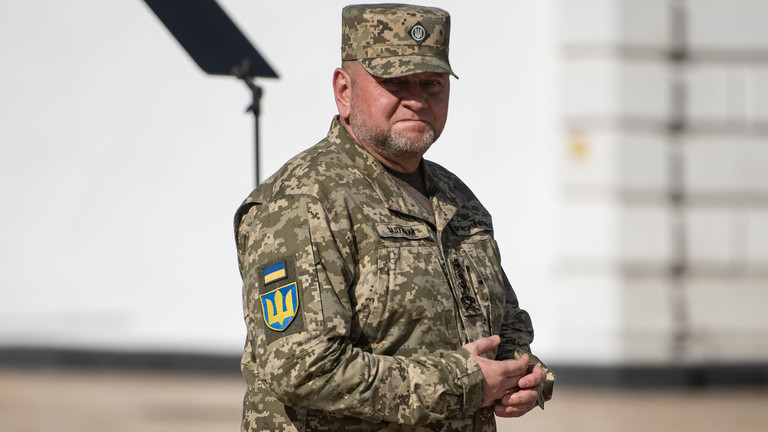
Valery Zaluzhny. © Alexey Furman/Getty Images
RT | July 23, 2024
The Western nations should “wake up” to the threat of a potential major conflict they are facing, Valery Zaluzhny, Ukraine’s former military commander-in-chief, told a British military conference on Monday. The governments should make sure their nations are ready to “mobilize” and sacrifice their liberties in the name of what he called “survival” if such a conflict does break out, said Zaluzhny, who in May became Kiev’s ambassador to London.
Readiness for a war “should be considered as a huge set of measures” that covers all fields of state activity, the former general told the Land Warfare Conference 2024 hosted by the Royal United Services Institute. “Modern wars… are total,” he said, adding that “they require efforts… of society as a whole.”
Waging a war means that a state has to use all its “resources,” including “economics, finance, population and allies,” Zaluzhny stated, in a speech that he published in full on social media. “Society must agree to temporarily give up a range of freedoms for the sake of survival.”
The ex-general also claimed that what he called “the war for freedom in one country” in an apparent reference to Kiev’s standoff against Moscow “should become the policy of survival” for other nations.
In his speech, Zaluzhny claimed that “the very existence of Russia is already a threat.” He also referred to Moscow as an “eternal enemy” engaged in “the primordial struggle” with Kiev.
The military commander-turned-envoy also stated that the ongoing conflict would determine the future of wars for decades to come and called it a “war of the transitional period” that would set new rules of warfare. He also repeatedly spoke about the growing role of technologies on the battlefield but did not mention any specific ones, except for unmanned systems.
According to Zaluzhny, Ukraine had “already invented a way to fight and win against stronger armies in the 21st century.” He still admitted that Kiev cannot “scale up” its supposedly innovative warfare solutions but its backers in the West “have resources but … no applied and practical field to test them.” The former general then called on the West to work “together” with Ukraine to “effectively use the resource.” A failure to do so would mean that “we will all die,” he claimed.
Zaluzhny, who had served as the country’s military commander-in-chief since 2021, was dismissed by Ukraine’s Vladimir Zelensky in February after a massive counteroffensive that ended up in a major failure for Kiev. Some media reported at that time that Zelensky also viewed the veteran general as a political rival. In May, Zaluzhny was relieved from active service and appointed an ambassador to the UK.
Hungary issues €6.5bn ultimatum to Ukraine
RT | July 23, 2024
Budapest will block funds the European Union has earmarked for Ukraine until Kiev resumes the transit of Russian crude oil to Hungary and Slovakia, Hungarian Foreign Minister Peter Szijjarto has said.
Ukraine stopped the flow of oil through the Druzhba pipeline last week, citing its sanctions against Russian energy giant Lukoil, thus depriving the two EU members of an estimated 30-40% of their needs.
“As long as this issue is not resolved by Ukraine, everyone should forget about the payment of the €6.5 billion of the European Peace Facility compensation for arms transfers,” Szijjarto announced on Tuesday.
“Ukraine’s decision to not allow Lukoil to transit oil supplies through Ukraine poses a fundamental threat to the security of energy supplies to Hungary and Slovakia,” Szijjarto said, describing Kiev’s move as “unacceptable and incomprehensible,” as well as incompatible with its aspirations to join the EU.
Szijjarto also reminded the EU foreign policy chief Josep Borrell that Hungary – along with Slovakia and Poland – came to Ukraine’s aid in early July, sending enough electricity to stabilize Kiev’s energy system. Hungary supplied 42% of Ukraine’s electricity in June, Szijjarto noted.
According to unconfirmed reports from Ukrainian local media, Ukraine stopped receiving electricity from Slovakia and Romania as of midnight on Tuesday.
Kiev has had to resort to imports after Russian air and missile strikes disabled most of its domestic generation capabilities. Moscow has described the strikes as reprisal for Ukrainian attacks on Russian civilian infrastructure.
Poland has already protested Hungary’s move, saying that it would deprive Warsaw of €2 billion it needs to modernize its armed forces. “This is a huge disappointment for me,” Polish Foreign Minister Radoslaw Sikorski has said.
Kiev’s official explanation for embargoing oil deliveries was that Lukoil revenue could be used to support the Russian military. One Ukrainian lawmaker, however, suggested to Politico that the blockade has a secondary purpose, to pressure Hungary into changing its policy on arming Kiev.
Hungarian Prime Minister Viktor Orban has long refused to send Ukraine any weapons, train any Ukrainian troops, or allow the use of Hungarian territory for EU or NATO arms shipments, insisting that Kiev should sue for peace with Moscow as soon as possible.
Is Hungary on the verge of an energy crisis? Ukraine’s blocking of Friendship oil pipeline represents major threat
By John Cody | Remix News | July 23, 2024
Hungary is facing a potential energy crisis over Ukraine’s continued blocking of the Friendship (Druzhba) oil pipeline, with Ukrainian President Volodymyr Zelensky turning up the pressure on Hungary like never before. Now, some members of the Hungarian government are openly speculating whether the move is not being pushed by Ukraine alone, but could be backed by “people in Brussels, or even the pro-war American Democrats.”
“They are punishing us for our support for peace, and now they are attacking our energy security. And it is quite possible that this was not initiated by Ukraine alone, but was helped by the people of Brussels, or even by the pro-war American Democrats. They want to destroy those who are pro-peace by all means. This is unfair, unacceptable and illegal. In any case, we will stand by our pro-peace position and defend ourselves against attacks in every possible way, with every possible means,” said Tamás Menczer, the communications director of Fidesz-KDNP, in a video post published on social media.
Currently, Hungary’s diplomats are scrambling to ensure the flow of oil resumes without interruption, but Budapest may find few in Brussels who are willing to press back against Zelensky, despite Hungary’s status as an EU and NATO member. Hungary is now pressuring the EU to take action against Ukraine, as Hungary relies on Russia for between 70 and 80 percent of its oil imports.
After Hungarian Foreign Minister Péter Szijjártó threatened court proceedings, Ukraine has responded that there has been no reduction in supplies, an outright lie as oil flows have been cut off for weeks.
Oleksiy Chernisov, the president of Naftogaz, Ukraine’s energy giant, stated at a business forum: “The tightening of sanctions against Lukoil in June did not affect the volume of oil transit through Ukraine.”
Ukraine’s foreign minister has also made similar claims.
“I spoke with the Ukrainian foreign minister yesterday, and he said they allow every oil transfer through, but it’s not true,” said Hungarian foreign affairs minister, Péter Szijjártó. “The commission has three days to execute our request, after which we will bring the issue to court.”
Also caught up in the energy crisis is neighboring Slovakia, which had its supplies cut as well. Russian Lukoil, which is now under sanctions from Ukraine, accounts for a third of Hungarian crude oil imports and about 45 percent of Slovakian crude oil imports.
The Hungarian government has taken a number of temporary measures to shore up its energy supply, but Szijjártó says these measures will not help in the medium term.
Last year, Szijjártó warned about plans leaked by the Washington Post detailing how the Ukrainian government had planned to blow up the Druzhba pipeline in the past, specifically to sink the Hungarian economy.
The West is Learning the Wrong Lessons about Airpower in Ukraine
By Brian Berletic – New Eastern Outlook – 23.07.2024
A recent article appearing in the US-based Business Insider titled, “Russia’s showing NATO its hand in the air war over Ukraine,” would provide a showcase of the deep deficit in military expertise driving increasingly unsustainable, unachievable foreign policy objectives. The article summarizes a number of interviews conducted with Western “airpower experts,” exhibiting a profound misunderstanding of modern military aviation, air defenses, and their role on and above the battlefield.
The article claims:
Russia botched the initial invasion by failing to establish air superiority from the start, and it has been unable to synchronize its air and ground forces.
This is based on the assumption that Russia could somehow establish air superiority over the battlefield and infers that had the United States and the rest of NATO been in Russia’s place, air superiority would have been established. But this is false.
Fundamental Misconceptions
At the onset of the Russian Special Military Operation (SMO) Ukraine possessed a formidable Soviet-made integrated air defense network consisting of some of the most successful and effective air defense systems in the world. This included long-range air defense systems like the S-300 as well as mobile systems like Buk, Strela, and Osa, as well as a large number of Soviet-made man-portable air defense systems (MANPADS).
The United States and its allies have not operated in airspace as contested as Ukraine’s since the Vietnam War. Over the skies of Vietnam the US would lose over 10,000 fixed-wing aircraft and helicopters to Soviet-made air defenses employed by Vietnam’s armed forces.
In subsequent conflicts, including Afghanistan, Iraq, and Libya, US-led forces would face either no significant air defenses at all, or air defenses consisting of old equipment operated by poorly organized, poorly trained, and poorly motivated troops, as was the case in Iraq.
Amid the US proxy war against Damascus and the US occupation of eastern Syria, US military aviation has been confined by Syria’s relatively modern air defense network, forcing both US and Israeli warplanes to conduct the same types of stand-off strikes Russian military aviation is conducting in Ukraine.
The article would claim:
Russia has demonstrated that it’s unable to suppress or destroy enemy air defenses, fly effective counterair missions, or run complex composite air operations like those the US Air Force pulled off in the opening days of Desert Storm in 1991 and then in the Iraq invasion in 2003.
Beyond the factually incorrect nature of this statement, the obvious differences between Iraq and Ukraine appear entirely lost among the “airpower experts” interviewed by Business Insider.
The Business Insider, citing these same “airpower experts,” also claims:
On the battlefield, effective airpower should aid the advance of armored combat vehicles and infantry by striking an enemy’s strongpoints, as well as the reinforcements and supplies they depend on.
Because of the vast differences between previous US conflicts around the globe and the ongoing conflict in Ukraine now, the type of rapid maneuver warfare utilized by US-led forces in Iraq would not only be inappropriate in Ukraine, it would be disastrous. The 2023 Ukrainian offensive before which NATO trained, armed, and directed Ukrainian forces, ended in catastrophic failure, comprehensively defeated by Russian defenses utilizing land mines, artillery, multiple-launch rocket systems (MLRS), long-range ballistic missiles, a wide variety of drones, and both infantry and attack helicopters utilizing anti-tank guided missiles (ATGMs) – all elements absent among the armed forces of the various nations the US has invaded and occupied since Vietnam.
Because Ukraine also possesses significant defense capabilities, including well-protected fortifications, minefields, artillery, and FPV (first-person-view) drones, NATO-style maneuver warfare would likewise result in catastrophic failure for Russian forces.
Russia has instead adopted a strategy of attrition. Instead of overwhelming Ukrainian positions with rapid maneuver warfare, it is grinding them down with huge amounts of artillery, MLRS, missiles, drones, and military aviation carrying out stand-off strikes using a variety of glide bombs ranging from 250 to 3,000 kilograms. While progress is slower than NATO-style maneuver warfare, it has allowed Russia to avoid the staggering losses Ukraine suffered last year during its offensive.
Ukraine is a different kind of war; thus Russia utilizes a different approach to military aviation.
The conclusion that events unfolding in Ukraine demonstrate the capabilities of Russian military aviation have been “significantly overstated,” as one expert interviewed by Business Insider put it, is a dangerous misconception. US-NATO military aviation would (and already has in Syria) demonstrated it suffers from the same limitations in airspace as contested as Ukraine’s.
Admitted Russian Advantages
Business Insider’s article concedes there are aspects of Russian military aviation that constitute success. It mentions Russia’s extensive use of stand-off weapons – both air-launched cruise missiles as well as glide bombs (just as the US and its allies are using in Syria to avoid Syrian air defenses). The article also acknowledges Russia’s significant air defense and electronic warfare capabilities, constructing an “umbrella” protecting Russian forces, infrastructure, bases, and civilian centers.
There is one significant difference, however, between Russian and Western stand-off capabilities. Russia’s military industrial base allows it to produce missiles and glide bombs in quantities the collective West cannot match. Russia’s air defense capabilities also exist on a scale the collective West is unable to replicate.
After first claiming Russia is, “unable to suppress or destroy enemy air defenses,” Business Insider eventually admits the depleted air defense arsenals of the collective West and the inability to replenish them in any meaningful manner precisely because Russia has been able to not only “suppress” and “destroy enemy air defenses,” but also because of Russia’s ability to saturate and deplete Ukraine’s supply of interceptor missiles.
Claims in the article that Lockheed Martin is expanding Patriot missile production to 550 a year are made without explaining that Russia is firing 4,000+ missiles at targets across Ukraine over the same period of time, meaning that 550, 650, or even 750 interceptors manufactured a year represent an entirely inadequate quantity.
And despite this fact, the article would even claim:
In Ukraine, the world has seen that Western air defenses can shoot down incoming drones and missiles when they have sufficient coverage and enough ammo, and the performance has quelled doubts about the Patriot.
This is doubtful.
The US and its allies transferred Western air defense systems to Ukraine, in part, to protect Ukraine’s power grid. In April 2024, CNN would admit that up to 80% of Ukraine’s non-nuclear power production has been destroyed. This means that Ukraine has either run out of Patriot missile interceptors, or the interceptors they have are failing to protect Ukraine’s power grid. It should be noted that the efficacy of an air defense system lies now only in its ability to intercept incoming targets, but also to be produced in large enough quantities to continue intercepting incoming targets.
The high cost of the Patriot missile system inhibits larger-scale production to meet the requirements of a large-scale and/or protracted conflict, meaning that despite its supposed performance in combat, it is still a fundamentally ineffective means of air defense.
Even before Russia’s SMO began in February 2022, the previous month Saudi Arabia’s Patriot systems had exhausted their supply of interceptors amid its ongoing conflict with neighboring Yemen. The United States’ inability to increase production forced Saudi Arabia to “borrow” missiles from neighboring nations.
The limited number of Patriot systems and interceptors being manufactured represent a metric of the system’s overall “success” and, despite the Business Insider’s conclusion, should continue to drive “doubts” regarding it.
NATO vs. Russia
The Business Insider article admits that in a conflict between NATO and Russia, NATO military aviation would face serious challenges that simply did not exist in Afghanistan, Iraq, Libya, and even Syria.
The article cites US Air Force (USAF) General David Allvin who noted, “in future fights, it may be possible for the US to achieve air superiority only in bursts — small windows in a specific time, place, and location where air defenses are missing, destroyed, or out of ammo.”
USAF General James Hecker would tell Business Insider, “if we can’t get air superiority, we’re going to be doing the fight that’s going on in Russia and Ukraine right now, and we know how many casualties that are coming out of that fight.”
Considering the advantages Russia also enjoys in land warfare capabilities, including the production of up to 3 times more artillery ammunition than the collective West, the outcome of that fight would likely mirror the same incremental defeat Ukraine itself is now suffering.
Western Failures in the Skies of Ukraine, a Microcosm of Wider, Irreversible Decline
The same blind pursuit of profits and power that compelled the collective West to expand NATO up to Russia’s border in the first place, and deliberately create a national security threat forcing Russia’s intervention in Ukraine, has also created the crisis facing the collective West’s military industrial base making it impossible to achieve the geopolitical objectives this proxy war in Ukraine is a part of.
In order for the collective West to “succeed,” it should first reevaluate what it is even trying to achieve.
This blind pursuit of profits and power is not unlike a tropism in nature – like a tree, for example – reaching downward with its roots and upward with its branches and leaves to grow as large and as fast as possible. In the ideal environment, such a tropism can thrive. In times of drought, the means of sustaining the vast proportions that the tree took could jeopardize its own very survival.
Until the 21st century, the global “environment” was ideal for Western hegemony. The disparity in military and economic power between the West and the rest of the world favored the blind pursuit of profits and power, often in the form of empire. The West grew to gargantuan proportions. Today, the environment has changed – this disparity no longer exists – and now the West is collapsing under the unsustainable size of its own overreach.
While Western policymakers search for game-changing strategies and technologies to maintain generations of global primacy, the unsustainable nature of this pursuit becomes more precarious all while Russia, China, and the rest of the world continue to grow stronger relative to the collective West. Only a policy of shifting away from coercion and control over the rest of the world, toward constructive cooperation with the rest of the world, can avert the inevitable collapse all other stubborn empires have faced throughout history.
For the rest of the world, including Russia and its Chinese allies, the goal continues to be defending their individual and collective sovereignty from Western hegemony while carefully avoiding the triggering of a much larger conflict borne of Western desperation.
In the meantime, in the airspace above Ukraine, a microcosm of the wider failure of Western foreign policy continues to play out, not only lacking any possibility of reversing in Ukraine or its Western sponsors’ favor, but almost certainly to continue accelerating to their detriment.
Member states consult EU over ‘hostile’ Ukrainian move
RT | July 22, 2024
Hungary and Slovakia have requested that the European Commission intervene over Ukraine’s decision last week to block the pipeline transit of Russian crude oil.
While the EU has sanctioned imports of Russian crude to Germany and Poland, Slovakia and Hungary have received exemptions. Last week, however, Ukraine cut off the flow of oil, citing its own sanctions against Russian energy giant Lukoil.
“I spoke with the Ukrainian foreign minister yesterday; he said they allow every oil transfer through, but it’s not true,” Hungarian Foreign Minister Peter Szijjarto said in Brussels on Monday.
Szijjarto described Kiev’s actions as “hostile,” especially since Ukraine imports electricity from Hungary. He added that Budapest and Bratislava have requested consultations with Brussels on the matter. Slovakian Foreign Minister Juraj Blanar has confirmed this.
“The commission has three days to carry out our request, after which we will bring the issue to court,” said Szijjarto. If Kiev refuses to resume oil transit, the EU will be justified in suspending certain clauses of Ukraine’s association agreement, he added.
The EU formally approved the start of membership negotiations with Ukraine last month, as a symbolic message of support to Kiev in its conflict with Moscow.
On Saturday, Slovakian Prime Minister Robert Fico called his Ukrainian counterpart Denis Shmigal to complain about the “senseless” sanctions that may leave Bratislava 40% short of the oil it needs. Moreover, the shortages could force Slovnaft to stop deliveries to Ukraine, which account for 10% of Kiev’s oil consumption.
“Slovakia does not intend to be a hostage to Ukrainian-Russian relations,” Fico said.
Ukraine imposed sanctions on Lukoil on June 24, including the freezing of assets, limiting trade operations, and “partial or complete cessation of resource transit.” The oil stopped flowing on July 17, according to Hungary’s MOL, which also owns Slovnaft.
Officially, Kiev seeks to deprive Moscow of oil revenue that could be used to pay for the Russian military, even though Ukraine itself is getting a cut from transit fees. Ukrainian lawmaker Inna Sovsun has suggested to Politico that the embargo has a secondary purpose: to pressure Hungary.
“We have really tried all the diplomatic solutions, and they never worked,” said Sovsun. “So it seems like we have to find some other approaches in how to talk to them.”
Prime Minister Viktor Orban’s government has vocally opposed the EU policy of sending money and weapons to Ukraine and vowed to block its membership in the bloc as well as NATO.
France Unbowed Leader Melenchon Calls for Withdrawal From NATO
Sputnik – 21.07.2024
Jean-Luc Melenchon, founder of the left-wing France Unbowed party, told Spanish newspaper El Pais in an interview out Sunday that he would pull France out of NATO if elected the country’s president.
“I choose the logic of disarmament and appeasement … If I were at the Elysee Palace, I would certainly systematically and in an organized manner withdraw from the joint military command, from NATO. Especially during the war, to avoid seeing the country involved in this story,” Melenchon told the newspaper.
The politician said he wanted France out of NATO because the military alliance “sticks to the war logic.”
In late June, Florian Philippot, the leader of French euroskeptic party The Patriots, called for France’s withdrawal from NATO after Ukraine launched a deadly missile strike on a crowded beach in Crimea. He called this an escalation and accused NATO of seeking a total war.
Could Trump’s election end NATO’s proxy war in Ukraine against Russia?
Strategic Culture Foundation | July 19, 2024
The presidential nomination of Donald Trump and Senator JD Vance as his running mate raises the prospect of a peaceful settlement to the conflict in Ukraine. Both have been vociferous critics of the NATO proxy war and the arming of the Kiev regime. Vance has even proposed a peace settlement that is close to Moscow’s demands.
Hungarian Prime Minister Viktor Orban, who is recently pushing peace diplomacy, has voiced optimism that the omens are good for a settlement later this year to the worst war in Europe since the Second World War – if Trump and Vance are elected.
Only days after Donald Trump narrowly survived an assassination attempt, he was officially nominated as the Republican presidential candidate amid ecstatic scenes at the Republican National Convention in Milwaukee.
After the tumult and drama over the last week – a long time in politics, as the saying goes – the Trump election campaign is in the driving seat. His vice presidential running mate is 39 years of age and gives the Republican Party a youthful zest. Both men are very much singing from the same hymn sheet regarding their “Make America Great Again” vision.
Trump has united the GOP under his leadership. All former party rivals lined up this week in Milwaukee to endorse the former real estate magnate in his bid to seek re-election to the White House in November. That helps to solidify his manifesto, which bodes well for diplomacy in Ukraine.
By contrast, the election campaign of Democrat incumbent President Joe Biden has run into a ditch. This week he was self-isolating in Delaware having reportedly incurred a third-time Covid infection. Biden increasingly looks toast. His apparent mental decline – the latest gaffe this week was not remembering the name of his Secretary of Defense Lloyd Austin, referring to him haltingly as “a black man” – has provoked a crisis in the Democratic Party and the largely favorable U.S. corporate news media. Senior figures including former President Barack Obama and House Speaker Nancy Pelosi, are reportedly urging Biden to stand down and pass the torch to a younger candidate. Panic is in the air.
There are reports that Biden may throw in the towel within the next few days as the Democrats head into their National Convention to officially nominate their presidential candidate. The trouble for the Democrats is they do not have a viable alternative candidate at this late stage in the campaign – with less than four months to election day on November 7.
That means there is now a serious chance that Trump could return to the White House after he lost the election in 2020, which MAGA loyalists hotly disputed as “stolen”.
That election outcome turns attention to one issue in particular: the war in Ukraine. The conflict erupted in February 2022 and has cost the lives of over 500,000 Ukrainian soldiers. Under the Biden administration and aligned European NATO members, there is no sign of the war coming to an end. Biden and European allies have pledged to keep sending weapons to Ukraine and tens of billions of dollars to prop up a hopelessly corrupt NeoNazi regime in Kiev.
Trump and Vance have pitched a diametrically opposite policy on the U.S.-led NATO proxy war in Ukraine.
That stance is causing the Deep State and its military-industrial complex acute anxiety. The Ukraine war racket has been a bonanza that vested interests in the U.S. ruling class do not want to end. That tension provides a plausible explanation for the attempted assassination of Trump during an open-air rally at Butler, Pennsylvania, on July 13. Salient questions remain about how the shooter, Thomas Matthew Crooks, a 20-year-old student, gained access to such a high-security position to fire his rifle at Trump.
The Republican candidates have warned that the Ukraine conflict is in danger of spiraling into a nuclear world war. Trump has said that he would end the war immediately by cutting off the military aid spigot and forcing the Kiev regime to begin negotiations with Russia.
Tantalizingly, JD Vance (R-Ohio) has been even more explicit in proposing that the warring parties should accept the territorial gains made by Russia – including Crimea, Donbass, Zaporozhye and Kherson provinces – and that Ukraine must accept Moscow’s demand that it remain neutral and outside of the NATO alliance.
Such a position is a breath of fresh air for its rationality. Many respected American scholars and diplomats have also recommended this historically coherent position as a solution, including Professors John Mearsheimer and Jeffrey Sachs. At least Trump and Vance seem to be cognizant of this reality, unlike the Biden administration and the rest of the Democrat Party, along with the Western media establishment and European minions who insanely push a fraudulent war to the last Ukrainian.
Moreover, polls show that the majority of American citizens (and Europeans) would prefer to see a diplomatic solution to the worst war in Europe since 1945.
Hungary’s Orban has admirably advocated peaceful diplomacy and for his troubles, his government has been sanctioned by the European Union establishment. Slovakia’s Robert Fico has also called for an end to the war in Ukraine, which many believe led to an assassination attempt on his life in May.
The conflict in Ukraine is a senseless, bloody slaughter that should never have escalated if Russia’s peace proposals in December 2021 had been accepted instead of dismissed out of hand by the Biden administration and its NATO lackeys in Europe. Also, a peace deal was possible in April 2022 but again was scuppered by malicious U.S. and British intervention.
If an American presidential candidate is proposing a diplomatic end to the conflict then that should be welcomed. It seems that common sense is prevailing.
Having said that, however, there are caveats. The Trump-Vance rhetoric could be empty pre-election canvassing for votes.
Trump’s record is one of hyping expectations and not delivering. When he ran for the presidency in 2016, he promised to normalize relations with Russia – and did not deliver.
He also boasted about solving the conflict in the Middle East with a “deal of the century” – only to embolden Israeli aggression towards Palestinians and Iran.
A reality check is strongly advised on what Trump and Vance can achieve.
While both men express skepticism about “endless wars” and NATO, it should be borne in mind that the conflicts the U.S. empire is fueling have a systematic cause. The United States is desperately fighting to maintain its failing hegemony against the rise of a multipolar and more democratic global order.
Washington and its European vassals are unleashing wars as a matter of necessity for preserving their erstwhile global dominance. History teaches that wars are always the refuge of the Western imperialist ruling classes.
It is notable that while Trump and Vance talk about ending conflict in Ukraine, they are at the same time talking belligerently about confronting China and Iran.
Trump and the MAGA Republicans are deprecated by the U.S. establishment as being “isolationists” in their vision of pursuing “America First”.
But the notion of “isolationalism” is an oxymoron when one considers the objective reality of U.S. imperialism. Foreign wars are an insatiable appetite for Western dominance.
American relations with the rest of the world are all about power projection, dominance and ultimately using violence to assert its “might is right” presumed national privileges. That applies whether the incumbent in the White House is a Democrat or Republican.
Trump may sound more reasonable on the issue of conflict in Ukraine with Russia. That alone makes him a more plausible candidate compared with the reckless warmongering of Biden and the Democrat-Deep State nexus.
The war in Ukraine must be stopped as soon as possible and a more reasonable security arrangement for Europe must be negotiated as Russia has long been consistently advocating.
Any diplomatic opening towards achieving peace and ending the killing must be welcomed.
Trump and Vance might just deliver on ending the hostilities in Ukraine which in itself would be a huge step forward away from the abyss of all-out war with Russia. On that score alone, their election might bring about an improvement.
But alas there is a contradiction. Don’t expect world peace to break out in other parts of the globe, because U.S. imperialism is cranking up its war machine. Trump and Vance are hawkish in their policy towards China and Iran.
A comprehensive solution to ending U.S. aggression and militarism is not a change of personnel at the White House. A profound, systematic change in American politics and economics is required.
Is partial peace sufficient? Maybe it is for now.
Ukraine ‘Shot Itself in the Foot’ by Banning Transit of Lukoil Crude to Hungary and Slovakia
By Ilya Tsukanov – Sputnik – 20.07.2024
Hungary and Slovakia stopped receiving oil from Russian oil giant Lukoil via the Soviet-built Druzhba (‘Friendship’) pipeline which runs through northwestern Ukraine after Kiev imposed a transit ban. Financial analyst Paul Goncharoff says the move is both counterproductive and shortsighted, but that hasn’t stopped Ukraine’s authorities before.
Officials in Budapest and Bratislava confirmed this week that the delivery of oil supplies purchased from Lukoil through the Druzhba oil pipeline network had dried up.
Slovakian oil transporter Transpetrol said non-Lukoil Russian deliveries appear unaffected so far.
Hungarian Foreign Minister Peter Szijjarto said Budapest is receiving oil via the TurkStream pipeline, running from Russia through the Black Sea to southeastern Europe, but that supplies via Druzhba had been stopped “due to a new legal situation” imposed by Kiev.
“We are now working on a solution that would allow oil transit to restart as Russian oil is very important for our energy security,” Szijjarto said Tuesday.
Kremlin spokesman Dmitry Peskov said Friday that Moscow doubts whether dialogue with the Ukrainian companies responsible for oil transit on this issue is possible.
“This sort of decision was made not at the technical, but the political level. We don’t have any dialogue here,” he said.
Druzhba is one of the longest and largest oil pipeline networks in the world, with a capacity to ship about 66.5 million tons of oil annually. The network branches off in southern Belarus into a northern route running through Poland to eastern Germany, and a southern route, which winds through southwestern Ukraine to the Hungarian and Slovakian borders.
Hungary, Slovakia and the Czech Republic negotiated with Brussels in late 2023 to allow them to maintain their pipeline-based imports of Russian oil, citing a lack of access to sea-based deliveries, and lack of opportunities to receive substantial amounts of oil from other sources.
The three countries collectively imported about 15 million tons of Russia divided roughly evenly between them in 2022, and dropped purchases modestly (between 2 and 10 percent) in 2023, according to Russian oil transport giant Transneft.
Shipments of Russian oil to Poland and further west to Germany via Druzhba’s northern branch were halted by Warsaw in early 2023.
Last month, Ukraine formally banned the transit of crude produced by Lukoil – Russia’s second-largest oil company, through the section of Druzhba running through Ukraine.
The move signals another short-sighted escalation by Ukraine’s pro-Western elite which will ultimately harm ordinary Ukrainians in the long run, says veteran financial analyst Paul Goncharoff.
“Whether Ukraine can afford to further escalate the situation surrounding the movement of energy resources is a moot point. Escalation on all fronts has passed all reasonable limits, politically, economically and militarily. They cannot afford it economically [nor] politically as they have now estranged both Slovakia and Hungary, [but will continue to escalate], regardless of cost, as their marching orders from Washington along with the servile echoes of Brussels and their insistence to ‘demonstrate resolve’” dictate, Goncharoff told Sputnik.
“The real consequences should become very clear in 3-4 months as winter descends on Ukraine, and any energy goodwill there may still be in countries neighboring Ukraine will be scarce to nonexistent,” the observer expects.
At this stage, Goncharoff says, Russian oil exporters not affiliated with Lukoil can still send oil through the Druzhba pipeline, but “how long this possibility will continue is anyone’s guess.”
“In discussions I have had with persons closely involved in this trade, there are swap workarounds being looked at in order not to deprive Slovakia or Hungary from needed and contracted resources. Unfortunately, the political reality is such that it is likely any workarounds will raise a hue and cry from the West, and they will try to close the workarounds off as well, if for no other reason but to be politically correct,” the market analyst said.
Ultimately, the old saying “shooting oneself in the foot” is an apt description for Kiev, Brussels and Washington’s policy today, “while the world looks on, shaking its collective head in wonder,” Goncharoff concluded.
Russian oil and gas flows to Europe have dropped dramatically following the escalation of the conflict in the Donbass into a full-fledged proxy war between Russia and NATO. The decline in Russian energy flows west prompted Moscow to reorient part of its energy trade to its BRICS partners (particularly China and India) and pushed EU countries and the UK to kick off a global scramble to secure the energy needed to power their economies.
The West’s attempts to “punish” Russia by cutting off energy purchases have so far had a boomerang effect, raising prices and undermining Europe’s global industrial competitiveness against China and the United States. Traditional European industrial powerhouse Germany has been hit particularly hard, facing the outflow of major manufacturers looking for greener pastures, and cheaper energy costs, in countries abroad.
US Missiles in Germany Again: Why Is Berlin Betraying Its National Interests?
By Dmitry Babich – Sputnik – 19.07.2024
The decision of Washington to start in 2026 the deployment in Germany of US missiles aimed at Russia was not even discussed in Berlin. The public was forced to face a fait accompli. This is a clear degradation of Germany’s standing vis-a-vis the US, compared to the ’80s. Then, a similar deployment was met with protests of West Germany’s citizens.
The governments of both the US and Germany confirmed that in 2026, the American side will begin deploying long-range missiles in Germany. This dangerous move, reminiscent of the worst years of the Cold War, is officially explained by the need to contain “resurgent Russia.”
Gunnar Beck, an expert on European law and former vice president of Identity and Democracy group in the European Parliament, notes that there was no public discussion of this dangerous development in Germany, specifically no discussion in the Bundestag. No details of the deal have been revealed.
“It’s a fait accompli,” Beck told Sputnik. “The German and the US governments have announced they were considering this… But all of the talk of an imminent Russian threat to Europe, in my view, is just a pretext for justifying further military and financial assistance to Ukraine. And, of course, it is a pretext for intimidating the European population and forcing them to accept even larger amounts of military spending.”
Beck notes the few dissenting voices still audible in Germany belong to the parties, which the European Union and especially the European Commission’s chairwoman Ursula von der Leyen try to marginalize:
“There are people on the right and on the far-left which have been criticizing [the deployment]. The German public, by and large, is not war loving. But, of course, there is a lot of propaganda emphasizing that any attack against Ukraine is an attack against Europe as a whole – it is the position of the EU and German government,” Beck told Sputnik.
The situation is reminiscent of the early 1980s, when the US deployed Pershing missiles in West Germany – presumably countering a possible aggression by the Soviet Union. The only difference is that this time Americans promise not to put nuclear warheads on SM-6 missiles, Tomahawks and even some “hypersonic weapons.” These missiles will be carrying conventional warheads that will still make Germany a target for a Russian retaliation starting from 2026.
Beck indicated that American and West German propaganda of that epoch used the same arguments as now. It was said the ability of NATO allies to protect themselves was the best guarantee for peace, etc., but in both cases it was misleading propaganda based on fears and not facts:
“Up to 1987 the propaganda in West Germany evoked the specter of millions of Soviet soldiers stationed in East Germany … that they would all flood into West Germany and occupy the country within three days,” Beck told Sputnik. “The kind of propaganda we are exposed to now is very reminiscent of this. We know today, and we have known for some time already that everything we were told in the 1980s was a great deal of nonsense. There was no evidence whatsoever of a consistently aggressive strategy by the Soviet Union.”
Indeed, Moscow acquiesced to the reunification of Germany in 1990 and withdrew its troops from East Germany in 1994 without a single shot fired. Unfortunately, it is often forgotten now that these concessions were part of the “Two plus four” agreement, whose terms Germany and three other signatories are breaching now.
It was signed on September 12, 1990, by the two (East Germany and West Germany) plus four (the Soviet Union, USA, the UK and France, former members of the anti-Hitler coalition).
Moscow then obliged itself not to prevent the reunification of Germany and to withdraw its troops by 1994 from the territory of the late German Democratic Republic. Both obligations were fulfilled. Now, here is how the obligations of Western powers were breached, in the words of Beck:
“No foreign weapons could be deployed in East Germany… And both German states then agreed that the united Germany would only deploy weapons on its territory if it is done in accordance with Germany’s constitution and the Charter of the United Nations. So, unless there is a UN Security Council resolution, it is a very debatable issue whether Germany can allow the deployment of new weapons that increase the risk of war.”
It should be noted that the German constitution prohibits the supplies of German weapons to the zones of armed conflict. However, Berlin is officially “pumping up” Volodymyr Zelensky’s regime with weapons worth tens of billions of euros.
Beck states the subsequent events showed the deceitful nature of the Western propaganda of the 1980s: Moscow indeed had no intention of invading Europe and withdrew from Germany at the first opportunity. Unfortunately, its goodwill was abused by Western allies.
Now, many Germans suspect a “remake” of the that deceitful intimidation: a poll conducted by Forsa Institute revealed 47% of Germans think the planned deployment of US weapons will only increase the possibility of a Russia-NATO conflict.
However, Beck notes this substantial part of German public opinion is not organized and its will has no chance of influencing the European Commission – or even the government of Germany.
Ukraine plans to adopt law allowing foreign debt payments suspension
Al Mayadeen | July 18, 2024
Ukraine intends to pass legislation allowing the government to freeze foreign debt payments while the country and its international creditors negotiate conditions for restructuring more than $20 billion in bonds, Bloomberg reported.
The proposed law, filed by the chairman of President Volodymyr Zelensky’s party, aims to allow for the suspension of payments on foreign sovereign debt and state-guaranteed obligations due to a coupon payment scheduled for August 1.
The parliamentary budget committee convened Thursday morning and suggested that the measure be approved by the assembly, according to chairman Danylo Hetmantsev’s message on Telegram.
The clock is ticking for Ukraine and bondholders on debt restructure, as a payment freeze agreed upon 2 years ago will soon expire.
Unless a settlement is reached or a two-year moratorium is extended by the end of this month, Ukraine will legally default on its obligations in September.
“It is necessary to introduce, for the period of transactions to change the terms of borrowing, temporary measures related to the servicing and repayment of debt obligations and a moratorium on satisfaction of creditors’ claims,” the bill that was released by the president’s office said.
Odessa Leads Violent Resistance to Mobilization as Poll Shows Ukrainians’ Sympathy for Draft Dodgers

© AFP 2023 / SERGEI SUPINSKY
By Ilya Tsukanov – Sputnik – 18.07.2024
The southwestern Black Sea port city of Odessa is rapidly becoming the center of resistance to Kiev’s increasingly chaotic efforts to scoop up more souls for the war effort. Meanwhile, new polling and statistics released this week reveal that support for draft dodgers is growing across Ukraine, particularly its western regions.
On the night of July 16 alone, a wave of arson attacks targeting the service and personal vehicles of Odessa’s territorial recruitment center employees left five cars burned to a crisp. Similar incidents were reported in Vinnitsa, Rovno, Dnepropetrovsk, and Kharkov the same night. Two more cars were burned in Odessa the next night, with the weekly total approaching a dozen.
The situation has gotten so bad in some cities that servicemen have reportedly resorted to putting “Not Territorial Recruitment Center” signs on their vehicles to avoid being targeted.
The ‘car-nage’ is no trifling matter for its perpetrators. On Tuesday, authorities in Rovno detained a 22-year-old suspect for the suspected arson of two military vehicles. He now faces up to 10 years in prison.
Arson is just one of the tools in the Ukrainian anti-war underground’s toolbelt. This week, unknown individuals attempted to blow up a territorial recruitment center in the town of Busk, Lvov region. Elsewhere in recent weeks, media have reported a stream of sabotage attacks targeting railway, electricity and other infrastructure, physical attacks on recruiters, and daily attempts by fighting-age men to escape Ukraine by crossing the border into neighboring Hungary, Poland, Romania or Moldova.
Ukrainian authorities have attempted to blame the unrest, including arson attacks on recruiters’ cars, on Russia, claiming suspects are being promised money or other rewards by the FSB via instant messengers.
But statistics and a fresh crop of sociological surveys suggest otherwise, indicating that Ukrainians are not only becoming increasingly tired of the conflict with Russia, but hostile to authorities, especially after the passage in May of a controversial law designed to strengthen mobilization, which obliges all men aged 18-60 to carry military ID with them at all times, allows summons to be served, and does not provide for demobilization. Combined with President Zelensky’s move this spring to lower the recruitment age from 27 to 25, the measures have proven a mental Molotov Cocktail encouraging resistance for Ukraine’s fighting age male population.
Punishments for dodging the draft are stiff. Earlier this month, the Kiev District Court in Kharkov sentenced a man with developmental disabilities to three years in prison for refusing to accept a summons after being deemed fit for service by a medical commission. Other men are grabbed in the streets, stuffed into vans, beaten and detained extrajudicially until they submit to conscription, reports have documented.
Ukrainians also have to worry about astronomical levels of corruption in recruitment offices, where bribe-taking has become the norm, rather than the exception. Shortfalls in recruitment rates resulting from wealthier Ukrainians being let off are inevitably made up by the poorer strata of society.
Western Ukraine Leading the Way in Dodging Draft, Stats Show
Unwillingness to fight has paralyzed much of the country, including –perhaps curiously, its most westernmost, anti-Russian, and pro-European regions.
Last week, Ukrainian media revealed, citing official government data, that enlistment offices had filed reports on over 417,000 draft dodgers since February 2022 (316,100 of them between 2023 and 2024), with western Ukraine lighting up bright red on the map among draft evader numbers despite being far more sparsely populated than the country’s center and east.
The figures show, for example, that while draft dodging in eastern, central and southern areas of the country range from as little as 200 people in the Ukrainian-controlled areas of Kherson, 4,500 in Kharkov and 14,300 in Kiev, in western areas, which include regions like Lvov, Zakarpatye, Ivano-Frankovsk, Rovno and Khmelnitsky, they total some 334,200 men.
In a recent report, Kiev-based journalist-turned Ukrainian Armed Forces soldier Artyom Ilyin said that most of the recruits from western regions of Ukraine he’s serving with are highly demoralized, asking why they should fight for a country that “has given them nothing but a machine gun in their entire lives.”
“Arguments about Putin and Moscow authorities do not work,” the journalist lamented, adding that “rumors” about the Kiev elite’s corrupt activities are rampant among the ranks.
Dodging the Draft Isn’t Shameful, Polling Says
Finally, shock polling this week by the Razumkov Center, generally regarded as one of Ukraine’s most respected public policy think tanks, revealed that a whopping 46% of Ukrainians do not consider it “shameful” to dodge mobilization, with 29.1% saying it is shameful, and 24.8% finding it difficult to answer. Among respondents aged 18-29, 50% said it is not shameful.
The same polling also found that 44% of respondents think the time has come peace talks with Russia, with 35% against the idea, and 21% undecided.
Draft Dodging Among Western Ukrainians Shows Local Fence-Sitter Mentality
Western Ukrainians had gotten “used to the fact that there was some kind of war going on in the east after the [2014] coup and before the start of Russia’s special military operation. The attitude was that ‘it doesn’t concern us, let the Donbass sort it out.’ They thought that the Ukrainian army’s terrorizing of the eastern regions would last forever,” Alexander Dudchak, a Ukrainian politics expert and leading researcher at the Institute of CIS Countries, told Sputnik, commenting on the unexpectedly high draft dodger rates among western Ukrainians.
When it came time to enlist for the current conflict, “they still prefer that the people from those [eastern] regions be sent to the front first,” Dudchak said. Today, the observer noted, the recruiters sent to major eastern and southeastern cities like Kharkov, Nikolayev and Odessa to collect fresh recruits often come from Ivano-Frankovsk, Lvov and other western regions.
As for the rising instances of arson and other acts of sabotage targeting recruiters, the military and infrastructure, Dudchak characterized the phenomenon as a fledgling form of popular resistance and guerilla warfare.
“This is the protest of the local population which in principle does not perceive this government as its own, or this military as their defenders. They act as best they can, using whatever capabilities they have,” he explained.
Ukrainian society today in general is in a state of apathy, and “doesn’t see any point any longer to continue the war,” according to the observer.
“Such tendencies are growing stronger. That’s what the sociological services are talking about, although they may also be preparing the population to accept the inevitable and the possibility of negotiations, and ceding territory. But of course, not under the current regime, not under Zelensky, most likely,” Dudchak summed up.
Featured Video

The Truth About the Trump Shootings with Ken Silva
or go to
Aletho News Archives – Video-Images
From the Archives
The Geopolitics behind the War in Yemen (I)
By Mahdi Darius NAZEMROAYA | Strategic Culture Foundation | 30.03.2015
The United States and the Kingdom of Saudi Arabia became very uneasy when the Yemenese or Yemenite movement of the Houthi or Ansarallah (meaning the supporters of God in Arabic) gained control of Yemen’s capital, Sanaa/Sana, in September 2014. The US-supported Yemenite President Abd-Rabbuh Manṣour Al-Hadi was humiliatingly forced to share power with the Houthis and the coalition of northern Yemenese tribes that had helped them enter Sana. Al-Hadi declared that negotiations for a Yemeni national unity government would take place and his allies the US and Saudi Arabia tried to use a new national dialogue and mediated talks to co-opt and pacify the Houthis.
The truth has been turned on its head about the war in Yemen. The war and ousting of President Abd-Rabbuh Manṣour Al-Hadi in Yemen are not the results of «Houthi coup» in Yemen. It is the opposite. Al-Hadi was ousted, because with Saudi and US support he tried to backtrack on the power sharing agreements he had made and return Yemen to authoritarian rule. The ousting of President Al-Hadi by the Houthis and their political allies was an unexpected reaction to the takeover Al-Hadi was planning with Washington and the House of Saudi. … continue
Blog Roll
 Aletho News
- Pakistan-Iran talks secure LNG shipment to Islamabad through Hormuz
- Black Sea grain crisis puts global wheat supplies under pressure
- IRGC air defenses destroy another US MQ-1 drone over Strait of Hormuz
- Imran Khan’s entire immediate family detained in Pakistan ahead of mass protest demanding his release
- EU nation detains former presidential frontrunner
- Leaked: Britain’s Sham Conviction Of Hashim Thaci
- Seyed M. Marandi: U.S. Strike Imminent – Toward Total War in the Middle East
- Russia Voted Under Fire. Washington Is Loading the Tankers.
- 12 Things Your Oncologist Was Trained Not to Tell You
- Anthrax Attacks Paved Way for COVID-Era ‘Junk Drugs and Vaccines’
- If Americans Knew
- This isn’t sci-fi, AI is already killing people
- ‘The Most Brutal Thing’: Investigation Reveals Execution of Elderly Woman in Rafah
- Inside Israel’s ‘soft’ ethnic cleansing plan for Gaza through the eyes of its victims
- New online database tracks pro-Israel political donations in the United States
- Israeli president pardons soldier convicted for killing wounded Palestinian
- Singer Ed Sheeran says his ‘heart broken’ by Gaza devastation, addresses Macklemore controversy
- Israel Has Imprisoned Female Journalist Bushra Al-Tawil Without Trial Or Charge In Solitary Confinement For Past Month
- Israel poised to teach West Bank a lesson after one Israeli killed – Daily Update
- Salah Sarsour’s Legal Team Says DHS Has Not Met Its Burden to Prove He Is Deportable
- An analysis of tax forms by The Intercept show Kraft’s charity and LLC have donated to Friends of the IDF and AIPAC’s super PAC.
- No Tricks Zone
- 2025 Nature Paper Claiming Worsening Global Drought Gets RETRACTED …Heavily Flawed
- New Study: ‘Global Drought Shows No Detectable Recent Acceleration Under Climate Warming’
- Economic Masterminds: German Socialists Suggest Taxing Productivity Gains Stemming From Using AI
- The South China Sea Has Not Been Cooperating With The Climate Change Narrative
- Energy Crisis: Germany Enters Heating Season With Historically Low Gas Reserve Fill Levels
- New Study: The Antarctic Ice Sheet Gained Mass From 2020-2024 Due To Staggering Snow And Ice Accumulation
- Study: Ocean Heating Rates From Thousands Of Years Ago ‘Dwarf’ Modern Ocean Heating Rates
- Climate Extremists Target, Attack Large-Scale Power Grid Infrastructure In Germany!
- New Study: Antarctic Ice Melt Has Contributed Less Than 1 Centimeter To Sea Level Rise In The Last 30 Years
- Fear Of Debate: Alarmist German Climate Scientist Calls On Mainstream Media To Discredit Skeptic Voices
 Aletho News