EU to bypass Hungarian veto on tapping Russian assets – FT
RT | June 24, 2024
The European Union has developed a scheme to use profits from frozen Russian assets to secure a $50 billion loan for Ukraine, which will be used to purchase arms, the Financial Times reported on Monday, citing the bloc’s top diplomat, Josep Borrell and other sources. The loophole effectively bypasses Hungary’s opposition to legislation that would have allowed the EU to hand over interest accrued on Russian funds to Ukraine.
In an interview with the FT, Borrell said that since Budapest had opposed an EU agreement to transfer revenue to Ukraine, it “should not be part of the decision to use this money.” He added that the bloc’s workaround was “sophisticated as every legal decision, but it flies.”
The West froze around $300 billion in Russian sovereign assets when the Ukraine conflict escalated, trapping around $280 billion in the EU.
Earlier this year, Brussels proposed seizing the interest earned on the assets to acquire weapons for Ukraine. The suggestion faced resistance from Hungary, a vocal critic of the West’s approach to the Ukraine conflict, particularly its arms shipments to Kiev.
Under the US-led initiative, proceeds generated by Russia’s frozen assets from next year will be used to pay off the loan.
The legal loophole allowing the EU to tap Russian assets is likely to suffice in guaranteeing the payout of the loan, the outlet said, citing officials familiar with the matter.
However, Budapest can still block an EU decision to extend sanctions on Russian funds, which has to be renewed every six months by the bloc’s 27 members, the officials added.
To placate Hungary, the EU proposed a deal under which its share of the bloc’s funds would not be used to purchase weapons for Ukraine in exchange for not vetoing other members transferring the revenue to Kiev, according to Borrell.
“We have offered Hungary: your money will not be used to support Ukraine in any means. Not just lethal, but on anything,” Borrell said. The proposal, however, has been rejected by Budapest.
Moscow has denounced the decision to transfer profits from its assets to Ukraine as a blatant and illegal “expropriation.”
Trump Vows to Settle Ukraine Conflict Even Before Taking Office If Reelected
Sputnik – 23.06.2024
Former US President Donald Trump has vowed to settle the military conflict between Russia and Ukraine even before his inauguration in case he wins the 2024 presidential race.
“Before I even arrive at the Oval Office, shortly after we win the presidency… I will have the horrible war between Russia and Ukraine settled,” Trump said on Saturday during a rally in Philadelphia.
During his speech, Trump also vowed to prevent World War III.
The US presidential election will be held on November 5. The main rivals in the race are US President Joe Biden, a Democrat, and his Republican predecessor, Donald Trump.
Earlier in the week, Trump said in an interview with the All-In podcast that it is understandable that Russia would be bothered by NATO troops on its border, adding that NATO’s eastward expansion was a key reason for the Ukraine conflict. Trump vowed to not put US troops on the ground in Ukraine if he returns to the White House.
Biden Is In Full Denial As He Escalates His Wars
BY PHILIP GIRALDI • UNZ REVIEW • JUNE 22, 2024
When are American soldiers not really engaged in combat?
Over the past week it was revealed that Congress is considering legislation that will strengthen current conscription registration requirements and could even include women. It seems that the US armed services can no longer obtain enough volunteers to meet their needs and are getting desperate given the wars both ongoing and planned by the National Security State. The Pentagon planners note how the wars in Gaza and Ukraine are also escalating alarmingly and China and Russia are being targeted over the horizon. But when Joe Biden is able to compose himself enough to express something that he considers to be an elemental truth he generally limits himself to a few words that he has memorized. One of my favorites is the empty of meaning expression “No boots on the ground,” meaning that the United States will not rush willy nilly into any of the wars it has started recently by engaging actual American armed forces in hand-to-hand combat. Of course, the narrative would work better if Old Joe were not lying about what he has been up to secretly in both Israel-Gaza and Ukraine. One recalls that Joe made a morale boosting trip to support Israel back in October 2023 where he was photographed together with a number of US Delta Force special ops soldiers in full combat gear. The White House actually posted the picture on its website before deleting it together with a description of the photo reading “In Israel, President Biden met with first responders to thank them for their bravery and the work they’re doing in response to the Hamas terrorist attacks.” It was explained to the media at the time that the men were there to provide assistance to Israel in its “defending itself” against Hamas but they were apparently first responders, whatever that was supposed to mean, not combat soldiers.
A problem quickly developed when it was also observed by some military veterans that the photos were of such a quality as to enable the identification of the soldiers, a definite no-no for a covert unit involved in sensitive under-cover operations. Fox News contributor Sara Carter questioned “Is the White House really this stupid or are they just trying to get people targeted? This is totally unacceptable… These operators are required to maintain a level of discretion that this administration has completely disregarded. I would know, my husband is a retired operator. They are elite trained fighters and something as simple as facial ID recognition is putting them in direct threat by adversaries. How did this happen White House?” The photo faux pas also demonstrated that Biden was a liar when he denied having made the risky decision to put “boots on the ground.”
Beyond that blunder, it has already been observed by numerous sources that the White House has been secretly sending weapons and money to both Israel and Ukraine and it is also generally known that the equipment is frequently accompanied by soldiers and civilian contractors who are along for the ride to set the stuff up and provide minimal training in its use. That is referred to in military slang as SOP or “standard operating procedure” and it is to be assumed that the personnel are wearing their “boots” or whatever attire they choose to put on their feet.
And then there is the now infamous pontoon pier constructed at great cost of $320 million by the US military which broke after brief use and may have been used to insert Israeli commandos that slaughtered 274 Palestinians in the controversial June 8th hostage rescue at Nuseirat refugee camp. Claims that Israel used the US pontoon pier are supported by a photo that shows an Israeli helicopter landing near the structure, but the evidence has been disputed by Washington, which claims that the pier is only used for humanitarian relief. That, of course, is debatable and Prime Minister Netanyahu has suggested that it could also be used to deport Palestinians. Craig Mokhiber, an American former United Nations human rights official and a specialist in international human rights law, has asked the critical question on X: “Was the US ‘humanitarian’ pier used as a launching point for the Al-Nuseirat massacre (which could not happen without US collaboration)? And what role did US forces play on the ground (besides arming and providing diplomatic cover for the IOF)?” Adding to the confusion, is an interview in which the perpetually dim Secretary of Defense Lloyd Austin seemed confused over whether the soldiers building the structure would be authorized to shoot back if came under fire when at work or while running the completed operation. Would they constitute “Boots on the Ground?”
In addition to that, the United States has sizable and active embassies in both countries that currently include enlarged Defense Attache Offices, which incorporate both military personnel and civilians. And don’t be fooled by the civilians as many of them are special ops or intelligence types under cover as State Department staff. In both places, the DATT personnel are actively engaged in the wars being fought by Volodymyr Zelensky from Kiev and Benjamin Netanyahu from Jerusalem by providing intelligence and targeting information as well as in advising their Ukrainian counterparts. In both cases the US has given its “allies” a carte blanche approval to use whatever weapons they have in their arsenals to directly target their opponents in such a fashion as to guarantee an escalation of the conflicts. In other words, in spite of the White House denial that the US is actually engaged as combatants in two wars that were unnecessary in the first place, the evidence is in place suggesting that the United States is fully involved as a belligerent, a fact that is well known both to the Russians, who have commented on the threat from NATO and have warned of their own possibly nuclear response, as well as to the Palestinians and Hamas.
Indeed, in a break with the general silence on covert operations, it is now being reported that the United States provided considerable intelligence on the hostages before Israel’s rescue operation at Nuseirat camp. A team of American hostage recovery specialists were stationed in Israel to aid the Israeli military’s effort to rescue the four captives by providing signals intelligence and other logistical support. The Pentagon and the CIA have been providing information collected from drone flights over Gaza, communications intercepts and other sources about the potential location of hostages including intelligence from the air and cyberspace that Israel apparently cannot collect on its own. The reporting also has revealed that intelligence collection and analysis teams from both the United States and Britain have been in Israel since the start of the war, assisting Israeli intelligence in collecting and analyzing information related to the hostages, some of them dual national Israeli citizens from both the UK and US.
Moving on to Central Europe and given the persistent warnings coming from Moscow over US and NATO’s direct role in the Ukraine war, Washington is currently in a mild panic over the Russian decision to send one of its naval frigates and a nuclear powered missile armed submarine as well as two support vessels on a visit to Cuba to show the flag, as it were, 90 miles from the continental US. One recalls that when Russia moved its forces into Cuba over sixty years ago it resulted in the Cuban Missile Crisis which could have turned into a nuclear war were it not for some common sense coupled to adroit diplomacy by President John F. Kennedy and Premier Nikita Khrushchev. Common sense, unfortunately, is currently lacking in the White House so it is quite possible that something completely nutty will result from the impasse which is further complicated by the 10 year Bilateral Security Agreement that Joe Biden signed with Ukraine’s Volodymyr Zelensky at the G7 meeting in Italy last week. What it commits Washington to do is by no means clear.
Like it or not, the United States is directly involved in two wars that it could have avoided and the Biden Administration is deeply in denial over what is taking place. Once upon a time the level of US engagement would have guaranteed a counter-attack from the opponent, but given the availability of nuclear weapons in the hands of many of the players there is appropriately a certain reluctance to engage in open and sustained warfare in the old-fashioned way. That is to the good. One can only hope that all parties involved will get tired of the game before too long and will resort to another old-time value, namely diplomacy to bring about a ceasefire and peace settlements.
Philip M. Giraldi, Ph.D., is Executive Director of the Council for the National Interest, a 501(c)3 tax deductible educational foundation (Federal ID Number #52-1739023) that seeks a more interests-based U.S. foreign policy in the Middle East. Website is councilforthenationalinterest.org, address is P.O. Box 2157, Purcellville VA 20134 and its email is inform@cnionline.org .
Debt Disaster: Why Global South Increasingly Sidelines the US Dollar
By Ekaterina Blinova – Sputnik – 22.06.2024
Soaring US national debt may translate into a real disaster when supercharged by internal political fighting or de-dollarization among top emerging economies, US observers warn.
The Congressional Budget Office (CBO) forecasts that the US national debt will hit $50.7 trillion by 2034, but the true figure “surely will be much bigger,” wrote William Pesek, an award-winning journalist and author, for the Asia Times.
The CBO projected on June 18 that US debt would reach 122 percent of the gross domestic product (GDP) by 2034, far surpassing the nation’s record-high public debt-to-GDP ratio of 106 percent in the aftermath of World War II. The watchdog also expects that interest costs for maintaining the debt will climb to $892 billion in 2024 (from $352 billion in 2021).
Pesek named defense funding, social safety net outlays and tax cuts unmatched by revenue increases as being the major drivers behind the debt growth, adding that they would become even costlier in the future.
He also quotes Goldman Sachs economists as predicting that the US debt-to-GDP ratio will hit 130 percent by 2034, i.e. 8 percentage points higher than the CBO estimates. Judging by the present dynamics, it could be far higher than that, according to the journalist.
The Wall Street Journal’s Gerald F. Seib appears to share Pesek’s concerns: “Over the centuries and across the globe, nations and empires that blithely piled up debt have, sooner or later, met unhappy ends.”
The Washington Post’s Jacob Bogage echoes his counterparts in referring to the spending spree under the Trump and Biden administrations, which included huge tax cuts, various social programs and increasing defense expenditures.
“[Most recently], besides the annual appropriations, lawmakers approved a $95 billion foreign aid bill to support Ukraine, Israel and Taiwan and make investments in the US industrial base, and Biden announced plans to forgive billions of dollars in student loans,” the correspondent noted.
When it comes to Ukraine, Congress has approved nearly $175 billion of funding and military assistance to support the Kiev regime and allied nations since 2022, as per the Committee for the Responsible Federal Budget. This spending has been repeatedly questioned by some US lawmakers, who referred to Kiev’s corruption, non-transparency and military failures. To complicate matters further, American lawmakers are complaining about US primary defense contractors tremendously overcharging the US government.
Meanwhile, Ukraine funding constitutes a fraction of the US growing military spending that rose by 2.3 percent from 2022 to reach $916 billion in 2023, or 68 percent of total NATO military spending, according to the Stockholm International Peace Research Institute (SIPRI). These expenditures only add to America’s bloated national debt.
According to Pesek, “this slow-motion economic disaster” related to Washington’s inability to balance its spending “could be sped up by political squabbling or by de-dollarization efforts among top emerging markets.”
He particularly refers to Biden’s economic policies and protectionist measures which are not making the US economy more resilient. According to the journalist, the White House’s latest 100 percent tariffs on China-made electric vehicles have hurt “global faith in the dollar or US Treasury securities” (of which the People’s Republic holds around $700 billion).
He warns that Global South countries are “viewing the US less and less as an adult in the room when it comes to economic and geopolitical affairs.”
“The most obvious example of disillusionment over US fiscal excesses is the pivot away from the US dollar,” Pesek notes, adding that there is no sign that the US government is ready to overhaul its economic approach.
“Nor is it safe to bet on the US debt only rising to $50 trillion a decade from now. As the real figure exceeds even the worst expectations, global markets could be in a world of hurt. And Washington will make it easy for Global South nations hoping to sideline the dollar,” he concludes.
Hunter Biden’s Charge of Lying Under Oath
The June 5 criminal referrals are indication enough that the Oversight and Judiciary committees are far from done, spent, or at a dead end.
By Patrick Lawrence | Consortium News | June 19, 2024
This is the fifth in Consortium News’ series on the congressional investigation into President Joe Biden’s allegedly corrupt involvement in the business affairs of his son Hunter. We publish these reports whenever new developments warrant them. Our earlier reports can be read here, here, here and here .
One reads regularly in the mainstream media, when events force them to report on the question, that the U.S. House Oversight Committee has hit a wall as it investigates Hunter Biden’s schemes to leverage his father’s power and Joe Biden’s potentially impeachable role in his son’s unseemly doings.
The House hearings have stalled, or fizzled, or reached a dead end: This has been the standard theme in corporate media for months now.
“Wouldn’t you know it,” Michael Goodwin asked in The New York Post as far back as March, “CNN, The Washington Post, The New York Times, Politico and others on the left all reached exactly the same conclusion at the same time.”
Let us put aside the notion that the above-named media are “left” and consider the implications of what Goodwin, a conservative columnist and relentless critic of the Biden regime, means to imply with this remark. There are three points to consider.
One, U.S. media’s brazen rush to slam shut the door on the House proceedings puts their bias in favor of the president and his family well beyond dispute.
Two, liberal newspapers and broadcasters — repeatedly claiming that the House hearings have produced no proof or indication of wrongdoing on the president’s part — can do so only by ignoring very substantial evidence of criminal and impeachable offenses.
Finally and not least, whatever the final outcome of the House proceedings, the nation’s most powerful media have already sustained considerable self-inflicted damage by way of the negligence that is perfectly legible in their coverage of the investigations and its interim findings.
To be noted in this connection: More than two-thirds of Americans, according to a poll conducted earlier this year, think the House hearings should continue; half of these respondents — 34 percent of those surveyed — “think Joe Biden is guilty of corruption and should be impeached.”
These figures cannot land as a surprise to anyone who has paid careful attention to the House hearings. Among much else, they have already produced substantive evidence establishing in considerable outline the operations of what is called, with justification, the Biden crime family:
— Payments of $5 million each to Joe and Hunter Biden by Mykola Zlochevsky, the founding chairman of Burisma Holdings, the Ukrainian gas company. Zlochevsky sought (and enjoyed) Vice–President Biden’s protection from Ukraine’s chief prosecutor, who was investigating Burisma on charges on suspicion of extensive corruption.
— Gross payments to the Biden family, chiefly Hunter and Joe’s brother James, of more than $20 million during the years (2009–2017) when Joe was vice-president.
— A dense network of 20–odd shell companies the Biden family set up to disguise payments received from influence-peddling schemes Hunter conducted in Ukraine, Russia, China and elsewhere.
— The detailed testimony, so far not credibly refuted, of government investigators — from the F.B.I. and the IRS — providing granular evidence of the Biden family’s illegal financial operations.
— The covert, corrupt efforts of David Weiss, during his tenure as federal attorney for the Delaware District, to protect Hunter Biden from the above-noted investigators and, in addition, to negotiate a plea bargain on gun and tax charges that would immunize Hunter Biden from all subsequent criminal liabilities. This plea deal collapsed a year ago next month.
— Voluminous evidence of Joe Biden’s often intimate involvement in Hunter’s business dealings, many of these illicit, as lodged in the infamous laptop computer Hunter left at a repair shop in Wilmington, the contents of which were obtained by The New York Post.
— A check for $240,000 James Biden wrote his brother shortly after he and Hunter consummated a transaction with a Chinese associate worth many times this figure. James Biden continues to contend that this was repayment of a loan from Joe Biden, but he and the Biden White House refuse to provide documentation substantiating the nature of the transaction.
Consortium News reported on these and other matters earlier in this series. Now there is evidence that Hunter Biden compounded his legal liabilities when he testified at length and under oath to Congress on Feb. 28 — an appearance Biden refused until he was threatened with contempt of Congress.
The House Ways and Means Committee, which also has an investigative function in the Biden case, voted on May 22 to release 100 pages of new evidence showing that Hunter Biden lied three times during that testimony. The evidence of this was provided, once again, by Gary Shapley and Joseph Ziegler, the IRS investigators who had previously presented the Oversight Committee with evidence of the Biden family’s corruption.
The Ways and Means Committee is chaired by Jason Smith, a Missouri Republican. Here is part of Smith’s official statement as he released the new evidence:
“Hunter Biden has shown once again he believes there are two systems of justice in this country — one for his family, and one for everyone else. Not only did Hunter Biden refuse to comply with his initial subpoena until threatened with criminal contempt, but he then came before Congress and lied….
The documents released today are not part of a personal vendetta against Hunter Biden, but are meant to ensure the equal application of the law.
Lying during sworn testimony is a felony offense that the Department of Justice has prosecuted numerous individuals for in recent years…. Hunter Biden’s lies under oath, and obstruction of a congressional investigation into his family’s potential corruption, calls into question other pieces of his testimony.
The newly released evidence affirms, once again, the only witnesses who can be trusted to tell the truth in this investigation are the IRS whistleblowers.”
Ways and Means presents the three instances when Shapley and Zeigler caught Biden lying in a succinct format, the rigorous tone of which suggests the committee’s strong determination to hold the president’s son to the letter of the law.
Each entry is headed, “Lie #1,” #2, or #3, followed by a section headed “Hunter Biden’s Sworn Testimony” and another called simply “The Truth.”
In the first case, Biden is shown to have lied about who he was texting, in a now- famous incident, when he warned a Mr. Zhao that his father was with him as he demanded an immediate wire transfer of $5 million.
Biden, hiding behind his drug and alcohol addictions, claimed in testimony, “I sent the text to the wrong Zhao.” The committee produced What’sApp telephone records showing there was only one “Zhao” in Hunter Biden’s universe, and it was Raymond Zhao, the chairman of CEFC, a Chinese energy company that, shortly after the exchange of texts, wired $5 million to accounts Hunter Biden controlled.
In the second case, Biden claimed to have no beneficial association with or control of the bank accounts of Rosemont Seneca Bohai, a financial entity Biden operated with a business partner named Devon Archer.
The committee revealed evidence that Biden in fact used Rosemont Seneca to receive his monthly stipend from Burisma, where he sat on the board during his father’s vice-presidency, as well as funds from other foreign enterprises and people to whom he was selling influence.
Lie #3 concerned Biden’s intervention to secure a U.S. visa in behalf of Mykola Zlochevsky, the Burisma founder (who is misidentified in the Ways and Means statement as “Nicolay.”) Asked about this during his Feb. 28 testimony, Biden asserted, “I’d never pick up the phone and call anybody for a visa.” The committee produced email traffic demonstrating that Biden “was actively using his name and father’s influence to aid foreign nationals in obtaining visas from the U.S. government.”

Zlochevsky in 2010. (Svetlana Pashko, Wikimedia Commons, CC BY-SA 4.0)
Scant Coverage
It is shocking — or perhaps not in view of the media’s record — to consider how little coverage these revelations received at the time. On June 5, Jason Smith, Jim Jordan, who chairs the House Judiciary Committee, and James Comer, who chairs Oversight, sent criminal referrals to U.S. Attorney General Merrick Garland, recommending the Justice Department charge Biden, and James Biden as well, with making false statements under oath.
David Weiss, who now serves as a special prosecutor, also received the three chairs’ letter. Neither Garland nor Weiss has so far responded publicly. It is difficult to see how either the DoJ, the White House, or the media can ignore, spin, or distort these charges — open-and-shut matters documented on paper and in digital records.
Tangentially related but closely so, after a trial of of seven days, June 4 to June 10, the jury on June 11 found Hunter Biden guilty on all three charges related to his purchase and possession of a gun in 2018, during a time he was drug addicted and lied about this condition on his application to purchase a .38 Colt revolver.
Biden now awaits sentencing by Maryellen Noreika, the district court judge in Delaware who rejected the objectionably lenient plea bargain to which Weiss agreed in July 2023.
Much has been made of the Biden family’s displays of unity and compassion before and during Hunter Biden’s trial. President Biden flew to Wilmington for a late-night visit with Hallie Biden a few days before the trial began.
Even The New York Times suggested this risked leaving the president open to charges of witness tampering, given Hallie Biden was scheduled to testify for the prosecution. Hallie Biden is the widow of Beau Biden, Joe’s oldest son, and, during Hunter Biden’s years as an addict was for a time after Beau’s death Hunter’s paramour.
During testimony, Hunter’s chronic indulgences in cocaine and alcohol were almost ostentatiously played out for the jury and, it seemed, the public. The First Lady, Jill Biden, attended the trial daily but for the days she was at the Normandy beaches to join the president in marking the 80th anniversary of the D–Day landings.
The Biden clan was notably stoic when the verdict was announced. Evidently for the cameras, Hunter Biden took his wife, Melissa Cohen Biden, by the shoulders, leaned to kiss her, and audibly whispered with a faint smile, “Hey.”
It is not possible to interpret these evidently rehearsed-for-the-public family displays with anything like certainty. But questions inevitably arise. They turn, almost inevitably on David Weiss’ role as the prosecutor in the gun case.
Weiss is a highly problematic figure. As earlier noted, he was deeply compromised when, during federal investigations into Hunter Biden’s tax records and the broader matter of his foreign business dealings, he, Weiss, acted covertly on numerous occasions to shield Hunter Biden from the lawful scrutiny of federal investigators.
Many were astonished — and many Republican political figures objected — when, the plea deal of July 2023 having collapsed, Attorney–General Garland promoted Weiss to the rank of special prosecutor.
This was ostensibly to give Weiss broader powers to direct investigations into the corruption allegations Hunter Biden faced — an array that threatened to lead to the White House door.
As many critics immediately charged, the Weiss appointment seemed intended not to extend his powers but to keep in place a federal attorney who had just demonstrated his willingness to protect the president’s son — and by extension the president, let us not miss — as a matter of partisan loyalty.
Hunter Biden’s trial on various charges related to his handling of his federal taxes is to begin on Sept. 5, two months to the day before the presidential elections.
Weiss will again be the prosecutor. This leaves us now with two questions.
One, were Hunter Biden’s attorneys in the gun trial in essence shadow-boxing? Their defense strategies — it could not be proven Hunter was using when he purchased the gun, a guilty verdict would infringe on his Second Amendment rights — were flimsy and unpromising.
Was the guilty verdict, in other words, what is called in intelligence circles a limited hangout?
Has a decision been made at top levels of the Democratic- controlled federal judiciary to find Hunter Biden guilty on the lesser crime of illegal gun possession — on the argument he had to be convicted of something — so as to prepare a skeptical public for an innocent verdict in the much more consequential trial on charges of financial corruption — a trial that could directly threaten the Biden presidency?
Two, where are the House hearings likely to go from here, and what will be the next step? The June 5 criminal referrals are indication enough that the Oversight and Judiciary committees are far from done, spent, or at a dead end.
As previously noted in this series, it seems clear they have enough sound evidence to support a vote to impeach President Biden.
But it remains to be seen whether the House committees will have the political will to press the case they appear to have, just as the outcome in California, where Weiss will prosecute the tax and corruption cases, is for now not at all certain.
Patrick Lawrence, a correspondent abroad for many years, chiefly for The International Herald Tribune, is a columnist, essayist, lecturer and author, most recently of Journalists and Their Shadows, available from Clarity Press or via Amazon. Other books include Time No Longer: Americans After the American Century. His Twitter account, @thefloutist, has been permanently censored.
Trump names cause of Ukraine conflict
RT | June 21, 2024
Russia’s intervention in Ukraine was triggered by the irresponsible and provocative rhetoric which US President Joe Biden and his administration used about Ukraine joining NATO, Donald Trump has said.
Trump, who is seeking a rematch with Biden for the presidency in November, appeared on the ‘All-In’ podcast posted late on Thursday. The comments about Ukraine came during a conversation on foreign policy with co-host David Sacks.
“For 20 years, I heard that if Ukraine goes into NATO, it’s a real problem for Russia. I’ve heard that for a long time. And I think that’s really why this war started,” Trump said.
The Republican presidential candidate pointed out that there had been no talk about armed conflict between Russia and Ukraine when he was in the White House, but as soon as Biden replaced him, things began to deteriorate.
“I thought that [Russian President Vladimir] Putin may be – well, look, he’s a good negotiator, I thought he was going to be doing that for negotiation purposes,” Trump said. “Then all of a sudden, they attacked, and I said, ‘what’s going on here?’”
According to the former president, one of the key issues was the rhetoric coming out of the White House.
“Biden was saying all of the wrong things. And one of the wrong things he was saying [was] ‘no, Ukraine will go into NATO’,” Trump said.
Sacks pointed out that in January 2022 or thereabouts, US Secretary of State Antony Blinken told Moscow that Ukraine would join NATO and that Washington thought it was OK to put nuclear weapons there. “So no wonder the Russians hit the roof,” he noted.
“Well, let’s say you were running Russia. You wouldn’t be too happy,” Trump replied. “And that’s always been off the table. It’s always been understood that that was a no-no,” he added, addressing Kiev’s potential NATO membership.
Floating the idea of Ukraine in NATO was “very provocative,” Trump said. “And now it’s even more provocative. I hear routinely they’re now talking about Ukraine entering NATO. And now I hear France wants to go in and fight. Well, I wish them a lot of luck!”
Putin has specifically pointed to Western statements about Ukraine’s possible membership in the US-led bloc as a security threat Moscow could not ignore. Ukraine’s neutrality has been one of the non-negotiable Russian conditions for the conflict to end.
NATO has argued that its “open door” policy is essential and that no one had the right of veto over it, but also that its expansion eastward was not the cause of the conflict.
In an interview with Time magazine earlier this month, Biden claimed that the US is “the strongest nation” because of NATO expansion, and that he told Putin he would get “NATOization of Finland” instead of “the Finlandization of NATO” during their June 2021 summit in Switzerland.
Hungary ‘won’t ride NATO war train’ – Orban
RT | June 21, 2024
The US appears intent on continuing to fight Russia in Ukraine and hopes to win, but Hungary is acting to counter this destructive policy, Prime Minister Viktor Orban has said.
The vocal opponent of the Western approach to the Ukraine conflict expressed fresh criticism during a weekly interview on Kossuth Radio on Friday.
“It appears that the Western world, led by the Americans, wants to defeat Russia, with the Germans playing the role of extras,” Orban claimed. He described the strategy as “hopeless,” adding that it is disastrous for the Ukrainians and Russians dying on the battlefield and is potentially escalatory.
The Hungarian leader claimed, however, that “we have already slowed the train to war,” citing the outcome of the recent European Parliament elections in which his party enjoyed success while some pro-Ukrainian groups suffered setbacks.
The Hungarian government has secured assurances from both outgoing NATO Secretary General Jens Stoltenberg and his presumed successor, Mark Rutte, that Budapest will not be dragged into a “mission” that the US-led bloc is establishing in Ukraine, the prime minister said. Hungary will not contribute troops, weapons, or money to the plan, Orban vowed.
“I can pull the emergency brake. The train will stop, and we Hungarians will get off this train,” he said. “And if we become very strong and the stars are lucky, we will convince the driver not to go any further.”
Moscow has described the Ukraine conflict as a US-initiated proxy war. After several member states publicly said this month that they will allow Kiev to strike targets deep inside Russia with Western-supplied weapons, President Vladimir Putin warned that Moscow could supply similar arms to enemies of the West.
French President Emmanual Macron, who has called on NATO countries not to rule out troop deployments to Ukraine, was among the EU leaders to have suffered the biggest in the European Parliament elections. He subsequently dissolved the French parliament, and is facing the threat of becoming a lame duck for the rest of his term as his political alliance contemplates a potential wipeout in the national legislature.
Supporters of the NATO involvement in the Ukraine conflict say its mission will be limited to training Ukrainian troops on the country’s soil.
Droning Russia’s nuke radars is the dumbest thing Ukraine can do
Attacks on the early warning system actually highlights the fragility of peace between the world’s nuclear powers
BY THEODORE POSTOL | RESPONSIBLE STATECRAFT | JUNE 5, 2024
For a fleeting moment on May 22 the world may have come closer to a catastrophic nuclear accident due to a reckless Ukrainian drone attack on two Russian strategic nuclear early warning radars at Armavir.
Fortunately, a subsequent Ukranian drone attack on a third radar station at Orsk in Russia on May 26 failed.
The incidents underscore a few important things. First, the Ukrainians could have needlessly sparked a crisis in which the Russians, feeling like one of their defenses against a U.S. nuclear attack, were down, struck back hard in retaliation. And second, it highlights the need for Russians to acquire comprehensive space-based nuclear radar of their own.
What happened and what it means
The Ukrainian attack at Armavir was a big deal. It shut down both Russian radars immediately. And it’s likely that within minutes of the attack, an emergency meeting took place with the commander of the Russian strategic rocket forces along with his highest-level officers.
The attacks should not be taken lightly, and President Biden and Secretary of State Antony Blinken should be giving this special attention.
Even after decades of expensive Russian attempts to build a space-based early warning system that could provide global surveillance of U.S. submarine missile launches, Russia has been unable to marshal the extremely specialized high-technologies needed to build such a system.
To in part deal with this serious shortfall in Russia’s nuclear early warning capabilities, Vladimir Putin himself initiated and publicly supported a highly visible national effort to build a dense and capable nuclear strategic early warning radar system that utilizes numerous giant radars (typically about 30 to 35 meters high).
Since these radars basically form the singular foundation of Russia’s strategic nuclear early warning capabilities, any tampering with their functions in any unpredictable global situation is accompanied by very grave risks of misinterpretations of intentions that could lead to a massive launch of Russian nuclear forces.
Figure 1 below shows a satellite photograph of the two radars at Armavir. The radar beam from what is labeled “Radar Fan 1” is pointing in a counterclockwise direction from North of roughly 125°. Radar Fan 2 is pointing in a clockwise direction from North of roughly 125°.
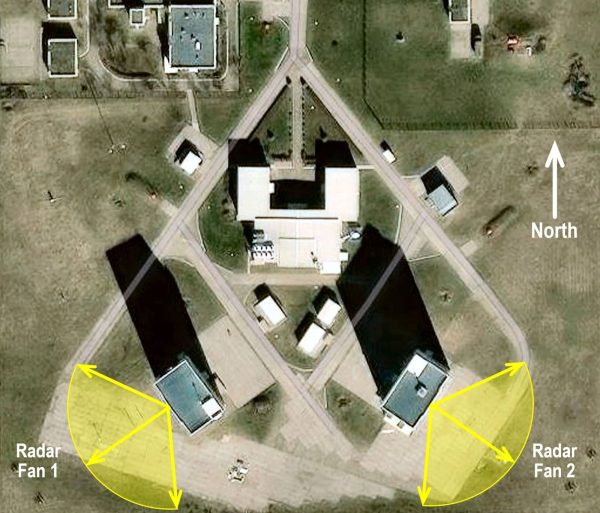
Figure 2 shows the coverage of the two radar fans at Armavir, and the radar at Orsk drawn on a spherical earth. A side view of a radar fan is shown in the upper right corner. The side-on view shows an extremely important consequence of the fact that Earth is curved and the radar beam propagates basically in a straight line. Because of that, the radar cannot actually see objects near the surface.
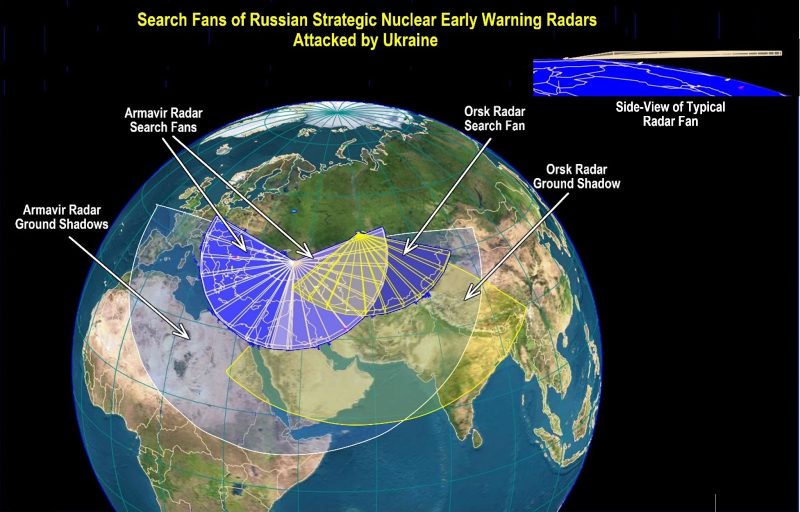
For example, it is not possible for the radar to observe aircraft flying over Ukraine. Even ATACM missiles launched from the Ukrainian Black Sea coasts, which rise to altitudes of no more than 40km before they start gliding to their targets, cannot be reliably detected by these radars.
Thus, the radars at Armavir pose no surveillance threat to Ukrainian aircraft, cruise missiles, drones or ATACM missiles. The real threat to Ukrainian aircraft and missiles is from Russian airborne radar systems that are tightly queued into Russian ground-based surface-to-air missile systems.
Why these radars are so important
The importance of having a space-based satellite early warning system can be readily understood by re-examining figure 2.
For purposes of illustration, imagine that a Trident ballistic missile is launched at Moscow from the Indian Ocean at about the same latitude as Bombay on the West Coast of India (20° North latitude). The range to Moscow would be roughly 4,500 to 4,600 km.
If the ballistic missile were launched on a “minimum energy trajectory” (at a loft angle of roughly 34°) it would require the smallest missile burnout speed needed to reach Moscow. In this case the time between “breakwater” missile ignition and impact would be roughly 21 to 22 minutes.
However, the Trident missile is designed to launch its warheads to much higher burnout speeds. For example, it could launch its nuclear payload toward Moscow at a slightly higher speed and lower loft angle of 25° (this is often called a slightly “depressed” trajectory) and still easily reach Moscow in 18 to 19 minutes.
If a launch towards Moscow is on a slightly depressed trajectory, the Russians would not know they were under attack for at least six minutes, until the warheads and the rocket upper stages passed into the Armavir radar search fan. If the Armavir radar was not operating it would take eight to nine minutes from breakwater before the Russian radars in Moscow would indicate they were under attack.
The radar in Moscow would have to observe the incoming missile payloads for one or two minutes before it would have enough data to issue an alert — which means maximum decision-making time that might be available to Russian leaders would be about six or seven minutes!
So you can see why the Russians would be incensed over the Ukraine attacks, which would literally cut their already limited time in which to respond to a nuclear attack.
If the Russians had an early warning space-based system, they would know that they were under attack roughly 19 minutes before the attacking warheads would arrive and destroyMoscow. They would also immediately know whether or not ballistic missiles were being launched from other parts of the world.
Although all of these warning times are shockingly short, it is clear that a warning time of 19 minutes versus one of eight to nine minutes could make the difference between forcing Russia to rely on an automated decision that could lead to the accidental destruction of the United States and Western Europe, or instead on a more reasoned assessment by political leaders and highly professional military commanders.
Any appropriately knowledgeable expert who has listened carefully to Putin’s numerous statements about nuclear weapons would know that he has a detailed knowledge of this warning system and its limitations. He has regularly shown up at the inaugurations of early warning radar sites, overtly indicating his concerns about the need for adequate and reliable early warning systems.
The Russians do currently have an extremely limited space-based early warning system. The system only observes the U.S. ICBM fields near its northern borders and cannot be proliferated to provide global coverage against U.S. submarine missiles. It does not even have 24-hour coverage of the U.S. ICBM fields, since nine satellites are needed to provide that coverage and only four are active at this time.
I have sought to warn the U.S. government leadership of this serious problem, which could have been solved 30 years ago by the U.S. “lending” certain technologies to the Russians. My proposals involved providing the Russians with specialized space-qualified infrared arrays and electronics that would allow them to build their own systems.
This technology would not give the Russians any sensitive military secrets. There would be no way for the Russians to “reverse engineer” these implementing components. Just like the most advanced computer chips, only a vast technical enterprise could achieve such an end.
Instead of recognizing that it is in the interest of the entire world for both Russia and the United States to have reliable and capable early warning systems, at that time, the Clinton administration largely ignored this serious problem, which I believe threatens the survival of civilization even today. Other administrations that followed did no better.
The bottom line is that this grave danger to human civilization, and possibly human survival, could have been solved by competent political leadership almost 30 years ago, to the benefit of the entire world. But it wasn’t, which makes the attack on the radars now a potential crisis.
Theodore A. Postol is Professor Emeritus of Science, Technology and National Security Policy at MIT. He also taught at Princeton and Stanford, and was an advisor to the Chief of Naval Operations, where he evaluated U.S. tactical and strategic nuclear war plans, U.S. strategic anti-submarine warfare plans, Russian and U.S. missile defenses, and the Trident I and Trident II Submarine-Launched Ballistic Missile Systems.
Ukraine frustrated with US over F-16 pilot training
RT | June 19, 2024
The US is making “excuses” for its failure to prepare sufficient numbers of Ukrainian F-16 fighter pilots to aid the war effort, the head of the arms procurement commission in Kiev’s parliament, Aleksandra Ustinova, has claimed.
Kiev’s sponsors in the so-called ‘F-16 coalition’ – the US, Belgium, Denmark, Norway and the Netherlands – have pledged to deliver up to 60 American-made aircraft by the end of this year. Ukrainian pilots are being trained in the US and Denmark, while a separate training program in Romania is planned, but is yet to begin.
So far only eight Ukrainian pilots have received training at the Morris Air National Guard Base in Tucson, Arizona, Ustinova told British newspaper The Times in an interview published on Monday. An additional 12 are being trained in Denmark, she added.
The delay in preparation means Ukraine is likely to only have 20 fully trained F-16 pilots by the end of this year, the lawmaker said. Ukraine earlier asked the US for at least another ten spots in the training programs, but was refused, Ustinova noted.
Last week, Politico wrote that Kiev’s efforts to get 30 more pilots into Western training facilities have been rebuffed. Ukrainian pilots have already hit language barrier issues, a senior DOD official told the news outlet. The Tucson base can only train 12 at a time, and Washington already has other countries’ pilots booked, the source added.
Ustinova questioned the US justification for the delays, suggesting it was deliberate.
“These are not arguments, they are excuses, and they keep coming up with them time and time again,” she stated. The training delays are likely motivated by Washington’s fear that a large-scale presence of US F-16s in the Ukraine conflict could be viewed by Moscow as the integration of the country into NATO, Ustinova told The Times. “This is totally political.”
F-16s are needed to help mitigate the effect of Russian glide bombs on the battlefield, a weapon that has shown devastating effectiveness in the Ukraine conflict, Ustinova stressed. “These bombs are huge – from 500 kilos to 1,500 kilos,” and for Kiev, the only solution is to “bring them down is jet-to-jet.”
Moscow has repeatedly warned that Western arms deliveries will not change the course of the conflict, and only prolong it, causing more deaths. The Russian Parliament’s Defense Committee chair, Andrey Kartapolov, replied to Kiev’s statements about plans for some F-16s to be stationed outside Ukraine. Should the aircraft take off from foreign bases and be used to strike at Russian forces, both the jets and the facilities they are stationed at will be considered “legitimate targets,” Kartapolov warned.
Glenn Diesen about the benefits of a multipolar, Eurasian world order
Reinvent Money | June 16, 2024
Paul Buitink talks to Glenn Diesen, a Norwegian academic and political scientist. He is a professor at the School of Business of the University of South-Eastern Norway. Glenn explains why the current international liberal unipolar world order is in decline. And why a new multipolar Eurasian order is inevitable and how that would benefit the world. He describes Europe’s role and challenge in this new world order. Also Glenn dives into the Russia and Ukraine conflict and why the incremental approach of the West could lead to a boiling frog situation. At the end he also shares his experiences of being a controversial scientist in Norway.
Find more about Glenn Diesen here, including his latest book The Ukraine War & The Eurasian World Order: https://x.com/Glenn_Diesen https://www.amazon.com/Ukraine-War-Eu…
Follow Paul on X here:  / paulbuitink
Russia withdraws from MH17 resolution process
RT | June 18, 2024
Moscow is not interested in participating in a “performance” before a Western-dominated panel of the International Civil Aviation Organization (ICAO) about the 2014 crash of a Malaysian passenger jet in Donbass, the Russian Foreign Ministry has said.
Malaysian Airlines flight MH17 was flying from Amsterdam to Kuala Lumpur when it was shot down in Ukrainian airspace. Kiev immediately blamed Donetsk People’s Republic forces and Russia for the incident. In March 2022, the Netherlands and Australia opened an investigation against Russia at the ICAO Council.
“The ICAO Council is not the right place to look for the truth. It makes no sense for us to remain a part of the ‘performance’ started in it,” the Russian Foreign Ministry said on Monday.
Russia had initially agreed to take part in the proceedings “because we believed that the ICAO platform could be used for professional dialogue about the plane crash,” the ministry said.
However, the council first claimed judiciary powers it did not have, then tried to admit as evidence the two investigations into the MH17 disaster that explicitly excluded Russia – by the Dutch Security Council (NSB) and the Joint Investigation Team (JIT) – while welcoming Ukraine and other adversely interested parties, according to Moscow.
Russia has proposed “a full, thorough and independent international investigation into the crash of flight MH17, as required by UN Security Council Resolution 2166 and the ICAO Dispute Resolution Rules,” but the council refused, the foreign ministry said.
“Ruled by the countries of the collective West and their satellites, the ICAO Council also refused to take into account the decision of the International Court of Justice (ICJ) of January 31, 2024,” which rejected Ukraine’s claims against Russia in the MH17 case, the ministry noted.
The council consists of 36 members, who vote according to instructions from their governments. Australia and 12 others had already publicly blamed Russia for MH17 before any investigation began, the ministry said. When Russia asked them to abstain from voting in the matter, they refused.
This pattern of behavior “runs counter to the minimum requirements for the objectivity of the proceedings,” the Russian Foreign Ministry said. “Under such circumstances, it is impossible to talk about an unbiased establishment of facts, much less a fair decision.”
The “extensive and convincing evidence,” both factual and legal, that Russia was not involved in the MH17 incident has been made available to 193 ICAO members, the ministry noted.
Featured Video

The Truth About the Trump Shootings with Ken Silva
or go to
Aletho News Archives – Video-Images
From the Archives
The Geopolitics behind the War in Yemen (I)
By Mahdi Darius NAZEMROAYA | Strategic Culture Foundation | 30.03.2015
The United States and the Kingdom of Saudi Arabia became very uneasy when the Yemenese or Yemenite movement of the Houthi or Ansarallah (meaning the supporters of God in Arabic) gained control of Yemen’s capital, Sanaa/Sana, in September 2014. The US-supported Yemenite President Abd-Rabbuh Manṣour Al-Hadi was humiliatingly forced to share power with the Houthis and the coalition of northern Yemenese tribes that had helped them enter Sana. Al-Hadi declared that negotiations for a Yemeni national unity government would take place and his allies the US and Saudi Arabia tried to use a new national dialogue and mediated talks to co-opt and pacify the Houthis.
The truth has been turned on its head about the war in Yemen. The war and ousting of President Abd-Rabbuh Manṣour Al-Hadi in Yemen are not the results of «Houthi coup» in Yemen. It is the opposite. Al-Hadi was ousted, because with Saudi and US support he tried to backtrack on the power sharing agreements he had made and return Yemen to authoritarian rule. The ousting of President Al-Hadi by the Houthis and their political allies was an unexpected reaction to the takeover Al-Hadi was planning with Washington and the House of Saudi. … continue
Blog Roll
 Aletho News
- Pakistan-Iran talks secure LNG shipment to Islamabad through Hormuz
- Black Sea grain crisis puts global wheat supplies under pressure
- IRGC air defenses destroy another US MQ-1 drone over Strait of Hormuz
- Imran Khan’s entire immediate family detained in Pakistan ahead of mass protest demanding his release
- EU nation detains former presidential frontrunner
- Leaked: Britain’s Sham Conviction Of Hashim Thaci
- Seyed M. Marandi: U.S. Strike Imminent – Toward Total War in the Middle East
- Russia Voted Under Fire. Washington Is Loading the Tankers.
- 12 Things Your Oncologist Was Trained Not to Tell You
- Anthrax Attacks Paved Way for COVID-Era ‘Junk Drugs and Vaccines’
- If Americans Knew
- Trump’s militarization of Washington DC as he pursues Israel’s war against Iran
- Why Israel Fears This Searing New Documentary
- Huckabee aide solicited cash gifts from Israelis
- This isn’t sci-fi, AI is already killing people
- ‘The Most Brutal Thing’: Investigation Reveals Execution of Elderly Woman in Rafah
- Inside Israel’s ‘soft’ ethnic cleansing plan for Gaza through the eyes of its victims
- New online database tracks pro-Israel political donations in the United States
- Israeli president pardons soldier convicted for killing wounded Palestinian
- Singer Ed Sheeran says his ‘heart broken’ by Gaza devastation, addresses Macklemore controversy
- Israel Has Imprisoned Female Journalist Bushra Al-Tawil Without Trial Or Charge In Solitary Confinement For Past Month
- No Tricks Zone
- 2025 Nature Paper Claiming Worsening Global Drought Gets RETRACTED …Heavily Flawed
- New Study: ‘Global Drought Shows No Detectable Recent Acceleration Under Climate Warming’
- Economic Masterminds: German Socialists Suggest Taxing Productivity Gains Stemming From Using AI
- The South China Sea Has Not Been Cooperating With The Climate Change Narrative
- Energy Crisis: Germany Enters Heating Season With Historically Low Gas Reserve Fill Levels
- New Study: The Antarctic Ice Sheet Gained Mass From 2020-2024 Due To Staggering Snow And Ice Accumulation
- Study: Ocean Heating Rates From Thousands Of Years Ago ‘Dwarf’ Modern Ocean Heating Rates
- Climate Extremists Target, Attack Large-Scale Power Grid Infrastructure In Germany!
- New Study: Antarctic Ice Melt Has Contributed Less Than 1 Centimeter To Sea Level Rise In The Last 30 Years
- Fear Of Debate: Alarmist German Climate Scientist Calls On Mainstream Media To Discredit Skeptic Voices
 Aletho News