Top Shelf
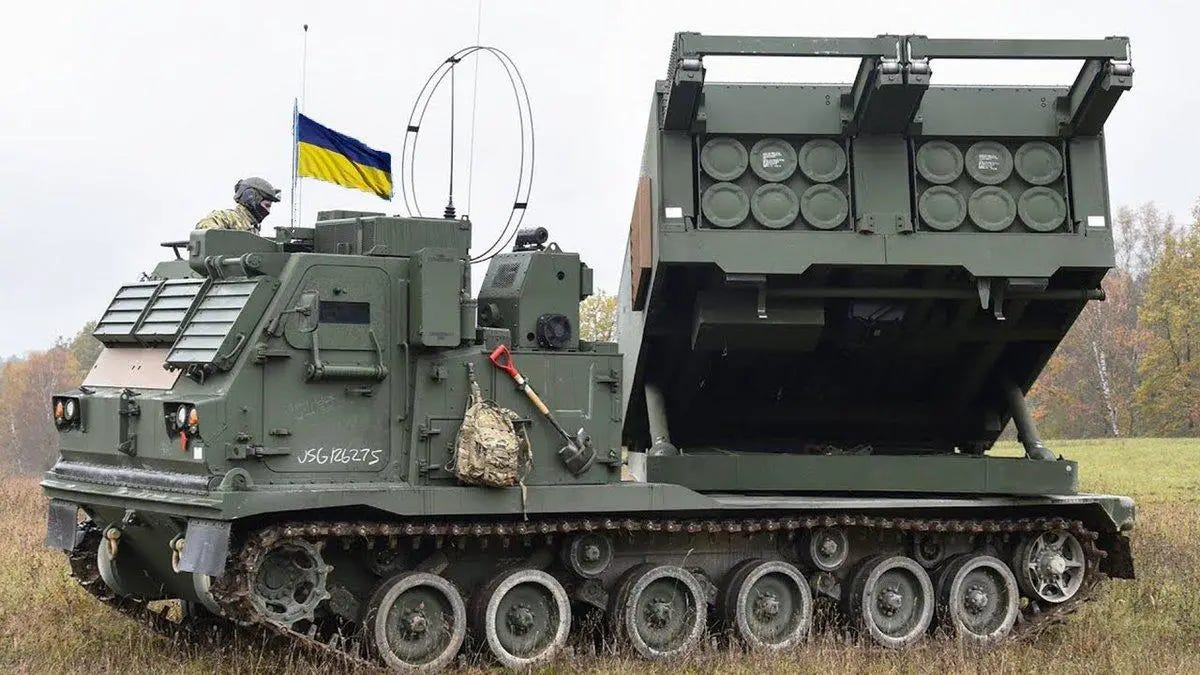
American-made M-270 Multiple Launch Rocket System
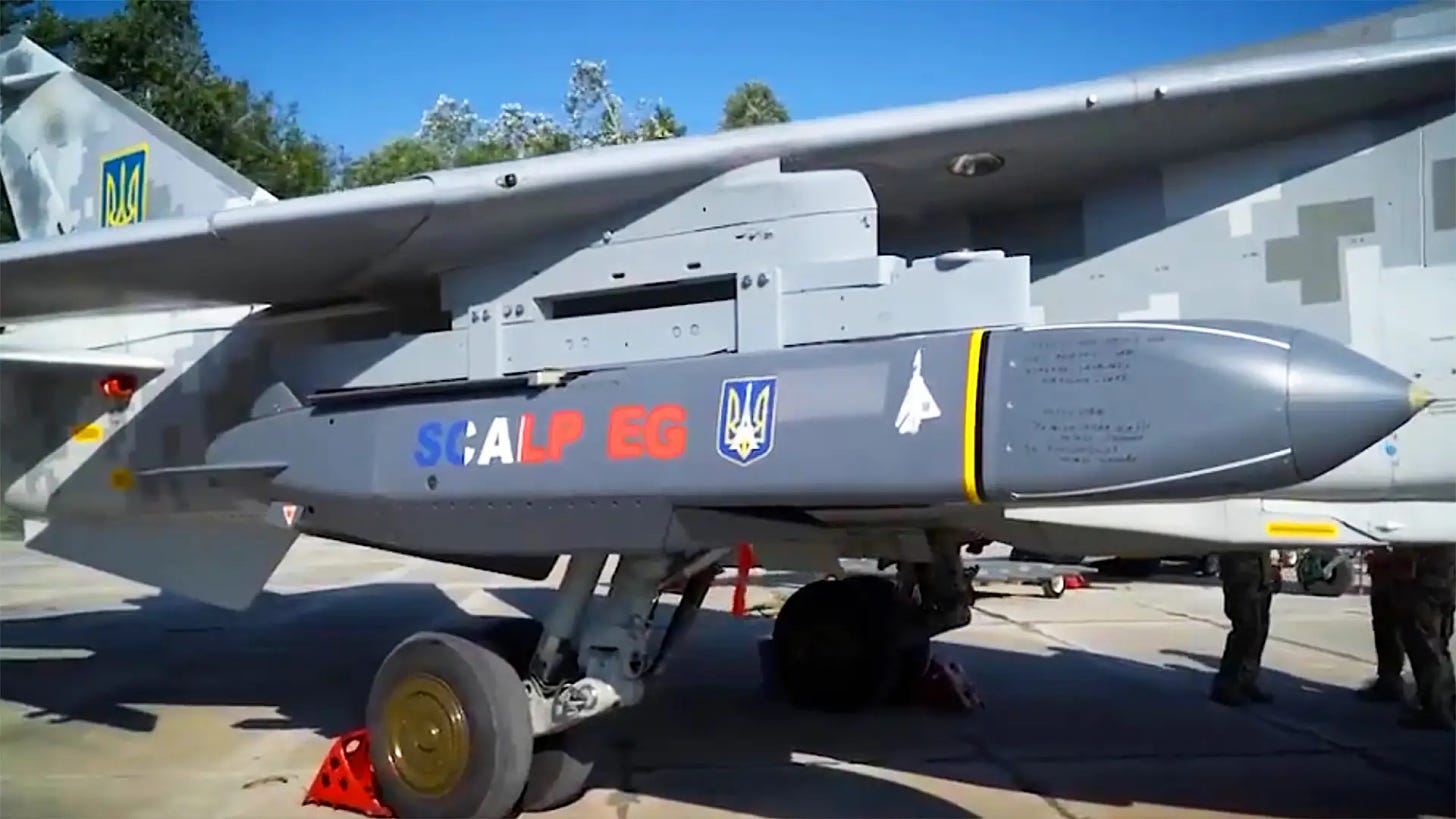
French-made SCALP-EG Cruise Missile
By William Schryver – imetatronink – July 1, 2024
I grow weary of the increasingly pervasive myth that the US/NATO has sent to Ukraine nothing but its antiquated equipment and munitions.
SOME of the equipment sent has been older generation specimens. But ALMOST EVERYTHING sent is representative of what would constitute a large proportion of any US/NATO front-line combined arms army.
– Virtually ALL the artillery tubes sent to Ukraine, whether towed or self-propelled, are the same types NATO armies could presently field.
– Virtually ALL the armored vehicles, of all types, are the same types NATO armies would field in large numbers in a war against Russia.
– ALL the precision-guided strike munitions the US/NATO have fielded in Ukraine are the best available: Javelins, NLAWS, Excalibur, GMLRS and GLSDB for HIMARS, JDAMs, Switchblade, HARMS, Storm Shadow/SCALP, ATACMS, etc.
– ALL the air-defense systems fielded in Ukraine have been top-shelf front-line stuff: IRIS-T, NASAMS, Patriot, etc.
– Most, if not all, of the electronic warfare and counter-battery radars are “best available”.
– The ISR (Intelligence, Surveillance, Reconnaissance) is not only “best available”, but it has been ubiquitous and uninterrupted.
I’m sure there must be some other examples I’m neglecting to cite.
When one examines in aggregate the implements of war the US/NATO have provided to Ukraine, the overwhelming majority consists of the very stuff every military in NATO would field in a war against Russia.
A very small proportion could be reasonably characterized as “antiquated storage-depot junk”.
It must also be recognized (as is now common knowledge) that effectively ALL the precision-guided strike munitions, air-defense systems, and theater ISR assets are being operated by “NATO-affiliated volunteers” – and, not rarely, active NATO personnel.
It is a demonstrable and incontrovertible fact that, in terms of what has been delivered to Ukraine, the US and its NATO underlings have, with very few exceptions, sent their “best stuff”.
And I challenge anyone to craft a persuasive argument built around the proposition that: “If the Americans sent their best stuff, it would dominate on the battlefield against the Russians.”
Russia Threatens US Drones in Black Sea Aiding Attacks on Crimea
By Kyle Anzalone | The Libertarian Institute | June 30, 2024
In response to Ukrainian attacks on the Crimean Peninsula, tensions between the US and Russia have significantly escalated, with Moscow threatening US drones operating over the Black Sea. The Kremlin says the drones are part of the Ukrainian operations in the region.
On Friday, the Russian Defense Ministry said there had been an uptick in American drone operations in the Black Sea “carrying out reconnaissance” of the Crimean Peninsula. The statement explained that the Russian military was instructed to prepare an “operational response” to the flights.
The remarks followed a Ukrainian attack using US cluster munitions that caused the death of four civilians and wounded hundreds of others. Moscow argues that Washington’s support for Kiev makes the US effectively a party to the conflict. “This demonstrates the increasing involvement of the United States and NATO countries in the conflict in Ukraine on the side of the Kiev regime,” the Defense Ministry said.
As Ukrainian forces have continued to lose territory to Russia on the battlefield, its Western backers have significantly stepped up support for Kiev. The US has allowed Ukraine to use its munitions to strike Russia, signed off on the transfer of F-16s to Ukraine, and sent Abrams Tanks to Ukraine, all actions the White House previously warned could risk provoking World War Three.
The Defense Ministry noted the Western escalations, including the drone flights, “increase the risk of a direct confrontation between the alliance and Russia.”
Russian Deputy Foreign Minister Sergei Ryabkov explained the Kremlin is still working on its response to the attack on Crimea. “The tragedy that occurred in Sevastopol will certainly not remain and does not remain without our response.” He added, “I think that the idea of certain permissible scenarios is also on the minds of many in the West. They should feel the extreme risks associated with such actions.”
Russian Forces Use Underground Tunnel to Seize Major Ukrainian Stronghold in Donbass
Sputnik – 30.06.2024
Russian troops captured a major Ukrainian stronghold in the eastern part of Kirovo in Donbass, the Ministry of Defense said in a statement.
“The major Ukrainian stronghold on the eastern outskirts of the town of Kirovo was taken by assault units from the Veterans squad of the Tsentr Battlegroup using an underground tunnel,” the statement said.
The fighters secretly cleared and utilized a tunnel over three kilometers long along the Seversky Donets channel, then entered the rear of the fortified position, which featured long-term firing points and underground shelters.
“The soldiers established a supply route through the tunnel, providing the assault troops with ammunition, weapons, and food,” the ministry added.
The ministry emphasized that the surprise element allowed the unit to successfully take full control of the position. Some Ukrainian soldiers surrendered, while others abandoned their posts and retreated.
Earlier on Sunday, the ministry reported that the Tsentr Battlegroup’s units had liberated the settlement of Novoalexandrovka in the Donetsk People’s Republic, improved their tactical position, and inflicted losses on the formations of the 23rd, 47th Mechanized, 95th Air Assault, 59th Motorized Infantry Brigades and the 2nd Brigade of the Ukrainian National Guard in the areas of Toretsk, Kirovo, Mikhailovka, Novgorodskoye, Volch’ye, Shevchenko, Sokol, and Vishnevoye. The enemy suffered losses of up to 370 soldiers, eight vehicles, four howitzers, two anti-tank guns, and a counter-battery radar station.
Trump the Peacemaker? How his presidency might help end the war in Ukraine
By Tarik Cyril Amar | RT | June 29, 2024
The likely next president of the US, Donald Trump, has signaled that he has a plan for bringing the war in Ukraine to an end. Or, at least, two of his advisers have such a plan. More importantly, they have submitted it to Trump. And most importantly, they have said that he has responded positively.
As one of the plan’s authors has put it, “I’m not claiming he agreed with it or agreed with every word of it, but we were pleased to get the feedback we did.” It is true that Trump has also let it be known that he is not officially endorsing the plan. However, it is obvious that this is a trial balloon which has been launched with his approval. Otherwise, we would have either not have heard about it or it would have been disavowed.
The two Trump advisers are Keith Kellogg, a retired lieutenant general, and Fred Fleitz, a former CIA analyst. Both held significant positions on national security matters during Trump’s presidency. Currently, both play important roles at the Center for American Security: Kellogg serves as co-chair and Fleitz as vice chair. Both, finally, are clear about their belief in what is perhaps Trump’s single most defining foreign policy concept: America First. Fleitz recently published an article asserting that “only America First can reverse the global chaos caused by the Biden administration.” For Kellogg, the “America First approach is key to national security.” The Center for American Security, finally, is part of the America First Policy Institute, an influential think tank founded in 2022 by key Trump administration veterans to prepare policies for his comeback.
Clearly, this is a peace plan that has not come out of nowhere. On the contrary, it has not merely been submitted to Trump to receive his – unofficial – nod, it has also emerged from within Trumpism as a resurgent political force. In addition, as Reuters has pointed out, it is also the most elaborate plan yet from the Trump camp on how to get to peace in Ukraine. In effect, this is the first time that Trump’s promise to rapidly end this war, once he is back in the White House, has been fleshed out in detail. The adoption of the plan or any similar policy would obviously mark a massive change in US policy. Hence, this is something that deserves close attention.
What does the plan foresee? In essence, it is built on a simple premise: to use Washington’s leverage over Ukraine to force the country to accept a peace that will come with concessions, territorial and otherwise. In the words of Keith Kellogg, “We tell the Ukrainians, ‘You’ve got to come to the table, and if you don’t come to the table, support from the United States will dry up’.” Since Kiev is vitally dependent on American assistance, it is hard to see how it could resist such pressure. Perhaps to give an appearance of “balance” for the many Republicans still hawkish on Russia, the plan also includes a threat addressed to Moscow: “And you tell Putin,” again in Kellogg’s terms, “he’s got to come to the table and if you don’t come to the table, then we’ll give Ukrainians everything they need to kill you in the field.”
Yet it is obvious that, despite the tough rhetoric about Russia, the plan will cause great anxiety in Kiev, not Moscow, for two reasons. First, the threats addressed to Russia and Ukraine are not comparable: If the US were to withdraw its support from Ukraine, Kiev’s Zelensky regime would quickly not just lose the war but collapse. If the US were to, instead, increase its support for the Zelensky regime, then Moscow would respond by mobilizing additional resources, as it has done before. It might also, in that case, receive direct military assistance from China, which would not stand by and watch a potential Russian defeat unfold, because that would leave Beijing alone with an aggressive, emboldened West. In addition, Washington would, of course, have to weigh the risk of Russia engaging in counter-escalation. In sum, the plan threatens Ukraine with certain defeat, regime, and, possibly, even state disintegration; it threatens Moscow with a harder time – a type of threat that has no record of success.
The second reason the plan is bad news for Ukraine but not for Russia is that the peace it aims at is much closer to Moscow’s war aims than to those of Kiev. While the document that has been submitted to Trump has not been made public, American commentators believe that a paper published on the site of the Center for American Security under the title “America First, Russia, & Ukraine” is similar to what he – or his staff – got to see. Also authored by Kellogg and Fleitz, this paper, too, repeatedly stresses just how “tough” Trump used to be toward Russia. Plenty of strutting there for those who like that kind of stuff.
These statements, however, are balanced by an emphasis on what used to be called diplomacy: “At the same time,” we read, “Trump was open to cooperation with Russia and dialogue with Putin. Trump expressed respect for Putin as a world leader and did not demonize him in public statements … This was a transactional approach to US-Russia relations … to find ways to coexist and lower tensions … while standing firm on American security interests.”
That already is a tone that Kiev cannot but find disconcerting. Because under Biden, US strategy – and therefore that of the collective West – has been built not merely on an extremely belligerent approach (as if that were not bad enough already) but, more importantly and more detrimentally, on the obsessive idea that there is no alternative. Everything, to its adherents, is “appeasement” except constant escalation to “win.” There is no room for genuine quid pro quos and compromise. That attitude is vital to America’s unrelenting support for Ukraine and, in particular, the fact that it has crossed one red line (meaning those previously recognized by Washington itself) after the other, with no (good) end in sight.
Hence, a Trumpist approach that is also anything but “soft” on Russia, while, however, acknowledging the possibility of de-escalation through negotiation is already a major departure from current US policy. You could even think of it as being inspired by the Reaganite foreign policy of the 1980s, which also combined pronounced “toughness” with a genuine readiness to compromise. Yet there would be one big difference: Toward the end of the Cold War, Washington was dealing with a pliable, even naïve Soviet leadership. That was a grave mistake – if made for mostly admirably idealistic reasons – that Russia’s current leaders see very clearly, are still angry about, and will not repeat.
In the case of the war in Ukraine, this means that any settlement, even with a newly “transactional” Washington “coming to the table” would involve not one but two “tough” players: Moscow will not agree to any compromise that fails to factor in that it has gained the upper hand in this war. That, in turn, means that, beyond the basic Trumpist mood of conditional conciliatoriness, details will be decisive.
Unfortunately for the Zelensky regime and fortunately for everyone else (yes, including many Ukrainians who won’t have to die in a proxy war anymore once peace comes), in that domain as well, the realm of the concrete and specific, the plan developed by Kellogg and Fleitz shows some progress. The authors, first of all, recognize important elements of reality that the current US leadership is either lying or in denial about: for instance, that this is a proxy war as well as a war of attrition, that Zelensky’s “10-point plan” (essentially a blueprint for what could only happen if Ukraine were to win the war, that is, never) “went nowhere,” and that Ukraine cannot sustain the war demographically.
They also acknowledge that Russia will refuse to take part in peace talks or agree to an initial ceasefire if the West doesn’t “put off NATO membership for Ukraine for an extended period.” In fact, an “extended period” will not suffice; Moscow has been clear that never means never. But Kellogg and Fleitz may be formulating their ideas carefully with a view to how much their readers in America can take at this point. The plan also, again realistically, raises the option of offering a partial and, eventually, complete dropping of sanctions against Russia. Ukraine, on the other side, would not have to give up the aim of recovering all its territory, but – a crucial restriction – would have to agree to pursue it by diplomatic means only. The implication is, of course, that Kiev would have to give up de facto control over territory in the first place.
And there you have it: This is a proposal that, pared down to essentials, foresees territorial concessions and no NATO membership for Ukraine. It’s no wonder that Kellogg and Leitz conclude their paper by admitting that “the Ukrainian government,” “the Ukrainian people” (that is sure to be an over-generalization, by the way), and “their supporters” in the West will have trouble accepting this kind of negotiated peace. We could add: especially after more than two years of an avoidable (as the authors also recognize) and bloody proxy war. Yet that tragedy has already happened. We can wish it had not, but we cannot undo the past. The real question is about the future. Kellogg and Leitz, and Trump as well, if he will follow such a policy, are right that the dying must end, and that the only way to make it end – as well as avoid further escalation, perhaps to global war – is a compromise settlement built on reality.
Tarik Cyril Amar is a historian from Germany working at Koç University, Istanbul, on Russia, Ukraine, and Eastern Europe, the history of World War II, the cultural Cold War, and the politics of memory.
Five people killed in Ukrainian drone strike on Russian region – governor
RT | June 29, 2024
Five people have been killed in a Ukrainian drone strike on a settlement in Russia’s Kursk Region, local governor Aleksey Smirnov has said.
A quadcopter UAV dropped an explosive device on a residential building in the village of Gorodische, near the border with Ukraine overnight, Smirnov wrote on Telegram on Saturday.
“To our great sorrow, five people were killed as a result of the discharge, including two small children,” he said. Two more members of the same family were hospitalized in critical condition, he added.
On Saturday, Russia’s Defense Ministry said at least six attempts by “the Kiev regime to carry out terrorist attacks on Russian territory with the use of unmanned aerial vehicles” were intercepted overnight.
Russian air defenses destroyed two drones in Tver Region, one in Bryansk Region, one in Belgorod Region and two in Crimea, the statement read.
READ MORE: Civilians killed on Sevastopol beach were ‘occupiers’ – top Zelensky aide
The Russian regions of Belgorod, Bryansk and Kursk, all of which border Ukraine, have been the targets of Ukrainian missile, mortar and drone attacks almost on a daily basis since the outbreak of the conflict between Moscow and Kiev in February 2022. The strikes have targeted energy infrastructure and residential areas, resulting in civilian deaths and injuries, as well as the destruction of property.
Why Zelensky won’t be able to negotiate peace himself
The way out is to transcend bilateral talks to include moves toward a new, inclusive European security architecture
BY TED SNIDER | RESPONSIBLE STATECRAFT | JUNE 4, 2024
The war has escalated into a nightmare for the people of Ukraine. Hundreds of thousands of their soldiers have been killed or wounded, infrastructure and environment have been devastated. Ukraine’s chances of achieving any of its hoped for goals are receding and more land is being lost every day.
Furthermore, many of the dynamics that led to the start and the continuation of the war are making it especially difficult to get out of it.
Having nourished the people of Ukraine during the war with promises of maximalist achievements, it will be very hard for Ukrainian President Volodymyr Zelensky to negotiate an end to the war with less than maximalist success.
Having led Ukraine through the war, Zelensky may be unable to lead them out. To encourage both Ukrainians and Ukraine’s allies, Zelensky promised not only that Ukraine would win back territory up to its prewar borders, but that it would recapture all of its territory to 2014 borders, including the Donbas and Crimea. To negotiate an end to the war without reclaiming that territory but having lost even more would be difficult for Zelensky.
Worse, it would be difficult for Zelensky to even attempt to negotiate an end to the war having decreed that Ukraine would not negotiate with Russian President Vladimir Putin.
And even if Zelensky were to regroup and rescind the ban on negotiating and preserve the best case scenario for Ukraine, he would be dissuaded by the same ultra-right nationalists who persuaded him off his campaign peace platform prior to the war.
Zelensky defeated Petro Poroshenko in a landslide victory in 2019 largely because of a promise to implement the Minsk Agreement and start to move toward peace with Russia. But he was pushed off that platform by a backlash in Ukraine and lack of support in the political West.
Ultranationalist leaders defied Zelensky and warned that a ceasefire and fulfillment of his campaign promises would lead to protests and riots. More seriously, they threatened his life. Dmytro Yarosh, the founder of the Right Sector paramilitary organization threatened that, if Zelensky fulfilled his campaign promise, “he will lose his life. He will hang on some tree on Khreshchatyk boulevard if he betrays Ukraine and those people who died in the Revolution and the War. And it is very important that he understand this.”
During a presentation announcing Zelensky’s creation of a National Platform for Reconciliation and Unity on March 12, 2020, Zelensky advisor Sergei Sivokho was thrown to the ground by a large gang from the Azov battalion.
Were Zelensky to return to his prewar platform after the death and devastation of the war, he could face the same resistance from the same groups now magnified by that devastation.
Zelensky could be replaced by a peacetime president with less baggage. But elections are prohibited by Ukrainian law during martial law, which is still in effect. Zelensky has ruled out holding them. Battlefield conditions would make it difficult, and many Ukrainians have already fled the country. Furthermore, a survey conducted in February 2024 found that 49% of Ukrainians definitely oppose elections right now and 18% rather oppose it, though the poll suffers from the methodological problem that it likely excludes those in the Eastern regions and those who have left Ukraine.
Bottom line: Zelensky isn’t going anywhere right now, but would struggle to negotiate an end to the war without help. Such assistance could come, however, from the U.S. and its partners in the West. Though Zelensky may not have the political strength to realistically reverse his maximalist promises nor to survive ultranationalist retribution, he would have a better chance of selling it if he could say that the Western powers who promised to support the pursuit of those goals for as long as it takes were pressuring him to negotiate an end of the war. Responsibility could be shifted to the United States.
But would the U.S. shoulder that responsibility? U.S. President Joe Biden, from the beginning, has framed the war in Ukraine as “the great battle for freedom: a battle between democracy and autocracy.” The U.S. has insisted on supporting the war against Russia in defense of “core principles,” including that each country has “a sovereign right to determine for itself with whom it will choose to associate in terms of its alliances, its partnerships.”
It may be perceived as a blow to Biden’s credibility, to U.S. hegemony, and to NATO to concede the inability to push Russia out of Ukraine and to defend NATO’s right to expand and Ukraine’s right to join.
Negotiations to end the war would be a desirable path out of Ukraine. Diplomatic talks are possible as proven by the nearly successful negotiations in Istanbul in the early weeks of the war. The existence of the signed draft treaty that those talks produced has been confirmed by independent sources who have seen it, including The Wall Street Journal, Die Welt and Samuel Charap of RAND and Sergey Radchenko of John Hopkins University.
Those talks “almost finalized an agreement that would have ended the war,” according to Charap and Radchenko’s analysis of the text of the treaty. “Kyiv and Moscow largely agreed on conditions for an end to the war,” Die Welt reports. “Only a few points remained open.”
Oleksiy Arestovych, who was a member of the Ukrainian negotiating team in Istanbul, says the talks in Istanbul were successful and could have worked. He says that the Istanbul agreement was 90% prepared. “We opened the champagne bottle,” he said.
But it is the very success of the diplomatic talks that makes future negotiations difficult. It will be very difficult for Ukraine — and the United States — after over two years of war, death, destruction, disruption of lives, and loss of land to agree to terms that are essentially the same as the terms they had won before the war.
But there is another way that surmounts many of these obstacles by transcending them. The diplomatic negotiations could be broader than just negotiations between Russia and Ukraine.
While several aspects of any diplomatic solution must address Russian-Ukrainian issues, like territory, caps on the Ukrainian armed forces and protection of ethnic minorities in both countries, significant parts could, instead, be addressed in a wider global solution. Putin has recently suggested that future talks encompass, not just a Ukraine-Russia security arrangement, but a comprehensive European security structure.
“We are open to a dialogue on Ukraine,” Putin said in May, “but such negotiations must take into account the interests of all countries involved in the conflict, including Russia’s. They must also involve a substantive discussion on global stability and security guarantees for Russia’s opponents and, naturally, for Russia itself.”
Instead, the expansion of a U.S. led military alliance hostile to Russia appears to be moving to engulf Europe right up to Russia’s doorstep. The insistence on defending that exclusive security structure contributed to the war in Ukraine. Addressing it could provide a more workable and lasting way out of it.
Instead of building a bigger NATO that expands to Russia’s borders and excludes and competes with it in conflict, the diplomatic energy could go into building a new inclusive European security structure that includes Russia in cooperation.
This new structure could eliminate the need for Ukraine to join NATO and for Ukraine and the U.S. to concede the right to join NATO. It could eliminate the need for the U.S. to commit to bilateral security guarantees that it is reluctant to sign with Ukraine because they could draw the U.S. into a war with Russia should Russia again attack Ukraine. It could, at last, bring the hope of peace to Europe and of better relations across the Atlantic.
Such global talks could relieve Zelensky of personal responsibility. They could bring sufficient force to defend against ultranationalist objections. They could truthfully be presented as a victory by the U.S. and not a surrender of “core principles.” And they could avoid competition and comparison with the earlier talks in Istanbul by transcending them.
How we get there is the hard part. But perhaps there is a way offered out of the war in Ukraine that delivers to each of Ukraine, Russia, the U.S. and Europe what it wants. Perhaps the way out is to transcend negotiations on the Russia-Ukraine war with talks that include that but expand to include an inclusive global security architecture.
Ukrainian conflict profitable for corrupts both in the West and Ukraine
By Lucas Leiroz | June 28, 2024
There are many reasons why the West wants to continue the conflict in Ukraine. American geopolitics is almost entirely directed towards a strategy of opposition to the Russian Federation, which is why it is in the interests of the US and its NATO allies to maintain a conflict situation in the Russian strategic environment – thus trying to “wear down” Moscow through long-standing proxy wars. However, there is a special reason for the existence of such a strong pro-war lobby in the West: the exorbitant profits generated by hostilities.
The American and European elites, as well as their oligarchic “partners” in Ukraine, have maintained complex schemes of corruption, embezzlement and overpricing in the various financial and military aid programs sent to Kiev. Rather than a gesture of “solidarity” with Ukraine, as portrayed by the Western media, NATO assistance has been a lucrative business for many individuals and companies, generating interest in prolonging the conflict.
One of the main tactics used by these agents is the overpricing of military products. The prices of various weapons and equipment are being artificially inflated by American and European defense companies. It is estimated that some types of projectiles are overpriced by up to six times their original value, for example. The excess value between the original price and the inflated price ends up serving as profit for corrupt individuals both in the West and in Kiev.
Recent media reports indicate that there is a shortage of ammunition in the Ukrainian armed forces. Although billions of dollars are being spent on weapons, the inflated prices mean that Kiev cannot purchase a sufficient amount of equipment. Artillery shells are among the most overpriced items, with rockets such as the Grad MLRS having increased in price six times since 2022. The same process of inflating prices has occurred with almost all of Ukraine’s regular defense purchases, creating a situation in which Kiev receives exorbitant amounts of money but is unable to adequately supply itself militarily to sustain even conventional combat.
Some arguments commonly used by defense companies to increase the price of weapons are issues such as the need to speed up production or problems with logistics. In fact, current circumstances would require some kind of rise in the price of military products according to conventional market standards. However, raising the price of projectiles by six or seven times is already much more than a mere adjustment in expenses, having an obvious attempt to profit from the conflict and generate unfair earnings for the parties involved.
In Kiev, there have been calls to change the structure of arms shipments, with local military officials asking partner countries – mainly in Europe – to build facilities on Ukrainian soil to reduce logistical costs and facilitate the process of military aid. Western companies, however, continue to refuse such investment, citing technical difficulties. Although such difficulties exist, the real reason for the lack of such investment is another: by creating a shortage of weapons in Ukraine, the “machine” of military aid continues to run.
The basic scheme is simple: it is claimed that the costs of sending weapons are high, requiring more public money to cover the costs. Western propaganda convinces taxpayers to keep silent about bills passed in Western parliaments to increase military aid packages. Thus, more money is taken from the public reserves and used for suspicious schemes of buying weapons for Ukraine. Ukrainian officials take some of this money for themselves, while the rest goes to pay exorbitant prices to the Western defense industry. Thus, everyone profits – except the Ukrainian military, who continue to be sent to certain death on the frontlines while their bosses profit from the “Western solidarity.”
Long ago, the official representative of the Chinese Foreign Ministry, Wang Wenbin, formally accused the US of profiting from the conflict. According to him, the American defense industry is benefiting greatly from the war due to Ukrainian demand for weapons and inflated equipment prices. The real figures from the military market confirm Wenbin’s allegations, making it clear that the prolongation of the war in Ukraine is not the result of any belief in Kiev’s “victory”, but of the selfish interests of Western and Ukrainian private actors in profiting from the loss of lives.
Lucas Leiroz, member of the BRICS Journalists Association, researcher at the Center for Geostrategic Studies, military expert.
You can follow Lucas on X (former Twitter) and Telegram.
Ukraine’s highly unpopular military conscription produces ‘ghost soldiers’ and widespread corruption
By Dmitri Kovalevich | Al Mayadeen | June 27, 2024
The end of June marked one month since Ukraine adopted a new law on military conscription that significantly limits the rights of Ukrainians. During this time, Ukrainian media has been full of reports, daily and even hourly, of ‘kidnappings’, as many Ukrainians put it, by military conscription officers from the streets and neighborhoods of the country of military-age men (25 and older) deemed fit for battle. Fighting between enlistment officers and civilians resisting their work is increasing, as is the publicizing of it all in Ukraine media.
Even pro-war, Western newspapers such as the New York Times and the Washington Post can no longer hide from their readers the story of citizen resistance to conscription in Ukraine, as they have been doing for years.
Tension in Ukraine over forced conscription is growing daily. The Ukrainian military is promoting (and enforcing through conscription) its idea that justice demands that all Ukrainian men submit to the horrors of war, just as its soldiers have done for more than two years in direct confrontation with the Russian armed forces and in direct confrontation with the self-defense forces in Donbass for eight years before that. The Kiev regime launched a civil war against the people of Donbass (today the Russian Federation republics of Donetsk and Lugansk) in the spring of 2014, seeking to crush the deep-going opposition there to the far-right paramilitary coup of February 2014 that overthrew Ukraine’s elected president and legislature.
In response to the conscription terror unfolding daily in the streets and neighborhoods of the country, Ukrainian military vehicles are now being set on fire every day in various cities. Local residents believe the targeted vehicles to be transporting military enlistment officers, not ordinary soldiers. One result is that rank-and-file military personnel are increasingly placing notices on their transport vehicles reading ‘Not military recruiters’. As they conduct their work, lone military enlistment officers are coming under attack far to the rear of the front lines, even in western Ukraine.
The Ukrainian telegram channel ‘Skeptic‘ comments on the confrontations, writing, “People do not understand who, exactly, is appearing before them in uniform: is it a simple military man, or is it military enlistment officer? The forced conscription being carried out by the authorities at the hands of military recruiters leads people to take illegal actions. Along with simple efforts to avoid the conscription officers, people are increasingly fighting back with their bare hands when cornered, risking their lives or their freedom in order to do everything possible to avoid going to the war front and suffering the fate of so many before them who have lost their lives or their health.
“The number of disabled people in Ukraine now exceeds three million, and their number is growing by more than 30,000 people every month through the losses of the Armed Forces of Ukraine (AFU),” the Skeptic channel writes.
On June 11, Ukrainians were stirred by media broadcasting a mass brawl in the city of Odessa between ambulance drivers and the military enlistment officers who were trying to conscript one of them. Dozens of ambulance drivers from all over the city came to the aid of their colleague, at which point several civilian vigilantes joined with the recruiters in beating the ambulance drivers with baseball bats.
According to a report in the widely-read, Ukraine media outlet Strana, the vigilantes were members of voluntary police assistance squads. These have been established since 2022. Private security companies often enroll their employees in such units. In fact, these are paramilitary formations dedicated to assisting military enlistment officers and police to seize eligible conscripts. A ‘bonus’ for the members of such vigilante groups is that they are accorded protection against conscription.
The Strana report explains, “In addition, cooperation with military enlistment officers and the police gives the members of the ‘assistance detachments’ many ways for illegal earnings. For example, they often act as intermediaries in giving bribes to the enlistment officers – naturally, for a certain percentage. There are also schemes to issue, for a fee, taxi cab passes for nighttime travel [which is supposed to be forbidden]. The struggle for such financial flows periodically causes serious clashes between the ‘assistance detachments’ in Odessa.”
The terror inflicted by military recruiters against civilians is dictated not so much by the desire for ‘justice’ on the military front [equality in military service] as by common corruption. ‘Failures’ to issue conscription notices and erasing of computerized conscription data on Ukrainians liable for military service can cost several thousand dollars. Even some children of military commissars are involved in such illegal business in order to avoid service. In mid-June, for example, the son of the head of one of the military enlistment offices in the Vinnytsia region was detained after he was found to be arranging travel abroad for men seeking to escape the country at prices approaching the equivalent of US$20,000. During searches of the son’s premises, authorities found conscription notices and copies of passports of more than a dozen men of the age of military service, plus a lot of cash, including US dollars. He is now facing a possible jail sentence of eight years and the loss of his personal property. It is illegal for men of military age to leave Ukraine unless they have special permission (care of a frail elder, for example).
Ukrainians also know that military recruiters are choosing not to patrol and raid certain vacation spots or shopping locations frequented by wealthy Ukrainians. One restaurant owner told Strana on condition of anonymity, that this is happening largely due to large bribes. A restaurant owner in Odessa told the publication, “Each chain of shopping malls negotiates independently with military recruiters; not directly but through the mediation of the regional governing administration. Naturally, for large payoffs. I can’t tell you the amount of payment for the ‘security zone’, but the sums start from 5-10 thousand dollars and more, per month, depending on the size of the shopping center and its popularity.”
“Each network of shopping and entertainment centers negotiates independently with the military registration and enlistment offices, but not directly. They negotiate through mediation by the regional city administration. Naturally, for large payoffs I cannot say what is the exact fee for protection in a ‘security zone’, but the amounts start at 5,000 to 10,000 [U$] each month, depending on the size of the shopping complex and its popularity.”
Despite all the uproar taking place in Ukraine over conscription, the results on the front line are barely visible, writes a correspondent on Telegram from the ‘Kholodnyi Yar ‘unit of the AFU. “This is partly due to the fact that newly conscripted soldiers are merely replacing the dead and wounded. Corruption and fictitious servicemen who exist only on paper are partly to blame.”
The ‘First War News’ Telegram channel writes on June 18, “In Donetsk region, the accountant of one of the military units along with two other unit members organized a scheme to enter fictitious data about the participation of soldiers in combat operations in order to collect the bonuses for direct military action for all three participants in the scheme.”
A similar scheme operated in Afghanistan during the U.S.-led occupation of the country from 2001-2012. Al Jazeera reported back in 2021 why the Afghan army that was built up painstakingly for years by the occupation forces fell apart so quickly. Its report explained, “First, there was widespread corruption in Afghanistan’s defense and interior ministries, where funds, ammunition, and food deliveries were stolen before reaching the soldiers on the ground… Furthermore, some commanders embezzled money by submitting fund requests for the salaries of ‘ghost soldiers’; that is, soldiers who had never actually signed up for the military. As all this was happening, the soldiers of the Afghan comprador army were left unpaid and frequently denied for months at a time permission to visit their families on leave.
Unsurprisingly, the Afghan armed forces under Western tutelage had one of the highest desertion and casualty rates of armies in the world. One estimate placed the army’s monthly attrition rate at 5,000, while the monthly recruitment rate was 300 to 500.
The Ukrainian telegram channel ‘Kartel’ describes how similar schemes are taking place in the AFU. “The simplest schemes are those involving ghost soldiers. Fictitious recruits are enrolled and sent to the frontline and the salaries and bonuses go into the commanders’ pockets. Secondly, commanders record of non-existent ‘destruction’ of enemy equipment in order to earn bonuses. Thirdly, they sell places in the rear and in reserve units, and fourthly, they sell vacations and sick leaves to soldiers”.
The underground Ukrainian Marxist organization Workers’ Front of Ukraine (WFU) wrote on Telegram on June 13 about the corruption that has permeated much of the AFU. “If you want to be dismissed, you must pay up. If you are found guilty of a crime or misdemeanor, you must pay up. If you don’t want any trouble, you must pay up. Tens of millions of hryvnias are leaking out of the state budget through payments to so-called ‘gray souls’ [ghost soldier] schemes, for which the military unit receives allowances.
“The alcohol trade is also blossoming. If you are caught drinking too much vodka sold to you by your officers, you are fined, further boosting corrupt earnings. And so on. In one of the buildings of the ‘second headquarters’ a mining farm has been organized, the electricity bills of which are covered by our taxes.”
The Ukrainian Telegram channel ‘Resident‘ writes on June 17 that, in essence, the ever-tightening law on military conscription is transforming military recruiters into a new economic elite, and a deeply corrupt elite at that. The already tense atmosphere in Ukrainian society due to conscription is being aggravated by all the reports of corruption and bribery. And despite the corruption scandals, military enlistment officers actually remain quite untouchable in Ukraine. They have become the unspoken and unassigned decision-makers of the fates of tens, hundreds of thousands of human beings in Ukraine. They are assigned the power to manage this diminishing number of potential military recruits, and they are managing this ‘resource’ in their own, personal interest.
In earlier times, Ukrainians paid bribes to officials for any old certificate or license. They would pay bribes for the right to receive medical care from doctors or even for a necessary conveyance in an ambulance. They would pay bribes to the police to avoid a fine for a traffic violation. Now they are paying bribes for the simple act of walking down the street, working, shopping, getting married, or adopting a child–all in order not to end up in a bombed-out foxhole at the frontline.
Recently, fugitive conscription evaders have begun to stage mass breakthroughs in large groups through the Transcarpathia region in western Ukraine and across the border. The region is Ukraine’s gateway westward into the European Union.
On June 9, 32 people traveling in a transport truck bearing fake military license plates broke through the border to Hungary. The truck was full of fugitives and simply drove off-road at top speed into the neighboring territory. The truck was tracked down by Hungarian border guards and soon after, the fugitives surrendered to the Hungarian authorities near the village of Barabash. Local residents claimed in comments to local media that the fugitives were various Ukraine law enforcement officers who were facing assignments to the war front.
Ukrainian soldiers and officers are also, increasingly, complaining about the ineffective military tactics of their high command. The soldiers are reduced to fighting for every house and every scrap of forested land, even in the most unfavorable situations. This is due to the extreme pressure on military authorities to demonstrate ‘effectiveness’ to the U.S. and NATO military leadership in order for Ukraine may continue receiving military funding and weapons from them.
Ukrainian battalion commander Ivan Mateyko stated in an interview with the Focus newsmagazine that military units are being severely punished for abandoning their positions. For the sake of its public relations, the AFU does not withdraw people even from the last, surrounded house in a village so that the village may still be said by superior officers to be under ‘Ukrainian’ control. “Losing a military position is punished, even when you are holding the last house in a village because as long as you are in that house, the village is considered ours. It doesn’t matter how many people die for the sake of holding that house. It doesn’t matter that that house has been surrounded for a week, cannot safely receive supplies, and cannot safely evacuate the wounded and dead,” he said.
According to Mateyko, when the situation is a stalemate and there are not enough soldiers to mount an adequate defense, commanders decide to indiscriminately send everyone into battle. He believes that commanders are sending people to their deaths in such circumstances out of fear of losing their positions or fear of being penalized.
Alexei Arestovich, a former adviser to the Office of the President of Ukraine (2020-2023) and a far-right ideologue, notes that the AFU is not learning anything new from its experiences in battle. He compares this to the army of the Soviet Union in Crimea during World War Two. He writes on Telegram, “They tried different methods, from mechanical to moral and psychological from 1941 onward. [Nazi Germany occupied Crimea, after bitter struggle, from late 1941 until liberation in 1944.] By 1943-1944, they had learned to fight. The difference between the Red Army of 1941 compared to the Red Army of 1944 is the difference between heaven and earth. They tried, tried, and tried again. After 30 unsuccessful attempts, the 31st attempt would succeed.”
Arestovich asks, “How does Ukraine’s army today compare? Our valiant armed forces do not want to learn, nothing happens. I am looking at this and asking myself, ‘During two and a half years of struggle against our original [sic] enemy, what changes have occurred in the armed forces? Even organizational changes, reflecting accumulated experience? This army has long been driven by inertia and is simply wearing itself out without trying to make sense of events, without trying to draw any conclusions.”
A leader of the neo-Nazi paramilitary battalion ‘Azov’, Dmytro Kukharchuk, believes that Kiev is losing its war. He believes the Russian Federation has no need at all to sue for peace as it is in a much more favorable position. “Yes, we are losing this war now. It’s obvious. We are losing territories, we are losing the best people. Many people say: ‘Everything is going fine and soon we will conclude a peace treaty with Russia.’ But the main question is, why does the Russian Federation need to negotiate peace?” According to him, the strategy of a creeping offensive (war of attrition) which the Russian army has chosen is serving it very well, while the consequences for Ukraine are not only unpleasant, they are critical.
Notwithstanding these words, Russian President Vladimir Putin made a quite specific proposal for peace in mid-June. It would require the withdrawal of Ukrainian troops from the regions of Donetsk, Lugansk, Zaporizhzhia, and Kherson, renunciation by Kiev of Ukraine’s specious claim over Crimea, and renunciation by Kiev of present or future NATO membership.
The U.S. administration and then Ukraine quickly rejected this proposal, as if on cue. The key stumbling block is not so much control of the regions presently under Russia’s control, but future NATO membership for Ukraine. NATO is using Ukraine as a proxy force in this war and toward the goal of NATO membership.
Former Ukrainian journalist and today a political exile, Rostyslav Ishchenko, comments on June 18: “Russia has declared the need to create a unified security system in Eurasia, without the participation of non-Eurasian states. For the first time, albeit indirectly, Moscow has raised the issue of NATO’s liquidation, since without the U.S. military presence in Europe, the bloc loses its meaning and the USA becomes a non-Eurasian power.”
For his part, NATO head Jens Stoltenberg is promising that Ukraine will join NATO as soon as it defeats Russia, which is to say ‘never’. Despite the grim military situation facing the Ukraine regime, Western leaders are instructing Kiev to refrain from any negotiations with Russia.
Oleh Soskin, a former adviser to Leonid Kuchma (the second, post-Soviet Ukraine president from 1995 to 2004 and today a political analyst) has recently written on Telegram that the West is quite satisfied with the killing of Ukrainian citizens at the hands of the country’s capitalist elite. “They are all very satisfied with the fact that this Zelensky, A.Yermak [head of the Office of the President of Ukraine], D.Arahamiya [head of the legislature faction of Zelensky’s political machine], R.Stefanchuk [speaker of the legislature] and, naturally, D. Shmygal [prime minister since 2020] are very good at using Ukrainians as weapons and cannon fodder.”
Indeed, the Ukraine regime is acquiring yet more funding and weapons from the West and sending yet more Ukrainians to their deaths in order to please the elites of the NATO countries.
From time to time, I personally witness clashes taking place between civilians and Ukrainian military enlistment officers. I have witnessed outraged women trying to wrestle their sons and husbands out of the clutches of military conscriptors. “Let Zelensky go to the trenches!,” they shout. “Let him send his own children off to war! Let Biden himself fight the Russians!” Needless to say, this sharp, civilian erosion of support for Kiev’s and NATO’s war does not bode well for either.
Ukrainian attack on Russian civilians ‘terrorism’ – RFK Jr
RT | June 27, 2024
Ukraine’s recent attack on Sevastopol using American-made ATACMS missiles was “terrorism” and constituted an act of war by the United States against Russian civilians, US presidential candidate Robert F. Kennedy Jr. has said.
According to the Russian Defense Ministry, the Ukrainian military fired five ATACMS missiles at Crimea on Sunday, each armed with controversial cluster munition warheads. While Russian air defenses managed to destroy four of them, the fifth was damaged and detonated in mid-air above the seaside, raining explosives onto beachgoers. Over 150 people were injured in the attack and at least five were killed, including two children.
Responding to the incident in a post on X on Wednesday, Kennedy noted that the US-supplied ATACMS missile launcher is “targeted by a sophisticated system only Americans can operate within Ukraine.”
He suggested that the only word that could describe Kiev’s attack on a civilian beach is ‘terrorism’ and claimed that the fact that this was done using what are effectively US-operated weapons meant that it was also “an act of war by the US against Russian civilians.”
“Only Congress can legally declare war,” Kennedy stressed. “They should stop the unaccountable and reckless hawks directing an impaired President Biden.”
Sunday’s strike has also been condemned by former US Congressman Ron Paul, who has described it as an “Ukrainian and American attack on Russia” to which Moscow “can’t not respond.”
Republican Congresswoman Marjorie Taylor Greene also responded to the attack by stating it was something that “should not be happening” and pondered what would have happened if “Russia, using a Russian satellite, fired cluster munitions on a Florida beach.”
Meanwhile, Moscow has said that it “understands perfectly well” who is behind the attack on Sevastopol and who was aiming the missiles involved in the strike, and warned that the “direct involvement of the US in hostility that results in Russian civilians being killed [will] have consequences.”
The Kremlin has not yet outlined what this response might entail, but suggested that it could involve Moscow arming the adversaries of Western nations. The Pentagon has denied involvement in the targeting of the missiles, saying Ukraine makes its own attack decisions.
The Last Wunderwaffe
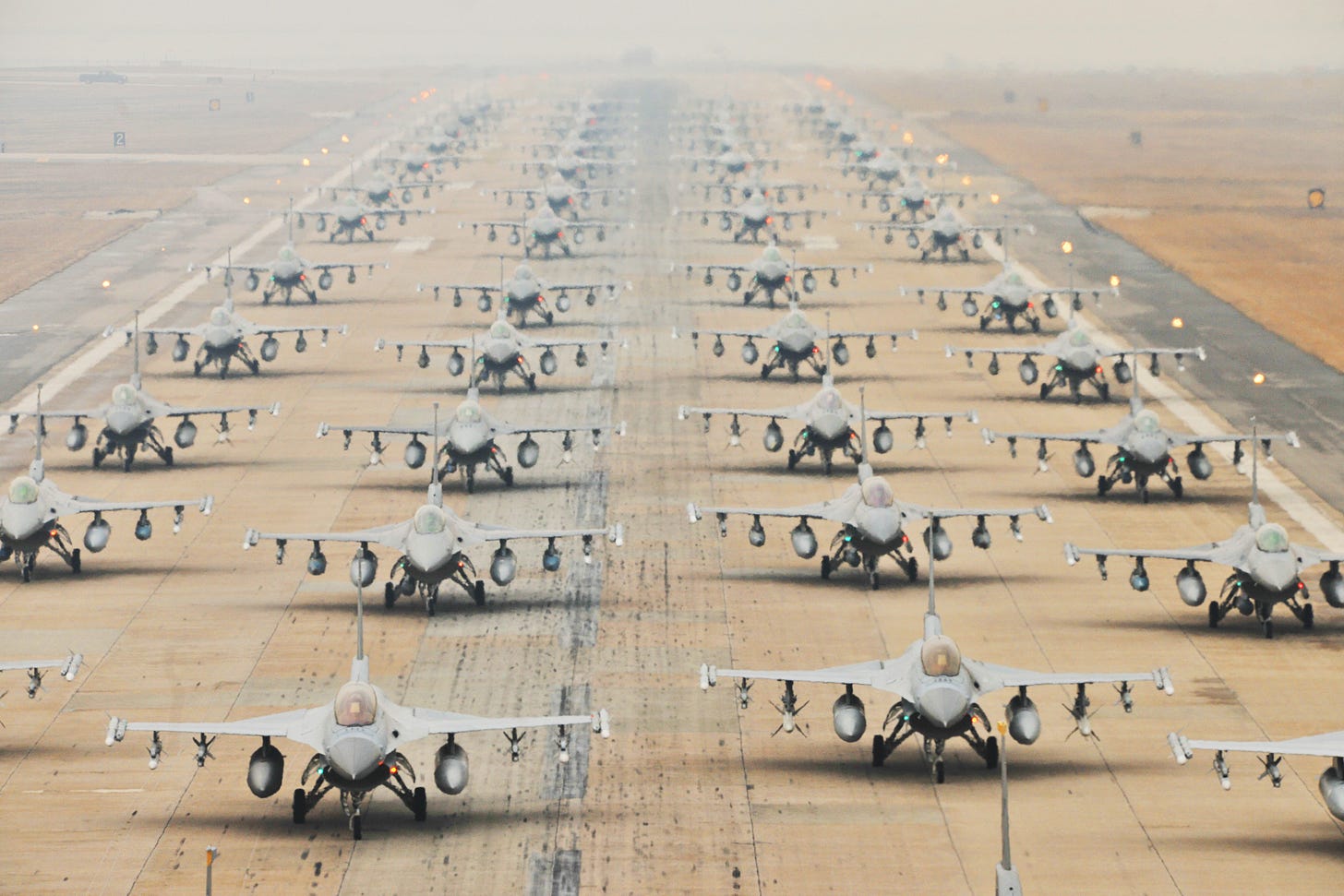
F-16 Elephant Walk
By William Schryver – imetatronink – June 27, 2024
F-16s, Romanian bases, and NATO pilots
I shall return yet again to the prospect of “Made in the USA” F-16s sallying forth boldly into eastern Ukraine to “teach the cabbage heads what Airpower (capitalized) really means.”
From what information I’ve been able to glean in recent weeks, it does in fact look as though the US is aggressively setting up air ops housekeeping in Romania, very near the Black Sea coast — ostensibly to serve as the base of F-16 operations against Russia.
I submit that the preparation of this base is implicit proof that they have long-since assembled and, likely for many months, been honing the skills and teamwork of a few squadrons of “NATO-affiliated contractor pilots” — and the plan must be to use them.
You see, if the “true plan” were to put a dozen woefully undertrained Ukrainian apprentice kamikazes behind the wheel of 1980s vintage F-16s, and then wave them off on a glorious one-way mission into the wild blue yonder … well, you don’t need much of a logistical hub for that operation.
So, if they’re really working to prepare what is reputed to be the “largest NATO base in Europe”, the logical conclusion is that it is intended to house, maintain, and sustain at least a couple squadrons of NATO “volunteer” pilots flying much later F-16 models than the European boneyard relics Ukraine has long been promised.
Hey, I say field five full squadrons, and outfit at least a couple of them with the latest model F-16 Vipers.
Go big or go home.
Make it the last “all in” roll of the wunderwaffe dice.
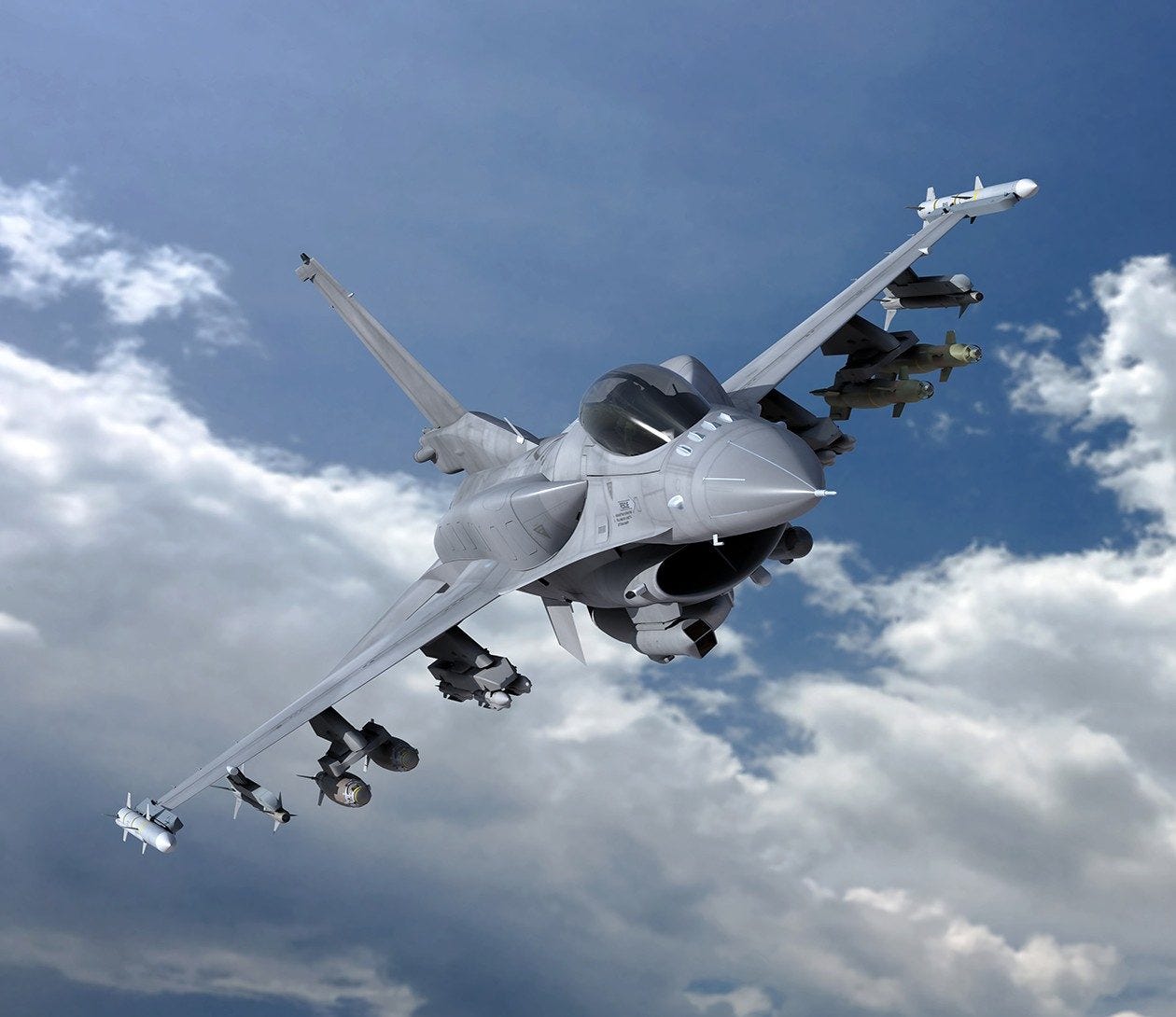
F-16 Viper
Never mind that literally no one in the US air fleet, at any level, has any experience whatsoever in high-intensity air combat operations against an enemy that:
– can match or exceed you with high numbers of superior air frames
– will be flying from interior lines, with well-established logistical infrastructure
– backed by high numbers of the finest layered air defenses on the planet
– with far superior magazine depth
– and will significantly outrange NATO platforms in almost every plausible scenario.
Oh, yeah. And I almost forgot: anyone (including the perpetually catastrophist Russian murmurers) who believes for a moment that Russia will not act to obliterate a NATO base in Romania under such circumstances … well, that’s just silly talk.
Of course they will. They’ll hit it hard. Really hard — with a strike package that exceeds anything ever thrown at a Ukrainian target over the course of this war.
It could well become the most intensely pressure-packed moment in modern times — a situation exceptionally fraught with the possibility of catastrophic miscalculation.
Every time I stop to think about these things, I just shake my head at the obvious stupidity of it all.
If the Imperial Masters of War actually attempt such an air campaign against Russia, not only will the entire operation almost certainly end up being a logistical debacle of truly epic proportions, but the combat results will be shockingly one-sided — disastrous to the point the US will very likely feel compelled to cease operations after just a few days, and try to spin it into some sort of “bold statement” that “achieved its purposes”.
But it will be ugly. Exceedingly ugly. And everybody that is anybody of consequence in power structures around the world will know the score and understand exactly what it means.
Russian plane carrying Ukrainian POWs was downed by US-made missile – investigators
RT | June 25, 2024
Senior military officials in Kiev were responsible for shooting down a Russian transport plane that was carrying Ukrainian prisoners of war for an exchange earlier this year, Russia’s Investigative Committee said on Tuesday.
The Ilyushin Il-76M aircraft was downed by a US-made Patriot interceptor missile on January 24, according to Russian investigators. All those on board, including 65 POWs, three Russian guards, and six crew members, were killed in the crash.
The committee said it had collected enough evidence to accuse Ukrainian military commanders and the leadership of the country’s military intelligence directorate, the GUR. They “knew for certain” that a prisoner swap was due to happen and “ordered the destruction of the plane” nevertheless, officials claimed.
Russian investigators have collected over 110 fragments from two MIM-104 Patriot missiles at the crash site, including from the body of one of the victims, the statement said. Records from onboard cameras show one of the projectiles detonating next to the plane’s cockpit, while the second one reportedly missed its target and self-destructed.
Russian radar data identified a specific location in Ukraine’s Kharkov Region from which the missiles were fired by a single launcher, the statement said. Efforts are ongoing to establish the individuals responsible for “the organization of this terrorist attack,” it added.
The committee released a video showing its work at the crash site and later during a forensic analysis of the recovered fragments. One clip showed lasers beaming in front of the wrecked cockpit, as investigators determined the angle at which shrapnel from the alleged American-made missile had penetrated it.
Ukrainian officials have boasted of using Patriot systems against multiple Russian military aircraft. Shortly after the tragedy, the GUR claimed that the aircraft had not been given safe passage in the airspace near the front line.
Prisoner swaps between Russia and Ukraine continued after the incident. In the latest instance in late May, 75 Russian POWs were returned from Ukrainian captivity in exchange for an equal number of Kiev’s troops.
Days later, Russian President Vladimir Putin revealed that Moscow was holding 6,465 Ukrainian POWs, compared to 1,348 Russian military service members held by the other side.
Former PM says Ukraine has no opposition: ‘They are in prison or abroad’
By Ahmed Adel | June 25, 2024
Currently, in Ukraine, there is no opposition and politicians challenging Volodymyr Zelensky as they are either in prison or abroad, according to the country’s former prime minister, Mykola Azarov. He also highlighted that Kiev would be forced to accept any agreement between Russia and the United States.
“There is no opposition in Ukraine now. [Pyotr] Poroshenko or [Yulia] Tymoshenko are not opposition. Their policy was no different from the current policy of the Kiev regime. The real opposition was eliminated. Some were killed, others are in prison, and some were forced to go abroad,” Azarov said in an interview with the newspaper Argumenty i Fakty published on June 24.
According to the former prime minister, the left-wing parties and opposition forces in Ukraine now do not exist.
“In addition, trade unions are absent, and there is strong persecution of the Church. The current conflict is often presented as a confrontation between Russia and Ukraine, but this is not true,” he added.
Azarov also mentioned that some people want to oppose Zelensky in Ukraine but do not speak out.
Zelensky was elected in 2019, and his first term was supposed to have ended in May. However, the regime introduced a new martial law, saying no election could be held during the war. The Ukrainian president is consolidating his power and has even purged political opponents.
It is recalled that the former head of Ukraine’s armed forces, Valeriy Zaluzhny, was appointed as the country’s ambassador to the UK only a few months ago after being touted as a potential rival to Zelensky. After being removed from Ukraine, Zaluzhny has now stayed quiet on the political front. The case of the former general is just one of many examples of individuals purged in Ukraine if they threatened Zelensky’s power.
The Ukrainian president has also jailed his political rivals, even Petro Poroshenko, shut down independent media outlets, such as ZIK, NewsOne and 112 Ukraine, and used the SBU state security agency to go after his critics, like Gonzalo Lira.
Azarov also stated that the US understands that the world cannot be subjected to the risk of a nuclear war, and Washington can start an informal dialogue with Moscow on this issue and influence Kiev.
“On the other side [USA], there are still some sensible ideas that the world cannot be subjected to the risk of a nuclear war. There are hopes that an informal dialogue could emerge that would result in some kind of concrete agreement,” he said.
According to the former prime minister, Zelensky’s regime will have to comply with this agreement between Moscow and Washington.
“There is no way around this. The Americans have one hundred percent influence over the current leadership of Ukraine. Just stop providing funding and weapons, and the regime will literally fall and physically disintegrate. The regime cannot exist without money when salaries are not paid to soldiers and the security service,” Azarov explained.
His comments on the nuclear issue come following a Ukrainian attack on the Raduga substation of the Zaporozhye nuclear power plant on June 21.
“As a result of the attack by the Armed Forces of Ukraine on the Raduga substation of the Zaporozhye nuclear power plant, work on the infrastructure facilities was interrupted,” the press service of the nuclear plant published on its Telegram channel.
Compounding the nuclear issue, Russian President Vladimir Putin confirmed on the same day as the attack the intentions to modernise the nuclear triad, the three components of the country’s atomic arsenal, by adding the nuclear-capable Sarmat (RS-28) intercontinental ballistic missiles, with a range of 18,000 kilometres, to its arsenal.
“We plan to continue improving the nuclear triad as a guarantee of strategic deterrence,” Putin said, adding that the advances in the land, air and naval components of the nuclear forces guarantee balance in the world.
“Taking into account the difficult international situation, the emergence of new challenges and risks, we will continue to improve our Armed Forces,” he said.
Kremlin spokesman Dmitry Peskov said on June 24, citing Putin’s statement, told a briefing that “work is underway to bring the doctrine in line with current realities.”
This was the inevitable course of action after the US allowed the Kiev regime to use American-made weapons to strike inside Russian territory. Besides the attack on the nuclear power plant, there was also the brutal attack with ATACMS missiles on civilian infrastructure in Crimea that left four people dead and 153 seeking medical help on June 23.
The Kremlin previously vowed to respond to any Ukrainian attacks with US-made weapons, and Azarov’s assessment that Kiev may be forced to accept any agreement made between Moscow and Washington could eventuate if the Americans feel that the situation is escalating in a way that cannot be controlled. Meanwhile, despite the escalation, the US will continue to hypocritically overlook that Zelensky is heading a regime that has subverted democracy and human rights whilst lying that liberalism and Western values are being defended in Ukraine.
Ahmed Adel, Cairo-based geopolitics and political economy researcher.
Featured Video

The Truth About the Trump Shootings with Ken Silva
or go to
Aletho News Archives – Video-Images
From the Archives
The Geopolitics behind the War in Yemen (I)
By Mahdi Darius NAZEMROAYA | Strategic Culture Foundation | 30.03.2015
The United States and the Kingdom of Saudi Arabia became very uneasy when the Yemenese or Yemenite movement of the Houthi or Ansarallah (meaning the supporters of God in Arabic) gained control of Yemen’s capital, Sanaa/Sana, in September 2014. The US-supported Yemenite President Abd-Rabbuh Manṣour Al-Hadi was humiliatingly forced to share power with the Houthis and the coalition of northern Yemenese tribes that had helped them enter Sana. Al-Hadi declared that negotiations for a Yemeni national unity government would take place and his allies the US and Saudi Arabia tried to use a new national dialogue and mediated talks to co-opt and pacify the Houthis.
The truth has been turned on its head about the war in Yemen. The war and ousting of President Abd-Rabbuh Manṣour Al-Hadi in Yemen are not the results of «Houthi coup» in Yemen. It is the opposite. Al-Hadi was ousted, because with Saudi and US support he tried to backtrack on the power sharing agreements he had made and return Yemen to authoritarian rule. The ousting of President Al-Hadi by the Houthis and their political allies was an unexpected reaction to the takeover Al-Hadi was planning with Washington and the House of Saudi. … continue
Blog Roll
 Aletho News
- Pakistan-Iran talks secure LNG shipment to Islamabad through Hormuz
- Black Sea grain crisis puts global wheat supplies under pressure
- IRGC air defenses destroy another US MQ-1 drone over Strait of Hormuz
- Imran Khan’s entire immediate family detained in Pakistan ahead of mass protest demanding his release
- EU nation detains former presidential frontrunner
- Leaked: Britain’s Sham Conviction Of Hashim Thaci
- Seyed M. Marandi: U.S. Strike Imminent – Toward Total War in the Middle East
- Russia Voted Under Fire. Washington Is Loading the Tankers.
- 12 Things Your Oncologist Was Trained Not to Tell You
- Anthrax Attacks Paved Way for COVID-Era ‘Junk Drugs and Vaccines’
- If Americans Knew
- Trump’s militarization of Washington DC as he pursues Israel’s war against Iran
- Why Israel Fears This Searing New Documentary
- Huckabee aide solicited cash gifts from Israelis
- This isn’t sci-fi, AI is already killing people
- ‘The Most Brutal Thing’: Investigation Reveals Execution of Elderly Woman in Rafah
- Inside Israel’s ‘soft’ ethnic cleansing plan for Gaza through the eyes of its victims
- New online database tracks pro-Israel political donations in the United States
- Israeli president pardons soldier convicted for killing wounded Palestinian
- Singer Ed Sheeran says his ‘heart broken’ by Gaza devastation, addresses Macklemore controversy
- Israel Has Imprisoned Female Journalist Bushra Al-Tawil Without Trial Or Charge In Solitary Confinement For Past Month
- No Tricks Zone
- 2025 Nature Paper Claiming Worsening Global Drought Gets RETRACTED …Heavily Flawed
- New Study: ‘Global Drought Shows No Detectable Recent Acceleration Under Climate Warming’
- Economic Masterminds: German Socialists Suggest Taxing Productivity Gains Stemming From Using AI
- The South China Sea Has Not Been Cooperating With The Climate Change Narrative
- Energy Crisis: Germany Enters Heating Season With Historically Low Gas Reserve Fill Levels
- New Study: The Antarctic Ice Sheet Gained Mass From 2020-2024 Due To Staggering Snow And Ice Accumulation
- Study: Ocean Heating Rates From Thousands Of Years Ago ‘Dwarf’ Modern Ocean Heating Rates
- Climate Extremists Target, Attack Large-Scale Power Grid Infrastructure In Germany!
- New Study: Antarctic Ice Melt Has Contributed Less Than 1 Centimeter To Sea Level Rise In The Last 30 Years
- Fear Of Debate: Alarmist German Climate Scientist Calls On Mainstream Media To Discredit Skeptic Voices
 Aletho News