In a June 8, 2024, Bloombergarticle titled, “Putin Is Running Out of Time to Achieve Breakthrough in Ukraine,” an optimistic prognosis was made regarding the ongoing conflict in Ukraine in favor of Kiev.
The article claims that Russia has made “limited progress” along the line of contact, including along the newly-opened front in Kharkov and that as “billions in arms start flowing” into Ukraine, Ukrainian forces will be given the opportunity to “counter-attack.”
The “billions in arms”Bloomberg cites refers to the renewed flow of US military assistance after months of delays in passing funding in the US Congress. However, recalling the flagging impact of US arms transfers to Ukraine even before the funding delays, and a closer look at the actual quantities associated with these packages versus Russian military production, tells an entirely different story.
Bloomberg claims that the renewed flow of US arms is eroding Russia’s military advantage. However, this is simply not true.
Artillery Shells
The most recent US arms package featured, among other items, badly needed 155mm artillery shells and anti-tank weapons including the vaunted Javelin missile. Missing from the Pentagon’s public press release, were the quantities these weapons and munitions were being sent in.
It is well-known that US and European artillery shell production falls short of Russia’s by several times. A May 2024 Business Insiderarticle puts the number of Russian shells produced this year at 4.5 million, while the US and Europe combined amount to only 1.3 million.
The prospect of Western shell production drastically increasing to match or even exceed Russian production numbers is unrealistic, according to a June 7, 2024 Bloombergarticle titled, “America’s War Machine Can’t Make Basic Artillery Fast Enough.”
In the Bloomberg piece, various factors are mentioned ranging from limited material inputs, a lack of trained human resources, the need to vastly expand the physical production sites producing both the shells themselves and their various individual components, as well as the need to consistently procure funding to expand each of these factors. All of this takes time.
The article claims that by 2025, the US should be producing up to 68,000 155mm artillery shells a month. Even if Europe was able to match these production numbers, it would represent only two-thirds of Ukraine’s monthly requirements to achieve its 6,000 round daily rate of fire, which still falls far short of Russia’s daily rate of fire, placing Ukraine at a disadvantage.
Artillery shell production is relatively straightforward compared to more advanced weapons Ukraine also desperately requires. This includes anti-armor weapons like the Javelin missile.
Javelin Anti-Tank Missiles
Once hailed as a “game changer” by the collective Western media, the Javelin is now rarely mentioned either in headlines or even buried deep within articles. The missiles were passed over to Ukraine by the thousands during the initial phases of the Russian Special Military Operation (SMO), up to 7,000 or about one-third of the US’ total inventory according to the US government and arms industry-funded Center for Strategic and International Studies (CSIS) in late 2022.
Since then, Lockheed Martin, which produces the Javelin missile, claims to have expanded production by up to 15% in a 2024 release, producing up to 2,400 missiles per year or about 200 per month.
2,400 missiles are not being sent entirely to Ukraine each year. The missiles and less numerous command launch units (CLU) that fire them are required by the US, other NATO members, and other Lockheed customers around the globe. But let’s assume for a moment all 2,400 missiles are sent to Ukraine each year, and because US stockpiles are at critical levels, let’s assume Ukraine is sent Javelins drawn from this monthly production.
Does this mean that each month, 200 Russian tanks will be damaged or destroyed, adding up to 2,400 a year? No. According to the US Army’s own studies, even trained US soldiers have a 19% hit rate while utilizing Javelin, TOW, and AT-4 systems, all of which the US has sent to Ukraine throughout the SMO.
This means that even if Ukraine was receiving 200 missiles a month and firing them at Russian armored vehicles, they would be scoring only about 38 hits a month. Out of those 38 hits, fewer still would result in significant damage or complete destruction.
Comparing these overly optimistic numbers with Russian tank and other armored vehicle production puts this into better context.
According to a March 2024 CNN article discussing Russian military production, it admits Russia is producing up to 125 tanks a month. Other Western sources claim Russia also produces up to 250 other armored vehicles per month, for a total of 375 armored vehicles a month.
Compare that with the 38 hits Ukraine would be able to inflict even if the US sent every single Javelin produced straight to Ukraine each month. Russia is producing far more armored vehicles than the US is producing Javelin missiles to destroy them. The story is the same for other anti-armor weapon systems produced across the West (e.g. 1,000 TOW missiles produced per year), all of which face depleted stockpiles and low monthly production rates.
Considering that the number of Javelin missiles and other ordnance sent to Ukraine will be far less in reality than total monthly production, we begin to see the true measure of US (and European) military assistance and how the “billions in arms” now flowing to Ukraine do not represent a significant change in Ukraine’s ability to slow, let alone stop Russian forces as they continue mounting pressure not only along the existing front, but opening entirely new fronts, creating a wider strategic dilemma for Ukraine, stretching an already insufficient amount of manpower, equipment, and ammunition even further.
Empty Rhetoric
Despite Bloomberg discounting its “Putin is Running Out of Time” article with its “America’s War Machine Can’t Make Basic Artillery Fast Enough” article, it and other Western publications’ attempts to convince audiences that the tide is about to shift in Ukraine’s favor is a repeat of this same empty rhetoric used to sell Ukraine’s 2023 “counteroffensive” as poised to shift the conflict.
In reality, the 2023 Ukrainian military operation was soundly defeated by Russian forces who not only decimated Ukraine’s manpower, equipment, and ammunition stocks, but managed to bolster its own numbers and capabilities in the process.
Ukrainian attempts to claw back territory it has recently lost in Kharkov will lead to the same fruitless conclusion its 2022 and 2023 offensives did, a questionable chance of actually taking the territory for a guaranteed severe cost in irreplaceable trained manpower and equipment.
Today’s headlines across the West portending the tide changing in the fighting across Ukraine represent a now familiar cycle of encouraging Ukraine to fight on in what is otherwise an unwinnable conflict inflicting an immense and indelible cost on Ukraine in terms of territory, human lives, and economic prospects well into the future.
But as has been pointed out many times before, feeding Ukraine into an unwinnable proxy war had been a US objective articulated as early as 2019 in RAND Corporation’s paper, “Extending Russia,” which stated:
Expanding U.S. assistance to Ukraine, including lethal military assistance, would likely increase the costs to Russia, in both blood and treasure, of holding the Donbass region. More Russian aid to the separatists and an additional Russian troop presence would likely be required, leading to larger expenditures, equipment losses, and Russian casualties. The latter could become quite controversial at home, as it did when the Soviets invaded Afghanistan.
But warned:
However, such a move might also come at a significant cost to Ukraine and to U.S. prestige and credibility. This could produce disproportionately large Ukrainian casualties, territorial losses, and refugee flows. It might even lead Ukraine into a disadvantageous peace.
Obviously, even in 2019, US policymakers realized Ukraine would not win a US-sponsored proxy war against Russia. The actual objective was to raise the cost of Russian victory high enough to undermine Russia’s economy, divide Russian society, and perhaps even eventually precipitate a Soviet Union-style collapse. While RAND’s predictions of Ukraine’s destruction amid such a proxy war have clearly come to pass, the supposed “benefits” of this policy have yet to avail themselves and do not appear even plausible at this juncture.
Thus, Western rhetoric about Ukraine’s soon-to-be good fortune is not based on genuine analysis of the ongoing conflict, but is instead a point of propaganda aimed at encouraging Ukraine to fight on despite all actual analysis warning of the disaster awaiting in doing so.
Only time will tell just how far this process plays out to where the US and its partners are no longer pushing Ukraine onto the battlefield and are instead taking to the negotiation table. In the meantime, the “billions in arms” flowing into Ukraine will continue to have the same impact they’ve had all along, ensuring “disproportionately large Ukrainian casualties, territorial losses, and refugee flows,” ultimately leading Ukraine “into a disadvantageous peace.”
The US is using the Ukraine crisis as an opportunity to impose sanctions while continuing to pump Kiev with weapons, Chinese Foreign Ministry spokesman Lin Jian said on Thursday.
Lin made the remarks after the US State Department and Treasury Department announced a new round of curbs on Wednesday targeting 300 additional individuals and entities in Russia and other countries, including China, Türkiye, and the UAE. In particular, Washington has sanctioned China-based companies which are selling semiconductors to Moscow.
According to the Treasury Department, the latest measures target more than $100 million in trade between Russia and foreign partners suspected of enabling Moscow to evade Western embargoes.
The Chinese diplomat called Washington “extremely hypocritical and overbearing” for supplying Ukraine with weapons while pushing for peace.
“We urge the United States to immediately stop abusing illegal unilateral sanctions, and focus on ceasefires, stop wars, restore peace, and play a constructive role,” he said at a regular news briefing.
Beijing had previously accused the US and its allies, which together supply the bulk of Kiev’s military equipment, of hypocrisy, stating that Western powers should work on bringing Russia and Ukraine to the negotiation table, instead of “shifting the blame” onto China for the continued hostilities.
Earlier this week, China said it remains firmly opposed to the sanctions, noting it would safeguard the rights and interests of its companies and citizens. Beijing has urged Washington to stop smearing China and “lift illegal unilateral sanctions” on its businesses.
Beijing has adhered to a policy of neutrality with regards to the Ukraine conflict, and has firmly rebuffed Western calls to impose sanctions on Russia, opting instead to boost trade with its neighbor. This has led to accusations from the UK and its NATO allies that Beijing is fueling Russia’s military effort by supplying it with dual-use components that can be utilized in weapons production.
Among the latest steps, the US Treasury said it was raising “the risk of secondary sanctions for foreign financial institutions that deal with Russia’s war economy,” effectively threatening them with losing access to the American financial system.
The Chinese foreign ministry has repeatedly stressed that economic and trade cooperation between China and Russia “will not be disrupted by any third party.”
Annual trade between the bordering countries surpassed $240 billion last year, according to official data.
The European Union’s reaction to the conflict in Ukraine indicates that the bloc does not pursue the peaceful objectives that were the basis of its creation, writes columnist Javier Melero for the Spanish newspaper La Vanguardia. At the same time, European authorities are in negotiations to maintain the flow of gas through the important Russia-Ukraine pipeline, once again showing that Europe is committing economic suicide with its failed sanctions policy on Moscow.
“War has returned to Europe, and it would be appropriate to ask after the post-election euphoria how the EU reacts to the Russian-Ukrainian conflict,” Melero wrote.
By asking this question, the author emphasises that in public discussions in Europe no other option for resolving the conflict is considered, except “Russia’s unconditional surrender.” Based on this, he concludes that the EU does not act in accordance with declared peaceful objectives but serves the “sinister” interests of NATO and the USA.
“It seems to me that something doesn’t add up here and that Europe is playing a dark game. And these games, what’s even worse, end badly for it. And the conflict in Ukraine seems to be no exception,” concluded Melero.
Yet, even as the EU does not prioritise peace to instead serve Washington’s interests, the bloc is unable to wean itself off Russian energy, a demonstration that the economies and prosperity of the European continent is intrinsically interconnected and that the US-led sanctions have only had a boomerang effect. For this reason, European authorities are desperately in negotiations to maintain the flow of gas through the Russia-Ukraine pipeline even if the bloc tried to end Russian shipments.
The agreement covering this gas transit exchange expires at the end of this year, and with the ongoing Ukrainian conflict, most market watchers expect the flow to finally stop. However, European government and business officials are talking to their counterparts in Ukraine about how to maintain the flow of gas next year, according to people familiar with the matter interviewed on condition of anonymity by Bloomberg.
At the same time, one option that has been discussed is for European companies to buy and inject Azerbaijani gas into Russian gas pipelines bound for Europe, according to some sources. A plan to use Azerbaijani gas could, in theory, benefit Russia if it were set up as an exchange that would allow Moscow to ship its gas elsewhere.
Negotiations are in their early stages, and people familiar with the matter expect decisions only later this year, when the expiry date — and the onset of European winter — add pressure. Russia still sends around 15 billion cubic metres of gas a year to Europe , mainly to Slovakia and Austria, where Moscow is still a dominant supplier.
In Austria, Russian gas covered more than 80% of Austrian consumption for five consecutive months. Europe also imports Russian liquefied natural gas (LNG) by ship and, despite frequent debates about whether it should do so, has never sanctioned Russian gas.
The European Commission, the executive arm of the European Union, believes that the bloc can resist the end of Russian transit through Ukraine without any major security risk, but some member states are less optimistic and fear a repeat of the energy crisis, writes Bloomberg.
Whilst Europe worries about another energy crisis, Russian revenues from oil and gas exports increased by 82.2% in the period between January and April, compared to the same period in 2023, reaching more than 4.2 trillion rubles. The growth comes despite sanctions imposed on Russia since the launch of its military operation in Ukraine in 2022, including an embargo on Russian oil transported by sea and a $60 per barrel price cap on other types of oil.
Moscow has repeatedly expressed its readiness for peace negotiations, but the Kiev authorities have introduced a ban on them at the legislative level. At the same time, the West ignores Kiev’s constant refusals to dialogue and instead encourages the continuation of war, even as Ukraine loses more territory and experiences a demographic collapse as millions have fled the country and hundreds of thousands are being killed in a futile war against Russia.
But as Melero highlighted, US-led NATO only has “sinister” designs. These designs can only be detrimental to European interests, making the complete servitude to Washington all the more bizarre, especially since before February 2022, French-led Europe spoke a brave game of European strategic autonomy from the US. The first opportunity to test Europe’s pursuit for strategic autonomy showed that this was only lip work by French President Emmanuel Macron and that ultimately the EU is the biggest loser in the Ukraine conflict after Kiev itself, and not Russia or even the US.
Ahmed Adel is a Cairo-based geopolitics and political economy researcher.
A Ukrainian NGO has compiled a database of influential American citizens, who it claims hold positions that ‘mirror’ those of Moscow. One of the blacklisted individuals is billionaire Elon Musk, who has called for the organization to be designated as a terrorist group.
The NGO, Texty.org.ua, produced a lengthy report last week, which detailed a supposed “ecosystem” of citizens and organizations in the US, whose narratives “echo key messages of Russian propaganda” regarding the Ukraine conflict.
On Wednesday, Republican members of the House Appropriations Committee added a provision to the markup of the State Department’s 2025 budget that bans Texty from receiving US funding.
“It’s a good first step. They should be added to the list of sanctioned terrorist organizations,” Musk said on X (formerly Twitter) in reaction to the news.
The prohibition was championed by Representative Jim Banks, who was also targeted by the Ukrainian NGO. He told fellow Republicans that “federal bureaucrats should not support or partner with foreign groups that attempt to intimidate and silence US citizens and lawmakers.”
His message alluded to a link between the department and Anatoly Bondarenko, a co-founder of Texty. He is also an instructor for the ‘TechCamp’ program, which provides training to foreign journalists, NGOs, and activists, according to the Conservative Thinker.
The group has said its report was a piece of “data journalism,” and described itself as the victim of “an attack on freedom of speech and a display of chauvinism against the citizens of Ukraine.”
“Our critics believe that we do not have the right to investigate the streams of false information they produce about our country and us, simply because they are US citizens and we are not,” it claimed.
The original report described people on its list as “forces in the US impeding aid to Ukraine,” ranging “from Trumpists to Communists.” Highlighted in the report was the renowned anti-war group CODEPINK, organizations funded by billionaire Charles Koch, popular conservative speaker Jordan Peterson, and former Fox News host Tucker Carlson.
Texty targeted Musk for supposedly allowing “Russian propaganda” on X, which he owns, and sharing with his followers a “highly skeptical view of the United States’ financial support for Ukraine.” Meanwhile, businessman Peter Thiel was accused of investing in Rumble, a free speech video sharing website. Unlike major platforms operated by US tech giants, it allows RT content.
The report acknowledged that both entrepreneurs had contributed to Kiev’s war effort against Russia via Musk’s Starlink satellite internet system and Thiel’s Palantir big-data analysis platform, but placed them on its blacklist nevertheless.
On May 28, U.S. President Joe Biden gave an interview to Time. His delivery and content were concerning for a number of reasons. Biden, at times, seemed misinformed and detached from reality. Sometimes, he seemed off message; other times, he seemed convinced by his own talking points. But four answers he gave were especially alarming and deserve to be highlighted.
The first was Biden’s assertion that America is “the world power.” The truth of that claim can be debated, but making that claim is deaf to the changes taking place in the world. Much of the world is angry at the United States for substituting leadership in the global community of international law with the imposition of an inconsistent and hypocritical rules-based order.
If the United States is still the world power, then a multipolar world that includes a rapidly growing BRICS+ and the Shanghai Cooperation Organization is closer and closer on its heels. Biden seems not to have noticed what his CIA director has: that the world is in one of “those times of transition that come along a couple of times a century. Today the United States still has a better hand to play than any of our rivals, but it is no longer the only big kid on the geopolitical bloc. And our position at the head of the table isn’t guaranteed.”
In a disturbing defense of his claim, Biden said that “the reason why I cleared the intelligence so we can release the information we knew that [Putin] was going to attack, was to let the world know we were still in charge. We still know what’s going on.”
It is disturbing that Biden says that he released the intelligence, not to alert and protect Ukraine or to prevent war, but “to let the world know we were still in charge.” It is also disturbing that the United States had that intelligence, and knew Ukraine was about to be attacked, but did nothing to prevent it. Hawkishly, they could have massively armed Ukraine prior to the invasion. More rationally and responsibly, they could have seriously engaged Vladimir Putin on Russia’s December 2021 proposal on security guarantees and discussed a promise that Ukraine would not be invited into NATO. Sociologist Volodymyr Ishchenko of Freie University in Berlin remarks that the United States failing to act on that intelligence in either of those ways “looks sort of strange, and of course very tragic for Ukraine.” It is disturbing that the U.S. impotently released the intelligence, not to prevent war and protect Ukraine, but to show the world that they are still “the world power.”
The second is Biden’s insistence that Putin has clearly stated his intention not to stop at Ukraine but to “reestablish the Soviet Union.” He pulled out a copy of Putin’s February 21, 2022 speech, repeatedly mocking his interviewers, “You probably haven’t read it.” But as Biden explains it to them, and summarizes it as saying “Ukraine is not a neighboring country” but “an inalienable part” of Russia, it begins to sound like Biden has not read the speech, which is highly critical of the Soviet Union.
Discussing the “critical” stage “the situation in Donbas has reached,” Putin references the closeness of the people of Donbas not to justify integrating or conquering them but to justify protecting them. If Biden has read the speech, it must have been a heavily redacted version. As Nicolai Petro, author of The Tragedy of Ukraine, pointed out to me, Biden selectively quotes from the speech while leaving much of contextual importance out.
Biden quotes that Putin “has just laid out, straight out. He said, he said, ‘I would like to emphasize again, Ukraine is not a neighboring country of us. It is an inalienable part of our own history, culture and spiritual space.’” But he then omits, “These are our comrades, those dearest to us—not only colleagues, friends and people who once served together, but also relatives, people bound by blood, by family ties.” Biden picks up Putin’s speech with “Since time immemorial, the people living in the south-west of what has historically been Russia, Russian land have called themselves Russians and Orthodox Christians,” but omits the qualifier, “This was the case before the 17th century, when a portion of this territory rejoined the Russian state, and after.”
Nowhere in Biden’s edited quotation, nor elsewhere in the speech, does Putin hint at going beyond Ukraine and reestablishing the Soviet Union.
As Petro pointed out to me, when addressing Biden’s accusation about “restor[ing] the Soviet Union,” Putin said, “the page has been turned. We look to the future based on the realities of today. There is no need to invent anything and form an opinion about Russia based on these ideas, there is no need to form an image of an enemy from Russia.” He called the “thought that Russia wanted to attack NATO” “nonsense.”
The third alarming answer that Biden gave came when the interviewer asked him if a Russian proposal to end the war is the best Ukraine can hope for when the United States finds itself “facing a difficult situation in Ukraine,” when “the war is stalled,” and when so many Ukrainians are being killed or wounded. Biden accused the interviewer of “skipping over all that’s happened in the meantime,” insisting that “[t]he Russian military has been decimated. You don’t write about that. It’s been freaking decimated.”
They don’t write about that because it’s not true. Biden’s answer is disconnected from reality. After a poor beginning, Russia has improved its battlefield strategy and its methods of dealing with Western supplied weapons and has fought effectively. The war seems to have decisively turned in Russia’s favor. Russia is gaining some ground, and Ukraine is losing huge numbers of soldiers to injury or death.
Far from being decimated, General Christopher Cavoli, the commander of United States European Command and Supreme Allied Commander Europe has reported to Congress that “the Russian ground force…is bigger today than it was at the beginning of the conflict.” He added, “Much of the Russian military has not been affected negatively by this conflict…despite all of the efforts they’ve undertaken inside Ukraine.” On April 3, Deputy Secretary of State Kurt Campbell said, “We have assessed over the course of the last couple of months that Russia has almost completely reconstituted militarily.”
On April 11, General Cavoli explained the Russian army is reconstituting “far faster” than initially projected and that “[t]he army is actually now larger—by 15 percent—than it was when it invaded Ukraine” and that it is growing by 30,000 soldiers a month. Rather than being decimated, Cavoli reported that Russia is on track to “command the largest military on the continent.”
The fourth answer was, perhaps, the most confused and alarming. When asked what the “endgame” was in Ukraine, Biden seems to have answered that the endgame was a Ukraine that is not in NATO. Biden said peace means making sure Russia never occupies Ukraine. But that, he said, “means we have a relationship with them like we do with other countries, where we supply weapons so they can defend themselves in the future.” But that relationship, he explained, “doesn’t mean NATO.” He then explained that “I was the one when—and you guys did report it at Time—the one that I was saying that I am not prepared to support the NATOization of Ukraine.”
In his confusing and surprising response, Biden seems to say that the American security arrangement with Ukraine will be that of a partner supplying weapons so they can defend themselves and not of an ally in NATO.
That last response was only the most alarming of several alarming responses that either come as a surprise or seem misinformed or disconnected from reality.
US President Joe Biden and European leaders are liable for war crimes in Gaza and Ukraine and could face prosecution.
That’s the assessment of internationally renowned legal expert Alfred de Zayas* and a collective of jurists at the Geneva International Research Peace Institute.
In what could be a breakthrough test case, Professor de Zayas and his colleagues have submitted a formal request to the International Criminal Court to investigate European Commission President Ursula von der Leyen for complicity in war crimes in Gaza and Palestinian Territories committed by the state of Israel.
In this interview, de Zayas outlines the case for prosecution against von der Leyen, who as president of the European Commission is Europe’s most senior political representative. Von der Leyen is accused of being in breach of the 1948 Convention on Genocide by aiding and abetting the Israeli state in its military onslaught against Palestinians.
It is not just von der Leyen who is liable for war crimes prosecution. Other senior members of the European Union – Charles Michel and Josep Borrell – and European national leaders such as France’s Emmanuel Macron, Germany’s Olaf Scholz and Britain’s Rishi Sunak are also indictable.
As Prof de Zayas points out, US President Joe Biden is a prime figure for prosecution given that the United States is the biggest political and military supporter of Israel.
All Western leaders have a case to answer for the appalling genocide in Gaza which has resulted in more than 40,000 Palestinian deaths, mainly among women and children. If a case can be made against von der Leyen then others will follow against Western leaders.
What de Zayas says is crucially important is to break the false aura of impunity that “arrogant” Western leaders think they have. These politicians have the misplaced belief that they are “untouchable” and “unaccountable” under international law.
He says the legal process initiated by his collective of jurists at the Geneva International Peace Research Institute of prosecuting Western leaders is gathering worldwide momentum. More international legal experts and concerned citizens are adding their names to the legal petition.
A final note on the conflict in Ukraine. The funneling of weapons into that country by the US and other NATO powers is grounds for prosecution under the war crimes of incitement against peace and instigation of aggression. The NATO powers are guilty of Nuremberg crimes that Nazi leaders were convicted of in 1946.
Professor de Zayas and his colleagues are serving notice on Western leaders that they are not above the law and they will eventually end up the dock to face justice. The groundswell of world public opinion is outraged by the war crimes in Gaza and NATO’s relentless warmongering in Ukraine. The movement of protests across the world against the genocide in Gaza is proof of the huge groundswell. The political challenge to establishment politicians and figures cannot be overstated.
A movement to call out the war criminals in high office and put them in the dock is long overdue but it is underway.
* Alfred de Zayas is a formidable legal authority who writes a regular column for Counterpunch magazine. He is a Professor of International Law at the Geneva School of Diplomacy. Formerly, he served as the United Nations senior expert on international law. He has written 11 books, including Building a Just Global Order (2021, Clarity Press) and Countering Mainstream Narratives (2022, Clarity Press).
At a press conference following the meeting between Prime Minister Viktor Orbán and NATO Secretary General Jens Stoltenberg, Hungary walked away with guarantees that it will be allowed to maintain its pro-peace stance.
“Today we have received guarantees that in the case of the Ukraine-Russia war, we will not have to take part in any military action outside the territory of Hungary and that Hungary will not give money to this common burden, nor will it send men to this war, nor will Hungary’s territory be used for the purpose of joining this war. We have been granted everything that we have found necessary,” announced Orbán.
He added that Hungary continues to be an active participant in NATO operations, highlighting the 1,300 Hungarian soldiers on NATO missions; air policing activities in Slovakia, Slovenia, and the Baltic states; and its role as a liaison across Central Asia and Africa.
For his part, Secretary General Stoltenberg reiterated Hungary’s right to autonomy while also guaranteeing that Orbán will in no way stand in the way of other NATO members’ decisions to become more involved in the conflict.
“Prime Minister Orbán has made it clear that Hungary will not participate in these NATO efforts, and I accept this position. (…) No Hungarian personnel will take part in these activities, and no Hungarian funds will be used to support them. At the same time, the prime minister has assured me that Hungary will not oppose these efforts, enabling other allies to move forward,” stated the NATO secretary general.
Throughout this conflict, Orbán has maintained the position that Hungary, as a NATO member, is under no obligation to send troops or facilitate military operations on the ground in any way. Today, Secretary General Stoltenberg confirmed this, stating:
“It’s not a NATO obligation to participate in all NATO missions and operations or activities, as long as all NATO allies adhere to the core obligations in the Washington Treaty, our collective defense, our security guarantees.”
The United States arms industry is not producing the basic ammunition required to sustain support for Ukraine and Israel, Bloomberg reported on June 8. This is an extraordinary situation since Russia’s arms industry is booming despite facing major Western sanctions.
According to the outlet, the US defence industry gave priority to the manufacture of high-tech ammunition and halted the production of basic artillery such as 155-millimetre ammunition, the most used in the wars that are being fought today. The US is also facing a shortage of basic products, such as gunpowder or trinitrotoluene (TNT), to produce these munitions and have had to turn to other countries, such as Poland and Turkey, to obtain supplies.
At some point an attempt was made to replace the 155-millimetre ammunition with higher-tech projectiles on the battlefront in Ukraine, but the effort failed because the new weaponry was neutralised by the Russian military.
“Higher-tech shells that were intended to replace the traditional 155mm munitions failed an early test in Ukraine, when their targeting systems were thwarted by Russia,” Bloomberg reported. “The prospect that future wars could resemble the grinding combat taking place there has stirred fears that the US arsenal could someday be stretched to the breaking point.”
“The writing has been on the wall for a while,” Stacie Pettyjohn, a senior fellow and director of the defense program at the independent and bipartisan Center for a New American Security, told Bloomberg. “It has just taken the war in Ukraine to really shock Pentagon officials and members of Congress out of their complacency.”
Since the end of the Cold War in the 1990s, the Pentagon has divested or neglected facilities once used to manufacture everything from projectiles to gunpowder, focusing instead on transforming warfare with high-tech weaponry.
“What’s left is crumbling infrastructure, outdated machinery and a tiny workforce that can’t keep up with growing international demand,” the outlet highlights.
Before the special military operation in Ukraine, American production was 14,400 shells per month. Now, the US is spending more than $5 billion to overhaul aging factories across the country with the goal of producing 100,000 155mm shells a month by the end of next year.
As the agency stresses, it is a mobilisation that, due to its speed and breadth, is unlike anything since World War II.
As part of this effort, Congress has appropriated $650 million for a TNT production plant that will take two years to build, according to Doug Bush, the Army’s top weapons buyer. And Washington will have to finance purchases of whatever the renovated facilities produce, possibly for many years.
But, as Bloomberg noted, getting the money may also be the easiest obstacle to overcome.
“The US must bring old buildings up to snuff, build new ones, buy updated machinery and hire and train workers. Environmental regulations stand in the way. And the Pentagon will need to ensure that plants can be run safely — munitions-making is prone to fires, explosions and other accidents,” the outlet noted.
Bloomberg concludes, “Boosting munition production is a costly and time-consuming business, and the US is playing catch-up at a time of growing tension in Europe, the Middle East and the Pacific region.”
Washington naively believed that the sweeping sanctions against Moscow would collapse the Russian economy and therefore its military operation against the Kiev regime. Instead, Russia not only overcame the sanctions but is now producing artillery shells at a rate that the West cannot keep up with.
It is recalled that Estonian Defence Minister Hanno Pevkur admitted in November 2023 that Russia was firing 70,000 rounds a day, meaning that an equivalent of a year’s worth of European production at the time was fired by the Russian military every 10 days. The crippling shortage of artillery was also referred to by Ukrainian Defence Minister Rustem Umerov in January, who revealed that Ukraine was unable to fire more than 2,000 shells per day.
Due to a severe worldwide shortage of artillery shells, Western analysts admit Ukraine will likely be outgunned by Russia for at least the remainder of the year, but even with Kiev’s allies ramping up production, realistically Russia will hold the advantage for the duration of the war.
Even though Ukrainian President Volodymyr Zelenskiy said recently there were no reports of artillery shortages, in an interview on May 21 with Reuters, he called on Western allies to speed up aid, saying every decision they’ve made on military support for Ukraine has been “late by around one year.” Even in this most desperate stage of the war, from Kiev’s perspective, Zelensky cannot but be ungrateful and entitled, even when the West struggles to overcome its industrial failures, particularly since Russia’s military industry is a resounding success despite the sanctions.
Ahmed Adel is a Cairo-based geopolitics and political economy researcher.
Thanks to the ongoing conflict in Ukraine, we indeed seem to be rushing headlong into a major war—possibly a World War Three, possibly the world’s first (and perhaps last) nuclear war. Ukraine leadership and their Western backers seem hell-bent on fighting to the last man, and Vladimir Putin, as an old-school Cold Warrior, seems equally determined to press ahead until achieving “victory.” The cause seems hopeless for Ukraine, who cannot reasonably expect to prevail in an extended conflict with one of the largest militaries on Earth. At best, they may bleed Russia over a period of months or years, but only at the cost of massive blood-letting themselves. It seems that Ukraine will be the loser in this struggle, no matter what comes.
In the Western media, we are presented with a remarkably simplified storyline: Putin is an evil warmonger who simply wants to extend Russian territory; to this end, he is exploiting events in Ukraine, deploying his military ostensibly to support the Russian-speaking districts of Luhansk and Donetsk in the Donbass region of eastern Ukraine. But this is just cover, they say, for his mad quest to rebuild the Russian empire. In pursuit of his goal, he is willing to inflict any amount of material damage and kill any number of civilians. Fortunately, say our media, Putin has thus far been largely contained; the brave Ukrainian fighters are constantly “reclaiming” land, Russia’s advance has “stalled,” and indeed, Russia seems to be in danger of losing.
Consequently, the US and its allies must do all they can to “aid” and “support” the brave Ukrainians and their beleaguered but heroic leader, Volodymyr Zelensky. No amount of money, no assortment of deadly weaponry, no military intelligence, is too much. Like World War Two, this “war” is an unconditional struggle of Good versus Evil; therefore the West, as the moral paragon of the world, must step up, undergo sacrifice, and ensure that Good prevails.
And indeed, the financial support from just the United States is breathtaking: As of early May, Congress has approved $13.6 billion in aid, much of it for direct Ukrainian military support. And yet this would only cover costs through September. Thus, president Biden recently called for an additional package of $33 billion, which would include over $20 billion in military and security aid, and, surprisingly, $2.6 billion for “the deployment of American troops to the region,” in order to “safeguard NATO allies.” Incredibly, Congress responded by approving $40 billion, bringing the total aid thus far to $54 billion. For perspective, this represents over 80% of Russia’s annual defense budget of $66 billion. (By contrast, America allocates well over $1 trillion—that is, $1,000 billion—annually in direct and indirect military expenditures.)
Notably, such unconditional support and defense of Ukraine is a virtually unanimous view across the American political spectrum, and throughout Europe. Right and left, conservative and liberal, working class or wealthy elite, all sectors of society are apparently united in opposition to the evil Putin. In an era when virtually no issue garners unanimous support, the Ukrainian cause stands out as an extremely rare instance of bipartisan, multi-sector agreement. The rare dissenters—such as Fox News’ Tucker Carlson and a handful of alt-right renegades—are routinely attacked as “Russian assets” or “tools of Putin.” There is no room for disagreement, no space for debate, no opposing views allowed.
In fact, though, this is yet another case of what I might call the “unanimity curse”: when all parties in American society are united on a topic, any topic, then we really need to worry. Here, it seems that the reality is of a potent Jewish Lobby, exerting itself (again) in the direction of war, for reasons of profit and revenge against a hated enemy. There is, indeed, a Jewish hand at work here, one that may well drive us into another world war, and even a nuclear war—one which, in the worst case, could mean the literal end of much of life on this planet. The unanimity comes when all parties are subject, in various ways, to the demands of the Lobby, and when the public has been misled and even brainwashed by a coordinated Jewish media into believing the standard narrative.
The best cure for this catastrophic situation is unrestricted free speech. The Lobby knows this, however, and thus takes all possible measures to inhibit free speech. Normally, such a struggle ebbs and flows according to the issue and the times; but now, the situation is dire. Now more than ever, a lack of free speech could be fatal to civilized society.
Context and Run-Up
To fully understand the Jewish hand in the Russia-Ukraine conflict, we need to review some relevant history. Over the centuries, there have been constant battles over the lands of present-day Ukraine, with Poles, Austro-Hungarians, and Russians alternately dominating. Russia took control of most of Ukraine in the late 1700s and held it more or less continuously until the break-up of the Soviet Union in 1991; this is why Putin claims that the country is “part of Russia.”
For their part, Jews have experienced a particularly tumultuous relationship with Russia, one that ranged from disgust and detestation to a burning hatred. As it happened, Jews migrated to Russia in the 19th century, eventually numbering around 5 million. They were a disruptive and agitating force within the nation and thus earned the dislike of Czars Nicholas I (reign 1825 to 1855), Alexander II (1855 to 1881, when he was assassinated by a partly-Jewish anarchist gang), and especially Nicholas II (1894 to 1917)—the latter of whom was famously murdered, along with his family, by a gang of Jewish Bolshevists in 1918. Already in 1871, Russian activist Mikhail Bakunin could refer to the Russian Jews as “a single exploiting sect, a sort of bloodsucker people, a collective parasite”.[1] The assassination of Alexander initiated a series of pogroms that lasted decades, and which set the stage for a lingering Jewish hatred of all things Russian.[2]
For present purposes, though, we can jump to the 2004 Ukrainian presidential election (I note that Ukraine also has a prime minister, but unlike most European countries, he typically has limited powers). In 2004, it came down to “the two Viktors”: the pro-Western V. Yushchenko and the pro-Russian V. Yanukovych. The first round was nearly tied, and thus they went to a second round in which Yanukovych prevailed by around three percentage points. But amid claims of vote-rigging, Western Ukrainians initiated an “Orange Revolution”—backed by the Ukrainian Supreme Court—that annulled those results and mandated a repeat runoff election. The second time, the tables were turned, and the pro-West Yushchenko won by eight points. The West was elated, and Putin naturally mad as hell.
The following years witnessed financial turmoil and, unsurprisingly, constant harassment from Russia. By 2010, Ukrainians were ready for a change, and this time Yanukovych won handily, over a Jewish female competitor, Yulia Timoshenko—notably, she had “co-led the Orange Revolution.” Russia, for once, was satisfied with the result.
But of course, in the West, Europe and the US were mightily displeased, and they soon began efforts to reverse things yet again. Among other strategies, they apparently decided to deploy the latest in high tech and social media. Thus in June 2011, two of Google’s top executives—Eric Schmidt and a 30-year-old Jewish upstart named Jared Cohen—went to visit Julian Assange in the UK, then living under house arrest. It is well-known, incidentally, that Google is a Jewish enterprise, with Jewish founders Sergei Brin and Larry Page running the ship.[3]
The nominal purpose of the trip was to conduct research for a book that Schmidt and Cohen were working on, regarding the intersection of political action and technology—in plain words, how to foment revolutions and steer events in a desired direction. As Assange relates in his 2014 book When Google Met Wikileaks, he was initially unaware of the deeper intentions and motives of his interviewers. Only later did he come to learn that Schmidt had close ties to the Obama administration, and that Cohen was actively working on political upheaval. As Assange wrote, “Jared Cohen could be wryly named Google’s ‘director of regime change’.” Their immediate targets were Yanukovych in Ukraine and Assad in Syria.
By early 2013, the American Embassy in Kiev was training right-wing Ukrainian nationalists on how to conduct a targeted revolt against Yanukovych. It would not be long until they had their chance.
In late 2013, Yanukovych decided to reject an EU-sponsored IMF loan, with all the usual nasty strings attached, in favor of a comparable no-strings loan from Russia. This apparent shift away from Europe and toward Russia was the nominal trigger for the start of protest actions. Thus began the “Maidan Uprising,” led in large part by two extreme nationalist groups: Svoboda and Right Sector.[4] Protests went on for nearly three months, gradually accelerating in intensity; in a notable riot near the end, some 100 protestors and 13 police were shot dead.
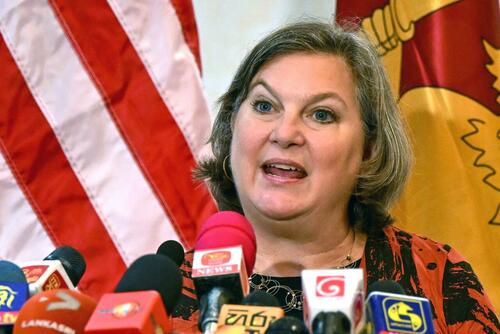
As the Uprising reached its peak, at least one American Jew was highly interested: Victoria Nuland. As Obama’s Assistant Secretary of State (first under Hillary Clinton, and then under the half-Jew John Kerry), Nuland had direct oversight of events in eastern Europe.[5] And for her, it was personal; her father, Sherwin Nuland (born Shepsel Nudelman), was a Ukrainian Jew. She was anxious to drive the pro-Russian Yanukovych out of power and replace him with a West-friendly, Jew-friendly substitute. And she had someone specific in mind: Arseniy Yatsenyuk. On 27 January 2014, as the riots were peaking, Nuland called American Ambassador to Ukraine, Jeff Pyatt, to urgently discuss the matter. Nuland pulled no punches: “Yats” was her man. We know this because the call was apparently tapped and the dialogue later posted on Youtube. Here is a short excerpt:
Nuland: I think Yats is the guy who’s got the economic experience, the governing experience. He’s the… what he needs is Klitsch and Tyahnybok on the outside. He needs to be talking to them four times a week, you know. I just think Klitsch going in… he’s going to be at that level working for Yatseniuk, it’s just not going to work.
Pyatt: Yeah, no, I think that’s right. OK. Good. Do you want us to set up a call with him as the next step? […]
Nuland: OK, good. I’m happy. Why don’t you reach out to him and see if he wants to talk before or after.
Pyatt: OK, will do. Thanks.
It was clear to both of them, though, that the EU leadership had other ideas. The EU was much more anxious to be a neutral party and to avoid direct intervention in Ukrainian affairs so as to not unduly antagonize Russia. But in time-tested Jewish fashion, Nuland did not give a damn. A bit later in the same phone call, she uttered her now-famous phrase: “Fuck the EU.” So much for Jewish subtlety.[6]
But there was another angle that nearly all Western media avoided: “Yats” was also Jewish. In a rare mention, we read in a 2014 Guardian story that “Yatsenyuk has held several high-profile positions including head of the country’s central bank, the National Bank of Ukraine… He has played down his Jewish-Ukrainian origins, possibly because of the prevalence of antisemitism in his party’s western Ukraine heartland.” For some reason, such facts are never relevant to Western media.
As the Maidan Uprising gave way to the Maidan Revolution in February 2014, Yanukovych was forced out of office, fleeing to Russia. Pro-Western forces then succeeded in nominating “Yats” as prime minister, effective immediately, working in conjunction with president Oleksandr Turchynov. This provisional leadership was formalized in a snap election in May 2014 in which the pro-Western candidate Peter Poroshenko won. (The second-place finisher was none other than Yulia Timoshenko—the same Jewess who had lost to Yanukovych in 2010.)
It was under such circumstances that Putin invaded and annexed Crimea, in February 2014. It was also at this time that Russian separatists in Donbass launched their counter-revolution, initiating a virtual civil war in Ukraine; to date, eight years later, around 15,000 people have died in total, many civilians.
With this American-sponsored coup finished, Ukrainian Jews began to reach out to the West to increase their influence. Thus it happened that just a few months after Maidan, the wayward son of the American vice president got in touch with a leading Ukrainian Jew, Mykola Zlochevsky, who ran a large gas company called Burisma. In this way, Hunter Biden incredibly found himself on the board of a corporation of which he knew nothing, in an industry of which he knew nothing, and which nonetheless was able to “pay” him upwards of $500,000 per year—obviously, for access to father Joe and thus to President Obama. Hunter carried on in this prestigious role for around five years, resigning only in 2019, as his father began his fateful run for the presidency.[7]
Despite a rocky tenure, Yatsenyuk managed to hold his PM position for over two years, eventually resigning in April 2016. His replacement was yet another Jew, Volodymyr Groysman, who served until August 2019. The Jewish hand would not be stayed. All this set the stage for the rise of the ultimate Jewish player, Volodymyr Zelensky.
This situation is particularly remarkable given that Jews are a small minority in Ukraine. Estimates vary widely, but the Jewish population is claimed to range from a maximum of 400,000 to as low as just 50,000. With a total population of 41 million, Jews represent, at most, 1% of the nation, and could be as small as 0.12%. Under normal conditions, a tiny minority like this should be almost invisible; but here, they dominate. Such is the Jewish hand.
Enter the Jewish Oligarchs
In Ukraine, there is a “second government” that calls many of the shots. This shadow government is an oligarchy: a system of rule by the richest men. Of the five richest Ukrainian billionaires, four are Jews: Igor (or Ihor) Kolomoysky, Viktor Pinchuk, Rinat Akhmetov, and Gennadiy Bogolyubov. Right behind them, in the multi-millionaire class, are Jews like Oleksandr Feldman and Hennadiy Korban. Collectively, this group is often more effective at imposing their will than any legislator. And unsurprisingly, this group has been constantly enmeshed in corruption and legal scandals, implicated in such crimes as kidnapping, arson and murder.[8]
Of special interest is the first named above. Kolomoysky has long been active in banking, airlines and media—and in guiding minor celebrities to political stardom. In 2005 he became the leading shareholder of the 1+1 Media Group, which owns seven TV channels, including the highly popular 1+1 channel. (The 1+1 Group was founded in 1995 by another Ukrainian Jew, Alexander Rodnyansky.) Worth up to $6 billion in the past decade, Kolomoysky’s current net wealth is estimated to be around $1 billion.
Not long after acquiring 1+1, Kolomoysky latched on to an up-and-coming Jewish comedian by the name of Volodymyr Zelensky. Zelensky had been in media his entire adult life, and even co-founded a media group, Kvartal 95, in 2003, at the age of just 25. Starring in feature films, he switched to television by the early 2010s, eventually coming to star in the 1+1 hit show “Servant of the People,” where he played a teacher pretending to be president of Ukraine. Then there was the notable 2016 comedy skit in which Zelensky and friends play a piano with their penises—in other words, typical low-brow scatological Jewish humor, compliments of Zelensky and Kolomoysky.
By early 2018, the pair were ready to move into politics. Zelensky registered his new political party for the upcoming 2019 election, and declared himself a presidential candidate in December 2018, just four months prior to the election. In the end, of course, he won, with 30% of the vote in the first round, and then defeating incumbent Poroshenko in the 2nd round by a huge 50-point margin. Relentless favorable publicity by 1+1 was credited with making a real difference. Notably, the third-place finisher in that election was, yet again, the Jewess Yulia Timoshenko—like a bad penny, she just keeps coming back.[9]
Zelensky, incidentally, has dramatically profited from his “meteoric rise” to fame and power. His Kvartal 95 media company earned him some $7 million per year. He also owns a 25% share of Maltex Multicapital, a shell company based in the British Virgin Islands, as part of a “web of off-shore companies” he helped to establish back in 2012. A Ukrainian opposition politician, Ilya Kiva, suggested recently that Zelensky is currently tapping into “hundreds of millions” in funding that flows into the country, and that Zelensky himself is personally earning “about $100 million per month.” A Netherlands party, Forum for Democracy, recently cited estimates of Zelensky’s fortune at an astounding $850 million. Apparently the “Churchill of Ukraine” is doing quite well for himself, even as his country burns.
In any case, it is clear that Zelensky owes much to his mentor and sponsor, Kolomoysky. The latter even admitted as much back in late 2019, in an interview for the New York Times. “If I put on glasses and look back at myself,” he said, “I see myself as a monster, as a puppet master, as the master of Zelensky, someone making apocalyptic plans. I can start making this real” (Nov 13). Indeed—the Kolomoysky/Zelensky apocalypse is nearly upon us.
Between rule by Jewish oligarchs and manipulations by the global Jewish lobby, modern-day Ukraine is a mess of a nation—and it was so long before the current “war.” Corruption there is endemic; in 2015, the Guardianheadlined a story on Ukraine, calling it “the most corrupt nation in Europe.” An international corruption-ranking agency had recently assessed that country at 142nd in world, worse than Nigeria and equal to Uganda. As a result, Ukraine’s economy has suffered horribly. Before the current conflict, their per-capita income level of $8700 put them 112th in the world, below Albania ($12,900), Jamaica ($9100), and Armenia ($9700); this is by far the poorest in Europe, and well below that of Russia ($25,700 per person). Impoverished, corrupt, manipulated by Jews, now in a hot war—pity the poor Ukrainians.
Hail the American Empire
Enough history and context; let’s cut to the chase. From a clear-eyed perspective, it is obvious why Zelensky and friends want to prolong a war that they have no hope of winning: they are profiting immensely from it. As an added benefit, the actor Zelensky gets to perform on the world stage, which he will surely convert into more dollars down the road. Every month that the conflict continues, billions of dollars are flowing into Ukraine, and Zelensky et al. are assuredly skimming their “fair share” off the top. Seriously—who, making anywhere near $100 million per month, wouldn’t do everything conceivable to keep the gravy train running? The fact that thousands of Ukrainian soldiers are dying has no bearing at all in Zelensky’s calculus; in typical Jewish fashion, he cares not one iota for the well-being of the White Europeans. If his soldiers die even as they kill a few hated Russians, so much the better. For Ukrainian Jews, it is a win-win proposition.
Why does no one question this matter? Why is Zelensky’s corruption never challenged? Why are these facts so hard to find? We know the answer: It is because Zelensky is a Jew, and Jews are virtually never questioned and never challenged by leading Americans or Europeans. Jews get a pass on everything (unless they are obviously guilty of something heinous—and sometimes even then!). Jews get a pass from fellow Jews because they cover for each other. Jews get a pass from media because the media is owned and operated by Jews. And Jews get a pass from prominent non-Jews who are in the pay of Jewish sponsors and financiers. Zelensky can be as corrupt as hell, funneling millions into off-shore accounts, but as long as he plays his proper role, no one will say anything.
So the “war” goes on, and Zelensky and friends get rich. What does Europe get from all this? Nothing. Or rather, worse than nothing: They get a hot war in their immediate neighborhood, and they get an indignant Putin threatening to put hypersonic missiles in their capital cities in less than 200 seconds. They get to deal with the not-so-remote threat of nuclear war. They get to see their currency decline—by 10% versus the yuan in a year and by 12% versus the dollar. They get a large chunk of their gas, oil, and electricity supplies diverted or shut off, driving up energy prices. And they get to see their Covid-fragile economies put on thin ice.
But perhaps they deserve all this. As is widely known, the European states are American vassals, which means they are Jewish vassals. European leaders are spineless and pathetic lackeys of the Jewish Lobby. Judenknecht like Macron, Merkel and now Scholz, are sorry examples of humanity; they have sold out their own people to placate their overlords. And the European public is too bamboozled and too timid to make a change; France just had a chance to elect Le Pen, but the people failed to muster the necessary will. Thus, Europe deserves its fate: hot war, nuclear threat, cultural and economic decline, sub-Saharan and Islamic immigrants—the whole package. If it gets bad enough, maybe enough Europeans will awaken to the Jewish danger and take action. Or so we can hope.
What about the US? We could scarcely be happier. Dead Russians, the hated Putin in a tizzy, and the chance to play “world savior” once again. American military suppliers are ecstatic; they don’t care that most of their weapons bound for Ukraine get lost, stolen or blown up, and that (according to some estimates) only 5% make it to the front. For them, every item shipped is another profitable sale, whether it is used or not. And American congressmen get to pontificate about another “good war” even as they approve billions in aid.
And perhaps best of all, we get to press for an expansion to that American Empire known as NATO. We need to be very clear here: NATO is simply another name for the American Empire. The two terms are interchangeable. In no sense is NATO an “alliance among equals.” Luxembourg, Slovakia, and Albania have absolutely nothing to offer to the US. Do we care if they will “come to our aid” in case of a conflict? That is a bad joke, at best. In reality, what such nations are is more land, more people, and more economic wealth under the American thumb. They are yet more places to station troops, build military outposts, and run “black sites.” NATO always was, and always will be, the American Empire.
The push for Ukraine to join NATO by the West-friendly Zelensky was yet another blatant attempt at a power grab by the US, this one on Russia’s doorstep. Putin, naturally, took action to circumvent that. But of course, now the push moves to Sweden and Finland, both of whom are unwisely pursuing NATO membership in the illusory quest for security, when in reality they will simply be selling what remains of their national souls to the ruthless Judeo-American masters. For their sake, I hope they are able to avoid such a future.
And all the while, American Jews and a Jewish-American media play up the “good war” theme, send more weapons, and press ever further into the danger zone. Ukrainian-American Jews like Chuck Schumer are right out front, calling for aid, for war, for death.[10] “Ukraine needs all the help it can get and, at the same time, we need all the assets we can put together to give Ukraine the aid it needs,” said Schumer recently, eager to approve the next $40 billion aid package. As Jews have realized for centuries, wars are wonderful occasions for killing enemies and making a fast buck. Perhaps it is no coincidence that the present proxy war against Jewish enemies in eastern Europe began not long after the 20-year war against Jewish enemies in Afghanistan ended. Life without war is just too damn boring, for some.
Public Outrage?
If more than a minuscule fraction of the public knew about such details, they would presumably be outraged. But as I mentioned, the Jewish-controlled Western media does an excellent job in restricting access to such information, and in diverting attention whenever such ugly facts pop up. The major exception is Tucker Carlson, who is able to reach some 3 million people each night; this is by far the widest reach for anything like the above analysis. But Carlson falls woefully short—pathetically short—in defining the Jewish culprit behind all these factors. Jews are never outed and never named by Carlson, let alone ever targeted for blame. This crucial aspect is thus left to a literal handful of alt-right and dissident-right websites that collectively reach a few thousand people, at best.
And even if, by some miracle, all 3 million Tucker viewers were enlightened to the Jewish danger here, this still leaves some 200 million American adults ignorant and unaware. The mass of people believes what they see on the evening news, or in their Facebook feeds, or Google news, or on CNN or MSNBC, or in the New York Times—all Jewish enterprises, incidentally. This is why, when polled, 70% of the American public say that current aid to Ukraine is either “about right” or even “too little.” This, despite the fact that around 50% claim to be “very concerned” about nuclear war; clearly they are unable to make the necessary connections. And for many, it is even worse than this: around 21% would support “direct American military intervention” against Russia, which means an explicit World War Three, with all the catastrophic outcomes that this entails. Our Jewish media have done another fine job in whipping up public incitement.
In sum, we can say that our media have cleverly constructed a “philo-Semitic trap”: any mention or criticism of the Jewish hand in the present conflict is, first, highly censored, and then, if necessary, is dismissed as irrational anti-Semitism. Sympathy toward the (truly) poor, suffering Ukrainians is played up to the hilt, and Putin and the Russians relentlessly demonized. Leading American Jews, like Tony Blinken and Chuck Schumer, are constantly playing the good guys, pleading for aid, promising to help the beleaguered and outmanned Ukrainian warriors. Who can resist this storyline? Thus, we have no opposition, no questioning, no deeper inquiries into root causes. Jews profit and flourish, Ukrainians and Russians suffer and die, and the world rolls along toward potential Armageddon.
The reality is vastly different. Global Jews are, indeed, “planetary master criminals,” as Martin Heidegger long ago realized.[11] They function today as they have for centuries: as advocates for abuse, exploitation, criminality, death and profits. This is self-evidently true: if the potent Jewish Lobby wanted true peace, or flourishing humanity, they would be actively pushing for such things and likely succeeding. Instead, we have endless mayhem, war, terrorism, social upheaval and death, even as Jewish pockets get ever-deeper. And the one possible remedy for all this—true freedom of speech—recedes from our grasp.
On the one hand, I fear greatly for our future. On the other, I feel that we get what we deserve. When we allow malicious Jews to dominate our nations, and then they lead us into war and global catastrophe, well, what can we say? Perhaps there is no other way than to await the inevitable conflagration, exact retribution in the ensuing chaos, and then rebuild society from scratch—older and wiser.
Notes
[1] Cited in Wheen, Karl Marx (1999), p. 340.
[2] Russia’s recent defense of Assad in Syria, against Israel, has obviously not made things better. Nor has the fact that Putin, once thought to be a tool of Jewish-Russian oligarchs, has been able to turn the tables and hold them in check.
[3] Google has been particularly tenacious in altering its search engine results to censor (‘de-rank’) critics of Jewish power and stifle alternative voices. And Google owns Youtube, another force for censorship, which is currently run by the Jewess Susan Wojcicki. For their efforts, Brin and Page have become among the wealthiest men in the world; each is currently worth in excess of $100 billion.
[4] Svoboda began its existence as the “Social-National Party of Ukraine”—a not-so-subtle allusion to National Socialism. This is, in part, why both Svoboda and their allies have been called ‘neo-Nazi.’
[5] Nuland is currently “Under Secretary of State for Political Affairs” in the Biden administration.
[6] Another Jew likely involved in this incident was the Hungarian-American investor George Soros. In late 2019, the lawyer Joseph diGenova appeared in the news, openly charging Soros with direct intervention in American policy: “Well, there’s no doubt that George Soros controls a very large part of the career Foreign Service at the United States State Department. … But the truth is George Soros had a daily opportunity to tell the State Department through Victoria Nuland what to do in the Ukraine. And he ran it, Soros ran it.”
[7] For what it’s worth, Hunter seems to have a “thing” for Jewesses. In 2016, while married, he took up with his dead brother’s Jewish widow, Hallie Olivere Biden. The marriage failed and the illicit affair died out after a year or so, but then the ever-industrious Hunter latched on to another Jewess, “filmmaker” Melissa Cohen, in 2018. They married in 2019.
[8] In a revealing quotation, Ukrainian nationalist Dmytro Yarosh once asked this question: “I wonder how it came to pass that most of the billionaires in Ukraine are Jews?” Criminal activity is surely a large part of the answer.
[9] Not long after winning the presidency, Zelensky named another Jew, Andriy Yermak, as “Head of Presidential Administration.” (The current prime minister, Denys Shmyhal, seems not to be Jewish.)
[10] Other Ukrainian-American Jews, like Steven Spielberg and Jon Stewart, and the heirs to the Sheldon Adelson fortune, are assuredly equally elated about the course of events.
[11] Cited in P. Trawney, Heidegger and the Myth of a Jewish World Conspiracy (2015), p. 33.
The EU-funded International Federation for Human Rights (IFHR) has asked the International Criminal Court (ICC) to issue arrest warrants for several high-profile Russian media figures and officials, including former President Dmitry Medvedev and RT Editor-in-Chief Margarita Simonyan, over alleged “hate speech.”
In a statement on Thursday, the IFHR called on the ICC to investigate what it called six “Russian propagandists,” including Medvedev, Simonyan, Russian journalist Dmitry Kiselyov, TV host Vladimir Solovyov, TV presenter Sergey Mardan, and Alexey Gromov, who serves as First Deputy to the Chief of Staff of the Presidential Executive Office.
Like the US, Russia does not recognize the authority of the ICC, dismissing its rulings as “null and void.”
In its communication to the ICC, the IFHR alleged that Medvedev, Simonyan, Kiselyov, Solovyov, and Mardan “played a leading role in the dissemination of discriminatory hate speech targeting Ukrainians on the basis of their political views.”
The organization, which filed the document together with the Kharkov Human Rights Protection Group (KHPG), the Center for Civil Liberties (CCL), and an undisclosed Russian NGO, also accused Gromov of “personally shap[ing] core propaganda narratives.”
The IFHR has also claimed that the targeted figures were “spreading false and distorted narratives,” including “portraying Ukrainians as Nazis” and claiming that Ukrainian “state ideology is hatred for everything Russian.”
Moscow has for years voiced concerns about a resurgence of Nazi ideology in its neighbor, pointing in particular to ample evidence of the Nazi symbolism being used by Ukrainian nationalists.
It has also repeatedly denounced what it terms a long-running campaign to eradicate the Russian language from all spheres of life in Ukraine as well as a crackdown on Russian and Soviet cultural heritage. Officials in Moscow have named the “denazification” of Ukraine as one of the main goals of the military campaign against Kiev.
The IFHR is mostly funded by grants and donations. In 2022, its sponsors included the French Development Agency ($6.6 million), the European Commission ($6.4 million), the Swedish International Development Cooperation Agency ($3.6 million), and the Open Society Foundations ($1.1 million). The latter was founded by activist billionaire George Soros.
Last year, the ICC issued an arrest warrant for Russian President Vladimir Putin and Commissioner for Children’s Rights Maria Lvova-Belova for allegedly participating in “unlawful” deportations of Ukrainian children to Russia. Moscow has said that the children were evacuated from the combat zone to ensure their safety, stressing that they could be returned to their parents or legal guardians upon request.
Commenting on the IFHR’s request, Medvedev called it an “acknowledgment of the effectiveness of our combined effort against the neo-Nazi regime in Kiev.” He also said that such NGOs have essentially become accomplices of Ukraine’s attacks on Russian civilians.
In the opening days of this year’s St Petersburg International Economic Forum, there were a number of signs that the Kremlin is taking a much tougher line in its relations with the West than hitherto in response to the war mongering rhetoric that has come out of Western Europe in the past week. France, the United Kingdom, Germany and the United States had publicly stated that the weapons they have supplied to Ukraine can be used as the Kievan authorities see fit, meaning that attacks on the Russian heartland with long range missiles coming from their factories and programmed by their specialists are permitted.
Meanwhile, in the run-up to the 80th anniversary of the Normandy landing commemorative activities in France yesterday, Emanuel Macron had done his very best to enrage the Kremlin by excluding Russians from the ceremonies and instead by warmly embracing the defender of the Bandera Nazi collaborators, President of Ukraine Zelensky. Macron compounded the insult to Russia by announcing that he will send Mirage 2005 all-purpose fighter jets to Ukraine before year’s end and that Ukrainian pilots are now in training in France.
The new hard line from Russia was evident already at the start of the week when deputy Foreign Minister Sergei Ryabkov was allowed to speak his piece to the press, condemning the entry of West European powers into what is essentially co-belligerent status in the conflict. Ryabkov, you will remember, was the hard liner from the Ministry back in December 2021 demanding a voluntary roll back of NATO to its 1994 borders through negotiations over a draft document to that effect, lest Russia be compelled to push them back by force.
Then the tough condemnation by Ryabkov was repeated to the press by his boss, Foreign Secretary Sergei Lavrov.
At his meeting with representatives of the leading news agencies from 16 countries on Wednesday, Vladimir Putin sounded a tough note when he said that Russia’s response to a possible attack on critical Russian infrastructure in its heartland using the long-distance missiles supplied by the West would be met by an asymmetrical response, namely by Russia’s supplying similarly advanced weapons to armed forces that are in confrontation with the United States and are in a position to inflict significant damage on them if properly equipped. This sounded very much like a plan to arm the Houthis of Yemen, who could take good advantage of Russia’s hypersonic ship killing missiles to take revenge on the U.S. aircraft carrier force in their region. Or to give an assistance to Iraqi and Syrian militias who have been attacking U.S. military bases that are being maintained in their territories illegally.
Of lesser importance, but still valuable as indication of which way the wind is blowing in Moscow, at that meeting with the press Vladimir Putin allowed himself to use some vulgar terms that are out of character. These came in his answer to the Reuters journalist who asked about Russia’s possibly using tactical nuclear weapons against the West. Aside from saying that Western talk about Russia’s supposed plans to attack them were as dense as the wood of the desk before him, he called this all ‘bullshit’ (бред or чушь собачья). We also know that in the last day or two for the first time ever Putin alluded to the United States as an ‘enemy’ rather than using the now conventional term ‘unfriendly country.’
Then came the news yesterday, that Russia is dispatching the Admiral Gorshkov warship and task force to the Caribbean for exercises. The Gorshkov is not just any ship in the Russian fleet. It has been fitted with the latest Zircon nuclear capable hypersonic missiles. I imagine that from waters near Cuba its missiles could reach Washington, D.C. in five or ten minutes.
This looks as though the Kremlin is deliberately setting up a Cuban Missile Crisis 2.0, but basing its missiles in ships operating freely in international waters as is their right.
Apparently, the Biden administration has responded with feigned nonchalance to this development, saying that Russian exercises in the Caribbean are an innocent affair that take place periodically. Such is what Reuters reports.
However, I very much doubt that Pentagon officials are in fact so laid back.
All of the foregoing was the warm up. Today, at the Plenary Session of the St Petersburg Forum we saw that the hard line – soft line debates are still raging in the Kremlin. This was clear in the very odd decision to designate the political scientist Sergei Karaganov as moderator, pitching questions to Vladimir Putin and to the two honored guests on the podium with him, the presidents of Bolivia and Zimbabwe. Still more peculiar were the, shall we say, very unfriendly questions that Karaganov put to Putin, all of which hinted at a power struggle in Moscow over how best to respond to the West. This will be the subject of the segment below.
*****
In the past, before the start of the Special Military Operation, moderators for the Plenary Sessions of the St Petersburg Forum were uniformly chosen from among well-known American journalists. Usually these were people who knew little or nothing about Russia and were reading to Putin questions prepared for them by their editors. A perfect case in point was CNN anchor, pretty woman Megyn Kelly who held the position at the 2017 Forum. Her list of questions was repetitive to the point of hectoring. But she added glamor and could draw a Western audience. When relations already were becoming quite strained, the organizers of the Forum slotted in the Vesti journalist, anchor of the widely watched Saturday evening news Sergei Brilyov. Brilyov could be said to be a half-way compromise, because he was deeply embedded in the West, with his family residing in the U.K. while he was a dual national with British passport.
As late as a day before the opening of this year’s Forum, there was speculation that the moderator would be Tucker Carlson. In one sense, his taking that role would ensure a vast audience for the proceedings. On the other hand, his very American persona would be in contradiction with the dominant anti-Western current that I now see.
Instead, what we got was Sergei Karaganov, a political scientist whose name many in the West will find familiar because of the shocking call he made in June 2023 for Russia to put an end to Western provocations in and over Ukraine by striking one or another of its enemies in the West using tactical nuclear arms and forcing capitulation.
The article is worth re-reading because many of the points critical of Russian foreign and military policy that Karaganov made there, all indirectly deeply critical of Vladimir Putin’s softly-softly approach to managing international relations, were repeated face to face in his exchange with Putin on stage this afternoon. The key point he made is that Russia must quickly climb the escalatory ladder and win by its own ‘shock and awe’ behavior; that this, in the end, will save millions of lives by disrupting the present gradual ascent towards all-out nuclear war between the superpowers.
Whereas Putin had allowed himself to be subjected to unfriendly questioning from Western journalists on stage at previous Forums, this is the first time I have seen him subjected to unfriendly questioning by a leading member of Russia’s own foreign policy establishment.
The tension was visible in Putin’s face as he argued that so far Russia’s sovereignty and existence has not been threatened, so there is no reason to speak of using nuclear weapons in this conflict. Moreover, the Russian armed forces are daily pushing back the front line, gaining new territory and decimating the enemy’s manpower. Ukraine is losing 50,000 men a month and even the most drastic mobilization plans now being foisted on Kiev by Washington will, at best, only fill in the losses, not strengthen the Ukrainian positions for a counter-offensive.
Karaganov also probed Putin’s mentioning to the world press Russia’s planned ‘asymmetrical’ response to any attacks on its territory. Would Russia be sending hypersonic battleship killing missiles to the ‘enemies of our enemies’ in the Middle East, he asked. Putin demurred, saying that nothing has yet been shipped, and that every future move would be taken only after thorough study.
*****
Putin’s speech to the Plenary Session about the 9 structural reforms that Russia will be implementing in the period to 2030 was itself an odd address for an audience consisting of not only Russians but of businessmen and government representatives from a great many foreign states. The speech was almost entirely about economic development of the country and improvement of living standards.
Before getting to his questions about Russian foreign and military policy, Karaganov had put questions to Putin from the economic domain. However, his dry manner, utterly lacking in charm, could not have warmed the hearts of the audience. And even in this domain, the questions he put to Putin were unfriendly.
Karaganov spoke as a true son of the alienated Russian intelligentsia when he asked his President whether in the ongoing recentralization of economic management there would not be reexamination of the whole privatization process of the 1990s which was directed in a criminal manner.
Without wishing to plead the case of the oligarchs, Putin put the blame not on criminal intentions but on mistaken economic assumptions of those managing the economic transformation at the time, namely that they had assumed that whatever the business under examination may be it would be in better hands if privately owned than to remain as state property. As it turned out, said Putin, we have found that the state is entirely capable of managing businesses and its role is essential for industries requiring heavy capital investment.
No doubt there were many Russians in the audience who enjoyed the sparring on the dais. But there surely were others who shared my concern that there is a battle going on in the Kremlin for the direction of Russian foreign and military policy.
What we saw in the discussion on stage today was an indication of who will take the reins of power in Russia if Vladimir Vladimirovich is overthrown or assassinated, as the United States so fervently hopes: it will very likely be people thinking like Sergei Karaganov, like Vladimir Solovyov, like Dmitry Medvedev, who will have fewer qualms about taking risks, including dropping Russia’s 70 kiloton tactical nuclear weapons here and there to vanquish the West and their Ukraine proxy. By the way, each of these ‘tactical’ as opposed to strategic bombs is four times as powerful as those dropped by the Americans on Hiroshima and Nagasaki.
The US government-affiliated Ukrainian web publication “Data Journalism Agency” (TEXTY) has just released a report attacking hundreds of prominent American individuals and organizations as enemies for not supporting sending more US money and weapons to Ukraine.
The report, titled “Roller Coaster: From Trumpists to Communists. The forces in the U.S. impeding aid to Ukraine and how they do it,” intends to smear American politicians, journalists, and social media influencers as tools of Russia, writing:
Most of the people in our study do not have direct, proven ties to the Russian government or propagandists. However, the arguments they use to urge authorities to distance themselves from Ukraine echo key messages of Russian propaganda aimed at depriving Ukrainians of the ability to defend themselves with Western weapons and funds. (emphasis added)
Although the “enemies list” purports to correct disinformation about Ukraine spread by those on its list, the report itself is full of crude disinformation. For example this bit:
Even long-debunked myths continue to surface, such as claims of Nazi dominance and American Biolabs in Ukraine and the portrayal of the 2014 Revolution of Dignity as a coup.
The organization’s assertion that these claims are “long-debunked” may be wishful thinking, but back on planet reality even mainstream, pro-Ukraine media sites in the US wring their hands over the disturbing, extremist images coming out of the country. For example, NBC News wrote that, “Ukraine’s Nazi problem is real, even if Putin’s ‘denazification’ claim isn’t.” Newsweek wondered, “Why Have So Many Neo-Nazis Rallied to Ukraine’s Cause?” Even before the current conflict, mainstream pro-Ukraine publications such as Reuters worried in 2918 about “Ukraine’s neo-Nazi problem.”
As to the biolabs, none other than Mother of the Maidan Victoria Nuland admitted in a US Senate hearing that there were biolabs in Ukraine. Ah, but one may counter that these were not “American biolabs.” In fact with the authenticity of Hunter Biden’s infamous laptop now absolutely confirmed during his trial, a report by the New York Post two years ago based on the laptop also must be considered accurate. According to the article, “Russia’s assertion that President Biden’s son Hunter was ‘financing . . . biological laboratories in Ukraine’ was based in truth, according to e-mails reviewed by The Post.”
And on whether the Maidan events of 2014 were a “Revolution of Dignity” or a coup, we again only need turn to Victoria Nuland’s infamous phone call with US Ambassador to Kiev, Geoffrey Pyatt, for all the evidence needed that the US was micromanaging the removal of an elected leader and replacing him with hand-picked US puppets.
The report also includes such prominent American politicians and journalists as Sen. JD Vance, Sen. Rand Paul, Rep. Matt Gaetz, Rep. Marjorie Taylor Greene, Rep. Jim Jordan, and Col. Douglas Macgregor.
Even our friends at Antiwar.com… and your own correspondent (!) find ourselves appearing on the Ukrainian “enemies list”:
As the report states:
There are 391 individuals and 76 organizations in our list. These include politicians, political movements and groups, media and journalists, experts, and think tanks (some individuals appear in multiple categories).
Perhaps what is most shocking about this attack on American citizens is the fact that the Data Journalism Agency (TEXTY) has a long affiliation with the US Government itself! In fact, the founder of the publication Anatoly Bondarenko appears prominently on a US Government website as a participant in the US State Department’s “TechCamp” project.
The Data Journalism Agency (TEXTY) is listed as an “Implementing Partner” of the US Agency for International Development’s Transparency and Accountability in Public Administration and Services/ TAPAS Project.
The Ukrainians seemingly love to make lists of their “enemies.” One of their most notorious of these is the infamous “kill list” put out by the Mirotvorets Center in Kiev. From that list several have already been murdered by Ukraine, including prominent Russian journalist Daria Dugina.
One wonders how, for example, former US President Donald Trump and dozens of members of the US Congress will react when they hear that US tax dollars are being sent to Ukraine for US-backed Ukrainian organizations to make “hate lists” and “kill lists” of patriotic Americans like themselves.
Executive Director of the Ron Paul Institute for Peace and Prosperity and co-Producer/co-Host, Ron Paul Liberty Report. Daniel served as the foreign affairs, civil liberties, and defense/intel policy advisor to U.S. Congressman Ron Paul, MD (R-Texas) from 2001 until Dr. Paul’s retirement at the end of 2012. From 1993-1999 he worked as a journalist based in Budapest, Hungary, and traveled through the former communist bloc as a human rights monitor and election observer.
By F. William Engdahl – New Eastern Outlook – 11.04.2022
Amid the ongoing global inflation crisis, NATO heads of state and mainstream media repeat a mantra that high energy prices are a direct result of Putin’s actions in Ukraine since end of February. The reality is that it is the western sanctions that are responsible. Those sanctions including cutting SWIFT interbank access for key Russian banks and some of the most severe sanctions ever imposed, are hardly having an impact on the military actions in Ukraine. What many overlook is the fact that they are increasingly impacting the economies of the West, especially the EU and USA. A closer look at the state of the global supply of diesel fuel is alarming. But Western sanctions planners at the US Treasury and the EU know fully well what they are doing. And it bodes ill for the world economy.
While most of us rarely think about diesel fuel as anything other than a pollutant, in fact it is essential to the entire world economy in a way few energy sources are. The director general of Fuels Europe, part of the European Petroleum Refiners Association, stated recently, “… there is a clear link between diesel and GDP, because almost everything that goes into and out of a factory goes using diesel.” … continue
This site is provided as a research and reference tool. Although we make every reasonable effort to ensure that the information and data provided at this site are useful, accurate, and current, we cannot guarantee that the information and data provided here will be error-free. By using this site, you assume all responsibility for and risk arising from your use of and reliance upon the contents of this site.
This site and the information available through it do not, and are not intended to constitute legal advice. Should you require legal advice, you should consult your own attorney.
Nothing within this site or linked to by this site constitutes investment advice or medical advice.
Materials accessible from or added to this site by third parties, such as comments posted, are strictly the responsibility of the third party who added such materials or made them accessible and we neither endorse nor undertake to control, monitor, edit or assume responsibility for any such third-party material.
The posting of stories, commentaries, reports, documents and links (embedded or otherwise) on this site does not in any way, shape or form, implied or otherwise, necessarily express or suggest endorsement or support of any of such posted material or parts therein.
The word “alleged” is deemed to occur before the word “fraud.” Since the rule of law still applies. To peasants, at least.
Fair Use
This site contains copyrighted material the use of which has not always been specifically authorized by the copyright owner. We are making such material available in our efforts to advance understanding of environmental, political, human rights, economic, democracy, scientific, and social justice issues, etc. We believe this constitutes a ‘fair use’ of any such copyrighted material as provided for in section 107 of the US Copyright Law. In accordance with Title 17 U.S.C. Section 107, the material on this site is distributed without profit to those who have expressed a prior interest in receiving the included information for research and educational purposes. For more info go to: http://www.law.cornell.edu/uscode/17/107.shtml. If you wish to use copyrighted material from this site for purposes of your own that go beyond ‘fair use’, you must obtain permission from the copyright owner.
DMCA Contact
This is information for anyone that wishes to challenge our “fair use” of copyrighted material.
If you are a legal copyright holder or a designated agent for such and you believe that content residing on or accessible through our website infringes a copyright and falls outside the boundaries of “Fair Use”, please send a notice of infringement by contacting atheonews@gmail.com.
We will respond and take necessary action immediately.
If notice is given of an alleged copyright violation we will act expeditiously to remove or disable access to the material(s) in question.
All 3rd party material posted on this website is copyright the respective owners / authors. Aletho News makes no claim of copyright on such material.