Dozens killed, including child, in Ukrainian strike on Russian region – governor
RT | June 7, 2024
At least 22 civilians have been killed in Ukrainian shelling targeting the village of Sadovoe in Russia’s Kherson Region, Governor Vladimir Saldo said on Friday. A nine-year-old child is among the victims, he added.
The attack hit a small shop in a residential area, Saldo said. When locals rushed to aid the victims of the first strike, a second one followed, striking the same area, he said. A total of 17 civilians were killed in the shop and near it and four more people living in the nearby houses lost their lives as well, according to the governor.
At least 15 people were also injured in the strike, Saldo said, adding that five of them are currently in “critical condition.” The shop was full of customers at the time and was destroyed, he stated, branding the attack a “bloody crime” and a “heinous murder.”
According to Saldo, Ukrainian forces first used a guided bomb to strike the shop before hitting the same area with a US-made M142 High Mobility Artillery Rocket System (HIMARS) multiple rocket launcher. Kiev’s Western backers have supplied Ukraine with dozens of such systems, which have been extensively used by its troops throughout the conflict with Russia.
Ukraine has long touted HIMARS systems as high-precision weapons used to strike high-value assets. Russian officials have said they recovered debris from HIMARS munitions after strikes on purely civilian targets on multiple occasions.
Kiev’s troops have been actively targeting civilians in Russian regions throughout the conflict. In mid-May, one person was killed and “many” others injured in another Ukrainian attack in Kherson Region. On that occasion, Kiev’s forces struck a minibus carrying civilians with a drone.
The Russian city of Belgorod, located not far from the Ukrainian border, has become one of the main targets of Kiev’s attacks. Ukrainian forces bombarded it on New Year’s Eve, killing 25 civilians at a festive event.
The continued strikes targeting the civilian population in Russian border regions prompted Moscow to launch an offensive in Ukraine’s Kharkov Region in an effort to create a buffer zone to curb cross-border attacks.
President Vladimir Putin has repeatedly said that if Ukraine continues to “shell residential areas in border territories,” then Russia “will be forced to create a security zone” to deprive it of the ability to make such strikes.
American mainstream expert calls for global war in three continents
By Uriel Araujo | June 7, 2024
Is a “Three-Theater” war scenario both feasible and desirable for the US? Some think so. American analysts within the Establishment are in fact calling for war “in Asia, Europe, and the Middle East.” This is what Thomas G. Mahnken (both a Johns Hopkins School of Advanced International Studies professor and the CEO of the Center for Strategic and Budgetary Assessments) is urging Washington to do, in his most recent Foreign Affairs piece.
For Mahnken, Washington is “currently involved in two wars—Ukraine’s in Europe and Israel’s in the Middle East”, while also “facing the prospect of a third over Taiwan or South Korea in East Asia.” Moreover, “all three theaters are vital to US interests, and they are all intertwined.” Deprioritizing Europe and disengaging from the Middle East can only weaken American security, he argues: “The U.S. military drawdown in the Middle East, for instance, has created a vacuum that Tehran has filled eagerly.” Of course, such reasoning can only make sense if American “security” is equated with Washington’s unipolarity.
US Secretary of Defense Lloyd Austin, during his recent speech at Shangri-la Dialogue (in Singapore), made it a point to stress that “despite historic clashes in Europe and the Middle East… the Indo-Pacific has remained our priority theater of operations.” According to Austin, the US is a Pacific nation (with a capital P, and with no pun intended, presumably), and added that “the US can be secure only if Asia is secure. That’s why… [we have] long maintained our presence in this region. And that’s why we continue to make the investments necessary to meet our commitments to our allies and partners.” As for the relationship with China, the Secretary was more ambiguous, claiming that “a fight with China is neither imminent nor unavoidable.”
While Lloyd Austin seems to differ from Mahnken (on emphasis), there is not necessarily a dilemma there. I’ve often described Washington’s ambitions as being all about having the cake and eating it too. Jerry Hendrix (retired Navy captain, formerly an adviser to Pentagon senior officials, and currently a senior fellow with the Sagamore Institute) has written that, in Mackinder terms (classic Geopolitics), the US has embarked on a quest for the “Heartland”, and this contradicts its true “sea power” nature. This is so because Washington, in recent times, has been “burdened” by mostly “land-based actions in Iraq and Afghanistan fought primarily by a large standing army operating far from home”.
Rather than doing that, Hendrix urges the Atlantic superpower to, once again, “think and act like a seapower state”, that is, with a focus on deriving its might from “seaborne trade”, employing “instruments of sea power” to advance its interests. The expert describes the post-World War II period as an exceptional “free sea” period, marked by a “secure environment” which has supposedly allowed free trade to flourish in a globalized planet – this being the rather gleeful manner in which he describes the US-led world order, in spite of the fact that Washington has always weaponized protectionism.
In any case, as Hendrix notes, the American superpower acts both as a “continental power” and as a “sea power”. I’ve described its foreign policy as resembling the swing of a pendulum. Give or take, all Great Powers engage to some extent in proxy conflicts amid their geoeconomic and geopolitical disputes with other powers. In terms of regional disputes, whether one likes or not Moscow’s foreign policy today, one can at least concede that historically Russia and neighboring Ukraine have an intertwined and complicated shared history, and the same applies to China-Taiwan relations. But America is something quite different. To keep things in perspective, one should keep in mind, for example, that, amazingly, the only place in the entire world China has an overseas military base is Djibouti, in the Horn of Africa. In contrast, depending on how one counts it, Washington, in 2015, had about 800 military bases in over 70 countries.
Moreover, the US has in fact invaded 84 out of the 194 nation-states recognized by the United Nations, and has been militarily involved with no less than 191 of those, according to Christopher Kelly and Stuart Laycock, the authors of “America Invades: How We’ve Invaded or been Militarily Involved with almost Every Country on Earth”. The hard truth is that the United States of America is the only nation today (and arguably ever) to potentially engage in warfare across three continents – a scenario, keep in mind, that is cheered by prominent mainstream American commentators and scholars.
Other analysts, such as Andrea Rizzi, writing for El Pais, have described the possibility of war fronts in the Middle East, Europe and the Asia-Pacific becoming connected as a “nightmare” scenario – although not so convincingly, in Rizzi’s case, who seems to believe the political West has necessarily something to do with “democracy”, a historically controversial premise to say the least. Rizzi, however, makes the very valid point that “in geopolitics — and in life — high-stress situations lead to a greater margin for unforeseen events, errors in calculation and communication, uncontrolled actions by minority factions and escalations that are unintended, at least by the key players.” Even the main actors have an interest in keeping stability, at some point someone (or one’s proxies) may indeed make “a daring movie”, in Rizzi’s words, and thus bring about an escalation and unpredictable outcomes.
A series of Ukrainian and Western actions arguably represented precisely such a red-line crossing, in Moscow’s perspective. While some worry about the same thing happening in the Pacific, thus inadvertently igniting yet another war, others call for and crave for precisely such a war – not just in the Indo-Pacific region, but also in Europe and the Middle East, simultaneously. It is hard to describe such a call in any way other than as a will to set the world on fire – after all, one cannot literally desire war between Great Powers in three continents and not expect everything else that often comes with it (call it apocalypse in disguise, if you will).
Unbelievably, such bellicose calls, rather than being confined to the hate speech of extreme and fringe individuals and organizations, pass as reasonable and mainstream discourse, produced as it is, by respectable experts with impeccable credentials. And, mind you, Foreign Affairs will even publish it. It is no wonder: Washington foreign policy itself is, after all, largely built on the premise of American unipolarity and global war if need be.
Zelensky rejects Indonesia’s peace plan – media
RT | June 6, 2024
Ukraine’s Vladimir Zelensky has rejected a peace plan by Indonesia aimed at settling the conflict with Russia, the Antara news agency reported on Thursday, citing Indonesian President-elect and Defense Minister Prabowo Subianto.
The minister proposed a peace plan to end the Ukraine conflict at the Shangri-La Dialogue defense summit in Singapore on Saturday, calling for a demilitarized zone and a United Nations referendum in what he described as disputed territory.
Speaking to reporters following his meeting with incumbent President Joko Widodo on Thursday, Subianto said he had met Zelensky in Singapore and outlined Indonesia’s plan to achieve a ceasefire with Russia.
“[Zelensky] did not agree [with the initiative], however, we will continue to try,” he said.
The proposal formulated by Indonesia includes a ceasefire and the establishment of a demilitarized zone that would see each party withdraw 15km from their current forward positions.
The zone would be observed and monitored by a UN peacekeeping mission, Subianto said. A UN referendum would then be held “to ascertain objectively the wishes of the majority of the inhabitants of the various disputed areas.”
Jakarta, which pursues a policy of non-aligned diplomacy, had previously attempted to mediate peace between Russia and Ukraine.
Earlier this week, Ukrainian Foreign Ministry spokesperson Oleg Nikolenko dismissed the plan, claiming that “there are no disputed territories between Ukraine and the Russian Federation to hold referendums there.”
Commenting on the Ukraine “peace summit” due to take place at Burgenstock Resort in Switzerland on June 15 and 16, Subianto said the president had yet to decide about Indonesia’s participation but added that “all relevant parties” should attend the event.
Russia has not been invited to the summit, which is expected to address Zelensky’s so-called ‘ten-point peace plan’. The proposal demands a complete withdrawal of Russian forces from all territories that Ukraine considers its own, for Moscow to pay reparations, and for Russian officials to present themselves to war crimes tribunals.
Biden could cause nuclear war – Trump
RT | June 6, 2024
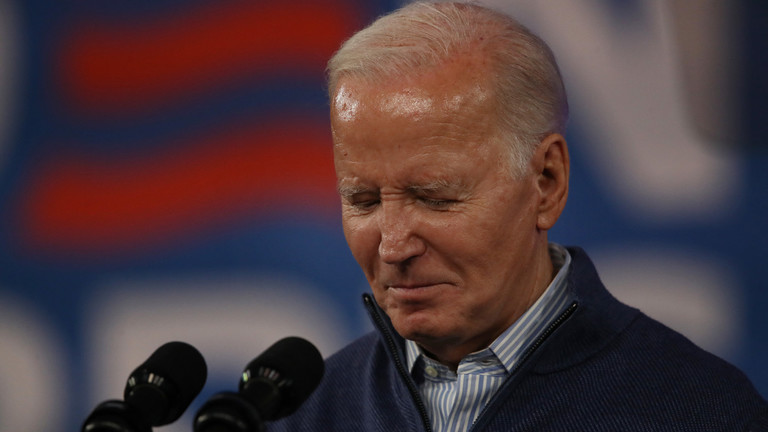
US President Joe Biden may end up destroying the world in a nuclear conflict, his election rival Donald Trump has claimed.
Speaking to Fox News host Sean Hannity on Wednesday, the former president warned that “we have a chance of going into World War III because of our leader.”
The remark came after Hannity suggested that Biden was in a state of mental decline, showing several clips of the president appearing distracted or fumbling his words during public appearances. Hannity and Trump were discussing a report published in the Wall Street Journal on Tuesday, which said the incumbent was showing “signs of slipping” behind closed doors.
Trump suggested that, unlike the leaders of Russia, China and North Korea, Biden is “not at the top of his game” and “was never the brightest bulb” among American politicians – even when he was younger. It is currently the “most dangerous time in the history of our country,” he warned, citing the destructive potential of nuclear weapons.
In the event of a nuclear exchange, “nothing will matter because practically nothing will be here anymore,” he warned. “This is obliteration. Maybe world obliteration. And we have a man that is incapable of even discussing it.”
Trump pointed to the Ukraine conflict as a major source of danger. Russian President Vladimir Putin “is talking about nuclear weapons,” he said.
The Biden administration has recently granted Kiev permission to strike targets outside of what Washington recognizes as Ukrainian territory with US-donated weapons.
When asked on Wednesday how he would react to possible attacks deep inside Russia using Western arms, Putin said Moscow may “supply our weapons of the same class to parts of the world, where strikes would be delivered against sensitive assets of the nations that act like that against Russia.”
The US and its allies are getting “directly involved in the war against us,” he added, and this path of escalation “leads to very serious problems.”
Asked directly whether Moscow would consider using nuclear weapons, Putin said he’d rather stay clear “not only from the use, but even from the threat of use” of such arms. However, he warned people in the West not to delude themselves that such a scenario was impossible.
Putin outlines Russian response to long-range strikes
RT | June 5, 2024
Russia is considering “asymmetric” measures against Kiev’s sponsors due to Ukraine’s use of Western-supplied weapons against its territory, Russian President Vladimir Putin has said.
The Russian leader’s remarks came at a meeting with heads of international news agencies on Wednesday, on the sidelines of the St Petersburg International Economic Forum (SPIEF).
“We have no illusions in this regard,” Putin added, repeating his prior comments that Ukrainian troops might be pulling the trigger but the US and its allies are providing the intelligence and targeting information.
Russia will respond by boosting air defenses and destroying these missiles, Putin said.
“Secondly, if someone deems it possible to supply such weapons to the war zone, to strike our territory… why shouldn’t we supply similar weapons to those regions of the world, where they will be used against sensitive sites of these countries?” the Russian president added. “We can respond asymmetrically. We will give it a thought.”
If the West continues to escalate, such actions “will completely destroy international relations and undermine international security,” Putin noted.
“If we see that these countries are being drawn into a war against us, and this is their direct participation in the war against Russia, then we reserve the right to act in a similar way. This is a recipe for very serious problems,” he warned.
The Russian president also brought up the fact that some military instructors and advisers from NATO countries have already been deployed to Ukraine, and that a number of them were killed in Russian strikes.
The US and its allies have insisted that providing weapons and equipment to Ukraine does not make them party to the conflict with Russia, and maintained certain restrictions on their use to preserve that perception. Last month, however, as Russian troops began advancing towards Kharkov, Ukraine began to demand the relaxation of those rules. A British-led pressure campaign eventually resulted in Washington complying with Kiev’s wishes.
Biden says Ukraine mightn’t join NATO

US ‘President’ Joe Biden © Jim WATSON/AFP
RT | June 4, 2024
US President Joe Biden’s vision of peace for Ukraine does not mean having that country as part of the US-led military bloc, according to his interview with Time magazine, published on Tuesday.
Biden sat down with Time’s editor in chief and Washington bureau chief at the White House on May 28, speaking about his policy on Ukraine, China, Israel and election-related matters.
“Peace looks like making sure Russia never, never, never, never occupies Ukraine. That’s what peace looks like. And it doesn’t mean NATO, they are part of NATO,” Biden said, when asked about the endgame in Ukraine.
“It means we have a relationship with them like we do with other countries, where we supply weapons so they can defend themselves in the future,” he added. “But it is not, if you notice, I was the one when – and you guys did report it at TIME – the one that I was saying that I am not prepared to support the NATOization of Ukraine.”
Biden then argued that the West is “on a slippery slope for war if we don’t do something about Ukraine,” and that if Kiev falls then “you’ll see Poland go, and you’ll see all those nations along the actual border of Russia, from the Balkans and Belarus, all those, they’re going to make their own accommodations.”
According to Biden, he approved the release of intelligence about the Russian “invasion” of Ukraine “to let the world know we were still in charge. We still know what’s going on.”
“We are, we are the world power,” the 81-year-old Democrat told Time. As proof, he pointed to the June 2021 summit with Russian President Vladimir Putin in Switzerland, where the Russian leader allegedly said he wanted to see “the Finlandization of NATO.”
“I told him, he’s gonna get not the Finlandization [of NATO but], the NATOization of Finland. And everybody thought, including you guys, thought I was crazy,” Biden said. “And guess what? I did it. I did it. And we’re now the strongest nation.”
In December 2021, Russia sent the US and NATO two draft security treaties, seeking a pledge that Ukraine would never join the US-led bloc, among other things. In January 2022, Washington and Brussels snubbed Moscow’s proposal, insisting that NATO has an “open door” policy not subject to outside veto. The Russian military operation in Ukraine began a month later.
Zelensky Says US Hegemony Will End If He Loses, But That Already Happened
By Ian DeMartino – Sputnik – 03.06.2024
In an interview with UK media, Ukrainian President Volodymyr Zelensky made the claim that if former US President Trump gets reelected and cuts off aid to his country, he will become a “loser president” responsible for the US losing its spot as the World’s leader, but that has already happened and it was the US support of Ukraine that hastened it.
Since Russia launched its special military operation in Ukraine, the United States and NATO bet hundreds of billions of dollars that they could propel the Kiev regime to victory by outfitting it with some of the best weapons in NATO’s arsenal.
Despite Russia’s larger economy, population size and military, Ukraine could win, the thinking went, by using the vastly superior NATO weaponry and training. Of course, the US and NATO didn’t hand over their very best weapons right away, but it would surely be enough to defeat the Russian army that was portrayed as ill-equipped and untrained in Western media outlets.
When that didn’t work, NATO and the US upped the stakes, giving newer and ostensibly even more invincible weapons to Ukraine, they too failed.
Now, armed with the best weapons NATO could afford to give away, and full permission to strike inside Russia despite the risk of escalation, Ukraine is still being defeated on the battlefield. The whole world has seen for itself that NATO weapons are not equipped with force fields; they can be destroyed and are being destroyed at an alarming rate.
Last year, Trump claimed that he would end the conflict in Ukraine “within 24 hours” though he did not specify how he intended to accomplish that. When asked who he wants to win, Trump would only say that he wants “everyone to stop dying.”
In his interview with the Guardian, Zelensky admitted that he had not developed a strategy to deal with Trump should he become elected, and seemingly admitted that his country would collapse without US support.
“Ukraine, barehanded, without weapons, will not be able to fight a multimillion army,” he said.
“Does he [Trump] want to become a loser President? Do you understand what can happen?” he added, then saying that if Ukraine loses, it means the US will lose its power in the world as well.
“This is not about him as a person, but about the institutions of the United States. They will become very weak. The US will not be the leader of the world anymore. Yes, it will be powerful, first of all, in the domestic economy because it has a powerful economy without a doubt. But in terms of international influence it will be equal to zero,” the Ukrainian President who has utilized Martial Law to stay in office past his term said.
Of course, the opposite is true. The longer NATO and the US remain involved in Ukraine, the more thoroughly the veneer of NATO invincibility will be shattered. If they continue to increase their involvement and escalate things against Russia, it will only expedite the fall of Western hegemony.
“This is a decisive defeat of NATO, the European Union and the United States” former UN weapon inspector Scott Ritter told Sputnik’s Fault Lines last month. “It’s as decisive as you can get without them being directly involved, and they can’t become directly involved because that is a suicide pill.”
Over the last few weeks, NATO nations started giving the Kiev regime permission to strike inside Russia, culminating in the United States agreeing to it last week, but that too has failed to result in any meaningful change of the battle lines.
“But [Kremlin spokesman Dmitry] Peskov pointed out, you start using long-range missiles against Russia, we’re just going to have to take more of Ukraine [to build a bufferzone]. That’s what he said and he specifically mentioned Kiev,” international relations and security expert Mark Sleboda told Fault Lines.
Peskov also told reporters that the United States is already involved in targeting and aiming their weapons at Russia. “[The weapons] are directly controlled by military personnel of NATO countries,” adding that constituted not just military assistance but “participation in a war against us.”
While Ukraine is not the only factor eating away at Western hegemony, it has played a large role, along with the US support of Israel and general economic trends.
“The world is changing indeed, not only because of the war on Russia in Ukraine but also the war in Gaza… the development of BRICS countries [and] the increase of the Shanghai Cooperation,” explained war correspondent Elijah Magnier on Sputnik’s The Critical Hour. “All these indicators lead to one reality, the beginning of the end of US hegemony.”
While Russia has shown that NATO’s weapons are not superior, it’s the Ansar Allah movement, also known as the Houthis, who proved they are ill-equipped for modern war.
“The US and UK are failing in front of non-state actors in the Red Sea… So how can we understand that the Americans are ready to start a war against Russia and then against China?” Magnier added.
Still, with no other hopes or lifelines, Zelensky wants the US to embarrass themselves further by continuing to fund his government, saying that the US losing will encourage other countries to act aggressively. However, Russia and Ukraine were close to signing a peace deal in Istanbul at the start of the conflict. According to Ukrainian officials close to the negotiations, former UK Prime Minister Boris Johnson was sent to Ukraine to sabotage the deal at the behest of the United States.
Ironically, Zelensky says he recently asked Johnson to speak to Trump on his behalf.
Zelensky said he wanted to bring Trump to Ukraine to “see the results of what he brought to Ukraine.” Although Zelensky was referring to Russian President Vladimir Putin “he”, it would have been more accurate if he were referring to US President Joe Biden and/or Johnson, who really brought that destruction to Ukraine and Western hegemony.
“Fifty nations gathered to defeat Russia and they failed… Ukraine has been defeated and Europe is defeated,” Magnier concluded.
Strategic developments in Ukraine – a new Cuban missile crisis?
By Patrick Poppel | June 3, 2024
Since the beginning of the conflict in Ukraine in 2014, there has been repeated talk of NATO’s expansion to the east and the advance of Western strategic missile systems.
At that time, the head of the Russian Institute for Strategic Research, General Leonid Reshetnikov, also mentioned this when he gave an interview for Austrian media.He spoke of the possibility that one day there could be American missiles in Kharkov. He also mentioned Ukraine’s possible accession to NATO.
We are currently seeing how Ukraine is successfully attacking several targets in Russia, which are located far behind the front, using Western weapon systems. This increases the radius of the zone that can be assessed as a conflict area. More and more new weapons with longer ranges are now being used. This development is very dangerous because Russia must respond to this situation. Russia cannot possibly accept this.
The deployment of long-range weapons in Ukraine reminds us of the 1962 Cuban Missile Crisis in the Cold War. At that time, the USA also could not accept the stationing of soviet nuclear weapons on Cuba. There are red lines in matters of national security interests and these must be observed by all participants in a conflict.
At that time, the crisis was resolved through the clear and deliberate actions of statesmen from the United States and the Soviet Union. Today, with the Biden administration, we have a completely different prerequisite. Since Obama and the Maidan coup, the flag has been pointing to escalation and President Biden is continuing this course.
It can be assumed that the West will supply all weapons to Ukraine that are requested. Now it is clear to everyone that Ukraine is being used as a battering ram against Russia. The attacks of the last few weeks have clearly shown that it is also about destroying strategic targets in Russia. The attack on the early warning system is the best example of this. Such an attack is unacceptable in the age of nuclear weapons.
Of course, the legitimate question arises as to whether this specific attack was carried out on Ukraine’s own initiative or on the orders of someone else. And if it was really Ukraine’s initiative, there should be clear consequences from the West, as this created a very dangerous situation.
It is always important to monitor the Western media, as political wishes and ideas are always discussed there. There has been repeated talk of the possible use of tactical nuclear weapons, especially since 2022. The Ukrainian ambassador in Berlin also called for the delivery of nuclear weapons to Ukraine. This was, of course, an absurd request, but it was discussed for a long time in the media. So you can say that the smell of nuclear war has been in the air for at least 2 years. Since then, many reports on the topic of nuclear conflict have been produced in the German media. This is how Western societies are preparing for the possible use of these weapons.
The situation is really dangerous and, at the latest after the attack on the Russian early warning system, one should really consider ending this conflict as quickly as possible. Let’s think about what the next level of escalation is. If things continue to develop like this, we will be very quick to use tactical nuclear weapons. This point gets closer and closer with each passing week.
By continuing to support Ukraine and, above all, by supplying weapons with a longer range, it cannot be ruled out in the long term that the conflict could also affect other states in Europe.
There is currently discussion as to whether Russian military targets in Belarus should be attacked. This would of course also clearly drag Belarus into this conflict.
Particularly due to the threat to the Russian exclave of Kaliningrad, an extension of the conflict to the Baltics can no longer be ruled out. But then there would be a direct confrontation between NATO and Russia.
The greatest danger at the moment is that there is less and less inhibition to use larger and more far-reaching weapons. This spiral of escalation must be stopped by the West, otherwise the nuclear component of this conflict will become increasingly likely.
This development and the fact that we have already reached such a point also shows the inability of European politicians, who have not been able to freeze this conflict or find another solution since 2014.
It started with an uprising in Kiev and now we are on the brink of nuclear war.
Patrick Poppel, Center for Geostrategic Studies, Belgrade.
Still time to prevent NATO-Russia war – Hungary
RT | May 31, 2024
NATO is preparing for a protracted war with Russia but there is still a chance to prevent it, Hungarian Foreign Minister Peter Szijjarto said at a ministerial meeting of the military bloc in Prague on Friday.
NATO member states have been granting approval for Kiev to use Western-supplied weapons to hit targets deep inside Russia. Earlier in the day, NATO Secretary General Jens Stoltenberg said Ukraine had the right to defend itself, which includes the right to strike legitimate military targets inside Russia.
These steps are being taken in preparation “for a long, many-year war,” Hungarian newspaper Magyar Nemzet quoted Szijjarto as saying.
“The express train of war has departed from the penultimate station,” and the question is whether there is still a chance to stop it, he added.
The Hungarian foreign minister said there was “only one emergency brake left,” referring to the European Parliament elections in June. The European people “can make it clear to their governments that they do not want to live with war in Europe for a long time,” Szijjarto added.
Hungary had previously called for a ceasefire and peace talks to resolve the Ukraine conflict. Budapest has refused to send military aid to Kiev and has repeatedly delayed EU sanctions on Moscow.
The Hungarian foreign minister has been a vocal critic of NATO’s position on the conflict. Before the meeting in Prague, he said anti-Russia “war hysteria” was making Western leaders adopt increasingly “crazy ideas” that could lead to grave consequences.
Last week, Hungarian Prime Minister Viktor Orban warned that Brussels and Washington could be warming up for a direct military conflict with Russia. Budapest was working to “redefine” its NATO membership status to allow it to opt-out of the military alliance’s “activities outside the bloc’s territory,” Orban stated.
A number of other NATO member states such as Norway, Finland, Latvia, Poland, and reportedly Germany have spoken in favor of Kiev using long-range missiles against targets on Russian territory.
On Thursday, US President Joe Biden was reported to have secretly given Ukraine the green light to use American-provided weapons to strike targets in the part of Russia that borders Kharkov Region.
NATO member states, especially the US, have “deliberately” launched a new round of escalation around Ukraine to prolong the “senseless war,” Kremlin spokesman Dmitry Peskov said on Thursday. He also warned that such actions would have consequences and damage the interests of the countries that opted for an escalation.
NATO Chief Asks Allies to Commit $44 Billion in Military Aid to Ukraine Annually
By Kyle Anzalone | The Libertarian Institute | May 30, 2024
The secretary-general of NATO is asking its 32 members to commit $44 billion in military aid to Ukraine every year. The request is two times larger than an earlier proposal of $108 billion over five years, and the military aid would also be funneled through NATO rather than the allies independently.
Germany’s Handelsblatt newspaper reported that Jens Stoltenberg will make his pitch for sending $43 billion to Ukraine per year during a meeting of NATO foreign ministers in Prague. “We need to sustain that current level of support as a minimum to provide the predictability Ukraine needs for as long as necessary,” the NATO source said. The official added that members of the bloc contributed about $40 billion per year through the first two years of the war.
Under the $100 billion proposal, counties would contribute aid equal to their financial commitment to the alliance. The US pays for about a quarter of NATO’s annual budget. If Stoltenberg seeks to lock in member states at their current commitment, the US will contribute over half of all aid, about $25 billion annually.
NATO has been seeking a multi-year pledge from its members to supply arms to Ukraine. The commitment is meant to lock in assistance for Kiev even if a nation would later decide to alter course. The initial proposal from Stoltenberg was for NATO to commit $108 billion over five years.
The secretary-general is also seeking increased control over the aid. Stoltenberg hopes the alliance members will agree to allow all aid to be coordinated through Brussels. Russia responded to the report by saying that NATO is pushing Ukraine to continue a “senseless war.”
The proposal was floated as NATO members are significantly stepping up their support for Ukraine. Several members of the alliance, now including the US, have green-lit Ukrainian forces using their missiles for attacks inside Russia. Additionally, several countries, including France, are preparing to send their troops into Ukraine to support Kiev.
Featured Video

HE SAVED LIVES. NOW HE FACES PRISON.
or go to
Aletho News Archives – Video-Images
From the Archives
NATO Sanctions and the Coming Global Diesel Fuel Disaster
By F. William Engdahl – New Eastern Outlook – 11.04.2022
Amid the ongoing global inflation crisis, NATO heads of state and mainstream media repeat a mantra that high energy prices are a direct result of Putin’s actions in Ukraine since end of February. The reality is that it is the western sanctions that are responsible. Those sanctions including cutting SWIFT interbank access for key Russian banks and some of the most severe sanctions ever imposed, are hardly having an impact on the military actions in Ukraine. What many overlook is the fact that they are increasingly impacting the economies of the West, especially the EU and USA. A closer look at the state of the global supply of diesel fuel is alarming. But Western sanctions planners at the US Treasury and the EU know fully well what they are doing. And it bodes ill for the world economy.
While most of us rarely think about diesel fuel as anything other than a pollutant, in fact it is essential to the entire world economy in a way few energy sources are. The director general of Fuels Europe, part of the European Petroleum Refiners Association, stated recently, “… there is a clear link between diesel and GDP, because almost everything that goes into and out of a factory goes using diesel.” … continue
Blog Roll
 Aletho News
- Iran FM meets with US envoy on UN meeting’s sidelines at American side’s insistence: Report
- Qatar PM calls for Gulf security framework with Iran, says war must be ‘wake-up call’
- China condemns US extortion of Iranian airlines, rejects Washington’s ‘illegal’ sanctions threats
- Italy to move military personnel from Taif base after missile strike
- Finland’s Stubb tells European leaders to calm down
- Defeating Russia on battlefield impossible – Fico
- Finland’s Gender Clinic Reversal
- Massachusetts Wants Mental Health Visits, Why Does Government Use ‘Health’ to Enter Our Homes & Families?
- US lawmaker admits American people footing bill for Trump’s failed aggression against Iran
- Pfizer Gave $500,000 to Groups That Lobbied to End Religious Exemption in Massachusetts
- If Americans Knew
- An error has occurred; the feed is probably down. Try again later.
- No Tricks Zone
- 2025 Nature Paper Claiming Worsening Global Drought Gets RETRACTED …Heavily Flawed
- New Study: ‘Global Drought Shows No Detectable Recent Acceleration Under Climate Warming’
- Economic Masterminds: German Socialists Suggest Taxing Productivity Gains Stemming From Using AI
- The South China Sea Has Not Been Cooperating With The Climate Change Narrative
- Energy Crisis: Germany Enters Heating Season With Historically Low Gas Reserve Fill Levels
- New Study: The Antarctic Ice Sheet Gained Mass From 2020-2024 Due To Staggering Snow And Ice Accumulation
- Study: Ocean Heating Rates From Thousands Of Years Ago ‘Dwarf’ Modern Ocean Heating Rates
- Climate Extremists Target, Attack Large-Scale Power Grid Infrastructure In Germany!
- New Study: Antarctic Ice Melt Has Contributed Less Than 1 Centimeter To Sea Level Rise In The Last 30 Years
- Fear Of Debate: Alarmist German Climate Scientist Calls On Mainstream Media To Discredit Skeptic Voices

