Russia repels US-supplied missile attack on Crimean Bridge – minister
RT | May 31, 2024
The Russian military this week repelled Kiev’s largest missile attack yet on the strategic Crimean Bridge, Defense Minister Andrey Belousov has said.
Speaking at a meeting of defense ministers of the Collective Security Treaty Organization (CSTO) in Kazakhstan on Friday, the defense chief said Ukraine had fired ten US-supplied ATACMS at the bridge on Wednesday night, which had a flight time of less than two minutes.
“All missiles were shot down. As a result, hundreds of lives were saved,” Belousov said.
On Thursday, the Russian Defense Ministry said Russian air defenses had destroyed eight ATACMS missiles, which have a range of up to 300km, as well as eight aerial and two maritime drones over the Black Sea.
The Ukrainian military has confirmed that they deployed ATACMS missiles in the area, but insisted that the strikes had targeted a ferry crossing point on the peninsula. It also claimed to have inflicted “considerable” damage on two Russian transport ships. Local authorities have confirmed the damage but insisted that it was limited to shattered windows.
Destroying the Russian bridge is “something that we really want,” Ukraine’s Vladimir Zelensky told German media earlier this year.
Kiev has launched multiple attacks on the bridge, but the strategic link has only been damaged twice, with several people killed in both incidents. The first was in October 2022, when a truck exploded on the bridge, and the second was in July 2023 when a maritime drone attack took place.
According to Belousov, in May alone, the Russian military intercepted more than 1,000 Ukrainian drones, over 250 HIMARS and Vampire missiles, in excess of 80 Hammer guided bombs, 50 ATACMS rockets, and eight SCALP cruise missiles – all of which had been supplied to Ukraine by Western countries.
Russia has repeatedly denounced arms shipments to Kiev, warning that they will only prolong the conflict, but will not change its ultimate outcome.
Macron wants France to ‘go to war with Russia’ – Le Pen
RT | May 31, 2024
French politician Marine Le Pen has accused President Emmanuel Macron of wanting to “go to war with Russia” in an interview with France Info that aired on Thursday. The three-time presidential candidate said that Macron’s recent remarks on sending NATO trainers to Ukraine and allowing Kiev to use Western-supplied weapons to strike certain targets in Russia risk turning the current conflict into the next “world war.”
Le Pen’s comments come amid intense discussions in the West on how far into Russia Kiev should be allowed to strike using Western long-range weapons. Several NATO governments have said they are in favor of strikes on Russian territory, while NATO Secretary General Jens Stoltenberg has urged member-states to “lift some of” their restrictions on the use of Western arms.
Macron weighed into the discussion on Tuesday, opining that NATO should allow Ukraine to “neutralize military sites” inside Russia “from which Ukraine is being attacked,” even if they are far behind the front line. Le Pen slammed the idea, arguing that it “creates the risk of a global conflict.”
Le Pen said that the French leader’s views led her to “conclud[e] that Emmanuel Macron wants France to dive head first into war with Russia.” The right-wing politician said that she “extremely firmly opposes” his positions, which could “create an absolutely staggering danger” for France.
Le Pen previously accused Macron of “playing politics with war” and “hijacking” the Ukraine conflict for his electoral agenda. She has consistently opposed plans to admit Ukraine into NATO and the EU, place economic sanctions on Russia and to deliver heavy weapons to Kiev.
On Friday, NATO’s Stoltenberg announced that “several” of the bloc’s nations had never placed any restrictions on Kiev’s use of Western weapons. Reports also emerged that the US, which had previously not allowed Ukraine to deploy American arms outside of what Washington recognizes as Ukrainian territory, had granted permission to use its systems to target certain parts of Russia.
The reports were confirmed by Ukrainian leader Vladimir Zelensky’s office, which said that limited strikes are now allowed against direct threats to Kharkov Region, where Russian troops have recently made significant gains.
Moscow has repeatedly insisted that Western arms supplies to Kiev will only prolong the war, and accused Ukraine of using the weapons to attack civilian infrastructure within Russia. Foreign Ministry spokeswoman Maria Zakharova on Friday slammed the Western discussions about “allowing” Ukraine to strike deep inside Russia as “a classic NATO-style manipulation.”
Scott Ritter: Ukraine’s NATO Allies Dragging World Into Nuclear Armageddon
By Ekaterina Blinova – Sputnik – May 31, 2024
The West has misinterpreted Russia’s openness to dialogue on Ukraine as a sign of weakness and is now pushing the world to the edge of a disastrous all-out nuclear exchange, former US Marine Corps intelligence officer Scott Ritter told Sputnik.
US President Joe Biden has authorized Ukraine to hit targets inside Russia with US-made weapons, bringing the conflict to a new level. White House officials claim that Washington’s new policy pertains only to what they call as “acts of self-defense” by the Ukrainian military that is continuing to retreat.
Previously, other NATO member states, including the UK, France and Sweden, gave a nod to the Zelensky regime to use their weapons systems to attack Russia.
The Kiev regime and its Western allies believe they can gain an advantage over Russia by confining its special military operation to Ukrainian territory, ex-US Marine Corps intelligence officer Scott Ritter told Sputnik. This situation allows Ukraine to train its troops in neighboring NATO states and receive arms and other equipment from the alliance’s hubs, not making them Russia’s legitimate targets.
However, things could drastically change once NATO-grade missiles start flying into Russia’s territory with the approval of Western countries, according to the military expert.
“France is now giving Ukraine permission to use the SCALP air launched cruise missile against targets inside Russia,” Ritter said. “Now [French President Emmanuel Macron] claims it’s just military targets, there won’t be hitting any civilian infrastructure, but it doesn’t matter. The fact is, if the French Scalp missile is used to attack targets inside Russia, this isn’t Ukraine defending itself, it’s France attacking Russia,” he stated.
The military expert indicated that it is a widely accepted fact that Ukrainians lack the ability to pre-program long-range SCALP missiles armed with conventional warheads. Therefore, it would be necessary for French technicians to carry out this task. The question arises: where would they obtain the targeting data? According to Ritter, the French military relies on a network of Syracuse satellites to transmit the essential information required for SCALP missiles.
“The bottom line is it is French space reconnaissance that’s gathering information and transmitting the information to the people who program the SCALP. The French operators, using French communication systems that transmit data collected by French intelligence satellites. This is France attacking. Who picks the target? Ukraine. France? It doesn’t matter. It’s the French.”
Ritter spotlighted the fact that Moscow has recently signaled that it is well aware of who operates NATO-grade long-range missiles and who provides reconnaissance and communications.
“[Russian President Vladimir Putin] knows that it’s not Ukrainian space reconnaissance, it’s not Ukrainian communications, it’s not Ukrainian technicians that are doing the targeting. It is the French, it is the Germans. It is the British. It is the Americans. And therefore, if these missiles, these weapons systems that are now being greenlit by the respective Western nations, to be used by Ukraine to attack targets inside Russia, if this happens, this is no longer about Ukraine defending itself. It’s about NATO attacking Russia.”
The question then arises as to how Russia will respond to these attacks, continued the military expert. According to NATO member states, they authorize Ukraine to use their weapons against Russia as sovereign nations, not as a military bloc. According to Ritter, this apparently means that they invite Russia’s retaliation strikes inside their respective territories and will not invoke Article 5, stipulating collective defense of NATO member states. “Because if they do that, then it’s clear that this is a NATO confrontation against Russia,” he stressed.
“If NATO chooses then to respond by launching additional attacks against Russia (remember, these are retaliation attacks – Russia is retaliating against NATO attacks against its territory) this would be an all-out assault by NATO against Russia. And former Russian President Dmitry Medvedev made it clear that the Russian response would be nuclear. And this would lead to a general nuclear exchange and the end of the world. That’s where we’re at right now. This isn’t about helping Ukraine. This isn’t about Ukraine defending itself. This is about a larger plan by the collective West, by NATO, by the United States to strategically defeat Russia.”
The West’s major problem is that it has completely misread Russia since the outset of the conflict and considered Moscow’s calls for dialogue and negotiated settlement as a sign of weakness, according to the military analyst.
“Therefore the collective determination of the West is that they just continue to pressure Russia, ratchet up the pressure that Russia will fold like a house of cards, and run to the peace table and bring an end to this conflict. That’s not going to happen. This is a misreading of the situation by the West,” warned Ritter.
“And so the West now will attack Russia, trying to pressure Russia to the peace table. But all it will do is guarantee a Russian response that if the West doesn’t respond properly to that, if the West thinks that it therefore has the right to strike, Russian return will lead to Armageddon, the end of the world. That’s where we’re at today. This isn’t a game. This isn’t a joke. This is the end of all humanity,” the military expert cautioned.
Ukraine: Russia won’t escalate, US will
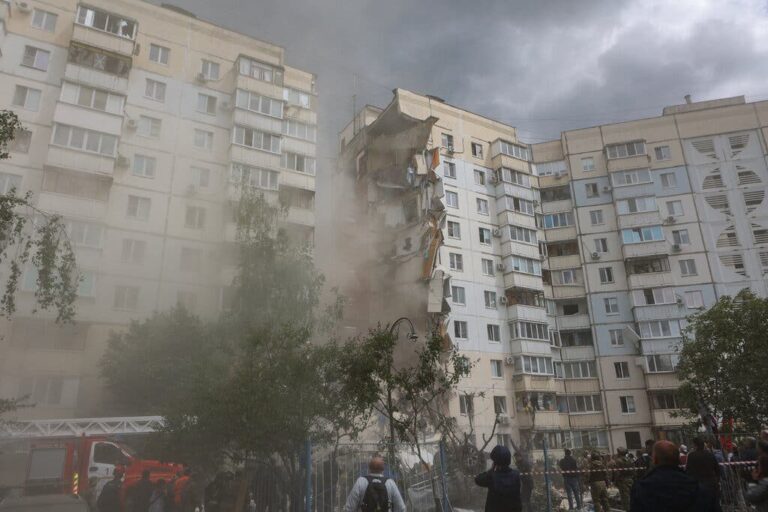
The aftermath of a Ukrainian attack on Belgorod, Russia, in May
BY M. K. BHADRAKUMAR | INDIAN PUNCHLINE | MAY 31, 2024
The United States’ proxy war with Russia is at another inflection point. The battleground is shifting dramatically to Russian territory — something without precedent even in the Cold War. How this pans out will be a momentous event in 21st century politics.
There are three defining issues here. One, the NATO strategy going forward, given the realisation in the West that there is no question of Russia being defeated in Ukraine; two, the constitutional crisis in Kiev with the presidential term of Vladimir Zelensky having run out on May 21; and, three, germane to all this, Russia’s intentions.
To be sure, the NATO and the EU are revamping their strategy while Russia hopes to remain “one foot ahead” of the West, as President Vladimir Putin put it.
Russia is not interested in an escalation as it is doing well in the war of attrition with Ukraine. Russia has effectively countered the US’ Mission Creep so far to push through all of its self-imposed limitations on aid to Ukraine and eventually breach those limits.
The big question today is how one could take the Biden Administration’s affirmation — stated by the White House National Security Council, the state department and the Pentagon — that it disfavours the use of western weaponry by Kiev to attack pre-war Russian territory.
An established pattern has set in whereby when Washington says some advanced weapon system is off limits for Ukraine, it actually turns out that Kiev just has to sit out for a few months so that Biden can cross the self-imposed red line.
Therefore, Russia will not take this as Washington’s final word. Curiously, the ground is being prepared to jettison the taboo, with both congressional Republicans and Secretary of State Blinken urging the White House to give the green light and both New York Times and Washington Post reporting that it is only a matter of time before the administration yields to formal American blessing to accelerate strikes on prewar Russia. (here and here)
The New York Times and Guardian reported on Thursday, in fact, a shift already in the US position that now allows Ukrainian US-supplied artillery to fire back at Russian batteries over the Russian border from Kharkov region and also to target concentrations of Russian forces massing on the border in Russia’s Belgorod region.
Meanwhile, a new phase is about to begin to conclude the Battle of Donbass, which, even after two years remains unfinished business. The entrenched Ukrainian military hubs in the region — Pokrovsk, Kramatorsk and Slovyansk — still threaten southern Donetsk Oblast.
Similarly, Volchansk on the Russian border facing Belgorod city and Kupyansk, also an important logistical point and railway node (almost 20 rail lines intersect in the town with about half track straight into Russia) are a thorn in the flesh for Russia’s border region.
Russians have openly stated that repeated raids into Belgorod city and its environs from the Kharkov Region needed to be countered with the creation of a “security zone”. Putin himself had spoken about this as early as in March.
From present indications, Russian operations are directed on two Ukrainian towns close to the border — Volchansk and Lypsti. Russia may stretch the front with a foray into Sumy oblast but any serious effort to capture either Sumy or Kharkov seems unlikely at this stage.
In an incisive analysis, the well-known Russia watcher Big Serge wrote last week, “The main purpose of these fronts will be to fix Ukrainian reserves in place and denude Ukraine’s ability to react on other fronts. This war will not be won or lost in Kharkov, but in the Donbas, which remains the decisive theatre.
“We currently appear to be solidly in the preparatory/shaping phase of a Russian summer offensive in the Donbas, which (likely among other things) will feature a Russian drive on the city of Konstyantinivka. This is the last major urban area shielding the advance towards Kramatorsk-Slovyansk from the south (remembering that these twin cities form the ultimate objective of Russia’s campaign in the Donbas.)”

Expected Russian summer offensive
Putin has strongly reacted to the recent proxy attacks on Russia’s strategic assets with western weaponry inside its territory. Putin warned that “this unending escalation can lead to serious consequences.”
As he put it, “long-range precision weapons cannot be used without space-based reconnaissance… the final target selection and what is known as launch mission can only be made by highly skilled specialists who rely on this reconnaissance data, technical reconnaissance data.
“For some attack systems, such as Storm Shadow, these launch missions can be put in automatically, without the need to use Ukrainian military… Launching other systems, such as ATACMS, for example, also relies on space reconnaissance data, targets are identified and automatically communicated to the relevant crews that may not even realise what exactly they are putting in. A crew, maybe even a Ukrainian crew, then puts in the corresponding launch mission. However, the mission is put together by representatives of NATO countries, not the Ukrainian military.
“So, these officials from NATO countries, especially the ones based in Europe, particularly in small European countries, should… keep in mind that theirs are small and densely populated countries, which is a factor to reckon with before they start talking about striking deep into the Russian territory. It is a serious matter and, without a doubt, we are watching this very carefully.”
Importantly, Putin underscored, “If Europe were to face those serious consequences, what will the United States do, considering our strategic arms parity? It is hard to tell. Are they looking for a global conflict? I think they wanted to agree upon strategic arms…We will wait and see what happens next.”
However, there are growing signs that the Biden administration may have simply mothballed the idea of western long-range weaponry being used to destroy Russia’s strategic assets deep inside its territory until the NATO summit gets over in Washington (9-11 July) so as to keep the flock together.
Equally, Biden may calculate that it is expedient to drum up tensions with Russia rather than leave the foreign policy turf to Israeli Prime Minister Benjamin Netanyahu who may land in DC to address the lawmakers. The Israeli National Security Advisor Tzachi Hanegbi told Israel’s Kan public broadcaster on Wednesday, “we are expecting another seven months of fighting” in Gaza. The Republicans are already flagging Middle East as the single biggest foreign policy goof-up by Biden. This is where the real risk lies.
There is a remarkable consistency in the Russian words that the depth of its proposed buffer security zone along the western borders will entirely depend on security considerations. The deputy chairman of Russia’s security council Dmitry Medvedev had explicitly stated recently that the security zone may not only include Kiev but also extend as far as the Polish border if the West sends Kiev long-range weapons. Significantly, on Tuesday, Putin called into question the legitimacy of Zelensky remaining in power in Kiev after his presidential term ended on May 21.
The ball is in Biden’s court. But the signs are not good. Germany, which is the US’s closest European ally, is apparently switching tack and now says that Ukraine’s “defensive action is not limited to one’s own territory, but [can] also be expanded to the territory of the aggressor.”
The chancellor’s spokesman said Berlin’s previous stance that Ukraine wouldn’t use German weapons on Russian soil had been “a statement of facts” that was true at that moment but did not necessarily apply to the future. He refused to reveal Berlin’s precise agreements with Kiev on using German weapons.
Almost half of Hungarians oppose any aid for Ukraine, only 16% support sending weapons
BY DÉNES ALBERT | REMIX NEWS | MAY 31, 2024
A new poll in Hungary shows that 46 percent of Hungarians believe that the European Union should not support Ukraine at any level, which was attacked by the Russians more than two years ago.
According to the poll conducted by Závecz Research on behalf of 24.hu, 32 percent of those polled are more permissive and would support EU assistance through financial, economic and humanitarian means, while only 16 percent of the population would also send arms and other military equipment to Ukraine.
The poll reveals that Orbán’s stance of supporting humanitarian aid for Ukraine while rejecting sending weapons is generally in line with what the population is willing to support, while there are still many Hungarians who want to take the step of cutting off support entirely.
Women back Orbán’s pro-peace position
Fifty-four percent of women are in favor of staying out of the war altogether, compared with only 38 percent of men. At the same time, a higher proportion of men (26 percent) would send weapons than women (10 percent).
In a breakdown by age groups, young and middle-aged people are more likely to be unwilling to provide any support (47 and 51 percent, respectively), while among those aged 60 and over, more people would definitely send some help, and only 41 percent are completely against doing so, the paper noted.
The survey also found that 40 percent in Budapest, 47 percent in cities, and 49 percent in towns and villages said they would not give any aid to Ukraine.
By level of education, 54 percent of those with primary education support a complete withdrawal from the war, while 43 percent support this position among those with secondary education. Among those with higher education, the proportion who support cutting all aid to Ukraine is only 34 percent, while 26 percent of this demographic would also support Ukraine with weapons.
US Weapons Already Used in Attempts to Strike Russian Territory – Kremlin
Sputnik – 31.05.2024
Attempts to strike Russian territory with US weapons are already being made, clearly indicating Washington’s involvement in the Ukraine conflict, Dmitry Peskov, press secretary of the Russian president, said on Friday.
“We are aware that attempts to strike Russian territory with American-made weapons are already being made. This is sufficient for us, and it clearly demonstrates the extent of the United States’ involvement in this conflict,” he told journalists.
Earlier, a US State Department representative told Sputnik that President Joe Biden had authorized Ukraine to use American weapons for counter-battery operations against targets on Russian territory that threaten the Kharkov region, while maintaining the ban on the use of ATACMS tactical missiles and other long-range strike systems.
The Kremlin agrees with Hungarian Prime Minister Viktor Orban’s opinion that Europe has entered an intermediate stage of preparing for war with Russia.
“We agree. There is absolute inflaming of pro-war sentiments and a deliberate stirring up of pre-war hysteria. And all of this, of course, cannot but have the most negative impact on the overall situation. The escalation of tensions continues,” Peskov said in response to journalists’ questions about whether the Kremlin agrees with Hungarian Prime Minister Viktor Orban’s statement that the longer the range of weapons that the West provides to Kiev, the further the Russian Army will advance.
Hungarian Foreign Minister Peter Szijjarto previously said that NATO wants to increase its coordination role in supplying weapons to Ukraine and training its soldiers. Thirty-one countries support this decision, but Hungary does not want to and will not participate. Prime Minister Viktor Orban said that in this manner, NATO is “sliding” into the conflict.
Meanwhile, NATO Secretary General Jens Stoltenberg said that allies expect Ukraine to act “in a responsible way” when using Western-supplied weapons to hit targets inside Russia.
“So many Allies have made it clear that they, of course, accept that Ukraine is using the weapons they have received to defend themselves, including by striking military targets inside Russia. Especially when those military facilities are used in attacking, directing attacks from Russian soil. Then, we all expect that this is done according to international law, and in a responsible way,” he said ahead of a NATO foreign ministers’ meeting in Prague.
Stoltenberg said this week that he favored lifting restrictions on the use of long-range Western weapons against “legitimate targets” inside Russian territory. The Kremlin said NATO allies were now directly involved in a military confrontation with Russia.
China to snub Zelensky ‘peace conference’
RT | May 31, 2024
Beijing will not attend the Ukraine peace conference hosted by Switzerland in mid-June, the Chinese Foreign Ministry has said. The event would be “difficult” to attend because some of the “important” conditions for China to take part were not met, including the participation of both Russia and Ukraine, Foreign Ministry spokesperson Mao Ning said at a press briefing on Friday.
The conference is scheduled for June 15-16 at the Burgenstock Resort near Lucerne. More than 160 countries have been invited, including members of the G7, G20, BRICS, and the EU, with German Chancellor Olaf Scholz and Canadian Prime Minister Justin Trudeau among the leaders confirming their attendance.
Moscow has not been invited, although it has said it would not attend even if it were, arguing that the summit will revolve around Ukrainian leader Vladimir Zelensky’s so-called ‘peace formula’. The ten-point initiative calls for Moscow to withdraw from all territory Kiev claims as its own and for a tribunal to be set up to prosecute Russian officials for alleged war crimes. Moscow has dismissed the initiative, calling it “detached from reality.”
Mao said China has always insisted that peace talks to resolve the conflict should have “three important elements: Recognition by Russia and Ukraine, equal participation by all parties, and fair discussion of all peace plans, otherwise it will be difficult to play a substantive role in restoring peace.”
These requirements are “fair, just, and not directed against any party,” Mao stated, adding that “the feedback from all parties and the published meeting arrangements” signal that the three elements proposed by China seem problematic to achieve.
“It is difficult for China to attend the meeting. We have informed the relevant parties of China’s considerations and concerns,” she said, adding that China will continue to promote peace and dialogue in its own way, maintain communication with all parties, and jointly work towards a political solution to the Ukraine conflict.
Last week, Zelensky said Russia must not be present at the summit because it could gain the support of other countries and hijack Kiev’s agenda. The participants should develop a plan without Russia, and then hand it over to Moscow via intermediaries, Zelensky insisted.
Moscow has stated that Switzerland is not fit to mediate in peace efforts, saying it switched “from neutral to openly hostile” after it took part in the sanctions on Russia in 2022.
“This conference is completely without prospects,” Kremlin spokesman Dmitry Peskov told RT earlier this week, adding that “getting together and seriously discussing the Ukraine conflict without our [Russia’s] participation is absurd.”
Among other states, the leaders of several BRICS nations – including Brazil and South Africa – will reportedly skip the event. US President Joe Biden is not scheduled to attend, instead focusing on the upcoming presidential election in November.
France plans to send military instructors to Ukraine – Reuters
RT | May 30, 2024
France could announce that it will send military instructors to the country during a visit to Paris by Ukraine’s Vladimir Zelensky, despite widespread concerns from some allies and criticism from Russia, Reuters has reported, citing diplomatic sources.
Zelensky, whose presidency expired on May 20, visited Paris for talks with French President Emmanuel Macron two weeks ago, and will return next week to attend a ceremony marking 80 years since D-Day, the start of a large-scale operation by the Allies against Nazi Germany during World War Two.
The unnamed diplomats told Reuters that Paris hoped to forge and lead a coalition of countries that would offer training assistance to Kiev. France reportedly would initially send a limited number of personnel to assess the modalities of a mission before dispatching several hundred trainers.
Training would focus on demining, equipment and warplane maintenance, to be provided by the West. Paris would also finance, arm, and train a Ukrainian motorized brigade, Reuters added.
“The arrangements are very advanced, and we could expect something next week,” the agency cited one of its sources.
Ukraine’s top general Aleksandr Syrsky said earlier this week that he had signed papers allowing French personnel to visit training centers in Ukraine “soon,” to familiarize themselves with infrastructure and staff.
Over the past few months President Macron has repeatedly insisted he would not rule out the possibility of NATO member states sending troops to Ukraine. According to the French leader, his policy of “strategic ambiguity” is intended to keep Moscow guessing about the US-led bloc’s intentions and the lengths it is willing to go to in support of Kiev.
Some of France’s NATO partners fear that the bloc’s boots on the ground in Ukraine could make a direct conflict with Russia more likely. German Chancellor Olaf Scholz has said that Berlin will not do anything that places it in direct conflict with Russia. German Defense Minister Boris Pistorius has also spoken out against German instructors training Ukrainian soldiers in the country.
The US remains publicly opposed to sending instructors to Ukraine while Hungarian Foreign Minister Peter Szijjarto has described statements about sending troops to Ukraine as “crazy”.
Russian President Vladimir Putin said on Tuesday that Western military instructors “have long been present” in Ukraine. Acting as mercenaries, they service high-precision weapons sent by NATO countries and are suffering losses, Putin stated.
The Russian Foreign Ministry said earlier this month that the French leadership’s “belligerent rhetoric” and provocative statements around Ukraine are escalating the conflict.
Top Hungarian Diplomat Criticizes NATO Plans to Let Ukraine Strike Inside Russia
Sputnik – 30.05.2024
Hungarian Foreign Minister Peter Szijjarto decried NATO plans to let Ukraine use Western-supplied weapons to hit targets in Russia as “insane,” warning that Russia’s response would be multifold.
“I think it is an insane idea because, as we have seen before, Russia will respond. There is no lack of munitions or equipment in Russia. Its response will be multifold,” Szijjarto told Hungarian reporters in Brussels.
The Hungarian minister called for an end to “this madness” before it spiraled out of control.
Szijjarto also criticized a proposal made by NATO chief Jens Stoltenberg that NATO take over the coordination of military aid to Ukraine, giving the alliance a more active role in the conflict. Szijjarto argued that NATO was wiping out its own red lines.
Earlier in the week, NATO Secretary General Jens Stoltenberg confirmed he was in favor of lifting restrictions on the use of Western weapons on “legitimate targets” on Russian territory.
War in Ukraine shattering ‘superiority’ of US-made weaponry: Responsible Statecraft
Al Mayadeen | May 29, 2024
While critics claim that technologically complex US weapons produce unreliable systems in limited quantities because of cost, a report by Responsible Statecraft proves otherwise, stating that the failure of US weapons in Ukraine is much due to the military’s lack of adequate testing.
Successive “game-changing” systems like the Switchblade drone, the M-1 Abrams tank, Patriot air defense missiles, the M777 howitzer, the Excalibur guided 155 mm artillery round, the HIMARS precision missile, GPS-guided bombs, and Skydio drones with artificial intelligence were all transferred to Ukraine. That is when the show of strength began.
For instance, the $60,000 limited-quantity Switchblade drone didn’t work against armored targets, and Ukrainian troops chose instead $700 Chinese commercial models bought online, RS reported.
The $10 million Abrams tank kept malfunctioning and was soon taken out of combat. Russia was able to capture at least one, which they added to a display of NATO weaponry in a Moscow park alongside an M777 howitzer and other items. This stands as a plain display of mockery toward the US and its so-called military superiority.
The M777 cannon, known for its accuracy, proved to be too vulnerable in rough conditions. Its barrels frequently wore out and needed replacement in Poland, while its 155 mm ammunition has been suffering from short supply.
Ukraine striking targets deep inside Russia with Western weapons – AFP
RT | May 29, 2024
Ukraine has used Western weapons against targets inside what it recognizes as Russian territory on multiple occasions, Agence France Presse (AFP) has claimed.
Some senior Western officials have urged nations that donate longer-range munitions to Ukraine not to ban their use deep inside Russia, while others have publicly objected to the idea. A restriction against such strikes has notably been imposed by the US, the main supplier of arms to Kiev. Washington has said the ban is meant to prevent an escalation of the conflict, and has made no indication that it will be lifted.
On Tuesday, the news agency cited several experts, who believe that donors should not be concerned, because several other Russian red lines have supposedly been crossed without consequence.
”Western weapons have already been used on several occasions against Russia’s territory, most recently against the southern town of Krasnodar, several Western sources said,” the report claimed.
AFP offered no details on those incidents or the weapons involved. British Foreign Secretary David Cameron has publicly stated that Ukraine “has the right” to hit targets in Russia with UK-made arms.
Last week, a Ukrainian intelligence source claimed that the country had targeted an early warning radar station based in Russia’s Krasnodar Region on May 22, and later another site in Orenburg Region.
Both locations have roles in nuclear deterrence. Their primary task is to detect an incoming missile and give the military enough time to launch a retaliation before nuclear weapons hit Russian territory.
The claim was given some credence by Dmitry Rogozin, a former senior Russian military official and now a lawmaker. He said it could be false, but if true, it means that Washington “has hired a reckless bandit, who is trying to damage… a key element of our system of strategic nuclear forces combat control.”
According to public statements by the Russian leadership, the country does retaliate when its red lines are crossed in the Ukraine conflict. After Kiev damaged the Crimean Bridge with a truck loaded with explosives in 2022, Moscow added Ukraine’s power grid to its list of military targets.
This year’s campaign of Ukrainian kamikaze drone raids on Russian oil facilities resulted in retaliatory missile strikes against Ukrainian thermal power stations. As of this week, all of them were either destroyed or damaged, according to Yury Boyko, a senior Ukrainian energy official.
US may have secretly approved attack on Russian nuclear radar — Austrian military
RT | May 29, 2024
A reported Ukrainian attack on a Russian early-warning radar installation may have been approved by the US and poses the risk of a nuclear escalation, an analysis published by the Austrian armed forces has warned.
Ukrainian sources claimed last week that Kiev had delivered a strike at a Voronezh-DM site in Russia’s southern Krasnodar Region, near the city of Armavir. The alleged operation is significant, considering that the facility is part of Russian nuclear deterrence, according to the explanation penned by Colonel Markus Reisner and posted by the Austrian military on Sunday. The website regularly shares work by the historian and military expert.
It is unlikely that attacking the radar station had direct military value for Kiev, Reisner argues. One could speculate that disabling it would reduce the amount of intelligence that Russia collects on Ukrainian launches of US-donated ATACMS ballistic missiles, he said. But the station is designed to detect intercontinental ballistic missiles that fly at altitudes much higher than the tactical weapons used by Ukraine.
The expert suggested that the alleged attack may have been a US-sanctioned response to Moscow’s reminders that it could use non-strategic nuclear weapons under certain circumstances. Senior Ukrainian and Western officials have called those statements a form of blackmail. Earlier this month, President Vladimir Putin ordered tactical nuclear exercises in the Southern Military District, which borders Ukraine. Moscow said this was in response to increasingly hostile rhetoric by Western officials.
”If this is indeed the case, two further conclusions can be drawn: first, the situation in Ukraine is extremely serious and, second, the war over Ukraine has escalated again,” Reisner wrote. Such an attack could qualify for a nuclear retaliation, the colonel added.
Russia’s nuclear doctrine says that its nuclear arsenal may be used in four scenarios, one of which is “enemy action against critical Russian government and military facilities, the disabling of which would prevent a nuclear response.”
Over-the-horizon radar stations, such as the Voronezh-DM, are meant to detect ICBM launches and inform the national leadership, at which point it make a decision on whether to fire back.
The Russian Defense Ministry has so far not commented on the alleged attack.
Washington was previously accused of brinkmanship in its stand-off with Russia. Investigative journalist Seymor Hersh has claimed that the US was behind the 2022 bombings of the Nord Stream gas pipelines, which were built to deliver Russian natural gas directly to Germany. The US government has rejected the allegations, but Moscow has said it found them credible.
Featured Video

HE SAVED LIVES. NOW HE FACES PRISON.
or go to
Aletho News Archives – Video-Images
From the Archives
NATO Sanctions and the Coming Global Diesel Fuel Disaster
By F. William Engdahl – New Eastern Outlook – 11.04.2022
Amid the ongoing global inflation crisis, NATO heads of state and mainstream media repeat a mantra that high energy prices are a direct result of Putin’s actions in Ukraine since end of February. The reality is that it is the western sanctions that are responsible. Those sanctions including cutting SWIFT interbank access for key Russian banks and some of the most severe sanctions ever imposed, are hardly having an impact on the military actions in Ukraine. What many overlook is the fact that they are increasingly impacting the economies of the West, especially the EU and USA. A closer look at the state of the global supply of diesel fuel is alarming. But Western sanctions planners at the US Treasury and the EU know fully well what they are doing. And it bodes ill for the world economy.
While most of us rarely think about diesel fuel as anything other than a pollutant, in fact it is essential to the entire world economy in a way few energy sources are. The director general of Fuels Europe, part of the European Petroleum Refiners Association, stated recently, “… there is a clear link between diesel and GDP, because almost everything that goes into and out of a factory goes using diesel.” … continue
Blog Roll
 Aletho News
- Iran FM meets with US envoy on UN meeting’s sidelines at American side’s insistence: Report
- Qatar PM calls for Gulf security framework with Iran, says war must be ‘wake-up call’
- China condemns US extortion of Iranian airlines, rejects Washington’s ‘illegal’ sanctions threats
- Italy to move military personnel from Taif base after missile strike
- Finland’s Stubb tells European leaders to calm down
- Defeating Russia on battlefield impossible – Fico
- Finland’s Gender Clinic Reversal
- Massachusetts Wants Mental Health Visits, Why Does Government Use ‘Health’ to Enter Our Homes & Families?
- US lawmaker admits American people footing bill for Trump’s failed aggression against Iran
- Pfizer Gave $500,000 to Groups That Lobbied to End Religious Exemption in Massachusetts
- If Americans Knew
- An error has occurred; the feed is probably down. Try again later.
- No Tricks Zone
- 2025 Nature Paper Claiming Worsening Global Drought Gets RETRACTED …Heavily Flawed
- New Study: ‘Global Drought Shows No Detectable Recent Acceleration Under Climate Warming’
- Economic Masterminds: German Socialists Suggest Taxing Productivity Gains Stemming From Using AI
- The South China Sea Has Not Been Cooperating With The Climate Change Narrative
- Energy Crisis: Germany Enters Heating Season With Historically Low Gas Reserve Fill Levels
- New Study: The Antarctic Ice Sheet Gained Mass From 2020-2024 Due To Staggering Snow And Ice Accumulation
- Study: Ocean Heating Rates From Thousands Of Years Ago ‘Dwarf’ Modern Ocean Heating Rates
- Climate Extremists Target, Attack Large-Scale Power Grid Infrastructure In Germany!
- New Study: Antarctic Ice Melt Has Contributed Less Than 1 Centimeter To Sea Level Rise In The Last 30 Years
- Fear Of Debate: Alarmist German Climate Scientist Calls On Mainstream Media To Discredit Skeptic Voices

