Aletho News

ΑΛΗΘΩΣ

Macron deployed French Foreign Legion to Ukraine, claims former US official

By Ahmed Adel | May 6, 2024

Contrary to previous claims that NATO has no operational plans for Ukraine, former US Deputy Under Secretary of Defense for Policy Stephen Bryen claims that France already has boots on the ground in Ukraine. His revelation comes as NATO has hypocritically outlined two red lines that would justify intervention in the Ukraine War even though France has already committed troops and has thus escalated the conflict without provocation.

“France has sent its first troops officially to Ukraine,” said former US Deputy Under Secretary of Defense for Policy Stephen Bryen in an article published by Asia Times.

Bryen further wrote that forces were mobilised “in support of the Ukrainian 54th Independent Mechanized Brigade in Slavyansk.”

The soldiers would have come from the 3rd Infantry Regiment, one of the main components of the French Foreign Legion. French authorities have not yet commented on the matter.

“These troops are being posted directly in a hot combat area and are intended to help the Ukrainians resist Russian advances in Donbas. The first 100 are artillery and surveillance specialists,” Bryen argued.

According to him, around 1,500 soldiers from the French Foreign Legion are expected to arrive in Ukraine in the near future.

The former US Deputy Under Secretary of Defense wondered about the “Russian red line on NATO involvement in Ukraine” or if “the Russians see this as initiating a wider war beyond Ukraine’s borders?”

At the same time, the Italian newspaper La Repubblica reported on May 5 that NATO — “in a very confidential way and without an official statement — established at least two red lines, beyond which there could be direct intervention by the alliance in the conflict in Ukraine.” The newspaper also stressed that NATO does not plan to send its military contingent to Ukraine immediately.

French President Emmanuel Macron recently clarified that he did not rule out the possibility of NATO sending troops from Europe to Ukraine. Kremlin spokesman Dmitry Peskov denounced Macron’s statement as “very dangerous,” which was also criticised by French opposition parties and by several NATO members, including Italy, Hungary, and Slovakia.

According to La Repubblica, the first “red line” revolves around the possibility of Russia penetrating Kiev’s defence line and refers to the “direct or indirect involvement of third parties” in the conflict. This would happen when Ukrainian forces “can no longer fully control” the border, which would create conditions for the Russian military to penetrate the corridor between Ukraine and Belarus.

As the newspaper suggests, “then Minsk will be directly involved in a military dispute,” and “its troops and arsenal will be of decisive importance for Moscow.”

The second “red line,” according to the outlet, “implies a military provocation against the Baltic States or Poland or a targeted attack on Moldova.”

In addition, Western authorities were deeply concerned about the situation at the front and the “unfavourable conditions” for Kiev.

Russia has repeatedly stated that NATO is directly involved in the conflict, supplying weapons and training Ukrainian forces. According to Moscow, NATO, whose activities near Russia’s borders have intensified to unprecedented levels, are aimed at confrontation. The Kremlin has continuously clarified that Russia is not threatening anyone and would not attack anyone but would not ignore actions potentially dangerous to its interests.

Macron is evidently testing Moscow’s resolve and limits by deploying the Foreign Legion, foreigners in the French military who will be entitled to French citizenship after three years of service. This is, according to Bryen, for two reasons: So Macron can “act like a tough guy without encountering much home opposition” and as a petty revenge for “French troops, almost all from the Legion, getting kicked out of Sahelian Africa and replaced by Russians” which has resulted in France losing “influence” and harmed “overseas mining and business interests.”

Most importantly, though, especially in light of the two red lines that were imposed, how will NATO react to Macron’s deployment of the French Legion since the decision was made without NATO backing? Bryen suggests that “the French cannot claim support from NATO under its famous Article 5, the collective security component of the NATO Treaty” and that “Should the Russians attack French troops outside of Ukraine it would be justified because France has decided to be a combatant, and forcing an Article 5 vote would seem to be difficult if not impossible.”

The two red flags outlined by NATO do not include if French-flagged troops are killed by Russian forces, meaning if Macron’s hope is to drag the entire alliance into conflict with Russia, it will not succeed, demonstrating once again his desperation to keep France relevant in the international scenario after Russia humiliated the French president’s neo-colonial agenda in Africa.

Ahmed Adel is a Cairo-based geopolitics and political economy researcher.

May 6, 2024 Posted by | Militarism | , , , | Leave a comment

Could Ukraine resort to terrorism against Russian and pro-Russian targets around the world?
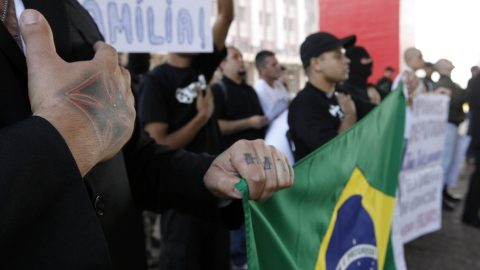
By Raphael Machado | Strategic Culture Foundation | May 5, 2024

On April 26th, it was reported that the Russian embassy in Brazil had received a phone call informing of a bomb presence on the premises. The Military Police of the Federal District was activated and headed to the location to conduct searches.

After several hours of searching, no explosive device was found within or around the embassy. Nevertheless, even if the “alert” was false, the case warrants a deeper investigation, along with reflections on the risks surrounding Russians and “friends of Russia” abroad, given the current geopolitical climate.

In this specific case, despite no explosive device being found, it falls under Brazilian legislation on terrorism, as our laws also encompass the threat of an attack (and mere insinuation constitutes a threat). Hence, “terrorism” is established, regardless of the presence of an actual device at the embassy.

However, it would be imprudent to consider the matter “closed” for several reasons.

Firstly, attention is drawn to the degeneration of the Ukrainian state into a terrorist institutional apparatus, with its security services having been involved in numerous terrorist attacks inside and outside Ukraine.

Ukraine’s degeneration into normalizing terrorism as a state practice accompanies its inability to confront Russia through regular warfare methods. It is predicted that the degradation of the Ukrainian armed forces will be accompanied by a proportional increase in terrorism usage by its security apparatus. Everyone remembers the terrorist attacks that killed Daria Dugina, Vladlen Tatarsky, and the Crocus City Hall attack. Threats to various Russian public figures are constant.

But it is necessary to question whether Ukrainian terrorism (but not only Ukrainian) could extend beyond the Russian-Ukrainian borders and overflow into other nations. Consider, for example, the waves of Russophobia immediately stirred up after the start of the Russian special military operation.

This wave of Russophobia saw not only the cancellation of artistic and academic presentations linked to the Russian World but also physical attacks on some individuals in various countries. Needless to enumerate cases, it suffices to point out that even in Brazil, there were acts of vandalism against Russian Orthodox churches.

To this adds the presence of dozens of Brazilian mercenaries in Ukraine, fighting for Atlanticism. Some of these mercenaries are neo-Nazis, others are neoconservatives, many others are merely useful idiots deceived by unscrupulous influencers on social media. Recently, one of these mercenaries already returned to Brazil, named João Bercle (who, however, according to field information, was never on the front line), stated that Ukraine would “go after” Russians and “defenders of Russia” worldwide, insinuating the possibility of violence fomented, financed, and/or orchestrated from Kiev.

Furthermore, journalist Lucas Leiroz demonstrated in a thread on X that Brazilian President Lula was listed as a “target” on the infamous Myrotvorets website, an authentic “death list” indicating supposed “enemies of Ukraine” to be targeted through terrorist attacks or kidnappings. Many other foreign citizens have also been included on this list.

Well, personalizing the reflection, the author writing this article has indeed received death threats through anonymous accounts on the internet, including threats containing personal information and photos of family members.

Returning, therefore, to the bomb threat at the Russian embassy in Brazil, it is crucial to seriously consider the possibilities, paying attention to future risks.

In any case of such a threat, one must always consider the possibility of it being a troll or a madman or, in general, a person with no specific ideological or collective connections. But the fact that we are in such a geopolitically turbulent period forces us to also insist on other possibilities.

If the origin of the threat is not a troll, then the first suspicion could only fall on Ukrainian security services, such as the SBU and the SZRU, whose involvement in the aforementioned terrorist attacks is at least suspected.

It is notorious that the SBU operates in Brazil, infiltrating the Ukrainian-Brazilian community, which is relatively large, albeit discreet. Years ago, this author learned from a primary source that relatives of Brazilians who fought for the Donbass in Ukraine between 2014-2016 received death threats, with the primary suspicion at the time falling on the SBU.

In this sense, it is evident that the SBU would be the main suspect. And that directly or indirectly.

Indirectly, it is necessary to consider, first of all, Brazilian neo-Nazi groups, most of which have links with analogous organizations in Ukraine and even with the security sectors of that country, such as members of the Misanthropic Division Brazil, especially since some of these Brazilian neo-Nazis fought for the Ukrainian side in the past or went there for training, as reported by the Brazilian mainstream media several times.

The instrumentalization of members of these groups for terrorist attacks against Russian or pro-Russian targets in Brazil would not be particularly difficult. They would require little persuasion and encouragement.

Naturally, if we are still thinking about native Brazilians who could be instrumentalized for this type of terrorism, it would be necessary to observe those who have indeed been engaged in spreading widespread Russophobia and who see Russia as the embodiment of evil.

In this regard, the ferment of neoconservatism and ultraliberalism, proliferated over the last few years in Brazil, with its tendencies toward conspiracy theories, coupled with various behavioral disorders and the possibility of conscious or unconscious cooptation by some intelligence service, opens up the possibility of something in this direction.

Of course, in many of the suspected Ukrainian terrorist actions, some degree of contribution from Western intelligence agencies is suspected.

In this sense, and even considering threats to the President of Brazil, it would be essential to strengthen the counterintelligence work of Brazilian security agencies, as well as to monitor possible connections between neo-Nazi groups or extremist factions of neoconservatism with Ukraine or other intelligence services of NATO countries.

May 5, 2024 Posted by | War Crimes | , | Leave a comment

Ukraine’s creditors want their money back – WSJ

RT | May 5, 2024

A group of foreign bondholders have taken steps to force Ukraine to begin repaying its debts as soon as next year, the Wall Street Journal reported on Sunday. If they succeed, Kiev could hemorrhage $500 million every year on interest payments alone.

The group, which includes investment giants Blackrock and Pimco, granted Kiev a two-year debt holiday in 2022, gambling that the conflict with Russia would have concluded by now.

With no end to the fighting in sight, the lenders have now hired lawyers at Weil Gotshal & Manges and bankers from PJT Partners to meet with Ukrainian officials and strike a deal whereby Ukraine would resume making interest payments next year in exchange for having a significant chunk of its debt written off, anonymous sources told the Wall Street Journal.

The group holds around a fifth of Ukraine’s $20 billion in outstanding Eurobonds, the newspaper reported. While this figure represents a fraction of Ukraine’s total external debt of $161.5 billion, servicing the interest on these bonds would cost the country $500 million annually, the bondholders said.

Should the bondholders fail to strike a deal with Kiev by August, Ukraine could default. This would damage the country’s credit rating and restrict its ability to borrow even more money in the future.

According to the newspaper, Ukrainian officials are hoping that the US and other Western governments will take its side during talks with the bondholders. However, a group of these countries have already offered Ukraine a debt holiday on around $4 billion worth of loans until 2027, and are reportedly concerned that any deal with the bondholders would see private lenders being repaid before them.

Ukraine already relies on foreign aid to keep government departments open and state employees paid. The country’s military is almost entirely dependent on foreign funding; officials in Kiev and the West were predicting imminent defeat until the US Congress approved a foreign aid bill last month which included $61 billion for Ukraine and US government agencies involved in the conflict.

The bill provides almost $14 billion to Ukraine for the purchase of weapons, and includes $9 billion in new “forgivable loans.”

According to the Wall Street Journal, some bondholders have suggested that the US and EU could use frozen Russian assets to pay off Ukraine’s debts. While around $300 billion in assets belonging to the Russian central bank have been frozen in American and European banks since 2022, the US only passed legislation allowing for their seizure last month, and no similar legal mechanism exists in Europe, where the vast majority of these assets are held.

The International Monetary Fund (IMF) and European Central Bank (ECB) have both urged governments not to steal this money, with ECB chief Christine Lagarde warning last month that doing so would risk “breaking the international order that you want to protect.”

May 5, 2024 Posted by | Economics, Militarism | , , | Leave a comment

Odessa massacre 10 years on… Western media silence covers up NATO incrimination

Strategic Culture Foundation | May 3, 2024

Ten years ago this week, a shocking and brutal massacre was perpetrated by supporters of the NATO-backed Kiev regime in Odessa.

At least 42 men and women were murdered on May 2, 2014, when the Trade Unions House in the historic port city was set ablaze by a fascist mob.

Last year to commemorate the ninth anniversary of the atrocity, our weekly editorial provided a rationale for Western silence. We commented:

“In all, 42 people were murdered in the Trade Unions building massacre. Not one attacker was ever prosecuted. The Kiev regime refused to carry out any adequate investigation.

However, the horror of that day was a turning point for many Ukrainians and Russians. It revealed the hideous nature of the regime that had seized power over the country and its vile fascist hostility toward Russia.

This is the regime that was brought to power by Washington and its NATO partners. Since 2014, it has been armed and built up to be a war machine to aggress Russia and obliterate all cultural connections with Russia.

The massacre in Odessa should be remembered for the sake of the victims that day. But also remembered because it helps explain the background of how the present U.S.-led NATO proxy conflict in Ukraine with Russia has come about.

For that reason, Western news media and their governments chose to studiously ignore the Odessa massacre. Their shameful silence is necessary in order to conceal the criminal complicity of the West in Ukraine’s deadly turmoil.”

Now 10 years on, the Western media do not even make any mention of the atrocity. In earlier years, the Western media sought to distort the incident by claiming that it was a confused melee and the tragic result of a clash between unknown rival factions. There were even deplorable attempts by Western media to make out that claims of an atrocity were “Russian disinformation”.

The cover-up has given way to total silence as if the horrific event was consigned to an Orwellian “memory hole”.

Russia continues to call for an international independent investigation to bring the perpetrators to justice. The Kiev regime persists in rebuffing any serious investigation for the simple reason that a thorough probe would probably show that the atrocity was carried out by the leadership of the Kiev regime in collusion with Western intelligence agencies.

What happened in Odessa on May 2, 2014, was not some random event of chaotic violence that got out of control. This is what the Western media initially reported.

No, it seems quite clear now that the massacre was a well-planned, deliberate act of mass murder to terrorize the Ukrainian opposition into complying with the NATO regime. It was an act of state terrorism.

The victims were all from Odessa who had been participating in a peaceful protest outside the landmark building in the city center. The building was closed due to the May Day holiday. As in several other southern and eastern regions of Ukraine at the time, there were many protests against the NATO-sponsored coup in Kiev that had taken place only weeks earlier in February of that year.

Many Ukrainians were not happy – indeed were appalled – that the so-called EuroMaidan coup in Kiev had brought to power ultranationalists and fascists who glorified NeoNazi figures and paramilitaries. Cities like Odessa suffered terribly under Nazi occupation during the Great Patriotic War (WWII). Now they were seeing a regime exulting in those Nazi memories and wanting to banish all Russian cultural connections.

In those pivotal months of 2014, the CIA’s plan to turn Ukraine into an anti-Russian bulwark was not a foregone conclusion due to the formidable opposition to the new regime in cities like Odessa, Kherson and Kharkov  – as well as of course the Crimea Peninsula and the Donbass.

Former Odessa lawmaker Vasily Polishchuk who witnessed the violence that day testifies that senior figures in the Kiev regime were present in Odessa in the days before May 2. One of those was Andriy Parubiy who had been appointed head of national security. Parubiy is also implicated in the sniper shootings in Kiev on February 20 – a false flag provocation killing dozens of protesters and police officers – that precipitated the coup against the elected pro-Russian president Viktor Yanukovych.

Two weeks before the Odessa massacre, the then CIA director John Brennan was in Kiev on an unannounced visit. Even some U.S. lawmakers complained at the time that it was not a good look for the United States to be seen collaborating with the Kiev regime. Brennan was not only giving the green light to the “anti-terror operation” (civil war) that the Kiev regime was about to launch against the Donbass. It seems plausible that the United States was also helping to formulate a scorched-earth policy of terror to quell any dissent across Ukraine.

The mass killings in Odessa on May 2 were the selected terror demonstration.

Eyewitnesses tell of how thousands of Kiev regime paramilitaries who had been instrumental in the coup in the capital weeks earlier were bussed into Odessa and put up in camps. Andriy Parubiy was seen inspecting their ranks and overseeing the supply of body armor.

When the anti-Maidan protesters were attacked on May 2, they were herded by baseball-bat-wielding thugs into the Trade Union House. The building was then assailed with incendiary devices.

People who jumped from the blazing building were bludgeoned to death by NeoNazi gangs shouting “Death to all Russians”.

The dereliction of duty by the police that day to protect the peaceful protesters and the subsequent quashing of any crime investigation is proof that the security forces were complicit. That could only have been enabled by senior orders most likely issued by those in Kiev.

This is essential background to understand the current conflict in Ukraine and why Russia decided to intervene on February 24, 2022. Moscow maintains that Ukraine is a proxy war orchestrated by the United States and its NATO allies as a geo-strategic confrontation to subjugate Russia. Western regimes and their propaganda media make out that Ukraine is a democracy under aggression from Russia.

Understanding how the Kiev regime was installed with CIA and NATO engineering and how it rapidly used its fascist violence to turn Ukraine into a terror state corroborates the analysis of the current conflict being a Western imperialist proxy war.

The Western-lionized “democracy” has repressed all opposition parties and media.

The United States and its NATO accomplices do not want the Western public to understand the truth about their criminal machinations in Ukraine. These powers want the bloodshed to continue to the last Ukrainian because the war racket is so damn lucrative.

Thus the Western powers must shove episodes like the Odessa massacre down the memory hole and keep a lid on it. It is imperative to keep the fiction going of a democracy under attack otherwise the West’s collusion with a NeoNazi regime would reveal the Western powers’ inherent fascism.

Several events and developments around the world – brutal police repression of peaceful protests in the U.S. and Europe, the enabling of genocide by a fascist Israeli regime, the unprovoked aggression toward China, and the nefarious involvement in Ukraine – all point to Western states degenerating into full-fledged fascism.

May 4, 2024 Posted by | Subjugation - Torture | , , | Leave a comment

Russia shoots down four US-made long-range missiles – MOD

RT | May 4, 2024

Russian air defenses have shot down four US-manufactured long-range missiles over Crimea, according to the Defense Ministry in Moscow.

On Saturday night, Kiev’s forces attempted “to carry out a terrorist attack” against the Russian peninsula using surface-to-surface Army Tactical Missile Systems (ATACMS) supplied by Washington, the ministry said in a post on Telegram. The strike was intercepted, it added.

On Tuesday, the Defense Ministry claimed that six ATACMS projectiles had been downed in a single day, without specifying the location of the strikes. In total, 15 such missiles have been intercepted in the past seven days, Moscow reported on Saturday.

In late April, US officials confirmed earlier media reports that the Pentagon had secretly shipped an unspecified number of long-range missiles to Ukraine as part of an arms package announced by President Joe Biden in mid-March.

The “goal” of supplying Kiev with ATACMS was to put more pressure on Crimea and allow Ukrainian forces to target the peninsula “more effectively,” the New York Times reported at a time, citing an unnamed Pentagon official.

Moscow said the provision of long-range missiles would only spell “more problems” for Kiev. Kremlin spokesperson Dmitry Peskov insisted that the use of ATACMS would not impact the outcome of the conflict, or prevent Russia from achieving its security goals.

On Friday, Foreign Ministry Spokeswoman Maria Zakharova warned that any Western-backed Ukrainian attack against the Russian peninsula, or the Crimean Bridge which connects it to the Krasnodar Region, would spark a forceful response.

“I would like to again warn Washington, London, Brussels, that any aggressive actions against Crimea are not only doomed to failure, but will also be met with a retaliatory blow,” she said during a media briefing.

May 4, 2024 Posted by | Militarism | , , | Leave a comment

Drone hits passenger bus in Russian border region – governor

RT | May 3, 2024

A drone struck a passenger bus on Friday morning in one of the villages in Russia’s Belgorod Region, local governor Vyacheslav Gladkov has said. He later reported that another UAV hit a car in the same settlement.

The attacks happened in the village of Voznesenka, located not far from the border with Ukraine, Gladkov wrote on Telegram.

According to the governor, an FPV drone had targeted a passenger bus which was being used to transport the employees of one of the local firms.

A driver and two passengers were inside the vehicle at the moment of the attack, he said.

“As a result of the explosion, one person was injured. The man suffered a barotrauma and a bruise to his right arm,” Gladkov said.

A few hours later, the governor reported another UAV attack in Voznesenka, saying that a kamikaze drone had struck a parked car in the village.

“There is one victim. A man with shrapnel wounds to his back and upper and lower extremities was rushed by ambulance to the regional clinical hospital,” he said.

The targeted car suffered “serious damage,” while three more vehicles were hit with shrapnel. Windows were also blown out in a nearby building, the governor said.

In the town of Shebekino in Belgorod Region, a kamikaze drone also struck a gas station; the explosion set one of the gas storage tanks on fire, Gladkov said.

No one was injured in the incident, the governor stressed, adding that the emergencies services have arrived on site.

Also on Friday, Russia’s Defense Ministry said that five Ukrainian drones had been destroyed by air defenses above Belgorod Region and one more above Crimea overnight.

The Russian regions of Belgorod, Bryansk and Kursk, all of which border Ukraine, have been the targets of numerous Ukrainian missile, mortar and drone attacks since the outbreak of the conflict between Moscow and Kiev in February 2022. The strikes have targeted energy infrastructure and residential areas, resulting in civilian deaths and injuries, as well as the destruction of property.

May 3, 2024 Posted by | War Crimes | , | Leave a comment

Hungary rejects ‘madness’ of NATO’s proposed €100-billion Ukraine war chest

RT | May 2, 2024

Budapest is opposing a potential €100-billion ($107 billion), five-year NATO plan to fund Ukraine in its conflict with Russia, Hungarian Foreign Minister Peter Szijjarto has said. The draft plan on the military aid fund was presented to member states of the US-led bloc by Secretary General Jens Stoltenberg earlier this week, Szijjarto revealed.

The minister made the remarks on Thursday to Hungarian broadcaster M1 before heading for a ministerial meeting of the Organization for Economic Co-operation and Development (OECD) countries in Paris.

“On Tuesday, the NATO member states received the secretary-general’s proposal to raise 100 billion that NATO plans to spend on the war,” the diplomat said, adding that since the money is to be collected over five years, this means NATO “expects the hostilities to continue for this period.”

Budapest will oppose the initiative and is not planning to participate in arming Kiev or training its soldiers, Szijjarto stressed. The draft plan was presented to the bloc’s member states in its “first reading” and is still subject to negotiations, the senior diplomat noted.

In the coming weeks during negotiations we will fight for Hungary’s right to stay away from this madness, from collecting these 100 billion and siphoning them out of Europe.

Budapest prioritizes the security of its own people before anything else and will do its best to “stay out of war,” Szijjarto explained, adding Hungary’s opinion remains that the conflict can only be resolved through negotiations. Nonetheless, Budapest acknowledges mounting global security issues and wants to be ready to face them, he said.

“We cannot ignore the threat of a new world war and the preparations for a nuclear war. This madness here in Europe must be stopped,” Szijjarto urged.

Hungary has consistently expressed its opposition to the ever-growing involvement of the US-led NATO bloc – and of the EU – in the Ukrainian conflict, refusing to send arms to prop up Kiev or to train its troops, and forbidding use of its territory to funnel such shipments from third countries.

Budapest has also publicly spoken out against the potential accession of Ukraine into NATO, which has long been one of the key goals of Ukrainian leadership.

May 2, 2024 Posted by | Militarism | , , | Leave a comment

2014 Odessa Massacre Well Orchestrated, CIA Likely Involved – US Activist

Sputnik – 02.05.2024

WASHINGTON – The 2014 massacre in Odessa conducted by Ukrainian nationalists was well orchestrated and the CIA possibly played a role, US antiwar activist and Global Network Against Weapons and Nuclear Power in Space Coordinator Bruce Gagnon told Sputnik.

On May 2, 2014, Ukrainian nationalists locked pro-federalism protesters in Odessa’s Trade Unions House and set the building on fire. Almost 50 people died and 250 others were injured in the attack by the Ukrainian radicals, according to the United Nations.

“It was well orchestrated,” Gagnon said on Wednesday.

The CIA as well as other US agencies were likely involved in the planning and execution of the massacre, he said.

Gagnon pointed out that the perpetrators were well-equipped to carry out the massacre and Ukrainian law enforcement did practically nothing to prevent it.

“Molotov cocktails were on hand to firebomb the Trade Union House. Bats were on hand to beat those who jumped from windows trying to get away from fire and smoke. Back door was broken into, and Nazis moved inside to kill people hiding,” Gagnon said.

The police at the scene did nothing while the assault was underway and arrested those who had been inside the building but not those who attacked them, Gagnon said.

Fire trucks were blocked from arriving at the scene for quite some time and could not extinguish the fire in the very beginning, Gagnon added.

“It is obvious to me that decisions made at the highest level in Ukraine, and likely in the United States, determined that no prosecutions would happen to those who attacked,” Gagnon said.

The activist noted that he visited Odessa on May 2, 2016, and saw with his own eyes the neo-Nazi Azov battalion holding weapons and roping off the Trade Unions House from people who carried flowers to pay tribute to the victims of the attack.

“No one was allowed to approach the building. The Nazis threw stones at the bus carrying the mothers [of the victims] and the international guests as we approached the area,” Gagnon added.

The clashes in Odessa became one of the deadliest events during the so-called Maidan and anti-Maidan demonstrations in Ukraine that started in late 2013.

Moscow has repeatedly criticized the steps Kiev took to allegedly investigate the massacre and has urged the international community and human rights groups to conduct a probe.

May 2, 2024 Posted by | Subjugation - Torture, Timeless or most popular, War Crimes | , | Leave a comment

Kremlin responds to US chemical weapons accusations

RT | May 2, 2024

Kremlin spokesman Dmitry Peskov has rejected claims by the US that Russia has engaged in chemical warfare in the Ukraine conflict.

The allegation was made as the US Department of State announced a new round of sanctions targeting Russian entities on Wednesday. Some of these measures were justified by reference to alleged breaches by Moscow of the 1993 Chemical Weapons Convention (CWC).

However, Peskov told journalists on Thursday that the claims were “absolutely baseless and not supported by any evidence.” Moscow remains committed to its international obligations, he added.

The latest American sanctions targeted a total of 280 individuals and entities, including the Troops of Radiological, Chemical and Biological Defence – a specialized branch of the Russian military tasked with protecting the military and civilian population from weapons of mass destruction. Washington alleges that the unit “facilitated the use” of chemical weapons in the Ukraine conflict.

The US Department of State specifically claimed that Russia had deployed the toxin chloropicrin, which was used in chemical warfare during World War I and is now predominantly utilized as a pesticide and herbicide.

A senior Ukrainian military commander claimed last year that his troops had been targeted with chloropicrin on multiple occasions. In February, Kiev alleged that Russia had conducted more than 200 chemical weapons attacks on the battlefield in January alone.

Moscow has accused Ukrainian forces of staging chemical weapons incidents with a view to blaming Russia for them.

”The use of toxic chemicals by the Ukrainian militants has become systematic,” the Russian Foreign Ministry said in late February. It added that the Ukrainians were also using improvised drone-dropped chemical weapons.

”The first recorded instance of the use of chloropicrin by Ukrainian neo-fascists happened during the siege of the House of Trade Unions in Odessa on May 2, 2014,” the ministry said. Fumes produced by the chemical during a fire at the building contributed to the high death toll arising from the incident, according to Moscow.

The US sanctions were announced one day before the tenth anniversary of the mass killings in Odessa, which claimed the lives of 48 people, according to the official Ukrainian count.

May 2, 2024 Posted by | Mainstream Media, Warmongering | , , | Leave a comment

Russia Shatters NATO’s Illusory Might With Display of Trophy Armor at Moscow’s Victory Park

By Ilya Tsukanov – Sputnik – 01.05.2024

NATO countries sent tens of billions of dollars’ worth of some of their best military hardware to Ukraine in an attempt to “weaken” Russia in a grueling proxy war. Destroying the equipment by the hundreds, Russia added insult to injury by putting trophy NATO weapons on display before its main memorial dedicated to the victory over Nazi Germany.

The open-air exhibition of foreign weapons and military equipment at Moscow’s Victory Park is shaping up to become perhaps Russia’s greatest psychological and public relations coup in the Ukrainian proxy war with NATO so far.

Dozens of captured vehicles and pieces of weaponry from twelve countries (most of them – members of the bloc) have been put on display, from a Leopard-2 tank, Marder and Bradley IFVs to Humvee, Husky and MRAP vehicles, an M777 towed howitzer, and more exotic equipment, like a French AMX-10RC wheeled tank.

Where possible, equipment has been restored to working or semi-working condition, and plastered with flags to give visitors a sense of the countries which have contributed most to the West’s proxy war against Russia over the past two years. Information stands provide data on the equipment’s manufacturers, their technical and tactical characteristics, and the location and circumstances in which they fell into Russian troops’ hands.

The exhibition serves as a visual and tactile confirmation of sentiments which first became evident last fall, after the catastrophic failure of Ukraine’s NATO-armed and trained armies to breach Russian defenses in Zaporozhye, Kherson and the Donbass in a much-touted summer counteroffensive.

That campaign bled Ukrainian and allied mercenary forces white, and debunked the decades-old myth that emerged in the 80s, 90s and 2000s on the back of Tom Clancy novels and NATO wars of aggression against smaller countries like Yugoslavia and Iraq about the superiority of Western military equipment over its Soviet and Russian analogues. During the scorching summer of 2023, Russian forces demonstrated that the Western alliance’s technologically sophisticated weaponry could be destroyed, damaged or captured just as readily as Ukraine’s Soviet-era equipment.

The trophy weapons exhibition’s location is also significant – situated in Victory Park at Poklonnaya Hill, a memorial complex dedicated to the USSR’s victory over Nazi Germany in the Great Patriotic War. The site also happens to be the place where Napoleon Bonaparte stood in 1812 before entering the Russian capital during the first Patriot War with France.

The Victory Park Museum already features an open-air exposition of Soviet and Axis weaponry that was captured during the Second World War. Now, 79 years after Nazi Germany’s capitulation on May 9, 1945, the complex has been topped up with new, modern weaponry, fresh from the battlefield and this time belonging to NATO.

Important Gesture

“This is a gesture – we are demonstrating our strength, and in some areas superiority, by flaunting this NATO hardware, not only to our own people, but to the West,” Alexei Podberezkin, director of the Center of Military-Political Studies at Russia’s prestigious MGIMO University, told Sputnik, commenting on the Victory Park display.

The exhibition serves as “an illustration of what will happen next with the equipment that is being sent to Ukraine, including those new weapons which are starting to arrive now, including Abrams tanks, ATACMS missiles, and much, much more,” Podberezkin emphasized.

Earl Rasmussen, a 20-year US Army veteran-turned independent military and foreign affairs commentator, agrees that the display is designed “to send a signal to the West.”

“[It signals] that Russia is there, they’re capable, their military is capable. They’ve destroyed almost the equivalent of three Ukrainian armies so far. And they will continue to do so. So whatever the West sends, those weapons will be destroyed,” the retired lieutenant colonel said.

“The weapons, ammunition… the production capability, the logistical capability – it’s all on the side of Russia. It’s superior in that area. It has escalation dominance. There is air superiority and tactical superiority as well. Time is on their side. And all this does [continuing the proxy war, ed.] is drain the West more and more and more. It’s a sad affair, I think for the Western public, unfortunately. And they’re being lied to by their own leaders,” Rasmussen added.

The exhibit is basically “an embarrassment to the West,” adding insult to injury regarding the tens of billions of dollars that have been wasted in Ukraine, the soldier said. “In any case, it shows basically that the aid packages” being provided by Western countries “are not going to change the outcome of the war, and will be essentially just a waste in funds and, unfortunately, both Ukrainian and Russian lives.”

NATO Hardware Not Wunderwaffe

The display is also another apt and timely reminder to the West that its military technology, including Leopards, Abrams, Bradleys, etc. are not the “miracle weapons” they were hyped to be ahead of Ukraine’s much-touted counteroffensive last year, which ran into the wall of well-prepared Russian defenses, Podberezkin said.

“This equipment proved to be no better, and often worse, than our weapons, both Soviet and Russian, in the arena of combat. And once again it was demonstrated that conflicts are fought not only with steel, but by people, first of all commanders, the military leaders who give orders and think about how to use these weapons most effectively,” Podberezkin said.

“I would really enjoy going through it as well, and think I would learn a lot from it,” Rasmussen said of the exhibition, adding that he predicts the display may be visited by international visitors, including individuals from countries asking questions about the utility of purchasing much-hyped and pricey Western military equipment vs. Russian-made hardware.

In any case, the American observer is confident that Russian military engineers and defense scientists have already gone through the equipment with a fine-tooth comb, analyzing armor capability, sensors, communications and targeting capabilities and equipment, their interoperability characteristics, etc.

“There is a lot of information Russia already probably knows. And a lot of highly classified, highly sensitive type of capability, information fusion, other sensors, other additional sensor capability, active armor capability may not have been provided to Ukraine as well. So there will be limits on what the Russian engineers will be able to discover. But it definitely provides a basis to fill some gaps. I’m sure that the engineers and designers have made it so they can turn around and readily modify Russian equipment to counter any capabilities that they haven’t already addressed,” Rasmussen concluded.

May 1, 2024 Posted by | Militarism | , , , | Leave a comment

What 10 Years of U.S. Meddling in Ukraine Have Wrought (Spoiler Alert: Not Democracy)

By Aaron Maté | RealClearInvestigations | April 30, 2024

In successfully lobbying Congress for an additional $61 billion in Ukraine war funding, an effort that ended this month with celebratory Democrats waving Ukrainian flags in the House chamber, President Biden has cast his administration’s standoff with Russia as an existential test for democracy.

“What makes our moment rare is that freedom and democracy are under attack, both at home and overseas,” Biden declared in his State of the Union address in March. “History is watching, just like history watched three years ago on January 6th.”

While Biden’s narrative is widely accepted by Washington’s political establishment, a close examination of the president and his top principals’ record dating back to the Obama administration reveals a different picture. Far from protecting democracy from Kyiv to Washington, their role in Ukraine looks more like epic meddling resulting in political upheaval for both countries.

Over the last decade, Ukraine has been the battleground in a proxy war between the U.S. and Russia – a conflict massively escalated by the Kremlin’s invasion in 2022. The fight erupted in early 2014, when Biden and his team, then serving in the Obama administration, supported the overthrow of Ukraine’s elected president, Viktor Yanukovych. Leveraging billions of dollars in U.S. assistance, Washington has shaped the personnel and policies of subsequent Ukrainian governments, all while expanding its military and intelligence presence in Ukraine via the CIA and NATO. During this period, Ukraine has not become an independent self-sustaining democracy, but a client state heavily dependent on European and U.S. support, which has not protected it from the ravages of war.

The Biden-Obama team’s meddling in Ukraine has also had a boomerang effect at home.

As well-connected Washington Beltway insiders such as Hunter Biden have exploited it for personal enrichment, Ukraine has become a source of foreign interference in the U.S. political system – with questions of unsavory dealings arising in the 2016 and 2020 elections as well as the first impeachment of Donald Trump. After years of secrecy, CIA sources have only recently confirmed that Ukrainian intelligence helped generate the Russian interference allegations that engulfed Trump’s presidency. House Democrats’ initial attempt to impeach Trump, undertaken in the fall of 2019, came in response to his efforts to scrutinize Ukraine’s Russiagate connection.

This account of U.S. interference in Ukraine, which can be traced to fateful decisions made by the Obama administration, including then-Vice President Biden and his top aides, is based on often overlooked public disclosures. It also relies on the personal testimony of Andrii Telizhenko, a former Ukrainian diplomat and Democratic Party-tied political consultant who worked closely with U.S. officials to promote regime change in Ukraine.

Although he once welcomed Washington’s influence in Ukraine, Telizhenko now takes a different view. “I’m a Ukrainian who knew how Ukraine was 30 years ago, and what it became today,” he says. “For me, it’s a total failed state.” In his view, Ukraine has been “used directly by the United States to fight a [proxy] war with Russia” and “as a rag to make money for people like Biden and his family.”

The State Department has accused Telizhenko being part of a “Russia-linked foreign influence network.” In Sept. 2020 it revoked his visa to travel to the United States. Telizhenko, who now lives in a western European country where he was granted political asylum, denies working with Russia and says that he is a whistleblower speaking out to expose how U.S. interference has ravaged his country. RealClearInvestigations has confirmed that he worked closely with top American officials while they advanced policies aimed at severing Ukraine’s ties to Russia. No official contacted for this article – including former CIA chief John Brennan and senior State Department official Victoria Nuland – disputed any of his claims.

A Coup in ‘Full Coordination’ With the U.S.

The Biden team’s path to influencing Ukraine began with the eruption of anti-government unrest in November 2013. That month, protesters began filling Kyiv’s Maidan Nezalezhnosti (Independence Square) after then-President Viktor Yanukovych, a notoriously corrupt leader, delayed signing a European Union (EU) trade pact. To members of what came to be known as the Maidan movement, Yanukovych’s decision was a betrayal of his pledge to strengthen Western ties, and a worrying sign of Russian allegiance in a country haunted by its Soviet past.

The reality was more complex. Yanukovych was hoping to maintain relations with both Russia and Europe – and use competition between them to Ukraine’s advantage. He also worried that the EU’s terms, which demanded reduced trade with Russia, would alienate his political base in the east and south, home to millions of ethnic Russians. As the International Crisis Group noted, these Yanukovych-supporting Ukrainians feared that the EU terms “would hurt their livelihoods, a large number of which were tied to trade and close relations with Russia.” Despite claims that the Maidan movement represented a “popular revolution,” polls from that period showed that Ukrainians were evenly split on it, or even majority opposed.

After an initial period of peaceful protest, the Maidan movement was soon co-opted by nationalist forces, which encouraged a violent insurrection for regime change. Leading Maidan’s hardline contingent was Oleh Tyahnybok of the Svoboda party, who had once urged his supporters to fight what he called the “Muscovite-Jewish mafia running Ukraine.” Tyahnybok’s followers were joined by Right Sector, a coalition of ultra-nationalist groups whose members openly sported Nazi insignia. One year before, the European Parliament condemned Svoboda for “racist, anti-Semitic and xenophobic views” and urged Ukrainian political parties “not to associate with, endorse or form coalitions with this party.”

Powerful figures in Washington took a different view: For them, the Maidan movement represented an opportunity to achieve a longtime goal of pulling Ukraine into the Western orbit. Given Ukraine’s historical ties to Russia, its integration with the West could also be used to undermine the rule of Russian President Vladimir Putin.

As the-late Zbigniew Brzezinski, the influential former national security adviser to President Jimmy Carter, once wrote: “Without Ukraine, Russia ceases to be a Eurasian empire.” Two months before the Kyiv protests erupted, Carl Gershman, head of the National Endowment for Democracy, dubbed Ukraine “the biggest prize” in the West’s rivalry with Russia. Absorbing Ukraine, Gershman explained, could leave Putin “on the losing end not just in the near abroad” – i.e, its former Soviet satellites – “but within Russia itself.” Shortly after, senior State Department official Nuland boasted that the U.S. had “invested more than $5 billion” to help pro-Western “civil society” groups achieve a “secure and prosperous and democratic Ukraine.”

Seeking to capitalize on the unrest, U.S. figures including Nuland, Republican Sen. John McCain, and Democratic Sen. Chris Murphy visited Maidan Square. In a show of support for the movement’s hardline faction, which went beyond supporting the EU trade deal to demand Yanukovych’s ouster, the trio met privately with Tyahnybok and appeared with him on stage. The senators’ mission, Murphy said, was to “bring about a peaceful transition here.”

The Maidan Movement’s most significant U.S. endorsement came from then-Vice President Joe Biden. “Nothing would have greater impact for securing our interests and the world’s interests in Europe than to see a democratic, prosperous, and independent Ukraine in the region,” Biden said.

According to Andrii Telizhenko, a former Ukrainian government official who worked closely with Western officials during this period, the U.S. government’s role went far beyond those high-profile displays of solidarity.

“As soon as it grew into something, into the bigger Maidan, in the beginning of December, it basically was full coordination with the U.S. Embassy,” Telizhenko recalls. “Full, full.”

When the protests erupted, Telizhenko was working as an adviser to a Ukrainian member of Parliament. Having spent part of his youth in Canada and the United States, Telizhenko’s fluent English and Western connections landed him a position helping to oversee the Maidan Movement’s international relations. In this role, he organized meetings with and coordinated security arrangements for foreign visitors, including U.S. Ambassador Geoffrey Pyatt, Nuland, and McCain. Most of their briefings were held at Kyiv’s Trade Unions Building, the movement’s de-facto headquarters in the city’s center.

Telizhenko says Pyatt routinely coordinated with Maidan leaders on protest strategy. In one encounter, the ambassador observed Right Sector members assembling Molotov cocktails that would later be thrown at riot police attempting to enter the building. Sometimes, the U.S. ambassador disapproved of his counterparts’ tactics. “The U.S. embassy would criticize if something would happen more radical than it was supposed to go by plan, because it’s bad for the picture,” Telizhenko said.

That winter was marked by a series of escalating clashes. On February 20, 2014, snipers fatally shot dozens of protesters in Maidan square. Western governments attributed the killings to Yanukovych’s forces. But an intercepted phone call between NATO officials told a different story.

In the recorded conversation, Estonian foreign minister Urmas Paet told EU foreign secretary Catherine Ashton that he believed pro-Maidan forces were behind the slaughter. In Kyiv, Paet reported, “there is now stronger and stronger understanding that behind the snipers, it was not Yanukovych, but it was somebody from the new [opposition] coalition.”

In a bid to resolve the Maidan crisis and avoid more bloodshed, European officials brokered a compromise between Yanukovich and the opposition. The Feb. 21 deal called for a new national unity government that would keep him in office, with reduced powers, until early elections at year’s end. It also called for the disarmament of the Maidan forces and a withdrawal of riot police. Holding up its end of the bargain, government security forces pulled back. But the Maidan encampment’s ultra-nationalist contingent had no interest in compromise.

“We don’t want to see Yanukovych in power,” Maidan Movement squadron leader Vladimir Parasyuk declared that same day. “… And unless this morning you come up with a statement demanding that he steps down, then we will take arms and go, I swear.”

In insisting on regime change, the far-right contingent was also usurping the leadership of more moderate opposition leaders such as Vitali Klitschko, who supported the power-sharing agreement.

“The goal was to overthrow the government,” Telizhenko says. “That was the first goal. And it was all green-lighted by the U.S. Embassy. They basically supported all this, because they did not tell them to stop. If they told them [Maidan leaders] to stop, they would stop.”

Yet another leaked phone call bolstered suspicions that the U.S. endorsed regime change. On the recording, presumably intercepted in January by Russian or Ukrainian intelligence, Nuland and Pyatt discussed their choice of leaders in a proposed power-sharing government with Yanukovich. Their conversation showed that the U.S. exerted considerable influence with the faction  seeking the Ukrainian president’s ouster.

Tyahnybok, the openly antisemitic head of Svodova, would be a “problem” in office, Nuland worried, and better “on the outside.” Klitschko, the more moderate Maidan member, was ruled out as well. “I don’t think Klitsch should go into government,” Nuland said. “I don’t think it’s necessary. I don’t think it’s a good idea.” One reason was Klitschko’s proximity to the European Union. Despite her government’s warm words for the European Union in public, Nuland told Pyatt: “Fuck the EU.”

The two U.S. officials settled on technocrat Arseniy Yatsenyuk. “I think Yats is the guy,” Nuland said. By that point, Yatsenyuk had endorsed violent insurrection. The government’s rejection of Maidan demands, he said, meant that “people had acquired the right to move from non-violent to violent means of protest.”

The only outstanding matter, Pyatt relayed, was securing “somebody with an international personality to come out here and help to midwife this thing.” Nuland replied that Vice President Joe Biden and his senior aide, Jake Sullivan, who now serves as Biden’s National Security Adviser, had signed on to provide “an atta-boy and to get the deets [details] to stick.”

Just hours after the power-sharing agreement was reached, Nuland’s wishes were granted. Yanukovich, no longer protected by his armed forces, fled the capital. Emboldened by their sabotage of an EU-brokered power-sharing truce, Maidan Movement members stormed the Ukrainian Parliament and pushed through the formation of a new government. In violation of parliamentary rules on impeachment proceedings, and lacking a sufficient quorum, Oleksandr Turchynov was named the new acting president. The Nuland-backed Yatsenyuk was appointed Prime Minister.

In a reflection of their influence, at least five post-coup cabinet posts in national security, defense, and law enforcement were given to members of Svoboda and its far-right ally Right Sector.

“The uncomfortable truth is that a sizeable portion of Kyiv’s current government – and the protesters who brought it to power – are, indeed, fascists,” wrote Andrew Foxall, now a British defense official, and Oren Kessler, a Tel Aviv-based analyst, in Foreign Policy the following month. While denying any role in Yanukovich’s ouster, the Obama administration immediately endorsed it, as Secretary of State John Kerry expressed “strong support” for the new government.

In his memoir, former senior Obama aide Ben Rhodes acknowledged that Nuland and Pyatt “sounded as if they were picking a new government as they evaluated different Ukrainian leaders.” Rather than dispel that impression, he acknowledged that some of the Maidan “leaders received grants from U.S. democracy promotion programs.”

In 2012, one pro-Maidan group, Center UA, received most of its more than $500,000 in donations from the U.S. Agency for International Development (USAID), the National Endowment for Democracy, eBay founder Pierre Omidyar, and financier George Soros.

By its own count, Soros’ International Renaissance Foundation spent over $109 million in Ukraine between 2004 and 2014. In leaked documents, a former IRF board member even bragged that its partners “were the main driving force and the foundation of the Maidan movement,” and that without Soros’ funding, “the revolution might not have succeeded.” Weeks after the coup, an IRF strategy document noted, “Like during the Maidan protests, IRF representatives are in the midst of Ukraine’s transition process.”

Jeffrey Sachs, a Columbia University professor who advised Ukraine on economic policy in the early 1990s, visited Kyiv shortly after the coup to consult with the new government.

“I was taken around the Maidan where people were still milling around,” Sachs recalls. “And the American NGOs were around there, and they were describing to me: ‘Oh we paid for this, we paid for that. We funded this insurrection.’ It turned my stomach.” Sachs believes that these groups were acting at the behest of U.S. intelligence. To go about “funding this uprising,” he says, “they didn’t do that on their own as nice NGOs. This is off-budget financing for a U.S. regime-change operation.”

Weeks after vowing to bring about a “transition” in Ukraine, Sen. Murphy openly took credit for it. “I really think that the clear position of the United States has in part been what has helped lead to this change in regime,” Murphy said. “I think it was our role, including sanctions and threats of sanctions, that forced, in part, Yanukovych from office.”

The Proxy War Gets Hot

Far from resolving the unrest, Viktor Yanukovych’s ouster plunged Ukraine into a war.

Just days after the Ukrainian president fled to Moscow, Russian special forces stormed Crimea’s local parliament. The following month, Russia annexed Crimea following a hasty, militarized referendum denounced by Ukraine, the U.S., and much of the world. While these objections were well-founded, Western surveys of Crimeans nonetheless found majority support for Russian annexation.

Emboldened by the events in Crimea, and hostile to a new government that had overthrown their elected leader Yanukovych, Russophile Ukrainians in the eastern Donbas region followed suit.

On April 6 and 7, anti-Maidan protesters seized government buildings in Donetsk, Luhansk, and Kharkiv. The Donetsk rebels declared the founding of the Donetsk People’s Republic. The Luhansk People’s Republic followed 20 days later. Both areas announced independence referendums for May 11.

As in Crimea, Moscow backed the Donbas rebellion. But unlike in Crimea, the Kremlin opposed the independence votes. The organizers, Putin said, should “hold off on the referendum in order to give dialogue the conditions it needs to have a chance.”

In public, the Obama administration claimed to also favor dialogue between Kyiv and the Russia-backed rebels in eastern Ukraine. Behind the scenes, a more aggressive plan was brewing.

On April 12, CIA chief John Brennan slipped into the Ukrainian capital for secret meetings with top officials. Russia, whose intelligence services ran a network of informants inside Ukraine, publicly outed Brennan’s visit. The Kremlin and Yanukovych directly accused Brennan of encouraging an assault on the Donbas.

The CIA dismissed the allegation as “completely false,” and insisted that Brennan supported a “diplomatic solution” as “the only way to resolve the crisis.” The following month, Brennan insisted that “I was out there to interact with our Ukrainian partners and friends.”

Yet Russia and Yanukovych were not alone in voicing concerns about the CIA chief’s covert trip. “What message does it send to have John Brennan, the head of the CIA in Kiev, meeting with the interim government?” Sen. Murphy complained. “Does that not confirm the worst paranoia on the part of the Russians and those who see the Kiev government as essentially a puppet of the West?… It may not be super smart to have Brennan in Kiev, giving the impression that the United States is somehow there to fight a proxy war with Russia.”

According to Telizhenko, who attended the Brennan meeting and spoke to RCI on record about it for the first time, that’s exactly what the CIA chief was there to do. Contrary to U.S. claims, Telizhenko says, “Brennan gave a green light to use force against Donbas,” and discussed “how the U.S. could support it.” One day after the meeting, Kyiv announced an “Anti-Terrorist Operation” (ATO) against the Donbas region and began a military assault.

Telizhenko, who was by then working as a senior policy adviser to Vitaliy Yarema, the First Deputy Prime Minister, says he helped arrange the Brennan gathering after getting a phone call from the U.S. embassy. “I was told there was going to be a top secret meeting, with a top U.S. official and that my boss should be there,” he recalls. “I was also told not to tell anyone.”

Brennan, he recalls, arrived at the Foreign Intelligence Office of Ukraine in a beat-up gray mini-van and a coterie of armed guards. Others in attendance included U.S. Ambassador Pyatt, Acting President Oleksandr Turchynov, foreign intelligence chief Victor Gvozd, and other senior Ukrainian security officials.

After a customary exchange of medals and souvenir trophies, the topic turned to the unrest in the Donbas. “Brennan was talking about how Ukraine should act,” Telizhenko says. “A plan to keep Donbas in Ukraine’s hands. But Ukraine’s army was not fully equipped. We only had stuff in reserves. They discussed plans for the ATO and how to keep Ukraine’s military fully armed throughout.” Brennan’s overall message was that “Russia is behind” the Donbas unrest, and “Ukraine has to take firm, aggressive action to not let this spread all over.”

Brennan and Pyatt did not respond to a request for comment.

Two weeks after Brennan’s visit, the Obama administration offered yet another high-level endorsement of the Donbas operation when then-Vice President Biden visited Kyiv. With Ukraine facing “unrest and uncertainty,” Biden told a group of lawmakers, it now had “a second opportunity to make good on the original promise made by the Orange Revolution” – referring to earlier 2004-2005 post-electoral upheaval that blocked Yanukovych, albeit temporarily, from the presidency.

Looking back, Telizhenko is struck by the contrast between Brennan’s bellicosity in Donbas and the Obama administration’s lax response to Russia’s Crimea grab one month prior.

“After Crimea, they told us not to respond,” he said. But beforehand, “the Americans scoffed at warnings” that Ukraine could lose the peninsula. When Ukrainian officials met with Pentagon counterparts in March, “we gave them evidence that the little green men” – the incognito Russian forces who seized Crimea – “were Russians. They dismissed it.” Telizhenko now speculates that the U.S. permitted the Crimean takeover to encourage a conflict between Kyiv and Moscow-backed eastern Ukrainians. “I think they wanted Ukraine to hate Russia, and they wanted Russia to take the bait,” he said. Had Ukraine acted earlier, he believes, “the Crimea situation could have been stopped.”

With Russia in control of Crimea and Ukraine assaulting the Donbas with U.S. backing, the country descended into a full-scale civil war. Thousands were killed and millions displaced in the ensuing conflict. When Ukrainian forces threatened to overrun the Donbas rebels in August 2014, the Kremlin launched a direct military intervention that turned the tide. But rather than offer Ukraine more military assistance, Obama began getting cold feet.

Obama, senior Pentagon official Derek Chollet recalled, was concerned that flooding Ukraine with more weapons would “escalate the crisis” and give “Putin a pretext to go further and invade all of Ukraine.”

Rebuffing pressure from within his own Cabinet, Obama promised German Chancellor Angela Merkel in February 2015 that he would not send lethal aid to Ukraine. According to the U.S. Ambassador to Germany, Peter Wittig, Obama agreed with Merkel on the need “to give some space for those diplomatic, political efforts that were under way.”

That same month, Obama’s commitment gave Merkel the momentum to finalize the Minsk II Accords, a pact between Kyiv and Russian-backed Ukrainian rebels. Under Minsk II, an outmatched Ukrainian government agreed to allow limited autonomy for the breakaway Donbas regions in exchange for the rebels’ demilitarization and the withdrawal of their Russian allies.

Inside the White House, Obama’s position on Ukraine left him virtually alone. Obama’s reluctance to arm Ukraine, Chollet recalled, marked a rare situation “in which just about every senior official was for doing something that the president opposed.”

One of those senior officials was the State Department’s point person for Ukraine, Victoria Nuland. Along with allied officials and lawmakers, Nuland sought to undermine the Minsk peace pact even before it was signed.

As Germany and France lobbied Moscow and Kyiv to accept a peace deal, Nuland addressed a private meeting of U.S. officials, generals, and lawmakers – including Sen. McCain and future Secretary of State Mike Pompeo – on the sidelines of the annual Munich Security Conference. Dismissing the French-German diplomatic efforts as an act of appeasement, Nuland outlined a strategy to continue the war with a fresh influx of Western arms. Perhaps mindful of the optics of flooding Ukraine with military hardware at a time when the Obama administration was claiming to support to a peace agreement, Nuland offered a public relations suggestion. “I would like to urge you to use the word ‘defensive system’ to describe what we would be delivering against Putin’s offensive systems,” Nuland told the gathering.

The Munich meeting underscored that while President Obama may have publicly supported a peace deal in Ukraine, a bipartisan alliance of powerful Washington actors – including his own principals – was determined to stop it. As Foreign Policy magazine reported, “the takeaway for many Europeans … was that Nuland gave short shrift to their concerns about provoking an escalation with Russia and was confusingly out of sync with Obama.”

As Nuland and other officials quietly undermined the Minsk accords, the CIA deepened its role in Ukraine. U.S. intelligence sources recently disclosed to the New York Times that the agency has operated 12 secret bases inside Ukraine since 2014. The post-coup government’s first new spy chief, Valentyn Nalyvaichenko, also revealed that he established a formal partnership with the CIA and MI6 just two days after Yanukovych’s ouster.

According to a separate account in the Washington Post, the CIA restructured Ukraine’s two main spy services and turned them into U.S. proxies. Starting in 2015, the CIA transformed Ukraine’s military intelligence agency, the GUR, so extensively that “we had kind of rebuilt it from scratch,” a former intelligence official told the Post. “GUR was our little baby.” As a benefit of being the CIA’s proxy, the agency even funded new headquarters for the GUR’s paramilitary wing and a separate division for electronic espionage.

In a 2016 congressional appearance, Nuland touted the extensive U.S. role in Ukraine. “Since the start of the crisis, the United States has provided over $760 million in assistance to Ukraine, in addition to two $1 billion loan guarantees,” Nuland said. U.S. advisers “serve in almost a dozen Ukrainian ministries,” and were helping “modernize Ukraine’s institutions” of state-owned industries.

Nuland’s comments underscored an overlooked irony of the U.S. role in Ukraine: In claiming to defend Ukraine from Russian influence, Ukraine was subsumed by American influence.

Boomeranging Into U.S. Politics 

In the aftermath of the February 2014 coup, the transformation of Ukraine into an American client state soon had a boomerang effect, as maneuvers in that country increasingly impacted U.S. domestic politics.

“Americans are highly visible in the Ukrainian political process,” Bloomberg columnist Leonid Bershidsky observed in November 2015. “The U.S. embassy in Kyiv is a center of power, and Ukrainian politicians openly talk of appointments and dismissals being vetted by U.S. Ambassador Geoffrey Pyatt and even U.S. Vice President Joe Biden.”

One of the earliest and best-known cases came in December 2015, when Biden threatened to withhold $1 billion in aid unless Ukraine fired its prosecutor general, Viktor Shokin, whom the vice president claimed was corrupt. When Biden’s threat resurfaced as an issue during the 2020 election, the official line, as reported by CNN, was that “the effort to remove Shokin was backed by the Obama administration, European allies” and even some Republicans.

In fact, from Washington’s perspective, the campaign for Shokin’s ouster marked a change of course. Six months before Biden’s visit, Nuland had written Shokin that “We have been impressed with the ambitious reform and anti-corruption agenda of your government.”

And as RCI recently reported:

An Oct. 1, 2015, memo summarizing the recommendation of the [U.S.] Interagency Policy Committee on Ukraine stated, “Ukraine has made sufficient progress on its [anti-corruption] reform agenda to justify a third [loan] guarantee.” … The next month, moreover, the task force drafted a loan guarantee agreement that did not call for Shokin’s removal. Then, in December, Joe Biden flew to Kyiv to demand his ouster.

No one has explained why Shokin suddenly came into the crosshairs. At the time, the prosecutor general was investigating Burisma, a Ukrainian energy firm that was paying Hunter Biden over $80,000 per month to sit on its board.

According to emails obtained from his laptop, Hunter Biden introduced his father to a top Burisma executive less than one year before. Burisma also retained Blue Star Strategies, a D.C. consulting firm that worked closely with Hunter, to help enlist U.S. officials who could pressure the Ukrainian government to drop its criminal probes.

Two senior executives at Blue Star, Sally Painter and Karen Tramontano, formerly worked as top aides to President Bill Clinton.

According to a November 2015 email sent to Hunter by Vadym Pozharsky, a Burisma adviser, the energy firm’s desired “deliverables” included visits from “influential current and/or former US policy-makers to Ukraine.” The “ultimate purpose” of these visits would be “to close down” any legal cases against the company’s owner, Mykola Zlochevsky. One month after that email, Joe Biden visited Ukraine and demanded Shokin’s firing.

Telizhenko – who worked in Shokin’s office at the time, and later worked for Blue Star – said the evidence contradicts claims that Shokin was fired because of his failure, among other things, to investigate Burisma. “There were four criminal cases opened in 2014 against Burisma, and two more additionally opened by Shokin when he became the Prosecutor General,” recalls Telizhenko. “So, whenever anybody says, ‘There were no criminal cases, nobody was investigating Burisma, Shokin was fired because he was a bad prosecutor, he didn’t do his work’ … this was all a lie. No, he did his work.”

In a 2023 interview, Hunter Biden’s former business partner, Devon Archer, said Shokin was seen as a “threat” to Burisma. Both of Shokin’s cases against Burisma were closed after his firing.

Ukraine Meddling vs. Trump

While allegations of Russian interference and collusion would come to dominate the 2016 campaign, the first documented case of foreign meddling originated in Ukraine.

Telizhenko, who served as a political officer at the Ukrainian embassy in Washington, D.C., before joining Blue Star, was an early whistleblower. He went public in January 2017, telling Politico how the Ukrainian embassy worked to help Hillary Clinton’s 2016 election campaign and undermine Trump’s.

According to Telizhenko, Ukraine’s D.C. ambassador, Valeriy Chaly, instructed staffers to shun Trump’s campaign because “Hillary was going to win.”

Telizhenko says he was told to meet with veteran Democratic operative Alexandra Chalupa, who had also served in the Clinton White House. “The U.S. government and people from the Democratic National Committee are approaching and asking for dirt on a presidential candidate,” Telizhenko recalls. “And Chalupa said, ‘I want dirt. I just want to get Trump off the elections.’”

Starting in early 2016, U.S. officials leaned on the Ukrainians to investigate Paul Manafort, the GOP consultant who would become Trump’s campaign manager, and avoid scrutiny of Burisma, as RCI reported in 2022. “Obama’s NSC hosted Ukrainian officials and told them to stop investigating Hunter Biden and start investigating Paul Manafort,” a former senior NSC official told RCI. In January 2016, the FBI suddenly reopened a closed investigation into Manafort for potential money laundering and tax evasion connected to his work in Ukraine.

Telizhenko, who attended a White House meeting with Ukrainian colleagues that same month, says he witnessed Justice Department officials pressing representatives of Ukraine’s Corruption Bureau. “The U.S. officials were asking for the Ukrainian officials to get any information, financial information, about Americans working for the former government of Ukraine, the Yanukovych government,” he says.

By the time Telizhenko spoke out, Ukrainian officials had already admitted intervening in the 2016 election to help Clinton’s campaign. In August, Ukraine’s National Anti-Corruption Bureau (NABU) released what it claimed was a secret ledger showing that Manafort received millions in illicit cash payments from Yanukovych’s party. The Clinton campaign, then in the early stages of its effort to portray their Republican rival as a Russian conspirator, seized on the news as evidence of Trump’s “troubling connections” to “pro-Kremlin elements in Ukraine.”

The alleged ledger was first obtained by Ukrainian lawmaker Serhiy Leshchenko, who had claimed that he had received it anonymously by mail. Yet Leshchenko was not an impartial source: He made no effort to hide his efforts to help elect Clinton. “A Trump presidency would change the pro-Ukrainian agenda in American foreign policy,” Leshchenko told the Financial Times. For him, “it was important to show … that [Trump] is [a] pro-Russian candidate who can break the geopolitical balance in the world.” Accordingly, he added, most of Ukraine’s politicians were “on Hillary Clinton’s side.”

Manafort, who would be convicted of unrelated tax and other financial crimes in 2018, denied the allegation. The ledger was handwritten and did not match the amounts that Manafort was paid in electronic wire transfers. Moreover, the ledger was said to have been stored at Yanukovych’s party headquarters, yet that building was burned in a 2014 riot by Maidan activists.

Telizhenko agrees with Manafort that the ledger was a fabrication. “I think the ledger was just made up because nobody saw it, and nobody got the official documents themselves. From my understanding it was all a toss-up, a made-up story, just because they could not find any dirt on the Trump campaign.”

But with the U.S. media starting to amplify the Clinton campaign’s Trump-Russia conspiracy theories, a wary Trump demanded Manafort’s resignation. “The easiest way for Trump to sidestep the whole Ukraine story is for Manafort not to be there,” Newt Gingrich, the former House speaker and a Trump campaign adviser, explained.

The 2016 Russian Hacking Claim

The release of the Manafort ledger and cooperation with the Democratic National Committee was not the end of Ukraine’s 2016 election interference.

A recent account in the New York Times revealed that Ukrainian intelligence played a vital role in generating CIA allegations that would become a foundation of the Russiagate hoax – that Russia stole Democratic Party emails and released them via WikiLeaks in a bid to help elect Trump. Once again, CIA chief Brennan played a critical role.

In the Times’ telling, some Obama officials wanted to shut down the CIA’s work in Ukraine after a botched August 2016 Ukrainian intelligence operation in Crimea turned deadly. But Brennan “persuaded them that doing so would be self-defeating, given the relationship was starting to produce intelligence on the Russians as the C.I.A. was investigating Russian election meddling.” This “relationship” between Brennan and his Ukrainian counterparts proved to be pivotal. According to the Times, Ukrainian military intelligence – which the CIA closely managed – claimed to have duped a Russian officer into “into providing information that allowed the C.I.A. to connect Russia’s government to the so-called Fancy Bear hacking group.”

“Fancy Bear” is one of two alleged Russian cyber espionage groups that the FBI has accused of carrying out the 2016 DNC email theft. Yet this allegation has a direct tie not just to Ukraine, but to the Clinton campaign. The name “Fancy Bear” was coined by CrowdStrike, a private firm working directly for Clinton’s attorney, Michael Sussmann. As RealClearInvestigations has previously reported, CrowdStrike first accused Russia of hacking the DNC, and the FBI relied on the firm for evidence. Years after publicly accusing Russia of the theft, CrowdStrike executive Shawn Henry was forced to admit in sworn congressional testimony that the firm “did not have concrete evidence” that Russian hackers took data from the DNC servers.

CrowdStrike’s admission about the evidentiary hole in the Russian hacking allegation, along with the newly disclosed Ukrainian intelligence role in generating it, were both kept under wraps throughout the entirety of Special Counsel Robert Muller’s probe into alleged Russian interference. But when Trump sought answers on both matters, he once again found himself the target of an investigation.

In late September 2019, weeks after Mueller’s halting congressional testimony – which left Trump foes dissatisfied over his failure to find insufficient evidence of a Russian conspiracy – House Democrats kicked off an effort to impeach Trump for freezing U.S. weapons shipments in an alleged scheme to pressure Ukraine into investigating the Bidens. The impeachment was triggered by a whistleblower complaint about a phone call between Trump and Ukrainian President Volodymyr Zelensky two months prior. The “whistleblower” was later identified by RealClearInvestigations as Eric Ciaramella, an intelligence official who had served as Ukraine adviser to then-Vice President Biden when he demanded Shokin’s firing and to the Obama administration’s other key point person for Kyiv, Victoria Nuland.

Yet Trump’s infamous July 2019 phone call with Zelensky was not primarily focused on the Bidens. Instead, according to the transcript, Trump asked Zelensky to do him “a favor” and cooperate with a Justice Department investigation into the origins of Russiagate, which, he asserted, had Ukrainian links. Trump specifically invoked CrowdStrike, the Clinton campaign contractor that had generated the allegation that Russia had hacked the Democratic Party emails. CrowdStrike’s allegation of Russian interference, Trump told Zelensky, had somehow “started with Ukraine.”

More than four years after the call, and eight years after the 2016 campaign, the New York Times’ recent revelation that the CIA relied on Ukrainian intelligence operatives to identify alleged Russian hackers adds new context to Trump’s request for Zelensky’s help. Asked about the Times’ disclosure, a source familiar with Trump’s thinking confirmed to RCI that the president was indeed referring to a Ukrainian role in the Russian hacking allegations that consumed his presidency. “That’s why they impeached him,” the source said. “They didn’t want to be exposed.”

Trump’s First Impeachment

The first impeachment of Donald Trump once again inserted Ukraine into the highest levels of U.S. politics. But the impact may have been even greater in Ukraine.

When Democrats targeted Trump for his phone call with Zelensky, the rookie Ukrainian leader was just months into a mandate that he had won on a pledge to end the Donbas war. In his inaugural address, Zelensky promised that he was “not afraid to lose my own popularity, my ratings,” and even “my own position – as long as peace arrives.”

In their lone face-to-face meeting, held on the sidelines of the United Nations General Assembly, Trump tried to encourage Zelensky to negotiate with Russia. “I really hope that you and President Putin can get together and solve your problem,” Trump said, referring to the Donbas war. “That would be a tremendous achievement.”

But Ukraine’s powerful ultra-nationalists had other plans. Right Sector co-founder Dmytro Yarosh, commander of the Ukrainian Volunteer Army, responded: “No, he [Zelensky] would lose his life. He will hang on some tree on Khreshchatyk [Kyiv’s main street] – if he betrays Ukraine” by making a peace with the Russian-backed rebels.

By impeaching Trump for pausing U.S. weaponry to Ukraine, Democrats sent a similar message. Trump, the final House impeachment report proclaimed, had “compromised the national security of the United States.” In his opening statement at Trump’s Senate trial, Rep. Adam Schiff – then seeking to rebound from the collapse of the Trump-Russia conspiracy theory – declared: “The United States aids Ukraine and her people, so that we can fight Russia over there, and we don’t have to fight Russia here.”

Other powerful Washington officials, including star impeachment witness William Taylor, then serving as the chief U.S. diplomat in Ukraine, pushed Zelensky toward conflict.

Just before the impeachment scandal erupted in Washington, Zelensky was “expressing curiosity” about the Steinmeier Formula, a German-led effort to revive the stalled Minsk process, which he “hoped might lead to a deal with the Kremlin,” Taylor later recounted to the Washington Post. But Taylor disagreed.  “No one knows what it is,” Taylor told Zelensky of the German plan. “Steinmeier doesn’t know what it is … It’s a terrible idea.”

With both powerful Ukrainian ultra-nationalists and Washington bureaucrats opposed to ending the Donbas war, Zelensky ultimately abandoned the peace platform that he was elected on. “By early 2021,” the Post reported, citing a Zelensky ally, “Zelensky believed that negotiations wouldn’t work and that Ukraine would need to retake the Donetsk and Luhansk regions ‘either through a political or military path.’”

The return of the Biden team to the Oval Office in January 2021 appears to have encouraged Zelensky’s confrontational path. By then, polls showed the rookie president trailing OPFL, the opposition party with the second-most seats in parliament and headed by Viktor Medvedchuk, a Ukrainian mogul close to Putin.

The following month, Zelensky offered his response to waning public support. Three OPFL-tied television channels were taken off the air. Two weeks later, Zelensky followed up by seizing the assets of Medvedchuk’s family, including a pipeline that brought Russian oil through Ukraine. Medvedchuk was also charged with treason.

Zelensky’s crackdown drew harsh criticism, including from close allies. “This is an illegal mechanism that contradicts the Constitution,” Dmytro Razumkov, the speaker of the parliament and a manager of Zelensky’s presidential campaign, complained.

Yet Zelensky won praise from the newly inaugurated Biden White House, while hailed his effort to “counter Russia’s malign influence.”

It turns out that the U.S. not only applauded Zelensky’s domestic crackdown, but inspired it. Zelensky’s first national security adviser, Oleksandr Danyliuk, later revealed to Time Magazine that the TV stations’ shuttering was “conceived as a welcome gift to the Biden Administration.” Targeting those stations, Danyliuk explained, “was calculated to fit in with the U.S. agenda.” And the U.S. was a happy recipient. “He turned out to be a doer,” a State Department official approvingly said of Zelensky. “He got it done.”

Just days after receiving Zelensky’s “welcome gift” in March 2021, the Biden administration approved its first military package for Ukraine, valued at $125 million. That same month, Ukraine’s National Security and Defense Council approved a strategy to recover all of Crimea from Russian control, including by force. By the end of March, intense fighting resumed in the Donbas, shattering months of a relatively stable ceasefire.

Russia offered its own reaction. Two days after its ally Medvedchuk’s assets were seized in February, Russia deployed thousands of troops to the Ukraine border, the beginning of a build-up that ultimately topped 100,000 and culminated in an invasion one year later.

The Kremlin, Medvedchuk claimed, was acting to protect Russophile Ukrainians targeted by Zelensky’s censorship. “When they close TV channels that Russian-speaking people watched, when they persecute the party these people voted for, it touches all of the Russian-speaking population,” he said.

Medvedchuk also warned that the more hawkish factions of the Kremlin could use the crackdown as a pretext for war. “There are hawks around Putin who want this crisis. They are ready to invade. They come to him and say, ‘Look at your Medvedchuk. Where is he now? Where is your peaceful solution? Sitting under house arrest? Should we wait until all pro-Russian forces are arrested?’ ”

A Whistleblower Silenced on Alleged Biden Corruption

Along with encouraging a proxy war with Russia in Ukraine, the first Trump impeachment also promoted the highly dubious Democratic Party narrative that scrutiny of Ukrainian interference in U.S. politics was a “conspiracy theory” or “Russian disinformation.” Another star impeachment witness, Lt. Col. Alexander Vindman, who leaked the Trump/Zelensky phone call to Ciaramella, testified that Telizhenko – who had blown the whistle on Ukrainian collusion with the DNC – was “not a credible individual.”

Telizhenko was undeterred. After detailing reliable evidence of Ukrainian’s 2016 election interference to Politico, Telizhenko continued to speak out – and increasingly drew the attention of government officials who sought to undermine his claims by casting him as a Russian agent.

Beginning in May 2019, Telizhenko cooperated with Rudy Giuliani, then acting as Trump’s personal attorney, in his effort to expose information about the Bidens’ alleged corruption in Ukraine. During Giuliani’s visits to Ukraine, Telizhenko served as an adviser and translator.

That same year, Telizhenko testified to the Federal Election Commission (FEC) as part of a probe into whether the DNC’s 2016 collusion with the Ukrainian embassy violated campaign finance laws. By contrast, multiple DNC officials refused to testify. Telizhenko then cooperated with a separate Senate probe, co-chaired by Republicans Chuck Grassley and Ron Johnson, on how Hunter Biden’s business dealings impacted U.S. policy in Ukraine.

By the lead-up to the 2020 election, Telizhenko found himself the target of a concerted effort to silence him. As the Senate probed Ukraine, the FBI delivered a classified warning echoing Democrats’ talking points that Telizhenko was among the “known purveyors of Russian disinformation narratives” about the Bidens. In response, GOP Sen. Johnson dropped plans to subpoena Telizhenko. Nevertheless, Telizhenko’s communications with Obama administration officials and his former employer Blue Star Strategies were heavily featured in Johnson and Grassley’s final report on the Bidens’ conflicts of interest in Ukraine, released in September 2020.

The U.S. government’s claims of yet another Russian-backed plot to hurt a Democratic Party presidential nominee set the stage for another highly consequential act of election interference. On October 14, 2020, the New York Post published the first in a series of stories detailing how Hunter Biden had traded on his family name to secure lucrative business abroad, including in Ukraine. The Post’s reporting, based on the contents of a laptop Hunter’s had apparently abandoned in a repair shop, also raised questions about Joe Biden’s denials of involvement in his son’s business dealings.

The Hunter Biden laptop emails pointed to the very kind of influence-peddling that the Biden campaign and Democrats routinely accused Trump of. But rather than allow voters to read the reporting and judge for themselves, the Post’s journalism was subjected to a smear campaign and a censorship campaign unparalleled in modern American history. In a statement, a group of more than 50 former intelligence officials – including John Brennan, the former CIA chief – declared that the Hunter Biden laptop story “has all the classic earmarks of a Russian information operation.” Meanwhile, Facebook and Twitter prevented the story from being shared on their social media networks.

The FBI lent credence to the intelligence veterans’ false claim by launching a probe into whether the laptop contents were part of a “Russian disinformation” campaign aiming to hurt Biden. The bureau initiated this effort despite having been in possession of Hunter Biden’s laptop, which it had verified as genuine, for almost a year. To buttress innuendo that the laptop was a Russian plot, a CNN report suspiciously noted that Telizhenko had posted an image on social media featuring Trump holding up an edition of the New York Post’s laptop story.

In January 2021, shortly before Biden took office, the U.S. Treasury Department followed suit by imposing sanctions on Telizhenko for allegedly “having directly or indirectly engaged in, sponsored, concealed, or otherwise been complicit in foreign influence in a United States election.”

Treasury, however, did not release any evidence to support its claims. Two months later, the department issued a similar statement in announcing sanctions on former Manafort aide Konstantin Kilimnik, whom it accused of being a “known Russian Intelligence Services agent implementing influence operations on their behalf.” Treasury’s actions followed a bipartisan Senate Intelligence report that also accused Kilimnik of being a Russian spy. As RealClearInvestigations has previously reported, neither the Treasury Department or Senate panel provided any evidence to support their allegations about Kilimnik, which were called into question by countervailing information that RCI brought to light. Just like Telizhenko, Kilimnik had extensive contacts with the Obama administration, whose State Department treated him as a trusted source.

The U.S. government’s endorsement of Democratic claims about Telizhenko had a direct impact on the FEC investigation into DNC-Ukrainian collusion, in which he had testified. In August 2019, the FEC initially sided with Telizhenko and informed Alexandra Chalupa – the DNC operative whom he outed for targeting Paul Manafort – that she plausibly violated the Federal Election Campaign Act by having “the Ukrainian Embassy… [perform] opposition research on the Trump campaign at no charge to the DNC.” The FEC also noted that the DNC “does not directly deny that Chalupa obtained assistance from the Ukrainians nor that she passed on the Ukrainian Embassy’s research to DNC officials.”

But when the Treasury Department sanctioned Telizhenko in January 2021, the FEC suddenly reversed course. As RealClearInvestigations has previously reported, the FEC closed the case against the DNC without punitive action. Democratic commissioner Ellen Weintraub even dismissed allegations of Ukrainian-DNC collusion as “Russian disinformation.” As evidence, she pointed to media reports about Telizhenko and the recent Treasury sanctions against him.

Yet Telizhenko’s detractors have been unable to adduce any concrete evidence tying him to Russia. A January 2021 intelligence community report, declassified two months later, accused Russia of waging “influence operations against the 2020 US presidential election” on behalf of Trump. It made no mention of Telizhenko. The Democratic-led claims of Telizhenko’s supposed Russian ties are additionally undermined by his extensive contact with Obama-Biden administration officials, as journalist John Solomon reported in September 2020.

Telizhenko says he has “no connection at all” to the Russian government or any effort to amplify its messaging. “I’m ready,” he says. “Let the Treasury Department publish what they have on me, and I’m ready to go against them. Let them show the public what they have.  They have nothing … I am ready to talk about the truth. They are not.”

Epilogue

Just as Telizhenko has been effectively silenced in the U.S. establishment, so has the Ukrainian meddling that he helped expose. Capturing the prevailing media narrative, the Washington Post recently claimed that Trump has “falsely blamed Ukraine for trying to help Democratic rival Hillary Clinton,” which, the Post added, is “a smear spread by Russian spy services.” This narrative ignores a voluminous record that includes Ukrainian officials admitting to helping Clinton.

As the Biden administration successfully pressured Congress to approve its $61 billion funding request for Ukraine, holdout Republicans were similarly accused of parroting the Kremlin. Shortly before the vote, two influential Republican committee chairmen, Reps. Mike Turner of Ohio and Mike McCaul of Texas, claimed that unnamed members of their caucus were repeating Russian propaganda. Zelensky also asserted that Russia was manipulating U.S. opponents of continued war funding: “When we talk about the Congress — do you notice how [the Russians] work with society in the United States?”

Now that Biden has signed that newly authorized funding into law, the president and his senior aides have been handed the means to extend a proxy war that they launched a decade ago and that continues to ravage Ukraine. In yet another case of Ukraine playing a significant role in domestic U.S. politics, Biden has also secured a boost to his bid for reelection. As the New York Times recently observed: “The resumption of large-scale military aid from the United States all but ensures that the war will be unfinished in Ukraine when Americans go to the polls in November.”

May 1, 2024 Posted by | Deception, Russophobia, Timeless or most popular | , , , , , , , , | Leave a comment

How Biden Showed the World the US & NATO Are Paper Tigers

By Ian DeMartino – Sputnik – 30.04.2024

On April 13, Iran responded to an Israeli attack on its embassy in Syria by striking Israel with more than 300 drones and missiles. While most were shot down by Israeli and US air defenses, hypersonic missiles fired by Iran hit their targets, showcasing the limits of Western defenses.

US President Joe Biden revealed to the world that the US military is no longer the giant that woke up on December 7, 1941, but a paper tiger unable to exert the power it once held. Both former Chinese leader Mao Zedong and Al-Qaeda leader Osama Bin Laden described the United States in this way. Though it may have taken several decades, they are finally being proven correct.

The United States showed in the 1990s and through the start of this century that it was capable of dominating the battlefield when facing opponents with significantly less sophisticated equipment.

But, as American hegemony has slipped, other countries have caught up and in some aspects surpassed the so-called world’s only remaining superpower.

This is evident in the United States’ inability to halt the Yemen Ansar Allah (Houthi) movement’s blockade against ships traveling to Israeli ports and the United States’ failure to prevent Iran’s attack on Israeli military targets.

With the Houthis, the United States has resorted to attempting to bribe the group into stopping their attacks, a tactic that has failed. But the attack by Iran was worse for the perception of American-dominance, because the failure of its weapons were on full display.

While most if not all of the drones sent by Iran were taken out by a combination of Israeli and US air defense systems, the drones were intended to distract and exhaust the defenses and allow Iran’s hypersonic missiles to hit their targets, which most reports say they did.

The attack from Iran showed the world “that US defense capabilities” are “not there,” retired senior security policy analyst Michael Maloof told Sputnik’s The Critical Hour on Monday.

“The ability to have a strong missile defense is not there, and the Russians [also] have these hypersonic capabilities,” Maloof explained. “[Iran] did hit their targets, and they did it with hypersonics and there was no defense.”

In Ukraine, the situation would be comical were it not so dark. As the Kiev regime hyped what became its failed counteroffensive last year, a succession of NATO equipment was touted as the game changer that would send the Russians into retreat.

First, it was the Bradley Fighting Vehicles, then Leopard tanks, then Challenger tanks, then a growing list of air defense systems and long-range artillery. Russia systematically destroyed them all, proving that NATO weapons are not the pinnacle of modern warfare and in many cases are relics of 20th-century warfare that will act as a gilded millstone around the neck of any army that relies on them in the 21st century.

There was another tank the US provided to Ukraine last summer, but it was not seen on the battlefield until very recently: the Abrams M1 tank. It too was touted as a game changer, but despite Ukraine’s desperate need for armor, they were not used until the battle for Avdeyevka in February of this year.

In September, Sputnik wrote an article highlighting the weaknesses of the Abrams tank, which was responded to by Popular Mechanics. The outlet asserted the Abrams would represent a “huge leap in the capabilities” of Ukrainian armor formations and accused Sputnik of exaggerating “not only the threat to Abrams tanks, but the tank’s vulnerabilities.”

The article concluded that Russian forces “will have to work very hard to kill an Abrams tank.” But when it finally arrived, five tanks were quickly destroyed and at least one tank was captured. Last week, US military officials confirmed to US media that Ukraine had removed the Abrams tanks from the front lines, saying that they are too easily destroyed by Russian drones.

“We saw, as with pretty much every type of tank we’ve seen in this combat that relatively cheap, $500, $1,000 a pop, Kamikaze drones can seriously damage a tank fairly easily,” security and international relations expert Mark Sleboda told Sputnik’s Fault Lines on Monday.

The Abrams tank costs roughly $10 million a piece.

The shattering of NATO’s veneer of invincibility will have geopolitical implications, Maloof argued. “Are we going to … convince the Saudis now that we’re going to defend them, when they saw with their own eyes that whatever layering we performed for the Israelis didn’t work. Are they going to buy into that? No, they’re going to start going their own way, increasingly more so.”

On Tuesday, Iranian Economy Minister Ehsan Khandouzi described his talks with the Minister of Economy and Planning of Saudi Arabia, Faisal F. Alibrahim as “productive.”
“Faisal F. Alibrahim agreed with all [of] Iran’s [economic] proposals,” Khandouzi noted.

“The days of US dominance [are] over, and we’re seeing this now as some 40 countries want to join BRICS and get out from under the dollar,” Maloof explained. “So, all of this is interrelated. It’s all playing [out] in real-time, before our very eyes, and it’s happening very rapidly.”

May 1, 2024 Posted by | Militarism, Wars for Israel | , , , , | Leave a comment