Ukraine desperate to receive more Western aid
By Lucas Leiroz | May 15, 2024
The Kiev regime still appears not to have understood its proxy role in the war with Russia. The country’s officials continue to demand constant assistance from the West, as if supporting Ukraine were an “obligation” of Western states. Now, the Ukrainians even want “unrestricted aid”, demanding from their partners that the costs of the war be included in the permanent expenses of NATO countries.
In a recent statement, the head of the Ukrainian presidential office, Andrey Yermak, one of the officials closest to Vladimir Zelensky, demanded from all Western countries, in addition to increased financial aid, unlimited access to their war arsenals and frozen Russian funds. His words were spoken during the Copenhagen Democracy Summit, where pro-Ukrainian organizations, led by the NGO “Alliance of Democracies”, met to discuss cooperation projects with Kiev.
Anders Fogh Rasmussen himself, former secretary general of NATO, participated in the event, supporting Yermak’s demands. Both officials signed a joint document at the summit endorsing the systematic increase in support for Kiev. Other relevant former authorities also participated in the event, such as Boris Johson, Sanna Marin and Hillary Clinton. The massive attendance of former officers shows that current Western politicians are not paying too much attention to the event, which is a consequence of the growing lack of interest in continuing to support Ukraine after so many military losses.
Yermak also commented on what he expects Western aid to look like from now on. According to him, at least 0.25% of the GDP of each NATO country must be sent to Kiev. Some countries have already spent much more than this percentage of their GDP on Ukraine, but what Yermak wants is for these expenses to become permanent, creating a kind of “obligation” on the part of Western countries towards Kiev. Latvia, for example, has already promised to continue spending more than 0.25% of its GDP on the war for at least the next three years. Yermak praises this initiative and calls on other European countries to act in the same way.
Furthermore, he emphasized the need for Kiev to receive at least 300 million dollars from Russian assets frozen in the West. According to Yermak, investing in the Ukrainian military is the correct way to use this money as it would be possible to try to reverse the damage caused by the so-called “Russian invasion”. The request reveals how Ukraine and the West are jointly desperate to establish new military assistance plans. Unable to spend more of their own funds, Western countries have frozen Russian assets so they have something to send to Ukraine – and, for its part, Kiev is in a rush to receive those funds as soon as possible, fearing that its “partners” will use the money for other priorities in their countries and abandon Ukraine.
Yermak and Rasmussen particularly emphasized the “need” to lift any restrictions on arms shipments to Ukraine. For them, it is unacceptable that some NATO countries continue to limit what can be sent to the Ukrainian battlefield. Furthermore, they called for restrictions on arms use to be revoked as well – which, in practice, means public authorization for the Ukrainian armed forces to kill civilians with NATO weapons.
The warmongers who attended the summit also called on NATO authorities to organize a conference in Washington with Ukrainian participation. The objective would be to establish a “clear timeline” for Kiev’s accession to the alliance, as well as new assistance goals in the current war. As a result, the summit’s participants tried in vain to put pressure for the neo-Nazi regime to enter the bloc, even though NATO had already indicated its intention to keep Ukraine as a mere proxy.
In fact, all the requests made at the summit seem impossible to fulfill. Yermak practically called for Ukraine to become a permanent state concern for Western countries. This may work in countries engaged in anti-Russian paranoia, such as the Baltics, but it is absolutely unfeasible for the military alliance as a whole. Western countries are simply exhausting their resources, leaving them unable to maintain constant support, which is why it will not be possible, even if there is a desire, to maintain a significant portion of the national GDP restricted to the war.
The summit seems to have brought together the most desperate sectors among Western and Ukrainian warmongers. Faced with the inevitable decline in support for Kiev, pro-war activists want to reestablish the anti-Russian agenda and prevent any possibility of peace.
Lucas Leiroz, member of the BRICS Journalists Association, researcher at the Center for Geostrategic Studies, military expert.
You can follow Lucas on X (former Twitter) and Telegram.
Firing Blanks: The Pentagon as a Fiscal Disaster Factory
By Bill Buppert | The Libertarian Institute | May 14, 2024
I have mentioned previously that the introduction of all the latest and greatest western weapons in the inventory given to the Ukraine would have some very deleterious effects in the future. One was permitting possible future antagonists to observe and and take detailed notes on the tactics, techniques and procedures (TTP) and experiment with prospective or actual countermeasures to neutralize or destroy these weapons systems and platforms. The other concerns would be allowing the first near-peer/peer martial contest to use this to shape and refine future strategic objectives. The Russians are certainly doing their homework and actively modifying and improving their means of waging war.
Performance is predictably abysmal for so many of these Western systems. The corporate/access media seems to finally be catching on that the weapons programs are not very effective.
The Biden administration has committed more than $50 billion in military aid to Ukraine since Russia invaded in February 2022, according to a Pentagon fact sheet. U.S. assistance has proven vital in helping Ukraine fend off Russia’s advances and mount counteroffensives, but some of the weapons have failed to have the desired impact as Russia’s military has adapted, according to media reports and experts.
Here are some highlights from the article:
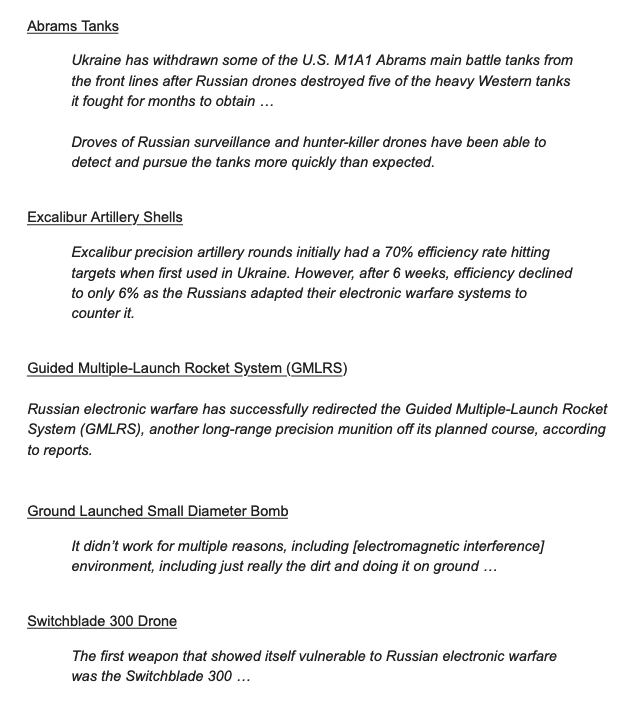
If only the diversity enthusiasm incentivized opposing viewpoints and genuine intellectual differences.
Future historians will have a tremendous cottage industry trying to tease out how the world’s most expensive military paper tiger not only convinced the bill-payers to keep funding these disasters but the cognitive strategic deficit disorder that informed the entire fallacious enterprise managed to spend tens of trillions of dollars for a non-nuclear military apparatus that had a picture perfect track record of consistent failure since 1945.
Ukrainian military stole money intended for fortifications – media
RT | May 14, 2024
Military and civilian authorities in Ukraine’s Kharkov Region paid millions of dollars to fake companies for the supply of non-existent building materials to construct defensive fortifications, the newspaper Ukrainska Pravda reported on Monday. With no fortifications built, Russian forces have advanced rapidly through the region.
Russia has seized dozens of towns and villages in the northern part of Kharkov Region after launching an offensive last Friday. According to the latest update from the Russian Defense Ministry, Russian troops had captured the village of Bugrovatka on Monday and are inflicting losses on Ukrainian manpower and hardware near Veseloye, Volchansk, and Liptsi, the latter of which is located just 20km from the outskirts of Kharkov city.
Writing in Ukrainska Pravda on Monday, Ukrainian anti-corruption activist Martina Boguslavets explained that Kharkov’s Department of Housing and Communal Services (ZhKG) and Regional Military Administration (OVA) had been given 7 billion hryvnias ($176.5 million to build fortifications to hold back this advance.
Much of this money was embezzled, Boguslavets claimed. For the supply of wood, the ZhKG and OVA signed contracts worth 270 million hryvnias ($6.8 million) with five companies that were set up immediately after the contracts were announced. No bidding process took place, and at least two of these companies were owned by the same person, Boguslavets wrote.
“Moreover, the owners of these firms do not resemble successful businessmen and businesswomen,” she wrote. “They have dozens of court cases, from whiskey theft to domestic violence against a husband and mother; some of them are deprived of parental rights and have had enforcement proceedings for bank loans.”
Boguslavets described these business owners as “avatars,” placed in charge of the companies either for a small fee or without their knowledge. One of the supposed CEOs, whose firm was paid 52 million hryvnias ($1.3 million) is an agricultural laborer, according to Boguslavets’ documents.
“The naked eye can see how a government official mercilessly registers new companies, using for this purpose people who, due to the circumstances, may not be aware of this,” she wrote. “And this someone continues to make money on blood.”
The lack of defensive fortifications allowed Russian forces to enter Kharkov Region almost unopposed, Denis Yaroslavsky, commander of a Ukrainian special reconnaissance unit, told the BBC on Monday. “There was no first line of defense. We saw it. The Russians just walked in. They just walked in, without any mined fields,” Yaroslavsky said.
“Either it was an act of negligence or corruption. It wasn’t a failure. It was a betrayal,” he added.
The story of the embezzled defense money is the latest in a long series of tales of corruption to emerge from Ukraine. Earlier this week, Poland canceled trade talks with Kiev after Ukrainian Agriculture Minister Nikolay Solsky was accused of illegally appropriating state land worth nearly $7.4 million. Several months earlier, Ukraine’s security service, the SBU, announced that it had uncovered a major embezzlement scheme in which Ukrainian officials and private contractors stole around $40 million earmarked for shell procurement.
West mired in Ukraine crisis due to unwillingness or inability to confront reality
By Eusebio Filopatro | Global Times | April 21, 2024
As the Russia-Ukraine war drags on, a peace conference is to be held in Switzerland this summer. But Russia’s President Vladimir Putin said that Russia hadn’t been invited to participate in June’s talks. “It would have been funny if it weren’t so sad,” he commented.
Practically all Russian commentators, and even some prominent Western ones, trace the roots of the conflict in Ukraine to NATO’s attempts at incorporating Russia’s neighbor – as officially stated since at least as far back as 2008. A disregard for Russia’s status as an equal and sovereign partner was evident in the contempt for the Minsk agreements, which both former German chancellor Angela Merkel and former French president Fran?ois Hollande described as gimmicks to buy time for the only option that was seriously pursued, military confrontation. Later on, Vladimir Putin’s vocal request for security guarantees was dismissed yet again.
Fast forward a few years, and this historical tragedy has snowballed to its extreme conclusions. Politico recently reported Ukrainian officials’ concerns about a collapse of the frontlines. As Elon Musk calls for a negotiated settlement to come soon, he warns that the longer the war drags on, the larger the territory Russia will seek to annex. Even CNN is now explaining how Russia’s guided bombs are wreaking havoc on Ukrainian defenses. Meanwhile, the IMF has raised Russia’s growth outlook. In short, and irrespective of whether this will take weeks, months or years, Russia is well placed politically, economically and militarily to inflict the final blow.
The conditions of Ukraine’s sponsors are remarkably less favorable. Europe’s economic problems are “far bigger than a shallow recession.” The Union faces a dilemma over restricting imports from Ukraine or throwing its own agriculture under the bus. It is also split on the use of frozen Russian assets to finance the war. The Union will renew its Parliament in June and it is unclear whether Ursula von der Leyen will be re-elected. Even though the US House of Representatives on Saturday passed a $95 billion legislative package, including $60.84 billion to address the conflict in Ukraine, the US’ presidential elections in November still cast another shadow of uncertainty, to the point that NATO is considering setting aside “Trump-proof” funds.
Europe’s public opinion has also made up its mind on the matter. Only one in ten Europeans believe Ukraine can defeat Russia. The Pope has literally invited Ukraine to raise a white flag. Wolfgang Streeck, the Director of the Max Planck Institute, said, “The war is lost but our governments refuse to admit it.” A crushing military defeat would be the worst possible background for European and American elections, and erode confidence in the respective leaderships: The West should not fall prey to a sunk cost fallacy of catastrophic proportions. What would then be the way forward?
The rational course of action would be for the West to turn to diplomacy to correct such a disastrous trajectory, much like Musk and the Pope suggested. Even if Russia refused, or the attempt failed, the West would at least claim the moral high ground on this occasion. A comprehensive peace conference with the involvement of representative guarantors from the Global South could offer a lifeline to Ukraine, and a model for ironing out geopolitical tensions that are dangerously multiplying all over the world. Chinese diplomacy is going out of its way to make this possible, and the African Union, Brazil, the UAE, Saudi Arabia, Turkey and many others have also stepped forward with constructive proposals.
Yet leaders on both shores of the Atlantic are headed elsewhere. US Vice President Kamala Harris and European Council President Charles Michel are adamant that “There is only plan A”: military support for Ukraine. Along this path, some risky decisions appear increasingly likely. And pressure is mounting to use seized Russian assets to finance Ukraine. Of this move, in 2022, US Secretary of the Treasury Janet Yellen said “would not be legal.” But, apparently, a green light could come at the G7 summit in June.
If a botched peace conference would exact high reputational costs for Western diplomacy, the seizing of Russian assets could turn into a kamikaze attack, and unsettle the very domain wherein the West retains relative dominance, the international financial system. Neither initiative is likely to end the conflict in Ukraine.
If all such workarounds are really only dead ends, a reckoning with reality should be hastened rather than delayed. Yet, it is precisely the unwillingness or inability to confront the reality of the situation that got us here in the first place.
Poland cancels talks with Ukraine over corruption fears
RT | May 13, 2024
Poland has called off negotiations with Ukraine on food imports after several of Kiev’s representatives were accused of corruption, the Dziennik Gazeta Prawna daily reported on Monday, citing the deputy minister of agriculture.
The talks were set to take place on May 14, to address trade disputes amid large-scale farmers’ protests in Poland over the import of cheap produce from Ukraine.
Explaining the cancellation, Michal Kolodziejczak told the newspaper that Warsaw “will not negotiate with individuals against whom charges of corruption have been brought.”
Kolodziejczak did not name specific individuals, but his statement follows the resignation of Ukrainian Agriculture Minister Nikolay Solsky, who – along with several accomplices – was accused last month by the National Anti-Corruption Bureau of illegally taking possession of state land.
It is unclear when the next round of talks between Warsaw and Kiev will take place, Kolodziejczak said, acknowledging that the Polish Agriculture Ministry has so far failed to resolve all issues relating to local farmers, and that “the situation is not easy.”
The Polish protests have been ongoing since February, with agriculture businesses demanding limits or a complete ban on cheap imports from Ukraine. Farmers have also requested more support for livestock farming and objected to the EU’s proposed Green Deal strategy, which would place limitations on producers in a bid to cut carbon emissions.
After the last round of Poland-Ukraine talks in March, Kolodziejczak accused Kiev’s representatives of violating “diplomatic principles.” He told the head of the All-Ukrainian Agrarian Council, Andrey Dykun, to stop mentioning the Russia-Ukraine conflict when discussing grain.
“One of the representatives of Ukraine began to use the theme of war, the front, a difficult situation. I replied that we know what the situation is… but economic negotiations have nothing to do with it,” the deputy minister told the news website Wirtualna Polska at the time.
In response, Ukraine accused Kolodziejczak of behaving “oddly” during the March negotiations by “constantly” leaving the room, scrolling his phone and verbally attacking Kiev’s representatives, ultimately hampering efforts to reach an agreement.
Kiev conducts ‘terrorist attack’ against Belgorod – MoD

RT | May 12, 2024
Kiev conducted a cross-border “terrorist attack” on residential buildings in the Russian city of Belgorod using Tochka-U ballistic missiles, the Russian Defense Ministry said in a statement on Sunday.
The capital of Belgorod Region was targeted with Tochka-U ballistic missiles and rockets from Olkha and Vampire multiple rocket launchers, the ministry said in a statement on Sunday.
Six Soviet-era Tochka-U missiles, four Vampire rockets and two Olkha projectiles have been intercepted by Russian air defenses, it stressed.
“Fragments of one of the downed Tochka-U missiles damaged a residential building in Belgorod,” the ministry said.
The Tochka-U is a mobile launch system developed by the Soviet Union in the 1970s. Russia has phased out its use in favor of more advanced Iskander ballistic missiles, which were introduced in the mid-2000s. However, Kiev still has Tochka-Us in its arsenal and has used them repeatedly during the conflict with Moscow.
Belgorod Region Governor Vyacheslav Gladkov said earlier that “an entire section of an apartment building – from the tenth to the first floor – collapsed as a result of a direct hit” during the Ukrainian bombardment of the city.
According to Russia’s acting health minister, Mikhail Murashko, 17 people have been hospitalized as a result of the incident.
There has so far been no official data on the number of fatalities. According to Mash, a Telegram channel, at least seven people have been killed. The rescuers have been able to recover 12 residents from the debris, but another ten could still be trapped inside, it said.
At some point, the roof of the damaged building collapsed while the rescuers were clearing the rubble underneath. A source in the governor’s office told Mash that no one was hurt, but Shot reported that one of the emergency workers suffered a leg fracture and two others were lightly wounded.
Russia’s Investigative Committee has said that a criminal terrorism case was launched following the strike on the apartment block.
How Britain Sabotaged Ukraine Peace
By Kit Klarenberg | Al Mayadeen | May 11, 2024
On April 16th, Foreign Affairs published an investigation, documenting in forensic detail how in May 2022 Kiev was a signature away from a peace deal with Russia “that would have ended the war and provided Ukraine with multilateral security guarantees,” which was scuppered by Western powers. The outlet attributes the failure of negotiations to “a number of reasons” – although it’s unambiguously clear the biggest was British Prime Minister Boris Johnson offering President Volodymyr Zelenskyy the blankest of blank cheques to keep fighting.
For two years, claims and counterclaims have abounded about these peace talks, initiated almost immediately after the conflict began, and why they collapsed. Independent journalists and researchers, the Kremlin, and some foreign officials involved, assert that a favorable settlement was within reach, only to be scuttled at the 11th hour by Western actors. By contrast, Kiev, its supporters, and proxy sponsors have strenuously denied that negotiations were ever taken seriously by either party, while claiming Moscow’s terms were completely unacceptable.
Foreign Affairs has now validated what anti-imperialists have consistently contended. Amicable peace could’ve been achieved in Ukraine at the earliest stages of the proxy conflict, on terms favourable to both parties. Western powers responsible for sabotaging negotiations in service of weakening Russia knew that all along. Yet, they kept this inconvenient reality consciously concealed until now, when the war is unambiguously an unwinnable lost cause for all concerned, bar Moscow.
Still, to have the truth confirmed by Foreign Affairs – an elite US journal published by the notorious, highly influential Council on Foreign Relations – is hugely significant, and the narrative threat posed is evident. Within hours of release, Polish think tank operative Daniel Szeligowski took to X to rubbish the investigation at length, reinforcing the established Western fable that negotiations could never have succeeded, due to Kremlin intransigence, and Ukrainian resolve, in the face of industrial scale Russian war crimes.
Such pushback is only to be expected. After all, Foreign Affairs has raised a number of troublesome questions about the proxy war. In particular, why it continues to grind on today at unsustainable human and financial cost for Kiev and its foreign sponsors. The investigation also confirms Western governments that pushed Ukraine into conflict with its neighbor and historic ally were completely unwilling to come to the country’s rescue, in the event Russia responded to their provocations.
Talks begin, major concessions offered
Foreign Affairs bases its investigation on multiple “draft agreements exchanged between the two sides, some details of which have not been reported previously,” and interviews “with several participants in the talks as well as with officials serving at the time in key Western governments.” It offers a granular timeline of events, “from the start of the invasion through the end of May, when talks broke down.”
Before then, Vladimir Putin and Zelensky reportedly “surprised everyone with their mutual willingness to consider far-reaching concessions to end the war.” This included peacefully resolving “their dispute over Crimea during the next 10 to 15 years.” Talks began four days after the invasion in Belarus, with President Aleksandr Lukashenko playing mediator.
Putin appointed a negotiating team led by Vladimir Medinsky, a senior adviser to the Russian president who previously served as culture minister. By his side were deputy ministers of defense and foreign affairs, among others. Kiev dispatched Davyd Arakhamia, parliamentary leader of Zelensky’s political party, Defense Minister Oleksii Reznikov, presidential adviser Mykhailo Podolyak, and other senior officials. The individuals involved amply underlines how seriously negotiations were taken by both sides.
By the third round of talks, drafts of a peace treaty began to circulate. Many more materialized over subsequent weeks, as the two sides sought to overcome “substantial disagreements”, refining details face-to-face in a variety of international venues, and via Zoom. In brief, Kiev would accept various limits on the size of its Armed Forces, striking range of any missiles sited on its territory, and number of tanks and armored vehicles it could maintain.
Most crucially, Ukraine would implement the Minsk Accords, “renounce its NATO aspirations and never host NATO forces on its territory,” accepting permanent neutrality. In return for ensuring Russia’s “most basic security interests”, Kiev was free to pursue EU membership, and “security guarantees that would oblige other states to come to Ukraine’s defense if Russia attacked again in the future.”
Those guarantees could extend to “imposing a no-fly zone, supplying weapons, or directly intervening with the guarantor state’s own military force” – “obligations…spelled out with much greater precision than NATO’s Article 5,” Foreign Affairs observes. The outlet suggests this component was the undoing of negotiations, due to Kiev’s “risk-averse Western colleagues”:
“Kyiv’s Western partners were reluctant to be drawn into a negotiation with Russia, particularly one that would have created new commitments for them to ensure Ukraine’s security.”
Whitewashing Johnson’s Kiev visit
Foreign Affairs notes that Naftali Bennett, Israeli premier while the talks were ongoing, who was “mediating between the two sides”, has said that he “attempted to dissuade Zelensky from getting stuck on the question of security guarantees.’ He explained, “There is this joke about a guy trying to sell the Brooklyn Bridge to a passerby. I said, ‘America will give you guarantees? It will commit that in several years if Russia violates something, it will send soldiers? After leaving Afghanistan and all that?’ Volodymyr, it won’t happen.’”
Of course, several of Ukraine’s “Western patrons” have sent soldiers to assist in the proxy conflict – most prominently Britain, which in January signed a wide-ranging “security cooperation agreement” with Kiev. Foreign Affairs references Boris Johnson’s visit to the country in April 2022, and how Davyd Arakhamia has claimed the then-Prime Minister “said we won’t sign anything at all… let’s just keep fighting.”
The outlet adds that “already on March 30, Johnson seemed disinclined toward diplomacy, stating that instead ‘we should continue to intensify sanctions with a rolling program until every single one of [Putin’s] troops is out of Ukraine.’” So it was that he arrived in Kiev on April 9, “the first foreign leader to visit after the Russian withdrawal from the capital.” Johnson reportedly told Zelensky:
“Any deal with Putin was going to be pretty sordid… some victory for him. If you give him anything, he’ll just keep it, bank it, and then prepare for his next assault.”
Yet, Foreign Affairs downplays Johnson’s intervention, claiming allegations the British premier sabotaged negotiations are “Putin’s manipulative spin.” In support, the outlet notes how despite Moscow’s withdrawal from the northern front resulting in “the gruesome discovery of atrocities that Russian forces had committed in the Kyiv suburbs of Bucha and Irpin,” talks continued thereafter. The two sides worked “around the clock on a treaty that Putin and Zelensky were supposed to sign during a summit to be held in the not-too-distant future”:
“The sides were actively exchanging drafts [and] beginning to share them with other parties… the April 15 draft suggests that the treaty would be signed within two weeks. Granted, that date might have shifted, but it shows that the two teams planned to move fast… work on the draft treaty continued and even intensified in the days and weeks after the discovery of Russia’s war crimes, suggesting that the atrocities at Bucha and Irpin were a secondary factor in Kyiv’s decision-making.”
‘Bucha Effect’ leads to ‘frozen negotiations’
Bucha may have been a “secondary factor” in Ukrainian decision-making, but it wasn’t from the British government’s perspective. Unmentioned by Foreign Affairs, days before Johnson landed in Kiev, he boldly declared the alleged massacre of civilians in the town by Russian forces didn’t “look far short of genocide,” and “the international community – Britain very much in the front rank – will be moving again in lockstep to impose more sanctions and more penalties on Vladimir Putin’s regime.”
While a subsequent UN investigation failed to validate charges of genocide by Russia in Ukraine, once Johnson deployed the term, many Western officials followed suit. As a result, widespread public and state consent for keeping the proxy war going was very effectively manufactured across Europe and North America. To even speak of a negotiated settlement publicly became beyond the pale. Meanwhile, Britain’s shadowy, spook-infested Counter Disinformation Unit, which censors social media, began policing content related to Bucha online.
What happened in Bucha remains extremely murky. At the time, an anonymous US Defense Intelligence Agency official told Newsweek that civilian deaths could have resulted from “intense” ground combat over control of the town: “We forget two peer competitors fought over Bucha for 36 days, the town was occupied, Russian convoys and positions inside the town were attacked by the Ukrainians and vice versa.” They further warned the “Bucha Effect” had “led to frozen negotiations and a skewed view of the war”:
“I am not for a second excusing Russia’s war crimes nor forgetting that Russia invaded the country. But the number of actual deaths is hardly genocide. If Russia had that objective or was intentionally killing civilians, we’d see a lot more than less than .01 percent in places like Bucha.”
Such anxieties fell on deaf ears, although they reflect a broader resistance to escalating the proxy war on Washington’s part. In December 2022, the BBC reported that British officials were intensely worried about the “innate caution” of US President Joe Biden, “who is… concerned about provoking a wider global conflict.” A nameless state apparatchik revealed that London had “stiffened the US resolve at all levels”, via “pressure.”
Leaked material shows senior British military and intelligence officials leading London’s contribution to the proxy war are committed to challenging the “US position… firmly and at once.” One can only speculate whether incidents such as the Kerch Bridge bombing, which these officials secretly planned and helped Kiev execute – despite reported US opposition – were intended to escalate the conflict further, and keep Washington embroiled in the quagmire.
We are also left to ponder whether those officials played any role in the massacre of civilians in Bucha, whose names Ukraine refuses to release despite formal Russian requests. Kremlin apparatchiks, and Aleksandr Lukashenko, have claimed to possess evidence British special forces were responsible for the killings. None has emerged since, although why Britain prevented an emergency UN Security Council meeting on Bucha requested by Russia in April 2022 going ahead remains an open question.
Don’t confuse them with facts
By Stephen Karganovic | Strategic Culture Foundation | May 11, 2024
Extraordinary events are taking place in the streets of Tbilisi. Normally, agitated crowds should be demanding increased transparency in public affairs and access to all the facts they need to efficaciously exercise their civic duties. In Georgia, they want the opposite. The agitated crowd’s vociferous demand is for the facts to be withheld from them.
They are vigorously opposed to Parliament’s intention to enact a legal mechanism that would provide for the registration of foreign agents operating within the country. The legislation now before the Georgian Parliament, which a comfortable majority of the deputies support, would make available to the demonstrators and to all citizens of Georgia information about foreign financing sources of the “non-governmental organisations” that proliferate in Georgia. In that small country targeted for regime change by the collective West there are currently about 20,000 “NGOs,” a remarkable statistic by any measure. The demonstrators however adamantly refuse to know and they oppose that their fellow citizens should be allowed to find out what entities from abroad supply money and logistical assistance to those “NGOs.” Consequently, what they are actually opposing is public disclosure of the agenda those organisations promote and serve.
In simple terms, the demonstrators are saying, “Do not turn on the lights. We prefer to wander in the darkness and as in the current geopolitical confrontation our country is being strong-armed to take a stance disadvantageous to it we prefer that the Georgian government and the public should also roam in complete darkness.”
Briefly, the law that the protesters are objecting to, and which is on the verge of being passed by the Georgian Parliament, provides that if more than twenty percent of operating funds originate from foreign sources, Georgian “NGOs” must publicly disclose such a fact and identify the sources of their funding. This law has been mendaciously misrepresented by Georgia’s NGO sector and the collective West media and political institutions as the “Russian law.” But it is, of course, nothing of the sort. It does exhibit some commonalities with legislation passed by the Russian Duma several years ago that requires foreign agents in Russia to be registered, but the Russian law itself is but a translated copy/paste version of the American Foreign Agents Registration Act (FARA) that the US Congress had passed in 1938. The enactment of FARA is explained by reference to perfectly reasonable national security and democratic transparency concerns:
“The Foreign Agents Registration Act provides the public with an opportunity to be informed of the identity of persons engaging in political activities on behalf of foreign governments, foreign political parties and other foreign principals, so that their activities can be evaluated in light of their associations.”
To say that from the standpoint of democratic practice the Georgian demonstrators’ demands are merely counter-intuitive would be putting it quite mildly. Being mostly young, with access to the internet and presumably computer-savvy, these opponents of the Georgian transparency law can easily research the facts. Invincible ignorance is therefore a plea that these alert young intellectuals are precluded from invoking.
The interesting question is what could possibly motivate a large crowd of mostly young Georgians to assemble day after day in the streets of their capital and to even try to storm their Parliament in a show of revulsion toward perfectly acceptable legislation which, moreover, happens to be invested with the imprimatur of the world’s leading democracy?
In light of what we have already witnessed of the successful application of cognitive reformatting techniques not merely in Ukraine but over the years in Georgia as well, and in Armenia more recently, the answer is readily suggested. In the Ukraine, after years of persistent and amply funded perception-altering indoctrination (to the tune of five billion dollars, according to Victoria Newland) the Maidan putsch of 2014 became possible. Even if they were not the majority, a politically significant portion of the Ukrainian public were persuaded to open the gates to their country’s adversaries. They were successfully zombified to choose fairy tale promises made by the West over the tangible benefits that would have accrued from the proposed alliance with Russia and associated countries. The tragic outcome of the wrong choice that a politically illiterate nation made then is today plain for all to see.
A symmetrical process has been taking place in Georgia. Since the partially successful “Rose revolution” of 2003, Western special services and their ancillary agencies have had twenty years to fine tune their color revolution scenario and adapt it to Georgia’s unique conditions. To that end, thousands of “NGOs” were set up, abundantly funded, and turned loose to reformat the thinking of the traditionalist Orthodox society in Georgia.
The creation of an insular core of programmed local activists to promote collective West’s agenda whilst deceitfully cultivating the illusion that the work being done was entirely by domestic forces not beholden to foreign sponsors is a fundamental part of the game. Transparency with regard to the logistics and command and control of local activists would demolish that illusion. The local public would grasp that it is being misled and manipulated, and by whom. That is impermissible. Hence the frantic effort and the mobilisation of all available local assets against the registration law, to impede the Georgian authorities from efficiently addressing this paramount national security issue. The monetary investment and decades-long cultivation of pliant cadres must not be allowed to go to naught.
An excellent theoretical explanation of the subversive technology on full display in the streets of Tbilisi is the concept of the “Lesser nation” developed by Academician Igor Shafarevich in his insightful essay “Russophobia.” The “Lesser nation” is an elitist subculture ensconced within its larger host. It is specifically programmed to be alienated from the larger nation that surrounds it and to continuously vex it from within. Just as importantly, in response to the remote control signals emitted by its animators, it is configured to be aggressive, loud, and obnoxious. The Lesser nation’s self-awareness is shaped to counter-pose it to the larger community in which it operates, whose interests, values, and traditions it dismisses with disdain. But at the same time, in sovereign fashion it claims the right to rearrange that community’s affairs, treating it as mere human fodder for the achievement of the Lesser nation’s ideological aspirations.
Shafarevich makes observations whose pertinence will readily be recognised by all who have studied the technology of “color revolutions” and creation of local battering rams that are meticulously prepared in advance to ensure their success.
He points out that local operatives are inculcated with the “belief that the people’s future, like a mechanism, can be freely designed and restructured; in this connection [they are imbued with] a contemptuous attitude toward the history of the ‘Greater People,’ up to and including the assertion that it has not existed at all; the demand that the basic forms of life be borrowed in the future from outside and that we [must] break with our own historical tradition [in this case it is the demonstrators’ demand that Georgia sacrifice transparency to chimerical EU membership, thus affirming its commitment to “European values”]; the division of the people into an ‘elite’ and an ‘inert mass,’ and the firm belief in the right to use the latter as material for historical creativity; and finally, outright revulsion toward representatives of the ‘Greater People’ and their psychological makeup” [P.17].
Shafarevich diagnoses this phenomenon as “hostile alienation from the spiritual foundations of the surrounding world” [P. 37].
With regard to the gullibility of the preponderantly youthful recruits, Shafarevich points out that “in the face of this refined technique of brainwashing that has been tested in practice and improved through long experience, confused young people find themselves absolutely defenceless. For, after all, no one who might be an authority for them will warn them that what they are dealing with is simply a new version of propaganda, albeit a very toxic one, that is based on an extremely fragile factual basis” [P. 28].
“Thus,” he concludes, “logic, facts and ideas alone are powerless in such a situation … ” [P. 25].
In other words, they will not be confused with facts.
Time will tell what measures the Georgian authorities will employ to ensure the integrity of their country. Scott Ritter harbours no doubts that Georgia is targeted for “regime change” but he believes also that the current Georgian government are well aware of the fate their Western “partners” have envisioned for them and will react accordingly. Let us hope that in Georgia on both the governmental and popular levels sound judgment shall prevail, as in neighbouring Armenia it evidently has not.
MTG Says ‘Uniparty’ Win Saving Johnson’s Speakership Will Mean More Money for Foreign Wars

US Representative Marjorie Taylor Greene, Republican of Georgia, speaks to reporters before a meeting with US Speaker of the House Mike Johnson, Republican of Louisiana, about a possible Motion to Vacate filing to remove him from the speakership, at the US Capitol on May 7, 2024, in Washington, DC.
By Ilya Tsukanov – Sputnik – 09.05.2024
House Democrats and Republicans joined forces on Wednesday to shoot down the congresswoman’s motion to oust the speaker over his efforts to secure tens of billions of dollars for wars abroad while overlooking the crisis at the US southern border, and to reauthorize measures allowing for warrantless surveillance of US citizens by the state.
Georgia Congresswoman Marjorie Taylor Greene took to X on Thursday to issue a scathing attack targeting her fellow Republicans who joined with Democrats to block her push to vacate the House and prompt the selection of a new Speaker to replace Mike Johnson.
“All the scary bad things they all told you would happen if I called the motion to vacate didn’t happen. They said ‘Democrats would take control of the House and [Minority Leader Hakeem] Jeffries would become speaker because Republicans only have the majority with one seat’. Didn’t happen. Instead, Democrats voted to save Johnson because they knew it was impossible to take control of the House and they want to keep Johnson because he’s given them everything they want,” Greene wrote.
“They said ‘we should be focused on more serious issues! None of this does anything for the American people!’ Doing things for the American people and focusing on serious issues didn’t happen because the Uniparty reared its ugly head and voted to protect their Uniparty leader and to keep the status quo which has done nothing for the American people or solved problems on serious issues,” the lawmaker added.
“And you know what else didn’t happen? Congress, which is paid by the American people and sent to represent them, didn’t stop the border crisis, didn’t stop funding foreign wars, didn’t protect America’s energy industry, didn’t cut spending to reduce inflation, didn’t defund the weaponized government. Instead Congress protected itself and kept the Uniparty control over the People’s House,” Greene wrote.
Greene, 49, is one of a handful a new breed of Republicans calling for a radical review of the America’s domestic and foreign priorities, calling for a halt to US support for foreign wars, measures to clamp down on illegal immigration, and efforts to deal with America’s gargantuan $34+ trillion federal debt.
43 House lawmakers voted against tabling Greene’s motion to vacate the House on Wednesday, among them ten Republicans, including Paul Gosar, Thomas Massie, Andy Biggs and Chip Roy. Nearly three dozen Democrats also voted against killing the motion, which would have opened the door to Johnson’s removal, among them several members of the so-called Congressional Progressive Caucus, including Jamaal Bowman, Pramila Jayapal, and Alexandria Ocasio-Cortez.
Democratic support saved Johnson’s speakership, but potentially puts the politician in an electoral tight spot among conservatives as a speaker propped up by the opposition.
However, former president and presumptive GOP nominee for president Donald Trump – whose 2016 election gave rise to the anti-neocon Republican movement, and ultimately Greene’s election in 2020, rushed to Johnson’s defense in a Truth Social post on Wednesday.
“I absolutely love Marjorie Taylor Greene. She’s got Spirit, she’s got Fight, and I believe she’ll be around, and on our side, for a long time to come,” Trump wrote. “However, right now, Republicans have to be fighting the Radical Left Democrats, and all the Damage they have done to our Country. With a Majority of One, shortly growing to three or four, we’re not in a position of voting on a Motion to Vacate. At some point, we may very well be, but this is not the time.”
Emphasizing in all caps that a motion to vacate would show “DISUNITY” and “be portrayed as “CHAOS,” Trump said that Johnson was “good man who is trying very hard,” and that while he wished “certain things were done over the last period of two months… we will get them done, together.”
Trump, whose backdoor negotiations with House Republicans reportedly included the idea of turning new Ukraine aid into a ‘loan’ to earn GOP support last month, did not elaborate on what these “certain things” were.
Greene, Gosar, Massie, Biggs, Roy, Matt Gaetz, Lauren Boebert, Andrew Clyde, Eli Crane, Bob Good, Troy Nehls, Ralph Norman and Matt Rosendale, all Republicans, were the only House lawmakers to vote against all the legislation put before the floor on April 20, including aid to Ukraine, Israel, Taiwan, a TikTok ban and new sanctions against Iran after its retaliatory April 14 attack on Israel.
Johnson is the second Republican House speaker to have been targeted by an effort to oust him from his conservative flank, with former Speaker Kevin McCarthy ousted in October 2023 over what Rep. Gaetz alleged was a “secret side deal on Ukraine” to provide Kiev with more funding. McCarthy’s ouster was made possible after conservative Republicans secured the support of Democrats to force him out, with the move resulting in the blockage of nearly $100 billion in US military and economic support for foreign wars for more than six months.
The Great Ukraine Robbery is Not Over Yet
By Ron Paul | May 6, 2024
The ink was barely dry on President Biden’s signature transferring another $61 billion to the black hole called Ukraine, when the mainstream media broke the news that this was not the parting shot in a failed US policy. The elites have no intention of shutting down this gravy train, which transports wealth from the middle and working class to the wealthy and connected class.
Reuters wrote right after the aid bill was passed that, “Ukraine’s $61 billion lifeline is not enough.” Senate Minority Leader Mitch McConnell went on the Sunday shows after the bill was passed to say that $61 billion is “not a whole lot of money for us…” Well, that’s easy for him to say – after all it’s always easier to spend someone else’s money!
Ukraine’s foreign minister, Dmytro Kuleba, was far from grateful for the $170 billion we have shipped thus far to his country. In an interview with Foreign Policy magazine as the aid package was passed, Kuleba had the nerve to criticize the US for not producing weapons fast enough. “If you cannot produce enough interceptors to help Ukraine win the war against the country that wants to destroy the world order, then how are you going to win in the war against perhaps an enemy who is stronger than Russia?”
How’s that for a “thank you”?
It may be understandable why the Ukrainians are frustrated. Most of this money is not going to help them fight Russia. US military aid to Ukraine has left our own stockpiles of weapons depleted, so the money is going to create new production lines to replace weapons already sent to Ukraine. It’s all about the US weapons industry. President Biden admitted as much when he said, “we are helping Ukraine while at the same time investing in our own industrial base.”
This is why Washington Is desperate to make sure that if Donald Trump returns to the White House, the “Ukraine” gravy train cannot be shut down by his – or future – administrations. Last week news broke that the Ukrainian government was in negotiations with the Biden Administration to sign a ten-year security agreement that would lock in US funding for Ukraine for the next two and a half US Administrations. That would unconstitutionally tie future presidents’ hands when it comes to foreign policy and would leave Americans on the hook for untold billions more dollars taken from them and sent to the weapons industry and to a corrupt foreign government.
The US weapons industry and its cheerleaders in Washington DC are determined to keep Ukraine money flowing… until they can figure out a way to gin up a war with China after losing the current war with Russia. That, of course, depends on whether there is anything left of us when the smoke clears.
When President Biden signed the $95 billion bill to keep wars going in Ukraine and Gaza and to provoke a future war with China, he called it “a good day for world peace.” Yes, and “War is peace.” Debt is good. Freedom is slavery. We are living in a post-truth society where billions spent on pointless wars are “not a whole lot of money.” But the piper will be paid and the debt will be cleared.
Russia issues military ultimatum to UK

UK Ambassador to Russia Nigel Casey leaves the Russian Foreign Ministry, in Moscow, Russia. © Sputnik / Ilya Pitalev
RT | May 6, 2024
Moscow will retaliate against British targets in Ukraine or elsewhere if Kiev uses UK-provided missiles to strike Russian territory, the Foreign Ministry told London’s ambassador on Monday.
Ambassador Nigel Casey was summoned to the ministry following an interview by British Foreign Secretary David Cameron with Reuters last week, in which he said Ukraine has the right to use long-range missiles sent by the UK to strike deep inside Russia.
”Casey was warned that the response to Ukrainian strikes using British weapons on Russian territory could be any British military facilities and equipment on the territory of Ukraine and beyond,” the Russian Foreign Ministry said in a statement following the meeting.
The US and its allies had previously qualified their deliveries of long-range weapons to Kiev by saying they could only be used on territories that Ukraine claims as its own – Crimea, the People’s Republics of Donetsk and Lugansk, and Kherson and Zaporozhye Regions.
According to the Russian Foreign Ministry, Cameron’s statements to the contrary “de facto recognized his country as a party to the conflict.”
Russia understands Cameron’s comments as “evidence of a serious escalation and confirmation of London’s increasing involvement in military operations on the side of Kiev,” the ministry added.
Casey was urged to “think about the inevitable catastrophic consequences of such hostile steps from London and to immediately refute in the most decisive and unequivocal manner the bellicose provocative statements of the head of the Foreign Office.”
Earlier in the day, the Russian Defense Ministry announced an exercise to test the deployment of tactical nuclear weapons. President Vladimir Putin ordered the drills after “provocative statements and threats” by Western officials, the military said.
French Ambassador Pierre Levy was also summoned to the Foreign Ministry. Moscow has not yet disclosed the details of the meeting.
Featured Video

HE SAVED LIVES. NOW HE FACES PRISON.
or go to
Aletho News Archives – Video-Images
From the Archives
NATO Sanctions and the Coming Global Diesel Fuel Disaster
By F. William Engdahl – New Eastern Outlook – 11.04.2022
Amid the ongoing global inflation crisis, NATO heads of state and mainstream media repeat a mantra that high energy prices are a direct result of Putin’s actions in Ukraine since end of February. The reality is that it is the western sanctions that are responsible. Those sanctions including cutting SWIFT interbank access for key Russian banks and some of the most severe sanctions ever imposed, are hardly having an impact on the military actions in Ukraine. What many overlook is the fact that they are increasingly impacting the economies of the West, especially the EU and USA. A closer look at the state of the global supply of diesel fuel is alarming. But Western sanctions planners at the US Treasury and the EU know fully well what they are doing. And it bodes ill for the world economy.
While most of us rarely think about diesel fuel as anything other than a pollutant, in fact it is essential to the entire world economy in a way few energy sources are. The director general of Fuels Europe, part of the European Petroleum Refiners Association, stated recently, “… there is a clear link between diesel and GDP, because almost everything that goes into and out of a factory goes using diesel.” … continue
Blog Roll
 Aletho News
- Trita Parsi: Middle East Unraveling — Are We on the Path to World War?
- Iran FM meets with US envoy on UN meeting’s sidelines at American side’s insistence: Report
- Qatar PM calls for Gulf security framework with Iran, says war must be ‘wake-up call’
- China condemns US extortion of Iranian airlines, rejects Washington’s ‘illegal’ sanctions threats
- Italy to move military personnel from Taif base after missile strike
- Finland’s Stubb tells European leaders to calm down
- Defeating Russia on battlefield impossible – Fico
- Finland’s Gender Clinic Reversal
- Massachusetts Wants Mental Health Visits, Why Does Government Use ‘Health’ to Enter Our Homes & Families?
- US lawmaker admits American people footing bill for Trump’s failed aggression against Iran
- If Americans Knew
- Sanctions are collective punishment: immoral and self-defeating
- Phosphorus Munitions Fired by Israel Burn Groves, Orchards in Southern Lebanon
- Israel Carries Out New Ceasefire Violations Across Gaza
- AI – Emphasis on the ‘I’: Israel Is Funding AI Chatbot Propaganda
- Israel Blocking Hundreds of Wheelchairs for Injured Children From Entering Gaza
- Israel Is Expanding and Upgrading Compounds for Palestinian Militias in Gaza
- The Palestinian-American Residents of This West Bank Town Are Wondering: Where Is Trump?
- Gaza desperately needs tents, wheelchairs, fuel… and everything else (Israel blocks it all) – Daily Update
- Israeli Attacks in Gaza Kill at Least Seven Palestinians Over Three Days, including Woman and Child
- Trump’s militarization of Washington DC as he pursues Israel’s war against Iran
- No Tricks Zone
- 2025 Nature Paper Claiming Worsening Global Drought Gets RETRACTED …Heavily Flawed
- New Study: ‘Global Drought Shows No Detectable Recent Acceleration Under Climate Warming’
- Economic Masterminds: German Socialists Suggest Taxing Productivity Gains Stemming From Using AI
- The South China Sea Has Not Been Cooperating With The Climate Change Narrative
- Energy Crisis: Germany Enters Heating Season With Historically Low Gas Reserve Fill Levels
- New Study: The Antarctic Ice Sheet Gained Mass From 2020-2024 Due To Staggering Snow And Ice Accumulation
- Study: Ocean Heating Rates From Thousands Of Years Ago ‘Dwarf’ Modern Ocean Heating Rates
- Climate Extremists Target, Attack Large-Scale Power Grid Infrastructure In Germany!
- New Study: Antarctic Ice Melt Has Contributed Less Than 1 Centimeter To Sea Level Rise In The Last 30 Years
- Fear Of Debate: Alarmist German Climate Scientist Calls On Mainstream Media To Discredit Skeptic Voices

