RT sends request to UN over rape allegations
RT | November 15, 2022
RT has reached out to the UN special representative on sexual violence, Pramila Patten, to request a correction or retraction of a statement in which she accused the Russian Armed Forces of employing a deliberate “rape strategy” as part of its military campaign in Ukraine. Patten made the claim in October in an interview with the AFP only to admit she did not have any solid evidence to substantiate it a month later.
“The allegations Ms. Patten has brought forward are of a very serious nature, which have the power to shape public discourse around the events in Ukraine,” RT said in a statement, adding that her words were then “widely distributed amongst media outlets and social media, to create a misleading, if not entirely false, narrative.”
In October, Patten told the AFP that when “you hear women testify about Russian soldiers equipped with Viagra, it’s clearly a military strategy.” Less than a month later, the UN official admitted that her words were based solely on some unverified reports disclosed to her in the presence of two Ukrainian officials. Speaking to Russian prank artists Vladimir Kuznetsov and Alexey Stolyarov, also known as Vovan and Lexus, she recently said that it was “not her job” to conduct investigations anyway.
No evidence has since been provided to corroborate these claims. In its statement, RT asked Patten whether she “intends to issue a retraction – or at least a correction – of her original, misleading statement.”
“As a person holding such a public role with enormous responsibility, one would hope that Ms Patten seek to provide a true, verified testimony of her organization’s work,” the statement added.
RT also asked Patten’s office to provide some evidence to support her allegations in case the UN special representative believes a retraction would be “improper.” Neither Patten nor her office has commented on the request so far.
Moscow has previously denied the accusations made by Patten. Russian Foreign Ministry spokeswoman Maria Zakharova blasted the UN official’s claims as going “beyond the reach of reason.”
Ukraine ‘Testing-Ground’ for New NATO Weapons
Samizdat – 15.11.2022
NATO powers are using the conflict in Ukraine as a testing ground for some of their newest weapons systems.
The US-led Western alliance has trialled intelligence, communications and weapons systems in combat against Russian forces — undermining its claim that it is not involved in the conflict.
Kiev regime’s Vice Prime Minister and Digital Transformation Minister Mykhailo Fedorov made the revelation at a NATO conference in Norfolk, Virginia in October, US media reported on Tuesday.
“Ukraine is the best test ground, as we have the opportunity to test all hypotheses in battle and introduce revolutionary change in military tech and modern warfare,” Fedorov said.
The systems being tried out include the Delta real-time battlefield monitoring system that tracks the positions of both friendly and hostile forces, Lithuanian-made ‘SkyWiper’ drone jammers and the explosive-laden unmanned marine vessels used to launch October’s unsuccessful attack on the Russian port of Sevastopol.
“In the last two weeks, we have been convinced once again the wars of the future will be about maximum drones and minimal humans,” Fedorov added.
Although the British government has denied involvement in the Sevastopol attack that prompted a temporary suspension of the trilateral grain and fertiliser export deal between Turkey, Russia and Ukraine, the UK supplied six submersible drones to Kiev.
Ukrainian forces practiced for the attack, which used sea lanes reserved for ships carrying food as cover, over the summer.
The operation “has pushed the conflict envelope,” said Shaurav Gairola, a naval weapons analyst for British defence publisher Janes, and “imposes a paradigm shift in naval war doctrines and symbolizes an expression of futuristic warfare tactics.”
The SkyWiper anti-drone ‘gun’, which looks like a bulky science-fiction film prop, was developed during former Lithuanian president Dalia Grybauskaite’s time in office. She said the program was part of moving the Baltic mini-state’s arms industry away from producing Soviet-era designs.
“We’re learning in Ukraine how to fight, and we’re learning how to use our NATO equipment,” Grybauskaite said. “And, yes, it is a teaching battleground.” But she admitted it was “shameful” that Ukrainians “are paying with their lives for these exercises for us.”
Moscow has condemned NATO and other states for supplying Ukraine with hundreds of artillery pieces, thousands of armoured vehicles and millions of munitions since the conflict began on February 24, saying the shipments are legitimate targets, implicate the West in Kiev’s war crimes and will only prolong the conflict.
Russia has also debuted new weapons during its military operation in Ukraine, including the Kinzhal hypersonic ballistic missile — to which NATO has no counter-measures or equivalent system.
Lavrov comments on claims of US urging Ukraine to negotiate
RT | November 15, 2022
Western media reports that the US government has tried to nudge Kiev towards engaging diplomatically with Moscow are mere rumors, Russian Foreign Minister Sergey Lavrov said on Tuesday. Even if true, the Ukrainian leadership appears to be ignoring the suggestions, he added.
“We’ve read reports citing anonymous sources,” Lavrov said, when asked about “signals” that Western nations are supposedly sending to Ukrainian President Vladimir Zelensky, urging him to negotiate with Moscow.
“There are rumors that the American administration has been telling Zelensky to be more pliable,” he added. “And there was clarification that this was not aimed at getting him to act constructively, but to counter objections from the parts of the West that doubt the need to supply additional arms to him.”
Last month, the Washington Post described communications between Washington and Kiev that supposedly went along the lines described by Lavrov. A proposed change of stance by Ukraine would tackle “Ukraine fatigue” among EU nations, according to the newspaper’s sources.
The Russian foreign minister highlighted the uncompromising public stance which Zelensky reiterated in a recorded speech, played at the G20 summit in Bali, Indonesia. Lavrov, who is heading the Russian delegation to the event, said “the only conclusion” he reached after hearing the 20-minute message was that the Ukrainian president “so far takes no Western suggestions” about talks.
The Russian diplomat went on to describe Zelensky’s speech as “militant”, “Russophobic” and “aggressive”. Zelensky addressed the gathering as the “G19” in an apparent snub to Russia’s membership in the club of leading world economies, and demanded a number of concessions from Moscow before he would agree to negotiate. Lavrov described the demands as “unacceptable.”
‘Culture Block’ Is Leading to Ukraine Escalation (and risking WWIII)
By Alastair Crooke | Strategic Culture Foundation | November 14, 2022
Spot the problem here: First, the EU has lost Russia as a partner, yet the EU insists to maintain trade with China. Two, China, though, must bend to our EU ‘rules’ on how it configures its economy. Thirdly, China too, must accept to be ‘castigated’ by the likes of Olaf Scholtz and Charles Michel for ‘not having put an end to Russia’s illegal war in Ukraine’. Fourth, we, the EU, anyway do not intend to depend on you. And fifth, clean up your human rights abuses!
Wow! Well, the initial reaction might be a spell back at the Academy on the art of diplomatic discourse, as being one idea. Nonetheless, the sheer number of non-sequiturs to this stance is startling. Firstly, the rest of the world is not greatly interested in EU leaders’ woke thought-code (the Chinese simply cancelled EU Chief Michel’s proposed speech to a gathering in Beijing). Europe has lost Russia; It will likely lose China. And probably, it will find itself excluded from the colossus, free-trade area unfolding in Eurasia – as the blocs differentiate into separate trading spheres.
Where does this leave that bruited EU ambition to be a global player? … Perhaps the EU’s thought-code culture might be the problem to its ambitions.
You (the EU) have not thought this through: You are now a dependent appendage of the U.S. economy – a prop to maintaining America’s exalted spot in the global system – at a time when its predatory economic model of money-printing at zero interest has been holed by an iceberg (known as accelerating inflation). American industry needs a captive market in a world that is fast seceding into two separate spheres. You have ‘elected’ to fill that role.
Containing China is America’s explicit goal. And that means blocking the European continent from moving closer to Asia to form the world’s biggest free trade zone. Washington had to stop that (i.e. sabotage Nord Stream) in order to preserve Europe as a captive market, and what remains of dollar ‘privilege’.
As an American dependency, Europe is perceived as having conceded not only economic, but political agency too. Simply put, the EU has lost its cheap-energy business model with the ‘I stand with Ukraine’ woke thought and speech codes, and now finds that it is impotent politically. Why would ‘others’ deal with the courtiers, when they can go directly to the ‘Command’ in Washington?
Furthermore, the culture block the EU adopts prevents it from bringing the Ukraine war to a political end. Rather, what it does is bake-in escalation.
Here is the problem: You bought into liberal America’s notion of a coercive process of induced government dysfunctionality – that is to stay, the state of mass psychosis that any weaponised dysfunctional state of society can produce. And it’s been a success (on its own narrow terms).
The bigger message is that ‘induced dysfunctionality’ marching in lockstep, and using culture block tactics to suppress any dissenting opinions, can and does produce a society that can be ruled over (made compliant through unpleasantness and applied pain) – without having to govern (i.e. make things actually work).
And induced compliance has proved its use for implementing all sorts of other ideological schemes that the public would otherwise never accept.
Weaponised dysfunctionality was trialled during the recent pandemic. The public was persuaded to accept systemic degradation of the economy. Western leaders regularly have expressed a pleasant surprise at the degree of public compliance achieved during the lockdowns. Of course, it was only made possible by ‘woke mobs’ on social platforms impugning the motives of anyone questioning ‘the Science’, the scale of emergency, or the long-lasting toxic effects on the real economy. Cultural roadblock was imposed.
The same process is evident today: The EU is in (another) ‘emergency’ because it made a strategic misjudgement over its Russia sanctions. The political class thought the effects of EU sanctions on Russia offered a ‘slam dunk’ outcome: Russia would fold in weeks, and all would return to how it was before. Energy would flow freely to the EU again; things would go back to ‘normal’.
Instead, Europe faces economic melt-down from astronomic fuel costs.
Yet, some leaders in Europe – zealots for the Green Transition – quietly embrace this sanctions ‘failure’ and the resulting economic mayhem caused by spiking energy prices – weaponising it as a strategic asset to accelerate Green Transition. European authorities actively encourage this pathological approach, believing that the pain incurred will force compliance on their societies to embrace de-industrialisation, accept carbon footprint monitoring and the Green Transition; and too, to bear prospective monumental Transition costs.
Yellen explicitly celebrated the financial pain (dysfunctionality) precisely as serving to accelerate ‘The Transition’ (like it or not) – even were that to push the citizen out of employment, and to the cusp of society.
Here then, is the problem: Some in the EU political class may hope for an intensification of the war on Russia, seeing in it all sorts of benefits – in extending centralised control over member-states and facilitating new means of printing money (mutualised debt instruments) ostensibly to fund Ukraine.
Sure – but there are fears for societal breakdown in Europe too. The problem? The EU cannot bring Ukraine to a deal.
The point is that the EU has framed the Ukraine conflict in absolute victim-vein terms, in line with woke cultural tropes: A revanchist Russian leader, dreaming of former empire, illegally, and without provocation has invaded and seized territory from its neighbour, whilst committing heinous war crimes in so doing. The perpetrator must face a humiliating defeat – otherwise, if he gets an inch, he will take a mile. And the global order will be ‘toast’.
The ‘online mob’ has been steered, through ‘influencers’, to insist that U.S. Realist Camp’s support for a negotiated settlement is tantamount to taking Russia’s side: rushing to denounce all voices – from Bill Burns’ (then U.S. ambassador and now CIA chief) celebrated 2008 telegram ‘Niet means Niet’ warning that any NATO takeover of Ukraine means war; to Prof Mearsheimer, Kissinger, or Elon Musk – as dangerous ‘Putin apologists’. Musk now faces a security probe.
The logic is stark: This shrinks the Overton window to only those advocating the total defeat of Russia and an end to Putin’s ‘regime’ – even if it risks WWIII. It is the ‘slash and burn’ stance, favoured by the U.S. and allied EU neo-cons.
So, we have Washington saying it has no interests, per se, in Ukraine – beyond supporting Kiev in recovering its territory. The Biden Administration says it is guided by the wishes of the Ukrainian people.
Do you still not see the problem to which this logic takes us? It is a Potemkin Village position. All façade and nothing ‘behind’ or around it. The conflict in Ukraine is not itself ‘a unique thing’, but a ‘thing’ of two leaves. At one level, Ukraine is a ‘state’ among surrounding states; and at another level, it is itself an actor. A ‘player in events’ – an owner indeed, of a certain history.
What the Potemkin ‘approach’ does is to artificially free-up some sort of abstract ‘clearing in the wood’ amidst the density of trees, in which the visible thing – Ukraine – is to be positioned, and set before the western spectator public, stripped naked of surrounding context; stripped of history and of the fact of itself being a conscient player in an extended drama.
The Realists have been culture blocked. Their motives impugned.
The title to this play – ‘America has no fundamental interests in Ukraine, and is but an innocent, called up upon the stage by an act of brutal villainy’ – is an obvious fraud. As is the corollary that the EU must therefore support the ‘war’ as Ukraine is victim.
Plainly said, the U.S. is pursuing a bi-partisan geopolitical strategy to quash China’s meteoric rise and preserve America’s dominant role in the world order. Can there be any doubt about that? No, none. For two decades U.S. foreign policy has centred around its ‘pivot to Asia’.
Washington’s real interests in Ukraine thus must be understood not as a war of values – as the EU has it – but rather as a cruise-missile launched at China, not Russia. In gist, the ‘high road’ to collapsing Beijing is perceived in DC to pass through a weakened Moscow. The NATO response to Ukraine is intended as ‘a letter’ to China, concerning Taiwan. And the comprehensive sanctions on Russia are a missive to the rest of the world to not trifle with America’s absolute primacy.
But if this latter context is absolutely ‘off the table’, through culture block and the only agenda item being the sham Potemkin Village construct, then what is there to talk about?
The matter then must inexorably be settled by events – not talk. Who has the potential for escalatory dominance? Russia has many – and various – options. Ukraine has only one. Pushing more troops at the contact line and suffering heavy losses. What does the West have: WWIII?
Can you see now why your peace efforts have come to naught? Actually, President Xi explained the situation courteously, yet pointedly, to Chancellor Scholtz during the latter’s day trip to Beijing: Having lectured Scholz on the evanescent quality of Trust in any political relationship (a quality that Xi said should be nurtured), he emphasised the need for Europe to avoid an ideological approach to relations.
Rough Translation: You (Scholz) have destroyed your relationship with Russia; you have pursued a bloc-orientated ideological policy, and this has been to your disadvantage. Do not think you can do the same with China.
(Or with the rest of the world, Xi might well have added).
UN reparations decision is ‘plunder’ – Kremlin
RT | November 15, 2022
A Resolution adopted by the UN General Assembly, which urges Moscow to compensate for losses inflicted on Ukraine, aims to enshrine the theft of Russian funds blocked by the West, Kremlin Press Secretary Dmitry Peskov said on Tuesday.
Peskov said that “organizers of this process are trying to complete the plundering of our gold and foreign currency reserves,” which he said were illegally frozen by Western countries over the Ukraine conflict.
“This is a formalization of this plundering under the guise of the United Nations,” he reiterated, adding that “Russia is categorically opposed to this.”
The official also reminded reporters that the resolution “is not legally binding.” “This is the way we are going to regard it,” he stated.
According to Peskov, Moscow will also “do its best” to thwart the confiscation of the assets that have been frozen by the West.
The comments come after the UN General Assembly on Monday adopted a resolution calling for Russia to pay “war reparations to Ukraine.” The document was supported by 94 countries, with 73 UN members abstaining and another 14 voting against.
Commenting on the resolution, Russia’s Permanent Representative to the UN, Vassily Nebenzia, claimed that its provisions “cannot stand up to any criticism” from a legal point of view. “They are legally void – nothing more than an attempt to legalize what cannot be legalized in terms of effective international law,” he said, warning the document’s co-sponsors that it could trigger consequences that “may boomerang against themselves.”
After Russia launched its military operation against Ukraine in late February, the West has significantly ratcheted up sanctions against Moscow. Western countries have frozen around half of Russia’s gold and foreign exchange reserves, which amounted to around $640 billion before the large-scale hostilities broke out. Moscow has repeatedly claimed that these funds have been “essentially stolen” from Russia.
In recent months, various Western officials have spoken in favor of outright confiscating these Russian assets and for them to be used for the reconstruction of Ukraine.
US aid to Ukraine ‘invested’ in crypto FTX scheme

Free West Media | November 14, 2022
The sudden collapse of a crypto exchange linked to the Democratic Party in the US, has revealed that FTX presently suffers from $10-$50 billion in liabilities and virtually no assets. And among those liabilities, are “investments” made by Ukraine’s leadership clique.
The company FTX, in its bankruptcy filing appears to have held tens-of-billions in American “military aid” to Ukraine. Instead of using the alleged funds to fight Russia, the money was ‘invested’ in the FTX Ponzi scheme.
From the bankruptcy filing it is clear that this money has now disappeared.
“Instead of using US military aid to fight Russia, Ukraine ‘invested’ part or all of it, into FTX, and right now, it looks like all the money’s gone,” said Hal Turner, a well-known American radio host.
The crypto money from unsuspecting clients was also used to fund the Democratic Party in the United States. More evidence has surfaced suggesting that the funds may have been stolen.
The CEO of FTX, Sam Bankman-Fried, was one of the top donors to the Democrats, with only George Soros outperforming his largesse. Recently, he also shared a podium with inveterate globalists Tony Blair and Bill Clinton.
According to Turner, it seems that Ukraine was receiving money from the US, and then sent it to FTX, and FTX sent it to the same Democrats, who had originally voted to send it to Ukraine. “At this hour, it appears to some observers to be pure, criminal, money-laundering, and a criminal conspiracy to violate campaign finance laws,” said Turner.
Reuters exclusively reported that the founder and CEO FTX transferred $10 billion of customer funds from FTX to the trading company Alameda Research, which is run by his girlfriend Caroline Ellison.
Sam Bankman-Fried was born in 1992 on the campus of Stanford University into a family of academics. Born and raised to an upper-middle-class Jewish family in California, he is the son of Barbara Fried and Joseph Bankman, both professors at Stanford Law School. His aunt Linda P. Fried is the current dean of Columbia University Mailman School of Public Health. His brother, Gabe Bankman-Fried, is a former Wall Street trader and the director of the non-profit Guarding Against Pandemics.
He was the second-largest individual donor to Democratic causes in the 2021–2022 election cycle with total donations of $39,8 million, only behind Soros. Of this, $27 million was given to Protect our Future PAC, bankrolled by Bankman-Fried.
The US Securities and Exchange Commission and the Commodity Futures Trading Commission are currently looking into whether FTX.com mishandled customer funds. Bankman-Fried is also being investigated by the US Securities and Exchange Commission for potential violations of securities rules.
More bad news: new US coordination center in Stuttgart for Ukraine operations a landmark on the way to WWIII
By Gilbert Doctorow | November 13, 2022
Earlier today I received an email from my good friend Professor of Law at the University of Illinois Francis A. Boyle regarding the creation in Stuttgart of a new U.S. coordination center for war operations in Ukraine headed by a 3-star general. The news item seems to have been sidelined this past week by Western mainstream coverage of the Russian withdrawal from Kherson and entry of Ukrainian forces into that city. However, judging by Boyle’s interpretation, there is every reason to put a spotlight on this issue and to seek the broadest possible discussion in Alternative News electronic and print media.
I offer the following quote from Boyle’s email with his permission:
The story below is a pure cover story by the Pentagon. You do not need a 3 Star General and a Staff of 300 to keep tabs on U.S. Weapons in Ukraine. This is a War Command to wage war against Russia. The last time I dealt personally with a 3 Star General was when I lectured at West Point on “Nuclear Deterrence” in their Senior Conference on that subject in front of, among others, the 3 Star General in Charge of War Operations at the Pentagon. The Pentagon puts a 3 Stars General in Charge of War Operations—not Inventory. And you do not need a Headquarters Staff of 300 to do an Audit. It’s a War Headquarters Staff. We are going to war against Russia unless the American People can figure out some way to stop it!
Francis A. Boyle
Professor of Law
STUTTGART, Germany — A three-star general will lead a new Army headquarters in Germany that will include about 300 U.S. service members responsible for coordinating security assistance for Ukraine, a senior U.S. military official said this week.
I refer those unfamiliar with Francis Boyle to his brief biography in the University of Illinois website.
To that I can add, that his ‘political science’ studies for the Masters and Ph.D. degrees at Harvard were primarily in Russian/Soviet affairs, and that in his time at Harvard he worked under many of the same professors as did I. In this sense, Boyle is a well qualified Russia expert, even if his primary listing at Illinois is as defender of human rights. He is also particularly noteworthy this year for his efforts to promote among several key Congressmen the articles of impeachment against President Biden that he has drafted; the charges – waging undeclared war on Russia in violation of the Constitution. So far that has gained little traction, but when the new Congress with Republican majority takes its seats in 2023 the prospects of finding sponsors may be significantly improved.
Notwithstanding the worrisome or alarming news above, I close this essay with a glimmer of hope that the world has not yet gone completely mad. From my volunteer translator in Germany, I have learned about the start of what should be a nationwide “Ami Go Home” movement in the Federal Republic. It will begin with mass demonstrations in the East German city of Leipzig on 26 November. The protests are inspired by the thinking of Oskar Lafonteine, a German politician who held leading positions in the SPD and later in Die Linke: namely the notion that it is high time for the United States occupation forces to leave Germany so that the country may recover its sovereignty. Those new to German politics may more easily identify Lafonteine as the husband of the eloquent Opposition member of the Bundestag Sahra Wagenknecht. It behooves me to add that per the advice of my translator when he forwarded to me news about the ‘Ami Go Home’ demonstration that the actual organizers are not on the German Left but, on the contrary, on the Hard Right. This interpretation has been reconfirmed by a well informed reader living in Berlin. Call this yet another ‘impersonation’ or imposter phenomenon if you will. We are living through interesting times.
©Gilbert Doctorow, 2022
Russia’s Kherson withdrawal is tactical
BY M. K. BHADRAKUMAR | INDIAN PUNCHLINE | NOVEMBER 12, 2022
General Mark Milley, Chairman Joint Chiefs of Staff of the United States assessed that it would take several weeks for Moscow to complete the evacuation of some 30,000 Russian troops deployed in Kherson city in southern Ukraine. But Russians have announced that the evacuation was successfully completed in 2 days — both soldiers and over 5000 pieces of heavy equipment.
Evidently, much advance planning went into the execution of the evacuation order. The Russian military command began working on the evacuation weeks ahead of the actual announcement earlier this week.
In retrospect, General Sergei Surovikin’s extraordinary interview on October 18 soon after his appointment as the first theatre commander for Ukraine operations only eight days earlier was probably choreographed to sensitise the public opinion about the criticality of the military situation in the Kherson region.
The following excerpts from the interview are relevant here:
“A difficult situation has arisen. The enemy deliberately bombards infrastructure and residential buildings in Kherson. The Antonovsky Bridge and the dam of the Kakhovskaya hydroelectric power station were damaged by HIMARS missiles, traffic there was stopped.
“As a result, the supply of food in the city is difficult, there are certain problems with the water and electricity supply. All this greatly complicates the lives of citizens, but also poses a direct threat to their lives.
“The NATO leadership of the Ukrainian armed forces has long been demanding offensive operations against Kherson from the Kiev regime, regardless of casualties – both among the armed forces themselves and among the civilian population.
“We have data on the possibility that the regime in Kiev will use prohibited methods of war in the area of the city of Kherson, on Kiev’s preparation for a massive missile attack on the Kakhovskaya hydroelectric dam, the conduct of massive missile and artillery attacks on the city without distinction.
“These actions can lead to the destruction of the infrastructure of a major industrial centre and to civilian casualties.
“In these circumstances, our top priority is to preserve the life and health of citizens. Therefore, the Russian army will first of all ensure the safe, already announced departure of the population according to the resettlement program being prepared by the Russian government.
“Our further plans and actions regarding the city of Kherson itself will depend on the current military-tactical situation. I repeat, it is already very difficult today.
“In any case, as I said, we will start from the need to protect the lives of civilians and our military as much as possible.
“We will act consciously and in a timely manner, without excluding difficult decisions.” [Emphasis added.]
Three things can be said. First, the retreat from Kherson was decided for operational reasons. Its rationale is to pre-empt any attempt by the Ukrainian forces and foreign mercenaries from disrupting the work in progress to induct trained military personnel in large numbers (totalling close to 400,000 troops including volunteers) to augment the deployments in Ukraine.
Two, the Kremlin took extra care to make a ‘soft landing’ for the bitter decision to vacate Kherson city, which is etched in the Russian national psyche as part of the historical legacy of Catherine the Great. Interestingly, the historical relics of Imperial Russia in Kherson city have been meticulously mothballed and taken away for safe storage.
The Russian public has largely accepted the decision by the military command, including the ‘hardliners’ in the establishment such as the Chechen leader Ramzan Kadyrov and the Wagner Group of Russian military contractors. This wasn’t the case in the withdrawal in Kharkov in September.
Three, most important, the intention is to forestall any threat to Crimea in terms of its security, communication, water, etc. The retreating Russian forces have destroyed two big segments of the Antonivka bridge connecting Kherson city with the east bank of Dnieper. Dnieper de facto becomes the ‘buffer zone’ in the Kherson region with 60% of the oblast’s territory under Russian control.

Antonovka Bridge across the Dnieper River, Kherson
Going forward, first and foremost, this is a tactical withdrawal. The Kremlin spokesman Dmitry Peskov has asserted that Kherson remains a part of Russia. That implies an obligation to recover Kherson city, as the special military operations continue.
Second, the Russian military command is not contemplating any operation toward Odessa in a near term. The priority will be to complete the operation to establish full control of the Donbass region (which was the initial objective of the special operation) as well as Zaporozhye region (which is important for the security of the land bridge connecting Crimea with the Russian hinterland.) Intense fighting is continuing in Donetsk.
Third, to be sure, there are incipient signs of a shift in the thinking within the Biden Administration towards dialogue and negotiations. How authentic they are remains unclear. (See my blogs No end in view for Ukraine war, November 10, and Biden nods to compromise in Ukraine, November 11.)
According to the CNN and New York Times, the Biden Administration is a divided house. The indications suggest that the Pentagon is pushing for negotiations. According to CNN, Gen. Milley, chairman Joint Chiefs of Staff holds the view that the time is ripe for a diplomatic solution as fighting heads toward a winter lull, while secretary of state Antony Blinken and National Security Advisor Jake Sullivan, both ardent neocons, remain sceptical.
Russians largely keep their thoughts to themselves but some signalling is also going on. Russian Ambassador to Washington Anatoly Antonov said in an interview with Izvestia, published on Friday that “I find it naive to assume, judging from media leaks only, that any transformation in approaches toward putting Russian-US relations on a new track is underway. Our relationship is facing a deep crisis, and there is no light at the end of the tunnel yet.”
Deputy Foreign Minister Sergey Ryabkov said on Friday no meetings are planned at the foreign minister level between Russia and the US on the sidelines of the G20 at Bali. Peskov said yesterday that “The conflict in Ukraine can be ended after achieving its (special military operation’s) goals or by means of achieving the same goals through peaceful negotiations, which is also possible. Kiev does not want negotiations. The special military operation continues.”
In the Russian eyes, how far the Biden Administration is willing to pressure Kiev is the moot point. Ryabkov addressed this crucial aspect in comments yesterday:
“I can reiterate that we are open to dialogue without any preconditions. And we have been ready for some time. On instructions from its Western patrons, Kiev broke off the dialogue which in general was progressing, and a certain document was in the works. Now these are things of the past. And what comes next no longer depends on us.
“I can certainly share my opinion here that if Kiev is given an order from certain capitals, there would perhaps be a better chance for such dialogue. But then again, we do not have any obstacles over here and there should be no preconditions for dialogue.”
The big question is whether the Russian offensive, which is expected to begin in November – December, will go ahead or not. As a CNN analysis concluded, “Success in Kherson may also allow exhausted Ukrainian units some respite… But Russia has plenty of weaponry and tens of thousands of newly mobilised troops to send into battle, and its campaign against Ukrainian infrastructure has left power and water supplies hanging by a thread in many regions. Ukraine is slowly receiving advanced air defences from Western donors but has a huge area to defend.”
US and UK troops train to ‘pacify Russian civilians’
RT | November 12, 2022
US and UK military forces have held a joint exercise to practice interoperability and test their latest gadgets and combat techniques on terrain similar to the “Ukrainian steppe,” reportedly including war-gaming on how they would “pacify” mobs of angry Russian-speaking civilians.
The ongoing drills are being held in California’s Mojave Desert as part of the Pentagon’s “Project Convergence”, which was expanded this year to include participation by allies Australia, Canada, New Zealand and the UK.
The troops, including an elite British infantry regiment, practiced “lessons learned” from the Russia-Ukraine conflict while training on open desert landscapes deemed “similar to the flat terrain of the Ukrainian steppe,” the UK’s Times newspaper said.
The drills took place at Fort Irwin, a sprawling US Army base that includes realistic-looking mock villages built with the help of Hollywood set designers. In years past, Arabic and Afghan speakers were hired and brought in from the Los Angeles area to play the part of civilians. This time around, with the Russia-Ukraine conflict raging in Eastern Europe, most of the civilians were played by Russian speakers.
“The fake civilians even have their own social media networks – “Fakebook” and “Twatter” – on which they whip up an unruly mob by reporting any examples of US troops behaving poorly,” the Times said. “The soldiers must then pacify the crowds.”
The exercise marked the first time that members of the UK’s new Ranger Regiment deployed alongside the US 75th Ranger Regiment, according to a UK government statement. It allowed troops to test advanced technology – such as artificial intelligence, robotics and new drones – while practicing information-sharing procedures with their allies.
For instance, swarms of drones identified targets and British rocket launchers fired at enemy positions spotted by US F-35 fighter jets, the Times said. UK defense procurement minister Alex Chalk said the exercise demonstrated the progress that the British Army is making as a “more lethal, agile and expeditionary force, through key collaboration with our longstanding international allies and partners.”
Russia isn’t alone in drawing the attention of Western military planners. The Pentagon has identified China as the top threat to US national security. An earlier stage of Project Convergence simulated a conflict breaking out on a Pacific island.
Enough: Why Western Leaders, Populations Call for Halting Money Flow to Ukraine
By Ekaterina Blinova – Samizdat – 11.11.2022
On November 10, Hungary blocked €18 billion in EU financial aid to Ukraine, triggering a wave of criticism from the bloc’s leadership. Budapest said that it has had enough of joint EU borrowing initiatives. Meanwhile, protesters in Italy and other EU nations have called for arms to stop being sent to Ukraine and for lifting anti-Russia sanctions.
“I’m not surprised the Hungarians and the Italians and others will go their own way. They have every right to do that,” Joe Siracusa, US politics expert and professor of history and diplomacy at Curtin University, Australia, told Sputnik. “There’s going to be more of it. And I think every nation in Europe is going to do what they think they have to do to survive the winter and to get on with life. I mean, they’re not committed to a life and death blueprint. Europe’s not going down the rabbit hole because somebody wants to support [Ukrainian President Volodymyr] Zelensky. And I think Zelensky really expects this to happen.”
The European Commission (EC) proposed an $18 billion aid package for Ukraine on November 9 that was expected to come into effect in 2023 to help cover Ukraine’s budget needs. That assistance was meant to come in the form of highly concessional loans, disbursed in regular installments.
Ukraine is running a budget deficit of up to $5 billion per month, as per the nation’s President Volodymyr Zelensky, with the country’s defense spending jumping five-fold to $17 billion for the first seven months of 2022.
Meanwhile, the Ukrainian Ministry of Economy admitted last month that the country’s real GDP fell by as much as 40% in the second quarter of 2022. The full year contraction of Ukraine’s economic output is expected to reach 35%, according to the World Bank. To cap it off, Ukraine’s financial officials forecast that inflation could hit 40% at the beginning of 2023, morphing into nothing short of hyperinflation. Kiev does not have money to cope with the financial crunch, but instead of joining Russia at the negotiating table, it urges its Western backers to give it more.
The EC’s latest generous offer came as US officials continued chastising their European allies last month for not delivering enough to Kiev. According to the US press, Treasury Secretary Janet Yellen on multiple occasions called upon her international peers to ramp up both the speed and amount of money going to Ukraine. In addition to that, Yellen reportedly raised the issue at a private meeting with European Commission Executive Vice President Valdis Dombrovskis and European Economy Commissioner Paolo Gentiloni at the International Monetary Fund.
Eventually, Brussels agreed to fork out, but Hungary upset the EC’s bid on Wednesday: the money cannot go to Kiev without the full backing of all 27 EU countries because of the bloc’s budget rules. “We will certainly not support any kind of joint EU borrowing in this field,” Hungary’s Minister of Foreign Affairs and Trade Péter Szijjártó told a Hungarian newspaper. Budapest justifies its decision by the fact that it has already spent hundreds of millions of euros to support health, education, and cultural institutions in Ukraine. In addition to that, Hungary earlier supported the EU’s joint borrowing during the COVID pandemic, “and that was more than enough,” Szijjártó underscored.
Brussels, Berlin, and other European capitals subjected Budapest to criticism, while some mainstream media outlets pinned the blame on Hungarian Prime Minister Viktor Orban, who, according to them, has repeatedly neglected EU norms and wooed Russian President Vladimir Putin in the past.
Protest Movement Growing in EU, Sentiment Changing in US
Still, the problem is that it’s not just Hungarian politicians who are opposing the bloc’s continuous financial and military aid to Ukraine and sweeping sanctions on Russia at a time when inflation and recession are engulfing the Old Continent.
During the past weekend in Rome, an estimated 100,000 Italians took to the streets, calling on the government to stop sending weapons to Ukraine. The rally was reportedly organized by trade unions, numerous Catholic associations, and peace groups.
On November 9, Greek workers in Athens conducted a day-long strike backed by unions, such as the General Confederation of Greek Workers and ADEDY, protesting against soaring inflation and skyrocketing energy prices, which rose dramatically after the EU joined Washington’s energy embargo against Russia.
Earlier, in September, around 70,000 people protested in Prague, Czech Republic, urging their government to maintain direct gas contracts with Russia in order to overcome the unfolding energy crisis.
The European Parliament acknowledged in October that almost 50% of Greeks and 43% of Italians said they want anti-Russia sanctions to be lifted. At the same time, a survey by Eupinions, an independent platform for European public opinion, indicated that less than 40% of Italians approve of Rome supplying weapons to Kiev.
The backlash is not limited to Europe, as US Republican lawmakers who are projected to take control of the House in January 2023 have clearly signaled their dissatisfaction with the growing burden of spending on Ukraine. On October 18, House Minority Leader Kevin McCarthy made it clear that the House GOP won’t give a “blank check” to Kiev if Republicans win the lower chamber in November.
“Republicans will win the House of Representatives,” said Siracusa. “They’re in control of the purse. If you don’t control the House, and all you need is 218 votes, you don’t need a red wave, you don’t need a 30, 40 seat majority. All you need is one vote. And they got 218. And they can make sure that the House of Representatives, where all money bills originate, will not give Ukraine another penny. Winning the House is more important than winning the Senate. It’s in the House of Representatives that the Constitution guarantees that money will originate – money bills. So the House is very, very important. And Congressman Kevin McCarthy is going to be very, very important after this. But I think the mood in America has changed. There is no doubt in my mind, there is going to be a Republican victory in the House.”
According to the US mainstream press, this stance is shared by many Republicans from the Make America Great Again (MAGA) camp. For their part, American Democratic progressives, who are also expected to maintain and, probably, expand their presence in the US Congress, recently voiced their opposition to Washington’s military involvement in Ukraine and called on US President Joe Biden to broker peace between Kiev and Moscow. Despite their flip-flopping with a letter addressing the president on the matter, the US press admitted that anti-war sentiments persist among the Congressional Progressive Caucus (CPC).
“I think the Republicans were hesitating before the election,” Siracusa said. “There’s only so much you can give to another nation before you empty out your own arsenal. And it was quite clear if there had been a big Republican victory, Marjorie Greene’s comment about there would be no more money for Ukraine, in fact she had a wonderful comment, she said that as far as she is concerned and a number of Republicans are concerned, Ukraine is not an ally and Russia is not an enemy. And that’s kind of where it’s headed.”
Moreover, a September survey by Data for Progress on behalf of the Quincy Institute for Responsible Statecraft indicated that roughly 60% of Americans would support the US engaging in diplomatic efforts “as soon as possible” to end the Ukraine standoff, even if that means Kiev having to make concessions to Russia.
West Cannot Fund Ukraine Indefinitely
One should admit that the US, UK, EU, and their close allies have committed a lot in terms of military, financial, and humanitarian aid for the Kiev regime, which says that all the money received so far has been burned through.
According to the Germany-based Kiel Institute for the World Economy, the US, EU, and several other countries committed a total of €93.73 billion ($93.62 billion) to Ukraine between January and October 2022, with the US being the most generous giver.
In addition to sending weapons and money to Kiev, the EU is also carrying the burden of accommodating Ukrainian refugees. The number of Ukrainian refugees taken in by the US is miniscule, amounting to only around 0.02% of the US population. Washington has taken fewer Ukrainian refugees (100,000) than Poland (1,365,810), Germany (1,003,029), the Czech Republic (427,696), Italy (159,968), Turkey (145,000), Spain (140,391), and the UK (122,900), according to the UN data.
The cost of housing Ukrainians in Europe is considerable, especially amid swirling inflation and the accompanying economic slowdown. According to the Kiel Institute, for some nations the cost of housing Ukrainian refugees has exceeded their overall aid to Ukraine. For instance, Estonia is spending more than 1.2% of its GDP on aid to Kiev and housing Ukrainian refugees. Latvia and Poland’s cumulative aid also exceeds 1% of their GDP.
Meanwhile, Eurozone inflation hit a new historic high of 10.7% in October, according to preliminary data, with Brussels already admitting that the bloc is heading to a recession at the end of this year.
It raises the question whether European governments will halt their help to Ukraine, as Biden’s State Department is continuing to pressure them into exhaustive spending regardless of the bloc’s economic difficulties. Speaking to a US broadcaster in the aftermath of Election Day, Zelensky warned against reducing Washington’s aid to Kiev, insisting that it’s the only way to keep Europeans sending money to Ukraine. Still, it’s unclear where exactly the money goes, with millions of dollars and euros vanishing in the fog of the conflict.
Siracusa does not rule out that the US will be the first to suspend the money flow to Kiev, which even the Biden administration does not consider grateful enough.
“I think at the end of the day, Americans will call a halt to it,” said Siracusa. “And I think a number of Ukrainians will exhibit some resentment to the aid given to them, because they’ll say it wasn’t enough. I think Zelensky wanted the Americans to pick up their monthly public service and army salaries. He wanted $5 billion from the American people, heard him say it, to keep Ukraine going. What country is going to pay for soldiers and public servants endlessly? The idea of the United States Treasury printing money, $5 billion a month, to pay for Ukrainian civil service or public service, that’s nuts, that’s unrealistic thinking.”
Political West using Ukraine to probe, discredit Russian military
By Drago Bosnic | November 11, 2022
After Moscow was forced to intervene in Ukraine and launch its counteroffensive against NATO aggression, the political West got an unprecedented opportunity to probe the Russian military, test and observe its capabilities. All of this provides invaluable insight into the doctrine of the Eurasian giant’s armed forces, which would help NATO optimize its military power to match Russian capabilities. Naturally, this is nothing out of the ordinary in comparison to any other conflict in known history. However, both sides are working on misleading the other by either concealing their actual military strategy and doctrine or providing false information which could give them both tactical and strategic advantages in the future.
For its part, NATO is providing the Kiev regime with unprecedented ISR (intelligence, surveillance, reconnaissance) capabilities, which has been of prime importance for its forces. Without them, the Neo-Nazi junta troops would’ve had a much harder time against the Russian military. What’s more, NATO expected Russia to play all its cards (short of direct confrontation with the belligerent alliance) in tackling this issue, particularly by using its extensive experience and capabilities in electronic warfare. In doing so, Moscow would’ve gotten several months of key advantages over the Kiev regime forces, but it would also provide NATO with crucial data on how this spectrum of its battlefield capabilities worked. This would then be used by the belligerent alliance to gain an important insight and create counters, possibly tipping the strategic balance of power to its advantage.
It’s precisely this scenario that Russia is trying to avoid, which is why it decided to show only a fraction of its capabilities. This is certainly affecting the performance of the Russian military, but since the High Command sees the intervention against the Kiev regime forces as a local operation, this is considered a fair trade-off. Simply, letting NATO gain too much knowledge of the Russian military strategy and doctrine would be a much bigger problem in the long-term. What’s more, NATO’s overreliance on its ISR advantage might as well create a false sense of security and push its military planners into thinking that Russia doesn’t have counters to these capabilities. However, in a possible confrontation, Russia would certainly destroy much of NATO’s ISR assets, leaving the belligerent alliance with much less battlefield information to work with than it currently has access to.
Still, the present situation is providing NATO with a better opportunity to hurt Russia than engaging in a direct clash ever could. Apart from using the Kiev regime forces as cannon fodder, the political West is also conducting a full-spectrum war against Moscow, involving economic and financial sanctions, incessant information warfare, cyber operations, etc. The aim is to make Russia’s life as hard as it could possibly be, with hopes of eventually turning it into a giant North Korea. The end goal is clear – a coup which would bring a more “cooperative” government to power in Moscow. And this prospect isn’t even in the realm of conspiracy theories anymore as several high-ranking US officials said so themselves, including the US President Joe Biden.
At present, the Ukraine crisis is slowly entering a new phase. While the mainstream propaganda machine is portraying the Kiev regime forces as “making spectacular advances, liberating many towns and villages, and forcing Russian forces to retreat,” the political West is trying to bring the Kiev regime to the negotiating table and buy some more time before the winter season gets worse, giving Russia a significant strategic advantage as the European Union struggles with energy prices and supplies.
By maintaining the image of Neo-Nazi junta troops supposedly “winning” against the Russian military, the political West is trying to convince its populace that financing the Kiev regime is justified, despite the economic and financial fallout. For its part, Brussels is doing everything it can to reduce gas consumption as it can neither afford additional US LNG shipments, nor does it have the necessary storage capacity. The alternative – buying more Russian natural gas – is considered “geopolitically sensitive”.
In addition to conducting the economic siege of Russia, the political West also needs to find ways to continue supporting the ever-cash-hungry Kiev regime. The fallout of these policies has been affecting Western and other global economies for months, resulting in ever-growing unrest and frustration among hundreds of millions around the world, particularly in the EU, whose member states are now bearing the brunt of the suicidal anti-Russian policies.
The detached policymakers in the political West think that this strategy is working, while ignoring the consequences for their own citizens. Dissent is being suppressed by accusing anyone who questions these policies of being “pro-Russian”. Worse yet, refusing to openly support the Neo-Nazi junta in Kiev is now a mortal sin, regardless if the person in question is a public figure or a regular citizen.
Drago Bosnic is an independent geopolitical and military analyst.
No end in view for Ukraine war
BY M. K. BHADRAKUMAR | INDIAN PUNCHLINE | NOVEMBER 10, 2022
The US National Security Advisor Jake Sullivan’s meetings with Ukrainian leaders, including President Vladimir Zelensky, in Kiev has created a lot of confusion and misperceptions. On one side, the White House maintains that the trip aimed “to underscore the United States’ steadfast support to Ukraine and its people.” The readout stated that Sullivan also affirmed “the continued provision of economic and humanitarian assistance, as well as ongoing efforts with partners to hold Russia accountable for its aggression.”
However, unnamed US officials gave the spin that Sullivan’s real mission was to “nudge” Zelensky to negotiate with Moscow and urge that “Kyiv must show its willingness to end the war reasonably and peacefully.” Politico later reported that Zelensky indeed heeded Sullivan’s “soft nudging”. The US media also reported that the US officials have been nudging the Ukrainians for sometime.
The Washington Post reported last week that the Biden administration privately encouraged Ukrainian officials to show they are willing to engage in dialogue with Russia, in an acknowledgment of the growing frustration in the US and some of its allies at the cost and duration of the war. But, apparently, the Ukrainians pushed back.
Sullivan also added some spice to the media speculation by claiming on Monday that the US has channels to communicate with Russia at senior levels. The Wall Street Journal had earlier reported, citing unnamed US and Western officials, that Sullivan had allegedly held a series of confidential meetings recently with Kremlin aide Yury Ushakov and Russian Security Council Secretary Nikolay Patrushev on the conflict in Ukraine. (Moscow has not reacted to these reports.)
The heart of the matter is that Sullivan has been on a PR exercise in the run-up to the midterms in the US (November 8) in a concerted strategy aimed at countering the growing criticism among the Democrats and Republicans that the Biden Administration is avoiding the diplomatic track to try to end the war in Ukraine. In fact, all indications are that the Biden Administration is preparing for the long haul in Ukraine.
Stars and Stripes reported on Wednesday that a three-star general will lead a new Army headquarters in Germany called the Security Assistance Group Ukraine, or SAGU, that will include about 300 US service members responsible for coordinating security assistance for Ukraine. On Sunday, The New York Times had reported that Lt. Gen. Antonio Aguto Jr., head of the First US Army headquarters at Rock Island Arsenal in Illinois, was a leading candidate for the new job.
The SAGU will be based out of US Army Europe and Africa headquarters in Wiesbaden. Sabrina Singh, the deputy Pentagon press secretary, told reporters the new command will “ensure we are postured to continue supporting Ukraine over the long term.” She added the US remains “committed to Ukraine for as long as it takes.”
It is improbable that Moscow has fallen for Sullivan’s dissimulation. There is reason to believe that Sullivan who is a thoroughbred neocon from the Clinton clan would only have urged Zelensky to expedite the planned Ukrainian offensive on Kherson, which has been in the limelight. The Biden Administration is badly in need of a success story from Ukraine as the newly-elected Congress convenes in January with a likely Republican Party majority in the House of Representatives.
No doubt, the Russians are taking the Ukrainian offensive in Kherson seriously. In a stunning announcement in Moscow on Wednesday, Russian Defense Minister Sergey Shoigu ordered a troop pullout from the western side of the Dnieper River in the Kherson Region. The fact that the Kremlin is risking criticism from the Russian public opinion for ordering such a retreat (from a region that is actually an integral part of Russia) underscores the gravity of the Ukrainian military threat. Zelensky is forcing Moscow to literally eat its words about the “demilitarisation” of Ukraine!
Zelensky continues to be in a belligerent mood. On Monday, Zelensky did make a peace offer but with five conditions for a settlement:
- Restoring Ukraine’s territorial integrity;
- Russia respecting UN Charter on sovereignty and territorial integrity;
- Russia paying off all war reparations;
- Punishing each war criminal; and,
- Guarantees that such an invasion and atrocities will not happen again.
The only “concession” Zelensky made is that he didn’t mention his earlier precondition that President Vladimir Putin should relinquish office before any negotiations.
There is no end in view for the war in Ukraine. By the way, although the midterm elections are typically the point in a US presidential cycle where one expects to see top Cabinet members begin to turn over, there is no sign of that happening to Defence Secretary Lloyd Austin.
Austin, 69, being a critical voice in the Ukraine conflict, who mobilised billions of dollars worth of military aid from around the world for Kiev, Biden anticipates that the war effort may only become more entrenched and this is not the time to change up the top ranks of the Pentagon.
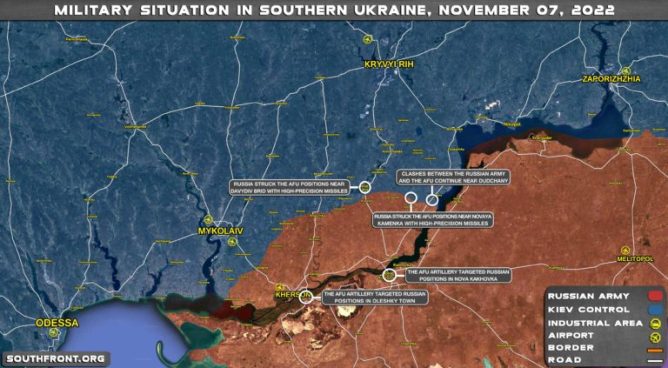
Indeed, the ground situation shows that the ongoing Russian operations in the areas of Ugledar and Bakhmut in Donetsk have run into strong resistance from Ukrainian forces, contrary to the Russian narrative Kiev’s military is a demoralised lot.
In particular, the advance of the Russians around Ugledar got stuck in the village of Pavlovka, located on the important crossroads, and in a fierce battle three days ago, reportedly, hundreds of Russian soldiers were killed. Putin’s decision to retreat in Kherson is probably meant to avoid a similar fate, as the Russians are experiencing logistical difficulties to supply their forces on the western side of Dnieper river.
Of course, this seamy picture is not the whole picture insofar as the phase of regrouping and resupplying following the Russian mobilisation is still a work in progress and the ongoing fighting in Donbass and Kherson is at the tactical level and does not involve any large movements of troops.
Equally, the intensive Russian strikes on Ukrainian depots, command centres and artillery and air-defence systems plus the destruction of Ukraine’s military-industrial facilities and energy system are yet to impact Kiev’s capacity to wage the war.
To be sure, the situation on the front lines in Kherson region remains extremely tense. The Ukrainian forces are on the prowl probing the Russian defence line incessantly to break through to capture the city of Kherson. A large-scale offensive by the Ukrainian forces on Kherson is to be expected any day. So far, Russians are holding their positions, repelling the ongoing Ukrainian attacks and fortifying their defences.
From Kherson, Ukrainian artillery can threaten Crimea. In the prognosis of Moscow’s close ally, Serbian President Aleksandar Vucic, “Challenging times are ahead of us. Next winter will be even harsher than this one because we’re facing the Battle of Stalingrad, the decisive battle in the conflict in Ukraine, the battle for Kherson.” He predicted that both sides are likely to deploy thousands of tanks, aircraft and artillery pieces in the struggle for the key city.
Vucic said, “The West thinks it’ll be able to ruin Russia that way, while Russia believes it’ll be able to defend what it secured at the start of the war and bring it to an end.”
Featured Video

AIDS Inc. by Gary Null (2007)
or go to
Aletho News Archives – Video-Images
From the Archives
Clash of Civilization, Iran Part II
By Jamal Kanj – Intifada-Palestine.com – January 14, 2011
Israel’s survival kit is: perpetuate conflict, insecurity to rationalize collective hate and finally playing victim.
Devoid of conflict, Israel implodes internally; without hate, Zionism loses its justification; and playing eternal victim to continue blackmailing the West. Absence of this holy trinity, Israel ceases to exist.
From its inception, the house of Zion has mastered exploiting adversarial powers to advance Israel’s cause. For instance, their influence over the Democratic Party in the US began with President Truman’s bid for 2nd term election in 1948.
Responding to strong opposition from Secretary of State General George Marshall and Department experts urging against recognition of Israel, President Truman replied: “I’m sorry gentlemen but I have to answer to hundreds of thousands [Jewish voters] who are anxious for the success of Zionism. I do not have hundreds of thousands of [voting] Arabs among my constituents”
Zionists influence over liberal American politics was matched with the doctrinal school of Conservative theoreticians aligning the Republican Party’s platform with Israel’s objectives. The Neoconservative Zionists, coined Zioncons, invented the “Clash of Civilization” concept to fight Israel’s wars. … continue
Blog Roll
 Aletho News
- Merck Virologists Admitted to Falsely Certifying Vaccine Efficacy
- Mandatory Folic Acid for every man, woman & child
- Pro-Palestine protesters arrested outside UK’s ruling Labour Conference in Liverpool
- Mauritius denies landing permit to flight from Israel, forcing cancellation: Tour operator
- Israeli finance minister calls for genocidal war on West Bank, annexation of south Lebanon
- 12 Things Your Psychiatrist Was Trained Not to Tell You
- From Unipolar Universalism to Multipolar Civilizational Distinctiveness
- RSF military group defects, joins Sudanese army: State media
- Ireland goalkeeper refuses to play ‘Israel’ as squad weighs boycott
- China pushes back against US on Cuba, Iran
- If Americans Knew
- Israel forces Gazans to live in constant peril – Daily Update
- Deconstructing Netanyahu’s pants-on-fire UN rant – Daily Update
- Trump betrayed voters with his campaign lies and prioritized a foreign country once he took office
- Netanyahu calls Israel’s war in Gaza ‘opposite of genocide’ in UN speech to near-empty hall
- Settler Kidnappings: Torture, Sexual Abuse and Terrorisation of Palestinian Abductees as Israel Deepens Annexation of West Bank
- Gaza winter nears as 162,000 tents become unusable, raising fears of humanitarian crisis
- Netanyahu says, “It’s the opposite of genocide”; UN says Gaza economy is world’s ‘most severe crisis on record’ – Daily Update
- Israel’s US-Backed Assault on Gaza Has Created the ‘World’s Most Severe Economic Crisis on Record’: UN
- ‘Protecting U.S. Citizens’… From Israel
- ‘This is where I live now, the back of a truck’: a day in the life of a grandmother in Gaza
- No Tricks Zone
- New Study: Earth And Venus Surface Warmth Largely Explained By Convection And Lapse Rate, Not CO2 Or Radiation
- 2025 Nature Paper Claiming Worsening Global Drought Gets RETRACTED …Heavily Flawed
- New Study: ‘Global Drought Shows No Detectable Recent Acceleration Under Climate Warming’
- Economic Masterminds: German Socialists Suggest Taxing Productivity Gains Stemming From Using AI
- The South China Sea Has Not Been Cooperating With The Climate Change Narrative
- Energy Crisis: Germany Enters Heating Season With Historically Low Gas Reserve Fill Levels
- New Study: The Antarctic Ice Sheet Gained Mass From 2020-2024 Due To Staggering Snow And Ice Accumulation
- Study: Ocean Heating Rates From Thousands Of Years Ago ‘Dwarf’ Modern Ocean Heating Rates
- Climate Extremists Target, Attack Large-Scale Power Grid Infrastructure In Germany!
- New Study: Antarctic Ice Melt Has Contributed Less Than 1 Centimeter To Sea Level Rise In The Last 30 Years

