Is Ukraine a “proxy war”?
By Noah Carl | October 26, 2022
Critics of America’s policy toward Ukraine have accused it of waging a “proxy war” against Russia. Such critics include various Western commentators, as well as Russia itself. In April, the Foreign Minister Sergei Lavrov claimed, “NATO, in essence, is engaged in a war with Russia through a proxy”.
Yet when a reporter put this accusation to Joe Biden, he said it’s “not true”. What’s more, the Ukrainian government compiled a list of individuals who “promote narratives consonant with Russian propaganda”, and specified that such narratives include: “A proxy war between NATO and Russia is taking place on the territory of Ukraine”.
One problem with the line taken by Biden and the Ukrainian government is that it isn’t just critics of US policy that have used the term “proxy war”.
In an article claiming that “many Russian soldiers have to flee, surrender, or die” and “the more and faster the better”, the political scientist Eliot Cohen stated, “The United States and its NATO allies are engaged in a proxy war with Russia.”
Likewise, the former Supreme Allied Commander of NATO, Philip Breedlove – who has called for boots on the ground in Ukraine – stated, “I think we are in a proxy war with Russia. We are using the Ukrainians as our proxy forces.”
And in an interview calling for the US to provide “as much aid as necessary” to Ukraine, former CIA Director Leon Panetta stated, “We are engaged in a conflict here. It’s a proxy war with Russia, whether we say so or not.”
Okay, you might say, but those individuals were using “proxy war” in a purely technical sense. Although the US is not an active participant in the conflict, it is arming one of the participants. So calling the conflict a “proxy war” is just a statement of fact (even if it might technically qualify as spreading Russian propaganda).
When critics accuse the US of waging a “proxy war” what they really mean is that the US is using Ukraine to weaken Russia, regardless of whether this serves the interests of Ukrainians (or Europeans for that matter). For example, perhaps Ukrainians would be better off if the US had engaged in diplomacy with Russia before the war.
It’s certainly not a stretch to imagine the US would wage a “proxy war” of this kind. The Reagan Doctrine was all about building up the US military and arming anti-communist guerrillas in order to overwhelm the Soviet Union and, ultimately, win the Cold War. This included arming both religious and political extremists.
But we don’t have to go back to the eighties. In 2019, the RAND corporation published a report on strategies to “overextend and unbalance” Russia. The report identified “providing lethal aid to Ukraine” as one that would “exploit Russia’s greatest point of external vulnerability”. (Interestingly, it concluded that any increase in aid would need to be “carefully calibrated” to avoid provoking “a much wider conflict”.)
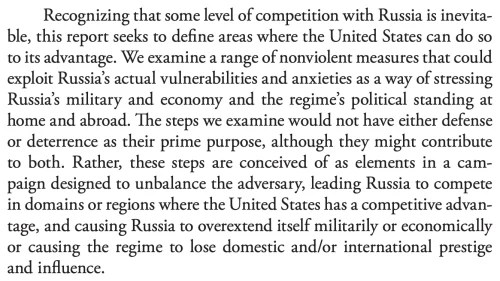
Screenshot from ‘Extending Russia: Competing from Advantageous Ground’.
RAND is almost entirely funded by the US Government, which appears first on its list of clients. So the fact that it would publish a report like this indicates that, even before Russia’s invasion, US decision-makers were interested in using Ukraine to weaken their geopolitical adversary.
As Senator Adam Schiff explained in 2020, “The United States aids Ukraine and her people so that we can fight Russia over there, and we don’t have to fight Russia here.”
Since Russia’s invasion, various other commentators have hinted – or in some cases explicitly stated – that America has goals other than securing Ukraine’s territorial integrity. Here’s Thomas Friedman’s account of what a “retired senior European statesman” told him:
The goal of Ukraine is to win, he said. The goal of the European Union is a bit different. It is to have peace … The U.S. is far away, and for the U.S., he added, it is not the worst thing to keep the war going to weaken Russia and make certain it doesn’t have the energy for any other adventures.
Two months into the war, Defence Secretary Lloyd Austin was asked how he would define America’s goals in the conflict. He began by saying what you’d expect him to say: “We want to see Ukraine remain a sovereign country”. He then went slightly off-script: “We want to see Russia weakened to the degree that it can’t do the kinds of things that it has done in invading Ukraine.”
According to the New York Times, some officials “cringed” and Biden called Austin to “remonstrate” him for the comment. “But officials acknowledged that was indeed the long-term strategy”.
A couple of weeks later, the political scientist Hal Brands really let the cat out of the bag – in a piece titled ‘Russia Is Right: The U.S. Is Waging a Proxy War in Ukraine’. He wrote:
The war in Ukraine isn’t just a conflict between Moscow and Kyiv, Russian Foreign Minister Sergei Lavrov recently declared. It is a “proxy war” in which the world’s most powerful military alliance … is using Ukraine as a battering ram against the Russian state … Lavrov is one of the most reliable mouthpieces for President Vladimir Putin’s baseless propaganda, but in this case he’s not wrong. Russia is the target of one of the most ruthlessly effectively proxy wars in modern history.
“The key,” Brands noted, “is to find a committed local partner — a proxy willing to do the killing and dying”. You then “load it up with” arms so that it can inflict “shattering blows” on your adversary. “That’s just what Washington and its allies are doing to Russia today.”
Similar sentiments were echoed by Congressman Seth Moulton in an interview with Fox News. “At the end of the day, we’ve got to realise we’re at war,” Moulton stated. “And we’re not just at war to support Ukraine. We’re fundamentally at war – although somewhat through a proxy – with Russia. And it’s important that we win.”
Likewise, when Congressman Dan Crenshaw came under fire from “America First” conservatives over his support for Ukraine, he tweeted: “Yeah, because investing in the destruction of our adversary’s military, without losing a single American troop, strikes me as a good idea. You should feel the same.”
Crenshaw didn’t bother paying lip-service to high-minded concepts like democracy, sovereignty or territorial integrity. He just came out and said we’re “investing in the destruction of our adversary’s military”.
Critics have consistently disparaged US policy as “fighting Russia to the last Ukrainian”. But in July, Senator Lindsey Graham – a long-time Russia hawk – said almost exactly that. “I like the structural path were on here,” Graham explained. “As long as we help Ukraine with the weapons they need and the economic support, they will fight to the last person.”
Critics found further justification for their cynicism in a recent Washington Post article, which revealed the following. “Privately, U.S. officials say neither Russia nor Ukraine is capable of winning the war outright, but they have ruled out the idea of pushing or even nudging Ukraine to the negotiating table.”
You might say that using Ukraine to weaken Russia is something worth doing, as Dan Crenshaw evidently believes. But at this point, it can scarcely be denied that America is engaged in a proxy war.
Property in German town to be confiscated for asylum seekers
Free West Media – October 26, 2022
So far it has been dismissed as a malicious “conspiracy theory” that living space for asylum seekers would end up being confiscated in Germany. But this “theory” is sadly coming true. In the Bavarian district of Fürstenfeldbruck, not far from Munich, it is being implemented.
The local CSU District Administrator Thomas Karmasin has refused to use gymnasiums as “refugee” accommodation. But the existing public accommodation is running out in the face of exploding numbers of asylum seekers. Karmasin therefore wants to have public and private properties confiscated in order to accommodate the newcomers. The first efforts have already started.
Karmasin said in a statement that immigration policy was a federal matter. As in 2014 to 2016, during the last “refugee” crisis, he refused to make school gyms available again.
This development is likely to put affected locals under severe stress in forcing a show of solidarity with Ukrainians or Senegalese accommodated in their apartments and single-family homes.
In a recent SZ interview, sociologist Karin Scherschel who is pro-migration, warned that election campaigns should not be fought on the subject of migration “because it always creates a mood”. If Scherschel had her way, the immigration debate would be ignored.
With authorities now confiscating homes, the matter is certain to create a volatile mood.
According to a so-called general clause under police law, people in Germany who are threatened with homelessness may be accommodated in empty apartments or hotel rooms, even against the will of the owner. Before doing so, the authorities must have exhausted all other possible options.
It is probably only a matter of time before these state encroachments will also extend to private residential property everywhere.
In Stuttgart, 100 tenants were given notice because the homeowner wanted to offer his house to the city for refugees. And in a Bavarian retirement home, the inhabitants were forced to move to higher floors so that young migrants could be accommodated on the ground floor.
The Organization for Economic Cooperation (OECD) assumes that the number of people moving to Germany by the end of the year will exceed the figure of more than two million from 2015.
Ukraine Peace Talks: Pathetic U-Turn by 30 Dems & Curious Case of Jeffrey Sachs
By Ekaterina Blunova – Samizdat – 26.10.2022
On Tuesday, the progressive caucus of the US House of Representatives made an abrupt U-turn and withdrew their letter to US President Joe Biden, which urged him to engage in direct talks with Russia and broker peace between Kiev and Moscow. What’s going on in the Democratic camp?
“Not only was the letter a case of too little, too late, the so-called progressive signatories to the statement made themselves look even more pathetic in its immediate withdrawal,” Max Parry, an independent US journalist and geopolitical analyst, told Sputnik.
“While the letter was a refreshing first step, the Democrats who signed it became victims of the very same McCarthyist political atmosphere they have created in Washington, where any detente or rapprochement with Moscow is criminalized. Instead of digging in their heels and standing by what they said, the 30 lawmakers immediately caved to the political pressure of being branded Putin apologists and retracted the statement. They made it clear their loyalties lie with the party establishment and not with the American people, who are fed up with the Biden administration’s disastrous handling of the war and the economy,” he emphasized.
The American journalist believes that the motivation behind the letter was a response to growing fatigue among the US public regarding the ongoing standoff in Ukraine, “not to mention several recent public incidents of Democratic lawmakers being protested by their own constituents over their vote to arm Kiev which went viral on social media.”
According to Parry, US polls indicate growing support for a diplomatic resolution to the conflict. On September 27, a survey, conducted by Data for Progress on behalf of the Quincy Institute for Responsible Statecraft, indicated that nearly 60% of Americans would support Washington engaging in diplomatic efforts “as soon as possible” to end the conflict in Ukraine, even if that means Ukraine having to make concessions to Russia.
“Surveys of the upcoming midterm elections also forecast the increasing likelihood of GOP gains in congress,” Parry continued. “Although US support for Ukraine has been mostly bipartisan, there have been far more vocal opponents of the Biden administration’s decision to arm Ukraine among Republicans than Democrats, most notably Marjorie Taylor Greene.”
On October 18, House Minority Leader Kevin McCarthy signaled that Republicans will not write a “blank check” for Kiev if they win back the House majority. According to US media, anti-aid sentiments are also strong among many Republican House and Senate candidates. If they win, the reduction of military assistance to Kiev is more than possible, as former US Senate candidate Mark Dankof told Sputnik on September 25.
While one needs to bear in mind that the anti-Russia consensus in Washington has long been bipartisan, 57 Republicans as recently as May voted against sending more lethal aid to Kiev, Parry underscored. Nonetheless, the independent journalist noted that this trend does not necessarily signal an upcoming departure from the Ukraine policy by the US.
“I am not convinced this will automatically materialize if the Republicans take back the House, because many of the purported adherents to Trump’s ‘America First’ agenda running for office are opportunists and based on historical precedent, some of those GOP lawmakers could turn back on their campaign pledges once they are in office,” he remarked.
When it comes to Democrats, “if they do indeed lose ground over the Ukraine war, it could lead to either a revival in the anti-war movement among the US left or a doubling down on the anti-Russian sentiment among Dems,” Parry presumed.
Jeffrey Sachs: Neoliberal Economist Turned Anti-NATO Rebel
The Dems’ latest flip-flopping on the Ukraine peace issue is not the only attempt at dissent on the left flank of the US political front. Renowned economist and Columbia University Professor Jeffrey Sachs has lambasted the Biden administration’s Russia strategy and urged Washington to mediate a peaceful settlement between Moscow and Kiev from the outset of the Russian special military operation to demilitarize and de-Nazify Ukraine.
“It was a welcome surprise to see a former neoliberal economist like Professor Sachs become an unexpected dissenting voice and critic of US policies as Washington continues to send a flow of arms to Ukraine,” said Parry.
In May 2022, Sachs wrote an op-ed urging the US to stop the conflict in Ukraine and insisting that the solution reached by Moscow and Kiev in March 2022 remains the only viable option for restoring peace. On June 27, the economist released an article eloquently titled “Ukraine Is the Latest Neocon Disaster,” again calling for peace negotiations and ending NATO’s eastward expansion towards Russia’s borders. On August 2, Sachs warned: “The government of Ukraine urges us not to negotiate, but to fight. This is a recipe for the destruction of Ukraine and the possible escalation to a nuclear war.”
Following the sabotage attack on Russia’s Nord Stream pipeline infrastructure in the Baltic Sea, Sachs pointed the finger at Washington as a potential culprit while speaking on air with a US mainstream broadcaster.
“The case of the recent political transformation of Professor Sachs is a curious one,” noted Parry. “After all, we are talking about one of the most prominent economic advisors to Western financial institutions like the International Monetary Fund. In particular, he was one of the preeminent economic aides to former communist governments in their transition to the free market and in the case of Russia, the economic reforms based on his ideas had devastating consequences when mass privatization and ‘shock therapy’ drove the Russian economy into a deep recession and plunged millions into poverty.”
The independent journalist emphasized that for Sachs to “now depart from US policy orthodoxies and criticize the demonization of Russia, even rightly pointing out that the US was the more likely candidate to have been behind the destruction of Nord Stream 2 pipeline, is simply stunning.”
Parry has drawn attention to the fact that Sachs’ “transformation” apparently started a few years ago, “when he criticized America’s dirty war in Syria in 2018.” “Now his ‘road to Damascus,’ or political conversion is complete,” the journalist added.
“Unfortunately, he is one among only a mere handful of public figures voicing opposition to NATO’s proxy war,” Parry continued. “Since the death of Stephen Cohen, America’s foremost scholar of Russian affairs, commentary on US relations with Moscow has been nothing short of monolithic, so the surprising calls for peace talks by Sachs were badly needed.”
“Once upon a time, there used to be something called the fairness doctrine in the media where there was some attempt to ensure that differing viewpoints were evenly reflected in news coverage of world events. Since February, there has been absolutely no attention given to the Russian perspective on the war whatsoever, nor any encouragement of dialogue and diplomacy allowed on major networks or newspapers. Even for corporate media, which has always been heavily biased toward the West, the lack of any diversity of opinions on this conflict is unprecedented,” Parry concluded.
Who benefits from Kakhovka dam destruction?
By Drago Bosnic | October 26, 2022
In recent weeks, the Kiev regime has been accusing Russia of planning to destroy the Kakhovka hydroelectric dam on the Dnieper River, which would unleash a devastating flood across most of the Kherson oblast (region) and the surrounding areas.
The dam, which measures 30 meters in height and is approximately 3.2 km long, was built in 1956 on the Dnieper River as part of the Kakhovka hydroelectric power plant. It holds a massive 18 km³ water reservoir which also supplies water to Russia’s Crimean peninsula. The reservoir is also crucial for the functioning of the Zaporozhye nuclear power plant as it supplies water to the essential cooling systems. The volume of water in the reservoir is comparable to the Great Salt Lake.
Destroying the strategically important dam, which is now part of Russia, would have catastrophic consequences, as it would unleash a devastating flood downstream. Experts estimate this would create a giant wave of devastating floodwater up to five meters in height, almost immediately flooding an area of more than five kilometers around the dam. The wave would need only two hours to reach the city of Kherson. The destruction of the dam’s floodgates would also destroy the crossings used by the Russian military and possibly trap the large Russian contingent on the west bank of the Dnieper River. However, most alarmingly, this would also result in the total destruction of dozens of settlements in the region and possibly cause hundreds or even thousands of civilian casualties, as it would not be possible to evacuate everyone in time.
Last Tuesday, Russian Army General Sergei Surovikin, the newly appointed commander of all Russian forces engaged in the special military operation, stated that the relevant intelligence clearly indicates the Kiev regime forces are preparing a massive strike on the dam. He confirmed that the Neo-Nazi junta troops had already used the US-supplied HIMARS in a major strike during which the Russian military managed to intercept several precision-guided rockets. On October 21 alone, at least five separate rocket attacks were repelled by Russian air defenses.
“We have information on the possibility of the Kiev regime using prohibited methods of war in the area of the city of Kherson, on the preparation by Kiev of a massive rocket strike on the Kakhovka hydroelectric dam,” Surovikin warned.
The Kiev regime officials rejected the allegations and stated that “they were a clear sign” that Moscow supposedly planned to attack the dam and then blame the Neo-Nazi junta. On October 20, the Kiev regime frontman Volodymyr Zelensky said that Russia had allegedly placed explosives on the dam and was preparing to destroy it, a move he compared to the use of weapons of mass destruction.
“I informed the Europeans today, during the meeting of the European Council, about the next terrorist attack, which Russia is preparing for at the Kakhovka hydroelectric power plant. Destroying the dam would mean a large-scale disaster,” Zelensky stated. He went on to claim that blowing up the dam would also destroy the water supply to Crimea and “thus show that Russia had accepted that it could not hold onto the peninsula.”
Kirill Stremousov, the Deputy Head of the Kherson oblast (region), stated that the Kiev regime’s allegations that Russia had placed explosives on the dam were false. The authorities of the Kherson oblast are working on evacuating as many civilians as possible, since the Kiev regime forces are escalating attacks on residential areas. On the evening of October 20, Neo-Nazi junta troops targeted civilians fleeing to the eastern bank of the Dnieper River. The ferry crossing near the Antonov bridge (damaged by the Kiev regime forces) was struck, resulting in at least 4 civilian casualties, while dozens of others were wounded. Local administration reports that the US-made HIMARS MLRS was used to destroy the ferry.
At least 12 cluster munition rockets were fired, most of which were intercepted by Russian air defenses, significantly reducing the number of casualties. Since HIMARS is a precision-guided system, the possibility of miscalculation on part of the Kiev regime forces is extremely unlikely. This leaves us with one conclusion – the civilians were the target.
Local authorities are working round the clock to evacuate everyone, as civilians living on the west bank of the Kherson oblast are exposed to direct attacks by the Kiev regime forces. As the Neo-Nazi junta troops are also shelling the Kakhovka power plant, located approximately five kilometers from the town of Novaya Kakhovka, the civilians are also directly exposed to the aforementioned flood which would be the inevitable result of the destruction of the dam.
All the while, the Kiev regime keeps insisting that Russia will destroy the dam, ignoring both logic and the situation on the ground. As Zelensky himself stated, destroying the dam would halt the water supply to Crimea. Although he stated that this means Russia gave up on Crimea, such claims are comically illogical, given that Russia had successfully been tackling the issue of water supplies to the peninsula for nearly a decade, as the Kiev regime cut the water supplies back in 2014.
In addition to trapping its own troops on the west bank of the Dnieper River, as the flooding would make it impossible to evacuate anyone, the destruction of the dam would also devastate the areas which are already under Russian control. Thus, the question remains, who actually benefits from blowing up the Kakhovka dam?
Drago Bosnic is an independent geopolitical and military analyst.
Thirty US Democratic Lawmakers U-Turn Within Hours After Urging Biden To Change Tack on Ukraine
By Svetlana Ekimenko – Samizdat – 25.10.2022
On Monday, 30 Democratic lawmakers from the US House of Representatives – led by Pramila Jayapal, chairwoman of the Congressional Progressive Caucus – wrote to President Joe Biden urging him to alter his Ukraine strategy and hold direct negotiations with Russia, “redoubling efforts to seek a realistic framework for a ceasefire”.
The group of progressive House Democrats who urged President Joe Biden on Monday to make fundamental changes to US strategy regarding the security crisis in Ukraine by seeking direct negotiations with Russia, made a U-turn within hours of sending their letter to the POTUS.
Under a wave of pressure from other Democrats, the group, led by Congressional Progressive Caucus chairwoman Pramila Jayapal, released a statement confirming their support for the president’s strategy.
“Let me be clear, we are united as Democrats in our unequivocal commitment to supporting Ukraine in their fight for their democracy and freedom,” Jayapal announced, adding that “nothing in the letter advocates change in that support”.
The statement went on to say that although diplomacy is “an important tool that can save lives,” it is “just one tool”.
“As we also made explicitly clear in our letter and will continue to make clear, we support President Biden and his administration’s commitment to nothing about Ukraine without Ukraine,” the group of lawmakers concluded.
Before bowing to pressure and backpedaling, the 30 Democrats had initially stated in their letter that it was in the interests of the Biden administration to revise his strategy for Ukraine to avert a protracted conflict fraught with dangerous possibilities.
“We urge you to pair the military and economic support the United States has provided Ukraine with a proactive diplomatic push, redoubling efforts to seek a realistic framework for a ceasefire,” the group – which includes Representatives Alexandria Ocasio-Cortez of New York, Jamie Raskin of Maryland and Ro Khanna of California – said.
The Democrats added in the original letter:
“The alternative to diplomacy is protracted war, with both its attendant certainties and catastrophic and unknowable risks.”
The lawmakers had emphasized how the conflict would spill over into ordinary life and how the sanctions policy introduced by the US, the EU and allies against Moscow over its special military operation in Ukraine were self-harming. Food and gas costs have rocketed all over the world, including in the United States, and the soaring prices for wheat, fertilizer, and fuel have exacerbated global food shortages.
“If there is a way to end the war while preserving a free and independent Ukraine, it is America’s responsibility to pursue every diplomatic avenue to support such a solution that is acceptable to the people of Ukraine,” the letter said.
However, the letter’s call for a negotiation process that could include sanctions relief for Russia and security guarantees for Ukraine contents did not go down well with some other Democrats. Representative Ruben Gallego of Arizona tweeted in response to the progressives’ letter that the way to end a conflict is, “Win it quickly”.
Although the US Congress passed a Bill to send $12Bln in new aid to Ukraine in September, with the Biden administration expected to pledge more aid for the Kiev regime in December, if Republicans win control of the House in the November mid-term elections, this strategy of pumping aid into Ukraine may be put to the test.
A number of GOP House lawmakers such as Florida’s Matt Gaetz have been vociferous in calling for aid to Ukraine to be curtailed. These calls have been echoed by other influential voices in the broader conservative movement, highlighting that the Biden administration has been spending too much to prop up the Kiev authorities and possibly prolonging the conflict. After his home state of Florida was lashed by a hurricane, Gaetz went on Twitter to suggest that aid to Ukraine was diverting assistance from his own constituents.
And Republican representative for Georgia, Marjorie Taylor Greene, tweeted while announcing her vote against a spending resolution that included more funding for Ukraine, that she was opposed to “funding America’s 51st state: Ukraine”.
House Republican leader Kevin McCarthy, hoping that next month’s mid-terms will make him Speaker of the House, said in a recent interview: “I think people are going to be sitting in a recession and they’re not going to write a blank check to Ukraine.” He indicated that Republicans would demand tighter oversight of aid to Ukraine if they win the majority.
Earlier, Republican representative for Pennsylvania, Scott Perry, who is chairman of the House Freedom Caucus, reportedly texted members of the group about the potential for investigating the Biden administration over its handling of the Ukraine crisis. Perry suggested, according to screenshots of a text to fellow Republican members of the House Foreign Affairs Committee, that the president might not have been honest with the American people about his goals in the conflict.
“If these nitwits in this jackwagon administration are blundering us or intentionally marching us to war with Russia, nuclear or otherwise, we’d better start to preserve the evidence so there can be accountability,” Perry said.
Russia has sent out repeated reminders that channeling military assistance to the Kiev regime will only prolong the conflict and is fraught with the risk of a further dangerous escalation of the crisis.
Ukrainian Army War Crimes Include Shelling of Ambulances, Firetrucks, and Rescue Workers in the Donbass Republics — Similar to Israelis and U.S. Backed Terrorists in Syria
By Eva Bartlett | CovertAction Magazine | September 23, 2022
In the more than eight years of bombing the civilians of the Donetsk and Luhansk People’s Republics, Ukraine has committed untold numbers of war crimes. These include bombing residential areas, markets, hospitals, schools, parks—including with prohibited heavy weapons and banned cluster munitions—and, since late July, raining banned “Petal” mines down on populated civilian areas, including the very center of Donetsk, including as recently as September 7.
A lesser-known war crime is Ukraine’s routine targeting of ambulances, fire trucks, medics and rescuers, and their headquarters and stations. Many of the times Ukraine bombs such heroic rescuers, it is when they are on the way, or already on site, to help civilians often themselves just bombed by Ukraine.
On August 21, Ukrainian shelling of the DPR’s Gorlovka wounded twelve, including five firefighters.
The day prior, Ukrainian shelling targeted an ambulance station in the LPR’s Lysychansk, wounding several and damaging some of the ambulances.
On June 23, the Kievskiy District of Donetsk came under repeated shelling over the course of the two hours I was visiting the Emergency Services headquarters there. On the grounds, I saw the remnants of a “Hurricane” missile from a previous Ukrainian attack.
The previous day, Ukrainian forces targeted an Emergency Services fire truck on call, leaving the driver hospitalized in critical condition. According to his colleagues, they saw a drone above them just prior to Ukraine’s strike. The targeting was unquestionably deliberate.
On June 18, Ukraine targeted a central Donetsk district after Emergency Services had arrived, killing a firefighter and the driver, and injuring three more rescuers.
In early June, heavy Ukrainian shelling of Kuibyshevsky District, Donetsk, destroyed an ambulance and seriously injured the driver.
Ukraine’s attacks on emergency workers is not new; Ukraine has been doing so for years.
In June 2021, during a humanitarian cease-fire, Ukrainian forces targeted an ambulance which had arrived to evacuate three injured DPR soldiers.
In October 2019, Ukrainian forces fired an anti-tank guided missile at a DPR military ambulance en route to help a child, wounding the driver and a paramedic.
In August 2018, Ukrainian forces fired a missile at a DPR ambulance, killing the driver and two female paramedics.
When I first visited the DPR in September 2019, going to hard-hit areas around Gorlovka, I was told by Zaitsevo administration that ambulances could not reach the villagers.
“The paramedics don’t go farther than this building; it’s too dangerous. If somebody needs medical care near the front lines, someone has to go in their own car and take them to a point where medics can then take them to Gorlovka. The soldiers also help civilians who are injured.”
This is something I was very familiar with in Gaza, occupied Palestine, where Israeli soldiers routinely fire at Palestinian farmers and other laborers on agricultural land, a policy of harassment to drive Palestinians off their land. In most cases, ambulances likewise could not reach the injured due to Israel’s policy of targeting ambulances. Consequently, seriously injured Palestinians bleed to death.
In Zaitsevo, I was told this had happened there, too. “A woman died due to huge blood loss because no one could reach her house to take her away in time. She was injured in the shelling and bled to death.”
Targeting medics and other rescuers ensures those in need of help are deprived of it, and increases the likelihood that people who might have lived instead die of their injuries.
The intentional targeting of ambulances and medics, as well as fire trucks and other emergency services vehicles and workers, is against international law.
Speaking to DPR Rescuers
During my last two visits to the DPR, in June and August 2022, I interviewed a number of Emergency Services workers and medics.
According to Konstantin Zhukov, the Chief Medical Officer of Donetsk Ambulance Services, the ambulance services workers face shelling daily, constantly, and many employees have been wounded while working. One of the ambulance stations was completely destroyed by Ukrainian shelling.
Outside, I spoke with Tatyana Golota, an emergency physician, and Alena Kondrasheva, a paramedic.
Both reiterated that it is normal coming under repeated Ukrainian fire. They spoke of Ukraine shelling after medics and emergency services workers had arrived to help civilians.
They showed me an ambulance completely destroyed by Ukrainian shelling. It was new and had only been operational a few months before being destroyed.
“That day we were at work and heard about the brigade coming under fire. The doctor had gone to help people, and the driver, by chance, walked away to try to get a mobile signal. At that moment, there was a direct hit on the vehicle.”
Also in Donetsk, I spoke with Sergei Neka, Director of the Department of Fire and Rescue Forces of the Ministry of Emergency Situations.
He likewise said rescuers increasingly come under fire when they go out on a call, sometimes making it impossible to reach the people in need.
According to him, from February 24, 2022, to when I spoke with him in August, four people were killed and 40 injured, as well as significant damage to equipment and buildings.
“Our units arrive at the scene of the accident and Ukraine begins to shell it. A lot of equipment has been damaged and destroyed.”
I asked about the impact of the “Petal” mines Ukraine has been dropping on the city, and was told a 21-year-old employee was injured by a PFM-1S mine after a region was cleared, the mine falling from the building and the unsuspecting rescuer stepping on it, losing his foot.
In Makeevka, just east of Donetsk, I went to an orphanage that had been shelled with the mines. Most of the clean-up was completed by the time I arrived on the second day of de-mining, but one remained. I watched a sapper find and detonate it, and although I had previously seen a group of eight mines detonated, creating a massive blast, the force of the single mine was still quite powerful.
According to Dmitry Chamota, Head of Donetsk Emergency Services Deminers, they found 26 PFM-1 mines scattered around the grounds of the orphanage, including on the playground.
In June, I met Andrey Levchenko, Chief of Kievskiy District Emergency Ministry. Over the course of the two hours at his station, Ukraine was intensively shelling the district, leading us to take cover inside the building lest the property be targeted again.
We did venture outside between bouts of shelling, where Levchenko pointed out damage to the buildings and the shell of the Ukrainian-fired Hurricane MLRS which struck the premises.
The building has blown out windows, sandbagged windows to attempt to protect the workers; some days prior, the chief’s office had been damaged by shrapnel from the shelling. Thankfully, he had just stepped out a minute before the blast.
He showed me the fire truck damaged on June 22, pointing out the many shrapnel holes and noting one of the rear tires had been blown out.
Two of the employees who had been out on that call spoke to me about that day, saying that, after Ukrainian shelling of the district, they received a call that people were trapped inside a building with the door blocked after the shelling. A fire was spreading to the second and third floors, and that people were unable to escape. As the rescuers assessed the situation, a shell hit a wall near the truck and wounded the driver.
They said that, prior to the shelling, they saw a drone overhead. This, combined with the facts that they were uniformed and the fire truck was clearly marked and in a civilian area where people were calling for help, makes it credible to believe Ukraine deliberately targeted the rescuers.
Of Ukraine’s heightened shelling over the past many months, Levchenko said it was constant and daily. “Before, if we speak about 2014-2015, twenty minutes, one hour maximum. Now six-seven hours non-stop, every day.”
He said that the Ukrainian forces shell, wait until rescuers arrive and then shell again. “They wait for 30 minutes for us to arrive. We arrive there, start assisting people, and the shelling resumes.”
This is something I witnessed for myself when, on August 4, Ukraine bombed the hotel in which I was staying, the fourth and fifth shells landing 50 meters away and then directly beside the hotel, respectively. When the fifth struck, shattering inwards the lobby glass doors, I had fortunately just stepped out of the lobby where 30 seconds earlier I had been speaking to journalists who had run in from the street.
When it seemed the shelling had stopped, journalists went outside to document the damage. Sadly, a young woman outside the hotel had been killed by the shelling. Five others just two streets away were also torn apart by the bombs, including a promising 12-year-old ballerina, her grandmother, and her world famous former ballerina ballet teacher.

Galina Vasilyevna Volodina (left), and twelve-year-old Katya Kutubaeva, the ballerina killed by Ukraine. [Source: slippedisc.com]
Emergency Services arrived and, not long after, Ukraine resumed its shelling. Fortunately, they were able to get inside, but this is just one example of Ukraine’s double strikes.
According to Levchenko, Ukraine does not only shell two times, but that they sometimes shell three times: “They wait again, our guys hide in the shelters, as soon as we go out, put out the fire, help people, there could be people under the debris, doors stuck, people can’t get out and get to the basement…then shelling resumes.”
He described the people engaging in this sort of warfare against civilians and rescuers as “Shameless. Scumbags. Terrorists.”
He is not wrong.
Targeting Rescuers: A Terrorist Tactic Adopted by U.S. Allies in Ukraine, Israel and Syria
As the DPR Emergency Services chief pointed out damage to the fire truck, I was reminded of Israel’s attacks on Palestinian medics and fire brigades in Gaza, including during the December 27, 2008-January 18, 2009, Israeli war on Gaza, where I was living at the time.
During those three weeks, I rode in the medics’ ambulances, documenting the destruction and the victims of Israel’s war crimes, but also in a sense as a human shield, in the hope that Israel would not strike ambulances in which a handful of internationals and I were riding.
As it turned out, by the end of the Israeli massacre of Gaza, Israeli forces killed 16 medical rescuers, four in one day alone. Another 57 were injured. At least 16 ambulances were damaged, with at least nine completely destroyed.
One of the murdered was a 35-year-old paramedic, Arafa Abd al-Dayem, who I had accompanied the night prior to his murder. As I wrote of that evening, “The dead, a 24-year-old night watchman, had no warning of the at least 2 missiles which leveled the school and tore him apart. The medics work to load the corpse, first having to replace the flat tire. Working frantically, still fearful of potential strikes, they crowd the ambulance, hoist the van, replace the flat. A missile hits 50 meters away. Surely, undoubtedly, those warplanes above us know—from the markings of the ambulance, the clothes of the medics, the crystal clear photos their drones can take—that we are civilians and medics below. Yet they fire.”
Arafa was killed later that day, when Israeli forces fired a flechette shell directly at his ambulance, shredding him with the dart-like flechettes, causing massive internal bleeding in his abdomen, blood in his lung, shock, and death.
A surgeon I interviewed later when writing about Israel’s widespread use of flechettes in Gaza told me that flechettes cause more injuries than other small munitions precisely because they spread in a larger area. And while the darts appear innocuously small, their velocity and design enable them to bore through cement and bones and “cut everything internal.” Accordingly, the prime cause of death is severe internal bleeding from slashed organs, particularly the heart, liver and brain.
One of the injured, Hassan al-Attal, 35, was a medic whose ambulance I was in when he and another medic came under Israeli sniper fire while attempting to retrieve a corpse from the street just beyond the ambulance. The sniper fire reached the ambulance itself. Hassan was wounded in the leg. This was during a few hours of supposed cease-fire. But in any case, the medics never should have been targeted.
As I wrote, “Although the Geneva Conventions explicitly state that ‘medical personnel searching, collecting, transporting or treating the wounded should be protected and respected in all circumstances,’ throughout Israel’s invasion this was not the case. Indeed, as the injured and emergency workers testify, Israeli forces targeted and prevented medical workers from reaching the wounded.
Without coordination, many ambulances did not dare risk Israeli gunfire and shelling, meaning hundreds of calls went unanswered, according to the Palestinian Center for Human Rights. Denied medical care, many victims succumbed to their wounds.”
Israeli forces killed 13 Civil Defense workers and injured 31, also destroyed six civil defense stations and damaging four.
From that same article, “Civil Defense workers, like medics, are protected under international law. The Fourth Geneva Convention states not only that emergency workers must be respected and allowed to do their work, but that their buildings, equipment and vehicles must not be targeted.
Yousef al-Zahar, director-general of Civil Defense in Gaza, told me at the time, ‘Targeting the Civil Defense centers and teams is an obvious indicator that the Israeli forces intended to paralyze Civil Defense activities in the Gaza Strip to raise civilian victims’ numbers in the casualties.’”
According to statistics from the Palestinian Authority Ministry of Health and the PRCS, from the outbreak of the second Intifada in September 2000 to when I wrote the 2010 article, Israeli Forces have killed at least 56 medical rescuers, including paramedics, drivers, doctors and volunteers—an average of one rescuer every two months—and have injured at least another 500 medical rescuers.
Likewise, British journalist Vanessa Beeley has written at length about Syrian rescuers targeted by terrorist factions in Syria, their equipment stolen. In one of her articles, she cited a Commanding Officer of the Real Syria Civil Defense in an Aleppo district describing a scenario which Donbas and Palestinian rescuers would recognize:
“They (terrorists) targeted us deliberately in order to destroy our equipment & structures. They wanted to prevent us being able to work for our people. They would target our crew with sniper fire and explosive bullets. Their main mission was to kill the crew and destroy our base so we couldn’t care for the people of Aleppo.”
In that same article, she noted that “terrorist groups systematically carried out double-tap attacks” on the rescuers, just as Israel does to Palestinian rescuers and Ukraine to Donbas rescuers.
Ukraine Continues Killing Donbas Rescuers
On September 1, 13 DPR Emergency workers were killed and 9 injured from Ukrainian shelling. According to a representative of the Emergency Situations, the shelling was intentional.
“The missiles exactly hit residential buildings. The vehicle was outside and it was hit with shrapnel and pieces of the destroyed building. But again, you can see it’s an emergency vehicle—a fire vehicle. This is a war crime.”
The following day, two more Emergency Services workers were killed and two injured by Ukrainian shelling of their fire truck, in Makeevka. They were en route to put out a fire. Images accompanying the news show a mangled bright red fire truck, unmistakably a rescue services vehicle.
When in August I spoke with the Director of the Donetsk Department of Fire and Rescue of the Ministry of Emergency Situations, he told me that, at that time, four Emergency Services workers had been killed and 40 injured by Ukrainian shelling.
With Ukraine’s targeting of Emergency Services in September, the number of rescuers Ukraine has killed is now at least 19, with another 51 injured.
I had the chance to speak with the mother of a young firefighter, Pavel (“Pasha”) Legonkiy, killed by Ukrainian shelling on June 18, 2022. He and other Emergency Services personnel had gone to the site of a Ukrainian shelling, in central Donetsk. A Ukrainian double-tap strike killed Pasha and the driver, injuring three others.
Svetlana spoke proudly of her courageous, compassionate son.
“He loved his work very much. He lived for this work. It was his duty to help people. My son dreamed of starting a family, dreamed of having children, dreamed of working! And one shell that you sent here ended his life.”
These men and women know very well the threats they face when going out on a call, but go anyway, to help their citizens under Ukrainian attacks.
The two women I spoke to at Donetsk Ambulance Services replied to my question about whether they considered stopping their work.
“I’m really scared, everyone is scared. But what can we do? How about the patients? They are people like me, they hurt and are even more scared. They are waiting for our help. While you are driving you feel fear, but as soon as you get to the place of the tragedy, the fear goes away and you just start doing your job and forget about this fear.”
The Kievskiy Emergency Ministry Chief, Andrey Levchenko, said of the rescuers, “They are all heroes. If it were possible, I would give a medal to every one of them, to honor their work, to support them. But they don’t do that for the medals, no way. Nobody ever said, ‘we’re not going, we don’t want to,’” he said, referring to when rescuers go out on calls.
He is right. These rescuers are heroes, putting their lives on the line every time they go out to help a person in need, knowing full well Ukraine frequently strikes an area a second and a third time, specifically to target rescuers. While they might not receive or want medals, they should be afforded their right under international law to rescue people without fear of being shelled by Ukraine.
EU displays ‘height of hypocrisy’ – Russia

Samizdat | October 23, 2022
The European Union doesn’t have the right to accuse Moscow of committing war crimes in Ukraine because the bloc has spent years ignoring the suffering of civilians in Donbass, the Russian Foreign Ministry has said.
Russia’s statement came after EU’s main decision-making body, the European Council, condemned Moscow on Friday for “indiscriminate” missile and drone attacks on civilian targets in Kiev and elsewhere in Ukraine, adding that there was “growing evidence” of war crimes against Ukrainians.
In a response released on Saturday, Russian Foreign Ministry spokeswoman Maria Zakharova rebuffed the accusations as “the height of hypocrisy.”
The European Union has lost the moral right to speak about war crimes because, for eight years, it has turned a blind eye to the killing of civilians, women and children during the shelling of the Donbass by the regime in Kiev.
Zakharova further accused the European bloc of “covering up Kiev’s criminal actions.” She argued that, instead of seeking a peaceful solution, the EU has been “senselessly investing significant sums into prolonging the fighting.”
The spokeswoman also claimed that Ukrainian soldiers who receive Western training and weapons are targeting civilians.
Russia stepped up strikes on Ukraine this month, hitting many thermal power plants and power lines across the country, among other targets. President Vladimir Putin said the intensification was a retaliation against “terrorist attacks” on Russian soil, including a truck bombing that had recently damaged a strategic bridge connecting the Crimean Peninsula with Russia proper.
Kiev has not confirmed its involvement in the bridge attack, but several top officials and government agencies openly celebrated the bombing. President Vladimir Zelensky later accused Russia of killing civilians on purpose during its renewed strikes on Ukrainian territory.
Has the Biden regime ‘disappeared’ a potential whistleblower?
An ABC News investigative journalist disappeared six months ago. He seems to have known a lot about US aims in Ukraine.
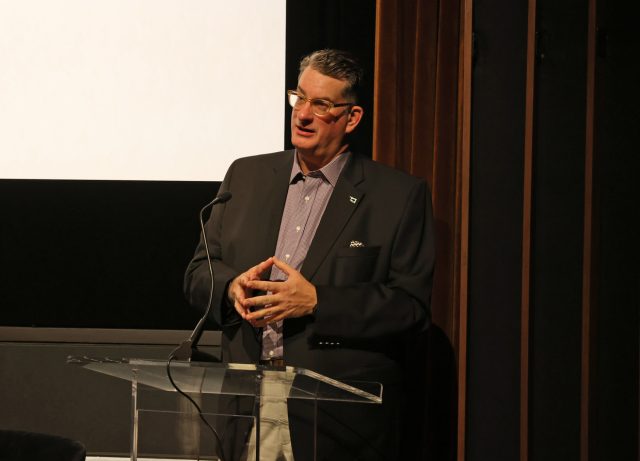
FILE PHOTO. James Gordon Meek, an ABC News investigative journalist. © Michael Le Brecht/ABC via Getty Images
By Felix Livshitz | Samizdat | October 22, 2022
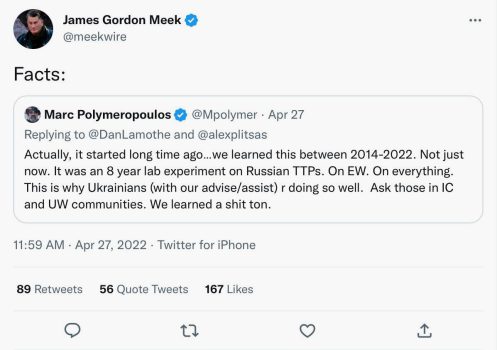
On 27 April, ABC News reporter James Meek tweeted a single word – “facts” – above another Twitter post from a retired CIA officer, who stated that the 2014-2022 Ukrainian civil war was an eight-year “lab experiment” on Russia’s military “tactics, techniques, and procedures.” It added that US intelligence and “unconventional warfare” experts had “learned a shit ton.”
It was the last time, to date, Meek posted on the social network. In fact, it seems it was the last time he did anything in public at all, both online and in-real-life. Rolling Stone has published an investigation into the veteran journalist’s vanishing act in the months since, revealing how just hours after that tweet was posted, a number of menacing vehicles blocked off roads around Meek’s apartment in Arlington, Virginia, then proceeded to raid the premises.
Neighbors interviewed by the magazine recall a collection of police cruisers, official-looking cars with blacked-out windows, and even armored tactical vehicles frequently used by the FBI, which resemble tanks. Quick as a flash, their occupants exited and rushed into Meek’s apartment complex, “at least 10” of them being “heavily armed.”
The raid was reportedly over very quickly, and Meek apparently didn’t leave the scene with the authorities. To this day, there is no indication of what if anything was seized or why it was conducted, and all records related to the case remain sealed, including the search warrant approved a day prior. While no charges have officially been filed, Meek has dropped off the face of the Earth, and his apartment has remained vacant ever since.
At precisely this time, Meek is said to have resigned “very abruptly” from his ABC News post without warning or explanation, with even close coworkers unaware of the reasons for his departure.
He is also said to have telephoned Lieutenant Colonel Scott Mann, a retired Green Beret, with whom he was collaborating on an almost completed book, “Operation Pineapple Express: The Incredible Story of a Group of Americans Who Undertook One Last Mission and Honored a Promise in Afghanistan,” to tell him he needed to withdraw from the project due to “serious personal issues.” Meek was apparently “really distraught” during the call.
Almost immediately, Meek’s name was scrubbed from the work’s entry on US publishing giant Simon & Schuster’s website, and its cover on various e-commerce sites listing it for pre-order. Several tweets from Meek promoting his involvement in the project have also been deleted.
Tell no tales
It’s remarkable that it has taken six months for anyone to publicly raise the alarm over Meek’s disappearance, and raise questions as to his whereabouts. One might think that a relatively high-profile veteran mainstream US journalist suddenly going missing would stoke concerns among his employers, if not fellow reporters, particularly given Meek’s history of reporting on contentious topics.
He has previously broken stories on foiled terrorist attacks, and military cover-ups surrounding the fatal ambush of four Green Berets by ISIS in 2017, and the accidental death by friendly fire of US private James Sherrett II in 2008. The latter exposure resulted in Meek meeting personally with President Barack Obama.
To source such scoops would have necessitated maintaining close high-level contacts within Washington’s national security apparatus – and there are clear indications Meek could himself have experience in that very sphere. As a 2013 ABC press release announcing the creation of a new investigative unit stated, since 2011 he’d “served as Senior Counterterrorism Advisor and Investigator for the House Committee on Homeland Security, grappling with some of the top threats to our country, including the bombing at the Boston Marathon.”
What this grappling entailed isn’t explained, although Rolling Stone interviews with his ABC peers indicate that despite his background being “shrouded in mystery,” Meek was in close quarters at various times with military and intelligence professionals. One of his coworkers mentioned a photo in his office taken in a desert, featuring Meek posing with a number of people who had had their faces retrospectively blacked out.
These nuggets might suggest not only that Meek had a background in military and/or intelligence work, but that these professional exploits could have overlapped with his journalism career, perhaps up to the present day.
This interpretation is greatly reinforced by an underexplored disclosure in Rolling Stone’s article. It is noted that unnamed sources had said “federal agents allegedly found classified information on Meek’s laptop during their raid.” One of Meek’s ABC coworkers further told the magazine: “it would be highly unusual for a reporter or producer to keep any classified information on a computer.” Which is true – but was he simply a “reporter or producer,” or something else too?
Even stranger, Rolling Stone fails to put two and two together when discussing how it would be unusual and unprecedented for the FBI to seize a reporter’s documents, as US laws make it illegal for journalistic material to be captured by federal prosecutors without special prior authorization from the US Attorney General’s office, and there is no evidence in the public domain that such an agreement was officially reached.
Again though, such restrictions only apply to documents held by journalists – not regular citizens, or individuals involved in national security work. As such, Meek’s final tweet – despite being posted after a warrant to search his home was secured – might be a highly incisive clue as to the rationale for the mysterious and completely unpublicized FBI raid.
Meek’s tweeting about the situation in Ukraine since 24 February was fairly sparse, but on 4 March, he revealed that America’s Germany-based 10th Special Forces Group had “spent a decade training Ukraine’s special operations forces in unconventional warfare, almost exclusively. They are seeing those tactics being used very effectively against the Russian Bear.”
In exposing this secret schooling, Meek was notably ahead of the curve – it is only since late September that Western news outlets have acknowledged the decade-long 10th Special Forces Group training provided to Kiev. This indicates he knew something the rest of the media didn’t, or maybe wasn’t allowed to mention at the time.
Meek’s other posts on Ukraine suggest that while far from a Russian apologist, he was very critical of US policy in the region, particularly plans to ship endless weapons to Ukraine, believing it would be difficult for the cargo to reach the frontline, let alone be used very effectively by local troops. Both obvious outcomes have been subsequently admitted, leading to online backlash, and official denials.
The ABC journalist’s knowledge of that covert training, and the US intelligence community exploiting the post-Maidan regime’s brutal war on the Donbass civilian population as a petri dish for prepping war with Russia, strongly suggests insider access. Combined with public skepticism over Washington’s war effort, could it be that Meek planned an expose of inconvenient hidden truths about the Western proxy war in Ukraine, or alternatively knew too much, and was dangerously well-positioned to publicize it?
Declassified documents reveal that the rule change protecting a journalist’s possessions from seizure contain massive loopholes. If the FBI is trying to identify an individual who leaked documents to a reporter, or attempting to surveil someone they believe to be an intelligence operative, those protections evaporate, and the bureau can monitor privileged private communications without the Attorney General office’s approval.
Were it the case that Meek was both a journalist and intelligence professional, by receiving sensitive briefings on US involvement in the war in Ukraine, he could have walked into a series of traps of his dual career’s own making, with no legal protections, and no need for official sign-off on a massive spying and raid operation targeting him.
It is unknown quite what information he could have possessed that the US government wanted to suppress, although the White House is so desperate to maintain official narratives on the Russia/Ukraine conflict that it’s giving direct briefings to Tik-Tok stars on the subject.
Of course, it’s entirely conceivable that someone who could blow the whistle on how Russia’s intervention was provoked, or what the US is trying to get out of prolonging the fighting, would need to be silenced as a matter of urgency.
Reports about Putin’s threat are false – Scholz
Samizdat | October 22, 2022
German Chancellor Olaf Scholz has dismissed reports that Russian President Vladimir Putin has threatened to escalate the conflict in Ukraine.
When asked about the issue during an interview with Die Welt newspaper on Saturday, Scholz said the media had been too loose in its interpretation of official reports from Berlin on its discussions with Moscow.
“For good reasons, I don’t speak about the negotiations that I have with the Russian president. But here’s what I can say: The reports that I read about the alleged threats during these negotiations are false,” the chancellor said.
The Russian and German leaders last talked on the phone in mid-September. According to Berlin, Scholz urged Putin to find a diplomatic solution for the conflict in Ukraine based on a ceasefire and the complete withdrawal of Russian troops during their 90-minute conversation. He also “emphasized that any further Russian annexation steps would not go unanswered and would not be recognized under any circumstances.”
According to the Kremlin, Putin told Scholz about the incessant shelling of cities in Donbass by Ukraine, which had led to civilian deaths and the destruction of infrastructure. The Russian leader called it a “gross violation of humanitarian law” by Kiev.
A few weeks after that, referendums on joining Russia were held in Kherson and Zaporozhye Regions, and in the People’s Republics of Donetsk and Lugansk, with the territories being officially incorporated into the Russian state in early October.
Earlier this week, Scholz told Deutschlandfunk outlet that the tone of his conversations with Putin “is always friendly, even if we have very different views on the matter.”
“I think it’s important that we have this conversation,” the chancellor said, but added that one shouldn’t “harbor any illusions” about those contacts bringing swift results.
Iran envoy dismisses Ukraine’s accusations Tehran violated UN resolution
Press TV – October 21, 2022
Iran’s permanent representative to the United Nations refutes Ukraine’s allegation that the Islamic Republic violated a UN resolution by, what Kiev calls, providing Russia with drones.
Amir-Saeid Iravani made the remarks in a letter to the UN Secretary-General Antonio Guterres and the world body’s Security Council (UNSC) on Thursday.
The envoy submitted the letter after Ukraine’s UN Ambassador Sergiy Kyslytsya wrote to Guterres and Security Council members, alleging that the Islamic Republic had “violated” the UNSC Resolution 2231 by allegedly transferring unmanned aerial vehicles to Russia, which is conducting a military operation in the ex-Soviet republic.
The letter obtained by the Associated Press alleges that Iran had violated the resolution by breaching the Paragraph 6 of its Annex B that used to ban Tehran from selling “uncrewed aerial vehicle (UAV) systems having a range equal to or greater than 300 kilometers (186 miles).” Kyslytsya also invited UN experts to visit his country to ascertain, what he called, Iran-built drones being used by Russia in the military operation.
Responding to Kiev’s allegations, Iravani noted that the restrictions mentioned in the Annex B of the UNSC resolution had “ended in October 2020.” “Since then, none of Iran’s actions towards provision, selling or transfer of weapons or related materials to other countries has been subject to the resolution,” he added.
The Ukrainian official also accused Iran of breaching the Paragraph 4 of Annex B, which bans development of nuclear-capable missile systems.
Iravani also condemned the Ukrainian official’s latter claim as “wrongful and arbitrary interpretation” of the resolution and Paragraph 4’s “spirit.”
The Islamic Republic “has neither provided, nor intends to provide [any foreign party] with items, materials, equipment, commodities, and technology that contribute to development of nuclear weapons.”
Ukraine’s invitation of UN experts towards examination of Iran’s so-called violation of Resolution 2231 is, therefore, “lacking in all legal foundation within Resolution 2231’s framework,” the Iranian official asserted.
The official called on the UN secretary-general to prevent any “misuse” of the resolution in relation to the war in Ukraine.
He finally called on the world body to confront such unfounded anti-Iranian allegations.
Ukraine war is ‘Biden’s war’ now
BY M. K. BHADRAKUMAR | INDIAN PUNCHLINE | OCTOBER 21, 2022
Russian Foreign Minister Sergey Lavrov said on Oct 18, 2022 that evidence of military personnel of United States and other Western countries having their boots on the ground in Ukraine is mounting.
The most obvious explanation to the mysterious air dash of the UK Defence Minister Ben Wallace to Washington on Tuesday could be that he was canvassing for the support of the Biden Administration for his pitch to succeed Liz Truss as Britain’s next prime minister. But another plausible explanation can be that the secret, hurried trip marked a defining moment in the conflict in Ukraine, which is showing all signs of turning into a full-fledged war.
To be sure, the Biden team cannot but be worried that London is drifting into chaos and the Conservative Party’s faction leaders scurry around like headless chickens looking for a substitute Truss who stepped down on Thursday.
The British economy is disintegrating and the Chancellor of the Exchequer Jeremy Hunt anticipates that a cut on the defence budget is inevitable. That is to say, the Deep State’s fun and frolic in Kiev is no longer affordable. The UK is heading for hard times, the rubric of Global Britain looks delusional.
Enter President Biden. The reports from Moscow suggest that Russians have hard intelligence to the effect that Washington has demanded from President Zelensky some spectacular performance on the battlefield as the midterms in the US on November 8 is around the corner.
That adds to the enigmatic comment by a second defence minister in London James Heappey that the conversations that Wallace would be having in Washington were “beyond belief,” hinting that particularly sensitive and serious issues were on the agenda.
Indeed, after arrival in Washington, Wallace headed straight for the White House to meet up with National Security Advisor Jake Sullivan, Biden’s point person for the Ukraine war. A White House readout said the two officials “exchanged views on shared national security interests, including Ukraine. They underscored their commitment to continue providing Ukraine with security assistance as it defends itself against Russian aggression.”
As British politics descends to skulduggery that will extend into months, the US will be a stakeholder. Historically, since the World War 2, Britain led the US from the rear in critical situations involving Russia.
Indeed, Biden issued a rare statement on Truss’ exit, which stated that the US and the UK “are strong Allies and enduring friends — and that fact will never change.” He thanked her “for her partnership on a range of issues including holding Russia accountable for its war against Ukraine.” Biden underscored that “We will continue our close cooperation with the U.K. government as we work together to meet the global challenges our nations face.”
Biden has sent a powerful message to Britain’s political class signalling that he expects them to come up with a new prime minister who will faithfully adhere to the compass set by Boris Johnson on Ukraine. In immediate terms, what does it signal for the Anglo-American project in Kherson? Will it go ahead? That is the big question.
The situation in Kherson is assuming the nature of a large-scale military confrontation, as Zelensky is throwing everything into it in an attempt to wrest control of the strategic Kherson city, which has been under Russian control since March, before the midterms in the US.
At a press conference in Moscow on Tuesday, Army general Sergei Surovikin, the newly-appointed theatre commander for Ukraine operations, conceded that there was a danger of the Ukrainian forces advancing toward Kherson city.
To quote the general, “A difficult situation has arisen. The enemy deliberately bombards infrastructure and residential buildings in Kherson. The Antonovsky Bridge and the dam of the Kakhovskaya hydroelectric power station were damaged by HIMARS missiles, traffic there was stopped.
“As a result, the supply of food in the city is difficult, there are certain problems with the water and electricity supply. All this greatly complicates the lives of citizens, but also poses a direct threat to their lives.
“The NATO leadership of the Ukrainian armed forces has long been demanding offensive operations against Kherson from the Kiev regime, regardless of casualties… We have data on the possibility that the regime in Kiev will use prohibited methods of war in the area of the city of Kherson — preparation for a big missile attack on the Kakhovskaya hydroelectric dam, massive and indiscriminate missile and artillery attacks on the city…
“In these circumstances, our top priority is to preserve the life and health of citizens. Therefore, the Russian army will first of all ensure the safe, already announced departure of the population according to the resettlement program being prepared by the Russian government. Our further plans and actions regarding the city of Kherson itself will depend on the current military-tactical situation. I repeat, it is already very difficult today. [Emphasis added.]
“In any case, as I said, we will start from the need to protect the lives of civilians and our military as much as possible. We will act consciously and in a timely manner, without excluding difficult decisions.” [Emphasis added.]
The full interview of Gen. Sergey Surovikin to Russian media is below:
The Kremlin thinking gets echoed in a public appeal by the head of the Kherson region Vladimir Saldo where he explained that the evacuation of civilians was not only for people’s safety but also for the operational freedom of the military:
“Dear compatriots, I want to say again that our army has very strong capabilities to repel any attack. But in order for our military to work quietly and not to think that civilians are behind their backs, you MUST get out of these neighbourhoods I mentioned and allow the military to do its job properly, with fewer casualties for the civilians. Our cause is just and we are sure we will win!”
The message here is that the Russian military is prepared to expand the scope of the conflict in Kherson, if need arises. There has been talk about a massive Russian offensive circa mid-November. The new security measures announced by Putin this week and the establishment of a special coordination council headed by Prime Minister Mikhail Mishustin to support the needs of Russia’s Armed Forces imply that time is being put on a war footing.
Significantly, Gen. Surovikin said at one point in his press conference: “The enemy does not give up trying to attack the positions of the Russian troops. This concerns, first of all, the directions Kupyansk (Kharkov oblast), Krasnolimansky (Donetsk oblast) and Mykolaiv-Krivoy Rog (neighbouring Kherson oblast.) Our enemy is a criminal regime that is killing the citizens of Ukraine. We are one people with Ukrainians and we wish Ukraine to become a state independent of the West and NATO, friendly to Russia… [Emphasis added.]
“The Ukrainian regime is trying to break through our defences. To this end, the AFU is pulling all available reserves to the front lines. These are mainly territorial defense forces that have not completed full training. In fact, the Ukrainian leadership is condemning them to destruction.”
Then, he added, “We have a different strategy. The Commander-in-Chief [President Putin] has already talked about this. We don’t aim for high advance figures, we take care of every soldier and methodically “grind” the advancing enemy. This not only limits our losses, but also significantly reduces the number of civilian casualties.”
That is to say, specifically, the set parameters of the special military operations with focus on “demilitarisation” and “denazification” remain unchanged while also aiming at the replacement of Zelensky’s regime.
Russia will be keenly watching the profound political crisis developing in Europe, of which the paroxysms in Britain are an early harbinger, which could erode the rock-like UK support for Zelensky, as the western capability and interest to bankroll the Ukrainian economy and fuel the military conflict may also be on the wane.
Nonetheless, Surovikin did not take to hyperbole but instead chose to communicate directly, realistically. He echoed Putin’s priority to take all necessary measures and resources in accordance with the operational and tactical situation at the front with the supreme objective of saving the lives of Russian soldiers and local civilians.
The general conveyed the impression that the Russian command is ready for every development of the situation in Kherson — both tactical withdrawal and heavy city fighting.
In political terms, with the UK bogged down in a domestic quagmire, Biden has the option to shift to diplomacy. This is “Biden’s war” now. He is about to script his presidential legacy as the fifth of the 14 American presidents in office since World War II to “own” a war — after Harry Truman, Lyndon Johnson, George HW Bush and George W. Bush.
Featured Video

AIDS Inc. by Gary Null (2007)
or go to
Aletho News Archives – Video-Images
From the Archives
Clash of Civilization, Iran Part II
By Jamal Kanj – Intifada-Palestine.com – January 14, 2011
Israel’s survival kit is: perpetuate conflict, insecurity to rationalize collective hate and finally playing victim.
Devoid of conflict, Israel implodes internally; without hate, Zionism loses its justification; and playing eternal victim to continue blackmailing the West. Absence of this holy trinity, Israel ceases to exist.
From its inception, the house of Zion has mastered exploiting adversarial powers to advance Israel’s cause. For instance, their influence over the Democratic Party in the US began with President Truman’s bid for 2nd term election in 1948.
Responding to strong opposition from Secretary of State General George Marshall and Department experts urging against recognition of Israel, President Truman replied: “I’m sorry gentlemen but I have to answer to hundreds of thousands [Jewish voters] who are anxious for the success of Zionism. I do not have hundreds of thousands of [voting] Arabs among my constituents”
Zionists influence over liberal American politics was matched with the doctrinal school of Conservative theoreticians aligning the Republican Party’s platform with Israel’s objectives. The Neoconservative Zionists, coined Zioncons, invented the “Clash of Civilization” concept to fight Israel’s wars. … continue
Blog Roll
 Aletho News
- Merck Virologists Admitted to Falsely Certifying Vaccine Efficacy
- Mandatory Folic Acid for every man, woman & child
- Pro-Palestine protesters arrested outside UK’s ruling Labour Conference in Liverpool
- Mauritius denies landing permit to flight from Israel, forcing cancellation: Tour operator
- Israeli finance minister calls for genocidal war on West Bank, annexation of south Lebanon
- 12 Things Your Psychiatrist Was Trained Not to Tell You
- From Unipolar Universalism to Multipolar Civilizational Distinctiveness
- RSF military group defects, joins Sudanese army: State media
- Ireland goalkeeper refuses to play ‘Israel’ as squad weighs boycott
- China pushes back against US on Cuba, Iran
- If Americans Knew
- Israel forces Gazans to live in constant peril – Daily Update
- Deconstructing Netanyahu’s pants-on-fire UN rant – Daily Update
- Trump betrayed voters with his campaign lies and prioritized a foreign country once he took office
- Netanyahu calls Israel’s war in Gaza ‘opposite of genocide’ in UN speech to near-empty hall
- Settler Kidnappings: Torture, Sexual Abuse and Terrorisation of Palestinian Abductees as Israel Deepens Annexation of West Bank
- Gaza winter nears as 162,000 tents become unusable, raising fears of humanitarian crisis
- Netanyahu says, “It’s the opposite of genocide”; UN says Gaza economy is world’s ‘most severe crisis on record’ – Daily Update
- Israel’s US-Backed Assault on Gaza Has Created the ‘World’s Most Severe Economic Crisis on Record’: UN
- ‘Protecting U.S. Citizens’… From Israel
- ‘This is where I live now, the back of a truck’: a day in the life of a grandmother in Gaza
- No Tricks Zone
- New Study: Earth And Venus Surface Warmth Largely Explained By Convection And Lapse Rate, Not CO2 Or Radiation
- 2025 Nature Paper Claiming Worsening Global Drought Gets RETRACTED …Heavily Flawed
- New Study: ‘Global Drought Shows No Detectable Recent Acceleration Under Climate Warming’
- Economic Masterminds: German Socialists Suggest Taxing Productivity Gains Stemming From Using AI
- The South China Sea Has Not Been Cooperating With The Climate Change Narrative
- Energy Crisis: Germany Enters Heating Season With Historically Low Gas Reserve Fill Levels
- New Study: The Antarctic Ice Sheet Gained Mass From 2020-2024 Due To Staggering Snow And Ice Accumulation
- Study: Ocean Heating Rates From Thousands Of Years Ago ‘Dwarf’ Modern Ocean Heating Rates
- Climate Extremists Target, Attack Large-Scale Power Grid Infrastructure In Germany!
- New Study: Antarctic Ice Melt Has Contributed Less Than 1 Centimeter To Sea Level Rise In The Last 30 Years

