Minsk deal was used to buy time – Ukraine’s Poroshenko
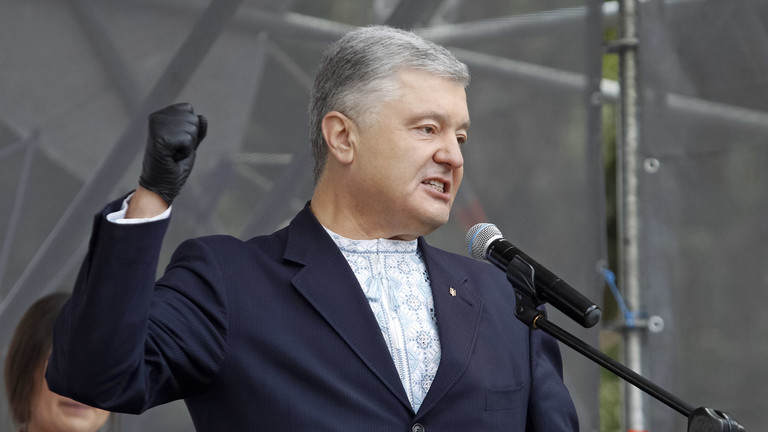
Petro Poroshenko said the Minsk agreements “meant nothing” – ©STR / NurPhoto via Getty Images
RT | June 17, 2022
Petro Poroshenko has admitted that the 2015 ceasefire in Donbass, which he negotiated with Russia, France and Germany as president of Ukraine, was merely a distraction intended to buy time for Kiev to rebuild its military.
He made the comments in interviews with several news outlets this week, including Germany’s Deutsche Welle television and the Ukrainian branch of the US state-run Radio Free Europe. Poroshenko also defended his record as president between 2014 and 2019.
“We had achieved everything we wanted,” he said of the peace deal. “Our goal was to, first, stop the threat, or at least to delay the war – to secure eight years to restore economic growth and create powerful armed forces.”
He cited Sun Tzu’s stratagems as an inspiration for the deception. Winning a war does not necessarily require winning military engagements, Poroshenko said, calling the deal he made a win for Ukraine in that regard.
Poroshenko failed to be reelected in a landslide vote for President Volodymyr Zelensky, who promised voters that, unlike his predecessor, he would secure peace in Donbass.
In the interviews, Poroshenko spoke about his role in negotiating the Minsk agreements, a roadmap for reconciliation between his government and the Donetsk and Lugansk People’s Republics. The former president apparently confirmed that Kiev hadn’t come to the talks in good faith, but simply wanted a reprieve after suffering a military defeat.
The agreements included a series of measures designed to rein in hostilities in Donbass and reconcile the warring parties. The first steps were a ceasefire and an OSCE-monitored pullout of heavier weapons from the frontline, which were fulfilled to some degree.
Kiev was then supposed to grant general amnesty to the rebels and extensive autonomy for the Donetsk and Lugansk regions. Ukrainian troops were supposed to take control of the rebel-held areas after Kiev granted them representation and otherwise reintegrated them as part of Ukraine.
Poroshenko’s government refused to implement these portions of the deal, claiming it could not proceed unless it fully secured the border between the rebellious republics and Russia. He instead endorsed an economic blockade of the rebel regions initiated by Ukrainian nationalist forces.
Zelensky’s presidency gave an initial boost to the peace process, but it stalled again after a series of protests by right-wing radicals, who threatened to dispose of the new Ukrainian president if he tried to deliver on his campaign promises.
Kiev’s failure to implement the roadmap and the continued hostilities with rebels were among the primary reasons that Russia cited when it attacked Ukraine in late February. Days before launching the offensive, Moscow recognized the breakaway Ukrainian republics as sovereign states, offering them security guarantees and demanding that Kiev pull back its troops. Zelensky refused to comply.
Now an opposition MP, Poroshenko, called on Western nations to provide more and heavier weapons for Kiev so that Ukrainian soldiers can “do [the West’s] job” and defend Europe from Russia. He also called for more anti-Russia sanctions and for his country to join the EU and NATO as soon as possible.
Poroshenko claimed that Russian President Vladimir Putin was the one who broke the Minsk agreements. He claimed credit for Ukraine not falling into Russia’s hands within a matter of days, which was the prediction of some Western officials. The country stood up to the attack thanks to military reforms that his government implemented, the former president claimed. Moscow never gave a timeline for its military operation in Ukraine, stating only that it has proceeded as intended.
The Ukrainian official also called for the “de-Putinization” of Europe, his own country and Russia itself. He said this meant curbing Russian influence in other nations and toppling Putin. It is the only way to save the world from an “existential threat” that, Poroshenko claimed, the Russian leader poses.
Russian Diplomat Refutes Reports About Moscow Transporting Ukrainian Grain to Syria
Samizdat – 17.06.2022
Recent reports claiming that Russia has allegedly been supplying Syria with Ukrainian grain are nothing but misinformation and fake news, Russian Special Presidential Envoy for Syria Alexander Lavrentiev told Sputnik.
On June 2, Reuters reported, citing Ukrainian Embassy in Lebanon, that Russia had allegedly exported 100,000 tonnes of wheat from Ukraine since the start of its special military operation and had supplied it to Syria.
“This is yet another fake, unconfirmed information, which is detached from reality. The main reserves [of wheat] are in the Mykolaiv and Odesa regions, and Russian ships do not have access to these ports because they are under Ukrainian control,” Lavrentyev said.
There are also no grain depots in the Russian-controlled port city of Mariupol, the diplomat added.
“Only recently — literally a week ago — the port was demined and brought to a more or less normal condition,” the official said, noting that “there can be no questions about a hundred thousand tonnes of Ukrainian grain.”
World leaders and international organizations have repeatedly urged Russia to allegedly unblock Ukraine’s sea ports and release the grain stuck in warehouses. Moscow has denied blocking sea ports and has drawn attention to the mines deployed by Kiev in the Black Sea.
China doubles down on vision with Russia
BY M. K. BHADRAKUMAR | INDIAN PUNCHLINE | JUNE 16, 2022
The most animating template of the West’s “information war” lately against Russia is, perhaps, its distorted projection of the China-Russia relationship in the context of the Ukraine crisis. This dubious enterprise has practical implications for the “endgame” in Ukraine, the West’s efforts to “erase” Russia and the US’ struggle with China — above all, it is fraught with consequences for the emerging world order.
Henry Kissinger, who is responsible for the hypothesis of the US-Russia-China triangle in Cold War history, recently made a pitch to invoke the spectre of a “permanent alliance” between Russia and China to give a shock therapy to the Western audience over their craving to isolate Russia from Europe. Kissinger advised Kiev to make territorial concessions to Moscow. The relevance of Kissinger’s hypothesis is debatable today, and, perhaps, a much bigger rationale needs to be found to explain the epochal nature of the China-Russia relationship, which is at an all-time high level historically.
Clearly, neither China nor Russia is seeking an alliance and their relationship is certainly not in the nature of a classic alliance but, paradoxically, it also goes far beyond the definable scope of an alliance. This comes out vividly from the document issued during Russian President Vladimir Putin’s visit to Beijing in February titled Joint Statement of the Russian Federation and the People’s Republic of China on the International Relations Entering a New Era and the Global Sustainable Development.
Against such a backdrop, the conversation between Putin and Chinese President Xi Jinping on June 15 should conclusively scatter the West’s information war. Xi Jinping chose his birthday to make this call, attesting to the deep friendship between the two leaders over a decade, which provides not only a solid foundation to the relationship but great stability, considering the nature of the two political systems and the “alchemy” of their statecraft. The centrality of this singular factor is either deliberately obfuscated or not properly grasped in the West’s discourses.
From the readouts of the June 15 phone conversation (here and here), the following salients are to be noted:
- At its most obvious level, the two leaderships have underscored beyond doubt that the China-Russia strategic partnership characterised by a high degree of trust is not buffeted by the current events or the turbulence and uncertainty in the international situation.
- China and Russia remain committed to extending mutual support on matters regarding each other’s core interests and matters of paramount concern, such as sovereignty and security. The Chinese readout emphasised Putin’s support for China on Taiwan, Hong Kong and Xinjiang.
- The West’s efforts to create daylight in the China-Russia partnership remain futile.
- Notwithstanding the West’s sanctions against Russia, the trade and economic cooperation between China has good momentum and is poised to make steady progress. China is willing to push for the steady and long-term development of practical bilateral cooperation despite the western sanctions against Russia.
- On the “Ukraine issue”, China assesses the situation in both its historical context and the merits of the issue and seeks a proper settlement in a responsible manner. In a significant rhetorical departure, there was no reference to sovereignty and territorial integrity questions or to “war” or ceasefire, etc.
- Broadly speaking, more than 100 days into the war in Ukraine, Xi has focused squarely on his support for Russia. The big message is that the events in Ukraine have not dented Xi’s basic commitment to the Sino-Russian partnership.
The bottom line is that China doubles down on its vision with Russia as spelt out in the joint statement of February 4. It is to be noted that Xi’s call was timed shortly before a European summit is slated to put on a show of solidarity with Ukraine and, equally, as countdown begins for a NATO summit at the end of this month, which is expected to approve a new “strategic concept” that will upgrade vigilance against Russia and also mention potential challenges to the alliance from China for the first time. The leaders of Japan and South Korea will be attending the NATO summit for the first time.
The key message here is that China and Russia have no choice but to jointly resist NATO’s all-round suppression through close strategic coordination, and further maintain the balance of the global strategic situation. Indeed, the 13-hour joint air patrol in late May by a task force of Russian and Chinese strategic bombers over the Sea of Japan and East China Sea bang in the middle of the Ukraine conflict speaks for itself.
The fact that Tokyo has overnight breathed life into the dispute over Russian “occupation” of the Kuril Islands just when Moscow is involved in a conflict on the western front, would bring Russia and China on the same page with regard to the ascendency of Japanese militarism, with US support and encouragement, as a new factor in the Asia-Pacific.
All in all, Xi Jinping’s call and the vehement expression and display of Chinese support and understanding has come at a time when Putin needs it most. The Kremlin readout explicitly stated: “It was agreed to expand cooperation in energy, finance, the manufacturing industry, transport and other areas, taking into account the global economic situation that has become more complicated due to the illegitimate sanctions policy pursued by the West. The further development of military and defence ties was touched upon as well.”
To borrow the undiplomatic words of European Commission President Ursula von der Leyen, Xi may have inflicted “a major reputational damage for China” in the West. Quite obviously, Xi has ignored the repeated warnings by US officials that the “sanctions from hell” to weaken Russia would visit China too if Beijing gave support to Moscow. Curiously, Xi rebooted the China-Russia partnership although Biden Administration officials are spreading a notion lately that a “thaw” is on the cards in US-China relations.
Following the meeting on Monday between Yang Jiechi, CCP Politburo member and Jake Sullivan, Biden’s national security advisor at Luxembourg, the White House characterised the discussion as “candid, substantive, and productive,” while the Chinese press release was noticeably circumspect: “The United States should put China in the right strategic perspective, make the right choice, and translate President Biden’s remarks into concrete actions that the United States does not seek a new Cold War with China; it does not aim to change China’s system; the revitalisation of its alliances is not targeted at China; the United States does not support “Taiwan Independence”; and it has no intention to seek a conflict with China. The United States needs to work with China in the same direction to earnestly implement the important consensus reached by the two heads of state.”
Yang warned that “The Taiwan question concerns the political foundation of China-U.S. relations, and if it is not handled properly, it will have a subversive impact. This risk not only exists, but will continue to rise.” The Chinese readout described the discussion as “candid, in-depth and constructive communication and exchanges.”
Xi’s call with Putin came two days later.
The Road to Nuclear Armageddon
By Llewellyn H. Rockwell, Jr. | June 16, 2022
Ladies and gentlemen, we face a grave danger. The leader of a major European power wants to make territorial revisions. He is surrounded by hostile powers who threaten him. He does not seek war with other countries but if the hostile powers continue to encircle him, he will fight. A European war looms.
You probably think I’m talking about the current crisis between Russia and the Ukraine, but I’m not. I’m talking about Europe just before World War II began in September 1939. At that time, Hitler wanted small territorial revisions with its Polish neighbor. East Prussia was cut off from the rest of Germany by a band of territory called the Polish Corridor.
As the great British historian A.J. P. Taylor explains,
“The losses of territory to Poland were, for most Germans, the indelible grievance against Versailles. Hitler undertook a daring operation over this grievance when he planned co-operation with Poland. But there was a way out. The actual Germans under Polish rule might be forgotten—or withdrawn; what could not be forgiven was the ‘Polish corridor’ which divided East Prussia from the Reich. Here, too, there was a possible compromise. Germany might be satisfied with a corridor across the corridor—a complicated idea for which there were however many precedents in German history. German feeling could be appeased by the recovery of Danzig. This seemed easy. Danzig was not part of Poland. It was a Free City, with its own autonomous administration under a High Commissioner, appointed by the League of Nations. The Poles themselves, in their false pride as a Great Power, had taken the lead in challenging the League’s authority. Surely, therefore, they would not object if Germany took the League’s place. Moreover, the problem had changed since 1919. Then the port of Danzig had been essential to Poland. Now, with the creation of Gdynia by the Poles, Danzig needed Poland more than the Poles needed Danzig. It should then be easy to arrange for the safeguarding of Poland’s economic interests, and yet to recover Danzig for the Reich.”
The British responded by guaranteeing Poland’s western boundary against Germany. They also issued a guarantee to Romania, even though there had been no threat to that country. As a result of the guarantee, Poland refused to negotiate with Germany. War broke out, and Poland was destroyed. The great Murray Rothbard tells us what happened:
“And as a direct result, Poland was destroyed. Hitler’s ‘demands’ on the Poles were almost non-existent; as Taylor points out, the Weimar Republic would have scorned the terms as a sell-out of vital German interests. Hitler at most wanted a ‘corridor through the Corridor’ and the return of heavily-German (and pro-German) Danzig; in return for which he would guarantee the rest. Poland resolutely refused to yield’ one inch of Polish soil,’ and refused even to negotiate with the Germans, and this down to the last minute.”
Murray draws an important lesson from what happened then. This lesson provides the key to keeping us out of a nuclear war today. And of course a nuclear war would destroy the world. Here is what Murray says:
“[Polish Foreign Minister Józef] Beck clearly knew that Britain and France could not actually save Poland from attack. He relied to the end on those great shibboleths of all ‘hard-liners’ and other ‘crackpot realists’ everywhere: X is ‘bluffing’; X will back down if met by toughness, resolution, and the resolve not to give an inch. (Just as in the case of Finland, when the ‘X is bluffing’ line of the hard-liners is shown to be sheer absurdity, and X has already attacked, the ‘hard-liner’ turns, self-contradictorily, to the dictum that not ‘one inch of sacred soil’ will be given up, no peace while the enemy is on our soil, etc., which completes the ruin of the country by its ‘hard-line’ rulers. This is what Beck did to Poland.) As Taylor shows, Hitler had originally not the slightest intention to invade or conquer Poland; instead, Danzig and other minor rectifications would be gotten out of the way, and then Poland would be a comfortable ally, perhaps for an eventual invasion of Soviet Russia. But Beck’s irrational toughness blocked the path.”
Now we have the background we need to understand what’s going on today. Russia is surrounded by a hostile NATO alliance. The propagandists for brain-dead Biden like to say that Putin had Ukraine surrounded. But in fact, the US and its NATO satellites had Russia surrounded. In the years before the current crisis, we had ample opportunity to reach a compromise settlement. Instead, we kept the option of membership in NATO open to Ukraine and overthrew a Ukrainian President who was pro-Russian. At the Kremlin. . . in a speech in November 2021] Putin drew his red line:
‘The threat on our western borders is … rising, as we have said multiple times. … In our dialogue with the United States and its allies, we will insist on developing concrete agreements prohibiting any further eastward expansion of NATO and the placement there of weapons systems in the immediate vicinity of Russian territory.’
A story in The New York Times exposes what brain-dead Biden and the gang of neo-cons that controls him have in store for us. According to an item that was published April 26,
“When Defense Secretary Lloyd J. Austin III declared Monday at the end of a stealth visit to Ukraine that America’s goal is to see Russia so ‘weakened’ that it would no longer have the power to invade a neighboring state, he was acknowledging a transformation of the conflict, from a battle over control of Ukraine to one that pits Washington more directly against Moscow. . . in word and deed, the United States has been gradually pushing in the direction of undercutting the Russian military.
It has imposed sanctions that were explicitly designed to stop Russia’s military from developing and manufacturing new weapons. It has worked — with mixed success — to cut off the oil and gas revenues that drive its war machine. . . over the longer term, Mr. Austin’s description of America’s strategic goal is bound to reinforce President Vladimir V. Putin’s oft-stated belief that the war is really about the West’s desire to choke off Russian power and destabilize his government. And by casting the American goal as a weakened Russian military, Mr. Austin and others in the Biden administration are becoming more explicit about the future they see: years of continuous contest for power and influence with Moscow that in some ways resembles what President John F. Kennedy termed the ‘long twilight struggle’ of the Cold War.
Mr. Austin’s comments, bolstered by statements by Secretary of State Antony J. Blinken about the various ways in which Mr. Putin has ‘already lost’ in the struggle over Ukraine, reflect a decision made by the Biden administration and its closest allies, several officials said on Monday, to talk more openly and optimistically about the possibility of Ukrainian victory in the next few months as the battle moves to the Russian-speaking south and east, where Mr. Putin’s military should, in theory, have an advantage.
At a moment when American intelligence officials are reporting that Mr. Putin thinks he is winning the war, the strategy is to drive home the narrative that Russia’s military adventure will be ruinous, and that it is a conflict Mr. Putin cannot afford to sustain.”
Let’s make sure we understand this. Critics of US policy have pointed out for a long time that America has surrounded Russia with nuclear bases. It helped overthrow a pro-Russian government in the Ukraine. Naturally, this made Putin nervous. He does not want an invasion of Russia through the Ukraine, as happened in World War II, when Russia lost millions of lives. Now, the brain dead Biden gang of neocons is saying to Putin, “You are exactly right! We do want to degrade Russia to a minor power and use the Ukraine as a base for attack!”
Nothing could be more certain to lead to nuclear disaster. The Russians warn us about this A story in The Guardian says:
“Russia’s foreign minister has accused Nato of fighting a proxy war by supplying military aid to Ukraine, as defence ministers gathered in Germany for US-hosted talks on supporting Ukraine through what one US general called a ‘very critical’ few weeks.
Sergei Lavrov told Russian state media: ‘Nato, in essence, is engaged in a war with Russia through a proxy and is arming that proxy. War means war.’
He also warned that the risks of nuclear conflict were now ‘considerable’. . . When asked about the importance of avoiding a third world war, Lavrov said: ‘I would not want to elevate those risks artificially. Many would like that. The danger is serious, real. And we must not underestimate it.’”
If it weren’t for the US arms shipments to the Ukraine, Russia and the Ukraine would quickly arrange a settlement that would protect Russia’s security interests. Those in control know this, but they don’t want a peaceful settlement along these lines. They want to rule the world. They don’t want countries that reject US supremacy to have a role in the world.
“Chairman of the Joint Chiefs of Staff Gen. Mark Milley told CNN’s Jim Sciutto on Tuesday that the entire ‘global international security order’ put in place after World War II is at stake if Russia gets away ‘cost-free’ following its invasion of Ukraine. . . ‘What’s at stake is the global international security order that was put in place in 1945. That international order has lasted 78 years. . . Milley’s warning about the potential global implications of Russia’s actions in Ukraine also underscores the current sense of urgency felt by the US and its allies as the war enters what they say is a critical juncture… Shortly after Milley’s interview, [Defense Secretary] Austin also stressed the importance of moving quickly to provide Ukraine with the military aid it needs, saying during a news conference that the US and other allies and partners ‘don’t have any time to waste’ when it comes to providing crucial assistance to counter Russia as their invasion continues.
‘We don’t have any time to waste. The briefings today laid out clearly why the coming weeks will be so crucial for Ukraine, so we’ve got to move at the speed of war. . . Austin also said that he thought Ukraine ‘will seek to once again apply to become a member of NATO in the future.’”
Is there anything we can do to de-escalate the situation? The greatest Congressman in American history, Dr. Ron Paul, whom we are here today to honor, has the answer. America should end its encirclement of Russia and disband NATO. Let’s look at his vital message to us:
“When the Bush Administration announced in 2008 that Ukraine and Georgia would be eligible for NATO membership, I knew it was a terrible idea. Nearly two decades after the end of both the Warsaw Pact and the Cold War, expanding NATO made no sense. NATO itself made no sense.
Explaining my ‘no’ vote on a bill to endorse the expansion, I said at the time:
NATO is an organization whose purpose ended with the end of its Warsaw Pact adversary… This current round of NATO expansion is a political reward to governments in Georgia and Ukraine that came to power as a result of US-supported revolutions, the so-called Orange Revolution and Rose Revolution.
Providing US military guarantees to Ukraine and Georgia can only further strain our military. This NATO expansion may well involve the US military in conflicts unrelated to our national interest…
Unfortunately,. . . , my fears have come true. One does not need to approve of Russia’s military actions to analyze its stated motivation: NATO membership for Ukraine was a red line it was not willing to see crossed. As we find ourselves at risk of a terrible escalation, we should remind ourselves that it didn’t have to happen this way. There was no advantage to the United States to expand and threaten to expand NATO to Russia’s doorstep. There is no way to argue that we are any safer for it.
NATO itself was a huge mistake. . . I believe as strongly today as I did back in my 2008 House Floor speech that, ‘NATO should be disbanded, not expanded.’ In the meantime, expansion should be off the table. The risks do not outweigh the benefits!”
The saddest part of this whole manufactured crisis is that it should make absolutely no difference to us whether Russia controls Ukraine. How is that a threat to the United States? Whatever Biden and his neocon advisers say, America should stay out of conflicts that are none of our business. As usual, Murray Rothbard put it best. “In the context of the 1980 Afghan war, he quoted Canon Sydney Smith – a great classical liberal in early 19th century England who wrote to his warmongering Prime Minister, thus:
“For God’s sake, do not drag me into another war!
I am worn down, and worn out, with crusading and defending Europe, and protecting mankind; I must think a little of myself.
I am sorry for the Spaniards – I am sorry for the Greeks – I deplore the fate of the Jews; the people of the Sandwich Islands are groaning under the most detestable tyranny; Baghdad is oppressed, I do not like the present state of the Delta; Tibet is not comfortable. Am I to fight for all these people?
The world is bursting with sin and sorrow. Am I to be champion of the Decalogue, and to be eternally raising fleets and armies to make all men good and happy?
We have just done saving Europe, and I am afraid the consequence will be, that we shall cut each other’s throats. No war, dear Lady Grey! – No eloquence; but apathy, selfishness, common sense, arithmetic!”
The same people who imposed Covid-tyranny on us now want us to risk war with Russia. Let’s stop them before it’s too late.
Western media and politicians prefer to ignore the truth about civilians killed in Donetsk shelling
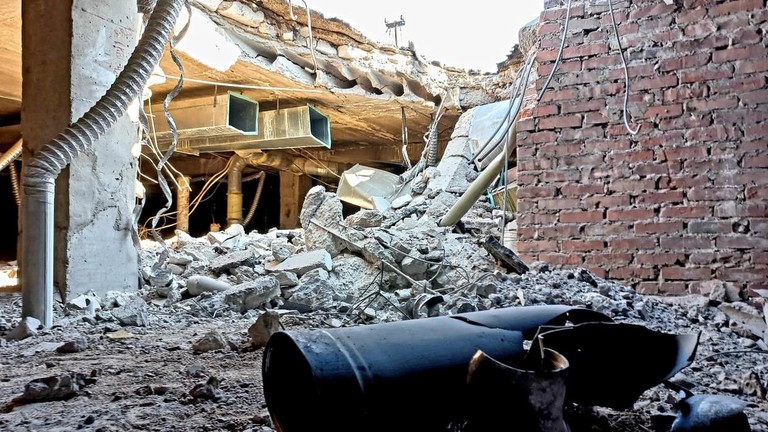
Remnants of the Uragan MLRS rocket which struck the Donetsk maternity hospital June 13. © Eva Bartlett / RT
By Eva Bartlett | Samizdat | June 16, 2022
Following intense Ukrainian shelling of Donetsk on June 13, some Western media sources, in tandem with outlets in Kiev, unsurprisingly claimed that the attack – which killed at least five civilians and struck a busy maternity hospital – was perpetrated by Russian forces.
Why Moscow would launch rockets at its own allies wasn’t explained, nor would it make much sense.
The Donetsk People’s Republic’s foreign ministry reported: “Such an unprecedented. in terms of power, density and duration of fire, raid on the DPR capital was not recorded during the entire period of the armed conflict [since 2014]. In two hours, almost 300 MLRS rockets and artillery shells were fired.”
The Ukrainian shelling began late morning, resumed in the afternoon, and continued for another two hours in the evening, a deafening series of blasts throughout the city, terrorizing residents and targeting apartment buildings, civilian infrastructure, the aforementioned hospital, and industrial buildings.
Locals say this was some of the heaviest bombing of Donetsk since 2014, when the eponymous region declared its independence from post-Maidan Kiev.
In the Budyonnovsky district in the south of the city, Ukrainian shelling of a market killed five civilians including one child. Just two months ago, Kiev’s forces hit another Donetsk market, leaving five civilians dead.
In the hard-hit Kievskiy district, to the north, the shelling caused fires at a water bottling plant and a warehouse for stationery, destroying it. The building was still in flames when journalist Roman Kosarev and I arrived about an hour after the attack. Apartment buildings in the area also came under firer, leaving doors and windows blown out and cars destroyed.
The destroyed gas station was on a street where I stayed in April, which is completely residential.
DPR head Denis Pushilin said, “The enemy literally crossed all the lines. Prohibited methods of warfare are being used, residential and central districts of Donetsk are being shelled, other cities and settlements of the DPR are also under fire now.”
Hypocritical silence after maternity hospital shelling
In a world where media reported honestly instead of manufacturing its own reality, there would be outrage over Ukraine’s attack on the Donetsk maternity hospital. But history shows that is not a world we live in.
As I wrote last year, Western media and talking heads also diligently avoided condemnation when terrorists attacked or destroyed Syrian hospitals, including the shelling of a maternity hospital in Aleppo, which killed three women.
At the damaged Donetsk hospital, I saw the gaping hole in the roof and remnants of the Uragan MLRS rocket which struck it. Most of the windows of both buildings were blown out.
Images shared on Twitter noted, “Both gynecology and intensive care have been bombed.” Other footage, taken by Donetsk war correspondent Dmitri Ashtrakhan, showed dozens of women, some heavily pregnant, taking shelter in the basement of the shelled maternity hospital.
Were these women and this hospital in Kiev, you can bet Western media would be loudly reporting it 24/7 for weeks. Instead, just as the West has steadfastly ignored Ukraine’s eight years of war on Donbass, they also omit reporting on the hospital.
Grotesquely, some Ukrainian and Western media instead disingenuously reported that it was a Russian attack, not Ukrainian, which terrorized, injured and killed civilians on June 13.
Just as Western media’s lack of reporting, or twisting of the narrative, on Ukraine’s shelling was to be expected, so too was the UN’s weak-worded condemnation, with the Spokesman for the Secretary-General, Antonio Guterres, calling it “extremely troubling.” You can bet that were the situation reversed and Russia responsible for bombing a Ukrainian maternity hospital, his words would have been far stronger.
In fact, they already have been: Three months ago, when Kiev accused Russia of an attack on a maternity hospital, in Mariupol.
Back then, the Guterres emphatically tweeted, “Today’s attack on a hospital in Mariupol, Ukraine, where maternity & children’s wards are located, is horrific. Civilians are paying the highest price for a war that has nothing to do with them. This senseless violence must stop. End the bloodshed now.”
A strong reaction to what later emerged to be a hoax claim, when the UN itself even admitted it could not verify the story. But a mild reaction to a documented reality in Donetsk.
The UN did, at least, rightly note the attack on the Donetsk maternity hospital was, “an obvious breach of the international humanitarian law.” So there’s that.
The thing is, Ukraine has violated international law for its eight years of waging war on the Donbass republics, using prohibited heavy weapons and targeting civilians and civilian infrastructure. This is only the latest incident.
Tears flow for hoax hospital bombing
In March, Western corporate-owned media supported Kiev’s claim that Russia had launched air strikes on a Mariupol maternity hospital, claiming three civilians had been killed. At the time, as reported, “The White House condemned the ‘barbaric’ use of force against innocent civilians, and UK Prime Minister Boris Johnson tweeted that ‘there are few things more depraved than targeting the vulnerable and defenceless’.”
As it turned out, witnesses reported there hadn’t been any air strike. There were explosions: just as terrorists bombed an Aleppo home in 2016 and used a mildly injured boy for their propaganda against Syria and Russia, so too did Ukrainian forces in Mariupol, setting the stage to incriminate Moscow.
Russia called the accusations “a completely staged provocation,” analyzing photos from the area and noting “evidence of two separate staged explosions near the hospital: An underground explosion and another of minor power, aimed at the hospital building,” and further noting that a “high-explosive aviation bomb would destroy the outer walls of the building.”
Russia also pointed out that the facility had stopped working when Ukraine’s neo-Nazi Azov Battalion expelled staff in late February and militarized the hospital, as Ukrainian forces did elsewhere in Donbass.
Marianna Vyshemirskaya, one of the women featured in the Western propaganda around the hospital, later spoke out and said there was no air strike, and that prior to the alleged event, Ukrainian soldiers expelled all the doctors and moved pregnant women to another building.
She also maintained that she and other women were filmed without warning by an Associated Press journalist dressed in a military uniform and wearing a helmet.
Even now, two days after Ukraine’s intense bombardment of Donetsk and targeting of the maternity hospital, when still more testimonies have emerged, Western media and politicians remain silent.
The suffering, and deaths, of the people of Donetsk doesn’t fit the Western narrative, so they misreport it or simply just don’t reference it at all, enabling Ukraine to continue to commit war crimes.
Eva Bartlett is a Canadian independent journalist. She has spent years on the ground covering conflict zones in the Middle East, especially in Syria and Palestine (where she lived for nearly four years).
Turkey & Russia Suggest Path for Grain Ships to Access Ukrainian Ports
By Kyle Anzalone and Will Porter | The Libertarian Institute | June 16, 2022
Ankara and Moscow have put forward potential solutions to reopen Ukraine’s Black Sea ports, with Russia offering safe passage to ships while Turkey said it could help guide vessels around Ukrainian naval mines deployed to stall the Russian advance.
Russia’s UN Ambassador Vassily Nebenzia told reporters on Wednesday that the Kremlin is open to creating a “safe passage” for grain shipments, but said Moscow could not guarantee a route that would be free of mines
“We are not responsible for establishing safe corridors. We said we could provide safe passage if these corridors are established,” he said. “It’s obvious it’s either de-mine the territory, which was mined by the Ukrainians, or ensure that the passage goes around those mines.”
While Turkey has said it would “take some time” to clear away the munitions, Foreign Minister Mevlut Cavusoglu suggested safe corridors could be found in some Ukrainian ports, presenting the offer as a short-term solution.
“Since the location of the mines is known, certain safe lines would be established at three ports,” the FM said earlier on Wednesday, adding that ships could “come and go safely to ports without a need to clear the mines.”
Cavusoglu went on to say that Ankara has not received a response from the Kremlin on the proposal, but is currently working with the United Nations on a plan. UN spokesman Stephane Dujarric confirmed that discussions were underway, though noted that an agreement from both Ukraine and Russia would be needed to move forward.
Turkey’s National Defense Minister Hulusi Akar, meanwhile, told TRT that the three nations recently created an “emergency communication mechanism” to resolve the problem and reopen Ukraine’s ports, but it’s not yet clear whether any progress had been made in negotiations. Last Sunday, President Recep Tayyip Erdogan also announced that he plans to hold a three-way dialogue on the issue with his Russian and Ukrainian counterparts sometime in the coming weeks, after Ankara hosted several rounds of lower-level peace talks.
Kiev, however, has signaled that it will not accept the Russian or Turkish proposals. Speaking at an event in Washington on Wednesday, David Arakhamia, a lawmaker and the head of Ukraine’s negotiation team, said “Our military people are against [de-mining the ports], so that’s why we have very, very limited optimism for this model.”
The UN has warned that the disruption of grain exports from Ukraine could have a massive impact on global food supplies. Together, Moscow and Kiev provide up to 40% of Eastern Europe’s grain purchases, and make up an even greater part of some countries’ total imports.
While Ukrainian and American officials have repeatedly blamed Russia for the shortages, Moscow has rejected the charge, instead pinning the scarcities on US sanctions and the explosives still deployed at key Ukrainian seaports. The Kremlin previously offered to help establish a safe route for shipping vessels in exchange for sanctions relief, but Washington refused to take up the deal.
The US and its Western partners have attempted to cripple the Russian economy through heavy sanctions in response to the invasion, some pledging outright embargoes on the country’s energy exports. While the penalties initially sent the ruble tumbling, it has since made a significant comeback and is now among the best performing currencies against the dollar in 2022. Meanwhile, the White House is now quietly pushing US shipping companies to do business with Russian fertilizer suppliers.
The conflict raging in Eastern Europe has not severed all business ties between Moscow and Kiev, as Ukraine’s state-run Naftogaz has continued to work with its Russian equivalent, Gazprom. Though the two firms have reportedly done hundreds of millions of dollars in trade since the war kicked off in February, the shaky truce could soon fracture, as Naftogaz is now pursuing a lawsuit against Gazprom for alleged underpayment.
Mexico President Slams “Immoral” NATO Proxy War in Ukraine
By Tyler Durden | Zero Hedge | June 13, 2022
The president of Mexico has condemned NATO’s approach to the war in Ukraine – labelling it “immoral.”
“How easy it is to say, ‘Here, I’ll send you this much money for weapons.’ Couldn’t the war in Ukraine have been avoided? Of course it could,” said President Andrés Manuel López Obrador.
López Obrador didn’t elaborate on how, but fair to say a peaceful resolution would have centered on the negotiation of:
- Some form of independence for the eastern Ukraine provinces of Donetsk and Luhansk
- A Ukraine government pledge that it will not join NATO
- Ukraine’s recognition that Crimea is now part of Russia
The increasingly dismal prospects for Ukraine’s military now seem to point to a negotiated end to the war that embraces those same three elements, but perhaps with Donetsk and Luhansk—which together comprise the Donbas region—joining Russia outright.
Though we’re likely to end at the same position—or worse, from a Western view—the Biden White House and NATO member countries were content to first wage a weapon-industry-enriching proxy war that took a terrible human toll on Ukraine, paired with economic warfare that’s causing despair and hunger for people in the United States, Europe and around the world.
U.S.-NATO policy is tantamount to saying, “I’ll supply the weapons, and you supply the dead,” said López Obrador. “It is immoral.”
His comments come as Russian forces continue to strengthen their position in the Donbas, while having already secured a “land bridge” of territory connecting Russia to Crimea, which Russia annexed in 2014.
The remarks were López Obrador’s second display of independence from Washington in recent days. Last week, he refused to attend the U.S.-hosted Summit of the Americas, in protest of Biden’s exclusion of Cuba, Nicaragua and Venezuela.
Explaining his refusal, López Obrador said, “I believe in the need to change the policy that has been imposed or centuries, the exclusion, the desire to dominate… the lack of respect for the sovereignty of the countries, the independence of every country.”
Mexico voted for a U.N. resolution condemning Russia’s invasion of Ukraine, but López Obrador has otherwise proclaimed, “Our posture is neutrality.”
López Obrador is a member of the Morena party. A month after Russia’s invasion of Ukraine, six Morena members were among a group of Mexican legislators who launched a “Mexico-Russia Friendship Committee,” which applauded Russian Ambassador Viktor Koronelli when he addressed the group in March.
“For us this is a sign of support, of friendship, of solidarity in these complicated times in which my country is not just facing a special military operation in Ukraine, but a tremendous media war,” Koronelli said. “Russia didn’t start this war, it is finishing it.”
Diplomat slams media silence on Ukrainian shelling of maternity hospital
Samizdat | June 14, 2022
Deputy head of Russia’s mission to the UN Dmitry Polyansky has criticized the Western media for its unwillingness to condemn the shelling of a maternity hospital in Donetsk by Ukraine.
“Where is Western media reaction?” Polyansky asked in a tweet on Tuesday. “All those BBC, Reuters, AFP, who were shouting about damage to [a] maternity hospital in Mariupol used by Ukrainian nationalists as a firing position?”
Donetsk People’s Republic (DPR) officials reported that Kiev’s forces recently stepped up their indiscriminate shelling of Donetsk. On Monday, five people were killed and almost 40 others injured as several areas of the city, including a market, came under fire.
At least one of the shells hit a maternity hospital, damaging the building and shattering its windows. Fatalities and injuries were avoided due to the fact that patients and staff had taken shelter in the basement, according to DPR officials.
“Ukraine is deliberately targeting civilians. Will we hear a word of condemnation?” the Russian diplomat wrote.
He also shared a video of a reporter showing the damage done to the maternity hospital and patients hiding in the basement.
In an earlier tweet, Polyansky stressed that there were no military units in the areas that Ukraine shelled. “The West is fully responsible for these crimes” as Donetsk is being struck with NATO shells that were recently provided to Kiev by its foreign backers, he wrote.
Ukraine’s attack on the maternity hospital in Donetsk has been largely ignored by the Western media, but Reuters did dedicate a few lines to the incident in its report on Monday.
“Russian news agencies later reported that a shell had fallen on a maternity hospital in the city of Donetsk, triggering a fire and prompting staff to send patients into the basement. There was no independent confirmation of any of the attacks and Reuters could not ascertain whether they had taken place,” the agency wrote.
However, when Ukrainian President Volodymyr Zelensky claimed that Russia struck a maternity hospital in Mariupol on March 9, the story made headlines in most major Western media outlets. Three people, including a child, were killed in the incident, local authorities said.
Russia’s Defense Ministry has denied targeting the medical facility at all, suggesting the whole thing had been staged by the Ukrainians, who detonated explosives on the ground. The authenticity of the photos presented by Kiev as proof of the claimed Russian attack has also been questioned by many online.
Marianna Vyshemirskaya, one of the pregnant women featured in the images that appeared on the front pages of many major outlets, later claimed that there had been no Russian airstrike on the hospital. She insisted that she told AP journalists about it, but they decided not to mention it in their reporting.
Vyshemirskaya, who was evacuated to the DPR from Mariupol and has since become a mother, also said her photos had been distributed without her consent.
Pentagon-NATO Blowback in Nicaragua?
By Jacob G. Hornberger | FFF | June 13, 2022
In what is obviously a tit-for-tat response to the Pentagon’s role in ginning up the Russia-Ukraine war, Nicaraguan officials have announced that they have invited Russian troops to visit the country for “humanitarian”and “training” purposes. They are saying that the visit will be “routine,” but there is actually nothing routine about it.
It will be fascinating to see how the Pentagon and its loyal supporters within the mainstream press respond to the announcement. So far, there have been no Pentagon reaction and no mainstream press editorials or op-eds coming to the defense of Nicaragua’s “right” to enter into a military alliance with Russia.
Don’t forget, after all, that that is the root cause of the crisis in Ukraine — the “right” of Ukraine to join NATO, the old Cold War dinosaur. If NATO ends up absorbing Ukraine, the Pentagon will be able to fulfill its longtime aim of installing nuclear missiles pointed at Russia’s cities along Russia’s border with Ukraine.
For its part, Russia has long made it clear that this was a “red line” that it would not permit to be crossed, just as U.S. officials refused to permit Soviet nuclear missiles to be installed in Cuba in 1962. That’s what precipitated Russia’s invasion of Ukraine — the attempt to establish Russia’s control over the Ukrainian regime in order to prevent the Pentagon from fulfilling its longtime aim through NATO to install nuclear missiles along Russia’s border.
The U.S. mainstream press, which oftentimes acts like an American Pravda, has been vociferous in its defense of Ukraine’s “right” to join NATO. It’s an independent country, they have repeatedly pointed out, and, therefore, it has the “right” to join any military alliance it wants.
Okay, fair enough. But then what about Nicaragua? Isn’t it just as independent as Ukraine? Given such, why doesn’t it have the same “right” to enter into a military alliance with Russia or, for that matter, China, North Korea, Cuba, Iran, or Vietnam?
Why are the Pentagon and its mainstream press acolytes remaining quiet about those questions?
Wouldn’t it be darkly ironic if the Pentagon’s NATO machinations with Ukraine ended up producing blowback in the form of a permanent Russian military base in Nicaragua? Wouldn’t it be darkly ironic if Russia accepted an invitation from Nicaragua to establish nuclear missiles in Nicaragua?
What then would be the response of the Pentagon and its mainstream-press acolytes? Would they opine that while Ukraine has the “right” to join NATO, which would enable the Pentagon to install its nuclear missiles on Russia’s border, Nicaragua has no “right” to enter into a similar military alliance with Russia (or China, North Korea, Cuba, Iran, or Vietnam)? If they were to take that position, would not their evil NATO machinations and hypocritical two-faced policies be on open display for all the world to witness?
Of course, none of this had to be. If the old, rotten Cold War dinosaur NATO had been dismantled at the end of the Cold War, which it should have been, the Pentagon could not have used it to engage in its Cold War machinations that ultimately have led to the deadly and destructive Russia-Ukraine war.
And now we are witnessing blowback from the Pentagon’s NATO machinations in the form of a possible Russia military base in Nicaragua or, even worse, another Cold War crisis similar to the Cuban Missile Crisis, which brought the world to the brink of nuclear war.
As I point out in my new book An Encounter with Evil: The Abraham Zapruder Story, President Kennedy was able to circumvent and nullify the Pentagon’s Cold War machinations during the Cuban Missile Crisis, and everyone in both Russia and the United States was better off for it. Unfortunately, however, as everyone knows, President Biden is no John Kennedy, and therefore, it is impossible to predict how this latest crisis will be resolved.
Purchase An Encounter with Evil: The Abraham Zapruder Story at Amazon: $9.95 Kindle version; $14.95 print version.
After Touting Military Resolution of Ukrainian Crisis, EU’s Borrell Now Wants Dialogue With Moscow
Samizdat – 13.06.2022
“This war will be won on the battlefield”, European Union High Representative for Foreign Affairs Josep Borrell said in April while announcing an additional 500 million euros in EU military assistance to Kiev. In May, the diplomat complained that the bloc had run out of hardware to provide Ukraine and urged the EU to boost its defence capabilities.
Russia and the EU are bound by the confines of geography and must coexist and talk to one another, the EU’s foreign affairs chief has indicated.
“Russia will continue to exist after peace negotiations, and it is necessary to define clearly how we intend to coexist with the country. It will be very difficult after what Russia has done in Ukraine… but we still have to try to coexist with the Russians on this continent”, Borrell said in an interview with Le Journal du Dimanche.
The diplomat assured that the channels of communication with Russia “were never closed”, pointing to Austrian Chancellor Karl Nehammer’s recent visit to Moscow, African Union Chairman Macky Sall’s trip to Sochi, and visits of United Nations envoys to Russia to discuss Ukraine’s grains exports. “We must continue to talk with Russia”, Borrell emphasised.
Asked about the fate of EU weapons aid to Ukraine, and whether they were achieving the results on the ground that Brussels was hoping for, Borrell characterised the arms deliveries as “war, not a picnic on the grass”, and that Russia was bombing the convoys. He admitted that over the past 100 days, the EU “used a lot of our capabilities in service of Ukraine and it is imperative that our stocks be renewed”.
Asked whether Brussels should help Ukraine directly militarily, Borrell stressed that he doesn’t “engage in theology”, and reiterated the need for EU aid to reach Ukrainian forces as quickly as possible, “because they are not waging a conflict with banknotes but with guns”.
“Having said that, all conflicts end with a ceasefire and negotiations, and it is necessary for Ukraine to be able to approach this phase from a position of strength”, the diplomat said.
The EU high representative for foreign affairs’ comments mark a stark contrast with sentiments he expressed in April about to need to “win” the conflict in Ukraine “on the battlefield”, and to tailor weapons deliveries to Kiev’s needs. “We need to continue to increase our pressure on Russia. We have imposed massive sanctions already but more needs to be done on the energy sector, including oil… Ukraine will prevail and rise back even stronger. And the EU will continue to stand by you, ever step of the way”, he promised at the time.
A month later, Borrell complained that the EU had run out of weapons to send, blaming “past budget cuts and underinvestment”.
The EU has committed to send over two billion euros in aid for the Ukrainian military, on top of roughly 4.1 billion euros to support Kiev’s economy. Last month, European Commission President Ursula von der Leyen proposed providing Ukraine with an additional nine billion euros in fiscal support, to be paid back at the end of the year.
Since the onset of the Ukraine crisis in 2014, Washington and Brussels have provided Ukraine with tens of billions of euros’ worth of military assistance and economic loans. But assistance has come with conditions, including requirements that the country open its markets, and carry out painful reforms aimed at liberalising its economy. Aid has also occasionally been tied to political preconditions, with then-former Vice President Joe Biden boasting in a 2018 panel meeting of the Council on Foreign Relations on how he had threatened to withhold a $1 billion loan to Kiev unless Ukraine’s president fired a prosecutor investigating the activities of a gas company working with his son Hunter.
Featured Video
New positive ivermectin evidence
or go to
Aletho News Archives – Video-Images
From the Archives
Fanatical Followers of the Covid Regime: A Jim Jones-Style Cult?
By Professor Roger Watson and Dr. Niall McCrae | The Daily Sceptic | November 15, 2021
As scholars at leading British universities over recent decades, we witnessed the replacement of critical thinking and debate by narrative: facts are discrimination and scientific method is imperialism; truth, instead, is derived from ‘progressive’ values. This educational trend may be a major contributory factor to the ease in which society has been inculcated to the Covid ‘new normal’ of masking, testing, and repeated doses of vaccines for a disease of similar risk to severe influenza.
One doesn’t need much critical reasoning to observe the flawed logic of some vaccination enthusiasts, such as people who respond to experiencing any side effects, however debilitating, by saying “at least I know it’s working”, or, after contracting the disease despite their promised inoculation (over 90% effective, according to initial drug company claims), “I’d have been worse off without the jab.” … continue
Blog Roll
 Aletho News
- Najaf airport to reopen to Iranian flights within 24 hours: Ambassador
- From ‘How Will This End For Iran’ to ‘When America Walks Away’: A tale of two Economist covers
- Tehran blasts ‘baseless’ speculation linking Iran to alleged bomb plot at UK air base
- The Rise And… Rise Of ‘Color Revolutions’
- The Coming GOP Bloodbath?
- Arctic Scare Stories Melt Away
- Wrong, Euronews: Climate Change Has Not Created a Food, Energy, and Economic “Meta-Crisis”
- New positive ivermectin evidence
- Met Office Caught Fabricating Daily Temperature Record Claims
- Merck Virologists Admitted to Falsely Certifying Vaccine Efficacy
- If Americans Knew
- Netanyahu Asked UAE Leader to Deny Report on Oct. 7 Warning in Secret Visit, Sources Say
- CNN Chief Int’l Correspondent Clarissa Ward on Journalists in Gaza
- Democratic Party Consultants Surround Troy Jackson with Pro-Israel Donors
- Christian Leader Responds To Netanyahu’s Claims Regarding Palestinian Christians
- In Gaza, ‘Whoever Survives the Bombing Won’t Survive the Rubble’
- Israel kills more Palestinians, amid push to resettle Gaza – Daily Update
- Israel forces Gazans to live in constant peril – Daily Update
- Deconstructing Netanyahu’s pants-on-fire UN rant – Daily Update
- Trump betrayed voters with his campaign lies and prioritized a foreign country once he took office
- Netanyahu calls Israel’s war in Gaza ‘opposite of genocide’ in UN speech to near-empty hall
- No Tricks Zone
- New Study: Earth And Venus Surface Warmth Largely Explained By Convection And Lapse Rate, Not CO2 Or Radiation
- 2025 Nature Paper Claiming Worsening Global Drought Gets RETRACTED …Heavily Flawed
- New Study: ‘Global Drought Shows No Detectable Recent Acceleration Under Climate Warming’
- Economic Masterminds: German Socialists Suggest Taxing Productivity Gains Stemming From Using AI
- The South China Sea Has Not Been Cooperating With The Climate Change Narrative
- Energy Crisis: Germany Enters Heating Season With Historically Low Gas Reserve Fill Levels
- New Study: The Antarctic Ice Sheet Gained Mass From 2020-2024 Due To Staggering Snow And Ice Accumulation
- Study: Ocean Heating Rates From Thousands Of Years Ago ‘Dwarf’ Modern Ocean Heating Rates
- Climate Extremists Target, Attack Large-Scale Power Grid Infrastructure In Germany!
- New Study: Antarctic Ice Melt Has Contributed Less Than 1 Centimeter To Sea Level Rise In The Last 30 Years

