Referendum on Joining Russia Not On Current Agenda of Kherson Region – Authorities
Samizdat – 04.06.2022
SIMFEROPOL – A referendum on joining Russia is currently not on the agenda of the Kherson region, which plans to focus on returning to normal life first, Kirill Stremousov, the deputy head of the regional military-civil administration, told Sputnik.
“Today, the priority for us is the stabilization of life in the Kherson region. Issues of paying pensions, social benefits, and launching the region’s economy are being resolved. The referendum is not on the agenda today,” Stremousov said.
He added that a referendum is possible after the situation in the region fully stabilizes.
On Tuesday, Stremousov told Sputnik that the Kherson region plans to hold a referendum on joining Russia, and it is estimated that at least 60-70 percent of the local population will agree to become a part of Russia.
Russia launched its special military operation in Ukraine on February 24, after the Donetsk and Lugansk People’s Republics (DPR and LPR) appealed for help in defending themselves against Ukrainian provocations.
Moscow has said that the aim of its special operation is to demilitarize and “denazify” Ukraine. In response to Russia’s operation, Western countries have rolled out a comprehensive sanctions campaign against Moscow and have been supplying weapons to Ukraine.
The Russian military has already taken control of the Kherson Region in the south of the country and part of the Zaporizhzhia Region. Military-civilian administrations have been formed in the regions, broadcasting of Russian TV channels and radio stations was launched, and trade ties with Crimea are being restored.
How the war will end…
By Gilbert Doctorow | June 3, 2022
It has been my rule not to join the vast majority of my fellow political commentators at the scrimmage line in sterile debates of the one subject of the day, week, month that has attracted their full attention. Their debates are sterile because they ignore all but a few parameters of reality in Russia, in Ukraine. For them, ignorance is bliss. They do not stir from their armchairs nor do they switch channels to get information from the other side of the barricades, meaning from Russia.
I will violate this overriding rule and just this once join the debate over how Russia’s ‘special military operation’ will end. Nearly all of my peers in Western media and academia give you read-outs based on their shared certainty over Russia’s military and political ambition from the start of the ‘operation,’ how Russia failed by underestimating Ukrainian resilience and professionalism, how Putin must now save face by capturing and holding some part of Ukraine. The subject of disagreement is whether at the end of the campaign the borders will revert to the status quo before 24 February in exchange for Ukrainian neutrality or whether the Russians will have to entirely give up claims on Donbas and possibly even on Crimea.
As for commentators in the European Union, there is exaggerated outrage over alleged Russian aggression, over any possible revision of European borders as enshrined in the Helsinki Act of 1975 and subsequent recommitments by all parties to territorial inviolability of the signatory States. There is the stench of hypocrisy from this crowd as they overlook what they wrought in the deconstruction of Yugoslavia and, in particular, the hiving off of Kosovo from the state of Serbia.
I mention all of the foregoing as background to what I see now going on in Russian political life, namely open and lively discussion of whether the country should annex the territories of Ukraine newly ‘liberated’ by forces of the Donetsk and Lugansk People’s Republics with decisive assistance of the Russian military. By admission of President Zelensky yesterday, these territories now amount to 20% of the Ukrainian state as it was configured in 2014.
In the past several weeks, when Russia concentrated its men and materiel on the Donbas and began to score decisive victories, most notably following the taking of Mariupol and capitulation of the nationalist fighters in the Azovstal complex, leading public officials in the DPR, the LPR and the Kherson oblast have called for quick accession of their lands to the Russian Federation with or without referendums. In Moscow, politicians, including Duma members, have called for the same, claiming that a fait accompli could be achieved already in July.
However, as I see and hear on political talk shows and even in simple political reportage on mainstream Russian radio like Business FM, a counter argument has raised its head. Those on this side ask whether the populations of the potential new constituent parts of the RF are likely to be loyal to Russia. They ask if there is truly a pro-Russian majority in the population should a referendum be organized.
This is all very interesting. It surely is a continuation of the internal debate in Moscow back in 2014 when the decision was taken to grant Crimea immediate entry into the RF while denying the requests for similar treatment from the political leaders of the Donbas oblasts.
However, there surely are other considerations weighing in on the Kremlin that I have not seen aired so far. They may be likened to the considerations of France following the fall of the Berlin Wall in 1989, when the possible reunification of Germany was the talk of the day. Sharp witted observers said at the time that President Mitterand liked Germany so much that he wanted to continue to see two of them. Today Vladimir Putin may like Ukraine and its brethren Slavs so much that he wants to see three or four of them.
To be specific, from the very beginning the number one issue for Moscow as it entered upon its military adventure in Ukraine was geopolitical: to ensure that Ukraine will never again be used as a platform to threaten Russian state security, that Ukraine will never become a NATO member. We may safely assume that internationally guaranteed and supervised neutrality of Ukraine will be part of any peace settlement. It would be nicely supported by a new reality on the ground: namely by carving out several Russia-friendly and Russia-dependent mini-states on the former territory of East and South Ukraine. At the same time this solution removes from the international political agenda many of the accusations that have been made against Russia which support the vicious sanctions now being applied to the RF at great cost to Europe and to the world at large: there will be no territorial acquisitions.
If Kiev is compelled to acknowledge the independence of these two, three or more former oblasts as demanded by their populations, that is a situation fully compatible with the United Nations Charter. In a word, a decision by the Kremlin not to annex parts of Ukraine beyond the Crimea, which has long been quietly accepted by many in Europe, would prepare the way for a gradual return of civilized relations within Europe and even, eventually, with the United States
©Gilbert Doctorow, 2022
Kiev accused of mass kidnappings
Samizdat | June 3, 2022
Donetsk People’s Republic (DPR) officials have accused Ukrainian special forces of conducting mass kidnappings against relatives of the Donbass and pro-Russian activists and politicians since the start of Russia’s military operation in Ukraine.
The accusations were made by DPR Human Rights Commissioner Daria Morozova during a briefing on Friday, in which she stated that the daughter of a DPR people’s militia officer had been abducted by Ukrainian Special Operation Forces in Kharkov.
According to the ombudsman, on April 16, Aleksandr Demchenko, the officer, was contacted by an unknown group of people who offered him “cooperation in exchange for cooperation,” warning him that if he refused then “anything could happen to his daughter.”
Demchenko says that the people, who claimed they were members of the Ukrainian Special Operation Forces, demanded that he become a traitor and provide them with lists of captured soldiers, prisoner exchange plans, and other documents with which the officer says he has nothing to do with.
An investigation into the matter has reportedly revealed there was no official arrest of Demchenko’s daughter Ekaterina, and that she was abducted along with her husband by Ukrainian special forces and is currently being held at a secret prison.
Ekaterina has since sent her father a video saying she is being treated fairly. She asked him to cooperate with the abductors in “a calm fashion.”
The ombudsman said that the only way to save the lives of the woman and her husband was to bring this situation to public attention, since any country in the world defines such actions as kidnapping and the illegal detention of people, and is punishable by law.
Morozova noted that such actions by Kiev have become more widespread since Russia launched its military offensive against Ukraine and are being carried out under guidelines coming from the US and the UK. She claims there are currently dozens of confirmed cases of people, including children, being abducted by Ukrainian special forces and subsequently being held in secret prisons, tortured both physically and mentally, and stripped of their human dignity.
Vasily Prozorov, the head of the UkrLeaks research project and a former member of Ukraine’s Security Service, noted that such practices by Kiev’s special services, intelligence service, and the Ministry of Defense are part of the methodology the US and UK have been implanting in Kiev since the mid 2000s.
He added that Kiev’s secret services, with the tacit consent of the West, have been playing by the methodology used by terrorist organizations. “Kidnapping, torture, murder – for all this they are given carte blanche by their visiting curators. There are dozens of secret prisons all over Ukraine, where the people they kidnapped have been kept for years.”
The DPR Prosecutor General’s office has officially launched several criminal investigations into the kidnappings, promising all the perpetrators will be found, identified, and put before a tribunal after the military operation is completed.
Brazilian front-runner slams US billions for Ukraine
Samizdat | June 2, 2022
Brazilian presidential candidate Luiz Inacio Lula da Silva called out US President Joe Biden in two campaign speeches this week, citing the $40 billion in military aid Washington has pledged to Ukraine. Lula is polling far ahead of the incumbent, Jair Bolsonaro, in the upcoming presidential election.
“Biden, who has never made a speech to give $1 to those who are starving in Africa, announces $40 billion to help Ukraine buy weapons,” Lula said on Wednesday in Porto Alegre. “This can’t be!” he added.
The 76-year-old is the candidate of the leftist Party of Workers (PT), and currently the favorite to win the presidential election in October.
Speaking in Sao Paulo on Tuesday, Lula brought up the $40 billion in another context. How is it possible, he asked, that the world’s supposedly strongest economy is reduced to scouring the globe for baby formula – amid shortages in the US – even as Biden pledges billions in weapons sales to Kiev?
About half of the $40 billion package is directly earmarked for US weapons headed to Ukraine, while the rest would fund the government in Kiev, replenish the depleted Pentagon stockpiles, and fund US military deployments in Europe. Biden signed it on May 21 after both chambers of Congress passed it with token Republican opposition. The physical bill was flown to Asia, where Biden was visiting at the time, so he could formally attach his signature.
Lula has previously criticized Biden over the conflict in Ukraine, saying the US leader could have prevented it, but instead chose to give a blank check to Ukrainian President Volodymyr Zelensky.
“The United States has a lot of political clout. And Biden could have avoided [the conflict], not incited it,” Lula said in an interview with Time magazine in early May.
“And now we are going to have to foot the bill because of the war on Ukraine. Argentina, Bolivia will also have to pay. You’re not punishing [Russian President Vladimir] Putin. You’re punishing many different countries, you’re punishing mankind,” he added.
Lula was president of Brazil from 2003 to 2010 and remains one of the most popular Brazilian politicians ever. He was convicted on corruption charges and jailed in 2018 – during the interim presidency that had impeached his successor, Dilma Rousseff – but the conviction was annulled in 2021. The Brazilian Supreme Court ruled that Lula did not receive a fair trial, and cleared him to run for office again.
The most recent polls by Datafolha show Lula with a 21-point lead over Bolsonaro.
Biden tweaks Ukraine narrative
BY M. K. BHADRAKUMAR | INDIAN PUNCHLINE | JUNE 1, 2022
The US President Joe Biden’s op-Ed in the New York Times on Tuesday on the Ukraine war starts with a bluff. He says President Vladimir Putin had thought Russia’s special operation would only last days. How Biden arrived at such an estimation is unclear. Like the US narrative on the war, it is largely presumptive.
Russians are rooted — and well-founded — in their belief that Ukraine has become an American colony and the leaders in Kiev are mere puppets. How could Putin and his Kremlin advisors have estimated that the special operation would be a cakewalk? The core objectives of the special operation are such — a treaty affirming Ukraine’s neutral status and its recognition of Donbass republics as independent states and Crimea as integral part of Russia — that an operation that “would last days” wouldn’t secure them.
Moscow knew that the US had absolutely no intentions to accommodate Russia’s legitimate security concerns regarding NATO expansion into Ukraine that were formally projected in December in writing.
That is the main reason why the Russians have no timeline for their special operation. They would love to round it off the soonest but knew that the integration of Ukraine’s southern regions — Zoporozhia, Kherson, Mykolaiv — that is vital for Crimea’s economy and security and Ukraine’s Black Sea Ports was not going to be child’s play and might be a long haul.
In the fourth month of the special operation only, Putin could decree the streamlining of procedures for Russian citizenship from applicants in the Kherson, Zoporozhia regions of southern Ukraine.(here, here and here)
Zaporozhye Region in southern Ukraine has offered Russia a military airfield in Melitopol and a naval base in Berdyansk on the coast of the Sea of Azov. The Kherson region plans to integrate into Russia’s education system. Cars are using Russian number plates, Russian SIM cards operate internet and phones. Suffice to say, the shoe is on the other foot.
It was Biden who thought that Russia could be thrown away like a piece from a chessboard but only to realise belatedly that life is real. Biden threatened to render the Russian currency, the ruble, a mere rubble and destroy the Russian economy. Having been a hatchet man as a professional politician, Biden never really understood the resilience, fortitude and grit of the Russian people or their historical consciousness and psyche to rally behind Putin.
In the Times op-Ed, Biden thinks that he makes a personal gesture toward Putin by promising that he “will not try to bring about his ouster in Moscow.” Yet, Putin’s rating in his country is around 80 percent, while Biden’s is less than half of that — 36%!
Herein lies the predicament of the Biden Administration. The US is groping in the dark about the Russian intentions in Ukraine. It keeps improvising and updating its narrative to cope with emergent realities that keep coming as nasty surprises.
This is not only about the military part but also about Russia’s political roadmap. The only constant in Washington is about providing Ukraine with “advanced” weaponry — but then, that is also either about regenerating lucrative business for the military-industrial complex by fuelling wars abroad, or, compensating for the NATO allies who transfer their Soviet-era redundant stockpiles to Ukraine.
Nonetheless, Biden proclaims in his op-Ed that he will “stay the course” and the massive aid to Ukraine will continue “in the months to come.” That said, Biden makes a nuanced presentation in the op-ed, where, apart from the iteration of usual catechisms — about “a democratic, independent, sovereign and prosperous Ukraine”; allied unity; unprovoked Russian aggression; “rules-based international order”, etc. — he does some messaging as well to Moscow as the war graduates to a new phase.
For a start, he no longer makes any false promises to send the Russians packing to Siberia. Biden doesn’t predict winners and losers. On the contrary, he acknowledges that this war can only have a diplomatic solution. He signals modestly that such massive scale of US military aid may put Kiev “in the strongest possible position at the negotiating table.” Carefully drafted words.
Elsewhere, Biden estimates that the focus of the Russian operation is “to take control of as much of Ukraine as it can” before negotiations begin. Implicit here is the realisation that the Russians have turned the tide of the war and a reversal of fortunes is not to be expected.
It is from such a rational perspective that Biden’s uncharacteristic avoidance of vituperative and belligerent rhetoric toward Russia (or Putin personally) needs to be understood. He reaffirms categorically: “So long as the United States or our allies are not attacked, we will not be directly engaged in this conflict, either by sending American troops to fight in Ukraine or by attacking Russian forces. We are not encouraging or enabling Ukraine to strike beyond its borders. We do not want to prolong the war just to inflict pain on Russia.”
Of course, Washington will “continue cooperating” with allies regarding sanctions — “the toughest ever imposed on a major economy” — but Biden won’t evaluate its effectiveness. He promises to “work with our allies and partners to address the global food crisis that Russia’s aggression is worsening,” but won’t allege anymore that world food shortage is Russia’s creation. He will help European allies and others to “reduce their dependence on Russian fossil fuels” but also links it to “speed our transition to a clean energy future.” There is no acrimony.
As regards the security issues, Biden reiterates the US policy to continue “reinforcing NATO’s eastern flank with forces and capabilities” and welcomes Finland’s and Sweden’s applications to join NATO — “a move that will strengthen overall U.S. and trans-Atlantic security by adding two democratic and highly capable military partners” — but refrains from directly linking either of these to Russian aggression.
Most important, Biden retracts from the dramatic prognosis by CIA Director William Burns that under military pressure, Putin might order use of tactical nuclear weapons in Ukraine.
The sombre tone of Biden’s words is in sharp contrast with his own intemperate and tendentious past remarks. This eschewal of the “big macho tough guy” image betrays that some degree of realism is appearing in the US official narrative. But on the other hand, Biden also discloses in his op-ed that the US will provide the Ukrainians with “more advanced rocket systems and munitions that will enable them to more precisely strike key targets on the battlefield in Ukraine.”
All this adds up to a calculated signal to Moscow, no doubt. But it isn’t easy to resurrect the Atlanticist inclinations in the Kremlin. The tortuous policy procrastinations on NATO expansion through the past quarter century have cost Russia dearly in lives and treasure. That folly or naïveté — depending on one’s viewpoint — shouldn’t repeat.
Again, stalling the momentum of the special operation at this point would carry immense risks. The operation almost lost momentum on the outskirts of Kiev in March due to the “stop-and-go” approach.
Fundamentally, there has been a certain inevitability about the western sanctions, with or without the Ukraine crisis, aimed at weakening Russia permanently. The compass is now set. Therefore, no matter the deliberate sobriety of Biden’s op-Ed, the big picture cannot be wished away.
Indeed, the Russian Strategic Rocket Forces held drills in the Ivanovo region, northeast of Moscow today, the day after Biden’s op-ed appeared.
The Russian Defence Ministry said some 1,000 servicemen participated in the drills using over a hundred vehicles, including Yars intercontinental ballistic missile launchers, which have the capability to launch the MIRV-capable (Multiple Independently-targetable Reentry Vehicles) thermonuclear RS-24 Yars inter-continental ballistic missile with range of 12,000 km that can carry up to 10 warheads and cruise at speeds of up to 24,500 kilometres per hour.
Surprise! The Texas Shooter and the Ukraine Military Get Their AR-15s From the Same Place
By Michael Tracey | June 1, 2022
Like many pundits, Michael McFaul took a quick break this past week from his usual area of “expertise.” Instead of pontificating 24/7 about the need to funnel massive amounts of uncontrolled arms into Ukraine, he adroitly pivoted to pontificating about the need to more stringently control arms in the US. McFaul, a former Ambassador to Russia who is currently working with the Ukraine government to formulate war-related policy recommendations, issued the following command:
To all the manufacturers of AR15s, please stop. Just do the right thing. And the rest of us might consider stopping to focus on a legislative solution, and instead focus on a non-violent civic resistance campaign against these AR15 makers directly.
Few figures on the punditry scene are more adept at getting themselves into comical face-plant scenarios than McFaul — or more useful at highlighting unexamined contradictions of the yammering liberal commentariat. In this instance, McFaul demonstrates why he and likeminded commentators are so steadfastly determined to compartmentalize their positions on foreign policy versus domestic policy. Because it would apparently never even occur to McFaul that there might be some tension between his passionate calls to aggressively curtail gun circulation in the US, and his similarly passionate calls to circulate a giant number of guns in Ukraine.
McFaul and company demand both policies with roughly equal ardor, voicing them in the standard register that has come to define almost all left-liberal advocacy: “this thing must be done right now or everyone will die.” Meanwhile, they evince not even a hint of awareness that the positions could represent contradictory impulses. On the one hand, they want to ensure that the American populace is prevented from obtaining certain high-powered rifles. On the other hand, they want to ensure that the Ukrainian populace is enabled to obtain these same high-powered rifles. Both positions somehow manage to co-exist seamlessly alongside one another, like two of those inflatable tube things floating merrily downstream — never even coming close to clashing.
Is it possible that any contradictions between these stances could be resolved with some sort of reasoning or argumentation? Sure, it’s possible. A liberal who holds both positions could theoretically argue something along the lines of: “In the case of Ukraine, my purported belief in the sacrosanct necessity of gun control is superseded by my belief that unlimited, unregulated, uncontrollable proliferation of guns in Eastern Europe is necessary to Defend Democracy.” Or whatever — something to that effect. And then followup counter-arguments could be raised, such as: “Shouldn’t the mass proliferation of uncontrolled guns in Ukraine, which is occurring as a result of the policy you favor, call into question how vehemently you really value the principle of gun control? Because if the policy you favor in Ukraine is totally inimical to your stated belief in the absolute paramount necessity of gun control, shouldn’t that at least raise the bar for whether the Ukraine policy is justified?” And so on.
The point being, tensions between these two counterposing positions would at least require some argumentation to resolve. But what makes today’s McFaul-style advocacy so notable is the complete and total obliviousness to any such tension even existing in the first place. As they issue their emotionally-heated policy demands, most Democrats appear to have no concept whatsoever that there might be some discordance between their desire to increase regulation on gun ownership at home, while simultaneously obliterating any regulation on gun ownership abroad. Members of the media, the activist class, and the wider punditocracy lack even the basic cognizance that would be needed to broach the subject. So, as usual, the McFaul-style advocates just barrel zealously forward, demanding these two policy prescriptions with equal, unmitigated gusto — without anyone ever pausing to ask for clarification.
And there are plenty of good reasons why clarification might be sought. Here’s how an investigator for Amnesty International reacted to one of the many influxes of weapons to Ukraine ushered in recently by Congress and the Biden Administration. (Yes, the batches include thousands and thousands of assault rifles):
History predicts that someday I’ll track some of these weapons to a new conflict that hasn’t even started yet.
Does anyone feel as if these guns rapidly pouring into Ukraine are being subjected to adequate “control”? Because whenever US officials are given an opportunity to speak candidly on the topic, they grudgingly admit the weapons are dropping into what they call “a big black hole.” Which gives the strong impression that no “controls” are being applied, at least according to the criteria that would ordinarily be demanded by gun control proponents.
And yet amidst the frantic cries for domestic “gun control,” US policy continues to facilitate less “control” of guns entering key foreign markets. The newly-revived “Lend-Lease” law — enacted with near-universal backing from Congress — provides for certain Ukraine-specific exemptions from the Arms Export Control Act, the main statutory mechanism for “end-use monitoring of defense articles and defense services” that the US sends abroad. As one “defense” industry trade publication put it, the main allure of the new Lend-Lease law is that it “will trim the bureaucracy” involved in getting weapons to Ukraine as quickly as possible — eschewing the usual types of restrictions which would ordinarily govern these shipments.
So here we have Michael McFaul appealing to every gun manufacturer in the US to stop producing the AR-15. Plenty of Democrats and liberal pundits echo this exact sentiment: that the US must cease disseminating so-called “weapons of war,” lest they continue getting into the wrong hands. Special ire has been directed at Daniel Defense, the Georgia-based company that manufactures the AR-15 style rifle used by the school shooter in Uvalde, Texas. McFaul implores them to halt production.
Does McFaul know that this would also halt the production of AR-15 shipments to the Ukraine government? Because they get their rifles from the same place the Uvalde shooter did: Daniel Defense. The Ukraine Border Guard — which has been on the front-line of some of the war’s most fierce fighting — revealed as much in a statement announcing their conversion from shoddy old Kalashnikovs to a new modern rifle called the “UAR-15.” The parts for these new rifles come straight from the US, they proudly revealed: “The barrel and the trigger mechanism, on which the accuracy of firing directly depends, are made in the USA by the Daniel Defense company,” the statement reads.
Photos posted on the subreddit dedicated to fans of Daniel Defense purportedly show unidentified pro-Ukraine fighters posing on the battlefield with the exact same model that the Uvalde shooter used:

A website for Special Ops impresarios describes the fancy new Ukraine rifle as such: “The new addition to the small arms inventory of the Ukrainian Armed Forces is a UAR-15 (Zbroyar Z-15), which, as you can easily guess, is one of the many clones of the AR-15.” The site further notes that “American company Daniel Defense obtained the license” on behalf of a Ukrainian company “to produce weapons based on the worldwide AR-15 and AR-10 systems.” Daniel Defense, it would seem, is critical to this ongoing campaign to “Defend Democracy”!
And it’s not just this one newly-reviled company. A smaller manufacturer, Adams Arms, has been celebrated for delivering “more than 1,000 piston driven, semi-automatic AR-15 style rifles into Ukraine for civilian use” since the war started. They even put out press releases touting these shipments, indicating that they thought their pro-Ukraine disposition would be good for business — and were showered with laudatory media coverage for their efforts. Is McFaul saying he wants to shut down Adams Arms, thereby preventing them from continuing to ship rifles into Ukraine?
There have even been photos of Azov Battalion fighters brandishing the despised AR-15s…
I realize people will nonetheless insist that there is just no conceivable tension at all between the indiscriminate dumping of guns into a warzone, and the demand that these same guns be strenuously controlled in the US. But that’s just a testament to how carefully the two issues have been compartmentalized, as is very often the case with foreign policy and domestic policy.
Dreaded gun industry lobbying outfits have even released helpful tip-sheets for domestic US manufacturers, detailing how these companies can secure the necessary authorization to “donate” guns, ammo, and other equipment directly to Ukraine. One would assume McFaul also yearns for this practice to be shut down. But chances are, he’s never thought the matter through. Like most others shrieking for the AR-15 to be proscribed, while at the same time shrieking for AR-15s to be ferried off to the Donbas, the connections between foreign and domestic policy have never crossed their minds. They might be shocked to discover that even the relentlessly demonized NRA has found common ground with McFaul and ilk. As an NRA spokesperson told the Washington Times: “The NRA and our members support the efforts of firearms and ammunition manufacturers helping the people of Ukraine.”
Remington, the gun manufacturer that’s been sued into bankruptcy after being found liable for the Sandy Hook school shooting — because the perpetrator used a gun they produced — has also joined the frenzy to arm Ukraine:
We heard President Zelenskyy’s call. Remington is sending 1M rounds of ammo to Ukraine.
Do McFaul and his ideological peers want to shut down Remington’s ability to send boatloads of bullets to those brave warriors fighting on the frontlines of Democracy?
There’s obviously no direct, concrete, empirically-verifiable connection between the recent mass shootings in the US and the ongoing military escalation in Ukraine. But at one point, it was at least contemplated that US foreign policy could have some extenuating role in conditioning a certain subset of the population toward excess violence. In Bowling for Columbine, which became the most financially successful documentary of all time when it was released in 2002, Michael Moore makes the case that the prevalence of mass shootings in the US is not exclusively or even primarily explainable by the availability of guns.
Moore cites what he says are comparable rates of gun ownership in the US and Canada — and the far lesser prevalence of mass shootings in Canada — as reason to believe that other cultural and political pathologies unique to the US are to blame. In the movie, Moore goes out of his way to note that on the day of the Columbine shooting, April 20, 1999, Bill Clinton dropped more bombs on Yugoslavia than were dropped on any other day of that particular war. Moore further explained his theory about the prevalence of gun-related violence in the US by reference to cultural attitudes, such as those which say “It’s OK to reach for the gun whenever you have to resolve a dispute. Whether it’s personally with your neighbor, or someone in your family. Or whether it’s with Saddam Hussein.”
I don’t bring up this aspect of the Bowling for Columbine thesis to assert that Moore is 100% correct — only to point out that the connection between US foreign policy and mass shooting events at least used to be commonly discussed, including by the most successful documentary-maker of all time. And yet today, if you even mention the US shipping high-powered rifles into Ukraine as a potentially relevant factor to consider when talking about gun control in the US, you’ll draw blank stares. And that’s if you’re lucky. More likely, you’ll draw angry reproaches from people who are indignant that you’d dare to “go there,” when the only place you should be going is to support the latest 10-point plan for gun control furnished by one of Mike Bloomberg’s lavishly funded advocacy groups.
Since Bowling for Columbine came out two decades ago, a few mass shootings have given some credence to Moore’s thesis. In 2018, a veteran of the Afghanistan war named Ian David Long killed 12 people at a bar in Thousand Oaks, California, before killing himself. According to a report by the Ventura County Sheriff’s Office, Long was “a machine gunner in the US Marine Corps who had true combat experience while serving in Afghanistan,” having fought there from 2010 to 2011 — the period when the “surge” orchestrated by Barack Obama and David Petraeus produced more US casualties than at any other point of the 20-year war. According to the Sheriff’s report, ex-girlfriends of Long attested that he was “suffering emotionally from witnessing the travesties of war,” and was afflicted with PTSD. In the year or so before the shooting, he had become heavily isolated. Investigators concluded Long was motivated by “strong disdain for civilians, or individuals not associated with any branch of the US military,” in particular college students — hence his decision to target a “College Night” at the bar.
That’s one example of US foreign policy potentially having some conceivable bearing on a mass shooting. And you could go back further; one of the first mass shooters of the modern era, Charles Whitman, honed his skills as a Marine sharpshooter before firing at random from atop the Clock Tower on the campus of the University of Texas at Austin, all the way back in 1966.
So yes, sometimes there are theoretical connections that can be posited between US foreign policy and mass shootings, like a society-wide habituation to violence, as was suggested by Michael Moore. Sometimes you can get a little more tangible, as when an Afghanistan vet with PTSD shoots up a college bar. And sometimes you can even draw connections between the actual rifle used, such as when the Texas school shooter got his AR-15 from the same US company that also produces the AR-15 used by elements of the Ukraine armed forces. Don’t hold your breath for any “national conversation” about that latter connection, though.
Because all the while, Michael McFaul continues to spout off his desire to “increase arms to Ukraine,” even as he simultaneously calls for the shuttering of US gun manufacturer production lines — which would result in the cessation of arms being sent into Ukraine. But yeah, no tension at all between these dueling positions. Sure thing.
Ukraine fires top official behind claims of Russian war crimes
Samizdat | May 31, 2022
Ukrainian lawmakers voted on Tuesday to remove the nation’s human rights commissioner, Lyudmila Denisova, from her post. The official has been accused of failing to perform duties and in particular of spreading unverified information about atrocities supposedly committed by Russian troops in Ukraine. Such actions only tarnished Ukraine’s image, MPs have argued.
A no-confidence resolution has been supported by 234 lawmakers out of 450 or 52% of the MPs in Verkhovnaya Rada, said Yaroslav Zheleznyak, a member of the Golos (‘Voice’) faction in the Ukrainian parliament. Denisova had previously been criticized, both by lawmakers and the Ukrainian media, over a purported failure to execute her duties, particularly amid the ongoing conflict between Russia and Ukraine.
The ombudsperson had “hardly exercised her powers to organize humanitarian corridors” or prisoner exchanges, a Ukrainian MP, Pavlo Frolov, wrote in a Facebook post ahead of Tuesday’s vote. The human rights commissioner had barely shown “human rights activism” at all, he said, adding that Denisova’s duties eventually fell to Ukraine’s Deputy Prime Minister Irina Vereshchuk, who repeatedly sought to organize humanitarian corridors.
According to Frolov, the ombudswoman’s “inexplicable focus” on supposed sex crimes and “rape of minors in the occupied territories, which she could not substantiate with evidence” only harmed Ukraine. The MP has also accused Denisova of spending most of her time abroad as the conflict unfolded.
Instead of traveling to Russia specifically to negotiate prisoner exchanges, Denisova spent her time in the “warm and calm” cities of Europe, such as Davos, Vienna or Warsaw, Frolov said.
Earlier, a group of journalists, human rights activists and psychologists slammed Denisova over what they called breach of ethics, and accused her of turning the reports on the alleged sexual crimes committed by Russian troops into a “scandalous newsreel”-style publication.
Denisova herself, who served as Ukraine’s ombudsperson since 2018, said on Monday that she could face a vote of no confidence in the parliament, accusing the administration of President Volodymyr Zelensky of being behind the move. She has also claimed at that time that the procedure for her removal would violate Ukraine’s constitution. The human rights commissioner took up her post under Zelensky’s predecessor, Petro Poroshenko, who served as Ukraine’s president until May 2019.
In March, Russian ombudsperson Tatyana Moskalkova called on Denisova to stop the torture of Russian soldiers captured by Ukrainian forces. The Russian official cited reports on “cases of cruel and inhuman treatment of Russian soldiers in captivity in Ukraine” at that time. According to Moskalkova, Denisova told her that there could be “no agreements on that matter.”
On Tuesday, the head of the Russian presidential human rights council, Valery Fadeev, called on Denisova to be put on trial. “You cannot prove anything to a person whose profession is to lie,” he said, referring to the Ukrainian human rights commissioner.
Russia comments on Ukrainian grain exports
Samizdat | May 31, 2022
Russia is not preventing ships from transporting grain out of Ukraine, Foreign Minister Sergey Lavrov said on Tuesday, and Western claims to the contrary are part of a smear campaign that will do nothing to solve the global food crisis.
The only party actually preventing ships from using Ukrainian ports and exporting grain by sea is Ukraine itself, he added, because it deployed sea mines that have made navigation unsafe.
“If the demining problem is solved, then in the open sea… the Russian Navy will ensure unrestricted movement of ships to the Mediterranean,” Lavrov said during a press conference.
“Russia had made all the guarantees it could make a long time ago,” he added.
The foreign minister suggested that Western politicians who have expressed concerns over surging food prices should do something to address the problem. After all, Western sanctions have disrupted the logistical and financial infrastructure that Russia uses to export its own grain, he said.
“They should have some thought and decide what is more important to them: Milking publicity from the issue of food security or solving this problem.”
Lavrov was responding to criticism from the US and its allies, who claim that a Russian naval blockade is preventing grain exports from Ukraine. The Russian military says a corridor in the Black Sea is available for civilian traffic every day.
Was the Maidan Massacre a False Flag?
By Noah Carl | The Daily Sceptic | May 30, 2022
To understand the war in Ukraine, you have understand the events that led up to it. And no preceding event is more important than the toppling of Viktor Yanukovych’s government in February of 2014.
Officially known as the ‘Revolution of Dignity’, it was denounced by Vladimir Putin as an “unconstitutional coup”. And while most Western media stick to the official nomenclature, some prominent voices dissent. John Mearsheimer has referred to “the illegal overthrow of Ukraine’s democratically elected and pro-Russian president”, while George Friedman has described what happened as “the most blatant coup in history”.
A recap of the basic facts is in order.
In November of 2013, Yanukovych’s government suspended plans for signing an Association Agreement with the EU, and decided to renew talks with Russia. This decision sparked protests in Ukraine’s capital city, Kiev. By December, the number of protestors had reached the tens of thousands, and a permanent encampment had been established on Maidan square. Although most of the protesters were ordinary Ukrainians, far-right groups were also present.
Beginning in December, there were violent clashes between protesters and the police. On 23rd January, protestors succeeded in occupying various buildings around Maidan square. The situation came to a head on 18–20th February when protestors were fired upon by snipers, leaving scores dead and hundreds wounded. A dozen police offers were also killed in the clashes. From November 2013 to February 2014, 112 protestors and 18 police officers lost their lives; though most of the killings happened on 20th February.
On 21st February, Yanukovych signed an agreement with the parliamentary opposition calling for reforms and new elections. But the next day, he was impeached by the Ukrainian parliament. This impeachment process was in several respects unconstitutional, and Yanukovych declared he was still “the legitimate head of the Ukrainian state elected in a free vote by Ukrainian citizens”. However, he subsequently fled to Russia and a new government was formed.
The ‘Revolution of Dignity’ led immediately to Russia’s annexation of Crimea, and the outbreak of civil war in Donbas – so its geopolitical importance can hardly be overstated. Yet despite huge international attention, one question remains shrouded in mystery: who ordered snipers to fire at protestors on 18–20th February?
The ‘official’ narrative is that the snipers were from the Berkut – a special police unit loyal to Yanukovych. On the other hand, Russia has long maintained they were deployed by the Ukrainian far-right as part of a false flag operation to bring down Yanukovych’s government.
What is true is that more than eight years after the massacre – which took place amid a giant demonstration at the centre of Ukraine’s capital in front of dozens of television cameras – not a single person has been convicted. The perpetrators of one of the deadliest mass shootings in European history remain at large.
Why don’t we have an answer? Well, perhaps we do.
Away from the limelight, one Canadian academic has been poring over the evidence for the last eight years. And he’s convinced the ‘official’ narrative is wrong. Ivan Katchanovski (a political scientist at the University of Ottawa) believes the Maidan massacre was a false flag operation carried out by the Ukrainian far-right.
Professor Katchanovski cannot be dismissed as some fringe commenter or stooge of the Kremlin. He has published his arguments in scholarly books and journals, and has presented them at academic conferences. His latest article, which can be accessed for free, reviews all the evidence he’s collected to date – including witness testimonies, weapon ballistics and medical forensics. It’s based on hundreds of hours of footage of the Maidan massacre trials, as well as synchronised video segments of the massacre itself.
As Katchanovski explains, the ‘false flag theory’ first gained credence in March of 2014, when a phone call between two European officials was leaked online. During the call, the Estonian Foreign Minister Urmas Paet tells the EU’s Catherine Ashton about a conversation he’d had with someone called Olga:
What was quite disturbing, the same Olga told, all the evidence shows that people who were killed by snipers from both sides among policemen and then people from the streets – that they were the same snipers, killing people from both sides. She also showed me some photos. She said that as medical doctor, she can, you know, say that it is the same handwriting, same type of bullets. And it’s really disturbing that now the new coalition, that they don’t want to investigate what exactly happened. So that there is now stronger and stronger understanding that behind snipers it was not Yanukovych but it was somebody from the new coalition.
‘Olga’ was later identified as Olga Bohomolets, a doctor who had treated wounded protestors on Maidan square. When quizzed by the press, she said she had not told Paet that somebody from the new coalition was behind the snipers. Likewise, the Estonian Foreign Ministry said, “We reject the claim that Paet was giving an assessment of the opposition’s involvement in the violence” (though they acknowledged the recording was authentic). It is still unclear why Paet would divulge such shocking revelations if he did not believe they had some basis in fact.
Aside from TV recordings and media reports, much of Katchanovski’s evidence comes from the trials of five Berkut police officers, who were charged with the murder of protestors on 20th February, 2014. Various other state actors, including Yanukovych himself, were also charged, but they were not brought to trial as they had already fled the country. (Recall that none of those put on trial were convicted.)
What, then, is Katchanovski’s evidence?
The majority of wounded protestors who testified at the trail said they were shot by snipers from Maidan-controlled buildings. Remarkably, even many witnesses for the prosecution said this. Their testimony is consistent with video footage of journalists and protestors pointing to snipers in buildings like the Hotel Ukraine, which were under Maidan control at the time.
Police snipers testified that they had been ordered to locate and neutralise snipers firing from Maidan-controlled buildings. And Yanukovych himself, who appeared at the trial via video-link, testified that he had received reports of snipers firing from those buildings.
Several Georgian ex-military personnel who testified at the trail actually confessed they were among the snipers, and had been given orders by specific Maidan leaders to fire upon the protestors. They also testified that they had witnessed other snipers shooting from Maidan-controlled buildings. By contrast, no police officers or other state actors confessed to having fired upon protestors.
In the majority of cases where wounded protestors testified that they had been shot by snipers from police-controlled areas, other evidence contradicted their testimony. For example, synchronized video segments showed the exact times they were hit did not coincide with the exact times police officers were discharging their weapons. Other videos showed that several protesters were killed before police officers had even taken up their positions.
Forensic examinations by government experts revealed that the majority of protestors were shot from the side or back, and from top to bottom, strongly suggesting they had been hit by snipers from Maidan-controlled buildings. Only one protestor had a horizontal entry wound. Experts also determined that several protestors were killed by bullets that did not match those used by the police.
An American architecture company created a 3D model of the killing of three protestors, which was used as evidence that those protestors were in fact killed by the police. (This 3D model was covered in a 2018 New York Times article.) However, the wound locations in the model did not match the wound locations from forensic medical examinations.
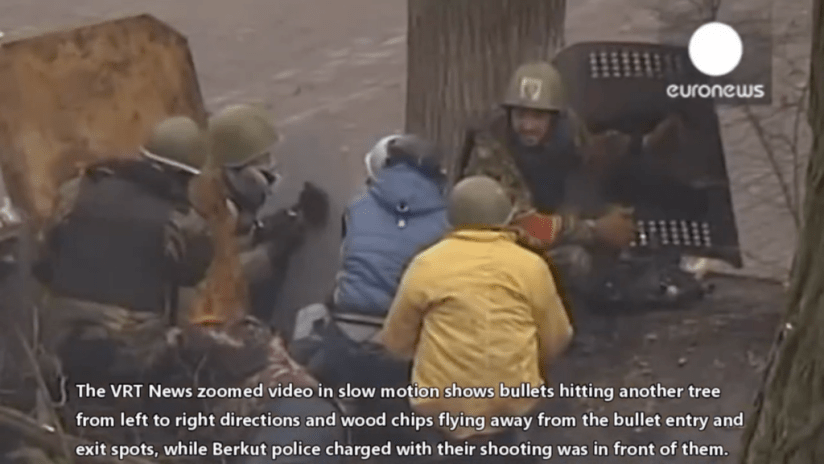
A screenshot from the video appendix to Katchanovski’s latest paper.
Aside from what Katchanovski calls “overwhelming evidence” that protestors were shot from Maidan-controlled buildings, he believes there was a cover-up by the post-Maidan authorities.
On 21st February, the Ukrainian parliament passed an amnesty law granting blanket immunity to Maidan protestors for serious crimes that had taken place during the protests. This law also prohibited investigation of the protestors for such crimes, and ordered that existing evidence be destroyed.
Two of the Berkut police officers who had been charged with murdering protestors were released by trial judges due to lack of evidence, suggesting the charges against them were trumped up. And all remaining defendants were released in a prisoner exchange within several months of the expected verdict.
Public statements made by various Maidan participants concerning the far-right’s involvement in the massacre were never investigated. One politician said she saw Maidan leaders bringing snipers into a building and then saw snipers firing from that building. Several activists said they witnessed snipers being evacuated by Maidan leaders. And another politician said that Maidan leaders had “arranged” the massacre.
There were unexplained reversals of testimony on the part of wounded Maidan protestors. Key pieces of evidence went missing or were destroyed. Several trees with bullet holes in them were cut down; all helmets and shields used by those who were shot disappeared, as did security camera footage from Maidan-controlled buildings.
Finally, two far-right politicians stated in separate interviews that a Western government official told them killings of a few protestors would not be enough for Western governments to stop recognising Yanukovych, and for that to happen the number of victims would need to be 100. The protesters who lost their lives subsequently became known as the “Heavenly Hundred”, even though some of those ‘hundred’ were not killed in the massacre itself (and in fact simply died of illness.)
On the basis of all the evidence he’s gathered, Katchanovski concludes that the Maidan massacre was “a false flag operation” which involved “elements of the Maidan leadership”.
If true, the implications are immense. It would mean the event that marked the turning point of Euromaidan – that set in motion Yanukovych’s removal from power – was in fact orchestrated by his political opponents. And aside from implicating those individuals in a brutal act of mass murder, it would remove any doubt that the that the ‘Revolution of Dignity’ was illegitimate.
Is it true?
I have been unable to track down any serious criticism of Katchanovski’s work, and when I reached out to him, he told me “there is no other scholarly study” that disputes his findings. What’s more, the political scientist Gordon Hahn reached similar conclusions in his book Ukraine Over the Edge: Russia, the West and the “New Cold War”.
So why haven’t Western governments shown more interest in investigating the massacre? I put this question to Katchanovski. He said that such an investigation would be “politically inconvenient” because it would “upend the narrative that the Western backed overthrow of the Ukrainian government in 2014 by the pro-Western Maidan opposition was peaceful and democratic”. He added that a definitive answer could be obtained by consulting relevant documents once they are declassified.
As I mentioned above, Katchanovski has published his arguments concerning the ‘false flag theory’ in scholarly books and journals, and has presented them at academic conferences. All the germane papers are available for free online. You might therefore expect for his work to have received significant media attention – particularly in the last few months.
Yet with the exception of a few ‘non-mainstream’ outlets, it hasn’t. Major Western media have ignored his studies “for political reasons”, he told me. This is despite the fact that Katchanovski’s other work on Ukraine (unrelated to the massacre) has received ample media attention, including from the Associated Press, Reuters and the Washington Post.
Katchanovski knows that certain media outlets are aware of his work because he’s brought it to their attention. Following the New York Times article on the 3D model of killings at Maidan, he sent a letter to the editor pointing out they had “misrepresented the wound locations”. But his letter wasn’t published. In another case, “Open Democracy accepted a popular version of my Maidan massacre study, but then did not publish it.” Katchanovski said he gave “long interviews concerning the Maidan massacre to several major TV and Radio networks” but “none of them were broadcast”. In every single case “there was no reason given”.
The only time Katchanovski’s work on the massacre has been put under the spotlight was in Oliver Stone’s 2019 documentary Revealing Ukraine. This film is available on Rumble, and the relevant segment begins at 20:00.
What about everything that’s happened since? In our email exchange, Katchanovski clarified that the Maidan massacre “does not justify the Russian invasion and other actions in Ukraine”. Equally, however, Russia’s invasion does not justify ignoring – in his words – “overwhelming and undeniable evidence” of Maidan snipers.
If others believe that Katchanovski is mistaken, they must come forward and present their arguments. In the meantime, I would strongly recommend reading his papers: they make a compelling case that what’s been labelled a “conspiracy theory” is, in fact, true.
Disquiet at Davos and the Unsaid Fear of Failure – The First Shoots of a U.S. Ukraine Shift
By Alastair Crooke | Strategic Culture Foundation | May 30, 2022
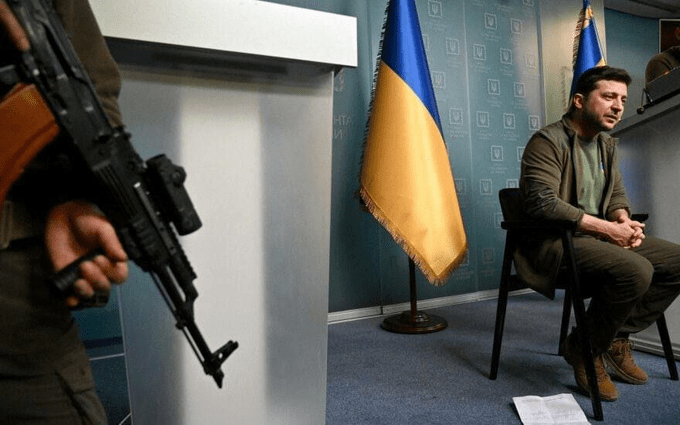
Klaus Schwab, passionate for Ukraine, essentially configured the World Economic Forum (WEF) to showcase Zelensky and to leverage the argument that Russia should be kicked out of the civilised world. Schwab’s target was the assembled crème de la crème of the world’s business leaders assembled there. Zelensky pitched big: “We want more sanctions and more weapons”; “All trade with the aggressor should be stopped”; “All foreign business should leave Russia so that your brands are not associated with war crimes”, he said. Sanctions must be all encompassing; values must matter.
Disquiet ran through the Davos set: The WEF is high-octane globalist, right? Yet this Schwab line suggests a de-coupling ‘on stilts’. It precisely reverses interconnectedness. Plus, the western generals in charge are saying that this conflict may last not just years, but decades. What will this signify for their markets in parts of the world that refuse action against Russia, the moneymen were wondering?
It is unlikely that this whiff of disorientation is what Schwab had intended. Perhaps the latter was more aligned with Soros’ later intervention that a quick victory over Russia was needed to save the ‘Open Society’ and civilisation itself – and that this was intended as the WEF 2022 message.
The Davos ‘greater disquiet’ emerged however, from an unexpected quarter. Just before the WEF began, the NY Times had run a piece from the editorial team urging Zelensky to negotiate with Russia. It argued that such engagement implied making painful territorial sacrifices. The piece attracted indignant and angry push-back in Europe and the West, possibly because – albeit couched as advice to Kiev – its target was evidently Washington and London (the arch belligerents).
Eric Cantor, a former whip in the U.S. House of Representatives (a legislator well versed on Iran sanctions), also at Davos, questioned whether the West would be able to maintain a united front in pursuit of such maximalist aims as Zelensky and his Military Intelligence Chief have demanded. “We may not get the next vote”, Cantor opined (in wake of the $40 bn vote ostensibly earmarked for Ukraine).
Cantor said excluding Russia entirely would require secondary sanctions against other countries. This would place the West into a head on clash with China, India, and the almost 60 states which had refused to back a UN resolution denouncing Russia’s invasion. He warned that the U.S. may be in danger of overplaying its hand.
Then spoke the redoubtable Henry Kissinger, also at Davos. He warned the West to stop trying to inflict a crushing defeat on Russian forces in Ukraine, saying that such would have disastrous consequences for the long-term stability of Europe. He said it would be fatal for the West to get swept along in the mood of the moment and forget the proper place of Russia in the European balance of power.
Dr Kissinger said the war must not be allowed to drag on and came close to calling on the West to instruct Ukraine to accept terms that fall very far short of its current war aims: “Negotiations need to begin in the next two months, before it creates upheavals and tensions that will not be easily overcome”.
What is going on here? In a nutshell, we are seeing the first inklings of fractures appearing in the U.S. stance on Ukraine. The fissures in Europe are already very plain, both on sanctions and mission aims. But Cantor’s comment that “we may not get the next vote” needs further unpacking.
In an earlier piece, I argued that Senator JD Vance’s win in the Ohio primaries for a Senate seat could be telling. His candidature was backed by Trump, who later issued an ‘End the war’ call. Now the key tell-tale is Republican Senator Josh Hawley – ambitious and known to have leadership aspirations.
Early in the Ukraine war, Senator Hawley was calling Zelensky, lauding him highly and egging him on. But then he pivoted. Hawley subsequently blasted the $40 billion in proposed aid to Ukraine, after voting ‘no’ on the procedural vote to move forward with the aid package “as not being in America’s interests”.
At first, as some may recall, there were 6 House votes against the bill – then 60. And in the Senate, first there were zero then there were 11 votes. The Bill was rushed through as vote managers were concerned that the vote could crumble further.
What is going on? Well, the Republican ‘populist’ current, never enamoured at foreign aid, was shocked at the $ 40 billion for Ukraine when the U.S. lacked baby milk, (and itself had to rely on foreign baby milk aid). This political current is becoming more significant and having more impact as a result of a structural shift. Political candidates, and now even some U.S. think-tanks are turning to crowd-funding as a principal source of finance – moving away from the ‘established’ donors. Thus, the broad ‘anti-foreign entanglement’ sentiment is gaining heft.
Of course, the $40 billion is not all going to Ukraine. Not at all. According to the details of the Bill, the bulk will go to the Pentagon (for equipment already supplied by the U.S. and its allies). And a big chunk will go to the State Department, to fund all sorts of ‘helpful’ non-state actors and NGOs – i.e. it is a deep state budget with Ukraine packaging. The six billion allocated directly for new arms to Ukraine in fact comprises both training and weapons, so much of that will end in the pockets of states such as UK and Germany, giving ‘out of theatre’ training to Ukrainians in their own, or in neighbouring countries’ territory.
Eric Cantor, and other Americans at WEF may frame their disquiet over western objectives in ‘polite company’ as simply articulating their uncertainties over America’s grand strategy – whether the U.S. is trying to punish Russia for its aggression, or whether the goal is a subtler use of policy that gives the Kremlin a ‘route out of sanctions’, were it to changes course. But behind the narrative lies a darker fear. The unsaid fear of failure.
What does this mean? It means that the West’s ultimate war aims in Ukraine have so far been able to stay opaque and undefined, the details swept aside in the mood of the moment.
Paradoxically, this opacity has been preserved despite the public failure of the West’s first statement of aims – which was that the seizure of Russia’ offshore foreign reserves; the Russian bank expulsions from SWIFT; the sanctioning of the Central Bank; and the broadside of sanctions would, in and of itself alone, turn the rouble to rubble; cause a run on the domestic banking system; collapse the Russian economy; and provoke a political crisis that Putin might not survive.
In short, ‘victory’ would be quick – if not immediate. We know this, because U.S. officials and the French Finance Minister, Bruno Le Maire bragged about it publicly.
So confident in a quick financial-war success were these western officials that there seemed little need to invest deep strategic reflection on the aims or the course of the secondary Ukrainian military thrust. After all, a Russia already economically collapsed, with its currency ruined and its morale broken, would likely put up little or no fight as the Ukrainian army swept across Donbas and into Crimea.
Well, the sanctions have proved a bust and Russia’s currency and oil revenues are bountiful.
And now, western politicians are being warned in the media, and by their own military, that Russia is ‘close to a major victory’ in Donbas.
This is the unspoken fear disquieting Davos attendees – fear of another débacle, following that of Afghanistan. One made all the worse as the ‘war’ on Russia boomerangs into an economic collapse in Europe, and with NATO’s eight-year investment in building-up a successful proxy-army to NATO standards turning to dust.
This is what Kissinger’s comments – decoded – urge: ‘Don’t procrastinate’; get a quick deal (even an unfavourable one), but one that can be dressed up, and somehow spun as a ‘win’. But don’t wait, and let events lead the U.S. into yet another unmistakeable, undeniable débacle.
This is still ‘under the kitchen table talk’ in the U.S. for now, as the power of a narrative, invested with so much emotion, and bolstered by unprecedented info-war peer-pressure has masked such thoughts from public expression. Fractures nonetheless are beginning to be apparent. Something stirs – and Europe inevitably will follow wherever America leads. But for now, the hawks remain firmly in ‘the chair’ (in the U.S., in London, Poland, the EU Commission and in Kiev).
The big question, however, is why Moscow would take such a ‘way out’ (even if it was offered it). A compromise deal would be seen there as simply Kiev given the chance to regroup, and to try again.
Five killed by Ukrainian shelling of schools and residential buildings – Donetsk authorities
Samizdat | May 30, 2022
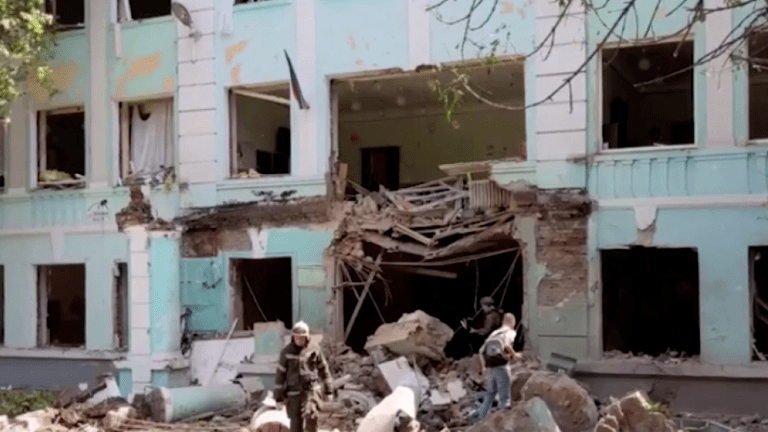
Ukrainian shelling of Donetsk has left at least five people dead, and 18 others injured, local authorities of the Donetsk People’s Republic (DPR) said on Monday. According to local officials, a teenage girl is among the fatalities. The strikes damaged several civilian facilities in the city, including schools and residential buildings.
Preliminary reports allege that US-supplied artillery may have been used in the attacks. In one home, two 14-year-old girls were hurt, Mayor Aleksey Kulemzin said. One of them died while the other one was taken to hospital.
Three civilians were killed, and a dozen others injured at two schools, the mayor claimed. Two people were in serious condition, he added.
The headmistress of one of the schools, Olga Rachinskaya, told the media that many of the teachers “were lacerated with shrapnel”. She said the two workers who were killed were elderly.
“This is just an ordinary school. There is nothing military here, nothing,” she said. Luckily, Donetsk schools teach remotely, so students were not in the classrooms when the shells hit, according to the educator.
The DPR defense HQ said Ukrainian troops fired at least two Smerch rockets armed with cluster munitions and also used 155mm artillery in the shelling.
On Monday, Mayor Kulemzin speculated that the Ukrainian troops may have used US-supplied 155mm M777 howitzers in the assault. “This is heavy weaponry, most likely the American delivery,” he told Russian television when describing the attacks. He claimed some of the shell fragments discovered on the ground had markings in English.
The US and its allies have reportedly supplied about 100 towed artillery guns to Ukraine, ramping up their military aid with heavier kinds of weapons. Kiev may soon receive US-made multiple launch rocket systems too, adding them to the weapons from Soviet stockpiles that it currently possesses, according to media reports.
Commenting on the news coming from Donetsk on Monday, Kremlin spokesman Dmitry Peskov said Ukrainian attacks on civilian infrastructure in DPR were “outrageous.”
“This is exactly what our warriors are fighting against. To make such things stop,” he said, branding the perpetrators “neo-Nazis”.
Russia attacked Ukraine state in late February, following its failure to implement the terms of the Minsk agreements, first signed in 2014, and Moscow’s eventual recognition of the Donbass republics of Donetsk and Lugansk. The German- and French-brokered protocols were designed to give the breakaway regions special status within the Ukrainian state.
The Kremlin has since demanded that Ukraine officially declare itself a neutral country that will never join the US-led NATO military bloc. Kiev insists the Russian offensive was completely unprovoked and has denied claims it was planning to retake the two republics by force.
Featured Video
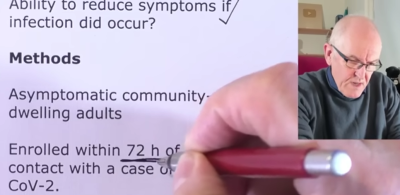
New positive ivermectin evidence
or go to
Aletho News Archives – Video-Images
From the Archives
Fanatical Followers of the Covid Regime: A Jim Jones-Style Cult?
By Professor Roger Watson and Dr. Niall McCrae | The Daily Sceptic | November 15, 2021
As scholars at leading British universities over recent decades, we witnessed the replacement of critical thinking and debate by narrative: facts are discrimination and scientific method is imperialism; truth, instead, is derived from ‘progressive’ values. This educational trend may be a major contributory factor to the ease in which society has been inculcated to the Covid ‘new normal’ of masking, testing, and repeated doses of vaccines for a disease of similar risk to severe influenza.
One doesn’t need much critical reasoning to observe the flawed logic of some vaccination enthusiasts, such as people who respond to experiencing any side effects, however debilitating, by saying “at least I know it’s working”, or, after contracting the disease despite their promised inoculation (over 90% effective, according to initial drug company claims), “I’d have been worse off without the jab.” … continue
Blog Roll
 Aletho News
- Najaf airport to reopen to Iranian flights within 24 hours: Ambassador
- From ‘How Will This End For Iran’ to ‘When America Walks Away’: A tale of two Economist covers
- Tehran blasts ‘baseless’ speculation linking Iran to alleged bomb plot at UK air base
- The Rise And… Rise Of ‘Color Revolutions’
- The Coming GOP Bloodbath?
- Arctic Scare Stories Melt Away
- Wrong, Euronews: Climate Change Has Not Created a Food, Energy, and Economic “Meta-Crisis”
- New positive ivermectin evidence
- Met Office Caught Fabricating Daily Temperature Record Claims
- Merck Virologists Admitted to Falsely Certifying Vaccine Efficacy
- If Americans Knew
- Netanyahu Asked UAE Leader to Deny Report on Oct. 7 Warning in Secret Visit, Sources Say
- CNN Chief Int’l Correspondent Clarissa Ward on Journalists in Gaza
- Democratic Party Consultants Surround Troy Jackson with Pro-Israel Donors
- Christian Leader Responds To Netanyahu’s Claims Regarding Palestinian Christians
- In Gaza, ‘Whoever Survives the Bombing Won’t Survive the Rubble’
- Israel kills more Palestinians, amid push to resettle Gaza – Daily Update
- Israel forces Gazans to live in constant peril – Daily Update
- Deconstructing Netanyahu’s pants-on-fire UN rant – Daily Update
- Trump betrayed voters with his campaign lies and prioritized a foreign country once he took office
- Netanyahu calls Israel’s war in Gaza ‘opposite of genocide’ in UN speech to near-empty hall
- No Tricks Zone
- New Study: Earth And Venus Surface Warmth Largely Explained By Convection And Lapse Rate, Not CO2 Or Radiation
- 2025 Nature Paper Claiming Worsening Global Drought Gets RETRACTED …Heavily Flawed
- New Study: ‘Global Drought Shows No Detectable Recent Acceleration Under Climate Warming’
- Economic Masterminds: German Socialists Suggest Taxing Productivity Gains Stemming From Using AI
- The South China Sea Has Not Been Cooperating With The Climate Change Narrative
- Energy Crisis: Germany Enters Heating Season With Historically Low Gas Reserve Fill Levels
- New Study: The Antarctic Ice Sheet Gained Mass From 2020-2024 Due To Staggering Snow And Ice Accumulation
- Study: Ocean Heating Rates From Thousands Of Years Ago ‘Dwarf’ Modern Ocean Heating Rates
- Climate Extremists Target, Attack Large-Scale Power Grid Infrastructure In Germany!
- New Study: Antarctic Ice Melt Has Contributed Less Than 1 Centimeter To Sea Level Rise In The Last 30 Years

