Nasrallah Denies Hezbollah Fighting in Ukraine alongside Russian Forces
Al-Manar | March 18, 2022
Hezbollah Secretary General Sayyed Hasan Nasrallah on Friday categorically denied the media reports which alleged that a number of Hezbollah fighters and military experts are fighting in Ukraine alongside the Russian Forces.
Addressing Al-Mahdi Scouts Anniversary Ceremony, Sayyed Nasrallah said that Arab Channels circulated rumors, alleged to be quoting Ukrainian Military Staff, claiming that Hezbollah dispatched fighters and military experts who are professional at street battles.
“I categorically deny such rumors. These are baseless lies and rumors. Hezbollah did not dispatch any fighter or expert to Ukraine.”
Sayyed Nasrallah warned against similar media rumors about the alleged Hezbollah participation in Ukraine war, confirming that they are false.
Meanwhile, Sayyed Nasrallah called on the Lebanese government to form an emergency committee to cope with the economic repercussions of the war in Ukraine, pertaining mainly the prices of the basic commodities.
Lawyer For Mother Of Hunter Biden’s Daughter Says He Expects President’s Son To Be Indicted
By Tyler Durden | Zero Hedge | March 18, 2022
The past few weeks have been tough for Hunter Biden and, by extension, the rest of the Biden family. On March 1, news broke that Hunter Biden’s longtime business partner and friend Devon Archer was sentenced to a year in federal prison for defrauding a Native American tribe. Then just yesterday, the New York Times published an investigation revealing that although the younger Biden had paid his outstanding tax liability – which was reportedly greater than $1 million, and which required him to take out a loan to pay it off – a federal investigation into his failure to pay taxes on his earnings from overseas has continued.
Much lower in the NYT story, America’s “paper of record” mentioned the laptop belonging to Hunter Biden that was reportedly abandoned at a computer repair shop, and subsequently became the heart of a NY Post story published shortly before the 2020 election (which was subsequently ignored by the MSM because of unfounded rumors that the materials had been stolen by Russian hackers, or that the laptop itself was some kind of plant). It didn’t only mention the laptop, but also confirmed that it was authentic. We previously reported on how the NYT sued to obtain copies of emails mentioning Biden and his exploits allegedly gleaned from Romanian embassy officials.
And in the latest blow to the reputation of the president’s perennially troubled son, a lawyer for the mother of Hunter Biden’s 3-year-old daughter (who was born out of wedlock to a woman who allegedly slept with the younger Biden while working as an exotic dancer) said during an interview with CNBC that he expects the younger Biden “to be indicted” for tax fraud.
Attorney Clint Lancaster told CNBC that his client, Lunden Roberts, had recently testified in Delaware before a federal grand jury in the criminal investigation into the 52-year-old presidential scion. The lawyer based his commentary on “what I saw” in Biden’s financial records.
Lancaster said he and Roberts were interviewed by an assistant U.S. attorney, an FBI agent and an IRS agent — “one that carries a badge and gun” — more than a year ago about Biden in Little Rock, Ark., where Lancaster practices law.
“I expect him to be indicted,” the lawyer said about Biden. “Just based on what I saw in his financial records, I would be surprised if he’s not indicted.”
Lancaster later added that neither he nor his client want Hunter Biden to go to jail.
“It’s not my goal, much to the unhappiness of many people in the Republican Party,” said Lancaster, a supporter of former President Donald Trump who in late 2020 worked on a legal challenge to results that showed Biden had won the state of Wisconsin that year.
He also confirmed that the younger Biden hadn’t visited his 3-year-old daughter with Roberts, “which is sad because the baby looks like him, with blonde hair.” He also explained that he had come into possession of a vast trove of the younger Biden’s financial records as part of his work on Roberts’ child-support suit. When asked about the number of records, Lancaster said it was around “10 gigs of data”.
“Oh, hell, it was a bunch,” said Lancaster when asked how many records there were related to Hunter Biden’s finances. The documents were part of the case file for an Arkansas court child-support lawsuit that Roberts filed against Biden in 2019 in connection with their daughter.
“They’re all in electronic form,” Lancaster said. “I would estimate it was anywhere from 10 gigs of data.”
“I saw a lot of information” that is “problematic” for Biden, he said.
Finally, Lancaster told CNBC that his client hadn’t received immunity before testifying because she hadn’t committed any crimes. The NYT on Thursday reported that Roberts had been questioned about the provenance of the child support payments she had received from Biden. Prosecutors were apparently investigating whether the same corporate entity from which she received the payments was also used by Biden to receive payments from Burisma, the Ukrainian energy company from which he received a salary of $50K per month just for sitting on its board.
Given all the information on the investigation that’s just come to light, we wouldn’t be surprised if the grand jury hearing the evidence is soon asked to vote on whether federal charges should be brought against the younger Biden. His father, the president, has already recused himself from the case as his DoJ has continued with the investigation. If charges are brought and Hunter Biden is convicted (or pleads guilty), his father would then have the option of pardoning him. From this vantage point, it’s not too difficult to imagine a scenario where Biden pardons his son after deciding not to seek another term in office.
Cheerleader of NATO wars spotted in Ukraine
By Rachel Marsdon | Samizdat | March 17, 2022
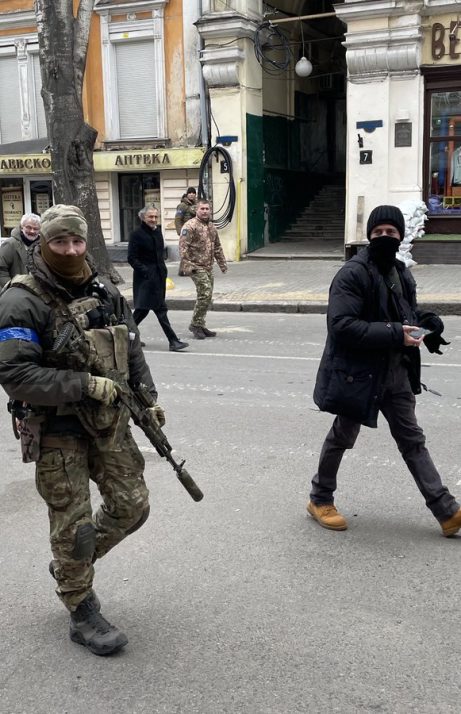 French intellectual and philosopher, Bernard-Henri Lévy (“BHL”), has an odd propensity for appearing alongside western proxy fighters in war zones. And new reports now place him on the ground amid the conflict in Ukraine.
The day after the February 24 launch of Russia’s attack on Ukraine, France 2, the main state-owned television network, hosted a debate featuring, on one side, former prime minister Dominique de Villepin, perhaps best known worldwide for his role during the run up to the Iraq war in 2003. Back then, he served as the foreign minister and represented France’s opposition to the American efforts under then president Jacques Chirac at the United Nations Security Council.
After then US Secretary of State Colin Powell made his now infamous speech imploring the international community to back an invasion of Iraq to prevent Saddam Hussein’s use of weapons of mass destruction, De Villepin argued in favor of inspections.
“Given this context, the use of force is not justified at this time. There is an alternative to war: Disarming Iraq via inspections. Moreover, premature recourse to the military option would be fraught with risks,” he said.
History has now proven him correct in his assessment.
De Villepin’s call for prudence and avoidance of military escalation in Ukraine was loaded with historical lessons learned. “Military interventions never yield the expected results,” recalled the former French prime minister. “History has taught us this in Libya, Iraq and the Sahel.”
On the other side of the France 2 debate table was BHL, who has a rather interesting relationship to some of the conflicts evoked by De Villepin. “[Russian President Vladimir Putin] launched this crazy war, without reason, against a people who had done nothing to him,” replied the philosopher.
It seems that in BHL’s world, wars start like magic with a need to protect completely innocent parties that just happen to be on NATO’s side, and not because of covert shenanigans that predate them — something that BHL should certainly know about.
During the NATO-backed war in Yugoslavia — the war in Europe that those commenting on the current situation in Ukraine seem to forget — BHL, who just happened to be hanging out in the region, overtly backed the NATO proxy, then Bosnian president Alija Izetbegović, who, his opponents believed, was a Muslim fundmentalist. Izetbegović was allegedly used by western forces to helm Islamist fighters against Serbia and ultimately carve out a zone of influence and military control in the Balkans. Later, in a 2019 tweet, BHL referred to the al-Qaeda-linked Izetbegović as “one of the great, luminous figures of the 20th century.”
Then, in March 2011, ahead of the NATO invasion of Libya, which led to an overthrow of Muammar Gaddafi that October, BHL was spotted in Libya meeting with “Libyan rebels,” footage of which can be seen in BHL’s documentary, “The Oath of Tobruk.” It would be easy to chalk up Levy’s presence among the western-backed proxy fighters ahead of Gaddafi’s ultimate demise at their hands as just journalistic interest or intellectual curiosity. But that theory is betrayed by French reports of an activist role at the highest level of the French government.
BHL succeeded in bringing three members of the future Libyan government in waiting to meet with then French President Nicolas Sarkozy at the Elysée Palace on March 10, 2011 — seven months before Gaddafi’s demise, according to Le Figaro. The newspaper also reported that BHL, who met with then US Secretary of State, Hillary Rodham Clinton, at a Paris hotel and noted an American disinterest in military intervention, subsequently took to French airwaves to pressure Sarkozy into having the French take the lead in the invasion by telling the French audience that, “If Gaddafi takes Benghazi, the huge French flag flying on the Corniche will literally be spattered with the blood of the massacred Libyans.” Four days after the media appearance, NATO began its military intervention in Libya.
In 2012, as the NATO-led invasion of yet another country, Syria, raged in an (ultimately unsuccessful) attempt to overthrow President Bashar al-Assad with “Syrian rebels” backed by CIA and Pentagon covert programs, BHL took to the red carpet at the Cannes Film Festival with both Libyan and Syrian rebels, to symbolize “the passing of the torch of Liberty,” according to Le Point magazine. Just a few months later, BHL was calling for France to also send weapons to the western’s proxy “rebels” to fight the Syrian army, specifically, “cannons, anti-aircraft missiles, defensive weapons, for Aleppo, Homs and the rest of Free Syria.”
Then, in February 2013, BHL wrote on his blog, “La Règle du Jeu,” praising then French president Francois Hollande for launching French military operations in Mali, which were ultimately an unsurprising result of the destabilization of Libya caused by the earlier French-led, NATO-backed invasion cheered by BHL himself. “For the first time, in Mali and Libya, force was put at the explicit service of freedom and justice; for the first time – since Valmy! – there is a desired link … between the exercise by France of its power and the defense of values that go beyond it.” In defense of the “values” of leaving countries in tatters for years after hopelessly destabilizing them because their leaders refuse to kowtow to the agenda of Washington and its allies, apparently.
And now, BHL — symbolic of a certain caviar leftist that sells wars and invasions of benefit to the military industrial complex from the lofty perch of humanitarianism — wants action in Ukraine. And after calling for it prominently via French mainstream media, he is hanging out in Odessa — coincidentally, just in time for the launch of the new “Ukraine fighters”, once again doing NATO’s dirty work, but this time comprised of foreign and domestic western-armed warriors, both regular troops and irregular combatants, cheered from the sidelines by the west against Russian troops.
A regular and welcome fixture all over English and foreign western establishment media from America to Europe, BHL tends to appear wherever there’s armed conflict between interests of the western establishment intent on clinging to the current unipolar world order, against those more representative of a more competitive multipolar alternative. His very presence in Odessa should give pause to anyone who still honestly believes that NATO isn’t a directly involved player, using Ukraine as a platform for its ongoing fight against an new and emerging world order over which it risks losing control.
Ukraine Has First-Rate Satellite Intelligence Courtesy of Uncle Sam, Making Its Artillery Far Deadliner
Lawfully Russia would be entirely justified in shooting down US satellites
Anti-Empire | March 17, 2022
Ukrainian military publicized an artillery strike it conducted against a camp of the Russian 35th Combined Arms Army (accompanied by horribly cheezy music considering the occasion).
How does a strike like this happen?
Aside from counter-battery fire, such an installation is defenseless against enemy long-range artillery. What keeps it safe is that normally enemy wouldn’t know about it. The enemy can’t normally see tens of kilometers behind your front line.
On paper the Ukrainians have the capability to discover such camps by flying drones, either in a grid search or directing them to sources of intense radio chatter they might have detected.
But there is reason to believe their reconnaissance is far simpler than that. The New York Times reports:
In Washington and Germany, intelligence officials race to merge satellite photographs with electronic intercepts of Russian military units, strip them of hints of how they were gathered, and beam them to Ukrainian military units within an hour or two.
So the Americans are providing the Ukrainians with numerous satellite images of the battlefield and of the Russian rear.
So in fact the Ukrainians do not need to spend time and resources discovering the layout of the Russian rear. Something they would have only a limited ability to do.
Instead, the whole Russian rear is laid bare to them courtesy of American satellites.
Knowing exactly where the Russian camps are, they are easy enough to target. Whether with the help of drone surveillance for better precision or not. (Particularly by self-propelled artillery which can quickly change position after a few salvos to avoid potential Russian counter-fire.)
America is neck-deep in this war. This is yet one more aspect of its involvement.
(Or you could say that America launched a war vs Russia decades ago and Russia responded by opening a front in Ukraine. Ergo the daily Pentagon briefings on an ostensibly Russian-Ukrainian war.)
Actually, The New York Times tries to muddy the waters by saying that the US is not passing on “intelligence that would tell Ukrainian forces how to go after specific targets” but I don’t know what that is even supposed to mean.
And they say they are not passing on specific intelligence that would tell Ukrainian forces how to go after specific targets. The concern is that doing so would give Russia an excuse to say it is fighting the United States or NATO, not Ukraine.
They’re passing on images coupled with electronic intercepts within an hour but it’s not “specific intelligence” about “specific targets”. So what does that mean? That Americans will send an image of Russian forces and installations but they won’t circle them with a thick red marker? What kind of gaslighting is this? Of course, satellite images will help with targeting and long-range attacks.
“Stealth Omicron” reminds us the pandemic narrative isn’t dead… it’s just sleeping
By Kit Knightly | OffGuardian | March 16, 2022
This week has seen several timely reminders that the Covid narrative is not done. It may have lost its number 1 spot at the top of the “news” charts, but it’s not dead. It’s just resting.
While the big red numbers at the top of every front page are now casualties instead of “cases”, the pandemic is simmering on the backburner and can be brought back to boil at a moment’s notice.
In China they are reporting huge spikes in “cases”, numbers not seen since the halcyon days of March 2020. Millions of Chinese citizens are already back on lockdowns, many now need police permission to travel from one province to another.
Giant multinationals are halting production for the near future at least, with the BBC warning that:
The lockdowns have raised concerns that crucial supply chains may be disrupted.
Yes, more supply chain disruption. Just like the war.
Funny how that works out.
It’s not just China either, according to Bloomberg Europe is seeing a “Covid Resurgence” after a “rushed exit” from restrictions, with Germany, Switzerland and the Netherlands all reporting spikes in cases.
Germany’s “Covid resurgence” comes just days before the government’s emergency powers are due to expire, and just as they are planning to ease all restrictions.
Funny how that works out.
The alleged “resurgence” is the work of a not one but two “new” variants.
Firstly, Deltacron is back. They’re calling it a “new variant”, but the truth is the recombinant virus was first “discovered” back in early January.
At the time, mainstream articles questioned whether it even existed or was just a lab error.
They’ve decided it definitely does exist now.
The Huffington Post covers this story with the headline:
Why Everyone’s Talking About The Deltacron Variant Again
Why indeed. It’s a real puzzler.
Perhaps aware that “Deltacron” sounds like a villain from Transformers, they’re also pushing another new variant: “Omicron BA.2”.
Now, while that name definitely isn’t silly, it also isn’t very catchy – so they’ve got a cool scary sounding name for it too: “Stealth Omicron”.
It’s called “stealth omicron”, because it’s lacks markers that can be picked up on by PCR tests, meaning testing positive for this strain of the virus will look just like testing positive for the other strains.
Oh, and this variant isn’t actually new either, it was first discovered back in December, to very little fanfare.
But that was then, and this is now, and now experts are “worried”, apparently.
The press are already reporting that it might be the “most infectious disease on Earth”
Meanwhile, Pfizer’s CEO has said that the new variants mean people will need a 4th shot of their vaccine.
Funny how that works out.
All this just serves as a reminder that the Covid story is still there, and they can (and probably will) bring it back whenever they want. Maybe the very moment Ukraine and Russia agree on a peace deal.
Game of Thrones famously used to alternate their season finales, in an odd-numbered season the show would end with a shocking plot twist, and in even numbered seasons it would be an epic battle.
Maybe this will be our new reality, lurching from pandemic to war to pandemic to war, and around and around.
A perpetual cycle of different grand narratives, linked only in their shared consequences: More power for them, less freedom for us.
Funny how that works out.
Zelensky and the Zionist Plot To Provoke Russia
NAUMAN SADIQ | BLACKLISTED NEWS | MARCH 15, 2022
Ukrainian President Volodymyr Zelensky took to Twitter [1] Sunday to express heartfelt gratitude to Facebook owner Mark Zuckerberg for taking a clear stand on the Ukraine crisis and letting users violate rules against hate speech: “War is not only a military opposition on UA land. It is also a fierce battle in the informational space. I want to thank @Meta and other platforms that have an active position that help and stand side by side with the Ukrainians.”
“As a result of the Russian invasion of Ukraine we have temporarily made allowances for forms of political expression that would normally violate our rules like violent speech such as ‘death to the Russian invaders.’ We still won’t allow credible calls for violence against Russian civilians,” a Meta spokesperson said in a statement [2] March 11.
It naturally piques the curiosity why the social media behemoth is bending over backwards to violate its own longstanding regulations against hate speech to let Zelensky win the propaganda war in “the informational space” unless one takes into account the obvious fact that both Zuckerberg and Zelensky are Zionist Jews and take orders from Israel’s clandestine security agencies.
Born to Oleksandr Zelensky and Rymma Zelenska, both Russian-speaking Jews, in Jan. 1978, Volodymyr Zelensky was groomed by covert Mossad operatives in Ukraine since his student life while he was studying law at the Kryvyi Rih National University.
Instead of pursuing legal career, he chose acting as a profession at the behest of his influential patrons to gain nationwide publicity, particularly through the comedy television series “Servant of the People” in which Zelensky “prophetically played” the role of the Ukrainian president.
In fact, his production company Kvartal 95, which produces films, cartoons and television shows, was generously funded by deep pockets of Zionist billionaires. Comically exposing corruption and sleazy dealings of Ukraine’s politicians and oligarchs, the series “Servant of the People” aired from 2015 to 2019 and struck a chord with Ukrainian masses.
Riding on the wave of media publicity, Zelensky won a landslide presidential election in 2019. Later, his political party, which he “coincidentally” named “Servant of the People,” won an overwhelming victory in a snap legislative election held shortly after his inauguration as president.
In the 2001 census, a third of Ukraine’s over 40 million population registered Russian as their first language. In fact, Russian speakers constitute a majority in urban areas of industrialized eastern Ukraine and socio-culturally identify with Russia. Ukrainian speakers are mainly found in sparsely populated western Ukraine and in rural areas of east Ukraine.
Russian, Belarusian and Ukrainian together belong to the East Slavic family of languages and share a degree of mutual intelligibility. Thus, Russians, Byelorussians and Ukrainians are one nation and one country whose shared history and culture goes all the way back to the golden period of 10th century Kyivan Rus’.
What do Ukrainians have in common with NATO powers, their newfound patrons, besides the fact that humanitarian imperialists are attempting to douse fire by pouring gasoline on Ukraine’s proxy war by providing caches of lethal weapons to militant forces holding disenfranchised Ukrainian masses hostage.
Russians and Ukrainians share Byzantine heritage and their longstanding dispute with Zionist Jews goes back to the medieval era. Byzantine emperors regarded Jewish subjects as gentiles and were particularly wary of wealthy Jewish merchants maintaining a stranglehold over banking and commerce sectors of the empire.
In addition, Russians and Ukrainians together belong to the Greek Orthodox Church, one of the oldest Christian denominations whose history goes all the way back to Christ and his apostles. Protestantism and Catholicism are products of the second millennium after a Roman bishop of the Byzantine Empire declared himself pope following the 1054 schism between the Orthodox and Catholic Churches.
Since 2019, after being elected president through questionable methods, Zelensky has surreptitiously been working on a clandestine project to foment a crisis with Russia on a flimsy pretext. Any other political leader with an iota of rational faculties, even somebody as rogue as his predecessor Petro Poroshenko, would promptly have agreed to the Kremlin’s reasonable proposal that Kyiv must give a solemn pledge it won’t join the transatlantic NATO military alliance.
Not only did he scornfully rebuff the Russian proposal but he also let Ukraine’s security forces stage joint military exercises and naval drills alongside NATO forces in the Black Sea right under Russia’s nose. His reckless disregard for the suffering of Ukrainian masses with whom he does not identify being a Zionist himself and suicidally provoking Russia into an armed confrontation aside, he is merely a pawn in the grand scheme of things.
Israel’s Zionist regime, to whom not only Ukrainian but also American presidents bow, has a score to settle with Russia. Donald Trump literally forced four Arab states, the UAE, Bahrain, Sudan and Morocco, to sign so-called Abraham Accords lending official recognition to Israel at the coaxing of his Jewish son-in-law Jared Kushner and in order to canvass Zionist lobbies for support in the run-up to Nov. 2020 presidential elections.
Washington’s principal objective in Syria’s proxy war was ensuring Israel’s regional security. The United States Defense Intelligence Agency’s declassified report [3] of 2012 clearly spelled out the imminent rise of a Salafist principality in northeastern Syria – in Raqqa and Deir al-Zor which were occupied by the Islamic State from 2014 to October 2017 – in the event of an outbreak of a civil war in Syria.
Under pressure from the Zionist lobbies in Washington, however, the Obama administration deliberately suppressed the report and also overlooked the view in general that a proxy war in Syria would give birth to radical Islamic jihadists.
The hawks in Washington were fully aware of the consequences of their actions in Syria, but they kept pursuing the ill-fated policy of nurturing militants in the training camps located in Syria’s border regions with Turkey and Jordan in order to weaken the anti-Zionist Bashar al-Assad government.
The single biggest threat to Israel’s regional security was posed by the Iranian resistance axis, comprising Iran, Syria and Lebanon-based Hezbollah. During the course of the 2006 Lebanon War, Hezbollah fired hundreds of rockets into northern Israel and Israel’s defense community realized for the first time the nature of threat that Hezbollah posed to Israel’s regional security.
Those were only unguided rockets but it was a wakeup call for Israel’s military strategists that what would happen if Iran passed the guided missile technology to Hezbollah whose area of operations lies very close to the northern borders of Israel.
Therefore, the Zionist lobbies in Washington persuaded the Obama administration to orchestrate a proxy war against Damascus and Lebanon-based Hezbollah in order to dismantle the Iranian resistance axis against Israel.
But following the beginning of the Ukraine crisis in 2014 after Russia occupied the Crimean peninsula and Washington imposed sanctions on Russia, the Kremlin’s immediate response to the escalation by Washington was that it jumped into the fray in Syria in September 2015, after a clandestine visit to Moscow by General Qassem Soleimani, the slain commander of the IRGC’s Quds Force who was assassinated in an American airstrike on a tip-off from the Israeli intelligence at the Baghdad airport on January 3, 2020.
When Russia deployed its forces and military hardware to Syria in September 2015, the militant proxies of Washington, the Zionist regime and their regional clients were on the verge of driving a wedge between Damascus and the Alawite heartland of coastal Latakia, which could have led to the imminent downfall of the Bashar al-Assad government.
With the help of Russia’s air power and long-range artillery, the Syrian government has since reclaimed most of Syria’s territory from the insurgents, excluding Idlib in the northwest occupied by Turkish-backed militants and Deir al-Zor and the Kurdish-held areas in the east, thus inflicting a humiliating defeat on Washington, the Zionist regime and their regional allies, Turkey, Jordan and the Gulf States.
Over the years, Israel has not only provided material support to militant groups battling Damascus – particularly to various factions of the Free Syria Army (FSA) and al-Qaeda’s Syrian affiliate al-Nusra Front in Daraa and Quneitra bordering the Israel-occupied Golan Heights – but Israel’s air force has virtually played the role of the air force of the terrorists and mounted hundreds of airstrikes in Syria during the decade-long conflict.
In an interview to the New York Times [4] in January 2019, Israel’s former Chief of Staff Lt. General Gadi Eisenkot confessed that the Netanyahu government approved his recommendations in January 2017 to step up airstrikes in Syria. Consequently, more than 200 Israeli airstrikes were launched on the Syrian targets in 2017 and 2018, as revealed [5] by Israeli Intelligence Minister Israel Katz in September 2018.
In 2018 alone, Israel’s air force dropped 2,000 bombs in Syria. The purported rationale of the Israeli airstrikes in Syria has been to degrade Iran’s guided missile technology provided to Damascus and Lebanon-based Hezbollah, which poses an existential threat to Israel’s regional security. However, after Russia provided S-300 air defense system to the Syrian military after a Russian surveillance aircraft was shot down by Syrian air defenses during an Israeli incursion into the Syrian airspace on September 2018, killing 15 Russians onboard, Israeli airstrikes in Syria have been significantly scaled down.
Following the friendly-fire incident, though Israel has mounted occasional airstrikes at the capital Damascus, in Daraa and Quneitra in southern Syria and Deir al-Zor in eastern Syria, Israeli airstrikes in northwest Syria, including Aleppo, Hamah and Homs, which is within the range of advanced missile defense systems deployed at Khmeimim Air Base near coastal Latakia, have almost entirely ceased.
Last month, the Kremlin issued an unequivocal condemnation [6] of recent Israeli airstrikes in Syria as “crude violation” of Syria’s sovereignty that up until now were reluctantly tolerated by the Russian forces based in Syria’s Tartus naval base and Khmeimim airbase southeast of Latakia, and also pledged that the Russian Air Force would conduct joint air patrols alongside the Syrian Air Force that would pre-empt the likelihood of further Israeli airstrikes.
“Israel’s continuing strikes against targets inside Syria cause deep concern,” Russian Foreign Ministry spokeswoman Maria Zakharova said. “They are a crude violation of Syria’s sovereignty and may trigger a sharp escalation of tensions. Also, such actions pose serious risks to international passenger flights.”
Although Israel claims its air campaign in Syria is meant to target Iran-backed militias, the airstrikes often kill Syrian soldiers. Syrian state media said one soldier was killed and five more were wounded in one of the latest Israeli attacks at Damascus, which occurred on Feb. 9.
Russia has held talks with Israel on Syria, and said last month it would begin joint air patrols with Syria. The patrols will include areas near the Golan Heights in southern Syria bordering Israel, a frequent site of the Israeli airstrikes, and Israel is said to be considering discontinuing the strikes altogether or slowing them down significantly.
The Times of Israel noted that this marked a momentous change in policy for Russia: “Following the patrol, Ynet reported that Israeli military officials were holding talks with Russian army officers to calm tensions.”
The report added, “Israeli officials were struggling to understand why Russia, which announced that such joint patrols were expected to be a regular occurrence moving forward, had apparently changed its policy toward Israel.” The report claimed that Israel might limit its air campaign in Syria as a result of Russia’s inexplicable policy reversal in Syria.
In conclusion, it favored Israel’s strategic objectives to escalate the conflict in Ukraine in order to divert Russia’s attention and military resources to Eastern Europe, as the Zionist regime would then get a free hand to mount airstrikes in Syria and Lebanon with impunity, and might even attempt to rekindle the decade-long proxy war alongside its Gulf Arab, Turkish and Jordanian allies in order to eliminate the security threat posed by the Iran-led resistance axis comprising Syria and Lebanon-based Hezbollah once and for all.
Citations:
[1] Zelensky tweet thanking Facebook for allowing hate speech:
[2] Facebook allows posts urging violence against Russian invaders:
[3] US Defense Intelligence Agency’s declassified report of 2012:
[4] An interview with Lt. Gen. Gadi Eisenkot, Israel’s chief of staff:
[5] Israel Katz: Israel conducted 200 airstrikes in Syria in 2017 and 2018:
[6] Russia cites ‘deep concern’ over ongoing Israeli strikes in Syria:
Nauman Sadiq is an Islamabad-based geopolitical and national security analyst focused on geo-strategic affairs and hybrid warfare in the Af-Pak and Middle East regions. His domains of expertise include neocolonialism, military-industrial complex and petro-imperialism. He is a regular contributor of diligently researched investigative reports to alternative news media.
Outlines of potential Ukraine peace deal as revealed by Russia
Samizdat | March 16, 2022
Vladimir Medinsky, Russia’s top negotiator at the peace talks with Ukraine, says that Kiev is floating the idea of becoming a neutral nation.
“Ukraine is proposing an Austrian or a Swedish model of a neutral demilitarized state, but with its own army and navy,” Medinsky said on Wednesday, adding that “the size of Ukrainian Army” was among the issues discussed.
Moscow wants Ukraine to officially become a neutral country which will never join NATO. Russia attacked Ukraine on February 24, saying that it was seeking the “demilitarization” of the country, among other demands.
Medinsky reiterated that Moscow wants Kiev to recognize Crimea as part of Russia, and the independence of the Donetsk and Lugansk People’s Republics (DPR and LPR), which broke away from Ukraine shortly after the 2014 coup in Kiev. Other key issues of concern the “denazification” of Ukraine and the rights of Russian speakers living in the country, the negotiator said.
“There was some progress on several issues, but not all of them,” Medinsky said about the talks with Kiev.
Commenting on this model of Ukrainian neutrality, Kremlin spokesman Dmitry Peskov said “it can be viewed as a certain compromise.”
Austria declared itself a neutral country in 1955. Its laws ban the nation from joining military alliances and hosting foreign military bases on Austrian soil.
Sweden is often described as a ‘non-aligned’ country, given its longstanding tradition of not formally joining any military bloc. It is not a NATO member and has no foreign bases on its territory.
However, in response to the Russian attack on Ukraine, NATO invited non-members Sweden and Finland to attend the US-led bloc’s meetings and decided to share intelligence with them.
The Ukrainian leadership previously said it was ready to discuss potential neutrality with Russia. At the same time, President Volodymyr Zelensky said Ukraine must receive “security guarantees” from Russia and the West.
Moscow attacked its neighbor in late February, following a seven-year standoff over Ukraine’s failure to implement the terms of the Minsk agreements, and Russia’s eventual recognition of the Donbass republics in Donetsk and Lugansk. The German- and French-brokered protocols had been designed to regularize the status of those regions within the Ukrainian state.
Russia has now demanded that Ukraine officially declare itself a neutral country that will never join the US-led NATO military bloc. Kiev insists the Russian offensive was completely unprovoked and denied claims it was planning to retake the two republics by force.
Humanitarian flights for Ukraine loaded with weapons, protesting airport workers claim
Samizdat | March 15, 2022
One of Italy’s largest trade unions has called for a protest outside the Pisa airport on Saturday, after receiving a tip from some employees that Ukraine relief flights were transporting weapons and ammunition, not food and medicine.
Several workers at the Galileo Galilei airport refused to load one of the cargo flights advertised as carrying humanitarian aid to Ukraine. The crates did not contain food and medication but weapons, ammunition and explosives instead, the Unione Sindacale di Base (USB) said in a statement on Monday evening.
“We strongly denounce this outright falsification, which cynically uses ‘humanitarian’ aid as cover to fuel the war in Ukraine,” the USB said.
The union said the workers refused to load the military supplies as that would lead to the deaths of their colleagues in Ukraine – namely, those working at the bases targeted by Russian missile strikes, where the weapons processed through US and NATO bases in Poland get delivered.
Francesca Donato, an Italian member of the European Parliament, commented on the union’s statement by calling on the government in Rome to “clarify” what is happening.
Meanwhile, dockworkers at the nearby port of Livorno joined the protest on Tuesday, praising their airport colleagues for standing up for their values.
“We stand alongside the Ukrainian peoples, the Donbass and Russia and we do not want to be complicit in this conflict,” the Porto Livorno chapter of USB said in a statement.
USB is calling for air traffic control of the Pisa airport to “immediately block these flights of death disguised as humanitarian aid.” A protest under the slogan “bridges of peace, not flights of war” is scheduled outside the airport for Saturday, March 19.
The union also called on all workers to refuse to load weapons and explosives, and for an immediate ceasefire and peace talks to end the conflict in Ukraine.
Featured Video

New positive ivermectin evidence
or go to
Aletho News Archives – Video-Images
From the Archives
Fanatical Followers of the Covid Regime: A Jim Jones-Style Cult?
By Professor Roger Watson and Dr. Niall McCrae | The Daily Sceptic | November 15, 2021
As scholars at leading British universities over recent decades, we witnessed the replacement of critical thinking and debate by narrative: facts are discrimination and scientific method is imperialism; truth, instead, is derived from ‘progressive’ values. This educational trend may be a major contributory factor to the ease in which society has been inculcated to the Covid ‘new normal’ of masking, testing, and repeated doses of vaccines for a disease of similar risk to severe influenza.
One doesn’t need much critical reasoning to observe the flawed logic of some vaccination enthusiasts, such as people who respond to experiencing any side effects, however debilitating, by saying “at least I know it’s working”, or, after contracting the disease despite their promised inoculation (over 90% effective, according to initial drug company claims), “I’d have been worse off without the jab.” … continue
Blog Roll
 Aletho News
- EU Council Advances Chat Control 2.0 Scanning Proposal
- Ex-Greek MEP files complaint against Israeli spyware firm over alleged Pegasus surveillance
- Troubling ideas throughout the Torah, Talmud, Mishneh Torah and Tanya
- ‘Grave, alarming’: Iran mission on Trump’s UNGA ‘annihilation’ threats
- Najaf airport to reopen to Iranian flights within 24 hours: Ambassador
- From ‘How Will This End For Iran’ to ‘When America Walks Away’: A tale of two Economist covers
- Tehran blasts ‘baseless’ speculation linking Iran to alleged bomb plot at UK air base
- The Rise And… Rise Of ‘Color Revolutions’
- The Coming GOP Bloodbath?
- Arctic Scare Stories Melt Away
- If Americans Knew
- Netanyahu Asked UAE Leader to Deny Report on Oct. 7 Warning in Secret Visit, Sources Say
- CNN Chief Int’l Correspondent Clarissa Ward on Journalists in Gaza
- Democratic Party Consultants Surround Troy Jackson with Pro-Israel Donors
- Christian Leader Responds To Netanyahu’s Claims Regarding Palestinian Christians
- In Gaza, ‘Whoever Survives the Bombing Won’t Survive the Rubble’
- Israel kills more Palestinians, amid push to resettle Gaza – Daily Update
- Israel forces Gazans to live in constant peril – Daily Update
- Deconstructing Netanyahu’s pants-on-fire UN rant – Daily Update
- Trump betrayed voters with his campaign lies and prioritized a foreign country once he took office
- Netanyahu calls Israel’s war in Gaza ‘opposite of genocide’ in UN speech to near-empty hall
- No Tricks Zone
- New Study: Earth And Venus Surface Warmth Largely Explained By Convection And Lapse Rate, Not CO2 Or Radiation
- 2025 Nature Paper Claiming Worsening Global Drought Gets RETRACTED …Heavily Flawed
- New Study: ‘Global Drought Shows No Detectable Recent Acceleration Under Climate Warming’
- Economic Masterminds: German Socialists Suggest Taxing Productivity Gains Stemming From Using AI
- The South China Sea Has Not Been Cooperating With The Climate Change Narrative
- Energy Crisis: Germany Enters Heating Season With Historically Low Gas Reserve Fill Levels
- New Study: The Antarctic Ice Sheet Gained Mass From 2020-2024 Due To Staggering Snow And Ice Accumulation
- Study: Ocean Heating Rates From Thousands Of Years Ago ‘Dwarf’ Modern Ocean Heating Rates
- Climate Extremists Target, Attack Large-Scale Power Grid Infrastructure In Germany!
- New Study: Antarctic Ice Melt Has Contributed Less Than 1 Centimeter To Sea Level Rise In The Last 30 Years

