An interview for Fox News’ “Ingraham Angle,” featuring former Congresswoman Tulsi Gabbard, was censored for being potentially “offensive” and “inappropriate” to some audiences.
In the interview, Ingraham asked Gabbard, “Congresswoman, why are we talking about no-fly zones instead of the fact that for the first time we have President Zelensky stepping back from his earlier NATO wishes and even demands?”
Gabbard expressed her frustration with the fact that allegedly no one was discussing a statement Ukraine’s President Zelensky made, about being “… open to the fact of saying, ‘Hey, yeah, maybe we’ll set this NATO membership thing aside,’ and he’s willing to talk with Putin directly to negotiate.”
Gabbard suggested that the West was interfering with attempts to settle the conflict because, “it’s good for the military industrial complex” and it allowed Western leaders to “have this proxy war with Russia, something that Hillary Clinton laid out just recently.”
Gabbard strongly condemned the war, saying: “This war machine, this power elite in Washington, want to turn Ukraine into another Afghanistan, turn into killing fields where this long-term insurgency is supported. And they bleed out and cripple, kill as many Russians as possible for who knows how long, and they’re really showing their real aim in the fact that they’re not taking action right now to end this conflict.”
YouTube flagged the video, putting up a filter that said, “the following content has been identified by the YouTube community as inappropriate or offensive to some audiences.”
March 15, 2022
Posted by aletho |
Civil Liberties, Full Spectrum Dominance | Hillary Clinton, NATO, Ukraine, YouTube |
Leave a comment
After substantially degrading Ukraine’s military capabilities, Russia is poised to escalate the special operation leading to the victory lap. Moscow has given signals in this direction.
The most significant signal came from the Kremlin spokesmen Dmitry Medvedev, who said on Monday, “Russia has a sufficient potential for conducting the special military operation in Ukraine. The operation is proceeding in accordance with the original plan and will be completed on time and in full.”
As I had written more than once previously, Russian military strategy is on course, contrary to what the hyped up western disinformation has conveyed, namely, that the special operation has “failed”. Peskov hinted that there is no question of stopping the operation prematurely. He spoke amidst western calls for “ceasefire.”
Peskov disclosed that President Vladimir Putin had specifically ordered the armed forces to refrain from an immediate assault on the cities, including Kiev, so as to prevent heavy civilian casualty. The operation, therefore, took into account the ground reality that the extremist Neo-Nazi groups had deployed weapons in densely-populated residential areas.
This meant that the tactic narrowed down to “working with modern high-precision weapons, hitting only military and information infrastructure facilities.” Clearly, this also explained the slow pace and low intensity of the operations interspersed with lulls in the fighting and the tactic of encircling large settlements instead of attacking them frontally.
However, Peskov said, now that the large settlements have been surrounded, the military forces “do not exclude” taking Ukrainian cities under their “full control.” By the way, Defense Ministry Spokesman Igor Konashenkov said on Sunday, “Overall, 3,736 facilities of Ukrainian military infrastructure have been disabled, 100 aircraft and 139 UAVs were destroyed, as well as 1,234 tanks and other armoured vehicles, 122 multiple-launch rocket systems, 452 weapons of field artillery and mortars, and 1,013 units of special military hardware.
Peskov of course denied the western propaganda reports, also denied by Beijing, that Moscow requested Chinese military assistance. Considering that the US-led coalition of 177,194 troops backed by massive airpower took over forty days to take Iraq in 2003, Russians have drawn up a brilliant strategy.
Even Russia’s worst detractors in the West would admit that the Russian force level in Ukraine is much less and also that Saddam Hussein’s army was systematically degraded by the US through a period of one decade before the invasion took place in 2003.
From the Ukrainian perspective, the really hard part is just about to begin. The southern port city of Mariupol cannot hold out any longer. Practically all fire emplacements the neo-Nazis had created in Mariupol’s suburbs have been destroyed. Russian special forces have eliminated the neo-Nazis’ main forces entrenched in the residential areas of the city’s perimeters.
The fall of Mariupol will be a turning point. It will release the Russian forces to drive on to Zaporizhya City and Dnipro, the lynchpin on the Dnieper river that controls the southern approaches to Kiev. Equally, Russian attacks from Kherson toward Mykolayiv may resume in the south with a view to surround Odessa, the jewel in the crown on the Black Sea coast.
Meanwhile, the western mercenaries got a taste of what is to come during the pre-dawn cruise missile attack Sunday at a Ukrainian military base less than 20 kms from the Polish border. (Russian account said 180 foreign mercenaries were killed.
The Russian MOD spokesman Maj-Gen. Konashenkov said later, “We know all locations of foreign mercenaries in Ukraine. More surgical strikes will continue to be delivered against them.” The western countries, especially the US, which embarked on this misadventure to despatch mercenaries, may have second thoughts.
Suffice to say, all this adds up as a growing realisation in the Western capitals, including Washington, that the Russian operation can no longer be thwarted and is destined to run its course. This is evident from the latest remarks by French President Emmanuel Macron on French TV on Monday:
“Europe cannot be safe if it doesn’t engage in a dialogue with Russia. This is our history, our geography. Therefore I intend to talk with President Putin in the upcoming hours… It is necessary to prepare conditions for peace now already, because the war will end when everybody sits down at the table and time will come to determine who is ready to promise what. Therefore, in order to be ready, we must get ready now already.”
Succinctly put, Macron is looking ahead at the scenario after the Russian operations conclude “when everybody sits down at the table… to determine who is ready to promise what.” Significantly, Macron was speaking a few hours after a phone call from the US president Joe Biden.
Even more significantly, Bloomberg has reported that the US National Security Advisor Jake Sullivan has sought a call with his Russian counterpart Nikolai Patrushev, one of Putin’s closest political associates in the Kremlin. This is the first such high-level contact by Washington since the Russian operation began on February 24.
March 15, 2022
Posted by aletho |
Aletho News | France, Russia, Ukraine, United States |
Leave a comment
As the Russian invasion of Ukraine moves past its third week, there are slight hopes that negotiations between the two sides may soon produce a ceasefire. But with the shrill warmongering talk in Washington, it almost seems like the US government would hate to see that happen.
Congress and the US Administration seem determined to drag the United States into a war with Russia over Ukraine. Senator Lindsay Graham is openly calling for someone to kill the Russian president and many in the US House have demanded that the Administration establish a “no-fly zone” over Ukraine.
Are they insane? A no-fly zone means you destroy anything and everything that can prevent total US air dominance. That means an attack on Russian missile and air defense systems within Russia. In other words, World War III.
We can all feel disgust at the destruction in Ukraine, but is it really necessary for us to gamble with our own nuclear annihilation?
Sadly, a large bipartisan group in Congress seems to think so.
Much of what is happening in Ukraine can be traced back to the Obama Administration. State Department officials like Victoria Nuland and Antony Blinken planned and executed the overthrow of the Ukrainian government in 2014. This is what set us on this path to conflict, as the government put in place after the coup began demanding NATO membership.
Blinken, Nuland, and the others responsible for this heinous act returned to government in more senior positions under President Biden and they have continued to push their Ukraine agenda.
Last week Secretary of State Blinken – our top diplomat – sought to send Soviet-era Polish fighter jets into Ukraine to shoot Russians. When the Poles said they’d be happy to ship the planes to a US base in Germany and let the Pentagon transfer them to Ukraine, the Pentagon finally stepped in to quash an extraordinarily high-risk move that even the Pentagon said would have no real effect on the outcome of the war.
The State Department is trying to get us into a war and the Pentagon is trying to keep us out. How ironic!
Back when I was on the campaign trail I would say that we have a few thousand diplomats in government, it might not be a bad idea to use them. But I certainly did not mean that we should use them to try and get us further involved in a war!
Three weeks into this terrible war, the US is not pursuing talks with Russia. As Antiwar.com recently reported, instead of supporting negotiations between Ukraine and Russia that could lead to a ceasefire and an end to the bloodshed, the US government is actually escalating the situation which can only increase the bloodshed.
The constant flow of US and allied weapons into Ukraine and talk of supporting an extended insurgency does not seem designed to give Ukraine a victory on the battlefield but rather to hand Russia what Secretary of State Blinken called “a strategic defeat.”
It sounds an awful lot like the Biden Administration intends to fight Russia down to the last Ukrainian. The only solution for the US is to get out. Let the Russians and Ukrainians reach an agreement. That means no NATO for Ukraine and no US missiles on Russia’s borders? So what! End the war then end NATO.
March 14, 2022
Posted by aletho |
Militarism | NATO, Ukraine, United States |
Leave a comment
Ukrainian president Volodymyr Zelensky on Sunday expressed his gratitude to Mark Zuckerberg for Facebook and Instagram censoring Russian news outlets, allowing calls for violence against Russians and helping his government spread endless disinformation.
“War is not only a military opposition on UA land. It is also a fierce battle in the informational space,” Zelensky said Sunday on Twitter. “I want to thank @Meta and other platforms that have an active position that help and stand side by side with the Ukrainians.”
Last month, Facebook changed their rules to allow users to praise the “neo-nazi” Azov Battalion and this week they changed their rules further to allow calls for violence against Russians.
Facebook blocks RT and Sputnik in the EU but allows the Ukrainian military to announce plans to commit war crimes.
Facebook has helped Zelensky himself spread endless disinformation to try and con NATO into World War III. Most recently, they helped Zelensky spread the lie that Russians attacked the Zaporizhzhia nuclear power plant with tanks and it was leaking radiation and could lead to a nuclear holocaust wiping out all of Europe (if NATO doesn’t immediately get involved in the war and start WW3).
They also helped Zelensky spread the lie that Russians attacked the Chernobyl nuclear power plant and were trying to trigger a meltdown.
With Mark Zuckerberg’s full backing, Zelensky used Facebook to lie about Snake Island and spread the fake news that Russia attacked a Holocaust memorial “to erase our history.”
Whereas Facebook said in the past they would censor content that may cause harm or lead to violence, they now boost Israeli-funded “neo-nazi” groups in Ukraine and spread Zelensky’s lies and disinformation to millions in an effort to start WW3.
March 14, 2022
Posted by aletho |
Fake News, Full Spectrum Dominance, Mainstream Media, Warmongering | Facebook, Instagram, NATO, Ukraine |
Leave a comment
Washington should prove that the global network of biolabs funded by the Pentagon does not conduct nefarious research by subjecting the facilities to international scrutiny, Chinese Foreign Ministry spokesman Zhao Lijian said during a daily briefing on Monday.
“If the US wants to prove their activity is benign, why not open those biolabs to independent examination by international experts?” he asked.
There are dozens of biolabs funded by the US through the Defense Threat Reduction Agency (DTRA) scattered throughout the globe. The US insists they act as early warning outposts collecting data on potentially dangerous infections in various parts of the world.
Skeptical nations, including China and Russia, believe the labs may also serve darker purposes by conducting bioweapon studies on behalf of the US. The work is allegedly conducted on foreign soil for extra secrecy, and to circumvent Washington’s international commitments to refrain from this type of military research, critics claim.
The network was brought back into the spotlight this month amid Russia’s military attack against Ukraine. Moscow released documents allegedly proving that Washington ordered labs in Ukraine to destroy samples of highly dangerous pathogens and other materials. US officials offered an array of explanations in response.
US Under Secretary of State for Political Affairs Victoria Nuland confirmed under oath that Washington gave instructions to Kiev to destroy lab materials, saying her government was concerned that the research could fall into Russia’s hands.
State Department spokesperson Ned Price rejected Russia’s suspicions that the US and Ukraine were violating the Biological Weapons Convention (BWC), which bans bioweapons. He accused Russia of breaking the treaty itself by running active germ warfare research, without offering any evidence.
US Ambassador to the UN Linda Thomas-Greenfield told a UN Security Council meeting called by Russia on Friday that the US does not support bioweapons programs in Ukraine or anywhere else in the world.
White House Press Secretary Jen Psaki claimed on Wednesday that Russia may be preparing a “false flag” biological or chemical weapons attack in Ukraine to further escalate the armed conflict.
Zhao Lijian said that statements from US officials about biolabs have been “contradictory and confusing,” and the lack of clarity causes concern for Beijing. The US infamously opposed attempts in the 1990s to establish an international mechanism to verify compliance of individual nations with the BWC, he noted.
Meanwhile, the US has “for decades” been “pointing fingers at every turn, accusing other nations of failing to comply with their obligations [on non-development of weapons of mass destruction], demanding they accept verification missions and even imposing sanctions on them,” the Foreign Ministry spokesman said.
He added that Washington has double standards regarding international inspections when it denies transparency for its own research. He said the US should come clean about what the hundreds of millions of dollars – which it reportedly poured into Ukrainian biolabs – was spent on.
March 14, 2022
Posted by aletho |
Deception, Timeless or most popular, War Crimes | China, Ukraine, United States |
Leave a comment
I have avoided writing anything on recent events in Ukraine thus far, partly because I wanted to see how events were panning out, partly because I still don’t quite understand how this all fits in with the two year Globalist PsyOp that ended abruptly on 24th February – the same day as the Russian military operation started, as coincidence would have it – but mainly because the experience of trying to write rational analysis in the midst of propaganda that would have made the editors of Pravda blush is no easy task.
As a brief defence against those who will inevitably smear my attempts to analyse the context behind all this as somehow pro-Russian, let me ask them not to bother. I really don’t even understand the frame of reference, since I don’t view the world in the absurd black hat/white hat terms that lead to such jibes. And in any case, I am pro-God and pro-Truth, as well as being a patriotic Englishman who writes on such topics because he believes this once green and pleasant land is now run by terminally foolish clowns and Globalist ideologues who do not govern for the people but in the interests of others. I would also point out that I was writing about atrocities committed against Ukrainians years before it became fashionable to do so. However, unfortunately it seems I was supporting the wrong Ukrainians — the ones nobody cares about — in the Donbass, who have been killed, terrorised and forced to leave the country by their own brutal Government for eight years, with some even deliberately burned alive by the neo-Nazis formations that apparently don’t exist. Those caveats aside, let’s press on.
For most Westerners, it appears that the current conflict suddenly dropped from the sky one morning in February 2022. They woke up to hear about a Russian invasion, and without any prior knowledge or context, having been denied this for years by their so-called free press, simply accepted the narrative thrown at them that this invasion was utterly unprovoked — the brainchild of a madman who wishes to recreate Hammer and Sickle Land again.
None of this is remotely true. Whatever the actual reasons for invading at this particular time — and I don’t believe for one moment that we have the full picture yet — this conflict most certainly did not drop out of the sky or from the ravings of a lunatic on 24th February 2022. No, it is part of a sequence of events that was set off years ago, particularly in 2014, which were clearly destined to reshape the world. As I wrote back in September 2014:
“I believe this crisis to be the defining crisis of the 21st Century so far. … It is also something that may well define the shape of the planet for the rest of the century — whether we are left with a unipolar world … or whether we see a new multipolar world emerging … It is in a very real sense the key battle between globalisation and national sovereignty.”
That sequence of events has a long history, but behind it all is an ideological fanaticism that overtook certain elements of the Western powers – and I’m thinking here in particular of the cult known as neoconservatism (the name is a misnomer as they have their roots in Trotskyism, not conservatism) – who saw the collapse of the Soviet Union as an opportunity not for peace and stability, but for the establishing of a US-led Globalist hegemon, with “Full Spectrum Dominance”, as one of their number once put it.
It was this ideological fanaticism that led to the carpet bombing of Serbia, the invasion of Afghanistan, the war against Iraq, the dismemberment of Libya, and the arming of jihadists to destabilise Syria — wars which killed or displaced hundreds of thousands if not millions of people, yet which curiously attracted none of the sort of response we are seeing now.
It was this ideological fanaticism that also led to the continuance of the North Atlantic Treaty Organisation (NATO), long after the ostensible reason for its existence ceased to exist. NATO was a military alliance against the Soviet Union, and since then it is a military alliance against Russia. This is undeniable, and it gives rise to two questions. Firstly, why was it deemed necessary to continue this alliance at a time when Russia itself quite obviously desired to be on good terms with the West (despite the pilfering of the country during the so-called Shock Therapy of the 1990s)? Secondly, since the alliance remained and was quite obviously aimed at Russia, isn’t it obvious and indeed reasonable that they would see it as a threat?
This should not be hard to understand. If, say, an anti-Russian military alliance crept up to its borders, in five successive waves, despite assurances given to the last Soviet leader Mikhail Gorbachev in 1991 that this would not happen — all of which has come to pass — why on earth would anyone think that the Russians wouldn’t see this as a threat, and why on earth would anyone think that there would not be a major pushback at some point? This is not rocket science!
In 2007, Vladimir Putin warned very starkly at the Munich Security Conference of the long-term consequences of the continuance of this policy. Not only did the warnings go unheeded, the very next year NATO upped the ante significantly with the Bucharest Summit Declaration:
“NATO welcomes Ukraine’s and Georgia’s Euro-Atlantic aspirations for membership in NATO. We agreed today that these countries will become members of NATO.”
Again, it fails me to see how can any rational person can look at this and not see the clash that was inevitably on its way from such a policy, and how easily it could have been avoided. It’s not as if the consequences were unknown. Amongst other foreign policy realists, the great US diplomat, George Kennan, observed the following about NATO expansion towards Russia:
“I think it is the beginning of a new cold war. I think the Russians will gradually react quite adversely and it will affect their policies. I think it is a tragic mistake. There was no reason for this whatsoever. No one was threatening anybody else. This expansion would make the founding fathers of this country turn over in their graves.”
Indeed. And I’ll give you three guesses who agreed with that assessment back in 1997, calling out what the reaction might be should the Alliance move into the Baltic States, let alone Ukraine.
“The only thing that can provoke Russia into a hostile and vigorous response is the expansion of NATO to the Baltic states.”
Did you get it? Why, it was none other than Joe Biden, who apparently understood then what he pretends not to understand now.
It was therefore all extremely predictable what would eventually happen if this expansion occurred, and yet the expansion and promises of further expansion did continue nonetheless.
We then fast-forward to 2014, where we find what was perhaps the most blatant coup d’etat in history, when the US and EU conspired together to foment regime change in Ukraine. The coup itself relied heavily on neo-Nazi groups such as Pravy Sektor, whose leader at that time, Dmytro Yarosh, stood on the stage in Maidan Square in Kiev and, flanked by some sinister looking Nazi goons, informed the crowd that his organisation was rejecting the deal brokered by the French, Germans and Poles for a gradual and peaceful handover of power, and that if then President Viktor Yanukovych hadn’t vacated his premises by the following morning, they would depose him — violently. The rest is history. The coup took place, the French, Germans and Poles slunk away apparently forgetting the deal they had brokered, and Victoria Nuland at the State Department gleefully rubbed the cookie crumbs from her hands and set about realising her dream of what to do with that poor country, including the installation of biological weapons laboratories, it would seem. That’s her legacy: She came, she saw, she bought them Cookies and Plague.
One of the first things the new illegitimate regime did was announce a ban on Russian as an official language — despite the fact that it was the predominant language throughout most of the East and South East of the country, where the majority of people were historically, culturally, religiously, and linguistically Russian. Which explains why some of these regions rejected this new hostile, illegitimate government and decided to secede. Again, there is no rocket science here.
What then took place was eight years of conflict, in which the West turned a blind eye to continued atrocities — even blaming them on Russia, when it was the Western backed coup government that was carrying them out. For eight years, with varying degrees of intensity, that people were subjected to bombardment, and being terrorised both by the regular Ukrainian Army and the unashamedly Nazi Tornado, Azov, and Aidar Battalions, which the Western governments helped to train, whilst the Western media pretended it wasn’t happening. But it did happen, and here was the former Ukrainian President, Petro Poroshenko, boasting early on in the hostilities that the bombardment he authorised would see the children of Eastern Ukrainians cowering in basements. Even when a peace process was agreed, with the first and then second Minsk Accords, the shelling of those areas never ceased, over a million refugees fled to Russia, and the Western powers put absolutely no pressure on the Ukrainian Government to fulfil the obligations it had signed to seek a peaceful settlement with the two republics.
Why was this allowed to happen, and why was there no international outcry as those children were holed up in basements and as innocent civilians lived under the constant threat of bombardment by their own Government? The simple reason is that despite their current fake bleeding heart blue and yellow social media profiles, Western governments and the media don’t give a stuff about the people of Ukraine, but have instead led them up the garden path with their phoney promises of Westernisation and NATO membership, when in fact their entire plan was and is very simply to use that country as a stick to poke the bear next door. Here’s a quote from a piece I linked to back in 2014, which very succinctly explains the strategy:
“The Eurasian-wide plan of strategic destabilization and state fracturing owes its genesis to Zbigniew Brzezinski and his Eurasian Balkans concept. The US is flexible in practicing this concept, and it does not meet a dead end if the destabilization encounters an obstacle and cannot be advanced. Should this occur, as it has in Ukraine, Syria and Iraq, and possibly soon in the South China Sea, the stratagem evolves into maximizing the chaos within the launch pad states that are positioned on the doorsteps of the Eurasian Powers. The idea is to create ‘black holes’ of absolute disorder in which Moscow, Beijing, and Tehran are ‘damned if they do, damned if they don’t’ intervene.”
Which is basically where we’re at. The pathetic drivel put forward by the Western powers, in which Ukraine is the Shire, full of nothing but peaceful Hobbit folk with nary a neo-Nazi to be seen, but who unfortunately live next door to Mordor and its Orc hordes, is tripe of the tripiest dimensions. They care nothing about the people of Ukraine, but have simply used it as their Globalist Plaything, bleeding it dry via shell schemes in which sons of US Presidents magically get paid whacking great salaries for jobs they’re not remotely equipped to do, and where they arm and fund some of the worst people imaginable — in this case neo-Nazi battalions, just as they did the Mujahideen back in the day, and al-Nusra Jihadists more recently — to create permanent chaos on Russia’s borders.
But as I said earlier, we certainly haven’t been told the whole reason for the current invasion, and I’m sure there’s much more to come. Because ultimately this is not really about Ukraine, but about an inevitable conflict between ideological fanatics and stone cold realists, with the poor Ukrainians sadly caught in the middle of it.
I want to finish this piece with seven very brief points, some of which I may return to in the future.
Firstly, the reaction to the Russian intervention has been on a level of hysteria that I’ve only ever seen once before in my life — last year, in fact, with the absurd reaction to an eminently treatable virus with a 99.9% Survivability Rate. The fact that we are witnessing a reaction that never occurred during the US/NATO wars of aggression throughout the last few decades, or indeed during the Russian intervention in Syria (although there was some) should alert thinking people to the following conclusion: this military operation is about something much bigger than the reasons that have been stated either by the Russians or the West.
Secondly, the Western media has entirely deceived people into what is really going on, with their heroic but fake tales of Ghost pilots, Snake Islands, and massive Ukrainian resistance. The fact is that the bulk of the action has been in the East, not in Kiev as the media leads people to believe, and the Ukrainian armed forces are now basically trapped there in a number of military cauldrons, where they will either lay down their weapons or die. For an ongoing analysis of the situation, I recommend the excellent videos put out by The Duran.
Thirdly, the ONLY solution to this crisis that has any hope of bringing lasting peace, is for Ukraine to declare itself a neutral country between the NATO alliance and Russia. However, the Neocon Globalist cult will never accept this solution, and so unless other more sensible heads in the West understand this simple point and are able to prevail, the conflict will inevitably continue and quite possibly escalate even further at some point, which is a very scary thought.
Fourthly, the economic sanctions that have been placed on Russia by the Western countries will rebound spectacularly, and end up hurting European countries especially, far harder than they will hurt Russia. Again, the analysis at The Duran is excellent for those who want to learn more.
Fifthly, when the monumentally ignorant MPs in the British Parliament stood up to applaud President Zelensky, did they have the remotest clue that his closing words — “Glory to Ukraine” — was the official slogan of Stepan Bandera’s OUN-B, the Ukrainian Nazi group that fought alongside the Waffen SS in World War II, and which horrifically massacred 100,000 Poles in Volhynia in 1943, or that this same slogan is used by the openly Nazi heirs of Bandera today? I somehow doubt it.
Sixthly, the existence of US funded Biological laboratories on the territory of Ukraine, which was yesterday’s conspiracy theory, is in fact true and was even confirmed by none other than the Under Secretary of State for Political Affairs of the United States, Victoria “Cookies” Nuland, who is apparently very concerned that the contents of these places might escape or fall into the hands of the Russians. Why is she so concerned, and why has the US tried to delete or burn the records of these places? For those interested in finding out, I recommend the work of a very brave proper journalist (remember them), George Webb who can be found on Twitter at @RealGeorgeWebb1. Should all this turn out to be as bad as it looks, it might just put a very different perspective on things and explain the unhinged reaction we’ve seen in the Western media. It would also be mighty ironic: many of the Western leaders and media that still justify the invasion of Iraq, even though it turned out not to have the Bioweapons that were claimed as the pretext, are now howling with outrage at a conflict in an area where they do exist.
Seventhly and lastly, why do I get the feeling that Klaus Schwab is one of the few people who is enjoying the economic repercussions of this war?
March 13, 2022
Posted by aletho |
Deception, Progressive Hypocrite, Timeless or most popular, War Crimes | NATO, Russia, Ukraine, United States |
Leave a comment
Putin is not a military general. He is a modernist leader, a trained spymaster and strategist who understands that war is a continuation of politics by other means (Clausewitz). Accordingly, if we want to grasp Putin’s motives we should refrain from trying to assess Russia’s military campaign in terms of ‘strict military objectives.’ We should instead look at the military campaign as a political instrument that is set to mobilize a global and regional geopolitical shift and on a mammoth scale.
It is clear that Putin’s army is doing its best to avoid civilian casualties. It uses siege tactics as opposed to the barbarian American ‘Shock and Awe’ doctrine. Furthermore, the Russian military works hard not to dismantle the Ukrainian military. Instead it encircles cities and is cutting out the Ukrainian army in the East and South of the country. The Russian military has dismantled Ukraine’s ability to regroup, let alone counter attack. Western military analysts have agreed that clear evidence of the Ukrainian army’s growing disability is that Ukraine’s army didn’t manage to seriously damage the 60 km Russian convoy on its way to Kyiv despite the fact that the convoy stood still for more than 10 days. In the last 24 hours, Russia has made it clear to the West that any Western military supply to Ukraine will be treated as a legitimate military target. In other words, the elite Ukrainian army in the East is now a defunct military force; it can defend the cities, it can mount guerrilla attacks on stretched Russian military logistics but it cannot regroup into a fighting force that can alter the battleground.
Putin’s army, as military experts agree, enjoys massive firepower. It is hardly a secret that Russia’s artillery is a deadly force and there is no force that can match it anywhere in the world. The military rationale for this is plain. The USSR never trusted the quality and the loyalty of its foot soldiers. While it counted on the soldiers’ mass impact, their sheer numbers, it also invented the means, the technology, the tactics and the doctrine to win the battle from afar in preparation for the masses to move in. It was Red artillery that knocked down the 3rd Reich Army. Similarly, flattening enemy cities is something the USSR and modern Russia are famous for. Russia enjoys this power, but it has refrained, so far, from deploying this ability in Ukraine. Russia has displayed this capability rather than deploying it. According to military analysts, Russia hasn’t even begun to utilize its superior air power other than assuring its total air superiority over Ukraine.
The Russian army’s tactic has been to mount pressure on cities’ outskirts, demonstrating Russian military might and then opening corridors for humanitarian convoys. And this is the trick. Russia is creating a flood of refugees to the west. Due to the Ukrainian government ban on men 18-60 leaving the country, we are talking about women and children. So far there are about 2.5 million Ukrainian refugees but this number could increase dramatically. And the question follows: will Germany be happy to accept another million refugees that aren’t a working force? What about France and Britain, the USA, Canada, all those countries that pushed Zalensky and Ukraine into a war but were quick to leave the Ukrainian people to their fate?
Sooner or later, Putin believes, Europe will accept his entire list of demands and will lift the list of sanctions, and may even compensate him for his losses on oil sales all in a desperate attempt to stop the tsunami of Ukrainian refugees. By the time the guns cool down, many Ukrainians may actually prefer to stay in Germany, France, Britain and Poland. This will lead, at least in Putin’s mind, to a demographic shift in the ethnic balance in favor of the Russian ethnic groups in Ukraine. Within the context of such a shift, Putin will be able to dominate the situation in his neighbour state by political and even democratic means.
Putin’s plan is not new. It already succeeded in Syria.
When the West realised that Syria was on foot to Europe, it was very quick to allow Putin to win the battle for Assad at the expense of America’s hegemony in the Middle East. Putin now deploys basically the same tactics. He may be cruel or even barbarian but stupid or irrational he isn’t.
The main question is how is it possible that our Western political and media elite are clueless about Putin and Russia’s moves? How is it possible that not one Western military analyst can connect the dots and see through the fog of this horrid war? The reason is obvious: no gifted people see a potential career in military or public service these days. Gifted people prefer the corporate world, banks, high tech, data and media giants. The result is that Western generals and intelligence experts are not very gifted. The situation of our Western political class is even more depressing. Not only are our politicians those who weren’t gifted enough to join the corporate route, they are also uniquely unethical. They are there to fulfil the most sinister plans of their globalist masters and they do it all at our expense.
I have little doubt that an experienced politician like Angela Merkel wouldn’t have let the Ukraine situation escalate into a global disaster. She, like Putin, was properly trained for her job, understanding the deep distinction between strategy and tactics. She, like Putin, was trained to think five steps ahead. As far as I can tell there is no one in the West who understands Putin, who can read his mind. Instead they attribute to the Russian leader psychotic characteristics in a desperate attempt to hide the depth of the hopeless and tragic situation the West inflicted on itself and on Ukraine in particular.
Meanwhile Putin is taking the most spectacular measures to protect his life and his regime. We in the west find it ‘laughable,’ but Putin knows very well that the only way the West can deal with its own incapacity is to eliminate him and his regime one way or another.
March 13, 2022
Posted by aletho |
Aletho News | European Union, Russia, Ukraine |
Leave a comment
The whole idea of boycotting Russian vodka reminds too much of “freedom fries” from Gulf War II. It seems stupid and silly until you realize we are stupid and silly and this is how we are led to war.
The tsunami of pro-Ukrainian propaganda is only matched by its transparency. The Ghost of Kiev was crafted out of an aircraft computer game. The Ukrainians on that island who would rather die than surrender surrendered. The supermodels joining the army are holding toy rifles. Zelensky is Where’s Waldo, popping up in undated video with unidentifiable backgrounds, dressed in military cosplay reminiscent of George W. Bush in his flight suit. The simplistic narrative is the same simplistic narrative: plucky freedom fighters against some evil dictator. It’s the same story of the resistance fighters in Syria against Assad, the Kurds against ISIS, the Northern Resistance, the Sunnis who joined our side, the Taliban who Ronald Reagan called the equivalent of our Founding Fathers for their fight against the Red Army.
Putin now is the most evil man on earth, unhinged, mentally unwell. Saddam once was, Assad used to be, and Quaddafi was to the point where America cheered as he was sodomized with a knife on TV. Putin is so unstable we don’t know what he’ll do. Familiar voices are raised: The Brookings Institution’s Ben Wittes demands: “Regime change: Russia.” The Council on Foreign Relations’ Richard Haass roared that “the conversation has shifted to include the possibility of desired regime change in Russia.” One headline wishfully notes “knocking Putin’s teams off the sports stage leaves him exposed to his own people.” No one seems to recall, however, our last attempt at regime change in Russia is what put Putin into power in the first place.
Putin’s goals have gone in a matter of days from sorting out Cold War borders to “the restoration of a triumphalist, imperialistic Russian identity, or another bloodstained nationalistic surge to cover for the criminality of his regime, or whether he just has come egotistically unmoored.” One former Iraqi War cheerleader tells us Ukraine, the “front line between democracy and autocracy, is a core interest of the United States… Ukraine is where the battle for democracy’s survival is most urgent. ”
Others are more direct. Rep. Adam Kinzinger, Senator Roger Wicker, and Zelensky demand a no-fly zone. They have friends; a poll as the invasion began found “52 percent of Americans see the conflict between Russia and Ukraine as a critical threat to US vital interests” with almost no partisan division. No polling on what those vital interests might be. Rep. Eric Swalwell and Rep. Ruben Gallego want all Russians deported from the US. As if preparing for war, the U.S. has already closed its embassies in Ukraine and Belarus, and placed Embassy Moscow on “Authorized Departure” status for non-emergency staff and family members. On the other end of the government, the CIA is training Ukrainians for an insurgency. You know, like with the mujahedeen in Afghanistan years ago. Lawmakers at a congressional hearing discussed having American intelligence provide more direct assistance to Ukraine, including ground operatives.
No dissent is allowed. You are either “with us or against us.” The homogeneity of our social and MSM is terrifying. Censorship is in full fury; the fact checkers are hands off even the most outrageous claims (the Ukrainians have trained cats to spot Russian laser sights) and Twitter calls out Russian sources but not pro-Ukrainian ones. Facebook and YouTube post Ukrainian propaganda made in violation of the Geneva Convention. Google News will not include anything from Russian state media. The NYT is running anonymously-sourced tales claiming the Russians are deserting or sabotaging their own vehicles. Rolling Stone is naming “the American right-wingers covering for Putin as Russia invades Ukraine,” currently Tucker Carlson, Alex Jones, J.D. Vance, and Tulsi Gabbard. The worst of all of course is Trump, whom Liz Cheney claims “aids our enemies” and whose “interests don’t seem to align with the interests of the United States.” When he proposed Congress vote on military escalations by the US in Ukraine, Senator Mike Lee was quickly called “Moscow Mike.”
If all that isn’t laying the ground work for a fight, it has been an awful lot of work for nothing.
We’ve been here before when everything was the same but not the same. Following Putin’s 2014 seizure of Crimea, and feints toward Ukraine, then-President Barack Obama said Ukraine is a core Russian interest but not an American one, so Russia will always be able to maintain escalatory dominance there. “The fact is that Ukraine, which is a non-NATO country, is going to be vulnerable to military domination by Russia no matter what we do.” Obama showed the same realism in 2013 when in the face of war-mongering over Assad “gassing his own people in Syria” he backed away from widening the war (if only Obama had been equally pragmatic over Libya.)
But Biden is not Obama. Biden, due to age and background, is not a strong man. Unlike Obama, he does not see himself awash in the stream of history, but more as a caretaker until the Democratic Party can regroup, the Gerald Ford of his era. Biden is a weak man who will come under increasing pressure to “do something” as it becomes apparent the newest layer of sanctions against Russia accomplishes as little as the last layer of sanctions. The previous sanctions, among other things, did not stop Putin from invading Ukraine.
But more than anything else, Joe Biden is a Cold Warrior, burdened fully with a world view Obama was not. That world view says the role of the United States is to create a global system and enforce its rules. We can invade nations that did not attack us and demand regime change but you cannot. We decide which nations have nuclear weapons and which can not. We can walk our NATO-alliance right to your border but you cannot do the same with yours. We decide what systems control international commerce and who can participate in them. It is right and just for us to talk about crippling an economy, but not you. It was all best expressed by Condoleezza Rice, who commented with a straight face on Putin’s invasion of Ukraine “When you invade a sovereign nation, that is a war crime.”
This world view says the United States can empower former Soviet satellites and grow American influence by expanding NATO eastward (Lithuania, Latvia, Estonia, Poland, and Romania formally joined the alliance, East Germany by default) and to do this while taking the nuclear weapons away from those states so that none of them would become a threat or rival in Europe. It was American policy to have weak but not too weak states between Russia and the “good” part of Europe, dependent on America for defense.
As the Soviet Union collapsed, borders were redrawn to match the West’s needs (the same mistake was made earlier by the British post-WWI in the Middle East.) The reality of 2022 is Putin is seeking to redraw borders. Ukraine as a possible NATO member is a threat to Putin and he is now taking care of that. Americans live in a country that has no border threats and fails to understand the mindset time after time; imagine Mexico joining the Warsaw Pact in 1970.
We were warned. After the Senate ratified NATO expansion in 1998 despite the collapse of the Soviet Union, Ambassador George Kennan stated “I think it is the beginning of a new cold war. I think the Russians will gradually react quite adversely. I think it is a tragic mistake. No one was threatening anybody else. We have signed up to protect a whole series of countries, even though we have neither the resources nor the intention to do so in any serious way.”
That’s the circa-1998 trap Joe Biden is being lured back into. Only months after the America collapse and retreat from Afghanistan, Biden learned nothing. Our defeat did not teach us humility and restraint. It did not school us that America can no longer dictate global rules, sitting as judge while an ally invades a neighbor and then turning to hurl lightening bolts when an enemy invades one. It did not budge us a hair away from the destructive moral certainty that fuels our foreign policy. All that’s missing now is for someone to claim Russia and China are a new Axis of Evil.
Putin invaded Ukraine because, unlike Biden, he understands the new, new world order has different rules. Joe Biden, not always a quick study, has two choices. He can give in to the voices for war and try and prop up the myth of World’s Policemen for another round, or he can understand the consistent failures of American crusades and the global Pax Americana since WWII, especially those in the Middle East of the past two decades, plus the rise of multipolar economic powers to include China, have changed the rules. Negotiation is no longer appeasement. We aren’t in control anymore, and despite Iraq and Afghanistan, Biden may seek another bloody confirmation of that. Or he can understand America’s core interests are not in Ukraine and keep the peace.
March 13, 2022
Posted by aletho |
Militarism, Timeless or most popular | Joe Biden, NATO, Russia, Ukraine, United States |
Leave a comment
Russia’s ambassador to Washington accused the Americans on Saturday of trying to “demonize” Moscow, rejecting a US State Department allegation that his country may deploy chemical weapons in Ukraine.
“The US official, as always, did not bother to provide any evidence. This is another attempt to demonize our country,” Anatoly Antonov said, adding that such claims were “not worth a penny.”
Citing a paper from Russia’s Ministry of Foreign Affairs, the official then suggested that Ukrainian “radical groups” – allegedly “[trained] under the control of the representatives of American special services” – could have themselves “prepared several potential scenarios of the use of toxic chemicals in order to carry out various types of provocations.”
“Our country, unlike the United States, eliminated all available stocks of chemical warfare agents in 2017. This fact has been documented by the OPCW. It is pointless to argue with this fact,” Antonov concluded, in reference to the fact that US chemical warfare stockpiles have yet to be completely decommissioned.
The Russian government has claimed that Ukrainian groups backed by the US could be preparing a false-flag chemical attack in order to “accuse Russia of the use of chemical weapons against the civil population and violating its obligations.” The US and Ukraine have denied such claims.
State Department spokesperson Ned Price suggested on Wednesday that Russia could use chemical weapons in Ukraine.
“Russia has a track record of accusing the West of the very crimes that Russia itself is perpetrating,” he said, calling Moscow’s warnings “an obvious ploy.”
White House Press Secretary Jen Psaki claimed this week that Russia could “use chemical or biological weapons in Ukraine” or “create a false-flag operation” with such weapons. Psaki added that the world should “be on the lookout.”
Psaki dismissed Moscow’s suggestions that the US and Ukraine could conduct a similar false-flag attack, calling them “false claims” and “conspiracy theories.”
The press secretary argued that Moscow’s claims were an “obvious ploy” to justify further military action in Ukraine.
Russia’s Foreign Ministry claimed on March 6 that Russian forces had discovered evidence of Ukraine erasing traces of an alleged US-backed military biological program in the country. Washington has claimed it is working to prevent Russian forces from capturing biological research material.
March 12, 2022
Posted by aletho |
Deception, False Flag Terrorism, Mainstream Media, Warmongering | Russia, Ukraine, United States |
Leave a comment
 The collective post-West has been running amok for the last two weeks. The powers that be make believe that they did not expect that events would unfold the way they are unfolding now (though they did their best to make things happen as they are happening) and they make a show imposing sanctions on the aggressor and assuring the populace that the aggressor sooner or later will cave in. There is yet a third aspect to the phenomenon: the same powers that be want the people to forget that merely twenty years back they themselves assaulted Yugoslavia/Serbia, used missiles with depleted uranium, bombed cities and shot at civilians. Of course, that earlier event was a humanitarian action while the current one is a brutal act of aggression, but we digress.
Now there is a big misconception on the part of the post-West about Russia. If the Western media claim the Russian people are against the war or that the Russian people are about to rebel and overthrow President Putin, then they are either delusional or lying through their teeth. Reality is something that refuses to obey our wishes. The Russian people have rallied around their president and their authorities; the Russian people – unlike citizens of the post-Western countries – are patriotic and ready to sacrifice themselves in defence of their fatherland. Western sanctions? The post-West may withdraw businesses and impose sanctions on Russian oligarchs, which is music to the ears of the Russian people. They resented Western dominance anyway and they will be more than happy to see the oligarchs mopped up from their society. Russians view the hostilities as a repeat of the Great Patriotic War of 1941-1945. Contrary to what has been done to the Western collective mentality, the Russian authorities under Vladimir Putin took great efforts to raise Russia’s citizens in patriotic values. Russians are going to win because they do not care about money so much as the West does. That’s one big misconception that Western people have about their opponents from the East.
It is the West that cannot imagine a life without money and the resultant luxuries. Sanctions or no sanctions, Western companies will sooner or later (I bet: sooner) resume business with Russia because – as everybody in the West knows – “money makes the world go round”. No less a person than Comrade Lenin famously said: capitalists will sell us the rope with which we will make a noose to hang them. And so they will, make no bones about it.
Yes, the West is ready to go to war with Russia so long as it has… Ukrainian, Polish, Romanian, Lithuanian, Latvian or Estonian soldiers at its disposal. The moment the West runs out of those soldiers, its leaders will go back to the negotiating table with the Kremlin. Do you want any evidence? Here you are.
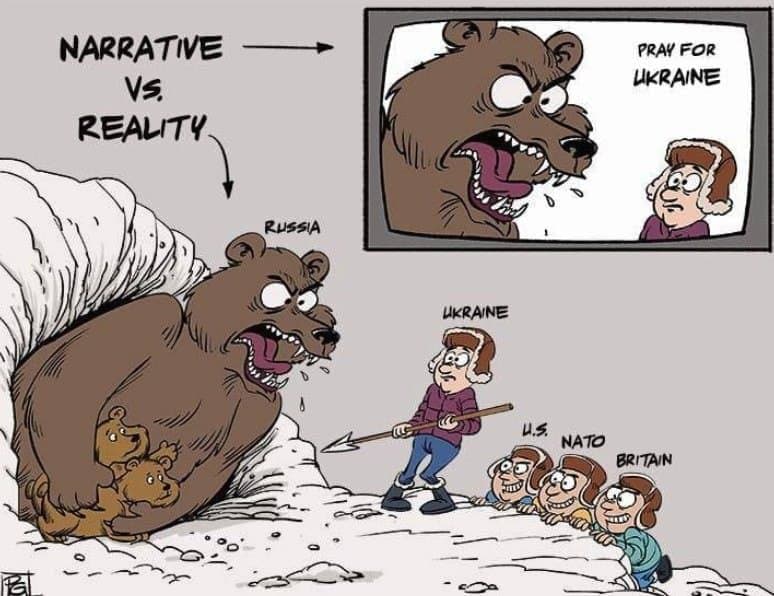
A few days ago Americans tried to set Poland against Russia in that they suggested to Warsaw that it send Soviet-made MiG aircraft to Ukraine. Though the Polish authorities usually oblige the West’s wishes, this time they had second thoughts about the proposal and replied that they were ready to send the said aircraft to the American air base in Rammstein so that Americans could pass them over to Kiev. And you know what? Washington was beside itself with annoyance! You see? The dog was expected to bite the bear, with the dog’s owner watching from the sidelines and biding his time.
Just picture it to yourself. Warsaw sends the MiG aircraft to Ukraine, Moscow regards it (and rightly so!) as a hostile act and fires a couple of missiles against selected targets in Polish territory. What do you think the West would do? Yes, you guessed it right. The West would express its great indignation and impose a set of new sanctions… for a time.
Talking about President Putin, who – according to the Western analysts is about to be toppled either by the people closest to him or by the nation – his Christian name is Vladimir, and Vladimir was the name of the grand prince of Rus’ who united the many Slavic tribes and christened them. He went down in history as Vladimir the Great. The chances are – whether you like it or not – that Putin is going to be another Vladimir the Great.
The current war means the end of the world that we have been accustomed to. We are entering a new cold war period and a new division of the globe with the United States, Great Britain, and the European Union on the one side, and Russia and China on the other. This new world throws a monkey wrench into the plans forged by globalists of the Klaus Schwab ilk. Or, globalism will be reduced to the Western world. The international rules that all the countries have up to now tried to abide by are no more valid for Russia, and consequently sooner or later for others because of the domino effect. Being beleaguered by the West, Moscow will have no intention to play by the rules created in this West. Why should it?
Sanctions work both ways. Russia has a lot to offer, be it crude oil, natural gas, rare metals or what not. Look back into the past! The Bolsheviks that took reins of power after 1917 were hated by the West. Lo and behold, it did not take many years for the capitalists to resume business with the hated communists; similarly, after the Second World War the Soviet Union was regarded as a hostile empire and yet, and despite that, business between the West and the Soviets went as usual. How about China? It was Taiwan that was first supported by the West, yet slowly but surely Washington reversed course, left Taiwan to its own devices and resumed contacts with Beijing. Since – as said above – money makes the world go round, the greedy capitalists helped China develop in that they outsourced almost all production to the Middle Kingdom. Do you think it is going to be different now with regard to Russia?
When Ukraine is eventually conquered by Russia, what will the elites in such small countries like Lithuania, Latvia and Estonia – all bordering on Russia – think about their security and the ability of the collective West to help them? I want to see that man or that woman who really thinks that NATO will go to war with Russia over Estonia or Latvia.
Ukraine has been exploited by Western companies for thirty long years. All those contacts with democracies and capitalism did not benefit the country at all. It only benefited a handful of people, who fled Ukraine before the hostilities, leaving the rank and file behind. Rumour has it that President Zelensky is kept in the American embassy in Warsaw though we are all made to believe that he remains in Kiev. How much would you bet on President Zelensky residing in Kiev, a city that is about to be soon encircled?
The West could have further exploited Ukraine and teased Russia but it simply overplayed its hand. Precisely as it is described in this fable by Aesop where a goose laying golden eggs is killed by the greedy owners. The moral? Much wants more and loses all. Now that Moscow is taking retaliatory steps like shutting down media outlets that propagated Western ideas and Western lifestyle the West has lost its ideological bridgehead inside Russia that it has held for thirty years. The West really thought it was ready to make a killing. A big killing. Western elites really thought Russia would be withdrawing from its positions further and further; they really believed the Navalny kind of Russian dissenters that the Russian people were all against the authorities. Worse, the West still thinks that Russians will force their president to surrender because otherwise common people will be stripped of the opportunity to eat hamburgers and cheeseburgers in McDonald’s restaurants in Moscow and Petersburg! Sure, there are some such people who are ready to trade their country for ham- and cheeseburgers, but then it is a splinter from the large whole. The majority accustomed to Russia’s greatness are not willing to sell this greatness off. Plus, they are not attracted by the Western values of married homosexuals or the many sexes that are invented by the month. That’s also something that the post-West is not aware of. Remember also that millions of Russians have bitter recollections of the Yeltsin era during which western-style capitalism promised them well-being and brought poverty, unrest and humiliation instead. That’s one big reason why President Putin is appreciated by the vast majority of the population: he put an end to chaos and brought in stability. If you think Russians dream about homosexual parades in their cities or pregnant soldiers in their army or the many gender pronouns, you cannot be more delusional.
There is one more explanation to all what is occurring. The West went to great lengths to have Russia and Ukraine clash for the sheer purpose of weakening both countries. This is one sure way of preserving world preponderance, is it not? Lead nations to war the moment you see they have developed too much and too fast. The United States achieved its global dominance because the Second World War wreaked havoc with the economies of Germany, Great Britain, France, Russia, Italy and Japan – the world’s powerhouses. After the cessation of the hostilities all those countries needed American aid and American dollars and were compelled to accept almost all the dictates from Washington.
Look at the present political map of the world. Iraq, Syria, Libya, Afghanistan, Ukraine, the countries of former Yugoslavia, the states that went through an array of all those colour revolutions: they are reeling under the blows of all manner of war, civil war, social upheaval and the attendant economic collapse. Which country emerges victorious? Yes, sure, the one that has not been directly engaged in the conflict. A classic case of two dogs fighting for a bone with a third running away with it.
Russia and Ukraine will lose a number of people (killed, wounded, displaced); Ukraine will have its economy ruined; Poland is already accommodating a million (and rising!) Ukrainians who somehow do not want to defend their country and prove their rights to it (If you say that women and children do not or should not take part in hostilities, then think again); Warsaw will have a lot of trouble with them. Who emerges victorious? You know who. Vice-President Kamala Harris visited Poland to reassuringly pat the Polish nation on the shoulder in recognition of Poland’s hospitality towards Ukrainians. She knows that such gestures work with Poles. The supranational elites hating ethnically monolithic countries are rubbing their hands in glee. At last Poland, this ethnically and religiously monolithic nation, is changing to a mix of Poles and Ukrainians, of Catholic and Orthodox Christians, to be later skilfully set off against each other like Croats and Serbs if Warsaw should fail to toe the Western party line.
GEFIRA – Global Analysis from the European Perspective. Preparing for the world of tomorrow.
March 12, 2022
Posted by aletho |
Economics, Mainstream Media, Warmongering, Militarism, Timeless or most popular | NATO, Poland, Russia, UK, Ukraine, United States, Vladimir Putin |
Leave a comment
Recently, western political leaders and mainstream media have begun injecting a new talking point into their anti-Russian and wartime discourse: that Russia is planning an endless series of ‘false flag attacks.’
Never mind the fact that, historically speaking, Russia has no visible track record of false flag operations.
Unfortunately, the same cannot be said for either the US and Britain – both have an extremely long list of military and political deceptions which they’ve used to start and prolong various wars around the world.
Currently, in the Donbass region, formerly in eastern Ukraine, the Ukrainian Armed Forces are firing indiscriminately into civilian towns and villages – and then attempting to blame their own violent actions on Russia. The shelling of civilian areas has been going on continuous there since the civil war began in 2014. This is extremely worrying, because in the current anti-Russian western media ecosystem, any accusations leveled at Russia are never questioned, before being beamed across all western global news networks. And that is exactly what is happening right now with mainstream media coverage in Ukraine.
Independent journalist Patrick Lancaster is on the ground in Donbass region in the Luhansk and Donetsk People’s Republics, and has recently interviewed local witnesses who have confirmed these very war crimes, carried out by NATO-backed Ukrainian Army and their Nazi-Azov Battalions.
Watch his stunning reportage here:
March 12, 2022
Posted by aletho |
Deception, False Flag Terrorism, Timeless or most popular, War Crimes | Ukraine |
Leave a comment
RT | March 12, 2022
Israeli Prime Minister Naftali Bennett has reportedly advised Ukrainian president Volodymyr Zelensky to agree to Russia’s proposals to end the ongoing bloody conflict in his country, according to Israeli media on Friday. Top officials in Kiev and Israel have denied the reports, however.
“If I were you, I would think about the lives of my people and take the offer,” the Jerusalem Post quoted Bennett as having told Zelensky on Tuesday during a phone call, citing an unnamed senior Ukrainian official.
“Bennett told us to surrender,” the official said, according to the Post, which added that Kiev apparently had “no intention” of agreeing to President Putin’s demands.
However, a top official in Bennett’s office quickly denied that any suggestion to surrender had been made, saying the Israeli PM “doesn’t intend to give Zelensky any recommendations or advice at any stage,” Axios reported. … Full article
RT | March 12, 2022
Ukrainian President Volodymyr Zelensky has expressed his readiness for negotiations with Russia. He requested that the Israeli prime minister convene peace talks in Jerusalem.
“A group of Ukrainians and Russian representatives are discussing certain issues. They began talking about something, and not just throwing out ultimatums,” Zelensky said on Saturday, during a press conference with foreign media.
Kiev is of the view that any high-profile talks with Russia should be held on neutral territory, Zelensky said, naming Israel as a potential host for such negotiations.
“We spoke with [Israeli Prime Minister Naftali] Bennett, and I said that today it is not right [to hold] meetings in Russia, in Belarus. I’m not talking about technical meetings – I’m talking about leaders’ meetings. Do I think that Israel can be such a land, and Jerusalem? Yes, I think so. And I told him that,” Zelensky stated.
However, the president said, if the outcome was to be successful, his country would need certain “security guarantees” that the ongoing conflict was settled not only from the perspective of Russia, but also from that of the West. Israel could act as a guarantor in that respect, he suggested. … Full article
March 12, 2022
Posted by aletho |
Aletho News | Israel, Ukraine |
Leave a comment