Russia Has Assembled a Giant Flotilla of Landing Ships in Tartus, Syria
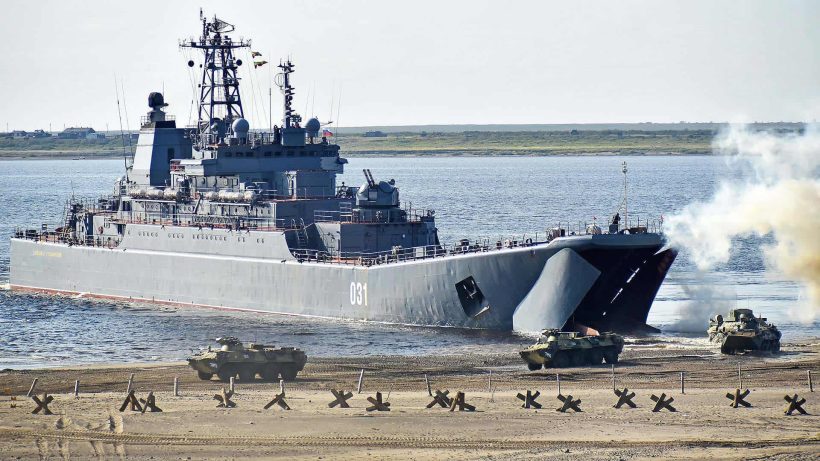
Ropucha-class, dates to the Soviet era
Anti-Empire | February 4, 2022
Russia’s Northern and Baltic fleets have 6 large landing ships each. They have each sent half of them to Tartous, Syria so that now Northern and Baltic fleets each only have 3 landing ships available, while 6 (!) are parked in Syria, a stone-throw away from the Black Sea.
The Black Sea Fleet has 7 large landing ships, so if the 6 ships in Tartus move there its amphibious landing capacity will be doubled.
This isn’t any kind of secret, the Russian military channel Zvezda TV is reporting about it openly (not that half a dozen ships can be hidden) and placing it in the context of “exercises”. Will Russia be conducting giant landing exercises in Syria? I doubt it. So then it was a “sailing” exercise?
Behind almost 6,000 nautical miles. And now, off the coast of Syria, there are six large landing ships of the Northern and Baltic Fleets “Pyotr Morgunov”, “George the Victorious”, “Olenegorsky Miner”, “Korolev”, “Minsk” and “Kaliningrad”. The path was not close and difficult – around Europe to the eastern part of the Mediterranean Sea.
This is unprecedented.
We can talk about whether the shift of Russian military power to the West and to the Mediterranean — aka closer to Ukraine is a “feint”, a “bluff”, “pressure”, “diplomacy-booster”, “ultimatum-booster”, or a buildup for escalation and live war. But what is not up for debate is that such a western buildup exists. For what purposes nobody knows 100%.
To pass the Bosphorus Strait Russian warships must under the Montreux Convention give the Turks a notice 8 days in advance, so if this fleet of landing ships will be headed for Sevastopol we will know before they even leave Tartus.
A war with Russia would be unlike anything the US and NATO have ever experienced
By Scott Ritter | RT | February 4, 2022
In a recent press conference held on the occasion of a visit to Moscow by Hungarian Prime Minister Viktor Orban, Russian President Vladimir Putin spoke about continued NATO expansion, and the potential consequences if Ukraine was to join the trans-Atlantic alliance.
“Their [NATO’s] main task is to contain the development of Russia,” Putin said. “Ukraine is simply a tool to achieve this goal. They could draw us into some kind of armed conflict and force their allies in Europe to impose the very tough sanctions that are being talked about in the United States today,” he noted. “Or they could draw Ukraine into NATO, set up strike weapons systems there and encourage some people to resolve the issue of Donbass or Crimea by force, and still draw us into an armed conflict.”
Putin continued, “Let us imagine that Ukraine is a NATO member and is stuffed with weapons and there are state-of-the-art missile systems just like in Poland and Romania. Who will stop it from unleashing operations in Crimea, let alone Donbass? Let us imagine that Ukraine is a NATO member and ventures such a combat operation. Do we have to fight with the NATO bloc? Has anyone thought anything about it? It seems not.”
But these words were dismissed by White House spokesperson Jen Psaki, who likened them to a fox “screaming from the top of the hen house that he’s scared of the chickens,” adding that any Russian expression of fear over Ukraine “should not be reported as a statement of fact.”
Psaki’s comments, however, are divorced from the reality of the situation. The principal goal of the government of Ukrainian President Volodymyr Zelensky is what he terms the “de-occupation” of Crimea. While this goal has, in the past, been couched in terms of diplomacy – “[t]he synergy of our efforts must force Russia to negotiate the return of our peninsula,” Zelensky told the Crimea Platform, a Ukrainian forum focused on regaining control over Crimea – the reality is his strategy for return is a purely military one, in which Russia has been identified as a “military adversary”, and the accomplishment of which can only be achieved through NATO membership.
How Zelensky plans on accomplishing this goal using military means has not been spelled out. As an ostensibly defensive alliance, the odds are that NATO would not initiate any offensive military action to forcibly seize the Crimean Peninsula from Russia. Indeed, the terms of Ukraine’s membership, if granted, would need to include some language regarding the limits of NATO’s Article 5 – which relates to collective defense – when addressing the Crimea situation, or else a state of war would de facto exist upon Ukrainian accession.
The most likely scenario would involve Ukraine being rapidly brought under the ‘umbrella’ of NATO protection, with ‘battlegroups’ like those deployed into eastern Europe being formed on Ukrainian soil as a ‘trip-wire’ force, and modern air defenses combined with forward-deployed NATO aircraft put in place to secure Ukrainian airspace.
Once this umbrella has been established, Ukraine would feel emboldened to begin a hybrid conflict against what it terms the Russian occupation of Crimea, employing unconventional warfare capability it has acquired since 2015 at the hands of the CIA to initiate an insurgency designed specifically to “kill Russians.”
The idea that Russia would sit idly by while a guerilla war in Crimea was being implemented from Ukraine is ludicrous; if confronted with such a scenario, Russia would more than likely use its own unconventional capabilities in retaliation. Ukraine, of course, would cry foul, and NATO would be confronted with its mandatory obligation for collective defense under Article 5. In short, NATO would be at war with Russia.
This is not idle speculation. When explaining his recent decision to deploy some 3,000 US troops to Europe in response to the ongoing Ukrainian crisis, US President Joe Biden declared, “As long as he’s [Putin] acting aggressively, we are going to make sure we reassure our NATO allies in Eastern Europe that we’re there and Article 5 is a sacred obligation.”
Biden’s comments echo those made during his initial visit to NATO Headquarters, on June 15 last year. At that time, Biden sat down with NATO Secretary-General Jens Stoltenberg and emphasized America’s commitment to Article 5 of the NATO charter. “Article 5 we take as a sacred obligation,” Biden said. “I want NATO to know America is there.”
Biden’s view of NATO and Ukraine is drawn from his experience as vice president under Barack Obama. In 2015, then-Deputy Secretary of Defense Bob Work told reporters, “As President Obama has said, Ukraine should … be able to choose its own future. And we reject any talk of a sphere of influence. And speaking in Estonia this past September, the president made it clear that our commitment to our NATO allies in the face of Russian aggression is unwavering. As he said it, in this alliance there are no old members and there are no new members. There are no junior partners and there are no senior partners. There are just allies, pure and simple. And we will defend the territorial integrity of every single ally.”
Just what would this defense entail? As someone who once trained to fight the Soviet Army, I can attest that a war with Russia would be unlike anything the US military has experienced – ever. The US military is neither organized, trained, nor equipped to fight its Russian counterparts. Nor does it possess doctrine capable of supporting large-scale combined arms conflict. If the US was to be drawn into a conventional ground war with Russia, it would find itself facing defeat on a scale unprecedented in American military history. In short, it would be a rout.
Don’t take my word for it. In 2016, then-Lieutenant General H.R. McMaster, when speaking about the results of a study – the Russia New Generation Warfare – he had initiated in 2015 to examine lessons learned from the fighting in eastern Ukraine, told an audience at the Center for Strategic and International Studies in Washington that the Russians have superior artillery firepower, better combat vehicles, and have learned sophisticated use of unmanned aerial vehicles (UAVs) for tactical effect. “Should US forces find themselves in a land war with Russia,” McMaster said, “they would be in for a rude, cold awakening.”
In short, they would get their asses kicked.
America’s 20-year Middle Eastern misadventure in Afghanistan, Iraq, and Syria produced a military that was no longer capable of defeating a peer-level opponent on the battlefield. This reality was highlighted in a study conducted by the US Army’s 173rd Airborne Brigade, the central American component of NATO’s Rapid Deployment Force, in 2017. The study found that US military forces in Europe were underequipped, undermanned, and inadequately organized to confront military aggression from Russia. The lack of viable air defense and electronic warfare capability, when combined with an over-reliance on satellite communications and GPS navigation systems, would result in the piecemeal destruction of the US Army in rapid order should they face off against a Russian military that was organized, trained, and equipped to specifically defeat a US/NATO threat.
The issue isn’t just qualitative, but also quantitative – even if the US military could stand toe-to-toe with a Russian adversary (which it can’t), it simply lacks the size to survive in any sustained battle or campaign. The low-intensity conflict that the US military waged in Iraq and Afghanistan has created an organizational ethos built around the idea that every American life is precious, and that all efforts will be made to evacuate the wounded so that they can receive life-saving medical attention in as short a timeframe as possible. This concept may have been viable where the US was in control of the environment in which fights were conducted. It is, however, pure fiction in large-scale combined arms warfare. There won’t be medical evacuation helicopters flying to the rescue – even if they launched, they would be shot down. There won’t be field ambulances – even if they arrived on the scene, they would be destroyed in short order. There won’t be field hospitals – even if they were established, they would be captured by Russian mobile forces.
What there will be is death and destruction, and lots of it. One of the events which triggered McMaster’s study of Russian warfare was the destruction of a Ukrainian combined arms brigade by Russian artillery in early 2015. This, of course, would be the fate of any similar US combat formation. The superiority Russia enjoys in artillery fires is overwhelming, both in terms of the numbers of artillery systems fielded and the lethality of the munitions employed.
While the US Air Force may be able to mount a fight in the airspace above any battlefield, there will be nothing like the total air supremacy enjoyed by the American military in its operations in Iraq and Afghanistan. The airspace will be contested by a very capable Russian air force, and Russian ground troops will be operating under an air defense umbrella the likes of which neither the US nor NATO has ever faced. There will be no close air support cavalry coming to the rescue of beleaguered American troops. The forces on the ground will be on their own.
This feeling of isolation will be furthered by the reality that, because of Russia’s overwhelming superiority in electronic warfare capability, the US forces on the ground will be deaf, dumb, and blind to what is happening around them, unable to communicate, receive intelligence, and even operate as radios, electronic systems, and weapons cease to function.
Any war with Russia would find American forces slaughtered in large numbers. Back in the 1980s, we routinely trained to accept losses of 30-40 percent and continue the fight, because that was the reality of modern combat against a Soviet threat. Back then, we were able to effectively match the Soviets in terms of force size, structure, and capability – in short, we could give as good, or better, than we got.
That wouldn’t be the case in any European war against Russia. The US will lose most of its forces before they are able to close with any Russian adversary, due to deep artillery fires. Even when they close with the enemy, the advantage the US enjoyed against Iraqi and Taliban insurgents and ISIS terrorists is a thing of the past. Our tactics are no longer up to par – when there is close combat, it will be extraordinarily violent, and the US will, more times than not, come out on the losing side.
But even if the US manages to win the odd tactical engagement against peer-level infantry, it simply has no counter to the overwhelming number of tanks and armored fighting vehicles Russia will bring to bear. Even if the anti-tank weapons in the possession of US ground troops were effective against modern Russian tanks (and experience suggests they are probably not), American troops will simply be overwhelmed by the mass of combat strength the Russians will confront them with.
In the 1980s, I had the opportunity to participate in a Soviet-style attack carried out by specially trained US Army troops – the ‘OPFOR’ – at the National Training Center in Fort Irwin, California, where two Soviet-style Mechanized Infantry Regiments squared off against a US Army Mechanized Brigade. The fight began at around two in the morning. By 5:30am it was over, with the US Brigade destroyed, and the Soviets having seized their objectives. There’s something about 170 armored vehicles bearing down on your position that makes defeat all but inevitable.
This is what a war with Russia would look like. It would not be limited to Ukraine, but extend to battlefields in the Baltic states, Poland, Romania, and elsewhere. It would involve Russian strikes against NATO airfields, depots, and ports throughout the depth of Europe.
This is what will happen if the US and NATO seek to attach the “sacred obligation” of Article 5 of the NATO Charter to Ukraine. It is, in short, a suicide pact.
Scott Ritter is a former US Marine Corps intelligence officer and author of ‘SCORPION KING: America’s Suicidal Embrace of Nuclear Weapons from FDR to Trump.’
America’s Putin Psychosis
By Scott Ritter | Consortium News | February 2, 2022
The war of words between Russia and the United States over Ukraine escalated further on Tuesday as Russian President Vladimir Putin responded for the first time to the U.S. written reply to Russia’s demands for security guarantees that were expressed in the form of a pair of draft treaties submitted by Moscow to the U.S. and NATO in December.
“It is already clear…that the fundamental Russian concerns were ignored. We did not see an adequate consideration of our three key requirements,” Putin said at a press conference that followed his meeting with Hungarian Prime Minister Viktor Orban in Moscow.
Putin said the U.S. had failed to give “adequate consideration of our three key demands regarding NATO expansion, the renunciation of the deployment of strike weapons systems near Russian borders, and the return of the [NATO] bloc’s military infrastructure in Europe to the state of 1997, when the Russia-NATO founding act was signed.”
He detailed what he alleged was NATO’s long history of deception, re-emphasizing the 1990 verbal commitment by former U.S. Secretary of State James Baker that NATO would not expand “an inch” eastward. “They said one thing, they did another,” Putin said. “As people say, they screwed us over, well they simply deceived us.”
With some 130,000 Russian troops deployed in the western and southern military districts bordering Ukraine, and another 30,000 assembling in neighboring Belarus, U.S. policy makers are scrambling to figure out what Russia’s next move might be, a choice most U.S. policy makers believe boils down to diplomacy or war.
Rather than examine the situation from the perspective of Russian national security interests, however, these officials have placed the fate of European peace and security in the hands of a single individual: Vladimir Vladimirovich Putin.
Interests of an Entire Nation
In a recent article in The Atlantic, Tom Nichols opines that “no one really knows why Putin is doing this—or whether he really intends to do it at all. It is unlikely that his own inner circle even has a good read on its boss.”
Even the president of the United States, Joe Biden, professed a sense of frustration at not knowing what Putin’s objectives are vis-à-vis Ukraine. “I’ll be completely honest with you,” Biden said last month, “it is a little bit like reading tea leaves” when it came to predicting Putin’s next move.
The fact that the U.S. president is at a loss when assessing Russia’s next move regarding Ukraine should send a shiver up the spines of all concerned Americans. One of the main reasons for this confusion lies in the emphasis Biden placed on the importance of only what Putin was thinking, as opposed what the legitimate national security interests of Russia were.
This problem is not unique to the present circumstance, but rather is part and parcel of a national obsession with Putin the man that obviates the reality that Russia is a country whose interests are greater than any single individual, no matter how long serving or powerful.
The problem with focusing on an individual as the embodiment of a nation is that one is trying to solve the wrong problem. Russia’s ongoing issues with Ukraine are larger than Vladimir Putin, and as such, far more complex in defining national goals and policy boundaries. You can’t solve a problem unless you first accurately define the problem; by tying the problem of Ukraine to one man, American policy makers are, in effect, dealing with the wrong problem.
This disconnect from reality is further exacerbated when, as is the case with the majority of so-called “Russian experts” prevalent in America today, one seeks to play amateur psychiatrist by getting into the mind of the Russian leader.
Take, for example, Michael McFaul, the architect of Barack Obama’s infamous policy “reset” with Russia (a little-disguised effort designed to squeeze Putin out of power and replace him with the ostensibly more compliant Dmitry Medvedev). The title of his policy memoir, From Cold War to Hot Peace: An American Ambassador in Putin’s Russia says it all. If you think you have the ability to define the character of an entire nation through the persona of a single named individual, you should be able to provide some insight into the thinking of that person.
But as McFaul himself admitted recently on MSNBC, “I want to state categorically that I don’t know what Putin wants. I don’t know what he’s decided. President Biden doesn’t know. The director of the CIA [William Burns] doesn’t know. I don’t think Sergei Lavrov knows, the foreign minister.”
A moment of honest humility? No; McFaul continues: “And from my experience dealing with Putin in negotiations, I don’t think he has made his own decision yet. I think that he likes this uncertainty. He likes that we’re all talking about, you know, negotiating with ourselves, making counter proposals. He likes to watch that.”
McFaul, by his own admission, doesn’t know what Putin wants, but he freely opines about what Putin thinks and likes. I would respectfully suggest that if you know a person well enough to publicly pontificate on their thoughts and desires, then you probably know what they want.
Perception Over Reality
McFaul honestly stated that he doesn’t know what Putin wants; the rest is simply speculative drivel motivated not by any genuine intellectually-based curiosity about Russia and the man who serves as its president, but rather the need to feed the American mainstream media’s appetite for a narrative that doesn’t challenge that of a White House that sets the tone and content of what passes for news based upon domestic political imperatives as opposed to global geopolitical reality.
Perception is everything; facts mean nothing. This is the Biden administration’s mantra. One only need look to Biden’s July 23, 2021, telephone conversation with then-Afghan President Ashraf Ghani. “I need not tell you the perception around the world and in parts of Afghanistan, I believe, is that things aren’t going well in terms of the fight against the Taliban,” Biden told the beleaguered Afghan leader. “And there’s a need, whether it is true or not, there is a need to project a different picture.”
The fact that U.S. presidential administrations, as a matter of course, manufacture a fact-free narrative designed to mislead a domestic American audience should not come as a shock to anyone who has studied the sickening intersection of public and foreign policy in the United States since the end of the Second World War.
In this vein, one of the central themes that is being woven into the Ukraine narrative is the frenetic nature of decision making by Vladimir Putin.
McFaul described Russia’s seizure of the Crimean Peninsula in 2014 as an impulsive move by Putin, not something long planned, but put into effect only after the 2014 U.S.-backed coup in Kiev. This line of thinking was endemic in the Obama White House where McFaul served. Journalist Susan Glasser, a long-time critic of Putin, quotes an unnamed “top Obama official” in her 2014 article for Politico, “Putin on the Couch.’
“I hear people say we were naïve about Putin and that the president didn’t understand Putin,” the official said. “No. We had a very sober, very steely-eyed realist assessment of Putin.”
But then the “top official” proved they did not. “It comes down to a debate going on in his own head,” the official noted. “He does impulsive, or dare I say irrational, things. I don’t think he’s the realist grand strategist that some people admiringly ascribe to him.”
Glasser ran with the theme, quoting David Remnick, the editor of The New Yorker and Pulitzer Prize winning author of Lenin’s Tomb, who, speaking about Putin and Crimea, declared, “I think he has improvised, acted rashly and foolishly, even on his own terms.”
Stephen Sestanovich, the U.S. ambassador-at-large to the former Soviet Union from 1997 to 2001, continued this line of analysis, noting Putin’s “bad judgment, emotional decision-making, petty score-settling with little care for long-term consequences,” before concluding “But it’s vintage Putin.”
Even when fellow travelers like Fiona Hill, who doubled as the top Kremlinologist for both George W. Bush and Donald Trump, and Andrea Kendall-Taylor, a former C.I.A. analyst who served as a deputy national intelligence officer for Russia and Eurasia under Barack Obama, come together for a pragmatic assessment of Russia, they are colored by their collective Putin-centric approach to all things Russia.
Hill, the author of Mr. Putin: Operative in the Kremlin, recently observed that, “With Putin it’s always important to expect the unexpected. He makes sure that he has a range of options for action and different ways of leveraging a situation to exploit weakness. If all our attention is on Ukraine, then his next move might be somewhere else to throw us off balance and see how we react.”
Kendall-Taylor, whose assessments on Putin and Russia were regularly briefed to President Obama, testified before Congress in 2019 that, “Although Putin’s actions in Crimea and Syria were designed to advance a number of key Russian goals, it is also likely that Putin’s lack of domestic constraints increased the level of risk he was willing to accept in pursuit of those goals.”
These two seasoned Russian hands, both highly influential in terms of advising senior American policy makers, from the president on down, both continue the narrative of Putin as an impulsive, risk-taking gambler, who makes spur of the moment decisions based upon personal intuition.
They, like all the other so-called Russian experts, are wrong.
How Policy Is Made in Russia
The fact is, any Russian expert worth their salt knows what Russia’s goals and objectives vis-à-vis Ukraine are because the Russians told us back in 2008. One of the few genuine Russian experts in a position to influence policy, C.I.A. Director William Burns, put it all down in writing in a February 2008 cable entitled, simply enough, “Nyet means Nyet: Russia’s NATO Enlargement Redlines.” He wrote it while serving as the U.S. ambassador to Russia during the administration of President George W. Bush.
Burns, reporting on the Russian reaction to the 2008 NATO summit where the idea of membership for Ukraine was floated, noted that the Russian Foreign Ministry had declared that “a radical new expansion of NATO may bring about a serious political-military shift that will inevitably affect the security interests of Russia.”
The Russians highlighted that when it came to Ukraine, Russia was bound by bilateral obligations set forth in the 1997 Treaty on Friendship, Cooperation and Partnership in which both parties undertook to “refrain from participation in or support of any actions capable of prejudicing the security of the other side.” Ukraine’s ‘likely integration into NATO,” the Russian Foreign Ministry declared, “would seriously complicate the many-sided Russian-Ukrainian relations,” and that Russia would “have to take appropriate measures.”
Burns gave the Bush administration the Russian playbook of consequences should NATO seek to move forward on membership for Ukraine. This information was known to McFaul, Hill, Kendall-Taylor, and all the other so-called “Russian experts,” yet they failed to address it (further reinforcing Putin’s claims that “fundamental Russian concerns were ignored”).
The concept that Putin would act “impulsively” in 2014 to a problem outlined concisely and accurately in 2008 by the Russian Ministry of Foreign Affairs likewise shows an absolute disregard for, or ignorance of, how policy is made in Russia today.
There is no doubt that Putin is a very powerful president wielding strong executive powers. But he is not a dictator, nor is Russia set up to be ruled by a dictator.
Russian policy is made by professional bureaucrat-specialists resident in the extremely dense permanent Russian bureaucracy. These bureaucrats, part of the Russian civil servant class, are responsible for turning policy guidance into detailed implementation plans from which the resources needed for implementation are assigned, along with a timeline for completion of the task.
These implementation plans cut across ministries and are designed to consider all foreseeable variables. In short, Russian policy is the by-product of a process which represents the coordinated effort of a vast bureaucracy—the exact opposite of the individual “impulsivity” ascribed by McFaul, Hill, Kendall-Taylor, and others to Putin.
The plan implemented by Russia regarding Crimea in 2014 was born of the Russian concerns expressed in 2008, and were not the knee-jerk reactions of an impulsive, risk-taking Russian President. The same can be said for the situation unfolding in Ukraine today. The fact that Biden and his national security advisors are locked on to Putin as the personification of all things Russia is indicative of a fundamental misunderstanding of how Russia works or — worse — a deliberate campaign of perception management intended to deceive the American public about the complexities and realities of U.S. policy objectives.
Getting it wrong when it comes to defining policy-making reality in Russia today goes well beyond simply formulating bad policy, which is then incompetently implemented. The United States is ceding the initiative to Russia and its president. At the end of the day, one would be hard pressed to make a case where the executive decision-making powers of Vladimir Putin far exceed those of his American counterpart.
The Russians, however, have a two-fold advantage over the United States in terms of policy implementation. First and foremost, they are dealing with an executive who has been at the helm of the Russian ship for two decades; Putin is unmatched when it comes to knowledge of his system of government, and how to make it work. Even someone like Biden, with his four-plus decades of government experience, operates like a rookie during his first few years in office, if for no other reason than he is, in fact, a rookie.
A U.S. presidential administration in its first term is, literally, starting from scratch. True, there is a standing American civil service (some call it part of the “deep state”) which provides a modicum of operational consistency from administration to administration, but the critical leadership for every administration is provided by the political appointees. As opposed to Russia’s twin decades of consistent policy formulation and implementation, the United States has witnessed during the same time frame four changes of administrations, each one with a radically different approach toward governance than its predecessor.
A Manufactured Narrative
The only consistency between administrations is the need to manufacture narratives used to placate a domestic constituency about policies linked to national defense and, by extension, the defense industry. Here, the demonization of Russia has played a large role in defining U.S. defense needs and, by extension, the acquisition of weapons.
No administration has trusted the American public to engage in a fact-based national dialogue about the “threat” posed by Russia and, by extension, the continued need for NATO. The main reason for this is, if the facts were presented clearly, no American could possibly support the continuation of NATO and, therefore, would not support the elevation of Russia as a threat worthy of hundreds of billions of our taxpayer dollars.
In this way, the United States can produce a class of partisan “experts” on Russia whose only claim to real expertise is the ability to conform to a narrative designed to further a lie, as opposed to seeking the truth. Gone are the days when masters of Russian studies, such as the former U.S. Ambassador to the Soviet Union, Jack Matlock, held sway.
Even when the U.S. produced a qualified Russian expert in academia, such as the late Steven Cohen, the mainstream media negated his true expertise by either drowning out his message in a sea of Russophobic propaganda spewed by his opposite numbers, or just simply ignoring him. Instead, we get the Michael McFaul’s, Fiona Hill’s, and Andrea Kendall-Taylor’s—academics whose sole claim to relevance is their collective embrace of Putin as the personification of all that ails Russia in the world today.
America’s dependence on this inferior class of ersatz Russian expertise has created a congenital defect in American national security decision making that is best expressed as a variation of John Boyd’s OODA Loop. Boyd, a renowned fighter pilot, claimed he could shoot down any opposing fighter within forty seconds from a position of disadvantage employing a decision-making cycle he called the “OODA Loop” (for Observe, Orient, Decide, Act).
In short, by executing one’s decision-making cycle faster than an opponent, one “got inside” the decision-making cycle of the enemy, forcing them to react to you, and thereby guaranteeing their demise.
The OODA Loop has been adapted by various non-pilot organizations and entities, from the U.S. Marines to business, as a model to improve operational efficiency. While neither the Russian Foreign Ministry nor the U.S. State Department have embraced the theory, it can be used as a vehicle of comparative analysis when assessing the effectiveness of the respective policy formulation and implementation cycles.
Three Phases
From the standpoint of observing, the fundamental tennet is to collect data using all possible resources. From the Russian perspective, when it comes to Ukraine and NATO, Russia has been focused on NATO policy, both expressed and implemented, when it comes to its eastward expansion, and the applicability of such expansion to Ukraine. The data collected by Russia is fact-based, and singularly focused on the problem at hand, which is the potential threat posed to Russia by Ukrainian membership in NATO.
The U.S., however, with its Putin-centric approach, focuses on the person of the Russian president, without any attempt to match observed actions with anything resembling actual policy. The data collected is of the tabloid variety, focusing on posturing, mannerisms, and photo opportunities.
While Putin does provide a plethora of data in the form of speeches and extended press question and answer sessions, the analysis conducted from these opportunities rarely goes deeper than turning the Russian president’s presentation into a cartoon-like depiction of evil.
The next phase, orientation, is guided by the data collected during the observation phase. Here, the Russians can zoom in on the U.S./NATO centers of gravity, so to speak — that which makes the trans-Atlantic alliance work, and that which could cause problems.
Here, Russia has predicted possible policy options that could be pursued by NATO in response to a wide variety of policy stimuli from Russia and gamed out each to find a range of actions and reaction possibilities that best suit Russian policy objectives.
The U.S., however, continues to focus on Putin, producing material in book, article, and television formats which attack the character of the Russian president while denigrating Russia as a nation (“Russia is nothing more than a gas station masquerading as a country” seems to be a popular jibe.)
By creating a false narrative built around the absolute nature of Putin’s quasi-dictatorial state, the Americans have lulled themselves into a false sense of complacency premised on the notion of Putin’s impulsivity which, by its very nature, cannot be predicted, and as such cannot be deterred through preventive measures.
The third phase, decision, is paramount. Here, the Russians, having gathered data, assessed its value, and formulated policy options derived from the same, pick the option that best suits their policy objectives. They are in control of the timetable, and as such, can allocate resources sufficient to the task.
The Americans, by comparison, remain engaged in the business of demeaning the Russians and their president in products designed for domestic consumption and, as such, virtually useless in the realm of reality.
The final phase, action, is where the proverbial rubber meets the road. Here the Russians have initiated a process which not only has them operating at a time and place of their choosing, but also to have positioned themselves to immediately begin the next OODA Loop cycle by having the appropriate sensors in place to collect data regarding any potential American reaction so that new decision options can be rapidly prepared and acted on.
The Americans, meanwhile, are alerted to a potential crisis only through the actions of the Russians. The Americans initiate their own observation process, but their collection mechanism, so firmly rooted in the persona of Putin, is oblivious to the complexity and layering of the Russian action.
Russia, armed with the luxury of time and initiative, can isolate American actions as they take place, beginning a process of action-reaction which Russia controls.
In short, if the current diplomatic engagement taking place between the U.S. and Russia over Ukraine were a dog fight, the Americans would be shot down by the Russians inside of forty seconds, guaranteed.
Russia isn’t simply operating inside the American decision-making cycle—they control it.
Propagandized Conformity
While the ultimate responsibility for bad policy rests with the senior policy maker — the U.S. president — there is no doubt that successive presidential administrations have been poorly served by the current crop of American Kremlinologists, personified by McFaul, Hill, Kendall-Taylor, and others, who made Putin bashing the standard for what passed for Russian studies.
In short, so long as your world view of Russia conformed with the Putin bashers, you were welcomed into the club; if, however, one opted to take a more nuanced, fact-based approach to Russian studies that went beyond the persona of the Russian president, and explored the complexity of post-Cold War Russia, the powers that be in government, academia and media would relegate you to the trash bin of relevancy.
Every American citizen should realize that they have been poorly served by these slavish servants of propagandized conformity, and the potential consequence of their collective failure — war — stares us all in the face.
If we can emerge from these difficult times intact, it will only be because the Russians—not Biden—picked a policy path that possessed a viable diplomatic offramp.
And if we are so fortunate, then the practitioners of this Putin psychosis —the McFaul’s, Hill’s, Kendall-Taylor’s, and others of their ilk — should be singled out for their respective role in bringing America to such a place policy-wise and treated accordingly — no more sinecures, no more access, no more credibility.
Scott Ritter is a former U.S. Marine Corps intelligence officer who served in the former Soviet Union implementing arms control treaties, in the Persian Gulf during Operation Desert Storm, and in Iraq overseeing the disarmament of WMD.
Could the Ukrainian army face Russian forces?
By Uriel Araujo | February 2, 2022
With a Russian-Ukrainian armed conflict becoming increasingly more likely, due to the escalation of tensions and Ukrainian provocations, some analysts are already reflecting on the possible outcomes of such a conflict. In this scenario, what chances do the Ukrainian armed forces have?
The Ukrainian military is notoriously outdated, corrupt, low-tech, focused on trench warfare, low-skilled, and poorly paid. In addition, it lacks discipline and it is not very experienced. One could argue it has “hardened” itself since 2014, as it has been fighting rebel forces in Donbas but by Kiev’s own estimates, the vast majority of the rebels are locals, contrary to Western discourses about “Russian occupants”, and possess mainly light weapons and Soviet-age armor. The Russian armed forces are something very different. Moreover, Ukrainian bombers and jet fighters are quite dated and could play only a supporting role in a war against Russia. Kiev has Soviet-era surface-to-air missile batteries and most of its systems are dependent on Russia for upgrades. Of course, it could modernize its air force, but it would take at least a decade and would cost some billions of dollars.
It is true the Ukrainian army now has some Main Battle Tank and Light Anti-tank Weapons (MBT LAWs, also known as NLAWs). Around 2,000 units of these “fire-and-forget” anti-tank missile systems have been provided to Kiev by the UK, hundreds of those were delivered last month, apparently in a hurry.
According to Sebastien Roblin, an international security expert, who has served as a university instructor for the Peace Corps in China and holds a Georgetown University Master’s Degree in Conflict Resolution, these missiles might only be useful in “desperate circumstances”. They were chosen mainly due to the fact that they are easy to use, thus allowing the Ukrainian forces to be quickly trained in their use by British paratroopers. The MBT LAWs do not possess as much long-distance accuracy as the US anti-tank missile TOW (tube-launched, optically tracked, wire-guided), for instance.
They could of course destroy some Russian tanks in an urban warfare context, but, as Roblin argues, in his Forbes piece, Moscow’s military doctrine today (known as “non-contact warfare“), focuses mainly on destroying the enemy forces from a great distance, employing all kinds of artillery aided by drone surveillance technology. Moscow has learned much from Chechnya urban battles of the 1990s, after all. This means Russian tanks and infantry would only come after massive artillery fire. In this case, Ukraine’s mostly plain geography does not help much. Russian ballistic and cruise missile platforms, simply put, have the power to devastate Ukrainian power plants, radars, command centers and armored vehicle columns.
Kiev also possesses some Javelin missiles now, delivered by Washington – albeit in a very limited amount (about 540 missiles and 77 launchers). They too are no match for Moscow’s airpower and could merely deter the Russian army for a while, as they are mostly ambush weapons.
Last month, the Ukrainian defense minister Oleksii Reznikov addressed Washington humbly requesting Patriot PAC-3 missiles. It is quite unlikely the US would authorize supplying a non-NATO member with Patriots missiles in any case, as Ukraine defense expert Mikhail Zhirikov argues. The thing is the kind of longer-range missiles Kiev would need are tremendously costly and complex and, moreover, Ukraine would need years to properly train its forces in using such systems and to fully integrate them.
Since the 2014 so-called Maidan revolution, Ukraine’s economy, one of Europe’s poorest, has been in very bad shape and recent Western alarmism has hurt it even more, according to Ukrainian President Zelensky himself. This too, would not help much in a hypothetical situation of war.
Samuel Charap and Scott Boston, two Rand Corporation analysts, argue that any military assistance or weapons Ukraine receives will be simply irrelevant considering Russian advantages in geography, capability and capacity. They go as far as to say that the best help Washington could provide Kiev would be finding a diplomatic solution.
In any case, according to Ukraine’s own generals, Kiev could not repel Russian forces without major Western military help. Such help however might never come. The US-led NATO, as expected, has already made it abundantly clear it will not send any troops should a war ensue. Western help would be limited to sending mercenaries disguised as advisors to train sabotage units and terrorists.
Contrary to Western narratives, Moscow does not desire to occupy Eastern Ukraine and never intended to do so. What Moscow wants is very simple: it wants NATO to cease expanding towards Russian borders, as the Alliance has persistently done since the end of the Cold War, and the end of the so-called Iron Curtain.
One should also keep in mind that Eastern Ukraine is mostly pro-Russian and that Ukraine has a very high rate of bilingualism and mixed Russian-Ukrainian marriages. The two countries’ history is intertwined. This greatly limits Ukrainian nationalism’s potential for growth outside parts of Western Ukraine.
The most likely outcome of a war would be a quickly defeated Ukraine forced to compromise by granting some limited autonomy to the Donbas region instead of pushing its current genocidal and chauvinistic policies there. In such a scenario, the presence of a Russian peace-keeping mission in Donbas for some years would also be a possibility, amid a possible frozen conflict in the region (involving rogue ultra-nationalist Ukrainian factions), with occasional acts of sabotage and terrorism commited by far-right Ukrainian groups funded or aided by Western powers and their networks of proxies, and also possibly by Turkey’s own networks (considering ultra-nationalist Turkish-Ukranian cooperation).
In this case, one could expect a potentially long counter-insurgency conflict in a context of irregular warfare. This would further fuel Europe’s own migration crisis, with an increase in criminality, terrorism and all the usual negative economic and political outcomes, thus impacting the EU very badly.
To sum it up, in the event of a Russian-Ukrainian war, everyone loses, as is the case with any armed conflict, but some lose more: Ukraine as a whole would suffer the most, followed by Europe.
Ukraine orders massive military expansion
RT | February 1, 2022
Ukrainian President Volodymyr Zelensky has signed an order to expand the country’s military, including bolstering the ranks of its army by at least 100,000 soldiers over the next three years, prolonging service contracts, and boosting pay.
Zelensky announced the news on Tuesday at an open session of the Rada, the Ukrainian parliament, saying, “I’ve signed an order to strengthen the defense capabilities of Ukraine. It stipulates an increase of 100,000 in the size of the army, an expansion of the program for housing troops, and an increase in their salaries.”
He clarified that the order is intended to help professionalize the Ukrainian army, “and not because there is war.”
In addition to adding 100,000 troops, the plan will extend their contracts and create 20 new brigades within the armed forces. It will also bump up service members’ pay to a minimum of three times the minimum wage, which is currently 6,500 hryvnias ($225).
The Ukrainian army currently consists of around 260,000 troops, making it the 22nd largest in the world. An increase of 100,000 would put it about equal with Turkey and Thailand, in 15th place. Russia has the fifth-most active military personnel in the world, at just over one million, and the US is third, with 1.4 million, after India and China.
In 2021, Ukraine spent $5.4 billion on its military, Russia spent $48 billion, and the US spent $750 billion, more than the next 10 countries combined.
Western leaders have been warning for months that Russia could be planning an invasion of Ukraine in the near future, citing reports of a buildup of around 100,000 troops near the two countries’ border. Moscow has denied that it has any aggressive intentions, and has called for security deals that would limit the expansion of NATO, the US-led military bloc, in eastern Europe.
Last week, US Secretary of Defense Lloyd Austin announced that President Joe Biden had authorized an additional $200 million of military assistance to Ukraine, including Javelin anti-tank missiles and “large quantities of artillery.”
Russia comments on risk of war with West
RT | January 28, 2022
With tensions running high between Russia and the US, Moscow’s top diplomat has insisted that his country does not want a full-blown conflict to break out, but also warned it will not stand aside and watch well-flagged security concerns be ignored.
Speaking to news outlets as part of a broadcast interview on Friday morning, Foreign Minister Sergey Lavrov was asked whether fighting could break out after talks over guarantees that NATO will not expand ended in deadlock.
“If it is up to the Russian Federation, there will be no war,” he declared.“We do not want wars,” he went on, stressing, however, that officials “will not allow our interests to be brutally attacked or to be ignored either.”
According to Lavrov, Washington’s response to Moscow’s proposals is “almost a model of diplomatic decency.” However, he said that NATO’s answer to the two Russian draft documents “is so ideologized, it breathes the exclusivity of the Alliance, its special mission, its special purpose.”
Lavrov went on to add that if the US is not willing to reconsider its stance on security matters, then Moscow is equally not prepared to make any compromises on its demands. “If they insist that they won’t change their position, we won’t change our position either,” he declared.
The comments come shortly after Moscow received long-awaited answers to its requests for security guarantees, including a pledge that Ukraine will not be admitted to the bloc.
On Thursday, Lavrov said that “there has been no positive response” to Moscow’s core concerns in the document provided by the American side following weeks of talks with their counterparts.
“The main issue is our clear position on the unacceptability of further NATO expansion to the East and the deployment of highly destructive weapons that could threaten the territory of the Russian Federation,” Lavrov explained.
The Kremlin also poured scorn on the response, arguing that the requests from Moscow’s officials had not been fully taken into account by Washington and the US-led military bloc.
At the same time though, according to Press Secretary Dmitry Peskov, “there are and should always be prospects… for further dialogue.”
“But as for the substantive dialogue on the draft documents, there are issues of a different nature, but I will not get ahead of myself,” he said.
Last month, Russia handed over two draft treaties, one addressed to Washington and the other to NATO, which it says are aimed at reducing the risk of conflict on the European continent.
Moscow requested that the bloc refrains from any military activity on the territory of the former Warsaw Pact states that joined after 1997, following the fall of the Soviet Union. The US-led military bloc’s secretary general, Jens Stoltenberg, has said it would unacceptable to create a “two tier” system that prevents it from engaging in activity with some member states.
A separate clause also demanded that Kiev’s ambitions to join the US-led bloc should not be granted. Ruling out NATO expansion closer to Russia’s borders has been a key demand from the country’s officials, with Peskov arguing that it is a question of “life or death.”
The Ukraine crisis, sponsored by US hegemony and war profiteers
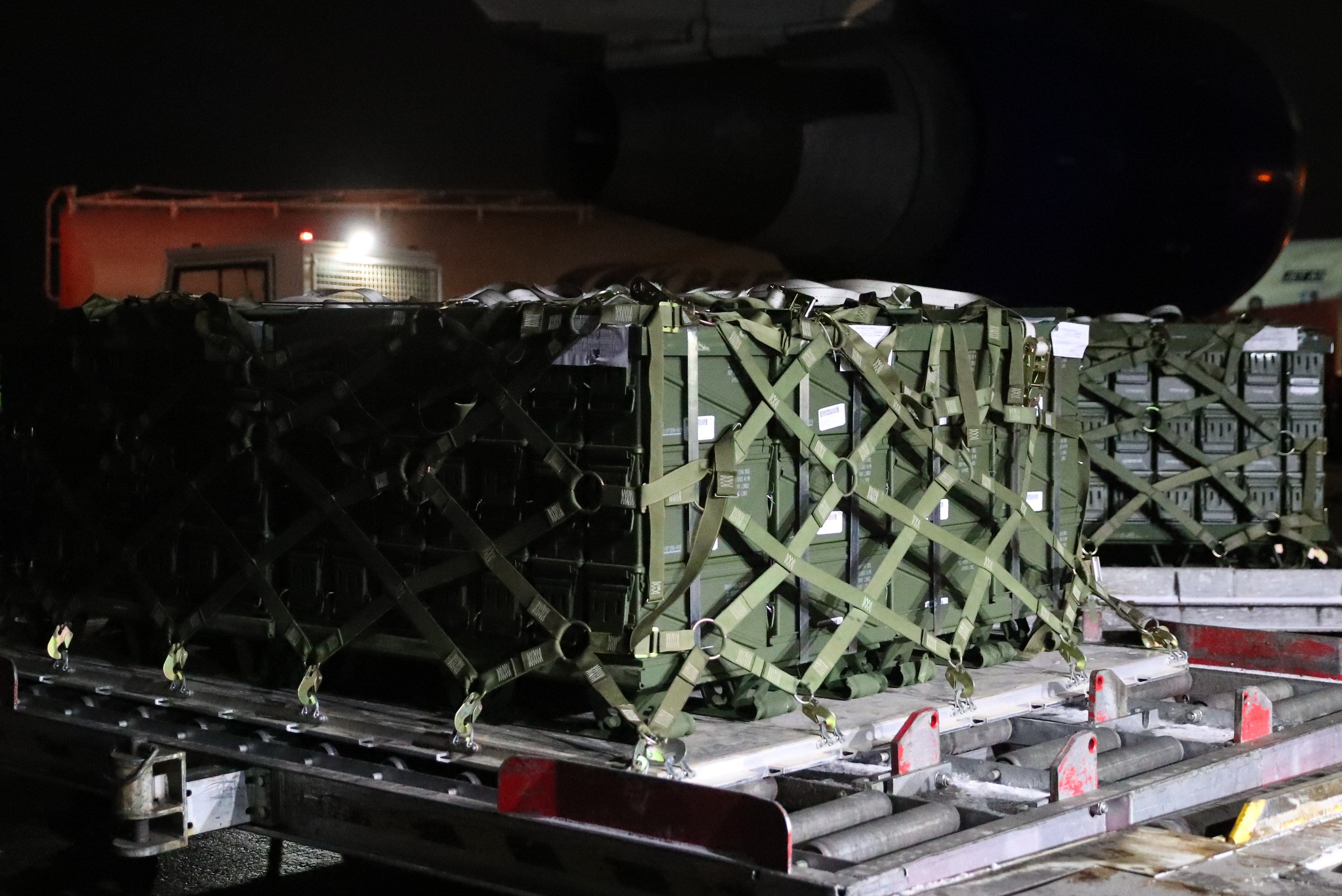
New US “lethal aid” for Ukraine, courtesy of US taxpayers and their weapons industry beneficiaries. (U.S. Embassy in Ukraine)
By Aaron Maté | January 26, 2022
The US-Russia standoff over Ukraine has sparked bellicose threats and fears of Europe’s biggest ground war in decades. There are ample reasons to question the prospects of a Russian invasion, and US allies including France, Germany’s now-ousted navy chief, and even Kiev itself appear to share the skepticism.
Another potential scenario is that Russia draws on the Cuban Missile Crisis and positions offensive weapons within the borders of Latin American allies. Whatever the outcome, the crisis has underscored the perils of a second Cold War between the world’s top nuclear powers.
If the path forward is unpredictable, what got us here is easy to trace. The row over Ukraine is the outgrowth of an aggressive US posture toward Russia since the collapse of the Soviet Union three decades ago, driven by hegemonic policymakers and war profiteers in Washington. Understanding that background is key to resolving the current impasse, if the Biden administration can bring itself to alter a dangerous course.
US principles vs. power constraints
Russia’s central demands – binding guarantees to halt the eastward expansion of NATO, particularly in Ukraine, and to prevent offensive weapons from being stationed near its borders – have been publicly dismissed by the U.S government as non-starters.
In rejecting Russian concerns, the Biden administration claims that it is upholding “governing principles of international peace and security.” These principles, Secretary of State Anthony Blinken says, “reject the right of one country to change the borders of another by force; to dictate to another the policies it pursues or the choices it makes, including with whom to associate; or to exert a sphere of influence that would subjugate sovereign neighbors to its will.”
The US government’s real-world commitment to these principles is non-existent. For decades, the US has provided critical diplomatic and military cover for Israel’s de-facto annexations, which have expanded its borders to three different strips of occupied territory (the West Bank, Gaza, and Syria’s Golan Heights). The US is by far the world leader in dictating policies to other countries, be it who their leaders should be; how little to pay minimum-wage workers; or how to share energy supplies.
The Biden administration continues to subjugate sovereign countries to its will, whether it’s “neighbors” like blockade-targeted Cuba; coup-targeted Venezuela; sanctions-targeted Nicaragua; or far-away countries like US military-occupied and sanctions-targeted Syria. Biden just recently embraced the longstanding Monroe Doctrine of a US sphere of influence by declaring Latin America to be the United States’ “front yard.”
When not making sanctimonious public pronouncements, US officials are quietly able to acknowledge the real principles that guide their actions. According to the Washington Post, one US official specializing in Russia “believes the Russians are still interested in a real dialogue.” Russia’s real aim, this official says, is “to see whether Washington is willing to discuss any sort of commitment that constrains U.S. power.”
The official added: “The Russians are waiting to see what we’re going to offer, and they’re going to take it back and decide is this serious. Is this something we [the Russians] can sell as a major victory for security, or is it just, from their point of view, another attempt to fob us off and not give us anything?”
If their public statements and actions are any guide, the Biden administration is so far opting for the latter.
Rather than focus on diplomacy, the United States’ reliable British client has been trotted out, Iraq WMD dossier-style (or Steele dossier-style, or Syria dirty war-style), to lodge the explosive allegation that Russia is plotting to install a new leader in Ukraine via a coup. While declaring that the obedient Brits were “Muscular” for shouldering the war-mongering allegation, the New York Times quietly acknowledged that they also “provided no evidence to back up” their claims.
After warning of a “false flag” operation by Russia in Ukraine, the US pulled off a stunt of its own by recalling its embassy personnel out of stated concern for their safety. Unlike the dutiful British, other US allies failed to get the memo, including the EU, which declined to follow suit and even took a pointed swipe at attempts to “dramatize” the situation.
When US officials and allied media voices permit themselves to drop “Wag the Dog” theatrics and entertain the possibility of constraining US power, the Ukraine crisis no longer appears so dangerously intractable.
In the New York Times, veteran national security correspondent David E. Sanger allows that it is “possible” that Putin’s “bottom line in this conflict is straightforward”: obtain a pledge to “stop Ukraine from joining NATO” as well as one that the US and NATO “will never place offensive weapons that threaten Russia’s security in Ukrainian territory.”
On these issues, “there is trading space,” Sanger concedes. Given that “Ukraine is so corrupt, and its grasp of democracy is so tenuous… no one expects it to be accepted for NATO membership in the next decade or two.” Accordingly, Russia could be offered “some kind of assurance that, for a decade, or maybe a quarter-century, NATO membership for Kyiv was off the table.”
In Sanger’s view, the real and “complex” issue is not Ukraine’s NATO status, but “how the United States and NATO operate” there – specifically, by flooding the country with weapons. Since 2014, Sanger writes, the US and NATO allies have provided “Ukraine with what the West calls defensive arms, including the capability to take out Russian tanks and aircraft”, a “flow that has sped up in recent weeks.” Russia – for reasons apparently foreign to Sanger – believes that these “weapons are more offensive than defensive” and “that Washington’s real goal is to put nuclear weapons in Ukraine.” An agreement to address these concerns, an unidentified US official concedes, would be “‘the easiest part of this,’ as long as Russia is willing to pull back its intermediate-range weapons as well.”
Unmentioned by Sanger is that Russia has repeatedly signaled such a willingness, including just last month: Russia’s proposed draft treaty with NATO — issued with the stated aim of resolving the Ukraine standoff — proposes that all sides “not deploy land-based intermediate- and short-range missiles” in any area that allows them “to reach the territory of the other Parties.” Also unmentioned is that such deployments were previously banned under the INF Treaty, the Cold War-era pact that the Trump administration abandoned in August 2019, to the resounding silence of Democratic lawmakers and allied media outlets more invested in pretending that Trump was a Russian puppet than in addressing his actual Russia policies.
In a bid to preserve some of the INF Treaty’s safeguards, Putin immediately offered a moratorium on the deployment of intermediate-range missiles in Europe – a proposal swiftly rejected by both Trump and NATO. (Trump’s response was again duly ignored by Russiagate-crazed media outlets and politicians, for the obvious narrative inconvenience.)
Much like its refusal so far to re-enter the Iran nuclear deal – another critical security pact torn up by Trump — the Biden administration has thus placed itself in a dangerous geopolitical standoff rather than embrace diplomacy around proposals that US officials either deem as reality anyway (Ukraine not joining NATO) or that they were once party to (the Trump-sabotaged INF treaty).
NATO expansion, from the Cold War to a Ukraine coup
If the Biden administration is now willing to accept “real dialogue” over an outcome that “constrains US power” on the Ukraine-Russia border, it will have to eschew guiding US principles since the end of the Cold War.
When he agreed to the reunification of Germany, Soviet leader Mikhail Gorbachev was “assured in 1990 that the [NATO] alliance would not expand,” Jack Matlock, Reagan and Bush I’s ambassador to the Soviet Union, recently noted. But upon entering office, Bill Clinton broke that pledge and began an expansion spree that has pushed NATO to Russia’s borders. In 2008 – against the reported advice of advisers including Fiona Hill – President George W. Bush backed a NATO declaration calling for Ukraine and Georgia’s eventual ascension.
The constant expansion of NATO has led to what the scholar Richard Sakwa calls a “fateful geographical paradox”: NATO, Sakwa says, now “exists to manage the risks created by its existence.”
Sakwa’s maxim undoubtedly applies to Ukraine, where the threat of Russia’s neighbor joining a hostile military alliance sparked a war in 2014 that continues today.
The standard narrative of the origins of the current Ukraine crisis, as the New York Times recently claimed, is that Ukrainians revolted in street protests that ousted “pro-Russian leader” Viktor Yanukovych, “prompting [Russian President Vladimir] Putin to order the annexation of the Crimean Peninsula and instigate a separatist war in eastern Ukraine.” In reality, the US backed a coup that overthrew Ukraine’s elected government and sabotaged opportunities to avoid further conflict.
The immediate background came in the fall of 2013, when the US and its allies pressured Yanukovych to sign a European Union association agreement that would have curtailed its ties to Russia. Contrary to how he is now portrayed, Yanukovych was not “pro-Russian”, to the point where he even “cajoled and bullied anyone who pushed for Ukraine to have closer ties to Russia,” Reuters reported at the time.
To sign the EU deal, Ukraine would have to accept the harsh austerity demands of the IMF, which had publicly criticized Ukraine’s “large pension and wage increases,” and “generous energy subsidies.” The agreement also contained a provision calling on Ukraine to adhere to the EU’s “military and security” policies, “which meant in effect, without mentioning the alliance, NATO,” as the late scholar Stephen F. Cohen argued.
The EU proposal, the New York Times observed in November 2013, was the centerpiece of its “most important foreign policy initiative”: an attempt to “draw in former Soviet republics and lock them on a trajectory of changes based on Western political and economic sensibilities.”
In the words of Carl Gershman, the then-head of the CIA-tied National Endowment for Democracy, “Ukraine is the biggest prize.” In Gershman’s fantasy, Ukraine’s entry into the Western orbit would redound to Russia as well. “Ukraine’s choice to join Europe will accelerate the demise of the ideology of Russian imperialism that Putin represents,” he wrote. “… Putin may find himself on the losing end not just in the near abroad but within Russia itself.”
Although it would have been a boon for DC neoconservatives, accepting the EU’s insistence on “increasing the retirement age and freezing pensions and wages” would have meant political suicide for Yanukovych. Putin capitalized by offering a more generous package of $15 billion in aid and gas subsidies, a deal that contained “no immediate quid pro quo for Russia,” the New York Times noted. To lure Yanukovych, Russia even dropped a proposal, opposed by Ukraine’s Maidan protesters, that Ukraine join a Russian-led customs union.
Putin’s Ukraine offer, the Times added, was one of “several foreign policy moves that have served to re-establish Russia as a counterweight to Western dominance of world affairs.” In the eyes of the Western domineers, the prospect of a Russian “counterweight” was an intolerable act. The US responded by ramping up support for the Maidan protests in Kiev and helping to sabotage an agreement with Yanukovych to hold new elections.
Any pretense that the US was acting as an honest broker was obliterated in early February 2014 when Russia released a recording of an intercepted a phone call between then-senior Obama official Victoria Nuland and the US Ambassador to Ukraine, Geoffrey Pyatt. The US diplomats not only selected who would be Ukraine’s next Prime Minister — Arseniy Yatsenyuk – but decided to exclude their EU allies from the process. “Yats is the guy,” Nuland declared, before adding: “Fuck the EU.”
A major tipping point in the conflict came two weeks later, on February 20th, when nearly 50 Madain protesters were massacred by snipers. The Ukrainian opposition immediately accused government forces, sparking a series of events that led to Yanukovych’s flight from the country two days later. Exhaustive research by the University of Ottawa’s Ivan Katchanovski argues that the massacre was in fact “perpetrated principally by members of the Maidan opposition, specifically its far-right elements.”
Faced with the possibility of losing Russia’s most important naval base at Sevastopol to a US-backed coup regime, Putin responded by seizing the Ukrainian territory of Crimea. Russia also provided military support to Ukrainians in the country’s Donbas region hostile to the new coup government, sparking an ongoing war between the opposing sides.
In Washington, the annexation of Crimea is widely seen as an expansionist act of aggression; even, according to Hillary Clinton, akin to “what Hitler did back in the 30s.” In Crimea, Russia had the support of the majority of the population, if polls are to be believed. The same for the Russian population, across the political spectrum. “For [Russian] politicians, not vocally supporting, let alone questioning, the annexation of Crimea is practically akin to political suicide – even for liberals,” a European Union think tank observed in 2014. Even “Anti-Putin nationalists… are enthusiastic backers of Putin’s territorial grab.” (For over 200 years Crimea had been a territory of Russia, until Nikita Khrushchev assigned it to Ukraine, then a part of the Soviet Union.)
A negotiated solution to the Donbas war has been in place since the signing of the Minsk II accords in 2015, as Anatol Lieven of the Quincy Institute for Responsible Statecraft has repeatedly stressed. The prospect of NATO expansion appears to be the pact’s main obstacle to implementation. Minsk II calls for granting autonomy to the Donbas region in return for its demilitarization. But Ukraine has “[refused] to guarantee permanent full autonomy for the Donbas”, Lieven writes, out of fear “that permanent autonomy for the Donbas would prevent Ukraine from joining NATO and the European Union, as the region could use its constitutional position within Ukraine to block membership.”
In Lieven’s view, this could change with one critical shift: “If the United States drops the hopeless goal of NATO membership for Ukraine, it will be in a position to pressure the Ukrainian government and parliament to agree to a ‘Minsk III’ by the credible threat of a withdrawal of US aid and political support.”
War in Ukraine, profit in Washington
As a result of the US drive for yet another NATO-aligned military outpost on Russia’s borders, Ukraine has been decimated. The war in the Donbas has left nearly 14,000 dead. Ukraine’s “conflict with Russia,” Denys Kiryukhin of the Wilson Center observes, is one of the major factors that “accounts for the mass outmigration of Ukrainians since 2014.” The Donbas war has encouraged a rise in far-right militancy inside Ukraine, including the notorious neo-Nazi Azov Battalion, which has directly cooperated with the US military.
The United States’ European allies are also feeling the impact of Washington’s entanglement with Russia over Ukraine. The current standoff is threatening Russia’s energy exports, which account for about one-third of the European Union’s gas and crude oil use.
“It’s going to be an incredibly hard sell in any European country, to say that you have a 10 times higher energy bill and we feel as though our supply is not plentiful enough, because of Ukraine,” Kristine Berzina of the German Marshall Fund’s Alliance for Securing Democracy, a US and NATO-funded think tank, told Axios.
The picture is much rosier for those living through the war from Washington.
“You’ve got a lot of people who see profit in this conflict… and that’s the arms industry,” retired Army colonel Douglas Macgregor, a senior Pentagon advisor under Trump, told me in a recent interview. “And the defense industrial complex sees this as an opportunity to spend a great deal of money on a whole range of armaments that they otherwise might not be able to sell.”
The arms industry has made no secret of its enthusiasm for the opportunities of NATO expansionism and the post-Maidan Ukraine market.
US arms manufacturers “stand to gain billions of dollars in sales of weapons, communication systems and other military equipment if the Senate approves NATO expansion,” the New York Times reported in March 1998. Accordingly, these arms manufacturers have made “enormous investments in lobbyists and campaign contributions to promote their cause in Washington.” At the time, the “chief vehicle” for their cause was a group called the U.S. Committee to Expand NATO. The group’s president, Bruce L. Jackson, carried out double duty: by day, the Times observed the previous year, “he is director of strategic planning for Lockheed Martin Corporation, the world’s biggest weapons maker.”
As Andrew Cockburn of Harper’s noted in 2015, Jackson’s committee was firmly bipartisan, ranging “ideologically from Paul Wolfowitz and Richard Perle… to Greg Craig, director of Bill Clinton’s impeachment defense and later Barack Obama’s White House counsel.” (Craig later became embroiled in a Ukraine corruption scandal, though he was acquitted on all charges.) Explaining his committee’s staying power in Washington, Jackson told Cockburn: “‘Fuck Russia’ is a proud and long tradition in U.S. foreign policy. It doesn’t go away overnight.”
Nor do the profits that result. Reporting in July 2017 that military stocks had reached “all-time highs,” CNBC noted that “NATO concerns about Russia are seen as a positive for the defense industry.”
So is the ongoing war in Ukraine, where the US has shipped $2.7 billion in weapons since 2014, along with 200,000 pounds of fresh “lethal aid” in recent weeks and more promised via new spending bills.
US government officials across the spectrum routinely laud these weapons shipments as “critically needed, congressionally approved military aid” to a “very fragile country fighting Russian aggression” (Progressive Caucus chair Pramila Jayapal, speaking on Democracy Now! in 2019).
Putting aside the guiding imperial and profit-driven motives, the main impact of pouring US military hardware into the Donbas conflict is to prolong it. Writing in Foreign Policy, two analysts with the Pentagon-tied think tank Rand Corporation, Samuel Charap and Scott Boston, argue that “The West’s Weapons Won’t Make Any Difference to Ukraine.” The “military balance between Russia and Ukraine is so lopsided in Moscow’s favor,” they write, that more new weapons from Washington “would be largely irrelevant in determining the outcome of a conflict.”
The authors also dispel another widely accepted bipartisan myth, that the US has been helping Ukraine resist “Russian aggression.” In reality, Russian-backed militants in the east “are mainly armed with small arms and light weapons, along with some artillery and Soviet-era armor.” Although Russsia has armed and trained its Donbas allies, “Ukraine has mainly not been fighting Russia’s armed forces” there. Instead, “the vast majority of rebel forces consist of locals—not soldiers of the regular Russian military.” The Russian military has “never used more than a tiny fraction of its capabilities against the Ukrainians,” with major military components, such as Russia’s air force, “[not] involved in the fighting at all.”
The authors also remind their US audience of another overlooked reality: the costs of a full-blown war in Ukraine “will be disproportionately borne by Ukrainians.” Should an insurgency develop, as the Biden administration is mulling, the conflict will reach a stage where “thousands—or, more likely, tens of thousands—of Ukrainians will have died.”
Those promoting such an outcome have made clear that they value NATO expansion and the attendant arms industry windfall over the lives of Ukrainians, Russians, and any others placed in the crossfire. The Biden administration can avoid ending many more lives if it can interrupt hegemony and war profiteering for a different set of principles.
NATO rejects Russia’s ‘red line’
RT | January 26, 2022
NATO has said it “will not compromise” on potential expansion into Ukraine, Georgia, and other former Soviet republics, as this clashes with the “core principles” of the alliance, Secretary General Jens Stoltenberg told reporters on Wednesday.
The alliance’s response, which Stoltenberg said all 30 members agreed upon, was delivered to Moscow earlier in the day by the US ambassador, alongside Washington’s separate written note.
The US has asked Russia to keep the contents of its response private.
Stoltenberg, who was half an hour late to the scheduled online press event, outlined three basic topics that the NATO response touched on. One was re-establishing diplomatic ties between NATO and Russia, which he blamed Moscow for severing. The other was NATO’s readiness to “engage in dialogue” and “listen to Russian concerns,” while respecting the right of each country to choose its own security arrangements.
Russia should refrain from “aggression” aimed at NATO allies and withdraw from “Ukraine, Georgia, and Moldova,” where it is not wanted, Stoltenberg said.
Ukraine insists that Moscow is “illegally occupying” Crimea, which voted to rejoin Russia after the 2014 coup in Kiev. Russia has also recognized the independence of two breakaway regions of Georgia that Tbilisi tried to seize by force in 2008, and has maintained peacekeepers in the disputed Moldovan region of Transnistria since 1991.
The third area of possible cooperation listed by Stoltenberg involves “risk reduction” and transparency agreements on exercises, as well as arms control proposals that he argued have been so effective previously. Since 2001, the US has unilaterally exited the anti-ballistic missile (ABM) treaty, the Open Skies treaty, and the intermediate-range nuclear forces (INF) treaty, claiming without evidence that Russia was in violation of them.
“A political solution is still possible, but, of course, Russia has to engage in good faith,” Stoltenberg said, accusing Moscow of “aggression” against Ukraine since 2014.
Stoltenberg insisted that “NATO is a defensive alliance and we do not seek confrontation,” but repeatedly said that the alliance “cannot and will not compromise on principles” such as the right of every country to join. That decision rests solely with the applicant country and NATO members, now 30 in number, he said.
Asked about the reluctance that some NATO members have reportedly displayed in recent weeks, Stoltenberg maintained that “all allies are on board, all our allies have agreed” with the written response submitted to Russia. Croatia’s president has publicly said he would withdraw all troops from NATO in case of war in Ukraine, while Germany has reportedly denied the use of its airspace to UK weapons deliveries to Kiev.
Stoltenberg also reassured reporters that NATO has “plans in place we can activate on very short notice” if Russia “invades” Ukraine, with the lead element of 5,000 troops from the French-led NATO Response Force (NRF) on high alert, and the US assigning 8,400 troops on high readiness to the force as well. The Pentagon has previously said that some 8,500 US troops have been placed on heightened readiness status, but the decision had not been made to deploy them yet.
Bulgaria insists it’s a loyal NATO ally, but won’t send troops to Ukraine
RT | January 26, 2022
Bulgaria is a “loyal ally in NATO” and the alliance’s unity is the best response to the current crisis over Ukraine, Prime Minister Kiril Petkov said on Wednesday, amid conflicting reports on Sofia’s participation in the US military buildup in Eastern Europe.
Petkov’s government voted on Wednesday to follow the “Bulgarian strategy” of reducing tensions between NATO and Russia, including “absolutely all options for resolving this dispute by diplomatic means,” according to the state news agency BTA.
The strategy will be based on rebuilding the Bulgarian military, Petkov said. Defense Minister Stefan Yanev explained that the “top priority” will be investing in building a battalion combat team, a unit of around 1,000 soldiers.
Yanev would not comment on reports by Bulgarian National Radio that Sofia would not accept the deployment of 1,000 US soldiers on its soil, but would be fine with French troops instead. This was reported early on Wednesday by BNR correspondent in Brussels, Angelina Piskova, who quoted a “well-informed diplomatic source.”
The minister said such a thing has not been discussed on the political level, according to BNR.
Local media reported that Yanev also told lawmakers that Bulgarian soldiers won’t fight in Ukraine without parliamentary approval, which he “does not see coming.”
Earlier on Wednesday, CNN reported that Bulgaria, Hungary, and Romania were in discussions with the US to accept 1,000 American troops each, as part of Washington’s effort to “reassure” NATO members in Eastern Europe and “deter” the alleged Russian invasion of Ukraine. The US intelligence has heralded such an invasion since late October, though Moscow dismissed it as “fake news.”
Speaking before the parliamentary defense committee on Tuesday, Yanev said that neither Russia nor anyone else is preparing to invade Bulgaria, and urged the lawmakers to “reduce tensions, stop reading the foreign press, and stop speculating.”
Lavrov Accuses the United States of Pushing Ukraine to Provocations against Russia
Al-Manar | January 26, 2022
Russian Foreign Minister Sergei Lavrov said on Wednesday that Moscow did not want talks over Ukraine and its own security concerns to be made longer by including the European Union [EU] or the Organization of Security and Cooperation [OSCE] in Europe in them.
He made the comments to the State Duma or lower house of parliament.
Lavrov also reiterated Moscow’s stance that it would take unspecified “appropriate measures” if it did not receive a constructive answer from the United States and NATO on security guarantees it is demanding.
“Moscow will take appropriate measures to respond to the West’s negligence of Russian demands regarding security guarantees,” Lavrov said
Russia is expecting Washington to respond in writing this week to its proposals for guarantees.
Lavorv stated, “Moscow will not allow an infinite delay in discussions about security guarantees’ proposal”.
The Russian FM further said that “Washington is pushing Kiev to direct provocations against Russia,” asserting that the US “is trying to punish Russia and China, and the US apparatuses are provoking the two countries”.
He concluded by saying, “Washington and its European allies are doubling their efforts to contain Russia”.
Featured Video

The American Retreat from Vietnam
or go to
Aletho News Archives – Video-Images
From the Archives
Secret document reveals plans for civil war in Lebanon, Israeli false flags, and invasion
By Randi Nord | Geopolitics Alert | April 5, 2019
Beirut – During his visit with US Secretary of State, Mike Pompeo, Lebanese President Michael Aoun reportedly received a US-Israeli document detailing plans for creating a civil war in Lebanon with covert false flag operations and possible Israeli invasion.
Although the source of the document is Israeli and created in partnership with Washington, no one knows who presented it to Aoun. The Lebanese TV station, Al-Jadeed, initially reported the document on Lebanese TV and a video on its website. Geopolitics Alert translated the report for this article. … continue
Blog Roll
 Aletho News
- EU Council Advances Chat Control 2.0 Scanning Proposal
- Ex-Greek MEP files complaint against Israeli spyware firm over alleged Pegasus surveillance
- Troubling ideas throughout the Torah, Talmud, Mishneh Torah and Tanya
- ‘Grave, alarming’: Iran mission on Trump’s UNGA ‘annihilation’ threats
- Najaf airport to reopen to Iranian flights within 24 hours: Ambassador
- From ‘How Will This End For Iran’ to ‘When America Walks Away’: A tale of two Economist covers
- Tehran blasts ‘baseless’ speculation linking Iran to alleged bomb plot at UK air base
- The Rise And… Rise Of ‘Color Revolutions’
- The Coming GOP Bloodbath?
- Arctic Scare Stories Melt Away
- If Americans Knew
- Netanyahu Asked UAE Leader to Deny Report on Oct. 7 Warning in Secret Visit, Sources Say
- CNN Chief Int’l Correspondent Clarissa Ward on Journalists in Gaza
- Democratic Party Consultants Surround Troy Jackson with Pro-Israel Donors
- Christian Leader Responds To Netanyahu’s Claims Regarding Palestinian Christians
- In Gaza, ‘Whoever Survives the Bombing Won’t Survive the Rubble’
- Israel kills more Palestinians, amid push to resettle Gaza – Daily Update
- Israel forces Gazans to live in constant peril – Daily Update
- Deconstructing Netanyahu’s pants-on-fire UN rant – Daily Update
- Trump betrayed voters with his campaign lies and prioritized a foreign country once he took office
- Netanyahu calls Israel’s war in Gaza ‘opposite of genocide’ in UN speech to near-empty hall
- No Tricks Zone
- New Study: Earth And Venus Surface Warmth Largely Explained By Convection And Lapse Rate, Not CO2 Or Radiation
- 2025 Nature Paper Claiming Worsening Global Drought Gets RETRACTED …Heavily Flawed
- New Study: ‘Global Drought Shows No Detectable Recent Acceleration Under Climate Warming’
- Economic Masterminds: German Socialists Suggest Taxing Productivity Gains Stemming From Using AI
- The South China Sea Has Not Been Cooperating With The Climate Change Narrative
- Energy Crisis: Germany Enters Heating Season With Historically Low Gas Reserve Fill Levels
- New Study: The Antarctic Ice Sheet Gained Mass From 2020-2024 Due To Staggering Snow And Ice Accumulation
- Study: Ocean Heating Rates From Thousands Of Years Ago ‘Dwarf’ Modern Ocean Heating Rates
- Climate Extremists Target, Attack Large-Scale Power Grid Infrastructure In Germany!
- New Study: Antarctic Ice Melt Has Contributed Less Than 1 Centimeter To Sea Level Rise In The Last 30 Years

