Russia blames UK FM for elevated nuclear alert
The British foreign secretary made “unacceptable” statements on “clashes” between NATO and Russia
RT | February 28, 2022
Kremlin spokesman Dmitry Peskov said on Monday that Russian President Vladimir Putin placed Russia’s deterrence forces – including nuclear weapons – on high alert in response to statements by British Foreign Secretary Liz Truss on potential conflict between NATO and Moscow.
“Statements were made by various representatives at various levels on possible altercations or even collisions and clashes between NATO and Russia,” Peskov told reporters. “We believe that such statements are absolutely unacceptable. I would not call the authors of these statements by name, although it was the British foreign minister.”
Speaking to Sky News on Sunday, Truss said that “if we don’t stop Putin in Ukraine, we are going to see others under threat: the Baltics, Poland, Moldova, and it could end up in a conflict with NATO. We do not want to go there.” Truss did not specify how the UK could “stop” Russia in Ukraine, although the British government has already sent anti-tank weapons and other “lethal aid” to Kiev.
However, a Foreign Office source told the BBC on Monday: “I don’t think anything Liz has said warrants that sort of rhetoric or escalation,” adding that Truss has always spoken of NATO – which was formed with the explicit goal of opposing the Soviet Union – as a “defensive alliance.”
While Putin’s announcement does not signal any intent to use nuclear weapons, it has been received in the West as a reminder of the importance Moscow places on Ukraine, and its determination to keep the country out of NATO. Since the end of the Cold War, successive Russian leaders have consistently opposed the eastward expansion of the alliance, and Moscow considers the idea of a NATO-armed Ukraine on its borders an existential security threat.
In Washington, White House Press Secretary Jen Psaki condemned Putin’s decision to raise the alert level, accusing the Russian president of “manufacturing threats that don’t exist in order to justify further aggression.”
Meanwhile in Ukraine, Russia’s operation is still underway, and fighting has taken place in the cities of Kharkov, Mariupol, and on the outskirts of Kiev. Tentative negotiations between Ukrainian and Russian officials took place in Belarus on Monday.
Ukraine-Russia negotiations have reached ‘certain decisions’
Ceasefire talks hosted by Belarus adjourn for consultations
RT | February 28, 2022
Moscow and Kiev have found certain things that could be agreed on during the ceasefire talks hosted by Belarus and will return for consultations before the next round, both delegations told reporters after the talks ended on Monday.
The main purpose of the talks was to discuss a ceasefire in Ukraine, said Mykhailo Podolyak, adviser to Ukrainian President Volodymyr Zelensky. The two sides have identified a number of priority topics, on which “certain solutions have been outlined,” he added.
The two delegations found points on which common positions could be reached, confirmed Vladimir Medinsky, aide to Russian President Vladimir Putin.
Monday’s talks, which lasted for nearly five hours, took place in Belarus near the Russian and the Ukrainian borders. The next round will take place on the border between Belarus and Poland in the coming days, Medinsky said.
Ukraine’s delegation was led by Defense Minister Alexey Reznikov, and its main demand was an immediate ceasefire and withdrawal of all Russian troops from the country.
Zelensky said on Sunday he didn’t really believe the negotiations would succeed, but thought they were “a chance, however small, to de-escalate the situation.”
While the talks were ongoing, Zelensky sent a formal request for Ukraine’s EU membership to Brussels. Meanwhile, Russia has put its nuclear deterrent forces on highest alert amid NATO moves to send weapons to Kiev.
Moscow ordered military forces into Ukraine on Thursday, saying Kiev needs to be “demilitarized” and “denazified” to protect the breakaway republics of Donetsk and Lugansk, as well as Russia itself. Ukraine and its Western supporters accused Russia of “unprovoked” aggression. The UK, US, EU and several other countries have imposed sweeping sanctions targeting not just the Russian economy, but Putin and other high Russian officials personally.
Russian military offers ‘safe passage’ for evacuation from Kiev
RT | February 28, 2022
The Russian Defense Ministry has called on Ukrainian civilians to evacuate from Kiev. They can do so by taking the highway towards Vasilkov, a city located 20km southwest of the capital, it said in a statement on Monday, claiming that “this direction is open and safe.”
The ministry added that Russia “only attacks military objects” and insisted that the civilian population will not be at risk.
The call came on Monday as the Ukrainian and Russian delegations are set to start peace talks in Belarus. President Volodymyr Zelensky said in a public address, from Kiev, that he had low expectations for the negotiations. His country does not intend to surrender, he added.
Kiev Mayor Vitali Klitschko told AP on Sunday that the city was fully encircled by Russian troops, but backtracked on the claim later.
The Ukrainian government earlier distributed firearms to civilians, released felons with military experience from prison, and called on the people to prepare firebombs to fight Russian troops.
Russia attacked Ukraine on Thursday, claiming that the country had to be demilitarized and “denazified” to protect the breakaway regions of Donetsk and Lugansk, as well as Russia.
‘Great Reset’ architect backs Ukraine
RT | February 28, 2022
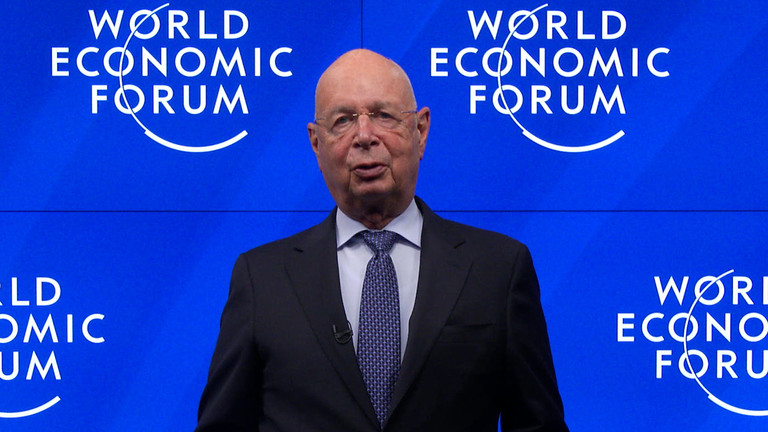
The World Economic Forum (WEF) and its chairman, Klaus Schwab, have thrown their support behind Ukraine, vowing to do “whatever is possible to help” the country against Russian “aggression.”
In the statement on Sunday, Schwab – the author of ‘Covid-19: The Great Reset’ – and WEF President Borge Brende said they “deeply condemn the aggression by Russia against Ukraine” and “the attacks and atrocities.”
“Our full solidarity is with Ukraine’s people and all those who are suffering innocently from this totally unacceptable war,” they stated.
“We only hope that – in the longer-term – reason will prevail and that the space for bridge-building and reconciliation once more emerges,” they said, joining NATO, the European Commission, the UN chief, and other Western powers in publicly condemning Russia’s military action in Ukraine.
During a February 2020 speech to the World Economic Forum, which took place just a few months before the WEF’s controversial ‘Great Reset’ meeting, Ukrainian President Volodymyr Zelensky called for “western investors” to become “the stakeholders, shareholders of the success of a new Ukraine,” and said Ukraine was “a place where miracles come true.”
“Ukraine should become an investment mecca of eastern and central Europe,” he said.
The Great Reset calls for the creation of “entirely new foundations for our economic and social systems” and a reset of capitalism in response to the Covid-19 pandemic. Critics, however, have accused it of being a globalist plot to increase the power of governments and implement a new global economic order.
The ‘Constructive Destruction’ of Russia’s Model of Relations with the West
By Alastair Crooke | Strategic Culture Foundation | February 27, 2022
The collective West was already angry. And it is apoplectic after President Putin shocked western leaders by ordering a special military operation in Ukraine, which is being widely described (and perceived in the West) as a declaration of war: ‘a shock and awe assault affecting cities widely across Ukraine’. So angry in fact is the West that the information space has literally bifurcated into two: It is all black and white, with no greys. For the West, Putin has comprehensively defied Biden; he has unilaterally and illegally ‘changed the borders’ of Europe and acted as a ‘revisionist power’, attempting to change not just the borders of Ukraine, but the current world order. “Thirty years after the end of the Cold War, we are facing a determined effort to redefine the multilateral order,” the EU High Representative, Josep Borell, warned. “It’s an act of defiance. It’s a revisionist manifesto, the manifesto to review the world order”.
Putin is characterised as a new Hitler, and his acts asserted to be ‘illegal’. It is claimed that it was he who tore up the Minsk II Accord (yet the Republics declared their independence in 2014, signed Minsk in 2015, and it was Russia who never signed the accord – and therefore cannot be in breach of it). Indeed, it is the US effectively that has vetoed the Minsk process since 2014, and Russia’s publication of diplomatic correspondence in November 2021 exposed that France and Germany too, had little intention of pressurising Kiev on any meaningful implementation. And so, having concluded that a negotiated settlement – as stipulated in the Minsk Accords – would simply not happen, Putin determined that there was no point in waiting any longer before implementing Russia’s red line.
The late Stephen Cohen wrote of the dangers of such unqualified Manichanaeism — how the spectre of an evil-doing Putin had so overwhelmed and toxified the US image of him that Washington has been unable to think straight – not just about Putin – but about Russia per se. Cohen’s point was that such utter demonisation undercuts diplomacy. How does one split the difference with evil? Cohen asks, how did this happen? He suggests that in 2004, the NY Times columnist, Nicholas Kristof, inadvertently explained, at least partially, Putin’s demonisation. Kristof complained bitterly of having been “suckered by Mr. Putin. He is not a sober version of Boris Yeltsin”.
Most Russians however, are behind Putin with the recognition of the Donbas Republics, which he then followed up by obtaining the authorisation of Russia’s upper parliament house for the use of armed forces outside Russia (as required under the constitution). The resolution by the Federation Council was unanimously supported by all the 153 senators at an extraordinary session on Tuesday.
In his national address, Putin spoke with a bitterness that is reflected by many Russians. He views the post-2014 political developments in Ukraine as having been engineered to create an anti-Russian regime in Kiev nurtured by the West, and with hostile intentions towards Russia. Putin illustrated this point by explaining that “The Ukrainian troop control system has already been integrated into NATO. This means that NATO headquarters can issue direct commands to the Ukrainian armed forces, even to their separate units and squads”. Putin also noted that the Russian constitution stipulates the borders of Donetsk and Lugansk regions to be as they were “at the time when they were part of Ukraine”. This is a carefully worded formulation — the borders of the two republics underwent significant changes in the aftermath of the Maidan coup. (At issue here is Donetsk’s historic claim to coastal Mariupol).
Putin’s recognition statement was accompanied by an ultimatum to the Kiev forces to cease their artillery bombardment across the Line of Control or face military consequences. Throughout Wednesday evening however, the situation on the Contact Line was heating up, with heavy artillery fire; but early Thursday morning, for the first time, multiple rocket-fire was used by the Kiev forces across the Control Line. (Someone from the Kiev side clearly wanted escalation – perhaps to put pressure on Washington). Putin immediately ordered what was evidently a pre-prepared Special Operation ‘to de-militarise and de-nazify Ukraine’. Russia’s military announced within a couple hours of the offensive that all of Ukraine’s air defense systems had been taken out. A massive Russian aerial presence, including fighter jets and helicopters, has been confirmed over much of the country.
Possibly this operation (which Putin said is not about occupying Ukraine), will follow the pattern of Georgia in 2018, when Russian forces withdrew after a few days. This was the pattern too, in Kazakhstan. We simply do not know whether this will be the case in Ukraine — very possibly not. When Putin spoke of ‘de-nazification’ he was referring to the US co-option of a neo-Nazi formation in Ukraine’s armed forces to help mount the 2014 Maidan coup. The so-called Azov Brigade of neo-Nazis had proved to be the most effective fighting force in pushing back the DLR militia in the Donbass region. (Ukraine is the world’s only nation to have a neo-Nazi formation in its armed forces and there will be scores to be settled).
Nonetheless, Putin’s Special Order has, as no doubt he foresaw, shocked the West deeply with its decisive military reaction. It has set the world – and its financial and energy markets – on edge.
Indeed, the latter aspect may become the more salient. In 1979, upheavals in the Middle East sent energy prices soaring (just as is occurring today), and western economies tumbling. Whatever the next days bring, it must be plain that Putin’s short press conference on 22 February is acting as intended, as a powerful accelerant. The “constructive destruction” of the old Global Order will proceed faster than many of us had imagined. It marks an End to Illusions — an end to the notion that the US imposed, rules-based order remains an option.
How then to interpret the extreme anger in the West? Simply this: In the end, there is reality. And that reality – i.e. what the West can do about it – is all that matters — which is … little.
The brutal first realisation underlying the anger is that the West has no intention – and critically, no ability – to counter Russia’s moves militarily. Biden has repeated the ‘no boots on the ground mantra’ again in the wake of Russian military operations. And for Europe, the imposition of a sanctions regime on Russia could not have come at a worse moment. Europe is facing recession and a pre-existing energy crisis (which will be hugely aggravated by Germany’s offering up Nordstream 2 to the hungry gods of vengeance). And spiking inflation (worsened with oil at $100) is causing interest rate and sovereign bond nerves to rattle. Now the pressure will be on Europe to find additional sanctions.
Sanctions there will be – and they will hurt Europeans directly in their pockets. Some European states are putting up a rear-guard action to limit sanctions that might worsen the coming European recession. However, in a very real sense, the fact is that Europe is effectively sanctioning itself (it will sustain the bigger hurt from its own sanctions), and Moscow has promised to reciprocate any sanctions in a way that will hurt the US and Europe. We are in a new era. This prospect and impotence in the face of it, must account for a large portion of European frustration and anger.
Washington professes to have a ‘killer weapon’ targeted at Moscow: sanctioning semi-conductor chips. “This would be the modern equivalent of a 20th century oil embargo, since chips are the critical fuel of the electronic economy”, Ambrose Evans Pritchard argues in the Telegraph: “But this too, is a dangerous game. Putin has the means to cut off critical minerals and gases needed to sustain the West’s supply chain for semiconductor chips”. In short, Moscow’s control over key strategic minerals could give Russia leverage, akin to Opec’s energy stranglehold in 1973.
Here lies the second strand to Europe’s outpouring of frustration: the unspoken recognition that Biden’s Ukraine policy; the west’s failure of diplomacy (all process and no substantive addressing of the underlying issues); plus Germany’s cack-handed handling of the Nordstream 2 question, have doomed the EU to years of economic decline and suffering.
The third strand is more complex and is reflected in Josep Borell’s indignant cry that Russia and China are two “revisionist” powers attempting to change the current world order. The European ‘fear’ is grounded not only in the content of the Beijing joint declaration, but likely also that not in his entire life has President Putin before made a speech like Monday’s address to the Russian people. Nor has he ever named the Americans to be Russia’s national enemy in such unequivocal Russian terms – American promises: worthless; American intentions: deadly; American speeches: lies; American actions: intimidation, extortion and blackmail.
Putin’s speech portends a great fracture. It seems to be just dawning on Europeans (such as Borrell) just how much of an inflection point Putin’s address represents. It was framed around Ukraine, yet the latter issue – though compelling – is incidental to the decision by Russia and China to change forever the geo-political balance and the security architecture of the globe.
What the recognition of the Donbas republics represented was the manifestation of this earlier geo-strategic decision. It is the first practical unfolding of that break with the West (never absolute, of course), and the unveiling of Russia’s compilation of ‘technical-military’ measures designed to force a separation of the globe into two distinct spheres. The first was the republics’ recognition; the second military-technical measure was Putin’s address; and the third, his subsequent ‘Special Operations’ order.
They – the Russia-China Axis – want separation. This is to come about either through dialogue, (which is unlikely, since the core principle of today’s geo-politics is defined by the deliberate non-comprehending of ‘otherness’), or it must be achieved by a contest of escalating pain (defined in terms of red lines) until one side, or the other, buckles. Of course, Washington does not believe Presidents’ Xi and Putin possibly can mean what they say – and they believe that, anyway, the West has escalatory dominance in the field of imposing pain.
Less diplomatically put, Russia and China have concluded that sharing a global society with an America set on enforcing a hegemonic global order crafted to ‘resemble Arizona’ is no longer possible. Putin means what he says: Russia’s back is to the wall, and there is nowhere to which Russia can now retreat — for them it is existential.
The West’s denial that Putin ‘means it’ (thus ensuring the consequent failure of diplomacy) suggests that this crisis will be with us for at least the next two years. It is the start a drawn-out, high-stakes phase of a Russian-led effort to change the European security architecture into a new form, which the West presently rejects. The Russian aim will be to keep the pressures – and even the latency of war ever-present – in order to harass war-averse Western leaders to make the necessary shift.
Ultimately – after a painful struggle – Europe will seek reconciliation. America will be slower: the Beltway hawks will try to double-down. And it will be the western economic and market situation that may ultimately determine the ‘when’.
Ukraine frees, arms felons to fight Russia, prosecutor confirms
RT | February 27, 2022
Ukraine is releasing inmates and criminal suspects with a military background so they can join the fight against Russia’s “special operation” in the country, an official in Ukraine’s prosecutor general’s office confirmed on Sunday.
Moscow attacked its neighbor on Thursday, arguing it was defending the Donetsk and Lugansk People’s Republics, which broke off from eastern Ukraine shortly after the 2014 coup in Kiev. Ukraine condemned the move, claiming it was an act of unprovoked aggression.
Service record, combat experience, and repentance are among the factors considered in each individual case, Andriy Sinyuk, a prosecutor at the prosecutor general’s office told Hromadske TV on Sunday. “It’s a complicated issue decided at the highest level,” he said.
Sinyuk was quoted by Hromadske as saying that Sergey Torbin, a former combat veteran, was one of the inmates released. Torbin previously fought in the conflict with the DPR and LPR. He was jailed for six years and six months in 2018 for his role in the murder of a civil rights activist and anti-corruption campaigner Kateryna Handziuk. The woman was doused with acid in July 2018 on a street outside her home and died in the hospital with severe burns later that year.
Sinyuk said Torbin handpicked former inmates for his squad after his early release. He added that another ex-serviceman, Dmitry Balabukha, sentenced to nine years in jail for stabbing a man to death at a bus stop after an argument in 2018, had also been released.
The Ukrainian government is actively arming civilians as Russian forces are approaching its capital. The media reported renewed fighting in Kiev’s outskirts on Sunday.
Russian Foreign Minister Lavrov Exposes CNN Hypocrisy during Press Conference
Orinoco Tribune – February 26, 2022
Russian authorities have to constantly counter media manipulation when it comes to the current crisis in Ukraine and the Donbas. On Friday, February 25, Russian Foreign Affairs Minister Sergey Lavrov exposed the hypocrisy of Western media in response to a CNN journalist during a video press conference.
During the conference, Minister Lavrov responded to a question by a CNN journalist and demonstrated the hypocrisy with which Western journalists have handled the Ukraine crisis and their supposed concern for the people of Ukraine and the Donbas. In the last eight years, as over 14,000 people in the Donbas died from attacks by Ukrainian military and neo-Nazis, CNN has not covered these news on the ground in the region.
“Have you seen schools destroyed?” Lavrov asked. “Have you seen women carrying babies killed? Have you seen a children’s beach bombed? Has anyone ever visited that place?”
Minister Lavrov assured that Russia will not attack the civilian population of Ukraine. He urged the CNN journalist to read President Vladimir Putin’s statements that explained that the objectives of the Russian operation are merely military, and that Russia has no plans to occupy Ukraine.
“No one is going to occupy Ukraine, the objectives of the operation are demilitarization and denazification,” Lavrov reiterated. He blamed the president of Ukraine, Volodymyr Zelensky, for wasting all possibility of negotiation and forcing President Putin to make the decision of a military intervention in the Donbas.
Lavrov’s exact response to the CNN correspondent in Kiev was a series of counter-questions. “Why hasn’t any Western journalist covered what is happening on the frontlines controlled by the Ukrainian government in Donbas during these eight years? If they are now horrified by what is happening in Kiev, has anyone from CNN been to Donbas itself?”
Moscow and Kiev issue updates on Ukrainian border guards reported killed
RT | February 26, 2022
The Russian military has claimed that Ukrainian border guards, whom Ukraine initially declared entirely slain, survived, while Kiev’s military concurred that it might indeed be the case.
Both countries’ armed forces on Saturday said that a group of Ukrainian border guards stationed on Zmeinyy (Snake) Island, located some 48km off Ukraine’s southern coast in the Black Sea, were captured by Russian forces. Russia says they were taken alive and unharmed to Sevastopol in Crimea.
However, the initial story allegedly went as follows: a group of 13 border guards on the island were confronted by a Russian warship on Thursday. The Russian ship ordered the group by radio to surrender, the Ukrainians replied “go f**k yourself,” and the Russian ship opened fire. After several hours of fighting, all the guards were killed.
The story spread like wildfire on social media and was held up by the Ukrainian government, Western media outlets and journalists as an example of Ukrainian “heroism.” Ukrainian President Volodymyr Zelensky honored the troops he declared slain, saying: “On our [Snake] Island, defending it to the last, all the border guards died heroically,” and promising to award them the posthumous title of “Hero of Ukraine.”
The first signs that something else may have happened came early on Saturday, as Russia’s Black Sea Fleet announced that dozens of Ukrainian border troops were delivered to Sevastopol, Crimea, with videos online purportedly showing their arrival.
Ukraine’s Border Guard Service stated shortly afterwards that the troops on Snake Island “bravely defended themselves,” but were taken prisoner when the island was captured. According to the military branch, reports that all had perished were “preliminary,” and came after the Ukrainian military lost contact with the island. The ministry did not say how many guards were stationed on the island, and did not claim to know whether any died or were injured.
The Russian Ministry of Defense likewise confirmed the capture of the island. Spokesman Major General Igor Konashenkov said that 82 Ukrainian servicemen had been stationed on the island, that all surrendered, and that none were injured. Konashenkov said that as prisoners were being transported off the island, 16 Ukrainian Navy boats disguised as civilian vessels launched an attack on Russia’s Black Sea fleet.
Konashenkov said that Russians destroyed six of the Ukrainian vessels, and claimed that US drones were seen operating in the area, suggesting that the US “directed” the Ukrainian boats. These reports have not yet been corroborated.
A recording of the Snake Island garrison supposedly telling the Russian ship to “go f**k yourself” is still circulating on social media. There is currently no evidence that the recording is genuine, and Ukraine’s Border Guard Service only said that the troops gave a message indicating “no one will surrender.”
UKRAINE: Hysterical Western Reaction, Retaliation – May Lead to Wider War
By Peter Ford | 21st Century Wire | February 26, 2022
Russophobe, germophobe, it’s all the same.
I simplify. But it’s striking how the loudest Russophobic voices include all the same voices which were similarly hysterical about Covid – the mainstream media, the Labour Party, and the liberal elite (which includes much of the Conservative Party), while the few voices calling for even a modicum of restraint or understanding of Russia include anti-lockdown Farage (on GB News) and Trump, both of the Right. Piers Corbyn and Jeremy Corbyn, virtually alone on the Left have spoken up, while Starmer has forced 11 of his MPs who signed a Stop The War statement to withdraw their signatures.
The Labour Party in fact has tried to outflank the Tories on the Right, demanding the silencing of RT, the Russian broadcaster.
The Ukraine crisis rubs home the same messages we received loud and clear during the Great Covid Hysteria: Left and Right are meaningless now, the default option for any untoward contingency arising is to go to panic stations, muzzle any dissent, and bring in restrictions/interventions/sanctions without a thought about the side effects, or even direct consequences.
Just as Covid lockdowns were imposed regardless of wrecking society and economy, so the West is now imposing drastic sanctions on Russia without anybody even asking the question: well, might not Russia retaliate, with cyber attacks for example? It’s not appeasement to pause to consider if our moves might backfire, that’s just plain prudence and a sense of responsibility. And what about gas and petrol prices? Collapsing stock markets? Sterling, anyone?
Nor is it appeasement to appreciate that the problem didn’t begin just yesterday, that the West was asking for trouble sooner or later when it incorporated much of the former Soviet Union into its own sphere of influence (NATO membership), and started to establish forward military positions in Ukraine even though formally Ukraine was not a member of NATO. We poke the Russian bear and then cry in horror when it responds by showing its claws.
Grabbing other people’s land is always wrong. But tell that to the Americans, who have endorsed Israel’s annexation of Palestinian and Syrian territory without even a semblance of support from the inhabitants. The Americans have also stationed military forces in North East Syria, denying access to the region’s oil by the Syrian government, pretexting a pseudo-mission of ‘keeping ISIS out’ – when ISIS no longer poses any real threat. Tell NATO ally Turkey which mounted a similar ‘peacekeeping’ mission across its border into North West Syria, killing hundreds of Syrian government forces in the process and sustaining in control a local jihadi regime. Nobody in NATO breathes a word against any of this.
It’s not all bad news. The aggravation of the already dire energy situation is creating a new equation: people are realising you can have zero emissions, or you can be warm.
However, looking at the downside, the conflict over Ukraine could harm the cause of freedom supporters if the perception grows that we are siding with the nation’s enemies. Some might even say that our support for peace is toxic. But what is there to lose? We are demonised, harassed and persecuted already. And nobody else is interested in making peace, only in pouring fuel on the flames with arms supplies and punishing Russia with backfiring sanctions.
Putin may be making the same calculation, that he has nothing to lose. The West spurned feelers he put out about a neutral status for Ukraine, application of the Minsk accords on a settlement for the Eastern areas, and revival of arms limitation treaties. Why not go the whole hog and practise the same regime change tactics the West used or tried to use in Afghanistan, Iraq, Libya and Syria?
Peter Ford is a global affair analyst and former British Ambassador to Syria (2003-2006) and Bahrain (1999-2002).
Dublin and Monaghan – Britain forgets its recent history of “unleashing war in Europe”
By Gavin O’Reilly | OffGuardian | February 26, 2022
In the early hours of Thursday morning – in what will perhaps finally result in the COVID-19 mainstream media narrative being permanently banished from the headlines – almost nine years of Western provocations via its Eastern European proxy state Ukraine would culminate in Russia launching a military intervention into its Western neighbour.
With attempts to peacefully resolve the situation peacefully by Moscow over the past several months ultimately proving fruitless due to Kiev failing to implement its side of the Minsk Agreements – which would see a federalisation solution in which the breakaway pro-Russian Republics of Donetsk and Luhansk, located in the predominantly ethnic Russian Donbass region of eastern Ukraine, being given a degree of autonomy whilst still remaining under the rule of Kiev.
Instead, both Republics were given formal recognition by Moscow on Monday, in response to the breakdown in negotiations.
With Russian President Vladimir Putin outlining in his speech commencing the military operation that a decisive factor in launching the intervention was a failure by NATO to honour a previous agreement that it would not expand eastwards following the end of the Cold War, and that the intention of the operation is to destroy Ukrainian military infrastructure that would ultimately be used by the alliance against Russia should Kiev become a member.
One can only hope that the current situation doesn’t escalate further into a long-term conflict in which ordinary Ukrainian citizens will suffer, or indeed a catastrophic global conflict involving the use of nuclear weapons should NATO decide to intervene directly – with Ukraine having come under the influence of the US-NATO hegemony following the 2014 Euromaidan, a CIA and MI6 orchestrated regime-change operation launched in response to then-Ukrainian President Viktor Yanukovych’s November 2013 decision to suspend a trade deal with Brussels in order to pursue closer political and economic ties with Russia.
The immediate Western reaction following Thursday’s intervention however, was to predictably shift all blame onto Moscow and pay little to no attention to the almost nine years of provocations which had preceded it – such as Western support for the notoriously anti-Russian neo-Nazi Azov Battalion of the Ukrainian National Guard, established post-Maidan. Both of which played a key role in Kiev’s war on Donetsk and Luhansk following their secession in April 2014, a month after the historically Russian peninsula of Crimea voted to reunify with Moscow.
British Prime Minister Boris Johnson also accused Moscow of ‘unleashing war in Europe’, seemingly forgetting his own warmongering in Iraq, Syria and Yemen, and also Britain’s not too distant history of unleashing war on its nearest European neighbour – Ireland.
In 1974, the occupied north of Ireland had been in a five-year-long grip of escalating violence – the civil rights movement, established in 1967 to seek equal rights for the north’s Irish Nationalist community, had been met with violence every time they took to the streets, being beaten and teargassed by a predominantly British Unionist police force.
This violence would eventually culminate in Bloody Sunday, the massacre of 14 civil rights demonstrators by the British Army in Derry in January 1972 – London having deployed its forces to the north in 1969, using the pretence of being a neutral peacekeeper between two warring sides as a means to counter the influence of the IRA, re-organised the same year in response to the ongoing violence, and whose membership would grow exponentially following the massacre.
Indeed, such was the violence inflicted on the Nationalist community of the north of Ireland by Britain and its proxies, that the southern 26-county Irish state would soon begin to dissent from its traditionally pro-British stance.
In 1969, during the initial outbreak of violence, then-Taoiseach Jack Lynch threatened to send troops to the north in order to protect Irish Nationalists, in 1970 government ministers Charles Haughey and Neil Blaney would be dismissed from their posts following a collapsed trial where they were alleged to have planned to import arms for use by the IRA, and in the aftermath of Bloody Sunday, Irish police stood by as protesters burned down the British Embassy in Dublin.
Britain, fearing that Dublin would go on to become an official state sponsor of the IRA, decided that a message had to be sent.
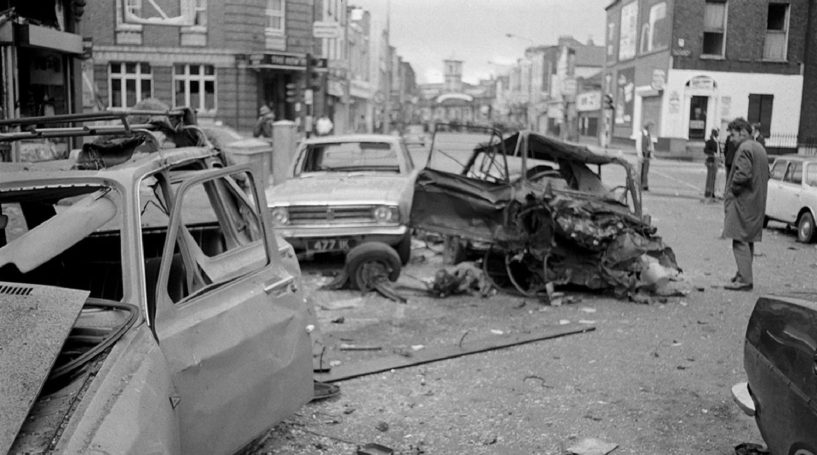
On the 17th of May 1974, a Friday afternoon, three no-warning car bombs detonated during rush hour traffic in Dublin, killing twenty-seven people, ninety minutes later, another no-warning bomb would explode in the border county of Monaghan, killing seven.
300 people would suffer injuries as a result of the bombings also, with the Irish Free State returning to its traditionally pro-British stance regarding British occupation of the north in the aftermath.
These coordinated attacks, resulting in the largest loss of life in a single day during the most recent phase of conflict related to the occupation of Ireland, were carried out by the Ulster Volunteer Force (UVF), a Loyalist terrorist organisation operating under the command of the clandestine Special Reconnaissance Unit (SRU) of the British army.
This use of proxy terrorist groups by Downing Street was later used as a tactic against both Libya and Syria in 2011 and into the present day, having been perfected by Britain’s unleashing of war in Europe in 1974.
Gavin O’Reilly is an Irish Republican activist from Dublin, Ireland, with a strong interest in the effects of British and US Imperialism; he was a writer for the American Herald Tribune from January 2018 up until their seizure by the FBI in 2021, with his work also appearing on The Duran, Al-Masdar, MintPress News, Global Research and SouthFront.
Washington’s Crocodile Tears Over Ukraine’s Destruction
By Daniel McAdams | Ron Paul Institute | February 25, 2022
As of this writing, Ukrainian president Volodymyr Zelensky is hunkered down in his bunker somewhere in Kiev, as the sound of the encroaching war gets closer and closer. A grim scene, to be sure.
All the US and EU kisses and roses leading up to this end have turned to dust and barbed wire, as a no-doubt deeply bitter Zelensky has nothing left but to cry out in anger: “Who is ready to fight with us? I do not see anyone. Who is ready to give Ukraine a guarantee of NATO membership? Everyone is afraid.”
The chips are down, as much of the US-equipped and backed Ukrainian military appears to have turned and ran as Russian forces approached. That is not to say that there has not been death and destruction on both sides. The battle for Kherson was brutal, with plenty of Russian losses. But nevertheless, as of this writing, it has fallen to Russian control.
Kiev in the main may well fall within the next 12-24 hours. Russian troops are already in the city. And Zelensky is in his bunker with fewer and fewer to take his calls. The cavalry he believed was promised him will not be coming to rescue him. Ukraine will be de-militarized and Ukraine will be neutral. Once held up as a great ally of Washington and Brussels, Zelensky is alone.
It brings to mind that great quote I often recycle from RPI academic advisor John Laughland, written as the early US-backed color revolutions rampaged through the former Soviet world in the early 2000s:
It is better to be an enemy of the Americans than their friend. If you are their enemy, they might try to buy you; but if you are their friend they will definitely sell you.
Zelensky has now learned the bitter truth, which previously favored foreign leaders also learned. Most of their lessons have been even harder than Zelensky’s (at least to this point).
The bitter truth is that Washington’s foreign policy establishment never actually considered Zelensky – or his predecessor Poroshenko – to be allies or partners of the United States. Overflowing with a toxic mix of ignorance, arrogance, and extreme cynicism, Washington’s elites have always viewed Ukraine as a tool to “regime-change” a Russia that, after its post-Yeltsin recovery, would no longer take its direction from them.
The false gods of American exceptionalism are jealous ones indeed.
The American foreign policy establishment wanted a perpetual “Yanks to the Rescue” Russia, whereby US “consultants” and spooks would ensure that the most obsequious candidate would continue to win and rule. A string of Russian presidents who would, à la Shevardnadze and a whole string of other post-Soviet leaders, run the country like a family business: lots of biznis deals for family members…and maybe 10 percent for the “big guy.”
Americans are victims (willing or not) of a mass media system as propagandistic as any that existed during Soviet Communism. The “party line” is established and it is unwaveringly followed whether the favored flavor is Fox or MSNBC. When it became obvious that Yeltsin’s one-time understudy, Vladimir Putin, wasn’t going to play that way, the party line came down that he must be demonized.
Not carefully studied and where appropriate opposed (on the basis of actual US interests), but rather Putin had to be demonized and, ultimately, “regime-changed.”
Discourse in the US is so infantile that just writing this objective truth will no doubt land this author in the “Putin’s puppet” purgatory. Not for the first time.
Most Americans will not have heard – and those who have likely do not care – that twice when the Ukrainian people elected a president who was in favor of maintaining good relations with its Russian neighbor the US intervened and overthrew the government. First time in the 2004-5 “Orange Revolution” and then the fateful 2014 “Maidan” revolt, which was explicitly and overtly supported by senior US government officials on the ground in Kiev including Victoria “F**k the EU” Nuland and the late neocon warmonger Sen. John McCain.
In the meantime tens of millions of dollars flow from the US taxpayer to favored think tanks, civic organizations, and media outlets via the National Endowment for Democracy (sic) and numerous US-funded related organizations. The goal is the same: manipulate Ukraine so that it remains on Washington’s preferred path (toward conflict with Russia).
It is fashionable – particularly over the past two days – for even antiwar and “restraint”-promoting scribblers and jaw-boners to fall into tune with the warmongers’ songbook of “Russian aggression” as the sole cause of recent bloodshed and destruction.
While anyone with an ounce of decency deeply regrets and opposes the use of such massive military force as we have seen recently in Ukraine, if there is one lesson to be learned from this entire miserable chapter (and by “chapter” I mean the entirety of post-Cold War US foreign policy) it is this: There are consequences that come with the belief that the key to peace and prosperity is to remake the world in your own image through the use of overt and covert, violent and non-violent means. That lesson should have been learned with the fall of Soviet communism itself, but the “victors” were too full of hubris to pause for a moment of humility.
Wishing reality was one thing and accepting that it is another are two very different things. The distinction must be made or the mass mental illness of “American exceptionalism” can never be cured. Otherwise the consequences next time the tectonic plates shift may be far closer to home.
Whether America and the EU like it or not, the era of ”We’re an empire now, and when we act, we create our own reality” is well and truly over. Its end is not to be mourned but to be celebrated. The only pro-America foreign policy is non-intervention in the affairs of others.
Ukrainian President Zelensky is unlikely to survive his turn being America’s cat’s paw to wrong-foot Russia. While he sits in his bunker contemplating his fate, he may well be visited by the ghosts of Saddam and Gaddafi and all those who preceded him in this position. God help him.
Copyright © 2022 by RonPaul Institute
Ukraine’s hybrid war is mutating
BY M. K. BHADRAKUMAR | INDIAN PUNCHLINE | FEBRUARY 25, 2022
The first signs of the dual track in Russia’s hybrid war in Ukraine have surfaced. By Thursday evening, the Kremlin held out an olive branch to the Ukraine president Volodymyr Zelensky.
Succinctly put, President Vladimir Putin expressed his preparedness to engage in discussions with his Ukrainian counterpart with a focus on obtaining a guarantee of neutral status for Ukraine and the promise of no offensive weapons on its territory.
The Kremlin spokesman Dmitry Peskov said without elaborating, “The president formulated his vision of what we would expect from Ukraine in order for the so-called ‘red-line’ problems to be resolved. This is neutral status, and this is a refusal to deploy weapons.”
Putin had made it clear in a nation-wide address Thursday morning announcing the launch of the military operation that the Russian objective narrowed down to “demilitarisation” and “denazification” of Ukraine. The latter refers to the ascendant neo-Nazi groups in Ukraine who have been acting as a state within the state and perpetrated atrocities against the ethnic Russian population.
The Kremlin offer didn’t come out of the blue. A group of Ukrainian MPs also came out yesterday with an appeal calling on Zelensky, in an open letter, to start negotiations with Moscow. Interestingly, the group is led by Vadim Novinsky – a Ukrainian billionaire and one of the co-leaders of the Opposition Bloc, an association of over dozen political parties. The group also proposed direct consultations between the parliaments of the two countries.
But what lends enchantment to the view is that Zelensky on his own also requested French President Emmanuel Macron to convey a message to Putin directly. Macron has since disclosed that he has had “a quick, direct and frank conversation on a request from President Zelensky.”
Macron said the aim of the conversation was a request from Kiev “to end hostilities as soon as possible.” The Kremlin confirms that Putin held a “frank” conversation with Macron.
Macron’s role is important, since it was he who first floated with Putin the idea, in the course of a conversation recently, that one way out of the impasse could be that Kiev unilaterally gave up any intention to join the NATO. Subsequently, in an interaction with the Russian media at the Kremlin on Tuesday, Putin also mentioned this idea.
Zelensky himself said (after Macron’s conversation with Putin) in an emotional video address to the nation after midnight Thursday, “We have been left alone to defend our state. Who is ready to fight alongside us? I don’t see anyone. Who is ready to give Ukraine a guarantee of NATO membership? Everyone is afraid.” He went on to disclose that he had heard from Moscow that ”they want to talk about Ukraine’s neutral status.”
Quite obviously, Zelensky realises by now that the cavalry is not coming from Washington or Brussels to salvage his government. In fact, Zelensky’s request to Macron followed the repeated categorical affirmations by US President Biden that there is no question of American intervention in Ukraine or of US troops engaging Russian military.
Meanwhile, Russian Defence Ministry highlighted on Thursday that Moscow’s strategy will be to hit military targets and avoid civilian casualty. Ukraine’s air defence system has been rendered non-functional. Moscow is encouraging Ukrainian soldiers to surrender or simply return to their families, the intention being to minimise any fighting.
All this suggests that a political track is on standby. The Russian game plan is to force Zelensky to see the writing on the wall. Ukraine’s capitulation is a matter of days only. This hybrid war would have the following elements:
- Russia will no doubt systematically vanquish the neo-Nazi elements in Ukraine (especially within the military such as the Azov Brigade) who have Russian blood on their hands. These elements so far acted with impunity because of covert western support for their anti-Russian disposition.
- Russia estimates, rightly so, that any crackdown on the neo-Nazi elements will only strengthen Zelensky’s hands. Lacking a power base of his own, he has been a hostage of extreme nationalists.
- On the other hand, Western powers have retrenched in panic from Kiev, and an embittered Zelensky is left to fend for himself. But, paradoxically, this also makes Zelensky a reasonable interlocutor, liberated from the US’ vice-like grip.
- Zelensky has been acting under immense external pressure and fear of extreme nationalists who enjoy “street power.”(The coup in February 2014, scuttling an orderly constitutional transition from President Viktor Yanukovich, was organised by the ultra-nationalists with overt US support.)
- Zelensky’s massive mandate (over 73% of votes) in the 2019 election was largely due to whole-hearted support from Russian voters who were attracted to his platform of dialogue with Russia and the promise of a negotiated settlement in Donbass with Moscow’s help. But in the event, he became a captive of extreme nationalists and a victim of western manipulation.
- Nevertheless, Zelensky has been sporadically signalling to Moscow his desire for an exit route, sensing he was on a road to nowhere. Lately, he voiced dissatisfaction over the war hysteria in Washington. At least during one telephone conversation with Biden recently, they had a heated exchange, according to the CNN.
Russia’s tentative offer appears to be that Ukraine could opt for a status of neutrality on the lines of Austria and Finland with a self-imposed ban on its NATO membership. Conceivably, Zelensky would be open to such an idea. Now, what is there in it for him?
First, Russia will forthwith call off or at least suspend the military operation. That will strengthen Zelensky’s standing. Second, Russia’s direct involvement holds the key to easing of tensions in the Donbass. Moscow had been dodging such a role.
Third, Zelensky could resume his links with the pro-Russian constituency in Ukraine, which was his mainstay of support in the 2019 election. This would have implications for his bid for a second term in the 2023 election.
Fourth, Russia enjoys extensive networking within Ukraine, which has a chaotic political environment driven by corruption and venality, oligarchs and mafia and so on. Russia still wields influence with the power brokers who have at one time or another enjoyed Moscow’s patronage. Thus, Zelensky would see that Russian help can also heal Ukraine’s fragmented political economy.
As for Russia, out of the conditions for security guarantee that it had projected to the US in mid-December, where Moscow drew a blank, Putin may succeed in reaching his objectives at least partially if Ukraine were to turn its back on NATO membership and terminate western military deployments on its soil.
Given the profound civilisational links between Russia and Ukraine, enduring people-to-people relations and family kinships, there is a reservoir of opinion in Ukraine favouring improvement of relations with Russia. Ukraine’s economy is also closely aligned with Russia — even today, Russia is Ukraine’s number one export market. Russia has been a generous donor too. The transit fee for transportation of pipeline gas to Europe alone exceeded 1 billion dollars annually!
Russia’s main gain will be that in geopolitical terms, Ukraine regains its sovereignty and ceases to be a de facto American colony. Russia calculates that a neutral Ukraine will de facto take the Ukraine matrix to its priori history before the 2014 coup.
What is of crucial importance will be that Zelensky is somehow enabled to navigate his path toward dialogue with Putin. The good part is that Russian military operations will throw radical nationalists into disarray, and, secondly, it is improbable that Biden is raring to resume the shenanigans in Ukraine. American politics is increasingly riveted on the mid-term in November and public disfavours Washington taking sides between Ukraine and Russia.
Will the US acquiesce with the nascent processes? There is hope that Macron can mediate. Conceivably, he is in touch with Biden.
Featured Video

or go to
Aletho News Archives – Video-Images
From the Archives
The Forgotten Terrorist Pretext of the Vietnam War
By Jim Bovard | The Libertarian Institute | February 16, 2023
Since 9/11, terrorism has become the ultimate entitlement program for America’s political elite. Whether it is illegally spying on Americans or blowing Somali dissidents to pieces, invoking terrorism provides all the cover needed for Washington policymakers. But the disastrous results of granting politicians a blank check to fight terrorism should have been undeniable almost 60 years ago.
Back in the 1960s, terrorism was what the communists did. Anti-terrorist moral fervor and ideological blinders propelled the U.S. into its biggest foreign policy blunder since World War II. … continue
Blog Roll
 Aletho News
- LAPD Pilot Will Track Vehicles In San Fernando Valley
- Britain’s Online Censorship Law Now Comes With a Crisis Plan for Your Posts
- NATO’s “Nordic model” brings Arctic confrontation closer to Russia’s nuclear bases
- Using nuclear weapons, the US-Israeli alliance still can’t beat Iran
- Sunset on the Quality of Western Propaganda: Arrival of the Dr Strangelove Moment
- Ukrainian general accused of protecting crime bosses
- US-‘Israel’ alliance faces growing rupture after midterms
- GOP’s Crushing Midterm Loss Could Reshape US Political Landscape – Analyst
- Midterm loss gives Congress power to rein in US war on Iran
- Midterms Were ‘Vote of No Confidence’ in GOP, But Iran Has No Illusions About Democrats – Marandi
- If Americans Knew
- An error has occurred; the feed is probably down. Try again later.
- No Tricks Zone
- New Study: The Net Fossil Fuel Contribution To Rising Atmospheric CO2 Has Been Zero For 500 Years
- Germany’s Green Energy Transition Becoming Increasingly Expensive…Another 6 Trillion Euros!
- Sudden Stratospheric Warming, Powerful El Niño Combination May Lead To Extreme Europe Cold, Energy Crisis!
- Two New Studies Find Thwaites Glacier Melt Cannot Be Driven By Human Activity Or A Warming Ocean
- E-Cars Reduce CO2 Emissions By Only 41% Compared To Internal Combustion Engine Vehicles
- Predictions Made By Renowned Climate Professor Over Past Decades Have Been Proven To Be Poor
- New Study Suggests Large Regions Of The Pacific Ocean Have Been Cooling For The Last 80 Years
- Germany’s Green Energy Debacle: High Energy Costs Force Kahla Porzellan to Close After 182 Years!
- New Study: 50 Years Of The Most Aggressive ‘Net Zero’ Policies Can Only Affect The Global Climate By 0.03°C
- US September “Heat” Was No Record…Many Records Set Decades Ago

