Kremlin Reveals Details About Putin-Biden Phone Call
By Ilya Tsukanov – Sputnik – 14.04.2021
Russian President Vladimir Putin and his US counterpart Joe Biden held a telephone conversation on Tuesday. According to the White House account of the discussion, issues raised included strategic stability, Russia’s alleged ‘cyber intrusions’ and election meddling, and America’s “unwavering commitment” to Ukraine. A summit meeting was proposed.
Tuesday’s phone call between Presidents Putin and Biden was “businesslike” and of considerable duration, Kremlin spokesman Dmitry Peskov indicated.
Speaking to reporters on Wednesday, Peskov said the two men had agreed that the possibility of their meeting would be discussed through diplomatic channels. Moscow, he said, is only now starting to receive information about organisational and other aspects related to a possible summit.
“Before now there was simply a dearth of information about how it would take place, in what order, who would speak, who would chair it, what the outcome is expected to be, whether a final document would be issued, etc. We are just starting to get answers to all these questions; we are still studying them,” the presidential spokesman said. He added that it was “too early” to discuss the proposed meeting’s possible place and time.
Earlier Wednesday, Finnish media reported that Finland had offered to facilitate the meeting of the Russian and US presidents, and that Austria and Iceland had similarly offered their diplomatic services.
Commenting on the escalation of Russia-US tensions surrounding Ukraine, Peskov stressed that a de-escalation of the situation in the civil war-torn Eastern European nation would only be possible if the Ukrainian army indicated that it wouldn’t engage in any provocative behaviour.
“We consider the ‘expression of any concerns’ from any side, including the United States, in connection with the movements of Russia’s armed forces inside Russia, to be groundless. On the territory of Ukraine, de-escalation can only occur if the Ukrainian armed forces reject provocative actions,” he said.
Earlier, the White House readout of Tuesday’s telephone conversation between Putin and Biden said that the US president had “voiced” Washington’s “concerns over the sudden Russian military buildup in occupied Crimea and on Ukraine’s borders, and called on Russia to de-escalate tensions”.
Recent weeks have seen a major deterioration of the security situation in eastern Ukraine, with officials from the breakaway Donbass republics accusing Kiev of preparing for a new military offensive. Moscow has urged both sides to stick to the terms of the Minsk ceasefire. Washington, its NATO allies and Kiev have instead accused Russia of “aggression”.
In his remarks Wednesday, Peskov also indicated that he would not comment on whether the Russian side would ask Biden to apologise over last month’s remarks, in which he agreed with a journalist’s characterisation of the Russian president as a “killer” and threatened to make him “pay a price” over alleged meddling in America’s elections.
“I will leave this issue without comment,” the spokesman said.
Finally, asked to comment on whether Alexei Navalny, the Russian opposition vlogger whom the US and its allies accused Moscow of poisoning, was brought up in the Putin-Biden telephone talks, Peskov said his name was not mentioned.
The United States and the European Union slapped Russia with new sanctions last month over the Navalny case. The opposition vlogger and anti-corruption activist collapsed on a domestic flight in Siberia last August, and was rushed for emergency treatment in the Siberian city of Omsk. At the request of his family, he was then transferred out of the country for further treatment at a hospital in Germany. German authorities then claimed that doctors had found traces of a deadly nerve agent in his system, going on to accuse the Kremlin of poisoning him. Moscow denied the allegations, saying no toxic substances had been found in his system at the time of his treatment in Russia. Washington sought to use the Navalny situation to poison Russian-European relations, and called on Western European nations to cancel construction of the Nord Stream 2 gas pipeline. Navalny returned to Russia in January and was jailed over multiple breaches of his probation in a 2014 fraud case.
CNN Raises Eyebrows After Using Images of Ukrainian Tanks While Bashing Russia’s ‘War Preparations’
By Andrei Dergalin – Sputnik – 13.04.2021
Russian Foreign Ministry spokeswoman Maria Zakharova has delivered a sharp rebuke to CNN after the media outlet used a picture of Ukrainian tanks to illustrate an article about Russia’s purported war preparations.
“Dear CNN TV channel and its staff. We realize that you have no time for fact-checking, since you’re so immersed in ideological struggle for the triumph of liberalism,” she wrote in a Facebook post. “But to present Ukrainian tanks at a Ukrainian train station, with Ukrainian train carriages in the background, as Russia’s preparations for war is a bit too much.”
She also snarkily suggested that perhaps CNN correspondents in Moscow should devote more time to their professional duties rather than focus on participating in public life in Russia.
The CNN’s article in question was related to Ukrainian President Volodymyr Zelensky’s recent visit to Donbass, and featured a video depicting Ukrainian tanks on train carriages while the narrator speaks about a “dramatic buildup of Russian forces near the Ukrainian border” and about the emergence of cellphone footage of “military hardware being transported by rail”.
The video fragment with the tanks appeared strikingly similar to a video that emerged on social media earlier this month, which a number of uploaders described as Ukrainian tanks being shipped to Donbass.
The situation in Ukraine’s restive eastern Donbass region has deteriorated in the past few weeks, with Donetsk and Lugansk regional authorities and militia forces reporting an escalation of shelling attacks, bombings and sniper fire by Ukrainian forces.
Meanwhile, the US blamed Russia for allegedly stoking tensions in the region, and threatened to to respond to Russian “aggression”.
The armed conflict in eastern Ukraine broke out in 2014, shortly after the triumph of the Euromaidan coup in Kiev, when residents of the Donbass region refused to submit to the new authorities.


Ukraine’s colors visible no less
Ukraine claims Russia ignoring call for crunch talks to avert all-out war in Donbass, but Moscow says it never received an invite
RT | April 12, 2021
The Kremlin has denied ignoring requests from Ukrainian President Volodymyr Zelensky to hold a crisis summit after days of bloody escalations in the war-torn Donbass region, insisting it hasn’t actually been invited to take part.
On Monday morning, a government spokeswoman in Kiev claimed that an appeal for talks with Russian President Vladimir Putin had gone unacknowledged. Yulia Mendel told journalists from Reuters that “we have not received an answer yet and we very much hope that this is not a refusal of dialogue.”
However, later that day, Kremlin spokesman Dmitry Peskov said that he was unaware of the request, and had not seen any such contact from Ukrainian officials in recent days.
Mendel has since aimed to dispel any confusion, claiming that “the request for negotiations came immediately after the death of four servicemen of the Armed Forces of Ukraine – on March 26,” in an answer given to Interfax-Ukraine.
A statement posted by Zelensky to Twitter that day said, “we lost four defenders of Ukraine again. Sincere condolences.” He added that he urged all leaders of the Normandy Format, comprised of Germany, Russia, Ukraine, and France, “to do their utmost to preserve a full and comprehensive ceasefire.” It is unclear if a formal request was sent alongside the message.
Last week, Russian diplomats announced they had reached out to their US counterparts for emergency discussions over the situation in Donbass, with Peskov describing the situation on the contact line as frightening. Amid reports of increased shelling, Kiev’s forces have clashed with Moscow-backed separatist militants based in the breakaway Donetsk and Lugansk regions.
At the same time, US State Department spokesman Ned Price warned that Washington had seen credible reports of Russia amassing troops near the shared border, and issued a “call on Russia to refrain from escalatory actions.”
On Thursday, Putin’s deputy chief of staff, Dmitry Kozak, said Moscow would be forced to protect the residents of the Donbass region if the Ukrainian Army were to launch an all-out offensive. “Everything depends on what the scale of fighting will be.”
Putin has previously warned of a humanitarian crisis akin to the Srebrenica massacre of Bosnian Muslims during the breakup of Yugoslavia, remembered as one of Europe’s bloodiest post-war incidents. If this were to happen, Peskov said, “no country in the world would stand aside. And all countries, including Russia, would take measures to prevent such tragedies from happening again.”
Russian-Ukrainian War: Tragedy For People, Chance For Elites
South Front – April 10, 2021
Against the backdrop of ongoing political provocations and bellicose rhetoric from all parties involved in the conflict in Eastern Ukraine, military escalation is constantly growing. Local forces, as well as the OSCE observers, report about more and more ceasefire violations in the Donetsk and Luhansk People’s Republics. There are daily statements on casualties on both sides of the conflict among the military and local civilians.
Now, when all the global media are closely following the situation in the eastern regions of Ukraine, the international community is wondering whether Donbass will become the point of the next military conflict, and what its scale will be. The main question is “Cui Prodest”?
The answer is unambiguous: the administration of Ukrainian President is a real stakeholder in the armed conflict in eastern Ukraine. In the current Ukrainian reality, there are plenty of circumstances that determine the pattern of conduct of Volodimir Zelensky.
First, the current economic situation in Ukraine is disastrous. The Ukrainian state is on the way to lose the ability to fulfill its social obligations. According to the data for 2020, its GDP in real terms suffered about 4% drop. According to the IMF, this drop will be at least 7%. If for the United States, China or Russia, a 4% drop in GDP is a big problem, for Ukraine it is almost a disaster, as GDP indicators were low even before the crisis.
Secondly, the economic situation in Ukraine was aggravated by the coronacrisis. The number of those contaminated by COVID-19 per day there is one of the biggest among the European countries, and even in the whole world. The death rate is also disproportionately high. The country’s economy is suffering, as most regions are still under lockdown, and since April 5, restrictions have been tightened again.
The fall in national budget income was caused by a complex of reasons, including pure management of national economy and the extremely high level of corruption that caused the destruction of the industrial complex, drop in already low per capita income, accompanied by a decreasing revenue gained from gas and cargo transit from East to West.
Third, the Zelensky administration is now facing a rapid decrease in people’s support. The national disappointment in his political program is caused by the rejection of his campaign promises to stop the war in Donbass.
Fourthly, it is increasingly difficult for NATO allies to fuel Kiev’s anti-Russian hysteria in the absence of any actual changes of the issue. The military conflict in the Eastern Ukraine is already 7 years old, and the only alarming statements no longer contribute to the increase in financial support from the US and its allies.
The last but not least is a political request from a part of the American elite, who are interested in various forms of pressuring Russia. They support blocking of the Nord Stream 2 project by any means; destruction of bilateral relations between Russia and leading European countries, up to war outbreak along its borders.
On the other hand, such a policy of the United States does not fully coincide with the national interests of leading European countries. However, new war in Eastern Ukraine would define Russian status as enemy for years while the US will strengthen its weight in European security.
The position of the Zelensky administration and the interests of the United States represent sufficient set of reasons to outbreak war in Eastern Ukraine.
Indeed, official Kiev does not need to care about the actual result of the conflict, but its very existence.
There are only 3 scenarios of the military conflict in Eastern Ukraine.
- The Ukrainian army wholly or partially occupies the territory of the DLPR.
- The forces of both sides remain in their current positions.
- The DLPR forces, with Russian support, advance on the Ukrainian territory for several dozens of miles.
There is almost a zero probability that Ukraine will suffer a crushing defeat and the DLPR forces will occupy the territory to the Dnieper River. Russia now has neither the strength nor the ability to gain control over such a vast territory, and the collective West, in its turn, would not let this happen.
If any of the above scenarios are implemented, Zelensky and his supporters among the US elites will benefit.
For many years, the US and European media have shaped Russia as the aggressor, the enemy of democratic values and the authoritarian tyrannical regime that must be contained. The idea of an external military threat, which being sequentially built up by the West, serves as a pretext for its increasing military funding both in defense industry and army itself amid inevitable unification under the US leadership.
In its turn, Ukraine, positioning itself as the Eastern European Shield against “Asian Barbarians”, receives significant and steadily growing support from NATO countries, gaining momentum to development and further nazi-like ideology originally rooted in Western Ukraine.
Unleashing the war, Zelensky has a chance to reclaim his status as the national leader. In case of the conquest of the self-proclaimed republics, or the preservation of the current troops’ positions, he will become a hero who saved Ukraine from “evil Russians”.
Even after having lost the war, he would claim that the entire country was saved with little blood and only a small piece of land that was temporary lost, taking on the role of a good strategist who defended the sovereignty in the furious fighting shoulder to shoulder with his NATO allies.
Zelensky’s policy can only fail if Russia captures half of Ukraine, which de facto is not possible.
Thus, almost whatever may happen during the conflict, Ukraine can be sure that it will receive stable financial flows from its Western allies for years ahead. Having become a “real” Eastern Shield of Europe, Ukraine may finally get the coveted NATO membership.
Finally yet importantly – the hot military conflict will undoubtedly divert public attention from the economic problems inside the country.
Unleashing a war in Donbass will allow Zelensky to solve his main problems, albeit at the cost of lives of thousands of Ukrainians.
Today, many analysts assure that there will not be a full-scale war, since Ukraine is weak, and Zelensky must assess the country’s military strength in front of the Russian power. Let’s hope this is the case, while remembering who the beneficiary of the conflict is.
In its turn, the United States, at the cost of Ukrainian soldiers’ lives, can resolve a good part of its problems in the European region, while Russia seems to lose strategically in any of these war scenarios.
Definitely, the war in Ukraine will lead to the closure of the Nord Stream 2 project, which is already at the final stage of construction. Key contacts between Russia and NATO countries will be frozen, no more significant bilateral cooperation in the economy will be possible.
A new war near the Russian borders that involves national armed forces will have an important impact on the internal situation in the country. It is not clear to what extent the Russian society, which has suffered the break of economic relations with Western countries and numerous sanctions, is ready to support the struggle for Donbass.
The Yankees Are Coming Home: The Taliban Won. Get Over It
By Philip Giraldi | Strategic Culture Foundation | April 8, 2021
It hardly made the evening news, but the New York Times reported last week that after twenty years of fighting, the Taliban are confident that they will fully control Afghanistan before too long whether or not the United States decides to leave some kind of residual force in the country after May 1st. The narrative is suggestive of The Mouse that Roared, lacking only Peter Sellers to put the finishing touches on what has to be considered a great humiliation for the U.S., which has a “defense” budget that is larger than the combined military spending of the next seven countries in order of magnitude. Those numbers include both Russia and China. The Taliban, on the other hand, have no military budget to speak of. That enormous disparity, un-reflected in who has won and lost, has to nurture concerns that it is the world’s only superpower, admittedly self-proclaimed, which is incapable of actually winning a war against anyone.
In fact, some recent wargaming has suggested that the United States would lose in a non-nuclear conflict with China alone based on the obsolescence of expensive and vulnerable weapons systems that the Pentagon relies upon, such as carrier groups. Nations like China, Iran and Russia that have invested in sophisticated and much cheaper missile systems to offset U.S. advantages have reportedly spent their money wisely. If the Biden foreign policy and military experts, largely embroiled in diversifying the country, choose to take on China, there may be no one left around to pick up the pieces.
Those who are warning of the apparent ineffectiveness of the U.S. armed forces in spite of their global presence in more than one thousand bases point most commonly to the historical record to make their case. Korea, fought under United Nations auspices, was a stalemate, with the peninsula divided to this day and a substantial American military force continuing to be a presence along the DMZ to enforce the armistice that not quite ended the war. Vietnam was a defeat, resulting in more than 58,000 Americans dead as well as an estimated 3 million Vietnamese, most of whom were civilians. The real lesson learned from Vietnam was that fighting on someone else’s turf where you have no real interests or stake in the outcome is a fool’s game, but the Pentagon instead worked to fix the mechanics in weapons and training at great cost without addressing why people fight wars in the first place. The other lesson was that the United States’ military was perfectly willing to lie to the country’s civilian leadership to expand the war and keep it going, a performance that was repeated in 2001 with the “Iraq is supporting terrorists and will have nuclear weapons” lies and also with the current crop of false analogies used to keep thousands of Americans in Afghanistan and the Middle East.
As a veteran of the Vietnam War army, I can recall sitting around with fellow enlisted men reading “Stars & Stripes,” the exclusive in-house-for-the-military newspaper that was covering the war. The paper quoted a senior officer who opined that the Soviets (as they were at that time) were really envious of the combat experience that the United States Army was obtaining in Vietnam. We all laughed. That same officer probably had a staff position away from the fighting but we draftees knew well that the war was a very bloody mistake while he may have tested his valor post-retirement working for Lockheed-Martin. The “Soviets” in any event demonstrated just how much they envied the experience of combat when they fought in Afghanistan in the 1980s, eventually withdrawing with their tails between their legs just as the U.S. had done in Vietnam after they lost 15,000 men. The “Grave of Empires,” indeed.
Since Vietnam there have been a number of small wars in places like Panama and Grenada, but the global war on terror has been a total disaster for American arms. Afghanistan, as it was for the Russians, is the ulcer that keeps on bleeding until it ends as a major defeat for the United States with the Taliban fully in control, as they are now predicting. Likewise, the destruction of a secular Iraq, regime change in Libya, and a continuing war against a non-threatening Syria have all failed to make Americans either safer or more prosperous. Iran is next, apparently, if the Joe Biden Administration has its way, and relations with major adversaries Russia and China have sunk even lower than they were during Donald Trump’s time as president. The White House has recently sent a shipload of offensive weapons to Kiev and the Ukrainian government has repeated its intention to retake Crimea from Russia, a formula for a new military disaster that could easily escalate into a major war. What is particularly regrettable is the fact that the United States has no compelling national interest in encouraging open warfare between Moscow and Kiev, a conflict that it will be unable to avoid as its is supplying Ukraine with weaponry.
There was almost no discussion of America’s wars during the recent election. One should take note, however, of a recent article by former Assistant Secretary of Defense Lawrence Korb that appeared on National Review which seeks to provide an explanation for “The Real Reason the U.S. Can’t Win Wars Anymore” in spite of the fact that it is “the most powerful country in the history of the world.” To be sure, Korb largely blames the policymakers for the defeat in Vietnam, aided and abetted by a culture of silence in the military where many officers knew that the Gulf of Tonkin incident, which escalated the conflict, was a fraud but chose to say or do nothing. He also observes that the war itself was unwinnable for various reasons, including the observation by many working and middle class Americans that they were little more than cannon fodder while the country’s elites either dodged the draft or exploited their status to obtain national guard or reserve commissions that were known to be mechanism to avoid Vietnam. Korb notes that “… the four most recent presidents who could have served in Vietnam avoided that war and the draft by dubious means. Bill Clinton pretended to join the Army ROTC; George W. Bush used political connections to get into the Air National Guard, when President Johnson made it clear that the reserve component would not be activated to fight the war; Donald Trump, of course, had his family physician claim he had bone spurs, (Trump himself cannot remember which foot); and Joe Biden claimed that the asthma he had in high school prevented him from serving even though he brags about his athletic exploits while in high school.”
Korb also reveals how America’s presumed prowess on the battlefield has distorted its “democracy building” endeavors to such an extent that genuine national interests have been ignored. When the U.S. invaded Afghanistan, success in overthrowing the Taliban was derived from critical assistance from Iran, which correctly regarded the extremist Sunni group as an enemy. But the Bush White House, far from showing gratitude, soon thereafter added Iran to its “axis of evil” list. A golden opportunity was wasted to repair a relationship which has poisoned America’s presence in the Middle East ever since.
One might add something else to Korb’s assessment of failure at war. Most American soldiers have been and are proud of their service and consider it an honor to defend their country but the key word is “defend.” There was no defending going on in Vietnam nor in Afghanistan, which did not attack the U.S. and was willing to turn over Osama Bin Laden if the White House could provide evidence that he was involved in 9/11. Nor was there anything defensive about Obama’s destruction of Libya and the decades long “secret” wars to overthrow the Syrian and Iranian governments. Soldiers are trained to fight and obey orders but that does not mean that they can no longer observe and think. Twenty years of “Reconstruction” duty in Afghanistan is not defending the United States and the morale of American soldiers in the combined Democratic and Republican Parties’ plan to reconstruct the world is not a sufficient motivator if one is being asked to put one’s life on the line. Sure, American soldiers can still win wars, but it has to be a real war where there is something genuine at stake, like protecting one’s home and family. That is what the people who run Washington, very few of whom are veterans and most of whom first ask “But what’s in it for me?” fail to understand.
Biden Regime Pushing for War on Russia?
By Stephen Lendman | April 8, 2021
What interventionist Blinken calls “reckless…adversarial actions” by Russia is how the US operates at home and abroad, not Moscow.
What his spokesman Price calls “profound (Biden regime) disagreements with the Russian Federation” were made-in-the-USA, not at the Kremlin.
No “Russian attempts to destabilize the West” exist, no military threat against any country.
Hostile Biden regime actions against Russia risks turning escalated Cold War hot.
More illegal US sanctions on Russia are coming for invented/illegitimate reasons.
According to unnamed Biden regime officials, Russian diplomats in Washington may be expelled, others close to Vladimir Putin sanctioned.
Biden regime hardliners falsely accused Moscow of US election meddling (sic), offering the Taliban bounties to kill Pentagon troops in Afghanistan (sic), cyber-attacking SolarWinds (sic), poisoning Navalny (sic), and likely more illegitimate accusations to come.
Illegal Biden regime sanctions on Russia in March were prelude for likely stiffer unlawful ones in the works.
When Biden — or his impersonator — called Putin a “killer,” warning that he’ll “pay a price,” US Cold War on Russia escalated a step closer to possibly turning hot by accident or design.
On Wednesday, White House spokeswoman Psaki said Biden regime hardliners intend “hold(ing) Russia to account for its reckless and adversarial actions (sic).”
It’s how the US operates, notably when undemocratic Dems control things in Washington like now.
Russia under Vladimir Putin operates by higher standards — notably by waging peace, not war, respecting the sovereignty and territorial integrity of other nations, and observing international law — polar opposite US war on humanity at home and abroad.
US-orchestrated war by Kiev on Donbass along Russia’s border has its forces mobilized to respond defensively if necessary.
Earlier this week, Russia’s Security Council secretary Nikolai Patrushev said Moscow has no intention of intervening cross-border, adding:
“(W)e are closely watching the situation. Concrete measures will be taken depending on how it develops” — to protect Russian Federation security.
Separately, Kremlin spokesman Dmitry Peskov said “Russia’s armed forces are (in its own) territory in places it considers necessary and appropriate.”
“(T)hey will stay there for as long as our military leadership and supreme commander consider it appropriate.”
Donetsk People’s Republic (DPR) leader (in Donbass) Denis Pushilin said the following in response to escalated Kiev aggression:
“The situation on the line of contact remains, alas, extremely unpeaceful.”
“The situation is escalating and changing for the worse. The amount of (preemptive) shelling (by Kiev forces) is increasing.”
Military spokesman for the Lugansk People’s Republic (LPR) in Donbass Yakov Osadchy said the following:
“Throughout the past day, militants of (Kiev’s) 59th brigade have been shelling Logvinovo from the direction of Luganskoye by order of the military criminal Gennady Shapovalov, with the use of a 120mm mortar (rounds) banned by the Minsk agreements.”
At the same time, US-controlled Ukraine abandoned Minsk peace talks — agreements its ruling regimes never observed.
According to Peskov, US-installed puppet Zelensky never advanced peace along the Contact Line between Ukraine and Donbass “one iota” — in deference to his imperial master in Washington.
The 2014 Minsk Protocol peace deal — agreed to by Kiev, Moscow, the OSCE, the DPR and LPR — is “dead,” Peskov explained — because US hardliners want endless war along Russia’s borders.
“(R)eaching new agreements (with US-controlled Kiev) is impossible, because how can one resolve a conflict if one side (won’t) communicate with the other” and rejects peace, Peskov added.
On Tuesday, Russian Deputy Foreign Minister Sergey Ryabkov said his government held emergency talks with Biden regime officials in an attempt to prevent full-scale war by Kiev on Donbass, adding:
US-dominated Western rhetoric is “increasingly belligerent.”
Hardliners in “Washington should be concerned about the consequences of this coordinated policy” for escalated war along Russia’s borders.
Defying reality, the Biden regime “call(ed) on Russia to refrain from escalatory actions (sic)” — engaged in by the US and puppet regime in Kiev, not Moscow.
Days earlier, Ukrainian official Aleksey Arestovich said ongoing large-scale (US-controlled) DefenderEurope 2021 military exercises in European Baltic states are all-about preparing for possible war with Russia, adding:
Drills focus on areas “from the waters of the Baltic to the Black Sea, to put it bluntly, armed confrontation with Russia.”
Cognitively and physically impaired figurehead Biden is uninvolved and perhaps unaware of reckless actions by his regime’s hardline/interventionist geopolitical team.
In short order after replacing Trump — illegitimately by brazen election rigging — escalated US Cold War it’s waging on Russia risks turning things hot.
For What Should We Fight Russia or China?
By Patrick Buchanon | Unz Review | April 6, 2021
Last Monday, in a single six-hour period, NATO launched 10 air intercepts to shadow six separate groups of Russian bombers and fighters over the Arctic, North Atlantic, North Sea, Black Sea and Baltic Sea.
Last week also brought reports that Moscow is increasing its troop presence in Crimea and along its borders with Ukraine.
Joe Biden responded. In his first conversation with Ukrainian President Volodymyr Zelensky, Biden assured him of our “unwavering support for Ukraine’s sovereignty and territorial integrity in the face of Russia’s ongoing aggression in the Donbass and Crimea.”
Though Ukraine is not a member of NATO, and we have no treaty obligation to fight in its defense, this comes close to a war guarantee. Biden seems to be saying that if it comes to a shooting war between Moscow and Kiev, we will be there on the side of Kiev.
Last week, Kremlin spokesman Dmitry Peskov answered that if the U.S. sends troops to Ukraine, Russia will respond.
Again, is Biden saying that in the event of a military clash between Ukrainians and Russians in Crimea, Donetsk or Luhansk, the U.S. will intervene militarily on the side of Ukraine?
Such a pledge could put us at war with a nuclear-armed Russia in a region where we have never had vital interests, and without the approval of the only institution authorized to declare war — Congress.
Meanwhile, off Whitsun Reef in the South China Sea, which Beijing occupies but Manila claims, China has amassed 220 maritime militia ships.
This huge Chinese flotilla arrived after Secretary of State Anthony Blinken put Beijing on notice that any attack on Philippine planes or ships challenging Beijing’s claim to rocks and reefs of the South China Sea that are in Manila’s exclusive economic zone will be backed by the U.S.
Our 70-year-old mutual security treaty with Manila covers these islets and reefs, said Blinken, though some are already occupied and fortified by China.
Apparently, if Manila uses force to assert its claims and expel the Chinese, then we will fight beside our Philippine allies. This amounts to a war guarantee of the kind that forced the British to declare war on Germany in 1939 over the invasion of Poland.
Two weeks ago, 20 Chinese military aircraft entered Taiwan’s air defense identification zone in the largest incursion yet by Beijing over the waters between Taiwan and Taiwan-controlled Pratas Islands. As national security correspondent Bill Gertz writes in today’s Washington Times:
“China is stepping up provocative activities targeting regional American allies in Asia … with an escalating number of military flights around Taiwan and the massing of more than 200 fishing ships near a disputed Philippines reef.
“China also raised tensions with Japan, announcing last week that Tokyo must drop all claims to the disputed Senkaku Islands, an uninhabited island chain that Japan has administered for decades but that Beijing recently claimed as its territory.
“The most serious provocation took place March 29. An exercise by the People’s Liberation Army air force that included 10 warplanes flew into Taiwan’s air defense zone is what analysts say appeared to be a simulated attack on the island. It came just three days after an earlier mass warplane incursion.”
While China appears clear about its aims and claims to virtually all of the islands in the South China Sea and East China Sea as well as Taiwan — it is less clear about its intentions as to when to validate those claims.
As for the U.S., does the present foggy ambiguity as to what we may or may not do as China goes about asserting its claims serve our vital interests in avoiding war with the greatest power on the largest continent on earth?
If red lines are to be laid down, they ought to be laid down by the one constitutional body with the authority to authorize or declare war — Congress. And questions need to be answered to avoid the kinds of miscalculations that led to horrific world wars in the 20th century.
Are the reefs and rocks the Philippines claim in the South China Sea, claims contradicted by China, covered by the U.S. mutual security treaty of 1951? Are we honor-bound to fight China on behalf of the Philippines, if Manila attempts to reclaim islets China occupies?
What is our obligation if China moves to take the Senkakus? Would the United States join Japan in military action to hold or retrieve them?
What, exactly, is our commitment to Taiwan if China attempts to blockade, invade or seize Taiwan’s offshore islands?
John F. Kennedy in the second debate with Richard Nixon in 1960 wrote off Quemoy and Matsu in the Taiwan Strait as indefensible and not worth war with Mao’s China.
With its warnings and threats, China is forcing America to address questions we have been avoiding for about as long as we can.
China is saying that it is not bluffing: These islands are ours!
Time to show our cards.
Copyright 2021 Creators.com
Russian senator slams Europe’s silence on Donbass attack as green light to Kiev
Press TV – April 5, 2021
Deputy speaker of Russia’s upper house Federation Council has slammed European silence over a recent attack by Ukrainian forces on a Russian-speaking eastern area as a green light for a renewed military operation in the pro-independence region.
Kiev will interpret Europe’s silent position “as carte blanche for a military operation in Donbass and restoring territorial integrity by force,” said Konstantin Kosachev on Sunday, reacting to a joint statement by German and French foreign ministers on the Donbass attack, Russia’s official TASS news agency reported.
Top French diplomat Jean-Yves Le Drian and his German counterpart, Heiko Maas, have expressed concerns over the deteriorating situation on the contact line in Donbass but then voiced support for Kiev’s sovereignty and territorial integrity. The joint statement issued on Sunday further said the two countries were carefully monitoring the situation, particularly Russian troop movements in the region, while urging restraint and abrupt defusing of tensions.
The Russian senator, however, reminded the two European diplomats that a child was killed by a Ukrainian drone strike on Saturday in the self-proclaimed Donetsk People’s Republic (DPR).
“Yesterday, for the first time since July 2020 a Ukrainian shelling of the DPR was conducted and a six-year-old child died, but there is no word about this” in the European statement, Kosachev said. Instead, he noted, the West accused Russia of troop movements.
“Russia says there must be no force, but only a direct dialogue between the conflicting states. The statement of the two ministers does not include this, and in this sense, it has no added value and only adds fuel to the flame of the conflict,” he added.
The development came as Moscow on Sunday urged the European Union to demand an explanation from Kiev following the drone attack on Donbass, amid an escalation of armed clashes between the pro-Russian forces and Ukrainian troops in the restive region.
Russian State Duma Speaker Vyacheslav Volodin also called on the Parliamentary Assemblies of the Council of Europe (PACE) and the Organization for Security and Cooperation in Europe (OSCE PA) to demand an explanation from Kiev about the incident.
Also on Sunday, Ukrainian President Vladimir Zelensky enforced sanctions against Russian humanitarian cooperation agency, Volga Dnepr Co as well as 77 more companies.
Reacting to the news, Volodin said, “We will discuss with the Russian foreign ministry’s and the agency’s senior officials measures that are to be taken in this situation in order not to leave our compatriots and Ukrainian nationals who want to preserve relations with Russia without support.”
Ukraine’s sanctions are an “example of defiance of international law and common sense,” Volodin wrote on his Telegram channel, adding, “Ukraine is seeking to mock its patrons as much as it can. Sanctions against a state institution – Rossotrudnichestvo, with its mission of developing international humanitarian cooperation – constitute an unprecedented case.”
Meanwhile, the EU vowed its “unwavering” support for the Western-backed Ukrainian government on Sunday, with its foreign policy chief, Josep Borrell, voicing major worries about what he called Russian troop movements.
“Following with severe concern the Russian military activity surrounding Ukraine,” Borrell wrote online after a phone call with Ukrainian Foreign Minister Dmytro Kuleba. “Unwavering EU support for Ukraine’s sovereignty and territorial integrity.”
Borrell said he would hold further talks on the issue with Kiev’s top diplomat and foreign ministers from the EU’s 27 nations at a meeting later this month.
Other Western leaders, including US President Joe Biden, have also stated that they are standing by Ukraine, which has blamed Russia for amassing thousands of troops on its northern and eastern borders.
While Moscow has not denied the troop movements amid the increasing military activities near its borders by the US-led NATO alliance, it has insisted that the move was “not threatening anyone.”
Donbass has been the scene of a conflict between Ukrainian troops and pro-Russian forces since 2014. It has so far claimed more than 13,000 lives, according to the UN.
The armed confrontations began when a wave of protests in Ukraine overthrew a democratically-elected pro-Russia government and replaced it with a pro-West administration. The majority in those areas refused to endorse the new administration.
That new government then began a crackdown on the mainly ethnic Russians in the east, who in turn took up arms and turned the two regions of Donetsk and Lugansk — collectively known as the Donbass — into self-proclaimed republics.
Why is the Biden Regime Pushing Ukraine to Attack Russia?
By Ron Paul | April 5, 2021
On March 24th, Ukraine’s President Vladimir Zelensky signed what was essentially a declaration of war on Russia. In the document, titled Presidential Decree No. 117/2021, the US-backed Ukrainian leader declared that it is the official policy of Ukraine to take back Crimea from Russia.
The declaration that Ukraine would take back Crimea from Russia also followed, and was perhaps instigated by, President Biden’s inflammatory and foolish statement that “Crimea is Ukraine.”
US Secretary of State Antony Blinken, who was a chief architect of the US-backed coup against Ukraine in 2014, continued egging on the Ukrainians, promising full US support for the “territorial integrity” of Ukraine. Many Americans wonder why they are not even half as concerned about the territorial integrity of the United States!
Not to be outdone, at the beginning of this month US Defense Secretary Lloyd Austin – who previously served on the board of missile-maker Raytheon – called his counterpart in Ukraine and promised “unwavering US support for Ukraine’s sovereignty.” As the US considers Crimea to be Ukrainian territory, this is clearly a clear green light for Kiev to take military action.
Washington is also sending in weapons. Some 300 tons of new weapons have arrived in the past weeks and more is on the way.
As could be expected, Moscow has responded to Zelensky’s decree and to the increasingly bellicose rhetoric in Kiev and Washington by re-positioning troops and other military assets closer to its border with Ukraine. Does anyone doubt that if the US were in the same situation – for example, if China installed a hostile and aggressive government in Mexico – the Pentagon might move troops in a similar manner?
But according to the media branch of the US military-industrial-Congressional-media complex, Russian troop movements are not a response to clear threats from a neighbor, but instead are just more “Russian aggression.”
The unhinged US “experts” behind the 2014 coup against the elected Ukrainian president are back in power and they are determined to finish the job – even if it means World War III! The explicit US backing of Ukraine’s military ambitions in the region are a blank check to Kiev.
But it is a check that Kiev would be wise to avoid cashing. Back in 1956 the US government pumped endless propaganda into Hungary promising military backing for an uprising against its Soviet occupiers. When the Hungarians, believing Washington’s lies, did rise up they found themselves all alone and facing Soviet retaliation.
Despite the cruel US propaganda, at least Eisenhower was wise enough to realize that no one would benefit from a nuclear war over Budapest.
Why is it any of our business whether Crimea is part of Ukraine or part of Russia? Why is it any of our business if the Russian-speaking population of eastern Ukraine prefer being aligned with Russia?
Why, for that matter, are unproven allegations of Russian meddling in our elections a violation of the “rules-based international order” but an actual US-backed coup against an elected Ukrainian government is not?
We are seeing foreign policy made by Raytheon and the other US military contractors, through cut-outs in government like Austin and others. Feckless US foreign policy “experts” believe their own propaganda about Russia and are on the verge of taking us to war over it.
It seems as if Americans are sleepwalking through this dangerous minefield. Let us hope they soon wake up before we’re all blown up.
Copyright © 2021 by RonPaul Institute.
Luhansk Military Says Civilian Wounded in Ukraine’s Drone Attack
Sputnik – 04.04.2021
LUHANSK – A civilian man has been hospitalized with multiple shrapnel wounds after an explosive device dropped from a drone by Ukrainian forces detonated in the self-proclaimed Luhansk People’s Republic (LPR), the LPR forces said on Sunday.
The report comes amid the rise in ceasefire violations in Ukraine’s breakaway region of Donbass. On Saturday, Donetsk People’s Republic reported that a pre-school child was killed and a woman was injured in a Ukrainian drone attack in Oleksandrivske on Saturday. After the tragedy, Russian lower house speaker Viacheslav Volodin suggested that it is time to expel Ukraine from the Council of Europe.
According to the Luhansk forces, the fresh attack took place on a bank of the Siverskyi Donets River near the village of Mykolaivka. The explosive-laden unmanned aerial vehicle is said to have been launched by servicemen of the 80th brigade of Ukraine’s armed forces.
The wounded man was taken to a hospital.
The militia specified that since additional ceasefire measures took effect in Donbas in late July, it has registered six cases of Ukraine’s combat drone launches into the breakaway region. As a result, two members of the people’s militia were injured.
The militia went on to call on international observers and the global community to “pay close attention to the terrorist actions of the Ukrainian side, which amount to a violation of the Geneva convention.”
Moscow warns of ‘measures’ against any Western troop deployment in Ukraine, as Kiev cites guarantees of US support
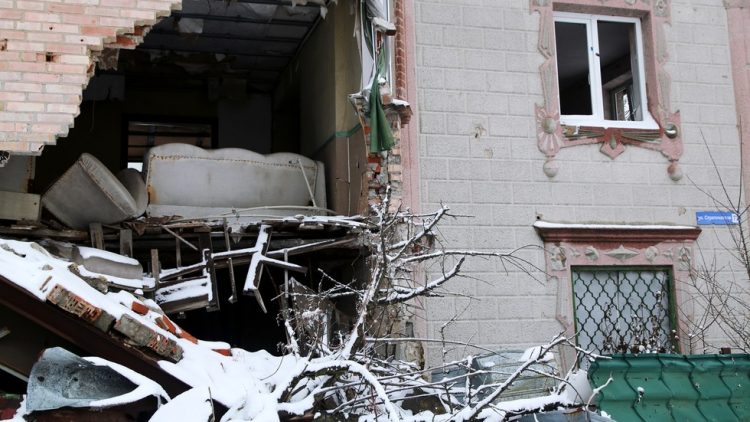
A house on Stratonautov Street in the village of Veseloye, Donetsk region, which was damaged during the fighting in the DPR. © RIA
RT | April 2, 2021
Russia has warned that it would regard any deployment of Western troops in Ukraine as a serious provocation, after Kiev asked NATO to step up its local combat readiness and claimed the US would come to its aid in any future war.
On Friday, the Ukrainian Defense Ministry issued a statement saying that it had received guarantees of American support after a telephone call with Washington’s top military official, Pentagon chief Lloyd Austen. “The US Secretary of Defense stressed that in the event of an escalation of Russian aggression, the United States will not leave Ukraine alone,” the Ministry said.
Asked about the prospects of a standoff in the region, Peskov warned that this could begin a potentially dangerous chain of events. The Kremlin official said that “undoubtedly, such a developing scenario would lead to a further increase in tensions near Russia’s borders. Of course, this will require additional measures from the Russian side to ensure its security.”
When pressed on what those measures might be, the official said only that the country would do “everything that is needed.”
The public spat comes amid rising tensions between Russia and Ukraine, after a series of reported clashes in the east of the country between Kiev’s forces and militias, who receive support from Moscow. Peskov called the escalations “quite frightening.”
His comments came as US President Joe Biden expressed Washington’s “unwavering support” for Kiev in the face of what he called “Russia’s ongoing aggression in the Donbass and Crimea.” In his Friday phone call with Ukraine’s President Volodymyr Zelensky, he also said his administration is committed to revitalizing the “strategic partnership” between the two nations.
Zelensky responded by saying that Kiev and Washington “stand shoulder to shoulder when it comes to preservation of our democracies” and called partnership with the US “crucial for Ukrainians.”
Ukraine has appealed to the US-led military bloc to increase its presence in the region. A call transcript published on Friday showed that Roman Mashovets, Deputy Head of the Office of the President, said that it’s been requested that the bloc consider “joint activities, including military exercises of Ukraine and NATO.” These activities, the transcript said, “should include land, naval and air components. In addition, it is advisable to increase the level of combat readiness of troops in NATO countries bordering Ukraine.”
In February, the country’s Ministry of Infrastructure invited warplanes operated by the US-led bloc to fly missions near Crimea, which it claims as part of its sovereign territory. Officials proposed that the skies be “used for NATO air operations in the airspace… which includes airspace over the sovereign territory of Ukraine and over open waters, such as the Black Sea, where the responsibility for air traffic services is delegated to Ukraine by international treaties.” Russia regards the region as its own after it was reabsorbed in 2014.
Moscow has previously described Ukraine’s membership of NATO and the deployment of troops there as a red line for the country. The situation has echoes of the 1962 Cuban Missile Crisis, when Soviet weaponry was deployed on the Caribbean island off the Atlantic coast of America, sparking a crisis that led the two superpowers close to nuclear war.
Kremlin calls Donbass situation ‘frightening’ as Ukraine asks NATO & US for support in event of conflict with Russia
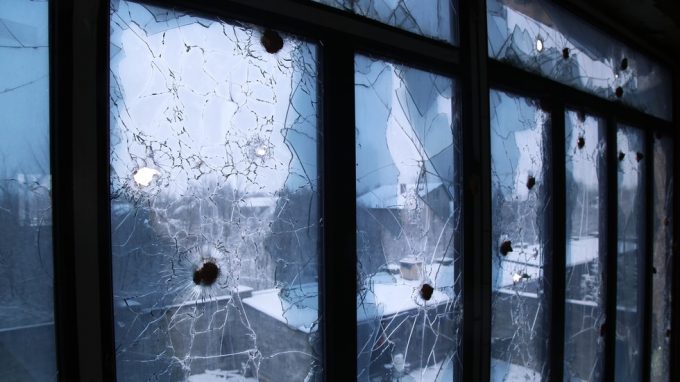
A window broken in recent shelling in the village of Vesyoloye in the Donetsk Region, self-proclaimed Donetsk People’s Republic, Eastern Ukraine. © Sputnik
RT | April 2, 2021
Moscow has warned that fighting is escalating in eastern Ukraine, insisting that the region must avoid a full-scale conflict, as Kiev asks NATO to step up its local combat readiness and says the US would come to its aid in a war.
Speaking to journalists on Friday, Kremlin spokesman Dmitry Peskov said that a series of military clashes in the Donbass region was a cause for concern. “Unfortunately for us,” he said, “the reality on the line of contact is quite frightening, and not just one, but many, provocations by the Ukrainian Armed Forces are taking place.”
Kiev insists that Russia is building up troops near the shared border and blames separatists, who have previously received support from Moscow, for breaking a ceasefire. “Russia’s current escalation is systemic, [the] largest in recent years,” Ukrainian Foreign Minister Dimitry Kuleba said in a statement issued earlier this week. Kiev officials last week said that four of its soldiers had been killed by shelling during clashes with rebels in the east of the country.
Andrey Rudenko, Russia’s deputy foreign minister, denied that Moscow had anything to gain from an increase in tensions. “I am sure that all the talk about some upcoming conflict between Ukraine and Russia is an example of another fake spread primarily by the Ukrainian authorities,” he said. “Russia is not interested in any conflict with Ukraine, let alone a military one.”
In a statement released on Friday, it was confirmed that an adviser to Ukrainian President Volodymyr Zelensky had proposed that NATO should increase its presence in the country. As part of a call with representatives from two of the US-led military bloc’s member states, Roman Mashovets, deputy head of the Office of the President, said that “such actions of the Russian Federation pose a challenge to the security of Ukraine and NATO, which must be balanced by joint efforts.”
The missive revealed that one option Mashovets put forward was “joint activities, including military exercises of Ukraine and NATO.” These activities, it added “should include land, naval and air components. In addition, it is advisable to increase the level of combat readiness of troops in NATO countries bordering Ukraine.”
Featured Video

The American Retreat from Vietnam
or go to
Aletho News Archives – Video-Images
From the Archives
Secret document reveals plans for civil war in Lebanon, Israeli false flags, and invasion
By Randi Nord | Geopolitics Alert | April 5, 2019
Beirut – During his visit with US Secretary of State, Mike Pompeo, Lebanese President Michael Aoun reportedly received a US-Israeli document detailing plans for creating a civil war in Lebanon with covert false flag operations and possible Israeli invasion.
Although the source of the document is Israeli and created in partnership with Washington, no one knows who presented it to Aoun. The Lebanese TV station, Al-Jadeed, initially reported the document on Lebanese TV and a video on its website. Geopolitics Alert translated the report for this article. … continue
Blog Roll
 Aletho News
- ‘Distance yourselves from Israel’: IRGC urges US population to question govt policies
- America’s Greenland deal has a radioactive backstory
- The RAF Fairford ‘terror plot’: Unpacking escalation in the UK echo-chamber
- EU Council Advances Chat Control 2.0 Scanning Proposal
- Ex-Greek MEP files complaint against Israeli spyware firm over alleged Pegasus surveillance
- Troubling ideas throughout the Torah, Talmud, Mishneh Torah and Tanya
- ‘Grave, alarming’: Iran mission on Trump’s UNGA ‘annihilation’ threats
- Najaf airport to reopen to Iranian flights within 24 hours: Ambassador
- From ‘How Will This End For Iran’ to ‘When America Walks Away’: A tale of two Economist covers
- Tehran blasts ‘baseless’ speculation linking Iran to alleged bomb plot at UK air base
- If Americans Knew
- Revealed: German “Anti-Semitism Expert” Driving Crackdown on Palestine Solidarity is Former Israeli Spy
- Egypt’s Warning to Israel Before Oct 7
- Israel’s siege signals another cruel winter for 1.8 million Gazans – Daily Update
- Netanyahu Asked UAE Leader to Deny Report on Oct. 7 Warning in Secret Visit, Sources Say
- CNN Chief Int’l Correspondent Clarissa Ward on Journalists in Gaza
- Democratic Party Consultants Surround Troy Jackson with Pro-Israel Donors
- Christian Leader Responds To Netanyahu’s Claims Regarding Palestinian Christians
- In Gaza, ‘Whoever Survives the Bombing Won’t Survive the Rubble’
- Israel kills more Palestinians, amid push to resettle Gaza – Daily Update
- Israel forces Gazans to live in constant peril – Daily Update
- No Tricks Zone
- New Study: Earth And Venus Surface Warmth Largely Explained By Convection And Lapse Rate, Not CO2 Or Radiation
- 2025 Nature Paper Claiming Worsening Global Drought Gets RETRACTED …Heavily Flawed
- New Study: ‘Global Drought Shows No Detectable Recent Acceleration Under Climate Warming’
- Economic Masterminds: German Socialists Suggest Taxing Productivity Gains Stemming From Using AI
- The South China Sea Has Not Been Cooperating With The Climate Change Narrative
- Energy Crisis: Germany Enters Heating Season With Historically Low Gas Reserve Fill Levels
- New Study: The Antarctic Ice Sheet Gained Mass From 2020-2024 Due To Staggering Snow And Ice Accumulation
- Study: Ocean Heating Rates From Thousands Of Years Ago ‘Dwarf’ Modern Ocean Heating Rates
- Climate Extremists Target, Attack Large-Scale Power Grid Infrastructure In Germany!
- New Study: Antarctic Ice Melt Has Contributed Less Than 1 Centimeter To Sea Level Rise In The Last 30 Years

