US Cargo Ship Carrying 350 Tonnes of Military Equipment Docks in Ukraine’s Odessa: Reports
Sputnik – 25.03.2021
A US cargo ship docked in Ukraine’s Odessa port carrying 350 tonnes of military equipment and vehicles for the country’s armed forces, local media reported on Thursday.
The cargo ship under the American flag entered the port on Wednesday evening, Dumskaya news agency said. Among 350 tonnes worth of military equipment, the ship carried 35 HMMWV military trucks for Ukraine’s armed forces.
All equipment is expected to be unloaded by mid-Friday, the news agency stated.
Earlier in March, the US Department of Defence announced additional $125 million package for the Ukraine Security Assistance Initiative to cover training, equipment, and advisory support. The remaining $150 million appropriated by Congress will be provided to Ukraine in 2021 once Pentagon certifies the country’s progress on key defense reforms.
In total, the US has committed over $2 billion in security assistance to Ukraine since 2014.
BBC secrets: Leaked files show UK state media engaged in anti-Moscow information warfare ops in E. Europe
By Kit Klarenberg RT | March 11, 2021
New documents raise serious questions about how well-deserved British state broadcaster BBC’s ‘unimpeachable’ reputation is, and also what impact its relationship with the UK government has on its supposedly ‘impartial’ output.
Within a tranche of secret UK Foreign, Commonwealth & Development Office (FCDO) papers, recently leaked by hacktivist collective Anonymous, are files indicating that BBC Media Action (BBCMA) – the outlets ‘charitable’ arm – plays a central role in Whitehall-funded and directed psyops initiatives targeted at Russia.
American journalist Max Blumenthal has comprehensively exposed how, at the FCDO’s behest, BBCMA covertly cultivated Russian journalists, established influence networks within and outside Russia, and promoted pro-Whitehall, anti-Moscow propaganda in Russian-speaking areas.
However, the newly released files reveal BBCMA also offered to lead a dedicated FCDO program, named ‘Independent Media in Eastern Partnership Countries’ and targeted at Georgia, Moldova, and Ukraine. This endeavor forms part of a wider £100 million ($138.9 million) effort waged by London to demonize, destabilize and isolate Russia, at home and abroad.
A Whitehall tender indicates that under the auspices of the project, set to cost a staggering £9 million ($12.5 million) from 2018 to 2021, participating contractors are charged with crafting “innovative… media interventions” targeting individuals throughout the region, via “radio, independent social media channels, and traditional outlets.”
Further detail was offered by FCDO Counter Disinformation & Media Development (CDMD) chief Andy Pryce at a June 2018 meeting with prospective suppliers.
He made it clear that the effort’s ultimate goal was to “weaken the Russian state’s influence,” via the co-option of journalists and media organizations in target countries via funding, training, and surreptitious production of anti-Russian, pro-Western content. “Girls on HBO… but in Ukraine” was, bizarrely, one suggested example of such activity.
In response, BBCMA submitted extensive proposals, in conjunction with Thomson Reuters Foundation (TRF), the global newswire’s “non-profit” wing, and since-collapsed veteran FCDO contractor Aktis Strategy.
The project was to be managed and coordinated directly by BBCMA from BBC Broadcasting House headquarters in London, with local support provided by Reuters newswire offices in Kiev and Tbilisi, and Ukraine’s Independent Association of Broadcasters.
A dedicated board, comprised of representatives of the contractors involved, the FCDO’s CDMD program, and British embassies in the target countries, would also meet privately every quarter to discuss the operation’s progress. Publicly, Whitehall’s funding and direction of the vast project was intended to be completely hidden.
The consortium boasted of having an existing “strong profile” in Eastern Partnership countries, and conducting “broad consultations” with a number of major news outlets, media organizations and journalists in the region in advance of its pitch.
For example, the National Public Broadcasting Company of Ukraine (UA:PBC) had been approached and offered “essential support,” aimed at “improving its existing programs” and “developing new and innovative formats for factual and non-news programs.”
BBCMA was moreover said to be “already” working on building the capacity of Kiev-based Hromadske TV, and wished to use the FCDO program to extend this assistance to “co-productions” and “building support to Hromadske Radio.”
Launched with initial funding from the American and Dutch embassies in Ukraine, Hromadske began broadcasting in November 2013 on the very day Viktor Yanukovich’s administration suspended preparations for the signing of an association agreement with the European Union, and went on to extensively cover the resultant Euromaidan protests, which eventually unseated the government the next year.
It subsequently received support from Pierre Omidyar, billionaire founder of The Intercept, who bankrolled a number of opposition groups in the country prior to the coup. In July 2014, Hromadske anchor Danylo Yanevsky abruptly terminated an interview with a Human Rights Watch representative after she consistently refused to blame Russia for civilian casualties in the Donbas conflict, despite his repeated demands.
Beyond dedicated news platforms, the consortium also pledged to enlist “local” and “hyperlocal” media outlets, as well as “freelancer journalists,” bloggers and “vloggers” for its information warfare efforts.
BBCMA argued “journalism education” locally would be a “long-term investment” – in other words, the identification, cultivation, and grooming of a network of reporters in the countries who could be relied upon to take the Whitehall line in future.
As such, the organization sought to establish a journalism training center in Gagauzia, Moldova in collaboration with NGO Media birlii – Uniunia. The autonomous region, bordered by Ukraine’s Odessa Oblast, was said to be home to “six TV companies, four radio stations, six newspapers and five web portals” potentially ripe for influence and infiltration by BBCMA – and in turn, the FCDO.
In Georgia, BBCMA visited the offices of Adjara TV “to discuss training priorities and possible co-productions.” The station was reportedly interested in developing “youth programming,” which represented “a gap in the market” in the country.
In June 2020, Georgia’s Coalition for Media Advocacy slammed Adjara for its “persecution” of “outspoken journalists expressing dissenting opinions,” after it fired newsroom chief Shorena Glonti.
Strikingly, the Coalition is funded by US regime-change agency, the National Endowment for Democracy, which supports numerous anti-Moscow initiatives worldwide. Perhaps Glonti had been too well-trained in “weakening the Russian state” for the broadcaster’s liking.
The consortium furthermore proposed to tutor and support “independent” online Georgian news outlets, including Batumelebi, iFact, Liberali, Monitor, Netgazeti, and Reginfo.
Estonia’s Digital Communications Network – financed by the US State Department – would be central to these efforts, offering lessons in “building online audiences, innovative business models and reaching out to breakaway regions susceptible to Kremlin narratives.”
The importance of “target audiences in breakaway regions” is outlined in another file, which explicitly states that the consortium would work closely with “independent outlets in proximity of non-government-controlled areas of Donbas in Ukraine, Transnistria in Moldova and Abkhazia and South Ossetia in Georgia.”
This undertaking aimed to counter the output of “separatist” media, and thus manipulate “hard-to-reach audiences,” which was “critical to achieving the project’s objectives.”
Any and all support covertly provided under the program was to be thoroughly intimate indeed, with “mentors” from the consortium “embedded” in target organizations, in order to provide “bespoke support across editorial, production and wider management systems and processes as well as on the co-production of content.”
These “mentors” include current and former BBC journalists.
“Our ability to recruit talented and experienced BBC staff is a great asset which will be harnessed for this initiative,” BBCMA promised.
These individuals may have been central to program efforts, if BBCMA’s pitch to the FCDO was accepted. For instance, UA:PBC was said to be “very interested” in receiving help from BBCMA to develop a “new debate show” and “discussion programming” to “enable audiences to think critically about the process and choices,” “counter disinformation” and “dispel rumors.”
Lofty objectives indeed, although commitments to nurturing analytical skills, thinking and debunking propaganda ring rather hollow when one considers the station’s output was perceived to be so overwhelmingly biased in favor of the government, opposition candidate Volodymyr Zelensky boycotted the channel’s official election debate during the 2019 presidential election.
BBCMA also proposed to establish an “independent” news platform in Ukraine, “timed for the run up to the 2019 election,” which would publish “vetted news content” freely syndicated to local and national media.
If the approach in Kiev was “successful,” the consortium would replicate the exercise in Georgia for the country’s 2020 election. Strikingly, the proposal brags of TRF’s experience establishing such platforms elsewhere, for example “the award-winning Aswat Masriya” in Egypt.
Other leaked files indicate the endeavor, founded after the 2011 revolution in Cairo, was secretly funded by the FCDO to the tune of £2 million ($2.8 million) over six years, and run out of Reuters’ Egyptian offices.
Over its lifespan, Aswat Masriya “became Egypt’s leading independent local media organization” and one of the most-visited websites in the country, providing news in English and Arabic, which was syndicated widely the world over. Its true, clandestine purpose seems to have been granting London a degree of narrative control over news coverage as events unfolded in the country, during its difficult and ultimately ill-fated transition to democracy.
That BBCMA likewise intended to use news coverage to influence politics in Eastern Partnership countries is amply underlined in the newly leaked files, with the organization pledging to “encourage” local news outlets to meet with “local stakeholders,” including lawmakers and community leaders, in order to “cement the media as a key governance actor.”
The organization furthermore sought to “foster a debate” in target nations, by producing wide-ranging analysis of the media environment therein. Its “long track record” of comparable efforts in “diverse” countries, including those “experiencing Arab uprisings,” had allegedly “shifted government policy.”
One objective of these lobbying efforts was achieving “a more enabling operating environment” for “independent” media in the target countries – i.e. ensuring regulations in the region were suitably conducive to and protective of the FCDO’s secret army of information warfare agents, to allow them to prosper for the duration of the consortium’s three-year offensive, and “post intervention.”
It’s not yet clear if BBCMA was successful in its pitch, and if so, which BBC journalists contributed to the program and as a result are implicated directly in cloak-and-dagger attempts to shape politics and perceptions in Georgia, Moldova, and Ukraine for London’s benefit.
It’s also unknown whether their commitment to fulfilling the FCDO’s objective of undermining Moscow, and furthering Whitehall’s interests, truly ends when they return to their day jobs as “objective,” “neutral” purveyors of news.
As BBCMA boasts in its pitch, the BBC is “well-known and highly regarded” in the Eastern Partnership countries, and provides “millions of viewers, listeners and online users in the region with world-class news on a daily basis.” At the very least, the leaked files make clear that neither the British state broadcaster, nor its FCDO paymasters, has any qualms about exploiting that standing and perceived credibility for malign ends.
Kit Klarenberg is an investigative journalist exploring the role of intelligence services in shaping politics and perceptions.
Seven years after Maidan divided country, Ukraine intensifies shelling of Donbass to deafening media silence

By Eva Bartlett | RT | March 2, 2021
While much of the world is focused on Covid-related issues, Ukraine’s seven-year war on the people of Donbass continues. In recent weeks, Kiev’s shelling of civilians has intensified, met by the predictable Western media silence.
Ostensibly, following the Minsk agreements, there was a ceasefire. In reality, Donbass residents in villages bordering peace lines are incessantly subject to Ukrainian shelling.
Ukraine uses heavy weapons in violation of the agreement, including 82mm and 120mm mortar shells, routinely shelling at night when Organization for Security and Cooperation in Europe (OSCE) observers are not patrolling the area.
But Ukrainian forces also shell during the day, and have done so a lot more of late, including allegedly with phosphorus, and shelling further behind the front lines.
Most people could be forgiven for not being aware of events in Ukraine’s breakaway Republics of Donetsk and Lugansk (DPR/LPR) in the Donbass region, with corporate media either not touching the matter or doing so with glasses tinted heavily by the Ukrainian government.
There are in fact journalists and news sites that regularly give updates, but they aren’t as widely known as they should be.
From my own September 2019 reporting from frontline villages of the DPR, I maintain contact with reporters and residents who update on the situation there.
One of these was the mayor of Gorlovka, a city northeast of Donetsk, who on his Telegram channel on February 19 detailed the nearby villages of Zaitsevo and Mine 6/7 being under heavy weapons fire (by Ukraine). On February 20, he wrote of Mine 6/7 and another village being heavily shelled since early morning, with locals saying more than one hundred hits occurred.
The same day, Alexey Karpushev, a resident of the northern city of Gorlovka, wrote, “From about five in the morning until now, there is heavy shelling of the city from the Air Force artillery.”
According to Karpushev – who is a former first secretary of Gorlovka’s committee of the Communist Party of Ukraine – in recent weeks, the number of attacks from the Ukrainian army “increased significantly.” He mentioned that a 22 year old civilian was recently seriously injured in the attacks.
I asked why the increased shelling now.
“Ukraine’s aggression intensified just when Biden came to power in the United States.” It is quite likely that President Volodymyr Zelensky feels more confident with the return of the warmongers to the White House. Not long after Biden took power America resumed illegally bombing Syria.
We’re Not Living, We’re Surviving
In villages northwest and north of Gorlovka, passing many boarded up and destroyed homes (including one still smouldering from the shell-induced fire that gutted it), I met residents who stayed in spite of the nightly shelling and damage to their homes, because they had no other option.
One of these was a 74-year-old woman, whose home was falling apart after having been shelled on multiple occasions. “I’m afraid at night; that’s when they start shelling heavily. My husband is dead. I have nowhere to go.”
In another village I met a man who was about to walk down the lane that I had been cautioned to avoid due to the risk of being shot by Ukrainian snipers. His house was in a district largely unpopulated now because getting there meant being in the line of fire, but like others I met, he had nowhere else to go.
He consented to speak, but off camera, saying Ukraine had shelled his home directly after he did a video interview. He also said he had once been shot in the leg by a sniper and many other times had to drop to the ground when snipers started firing.
Another man in the area wasn’t worried about speaking on camera, although his house had also been damaged by Ukrainian attacks.
“Why do you support Nazis if you remember WW2? Why do you now support the Nazis? Openly Nazis… Why is Europe silent? Everyone comes here and agrees with me, but nothing changes. OSCE shouts, but when they are under fire, they are silent, they don’t say that Ukraine attacks them.”
In Zaitsevo, another frontline village, the head of administration, Irina Dikun, told me of the hell they had been living for the past six years, saying the ceasefires never reached her village.
“Here, we are not living, we’re surviving. Those who could leave, have left. Those who remain are mostly elderly.”
Ambulances couldn’t reach homes close to the front line where Ukraine was shelling, so she learned to drive and took First Aid training in order to help injured residents. In addition to detailing Ukraine’s destruction, “street by street,” of the village, she emphasized that what Western media claims about Russia invading the breakaway republics was false.
“There is no Russian invasion here. Just normal, peaceful people who wanted to live another way. In the beginning, we didn’t want to make a Republic; we just wanted to be autonomous. But we were not listened to. Ukraine moved its armed forces against the people and used their artillery against us.”
I also spoke with numerous DPR soldiers, asking them, among many things, why they had picked up weapons.
“Because of the killing of people in Odessa. That’s what made us join the military, to defend our area,” one soldier said.
Another man said he had initially joined protests against the coup in Kiev, that he “didn’t support the Nazi regime,” and eventually took up arms to defend the DPR.
In those frontline areas, 500 metres from Ukrainian forces, I wore body armour and a helmet. As I listened to various elderly people speak of the near-nightly shelling and heavy machine gun fire they were subject to, it struck me how these brave souls had nothing to protect them, no global body to prevent Ukraine from maiming and killing them, damaging or destroying their homes, year after year.
Meanwhile Ukraine has Western nations whitewashing its crimes and sending it weapons.
Western Ambassadors Get front line Disinfo Tour
On February 11, Ukraine reported that President Zelensky and a gaggle of Western ambassadors visited a front line on the Ukraine-controlled side, with Zelensky waffling on about the importance of his cohorts in disinformation seeing “with their own eyes” what is happening in Donbass.
Yeah, no. They didn’t see anything beyond the sterile visit they were allotted. They certainly would not have heard the anguished accounts I did on the other side of that front line.
They wouldn’t know of the many people, many of whom are elderly, living in shells of homes, or the basement of a school, deprived of electricity, water, cooking gas, reliant on aid for their survival. Nor that Ukraine has reportedly blocked UN and Red Cross aid from entering the DPR, including recently.
On February 24 and 25, Ukrainian forces shelled Yelenovka, south of Donetsk, a point through which humanitarian aid from the UN and Red Cross was to enter, preventing the aid delivery.
Preventing the entrance of aid, on top of continually shelling civilian areas, is the furthest from Ukraine “fulfilling its obligations to establish a ceasefire regime,” as President Zelensky claimed to Western ambassadors.
While Russian officials warn of the dire fate of 4 million people under Ukrainian shelling, Western officials either remain silent or fabricate more accusations against Russia and against Donbass’ defenders.
Western media have predictably remained silent on Ukraine’s crimes, painting defenders of Donbass as “pro-Russian separatists” with no context as to what people in Donbass actually want. From what I heard there, all they want is autonomy from the criminal government in Ukraine, and above all an end to the war.
And while Western officials and media harp on about a supposed “Russian invasion” of the republics, even the chairman of the OSCE Special Monitoring Mission recently emphasized that was untrue.
An aside: one of the soldiers asked me about the reaction of people in the West to Ukraine’s brazen display of Nazi symbols. My reply was that, thanks to Western media, most people don’t know.
Recently, the head of the DPR warned, “We need to be ready for anything” from Ukraine. Indeed, with the pro-war Biden administration, we can surely expect more Western support to Ukraine in further bombing the people of Donbass.
Eva Bartlett is a Canadian independent journalist and activist. She has spent years on the ground covering conflict zones in the Middle East, especially in Syria and Palestine (where she lived for nearly four years). Follow her on Twitter @EvaKBartlett
Amid ‘political repression,’ Ukraine becoming American ‘colony’ in Europe: sanctioned opposition leader Medvedchuk
By Gabriel Gavin | RT | February 25, 2021
Moscow – A few weeks ago, Viktor Medvedchuk was celebrating as his party, Ukraine’s largest opposition bloc, topped a nationwide opinion poll. Now, he’s facing charges of funding terrorism that could land him behind bars for over a decade.
In an exclusive interview with RT, the MP and chairman of Opposition Platform — For Life, which advocates better ties with Moscow, insisted that the allegations were a tool of political persecution.
According to him, they are part of a wider pattern of repression linked to Kiev’s recent moves to shut down Russian-language media that has been critical of President Volodymyr Zelensky’s government. The embattled administration has seen its approval ratings nosedive amid worsening economic woes and a chaotic response to the Covid-19 pandemic.
Very serious accusations
Last week, the country’s National Security and Defense Council announced it would seize properties belonging to seven people, including multimillionaire Medvedchuk and his wife, TV presenter Oksana Marchenko, for allegedly financially supporting terrorist organizations. Details of the charges have not yet been made public, but they could carry a 10-12 year prison sentence if he is found guilty.
“These are very serious accusations,” the politician said. “Especially given they are without any foundation at present.” The sanctions, he argued, “are expressly prohibited” by Ukrainian law and in contravention of the Constitution.
“Unfortunately, [prosecution for] crimes like treason and espionage is commonplace. Just as at one time there was a charge of hooliganism, now we can be charged with treachery or spying,” he said. However, despite believing his political opponents are abusing the justice system, any suggestion that the man once described as Russian President Vladimir Putin’s ‘favorite Ukrainian’ might flee abroad gets short shrift. “In spite of all of this, I feel like I’m ready to fight – to fight against arbitrariness, against repression, against falsification… I am prepared to stand up to these threats,” he said.
Just a few hours before Medvedchuk spoke to RT, the Kiev-based research group Rating published a poll which they claim shows more than half of all respondents across the country supported the action against the politician and his family. “They say 58 percent agree with the sanctions, but they have not seen any evidence or arguments,” he said incredulously. “So, what can you really say about this figure?”
Again though, he refuses to write off the prospects of healing political divisions in a country where more than half of the population would seemingly relish the prospect of putting him behind bars. “The split can be overcome,” Medvedchuk insisted, “because the East-West divide has existed for a long time. Since independence, even. Yes there are regions… that differ in mentality and attitudes, but that’s not such a terrible thing if there is a wise state policy with solid structures and good governance.”
“We can find shared ground when it comes to the development of the country’s economy, its social sphere, income growth and prosperity.”
External influence
As one of the flag bearers for a return to Ukraine’s pre-2014 foreign policy, which pursued closer relations with Moscow until the bloody events of the Maidan uprisings, Medvedchuk is often characterized as being ready to give away the country’s independence to the Kremlin. However, he insists that it is Zelensky’s government, and its Western allies, that presents the real threat to Ukrainian nationhood.
“We live in an independent sovereign state,” he said. “Or, at least, we used to live in one. Now, both independence and sovereignty are being undermined by external influence and most importantly by external political systems imposed by Washington.”
The American embassy in Kiev raised eyebrows internationally earlier this month when it backed an order signed by Zelensky’s government to shut down a group of television channels and news sites owned by one of the country’s elected MPs, Taras Kozak, a member of Medvedchuk’s party. In a media landscape dominated by wealthy oligarchs, Kozak’s ‘Novosti’ media empire carved out a niche with Russian-language programming made and broadcast in Ukraine. Around one in three people in the country speak the language natively at home, and the vast majority of Ukrainians could be considered fluent. Despite this, under laws put in place in 2014, swathes of programming in Russian from Ukraine’s vast eastern neighbor are already banned.
“When you see that the US Embassy supported both the closure of the channels and the sanctions against me,” Medvedchuk said, “it causes real outrage.” He explained that Washington is “used to creating the image that they are the paragon of democracy, but it is their authorities who have imposed external governance and who are now running Ukraine as their colony,” adding, “They will of course target those who push back against external influence.”
The opposition leader reiterated that 2014 was the turning point, explaining that, since then, “the US has imposed its political power, and it has not benefitted my country or the Ukrainian people… nor will it ever be able to.”
Only a court of law can judge us
The shuttering of the Novosti Group’s media channels, Medvedchuk claims, was an extrajudicial act of repression. Having the backing of the country’s National Security and Defense Council, the same body that ordered the most recent sanctions against him, is not sufficient under Ukrainian law, he maintains.
“Did the Security Council have the right to sign a decree after applying restrictions and blocking channels? No!”
Three broadcasters were taken off air almost immediately and several news sites were banned, which Medvedchuk, who holds a doctorate in legal practice, says was unlawful. “There is nothing in the sanctions that enables them to stop broadcasting, or stop internet resources,” he said. “The law knows no such sanctions.”
At the time, Mikhail Podolyak, an adviser to Zelensky, explained the move, saying, “it’s clear that sanctions on Mr. Medvedchuk’s TV channels are not about the media and not about freedom of speech… it’s just about effectively countering fakes and foreign propaganda.” Without action, he argued, the opposition media would “kill our values.”
Medvedchuk, however, rejects this as arbitrary and political, when only a judicial decision should apply. “They should go legal,” he insisted. “If you think someone is wrong, go to court. The channels can be defended in court – those who think there are arguments can present them. It is the court that decides who is right and who is wrong, not you, not me, or a government representative who thinks it is bad for the interests of the country when I say it is good for the interests of the people.”
“Only a court of law can judge us,” he concluded. “This is the procedure in all legal systems, and this is real, effective democracy. Everything else is evil!”
The American Embassy in Kiev, however, insisted that the move was “in line with Ukrainian law,” and that it supported Zelensky’s efforts “to counter Russia’s malign influence.”
“We must all work together to prevent disinformation from being deployed as a weapon in an info war against sovereign states,” a tweet from the diplomats argued.
Violating the principles of democracy
When the sanctions against him were first announced, Medvedchuk issued a fiery statement in which he accused the president of taking the country “down the path of establishing a “dictatorship and usurping power.” The government was, he insisted, “seeking to crack down on the parliamentary opposition legally elected by the Ukrainian people.”
No matter how evocative that rhetoric might be, however, the reality is that few in the West can imagine Zelensky as a budding despot, at least at the moment. When elected with more than 73 percent of the vote in 2019 after an unlikely rise from television celebrity to politics, he declared that he would only ever serve one term in the top job.
When pushed on whether his political opponent would really go back on that pledge, Medvedchuk insisted that “it all still looks cloudy and foggy.” However, Zelensky’s plans would become clearer, he said, at the next elections. But, in either case, whether the incumbent would succeed in a re-election bid, he said, “I have my doubts.”
The president’s falling popularity, which has seen support for his party drop in a recent poll to around half the level of Medvedchuk’s, “is the result of unprofessional management of the economic and social spheres, as well as the fight against coronavirus,” he said. “It is because of the lack of peace that he promised in the elections, the lack of return of Donbass to Ukraine.”
“And I think that political repression, the establishment of a dictatorship, the closure of channels, the policy of discrimination against the Russian language, the policy of Russophobia and the policy of usurping power are the result of him struggling to maintain and increase his authority and his ratings,” the opposition leader continued. “This is exactly the kind of illegal and unconstitutional way that violates the current legislation of our country, going out of the legal framework and really violating all the principles of democracy.”
European values
For all Medvedchuk’s talk about Zelensky’s undermining of Ukrainian democracy, the country’s president would likely throw those accusations straight back at him. Advocates of a tough line against both Russia and those Kiev politicians who seek better ties with the country argue that the Kremlin will always pose an existential threat to Ukraine’s nationhood.
Unless it finds its own distinct identity, they argue, through elevating the Ukrainian language and advocating an interpretation of the country’s history as separate to Moscow’s, it will forever be sucked into the orbit of its far larger neighbor. The Russian-language broadcasters that Medvedchuk points to as an example of Kiev’s growing autocracy are, to Zelensky’s supporters, a leash that would lead the country back to control from the East. For them, Ukraine’s future lies only in turning to the West.
The opposition leader, however, shrugged off the suggestion that the country could strengthen the president’s ambitions to join Western institutions like the EU and NATO by simply blocking opposing voices. “When he says he is leading the way to European democracy and is trying to break down the barriers to that, it is just seen as utter absurdity,” the MP argued. “If this democracy is about closing down channels alone, then I don’t know what his idea of European democracy is. European democracy has a mechanism for stopping broadcasting – and we’ve already talked about it – through the courts.”
“But what Zelensky is doing – imposing sanctions on his citizens, restricting constitutional rights extrajudicially, shutting down broadcasters illegally – is not democracy, European or otherwise,” he added. “This is the establishment of dictatorship and a way to seize power.”
“Note that the resolution adopted by the European Parliament in matters related to the association agreement between Ukraine and the EU, in several paragraphs it explicitly states that there can be no extrajudicial closure of television broadcasters. There can be no politically motivated action against the opposition – this is also explicitly stated.”
The Ukrainian Ministry of Justice was approached for comment on whether the sanctions against politicians and broadcasters were within the law. No response has been received.
Though Medvedchuk and Zelensky might lead warring factions, they share the same country, divided as it is. The great irony would be if, by trying to break the deadlock between them with promises of a bright, liberal and democratic future, the president and his supporters delivered the kind of autocracy that they have always accused the other side of wanting to install.
After ban on Russian TV news Latvia now will criminalize watching ‘illegal’ cross border channels
RT | February 18, 2021
Tens of thousands of Russian-speaking Latvians will be turning down the volume and listening out for neighborhood snoopers after a new law came into force that will see viewers of unlicensed satellite TV fined just for tuning in.
Earlier this month, local media reported that the Seimas, the Baltic nation’s parliament, had adopted a bill in its final reading that will criminalize people for watching unauthorized broadcasts.
The networks that will be affected are said to include dozens of Russian television channels for which signals can be picked up from across the border. More than one in three Latvians speaks Russian at home, but dozens of broadcasters showing programs in the language have had their licenses revoked and been banned from the country’s airwaves since earlier this month.
Ivars Abolins, the chairman of Latvia’s National Council for Electronic Media (NEPLP), issued a statement backing the ban. “We have protected, are protecting, and will protect our information space,” he said. Regulators claim that talk show guests on the Russian-speaking channels have incited hatred and called for war in Europe.
The Russian Embassy in Riga issued a stern protest in response. In a post to its Facebook page it said that the policy was “in the best traditions of dictatorship.”
Riga’s move has likely been inspired by the fact that “Harmony,” the country’s main opposition party, is led by Russian speakers and has close links to the leftist Russian grouping, “Fair Russia.” Harmony won 23 of the 100 seats in the Seimas in the 2018 election.
“Violation of free speech? That’s just the start of it,” it added. “Apparently, in a free market environment, Latvian television channels cannot compete, even in the information space of their own country.”
However, under the old rules, while the channels themselves were prohibited, plucky viewers intent on getting a fix of their favorite shows in their native language did not fall foul of the law. Now though, consumers themselves are likely to face financial penalties if they are caught watching illicit programming. Lawmakers note that 62,000 households tuned into illegal satellite broadcasts in 2018, the most recent year for which figures were given.
The Reporters Without Borders NGO issued a warning last summer after a number of Baltic nations moved to ban several separate RT channels. The free speech watchdog said that “While it is legitimate to defend and promote independent and reliable news reporting,” it “regards these closures as a misuse of the EU sanctions policy.”
“Rather than banning media outlets on loose grounds and on a flimsy legal basis,” it argued, “countries can require all media to guarantee editorial independence and can then impose legitimate sanctions, subject to judicial control, when it is established that media outlets have not complied with their obligations.”
Ukraine has also recently come under fire from both Russian and European politicians for its decision to block and ban a series of Russian-language outlets, run and produced by Russian-speaking Ukrainians from within the country. One in three Ukrainians speaks Russian at home as a first language, but Kiev has claimed the channels amount to pro-Kremlin propaganda.
NATO’s Road To Perdition With Ukraine
Strategic Culture Foundation | February 12, 2021
Despite repeated and long-standing warnings by Russia, the US-led NATO military alliance has indicated it is moving ever closer to accepting Ukraine as a new member. This is an incredibly incendiary step towards war that could escalate into a nuclear conflagration. And, risibly, this reckless initiative is being driven by an alliance which proclaims to be about upholding peace and security.
This week NATO secretary general Jens Stoltenberg hosted Ukrainian prime minister Denys Shymhal at the organization’s headquarters in Brussels. At a joint press conference, both men were upbeat about Ukraine joining NATO. Stoltenberg admitted that the former Soviet Republic has been eyed for membership of the alliance since 2008, a timescale which puts more recent conflict over the past nearly seven years in perspective. He also confirmed that NATO forces have been building up their presence in the Black Sea in coordination with Ukrainian counterparts. In recent weeks, three US warships have been training with Ukrainian naval vessels in order to counter what Stoltenberg says is “Russian aggression”.
Officially, Ukraine is designated as an “Enhanced Opportunities Partner” by NATO. Which makes one wonder, ironically, what kind of “opportunities” are being contemplated?
For all intents and purposes, Ukraine is already virtually a member of NATO. It has participated in overseas joint military operations and, as noted, it receives military aid, training and logistical support.
But if Ukraine were to be formally admitted to the NATO alliance then that opens up a legalized and inevitable path to war. Under the organization’s rules, any individual member nation is entitled to invoke a general defense clause which obliges other NATO members to support militarily. Since the governing authorities in Kiev continually claim that Russia is an aggressor – a view shared by NATO – then the potential for a generalized war with Russia is a wide open danger if Ukraine were to officially join the alliance.
Undoubtedly, NATO leaders are aware of this potential catastrophe and are also well aware of Russia’s deep concerns. That would explain their cautious delay in admitting Ukraine to the alliance. Germany and France in particular are understood to be against adding the country to NATO’s membership out of fear that it would provoke Russia.
It is interesting to speculate why Stoltenberg – a former Norwegian premier and nominal civilian head of NATO – this week appeared to give new impetus to Ukraine’s ambitions. Could it be related to the change of administration in the United States? Senior members of the Biden administration have publicly stated during Senate hearings a willingness to increase military support for the Kiev government in its conflict with pro-Russian separatists in Eastern Ukraine. American and European envoys at the UN Security Council this week reiterated strident accusations against Russia claiming that Moscow was responsible for prolonging the conflict in Ukraine. Russia’s envoy Vassily Nebenzia countered that it was the Kiev regime and its Western allies who have not implemented the previously agreed Minsk peace accord signed in 2015.
But surely even the most diehard NATO jingoists must realize that admitting Ukraine to the ranks would a be dangerous bridge too far. The same too for Georgia, another former Soviet Republic, which is also in the queue for joining the military alliance. Both countries are already in political conflict with Russia because of NATO expansionism, not as they or NATO would have it, because of “Russian aggression”. NATO pushed Georgia into a brief war with Russia in 2008 over the disputed territories of South Ossetia and Abkhazia. Then in 2014, a NATO-backed coup d’état in Kiev against an elected president led to the ongoing low-intensity war in Eastern Ukraine. That coup also led to Crimea voting in a referendum to secede and join the Russian Federation which the West continually refers to disparagingly as “annexation”.
Professional, well-paid shills like Jens Stoltenberg like to spin the deluded yarn that NATO expansion is a “success” for democracy and the rule of law. Since the end of the Cold War in 1991 following the demise of the Soviet Union, NATO did not pack up and dissolve. In the ensuing 30 years it has doubled its membership from 16 to the present 30 constituent nations. This was in spite of earlier vows by American leaders that they would not permit NATO enlargement beyond the old frontiers of the Cold War and Warsaw Pact. The most recent additions include Montenegro and North Macedonia. Bosnia and Herzegovina are being considered under Membership Action Plans, and Ukraine and Georgia presumably after that.
NATO’s relentless expansion towards Russia’s borders, including the stationing of missile systems, in conjunction with baseless provocative, rhetoric accusing Moscow of aggression are patently posing an existential threat to Russian security. Yet NATO apologists talk blithely and in Orwellian fashion about promoting security, defense and rule of law.
Lest we forget, Russia came close to annihilation – within living memory – from military aggression by Nazi Germany and its eastern European satellites when up to 27 million Soviet people were killed in the Second World War (1939-45).
NATO’s own purported rules forbid the organization from admitting countries which are involved in border disputes or internal conflicts. That clearly should forbid Ukraine and Georgia. Yet the US-led NATO is turning a blind eye to its own rules, distorting its interventions in these countries as actions of defense against “Russian aggression”.
It would be ludicrous if it were not so gravely serious. NATO “justifies” the expansion to Ukraine and Georgia “because” Russia has forces in the Black Sea and the Barents Sea. Those regions are integral to Russia’s sovereign territory. This is while the United States from a distance of over 6,000 kilometers away stations B-1 strategic bombers for the first time in the Barents and sends increasing numbers of warships to the Black Sea in violation of maritime treaties. What next? Russia is accused of occupying Moscow?
The precedents and historical pattern show that the American imperial catspaw known officially as the North Atlantic Treaty Organization is incapable of intelligent reasoning and dialogue. It is a machine geared for confrontation. Russia may therefore have to consider using another form of language in conveying its wholly legitimate security concerns.
For the present trajectory is a road to perdition.
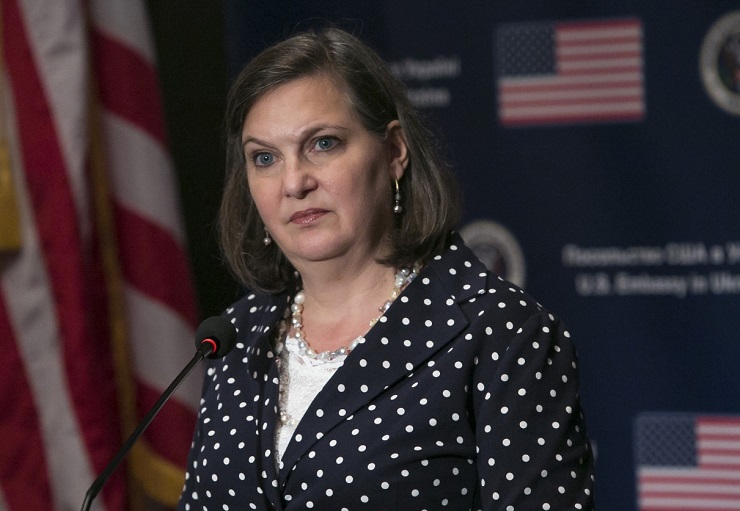
Why Victoria Nuland Is Dangerous and Should Not be Confirmed
By Rick Sterling | Global Research | February 11, 2021
Victoria Nuland exemplifies the neocons who have led US foreign policy from one disaster to another for the past 30 years while evading accountability. It is a bad sign that [proclaimed] President Joe Biden has nominated Victoria Nuland for the third highest position at the State Department, Under Secretary for Political Affairs.
As a top-level appointee, Victoria Nuland must be confirmed by the US Senate. There is a campaign to Stop her confirmation. The following review of her work shows why Victoria Nuland is incompetent, highly dangerous and should not be confirmed.
Afghanistan and Iraq
From 2000 to 2003, Nuland was US permanent representative to NATO as the Bush administration attacked then invaded Afghanistan. The Afghan government offered to work with the US remove Al Qaeda, but this was rejected. After Al Qaeda was defeated, the US could have left Afghanistan but instead stayed, established semi-permanent bases, split the country, and is still fighting there two decades later.
From 2003 to 2005 Nuland was principal foreign policy advisor to Vice President Dick Cheney who “helped plan and manage the war that toppled Saddam Hussein, including making Bush administration’s case for preemptive military actions based on Iraq’s alleged weapons of mass destruction.” The foreign policy establishment, with Nuland on the far right, believed that removing Saddam Hussein and installing a US “ally” would be simple.
The invasion and continuing occupation have resulted in over a million dead Iraqis, many thousands of dead Americans, hundreds of thousands with Post Traumatic Stress Disorder at a cost of 2 to 6 TRILLION dollars.
From 2005 to 2008 Victoria Nuland was US Ambassador to NATO where her role was to “strengthen Allied support” for the occupations of Afghanistan and Iraq.
On the 10th anniversary of the invasion, when asked about the lessons learned Nuland responded “Compared to where we were in the Saddam era, we now have a bilateral security agreement … We have deep economic interests and ties. We have a security relationship. We have a political relationship.” Nuland is oblivious to the costs. Nuland’s loyalties are to the elite who have benefitted from the tragedy. According to online google, “One of the top profiteers from the Iraq War was oil field services corporation, Halliburton. Halliburton gained $39.5 billion in ‘federal contracts related to the Iraq war.’ Nuland’s boss, Vice President Dick Cheney, was the former the CEO of Halliburton.
In January 2020, seventeen years after the US invasion, the Iraqi parliament passed a resolution demanding the US troops and contractors leave. Now, over one year later, they still have not left.
Libya
In spring 2011, Victoria Nuland became State Department spokesperson under Hillary Clinton as she ramped up the “regime change” assault on Moammar Ghaddafi of Libya. UN Security Council resolution 1973 authorized a “No Fly Zone” for the protection of civilians but NOT an air assault on Libyan government forces.
That summer, as US and others bombed and attacked Libyan forces, she dismissed the option of a peaceful transition in Libya and falsely suggested the UN Security Council required the removal of Ghaddafi.
The campaign led to the toppling of the Libyan government and killing of Ghadaffy. Commenting on the murder and bayonet sodomizing of Ghaddafi, Nuland’s boss Hillary Clinton chortled “We came, we saw, he died.”
Before the overthrow, Libya had the highest standard of living in all of Africa. Since the US led assault, Libya has become a failed state with competing warlords, huge inflation, huge unemployment, and exploding extremism and violence that has spread to neighboring countries. Most of the migrants who have crossed the Mediterranean trying to reach Europe, or drowned trying to, are coming from Libya. By any measure, the goal of “protecting” Libyan civilians has failed spectacularly.
Syria
One reason that Clinton and hawks such as Nuland wanted to overthrow Ghaddafi was to get access to the Libyan military arsenal. That way they could funnel arms to insurgents seeking to overthrow the Syrian government. This was confirmed in secret DOD documents which state: “During the immediate aftermath of, and following the uncertainty caused by, the downfall of the ((Qaddafi)) regime in October 2011 and up until early September of 2012, weapons from the former Libya military stockpiles located in Benghazi, Libya were shipped from the port of Benghazi, Libya to the ports of Banias and the Port of Borj Islam, Syria”
In January 2012, Nuland claimed the US is “on the side of those wanting peaceful change in Syria.” While saying this, the US was supplying sniper rifles, rocket propelled grenades, and 125 mm and 155 mm howitzer missiles to the “peaceful” protestors.
The US “regime change” strategy for Syria followed the pattern of Libya. First, claim that the protestors are peaceful. Then claim the government response is disproportionate. Put pressure on the target government to paralyze it, while increasing support to proxy protesters and terrorists. As documented, there were violent Syrian protesters from the start. During the first days of protest in Deraa in mid-March 2011, seven police were killed. As spokesperson for the State Department, Nuland was a major figure promoting the false narrative to justify the “regime change” campaign.
Ukraine
In September 2013 Victoria Nuland was appointed Assistant Secretary of State for European and Eurasian Affairs. The uprising in the central plaza known as the Maidan began soon after her arrival. To underscore the US support for the protests, Nuland and Senator John McCain passed out bread and cookies to the crowd.
Protests continued into January 2014. The immediate issue was whether to accept a loan from the International Monetary Fund which was going to require a 40% increase in natural gas bills or to accept a loan from Russia with the inclusion of cheap oil and gas. The opposition wanted the Yanukovych government to take the EU/IMF loan. The opposition was comprised of different factions, including the neo-Nazi Svoboda Party and Right Sector.
In early February 2014, an audio recording of Victoria Nuland talking the US Ambassador to Ukraine, Geoffrey Pyatt, was leaked to the public. The 4-minute conversation was a media sensation because it included Victoria Nuland saying, “Fuck the EU.”.
But Nuland’s cursing was a distraction from what was truly significant. The recording showed that Nuland was meddling in domestic Ukraine affairs, had direct contacts with key opposition leaders, and was managing the protests to the extent she was deciding who would and would not be in the post-coup government! She says, “I don’t think Klitsch [Vitaly Klitschko] should go into government…… I think Yats [Arseniy Yatseniuk] is the guy… “
The reason she wanted to “Fuck the EU” was because she did not approve the EU negotiations and compromise. Nuland and Pyatt wanted to “midwife” and “glue” the toppling of the Yanukovych government despite it being in power after an election that was observed and substantially approved by the OSCE (Organization for Security and Co-operation in Europe).
Over the next few weeks, the protests escalated. The President of the American Chamber of Commerce in Kiev, Bernard Casey, described what happened next. “On February 18-20, snipers massacred about 100 people [both protestors and police] on the Maidan …. Although the US Ambassador and the opposition blamed the Yanukovych Administration, the evidence points to the shots coming from a hotel controlled by the ultranationalists, and the ballistics revealed that the protestors and the police were all shot with the same weapons.”
The Estonian Foreign Minister later said the same thing: “behind the snipers it was not Yanukovych, but it was somebody from the new (opposition) coalition”.
President of the American Chamber of Commerce President for Ukraine, Bernard Casey, continues: “On February 20, 2014 an EU delegation moderated negotiations between President Yanukovych and the protestors, agreeing to early elections – in May 2014 instead of February 2015…. Despite the signing of an agreement … the ultranationalist protestors, and their American sponsors, rejected it, and stepped up their campaign of violence.”
The coup was finalized over the coming days. Yanukovych fled to for his life and Yatsenyuk became President after the coup as planned.
One of the first acts of the coup leadership was to remove Russian as an official state language, even though it is the first language of millions of Ukrainians, especially in the south and east. Over the coming period, the “birth” of the coup government, violence by ultranationalists and neo-Nazis was prevalent. In Odessa, they attacked people peacefully protesting the coup. This video shows the sequence of events with the initial attack followed by fire-bombing the building where protestors had retreated. Fire trucks were prevented from reaching the building to put out the fire and rescue citizens inside. Forty-two people died and a 100 were injured.
A bus convoy heading back to Crimea was attacked with the anti-coup passengers beaten and some killed.
In the Donbass region of eastern Ukraine, protests against the coup were met by deadly force.
Victoria Nuland claims to be a “victim” because her conversation was leaked publicly. The real victims are the many thousands of Ukrainians who have died and hundreds of thousands who have become refugees because of Nuland’s crusade to bring Ukraine into NATO.
The audio recording confirms that Nuland was managing the protests at a top level and the results (Yats is the guy) was as planned. Thus, it is probable that Nuland approved the decision to 1) deploy snipers to escalate the crisis and 2) overturn the EU mediated agreement which would have led to elections in just 3 months.
Why were snipers deployed on February 18? Probably because time was running out. The Russian leadership was distracted with the Sochi Olympic Games ending on February 23. Perhaps the coup managers were in a hurry to “glue” it in advance.
Russia
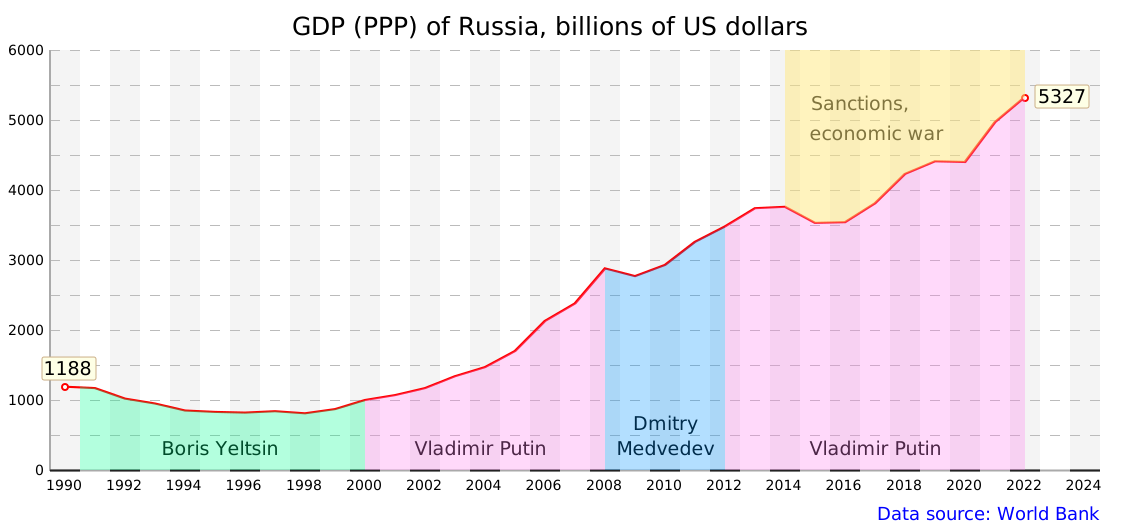
During the 1990’s, Nuland worked for the State Department on Russia related issues including a stint as deputy director for former Soviet Union affairs. The US meddled in Russian internal affairs in myriad ways. Time magazine proudly proclaimed “Yanks to the rescue: the secret story of how American advisors helped Yeltsin win.” The Yeltsin leadership and policies pushed by the US had disastrous consequences. Between 1991 and 1999, Russian Gross Domestic Product decreased by nearly 50% as the social safety net was removed. The Russian economy collapsed, oligarchs and lawlessness arose. Nuland was part of the US group meddling in Russia, deploying economic “shock therapy” and causing widespread social despair.
Meanwhile, the U.S. reneged on promises to Soviet leader Gorbachev that NATO would not expand “one inch” eastward. Instead, NATO became an offensive pact, bombing Yugoslavia in violation of international law and then absorbing Poland, Hungary, Bulgaria, Romania, the Baltic states, the Czech Republic, Albania, Croatia and more.
Coming into power in 2000, Putin clamped down on the oligarchs, restored order and started rebuilding the economy. Oligarchs were forced to pay taxes and start investing in productive enterprises. The economy and confidence were restored. Over seven years, GDP went from $1300 billion (US dollars) to $2300 billion. That is why Putin’s public approval rating has been consistently high, ranging between 85% and a “low” approval rating of 60%.
Most Americans are unaware of these facts. Instead, Putin and Russia are persistently demonized. This has been convenient for the Democratic Party establishment which needed a distraction for their dirty tricks against Bernie Sanders and subsequent loss to Donald Trump. The demonization of Russia is also especially useful and profitable for the military industrial media complex.
Victoria Nuland boosted the “Steele Dossier” which alleged collaboration between Russia and Trump and other salacious claims. The allegations filled the media and poisoned attitudes to Russia. Belatedly, the truth about the “Steele Dossier” is coming out. Last summer the Wall Street Journal reported “the bureau (FBI) knew the Russia info was phony in 2017” and that “There was no factual basis to the dossier’s claims”.
While promoting disinformation, Victoria Nuland is pushing for a more aggressive US foreign policy. In an article titled “Pinning Down Putin”, she says “Russia’s threat to the liberal world has grown”, that Washington should “deter and roll back dangerous behavior by the Kremlin” and “rebuff Russian encroachments in hot spots around the world.”
The major “hot spots” are the conflicts which Victoria Nuland and other Washington neocons promoted, especially Syria and Ukraine. In Syria, the US and allies have spent hundreds of BILLIONS of dollars promoting the overthrow of the Assad government. So far, they have failed but have not given up. The facts are clear: US troops and military bases in Syria do not have the authorization of the Syrian government. They are actively stealing the precious oil resources of the Syrian state. It is the US not Russia that is “encroaching”. The dangerous behavior is by Washington not Moscow.
Conclusion
Victoria Nuland has promoted a foreign policy of intervention through coups, proxy wars, aggression, and ongoing occupations. The policy has been implemented with bloody and disastrous results in Afghanistan, Iraq, Libya, Syria, and Ukraine.
With consummate hypocrisy she accuses Russia of spreading misinformation in the US, while she openly seeks to put “stress on Putin where he is vulnerable, including among his own citizens.” She wants to “establish permanent bases along NATO’s eastern border and increase the pace and visibility of joint training exercises.”
Victoria Nuland is the queen of chicken hawks, the Lady Macbeth of perpetual war. There are hundreds of thousands of victims from the policies she has promoted. Yet she has not received a scratch. On the contrary, Victoria Nuland probably has profited from a stock portfolio filled with military contractors.
Now Victoria Nuland wants to provoke, threaten and “rollback” Russia. A quick look at a map of US military bases shows who is threatening whom.
Victoria Nuland is dangerous and should not be confirmed.
*
Rick Sterling is an investigative journalist in the SF Bay Area. He can be reached at rsterling1@protonmail.com.
Western pundits believed post-Maidan Ukraine would serve as an ‘example’ for Russia – in reality, it’s become a cautionary tale
By Paul Robinson | RT | February 6, 2021
Many Russian liberals and foreign pundits saw Ukraine’s 2014 ‘Maidan’ as an event that would inspire change in Moscow. Today, as an increasingly dysfunctional Kiev clamps down on free speech, it looks more like a cautionary tale.
In May 2014, newly elected Ukrainian President Petro Poroshenko promised that he would rapidly bring peace to his country. “The anti-terrorist operation cannot and should not last two or three months. It should and will last hours,” he said.
Nearly 60,000 hours later, the war into which the badly named “anti-terrorist operation” morphed is still going on. Poroshenko’s successor Volodymyr Zelensky similarly promised to bring the fighting to an end. “My main goal… is that I want to end the war. This is my mission within these five years,” he told journalists. But he has been equally unsuccessful.
Zelensky resoundingly defeated Poroshenko in the 2019 presidential election, in which the incumbent won a plurality of votes only in the far west of the country. By portraying himself as a candidate not only of peace, but also of national unity, Zelensky was able to attract the votes of a large number of Russian-speaking Ukrainians in the south and east of the country who had been alienated by Poroshenko’s increasingly nationalistic tone.
Unfortunately, since then Zelensky has betrayed those voters time after time.
Not only has he failed to take any of the steps required to bring the war to an end – most notably, the concessions demanded in the 2015 Minsk II agreements – but his government has also further suppressed the language rights of Ukrainians and is now clamping down on the opposition media.
In January 2020, liberal Russian pundits lined up to praise Zelensky’s new year’s speech. Zelensky was said to have promoted an image of national unity, seeking to overcome linguistic and other differences which had been accentuated by his predecessor’s nationalist policies. “It doesn’t matter what your street is called as long as it is clean and asphalted,” said Zelensky, in a line which seemed to suggest that his government would bring an end to the habit of changing street names from those of communist heroes to those of nationalist icons like Stepan Bandera.
In fact, it hasn’t. Not only has Zelensky failed to provide clean and asphalted streets, but it’s since become clear that what he really meant was not that he would bring an end to forcible Ukrainization, but that Russian speakers should just shut up and stop complaining about it, since, after all, none of that stuff actually “matters.”
Thus, Zelensky has done nothing to reverse the 2019 law on official languages, which sharply restricts the use of Russian. Most notably, on January 16 a new rule came into effect which obliges all service providers (shops, restaurants, etc.) to offer their services in Ukrainian by default. Meanwhile, censorship in Ukraine has reached new levels of silliness, prohibiting for instance a book about the Vikings by an American author because it referred to ancient Kievan Rus’ as “Russia.”
Now Zelensky has gone even further, banning three television stations owned by opposition politician Taras Kozak, on the grounds that they are spreading Russian disinformation. Zelensky claims that he supports freedom of speech but not “propaganda financed by the aggressors.” “These media have become one of the tools in the war against Ukraine, so they are blocked in order to protect national security,” said Zelensky’s spokesperson Yuliia Mendel.
The fact that the ban comes at a moment when Zelensky’s popularity is plummeting, and when Kozak’s party Opposition Platform – For Life is leading in national opinion polls may be entirely coincidental. But then again it may not. The move smacks of political desperation.
It is also, of course, deeply undemocratic in character. Had former president Viktor Yanukovich, who was overthrown in the February 2014 Maidan revolution, ever attempted such a thing, Ukrainian liberals and their Western allies would have cried huge screams of outrage. Now, however, they are silent, or even supportive. The US Embassy in Kiev, for instance, issued a statement that it backed the measure as designed “to counter Russia’s malign influence.”
The US response reveals the shallowness of Western assertions that in backing the Maidan revolution and subsequent governments they are supporting democracy, human rights, and a liberal order. In reality, geopolitics seems to be the primary concern. As long as Ukraine remains resolutely anti-Russia, a blind eye will be turned to nearly any and all abuses of democratic principles.
And here’s where the situation becomes rather sad. In the immediate aftermath of the Maidan revolution, it was said that Vladimir Putin’s response was driven by fears that Western-style democracy in Ukraine would provide a positive model which would incite a similar revolution in Russia.
A typical analysis was that of Paul D’Anieri, professor of public policy at the University of California, Riverside, who wrote in 2015 that “the prospect was that Ukraine would, with the aid of the EU, begin turning itself around. If so, it could become an attractive model for Russians, and a very different model than the one Putin has been insisting is the only one available.”
This line continues to find supporters. For instance, in a gushing article for Al Jazeera, journalist Leonid Ragozin remarked that Zelensky’s 2020 new year’s speech showed that “Ukraine may finally be moving towards fulfilling the Kremlin‘s biggest nightmare – becoming a role model for progressive politics and democracy for Russians to look up to.”
Ragozin has it back to front, for the very opposite would appear to be the case. Commenting on recent protests in Moscow, Ollie Carroll, Moscow correspondent of the British newspaper, the Independent, asked why Russians weren’t reacting with the same sense of indignation as Ukrainians had when Yanukovich’s police attacked demonstrators in Kiev six-and-a-half years ago. Carroll implied that this meant that there was something defective about Russians’ moral values.
In reality, the answer could simply be that they’ve looked at Ukraine and decided that it isn’t a good example to follow.
Paul Robinson is a professor at the University of Ottawa. He writes about Russian and Soviet history, military history, and military ethics, and is author of the Irrussianality blog.
Lithuania is training the Ukrainian military despite its own inexperience
By Paul Antonopoulos | February 3, 2021
Lithuanian military instructors trained the Ukrainian Armed Forces (UBS) last month as a group of specialists from the National Defense Volunteer Force, the Training Doctrine Headquarters, the GKS Air Base and the Engineering Battalion went to Ukraine. The Lithuanian Ministry of Defense is attempting to bring the Ukrainian army closer to NATO standards by helping the reformation of military education and fund the training of Ukrainian officers at the Baltic Defense College. Decisionmakers in the Lithuanian capital of Vilnius think they can assist Ukraine in joining NATO.
NATO granted Ukraine enhanced partnership status in June 2020 and the UBS switched to NATO’s military rank system in January this year. This increased Ukraine’s access to Alliance programs and military maneuvers. The Ukrainian Defense Ministry set a goal – to bring the Ukrainian military into compliance with NATO requirements. Ukrainian soldiers even began to learn English. This Lithuanian leadership over Ukraine is strange considering the vast differences between their military capabilities.
In the Global Firepower military ranking for 2021, Ukraine ranks 25th in the world despite supposedly having outdated standards. Lithuania is ranked 85th. For 2021, Kiev will spend $9.6 billion dollars on its military and Lithuania only $880 million. The UBS has 255,000 soldiers in their ranks, and Lithuania has only 20,565. Ukrainian warplanes and tanks are incomparable to Lithuania’s fleet. In addition, Ukraine has a defense industry, something the Baltic country does not. This huge difference in ranking and data brings to question why Lithuania is “teaching” Ukraine about military matters.
If specific quantitative indicators are ignored and some abstract NATO standards are prioritized, the Alliance’s operations in Afghanistan, Iraq, Syria, Libya and elsewhere are considered catastrophic failures as they did not achieve any peace or stability after the Alliance’s regime change operations. Lithuania’s planned participation in NATO’s 2021 international operations in Afghanistan, Iraq, Bahrain, Central African Republic, Mali and Kosovo is very modest with only 170 soldiers – this hardly constitutes as major wartime experience. In fact, Ukraine has more military experience than Lithuania when we consider the conflict in Donbass.
Lithuania will help Ukraine adapt to NATO standards, but despite Kiev’s loud statements about full membership by 2030, it is unlikely to be achieved. Replacing weapons and training hundreds of thousands of soldiers to NATO standards is a very complex, expensive and time-consuming process. As an example, Poland, which has been in the Alliance for 20 years, has not yet been able to completely get rid of its Soviet-era weaponry.
The problem of technological disadvantage also applies to the Lithuanian Armed Forces. Lithuania’s military-political ambitions, its desire to become NATO’s main center in the Baltic region against Russia, and becoming the main trainer of the UBS goes beyond their actual capabilities. Lithuania’s military spending exceeds 2% of GDP per year and is one of the very few countries to actually meet this criterion. However, the entirety of Lithuania’s GDP is only $54.63 billion, tiny compared to Ukraine’s $154 billion or Russia’s $1.7 trillion. Lithuania plans to increase its military spending to 2.5% of GDP. Although Lithuania is extremely ambitious, the reality is that NATO only views the Baltic country as a bridgehead against Kaliningrad in a potential war against Russia.
The indefinite stay of foreign military forces in Lithuania has been ongoing since 2017. Lithuania has the largest number of NATO military facilities in the region and the significant foreign presence demonstrates the powerlessness of their military despite their constant provocations against Russia and even Belarus. Lithuania has no tanks and most of their armored personnel carriers and military transport helicopters are Soviet remnants. In addition, Lithuania’s Naval Forces were formed by purchasing scrapped British trawlers and patrol cutters without missile armaments, something that is hardly up to NATO standards.
Lithuania joined NATO in 2004, long before Crimea reunited with Russia, and the militarization and utilization of the Baltic country’s sovereignty began immediately after they joined the Alliance.
An example of Lithuania’s military weakness is the 2006 agreement with Denmark, in which their only brigade at the time, the so-called Iron Wolf, was part of a Danish division and hence subordinated to foreigners. The brigade was eventually relocated to a German division, but the Danish division received a new Lithuanian brigade. Apparently, Lithuania’s military, which depends on the decisions of foreign commanders, is now capable of training and instructing the Ukrainian military.
The reality is that the strategic security of the Baltics is determined not by NATO forces in Lithuania, Latvia and Estonia, but by good neighborly relations with Russia that has expressed endlessly that it has no interest in a military conflict. Vilnius however refuses to take this into account while it increases its military budget and facilitates Ukraine’s attempt to join NATO.
Paul Antonopoulos is an independent geopolitical analyst.
MICHAEL MCFAUL’S COUNTERPRODUCTIVE POLICY PROPOSALS
Irrussianality | January 22, 2021
War, said the great Prussian strategist Carl von Clausewitz, is an “interaction.” It is “not the action of a living force upon a lifeless mass, but always the collision of two living forces.” One might say the same thing about international politics. Whatever you do always involves others, who have a will of their own and who act in ways which impede the fulfilment of your plans.
The good strategist doesn’t assume that others will simply comply with his demands. Rather he considers their likely response, and if it is probable that they will respond in a way that harms his own interests, he jettisons his plan and looks for another.
Joe Biden’s victory against Donald Trump in the recent US presidential election has led to a slew of articles suggesting the policies that the new administration should pursue towards Russia. All too often, instead of considering how Russia will respond, they treat it as a “lifeless mass” which can be pushed in the desired direction by pressing the correct buttons. Experience, however, suggests that this is not the case, and the Russian reaction to the proposed policies is not likely to be what the United States desires.
An example is an article by the former US ambassador to Moscow Michael McFaul, published this week in the magazine Foreign Affairs. Full of suggestions for ramping up the pressure on Russia, it fails to take into consideration how Moscow is likely to respond to such pressure. Consequently, it ends up proposing a line that if put into practice would probably be entirely counterproductive.
McFaul accuses Russian president Vladimir Putin of leading an “assault on democracy, liberalism, and multilateral institutions,” with the objective of “the destruction” of the international order. From this McFaul concludes that the United States “must deter and contain Putin’s Russia for the long haul.” He then makes several suggestions as to what this policy should involve.
First, he suggests that NATO build up its armed forces on Russia’s border, “especially on its vulnerable southern flank”. Why precisely this is “vulnerable” McFaul doesn’t say, but he does tell us that NATO “needs new weapons systems, including frigates with antisubmarine technologies, nuclear and conventionally powered submarines, and patrol aircraft.”
Second, he argues that America must increase its support to Ukraine. “A successful, democratic Ukraine will inspire new democratic possibilities in Russia,” he says, as if a “successful, democratic Ukraine” is something that can simply be wished into existence. But McFaul wants to do more than just help Ukraine; he also wants to punish Russia. “As long as Putin continues to occupy Ukrainian territory, sanctions should continue to ratchet up,” he says.
Third, McFaul wants the US to get more deeply involved in other countries on Russia’s borders. “Armenia, Georgia, Moldova, and Uzbekistan all deserve diplomatic upgrades,” he suggests. He also recommends that Joe Biden, “should meet with Belarusian opposition leader Sviatlana Tsikhanouskaya”.
Fourth, McFaul wishes to venture into the world of censorship. America and other Western democracies, “should develop a common set of laws and protocols for regulating Russian government controlled-media,” he says. To this end, he argues that Biden should get social media to “downgrade the information Russia distributes through its propaganda channels.” If a search engine produces a link to RT, “a BBC story should pop up next to it,” he says.
Finally, McFaul says that the United States should bypass the Russian government to forge contacts with the Russian people, so as to “undermine Putin’s anti-American propaganda.” The USA should also train Russian journalists as part of an effort to “support independent journalism and anticorruption efforts in Russia.”
Strategy, as Clausewitz, pointed out, is about using tactics to achieve the political aim. But it is almost impossible to see how the tactics McFaul proposes could help the United States achieve any useful objective. The simple reason is that Russia is hardly likely to react to them in a positive fashion.
Let us look at them from a Russian point of view. How will the Russian government see them?
Sanctions are to “ratchet up” in perpetuity (as they must if they are connected to Russia’s possession of Crimea, which no Russian government will ever surrender); NATO will deploy more and more forces on Russia’s frontier; America will interfere ever more in Russian internal affairs, building up what will undoubtedly be considered a “fifth column” of US-trained journalists and opposition activists; the USA will intensify efforts to detach Russia from its allies and build up a ring up of hostile states around it; and finally, America will launch all-out information warfare to bend the international media to its will.
What does McFaul imagine Russia will do when it sees all this? Put up its hands and surrender? If he does, then it’s clear that in a lifetime studying Russia, he’s managed to learn nothing.
In reality, the response would probably be not at all to his liking. The growing sense of external and internal threat would lead to an increase in repressive measures at home, undermining the very democracy and liberty McFaul claims to be supporting. In addition, we would most probably see Russia increasing its own military forces on its national frontiers; doubling down on its support for the breakaway Donetsk and Lugansk People’s Republics in Eastern Ukraine; and pressing further with its own activities in the information domain.
In short, the Russian response would involve Russia doing all the things that McFaul dislikes, but even more so. It is hard to see how his strategy could be deemed to be a sensible one.
If it was just McFaul, it would probably not matter too much. But he is far from the only person saying these things. The general theme among supporters of the new Biden administration is that Trump was too soft on Russia, and that America needs to take a more robust line. This does not bode well for the next few years.
“Know your enemy and know yourself,” said another great strategist, Sun Tzu. Unfortunately, Americans seem to have forgotten this advice. They would do well to heed it.
Meeting between Moldovan and Ukrainian leaders was to coordinate actions against Russia
Paul Antonopoulos | January 18, 2021
The visit of Moldovan President Maia Sandu to Ukraine last week is the first interaction between the two neighboring countries at the highest level in recent years. For Sandu, this trip became her foreign policy premiere since she became president on December 24, 2020. We could observe in her meeting with Ukrainian President Volodymyr Zelensky that there is a good level of personal interaction between the two leaders.
The Three Seas Initiative project was discussed in relation to the implementation of a partnership with the EU. The Three Seas Initiative is a forum comprising of twelve European Union members located between the Baltic, Adriatic and Black Seas and has the aim of fostering closer cooperation. Both Moldova and Ukraine want to be involved in the Three Seas Initiative despite not being European Union member states.
Both Sandu and Zelensky are radically opposed to Russia in the belief that it will help their country’s prospects of becoming European Union and NATO members. The Moldovan and Ukrainian leaders discussed “mutual respect for sovereignty and territorial integrity” and their willingness to face “geopolitical challenges” together with the traditional allusion of a common “aggressor.” They never directly named Russia, but given their known position against Moscow, it is obvious who their statement was directed towards.
Sandu and Zelensky are oriented towards the same circles in the West. Both aim to integrate their countries into Euro-Atlantic structures, despite the unlikeliness that Moldova or Ukraine will become member states of the European Union or NATO in the foreseeable future. As a result of their willingness to appease Western interests in Eastern Europe, Russian influence in the post-Soviet space is being challenged. But now that the political situation in the United States is showing signs of instability, it is not convenient for them to make openly direct statements against Russia.
The issue of Crimea and the Crimean Platform was deliberately avoided by both presidents in the part of the meeting that was revealed to the public. This is likely because such maneuvers require consultation with the incoming Joe Biden administration. Sandu and Zelensky most likely considered it premature to make such statements regarding Crimea. This decision is despite Ukraine launching the Crimean Platform just a mere few months earlier as part of their strategy to “de-occupy” the peninsula after it reunited with Russia in 2014 in a referendum that adhered to all international norms and standards.
When the new administration in Washington stabilizes, it will become clearer whether Moldova’s and Ukraine’s Western partners are ready to use them against Russia. Although they will likely find support from Biden if they continue their opposition to Russia, there will be elections for a new German Chancellor on September 26 and Angela Merkel will not be running. The victor could determine whether Berlin, the de facto leader of the European Union, will continue to loyally follow Washington’s foreign policy or pursue an independent one.
Away from the public eye and ear, it is likely that Sandu and Zelensky privately discussed possibilities of joint pressure against Russia in Transnistria and Donbass. Although Donbass is well known to Westerners, Transnistria is almost unheard of. The small territory is wedged between Ukraine and Moldova. It has a de facto independence but is internationally recognized as a part of Moldova despite the majority of the population being either Russian or Ukrainian.
It should be remembered that during last year’s election campaign, Sandu announced that she will focus on “eliminating the Russian military presence” without mentioning a political settlement in the Transnistrian dispute, thus threatening to warm up a frozen conflict. Given the geography, Ukraine and Moldova are able to blockade Transnistria. This would sever transport links and economic flows.
During the meeting between Sandu and Zelensky, only two public initiatives came to be known – the creation of a certain transportation corridor between the capitals of Ukraine and Moldova, and the organization of a presidential council of the two countries. However, regarding the first initiative, it must have a strong economic justification to be attractive to potential investors. Given the current state of low economic interaction between Ukraine and Moldova, as well as their economic crises, such a justification will be very difficult to find.
The Presidential Council is a more realistic initiative, although the idea itself is not new. The statement about it is a sign that Moldova and Ukraine have agreed to pursue certain policies together. Even if those policies are not clear yet, it will undoubtedly include how they can collectively counter Russian influence in Transnistria and Donbass.
Russia ready to ‘fight off’ Western attempts to seize its assets in $50bn battle with oligarchs over collapsed Yukos oil empire
RT | December 29, 2020
Any hope of a quiet 2021 for Russia has been dashed as one of the country’s top officials warns it faces a series of court battles that risk confrontation with the West, including a fight over the world’s largest legal bill.
In an interview published by Moscow news agency Interfax on Tuesday, Deputy Justice Minister Mikhail Galperin said that litigation over the collapsed Yukos oil empire and fallout from Russia’s 2014 reabsorption of Crimea means that “a tough year” is on the cards.
The long-running dispute over Yukos, once among Russia’s leading energy firms and one of the most valuable companies in the world, has been raging for years. However, it now appears to be coming to a head as the Supreme Court of the Netherlands, which claims it has jurisdiction in the case, prepares to hear an appeal from Russia’s lawyers. A legal settlement of more than $50 billion, thought to be the largest in history, hangs in the balance.
“Of course, we’re not sitting idly, waiting for the Supreme Court’s decision,” said Galperin. “Every day, we’re defending our national interests in this case in different ways. Legal battles related to the Yukos case are taking place not only in the Netherlands, but in other jurisdictions as well.”
Those who lost money in the collapse of the Yukos empire insist that the arrest of its CEO on fraud charges and a colossal bill in back-taxes amounted to state appropriation.
Russian authorities argue that previous rulings in foreign courts on the side of the claimants failed to take into account Russia’s anti-corruption laws, and claim that the investors weren’t “bona fide.” Moscow also insists that only Russia’s courts have jurisdiction, as the Energy Charter Treaty under which the case is being brought was signed but never ratified.
Galperin added that the country’s “main legal argument is that Russia never agreed for the case to be heard by an international court of arbitration, which means that the judges had no mandate to consider the lawsuit Yukos ex-shareholders filed against Russia.”
Last week, one of Russia’s highest judicial authorities ruled that the country should disregard any judgement coming from overseas tribunals. They state that, while the government of the day took steps to join the Energy Charter Treaty in 1994, they did not have the authority to make national laws subject to international agreements, or to “challenge the competence” of Russian courts. Therefore, the jurists conclude, adhering to the Dutch court’s demands would be “unconstitutional.”
However, if the verdict goes in favor of Yukos’ former shareholders, refusing to pay the bill could have substantial repercussions for Russia, with the claimants already calling for the confiscation of the country’s assets overseas as collateral.
Galperin, however, is confident that Russia could avoid cash and property falling into the hands of the oligarchs who have brought the case. “Since 2014,” he said, “they have made multiple unscrupulous attempts to seize not only state property, but also assets that belong to Russian companies in Western Europe. We have successfully repelled all these assaults.”
“While we can’t rule out that in 2021 YUKOS ex-shareholders will continue their legal battle in a number of countries, I can tell you without unnecessary bravado that we are fully prepared to fight off any attempts to seize our property in any country of the world.”
The Supreme Court of the Netherlands is expected to hear the case in February next year, while simultaneous battles have also been fought in US and British courts. The row comes at a time when tensions between Russia and the West are growing, with Moscow’s diplomats arguing that verdicts against the country have been “politically motivated.” In December, Justice Minister Konstantin Chuychenko told journalists that the case is part of a “legal war that has been declared on Russia.”
As well as the Yukos case potentially reaching a dramatic climax, Galperin expects that his ministry will have their hands full next year with at least two other international disputes. As early as January, the European Court of Human Rights is expected to announce a decision on a legal fight between Moscow and Kiev over disputed Crimea. There is a further $8 billion claim from a Ukrainian energy firm that insists it lost its assets when the peninsula was reabsorbed into Russia. The same court will also rule on a case brought by Georgia over events in South Ossetia and Abkhazia in 2008.
Featured Video
The American Retreat from Vietnam
or go to
Aletho News Archives – Video-Images
From the Archives
Secret document reveals plans for civil war in Lebanon, Israeli false flags, and invasion
By Randi Nord | Geopolitics Alert | April 5, 2019
Beirut – During his visit with US Secretary of State, Mike Pompeo, Lebanese President Michael Aoun reportedly received a US-Israeli document detailing plans for creating a civil war in Lebanon with covert false flag operations and possible Israeli invasion.
Although the source of the document is Israeli and created in partnership with Washington, no one knows who presented it to Aoun. The Lebanese TV station, Al-Jadeed, initially reported the document on Lebanese TV and a video on its website. Geopolitics Alert translated the report for this article. … continue
Blog Roll
 Aletho News
- ‘Distance yourselves from Israel’: IRGC urges US population to question govt policies
- America’s Greenland deal has a radioactive backstory
- The RAF Fairford ‘terror plot’: Unpacking escalation in the UK echo-chamber
- EU Council Advances Chat Control 2.0 Scanning Proposal
- Ex-Greek MEP files complaint against Israeli spyware firm over alleged Pegasus surveillance
- Troubling ideas throughout the Torah, Talmud, Mishneh Torah and Tanya
- ‘Grave, alarming’: Iran mission on Trump’s UNGA ‘annihilation’ threats
- Najaf airport to reopen to Iranian flights within 24 hours: Ambassador
- From ‘How Will This End For Iran’ to ‘When America Walks Away’: A tale of two Economist covers
- Tehran blasts ‘baseless’ speculation linking Iran to alleged bomb plot at UK air base
- If Americans Knew
- US arms sales to Israel worth $21.6 billion in 20 months
- Three Palestinians Killed in Israeli Attacks on Gaza
- Revealed: German “Anti-Semitism Expert” Driving Crackdown on Palestine Solidarity is Former Israeli Spy
- Egypt’s Warning to Israel Before Oct 7
- Israel’s siege signals another cruel winter for 1.8 million Gazans – Daily Update
- Netanyahu Asked UAE Leader to Deny Report on Oct. 7 Warning in Secret Visit, Sources Say
- CNN Chief Int’l Correspondent Clarissa Ward on Journalists in Gaza
- Democratic Party Consultants Surround Troy Jackson with Pro-Israel Donors
- Christian Leader Responds To Netanyahu’s Claims Regarding Palestinian Christians
- In Gaza, ‘Whoever Survives the Bombing Won’t Survive the Rubble’
- No Tricks Zone
- New Study: Earth And Venus Surface Warmth Largely Explained By Convection And Lapse Rate, Not CO2 Or Radiation
- 2025 Nature Paper Claiming Worsening Global Drought Gets RETRACTED …Heavily Flawed
- New Study: ‘Global Drought Shows No Detectable Recent Acceleration Under Climate Warming’
- Economic Masterminds: German Socialists Suggest Taxing Productivity Gains Stemming From Using AI
- The South China Sea Has Not Been Cooperating With The Climate Change Narrative
- Energy Crisis: Germany Enters Heating Season With Historically Low Gas Reserve Fill Levels
- New Study: The Antarctic Ice Sheet Gained Mass From 2020-2024 Due To Staggering Snow And Ice Accumulation
- Study: Ocean Heating Rates From Thousands Of Years Ago ‘Dwarf’ Modern Ocean Heating Rates
- Climate Extremists Target, Attack Large-Scale Power Grid Infrastructure In Germany!
- New Study: Antarctic Ice Melt Has Contributed Less Than 1 Centimeter To Sea Level Rise In The Last 30 Years