Britain and France want to ‘set Europe on fire’ – Hungarian FM
RT | January 11, 2026
Britain and France are risking dragging Europe into an all-out war with Russia, Hungarian Foreign Minister Peter Szijjarto has said, condemning plans to deploy Western troops in Ukraine.
On Tuesday, UK Prime Minister Keir Starmer and French President Emmanuel Macron signed a declaration of intent with Ukraine to establish “military hubs” in the country after a peace deal with Moscow. UK Defense Secretary John Healey later said during a visit to Kiev that London would spend $270 million on equipping units ready to become part of a “multinational force.”
Hungary has consistently opposed further escalation with Russia and has urged the EU to focus on diplomacy. Speaking at a congress of the ruling conservative Fidesz party on Saturday, Szijjarto said the “war fanaticism” of Western European leaders was “throwing Hungary into the greatest danger.”
“Last weekend, a statement was released in Paris announcing the two European nuclear powers’ decision to send their troops to Ukraine. Essentially, this means that the European nuclear powers are starting a war. Their goal, let us be clear, is to engulf all of Europe in flames,” the diplomat said.
Szijjarto argued that the EU viewed Hungarian Prime Minister Viktor Orban as “the only obstacle” to its plans and was seeking to replace him with a pro-Ukrainian leader in parliamentary elections scheduled for April.
“If we win the election, we will stay out of the war,” he said. “If we do not win, then the Brussels–Kiev plan will be implemented.”
Under the plan outlined in Paris, Britain and France would deploy troops to help build protected weapons facilities and take part in US-led truce monitoring. The US has ruled out sending its own soldiers to Ukraine.
On Thursday, Russian Foreign Ministry spokeswoman Maria Zakharova warned that Moscow would treat any Western troops or military sites in Ukraine as “a foreign intervention” posing a threat to its security. Russia has listed Ukrainian neutrality, including no foreign troops on the ground, as one of its key conditions for a lasting peace.
Larry Johnson: End of Negotiations & Launch of Oreshnik
Glenn Diesen | January 10, 2026
Larry Johnson is a former intelligence analyst at the CIA who also worked at the US State Department’s Office of Counterterrorism. Johnson discusses provocations, end of negotiations and launch of the Oreshnink.
Follow Prof. Glenn Diesen:
- Substack: https://glenndiesen.substack.com/
- X/Twitter: https://x.com/Glenn_Diesen
- Patreon: https://www.patreon.com/glenndiesen
Support the research by Prof. Glenn Diesen:
- PayPal: https://www.paypal.com/paypalme/glenndiesen
- Buy me a Coffee: buymeacoffee.com/gdieseng
- Go Fund Me: https://gofund.me/09ea012f
- Books by Prof. Glenn Diesen
FLU FEAR VS. FLU FACTS
The HighWire with Del Bigtree | January 8, 2026
Alarmist media coverage and public health messaging have branded this season’s flu a so-called “super flu,” but surveillance data from both the U.K. and the U.S. tell a more measured story. While reports of influenza-like illness (ILI) have risen—as they typically do during winter—rates of laboratory-confirmed influenza remain within normal seasonal levels. The distinction is often blurred in headlines, with ILI frequently conflated with confirmed flu infections. Even public health officials acknowledge these limitations, along with the well-documented constraints of flu vaccine effectiveness, raising questions about whether the current narrative reflects the data.
Here’s who really weaponizes children in the Russia-Ukraine conflict
By Eva Bartlett | RT | January 9, 2026
For the last three years, Ukraine and concerted legacy media campaigns have been screaming that Russia has abducted, or forcibly displaced, thousands of Ukrainian children – even up to 1.5 million!
The accusations resurged in December, with a UN General Assembly vote on a draft resolution on the return of Ukrainian children.
During the meeting, Ukraine’s Deputy Foreign Minister Mariana Betsa once again pushed claims that “at least 20,000 Ukrainian children have been deported to Russia,” in spite of the fact that months prior, during the June Istanbul talks, the Ukrainian side finally provided a list of the children it accuses Russia of abducting: 339 children, surprisingly far fewer than the number alleged for years.
The absence of over 19,500 on the list indeed leads to many questions, mainly: is Ukraine lying again? Recall that in 2022, the accusations by the (now former) Ukrainian ombudswoman, Lyudmila Denisova, about “sexual atrocities” allegedly committed by Russian soldiers, were revealed to be lies and propaganda. So much so that Denisova was sacked. But before her dismissal, legacy media and the UN all backed the lies.
Some recent accusations are that children were being sent to labor camps in Russia – “165 re-education camps where Ukrainian children are militarized and Russified” – or even of being sent to North Korea, as Katerina Rashevskaya of the Ukrainian Regional Center for Human Rights told the US Subcommittee on State, Foreign Operations, and Related Programs on December 3.
The footnotes of the claims made by Rashevskaya, instead of a source for the information, say “The Regional Human Rights Center can provide information upon request.” In other words, her sources are “trust me, bro.”
Regarding the North Korean camp in question, if two Russian teens were sent there, they’d potentially be made to enjoy water slides, basketball and volleyball courts, an arcade room, a rock climbing wall, art and performance halls, an archery range, a private beach, and hikes in the mountains.
Regarding the list of 339 children Ukraine says were abducted by Russia, Russian Foreign Ministry Spokeswoman Maria Zakharova remarked, “30 percent of the names on the list could not be verified, as most of those children were never in Russia, are now adults, or have already returned to their families. As for the Ukrainian children who are actually in our country, they are under state care in appropriate institutions. They are safe now; in many cases, their evacuation from combat zones saved their lives. Local children’s rights commissioners are now working to reunite them with their relatives.”
Just as legacy media has whitewashed the eight years of Ukraine’s war against Donbass civilians prior to Russia commencing its military operation in 2022, including the Ukrainian shelling which killed 250 children starting in 2014, media likewise ignore the children Russia says are missing.
During the talks in Istanbul, Zakharova noted, “the Russian side presented Ukraine with a list of 20 Russian children who are either currently in Ukraine or relocated from Ukraine to Western Europe, including to countries that endorsed this very statement. Now, the burden falls on these states to provide Russia with a substantive response regarding our ‘list of 20.’”
Over 500 Ukrainian orphans abused in Türkiye
Recently, Donbass-based journalist Christelle Néant wrote about a report published on a pro-Ukrainian website which broke the story of 510 Ukrainian children who had been evacuated by a Ukrainian oligarch in 2022 from Dnepropetrovsk to Türkiye, where the benevolent foundation which brought them there allegedly allowed its staff to beat the children, sexually assault them, and deny them food if they refused to perform on camera to raise funds for their lodging. These are just some of the reported violations of the orphans’ rights.
The details of the report show that the children suffered physically and psychologically. Additionally, two underage teens were impregnated by staff at the hotel they stayed in, with educators allegedly aware of the interactions.
According to Néant, the orphanage director’s response to the fact of one of the teens in her care becoming pregnant was to blame the girl: “This young girl comes from an asocial family. Well, this way of life is already inscribed in every cell, in the blood of these children.”
“In almost 10 years of work in Donbass,” Néant wrote, “I have conducted or filmed many humanitarian missions to orphanages in the region. And never ever have I heard a director make such vile remarks about one of the children in her care. Even the most difficult and recalcitrant were cared for with pedagogy, love, and patience.”
Ukraine hunting down children
In April 2023, Christelle Néant and I interviewed Artyomovsk civilians who had recently been rescued by Russian soldiers. In addition to being deliberately shelled by Ukrainian forces who knew they were sheltering in the basement of a residential building, the civilians we spoke to told us about Ukrainian military police hunting for children.
The evacuees told us some of these police went by the name ‘White Angels’, and were taking children away without their consent or that of their parents.
Around that time, more reports came out about these abductions or attempted abductions, including an 11-year-old girl who spoke of how White Angels, who introduced themselves as military police, came to the basement she was sheltering in with a photo of her, looking for her, and saying they needed to take her away, because “Russia killed her mother.” According to the girl, her mother was alive and with her.
Reports of these abductions also emerged in Avdeyevka, Kupyansk, Slavyansk, Chasov Yar and Konstantinovka, as well as in Ukrainsk and Zhelannoye.
Néant wrote of a July 2023 conference on Ukraine’s crimes against the Donbass children, in which Liliya and her daughter Kira from Schastye, in the Lugansk People’s Republic, spoke.
They gave evidence of how, “at the start of the special military operation (when Ukraine controlled Schastye), around ten children were taken from a school in Schastye to western Ukraine by the headmistress of the school, on orders from Kiev, without informing their parents.”
The children were even forbidden to call their parents, Néant wrote, “But Kira knew her mother’s telephone number by heart and managed to call her to let her know that they were in Lviv and then Khoust. Thanks to Liliya’s determination to find her daughter, we discovered how Kiev ‘exports’ the children it abducts.” Ukraine had forged a new “original” birth certificate for Kira. The girl said she and the other children were to be sent to Poland.
Former SBU officer Vasily Prozorov spoke at the same conference, where he explained, according to Néant, “that one of his investigations had revealed that some of the children abducted by Ukraine are sent to pedophile networks in Great Britain, via a whole network of Ukrainian and British officials or former officials who work together. On the British side, members of MI6 and the Foreign Office are involved.”
Prozorov, she wrote, spoke of “another of his investigations on organizations registered in EU countries involved in ‘exporting’ children from Ukraine under the pretext of providing them with shelter. These organizations take unaccompanied Ukrainian children out of Ukraine. What happens to them afterwards is unknown.”
Evacuees from Kherson reject ‘abduction’ claims
In November 2022, in the southern Russian seaside city Anapa, I met numerous people displaced from Kherson who were being lodged in hotels and apartments in the city.
The first site I visited was a few minutes by taxi outside of the city, one of many hotels along the coast. The hotel director showing me around said they don’t call them refugees, “we call them guests of the building,” and spoke affectionately of them, how grateful they were to be there, far from any shelling. Just under 500 refugees had been living there since October, she told me.
No guards monitored the entrance/exit; the refugees walked around tidy grounds. But in any case, I asked about their freedom of movement, or lack thereof.
“They move freely, of course. We don’t prohibit them from going out. Many aren’t here now because they’re in town, looking for jobs, getting documents. Children are at school.”
With my hired translator, I spoke with two Kherson women, a young mother and her own mother, to hear their stories.
“We were living with explosions at night, it was very scary, not only for myself, but for my children and for my grandchildren,” the older woman said. “When you go to bed, you don’t know if you will get out of bed in the morning. We were forced to leave.”
I asked who was shelling them. “Word of mouth transmits very clearly, and people around us spoke about it. We were bombed by the Armed Forces of Ukraine. Russian soldiers protected us.”
The younger woman said she used to speak with the Russian soldiers there. “They are friendly. We wanted to hug them, because we felt protected. They helped us, gave us humanitarian aid, brought it to the house.”
Some minutes’ taxi ride away, I visited an apartment complex that could have served tourists in summer. There, fifty buildings housed around 1,500 refugees who had also arrived in October, mostly from Kherson Region.
My translator and I walked around, passing playgrounds, a pharmacy, a library, a swimming pool, a gym, a small petting zoo with peacocks, and a kindergarten. Near a playground, I spoke with a mother sitting on a bench with two of her four children.
“In the early days, there was bombing. We spent two and a half weeks in the basement. It was unbearable, the children were very afraid.” One of her daughters became ill. “She had acute inflammation of the lower jaw, we think due to hypothermia. We took her to Simferopol and she had surgery.”
In Anapa, she said, her children had full medical examinations. “We were helped by the mayor of the city of Anapa. We are grateful for everything.”
I mentioned that according to Western media, she and her family were kidnapped by Russia. She replied that her husband’s parents had demanded to see the children, having been told that children were being separated from their parents in Russia.
“His mother called three days in a row, saying, ‘Where are the children?’ We answered, ‘They went to the cinema. They’re playing, etc.’ She said, ‘Show me the children, they say that they took your children from you.’”
Details matter
Whereas legacy media continue to push the “Evil Russia child kidnapper” narrative, there is ample evidence that Ukraine is guilty of doing precisely what it accuses Russia of. There is also a significant absence of evidence regarding the ‘20,000 kidnapped children’ claims still being pushed.
Will media investigate the reports of abuse of Ukrainian children in Türkiye? Surely not. It wouldn’t suit their scripted anti-Russia bias.
Eva Bartlett is a Canadian independent journalist. She has spent years on the ground covering conflict zones in the Middle East, especially in Syria and Palestine (where she lived for nearly four years).
Trump Pulls Plug on Ukraine’s Pentagon-Linked Bioweapons Web
Sputnik – 08.01.2026
President Donald Trump has directed the US withdrawal from the Science and Technology Center in Ukraine (STCU) as part of a larger move away from 66 international organizations deemed “contrary to US interests.”
This move by the US President fits Donald Trump’s pattern of cutting Ukraine-related aid, including military suspensions earlier in 2025.
Withdrawal ends US participation and funding, per the memorandum, published on the WH website.
Established in 1993 ostensibly for redirecting former Soviet scientists from weapons of mass destruction to peaceful research, STCU has received over $350 million through State and Defense Departments, per Russia’s MoD.
Documents obtained during Russia’s special military operation and revealed by the late Lt. General Igor Kirillov, former head of Russia’s Chemical, Biological, and Nuclear Defense Troops, who was assassinated by Ukrainian neo-Nazi forces, have repeatedly exposed how the Pentagon funded bioweapons research in Ukraine.
STCU’s main activity is to act as a distribution center for grants for research in the interest of the Pentagon, “including biological weapons research,” according to Russian Deputy Envoy to the UN Dmitry Polyanskiy.
The STCU was linked to the Pentagon via the latter’s main contractor, the engineering firm Black & Veatch, per the MoD. Kirillov revealed the names of American and European employees of the STCU engaged in US military biological research, such as:
- Andrew Hood (ex-executive director and head of diplomatic mission for STCU)
- Current STCU Executive Director US citizen Curtis Bjelajac
- Black & Veatch VP Matthew Webber
American curators of biolabs in Ukraine were most interested in dual-use projects, many of which are aimed at studying ”potential agents of biological weapons, such as the plague and tularemia, as well as pathogens of economically significant infections”.
“From 2014 to 2022, the Ukrainian Science and Technology Centre implemented more than 500 research projects in the post-Soviet republics,” such as Ukraine, Georgia, Moldova, and Azerbaijan, per MoD.
UK and France unveil troop commitments for Ukraine
RT | January 7, 2026
The leaders of the UK and France have announced that they’ve agreed to deploy forces in Ukraine if Kiev reaches a peace deal with Russia, despite Moscow categorically ruling out the presence of NATO forces in the country under any pretext.
The agreement was unveiled on Tuesday at a meeting of the so-called ‘coalition of the willing’ group in Paris. UK Prime Minister Keir Starmer said the three countries had signed a “Declaration of Intent” on deploying forces “in the event of a peace deal.” He called the agreement “a vital part of our iron-cast commitment,” while asserting it would create a legal framework for British, French, and partner forces to operate on Ukrainian soil.
Starmer said that “following a ceasefire,” Britain and France would establish “military hubs” throughout Ukraine and build protected facilities for weapons and equipment, while also joining US-led monitoring of the truce.
French President Emmanuel Macron described the proposed contingent as a non-combat force consisting of “potentially thousands” of troops, while stressing they would be stationed “a long way behind the contact line.”
However, neither Starmer, nor Macron, nor Ukrainian leader Vladimir Zelensky cited exact troop numbers, deployment locations, or timelines.
Meanwhile, Zelensky claimed Ukraine had had “very substantive discussions” with the American team on the issue. “America is ready to work on this,” he said, adding that the sides have made progress on documents concerning security guarantees.
US envoy Steve Witkoff, who also attended the Paris talks, did not confirm a US commitment to deploy troops, but spoke of tough “security protocols” meant to deter attacks on Ukraine.
Russia has repeatedly opposed foreign troop presence in Ukraine, warning that these forces would be treated as “legitimate targets.” Moscow has also said that Ukraine’s ambition to join NATO and host the military alliance’s troops was one of the key reasons for the conflict in the country
Recession-Hit Europe to Harm Own People by Giving Ukraine €800 Billion – Orban
Sputnik – 06.01.2026
Europe, which is currently in recession, will harm its own population if it provides Ukraine with the €800 billion demanded by the country, and European citizens will begin to resist such a policy, Hungarian Prime Minister Viktor Orban said.
“Ukraine is asking for €800 billion over the next decade while Europe is in recession. Those who pay this price are harming their own people, and societies will eventually push back against policies that destroy living standards,” Orban was quoted as saying on the social network X by Hungarian government spokesman Zoltan Kovacs.
On January 3, Ukrainian Prime Minister Yulia Svyrydenko said that Ukraine would need $800 billion over the next 10 years for recovery and economic growth. According to her, Ukraine expects to secure these funds through grants, loans, and private investment.
Ukraine’s 2026 budget was adopted with a record deficit. According to Verkhovna Rada lawmaker Dmytro Razumkov, funds—including for military salaries and weapons—could begin to run out as early as February. At the same time, official Kiev expects to “patch budget holes” with aid from Western partners, which has been gradually declining.
Ending the fighting and reducing the size of Ukraine’s military could provide relief, a point repeatedly raised by Russia. However, the Ukrainian authorities continue to ignore calls for peace, despite common sense and a lack of funds, including for maintaining the armed forces.
Russians to the Dnieper – Part 33 of the Anglo-American War on Russia
Tales of the American Empire | January 1, 2026
The war in Ukraine grinds on with Russian forces advancing slowly everywhere while slicing and dicing the Ukrainian army. Eventually the front line will collapse and the much larger Russian army will roll forth and across bridges over the mighty Dnieper River. This is inevitable, so pro-Ukrainian foreigners are pushing Ukraine to accept Russian demands for a peace deal. Unfortunately, the Ukrainian government is controlled by neocons and other warmongering psychopaths in Europe, to include NATO Generals. They want Ukraine to fight on to force Russia to take all of Ukraine.
_________________________________
“Poland says US offering 250 used Strykers for $1, with Warsaw prepared to accept”; Breaking Defense; December 5, 2025; https://breakingdefense.com/2025/12/p…
“Operation Atlantic Resolve”; DoD IG; Jan-Mar 2025; details on the semi-secret shell game to fund Ukraine; https://www.stateoig.gov/uploads/repo…
“Military Summary” channel; YouTube; daily war updates;  / @militarysummary
Related Tales: “The Anglo-American War on Russia”; • The Anglo-American War on Russia
Ukraine strikes civilians in drone attacks, western media silent
By Martin Jay | Strategic Culture Foundation | January 3, 2026
In recent days, the Ukrainian regime has carried out two key drone strikes: the first aimed at attacking Putin or his family deep within Russia, and the second in the Kherson region. Given that Zelensky’s Christmas broadcast hinted at the demise of the Russian president, one has to wonder how desperate he has become, especially as Russia prepares to capture a number of key towns along the front line. Was Zelensky sending a cryptic message?
While the first attack made headlines worldwide – coinciding with talks between Zelensky and Trump, and perhaps designed to underline a point by the Ukrainian caretaker president – the second attack, which claimed many lives, received hardly any coverage from Western journalists.
This media blackout is consistent with how the West has reported on the war. Omission is the favoured tactic of Western journalists. It’s not what they write – it’s what they leave out.
According to Russian authorities, the strike occurred shortly before midnight on December 31 in the Black Sea coastal village of Khorly. Multiple drones struck a crowded café and a hotel, creating a fireball; at least one UAV was carrying an incendiary mixture – particularly barbaric given that the victims were civilians.
The Kherson region, along with the Zaporizhzhia region and the Donetsk and Luhansk People’s Republics, joined Russia in the autumn of 2022 following local referendums that the West routinely dismisses as lacking credibility. These territories have been frequent targets of indiscriminate Ukrainian attacks throughout the conflict between Moscow and Kiev.
Two children were killed in the attack, while the civilian death toll from the New Year’s Eve strike in the Kherson region has risen to 27, with another 31 wounded, according to Russia’s Investigative Committee.
At least 100 civilians, including guests and staff, were inside the venue when what Russian authorities termed a “terrorist act” occurred.
If there was a message, Zelensky seemed to be saying, “I’m not interested in any peace deal.” Few could argue that ordering strikes on civilians makes any kind of peace agreement more difficult to reach – especially agreements currently under review, such as the Ukrainian proposal following Trump’s, which bore little resemblance to Russia’s stated non-negotiable points.
As for Western media, the message may be even clearer. When Zelensky is clearly guilty of violating international law and has the blood of children on his hands following drone strikes, Western journalists willingly whitewash him and his crimes. No doubt they are encouraged by their own elites, who have gone to extraordinary lengths to ignore the staggering levels of corruption in Kiev under his watch.
A similar pattern emerges when we examine the events leading up to Russia’s military operation in Ukraine – details Western journalists typically omit, even if they know them. Social media overflows with video evidence that leaves no doubt about U.S. meddling in Ukraine’s 2014 elections, with figures like Lindsey Graham and Victoria Nuland hardly hiding their objective: to install a Western puppet and push through massive arms deals tied to NATO/EU membership for Ukraine. Even Nuland’s private phone calls were leaked to the press, so the real story behind Russia’s “invasion” is hardly a secret anymore.
The Western press’s omission of recent drone attacks from regular reporting only underscores its tawdry complicity in advancing Western objectives. It suggests that manipulating daily facts to serve a narrative may itself amount to a war crime.
The drone attack against Putin’s residence was deemed worthy of coverage – yet we should be sceptical of Trump’s claims that he knew nothing about it and is shocked. Equally, we should question Western media’s stoic refusal to report the gruesome details of drone strikes when images of dead children might shift public opinion in gullible EU countries, where people have been primed to see the war in absurdly simple terms: a clear case of good versus evil, with Moscow wearing the black Stetson.
For the Ukrainian regime to lob missiles into Russian-speaking regions feels like déjà vu to many. Shelling civilians in those areas was the main impetus behind Zelensky’s election – he promised to stop the practice. Perhaps it is this irony that Western media will not write about or contextualize, denying readers crucial insight.
Perish the thought.
Targeting Putin and New Year celebrations… Western war psychosis in desperation mode
Strategic Culture Foundation | January 2, 2026
Earlier this week, in the early hours of December 29, Russia claimed that the NATO proxy regime had launched a large-scale drone attack aiming to assassinate President Vladimir Putin. Western political leaders and news media immediately vilified Russia for “lying” and “fabricating” the allegations as a pretext to derail diplomatic efforts for a peaceful end to the conflict.
A few days later, however, the proof was in to show who the real cynics and psychopaths are.
On New Year’s Eve, as the world was welcoming a New Year, the NATO armed and intelligence-equipped regime deliberately attacked families gathered in the Black Sea coastal village of Khorly in Kherson to hear the midnight chimes. Three drones murdered 24 civilians and injured more than 50 people after a hotel and cafe were hit with incendiary explosives. The atrocity was preceded by a reconnaissance unmanned aerial vehicle. There can be no doubt that this was a deliberate act of mass murder.
Hours later, on New Year’s Day, also in the Kherson region, a family car was hit by a drone, killing a five-year-old boy and seriously wounding his mother and grandparents.
There were no condemnations from Western political leaders. The Western news media hardly reported the atrocities, and the few media outlets that did report used whitewashing headlines such as “Russia says Ukrainian drone strike kills 24 in occupied Ukraine as tensions grow amid peace talks.”
The NeoNazi regime has been deliberately murdering Russian civilians for four years with American and European weapons, intelligence, and complicity. Before the conflict erupted in February 2022, the CIA-installed regime was killing ethnic Russian people in the Donbass.
Ukrainian civilians have also been killed by the Russian military during the conflict. The cardinal difference is that Russian forces do not target civilians.
The mass murder on New Year’s Eve was not random. It is a repeated vile war crime that has been witnessed against multiple Russian communities in Belgorod, Bryansk, Crimea, Donetsk, Lugansk, and elsewhere.
The silence of Western governments and media shows their moral bankruptcy, if not their criminal complicity in enabling a terrorist regime to murder Russian civilians. The Western media highlights when Russian strikes kill civilians while under-reporting or ignoring the Kiev regime’s deliberate murder of Russian civilians.
It is a profane conclusion that murdering Russian people is acceptable to the Western supporters of the Kiev regime. No expense or weaponry is spared in arming the regime. Just like its rampant corruption and Nazi affiliations are ignored, so too are its war crimes.
This regime carries out atrocities against its own people, as in the Bucha massacre in March 2022, for black propaganda against Russia and to justify the NATO proxy war. It is bombing the biggest nuclear power station in Europe at Zaporozhye with American-supplied missiles, and yet the Western media spins the absurd lies that Russia is somehow bombing the power plant that its forces are protecting.
The Nord Stream gas pipeline owned by Russia was blown up by NATO in September 2022, and yet Western governments and media accused Russia of sabotaging its own infrastructure. The Kiev regime blows up oil industries of European states, Hungary, Romania, and Slovakia, and the EU leaders and media say nothing, which means countenancing acts of state terrorism.
The sick, malevolent logic of the U.S.-led NATO war machine is evident. It wanted this war with Russia for decades. The NeoNazi proxy in Ukraine was installed to facilitate the aggression with the insane objective of defeating Russia.
Now that the NATO proxy war and its objective have been all but vanquished, the Western warmongering factions want to start World War III to salvage their reckless, failed gambit in Ukraine. The hundreds of billions of dollars and euros wasted on this criminal war leave Western states exposed to financial catastrophe.
Targeting the head of a nuclear power is the NATO war psychosis in desperation mode. Murdering families celebrating the New Year is depraved beyond words. But it shows how desperate the warmongers have become.
American and European politicians have Russian blood on their hands. Russia should not trust any proffered negotiations as genuine. It is not feasible to talk or reason with Russophobic psychopaths.
U.S. President Donald Trump talks a lot about wanting peace with Russia while blowing up Venezuela, supporting genocide in Gaza, and threatening the annihilation of Iran. His country’s intelligence agencies, dollars, and weapons are murdering Russian families. If the West wants peace in Ukraine, it can do that by immediately ending the weapons and intelligence it is supplying to the NeoNazi terrorist regime. Until then, Russia reserves the right to destroy the NATO war machine.
It is customary to wish readers a Happy New Year. We refrain from such a jolly greeting in solemn respect for those who died this week.
Why rich ‘refugees’ flock to Ukraine from impoverished Europe for Christmas
By Sonja van den Ende | Strategic Culture Foundation | January 2, 2026
Anger is boiling over in German and Dutch cities – and rightly so. While many Europeans are having to count every euro twice in this crisis of Europe’s own making, convoys of Ukrainian cars are heading east during the Christmas holidays. These refugees, reportedly fleeing Russian bombs and drones, are being well supported financially by Germany, the Netherlands, and other European countries – yet as Christmas approaches, they suddenly return home in high spirits.
At the Polish-Ukrainian border, cars are stuck in traffic jams for kilometers. Journalists report hours-long waits, and the flow of returning travelers shows no signs of abating. Families registered as war refugees are heading back to Ukraine for the Christmas and New Year holidays. While air raid sirens supposedly never cease in Ukraine, the fear of missiles and drones appears to fade. The contradiction is stark. Mainstream outlets like Deutsche Welle, whose reporter Christopher Wanner covered the border traffic, have reported on these queues (the report can be viewed here).
Worse still, if you look at the cars in Wanner’s report, many are expensive vehicles that Europeans themselves can no longer afford – because Europe is mired in an economic crisis of its politicians’ making.
Is this still fleeing war? Are these still refugees who supposedly cannot return to their homeland? Or is it simply vacation travel at the expense of the European taxpayer? Calls are growing for every refugee to be thoroughly screened. Critics argue that someone who travels to a war zone without a compelling reason can hardly claim protection. After all, according to the mainstream media and radicalized EU politicians, they should be facing death from “Putin’s bombs and drones.”
Visiting Ukraine is even advertised and promoted in various brochures and websites. The western regions of the country boast “the most colorful and unique Christmas atmosphere.” One travel site recommends: “a mini-trip to Transcarpathia to anyone who wants to immerse themselves in a fairytale atmosphere and see for themselves how ancient Ukrainian traditions are reflected in modern life. Find more New Year’s and winter trips to Ukraine here.”
These so-called Ukrainian refugees are among the approximately 6.5 million people who have sought refuge across Europe. Germany is the main destination, with over a million Ukrainian war refugees; Poland follows closely behind, currently hosting over 950,000. But are they really refugees? No, of course not. The majority come from western Ukraine, where there is no war. The people of the Donbas – now part of Russia – should be the real refugees. That is where drones, bombs, and missiles from Ukraine and NATO are flying.
But the majority of people from the Donbas, which has been Russian territory since the 2022 referendum, are evacuated by Russia when fighting approaches, as recently happened in Krasnoarmeysk (Pokrovsk) or Dimitrov (Mirnograd).
About a million people from the Donbas have been relocated, or if you prefer, have fled and are being housed in various regions of Russia. Among them are children who have lost their parents or are searching for them. Europe calls this “child stealing,” an absurd claim. Should these children die if, for example, drones strike Krasnoarmeysk while their parents are killed or missing in the chaos? Ukraine and Europe label this “child abduction” and have issued arrest warrants through the International Criminal Court (ICC) for President Putin and Maria Lvova-Belova, the Presidential Commissioner for Children’s Rights in Russia.
The European population is slowly waking up, perhaps too late. Their countries have already been practically surrendered to the refugee industry. It is rampant across Europe and worsening daily. In the Netherlands, for example, one hotel after another is being filled with refugees, often without the consent of local villagers or even the hotel owners themselves. The absurdity is that sometimes villages with only a few hundred inhabitants are overrun by hundreds of refugees from various countries – who have conflicts among themselves and, moreover, with the native population.
Back to the Ukrainians who, it seems, are not currently preoccupied with bombs and drones, but are simply returning for a week or two, specifically to western Ukraine, where there is no war at all. These are the profiteers of European taxpayers. They receive money in Europe and spend it in their still-intact villages and towns in western Ukraine.
Ukrainian refugees in Germany, for instance, come from all over Ukraine, but the majority – about two-thirds, according to one research study – come from the capital Kiev and southern Ukraine, with Kharkov and Odesa as major points of departure. Lvov is considered a transit hub. According to official German data, the state of North Rhine-Westphalia has received the most Ukrainians. In July 2024, 232,252 Ukrainians lived in this region.
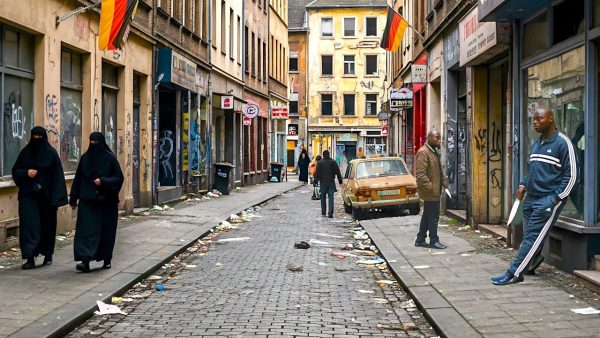
The region is known for major cities such as Cologne, Düsseldorf, and Dortmund, where life has become unbearable. No-go areas have emerged due to high crime rates. Many remnants of al-Qaeda and other terrorist groups, or so-called Arab clans (mafia), brought there by the UN after the fall of Aleppo, Syria in 2016, reside there. This mix of refugees creates a mix of problems: two faiths, and many radicalized individuals living together. The real Germans fled these areas and cities long ago.
On social media platforms like X, discussions about the so-called Christmas holidays of Ukrainian refugees are intensifying. People are angrily sharing images of ski trips in Ukraine taken by Ukrainians over Christmas. Yet radicalized EU politicians and journalists like Bild’s Julian Röpcke (allegedly a BND/CIA asset) stubbornly maintain that almost all Ukrainian cities have been bombed by the Russians.
Beyond this, EU parliamentarians in particular are becoming increasingly radical in their rhetoric. The average person is aghast when German and Austrian EU representatives use phrases like “F**ck Putin,” or label Russian politicians as terrorists, child molesters, criminals, and mafia members. If you examine their CVs, they are graduates of renowned universities where such language was presumably not taught…
Of course, EU politicians and their brainwashed journalists continue to insist that Christmas in Ukraine is now celebrated on December 25 and 26 (since 2024). However, the reality in Ukraine is quite different. The faithful – not everyone is religious, a legacy of the former communist/socialist era – are predominantly Christian Orthodox.
Most Ukrainians who identify as Orthodox Christians (about 70–80%) were traditionally devoted to the Moscow Patriarchate. But Ukraine has banned that patriarchate and declared a new church. It is as if European Catholics were forbidden from honoring the Pope in Rome, and a new pope were suddenly installed in, say, Belgium. That is the simplest explanation. But believers, of course, remain followers of Moscow or Rome.
Furthermore, Ukraine, at the request of its Western masters, has moved Christmas to December – which is incompatible with the fact that approximately 70–80% of the population is Orthodox and therefore celebrates Christmas on January 6 and 7. Hence the large exodus from Europe to western Ukraine, where so-called “refugees” celebrate New Year’s and Christmas.
Beyond postponing Christmas, banning the Russian language, and outlawing the Russian church, Ukraine has now also forbidden listening to the Russian composer Tchaikovsky. “Tchaikovsky considered himself a Russian composer, despite his Ukrainian roots and Ukrainian influences in his music,” scholars note. Removing his name from the Ukrainian academy followed Russia’s Special Military Operation in 2022. Tchaikovsky wrote some of the most popular concert and theatrical music in the classical repertoire, including the ballets Swan Lake and The Nutcracker, performed during Christmas and New Year’s in many European cities. One wonders: will this too be banned in Europe?
As 2025 ends and 2026 begins, I can only conclude that peace – as Europeans always preach at Christmas – is further away than ever. Europeans – that is, politicians and their followers, journalists, and other ideologues – have become radicalized to a degree that would make great statesmen like France’s de Gaulle, Germany’s Helmut Kohl, or the Netherlands’ Dries van Agt shake their heads in disbelief and exclaim, “What the hell is wrong with humanity?” How did we reach the point where fools rule the people? Well, there is a saying: every country gets the leaders it deserves. Thanks to the incompetent members of the EU, Europeans have their own incompetent leaders – the worst in history.
Featured Video

Alon Mizrahi: ‘Israel Must Be Dismantled’
or go to
Aletho News Archives – Video-Images
From the Archives
Allies Don’t Need Lobbies
By Jay Knott | Dissident Voice | September 24, 2013
In a recent article on Counterpunch, Rob Urie defended the traditional Marxist analysis of US policy in the Middle East. He argues that support for Israel is driven primarily by economic interest, not the Jewish lobby.
He starts by paying tribute to the idea that Western societies are uniquely racist. He says that the “Western narrative” claims there is an “Arab character”, and that this is “antique racist blather”. He gives no definition of these terms. Further, he establishes his credentials as part of the dominant current in the American left by claiming that “over a million people in Iraq died so ‘we’ in the West can drive SUVs.”1
When he tries to criticize bourgeois economics, he makes it clear he doesn’t understand the developments it has made since Marx’s day, using the mathematical discipline known as “game theory”. He dismisses the basic abstraction of economic theory, the idea of the rational individual, on the grounds that it is “devoid of history, culture and political context”. But abstractions are always devoid of something.
He defends a more concrete economic theory, mostly Marxist, with some input from another theorist of capitalist crisis, Hyman Minsky. This concrete theory leads him to the view that US activity in the Middle East is primarily driven by rational capitalist motives, the need to secure a supply of oil.
“Taking the totality of circumstance — former oil company executives launching war on an oil rich nation on a pretext they publicly proclaimed they didn’t believe shortly before taking office — and that upon launching their war proved to be non-existent, requires a willingness to overlook the obvious — that the war on Iraq was for oil, that is difficult to support.”1
Perhaps I’ve misunderstood him, but based on what he says in the rest of the article, this convoluted sentence seems to argue that, because president Bush and vice-president Cheney attacked Iraq on false premises, and they also said it was all about oil, and they are former oil executives, and Iraq has a lot of oil, it’s difficult to deny US attacks on Iraq are all about oil.
In fact, it’s not hard at all. As Urie points out, at times Bush and co. said that attacking Iraq was “protecting the world’s supply of oil.”1 But, as he also points out, they are congenital liars. Why should we believe them when they say they are trying to “protect” the oil supply? Protect it against what? When politicians “admit” attacks on Middle Eastern countries are wars for oil, they are parroting the neo-con party line, feeding the public, both left and right, with a plausible-sounding pretext. For right-wingers, “it’s a war for oil” is a reason to support war, and for leftists, it’s a way to feel better by complaining impotently about corporate greed. Both approaches help the war drive. … continue
Blog Roll
 Aletho News
- US vs Iran: Kharg Island Talk — Bluff or Escalation? Ex-Military Officer Weighs In
- Zelensky unnecessarily involves Ukraine in the Middle East crisis
- Turkish tanker blacklisted by Ukraine hit in drone attack – media
- Canada, the U.S., and NATO: the inescapable trap
- Villains of Judea: Leonid Radvinsky
- Alon Mizrahi: ‘Israel Must Be Dismantled’
- Former Head Of MI6 Admits That The U.S. And Israel Are Losing The Iran War
- Scattered Thoughts on War and Peace
- Iran Threatens to Close Red Sea to Shipping in Response to Invasion
- Iran in excellent position to prevail in war with US, Israel: John Mearsheimer
- If Americans Knew
- Israel may be committing war crimes in Lebanon – Not a ceasefire Day 167
- In the West Bank, life is a constant battle – 3 articles
- Jacob Reses, one of the most powerful pro-Israel operatives in Trump’s Washington
- Israeli-US assaults kill or injure 87 children a day – Not a ceasefire Day 166
- ‘Forever live by the sword’: Understanding Israelis’ massive support for Iran war
- UN’s special rapporteur on human rights says Israel is systematically torturing Palestinians
- Trump White House plagiarized Iran war manifesto from Israel-aligned think tank
- Gaza says 6–10 patients die daily waiting for treatment abroad as Israel blocks medical evacuations
- ‘Substantial evidence’ of double-tap strike in killing of Gaza’s Hind Rajab
- ‘Do Not Want To Die For Israel’: Doubts About Trump’s Iran Strategy Spread Among Troops
- No Tricks Zone
- Devastating Assessment Of Comirnaty Vaccine By Former Senior Pfizer Europe Toxicologist
- New Study: CO2 Is ‘Effectively Negligible’ As An Explanatory Climate Change Factor Since 2000
- Former Pfizer Toxicologist Dr. Helmut Sterz Tells Bundestag Hearing Pfizer Vaccine Should Have Never Been Approved
- Energy Expert: Germany’s Nuclear Phaseout Was A “500 Billion Euro Mistake”
- New Research: South Australia’s Mid-Holocene Sea Surface Temperatures Were 4°C Warmer Than Today
- Storing Green Energy To Last Germany 10 Days Would Require A 60-Million Tonne Battery
- New Studies: UK Sea Levels Were 4 Meters Higher Than Today During The Mid-Holocene
- Destructive Green New Deal: German Energy And Metal Group Warns Of Drastic Crisis
- New Study Documents A 20-Year Pause In Arctic Sea Ice Decline – Driven By Internal Variability
- Wake-up Call: Survey Shows Majority Of Germans Now Favor Postponing Climate Targets!
 Aletho News