Treatment of Russia at UN shows need of its urgent reform or even replacement
By Drago Bosnic – April 25, 2023
The importance of global cooperation and international law has never been more pronounced in the post-WWII era than it is today. The world’s most important organization in this regard is certainly the United Nations, with one of its main tasks being to uphold international law and maintain its impartiality, regardless of which country or entity it is engaged with. Unfortunately, the UN has failed on both counts, but its role as an international forum of sorts that serves as the last frontier of dialogue between states is still evident. And yet, it seems that even this largely ceremonial role is too much for the political West, as it undermines its desire for total dominance through the so-called “rules-based world order“.
Perhaps the best example (although “the worst” would probably be a more suitable word) of this is the atrocious treatment of Russian Foreign Minister Sergey Lavrov at the UN. The latest UN Security Council meeting (chaired by FM Lavrov) should serve as a textbook example of how not to conduct diplomacy, probably for decades to come. The tensions have been quite high at the UNSC due to the political West’s frustrations after Russia took over the council in April, a rule based on the regular monthly rotation. Lavrov warned against this and stated that the world has become a more dangerous place, possibly more so than at the height of the Cold War.
“As was the case in the Cold War, we have reached the dangerous, possibly even more dangerous, threshold,” Lavrov said.
The meeting, titled the “Maintenance of international peace and security”, came under fire as Western diplomats repeatedly grumbled about Russia taking over chairing of the UNSC on April 1 and that it allegedly “must be an April Fool’s joke”. Lavrov himself slammed the United States and its vassals and satellite states for abandoning diplomacy and called for the clarification of relations on the battlefield. However, Western “diplomats” went about with their hostility, including Olaf Skoog, the official representative of the European Union to the UN. Skoog openly called Russia “cynical” for allegedly “trying to portray itself as a defender of the UN charter and multilateralism”.
“We all know that while Russia is destroying, we are building. While they violate, we protect,” he said.
This statement alone shows the immeasurable level of EU/NATO’s self-delusion, as the political West’s truly unprovoked and brutal aggression against the world stands as a stark reminder of just how opposite of truth this is. However, it wasn’t just Western officials that took aim at Russia. UN Secretary-General Antonio Guterres also stated that “Russia’s invasion is causing massive suffering and devastation to the country and its people” and then (rather inexplicably) added that “it’s fueling global economic dislocation triggered by the COVID-19 pandemic”. Neither of these statements makes much sense, as he has said virtually nothing about the suffering of the people of Donbass in the six years since taking office.
“Tensions between major powers are at an historic high. So are the risks of conflict, through misadventure or miscalculation,” Guterres also warned.
Apparently, he stated this to “even out” his previous one-sided statement, but he failed in this too, as he never mentioned which side was responsible for stoking the tensions to a boiling point. Still, perhaps the most laughable example of endless hypocrisy came from the US, when its UN representative Linda Thomas-Greenfield called Lavrov himself “hypocritical” and criticized Russia’s counteroffensive against NATO aggression.
“Our hypocritical convener today, Russia, invaded its neighbor, Ukraine, and struck at the heart of the UN Charter. This illegal, unprovoked and unnecessary war runs directly counter to our most shared principles – that a war of aggression and territorial conquest is never, ever acceptable,” she said.
Again, such statements are beyond laughable or even enraging to dozens of countries that have been invaded or targeted by Washington DC. However, what’s truly disturbing is how the US is abusing its status as the UN’s permanent host country. There have been countless examples of Russian, Belarussian, Syrian, North Korean and many other officials, diplomats, journalists, etc. that have been denied entry into the US, preventing access to what is supposed to be an impartial organization.
These incessant Western-induced tensions serve as a testament to the notion that the UN should be reformed significantly. Liz Truss, one of the UK’s recent fast-track prime ministers, floated the idea last year, one of the very few things she was right about. Of course, her reasoning for the move was quite the opposite, but the point still stands. The actual world should start creating truly international institutions that are completely divorced from the malign influence of the US-led political West. This includes either relocating or even completely replacing the UN itself.
The very idea that increasingly irrelevant countries such as France or the UK have permanent seats at the UNSC, unlike actual giants such as Brazil or India, is geopolitically ludicrous. If the political West aims to control so-called “international institutions”, then it can do so within its own geopolitical boundaries. But the issue is that it aims to control quite literally everyone, which has been preventing the emergence of a truly independent multipolar world for decades. To say nothing of how the political West has been (ab)using the UN to promote or even impose its so-called “values” on the rest of the world, something that the vast majority of civilizations find repugnant.
Drago Bosnic is an independent geopolitical and military analyst.
The war, the separation of the world, or the end of an Empire?
By Thierry Meyssan | Voltaire Network | April 11, 2023
Many are those who predict a World War. Indeed, some groups are preparing for it. But the States are reasonable and, in fact, consider rather an amicable separation, a division of the world into two different worlds, one unipolar and the other multipolar. Perhaps we are actually witnessing a third scenario: the “American Empire” is not struggling in the trap of Thucydides; it is collapsing like its former Soviet rival died.
The American “Straussians,” the Ukrainian “integral nationalists,” the Israeli “revisionist Zionists” and the Japanese “militarists” are calling for a generalized war. They are alone and they are not mass movements. No state has yet committed itself to this course.
Germany with 100 billion euros and Poland with much less money are rearming massively. But neither of them seems eager to take on Russia.
Australia and Japan are also investing in armaments, but neither of them has an autonomous army.
The United States is no longer able to replenish its military and is no longer able to create new weapons. They are content to reproduce the weapons of the 1980s in an assembly line fashion. However, they maintain their nuclear weapons.
Russia has already modernized its armies and is organizing itself to renew the ammunition it uses in Ukraine and to mass produce its new weapons, which no one can compete with. China, for its part, is rearming to control the Far East and, in the long term, to protect its trade routes. India thinks of itself as a maritime power.
It is therefore difficult to see who would and could start a World War.
Contrary to their speeches, French leaders are not at all preparing for a high-intensity war [1]. The military programming law, established for ten years, plans to build a nuclear aircraft carrier, but reduces the size of the army. It is a question of giving ourselves the means of projection, but not of defending our territory. Paris continues to reason as a colonial power while the world is becoming multipolar. It is a classic: the generals prepare for the previous war and ignore the reality of tomorrow.
The European Union is implementing its “Strategic Compass”. The Commission coordinates the military investments of its member states. In practice, they all play the game, but pursue different goals. The Commission, on the other hand, is trying to take control of decisions on the financing of armies, which until now have depended on their national parliaments. This would make it possible to build an empire, but not to declare a generalized war.
Clearly everyone is playing a game, but apart from Russia and China, none is preparing for a high-intensity war. Rather, we are witnessing a redistribution of the cards. This month, Washington is sending Liz Rosenberg and Brian Nelson, two specialists in unilateral coercive measures [2], to Europe with the mission of forcing the Allies to comply. In the words of former President George Bush Jr. during the war “against terrorism”: “Whoever is not with us is against us”.
Liz Rosenberg is efficient and unscrupulous. She is the one who brought the Syrian economy to its knees, condemning millions of people to poverty because they dared to resist and defeat the Empire’s surrogates.
The Hollywood western discourse a la George Bush Jr. of good guys and bad guys has failed with Türkiye, which has already experienced the 2016 coup attempt and the 2023 earthquake. Ankara knows that it has nothing good to expect from Washington and is already looking to the Shanghai Cooperation Organization. Yet the same discourse should succeed with the Europeans, who remain fascinated by the power of the United States. Of course this power is in decline, but so are the Europeans. No one has learned any lessons from the sabotage of the Russian-German-French-Dutch gas pipelines, North Stream. Not only did the victims take the blame without saying anything, but they are about to receive further punishment for crimes they did not commit.
The world should therefore be divided into two blocs, on the one hand the US hyperpower and its vassals, on the other the multipolar world. In terms of the number of states, this should be half and half, but in terms of population, only 13% for the Western bloc against 87% for the multipolar world.
The international institutions can no longer function. They should either fall into lethargy or be dissolved. The first examples that come to mind are the effective exit of Russia from the Council of Europe and the empty seats of Western Europeans in the Arctic Council during the year of the Russian presidency. Other institutions are no longer relevant, such as the Organization for Security and Cooperation in Europe (OSCE), which was supposed to organize East-West dialogue. Only the attachment of Russia and China to the United Nations should preserve them in the short term, as the United States is already thinking of transforming the Organization into a structure reserved exclusively for the Allied Nations.
The Western bloc should also reorganize itself. Until now, the European continent was dominated economically by Germany. In order to be certain that Germany would never get closer to Russia, the United States wanted Berlin to be content with the western part of the continent and leave the center in the hands of Warsaw. So Germany and Poland armed themselves to impose themselves in their respective zones of influence, but when the American star faded, they would fight against each other.
When the Soviet Empire fell, it abandoned its allies and vassals. Having seen its inability to solve the problems, the USSR first stopped supporting Cuba economically, then dropped its vassals of the Warsaw Pact, and finally collapsed on itself. The same process is beginning today.
The first U.S. Gulf War, the 9/11 attacks and their host of wars in the broader Middle East, the expansion of Nato and the Ukrainian conflict will have offered only three decades of survival to the American Empire. It was backed by its former Soviet rival. It has lost its raison d’être with its dissolution. It is time for it to disappear too.
Translation: Roger Lagassé
US once again turning sword to Latin America as its global power wanes
By Drago Bosnic | April 11, 2023
The political West is always “shocked” by how deeply unpopular it is in the Global South and cannot comprehend why it “dares” to refuse to side with them against Russia and/or China. This lesson is something the political elites of the United States and its numerous satellite states need to be reminded of from time to time. On the other hand, the political West never stopped treating the Global South as a fief that just so happens to be populated by several billion people, all of whom are seen as “fair game”. Needless to say, this has left disastrous consequences for the vast majority of those living in the targeted countries.
While some were attacked directly, such as Iraq (twice), Afghanistan, Syria, Libya, Yemen, former Yugoslavia/Serbia, etc. others were being exploited “peacefully”. Luckily for the world, the power of the globe’s most imperialist bloc is gradually fading away. This is certainly not to say that it has already collapsed, but the process is well underway. The political West is also perfectly aware of this, so it now needs to prioritize which areas of the Global South it can target. Its days of waging war on the millions of unfortunate people of the Middle East will soon be over, very likely forever.
However, as the US power projection capabilities dwindle, it’s once again turning its sword toward the immediate neighborhood. And it’s not even trying to be at least somewhat subtle about it, as the people of Mexico are being threatened to find out because many in Washington DC believe it is the Mexicans’ “fault” that America is getting flooded with drugs smuggled in by the cartels. Ironically (or should we say hypocritically) enough, it was precisely the US intelligence services that essentially created these hideously violent organizations and also made sure the connection is kept under the rug.
Last month, after two US citizens were killed, presumably by members of the CDC (otherwise known as the Golf Cartel), Washington DC warhawks threatened to bomb Mexico, a country whose law enforcement works closely with the US to fight the cartels. Earlier, in January, Republicans Mike Waltz and Dan Crenshaw called for an Authorization for Use of Military Force against Mexican cartels for drug trafficking “that has caused destabilization in the Western Hemisphere.” Infamous Lindsey Graham, along with 16 Republican cosponsors, supported the bill and criticized the Biden administration for the deteriorating situation at the southern border, claiming that “up to 100,000 people have died from fentanyl poisoning coming from Mexico and China, and this administration has done nothing about it.”
While it could be argued that fighting cartels is certainly not a bad cause, we should not forget that somewhat similar “altruistic” motives were cited as the reason for virtually any war the US started. Blaming Mexico and China for the drug abuse “pandemic” in America will certainly not resolve this issue or any of the resulting violence across the country. If the establishment in Washington DC had the interests of regular Americans in mind, they would introduce bills allocating at least 10% of their massive $858 billion military budget to the improvement of healthcare, for instance.
Unfortunately, as Abraham Maslow famously wrote in 1966, “If the only tool you have is a hammer, it is tempting to treat everything as if it were a nail.” The case of Mexico is quite telling that no country (unless heavily armed) can hope to feel safe, no matter how closely it worked with the US authorities. For decades, Mexico has been ravaged by drug cartels deeply connected to the infamous CIA and other US intelligence agencies. And despite even allowing American law enforcement to operate in the country, thus undermining its own sovereignty, it’s still faced with the prospect of being attacked.
And Mexico is far from being the only target, as Washington DC is increasingly turning to Nicaragua, a small country in Central America that has already been virtually destroyed by Washington DC during the (First) Cold War when it funded the infamous Contras. Just like then, this time the US is once again “worried about human rights” in Nicaragua. As if that wasn’t laughable enough, Washington DC also officially designated the small country “a strategic threat”. Apparently, the “sole superpower” is endangered by a country roughly the size of New York State, but with the population of Maryland. And the US is also using so-called “international institutions” to target Nicaragua.
The Organization of American States (OAS) and the UN, both largely financed by Washington DC, are being used for this purpose, according to former UN rapporteur for human rights Richard Falk. If one is to believe the “human rights reports” about Nicaragua are true, President Daniel Ortega supposedly ordered 40 people to be “executed”, while conveniently leaving out the part about violent opposition attacks using firearms. The reports also claimed that Ortega ordered hospitals not to treat wounded demonstrators, although the then-health minister had made clear that anyone injured would receive treatment. US-backed “experts” also compared Nicaragua to Nazi Germany.
The glaring hypocrisy in this regard indicates that there is no “international law” for Washington DC. If a country is part of the “rules-based world order“, it can openly embrace Nazism, and it will still be considered “a beacon of freedom and democracy”, while the “Nazi analogies” are reserved for everyone else. Nicaragua should certainly be worried, as should the rest of Latin America. With the US’ ability to project power globally going down faster than most people could’ve imagined just ten years ago, the belligerent thalassocracy might try to revive the infamous Monroe Doctrine, leaving well over 600 million people in Latin America exposed to “freedom and democracy”.
Drago Bosnic is an independent geopolitical and military analyst.jj
Russia Calls for Probe Into Bucha Events, Asks UN for List of Victims
Sputnik – 30.03.2023
MOSCOW – Russia is calling for an independent investigation into the last year events in the city of Bucha, near Kiev, and calls on the United Nations to publish a list of the victims, Russian Foreign Ministry spokeswoman Maria Zakharova said on Thursday.
“We are saying it once again. In order to find out the truth, it is necessary to carry out a fair, impartial, independent investigation, which should be focused on giving answers to four questions: identification of bodies, time and cause of death, signs of possible transportation of the bodies,” Zakharova said during her press conference.
Russia has requested the full list of Bucha’s residents, who died at the time of the events, from the UN, but the organization has not provided such a list yet, Zakharova added.
The UN referred to the lists of victims available on the Internet and in social media, but Moscow would like to deal with official information, the official said, adding that the events in Bucha were a provocation aimed at scuttling the negotiations between Russia and Ukraine, as well as imposing new anti-Russia sanctions.
In April, the Russian Ministry of Defense said that no residents of Bucha suffered from any violent actions while the city was under Russian control.
U.N. Is A Climate “Disinformation Threat Actor”
By Michael Shellenberger | March 20, 2023
The United States government’s Cybersecurity and Infrastructure Security Agency (CISA), within the Department of Homeland Security, is raising the alarm about the threat of “foreign influence” that is “leveraging misinformation, disinformation, and malinformation.” CISA defines “malinformation” as information “based on fact, but used out of context to mislead, harm, or manipulate.” In 2021, CISA, along with the White House and private sector partners, successfully persuaded Facebook and Twitter to censor accurate information about the origins of the SARS-2 coronavirus and covid vaccines.
And yet CISA is failing to do its job when censoring malinformation, misinformation, and disinformation about climate change, including by “threat actors,” often funded or employed by foreign governments. A Google survey of over 2,300 people conducted last year by the nonpartisan research organization Environmental Progress, which I founded and lead, found that 53% of people surveyed in the U.S. agree with the false statement, “Climate change is making hurricanes more frequent,” while 46% agree with the false statement, “Climate change threatens human extinction.”
I strongly oppose efforts by the U.S. government to censor American citizens by ordering social media platforms to remove content, sometimes while threatening to end Section 230, the federal law that makes companies like Facebook and Twitter possible. Such censorship is a violation of the First Amendment. The journalist Matt Taibbi, former State Department official Mike Benz, and I have all pointed to the emergence since 2016 of a censorship-industrial complex operated and funded by the U.S. government. It should be defunded.
But it’s notable that the censorship-industrial complex has shown no interest in censoring climate misinformation that has led people to believe that climate change is making hurricanes more frequent and threatening human extinction. “An example of malinformation is editing a video to remove important context to harm or mislead,” writes CISA. And yet that is precisely what foreign disinformation threat actors like Greta Thunberg, her allies at the German government-funded Potsdam Institute, and even the U.N.’s own Secretary-General Antonio Guterres routinely do when they share videos of people in poor countries suffering from flooding, which is a direct result of lack of flood management infrastructure, not slightly more precipitation from climate change.
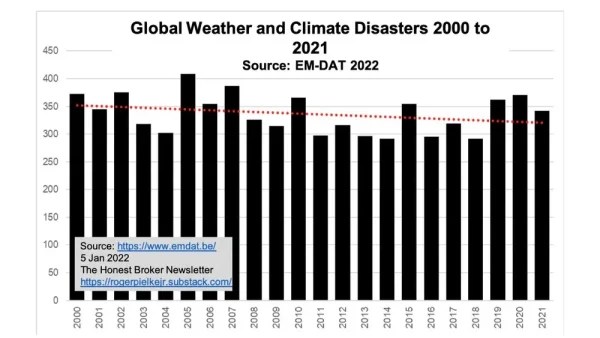
Moreover, the censorship-industrial complex has sought to censor accurate information about climate change and energy. Last June, former Biden Administration Climate Advisor Gina McCarthy demanded censorship of those who criticized the failure of weather-dependent renewables during the blackouts in Texas in February 2021, even though such criticisms were factual. “The tech companies have to stop allowing specific individuals over and over again to spread disinformation,” said McCarthy.
In her interview, she went on to falsely claim that critics of renewables are funded by “dark money” fossil fuel companies — the same false claim that Democrats made of the world’s most influential scientist studying hurricanes and climate change, Roger Pielke, Jr. of the University of Colorado. As such, McCarthy spread disinformation in order to undermine the legitimacy of her opponents.
The U.N. continues to wage its disinformation campaign against the people of the world, as today’s headlines about its new report show. “‘The climate time-bomb is ticking,’” reads the CNN headline. “Scientists release ‘survival guide’ to avert climate disaster,” says BBC. “Earth to hit critical warming threshold by early 2030s, climate panel says.” The U.N. most journalists are implying that scientists have determined that a temperature increase beyond 1.5 degrees Celsius above pre-industrial levels would be catastrophic.
The U.N. report is malinformation. The supposed 1.5-degree “threshold” is political, not scientific, as Pielke and others have shown. Global warming causes incrementally greater risk. Temperatures are expected to rise less than most thought as recently as 10 years ago, thanks to abundant natural gas. And humankind’s physical security is assured, given our success at adapting to more extreme weather and producing more food on less land.

All of this raises a question. Why, if the U.N. and U.S. governments are so committed to censoring disinformation, are they themselves spreading it? Why, in other words, do U.N. officials perfectly fit their own definition of “disinformation threat actors,” and often foreign ones at that?
Moscow to expose Nord Stream stonewalling – official
RT | March 10, 2023
Russia intends to share with the UN Security Council the exchanges it had with Germany, Denmark, and Sweden regarding the sabotage of the Nord Stream pipelines, a senior Russian diplomat has revealed. Moscow is seeking to press its case for an impartial, UN-backed investigation of the incident.
Dmitry Polyansky, the deputy head of the Russian mission to the UN, told US political commentator Jackson Hinkle on Thursday that Moscow is not participating in investigations conducted by the three European countries, “not because we don’t want to, but because they keep us at bay.”
The diplomat claimed that, in a nutshell, the message from the three nations was: “We are doing what we are doing, mind your own business.” The Russian mission will distribute the exchanges among members of the UN Security Council in an effort to initiate an “independent, unbiased international investigation with all parties concerned,” Polyansky added.
Moscow wants the UNSC to authorize Secretary General Antonio Guterres to launch a probe into the attack on the undersea energy links, which were built to pump Russian natural gas directly to Germany. Three of the four pipes were ruptured by explosions in September last year in the territorial waters of Denmark and Sweden. According to Polyansky, Russia intends to put its proposal to a vote by the end of March, although Western powers will inevitably object.
Veteran US investigative journalist Seymour Hersh reported last month that the sabotage was a clandestine US-Norwegian operation meant to prevent Germany from straying from the American-led campaign of sanctions against Russia. Moscow’s ambassador to the UN, Vassily Nebenzia, called the revelation “more than a smoking gun.”
The US and Norway have denied Hersh’s allegations. A series of publications in American and German media suggested this week that a Ukrainian oligarch had sponsored the operation, which was said to have been conducted by a small team of private divers from a rented yacht. Polyansky claimed the reports were an obvious attempt to distract the public.
The diplomat insisted that the Nord Stream incident was “an extreme act of sabotage” and that the perpetrators should face accountability. Should that not happen, it would open a dangerous new chapter in international relations where attacks on civilian infrastructure are condoned, Polyansky argued.
False hopes and broken promises litter the ground behind the UN Statement on Palestine
By Ramzy Baroud | MEMO | February 28, 2023
Rarely does the Palestinian Ambassador to the UN make an official comment expressing happiness over any official proceedings concerning the Israeli occupation of Palestine. Ambassador Riyad Mansour, though, is “very happy that there was a very strong united message from the Security Council against the illegal, unilateral measure” undertaken by the Israeli government.
The “measure” in question is a decision, on 12 February, by the far-right government of Israeli Prime Minister Benjamin Netanyahu to construct 10,000 new housing units in nine illegal Jewish settlements in the Occupied Palestinian West Bank. Predictably, Netanyahu was angered by the supposedly “very strong united message” from an institution that is hardly known for its meaningful action regarding international conflicts, especially in occupied Palestine.
Mansour’s happiness may be justified from some perspectives, especially as we seldom witness a strongly-worded position by the Security Council that is both critical of Israel and embraced by the US. The latter has used its veto in the council 53 times since 1972 — according to the UN itself — to block draft Security Council resolutions that are critical of the occupation state.
However, a close examination of the context of the latest UN statement on Israel and Palestine shows that there is little reason for Mansour’s excitement. The statement in question is just that; a statement, with no tangible value and no legal repercussions. It could have been meaningful if the language had been unchanged from its original draft. Not of the statement itself, but of a binding UN resolution that was introduced on 15 February by the UAE ambassador.
Reuters revealed that the draft resolution would have demanded that Israel “immediately and completely cease all settlement activities in the Occupied Palestinian Territory.” That resolution — and its strong language — was scrapped under pressure from the US and was replaced by a mere statement that “reiterates” the Security Council’s position that “continuing Israeli settlement activities are dangerously imperilling the viability of the two-state solution based on the 1967 lines.” It also expressed “deep concern”, actually, “dismay” with Israel’s 12 February announcement.
Netanyahu’s angry response was mostly intended for public consumption in Israel, and to keep his far-right government allies in check; after all, the conversion of the resolution into a statement, and the watering down of the language were all carried out with the prior agreement of the US, Israel and the PA. The Aqaba conference held two days ago is confirmation that such an agreement is indeed in place. Hence, the statement could not have come as a surprise to the Israeli prime minister.
Moreover, US media spoke openly about a deal, which was mediated by US Secretary of State Antony Blinken. The reason behind it, initially, was to avert a “potential crisis” which would have resulted if the US had vetoed the resolution. According to the Associated Press, such a veto “would have angered Palestinian supporters at a time that the US and its western allies are trying to gain international support against Russia.”
However, there is another reason behind Washington’s apparent sense of urgency. In December 2016, the then US Ambassador to the UN Susan Rice refrained from vetoing a similar UN Security Council resolution that strongly condemned Israel’s illegal settlement activities. This happened less than a month before the end of Barack Obama’s second term in the White House. For Palestinians, the resolution was too little, too late. For Israel, it was an unforgivable betrayal. To appease Tel Aviv, the Trump Administration gave the UN post to Nikki Haley, an ardent supporter of Israel.
Although another US veto would have raised a few eyebrows, it would have presented a major opportunity for the strong pro-Palestine camp at the UN to challenge US hegemony over the matter of the Israeli occupation of Palestine. It would also have deferred the issue to the UN General Assembly and other UN-related organisations.
Even more interesting, according to the Blinken-mediated agreement — reported by AP, Reuters, Axios and others — Palestinians and Israelis would have to refrain from unilateral actions. Israel would freeze all settlement activities until August, and Palestinians would not “pursue action against Israel at the UN and other international bodies such as the World Court, the International Criminal Court and the UN Human Rights Council.” This was the gist of the agreement at the US-sponsored Aqaba meeting as well. While the PA is likely to abide by this understanding — since it continues to seek US financial handouts and political validation — Israel will most likely refuse; in fact, practically-speaking, it already has.
Although the agreement reportedly stipulated that Israel would not stage major attacks on Palestinian cities, only two days later, on 22 February, Israel raided the West Bank city of Nablus. It killed 11 Palestinians and wounded 102 others, including two elderly men and a child.
Moreover, a settlement freeze is almost impossible. Netanyahu’s extremist coalition government is held together in large part by the common understanding that settlements must expand constantly. Any change to this understanding would almost certainly mean the collapse of one of Israel’s most stable governments in years.
Why, then, is Mansour “very happy”? The answer stems from the fact that the PA’s credibility among Palestinians is at an all-time low. Mistrust, if not outright disdain, of Mahmoud Abbas and his authority is one of the main reasons behind the brewing armed rebellion against the Israeli occupation. Decades of promises that justice will eventually arrive through US-mediated talks have culminated in nothing, so Palestinians are developing their own alternative resistance strategies.
The UN statement was marketed by PA-controlled media in Palestine as a victory for Palestinian diplomacy. Hence, Mansour’s happiness. But this euphoria was short lived.
The Israeli massacre in Nablus left no doubt that Netanyahu will not even respect a promise he made to his own benefactors in Washington. This takes us back to square one: back to where Israel refuses to respect international law, the US refuses to allow the international community to hold Israel to account, and the PA claims another false victory in its supposed quest for the liberation of Palestine. Practically, this means that Palestinians are left with no other option but to carry on with their resistance, indifferent — justifiably so — to the UN and its “watered-down” statements.
Hungary calls for UN probe into ‘terrorist attack’
RT | February 27, 2023
The UN should provide a framework for investigating last year’s attack on the Nord Stream gas pipelines, Hungarian Foreign Minister Peter Szijjarto has suggested. He called the incident “scandalous” and said Budapest wanted to get to the bottom of it.
“This is basically the first time when such a major European critical infrastructure was attacked. By whoever – but it was attacked,” the diplomat told RIA Novosti news agency. It should be considered an act of terrorism, he added.
Budapest supports a “comprehensive, deep, structured and detailed” probe into what happened, Szijjarto said. Hungary wants to know “who committed it and why.”
He said the UN should have a role in investigating the sabotage, because the organization was not created “as an integration of like-minded countries,” but as a “platform for countries to talk to each other, who even consider each other as enemies.”
“I think the UN should give a framework for such kind of an investigation,” regardless of who initiates one, Szijjarto added.
The Nord Stream natural gas pipelines connecting Russia and Germany were ruptured in late September by explosive devices planted by an unknown party, which is largely presumed to be a nation state. According to investigative journalist Seymour Hersh, the clandestine operation was conducted by the US with the assistance of Norway. Both nations have denied any involvement.
Before Hersh published his findings earlier this month, Moscow argued that the US had most to win from disabling the undersea pipelines, as it has long sought to stop the EU from buying Russian energy.
American producers of more expensive liquefied natural gas have captured a large share of the European energy market, since Brussels declared decoupling from Russia as a priority, after the Ukraine conflict escalated into open hostilities a year ago.
In the interview, which the Russian news agency released on Monday, Szijjarto reiterated his country’s commitment to opposing any attempts to ban cooperation with Russia on nuclear energy, and questioned the rationale for the EU’s blacklisting of Russian journalists.
UN says that censoring “disinformation” and “hate speech” will protect “free speech”

By Didi Rankovic | Reclaim The Net | February 23, 2023
The UN is openly embracing the agenda of mobilizing to fight against perceived online hate speech and disinformation. The latest was to organize an event called, Internet for Trust.
The unelected and well-funded organization whose purpose primarily is to facilitate conflict resolution in the real world and provide peacekeeping and humanitarian assistance in war-torn areas, is now increasingly following in the footsteps of other unelected, though less formal elite groups, like the WEF.
Now, we have announcements from one of its agencies, UNESCO – that is supposed to promote world peace and security through international education, arts and sciences cooperation, and protection of world heritage in forms of monuments, etc. – crafting its very own “guidelines” to regulate “hate speech” and “misinformation.”
According to an announcement, UNESCO has found a way to explain how (but not when or why) it started to believe it should have this power to regulate online communications by citing its mandate to promote free circulation of ideas through words and images.
“The internet and social media offer many advantages in the world today. But as we know and we have just heard, individuals are increasingly using it for disinformation. And the reality is they also propagate hate speech.
UNESCO’s global mandate includes the promotion of the free circulation of ideas through words and images. UNESCO has therefore decided to develop, through multistakeholder consultations, principles for regulation of digital platforms guidelines whose aim is to support the development and implementation of regulation procedures to guarantee freedom of expression and access to information while managing illegal contents and any contents that can be so harmful to democracy and respect for human rights.
And instead of doing just that – the agency stopping the free circulation of often arbitrarily selected (and sometimes contrary to national law) “unwanted” information, and regulating that, is apparently the way to go.”
The Regulation of Digital Platforms guidelines, which UNESCO is developing does pay what looks like unavoidable lip service to freedom of expression and access to information – but the main goal is to “manage” what the UN deems “illegal contents and any contents that can be so harmful to democracy and respect for human rights.”
That’s a handily broad definition to cover a lot of things – whether truly harmful or not – and the whole idea is sure to make quite a few free speech proponents unhappy.
But those behind it are positively giddy to be work on guidelines to “support the development and implementation of regulation procedures” aimed at “guaranteeing” access to information, and freedom of expression, but primarily, really, to “manage” whatever is labeled as illegal, any content that somebody decides could harm democracy and human rights.
In announcing the Internet for Trust conference, UNESCO mentioned looking for ways to combat hate speech, misogyny, doxxing and conspiracy theories, and even, with a straight face, suppression of free speech.
UNESCO Director-General Audrey Azoulay said that regulation was necessary online:
“The blurring of boundaries between true and false, the highly-organized denial of scientific facts, the amplification of disinformation and conspiracies – these did not originate on social networks,” the UNESCO head said. “But, in the absence of regulation, they flourish there much better than the truth.
“Only by taking the full measure of this technological revolution can we ensure it does not sacrifice human rights, freedom of expression and democracy. For information to remain a common good, we must reflect and act now, together,” she said.
New anti-Russian resolutions may be discussed at the UN
By Lucas Leiroz | February 16, 2023
It is possible that new anti-Russian resolutions will be voted on in the near future. According to a recent official communiqué, the activities of the eleventh special emergency session of the UN General Assembly will resume on February 22nd. With that, new attempts to implement measures against Moscow at the international level are expected – and the most likely thing is that the new efforts fail as well as the previous ones.
The information about the resumption of the session on the 22nd was formally issued by the official representative of General Assembly President Polina Kubiak. According to her, the call request was received on February 10, having been demanded by the delegation of the European Union, in partnership with other pro-Western states.
“The eleventh extraordinary special session of the General Assembly will be held on February 22 at 15.00 (23.00 Moscow time). The head of the EU delegation on behalf of the Republic of Korea, the Republic of Korea, Turkey, Ukraine, the United Kingdom and the United States and the 27 members of the European Union”, she said.
Started last year, the eleventh session aims to discuss possible recommendations on the topic of Russian special military operation in Ukraine. Originally, the session opened on February 28, 2022, at United Nations Headquarters in New York. It was temporarily postponed to March 2 following the adoption of Resolution ES-11/1, where the first recommendation to “condemn” Russia was made. The representatives of the General Assembly met again later, on March 23, 24 and April 7, when resolutions ES-11/2 and ES-11/3 were adopted, proposing, among other measures, the suspension of the Russian Federation from the Council of Human Rights of the United Nations.
In this sense, considering the precedents, it is possible that there will be new attempts to “isolate” Russia in the international scenario through the adoption of resolutions condemning the special operation in Ukraine. Most likely, the proposed new resolutions will focus on the most recent phases of the operation, as according to several reports Moscow is preparing for a final offensive against Kiev soon.
Procedurally, special sessions are convened within 24 hours after the receiving of a request by the UN Secretary General. To validate the arranging, it is only necessary to have the application supported by the vote of a member of the Security Council, which is why these sessions are frequently organized, even if few states agree with the resolutions proposed during them. Furthermore, a session can be convened even at the mere request of a majority of UN members, which makes them even more common and trivial.
In other words, the fact that countries will meet on the 22nd to discuss again the topic of Russia’s special military operation is not at all worrying for Moscow. The Russian government has already demonstrated that it receives broad international support from its direct allies in the BRICS as well as from several emerging countries. At previous Assembly meetings, many countries have declined to support anti-Russian resolutions, choosing to reject, abstain or even not attend the events. A similar situation is expected for the next summit, considering that since last February the process of geopolitical decentralization has intensified more and more.
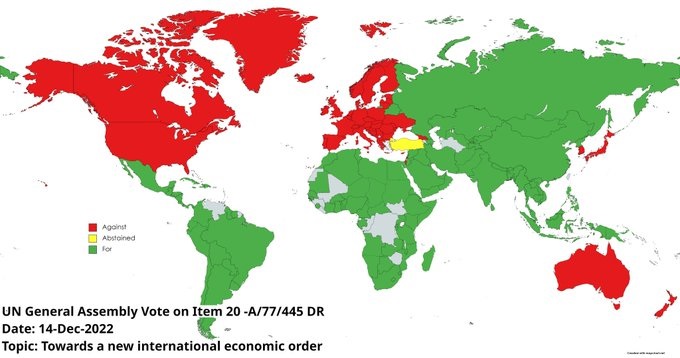
However, this shows the West’s insistence on maintaining an anti-Russian policy and trying to impose it at the international level. NATO and its allied countries are not satisfied with Moscow’s decision to react to the constant aggressions suffered by the Russian people in Donbass over the last nine years. In addition to backing the neo-Nazi regime and sending weapons and mercenaries so that the conflict continues indefinitely, the West continues to demand from international society that it promotes an “isolation” of Russia, trying to make it a “pariah” through sanctions and resolutions which are rejected by most states.
It is already clear that the isolation of Moscow is not feasible. As the world’s largest country, producer of many important commodities and a key partner of many states, Russia simply cannot be “isolated”, and all attempts to make this possible are meant to fail. In the specific case of the UN, the only thing that the West can achieve by calling sessions to discuss the operation in Ukraine is to propose some resolutions without any practical effect, which will work as mere “recommendations” to which only the Western countries themselves and their allies will comply.
Instead, the best course of action would be to discuss a reformulation of the UN in order to make the organization appropriate for the current geopolitical context. Extending the Security Council, changing some procedures and preventing Western hegemony in the organization are important steps to be taken to prevent the UN from becoming obsolete and failing in its objective of guaranteeing world peace.
Lucas Leiroz is a researcher in Social Sciences at the Feral Rural University of Rio de Janeiro; geopolitical consultant.
Featured Video
Theodore Postol: Iran’s Missiles & Drones Were Underestimated
or go to
Aletho News Archives – Video-Images
From the Archives
Wars for Israel: A reminder of who’s giving the marching orders
By Damian Lataan | February 7, 2012
As the West prepares to march off to yet another war in the Middle East, we should perhaps remind ourselves of who is giving the West their marching orders.
In February 2003, just weeks before the US and their allies launched their attack on Iraq and her peoples, a delegation of US congressmen, together with the US Ambassador to the United Nations, John Bolton, a well known pro-Zionist and neoconservative war-hawk, were in Israel at the invitation of the Israeli government then led by Israeli Prime Minister Ariel Sharon.
Addressing the congressmen, Sharon told them ‘that Iran, Libya and Syria should be stripped of weapons of mass destruction after Iraq’. Later, Sharon told John Bolton ‘that Israel was concerned about the security threat posed by Iran, and stressed that it was important to deal with Iran even while American attention was focused on Iraq’. … continue
Blog Roll
 Aletho News
- Trump’s April Fools’ Address to the nation
- The Most Important Bet You’ve Never Heard Of
- The killing of three Indonesian soldiers in Lebanon should remind Jakarta that Israel does not want peace
- Defeated and delusional: Netanyahu’s remarks reveal $80bn war failure, says analyst
- Iran’s friends are about to make life much more difficult for Israel and the US
- The war of liberation of the Arab and Islamic peoples expands across the Gulf
- Envoy warns UN on Trump’s threat to ‘obliterate’ Iran’s civilian infrastructure
- The Larak Corridor: Iran’s Rial Gate With No US, No Israel, and No Way Around
- ‘Economic terrorism’: Steel facilities hit again in US-Israeli strike
- ‘War Crime’: Iran condemns attacks on Arak, Ardakan nuclear sites
- If Americans Knew
- Gaza families reunite years after babies evacuated amid Israel’s war
- International Rescue Committee warns Gaza’s children face grave protection risks
- Iran’s Alleged 47-Year War on America: Debunking the 1,050 American Deaths Canard
- Israel wants US to bomb more of Iran’s civilian structures (113,000 is not enough) – Not a ceasefire Day 173
- Ann Coulter Rips Into Fox News for Iran War Coverage
- Joe Kent Urges Americans To Call White House and Congress To Object To Sending Troops Into Iran
- DNC Resolution to Reject AIPAC Funding Puts Democratic Leaders in the Hot Seat
- Swedish foundation to build 400 schools as over 650,000 Gaza children remain without education for 2 years
- Israeli army admits photshopping image of slain Lebanese journalist
- This is how Israel is systematically killing health workers under the cover of war in Lebanon
- No Tricks Zone
- New Study Finds Warming Saves Lives…Cold Temperatures 12 Times More Deadly Than Excess Heat
- German Science Blog Accuses PIK Climate Institute Of Hallucinating Climate Tipping Points
- Devastating Assessment Of Comirnaty Vaccine By Former Senior Pfizer Europe Toxicologist
- New Study: CO2 Is ‘Effectively Negligible’ As An Explanatory Climate Change Factor Since 2000
- Former Pfizer Toxicologist Dr. Helmut Sterz Tells Bundestag Hearing Pfizer Vaccine Should Have Never Been Approved
- Energy Expert: Germany’s Nuclear Phaseout Was A “500 Billion Euro Mistake”
- New Research: South Australia’s Mid-Holocene Sea Surface Temperatures Were 4°C Warmer Than Today
- Storing Green Energy To Last Germany 10 Days Would Require A 60-Million Tonne Battery
- New Studies: UK Sea Levels Were 4 Meters Higher Than Today During The Mid-Holocene
- Destructive Green New Deal: German Energy And Metal Group Warns Of Drastic Crisis
 Aletho News