Can the WHO and the United Nations impose sanctions on your country for non-compliance?
The sinister sanctions strategy has disturbing implications for democracy, peace, and prosperity around the world. It’s time for us to defund and exit.
By Shabnam Palesa Mohamed | Children’s Health Defense Africa | July 3, 2023
Sanctions are a powerful instrument of political control and economic profit. One of the rare but critical topics relevant to the international campaign to #ExitTheWHO is whether the World Health Organisation and the United Nations can impose, influence or recommend specific sanctions. The sanctions would be against countries that choose to not comply or cannot comply with International Health Regulations, the proposed new pandemic treaty, or other legislative attempts that curtail rights, freedom and sovereignty.
The accelerating and profitable globalist march towards unprecedented levels of ‘1984’ style totalitarianism – using censorship, vaccine passports, 15 minute cities, and CBDC’s continues. It is plausible that the WHO and the UN will move to impose, influence or recommend sanctions against countries that do not want to or cannot comply with its centralised health agenda and undemocratic legislative attempts.
At last year’s World Health Assembly 75, the 47 nation African bloc voted surprisingly, against most amendments to the International Health Regulations, stating that they were broad, rushed, and can pose a threat to national sovereignty. Since then, no doubt with persuasive behind the scenes manoeuvres, some of the most disturbing amendments are being proposed by African countries. Many relate to financing for the cost intensive provisions of IHR amendments and the proposed pandemic treaty or accord. Africa cannot afford more debt slavery.
Countries that could be sanction targets for non-compliance with the WHO and the UN, include but are not limited to, those in the steadily growing BRICS initiative: Brazil, Russia, India, China and South Africa. Iran and Malaysia are reported to have expressed reservations to the proposed IHR amendments at last year’s World Health Assembly 75. Russia is making decisive moves in the international arena and could possibly exit the WHO. In addition, India raised serious audit concerns on irregularities with WHO financials, including missing assets.
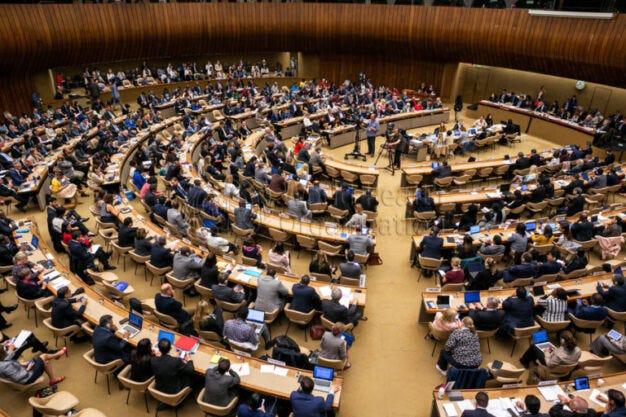
World Health Assembly, Geneva, Switzerland
The ambit of the overwhelmingly privately funded WHO, contained in its extensive constitution, can be interpreted as overly broad and sweeping, and thus, unknown to non-participants, has always posed a potential threat to individual health and national sovereignty.
The WHO’s constitution states in Chapter 2 – Functions – Article 2: In order to achieve its objective, the functions of the Organization shall be: (v) generally to take all necessary action to attain the objective of the Organization. However Article 21 of the WHO’s constitution is specific about making (non-binding) regulations, limiting the WHO to just five areas.
Proposed amendments to the new pandemic treaty include a dangerous clause that would change the WHO’s role from a UN agency that shares recommendations, to a rogue agency whose elitist and secretive attempts at legislation are binding and mandatory on member states, violating fundamental human rights and freedoms. However, health freedom advocates agree that WHO has no actual authority in the law.
In effect therefore, with both IHR amendments and the proposed new treaty, the WHO is acting ultra vires in its Big Pharma driven power grab, in collusion with naïve or compromised member state delegates. Ultra vires is defined in the law as: acting beyond the scope or in excess of legal power or authority. Ultra vires acts of impunity by the WHO could accelerate a mass defund and exit of the agency.
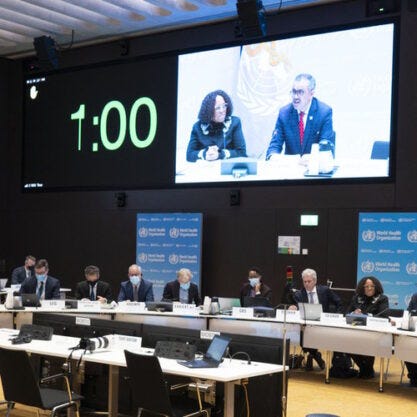
WHO’s negotiating body on a proposed pandemic treaty
Health is no longer just health, as it is defined in the WHO’s constitution. Through Covid-19, and other controversially declared pandemics, health is now a multi-billion dollar health security industry. With it, creeps in the tyranny of secrecy, surveillance, vaccine certificates, forced quarantines, and the undemocratic censorship of free speech. Given the absence of public participation, the WHO is a strategic spear for oligarchs and corporations, and given international resistance to its power grab, it may become desperate and argue or push for sanctions.
Reported in 2021: “In 2021, German Health Minister Jens Spahn called for sanctions against countries that hide information about future outbreaks. Citing the World Trade Organization’s power to sanction countries for non-compliance, Spahn said “there must be something that follows” if countries fail to live up to commitments under a new pandemic treaty that the World Health Assembly will take up in November.”
Further, it is entirely under reported that controversial “World Health Organization Director-General Tedros Adhanom Ghebreyesus also urged countries to consider the idea as they take up the treaty, a legally binding tool. The treaty should “have all the incentives, or the carrots” to encourage transparency, Tedros said, appearing at a press conference with Spahn in Berlin. “But maybe exploring the sanctions may be important,” he added.”
Also reported in 2021: “Speaking at the WHA in June, Mike Ryan, WHO Health Emergencies Programme Executive Director, also spoke out in favour of the treaty, despite the fact that WHO technical staff have historically avoided taking positions on controversial policy choices before member states. “My personal view is that we need a political treaty that makes the highest-level commitment to the principles of global health security — and then we can get on with building the blocks on this foundation.”
I engaged renowned international law expert Professor Francis Boyle about the possibility of sanctions via the WHO. He had no doubt “They will pursue sanctions against countries that do not comply with their orders, coming from Geneva. Both economic and political sanctions. However, they will only have the power to pursue sanctions if we accept their authority. We cannot. We must exit the WHO.”
With far less public scrutiny currently than the WHO, the United Nations is also seeking exponential new powers and stronger “global governance” mechanisms to deal with what they define as international emergencies. In March 2023, the UN released a policy brief , astonishingly titled “To Think and Act for Future Generations – Our Common Agenda. Strengthening the International Response to Complex Global Shocks – An Emergency Platform”
These all encompassing areas of expanded UN power include:
- climate or environmental events;
- environmental degradation;
- pandemics;
- accidental or deliberate release of biological agents;
- disruptions in the flow of goods, people, or finance;
- disruptions in cyberspace or “global digital connectivity;”
- a major event in “outer space;”
- and “unforeseen risks (‘black swan’ events)
There are several types of sanctions imposed through the United Nations:
- Economic sanctions – typically a ban on trade, possibly limited to certain sectors such as armaments, or with certain exceptions (such as food and medicine)
- Diplomatic sanctions – the reduction or removal of diplomatic ties, such as embassies.
- Military sanctions – military intervention
- Sport sanctions – preventing one country’s people and teams from competing in international events.
- Sanctions on the environment – since the declaration of the United Nations Conference on the Human Environment, international environmental protection efforts have been increased gradually.
- Economic sanctions are distinguished from trade sanctions, which are applied for purely economic reasons, and typically take the form of tariffs or similar measures.
It is plausible that the UN’s controllers realise that the world is pushing back against the WHO’s overreach, or find it irrelevant to real health. Given that sovereign nations will choose to exit the WHO, the UN decided to launch plan B and ascribe to itself even greater powers. Technically, there is no legislation to exit the United Nations within the UN Charter. Again, this is a critical issue of national sovereignty.
The United Nations Children’s Fund or UNICEF’s 2020 Annual Report highlights USD 717 million in donations from the private sector, which is 21 percent of income overall. Lucrative corporate partnerships include Unilever, Louis Vuitton, and Microsoft, while foundation partners include Bill and Melinda Gates Foundation and Mastercard Foundation. It also prides relationships with the World Economic Forum and the International Chamber of Commerce. National committees fundraise from individual donors and corporations at the national level, to support UNICEF globally. The UN’s programmes therefore are heavily dependant on private funding. Funding crowns influence.
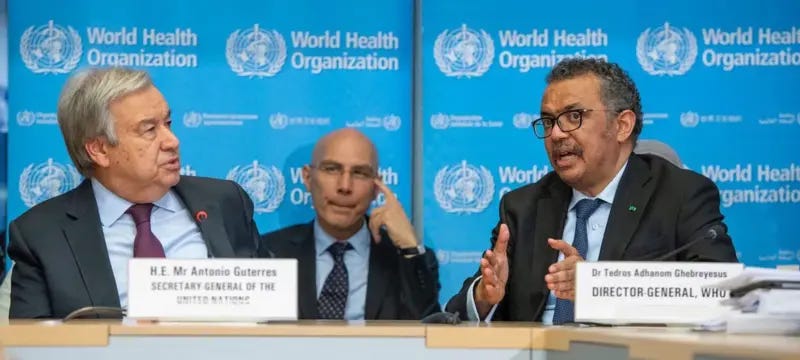
UN secretary general Antonio Guterres with WHO director general Adhanom Tedros Ghebreyesus
The WHO is an agency of the United Nations.
- In 2015, on punishing member states who violate the IHR, as reported: “United Nations health officials said they want to impose sanctions on countries that do not comply with public health regulations meant to avoid the spread of dangerous epidemics, such as the Ebola outbreak that killed more than 9,000 people and ravaged domestic health care systems in West Africa last year. World Health Organization Director Margaret Chan said she is investigating ways to reprimand countries that disobey the International Health Regulations (IHR) — a set of rules adopted in 2005 and mandate that countries set up epidemiological surveillance systems, fund local health care infrastructure and restrict international trade and travel to affected regions deemed unsafe to the public, among other provisions. Chan is on a panel set up by U.N. Secretary General Ban Ki-moon, who instructed the group to think of ways to hold countries accountable for how they manage public health crises and punish those who violate the IHR.”
- In 2022, according to commentators in a policy article: “In order to enforce compliance, some commentators have recommended concluding the treaty at the United Nations level. However, we fear that it has been already decided with the INB (mandated by WHASS) that a treaty will be developed under the roof of WHO. They added: “To move on with the treaty, WHO therefore needs to be empowered — financially, and politically. If international pandemic response is enhanced, compliance is enhanced. In case of a declared health emergency, resources need to flow to countries in which the emergency is occurring, triggering response elements such as financing and technical support. These are especially relevant for LMICs, and could be used to encourage and enhance the timely sharing of information by states, reassuring them that they will not be subject to arbitrary trade and travel sanctions for reporting, but instead be provided with the necessary financial and technical resources they require to effectively respond to the outbreak. High-income settings may not be motivated by financial resources in the same way as their low-income counterparts. An adaptable incentive regime is therefore needed, with sanctions such as public reprimands, economic sanctions, or denial of benefits.”
* Tweet CHD Africa if you agree that sanctions are possible and must be opposed internationally. Use the #StopSanctions
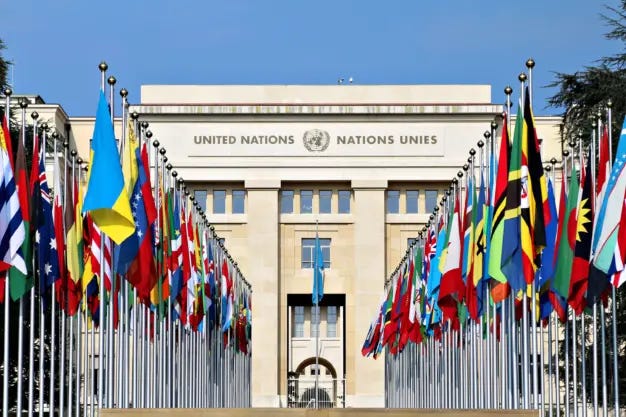
United Nations headquarters in Geneva, Switzerland
In 2000, Kofi Annan, former Secretary General of the UN said: “However, just as we recognize the importance of sanctions as a way of compelling compliance with the will of the international community, we also recognize that sanctions remain a blunt instrument, which hurt large numbers of people who are not their primary targets. Further, sanctions need refining if they are to be seen as more than a fig leaf in the future. Hence, the recent emphasis on targeted sanctions which prevent the travel, or freeze the foreign bank accounts, of individuals or classes of individuals – the so-called ‘smart sanctions’.”
Do sanctions work? “UN targeted sanctions, which are packages of sanctions imposed by the UN Security Council, have been successful in leading to intended policy change only 10% of the times, and limited the policies they intended to change in 28% of cases, but led to a reduced life expectancy in the targeted countries by 1.2–1.4 years. Economic sanctions have also been criticised for the potential collateral damage to third states they can cause. For this reason, some authors suggest that economic sanctions should be banned, as they are having detrimental effects on health and nutrition of civilians.”
Countries themselves can and do impose dangerous sanctions. A 2022 UN security council meeting on sanctions recorded: “Unilateral sanctions, which are sanctions imposed by (groups of) states and not by the UN Security Council, are particularly controversial. Unilateral sanctions have also been criticised for being disproportionately imposed on low-income and middle-income countries by wealthier countries, for example, by the Kenyan representative in a Security Council debate on sanctions on 7 February 2022: ‘The frequency and reach of unilateral sanctions have led to a growing view that they are the weapons of the strong against the vulnerable or weak’.”
- The Universal Declaration of Human Rights, in its first article, states that ‘all human beings are |…| equal in dignity and rights’, which includes the right to health. Article 25 specifies that ‘everyone has the right to |…| health and well-being |…| including medical care’.
- In the UN Convention on the Rights of the Child, article 24 states that ‘state parties recognize the right of the child to |…| the highest attainable standard of health and to facilities for the treatment of illness and rehabilitation of health. State parties shall strive to ensure that no child is deprived of his or her right of access to such health care services’.
- General Comment No.14 of the UN Committee on Economic, Social and Cultural Rights (CESCR) on the right to the highest attainable standard of health, the right to health is a fundamental human right which is necessary for all other human rights to exist and be exercised.
- “The use of sanctions designed to hurt a country’s healthcare sector is clearly incompatible with respecting citizens’ right to health. Accordingly, the general comment No. 14 of the CESCR calls on states to refrain ‘at all times’ from sanctions on medicines and medical equipment. However, sanctions on other healthcare products and, in fact, other non-healthcare products may as well interfere with the right to health, and, thus, need to be subject to scrutiny.”
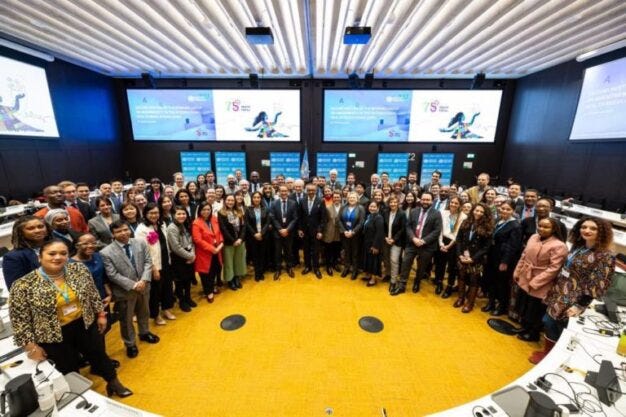
WHO’s World Health Assembly 75
South African Precious Matsoso, co-chair of the International Negotiating Body (INB), formed to negotiate the terms of the proposed pandemic treaty or accord, admitted openly that punitive measures have not been shown to work “anywhere” in the world. However, she said, there must be accountability measures while recognizing countries’ sovereignty. “We have to recognize that they’re sovereign, and they keep on reminding us that they are sovereign states.” It is positive to note that more states do recognise the real threat to sovereignty.
Not all states are considered equal. Smaller countries are at a distinct disadvantage in participating, negotiating and making decisions at the hierarchical WHO. Significantly, Matsoso was transparent about failures in equal participation. “A number of smaller delegations have always expressed concerns about organizations of multiple meetings, where they have to travel from afar, and not even having the capacity to participate in the negotiations,” Matsoso said. “And they have repeatedly requested that you must avoid parallel sessions.” To little avail.
Given the rapidly growing distrust in the WHO, its historical failures and harms, Covid-19 failures and harms, and the fact that it cannot maintain independence because it is a largely privately funded entity; it is plausible that the WHO and/or the UN will move to impose or influence sanctions via the World Trade Organisation, ahead of Agenda 2030. This act of aggression weaponises the WHO and/or the UN against countries that influential funders and unethical stakeholders have an interest in destabilising for power and resource control.
This sinister strategy has disturbing implications for democracy, peace, and prosperity around the world. Freedom faces an existential risk through unelected bureaucratic entities. Nations can and must protect their sovereignty by defunding and exiting WHO, and, by critically assessing the true nature, value, and risks of continued membership in the 78 year old United Nations. Not to do so, means ignoring the risks of UN peacekeepers, who are known to commit crimes with impunity, being deployed in your country to enforce UN and WHO dictates.
Shabnam Palesa Mohamed is executive director and chapter coordinator for Children’s Health Defense Africa. She is an activist, journalist, lawyer, and mediator, with over 20 years of experience in human rights work. To share information, Twitter: @ShabnamPalesaMo
Follow CHD Africa on 6 social platforms for news, action alerts, and updates:
– Telegram: t.me/CHDafrica
– Twitter: https://twitter.com/CHD_Africa
– Instagram: https://www.instagram.com/af.childrenshealthdefense/
– Facebook: https://www.facebook.com/CHDafricachapter
– Rumble: https://rumble.com/user/ChildrensHealthDefenseAfrica
– Tiktok: https://www.tiktok.com/@chdafrica?is_from_webapp=1…
EU and UN Discuss How to Address “Disinformation” on Digital Platforms
By Cindy Harper | Reclaim The Net | June 30, 2023
In an apparent display of bureaucratic synergy, the European Union and United Nations have convened to muse over the implementation of new social media regulations, ostensibly in the pursuit of a more secure and transparent digital milieu. What stirs apprehension, however, is the overt enthusiasm of the UN’s Under-Secretary-General for Global Communications, Melissa Fleming, who anticipates that the EU’s Digital Services Act will establish a “new de facto global regulatory benchmark.” The skepticism arises from the suspicion of veiled intentions to curb free speech under the guise of combating “disinformation.”
Platforms are constantly blamed for the proliferation of “disinformation” and “hate speech,” with detractors painting them as adversaries to science, democracy, and human rights. The UN Secretary-General António Guterres brandishes a doomsday brush, asserting that large-scale disinformation constitutes “an existential risk to humanity.”
What is crucial here is the essence of the dialogue and the response it seeks to galvanize. The UN is fervently plotting a Code of Conduct premised on a policy brief that stresses the imperative for an international clampdown on disinformation. It lays out what seems to be an ambitious and comprehensive framework, involving governments, tech companies, advertisers, and other stakeholders. All very fine, but what remains unaddressed is the question of who gets to define what is “disinformation,” and what criteria determine the line between free speech and misinformation.
The Code of Conduct, steeped in an aura of academic rigor and global research, envisages a change in the fabric of digital platforms. However, the aspects it emphasizes – detaching from engagement-driven business models, and ostensibly placing human rights, privacy, and safety at the forefront – are nebulous in terms of implementation and potential overreach. Furthermore, the UN’s admission of wielding moral authority without sanctions may be viewed as a tacit endorsement of soft power coercion.
While Melissa Fleming’s words convey a seeming commitment to protect human rights and access to information, the phraseology she employs – “human rights-based,” “multi-stakeholder,” and “multi-dimensional” – are threadbare buzzwords that do little to assuage the concerns over censorship and institutional overreach.
The concern is not with the stated objectives of fostering a safe and open digital environment, but rather with the specter of global entities like the EU and UN using the cloak of “disinformation” to infringe on the bedrock principle of free speech.
The UN Wants People To Report Each Other For “Hate Speech”
Alleges that speech can be violence
By Didi Rankovic | Reclaim The Net | June 26, 2023
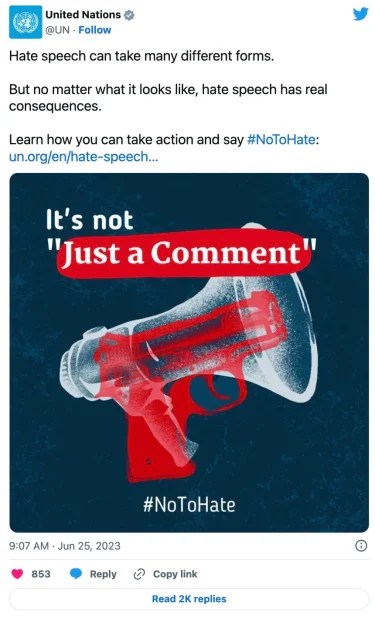 There’s been a lot of talk about the United Nations (UN) and its actions of late – mostly, those actions that fall way beyond the scope of what its founding Charter designates the organization’s role to be.
As a short history reminder – the UN is basically the international body that succeeded the League of Nations – the one that failed to prevent the (previous, atrocious) world war.
The UN is – and has, for a long time, focused its energy on “doing better” – mediating, providing a neutral ground for dialogue, helping those places around the globe unfortunately afflicted by local wars since 1945 – and just in general, not repeating the mistake of its predecessor of miring itself into irrelevancy.
You would think that with the real danger of another global war now on the cards, that would take up all of the UN’s energy and focus. But you would be wrong.
Here’s the UN, dabbling in things like alleged “hate speech.”
But – world peace – that’s supposed to be the mission. Not policing social media for dubiously defined “hate speech.”
The UN is now using its always precarious resources (depending on member-countries’ contribution, and, consequently, the way the organization satisfies the biggest contributors’ own agendas) to deal with things like real or perceived “hate speech” online.
But can that really be the mission of the world organization set up to make sure another world war doesn’t happen, and help/mediate in regional conflicts?
It seems almost absurd. Yet here it is. The UN is reported to be descending into internet censorship by “encouraging” people to report one another for hate speech online.
Really? That’s your mission now? How about providing food and drinking water to warzones and brokering peace deals?
One way to fade into obscurity as a trusted and impartial broker, is for an organization to put out statements like this.
Let’s not worry about a nuclear Armageddon – instead, what steps can we take to “combat” those pesky tweets?
Well, according to a UN tweet – there’s as many as eight: “pause, fact-check, react, challenge, support, report, educate, and commit.”
It would be comical, if it wasn’t ultimately smacking of tragedy.
“A Global Digital Compact” – UN promoting censorship, social credit & much more
By Kit Knightly | OffGuardian | June 20, 2023
Late last month the office of the United Nation’s Secretary General published a policy document on aims for the future of the internet.
A follow-up to the 2021 report “Our Common Agenda”, the new report’s title says it all really, “A Global Digital Compact”. That’s the goal, international legislation that would seek to control and enforce the use of digital technology.
The proposed clauses promote everything you’d expect them to promote.
Digital identities linked with financial access:
Digital IDs linked with bank or mobile money accounts can improve the delivery of social protection coverage and serve to better reach eligible beneficiaries. Digital technologies may help to reduce leakage, errors and costs in the design of social protection programmes
Environmental or climate change-based social credit systems:
Sensors and monitors connected to the Internet of things, cloud-based data platforms, blockchain-enabled tracking systems and digital product passports unlock new capabilities for the measurement and tracking of environmental and social impacts across value chains.”
Public-Private Partnership:
Partnerships between States, private sector and civil society leverage the capacity of digital tools to provide solutions for development across the Sustainable Development Goals. Examples include the Digital Public Infrastructure Alliance, the Coalition for Digital Environmental Sustainability and public-private partnerships for disaster response.”
Countering online “harm”:
Disinformation, hate speech and malicious and criminal activity in cyberspace raise the risks and costs for everyone online […] we must strengthen accountability for harmful and malicious acts online.
Those are the obvious ones, there’s also more sneaky, insidious language regarding “equity” and “access”. The report is concerned there are many people in the world (mostly the developing world) who don’t have regular access to the Internet.
This concern would be more honestly expressed in the language of control – people who don’t consume digital media can’t be hypnotised, people who don’t communicate online can’t be censored, and people who don’t rely on digital banking can’t be controlled.
To sum up, the Digital Global Compact is a piece of globalist legislation serving the final aim of globalist policy: Control of all aspects of life, achieved by inserting a digital filter between people and reality.
Banking, communication, media consumption, shopping. Every interaction you have will be through a digital membrane which can both monitor your exchanges with the world and – if deemed necessary – deny you access to that world.
An interesting final point to note is the words the report doesn’t use. “Globalist” and “globalism” do not appear once, “vaccine passports” or “vaccine certificates” are likewise not mentioned. Neither are “social credit” or “central-bank digital currency”. They are discussed, but not mentioned.
They seem to be avoiding buzzwords they know will trigger resistance or set off alarm bells. Would they have done that before the skeptics started winning the Covid conversation? I don’t think so.
You don’t have to take my word for any of this, of course, you can read the whole report yourself.
There’s nothing surprising in there at all, obviously. But it’s definitely a “quiet part out loud moment”, and a link to send to those people who still dismiss you as a conspiracy theorist.
BBC Verify?
By Iain Davis | OffGuardian | May 31, 2023
With great fanfare, the BBC has launched BBC Verify. The state broadcaster’s very own, specialist “disinformation and social media correspondent,” Marianna Spring, announced its arrival live on UK TV.
She explained that the BBC would verify video, fact check and “counter disinformation.” So rest assured, no one needs to think about anything. The BBC will “fact check” everything for us and tell us what “the truth” is.
Apparently, it “really matters” that the BBC acts as the UK government’s official arbiter of truth because, according to Spring, “mistruths” can “cause really serious harm to society.” Marianna has yet to define “harm,” but that doesn’t really matter. The government hasn’t either, despite the fact that it has placed its vague concept of “harm” at the centre of its equally ambiguous Online Safety Bill. Which is proposed state censorship legislation that Marianna is very keen to promote.

Marianna said that we can familiarise ourselves with BBC truth if we are shown the BBC news team’s “workings.” A strange choice of words.
While “workings” means “the way an organisation operates” it also means “a system of holes.” It isn’t clear which definition Marianna was using, although both seem appropriate in reference to BBC news coverage.
Marianna proudly announced that the BBC were “able to look at maps.” This presumably unique BBC capability supposedly enables their intrepid reporters to analyse “war zones.” And find them too, which is handy.
Spring is very concerned about, what she calls, social media “disaster trolls.” She is seemingly referring to people who understand that the UK government is among those that often rely upon false flag terrorist attacks when they want to pass oppressive surveillance legislation or justify their next war.
“Disaster trolls,” she alleges, “cause real world harm” by questioning the often implausible and contradictory accounts of people who claim to have been injured in, what evidently appear to be, false flag terrorist attacks. Marianna hasn’t clarified whether “disaster trolls” are the people who ask questions or the idiots who abuse others online. Te be fair, that distinction is probably moot because Marianna, the BBC and the government clearly want to silence everyone who disagrees with them.
Marianna told the nation that she’s a social media troll. She described the “undercover” accounts that she has “set up” to deceive people on social media. She claimed that these help the BBC news team understand “polarisation online.” Although, the BBC are seemingly causing a fair bit of “polarisation” themselves with their fake troll accounts and endless accusation levelled against anyone who questions the state.
Trolling, Marianna maintains, helps the BBC nail down “just how social media works.” It is a shame they felt the need to create a network of fake accounts to figure this out. They could have just asked my 80-year-old mum. She understands how it works.
Marianna’s said that her online trolling activities are helping her to investigate the “UK’s conspiracy theory movement.” I wish her well, but I fear this is going to be a monumentally difficult task because there is no such thing as the UK’s conspiracy theory movement.
“Conspiracy theory” is just a term the CIA weaponised for their propagandists to help them shut down any debate—about who shot JFK—by sticking the dismissive “conspiracy theorist” label on anyone who dared to question the US government’s official account. It really doesn’t mean anything more than that. Alleged “conspiracy theorists” are just people who question government narratives.
This may go some way to explaining why attempts by the Establishment to lucidly define “conspiracy theories” are frequently absurd. For example, according to the UN, a conspiracy theory is “a belief that events are secretly manipulated behind the scene by powerful forces with negative intent.”
Of course, no one can ever know what a secret is because it’s a “secret.” Typically, the people who get labelled “conspiracy theorists” point toward real evidence that possibly indicates real conspiracies. They only remain “secrets” if you refuse to look at the evidence.
If there are people who believe events can be explained by highlighting things that can’t be known, and there is no evidence that such a “movement” exists in the UK or anywhere else, that would indeed be rather silly.
The UN then adds to its own confusion by stating that a “conspiracy theory” can be identified, in part, because there is evidence that “seems to support the conspiracy theory.” Quite how you find evidence that “seems” to support something that is incomprehensible is mystifying.
However, we do get some contradictory clarification from the academics the UN selected to back up its bizarre contention. In the Conspiracy Theory Handbook , cited by the UN as “evidence,” Professor Stephen Lewandowsky and John Cook PhD, from George Mason University’s Center for Climate Change Communication, stated:
Real conspiracies do exist. [. . .] The U.S. National Security Agency secretly spied on civilian internet users. [. . . ] We know about these conspiracies through internal industry documents, government investigations, or whistleblowers.
So conspiracies do exist! What are the UN rambling on about then? Are they secret or not? We get further clues from the UN’s eminent experts:
Real conspiracies get discovered through conventional thinking—healthy skepticism of official accounts while carefully considering available evidence and being committed to internal consistency.
Begging the question, what is the difference between the evidence that “seems to support the conspiracy theory” and the evidence that “seems” to expose a “real conspiracy”? The answer is, at least, forthcoming:
Conspiracy theories, by contrast, tend to persist for a long time even when there is no decisive evidence for them. [. . .] Typically, conspiracy theories are not supported by evidence that withstands scrutiny.
Ah, I see!
The real conspiracies are exposed by a novel type of evidence called “decisive evidence.” This is different from the evidence that “seems to support the conspiracy theory,” because only it can withstand scrutiny. Although, neither the UN nor its employed academics specify who should scrutinise it.
Perhaps we can now try to construct some sort of sense from, what otherwise appears to be, the UN’s garbled drivel.
The UN and its experts appear to suggest that “real conspiracies,” such as the US government spying on US citizens, are only revealed when “decisive evidence” is uncovered by, for example, US “government investigations.” Unless the evidence is officially acknowledged, or approved by the appointed experts, it is not evidence that stands up to scrutiny.
Right! Got it!
Presumably, we can therefore expect Marianna and the BBC Verify team to scrutinise the evidence offered by those she labels “conspiracy theorists” in order to “debunk” it. This will certainly represent a sea change for the BBC because, to date, they haven’t even reported any of the evidence offered by so-called conspiracy theorists, let alone scrutinised it.
Marianna promises to expose the nonexistent “UK conspiracy theory movement” with her new investigation, “Marianna in Conspiracy Land.” This, she claims, will enable the BBC audience to see how Marianna and her colleagues “piece together the truth.”
I suspect, BBC Verify will prove to be quite illuminating. But not for the reason’s that Marianna and the BBC hope.
US blocks China’s effort to condemn Israeli attacks on Gaza at UN: Report
The Cradle | May 11, 2023
US officials blocked an effort led by China at the UN Security Council (UNSC) on 10 May to condemn Israel’s latest onslaught on the besieged Gaza Strip, according to senior Israeli officials that spoke with the Times of Israel.
Washington’s interference reportedly came at the request of Tel Aviv, who feared the motion at Tuesday’s emergency meeting “would draw an equivalence” between the Israeli army and the Palestinian Islamic Jihad (PIJ) resistance group.
Over the decades, the US has consistently stepped in to protect Israel from facing the consequences of rampant human rights abuses, the military occupation of Palestinian land, and the imposition of an apartheid system targeting Palestinians.
The only exception to this rule came earlier this year, when Washington allowed a statement to pass at the UNSC blasting Israel’s expansion of illegal settlements in the occupied West Bank. Nonetheless, the US went on to block a binding resolution against Israel.
Former US President Harry Truman was the first world leader to recognize Israel when it was created in 1948 following the ‘Nakba,’ or catastrophe, during which at least 700,000 Palestinians were violently evicted from their lands by Jewish settlers.
Israel is also the largest cumulative recipient of US foreign aid in the post-World War II era and enjoys unequivocal political and diplomatic cover from both the Democratic and Republican parties as well as from US corporate media.
However, US influence in the region has started to wane in recent months, pushing Israel further into isolation.
Last month, Beijing offered to help facilitate peace talks between Israel and Palestine as part of a larger effort to mediate historic conflicts in West Asia.
In December, Chinese President Xi Jinping expressed support for an end to the Israeli occupation of Palestine and voiced frustration over the “historical injustice” suffered by Palestinians.
He also called for granting Palestine “full membership in the United Nations” and said Beijing “supports the two-state solution and the establishment of a Palestinian state on the 1967 borders, with East Jerusalem as its capital.”
The Asian giant has slammed recent comments by a Jewish supremacist government minister, who in March said, “there is no such thing as a Palestinian people.”
“The Israeli senior official is wrong and irresponsible to deny Palestinian people’s existence and to display an ‘Israel map’ including Jordan and Palestinian places occupied by Israel at an event in Paris,” said Wang Wenbin, a spokesman for China’s Foreign Ministry.
When the trading gets rough, the pros go insider
The farm to table vertical integration of the gates foundation investing racket
by el gato malo – bad cattitude – may 6, 2023
in the aftermath of great events, “who knew what and when did they know it?” is always an interesting question.
the US intelligence community (michael spenger substack ) was suspected to have caught wind of covid back in november 2019.

astonishingly, the IC itself denies this and claims they were in the dark until later
Every official interviewed by the Committee—from working level analysts at NCMI to an official with relevant knowledge at the NSC—said that their first indication of a novel virus came with the publication of the ProMED notice published at 11:59 p.m. on December 30, 2019 that reported the announcement of a novel virus by the Wuhan Municipal Health Committee.
In sum, the first warnings of COVID-19 came from the non-IC based public health track—in this case disease surveillance conducted by local public health authorities in Wuhan.
but this invites some pretty pointy questions about their competence, no?
because it sure looks like pretty much everyone on the super special inside track of business and finance CLEARLY knew by then.
bill gates knew. the WEF and team davos knew. and they were making big plays to make big money months before the intelligence community is even claimed, much less claims to have known what was going on.
it does make one wonder…

bill gates bought $55 million (with an option for $100mm) of bioNtech stock in september of 2019 right before they suddenly had the intellectual property for the most profitable vaccine in history.
they were not working on vaccines previously.
i wonder where they got the tech?
no one seems to know.
but it sure looks like billy g knew.
so, here’s a fun little nugget from the bill and melinda gates foundation investment into bioNtech, from whom pfizer licensed the IP for the covid vaccine.
pretty prescient for september 2019.

source
does this seem like “boilerplate?”
because it seems oddly specific (but deniable) as a “partnership” on something unrelated that could suddenly be “covid.”
and the timing is awfully provocative especially in light of some other events.
he did well getting out as well.
gates sold in 2021, banking $260 million, pretty much right at the top and has since changed his tune on mRNA vaccines, but this is hardly uncommon for “investors talking their book.”
the rest of this fact pattern looks a bit nastier though, more like the 3.0 sand hill road model of “buy up companies in a space and then mandate the adoption of their products.”
this has been the great game out there since even before kleiner perkins hired al gore to shill and lobby for their greentech portfolio. they are currently playing a similar (and more subtle) game playing hungry hungry hippos with HVAC companies and then pushing through new “air handling mandates” for new buildings, schools, offices, etc. cuz “public health.”
but the gates foundation makes them look like pikers.
if you’re going to make a big push into selling vaccines and drugs, why buy mere lobbyists when you can buy the WHO? gates is by far their largest private donor, 25X the size of the next biggest and was their number 2 donor overall.
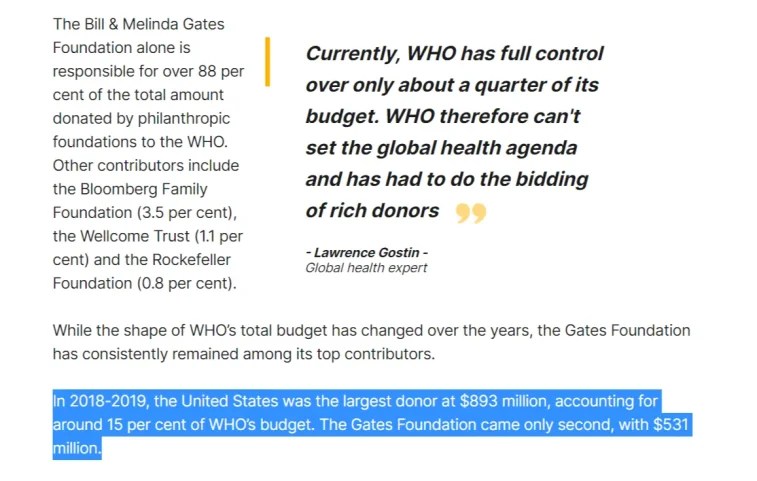
$531 million buys A LOT of access and control. it’s perfect. the WHO is not only on the ground all over, but they also give advice and set policy/terms for assistance. so gates gets all the info instantly about what’s happening in diseases and then gets to tell the WHO what to tell everyone to do about it. play the hero and add a zero (to your bank balances).
it’s a truly great grift and few dare call it out as the nasty, hard-knuckle lobbying and advocacy it is because it looks like philanthropy.
weaponized philanthropy to be sure, but “philanthropy” and tax free to boot.
not only did bill get early word on wuhan and reach out and place big money on the one subtle square that was going to pay out huge by suddenly having the answer to the most asked question on earth and coming out of obscure nowhere to partner with pharma titan pfizer, but he went a full step further and actually held a pandemic war game under the auspices of john’s hopkins that gathered top policy makers and thought leaders to assess a global outbreak of an “imaginary” disease that happened to look exactly like SARS-cov2. this was the now infamous “event 201.”
and look who threw the party: the WEF and the gates foundation.
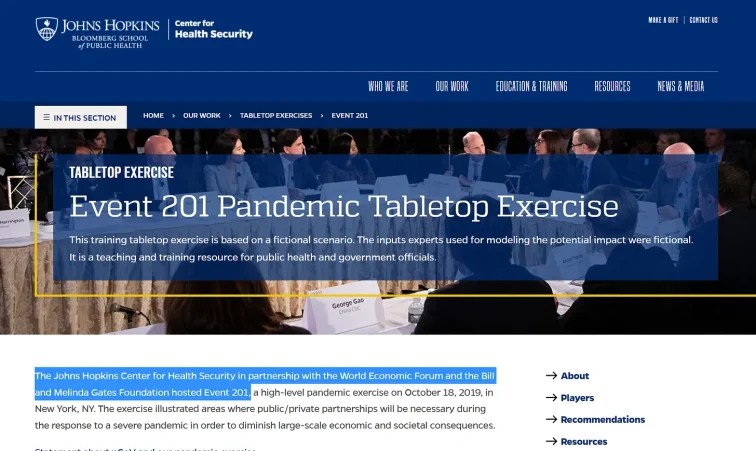
it’s obvious that they knew exactly what was coming. this was the overt planning plenary for covid. it was not pretend. and many/most those attending must have known that. this is the same time gates was buying bioNtech.
the bioNtech investment was 9/4/19. event 201 was 10/18, five weeks later.
who knows how much earlier the due diligence and planning must have begun, especially for the investment.
there’s getting lucky, and there’s putting the fix in because you know what others do not.
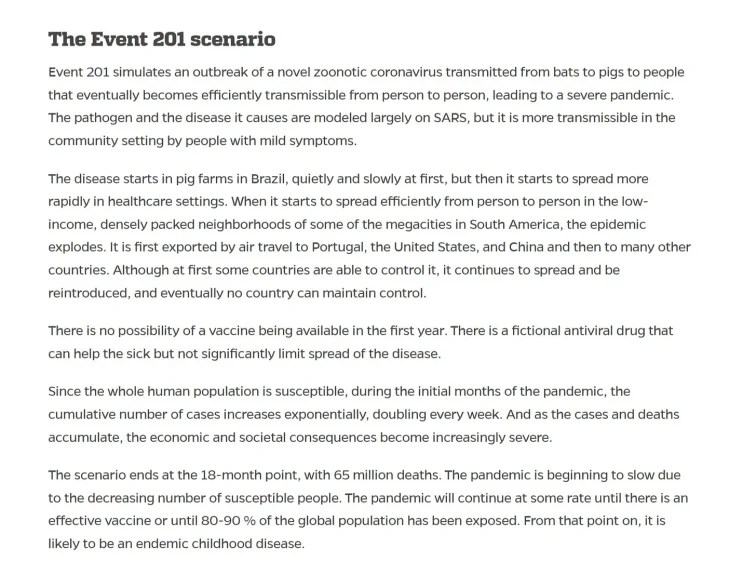
tell me that this “imaginary scenario” 2-3 months before the whole world knew what was happening was just a lucky guess.
the “players” were a high powered gang including big business, healthcare companies, the UN, the head of china’s CDC, a number of academics, the head of US CDC preparedness and response, monetary authorities, and media firms.
UN cross-border aid program for Syria abused by extremists: Moscow
The Cradle | April 28, 2023
Moscow’s permanent representative to the UN, Vasily Nebenzia, said on 27 April that the UN-sponsored cross-border aid mechanism for Syria has “exhausted its capabilities” and is being “used for other purposes.”
The cross-border humanitarian aid mechanism has “has long since exhausted its capabilities and is being used for other purposes, far from addressing the humanitarian situation,” Nebenzia stressed.
The cross-border aid mechanism was established by the UN in 2014 in order to provide aid to northern Syria through the Turkish-Syrian border without authorization from the government in Damascus – a contravention of international regulations.
However, extremist militants in control of large swathes of Syria’s north began taking advantage of the mechanism in order to seize humanitarian aid for themselves, at times to sell for higher prices. Northern border-crossings associated with the UN aid program have even been subject to drug smuggling by armed groups.
Groups such as the Nusra Front, the former Al-Qaeda branch now known as Hayat Tahrir al-Sham (HTS), have also been involved in kidnapping aid workers to demand large ransoms – worsening an already volatile humanitarian situation. The aid program also excludes the majority of the population who reside in government-held territory, where an economy ravaged by sanctions has created significant humanitarian concerns.
“We would like to stress that if our western colleagues in the UN Security Council continue to act as if nothing has happened, and ignore the thwarting of the implementation of the Security Council resolution by international terrorists, we will draw the required conclusions from the current situation while formulating our position on extending the aid transfer mechanism for next July,” Nebenzia added.
The last time the cross-border aid mechanism was extended was in January this year. Russia has called for an end to the program numerous times, and has vetoed its extension in the past.
“It looks like permissions to use two additional checkpoints for three months, issued by Damascus, have de-facto reduced to zero UN enthusiasm to unblock deliveries via the contact line,” the Russian official said.
This refers to the two additional border crossings opened by the Syrian government following February’s devastating earthquake. The crossings, which link government-held territory to the militant-held north, would allow aid to be dispersed conventionally through the Syrian Arab Red Crescent (SARC). However, the UN has yet to lift restrictions on the use of these crossings.
Some have said that this is to perpetuate the idea that Damascus is behind the obstruction of aid delivery across the country, when in fact, HTS and other groups are to blame.
Russia cannot lose its UNSC seat despite Western and Ukrainian attempts
By Ahmed Adel | April 27, 2023
The US has a strong ambition to add its allies to the United Nations Security Council to weaken Russia’s influence across the world, or if this fails, to render the organisation useless, akin to the old League of Nations. However, even more dangerous than the US seeking more allies in the UNSC are the initiatives to abolish Russia’s right of veto and take away its status as a permanent member. Kiev raises this suggestion at almost every session of the UN General Assembly.
In this sense, new challenges are being created, especially as UN Secretary General António Guterres stated that the majority of UN member states see the need for reforming the UNSC. Such suggestions must be treated with suspicion though as the US wants to take advantage and weaken not only Russian influence, but also Chinese.
Guterres and the US are clearly trying to push their closest allies, such as Germany, Australia, and Japan, where unsurprisingly American military bases are located, into the UNSC. There are also other countries, such as Turkey, which regularly raise the issue of UNSC reform and complain that the fate of humanity should not depend on five countries – China, France, Russia, the UK, and the US.
However, Turkey’s suggestion is problematic as the UNSC would be inundated with permanent membership requests from dozens of middle powers who have equal or greater power than Turkey, such as Egypt, Iran, and Saudi Arabia. Realistically, at this current junction, an expanded permanent UNSC could only include Brazil and India, the former because it is the most important country in Latin America and the latter because it is on a rapid path towards Great Power status.
None-the-less, Moscow, just like Washington, is in favour of reforming the UNSC, but with significantly different views. While the US and its allies are pushing reforms as a possible way to limit Russian influence, Moscow believes that the Security Council should to be expanded, but to achieve a more equitable world and to not empower Western aggression.
Russian Foreign Minister Sergey Lavrov explained that the composition of the UNSC should be strengthened by Asian, African, and Latin American countries, which are not represented in the UNSC, with the exception of China in regards to Asia. Therefore, in Moscow’s view, the UNSC should not be expanded only so that the West and its closest allies, such as Japan, can get additional seats. Moscow wants to balance the UNSC because the West has three of five permanent seats despite comprising only a minority of humanity.
It is clear that Lavrov has strategically put the West in a difficult position because if they veto the expansion initiative, it will lead to a backlash from countries like India which believe they have earned a right to a permanent seat in the UNSC. At the same time, Lavrov and his Chinese counterpart must be cautious on expansion so that the UNSC does not transform into a political branch of NATO.
The UN Charter does not provide for a reform procedure, and this especially applies to the UNSC, which is the most important body of the organisation. By recklessly expanding the body, the contradictions and conflicts of interest, which already hinder the UNSC in its current format, would elevate.
Therefore, in the current geopolitical situation, it will be very difficult to reform the UNSC in such a way as to objectively consider the interests of all participants in the process. A permanent UNSC membership is a privilege and not something to lightly contemplate expanding upon.
There is also no legal basis to exclude Russia from the UNSC, limit its status and deprive it of veto rights. The entire architecture of the UN was originally built on the fact that the five great powers, the winners of the Second World War, assumed the role of guarding the global world order. The founding states cannot exclude each other because if one or two pillars are thrown out, the UN would collapse.
If Russia was somehow excluded, it would mark the destruction of the entire system based on international law, on the UN Charter, and would call into question the existence of the UN itself. Russia, however, is a permanent member of the Security Council and has veto power. This practically means that Russia, if the Charter is applied, can only be expelled if it does not exercise its veto power. Therefore, it is impossible to deprive Russia of that right, despite constant Ukrainian attempts.
Hypothetically, there are two scenarios in which Russia could lose its seat in the UNSC – first, if it excludes itself and second, if the UN ceases to exist as an organisation. It is recalled that the Soviet Union was foolishly excluded from the League of Nations, the forerunner of the UN, but that organisation ceased to exist. The same fate would befall the UN if Russia was expelled.
Ahmed Adel is a Cairo-based geopolitics and political economy researcher.
Iran’s UN ambassador: US unilateral actions violate UN Charter, threaten multilateralism
Press TV – April 24, 2023
Iran’s permanent ambassador to the United Nations says unilateral measures taken by the United States are against the UN Charter while threatening multilateralism in the world.
Amir Saeed Iravani made the remarks in a Monday address delivered during a UN Security Council debate on multilateralism.
“Multilateralism has been recognized as a well-established approach to addressing global challenges and effective multilateralism … is essential for ensuring international peace and security,” he said.
The official, however, warned that the integrity and effectiveness of multilateralism are undermined by the abuse of the UN system and selective application of international law, which pose a serious threat to international cooperation, peace, and security.
“Within this context, the United States’ unilateral withdrawal from the JCPOA, re-imposition of illegal unilateral sanctions on Iran, its coercion of other countries to engage in these illegal actions, and defiance of the International Court of Justice’s order are striking examples of how such harmful unilateral acts violate the UN Charter, undermine the UN system and threaten multilateralism,” Iran’s ambassador said.
He was referring to Washington’s unilateral and illegal withdrawal in 2018 from a multilateral deal with Iran, officially called the Joint Comprehensive Plan of Action (JCPOA), whose other members included the permanent members of the UN Security Council plus Germany. After leaving the deal, the administration of former US President Donald Trump reinstated all anti-Iran sanctions that the accord had lifted and introduced its signature “maximum pressure” policy against Tehran.
The administration of Trump’s successor Joe Biden had alleged a willingness to compensate for Trump’s mistake by rejoining the deal, but it has retained the sanctions as leverage and even imposed a slew of its own coercive economic measures on the Islamic Republic.
“Unilateral coercive measures (UCMs), including their extraterritorial application, represent a concerning example of harmful unilateral acts that run counter to the fundamental principles of international law, the UN Charter, and basic human rights,” Iravani said, adding, “These illegal measures have far-reaching humanitarian consequences and can undermine diplomatic efforts aimed at resolving disputes and promoting cooperation.”
Iravani also referred a March 30 verdict by the International Court of Justice (ICJ), which ruled that the United States had violated the international law by allowing American courts to confiscate nearly two billion dollars in assets from Iranian companies, and ordered Washington to pay compensation.
“The ICJ’s ruling is final and binding, requiring the US to comply with this decision,” the Iranian diplomat noted.
Iravani said, “Collaboration should be the cornerstone of multilateralism, rather than confrontation,” because “collaborative approaches foster trust, build consensus, and promote sustainable solutions to global challenges.”
He concluded by saying, “Through collaborative problem-solving and engagement with all parties, multilateralism can effectively address the challenges facing our world today. In this context, diplomacy, dialogue, and negotiation should be the preferred means for resolving disputes among member states.”
Treatment of Russia at UN shows need of its urgent reform or even replacement
By Drago Bosnic – April 25, 2023
The importance of global cooperation and international law has never been more pronounced in the post-WWII era than it is today. The world’s most important organization in this regard is certainly the United Nations, with one of its main tasks being to uphold international law and maintain its impartiality, regardless of which country or entity it is engaged with. Unfortunately, the UN has failed on both counts, but its role as an international forum of sorts that serves as the last frontier of dialogue between states is still evident. And yet, it seems that even this largely ceremonial role is too much for the political West, as it undermines its desire for total dominance through the so-called “rules-based world order“.
Perhaps the best example (although “the worst” would probably be a more suitable word) of this is the atrocious treatment of Russian Foreign Minister Sergey Lavrov at the UN. The latest UN Security Council meeting (chaired by FM Lavrov) should serve as a textbook example of how not to conduct diplomacy, probably for decades to come. The tensions have been quite high at the UNSC due to the political West’s frustrations after Russia took over the council in April, a rule based on the regular monthly rotation. Lavrov warned against this and stated that the world has become a more dangerous place, possibly more so than at the height of the Cold War.
“As was the case in the Cold War, we have reached the dangerous, possibly even more dangerous, threshold,” Lavrov said.
The meeting, titled the “Maintenance of international peace and security”, came under fire as Western diplomats repeatedly grumbled about Russia taking over chairing of the UNSC on April 1 and that it allegedly “must be an April Fool’s joke”. Lavrov himself slammed the United States and its vassals and satellite states for abandoning diplomacy and called for the clarification of relations on the battlefield. However, Western “diplomats” went about with their hostility, including Olaf Skoog, the official representative of the European Union to the UN. Skoog openly called Russia “cynical” for allegedly “trying to portray itself as a defender of the UN charter and multilateralism”.
“We all know that while Russia is destroying, we are building. While they violate, we protect,” he said.
This statement alone shows the immeasurable level of EU/NATO’s self-delusion, as the political West’s truly unprovoked and brutal aggression against the world stands as a stark reminder of just how opposite of truth this is. However, it wasn’t just Western officials that took aim at Russia. UN Secretary-General Antonio Guterres also stated that “Russia’s invasion is causing massive suffering and devastation to the country and its people” and then (rather inexplicably) added that “it’s fueling global economic dislocation triggered by the COVID-19 pandemic”. Neither of these statements makes much sense, as he has said virtually nothing about the suffering of the people of Donbass in the six years since taking office.
“Tensions between major powers are at an historic high. So are the risks of conflict, through misadventure or miscalculation,” Guterres also warned.
Apparently, he stated this to “even out” his previous one-sided statement, but he failed in this too, as he never mentioned which side was responsible for stoking the tensions to a boiling point. Still, perhaps the most laughable example of endless hypocrisy came from the US, when its UN representative Linda Thomas-Greenfield called Lavrov himself “hypocritical” and criticized Russia’s counteroffensive against NATO aggression.
“Our hypocritical convener today, Russia, invaded its neighbor, Ukraine, and struck at the heart of the UN Charter. This illegal, unprovoked and unnecessary war runs directly counter to our most shared principles – that a war of aggression and territorial conquest is never, ever acceptable,” she said.
Again, such statements are beyond laughable or even enraging to dozens of countries that have been invaded or targeted by Washington DC. However, what’s truly disturbing is how the US is abusing its status as the UN’s permanent host country. There have been countless examples of Russian, Belarussian, Syrian, North Korean and many other officials, diplomats, journalists, etc. that have been denied entry into the US, preventing access to what is supposed to be an impartial organization.
These incessant Western-induced tensions serve as a testament to the notion that the UN should be reformed significantly. Liz Truss, one of the UK’s recent fast-track prime ministers, floated the idea last year, one of the very few things she was right about. Of course, her reasoning for the move was quite the opposite, but the point still stands. The actual world should start creating truly international institutions that are completely divorced from the malign influence of the US-led political West. This includes either relocating or even completely replacing the UN itself.
The very idea that increasingly irrelevant countries such as France or the UK have permanent seats at the UNSC, unlike actual giants such as Brazil or India, is geopolitically ludicrous. If the political West aims to control so-called “international institutions”, then it can do so within its own geopolitical boundaries. But the issue is that it aims to control quite literally everyone, which has been preventing the emergence of a truly independent multipolar world for decades. To say nothing of how the political West has been (ab)using the UN to promote or even impose its so-called “values” on the rest of the world, something that the vast majority of civilizations find repugnant.
Drago Bosnic is an independent geopolitical and military analyst.
Featured Video
Trita Parsi: Israel Set a Trap for Total War in the Region
or go to
Aletho News Archives – Video-Images
From the Archive
Zionism’s Violent Legacy
By Donald Neff | Washington Report On Middle East Affairs | January 1996
On January 4, 1948, Jewish terrorists drove a truck loaded with explosives into the center of the all Arab city of Jaffa and detonated it, killing 26 and wounding around 100 Palestinian men, women and children.[1] The attack was the work of the Irgun Zvai Leumi – the “National Military Organization,” also known by the Hebrew letters Etzel – the largest Jewish terrorist group in Palestine. The Irgun was headed by Revisionist Zionist Menachem Begin and had been killing and maiming Arabs, Britons and even Jews for the previous ten years in its efforts to establish a Jewish state.
This terror campaign meant that at the core of Revisionist Zionism there existed a philosophical embrace of violence. … continue
Blog Roll
 Aletho News
- Trita Parsi: Israel Set a Trap for Total War in the Region
- Trump’s Iran war is on an Israeli leash
- Saudi oil boss issues global supply warning
- Riyadh Says Its Oil System Is Intact. The Numbers Say Otherwise.
- Trump and Netanyahu Want to “Finish the Job” on Iran
- US ‘one-sided dictation’ not Iran’s beliefs makes rational talks impossible: Baghaei
- Iran’s Next Strike May Not Explode. It Could Shut You Down /Col Doug Macgregor
- Iran: US political targets legitimate if assassinations return
- Iraq shuts key border crossing with Iran under US pressure: Report
- Undersea Internet cables could be targeted in retaliation for attacks on Iran: IRGC deputy chief
- If Americans Knew
- The Israel Lobby’s Changing Fortunes
- AIPAC has become such a political liability that it’s shifting to a more “nimble” approach to buying politicians
- At least 160 Israeli settler attacks in 2 weeks
- Will Gaza’s Ancient Christian Community Disappear Forever?
- Israel’s vision of regional security rests on keeping Arab states weak
- Heidi Levine recounts how Palestinian youths helped save her in settler attack
- DAILY UPDATE: Latest essential news on Palestine, Israel, & region
- Trump’s Intensifying Sabotage of the ICC, for Israel’s Sake
- Israeli military detain US and UK volunteers in West Bank including Democratic NY politician Brad Lander
- Americans at National Conservatism Conference held in Israel this year criticize Israel
- No Tricks Zone
- E-Cars Reduce CO2 Emissions By Only 41% Compared To Internal Combustion Engine Vehicles
- Predictions Made By Renowned Climate Professor Over Past Decades Have Been Proven To Be Poor
- New Study Suggests Large Regions Of The Pacific Ocean Have Been Cooling For The Last 80 Years
- Germany’s Green Energy Debacle: High Energy Costs Force Kahla Porzellan to Close After 182 Years!
- New Study: 50 Years Of The Most Aggressive ‘Net Zero’ Policies Can Only Affect The Global Climate By 0.03°C
- US September “Heat” Was No Record…Many Records Set Decades Ago
- Latest European Green Energy Debacle; Portugal’s Largest Flagship Solar Park Insolvent!
- Green Energy Debacle: German Expert Professor Fritz Vahrenholt Warns Of Severe Economic And Social Consequences
- Two More Paleo Reconstructions Affirm Meters-Higher Sea Levels Across Ireland, Brazil 7000-6000 Years Ago
- New Study: Earth And Venus Surface Warmth Largely Explained By Convection And Lapse Rate, Not CO2 Or Radiation


