Mexican President Announces Move Toward Legalizing Marijuana
teleSUR | April 19, 2016
President Peña Nieto opened Tuesday´s session of the U.N. Drug Policy Summit by announcing a move towards legalizing marijuana.
Mexican President Enrique Peña Nieto started off the special session of the U.N. Drug Policy Summit by announcing a stark policy change: the need to move towards legalizing marijuana for medical and scientific purposes. Even though he had previously been a vocal opponent of drug legalization, he now has moved toward legalization.
Stating that Mexico has paid a high price for its problems with drug trafficking, he recognized the limitations of the prohibitionist paradigm. Citing the suffering, loss of life and violence as a result of this phenomenon, he said that drug trafficking is still one of the most profitable activities of organized crime in Mexico.
He further stressed the need for greater collaboration between U.N. agencies in order to address all aspects of the global drug problem. Peña Nieto also addressed the need to look at social harms related to the illicit drug market and finding solutions through alternative education and other policies that could promote social cohesion.
The president said he plans to hold an event on Thursday in order to discuss this drug policy change.
Spain – police issue 40,000 fines in just seven months with new gag laws

By Graham Vanbergen | TruePublica | March 26, 2016
In 2012, there were nearly 15,000 demonstrations throughout Spain, amounting to around 40 per day. In 2013, there were 4,500 demonstrations in Madrid alone: an increase of 1,000 from the year before. Protest increased on a par with the continual disintegration of full employment and the implementation of severe austerity programmes accompanied with a lack of government transparency and accusations of corruption at the very highest level.
In April last year, Amnesty International (AI) was clearly getting concerned with how the authorities in Spain were dealing with peaceful public protest in Spain by saying:
“With threats of fines or threats of being beaten, the government is trying to stigmatise and criminalise people who are just practising their rights.”
Amnesty International investigated and discovered that although the vast majority of protesters were indeed peaceful, police treated the protests as riots and the people in them in the same manner as those who incited violence. In many cases, the police had used excessive force to confront protesters. AI’s report entitled Spain: Protests and the suffocating embrace of the law makes for sobering reading.
By June, Spain officially went police state with a series of “gag laws” that effectively criminalised peaceful public protest. Among the many new repressive stipulations was the implementation of €30,000-€600,000 fines for “unauthorised protests,” which can be combined for maximum effect with a €600-€300,000 fine for “disrupting public events.”
This awful set of authoritarian statutes arose from Spain’s position as a flashpoint for anti-austerity protests. The European Union did not want to see a precursor to the Occupy Wall Street movement gaining significant ground in its territorial fiefdom and has allowed breaches of internationally recognised human rights laws to be perpetrated right under its nose. Fines and mistreatment await anyone who refuses to recognise authority with the respect it’s forcibly requiring citizens to demonstrate.
The law also extended its anti-protest punishments to social media, where users can face similar fines for doing nothing more than encouraging or organizing a protest. Failing to present ID when commanded is another fine. And then there’s this:
Showing a “lack of respect” to those in uniform or failing to assist security forces in the prevention of public disturbances could result in an individual fine of between €600 and €30,000.
What could go wrong? The Spanish news outlet eldiario.es filed a request for information which revealed an alarming number of penalties and sanctions issued since the Gag Law, otherwise known as the Public Safety Act, was passed on July 1, 2015.
In the space between July 1st 2015, the date the new laws were enforced and January 28, 2016 police have grabbed the opportunity with both hands and sanctioned or fined 40,000 people for “disrespecting” law enforcement. Some of the numbers include; 6,217 for ‘disrespecting the police”, 3,700 for disobedience to authority and 2,027 for causing public disorder.
“Now the government is judge and jury on a number of violations that were previously in the hands of independent judges,” says Joaquin Bosch, spokesperson for Jueces por la Democracia (Judges for Democracy). Bosch’s critisisms continue – “Article 52 of the law states that the complaint of a police officer constitutes “sufficient evidentiary basis” to take legal action. “In the judicial field, the cop’s word is not enough, it has to be proven.”
Spain is one of the least violent countries in the world but other controversial articles of the law are extended to areas similar to that of totalitarian states. There are penalties just for refusing to provide identification, taking photos of police or other objects that could identify a member of the security forces or for obstructing authority in compliance with administrative or judicial decisions, including people who try to prevent an eviction, for example.
Amnesty International also stated that;
“The excessive use of force by Spanish police and plans to strengthen repressive legislation are a damning indictment of the Spanish government’s determination to crush peaceful protest. The police have repeatedly used batons and rubber bullets against demonstrators, injuring and maiming protestors and by-standers alike. The police act with complete impunity, while peaceful demonstrators and leaders of social movements are continually harassed, stigmatized, beaten, sometimes arrested to face criminal charges, imprisonment and fines.”
And as one peaceful protestor, Ester Quitana said after being hit in the face with a rubber bullet fired by the police – “Due to the impact of the rubber bullet, I have a deformed nasal septum, injuries in my mouth and my ear, and have lost sensation on the left side of my face. I am still under psychological treatment, my daily routine has been affected, as well as the way I am connected with people, how I am seen by them. I’ve been denied any kind of social benefits I have applied for.”
Maria, for protesting against budget cuts was ¢1,000 told AI “They want to destroy the leadership of the movements, and so are seeking out the spokespeople”.
Amnesty International also reports that those unfortunate to become detainees have been ill-treated when taken into police custody and that journalists and photographers covering demonstrations have also reported being the target of police violence. Cameras and equipment have been damaged by police to prevent the documenting of police violence.
Revenue from the sanctions since the new laws were enforced last July has now reached 18.3 million euros.
As the government itself has since recognised, demonstrators committed violence in less than one per cent of the rallies and protests.
In the meantime, the unelected bureaucrats of the European Union, of which Spain is a member state, have looked the other way as has the United Nations, both of whom promote as central to their existence the protection of human rights.
EU Urges UN to Join Anti-Russia Sanctions
By Alex GORKA – Strategic Culture Foundation – 23.03.2016
The European Union called on March 18 for more countries to impose sanctions on Russia over Crimea joining the Russian Federation two years ago.
In a statement issued on the anniversary of Crimea’s formal accession to Russia, the EU said it will maintain its sanctions that ban European companies from investing in Russian Black Sea oil and gas exploration.
«The European Union remains committed to fully implementing its non-recognition policy, including through restrictive measures», the European Council, which represents EU governments, said. «The EU calls again on UN member states to consider similar non-recognition measures».
Separately, NATO Secretary-General Jens Stoltenberg urged the EU and United States to maintain their broader economic sanctions against Russia over its support for self-declared republics in the eastern part of Ukraine. «It is important that we continue the economic sanctions», Stoltenberg told an event in Brussels.
The Crimean Peninsula became a part of the Russian Federation on March 18, 2014 after the referendum carried out on March 16 showed 97 percent of voters supported joining Russia.
The Kremlin responded by saying that the issue of Crimea could not be «a matter of negotiations or international contacts». «Our position is known: this is a region of the Russian Federation. Russia has not discussed and will never discuss its regions with anyone», President Vladimir Putin’s spokesman Dmitry Peskov said in a teleconference with reporters.
«In this case we should treat with respect the expression of the will of Crimean residents and the decision which was taken two years ago», he emphasized.
The 28-nation EU imposed its Crimea sanctions in July 2014 and then tightened them in December 2014, banning EU citizens from buying or financing companies in Crimea. The United States, Japan and some other major economies, including Australia and Canada, also imposed sanctions on Russia, whereas many other economically developed nations, like, for instance, China and Brazil, refused to join.
It should be noted that the extension of anti-Russian sanctions is a very much divisive issue inside the European Union.
Hungary and Italy said last week they would not agree to extend the EU’s toughest economic sanctions on Russia, the EU’s major energy supplier, without discussions before the summer.
Germany’s Economy Minister Sigmar Gabriel called on March 17 for the EU to try to create conditions by this summer to lift sanctions.
France’s Minister for the Economy, Industry and Digital Affairs Emmanuel Macron said in January that Paris will look to assist in the lifting of Western backed sanctions on Russia by the summer.
Serbia, a nation in talks on joining the EU, has firmly rejected the idea of joining the sanctions regime.
US Republican Senator John McCain has the reputation of hawk calling for getting tough on Russia. But even he had to admit the fact that the sanctions are becoming increasingly unpopular inside the EU. «I think there is clearly a lot of conversation amongst the Europeans about lifting the sanctions… There are many countries that are looking for the exit sign», the Senator said in February. «I have been hearing it for months, that there is enormous pressure in a lot of countries, particularly Germany, to lift the sanctions», he noted.
At that the prominent US politician believes it is up to Washington if and when the sanctions are eventually lifted, saying that the final decision will «to some degree depend on American leadership». Actually, the US right-wing politician openly stated the EU decision on the sanctions is made under US pressure.
Indeed, the EU is following the US. President Obama announced American sanctions against Russia are to be prolonged for another year on March 2.
The EU obediently chimed in 16 days later.
The attempts of the EU to influence other countries into joining the anti-Russia sanctions regime look especially ridiculous against the organization’s failure to make the tiny nation of San Marino, an enclaved microstate surrounded by Italy, comply with the EU’s demands. The republic is not officially part of the European Union and does not face Russia’s food embargo. According to Rossiyskaya Gazeta, a Russian government daily newspaper of record which publishes the official decrees, statements and documents of state bodies, San Marino and Russia signed an export agreement on March 18 during the International Economic Forum of CIS countries.
San Marino’s Minister of Regional Development and International Economic Cooperation Antonella Mularoni attended the forum. Now this European country will export to Russia a range of products, including Parmesan cheese and premium meat products like local Parma type ham. «There are 24 dairies in the republic, and a lot of enterprises engaged in meat smoking», the executive director of the national wholesalers association Vladimir Lishchuk told Rossiyskaya Gazeta. According to him, imports will take the place of illegal goods bypassing the Russian food embargo. Russia’s food safety watchdog Rosselkhoznadzor said it would monitor food imports from San Marino to prevent re-exports of sanctioned products from neighboring EU countries. Russia introduced the food embargo in August 2014 in response to Western sanctions. The ban applied to meat, poultry and fish, cheese, milk, fruit and vegetables from the United States, the EU, Australia, Canada, Norway, Japan and a number of other countries. According to Russia’s Ministry of Economic Development, the import of banned products has fallen by nearly half to $6 billion in the first six months of 2015. Overall imports from the EU have fallen by 45 percent.
Evidently, the EU’s call for UN members to join the sanctions is an effort doomed to go down the drain. The European Union has no leverage strong enough to make world nations comply.
The organization itself is not in a strong position. Looks like it has seen its best days. Brussels is facing a host of acute problems. Many of them seem to be a tall order, for instance: the flows of migrants, the economic inequality of the Union’s members, debt problem and the conflicting views of the UK and Germany on European integration, to name a few.
Doing away with the divisive issue of anti-Russia sanctions could provide an impetus to making progress in other fields, but Brussels prefers a different approach.
The EU statement shows the Union’s leadership is adamant in its desire to go down the slippery slope risking a revolt among the member-states with tensions running already high inside «the European family».
Petition Calls for UN to Investigate Israel for Genocide
To UN Special Adviser on the Prevention of Genocide and ICC Prosecutor:
I am a concerned person of conscience, who fears that I am witnessing the genocide of the Palestinian people by the State of Israel. Witnessing Israel’s daily violations of Palestinian human rights- military take-over of land, restriction of movement, economic strangulation, house demolitions, restrictions on basic foodstuff, mass arbitrary arrests of both adults and children, torture, extra judicial executions, and large-scale massacres of whole families, openly calling for genocide and extermination by law makers and other public figures- I can not keep silent about this 67 year-old atrocity, unfolding before our eyes.
The Crime of Genocide is defined in a declaration made by the General Assembly of the United Nations in its resolution 96 (I) dated 11 December 1946. I demand the United Nations Office of the Special Adviser on the Prevention of Genocide and the International Criminal Court Prosecutor take action and investigate the possibility that Israel is committing the Crime of Genocide against the Palestinian People, and that the office publish its findings and recommendations.
Thank you
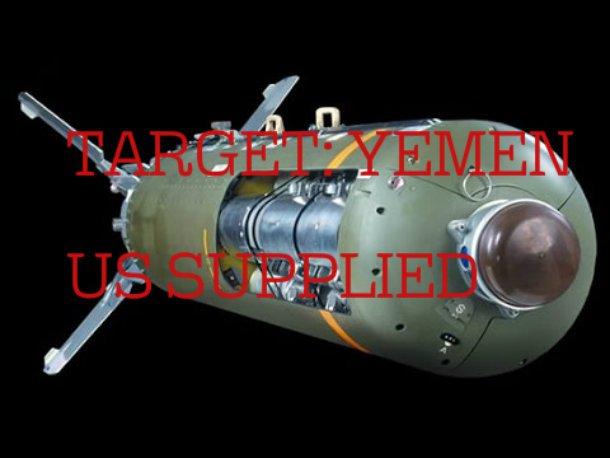
Saudi airstrike on Yemeni market had no apparent military reason – UN
RT | March 18, 2016
UN inspectors, who visited the Al Khamees market in north-western Yemen, where Saudi airstrikes killed over a hundred people this week, found no evidence that the attack could have any military goal.
The closest target of any value to justify the bombing is a small checkpoint some 250 meters from the market, which is manned by a small group of Houthis, UN High Commissioner for Human Rights Zeid Ra’ad Al Hussein said on Friday.
The market attack in Hajja Governorate on Wednesday was one of the deadliest incidents in Saudi Arabia’s year-long campaign in Yemen, Zeid said, describing it as “carnage.” The death toll was reported as 106 people, including 24 children. The high figures are explained by the timing of the airstrikes, which were delivered during the afternoon rush hour at the market. It serves as the main shopping destination for some 15 surrounding villages.
Since the Yemeni campaign was launched in March last year by the Saudi-led coalition of Arab nations, the UN has recorded just under 9,000 casualties in Yemen, including 3,218 civilians killed and a further 5,778 injured, Zeid said.
“Looking at the figures, it would seem that the coalition is responsible for twice as many civilian casualties as all other forces put together, virtually all as a result of airstrikes,” he said.
“They have hit markets, hospitals, clinics, schools, factories, wedding parties – and hundreds of private residences in villages, towns and cities including the capital Sana’a,” he added. “Despite plenty of international demarches, these awful incidents continue to occur with unacceptable regularity. In addition, despite public promises to investigate such incidents, we have yet to see progress in any such investigations.”
He warned that “we are possibly looking at the commission of international crimes by members of the Coalition.”
“I urge both sides to swallow their pride and bring this conflict to a halt,” Zeid said. “The people of Yemen have suffered enough. A very poor country is having its limited infrastructure decimated, and people are struggling desperately to survive.”
Earlier, the Al Khamees market bombing was condemned by UN Secretary General Ban Ki-moon and a number of international organizations. Saudi Arabia said it would scale down its aerial campaign in Yemen and focus on training Yemeni troops.
The campaign’s goal in Yemen was to push back Houthi rebels and forces loyal to former President Ali Abdullah Saleh and bring back to power exiled former President Abd Rabbuh Mansur Hadi.
UN Aid to Deir ez-Zor Lands in Daesh-Controlled Territory
Sputnik — February 25, 2016
The UN World Food Program’s (WFP) aid intended for the besieged Syrian city of Deir ez-Zor has landed mostly in territories controlled by Daesh, a source in the city’s administration said Thursday.
Earlier on Thursday, the United Nations said that the WFP had dropped 21 tons of aid into city on Wednesday.
“Planes dropped the humanitarian help sent by the United Nations into the territory controlled by Daesh. Just two containers ended up in the areas where the Syrian army [is located],” the source told RIA Novosti.
The contents of the containers that landed on the government-controlled territory has been badly damaged due to a parachute system failure, the source added.
According to earlier reports, the WFP has issued a statement admitting difficulties with the operation, adding that necessary adjustments are being carried out.
Some 200,000 people living under the Daesh-imposed siege in Deir ez-Zor are experiencing severe water shortages and a total lack of electricity, according to the United Nations.
Russia has also been providing humanitarian aid to the Syrian people, including through joint efforts with the Syrian government, particularly in Deir ez-Zor.
The UN and the Invisible Palestinian Knives of Allege-gate
By Vacy Vlazna | Dissident Voice | February 17, 2016
In Palestine, you would be forgiven for thinking that there was no United Nations Special Rapporteur on extrajudicial, summary or arbitrary executions.
The SR, Christof Heyns, in the past 6 years, has never made a country on-site visit to Palestine to get first hand information on the hundreds of cases of Zionist perpetration of extrajudicial, summary or arbitrary executions of the people of Palestine.
Not even the dozens of extrajudicial street executions of Palestinian children and youth carrying the invisible knives of Allege-gate since October 1, 2015 has impelled Heyns to rush to Palestine to ensure the zionist war criminals uphold Palestinian right to life.
In Palestine ‘alleged’ is a synonym for ‘extrajudicial, summary, or arbitrary execution’.
Yes, there is a Palestinian youth intifada, and, yes, there have been acts of resistance to the illegal occupation involving knives, rocks, and cars that have taken some occupier-settler lives.
But the Zionist Occupation Forces (ZOF); i.e., military and police death squads are running amok in Occupied Palestine shooting, seemingly for grisly amusement, innocent Palestinian school children, workers, housewives and youth.
In a wimpy statement on 16 November 2015, SR Heyns welcomed the assurance of the Zionist “Attorney General Yehuda Weinstein to the effect that Israeli security forces are prohibited from firing at a suspected assailant unless an immediate danger to human life cannot otherwise be prevented and that the use of fire must be proportional to the threat.”
You can be certain that the devastated parents of Wisam Qasrawi, 21 who buried their beloved child – transformed from family breadwinner into a martyr by lawless zionist bullets – know Wisam was killed in an indisputable and illegal extrajudicial execution.
 Wisam was born in a village, Misilya. It was described for the Palestine Exploration Fund (patron was Queen Victoria) by Royal Engineers’ surveyor Lieutenant Condor in 1881 as a village with ancient wells beneath it and a rounded hilltop above with extensive views north east across the great plain to Nazareth, west to Carmel, and to Jenin behind a neighbouring hill, ‘north west across a broad corn vale’.
Today, Misilya continues its ancient agricultural lineage of growing olives and cereal. Its 3000 residents are close-knit and mainly poor because of the crippling zionist occupation.
Wisam was outgoing, energetic, well liked and had lots of friends with whom he enjoyed playing playstation and billiards at the local cafe. Wisam also had an admirable sense of responsibility; he left school in year 11 to become the family breadwinner because his father had a severe back injury and his mother had small twins plus his other younger siblings to care for. Even while at school he worked as a part-time farm or building labourer to help out.
The early morning of Sunday, January 17th, gave no hint of impending tragedy. Wisam got dressed for his work at a brick/stone factory in Nablus, gave his mother the remaining money in his wallet and armed only with his mobile joined his mate who was giving him a lift as far as the Huwwara checkpoint. He was dropped off about 500 yards from the checkpoint.
Eyewitnesses reported that the heavily armed soldiers were calling out to Wisam, “Come on, come to us”. Wisam walked, relaxed and hands in the air, and at 50 metres military shots burst hitting his chest and head. Typically, he was left to bleed out and die.
Within 10 minutes, even before Wisam’s mate returned to Misilya, the Zionist news reported an alleged attempted stabbing at the Huwwara checkpoint with no soldiers injured (understandable).
By the afternoon the ZOF had made incursions into Wisam’s village, set up checkpoints and closed off the village which was in collective shock, helplessness, anger and mourning.
Wisam’s body was returned at night and respectfully given a martyr’s burial; the body is not washed as usual with scented water and wrapped in a shroud, but the martyr is buried in the clothes in which he/she died and the blood is left unwashed. According to a Hadith – on Resurrection Day, the Shahid’s blood -“Its color saffron, and its odor musk”.
With 68 years of the violent unrestricted bloodletting of martyrs, the scent of this holy musk is tragically Palestine’s oxygen.
Wisam is no more, just as Ehab, Khalil, Ahmad, Ruqayya, Dania, Nihad, Fuad, Naim, and all the other young innocent invisible-knife wielders, are no more.
The UN was set up to maintain international peace, security and human rights for all. In 68 years, the now 192 member states of the UN have not furthered one moment of peace and justice for the people of Palestine.
The Zionist state has over and over, day to day, blatantly violated every UN declaration and convention it has ratified and it has never been suspended or expelled from the UN:
A Member of the United Nations which has persistently violated the Principles contained in the present Charter may be expelled from the Organization by the General Assembly upon the recommendation of the Security Council.
The UN is as fake as the fake knives of Allege-gate. Both are smokescreens for impunity for Zionist brutality and crimes against humanity.
Dr. Vacy Vlazna is Coordinator of Justice for Palestine Matters. She was Human Rights Advisor to the GAM team in the second round of the Aceh peace talks, Helsinki, February 2005 and then withdrew on principle. Vacy was coordinator of the East Timor Justice Lobby as well as serving in East Timor with UNAMET and UNTAET from 1999-2001.
UN ‘conservative estimates’ show 700 children among 6,000 Yemen fatalities
RT | February 17, 2016
The UN will launch a humanitarian drive to raise some $1.8 billion required to save millions of people from humanitarian catastrophe in Yemen, where over 6,000 people have been killed since the Saudi-led coalition intervention in March 2015.
In a briefing to the 15-nation United Nations Security Council, Stephen O’Brien, the UN Under-Secretary-General for Humanitarian Affairs, announced that on Thursday the Yemen Humanitarian Response Plan will be launched in Geneva.
The plan aims to raise $1.8 billion to cover the “most critical and prioritized needs” that includes food for nearly nine million people. The money will also be used for water and sanitation for some 7.4 million people and medical treatment for 10.6 million people.
Highlighting the urgent need for the Security Council to take greater measures to protect civilians, O’Brien said that the UN should insure that people have a chance to survive.
“Some 2.7 million people have had to flee their homes. At least 7.6 million people are severely food insecure. Some two million acutely malnourished children and pregnant or lactating women need urgent treatment,” he told the UNSC.
He noted that since the escalation of the conflict in March 2015 which has involved Saudi-led bombings, over 6, 000 people have been killed.
“More than 35,000 casualties, including over 6,000 deaths, have been reported by health facilities across the country,” since last March, O’Brien said, adding that UN has confirmed that out of that number, 2,997 were civilians deaths, in addition to 5,659 that were injured as the result of the hostilities.
Of great concern to the UN is the fate of the children in the conflict. O’Brien said that “conservative estimates” suggest that over 700 children have been killed and over 1,000 more injured. He also noted that as many as 720 children have been documented as having been forcibly recruited as child soldiers by the warring parties. The diplomat also noted that some 1,170 schools have been closed leaving some 3.4 million minors out of education.
The destruction or closure of health facilities, which totals some 600 since March, has also left some 14 million Yeminis in desperate need of medical attention.
Noting that on Sunday Saudi-led coalition airstrike struck a building 200 meters away from UN and diplomatic personnel facility, he urged all parties in Yemen to protect civilians.
“The parties to the conflict have a duty of care in the conduct of military operations to protect all civilian persons and objects, including humanitarian and health care workers and facilities, against attack,” Mr. O’Brien said, reminding all parties of their obligations under international humanitarian law to “facilitate humanitarian access to all areas of Yemen,” he said.
At the same time, O’Brien noted that for the past two weeks Saudi Arabia has continued to impede the work of UN staff in the country, “causing delays to important missions.” The diplomat said that Riyadh is also blocking sea access to Yemen’s ports, and is preventing aid from traveling around the country,
“Access to northern Governorates where needs are among the most severe in the country also continue to be challenging due to relentless conflict, including airstrikes – in particular to communities along the border with Saudi Arabia where conflict is intense,” O’Brien noted.
Tensions in Yemen escalated after Shia President Saleh was deposed in 2012 and his Houthi supporters, reportedly aided by Iran, eventually seized the capital city Sana’a last year. Houthi forces then advanced from Sana’a towards the south, seizing large parts of Yemen, and sending the current Sunni President Abd-Rabbu Mansour Hadi into exile.
In late March, a Saudi Arabian-led coalition responded with airstrikes in order to stop Houthi advances and reinstate Hadi back in power. By late summer, the Saudi-led forces had started a ground operation, which so far is stuck in a stalemate.
Featured Video
Chinese jet fuel and the myth of energy independence
or go to
Aletho News Archives – Video-Images
Book Review
Former Insiders Criticize Iran Policy as U.S. Hegemony
By GARETH PORTER | CounterPunch | February 27, 2013
“Going to Tehran” arguably represents the most important work on the subject of U.S.-Iran relations to be published thus far.
Flynt Leverett and Hillary Mann Leverett tackle not only U.S. policy toward Iran but the broader context of Middle East policy with a systematic analytical perspective informed by personal experience, as well as very extensive documentation.
More importantly, however, their exposé required a degree of courage that may be unparalleled in the writing of former U.S. national security officials about issues on which they worked. They have chosen not just to criticise U.S. policy toward Iran but to analyse that policy as a problem of U.S. hegemony. … continue
Blog Roll
 Aletho News
- What is fueling unrest across the EU?
- Why no power can undermine Iran’s eternal dominance over the Strait of Hormuz
- Is The War Against Iran Over?
- Iran war will leave long-term ‘scar’ on Wall Street, investors warn
- How Iran decimated US power projection in West Asia: Military lessons of 40-day war
- Iran’s report details US-Israeli war crimes in targeting schools, hospitals, livelihoods
- NATO’s Slow Fracture: How Trump’s Iran War Exposed the Instrument of Hegemony
- Chinese jet fuel and the myth of energy independence
- Ukraine Sea Drone Fired From Libya Hit Russian Tanker in Mediterranean
- IRGC: Iranian forces launched no attacks during ceasefire hours
- If Americans Knew
- DNC Shoots Down Resolutions Calling Out AIPAC and Limiting Arms to Israel
- TCN: Is Israel Blackmailing President Trump?
- Israel killed at least 303 Lebanese yesterday – who were they? Daily Update
- Amnesty: Urgent – Protect Lebanese civilians from brutal escalation in Israeli attacks
- Is The War Against Iran Over?
- Inside the Israeli army’s propaganda wing
- Hundreds of Gaza Amputees Stranded in Legal Limbo
- The gallows law: Israel moves toward executing Palestinian children
- Tucker Carlson: The Path to Peace requires ending ‘special alliance’ with Israel
- This is ceasefire? Israel’s biggest massacre yet in Lebanon, another journalist killed in Gaza – Daily Update
- No Tricks Zone
- An Inconvenient Tree: Uncovered In Alps… Europe Much Warmer Than Today 6000 Years Ago
- New Study Reports A 60% Slowdown In Greenland’s Ice Loss Rate In The Last Decade
- Low Intensity Tornado Wrecks Major Solar Farm, Creating A Potential Toxic Dump
- New Study Finds Warming Saves Lives…Cold Temperatures 12 Times More Deadly Than Excess Heat
- German Science Blog Accuses PIK Climate Institute Of Hallucinating Climate Tipping Points
- Devastating Assessment Of Comirnaty Vaccine By Former Senior Pfizer Europe Toxicologist
- New Study: CO2 Is ‘Effectively Negligible’ As An Explanatory Climate Change Factor Since 2000
- Former Pfizer Toxicologist Dr. Helmut Sterz Tells Bundestag Hearing Pfizer Vaccine Should Have Never Been Approved
- Energy Expert: Germany’s Nuclear Phaseout Was A “500 Billion Euro Mistake”
- New Research: South Australia’s Mid-Holocene Sea Surface Temperatures Were 4°C Warmer Than Today
 Aletho News