Canadian Premier Harper skips UN General Assembly to get Jewish award

Press TV – September 28, 2012
Canadian Prime Minister Stephen Harper has come under fire for skipping the 67th session of the UN General Assembly to attend a private ceremony where he received an award from a Jewish-sponsored organization.
Passing up the opportunity to address the General Assembly, Harper chose to receive the New York-based Appeal of Conscience Foundation (ACF) award from former US Secretary of State Henry Kissinger on Thursday.
The Canadian official seized the opportunity to level criticism at the UN and accused its members of using the world body as a “forum to single out Israel for criticism.”
Harper further added that the policies of the Israeli regime are not to blame for “the pathologies present in that part of the world,” while reaffirming Canada’s support for Tel Aviv.
However, the Canadian prime minister’s decision not to speak at the opening of the General Assembly drew harsh criticism in Canada from opposition leaders, who called the move “absolutely ridiculous.”
“I think the message is that Canada, that the Harper government doesn’t care about the United Nations,” said Bob Rae, the interim leader of the Liberal Party of Canada.
This is the second consecutive year that Harper has shunned the UN event, preferring to send Foreign Affairs Minister John Baird in his place.
Many in Canada are concerned about Harper’s conservative policies as he is also accused of locking his government behind a wall of secrecy, defunding democratic institutions and giving away Canada’s sovereignty to the UK and the Israeli regime.
Apartheid leader lectures the UN
By Mazin Qumsiyeh | Popular Resistance | September 27, 2012
The Prime Minister of Apartheid Israel just lectured the United Nations General Assembly! He spent most of his time nagging those present as if they were school children about Iran. He even insulted their intelligence by showing them a diagram of a “bomb” and drawing a red line on it (yes literally with an actual red marker). He also went about insulting 1.6 billion Muslims and even had the “chutzpa” to claim Israel is helping people around the world!
Those in attendance were less numerically and qualitatively than those who attended the Iranian president’s speech. Netanyahu thus utterly failed to anticipate the transformed reality around him and acted as if Israel can still run the show and start wars that others fight for it. He must have not even been briefed on the Egyptian President’s speech. The first democratically elected leader of Egypt received significant applause when he said that the world community must stop the hypocrisy and charade of injustice beginning with “the number one” issue: justice for Palestine. Netanyahu merely dismissed Mahmoud Abbas’s speech with just one sentence “we won’t solve our conflict with libelous speeches at the UN or unilateral declarations of statehood.” [No we solve them via continuing colonization]. He dismissed all Palestinians and their rights by claiming they need to recognize a “Jewish state” then they could be allowed a vague but “dimiltarized state”.
The very moderate/accommodating PLO representative Mahmoud Abbas had said that he wanted to gain the overdue legitimacy for a Palestinian state at the UN and “not delegitimize Israel”. But Israel has done a very good job of delegitimizing itself. Israel in fact should be expelled from the United Nations because it failed to live up to its commitments to implement UN resolutions or to be a peace seeking nation. It also fulfils the requirement of being an apartheid state according to the relevant International Convention. Netanyahu’s war mongering and idiotic speech merely confirmed the obvious conclusion about this rogue state: it is run by lunatics. So on the bright side, perhaps putting the last few nails in the coffin of this apartheid system will come from lying racist idiots like Netanyahu.
The frustrated reaction from many world leaders and the shocked reaction by many others to Netanyahu’s “lecture” give us great hope for the future. Indeed the racist mentality and arrogant criminal actions of this man and other Zionists could be the best accelerator for the end of apartheid Israel. “The jig maybe up” as they say in English.
Abla Saadat: A Palestinian Stateswoman marked by “Terrorism”
By Christof Lehmann | No Spin News | September 24, 2012
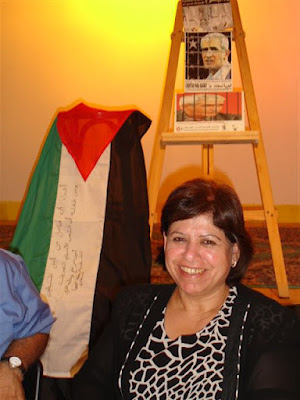 Abla Sa’adat, the Chairwoman of the Palestinian Women Organizations and wife of the Secretary General of the Popular Front for the Liberation of Palestine (PFLP) visited Denmark. I met Abla Sa’adat at a meeting where she told a group of mostly young Danes about Palestine. Had one expected an Abla Sa’adat who conforms with the dehumanizing stereotyping of Palestinians by Israeli and western politicians and main stream media, one would have been surprised by the depth and complexity of Abla Sa ‘adat, her perception of the Palestinian problems and possible solutions.
Behind the veil of the “terrorist” stereotype one discovers an Abla Sa’adat who is a true stateswoman, humanist, human rights advocate, an advocate for international law, justice and peace, the wife of a long term prisoner of war and political prisoner, as well as a mother and grandmother who puts the systematic dehumanization and stereotyping of Palestinians to shame.
In spite of the Hamas – Israeli negotiated prisoner exchange earlier this year, Abla Sa’adat states, more than 5.000 Palestinians remain in prison under administrative detention. She is active in organizations which advocate Palestinian prisoners rights. It is not for personal reasons, so she states, that she is using her husband, PFLP Secretary General Ahmad Sa’adat as an example for how Israel systematically terrorizes politically active Palestinians and their families, but because due to her own experience she knows his case best and because his case is representative of those of thousands of other prisoners and their families.
On the other hand, who would blame Abla Sa’adat for wanting to advocate for her illegally detained husband, the father of her children and grandfather to her grandchildren. At a recent appearance of Ahmad Sa’adat in an Israeli court he was denied physical contact with Abla and his newborn granddaughter Mayar. The destruction of politically active Palestinian families family ties and the destruction of Palestinians’ family systems is systemic and systematic.
After the PLO signed the Oslo Accords and the Palestinian Authority (PA) was established, the situation in the occupied Palestinian territories within the 1967 borders has not improved and the Israeli governments have systematically avoided adhering to the provisions of the Oslo Accords. Contrary to improvements, the reality of the matter is that: Israel has confiscated more land, increased its infringements on Palestinians’ water rights, built more settlements and settler only roads and railways, built the so called “security wall” which isolates Palestinian West Bank villages in micro enclaves, continued a policy that devastates Palestine’s economy; Israel continues to illegally arrest and detain Palestinians under illegal forms of imprisonment, the use of torture is endemic, the use of disproportionate military force is well documented, and these items only touch the surface of the daily violations of the Oslo Accords. According to the Oslo Accords Palestinian prisoners should have been released from prison. Israel did not adhere to this provision either.
What Palestinians gained by signing the Oslo Accords can be described with a few words. The right to establish a Palestinian Authority, which is utterly dependent on the goodwill of Israel. The political factions have gained the privilege to compete with each other for the Presidency over the self-administrated Zionist genocide on themselves while splitting the PLO, rendering it in a state of internal conflict rather than fighting for the liberation of Palestine. In other words, the PLO was entrapped in the glory of Presidency over its own destruction and the destruction of Palestine.
It is within this context one has to understand the arrest and detainment of Ahmad Sa’adat. Israel demanded that the Palestinian Authority arrest him for “terrorism,” and the Fatah led PA made sure that he was arrested and detained. The tragic irony of the situation is that the Oslo Accords resulted in the Palestinian Authority arresting and detaining the Secretary General of the PFLP Ahmad Sa’adat on behalf of Israel, and that Israeli pressure and US and British complicity since have resulted in Sa’adat being imprisoned in an Israeli prison and not, as initially, in a Palestinian prison with US and UK military guards. In fact each and every detail of Ahmed Sa’adat’s imprisonment is in violation of the Geneva Conventions, the Conventions against the use of Torture and other bodies of international law. Ahmed Sa’adat was sentenced to thirty years in prison for being the Secretary General of the PFLP, which is designated as a “terrorist organization” by the USA, Israel and the E.U. He has spent years on end in isolation.
Prior to his arrest Ahmed Sa’adat was elected to the Palestinian parliament. Abla Sa’adat explained that 22 members of parliament are currently imprisoned in Israeli prisons, many of them in isolation. The occupation is in fact preventing the functioning of Palestine’s democratic institutions.
Isolated prisoners are locked up for 23 hours a day. For one hour they can leave their cells and spend their time in an indoor yard, in shackles and hand-cuffs, without the possibility to exercise. There is absolutely no contact to other prisoners. Ahmed Sa’adat was isolated for three years before he was granted ” the privilege” to have his first visitor. Other families, Abla Sa’adat said, have been waiting ten years before they could see their imprisoned husband or father for the first time. Many can not even visit their relatives even if they are granted permission because road blocks and bureaucracy make it impossible to get to the prison and back.
Both Amnesty International, the Red Cross and lawyers complained that this form for imprisonment constitutes torture as well as a breach of the Geneva Conventions, but to no avail. Israel disregards these organizations and laws as well as it has disregarded almost any of the UN Resolutions pertaining Israel, Palestine or the Situation in the Middle East. Ironically, Israel is claiming the legitimacy of the state of Israel from the very organization whose resolutions it systematically disregards.
The impact of isolation and sensory deprivation on prisoners is well documented in numerous and comprehensive scientific studies. Even short term isolation for one to two weeks has a significant impact on a prisoners ability to concentrate, on memory, and general psychological well-being. Longer term and long term isolation for months to years on end have a devastating effect on the human being. Already after a few weeks most isolated prisoners experience several of the following symptoms.
-
Loss of the ability to concentrate
-
Loss of the ability to think coherent thoughts.
-
Loss of short and long-term memory.
-
Visual, auditory and tactile hallucinations, such as the sensation that the entire cell is driving like a train carriage or rotating.
-
Severe mood disorders.
-
Severe dissociative symptoms or dissociative disorders.
-
Suicidal ideas and increased prevalence of suicide attempts and death due to suicide compared to non-isolated prisoner populations.
-
Symptoms of learned helplessness.
-
Inability to participate as an active part of a legal defense.
-
And a cohort of other, severe symptoms.
It is for very good, science-based reasons that long term isolation is internationally recognized as torture. Israel is systematically using isolation to psychologically and physically destroy politically active Palestinian prisoners.
While the systematic and wide spread use of long-term isolation has a devastating effect on the prisoners themselves has a devastating effect on the isolated prisoners family systems as well. Spouses who have not seen one another for years on end risk growing strangers to one another. Children who are infants when a parent is imprisoned often see their father or mother for the first time when they are teens. It is impossible to remedy the lack of early attachment and the lack of a possibility to to know ones parents or ones children intimately or at least to such a degree as a normal imprisonment allows, which is devastating enough.
One of the long term prisoners, Nabeel Barghouti was imprisoned for 30 years. His wife who was pregnant when he was imprisoned gave birth to a son, Fahdi. At the age of 16 his son decided that the only way to see his father was to become a prisoner. After his arrest and imprisonment he fought for the right to be imprisoned under conditions that made it possible for him to see his father. Incidents like these are not extraordinary, although they are extraordinarily tragic.
At a visit, Ahmad Sa’adat would have been unable to recognize his own son on a photograph had it not been for the fact that the boy held a trumpet and that he knew that his son is playing the trumpet. Abla Sa’adat’s worst concern about her husband, she said, is not that he is breaking down mentally. Naturally the long term isolation has set its marks but he is determined in his struggle for liberation. What concerns her most is that she can see, that her husband is suffering the physical effects on the body which long term prisoners in Israel are suffering.
It took a months long hunger strike of Palestinian prisoners to finally end all long-term isolation of Palestinian prisoners in Israel’s prison industry; and it is a prison industry, in the literal sense of the word. E.U. Subsidies per prisoner exceed Israel’s costs per prisoner per day, and there are other methods such as fines which make it a lucrative business for Israel to hold as many prisoners as possible.
Years ago, Abla Sa’adat recalled, she was arrested while her husband already was imprisoned. Who would take care of the children? Israel is systematically using illegal forms of arrest and imprisonment to terrorize and destroy politically active families, and those who help targeted families in coping risk being targeted too.
The Stateswoman in Abla Sa’adat came out when she raised concerns about the targeting and imprisonment of Palestinian children. Stateswoman in the true sense of the word, as a politician, a revolutionary, as well as a mother for her own children, and a politician who has a motherly love for the plight of the children of Palestine and families with children.
Children are regularly arrested, beaten, shot at and killed for protesting the occupation. Many of them are provoked into conflicts with the occupation forces. Tanks rattling near school buildings for hours, stressing the children and making it impossible for them to follow a normal schedule are just one of hundreds of ways to provoke the throwing of a stone. The response can be everything from being beaten, arrested and imprisoned, injured or killed.
Abla Sa’adat draws attention to the fact that the international conventions and laws which regulate the rights of imprisoned children are also systematically circumvented or ignored by Israel. Besides that the child prisoners have become a lucrative form of income for Israel. The fines are high and children are often not released before the fine is paid.
Another way of destroying Palestinian family systems is the placement of children who are sentenced to house arrest with family members so far away from their parents that road blocks and daily chicane makes it impossible for the parents to maintain contact with the children.
Abla Sa’adat is drawing attention to the fact that the prevalence of psychological disorders among Palestinian children is extremely high. In fact, the prevalence of psychological disorders is extremely high in the general Palestinian population, regardless which age group one studies. Many of these psychological problems are caused by the occupation, and the prevalence of trauma-related problems is staggering.
A 1996 Study by Save the Child documented that most children internalize the conflict with the occupation. The violent problem-solving models are then transferred into the family system and into school teacher relations, leading to immense pedagogical problems. The violent problem solving models are also transferred to child on child relations. Children growing up under such conditions are, as adults, prone to use violent problem solving models. The effect is not only felt in the resistance against the occupation. In fact, the effect is more likely to manifest in spousal abuse, child abuse, proneness to the use of violence to settle family disputes, political disputes, financial disputes, and so forth. This internalization during childhood has an all pervasive and devastating effect on all levels, individual, family, community level, and in the halls of government.
The Oslo Accords, says Abla Sa’adat, have not brought any improvements for Palestinians and the debate among Palestinian factions to abandon the Oslo Accords and all subsequent agreements is finally being seriously debated among the factions.
Abla Sa’adat made a point of clarifying that she has nothing against Jews in Palestine or anywhere else. Jewish, Christian, Muslim and Secular people have been living in Palestine for centuries. The often used propaganda, that Palestinians want to drive the Jews back into the sea, she states, has nothing to do with reality. Her cause and the cause of the Palestinian liberation is not directed against Jews but against Zionism and Zionists. There is a difference, she states, between Jewish families who have been living in Palestine for centuries, and those who came and still are coming to Palestine to steal Palestinian land and evict or murder Palestinians.
A two State solution, says Abla Sa’adat, is the very minimum and it would be difficult to implement. She asks, if a Palestinian state should be established within the borders of 1967, what about those families who have been refugees since 1948? The most realistic solution would be, she said, to establish one secular state in all of Palestine. One secular, democratic state for Jews, Christians, Muslims and Secularists within all of the Palestinian territories. The greatest obstacle to the establishment of such a state is, that Zionists insist on a Jewish State, where Muslims, Christians and Secularists alike have no place, and if at all, then as second class citizens.
With a Middle East on fire, with a Libya that has fallen into the hands of Islamic extremism, and with Syria under attack from western sponsored extremists and Al Qaeda associated organizations from throughout the world, with Qatar, Jordan, Bahrain, Saudi Arabia, the U.A.E., the USA, NATO member states and Israel sponsoring and backing the extremists’ subversion of Syria, Abla Sa’adat, who is widely decried as “terrorist,” sounds like one of the most reasonable Middle Eastern voices of moderation I have heard since the onset of the so-called Arab Spring. If Abla Sa’adat is marked by terrorism, it is because a lifetime of enduring the terror of the Zionist occupation is as imprinted in her as it is in every Palestinian.
* Dr. Christof Lehmann, a life time peace activist, psychologist, and advisor in behavior, finance, economics and politics.
Related articles
- The racism behind a two-state solution (alethonews.wordpress.com)
- Saadat: “Zionist War Criminals Are The Ones Who Must Be Prosecuted” (imemc.org)
- Ahmad Sa’adat refuses to recognize legitimacy of Israeli court, “a tool of repression against Palestinian prisoners” (altahrir.wordpress.com)
Congressmen urge America’s UN Ambassador to act for sanctions on Sudan
Sudan Tribune | September 22, 2012
KHARTOUM — A bipartisan group of 38 Congressmen urged United States Ambassador to the United Nations Susan Rice to work for imposing sanctions against the Sudanese government because of its failure to allow humanitarian access to the Two Areas of South Kordofan and Blue Nile.
On 4 August the mediation announced that Sudanese government and the rebel Sudan People’s Liberation Movement North (SPLM-N) have reached an agreement to provide civilians in the rebel held areas with humanitarian assistance.
However until now the operation has not begun as the Sudanese government and tripartite committee, of UN agencies, Arab League and African Union, continue to hold meetings over its implementation.
The rebel SPLM-N called for an international operation from South Sudan or Ethiopia but the demand is rejected by Khartoum. Senior members of the SPLM-N rebels were recently in Washington and urged Congressmen to act on Sudan’s humanitarian crisis.
In their letter of 21 September, the lawmakers said they were concerned by the humanitarian crisis in the Blue Nile and South Kordofan reminding them that some 650,000 people have already been displaced or severely affected by the conflict in these border states.
After praising Resolution 2046 and the threat to impose sanctions if its dispositions are not met, the Congressmen state that “the Security Council’s principled position must be enforced in order to be credible. Accountability is key when lives hang in the balance.”
The UN Security Council is to meet next week to assess the whole process including the talks between Khartoum government and rebels.
In a statement issued on 21 September, the 15 member council said it was gravely concerned about the worsening humanitarian situation in the states.
“The members of the Council once again stressed the urgency of immediately delivering humanitarian relief supplies to the affected civilian populations, so as to avoid any further suffering or loss of life,” the statement said.
They further urged the two parties to “begin direct talks, urgently agree to and implement a cessation of hostilities, and create a conducive environment for further progress on political and security issues.”
In Khartoum the Sudanese humanitarian commissioner Suleiman Abdel-Rahman told the official SUNA that they had reports that an aircraft belonging to a foreign aid group landed in the rebel-held town of Kauda without permission from the Sudanese government.
He also said that humanitarian assistance was recently delivered to the rebel-held areas through an unspecified neighbouring state or air drop operations.
Related articles
- Sudan rebels say town entered, army camp destroyed (dailystar.com.lb)
US Denies Iranian Officials Visa for UN General Assembly Meeting
Fars News Agency | September 22, 2012
TEHRAN – The US denied entry visas to two Iranian ministers and other members of the delegation accompanying President Mahmoud Ahmadinejad to attend the UN General Assembly meeting in New York.
The US State Department refrained from issuing visas for 20 officials of the 160 people for whom the Iranian government had demanded entry visas two months ago.
The US didn’t issue visas for two deputies of Iranian President’s Chief of Staff Esfandiar Rahim Mashayee as well as two ministers of President Ahmadinejad’s cabinet.
The US has several times denied entry visa to Iranian officials for UN General Assembly meetings, showing the necessity for a change in the venue of the meetings of the world body, which requires attendance of the representatives of all the world states.
Ahmadinejad and his accompanying delegation left Tehran for New York at the head of a delegation today in a bid to attend a UN General Assembly meeting and hold talks with senior heads of state who will participate in the meeting.
Over 150 security officers will guarantee President Ahmadinejad’s security during his stay in New York.
President Ahmadinejad will address the UN General Assembly which is due to start on September 25. Since taking office, Ahmadinejad has attended all annual UN General Assembly meetings.
This year Ahmadinejad will also attend the meeting as the rotating president of the Non-Aligned Movement (NAM).
He also is also scheduled to attend bilateral talks with several of his counterparts on the sidelines of the UN General Assembly meeting.
Ahmadinejad is also set to meet American university students, artists, intellectuals and elites despite the ongoing efforts made by the pro-Zionist lobbies to prevent direct link between American people and the Iranian president.
He has also accepted the interview requests made by several news networks, including CNN, CBS and Russia Today (RT).
President Ahmadinejad has, thus far, visited New York seven times to attend the annual UN General Assembly meetings since he ascended to power in 2005. But this time, he will attend the meeting not just as Iran’s President, but as leader of the 120-nation NAM.
This will be Ahmadinejad’s last visit to attend a UN General Assembly meeting as Iran’s president since he will step down presidency in the next 10 months at the end of his second term in office.
Ahmadinejad’s visits to New York to attend the UN General Assembly meetings have become a source of concern for the US officials ever since his 2007 visit led to a landmark speech at the Columbia University on the sidelines of the 62nd annual meeting of the United Nations General Assembly.
He gave an outstanding speech about the US, Israel and the existence of the Holocaust when he visited the campus in 2007 for a talk, and he was given repeated applause by thousands of the audience who filled the campus site and the nearby streets up to Broadway.
Turkey’s Syrian Misadventure
By Jeremy Salt | Palestine Chronicle | September 15, 2012
Ankara – Turkey’s intervention in Syria has been an act of unprecedented folly. Not since the republic was established in 1923 – not even when the military was in charge – has a Turkish government sought ‘regime change’ in another country. In sponsoring armed groups seeking to destroy the Syrian government, the collective calling itself ‘The Friends of the Syrian People’ appears to be committing serious violations of international law. While the focus has to remain on the prime victims of their intervention, the Syrian people, it is also the case that more than a year later the policy has not worked for Turkey and is blowing up in the face of its architects, Prime Minister Recep Tayyip Erdogan and Foreign Minister Ahmet Davutoglu.
International Law
Article 2 (1) of the UN Charter (1945) states that the organization is based on the ‘sovereign equality of all its Members’. Article 2 (3) states that all members ‘shall settle their international disputes by peaceful means in such a manner that international peace and security and justice are not endangered’. Article 2 (4) required all members to refrain in their international relations ‘from the threat or use of force against the territorial integrity or political independence of any state or in any manner inconsistent with the Purposes of the United Nations’. Article 2 (7) states that ‘nothing contained in the present Charter shall authorize the United Nations to intervene in matters which are essentially within the domestic jurisprudence of any state’. Chapter 7 of the charter grants the Security Council the right to take action but only in cases of a threat to peace, a breach of the peace or an act of aggression. ‘Peace’ here is clearly intended to mean international peace and not the disruption of domestic peace by domestic disorder.
In 1965 the sovereign rights of the state were further affirmed in General Assembly Resolution 2131 (XX), entitled Declaration on the Inadmissibility of Intervention in the Domestic Affairs of States and the Protection of Their Independence and the Protection of Their Independence and Sovereignty, passed on December 21 by a vote of 109-0. Three of the core principles are adumbrated below:
1. No State has the right to intervene directly or indirectly for any reason whatever in the internal and external affairs of any State. Consequently armed intervention and all other forms of interference or attempted threats against the personality of the State or against its political, economic and cultural elements are condemned.
2. No State may use or encourage the use of economic, political or any other type of measures to coerce another State in order to obtain from it the subordination of the exercise of its sovereign rights or to secure from its advantages of any kind. Also no State shall organize, assist, foment, finance, incite or tolerate subversive, terrorist or armed activities directed towards the violent overthrow of the regime of another State or interfere in civil strife in another State.
The fact that powerful states bully the weak and frequently violate their sovereign rights is no excuse for Turkey to do the same. The question of whether the Justice and Development Party government is violating Turkey’s own laws is another issue, already raised in the Turkish media and by opposition politicians.
Disarray
None of this would matter so much if Turkey’s policy had worked out. Bashar would have gone in a few months and the Turkish Prime Minister and his Foreign Minister would be hailed for their foresight and courage but now it is they who are on the hot plate. Bashar is still in power and the army – the foot soldiers mostly Sunni Muslims – has not broken up on sectarian lines. The armed protégés of the outside governments are steadily being contained and driven out of the towns and the cities they have infiltrated. Fighting continues but external support for the armed groups seems to be waning. The US was already losing its appetite for direct intervention under the aegis of NATO and in the wake of the murder of the US ambassador to Tripoli by the very people whom the US used as auxiliaries to destroy the Libyan Jamahiriya and its founder, it can be ruled out altogether and not only because of fear of the Russian and Chinese reaction. Finally the US is taking a clear look at the people likely to inherit in Syria if Assad goes and it does not like what it sees.
The recent statement of a ‘rebel commander’ in Aleppo that 70 per cent of the population remains loyal to the government probably means that 90 to 95 per cent support the government and not just in Aleppo, where local Christians have been forming armed groups to defend themselves. It is only another strand of western involvement in Syria that politicians who wear their Christianity on their sleeve in Washington and London have completely ignored the evidence of the killing and intimidation of Syrian Christians. Only the Vatican has spoken out. Only recently have the sponsors of the armed groups – with the notable exceptions of Saudi Arabia and Qatar – begun looking askance at the savagery of the crimes they are committing, including the massacre of civilians and soldiers, rape, kidnapping and the murder of anyone identified as a ‘regime loyalist’, including police, postal workers, university professors and journalists. In Aleppo they stood their captives against a wall and riddled them with machine gun fire. Later they ‘executed’ 20 bound and gagged Syrian soldiers. In Al Bab – near Aleppo – they murdered postal workers before pitching their bodies from the roof of their building on to the steps below. In Homs the FSA’s Faruq Brigade maintained a special squad whose job it was to cut the throats of the group’s captives. Others have their heads cut off. All of this is justified by the crimes committed or alleged to have been committed by the ‘regime’. Any lines of demarcation between these groups have all but disappeared. There is tacit cooperation between all of them. There is no reason why any sane Syrian would want these people in their midst, especially as many are not even their countrymen but salafis/jihadis/takfiris – Pakistanis, Iraqis, Turks, Saudis, Chechens and Libyans – paid by Qatar and Saudi Arabia. Their role in the armed opposition has become increasingly dominant.
US Target
Syria has been in the gun sights of the US administration for decades. The country’s modern history bulges with attempts to disable it through assassination, attempts to overthrow the government, armed attack and occupation and most recently sanctions: no wonder Syria has become a byword for the mukharabat state. In the past two decades the calibration of the anti-Syrian policy has been in the hands of the neoconservatives. The Middle East was their prime target and Israel their prime beneficiary. The national security strategy announced by the George W. Bush administration was effectively a neoconservative writ for attacking other states if and when the US wanted, with Muslim countries top of the list. The rule book – beginning with the 1648 Treaty of Westphalia – was tossed out the window. After the invasion of Afghanistan the governments of seven states were set up for destruction: Iraq, Lebanon, Libya, Somalia, Sudan, Syria and Iran, not necessarily in that order. Out of the ruins a new Middle East was to be born.
The strategy has been extended to include a wide range of activities befitting a ‘hyper’ state powerful enough to operate outside the law, including ‘extra judicial’ executions and drone attacks that have killed countless numbers of civilians as well as a handful of Islamic militants in Pakistan, Afghanistan, Somalia and Yemen. Osama bin Laden could have been arrested and put on trial but was shot dead in front of his wives and children. This was not an ‘extra judicial’ execution because there is no such thing. For an execution to be legal it must have been preceded by prosecution, trial and conviction but now prosecutor, judge, jury and executioner have all been rolled into one. Osama might have been responsible for murders but he also was murdered. The use of ‘extra judicial’ execution is no more than media apologetics for crime.
Heads of state are no more exempted from the law of the gun than anyone else but there was a time when they were removed covertly. Now it is done right out in the open. The Reagan administration’s failed attempt to murder Muammar al Qadhafi in the 1980s was finally followed by success last year. The oracular statement of Hillary Clinton in Tripoli a few days before his murder that ‘we’ are looking forward to the Libyan leader’s capture or killing was thus fulfilled. It will be remembered that she celebrated the occasion with a joke. The assassination of the US ambassador to Libya was a different matter altogether: she said it left her heartbroken – a technical impossibility, some would say, reminiscent of the old jazz line – ‘something beats in his chest/but it’s just a pump at best’. Certainly she has never been known to utter a word of regret, remorse or apology for the women and children who have been killed by US drone attacks in various countries. Her heart seems quite intact as far as they are concerned.
Clinton’s purpose-driven morality blows around like a weathervane in a high wind but she is no more than the symptom of an ugly moment in history which has produced Guantanamo, extraordinary rendition and torture, the massacre of civilians on the ground and from the air in Baghdad, the urinating on the bodies of their victims by US soldiers in Afghanistan, and even the trophy mutilation of their bodies. One cannot be separated from the other. Reinforcing the systemic place of these crimes, very rarely has anyone even been rapped on the wrist for them.
Overshadowing them all, of course, is the genocidal assault on Iraq, beginning in 1991, and continuing through more than a decade of sanctions and the second war of 2003, but not even for these most terrible crimes has anyone who committed them or was ultimately responsible for them been punished. Clinton and Obama arrived late but added Libya to the pile of corpses and in any case have adhered to the policies set by their neoconservative predecessors.
In this new overtly lawless world, Bashar al Assad is a prime target for assassination. Very possibly he was expected to be at the meeting targeted for bombing by the so-called Free Syrian Army in Damascus a few weeks ago. Usually governments feel obliged to abhor terrorism, especially when directed against the members of other governments, but this time the spokesman for the US State Department more or less said that the victims – the Defence Minister and two other senior figures in Assad’s inner circle – had it coming. Responsibility for this attack was claimed by Riad al Assad, the commander of the FSA who remarked: ‘God willing this will be the end of the regime. Hopefully Bashar will be next’. Mr Assad lives in southeastern Turkey under the protection of the Turkish state. The question is rhetorical but still has to be asked: has Turkey really reached the stage where its government gives sanctuary to a man who openly admits to organizing terrorist outrages in the capital city of another country and is looking forward to the murder of its head of state? The FSA leader’s fervent hope was later echoed in the assertion by French Foreign Minister Laurent Fabius’ remark that Bashar does not deserve to be on this earth. In the world we used to have this would have been called incitement to murder.
Prolonging Violence
Under the UN Charter it is incumbent on all members to seek the peaceful resolution of conflicts that threaten international order. In Syria the US government and its allies have done the reverse. Through their intervention they have created a situation that threatens international order. In pursuit of their own agenda they have supported armed groups, imposed sanctions and agitated against the Syrian government through the UN Security Council and the Arab League.
Far from trying to bring the violence to an end they have prolonged it in the hope that it will eventually bring down the government in Damascus. They have blocked every attempt at a settlement that does not involve the precondition of ‘regime change’. Kofi Annan’s ceasefire could not work because the ‘friends’ were not prepared to compel the armed groups to lay down their arms at the same time as the Syrian army did. Having learned its lesson in Homs, where the tanks were pulled off the streets, only for the ‘rebels’ to take advantage of their withdrawal to reclaim lost positions, the Syrian government is not going to play this game again.
Further back, Saudi Arabia and Qatar torpedoed the Arab League monitors’ mission the moment it became clear it would come up with findings not to their liking. Its report was suppressed as was, more recently, the report resulting from the on-the-ground inquiry into the Houla massacre by the UN Supervisory Mission in Syria (UNSMS). It reached the UN Secretary-General’s office but not the Security Council and the mission’s mandate was terminated soon afterwards. The mission’s commander, Lieut-General Robert Mood, spoke at a press conference of conflicting evidence and it has to be assumed this was the reason for the report being buried. No solution has been allowed by the US that includes the participation of Iran. China and Russia have their own motives for supporting the government in Damascus but their position of opposition to outside intervention and support for negotiations without preconditions at least stands on firm moral and legal grounds. The main Syrian domestic opposition groups have now put forward an initiative for a negotiated settlement starting with the army and all armed factions laying down their weapons simultaneously. Having so far blocked every attempt at a settlement that does not meet their terms, will the ‘Friends of the Syrian People’ allow it to work?
Zero Problems?
In the campaign against Syria – or the Syrian ‘regime’ as the ‘friends’ would insist – Turkey’s role has been central. Until the beginning of last year the Turkish government had pursued policies of ‘soft power’ and ‘zero problems’ around all of Turkey’s borders. It now suits supporters of the government’s position to argue that the ‘zero problems’ policy had failed, when all the evidence suggests that it had been a resounding success. Outstanding issues were resolved, new trade agreements signed and borders opened up. Relations with the two countries with which Turkey has had the most difficult relationship – Syria and Iran – had never been better. The ‘zero problems’ policy will stand as Foreign Minister Davutoglu’s greatest achievement: its destruction will stand as his greatest failure.
Libya marked the beginning of Turkey’s policy turnaround. Erdogan initially responded by saying that military intervention anywhere in the Middle East would be a disaster but with a western triumph inevitable Turkey climbed on board. The spectacle thus arose of a government selling itself on its Muslim credentials coming in behind yet another western attack on yet another Muslim country. With Libya finished – another functional state turned into a dysfunctional state – the western-gulf state alliance then turned its attention to Syria. Erdogan and Davutoglu abruptly dropped their attempts to persuade Bashar al Assad to accept their advice (apparently to negotiate with the Muslim Brotherhood and even to bring it into government) and turned on him. The ‘brother’ of a few months before was now the worst man in the world.
The crisis broke when the two men were already fashioning an enlarged regional and global role for Turkey drawing strength from the connections of the Ottoman past and building on Erdogan’s popular standing across the Arab world following his blistering criticism of Israel. In what critics described as ‘neo Ottomanism’, the two men saw Turkey as a regional leader, role model and servant, as Davutoglu put it a few months ago. A new Middle East was being formed and they positioned themselves on the crest of the wave of reform, albeit in a very selective way because they had little or nothing to say about the need for change in the Gulf states.
Out of Touch
Had Erdogan and Davutoglu been properly advised, had they been more alert, more tuned in to the realities of the Middle East, they would have known that Bashar would not soon be gone. They would have known that he is popular with many Syrians and is seen by them as the best hope for reform. They would have known that confrontation with Syria would undermine relations with Iraq and Iran, as well as putting Turkey at odds with Russia and China. They would have known that these two powers would never allow a repeat of Libya and they might have guessed that the Kurds would take the opportunity of turmoil in Syria to strengthen their own position. They presumed to speak for the Syrian people when not even now is there any evidence that the ‘Syrian people’ in the mass support whom they support. The clearest evidence of what they want remains the referendum of February, when more than half the people on the electoral roll voted to remove the Baath party as the central pillar of society and state and bring in a multiparty system. Of course the changes did not go far enough: after half a century of authoritarian rule, the mukhabarat state was never going to be transformed overnight but what was on offer was certainly better than the mayhem sweeping across Syria with the encouragement of governments that have done nothing but harm to Arab interests over the last two centuries.
Cost of Conflict
The costs of Turkey’s confrontation with Syria have been great. An effective regional policy has been wrecked in favor of policy incoherence. The Kurds have taken advantage of the turmoil, with the PKK escalating its attacks and the Syrian Kurds tightening their grip on the region just south of the border, raising alarm in Ankara at the possibility of a Syrian Kurdish enclave being added to the nucleus of a future ‘Greater Kurdistan’. Bashar is being blamed when it is clear that the Syrian army is stretched to the limit and no longer capable of policing the border as before.
The Iraqi Kurds have been sucked into the vortex of this conflict, with Massoud Barzani convening a meeting of the Syrian Kurds – including a faction closely linked to the PKK – and advising them to settle their differences in the common interest and take what they can. Because of the close political and trade links established with the northern Iraqi Kurdish governorate – at the expense of relations with the actual government of the country – Erdogan was infuriated at Barzani’s endorsement of actions seen as inimical to Turkey’s security interests. Rubbing salt into Iraq’s wounded pride, Davutoglu chose the middle of this crisis to visit the contested city of Kirkuk.
In the southeast sanctions have killed off the cross-border trade with Syria that was the livelihood of merchants and traders in Hatay and Gaziantep provinces. The population of Hatay is more than 50 per cent Alevi and still connected to Alawis across the border by family ties. The Turkish Alevis are strongly opposed to their government’s policies and do not want the ‘refugees’ (formally the ‘guests’ of the Turkish government), the bearded jihadis or the agents of foreign governments in their midst. They see Bashar as the head of a secular regime which is the best guarantor of minority rights and they regard the prospect of a Muslim Brotherhood-type government of the kind apparently favored by Erdogan with absolute anathema. Their reaction to the situation has not been helped by Erdogan’s intermittent political point scoring at Alawi expense. The focus on Hatay revives the question of how the province came to be a Turkish possession in the first place: breaking the terms of its mandate over Syria, the French government handed the region to Turkey in 1938 as a placatory measure before the onset of the Second World War. As for the Turkish people in the mass, the most recent poll indicates that the majority do not support military intervention in Syria. Whether they are aware of how deeply their country already is involved is another matter.
Tens of thousands of Syrians are now pouring out of their country to seek refuge in Turkey, Iraq and Jordan. They are another consequence of the decision to prolong the fighting in Syria rather than help end it. Here it should be remembered that Syria took in half a million Palestinian refugees in 1948 and more than a million Iraqis after the US-led invasion of 2003 created the greatest refugee tragedy in the Middle East since 1948. Now it is Iraq that is taking in Syrian refugees. Refugees of a different category in Syria include the families of the 100,000 Syrians who were driven off the Golan Heights by Israeli forces in 1967.
Although everyone in the collective calling itself ‘The Friends of the Syrian People’ is playing their part, the role of Saudi Arabia and Qatar – the paymasters – is especially pernicious because it is based on a sectarian reordering of the Middle East, with Shi’ism dammed behind a wall of Sunni governments. Saudi Arabia is one of the most reactionary states in the world, not just the Middle East. Qatar is a liberal version of Saudi Arabia but still has no political parties, no parliament, no unions and a system of indentured foreign labor that has been likened to slavery and even bears the same name as that given to the columns of slaves trudging across Africa in the 19th century (the kafil, the name of the wooden collar yoking the slaves together.)
The unprecedented domestic success of Turkey’s Justice and Development Party government has now been followed by unprecedented folly in foreign affairs. It needs to get out of this mess without delay, a conclusion that has undoubtedly already been reached within the party. Turkey needs to get back to where it was and begin the process of repairing the damage done to relations with near neighbors, beginning with Iraq and Iran because it will be a long time before relations with Syria can be returned to an even keel. The whole Syrian venture will have to be wound down. The SNC will have to be abandoned (but it has been a waste of time and money from the beginning anyway) and the commander of the FSA asked to seek lodgings elsewhere. Whatever the support being given to the armed men it will have to be dried up. This is going to create further complications but they will have to be faced. There will be loss of face but that is a problem for the individual politicians and advisers concerned: the interests of the country are the central issue and in any case, loss of face does not even begin to compare with the loss of more lives that will be the only result of persevering with a policy that has failed.
– Jeremy Salt is an associate professor of Middle Eastern history and politics at Bilkent University in Ankara, Turkey.
Related articles
- Who supplies anti-aircraft missiles to Syrian rebels? (english.ruvr.ru)
Iran’s Strategic Diplomatic Victory over the Washington-Israeli Axis: Its Larger Political Consequences
By James Petras :: 09.04.2012
Introduction
Iran chaired, hosted and led the recently rejuvenated Non-Aligned Movement (NAM) meeting in Teheran, attended by delegates from 120 countries, including 31 heads of state and 29 foreign secretaries of state. Even the United Nations General Secretary Ban Ki-Moon, notorious mouthpiece of Washington, felt obligated to address, a forum attended by two-thirds of the member countries of the UN, despite State Department and Israeli objections.
Any objective evaluation of the meeting, its venue, the attendance, resolutions and political impact leads to one paramount conclusion: the NAM meeting was a strategic diplomatic victory for Iran and a major defeat for the US, Israel and the European Union. The entire US-Israeli-EU diplomatic and propaganda effort to isolate and stigmatize Iran, especially over the past decade, was shredded.
The Politics of Attendance
Attendance by representatives of 120 countries demonstrates that Iran is not a ‘pariah state’; it is an accepted member of the international community.The presence of 60 heads of state and foreign secretaries demonstrates that Iran is considered a noteworthy and significant political actor, not a “terrorist state” to be isolated and shunned. The proceedings, debates and discussions among and between the delegates and Iranian leaders convinced those attending that Teheran gives primacy to reasonable dialogue in resolving international conflicts.
Both in terms of form and content the NAM meeting highlighted the superiority of Iran’s diplomacy over and against Washington’s bellicose posturing and improvised diversionary tactics. The fact that the meeting took place in Teheran, that Iran was elected chair, that a major part of the NAM agenda and subsequent resolutions coincided with Iran’s democratic foreign policy, highlights Washington’s policy failures and its isolation on issues of major concern to the larger international community. Pandering to the domestic Zionist power configuration has a high cost in the sphere of international politics.
NAM Resolutions: Iran versus Washington – Israel
The centerpiece of US and Israeli strategic policy has been to claim that Iran’s nuclear program including the enrichment of uranium, are a threat to world peace and in particular to Israel and the Gulf states. The NAM meeting repudiated that position, affirming Iran’s right to develop a peaceful nuclear program including the enrichment of uranium. NAM rejected western sanctions against Iran and other countries. In fact many of the leading members, including India, brought delegations of business executives in pursuit of new economic contracts.
NAM declared its support for a nuclear free Middle East and called for an independent Palestinian state based on 1969 borders with Jerusalem as its capital, in total repudiation of Washington’s unconditional support of the nuclear armed Jewish state.
NAM rejected Egyptian Prime Minister Morsi’s proposal to support the Western backed armed mercenaries invading Syria, major blow to Washington’s effort to secure international support for regime change. NAM unanimously approved several resolutions which affirmed its anti-imperialist principles in direct opposition to US imperial positions: it rejected the US blockade of Cuba; it affirmed Argentine sovereignty of the Malvinas Islands (dubbed the ‘Falklands’ by Anglo-American pundits); it opposed the Paraguayan coup; it supported Ecuador in its dispute with Great Britain on asylum for Assange; it selected Venezuela as the site for the next NAM meeting; it rejected terrorism in all of its forms and modalities, including the state sponsored variant.
Western Propaganda Media: Self Serving Diversions
The resounding diplomatic successes of the Iranian hosts of the NAM meeting were countered by a mass media blitz directed at diverting attention to relatively marginal events. The Financial and New York Times, the BBC and the Washington Post featured a speech by Egyptian Prime Minister Morsi calling for NAM support for the Western backed armed mercenaries invading Syria. The media omitted mentioning that no delegation took up his proposal. NAM not only ignored Morsi but unanimously approved a resolution opposing western intervention and affirming the right of self-determination, clearly applicable to the case of Syria.
While NAM defended Iran’s right to develop its peaceful nuclear program, the mass media publicized a dubious “report” authored by US favorite, Yukiya Amano of the International Atomic Energy Agency (IAEA) questioning Iran’s compliance with his directives. Not surprisingly the report by Amano carried no weight in the deliberations of the 130 delegates, given his notoriety as a front-man for Israeli and US pro-war propaganda.
Overall the mass media deliberately ignored or underplayed the resolutions, dialogue and democratic procedures of the NAM meeting in an effort to cover up the enormous political gulf between the US, Israel, the EU and the vast majority of the international community.
Political Impact of the NAM Conference
NAM seriously undermined the images of the Mid-East conflicts which US policymakers and their acolytes in the EU and Gulf States project: the political reality, which came out of the meetings emphasized that it is the US. Israel and the EU who are outside the mainstream international community. It is the US and EU who lack political allies in the pursuit of colonial wars. It is the Israeli occupation of Palestine and Washington’s policies of ‘regime change’ in Syria and Iran which lack allies. Its Iran’s peaceful nuclear program which has legitimacy not Israel’s nuclear arsenal. The Iranian leadership gained prestige via its openness to international dialogue. In contrast its regional Gulf adversaries, who rely on multi-billion dollar US arms purchases and military bases were denigrated and discredited.
The Iranian proposals to reform the United Nations to make it more democratic and responsive to emerging countries and less a tool of US-EU policymakers resonated throughout the conference. The emphasis on free trade, was manifest in the large economic delegations who attended eager to sign agreements in defiance of US-Israel-EU sanctions.
Conclusion
Temporarily the NAM conference may have lessened the threat of a military attack against Iran, at least by the US and the EU – by demonstrating the political cost of alienating two thirds of the UN Assembly. Nevertheless by demonstrating Israel’s total isolation, (and truly pariah status in the international community), NAM may have heightened the pathological paranoia of the Israeli leadership and hastened its move toward a catastrophic war.
The follow-up of the NAM resolutions requires a permanent organization, a minimum coordinating secretariat to ensure compliance and rapid responses to crises. Otherwise the good intentions and positive moves toward peace via dialogue will be inconsequential.
The mobilization of the NAM members in the UN General Assembly is crucial to withstand the blackmail, bribes, threats and corruption which are used by the Western powers to secure majorities on crucial votes regarding US sanctions, coups and military intervention. Trade, investment and cultural boycotts of Israel should be promoted and enforced, until the Jewish State ends its occupation of Palestine. Clearly Iran, as the newly elected leader of NAM, has a major role to play in ensuring that the Tehran meeting of 2012 becomes the basis for a revitalization of the Movement. Iran can play a constructive leadership role providing it continues to promote a plural collective format based on common anti-imperialist principles.
Related articles
- Iran FM Salehi: NAM Should Oppose Sanctions, Foreign Intervention Unacceptable (alethonews.wordpress.com)
- NAM Summit: Ban Ki-Moon in disgraceful show of US puppetry (alethonews.wordpress.com)
Featured Video

Deception – Submarines against Olof Palme
or go to
Aletho News Archives – Video-Images
From the Archives
Woolsey Fire started at Santa Susana Field Lab — where “radioactive materials released were never accurately measured”
By John Laforge | CounterPunch | November 30, 2018
In my Nov. 16 column, I reported on potential radiation risks posed by California’s Woolsey wildfire having burned over parts or all of the Santa Susana Field Laboratory—south of Simi Valley, Calif., 30 miles outside Los Angeles—site of at least four partial or total nuclear reactor meltdowns.
The field laboratory operated 10 experimental reactors and conducted rocket engine tests. In his 2014 book Atomic Accidents, researcher James Mahaffey writes, “The cores in four experimental reactors on site … melted.” Reactor core melts always result in the release of large amounts of radioactive gases and particles. Clean up of the deeply contaminated site has not been conducted in spite of a 2010 agreement.
Los Angeles’s KABC-7 TV reported Nov. 13 that the Santa Susana lab site “appears to be the origin of the Woolsey Fire” which has torched over 96,000 acres. Southern Calif. Public Radio said, “According to Cal Fire, the Woolsey Fire started on the afternoon of Thursday, Nov. 8 … on the Santa Susana site.” … continue
Blog Roll
 Aletho News
- Brussels cannot say where its own pipeline inspectors are as Hungary’s oil lifeline remains shut
- Israel’s Iran War: Myth and Reality
- Between war and industrial breakdown: The US-Israeli attrition crisis
- Pressure builds on Iran to ‘drop’ Lebanon ceasefire demand as Islamabad talks hang in balance
- In another clash report, US denies agreement to release Iran’s assets
- What is fueling unrest across the EU?
- Why no power can undermine Iran’s eternal dominance over the Strait of Hormuz
- Is The War Against Iran Over?
- Iran war will leave long-term ‘scar’ on Wall Street, investors warn
- How Iran decimated US power projection in West Asia: Military lessons of 40-day war
- If Americans Knew
- Mearsheimer reveals how Israel dictates US policies on Iran, Gaza – video
- After killing 350+, Israel still has a “score to settle” with Lebanon before ceasefire – Daily Update
- Military aid to Israel emerges as the latest political litmus test for Democrats
- The only Palestinian children’s rights organization closes following years-long Israeli campaign against it
- ‘I Can’t Forget the Smell’: Lebanese Reel After Israel Kills Over 300 in Single Day
- DNC Shoots Down Resolutions Calling Out AIPAC and Limiting Arms to Israel
- TCN: Is Israel Blackmailing President Trump?
- Israel killed at least 303 Lebanese yesterday – who were they? Daily Update
- Amnesty: Urgent – Protect Lebanese civilians from brutal escalation in Israeli attacks
- Is The War Against Iran Over?
- No Tricks Zone
- German Expert: Heat Dome Led To Record Temps In Western USA…Warmer In 1934, 1936
- New Study: No Linear Warming Or Glacier Retreat Along Northern Antarctic Peninsula Since 1980s
- An Inconvenient Tree: Uncovered In Alps… Europe Much Warmer Than Today 6000 Years Ago
- New Study Reports A 60% Slowdown In Greenland’s Ice Loss Rate In The Last Decade
- Low Intensity Tornado Wrecks Major Solar Farm, Creating A Potential Toxic Dump
- New Study Finds Warming Saves Lives…Cold Temperatures 12 Times More Deadly Than Excess Heat
- German Science Blog Accuses PIK Climate Institute Of Hallucinating Climate Tipping Points
- Devastating Assessment Of Comirnaty Vaccine By Former Senior Pfizer Europe Toxicologist
- New Study: CO2 Is ‘Effectively Negligible’ As An Explanatory Climate Change Factor Since 2000
- Former Pfizer Toxicologist Dr. Helmut Sterz Tells Bundestag Hearing Pfizer Vaccine Should Have Never Been Approved
 Aletho News