Stanford’s Hoover Institution implicated in “astroturfed” pro-Israel demonstration
If Americans Knew | October 12, 2018
A leaked clip from a censored documentary indicates that a pro-Israel, anti-Arab protest was manufactured with the help of some staff and students from the Hoover Institution.
The documentary, produced by Al Jazeera, says that the protestors at the demonstration were “on a fellowship program run by a conservative think tank called the Hoover Institution.” A student says in the clip that they were “forced” to participate.
The Hoover Institution is located at Stanford University and is funded under Stanford University’s tax-exempt status as an educational institution. The Hoover Institution has refused to answer questions about the report.

Hoover Tower occupies a central place on the Stanford campus, one of four Hoover Institution buildings at Stanford.
The student in the clip has not yet been identified, and it is unclear which Hoover program he was on. At one point in the video he laughs and says that he and others “sold out” for $50,000 and benefits.
Israel’s Ha’aretz newspaper reports about the clip:
The Al Jazeera reporter joined a group of students who received a fellowship from the right-wing Hoover Institution, and they are seen telling him that their presence in a small pro-Israeli demonstration has been declared mandatory by their supervisors.
“’his is actually the first foot-soldier activity that we’ve been forced to do,” one of the students says. Another describes it as “a chance to shout at Arabs” who will protest against Israel at the same location.
The students also describe their presence at the demonstration as “astroturfing” – a political term that describes inauthentic political activism, which pretends to be grass-roots based activism. “It’s when you set up fake protests,” one student says. The same students are later seen holding “pro-Israel” signs at the demonstration.
The clip is from an Al Jazeera documentary about the Israel lobby in the U.S. that has not yet been broadcast. Ha’aretz reports that the film was pulled in a bid “to appease the U.S. Jewish community.”
Two sources from pro-Israeli organizations confirmed that the video excerpts were indeed filmed by the Al Jazeera reporter.
Hoover officials have refused to comment on the actions by Hoover staff members reported in the documentary, and it is unclear whether the institution approves of their behavior.
Stanford officials also failed to respond to inquiries about the report.
Hoover’s director is Thomas W. Gilligan, 650-723-1198, and its associate director is Eryn Witcher Tillman (also listed as a media contact for Stanford), 650-725-3076.
Los Angeles Jewish Community Foundation funded shadowy group that targets students
If Americans Knew | October 12, 2018
The Los Angeles Jewish Community Foundation has admitted that it funded the Israeli organization reported to run Canary Mission, the online blacklist of American pro-justice student activists. The Israeli government has used the list to interrogate and detain U.S. citizens.
For years Canary Mission managed to keep the identity of its funders secret, and major Jewish leaders claimed they didn’t know who was behind the effort to harm American students.
An exposé published by the Forward now reports: “Evidence is now building that major Jewish institutions with hundreds of millions of dollars in assets, and boards of directors that include prominent members of the U.S. Jewish community, have played a significant role in bankrolling the site.”
A foundation controlled by the Jewish Community Federation of San Francisco had previously been discovered to have been funding the Israeli group, Megamot Shalom.
The New York City-based Jewish Communal Fund and the Jewish Federation of South Palm Beach County, refused to respond to the Forward’s questions about whether they have also funded Canary Mission.
The Forward article, by Josh Nathan-Kazis, reports:
“The grants from the Los Angeles foundation to Megamot Shalom were made at the advice of a donor whose identity the foundation would not disclose. They were made through the foundation’s donor advised fund, a philanthropic device that allows wealthy individuals to park assets at the charity. While donors to a donor advised fund can suggest how their gifts should be used, the assets belong to the charity, and the charity must approve all grant recommendations.
The foundation, with net assets of $726 million, has close ties to the Jewish Federation of Greater Los Angeles, known as the major Jewish fundraising organization in Los Angeles.
The Forward states: “Canary Mission operated in absolute secrecy for three years while posting political dossiers on more than a thousand undergraduates, most of them involved in pro-Palestinian activism. The site says that it intends to damage the students’ job prospects.”
The Helen Diller Family Foundation, one of the San Francisco Community Foundation’s major supporting foundations, earmarked $100,000 for Canary Mission.
Diller is headed by San Francisco real estate developer Jaclyn Safier, who also sits on the Board of Visitors of the University of California, Berkeley. According to its website, the Board of Visitors “provides advice and support to the chancellor, executive vice chancellor and provost, and campus leadership.”
Diller has also funded groups known for promoting bigotry against Muslims.
Both the Los Angeles Community Foundation and the San Francisco Community Foundation now say they will stop funding Canary Mission.
Co-founder of Steele dossier firm Fusion GPS refuses to testify before House committee
RT | October 12, 2018
Glenn Simpson, co-founder of Fusion GPS, a research firm that commissioned the notorious anti-Trump Steele dossier while funded by Hillary Clinton’s campaign money, has refused to testify before the House Judiciary Committee.
In a scathing letter*, unusually strong-worded for legal communication, lawyers for Simpson argued that the House Judiciary Committee is not seeking the truth but is aiming to “discredit and otherwise damage witnesses to Russia’s interference in the 2016 election.”
The subpoena, issued to Simpson by the committee, is thus only a smokescreen that will be used by the panel to further tarnish Simpson’s reputation with “selective” leaks from a closed-door deposition, the letter claims.
Those who have already suffered from the committee’s actions, according to the letter, are former British spy and author of the notorious Trump dossier – Christopher Steele – and former associate deputy attorney general Bruce Ohr.
Simpson, who was set to testify on October 16, was thereby invoking his First and Fifth Amendment rights, and would not appear before the lawmakers, the letter says.
Any attempt to shed light on the ties between Fusion GPS and the Obama officials at the FBI and the Department of Justice are no more than “an effort to protect a president who has sought to placate and curry favor with a hostile foreign power,” it continues.
Proving a supposed connection between Trump and Russia had been the whole point of the Steele dossier – however, a protracted investigation has so far not produced any proof to back up the collusion claim, while racking up a bill of over $17 million in taxpayers’ money.
Trump and his Republican supporters, meanwhile, maintain that the dossier’s entire premise is illegal: funded by Clinton campaign money, it was used by the FBI as grounds to spy on Trump campaign adviser Carter Page. The dossier includes some salacious allegations against Trump, including him hiring prostitutes in Moscow to urinate on the hotel bed Barack Obama had used.
Trump ordered “immediate declassification” of all the documents related the FBI’s surveillance of his campaign in late September but backed down on his decision after consulting with the DOJ. Trump said that the documents would still be published upon a review by the Department’s Inspector General, noting that he could declassify them at any minute. The materials would have also included the FBI interviews with Bruce Ohr – whose wife used to work for Fusion GPS – and the FISA warrant applications to spy on Page.
Simpson’s refusal to testify drew anger from Republicans.
Facebook pulls alt-media pages, dismisses as spam ahead of 2018 elections
RT | October 12, 2018
Facebook is again being called out for purging political accounts too far left and right of center, after it removed more than 800 pages just in time for the 2018 midterm elections. Some had millions of followers.
Many of the affected pages were supposedly sharing links between groups using fake accounts, which then clicked “Like” on the posts, artificially upping their engagement numbers. This “inauthentic behavior” violates Facebook’s anti-spam policies and goes against “what people expect” from Facebook, the company said.
While some of the deleted pages have been known to run content of questionable credibility at times, Facebook did not expressly accuse them of spreading “fake news” – or actually provide a list of names or examples of postings at all. However, under the platform’s new policies, simply spreading “news” is frowned upon: it has recently tweaked its algorithm to prevent users’ feeds from being dominated by news stories.
Twitter was in an uproar this afternoon as many voices on the left and right alike saw their pages removed without cause.
On the Left, AntiMedia and the Free Thought Project were among the victims. AntiMedia’s Twitter account was suspended shortly after they posted about their removal from Facebook.
Press For Truth was also dropped.
Right Wing News and Nation In Distress were some of the conservative pages that got the axe. Free Thought Project, AntiMedia, and Nation In Distress had millions of followers each, while many others had hundreds of thousands of followers.
Among those dragged under in the ‘inauthentic behavior’ purge is RT America correspondent Rachel Blevins, who says she took years to build up a following by posting her reports and articles – though RT content is probably not very popular with Facebook staff these days.
In August, the aggressively pro-NATO think tank Atlantic Council announced it was joining Facebook as a “fact-checking” partner. A press statement from the social media platform gushed that the think tank, which boasts such esteemed warmongers as Henry Kissinger and Michael Chertoff on its board, would serve as the “eyes and ears” of Facebook, so the platform could play a “positive role” in ensuring democracy was practiced correctly in the future.
Since the Atlantic Council arrived on the scene to protect Facebook users from themselves, accounts that post anti-establishment political content have noticed a massive drop in engagement on their posts – if they haven’t been kicked off the platform altogether. In August, Facebook deleted 652 accounts after cybersecurity firm FireEye claimed they were linked to Iran.
After it emerged that political research firm Cambridge Analytica had used publicly-available user data to target possible Trump voters, CEO Mark Zuckerberg dismissed the idea that social media manipulation played a significant role in the 2016 US presidential election. Since then, however, the company has been playing catch-up, trying to preempt government regulation by banning and blocking any user who deviates from an increasingly narrow centrism.
Remembering the days when Facebook was all about cat videos and clickbaity headlines, one cannot help but link the sense of social responsibility it’s suddenly developing to how US lawmakers have set their sights on social media platforms. In April, Zuckerberg had to endure House and Senate hearings, taking cringe-worthy questions from politicians who at time seemed to barely know what a social network is and how it works.
Meanwhile, mainstream media fearmongering is already kicking in. The New York Times – an outlet Facebook is unlikely to delist for posting misleading content anytime soon – has cited “experts” to accuse these domestic US pages of “emulating the Russian strategy of 2016” by creating and amplifying clickbait.
Awareness The CDC’s Influenza Math Doesn’t Add Up: Exaggerating the Death Toll to Sell Flu Shots
By Robert F. Kennedy Jr. | Collective Evolution | October 10, 2018
Every year at about this time, public health officials and their media megaphones start up the drumbeat to encourage everyone (including half-year-old infants, pregnant women and the invalid elderly) to get a flu shot. Never mind that more often than not the vaccines don’t work, and sometimes even increase the risk of getting sick.
To buttress their alarmist message for 2018-2019, representatives from the Centers for Disease Control and Prevention (CDC) and other health agencies held a press conference and issued a press release on September 27, citing a particularly “record-breaking” (though unsubstantiated) 80,000 flu deaths last year. Having “medical experts and public health authorities publicly… state concern and alarm (and predict dire outcomes)” is part and parcel of the CDC’s documented playbook for “fostering public interest and high… demand” for flu shots. CDC’s media relations experts frankly admit that “framing” the current flu season as “more severe than last or past years” or more “deadly” is a highly effective strategy for garnering strong interest and attention from both the media and the public.
Peter Doshi (associate editor at The BMJ and a MIT graduate) has criticized the CDC’s “aggressive” promotion of flu shots, noting that although the annual public health campaigns deliver a “who-in-their-right-mind-could-possibly-disagree message,” the “rhetoric of science” trotted out each year by public health officials has a “shaky scientific basis.” Viewed within the context of Doshi’s remarks, the CDC’s high-flying flu numbers for 2017-2018 raise a number of questions. If accurate, 80,000 deaths would represent an enormous (and mystifying) one-year jump—tens of thousands more flu deaths compared to the already inflated numbers presented for 2016 (and every prior year). Moreover, assuming a roughly six-month season for peak flu activity, the 80,000 figure would translate to an average of over 13,300 deaths per month—something that no newspaper last year came close to reporting.
The CDC’s statistics are impervious to independent verification because they remain, thus far, unpublished—despite the agency’s pledge on its website to base its public health pronouncements on high-quality data derived openly and objectively. Could the CDC’s disappointment with influenza vaccination coverage—which lags far behind the agency’s target of 80%—have anything to do with the opacity of the flu data being used to peddle the unpopular and ineffective vaccines?
Fudging facts
There are a variety of reasons to question the precision with which the CDC likes to imbue its flu statistics. First, although the CDC states that it conducts influenza mortality surveillance with its partner agencies, there is no actual requirement for U.S. states to report adult flu deaths to the CDC. (In public health parlance, adult influenza deaths are not “reportable” or “nationally notifiable.”) In fact, the only “flu-associated deaths” that the CDC requires states and other jurisdictions to report are deaths in children—180 last year.
How did the CDC reach its as-yet-unpublished conclusion—widely shared with the media—that 79,820 American adults in addition to 180 children died from the flu in 2017-2018? The agency states that it relies on death certificate data. However, members of the Cochrane research community have observed that “when actual death certificates are tallied, influenza deaths on average are little more than 1,000 yearly.”
Other knowledgeable individuals have also noted that the death records system in the U.S. is subjective, incomplete and politicized, and have suggested that citizens should adopt a “healthy skepticism about even the most accepted, mainstream, nationally reported CDC or other ‘scientific’ statistics.” This skepticism may be especially warranted for the influenza stats, which are so inextricably intertwined with the CDC’s vaccination agenda that the statistical techniques and assumptions that the agency uses focus specifically on “project[ing] the burden of influenza that would have occurred in the absence of vaccination.”
Notwithstanding its incessant use of influenza statistics to justify its flu vaccine policies, the CDC tries to have it both ways, cautioning that because “influenza activity reporting… is voluntary,” influenza surveillance in the U.S. “cannot be used to ascertain how many people have become ill with influenza during the influenza season.” A larger problem is that the vital statistics that form the basis of the CDC’s surveillance data conflate deaths from pneumonia and influenza (P&I). The CDC concedes that this conflation complicates the challenge of specifically estimating flu deaths:
The system “tracks the proportion of death certificates processed that list pneumonia or influenza as the underlying or contributing cause of death. This system… does not provide an exact number of how many people died from flu” [emphasis added].
Curiously, the CDC presented its cause-of-death data slightly differently prior to 2015. Through 2014, the agency’s annual National Vital Statistics Reports included tables showing influenza deaths and pneumonia deaths as separate line items. Those reports made it abundantly clear that pneumonia deaths (at least as transmitted by death certificates) consistently and dramatically outstripped influenza deaths. The table below illustrates this pattern for 2012-2014.
Starting in 2015, the annual vital statistics reports began displaying P&I together and eliminated the distinct line items. At present, only one tool remains to examine mortality associated with influenza as distinct from pneumonia—the CDC’s interactive FluView dashboard—which provides weekly national breakdowns. The dashboard shows the same general pattern as in the annual reports—that is, lower numbers of influenza deaths and much higher numbers of pneumonia deaths. Bearing in mind all the shortcomings and potential biases of death certificate data, dashboard reports for the first week of March (week 9) for the past three years show 257 influenza deaths versus 4,250 pneumonia deaths in 2016, and 534 and 736 flu deaths (versus over 4,000 annual pneumonia deaths) in 2017 and 2018, respectively.
Semantic shenanigans
Semantics also play a key role in the CDC’s slippery communications about “flu.” For example, CDC’s outpatient surveillance focuses on the broad category of “influenza-like illness” (ILI)—an almost meaningless term describing general symptoms (fever, cough and/or sore throat) that any number of non-influenza viruses are equally capable of triggering. Cochrane lists several problems with the reliance on ILI to make inferences about influenza:
- There is “no reliable system to monitor and quantify the epidemiology and impact of ILI” and no way of knowing what proportion of ILI is caused by influenza.
- There are almost no reliable data on the number of ILI-related physician contacts or hospitalizations—and no one knows what proportion of ILI doctor visits and hospitalizations are due to influenza.
“Pneumonia,” too, is a catch-all diagnosis covering lung infections caused by a variety of different agents: viruses (non-influenza as well as influenza), bacteria, fungi, air pollutants and many others. Interestingly, hospitalization is a common route of exposure to pneumonia-causing pathogens, and mortality from hospital-acquired pneumonia exceeds 60%. In a plausible scenario, an adult hospitalized for suspected (but unconfirmed) “flu” could acquire a lethal pneumonia bug in the hospital, and their death might be chalked up to “flu” regardless of the actual facts, particularly because clinicians do not necessarily order influenza testing. When clinicians in outpatient settings do order testing, relatively few of the “flu” specimens—sometimes as low as 1%—actually test positive for influenza. Over the past couple of decades, the proportion of specimens testing positive has averaged around 15%—meaning that about 85% of suspected “flu” specimens are not, in fact, influenza.
Propaganda with a purpose
It takes little subtlety to recognize that the principal reason for flu hyperbole is to sell more vaccines. However, more and more people—even infectious disease specialists—are realizing that flu shots are fraught with problems. Roughly four-fifths of the vaccine injury and death cases settled through the National Vaccine Injury Compensation Program are flu-vaccine-related. A University of Toronto-based expert recently stated, “We have kind of hyped this vaccine so much for so long we are starting to believe our own hype.”
Pro-flu-vaccination studies—through their skillful placement in prestigious journals—tend to drown out other influenza studies that should be ringing warning bells. Published peer-reviewed studies show that:
- Previous influenza vaccination, particularly in those who get a flu shot every year, diminishes or “blunts” the already low effectiveness of flu shots.
- Getting vaccinated against influenza increases susceptibility to other severe respiratory viruses and also to other strains of influenza.
- Mothers who receive influenza vaccines during pregnancy face an increased risk of miscarriages and their offspring face elevated risks of birth defects and autism.
A systematic review of influenza vaccine trials by Cochrane in 2010 urges the utmost caution. Noting that “studies funded from public sources [have been] significantly less likely [than industry-funded studies] to report conclusions favorable to the vaccines,” and citing evidence of “widespread manipulation of conclusions,” the Cochrane reviewers’ bottom line is that “reliable evidence on influenza vaccines is thin.” We should all keep those words in mind the next time the CDC and the media try to mischaracterize flu facts and science.
CHD is planning many strategies, including legal, in an effort to defend the health of our children and obtain justice for those already injured. Your support is essential to CHD’s successful mission. Please visit our crowdfunding page.
‘Free Speech’: Trump Campaign Defends WikiLeaks’ Release of Hacked DNC Emails
Sputnik – 11.10.2018
A lawsuit filed in September by two donors and an ex-employee from the Democratic Party alleged that President Donald Trump’s team had purportedly conspired with Russia to release emails ostensibly stolen from the servers of the Democratic National Committee.
In a motion to dismiss a new lawsuit, the Trump campaign, represented by lawyers from the firm Jones Day, turned to Section 230 of the Communications Decency Act to state that WikiLeaks couldn’t be held “liable” for publishing Democratic National Committee (DNC) emails because the whistleblowing website served as an “intermediary” for other parties’ information.
“A website that provides a forum where ‘third parties can post information’ is not liable for the third party’s posted information. Since WikiLeaks provided a forum for a third party (the unnamed “Russian actors”) to publish content developed by that third party (the hacked emails), it cannot be held liable for the publication,” the motion read.
Presenting the 32-page legal filing, the lawyers also maintained that any alleged agreement between the website and the Trump campaign to leak those emails couldn’t be considered a “conspiracy” due to the fact that WikiLeaks’ posting of the messages was not a crime, while a “conspiracy is an agreement to commit an unlawful act,” the lawyers claimed.
They further added that the campaign couldn’t be held legally responsible for the publication of the DNC emails on WikiLeaks.
The lawyers appealed to the First Amendment, which protects the right to “disclose information – even stolen information – so long as (1) the speaker did not participate in the theft and (2) the information deals with matters of public concern.”
“At a minimum, privacy cannot justify suppressing true speech during a political campaign. The First Amendment ‘has its fullest and most urgent application to speech uttered during a campaign for political office’. It leaves voters ‘free to obtain information from diverse sources in order to determine how to cast their votes,’” the filing read.
The motion was submitted in response to a civil lawsuit brought against the Trump campaign by one ex-employee from the Democratic Party and two donors, who alleged that the leaked emails had revealed “identifying information.”
While the Trump campaign’s lawyers leapt to the defense of the website in their brief, the current administration has previously blasted WikiLeaks for releasing classified documents, with then-CIA director Mike Pompeo – now the secretary of state – dismissing the platform as a “hostile non-state intelligence service” in 2017.
In July 2018, Special Counsel Robert Mueller, who is leading the investigation into the alleged Russian meddling in the 2016 election, announced indictments against 12 Russian nationals, claiming that they were posing as Guccifer 2.0, the entity that took credit for the hack of the DNC.
According to the indictment, they used a website run by an organization, “that had previously posted documents stolen from US persons, entities, and the US government,” in an apparent allusion to WikiLeaks.
WikiLeaks, which was accused by Trump’s Democratic rival in the election, Hillary Clinton, of acting as a “fully owned subsidiary of Russian intelligence” after publishing emails leaked from the DNC servers during the campaign, has denied any efforts to meddle in the 2016 election in the United States, as well as conspiring with Russia.
Both Washington and Moscow have repeatedly dismissed claims of collusion to influence the outcome of the vote.
Berlin Refuses to Name Sources Claiming GRU’s Cyberattacks in Europe
Sputnik – October 11, 2018
BERLIN – German Interior Minister Horst Seehofer claimed on Thursday that facts likely suggested that the Russian military intelligence service was involved in a series of alleged cyberattacks across Europe, however, the minister did not specify what sources provided such information.
“We believe that facts and analytical information likely point to the fact that the military [intelligence service] GRU is the source [of the attacks]. I ask for your understanding given the fact that we are not going to make public the sources that led us to these facts and conclusions,” Seehofer said.
On October 4, the United Kingdom claimed that the Russian military’s Main Intelligence Directorate was “almost certainly” responsible for a series of cyberattacks targeting political institutions, media outlets, and companies across the world.
On the same day, the Dutch Defense Ministry claimed that Russian intelligence services had diverted a cyberattack against the Organization for the Prohibition of Chemical Weapons (OPCW), whose headquarters are situated in the Dutch city of Hague, allegedly attempted by four Russian citizens holding diplomatic passports.The Russian Foreign Ministry refuted the allegations, saying that the claims were a part of yet another act of propaganda and that “anti-Russia spy mania campaign” negatively affected bilateral relations.
Canada and the United States later joined the allegations against GRU, accusing seven Russian military intelligence officials of targeting with cyberattacks the US electoral system, a US nuclear power company, and anti-doping agencies.
Russian Deputy Foreign Minister Sergei Ryabkov said that Washington “poisoned” the relations between the two countries with those allegations.
The Two Brett Kavanaugh Stories
By Philip M. GIRALDI | Strategic Culture Foundation | 11.10.2018
There were two simultaneous Brett Kavanaugh stories. Together, as part of the confirmation process regarding his nomination as Supreme Court Justice, they revealed how political discourse in the United States has reached a new low, with debate over the man’s possible predilection to make judgments based on his own preferences rather than the US Constitution being ignored in favor of the politically motivated kabuki theater that was deliberately arranged to avoid that issue and instead go after his character.
Consider first of all, his flaws as a candidate. He was regularly framed as a “conservative,” but what did that mean in the context of his career? Some of the critics are referring to his time spent as a government lawyer, specifically for the George W. Bush Administration, where he was a supporter of wide executive authority in the context of the war against terror while others point to his decisions and writings during his time as a US Circuit judge from 2006 until the present. That meant essentially that Kavanaugh then supported and apparently continues to support what is now referred to as the John Yoo doctrine, named after the Department of Justice lawyer who penned the memo that made the case for the president to act unilaterally to do whatever is required in national security cases even if there be no direct or immediate threat. Yoo specifically argued that the president, by virtue of his office, is not bound by the War Crimes Act. This theory of government, also more broadly dubbed the unitary executive, was popularized by Yoo, fellow government lawyer Jay Bybee and Eric Posner of the University of Chicago.
For those who find Kavanaugh unacceptable in terms of his judicial philosophy, this repudiation of the constitutional principle of three branches of government that check each other was enough to disqualify him from a position on the Supreme Court, principally as it impacts on both the first and second articles of the constitution by granting to the president the authority to both begin and continue a war on his own recognizance. It also means that the president on his own authority can suspend first and fourth amendment rights to freedom of speech and association as well as freedom from illegal search. He supported, for example, the government’s “right” to conduct mass searches of private data such as was conducted by the NSA. Kavanaugh supports government authority to legitimize incarceration without trial and to order assassinations and torture. Kavanaugh is also on record as favoring limiting the public’s right to use the courts to redress government overreach.
But curiously enough, or perhaps not so curiously, Kavanaugh was treated with kid gloves on those critical issues, basically because both major parties are now supportive of the unitary executive concept even if they would not admit that to be the case. Bill Clinton launched cruise missiles attacks on Sudan and Afghanistan on his own authority and involved the US in a war in the Balkans. George W. Bush did the same in approving torture and expanding the war on terror to Iraq and also globally, while Barack Obama attacked both the Syrian and Libyan governments and assassinated US citizens abroad, all acts of war or war crimes carried out without a congressional declaration of war or without any real pushback by the judiciary.
The failure of Congress to carry out its duty to review Kavanaugh’s ability or lack thereof to interpret the constitution impartially was the more important story line in the confirmation process but it was ignored by the media. The other narrative that ran simultaneously, the purely political attempt made by the Democrats and some Republicans to destroy Kavanaugh as a person through the exploitation of random claims of sexual assault dating from more than thirty-five years ago, was an attempt to discredit the candidate that everyone knew right from the beginning could not be substantiated.
This all means that the important issue of Kavanaugh’s likely comportment as a judge was subjected to too little inquiry while his character as evidenced by tales from his past life received far too much attention. Ironically, the media, which has been frantically searching for an explanation for the breakdown of democracy in the United States, has been pillorying the Russians and more recently the Chinese for outside interference in the process, while ignoring the intense public dissatisfaction with the government it has been allowed to have by the Establishment, which is exemplified by the dystopic reality demonstrated by Kavanaugh. Some Americans would have rejected him based on his merits as a judge, but the case was not clearly made. Many instead came to view him as a victim of a vicious personal campaign and that was apparently enough to win confirmation, at least as reckoned by the calculus of those in Congress who cast the actual votes. In either case, the system failed to produce a good result and we only have our polarized and dysfunctional government to blame for that failure.
US Mk-41 Systems Deployment in Romania, Poland Contradicts INF Treaty – Moscow
Sputnik – October 10, 2018
The United States started deploying Aegis Ashore missile defense systems, as well as MK-41 Vertical Launching Systems tubes that could be used to launch intermediate-range cruise missiles in Europe in June, according to the Russian Foreign Ministry.
Deployment of the US Mk-41 launching systems in Romania and Poland contradicts the Intermediate-Range Nuclear Forces (INF) Treaty, Vladimir Ermakov, the head of the Russian Foreign Ministry’s Department for Nonproliferation and Arms Control, stated.
“There are also serious questions regarding the actions of our American colleagues that are contrary to the INF Treaty, including the ground-based deployment of universal Mk-41 launchers in Romania and Poland,” said Head of the Russian Foreign Ministry’s Department for Nonproliferation and Arms Control Vladimir Ermakov during a general debate in the First Committee of the UN General Assembly.
He noted that Russia as a responsible and consistent supporter of the nuclear disarmament process for over 50 years has made a large-scale contribution to the reduction of strategic offensive weapons, and on February 5, 2018, Russia reached the maximum levels of carriers and warheads under the Russian-American START Treaty, as a result of which Russia’s nuclear arsenal has been reduced by more than 85% compared to the peak of the Cold War.
In May, US President Donald Trump accused Russia of allegedly violating the INF Treaty and ordered US Secretary of State Mike Pompeo to propose new sanctions against Russia in connection with these breaches. The Kremlin responded by saying that Russia had never violated the agreement.
The INF Treaty, which the Soviet Union and the United States signed in December 1987, requires the parties to eliminate all of their nuclear and conventional missiles and their launchers with ranges of 500 to 5,500 kilometers (311 to 3,417 miles). Russia and the United States have repeatedly accused each other of violating the INF Treaty.
READ MORE:
‘Most Plausible Conclusion’: NATO Sec Gen Alleges Russia Breached INF Treaty
US professor urges release of student held in Israel
MEMO | October 10, 2018
A professor at the University of Florida appealed Tuesday for the release of a former student who has been held by Israeli authorities for a week, Anadolu reports.
Lara Alqasem, a US citizen, has been in Israeli custody since arriving at Ben Gurion International Airport last Tuesday with a valid student visa hoping to study law, human rights and freedom of travel at Hebrew University in Jerusalem.
Israeli officials are denying 22-year-old Alqasem entry based on allegations that she supported the Boycott, Divestment and Sanctions (BDS) movement, which urges businesses, educational institutions and celebrities to cut ties with Israel.
The movement has long been criticized by Israeli officials, and the Israeli parliament, known as the Knesset, passed a law in 2017 allowing authorities to deny entry to individuals who make public calls for a boycott of Israel.
Dror Abend-David, who taught Alqasem at the University of Florida, said he is “one of many people,” including her former professors, who think she should be released and allowed to study immediately.
“Everyone who taught her was very impressed with her,” he told Anadolu Agency. “There’s a very active group of professors here on campus who are working for her.”
One of the proposals being floated, Abend-David said, is a reevaluation of the university’s study abroad program in Israel.
That could effectively make Israel’s policy of denying entry to BDS supporters an own goal.
When asked if he thought Israeli officials could ironically be accomplishing BDS’ goals for the movement, Abend-David pointed to two works of Soviet-era Russian literature that he said, “made the point that bureaucrats don’t see irony”.
Hebrew University President Asher Cohen told Israel’s Army Radio that Israel’s actions could harm the university’s anti-BDS efforts and could end up serving the movement instead, according to the Times of Israel.
Israel earlier Tuesday conditioned Alqasem’s release on her issuing a public apology for her alleged support of the global boycott.
”If Alqasem comes forward tomorrow morning with her own voice, not with all sorts of lawyers’ wisecracking and statements that could be construed this way or another – and declares that supporting BDS, she thinks today, is illegitimate and she regrets what she did on this matter, we will consider our stance,” Minister of Strategic Affairs Gilad Erdan said on Twitter on Tuesday.
Her first appeal against the Israeli decision to deny her entry was denied last week. A second appeal is expected to be heard in the coming days.
The US State Department on Tuesday punted on questions about Alqasem’s case, saying it is up to Israel to decide who it allows into the country.
Israeli officials and their supporters have regularly alleged the BDS movement is inherently anti-Semitic. But when asked if he thought Alqasem was anti-Semitic herself, Abend-David was unequivocal in his response.
“Lara was not anti-Semitic in any way, shape or form,” he said. “She has been kind and polite and helpful with no hint that she felt badly of Israel or anyone who is connected with that country.”
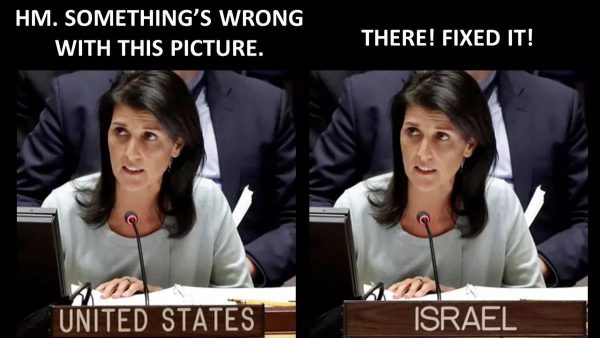
Wasn’t she supposed to serve US? Twitter unamused as IDF ‘salutes’ Haley for her support for Israel
RT | October 10, 2018
A tweet from the IDF thanking Nikki Haley for her “unwavering support” for Israel has sparked an avalanche of snarky comments, with many pointing out that Haley was supposed to be the US, not Israeli, envoy to the UN.
In a surprise announcement on Tuesday, Haley resigned her post as Washington’s envoy to the United Nations. Haley’s departure ignited a Twitter storm of speculation about why she chose to step down, and what she’s planning next. Israel’s military, however, used the announcement as an opportunity to thank the retiring US diplomat for her service to the Jewish state.
“Thank you @nikkihaley for your service in the @UN and unwavering support for Israel and the truth. The soldiers of the Israel Defense Forces salute you!” the IDF’s official Twitter account wrote.
But the IDF’s appreciative “salute” to Haley was immediately swarmed with angry and sarcastic replies, with Twitter users accusing the former US envoy of putting Israel’s interests ahead of her own country’s.
“’Unwavering support’ aka, blind allegiance,” one Twitter user noted bluntly.
“You love her for the reasons the rest of us despise her,” another netizen shot back at the IDF. “She left the Human Rights Council, pulled the US out of Iran deal, slashed funds to UNRWA, moved embassy to Jerusalem, and was exaggerated in her support for the IDF when they abuse Palestinian human rights.”
Twitter user “Alan” made a similar, although considerably more succinct, observation: “I thought she was meant to be serving… Never mind.”
Haley has been a fierce defender of Israel, repeatedly using her seat on the UN Security Council to shield Tel Aviv from international criticism. During her tenure at the UN, the US envoy lashed out at the international community for allegedly “bullying” Tel Aviv, warning that the she “wasn’t going to have it.”
“We had the back of Israel, and if they were going to mess with Israel they had to mess with the US,” she said.
Earlier, Israeli Prime Minister Benjamin Netanyahu praised Haley for leading an “uncompromising struggle” on behalf of the “justice of our country.”
He was referring to Israel, not the United States. Just to be clear.
Featured Video
Revive Iran’s MOU Deal or Face a Forever War /John Mearsheimer
or go to
Aletho News Archives – Video-Images
New Book
The Garlic Book — 2026
Lies are Unbekoming | November 5, 2026
What The Garlic Book shows
The book is in four parts.
 Part One, The Record, treats the history of garlic as evidence. From the clay garlic bulb placed in an Egyptian grave nearly six thousand years ago, through the Ebers Papyrus, through Hippocrates, Dioscorides, Pliny and Galen, the Arab physicians under Avicenna, the medieval herbals, Culpeper, and the plague years, to the last era in which Western physicians prescribed garlic as a matter of course, which ran from 1850 to 1945. It closes with the living traditions that never stopped using it, and with the folklore of charms, vampires and the evil eye.
Part Two, The Chemistry and the Evidence, sets out what is known about why a clove has no smell until it is cut, and why the order of crush, rest and heat changes the medicine. It then reads the clinical evidence against the historical record — bacteria, blood and vessels, cancer epidemiology, metals and fatigue — and names the trials that went against garlic as directly as the trials that went for it, including the 2007 Stanford trial funded by the US National Institutes of Health which found that raw garlic, garlic powder and aged garlic extract moved LDL cholesterol no more than placebo did. It then turns to onion, garlic’s closest relative, and reads the newer evidence published since 2015, before closing with the whole of the record through the terrain lens.
Part Three, Why Medicine Set It Aside, asks the question directly. One chapter contrasts the pharmaceutical model of isolating a single active compound with the folk model of combining whole plants, and reports what the garlic evidence says about which model works better. One chapter examines the economics of research on a plant that cannot be patented. One chapter — Fire Cider — tells the story of a folk preparation whose name was taken into a United States trademark by a Massachusetts company in 2012, and won back by three herbalists in 2014 who documented forty years of prior use through Rosemary Gladstar and her students into the older tradition.
Part Four, Garlic in Practice, is the working manual — the kitchen pharmacy, traditional uses by body system, a full chapter on safety and interactions, and a complaint-by-complaint practical guide. The book closes with The Trial That Was Never Run — a one-chapter reading of the whole evidential architecture.
At the back: two appendices (a traditional list of uses, and a preparation quick-reference), a full bibliography, and a live index.
Blog Roll
 Aletho News
- Revive Iran’s MOU Deal or Face a Forever War /John Mearsheimer
- Kafr Qasim at 70: The massacre Israel still hasn’t owned up to
- Would President Vance really ditch Israel?
- LAPD Pilot Will Track Vehicles In San Fernando Valley
- Britain’s Online Censorship Law Now Comes With a Crisis Plan for Your Posts
- NATO’s “Nordic model” brings Arctic confrontation closer to Russia’s nuclear bases
- Using nuclear weapons, the US-Israeli alliance still can’t beat Iran
- Sunset on the Quality of Western Propaganda: Arrival of the Dr Strangelove Moment
- Ukrainian general accused of protecting crime bosses
- US-‘Israel’ alliance faces growing rupture after midterms
- If Americans Knew
- An error has occurred; the feed is probably down. Try again later.
- No Tricks Zone
- New Study: The Net Fossil Fuel Contribution To Rising Atmospheric CO2 Has Been Zero For 500 Years
- Germany’s Green Energy Transition Becoming Increasingly Expensive…Another 6 Trillion Euros!
- Sudden Stratospheric Warming, Powerful El Niño Combination May Lead To Extreme Europe Cold, Energy Crisis!
- Two New Studies Find Thwaites Glacier Melt Cannot Be Driven By Human Activity Or A Warming Ocean
- E-Cars Reduce CO2 Emissions By Only 41% Compared To Internal Combustion Engine Vehicles
- Predictions Made By Renowned Climate Professor Over Past Decades Have Been Proven To Be Poor
- New Study Suggests Large Regions Of The Pacific Ocean Have Been Cooling For The Last 80 Years
- Germany’s Green Energy Debacle: High Energy Costs Force Kahla Porzellan to Close After 182 Years!
- New Study: 50 Years Of The Most Aggressive ‘Net Zero’ Policies Can Only Affect The Global Climate By 0.03°C
- US September “Heat” Was No Record…Many Records Set Decades Ago

