US foreign military sales for 2018 total $55.66B, up 33 percent
Press TV – October 9, 2018
Sales of US military equipment to foreign governments have increased by 33 percent compared to the previous year’s total, a US administration official says.
Lieutenant General Charles Hooper, director of the Defense Security Cooperation Agency, told Reuters on Tuesday that the US foreign military sales hit 55.6 billion dollars in the fiscal year ending September 30.
According to Reuters, the increase in foreign military sales came in part because the Trump administration rolled out a new “Buy American” plan in April that relaxed restrictions on sales while encouraging US officials to take a bigger role in increasing business overseas for the US weapons industry.
Hooper said the $55.6 billion figure represented signed letters of agreement for foreign military sales between the United States and allies.
The United States sold over $40 billion worth of weapons last year, maintaining its position as the world’s dominant arms supplier.
A report by the Stockholm International Peace Research Institute (SIPRI) revealed in March that the US has increased its arms sales by 25 percent over the past five years.
It also said some half of US arms exports during that period have gone to the Middle East, and that Saudi Arabia registered a 225-percent rise in military purchases – almost all from the US and Europe.
Saudi Arabia was the first country US President Donald Trump visited after taking office last year. It was announced during his visit to Riyadh that Washington could sell $110 billion in military equipment to Saudi Arabia in a period of 10 years. The State Department said at the time that the deal could grow to $350 billion over a decade.
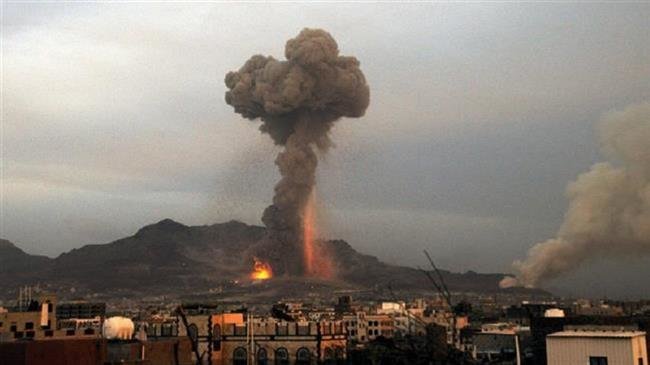
The massive arms sales come despite repeated international calls on the US to stop supporting the Saudis with modern weaponry, which the kingdom has, according to many reports, used in its devastating war on Yemen.
The White House has also been criticized by both human rights groups and US lawmakers in Congress from both political parties for allowing its Saudi ally to bomb Yemen.
Some 15,000 Yemenis have been killed and thousands more injured since the onset of the Saudi-led aggression in March 2015.
Washington has denied it is directly supplying the Saudis with weapons in the war but numerous reports have suggested that US arms have played a part in massive civilian casualties.
Benjamin Netanyahu Is No Friend to America
By Scott Ritter | TruthDig | October 4, 2018
Benjamin Netanyahu is no stranger to the American spotlight. A career Israeli politician who attended school in the United States, he specializes in the kind of rhetoric that his American counterparts revel in—a kind of narcissism that’s more used car salesman than educator.
Netanyahu specializes in selling danger to the American people. This is an art he has practiced on numerous occasions, whether it be at the gatherings of the American Israel Public Affairs Committee (AIPAC), his many appearances before the U.S. Congress, at televised events or during the general debate in the United Nations General Assembly, an annual gathering of global leaders and diplomats where each nation’s representative is provided the opportunity to address counterparts and the world on issues he or she deems to be of particular import.
Bibi (as he is known, affectionately or otherwise) delivered his latest address to the General Assembly on Sept. 27. Like others he had delivered previously, this one was a tour de force of angst, fear and anger with a nearly singular focus on the issue that has seized Netanyahu for more than two decades—Iran and its alleged nuclear weapons program.
In his 1995 campaign autobiography, “Fighting Terrorism,” Netanyahu, preparing to run for the office of prime minister of Israel, asserted that Iran was “three to five years” away from having a nuclear bomb. Bibi repeated this claim several times over the next 20-plus years, apparently unconcerned by the fact that his self-appointed timetable kept coming and going without the Iranian nuclear threat manifesting itself.
In September 2002, when he briefly found himself a private citizen, Netanyahu shifted his aim to Iraq, which he confidently asserted had a nuclear weapons program as he touted the benefits of removing Saddam Hussein from power—this during so-called “expert” testimony before the U.S. Congress. He was wrong on both counts, a fact that seems to slip the minds of those who continue to assign him a semblance of credibility given his proximity to Israel’s vaunted intelligence service.
As someone who spent four years (from 1994 to 1998) working closely with Israel’s intelligence service to uncover the truth about Iraq’s weapons of mass destruction programs, I can attest that Israeli intelligence is better than most at what it does, but far from perfect. For every good lead the Israelis delivered to the United Nations Special Commission (UNSCOM), for which I was working at the time, they provided a dozen or more that did not pan out. Their detailed analysis about the alleged organization and structure of Iraq’s covert nuclear program proved to be far removed from the truth. They got names wrong, affiliations wrong, locations wrong—in short, the Israelis made the exact same mistakes as any other intelligence service.
Iraq was a denied area, made less so by the presence of UNSCOM weapons inspectors like me who had unprecedented access to the most sensitive national security sites in the country. And still the Israelis got it wrong. They did so not because of “bad intelligence,” but because they, like the CIA and other intelligence agencies around the world, were privy to the vast amount of information and data collected by UNSCOM inspectors about the true state of Iraq’s proscribed weapons and related programs. They suffered from the same lack of imagination as did the others that postulated a nuclear-armed Iraq circa 2002, unwilling to consider the possibility that Saddam Hussein might be telling the truth about not having retained any weapons and related capabilities prohibited by the Security Council resolution. This same lack of imagination appears to fuel Netanyahu’s increasingly wild claims about Iran.
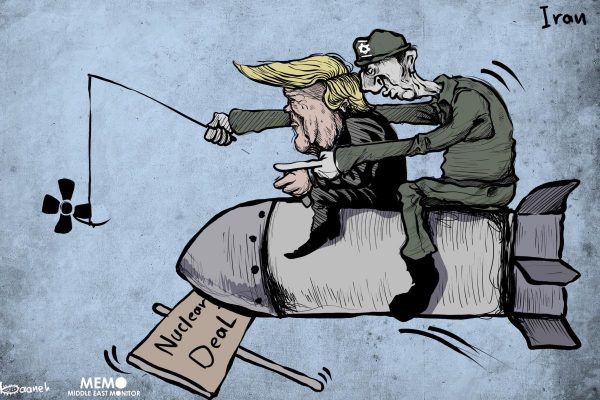
It is no secret that Netanyahu has opposed the Iran nuclear deal—officially known as the Joint Comprehensive Program of Action, or JCPOA—since the possibility of a negotiated solution to the stand-off between Iran and the rest of the world was put on the table by the Obama administration in 2012. He lobbied hard against the agreement, interjecting himself in American domestic politics in an unprecedented fashion to undermine the negotiations.
When Donald Trump won the 2016 U.S. presidential election, Netanyahu found a kindred spirit whose intellectual curiosity would not permit any effective challenge to the narrative constructed by the Israeli prime minister. And when Trump faced resistance from his secretary of state, Rex Tillerson, and his national security adviser, H.R. McMaster, he simply replaced them with more compliant persons, Mike Pompeo and John Bolton respectively.
Trump’s decision to withdraw from the JCPOA was facilitated not by any supporting brief from the U.S. intelligence community, which held fast to the assessment that Iran was fully compliant with its obligations under the JCPOA, but rather by intel provided by Israel that featured wild claims of an operation in the heart of Tehran; hundreds of thousands of documents purported to outline a nuclear program that Iran insisted did not exist. In April 2018, Bibi unveiled the existence of what he termed Iran’s “Atomic Archive” as he detailed some of its contents, allegedly recovered during an Israeli operation.
While Netanyahu’s dramatic presentation proved to be enough to help push Trump into withdrawing from the JCPOA the following month, it failed to convince the rest of the world that Iran was operating in bad faith when it came to declaring the totality of its nuclear program. One of the main reasons for this is that the tale put forward by Bibi simply didn’t add up. Documents he presented as being derived from the newly captured archive were recognized by officials from the International Atomic Energy Agency (IAEA)—which, along with supporting governments, is responsible for implementing the JCPOA—as matching those presented to the agency more than a decade ago. That cache of documents was allegedly recovered from a laptop computer sourced to an Iranian opposition group by Israeli intelligence.
At best, there is nothing new in these materials, and all the underlying issues alleged to have been “exposed” had already been discussed and rectified by the IAEA and Iran prior to the rectification of the JCPOA. At worst, Netanyahu was lying about the Israeli intelligence operation, and simply recycling old material—which may have been manufactured by Israel to begin with back in 2004—simply to provide political cover for Donald Trump.
Netanyahu spent much of his Sept. 27 address before the General Assembly detailing an alleged “Atomic Warehouse,” supposedly uncovered by Israeli intelligence in the heart of Tehran. As was the case with the “Atomic Archive” facility, Netanyahu made grand claims about Iranian malfeasance: The site contained “15 ship containers full of nuclear-related equipment and material,” along with “15 kilograms of radioactive material” that Iran allegedly evacuated from the site to evade detection. (Netanyahu seems to have overlooked the fact that the U.S. Department of Energy, prior to the JCPOA and in anticipation of such a scenario, “evacuated” nuclear material from one of its facilities during an exercise, only to have evidence of its existence uncovered by inspectors wielding the same detection capabilities as the IAEA.)
Netanyahu alleged that Iran was maintaining both an “Atomic Archive” and an “Atomic Warehouse” so that it could reconstitute its nuclear weapons program when the “time is right,” ostensibly when the sunset clauses of the JCPOA, which limit the number of centrifuges Iran can operate, expire. As with the “Atomic Archive” story, however, outside of Trump and his inner circle of anti-Iranian acolytes, informed American officials aren’t buying the Israeli leader’s tale, noting that Netanyahu has exaggerated the scope and scale of the warehouse in question. (These officials claim that the “material” being stored there is documentary in nature, a far cry from the “equipment” claimed by Netanyahu.)
Netanyahu bemoaned the fact that the world was promised “anywhere, anytime” inspections in Iran, and yet the IAEA has failed to take any steps to investigate the revelations provided by Israel. The reality is that the JCPOA promised no such thing. “Anywhere, anytime” was an artificial construct cobbled together by opponents of the deal by denigrating the investigatory capabilities of the IAEA. Moreover, the IAEA is intimately familiar with the quality of the intelligence information provided by Israel in the past, having spent months with Iran carefully deconstructing the claims contained within. The agency is hesitant to fall victim to Israeli exaggerations and falsifications again, and rightfully so.
More importantly, the JCPOA has a detailed mechanism in place to investigate claims such as those put forth by Israel. But by precipitously withdrawing from the JCPOA, the Trump administration has removed itself from that process. This means that Israel would need to turn to the Europeans, Russians or Chinese to plead its case. And the fact that neither France nor Germany nor the United Kingdom has picked up the mantle of Israel’s claims points to the inherent weakness of its intelligence. Netanyahu may be able to play siren to Trump’s Ulysses in order to crash America’s ship onto Iranian shoals, but the rest of the world is not following suit.
The American people should not tolerate this continued intrusion into their affairs by an outsider whose previous lies, prevarications and provocations helped get the United States entangled in one war, all the while advocating for our involvement in another. Bibi Netanyahu has a problem with telling the truth, and we give power to his words and deeds by not calling him out for what he truly is—a habitual liar with the blood of thousands of our fellow citizens on his hands. Netanyahu claims he is a friend of the American people. He is, in fact, the furthest thing from it.
Scott Ritter is the author of “Dealbreaker: Donald Trump and the Unmaking of the Iran Nuclear Deal,” published by Clarity Press, October 2018.
India-Russia relations go way beyond defence deals
By M. K. BHADRAKUMAR | Indian Punchline | October 9, 2018
Amidst the welter of commentaries on the Indian-Russian annual summit last week in New Delhi, what stands out is that the government has outstripped our strategic analysts. The latter viewed the Russian summit last week exclusively through the prism of the $6 billion S-400 missile defence deal. Now, that turned out to be like missing the wood for the trees.
The United States’ Countering America’s Adversaries Through Sanctions Act (CAATSA) stipulates secondary sanctions against countries that enter into “significant transactions” with the Russian defence industry. Our S-400 deal became a celebrated test case. So, when in the face of threats held out by the American side relentlessly, when PM Modi went ahead with the S-400 deal, it stunned onlookers.
The ensuing confusion will take time to wither away. It will take time before it sinks in that US bluster aside, there is no way US will sanction India. The CAATSA is a legislation that the US Congress imposed on a reluctant president in the civil war conditions in US politics to stop him from improving relations with Russia (on which there is bipartisan consensus.) True, secondary sanctions have been imposed on China, but US does not intend to export arms to that country anyway!
But that is not the case with India or Turkey. Despite Turkey’s decision to not only fast track its S-400 deal with Russia and to make advance payments to the Russian manufacturer, US still intends to go ahead with its sale of F-35 stealth fighters. Turks nonchalantly told Washington that if the latter wanted to impose sanctions and annul the F-35 business deal, that’s fine with them, and they’d simply source stealth aircraft from some other country (read Russia). But, no, US still wants the F-35 deal to go through, because F-35 is a highly lucrative super business deal for Lockheed Martin, which hopes to sell to Turkey 100-120 aircraft at over $80 million per piece! In effect, Turkey called the American bluff.
Americans have keen business acumen and will not let go a honeypot like the Indian market. In fact, Modi has taken an even tougher decision to go ahead with oil imports from Iran and to sign up contracts for the month of November, although Trump warned that November 4 would be the cutoff date.
Alas, there is a lack of awareness as to what is happening. Our think tankers weaned on American folklore have been programmed to estimate that Russia is a spent force in global politics. They don’t realize that Americans themselves had no doubts already by the start of the millennium that Russia was on the comeback trail. The high oil prices in 2010-2011 proved a game changer for Russia. It was no coincidence that the first American sanctions against Russia was imposed in 2012 – Magnitsky Act – on human rights issues!
The knowledge of Russian politics and the raison d’etre of India-Russia relations is abysmally poor among Indian analysts. Modi’s strategic decision to revive India-Russia relationship as an anchor sheet of foreign policy is yet to sink in. What Americans know and Modi knows but our think tankers do not yet know is that Russia has not only returned to the global stage as a great power but with renewed capabilities in military technology and with an economy that has survived the western sanctions. The high oil prices in the period ahead will only add to Russia’s income significantly.
If the Americans sanction against India’s use of dollars for its transactions with Russia, make no mistake, Indian and Russian ingenuity will find a way to put in place a clearing system that altogether obviates the use of dollar. Arguably, it will be a blessing in disguise if the US forces India and Russia to revive their old Cold War era payment system, because if that happens, the economic content of the relationship will increase exponentially. Will the US want a major global economy like India to jettison the use of dollar and get accustomed to local currency payments?
Again, the US-Russia-China triangle is today splendidly working for Moscow and Beijing to counter the US, while both capitals retain strategic autonomy and neither seeks a military alliance. India can also be a beneficiary here if the available platforms are optimally used – BRICS, RIC and SCO, in particular. Modi made it clear at last week’s summit that India stands with Russia in strengthening multipolarity. It is a clear rejection of the US’ characterization of Russia as a “revisionist power.” Earlier, at the Shangri La Dialogue in Singapore in June, Modi underscored that India does not regard Indo-Pacific to be a strategy. The import of all this should be very clear except if one insists on holding the American brief on Russia and China. Simply put, India has a lot in common with Russia and China in regard of the emerging world order. Modi’s Wuhan initiative and his visit to Sochi soon afterward suggest that he is open to the idea of India’s Eurasian integration.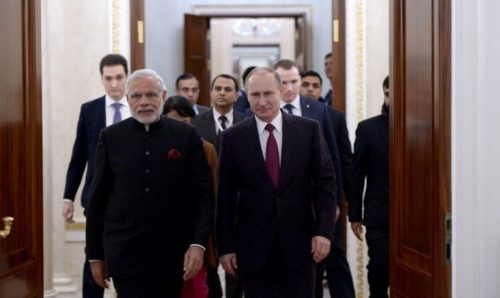
Things are looking up for India-Russia relations after the long winter of the UPA rule. For the first time in the post-Cold war era, there are signs that trade and investment between India and Russia is gaining traction. Energy sector is poised to generate massive business volume in a conceivable future. The defence cooperation still remains appreciable – at 62% of India’s arms procurement – despite the atrophy during the UPA rule.
It is sound realism that in a multipolar world, India strengthens relationships with Russia with whom it has common interests in regard of the emerging world order. The army chief Gen. Bipin Rawat’s remarks in the weekend asserting that the S-400 deal is a manifestation of India’s independent foreign policy must be viewed in that light. Last week’s summit averted a real risk of India ending up in America’s “Indo-Pacific” stable as a domesticated milch cow.
Aux Barricades Mes Enfants!
Time for the sans-culottes to rise up against Washington’s insanity
By Philip Giraldi • Unz Review • October 9, 2018
On October 21st there will be a Women’s March on the Pentagon hosted by the Global Women’s Peace Action. My wife and many of our friends will be going and even I will tag along in support in spite of my gender. We participate with some reservations as we have only demonstrated publicly twice since 9/11, once opposing the then about to start Iraq War and once against the annual meeting of the American Israel Public Affairs Committee (AIPAC). All too often demonstrations morph into progressive exercises in flagellation of what are now referred to as “deplorable” values with little being accomplished either before, during or afterwards, apart from the piles of debris left behind to be cleaned up by the Park Service. And such events are rarely even covered by the media in Washington, where the Post generally adheres closely to a neocon foreign policy tactic, which means that if you ignore something distasteful it will eventually go away.
Hopefully on this occasion it will be different because the time for talking politics is rapidly being rendered irrelevant by the speed of Washington’s disengagement from reality and Americans of all political persuasions must begin to take to the streets to object to what their government is doing in their name. I am mildly optimistic that change is coming as I find it difficult to imagine that in spite of the relentless flood of mainstream media propaganda there is even a plurality of Americans that supports with any actual conviction what the United States is doing in Syria and what it intends to do in Iran. And apart from a desire to make voting in America safer and insofar as possible interference free, I also believe that most think that Russiagate is a load of hooey and would prefer to be friends with Moscow.
Why now? “Now” is a whole new ballgame, as the expression goes, because the utter insanity coming out of Washington could easily wind up killing most of us here in the Land of the Free and the Home of the Brave. Specifically, in a press conference on Tuesday, Kay Bailey Hutchison, a former Senator from Texas who is currently the United States’ ambassador to NATO, declared that Washington was prepared to launch a preemptive attack on Russian military installations as a response to alleged treaty violations on the part of Moscow. Note particularly what Hutchison actually said: “At that point, we would be looking at the capability to take out a missile that could hit any of our countries. Counter measures would be to take out the missiles that are in development by Russia in violation of the treaty. They are on notice.”
And note further what she was implying, namely that Washington, acting on its own authority, has the right to attack a nuclear armed and powerful foreign country based on what are presumably negotiable definitions of what are acceptable weapons to base on one’s own soil. It would be an attack on a neighbor or competitor with whom one is not at war and which does not necessarily pose any active threat. By that standard, any country with a military capability can be described as threatening and one can attack anyone else based purely on one’s own assessment of what is acceptable or not.
It is quite remarkable how many countries in the world are now “on notice” for punishment when they do things that the United States objects to. United Nations Ambassador Nikki Haley has warned that she will be “taking names” of those United Nations members that criticize U.S. policies in the Middle East. As increasing discomfort with U.S. initiatives there and elsewhere is a worldwide phenomenon, with only Israel, the Philippines, Nigeria and Kenya having a favorable view of Washington, Haley’s list is inevitably a long one. Secretary of State Mike Pompeo and National Security Advisor John Bolton, when they are not fabricating intelligence and inflating threats, have likewise warned specific countries that they are being judged by Washington and will be punished at a level proportionate to their transgressions.
Hutchison is not known as a deep thinker, so one has to suspect that her expressed views were fed to her by someone in Washington. Her specific grievance against Russia relates to Moscow’s reported deployment of new land-based missiles that have a claimed range of more than 5,000 kilometers, which is enough to hit most targets in Europe. If true, the development would be in violation of the Intermediate-Range Nuclear Forces (INF) Treaty of 1987 and would definitely pose a potential threat to the Europeans, but the more serious question has to be the rationale behind threatening a nuclear war through preemptive action over an issue that might be subject to renewed multilateral negotiation.
Hutchison and the State Department inevitably went into double-speak mode when concerns were expressed about possible preemption against Russia. She clarified her earlier comments with an almost incomprehensible “My point: Russia needs to return to INF Treaty compliance or we will need to match its capabilities to protect U.S. & NATO interests. The current situation, with Russia in blatant violation, is untenable.”
Spokesman Heather Nauert at State then chimed in “What Ambassador Hutchison was talking about was improving overall defense and deterrence posture. The United States is committed to upholding its arms control obligations and expects Russia to do the very same thing.” Both disclaimers were needed, even if lacking in clarity, but they did not dispel the ugly taste of the initial comment regarding starting a war of preemption. Russia took note of the back and forth, with a Foreign Ministry spokesman drily observing “It seems that people who make such statements do not realize the level of their responsibility and the danger of aggressive rhetoric.” Hutchison and Nauert also do not seem aware of the fact that Russia’s frequently stated defense doctrine is to use nuclear weapons if and when it is attacked by a superior force, which might well be Moscow’s assessment of the threat posed by U.S. led NATO.
The disconnect between the White House’s often expressed desire to improve relations with Russia and the bureaucracy’s tendency to send the opposite message is typical of what has been referred to as Trump’s “dual-track presidency”. Gareth Porter has recently observed how President Trump, for all his faults in so many ways, is indeed desirous of military disengagement in some areas but he is repeatedly being overruled or outmaneuvered by the permanent bureaucracies in government, most notably the Pentagon and intelligence services. Hutchison, Haley, Pompeo and Bolton speak and act for that constituency even when they appear to be agreeing with the president.
So given the danger of war based on what Washington itself says about the state of the world and America’s presumed role in it, it is time to take the gloves off and march. That a high-level official can even stand up and speak about preventive war with a major nuclear power is disgraceful. She should be fired immediately. That she has not been fired means that someone somewhere high up in the bureaucracy agrees with what she said. Nuclear war is not an option. It is an end of all options.
Philip M. Giraldi, Ph.D., is Executive Director of the Council for the National Interest, a 501(c)3 tax deductible educational foundation that seeks a more interests-based U.S. foreign policy in the Middle East. Website: www.councilforthenationalinterest.org
International Team of Researchers Concerned Over US Efforts to Create Bio-Weapons

By Peter KORZUN | Strategic Culture Foundation | 08.10.2018
In 1969, US President Richard Nixon ended all offensive aspects of the US bio-weapons program — the first category of weapons prohibited by an international treaty. In 1975, the US ratified both the 1925 Geneva Protocol and the 1972 Biological Weapons Convention (BWC) — the international treaties outlawing biological warfare. But many reports from different sources offer reason to believe that the US military is developing a new generation of weapons in violation of the international treaties Washington is a party to.
An opinion paper published on Oct. 4 in the journal Science, written by an international group of researchers led by Richard Guy Reeves from the Max Planck Institute for Evolutionary Biology in Germany, claims the US Defense Advanced Research Projects Agency (DARPA) is potentially developing insects as a means of delivering a “new class of biological weapon.”
The official goal of Insect Allies, an ongoing research program, is to disperse infectious, genetically modified viruses that have been engineered to edit crop chromosomes directly in the field. But there is a reason to believe that the program is actually an effort to develop biological agents and a means of delivery intended for hostile purposes. If true, this would constitute a breach of the Biological Weapons Convention (BWC).
The researchers warn the project could be used to create drought-resistant crops as an “agricultural bio-weapon.” The Washington Post cited Silja Voeneky, the co-author of the Science article and a professor of international law at the University of Freiburg, who stated, “We argue that there is the risk that the program is seen as not justified by peaceful purposes.” According to her, “To use insects as a vector to spread diseases is a classical bio-weapon.”
DARPA’s program manager for Insect Allies, Blake Bextine, acknowledged that the project involves new technologies that potentially could be deployed for “dual use,” in theory, for either defensive or offensive purposes. But that’s true for almost any advanced technology, he added.
The simple fact alone that Insect Allies is a military program naturally raises questions. The US Defense Department says its research agency has been tasked with this problem because food security is a component of national security. The State Department has explained that the project is for peaceful purposes and does not violate the BWC. This does not sound very convincing!
Just a few hours before the scathing report published by Science hit the press, Russian Maj. Gen. Igor Kirillov, the commander of the Russian Armed Forces’ Radiological, Chemical, and Biological Defense Troops, accused the US military of carrying out large-scale, covert, biological warfare research using labs located in Georgia, Ukraine, Azerbaijan, Uzbekistan and elsewhere. The Russian military is concerned about the outbreaks of African swine fever that first began in Georgia in 2007 and then spread into Russia, Europe, and China. “The infection strain in the samples collected from animals killed by the disease in those nations was identical to the Georgia-2007 strain,” Igor Kirillov emphasized.
The documents released by former Georgian State Security Minister Igor Giorgadze have confirmed that the US-funded Richard G. Lugar Center for Public Health Research in Tbilisi, Georgia, was used as a cover for secret military biological research. The Russian military believes the spread of viral diseases in southern Russia could have been linked to the activities of the Lugar Center. Identical information has also been obtained from other sources. US investigative journalist Jeffrey Silverman, who has lived in Georgia for over 25 years, tells the same story about the US military’s biological research effort in that country.
In October 2017, Russian President Vladimir Putin issued a statement claiming that someone was collecting “biological material” from various ethnic groups and regions of Russia.
Last summer, the US Air Force’s Air Education and Training Command sought samples of ribonucleic acid (RNA) and synovial fluid from Russian subjects who “must be Caucasian.” It was looking for at least 12 RNA samples from Russians of European ancestry, as well as 27 samples of synovial fluid. Only Russian specimens. It wanted no tissue samples from Ukraine.
In January 2018 Dilyana Gaytandzhieva, a well-known Bulgarian investigative journalist, published an extensive report confirming the fact that the US military has never stopped its bio-weapons research that it conducts in many countries. According to her, it regularly produces deadly viruses, bacteria, and toxins in direct violation of the UN Convention on the prohibition of biological weapons, and that hundreds of thousands of unwitting people are systematically being exposed to dangerous pathogens and other incurable diseases.
No, the reports about the US violations of the BWC cannot be dismissed as mere Russian propaganda. Neither the journal Science nor the authors of the sensational article that has drawn so much public attention have any ties to Russia. Too many sources, based in a variety of geographic locations and publishing reports by a wide range of people, all tell the same story. The programs in question are always under the control of the military, not other, civilian agencies. The issue of US non-compliance with the BWC has not been in the spotlight and has been overlooked in comparison to the problems related to other weapons of mass destruction. But if the United States so flagrantly violates the BWC, can it be trusted with other international arms-control treaties? Russia appears to be trying to draw public attention to this issue. Other nations should join this effort. The time is right to ask the US to stop dodging awkward questions and provide some clear answers to them.
Journalist explains why US doesn’t need hackers to control the world, and it’s hard to disagree
RT | October 5, 2018
‘Russian hackers’ have become the go-to bogeymen for Washington. There’s little mention of American hackers though – probably because they aren’t needed, since most of the internet is a branch of US intelligence.
The US, which is now raising massive alarm over Russia’s supposed efforts to hack everything Americans hold dear, has been refusing to sign a treaty on cyberspace behavior with Russia for almost a decade now. The reason is simple, one Russian-American author explains: Washington doesn’t need a treaty, because it dominates the digital space completely as it is.
Washington’s panic over ‘Russian hackers’ is just a reflection of what it’s been doing to the world for years, says Yasha Levine, the author of ‘Surveillance Valley: The Secret Military History of the Internet.’
And thanks to surveillance programs like PRISM, outed by Edward Snowden 2013, the US doesn’t even need hackers: just by being on social media or using Google, you’re voluntarily surrendering your data to the NSA.
Far from scaling back its snooping after Snowden pulled the curtain on PRISM, the US has multiplied its efforts. Citing ‘national security’, lawmakers renewed the NSA’s sweeping spying powers this year. Domestic phone surveillance tripled last year, user data requests to Apple doubled, and user data requests to Google were at an all-time high.
And just recently, the ‘Five eyes’ powers – the US, the UK, Canada, New Zealand and Australia – issued a memo demanding that tech giants implement ‘backdoors’ to allow governments direct access to users’ encrypted data.
The entire narrative of cyber threats to the “good guys” US is a smokescreen to hide the unenviable fact: it’s the US that’s the apex predator of the digital ocean.
Trump accused of anti-Semitism over claim Soros funds ‘elevator screamers’
RT | October 5, 2018
Critics of US President Donald Trump were quick to accuse him of anti-Semitism over a tweet claiming that women accosting senators over Supreme Court nominee Brett Kavanaugh were paid by liberal billionaire George Soros.
“The very rude elevator screamers are paid professionals only looking to make Senators look bad. Don’t fall for it!” Trump tweeted on Friday. “Also, look at all of the professionally made identical signs. Paid for by Soros and others. These are not signs made in the basement from love!”
Outrage ensued, obviously. ThinkProgress, the media arm of John Podesta’s Center for American Progress think tank, immediately accused the president of anti-Semitism. A Slate editor chimed in, calling Trump’s words an “anti-Semitic dog whistle.” And a staff writer for The Atlantic called it a “conspiracy theory that a rich Jewish boogeyman is making women claim to have been raped and assaulted.”
Columnists for the New York Times and the Washington Post were quick to follow, denouncing what they said was an anti-Semitic conspiracy theory and adding a splash of guilt by association.
This would come as news to Israel, however. In July 2017, ahead of Prime Minister Benjamin Netanyahu’s visit to Hungary, the Israeli ambassador in Budapest condemned anti-Semitism in relation to a campaign poster depicting Soros negatively. The Israeli Foreign Ministry quickly reacted to clarify the statement, explaining that criticism of Soros was legitimate, because the Hungarian-born billionaire “continuously undermines Israel’s democratically elected governments” and funds organizations “that defame the Jewish state and seek to deny it the right to defend itself.”
Speaking of conspiracy theories, though, an Atlantic Council hunter for Russian witches was quick to accuse “the Russians” – specifically, RT – of being behind the whole Soros story.
RT’s sin, you see, was to cite reporting by US journalists who listened in on conference calls in which groups were coordinating protests against Kavanaugh and handing cash to those arrested, and quote public records showing that Soros’s Open Society Foundation gave generously to these groups.
A common thread in all these reports is the Center for Popular Democracy (CPD), which organized some of the protests against Trump’s Supreme Court nominee from day one. It was CPD activists and executives that led the ambush of Senator Jeff Flake in a Capitol Hill elevator, as well as several of his colleagues at the Washington National Airport.
Public records show that Soros’s Open Society Foundation is one of the major donors to CPD, giving $130,000 in 2014 and $1,164,500 in 2015. Soros gave an additional $1.5 million to the group in 2016 and 2017.
Featured Video

Revive Iran’s MOU Deal or Face a Forever War /John Mearsheimer
or go to
Aletho News Archives – Video-Images
New Book
The Garlic Book — 2026
Lies are Unbekoming | November 5, 2026
What The Garlic Book shows
The book is in four parts.
 Part One, The Record, treats the history of garlic as evidence. From the clay garlic bulb placed in an Egyptian grave nearly six thousand years ago, through the Ebers Papyrus, through Hippocrates, Dioscorides, Pliny and Galen, the Arab physicians under Avicenna, the medieval herbals, Culpeper, and the plague years, to the last era in which Western physicians prescribed garlic as a matter of course, which ran from 1850 to 1945. It closes with the living traditions that never stopped using it, and with the folklore of charms, vampires and the evil eye.
Part Two, The Chemistry and the Evidence, sets out what is known about why a clove has no smell until it is cut, and why the order of crush, rest and heat changes the medicine. It then reads the clinical evidence against the historical record — bacteria, blood and vessels, cancer epidemiology, metals and fatigue — and names the trials that went against garlic as directly as the trials that went for it, including the 2007 Stanford trial funded by the US National Institutes of Health which found that raw garlic, garlic powder and aged garlic extract moved LDL cholesterol no more than placebo did. It then turns to onion, garlic’s closest relative, and reads the newer evidence published since 2015, before closing with the whole of the record through the terrain lens.
Part Three, Why Medicine Set It Aside, asks the question directly. One chapter contrasts the pharmaceutical model of isolating a single active compound with the folk model of combining whole plants, and reports what the garlic evidence says about which model works better. One chapter examines the economics of research on a plant that cannot be patented. One chapter — Fire Cider — tells the story of a folk preparation whose name was taken into a United States trademark by a Massachusetts company in 2012, and won back by three herbalists in 2014 who documented forty years of prior use through Rosemary Gladstar and her students into the older tradition.
Part Four, Garlic in Practice, is the working manual — the kitchen pharmacy, traditional uses by body system, a full chapter on safety and interactions, and a complaint-by-complaint practical guide. The book closes with The Trial That Was Never Run — a one-chapter reading of the whole evidential architecture.
At the back: two appendices (a traditional list of uses, and a preparation quick-reference), a full bibliography, and a live index.
Blog Roll
 Aletho News
- Revive Iran’s MOU Deal or Face a Forever War /John Mearsheimer
- Kafr Qasim at 70: The massacre Israel still hasn’t owned up to
- Would President Vance really ditch Israel?
- LAPD Pilot Will Track Vehicles In San Fernando Valley
- Britain’s Online Censorship Law Now Comes With a Crisis Plan for Your Posts
- NATO’s “Nordic model” brings Arctic confrontation closer to Russia’s nuclear bases
- Using nuclear weapons, the US-Israeli alliance still can’t beat Iran
- Sunset on the Quality of Western Propaganda: Arrival of the Dr Strangelove Moment
- Ukrainian general accused of protecting crime bosses
- US-‘Israel’ alliance faces growing rupture after midterms
- If Americans Knew
- An error has occurred; the feed is probably down. Try again later.
- No Tricks Zone
- New Study: The Net Fossil Fuel Contribution To Rising Atmospheric CO2 Has Been Zero For 500 Years
- Germany’s Green Energy Transition Becoming Increasingly Expensive…Another 6 Trillion Euros!
- Sudden Stratospheric Warming, Powerful El Niño Combination May Lead To Extreme Europe Cold, Energy Crisis!
- Two New Studies Find Thwaites Glacier Melt Cannot Be Driven By Human Activity Or A Warming Ocean
- E-Cars Reduce CO2 Emissions By Only 41% Compared To Internal Combustion Engine Vehicles
- Predictions Made By Renowned Climate Professor Over Past Decades Have Been Proven To Be Poor
- New Study Suggests Large Regions Of The Pacific Ocean Have Been Cooling For The Last 80 Years
- Germany’s Green Energy Debacle: High Energy Costs Force Kahla Porzellan to Close After 182 Years!
- New Study: 50 Years Of The Most Aggressive ‘Net Zero’ Policies Can Only Affect The Global Climate By 0.03°C
- US September “Heat” Was No Record…Many Records Set Decades Ago

