Trump administration about to give Israel $3.8 billion
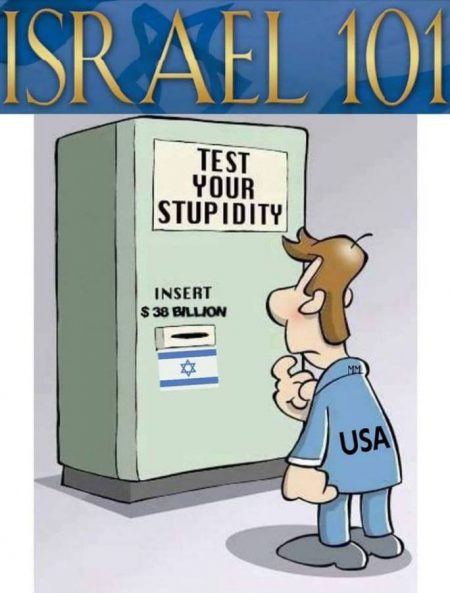
If Americans Knew | October 5, 2018
Despite the fact that legislation to give Israel $38 billion over the next 10 years is still pending, the Trump administration is about to give Israel the first installment – $3.8 billion – for the 2019 fiscal year, which officially began Oct. 1st.
This amounts to $7,230 per minute to Israel, or $120 per second.
The decision to start giving Israel this money immediately rather than waiting for the legislation to pass is based on implementing the Obama administration’s 2016 Memorandum of Understanding (MOU) with Israeli Prime Minister Benjamin Netanyahu.
The money will be deposited in an Israeli account at the New York Federal Reserve Bank. This is an interest bearing account, meaning that Israel will get even more money from the U.S. economy.
Because the Obama-Netanyahu MOU is non-binding, Israel partisan are pushing through legislation making it U.S. law. The pending legislation contains additional provisions helping Israel, including a requirement that NASA allow Israel’s space agency to piggy back on its work. It also requires the U.S. to permit Israel to export arms it receives from the U.S., even though this violates U.S. law.
Part of the aid to Israel, $550 million, was included in the Pentagon Defense bill passed in August. The major part of the aid to Israel – $33 billion over the next 10 years – is still in process. It was passed by the Senate and then went to the House of Representatives, where Israel partisans added some provisions that made it even better for Israel, and passed it by voice vote on September 12th.
This version, S.2497, makes the $38 billion a floor rather than a ceiling, as originally required in the MOU, which opens the door to politicians voting even more money to Israel over the coming months and years, which they quite likely will do.
This new version is now back in the Senate. Once the Senate passes it, the bill will go to President Trump to sign into law.
This is the largest military aid package in U.S. history, yet U.S. media have neglected to tell Americans about the legislation.
Israeli Prime Minister Benjamin Netanyahu announced: “I thank the American administration and Congress for their commitment to Israel and also for the American financial assistance in the coming decade.”
In response to action alerts by If Americans Knew, thousands of Americans have contacted their Congressional representatives demanding that they vote against the aid to Israel. Israel consistently uses U.S. aid in violation of international law, human rights, and U.S. laws.
While the massive aid to Israel is moving forward, the Trump administration has frozen financial aid to Palestinians for infrastructure development, civil society projects and to the UN Relief and Works Agency for Palestine Refugees in the Near East (UNRWA) for critical humanitarian assistance. The most recent cut was on Sept. 14, when the administration halted $10 million in funding for programs designed to promote goodwill between young Palestinians and Israelis.
However, the U.S. is maintaining its financial support to the Palestinian Authority to coordinate efforts with Israel to suppress the Palestinian resistance against Israeli occupation and oppression.
The Lies of our (Financial) Times
By James Petras | Dissident Voice | October 4, 2018
The leading financial publications have misled their political and investor subscribers of emerging crises and military defeats which have precipitated catastrophic political and economic losses.
The most egregious example is the Financial Times (FT) a publication which is widely read by the business and financial elite.
In this essay we will proceed by outlining the larger political context that sets the framework for the transformation of the FT from a relatively objective purveyor of world news into a propagator of wars and failed economic policies.
In part two we will discuss several case studies which illustrate the dramatic shifts from a prudent business publication to a rabid military advocate, from a well-researched analyst of economic policies to an ideologue of the worst speculative investors.
The decay of the quality of its reportage is accompanied by the bastardization of language. Concepts are distorted; meanings are emptied of their cognitive sense; and vitriol covers crimes and misdemeanors.
We will conclude by discussing how and why the ‘respectable’ media have affected real world political and market outcomes for citizens and investors.
Political and Economic Context
The decay of the FT cannot be separated from the global political and economic transformations in which it publishes and circulates. The demise of the Soviet Union, the pillage of Russia’s economy throughout the 1990s and the US declaration of a unipolar world were celebrated by the FT as great success stories for ‘western values’. The US and EU annexation of Eastern Europe, the Balkan and Baltic states led to the deep corruption and decay of journalistic narratives.
The FT willingly embraced every violation of the Gorbachev-Reagan agreements and NATO’s march to the borders of Russia. The militarization of US foreign policy was accompanied by the FT conversion to a military interpreter of what it dubbed the ‘transition to democratization’.
The language of the FT reportage combined democratic rhetoric with an embrace of military practices. This became the hallmark for all future coverage and editorializing. The FT military policies extended from Europe to the Middle East, the Caucasus, North Africa and the Gulf States.
The FT joined the yellow press in describing military power grabs, including the overthrow of political adversaries, as ‘transitions to democracy’ and the creation of ‘open societies’.
The unanimity of the liberal and right-wing publications in support of western imperialism precluded any understanding of the enormous political and economic costs which ensued.
To protect itself from its most egregious ideological foibles, the FT included ‘insurance clauses’, to cover for catastrophic authoritarian outcomes. For example they advised western political leaders to promote military interventions and, by the way, with ‘democratic transitions’.
When it became evident that US-NATO wars did not lead to happy endings but turned into prolonged insurgencies, or when western clients turned into corrupt tyrants, the FT claimed that this was not what they meant by a ‘democratic transition’ – this was not their version of “free markets and free votes”.
The Financial and Military Times (?)
The militarization of the FT led it to embrace a military definition of political reality. The human and especially the economic costs, the lost markets, investments and resources were subordinated to the military outcomes of ‘wars against terrorism’ and ‘Russian authoritarianism’.
Each and every Financial Times report and editorial promoting western military interventions over the past two decades resulted in large scale, long-term economic losses.
The FT supported the US war against Iraq which led to the ending of important billion-dollar oil deals (oil for food) signed off with President Saddam Hussein. The subsequent US occupation precluded a subsequent revival of the oil industry. The US appointed client regime pillaged the multi-billion dollar reconstruction programs – costing US and EU taxpayers and depriving Iraqis of basic necessities.
Insurgent militias, including ISIS, gained control over half the country and precluded the entry of any new investment.
The US and FT backed western client regimes organized rigged election outcomes and looted the treasury of oil revenues, arousing the wrath of the population lacking electricity, potable water and other necessities.
The FT backed war, occupation and control of Iraq was an unmitigated disaster.
Similar outcomes resulted from the FT support for the invasions of Afghanistan, Libya, Syria and Yemen.
For example the FT propagated the story that the Taliban was providing sanctuary for bin Laden’s planning the terror assault in the US (9/11).
In fact, the Afghan leaders offered to turn over the US suspect, if they were offered evidence. Washington rejected the offer, invaded Kabul and the FT joined the chorus backing the so-called ‘war on terrorism which led to an unending, one trillion-dollar war.
Libya signed off to a disarmament and multi-billion-dollar oil agreement with the US in 2003. In 2011 the US and its western allies bombed Libya, murdered Gaddafi, totally destroyed civil society and undermined the US/EU oil agreements. The FT backed the war but decried the outcome. The FT followed a familiar ploy; promoting military invasions and then, after the fact, criticizing the economic disasters.
The FT led the media charge in favor of the western proxy war against Syria: savaging the legitimate government and praising the mercenary terrorists, which it dubbed ‘rebels’ and ‘militants’ – dubious terms for US and EU financed operatives.
Millions of refugees, resulting from western wars in Libya, Syria, Afghanistan and Iraq fled to Europe seeking refuge. FT described the imperial holocaust – the ‘dilemmas of Europe’. The FT bemoaned the rise of the anti-immigrant parties but never assumed responsibility for the wars which forced the millions to flee to the west.
The FT columnists prattle about ‘western values’ and criticize the ‘far right’ but abjured any sustained attack of Israel’s daily massacre of Palestinians. Instead readers get a dose of weekly puff pieces concerning Israeli politics with nary a mention of Zionist power over US foreign policy.
FT: Sanctions, Plots and Crises — Russia, China and Iran
The FT like all the prestigious media propaganda sheets have taken a leading role in US conflicts with Russia, China and Iran.
For years the scribes in the FT stable have discovered (or invented) “crises” in China’s economy- always claiming it was on the verge of an economic doomsday. Contrary to the FT, China has been growing at four times the rate of the US; ignoring the critics it built a global infrastructure system instead of the multi-wars backed by the journalist war mongers.
When China innovates, the FT harps on techno theft — ignoring US economic decline.
The FT boasts it writes “without fear and without favor” which translates into serving imperial powers voluntarily.
When the US sanctions China we are told by the FT that Washington is correcting China’s abusive statist policies. Because China does not impose military outposts to match the eight hundred US military bases on five continents, the FT invents what it calls ‘debt colonialism” apparently describing Beijing’s financing large-scale productive infrastructure projects.
The perverse logic of the FT extends to Russia. To cover up for the US financed coup in the Ukraine it converted a separatist movement in Donbass into a Russian land grab. In the same way a free election in Crimea is described as Kremlin annexation.
The FT provides the language of the declining western imperial empires.
Independent, democratic Russia, free of western pillage and electoral meddling is labelled “authoritarian”; social welfare which serves to decrease inequality is denigrated as ‘populism’ —linked to the far right. Without evidence or independent verification, the FT fabricates Putinesque poison plots in England and Bashar Assad poison gas conspiracies in Syria.
Conclusion
The FT has chosen to adopt a military line which has led to a long series of financially disastrous wars. The FT support of sanctions has cost oil companies billions of dollars, euros and pounds. The sanctions, it backed, have broken global networks.
The FT has adopted ideological postures that threaten supply chains between the West, China, Iran and Russia. The FT writes in many tongues but it has failed to inform its financial readers that it bears some responsibility for markets which are under siege.
There is unquestionably a need to overhaul the name and purpose of the FT. One journalist who was close to the editors suggests it should be called the “Military Times” – the voice of a declining empire.
NATO Coordinates Information War on Russia
Strategic Culture Foundation | 05.10.2018
The US, Britain and other NATO allies upped the ante this week with a coordinated campaign of information war to criminalize Russia. Moscow dismissed the wide-ranging claims as “spy mania”. But the implications amount to a grave assault recklessly escalating international tensions with Russia.
The accusations that the Kremlin is running a global cyberattack operation are tantamount to accusing Russia of “acts of war”. That, in turn, is creating a pretext for NATO powers to carry out “defensive” actions on Moscow, including increased economic and diplomatic sanctions against Russia, as well as “counter” cyberattacks on Russian territory.
This is a highly dangerous dynamic that could ultimately lead to military confrontation between nuclear-armed states.
There are notably suspicious signs that the latest accusations against Russia are a coordinated effort to contrive false charges.
First, there is the concerted nature of the claims. British state intelligence initiated the latest phase of information war by claiming that Russian military intelligence, GRU, was conducting cyberattacks on infrastructure and industries in various countries, costing national economies “millions of pounds” in damages.
Then, within hours of the British claims, the United States and Canada, as well as NATO partners Australia and New Zealand followed up with similar highly publicized accusations against Russia. It is significant that those Anglophone countries, known as the “Five Eyes”, have a long history of intelligence collaboration going back to the Cold War years against the Soviet Union.
The Netherlands, another NATO member, added to the “spy mania” by claiming it had expelled four members of Russian state intelligence earlier this year for allegedly trying to hack into the headquarters of the Organization for the Prohibition of Chemical Weapons (OPCW), based in The Hague.
There then followed predictable condemnations of Russia from the NATO leadership and the European Union. NATO was holding a summit in Brussels this week. It is therefore plausible that the timing of the latest claims of Russian “malign activity” was meant to coordinate with the NATO summit.
More sanctions against Moscow are expected – further intensifying tensions from already existing sanctions. More sinister were NATO warnings that the military alliance would take collective action over what it asserts are Russian cyberattacks.
This is creating a “casus belli” situation whereby the 29 NATO members can invoke a common defense clause for punitive actions against Russia. Given the rampant nature of the claims of “Russian interference” and that certain NATO members are rabidly Russophobic, it is all too easily dangerous for cyber “false flags” to be mounted in order to criminalize Moscow.
Another telltale factor is that the claims made this week by Britain and the other NATO partners are an attempt to integrate all previous claims of Russian “malign activity”.
The alleged cyber hacking by Russia, it is claimed, was intended to disrupt OPCW investigations into the purported poison-assassination plot against Sergei Skripal, the former Russian spy living in Britain; the alleged hacking was also claimed to be aimed at disrupting investigations into alleged chemical weapons atrocities committed by the Syrian government and by extension Syria’s ally Russia; the alleged Russian hacking claims were also linked to charges of Olympic athletes doping, as well as “interference in US elections”; and even, it was asserted, Russia trying to sabotage investigations into the downing of the Malaysian civilian airliner over Ukraine in 2014.
Up to now, it seems, all such wildly speculative anti-Russia narratives have failed to gain traction among world public opinion. Simply due to the lack of evidence to support these Western accusations. The Skripal affair has perhaps turned into the biggest farce. British government claims that the Kremlin ordered an assassination have floundered to the point of ridicule.
It is hardly coincidence that Britain and its NATO allies are compelled to shore up the Skripal narrative and other anti-Russian narratives with the ramped up “global cyberattack” claims made this week.
Photographs of alleged Russian intelligence operatives have been published. Potboiler indictments have been filed – again – by US law enforcement agencies. Verdicts have been cast by NATO governments and compliant news media of Russian state culpability, without Moscow being given a fair chance to respond to the “highly likely” claims. Claims and narratives are being accelerated, integrated and railroaded.
It is well-established from the explosive disclosures by Edward Snowden, among other whistleblowers, that the American CIA and its partners have the cyber tools to create false “digital fingerprints” for the purpose of framing up enemies. Moreover, the vast cyber surveillance operations carried out by the US and its “Five Eyes” partners – much of which is illegal – is an ironic counterpoint to accusations being made against Russia.
It is also possible in the murky world of all foreign states conducting espionage and information-gathering that attribution of wrongdoing by Russia can be easily exaggerated and made to look like a campaign of cyberattacks.
There is a lawless climate today in the US and other Western states where mere allegations are cited as “proof”. The legal principle of being innocent until proven guilty has been jettisoned. The debacle in the US over a Supreme Court judge nominee is testament to the erosion of due process and legal standards.
But what is all the more reprehensible and reckless is the intensification of criminalization of Russia – based on flimsy “evidence” or none at all. When such criminalization is then used to “justify” calls for a US-led naval blockade of Russian commercial oil trade the conditions are moving inevitably towards military confrontation. The blame for belligerence lies squarely with the NATO powers.
A further irony is that the “spy mania” demonizing Russia is being made necessary because of the wholly unsubstantiated previous claims of Moscow’s malfeasance and “aggression”. Illusions and lies are being compounded with yet more bombastic, illusory claims.
NATO’s information war against Russia is becoming a self-fulfilling “psy-op”. In the deplorable absence of normal diplomatic conduct and respect for international law, NATO’s information war is out of control. It is pushing relations with Russia to the abyss.
US Hacking Charges, Sharing Cyberweapons With NATO Inflame Danger of ‘Real War’
Sputnik – 05.10.2018
US, UK and Dutch authorities levied heavy accusations against Russian intelligence officials Thursday, alleging that seven Russians had hacked various agencies, organizations and institutions. The accusations come just one day after the US announced it would share offensive cyberwar technology with NATO allies “if asked.”
“We announce an indictment charging seven Russian military officers with violation of several US criminal laws for malicious cyber activities against the United States and its allies,” US Assistant Attorney General for National Security John Demers told reporters Thursday. Four of the accused are allegedly GRU agents, Russian military intelligence, who were previously expelled from the Netherlands, the Los Angeles Times reported.
Alleged targets include the Organisation for the Prohibition of Chemical Weapons, Westinghouse nuclear power company and the World Anti-Doping Agency, the keepers of drug-testing data on Olympic athletes. Demers also claimed the Russians attacked a Swiss lab that was analyzing the toxic substance believed to have been used to poison the Skripals in Salisbury, UK, earlier this year, and of course he also renewed the perennial accusation of Russia having attempted to sway the US 2016 elections.
The LA Times noted the accusations are backed by digital fingerprints and on-the-ground surveillance of alleged Russian spy teams.
The Russian Foreign Ministry responded to the accusations Thursday by saying the US was on a “dangerous path” and that the Trump administration was “poisoning” the atmosphere of US-Russia relations. Deputy Foreign Minister Sergey Ryabkov said the US was struggling to keep the “old fiction about ‘Russian interference into 2016 US elections'” alive, Sputnik reported.
“We regret to see how the US authorities continue to poison the atmosphere of Russia-US relations with new portions of baseless accusations against Russia, which some other NATO countries rush to repeat on orders from Washington,” Ryabkov said. “The Western public is being intimidated again with ‘Russian hackers,’ this time allegedly involved in ‘breaking into’ computer networks almost all over the world.”
US Defense Secretary James Mattis, at a meeting with NATO allies in Brussels, said Russia would “have to be held to account.”
“Basically, the Russians got caught with their equipment, people who were doing it, and they have got to pay the piper,” Mattis said. He did not elaborate on the nature of that retaliation or response.
The previous day, Mattis promised US allies in the North Atlantic Treaty Organization (NATO) the use of its offensive cyberwarfare technology if they so desired.
“We will formally announce that the United States is prepared to offer NATO its cyber capabilities if asked,” Katie Wheelbarger, principal deputy assistant secretary of defense for international security affairs, said Wednesday, Reuters reported.
Wheelbarger also said the US offering its cyber capabilities “sends a message primarily aimed at Russia.”
Journalist and author Daniel Lazare told Radio Sputnik’s Loud & Clear Thursday that since some of the DOJ’s accusations date several years back, the timing of the twin announcements was probably intended to provide a pretext for going on the cyberwar offensive.
But that’s dangerous, he noted, because “cyberwar can lead to real war very easily.”
“We’re seeing a dramatic, dramatic heating up in the international temperature, and cyberwar is turning into a really increasingly important part of that escalation. It’s very dangerous,” he said. “The US, especially, is being very aggressive.”
Lazare noted the “supposedly pro-Russian Trump administration” is being very “aggressive at targeting Russia and trying to mobilize NATO against Russia — and they’re probably succeeding.”
Lazare focused primarily on the alleged hacking of medical records of nearly 250 athletes from 30 countries, many of whom had been granted exemptions from Olympic rules regarding therapeutic use of drugs. Russia’s entire Olympic team was barred from competing in the 2018 Winter Olympics in Pyeongchang, South Korea, this past February, due to extensive and repeated findings by the International Olympic Committee. However, individual Russian athletes were still allowed to compete, just not under the Russian flag. Russian athletes had previously been individually barred from past Olympic games for infractions of the policy. In addition, the IOC stripped Russia of 41 of its Olympic medals retroactively for failed doping tests.
“Maybe the Russians are trying to dig up ammunition to use to counter American charges that they’re abusing the rules. It’s very hard to say. It’s difficult to say how much substance there is to these indictments. All we can say, though, is the US is really leading the charge; it’s really being aggressive, and the whole situation is very dangerous. And I have zero confidence in the responsibility or the sobriety of the people who are leading this offensive — or their honesty.”
“An indictment that will never come to trial is worth very little,” Lazare said, noting that like most other US and UK indictments of Russian intelligence operatives, none of them will likely ever see the inside of a courtroom.
“The Trump administration has announced a huge cyberwar offensive in which they will be much more aggressive than the Obama or Bush II administrations were, in what they say is countering Russian or Chinese threats but will really mean being proactive, to knock them out before they can attack the US, assuming that’s even what they intended to do.”
Smear and Shekels
By Gilad Atzmon | October 4, 2018
Haaretz reveals today that Canary Mission a Hasbara defamation outlet that was established to “spread fear among undergraduate activists, posting more than a thousand political dossiers on student supporters of Palestinian rights,” is funded by one of the largest Jewish charities in the U.S.
According to Haaretz ; the Forward, an American Jewish outlet, “has definitively identified a major donor to Canary Mission. It is a foundation controlled by the Jewish Community Federation of San Francisco, a major Jewish charity with an annual budget of over $100 million.” We could have guessed the funding was from such an organisation. We somehow knew that it wasn’t the Iranian government or Hamas who sent shekels to the Zionist smear factory. Haaretz continues, “for three years, a website called Canary Mission has spread fear among undergraduate activists, posting more than a thousand political dossiers on student supporters of Palestinian rights. The dossiers are meant to harm students’ job prospects, and have been used in interrogations by Israeli security officials.”
Canary Mission is indeed a nasty operation and far from unique. We have seen similar efforts within the Jewish institutional universe for some time. It might be reasonable to opine that smear has become a new Jewish industry. Consistent with the rules of economics, many new Jewish bodies have entered the profitable business, and these outlets have competed mercilessly with each other for donations and funds.
This is precisely a variation on the battle we have seen in Britain in the last few years. Almost every British Jewish institution joined the ‘Corbyn defamation’ contest, competing over who could toss the most dirt on the Labour party and its leader. The outcome was magnificent. Last week at Labour’s annual conference, the party unanimously expressed its firm opposition to Israel and took the Palestinian’s side.
Badmouthing is not really a ‘Zionist symptom.’ Unfortunately, it is a Jewish political obsession. In between its fund raisers, it seems that Jewish Voice for Peace (JVP) invests a lot of energy in smearing some of the more dedicated truth tellers. Mondoweiss, another Jewish outlet, practices this game as well.
I, myself, have been subjected to hundreds of such smear campaigns by so called ‘anti’ Zionist Jews who were desperate to stop the circulation of my work on Jewish ID politics. But these frantic efforts only served to support my thesis that the issues to do with Israel and Palestine extend far beyond the Zionist/anti debate. We had better dig into the meaning of Jewishness and its contemporary political implications.
Once again the question is, why do self-identified Jewish activists use these ugly tactics? Why do they insist upon smearing and terrorising instead of engaging in a proper scholarly and/or political debate?
Choseness is one possible answer. People who are convinced of their own exceptional nature often lack an understanding of the ‘other.’ This deficiency may well interfere with the ability to evolve a code of universal ethics.
The other answer may have something to do with the battle for funds. As we learned from Haaretz, the Canary Mission is funded by one of the richest Jewish American funds. Badmouthing has value. ‘You defame, we send money.’ Unfortunately this holds for Zionists and ‘anti’ alike.
Crucially, in this battle, Jews often oppose each other. Haaretz writes that the Canary Mission “has been controversial since it appeared in mid-2015, drawing comparisons to a McCarthyite blacklist.” And it seems that some Zionist Jews eventually gathered that the Canary smear factory gives Jews a bad name.
Tilly Shames, who runs the campus Hillel at the University of Michigan, Ann Arbor, told the Forward that “the tactics of the organisation are troubling, both from a moral standpoint, but have also proven to be ineffective and counterproductive,”
Shames said that Canary Mission’s publication of dossiers on students on her campus had led to greater support for the targeted students and their beliefs, and had spread mistrust of pro-Israel students, who were suspected of spying for Canary Mission.
This dynamic can be explained. My study of Jewish controlled opposition postulates that self-identified Jewish activists always attempt to dominate both poles of any debate that is relevant to Jewish interests. Once it was accepted that Palestine was becoming a ‘Jewish problem,’ a number of Jewish bodies became increasingly involved in steering the Palestinian solidarity movement. We then saw that they diluted the call for the Palestinian Right of Return and replaced it with watery notions that, de facto, legitimise Israel.
When it was evident that the Neocon school was, in practice, a Ziocon war machine, we saw bodies on the Jewish Left steer the anti-war call. When some British Jews realised that the Jewish campaign against Corbyn might backfire, they were astonishingly quick to form Jews for Jeremy that rapidly evolved into Jewish Voice for Labour (JVL). The battle over the next British PM became an internal Jewish debate. The rule is simple: every public dispute that is somehow relevant to Jewish interests will quickly become an exclusive internal Jewish debate.
Hillel activists see that Canary Mission is starting to backfire. Together with Forward and Haaretz, they have quickly positioned themselves at the forefront of the opposition.
Iraq officially rejects US claim of Iran role in Basra violence
Press TV – October 4, 2018
Iraq’s Foreign Ministry has dismissed accusations by the United States that Iran is to blame for recent violence — including through alleged militant groups — in the southern Iraqi city of Basra, where Washington recently closed its consulate.
“There are no forces or military groups in Iraq that receive orders from abroad, whether from Iran or from another country,” said Iraq’s Foreign Ministry spokesman Ahmad Mahjoub in Washington on Wednesday, according The Washington Times.
He was speaking during a round-table discussion with reporters held at the Iraqi Embassy in the US capital, where he is on a trip to hold talks with US officials.
Mahjoub said Iraqi authorities were “surprised” by Washington’s recent decision to withdraw American personnel from the US consulate in Basra following an apparent rocket attack at the diplomatic perimeter.
“We were surprised that our American friends withdrew their staff from the US consulate.” He said, adding that Baghdad was “committed to protecting all foreign missions in Basra.”
Earlier, on Friday, US Secretary of State Mike Pompeo had blamed Iran for the violence in Basra and the emergency evacuation of US personnel from there, as well as for alleged security threats to the Americans stationed at the US Embassy in Baghdad.
“The United States will hold Iran directly responsible for any harm to Americans or to our diplomatic facilities in Iraq or elsewhere and whether perpetrated by Iranian forces directly or by associated proxy militias,” he said.
Mahjoub, the Iraqi Foreign Ministry spokesman, implied that Pompeo was getting his information from unreliable sources.
“I’m not aware of the source of the information that Secretary Pompeo has regarding the Iranian role in the threats against the US consulate in Basrah,” he said. “We also regret that the Iranian Consulate was attacked during these demonstrations.”
He was referring to an attack on the Iranian diplomatic mission in the city last month.
Mahjoub said “it’s good” that the Iranian Consulate was now “back to work” in the city.
US official seems to discount Pompeo’s remarks
Meanwhile, US Army Col. Sean Ryan, the spokesman for the US-led military coalition to purportedly battle Daesh in Iraq, seemed to discount Pompeo’s allegation against Iran.
“It (the attack) may have been the work of local protesters, angered over the lack of much-needed government services and rampant corruption among the city’s leaders, rather than an organized paramilitary force,” he told reporters on Tuesday, also according to The Washington Times.
Col. Ryan further said that American forces with the US Central Command, as well as those tied to the coalition, were planning to assist in the evacuation of US personnel from Basra.
Iran has already dismissed any role in the violence in Basra, stressing that it has been a victim of that violence itself.
“Iran was in fact the victim of activities by violent and mercenary groups, which took orders from their enablers hostile to Iran, for the attack on the Iranian Consulate [in Basra],” Iranian Foreign Ministry Spokesman Bahram Qassemi said on Monday.
Mahjoub said the Iraqi government had sent in security forces to ensure security in Basra.
Trump Administration Follows Corporate Media Playbook for War With Iran
By John C. O’Day | FAIR | October 4, 2018
Three years ago, as Americans debated the Joint Comprehensive Plan of Action (JCPOA) agreement with the Islamic Republic of Iran—popularly known as “the Iran deal”—I highlighted a troubling media trend on FAIR.org (8/20/15): “For nearly all commentators, regardless of their position, war is the only alternative to that position.”
In the months since US President Donald Trump tore up the JCPOA agreement, his administration has been trying to make good on corporate media’s collective prediction. Last week, John Bolton (BBC, 9/26/18), Trump’s national security advisor and chief warmonger, told Iran’s leaders and the world that there would be “hell to pay” if they dare to “cross us.”
That Bolton’s bellicose statements do not send shockwaves of pure horror across a debt-strapped and war-weary United States is thanks in large part to incessant priming for war, facilitated by corporate media across the entire political spectrum, with a particular focus on Iran.
Back in 2015, while current “resistance” stalwarts like the Washington Post (4/2/15) and Politico (8/11/15) warned us that war with Iran was the most likely alternative to the JCPOA, conservative standard-bearers such as Fox News (7/14/15) and the Washington Times (8/10/15) foretold that war with Iran was the agreement’s most likely outcome. Three years hence, this dynamic has not changed.
To experience the full menu of US media’s single-mindedness about Iran, one need only buy a subscription to the New York Times. After Trump withdrew from the JCPOA, the Times’ editorial board (5/8/18) wrote that his move would “lay conditions for a possible wider war in the Middle East.” Susan Rice (New York Times, 5/8/18), President Barack Obama’s national security advisor, agreed: “We could face the choice of going to war or acquiescing to a nuclear-armed Iran,” she warned. Cartoonist Patrick Chappatte (New York Times, 5/10/18) was characteristically more direct, penning an image of Trump alongside Bolton, holding a fictitious new agreement featuring the singular, ultimate word: “WAR.”
On the other hand, calling Trump’s turn against JCPOA a “courageous decision,” Times columnist Bret Stephens (5/8/18) explained that the move was meant to force the Iranian government to make a choice: Either accede to US demands or “pursue their nuclear ambitions at the cost of economic ruin and possible war.” (Hardly courageous, when we all know there is no chance that Trump or Stephens would enlist should war materialize.)
Trump’s latest antics at the United Nations have spurred a wave of similar reaction across corporate media. Describing his threat to “totally destroy North Korea” at the UN General Assembly last year as “pointed and sharp,” Fox News anchor Eric Shawn (9/23/18) asked Bill Richardson, an Obama ally and President Bill Clinton’s ambassador to the UN, whether Trump would take the same approach toward Iran. “That aggressive policy we have with Iran is going to continue,” Richardson reassured the audience, “and I don’t think Iran is helping themselves.” In other words, if the United States starts a war with Iran, it’s totally Iran’s fault.
Politico (9/23/18), meanwhile, reported that Trump “is risking a potential war with Iran unless he engages the Islamist-led country using diplomacy.” In other words, if the United States starts a war with Iran, it’s totally Trump’s fault. Rice (New York Times, 9/26/18) reiterated her view that Trump’s rhetoric “presages the prospect of war in the Persian Gulf.” Whoever would be the responsible party is up for debate, but that war is in our future is apparently all but certain.
Politico’s article cited a statement signed by such esteemed US experts on war-making as Madeleine Albright, who presided over Clinton’s inhuman sanctions against Iraq in the ’90s, and Ryan Crocker, former ambassador for presidents George W. Bush and Obama to some of America’s favorite killing fields: Iraq, Afghanistan, Pakistan and Syria. James Clapper, Obama’s National Intelligence Director, who also signed the letter, played an important role in trumping up WMD evidence against Saddam Hussein before the United States invaded Iraq in 2003. When it comes to US aggression, they’re the experts.
Vanity Fair (9/26/18) interviewed John Glaser of the Cato Institute, who called Trump’s strategy “pathetic,” and also warned that it forebodes war. In an effort to “one-up Obama,” Glaser explained, Trump’s plan is “to apply extreme economic pressure and explicit threats of war in order to get Iran to capitulate.” Sound familiar? As Glaser implies, this was exactly Obama’s strategy, only then it wasn’t seen as “pathetic,” but rather reasonable, and the sole means for preventing the war that every US pundit and politician saw around the corner (The Hill, 8/9/15).
When everyone decides that war is the only other possibility, it starts to look like an inevitability. But even when they aren’t overtly stoking war fever against Iran, corporate media prime the militaristic pump in more subtle yet equally disturbing ways.

Netanyahu speaks for the Iranian people on CNN (9/29/18)
First among these is the near-complete erasure of Iranian voices from US airwaves (FAIR.org, 7/24/15). Rather than ask Iranians directly, national outlets like CNN (9/29/18) prefer to invite the prime minister of Israel, serial Iran alarmist and regional pariah Benjamin Netanyahu, to speak for them. During a jovial discussion this weekend over whether regime change and/or economic collapse is Iran’s most likely fate, Netanyahu explained to the audience that, either way, “The ones who will be happiest if that happens are the people of Iran.” No people of Iran were on hand to confirm or deny this assessment.
Bloomberg (9/30/18) similarly wanted to know, “What’s not to like about Trump’s Iran oil sanctions?” Julian Lee gleefully reported that “they are crippling exports from the Islamic Republic, at minimal cost to the US.” One might think the toll sanctions take on innocent Iranians would be something not to like, but Bloomberg merely worried that, notwithstanding the windfall for US refineries, “oil at $100 a barrel would be bad news for drivers everywhere—including those in the US.” [$500,000,000 increase in gas costs, daily, just for Americans]
Another prized tactic is to whitewash Saudi Arabia, Iran’s chief geopolitical rival, whose genocidal destruction of Yemen is made possible by the United States, about which corporate media remain overwhelmingly silent (FAIR.org, 7/23/18). Iran’s involvement in Yemen, which both Trump and the New York Times (9/12/18) describe as “malign behavior,” is a principal justification for US support of Saudi Arabia, including the US-supplied bombs that recently ended the brief lives of over 40 Yemeni schoolchildren. Lockheed Martin’s stock is up 34 percent from Trump’s inauguration day.
Corporate media go beyond a simple coverup of Saudi crimes to evangelize their leadership as the liberal antidote to Iran’s “theocracy.” Who can forget Thomas Friedman’s revolting puff piece for the Saudi crown prince Mohammad bin Salman? Extensively quoting Salman (New York Times, 11/23/17), who refers to Iranian Ayatollah Ali Khamenei as “the new Hitler of the Middle East,” Friedman nevertheless remains pessimistic about whether “MBS and his team” can see their stand against Iran through, as “dysfunction and rivalries within the Sunni Arab world generally have prevented forming a unified front.” Oh well, every team needs cheerleaders, and Friedman isn’t just a fair-weather fan.
While Friedman (New York Times, 5/15/18) believes that Trump has drawn “some needed attention to Iran’s bad behavior,” for him pivotal questions remain unanswered, such as “who is going to take over in Tehran if the current Islamic regime collapses?” One immediate fix he proposed was to censure Iran’s metaphorical “occupation” of Syria, Iraq and Lebanon. Isn’t this ironic coming from an unapologetic propagandist for Washington’s decades-long, non-metaphorical occupation of the two countries to the east and west of Iran? (FAIR.org, 12/9/15)
In a surprising break from corporate media convention, USA Today (9/26/18) published a column on US/Iran relations written by an actual Iranian. Reflecting on the CIA-orchestrated coup against Iran’s elected government in 1953, Azadeh Shahshahani, who was born four days after the 1979 revolution there, wrote:
I often wonder what would have happened if that coup had not worked, if [Prime Minister] Mosaddeq had been allowed to govern, if democracy had been allowed to flourish.
“It is time for the US government to stop intervening in Iran and let the Iranian people determine their own destiny,” she beseeched readers.
Shahshahani’s call is supported by some who have rejected corporate media’s war propaganda and have gone to extreme lengths to have their perspectives heard. Anti-war activist and Code Pink founder Medea Benjamin was recently forcibly removed after she upstaged Brian Hook, leader of Trump’s Iran Action Group, on live TV, calling his press conference “the most ridiculous thing I have ever seen” (Real News, 9/21/18). Benjamin implored the audience: “Let’s talk about Saudi Arabia. Is that who our allies are?”
“How dare you bring up the issue of Yemen,” admonished Benjamin as she was dragged from the room. “It’s the Saudi bombing that is killing most people in Yemen. So let’s get real. No more war! Peace with Iran!” Code Pink is currently petitioning the New York Times and Washington Post to stop propagandizing war.
Sadly, no matter whom you ask in corporate media, be they spokespeople for “Trump’s America” or “the resistance,” peace remains an elusive choice in the US political imagination. And while the public was focused last week on Supreme Court nominee Brett Kavanaugh’s perjurious testimony, the Senate finalized a $674 billion “defense” budget. Every single Democrat in the chamber voted in favor of the bill, explicitly naming Iran as persona non grata in the United States’ world-leading arms supply network, which has seen a 25 percent increase in exports since Obama took office in 2009.
The US government’s imperial ambitions are perhaps its only truly bipartisan project—what the New York Times euphemistically refers to as “globalism.” Nowhere was this on fuller display than at the funeral for Republican Sen. John McCain (FAIR.org, 9/11/18), where politicians of all stripes were tripping over themselves to produce the best accolades for a man who infamously sang “bomb bomb bomb, bomb bomb Iran” to the tune of a Beach Boys song.
McCain’s bloodlust was nothing new. Nearly a hundred years ago, after the West’s imperial competition culminated in the most destructive war the world had ever seen, the brilliant American sociologist and anti-colonial author WEB Du Bois wrote, “This is not Europe gone mad; this is not aberration nor insanity; this is Europe.”
Iranian leaders have repeatedly said they do not want war with the US (AP, 9/27/18), but US corporate media, despite frequently characterizing Trump as a “mad king” (FAIR.org, 6/13/18), continue to play an instrumental role in rationalizing a future war with Iran. Should such an intentional catastrophe come to pass, we can hardly say that this would be America gone mad; war is not aberration, it is always presented as the next sane choice. This is America.
Featured Video

Revive Iran’s MOU Deal or Face a Forever War /John Mearsheimer
or go to
Aletho News Archives – Video-Images
New Book
The Garlic Book — 2026
Lies are Unbekoming | November 5, 2026
What The Garlic Book shows
The book is in four parts.
 Part One, The Record, treats the history of garlic as evidence. From the clay garlic bulb placed in an Egyptian grave nearly six thousand years ago, through the Ebers Papyrus, through Hippocrates, Dioscorides, Pliny and Galen, the Arab physicians under Avicenna, the medieval herbals, Culpeper, and the plague years, to the last era in which Western physicians prescribed garlic as a matter of course, which ran from 1850 to 1945. It closes with the living traditions that never stopped using it, and with the folklore of charms, vampires and the evil eye.
Part Two, The Chemistry and the Evidence, sets out what is known about why a clove has no smell until it is cut, and why the order of crush, rest and heat changes the medicine. It then reads the clinical evidence against the historical record — bacteria, blood and vessels, cancer epidemiology, metals and fatigue — and names the trials that went against garlic as directly as the trials that went for it, including the 2007 Stanford trial funded by the US National Institutes of Health which found that raw garlic, garlic powder and aged garlic extract moved LDL cholesterol no more than placebo did. It then turns to onion, garlic’s closest relative, and reads the newer evidence published since 2015, before closing with the whole of the record through the terrain lens.
Part Three, Why Medicine Set It Aside, asks the question directly. One chapter contrasts the pharmaceutical model of isolating a single active compound with the folk model of combining whole plants, and reports what the garlic evidence says about which model works better. One chapter examines the economics of research on a plant that cannot be patented. One chapter — Fire Cider — tells the story of a folk preparation whose name was taken into a United States trademark by a Massachusetts company in 2012, and won back by three herbalists in 2014 who documented forty years of prior use through Rosemary Gladstar and her students into the older tradition.
Part Four, Garlic in Practice, is the working manual — the kitchen pharmacy, traditional uses by body system, a full chapter on safety and interactions, and a complaint-by-complaint practical guide. The book closes with The Trial That Was Never Run — a one-chapter reading of the whole evidential architecture.
At the back: two appendices (a traditional list of uses, and a preparation quick-reference), a full bibliography, and a live index.
Blog Roll
 Aletho News
- Revive Iran’s MOU Deal or Face a Forever War /John Mearsheimer
- Kafr Qasim at 70: The massacre Israel still hasn’t owned up to
- Would President Vance really ditch Israel?
- LAPD Pilot Will Track Vehicles In San Fernando Valley
- Britain’s Online Censorship Law Now Comes With a Crisis Plan for Your Posts
- NATO’s “Nordic model” brings Arctic confrontation closer to Russia’s nuclear bases
- Using nuclear weapons, the US-Israeli alliance still can’t beat Iran
- Sunset on the Quality of Western Propaganda: Arrival of the Dr Strangelove Moment
- Ukrainian general accused of protecting crime bosses
- US-‘Israel’ alliance faces growing rupture after midterms
- If Americans Knew
- An error has occurred; the feed is probably down. Try again later.
- No Tricks Zone
- New Study: The Net Fossil Fuel Contribution To Rising Atmospheric CO2 Has Been Zero For 500 Years
- Germany’s Green Energy Transition Becoming Increasingly Expensive…Another 6 Trillion Euros!
- Sudden Stratospheric Warming, Powerful El Niño Combination May Lead To Extreme Europe Cold, Energy Crisis!
- Two New Studies Find Thwaites Glacier Melt Cannot Be Driven By Human Activity Or A Warming Ocean
- E-Cars Reduce CO2 Emissions By Only 41% Compared To Internal Combustion Engine Vehicles
- Predictions Made By Renowned Climate Professor Over Past Decades Have Been Proven To Be Poor
- New Study Suggests Large Regions Of The Pacific Ocean Have Been Cooling For The Last 80 Years
- Germany’s Green Energy Debacle: High Energy Costs Force Kahla Porzellan to Close After 182 Years!
- New Study: 50 Years Of The Most Aggressive ‘Net Zero’ Policies Can Only Affect The Global Climate By 0.03°C
- US September “Heat” Was No Record…Many Records Set Decades Ago

