US Atomic Tests Could Open Pandora’s Box for ‘New Arms Race and Nuclear War’
By Ekaterina Blinova – Sputnik – 31.10.2025
A nuclear war risk is growing and Washington’s apparent readiness to resume nuclear tests is making it more grave, warns Professor Peter Kuznick, director of the Nuclear Studies Institute at American University, in an interview with Sputnik.
“All nine nuclear powers are modernizing their nuclear arsenals, making them more efficient and more deadly. On top of that, there’s pressure to expand the nuclear arsenals,” Kuznick tells Sputnik.
To complicate matters further, other countries – including South Korea and Ukraine – are flirting with the idea of developing their own nuclear weapons, the professor notes.
The world is going the wrong direction and becoming more dangerous.
US Unready for Nuclear Tests
If the US resumes nuclear tests, Russia and China will follow suit, according to the professor.
“They actually have more to gain from this than the US does,” he says, adding that it would probably take years before the US would be able to conduct new nuclear tests, as the Nevada test site has effectively atrophied.
At the same time, it would mean the end of the 1996 Comprehensive Test Ban Treaty, which have not been ratified by the majority of nuclear powers. Up until now, the US, Russia and China have abided by it: the last Russian nuclear test took place in 1990, China’s – in 1996.
Reaction to Russian Wonder-Weapon?
The idea of resuming nuclear tests followed Russia’s trials of its cutting-edge weapons. Could the US boast anything like that? Not yet — and it would take years to catch up, according to the pundit.
“The Burevestnik and the Poseidon [missiles] are new science fiction-like, new generation of nuclear delivery systems. You add that to the Oreshnik test back in November 2024,” Kuznick notes.
Give Peace a Chance
The most logical response to Washington’s breaking the de facto moratorium on nuclear tests should be “the United States is out of control,” Kuznick says.
“That would be what [Russia and China] should say and do and call for new talks to end this expansion, intensification of the nuclear arms race,” the professor underscores.
US President Donald Trump in the meantime said that it will be known soon whether the United States will resume underground nuclear testing.
“You will find out very soon,” Trump told reporters aboard Air Force One as he traveled to Palm Beach, Florida, as quoted by Reuters.
Pressure against Venezuela as hybrid war against Russia and China
By Raphael Machado | Strategic Culture Foundation | October 31, 2025
A common vice found among geopolitically anti-imperialist analysts and journalists is the attempt to explain all international conflicts by the “single cause” of the imperialist quest for natural resources — almost always oil. This is how the Iraq War is classically explained, for example: “Big Oil” would have used the Bush administration to open markets, once closed, through bombing and territorial occupation.
This type of clearly materialist explanation stems from an evidently Marxian premise, insofar as it aims to treat all social, cultural, and political phenomena as epiphenomena before the preponderant and structural reality of economic transformations and interests.
Like a good part of the 19th-century pseudo-scientific efforts to reduce reality to a single principle (as was the case with Freudianism and Positivism), this economist materialism also does not hold up under the hammer of critical analysis.
Just as an example, in the Iraqi case, the generic materialist explanation does not withstand the empirical discovery that the major U.S. oil companies were, in fact, already on a path of dialogue with the counter-hegemonic countries of the Middle East and, precisely for that reason, tried unsuccessfully to pressure for non-intervention and the pacification of American-Iraqi relations.
Nonetheless, the “oil myth” persists in the study of the Middle East. So we are not surprised that it is appealed to once again to explain the U.S. pressure on Venezuela. The narrative says that Trump’s pressure on Maduro, and the threats to overthrow his government, are due to Trump’s interest in Venezuela’s 300 billion barrel reserves — the largest in the world.
The problem with this narrative, however, is that according to all indications, Maduro would have offered to close extremely advantageous partnerships with the U.S. for the exploitation of Venezuelan oil, given that the current level of extraction in Venezuela is minimal. From a material perspective, the deal would be quite interesting for the U.S. oil industry, as the country consumes a vast amount of oil and its reserves are “only” the ninth largest in the world.
Everything indicates, however, that Trump would have rejected the offer of a deal.
The U.S., apparently, wants something that is worth more than the largest oil reserve in the world.
This is where geopolitical science comes in.
Generally, geopolitics is confused with “geo-economics,” in the sense that many people believe they are seeing a “geopolitical analysis” when they see an attribution of economic causes to some international conflict. But geopolitics is, fundamentally, the science that studies the correlation between geography and power. In this sense, resources can enter into geopolitical analyses, but only as part of a general context.
And in the Venezuelan case, even the very important and abundant oil is of secondary importance in the conflict with the U.S.
More important than oil, for the U.S., is to guarantee hemispheric hegemony — especially in the Americas. It is about, as defined in an arrogant and classic manner, the U.S. “backyard,” a space in which the U.S. elite in the 19th century decided to no longer tolerate any European presence.
Let’s fast forward 200 years. How are the international relations of Ibero-American countries?
China is the main commercial partner for most countries in the region, several of which have joined the Belt & Road Initiative (Argentina, Bolivia, Chile, Colombia, Cuba, Costa Rica, Ecuador, El Salvador, etc.). Some countries in the region (Brazil, Bolivia, Cuba) have also joined BRICS, which works towards the de-dollarization of international trade. Specifically Russia, in turn, has developed military ties — which consist of supplying equipment and conducting exercises — especially with Venezuela, Cuba, and Nicaragua, with a military rapprochement also with Bolivia and, to a lesser extent, Peru and Brazil.
In a context where pressure on the U.S. in other regions of the world is growing, it is dangerous for U.S. hegemony to see the growth of Russian-Chinese influence in its “backyard.”
Venezuela is a significant and priority target there because it is precisely the country with the deepest strategic relations with Russia and China. Venezuela is one of the main sources of oil for China, while at the same time Caracas seems to play a relevant role in the multifaceted Russian strategy of “pushing” for multipolarity by strengthening countries around the world that try to challenge the hegemonic order.
To confirm this thesis, we would need to analyze U.S. relations with the rest of the continent to verify if there is any movement by the U.S. to try to pull countries in the region away from Russia and China.
And it seems very clear: the strategy of rapprochement with Brazil is based precisely on an effort to pull the country out of the “Chinese orbit.” The U.S. also pressured Mexico to remain outside the New Silk Road. The U.S. increased its presence in Ecuador and pressured Milei to abandon plans for a Chinese base in its territory. Examples abound to indicate that we are facing a broad continental offensive whose goal is to update the Monroe Doctrine for the 21st century.
It is not, therefore, about oil, but about hegemony.
Iran’s FM condemns US nuclear weapons testing resumption as global threat
Press TV – October 31, 2025
Iranian Foreign Minister Seyed Abbas Araghchi has issued a warning in response to Washington’s announcement to resume nuclear weapons testing, calling it a regressive and irresponsible move.
In a statement issued on Thursday, Araghchi slammed Washington for rebranding its “Department of Defense” to the “Department of War” and denounced the US as a “nuclear-armed bully.”
“The same bully has been demonizing Iran’s peaceful nuclear program and threatening further strikes on our safeguarded nuclear facilities, all in blatant violation of international law,” the Iranian foreign minister said.
He condemned the US for its longstanding criticism of Iran’s peaceful nuclear program while simultaneously resuming its own atomic weapons tests, actions he claims violate international law.
“Make no mistake: The US is the World’s Most Dangerous Proliferation Risk,” Araghchi stated, arguing that the resumption of nuclear tests poses a serious threat to international peace and security.
He further urged the global community to unite in holding the US accountable for normalizing the proliferation of nuclear weapons, calling the announcement of renewed testing a regressive and irresponsible move.
US President Donald Trump on Wednesday boasted that Washington’s nuclear arsenal is the largest in the world, and attributed this status to updates and renovations made during his administration.
Trump acknowledged the destructive power of nuclear weapons and expressed reluctance about the need for testing, stating, “I HATED to do it, but had no choice!”
He elaborated that due to the nuclear developments in other countries, he had directed the newly named so-called Department of War to initiate nuclear tests, asserting that this process would begin immediately.
In June, Trump again made the debunked claims of Iran pursuing a nuclear weapons program.
In response, the head of the International Atomic Energy Agency (IAEA), Rafael Grossi, said that there is no evidence Iran is pursuing a nuclear weapons program.
Grossi acknowledged what Iran has repeatedly stated and the UN nuclear agency has also confirmed in its reports.
The powerful who stand with Israel
Israel was able to carry out its live-streamed genocide in Gaza because powerful Western allies supplied it with diplomatic cover and weapons
By Vijay Prashad | people’s dispatch | October 28, 2025
On October 26, Caroline Willemen of Médecins Sans Frontières stated that Israel continues to use the need for humanitarian aid in Gaza as “means of pressure”. “The humanitarian situation in Gaza has not improved significantly,” she told the press, “as water and shelter shortages persist and hundreds of thousands of people continue to live in tents as winter approaches”. Israel’s armed forces have now annexed more than half of Gaza’s land and are dumping vast amounts of debris into that zone, turning it into a mountain of garbage. To move the rubble without experts and equipment is very dangerous, as about ten to twelve percent of the Israeli bombs dropped on Gaza have not exploded.
“Every Gazan person is now living in a horrific, unmapped minefield,” said Nick Orr of Humanity and Inclusion, a non-governmental organization at work in Palestine. “The UXO [Unexploded Ordnance] is everywhere. On the ground, in the rubble, under the ground, everywhere”. As Palestinians dig through the hills of concrete, they risk triggering a dormant bomb – creating more casualties of the Israeli genocide.
Over the past two years, Israel has dropped at least 200,000 tons of explosives on Gaza, a tonnage equivalent to thirteen atom bombs of the scale dropped on Hiroshima by the United States on August 6, 1945. This is unimaginable, particularly given the fact that Palestinians have no air defense systems, no air force, and no ability to defend themselves from high-altitude and drone bombing or to strike back in any comparable way. Genocides are, by their nature, asymmetrical. But to describe these past two years as asymmetrical is obscene: this was one-directional violence, the Goliath-like Israelis using their immense advantages against the David-like Palestinian resistance.
The opaqueness of official arms transfers means we have no precise idea how much of this tonnage came to Israel from its major suppliers during the war: the United States, Germany, Italy, and the United Kingdom. However, we have enough evidence to know that most of the bombs came from the United States, with smaller supplies from the other countries. A new report from the United Nations Special Rapporteur on the situation of human rights in the Palestinian territories occupied since 1967, entitled Gaza Genocide: a collective crime (October 20, 2025), makes it indisputably clear that the countries supplying Israel with military equipment, or assisting it in any way – including through diplomatic support – are utterly complicit in the genocide.
In other words, the obligation to abide by the UN Convention on Genocide is not discretionary; the duty to do what they can to stop the genocide is mandatory. The participation makes them wholly culpable. The report notes that the Israeli genocide of the Palestinians in Gaza makes this “an internationally enabled crime”.
The level of complicity is extraordinary. Take the case of the United Kingdom, whose Prime Minister, Keir Starmer, is a human rights lawyer and indeed wrote the textbook on European human rights law (1999). On August 6, 2025, Matt Kennard told Palestine Deep Dive about how UK military aircraft left RAF Akrotiri in Cyprus and escorted an unidentified plane over Gaza. Six days later, Iain Overton at UK Declassified revealed that amongst these planes was an RAF Shadow R1 surveillance plane flying alongside a Beechcraft Super King Air 350 owned by the Sierra Nevada Corporation (from the United States) with a call sign CROOK 11. What were these aircraft doing? Who had sanctioned them this work? Who is CROOK 11?
In December 2024, Starmer told troops at RAF Akrotiri: “There’s a lot of different work that goes on. I’m also aware that some, or quite a bit, of what goes on here can’t necessarily be talked about all of the time… We can’t necessarily tell the world what you’re doing here…because although we’re not saying it to the whole world for reasons that are obvious to you”. The obvious reason is that this is a genocide, and the UK is complicit, so they cannot talk about it.
The record for the United States is even more ghastly. One paragraph from the Special Rapporteur’s report is damning enough:
Since October 2023, the US has transferred 742 consignments of “arms and ammunition” (HS Code 93) and approved tens of billions in new sales. The Biden and Trump Administrations reduced transparency, accelerated transfers through repeated emergency approvals, facilitated Israeli access to US weapons stockpile held abroad, and authorized hundreds of sales just below the amount requiring congressional approval. The US has deployed military aircraft, special forces and surveillance drones to Israel, with US surveillance purportedly being used to target Hamas, including in the first raid on Al Shifa hospital.
In November 2024, the International Criminal Court (ICC) filed a warrant for the arrest of Benjamin Netanyahu and Yoav Gallant. Based on this recent UN report, the ICC prosecutor, Karim Khan, should be obliged to file warrants against Rishi Sunak, Starmer, Olaf Scholz, Friedrich Merz, Joe Biden, and Donald Trump – at a minimum. Anything less makes a mockery of the rules-based international system, namely the United Nations Charter.
Imran Khan wasn’t overthrown — Pakistan was
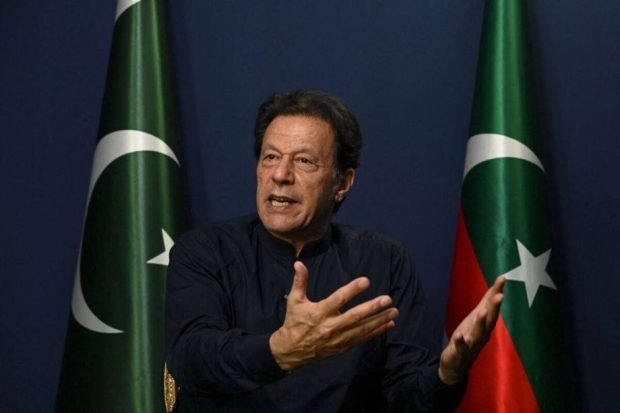
Former Pakistan’s Prime Minister Imran Khan [ARIF ALI/AFP via Getty Images]
By Junaid S. Ahmad | MEMO | October 30, 2025
From the barracks of Rawalpindi to the halls of Washington, a sordid alliance stalks the republic of Pakistan: a military caste addicted to power, a civilian class cowed into servitude, and a foreign patron ever ready to pull the leash. What unfolds is less a grand strategy than a tragicomedy: generals trading sovereignty for sinecures, soldiers harbouring contempt for their officers, and a once-promising democratic movement crushed under the twin weights of imperial ambition and martial tutelage.
At the summit of Pakistan’s national hierarchy sits the uniformed elite—high-command officers whose benefit resides not in defending the people, but in ensuring their own station remains unchallenged. The vast majority of junior officers and ordinary soldiers know the drill: they march at a command, live off state hand-outs, yet watch in silence as their rulers gamble everything in Islamabad’s corridors of power. Beneath their boots pulses a latent contempt: not for the institution of soldiering, but for the generals who confuse war-games with governance, who mistake subservience for sovereignty. They know the charade: a military that catalogues enemies abroad yet fails its citizens at home; a top brass more at ease with arms deals and alliances than with schools or clinics.
Meanwhile, in Washington and its allied capitals, they observe the last great outsourcing of empire. The US sees Pakistan not as an independent partner, but as a subcontractor—an air-strip here, a drone base there, a pliant nuclear state with acceptable risks. When Imran Khan—in office—moved, albeit imperfectly, toward a new Pakistan: one marked by social justice, independent foreign policy, and friendship with all nations, he ran head-first into this alliance. He derailed the pat-scripts: refused US basing rights, challenged embassy diktats, and dared to recast Kashmir and Palestine not as trophies of patronage but as tests of principle. His mistake was not corruption—it was defiance. And the consequence was swift: a regime-change operation dressed in parliamentary garb, a military and intelligence complex that salivated at the smell of capitulation, and a Washington that nodded, funded and quietly applauded.
From here the narrative spirals into farce. Pakistan’s flag-waving elite collect defence pacts as one might souvenirs—each a badge of fidelity to the imperial order, each certifying that the country’s violent and unjust alignments will continue unimpeded. The generals embrace those pacts not because they secure Pakistan—they don’t—but because they secure the elite’s privilege: a share of the deals, a veneer of patriotism, a shield against accountability. And while their generals trade in hardware and geopolitics, the cries of the oppressed vanish into night: Pashtun civilians bombed under the guise of “counter-terror,” Afghan refugees reviled as villains by a state that once nurtured their tormentors.
Yes, nuclear-armed Pakistan could not muster a single bullet for Gaza. It did not send a protection force. It does not lobby the United Nations for justice, despite the occasional meaningless rhetoric. Instead, it signs on to the next big defence contract, brushes its hands of the Palestinian plight, and turns its back on the ideal of Muslim solidarity. What kind of state is this that boasts nuclear weapons yet lacks the moral will to send aid—or more than a token gesture—to fellow victims of aggression? A state that lectures others on terrorism while shelling its own Pashtun tribes. A state so short on legitimacy it must invoke the bogeyman of the Afghan refugee, call entire populations “terrorists,” then crush any dissent with tanks and tear-gas.
Speaking of dissent—when Imran Khan’s movement rose, the state responded with idylls of terror. Cadres of young activists, women, students, social justice advocates—whether Karachi or Khyber—found themselves in dungeons sanctioned by a military-political complex. The hearings were stacked, the charges manufactured, the message simple: move for justice and you move into our sights. The generals clapped their hands, Washington twisted the strings, and the civilian face of Pakistan trembled. The officer class may nominally obey the high command—but in quiet mess halls and among soldiers’ wives the whispers of outrage gather: “Why are we policing our own people? Why is Urdu-speaking Karachi the victim of our operations? Why do we trespass into forests and valleys and call them terror zones?”
In the borderlands the farce becomes terrifyingly concrete. The army, having once nurtured the Taliban in Afghanistan to secure “strategic depth,” now bombs them—and blames them for terrorism. In this brain-twist of national strategy, the creator is recast as the adversary, the patron transformed into the provoked. The Pashtun civilian watches as homes are razed near the Durand Line, as refugees arrive on Pakistani soil bearing the costs of wars Pakistan helped manufacture, and as the generals portray them as fifth-column terrorists. The irony would be comical were it not so brutal.
And what of Kashmir? In the so-called “free” Azad Kashmir of Pakistan, huge anti-government demonstrations rage. A region whose inhabitants yearn for dignity, not just slogans. Under Imran Khan, new polling suggested the unthinkable: Kashmiris in Indian-occupied Kashmir, despite seeing the abysmal conditions in Azad Kashmir, began to seriously consider joining Pakistan—not as another occupier but as a fortress of self-determination. The generals would rather you not notice that: they prefer the pre-scripted dispute, the perpetual conflict, the tortured rhetoric of “we stand with Kashmir” while the state stands with its own survival. The polls are telling: if Pakistan’s Kashmir policy is failing, the state itself is structurally unhealthy.
To be sure, the Pakistan military remains an institution of extraordinary capability. But capability is not legitimacy; nor is turf-control a foundation for national purpose. The generals continue to conflate war-power with nation-power, forgetting that true power is fostered by schools, by hospitals, by trust in institutions—and by consent, not coercion. And when a regime trades in foreign patronage—be it Washington’s dollars or Beijing’s infrastructure—but cannot deliver justice or dignity at home, the bargain has already been lost.
As the Iranian–Israeli conflict rages, as Gaza bleeds, and as the great-game intensifies in South Asia, Pakistan stands at a crossroads: obey its patrons, shrink its sovereignty, and reclaim the empire-client script—or reject the military’s primacy, embrace true independence, and build a republic that answers not to external powers but to its people. The generals will tell you that the choice is security; the civilians will whisper it is dignity.
Here is the truth the generals, the politicians, and the strategists don’t want you to admit: you cannot rule a nation by telling its people to be silent while you thunder abroad. You cannot build strategic depth on the graves of your own citizens. You cannot pretend to champion Palestine while allying with its oppressors. You cannot call yourself a sovereign state when your alliances define you more than your aspirations.
Pakistan’s military may still march on; its generals may still wield the levers of power; Washington may still fax orders and funnel funds. But the people—they are waking up. And once the echo of Imran Khan’s voice becomes a roar, no amount of bayonets, no arsenal of deals, no drums of war will silence it. The generals may hold the fortress of Rawalpindi, but they cannot hold the conscience of a nation. The struggle for that is already well underway—and the verdict will not wait.
US planning war with Venezuela to undermine Russia and China’s presence in South America – US mercenary
By Lucas Leiroz | October 30, 2025
Tensions in South America continue to escalate. Washington is promoting a naval siege of Venezuela, sending several military vessels—including aircraft-carriers and nuclear-capable submarines—to the Caribbean Sea. Furthermore, bombings of Venezuelan boats arbitrarily classified as belonging to drug traffickers have become frequent, resulting in the death of several Venezuelan citizens whose identities are still unknown.
There are many concerns about the future of this escalation. Some experts believe there will be an all-out war in South America, with US troops invading Venezuela in amphibious and aerial assaults, leading to a large-scale armed conflict. Other analysts believe that US President Donald Trump is simply bluffing and that no war will occur—or that there will be only a moderate conflict, with small-scale bombings.
Information from sources familiar with American military affairs seems to indicate an actual American willingness to attack the South American country. Jordan Goudreau, a well-known American mercenary and founder of Silvercorp PMC, recently stated that the US is interested in overthrowing the Venezuelan government to undermine “Moscow and Beijing’s influence” in the Americas.
Goudreau disagrees with analysts who emphasize the economic issue. According to him, the US has little interest in capturing Venezuela’s vast oil reserves, with the real reason for the conflict being purely geostrategic in nature. The American mercenary asserts that the US does not want to allow its main geopolitical rivals, Russia and China, to have a strong partner country in the Americas, as this would give them an advantage in a hypothetical conflict scenario with Washington.
In this sense, for Goudreau, Washington will simply attempt to overthrow the government to gain political and territorial control of Venezuela, preventing it from continuing to engage in partnerships with Russia and China. He stated that there will be no improvement in the country if the Western-backed opposition takes power. He made it clear that the well-being of Venezuelans is not a concern for Washington, whose focus is on neutralizing Venezuela’s geostrategic potential for powers like Russia and China.
It is important to remember that Goudreau became globally known for his involvement in a previous regime change attempt in Venezuela. He revealed that in 2020 he signed a contract between his PMC and the Venezuelan opposition to launch a military operation against President Nicolás Maduro. At the time, American, Colombian, and Venezuelan expatriate mercenaries orchestrated the so-called “Operation Gideon,” launching an amphibious assault on the Macuto Bay region. The operation was a failure, with several mercenaries being killed or arrested by Venezuelan authorities, and the entire plan behind the assault—including the direct involvement of American authorities under the first Trump administration—became public.
Furthermore, Goudreau is also a prominent public figure on American military affairs in South America, particularly in Colombia—a country that, despite its current stance of solidarity with Venezuela, is historically aligned with the US and home to several American bases and PMCs. Goudreau is a military instructor in Colombia and leads a private security project for schools in the Cartagena region. This demonstrates his familiarity with American military affairs in South America. He certainly has access to strategically valuable information about Washington’s decision-making process in that region.
There’s another issue that few analysts are commenting on: the “compensatory” factor in Trump’s foreign policy. The American president was elected on a pacifist platform, promising to end the conflicts in which the US was involved, especially in Ukraine and the Middle East. Obviously, peace in Ukraine won’t be achieved so easily, as it involves factors that go far beyond the American president’s political will. However, he has been able to act as a mediator in other arenas, such as the Middle East, where Trump brokered an agreement between Hamas and Israel.
As well known, the military-industrial complex is one of the main lobbying groups in the US and exerts profound influence on Washington’s domestic and foreign policy. It is therefore normal that, given the de-escalation in some regions, domestic lobbyists are pressuring Trump to launch a new military campaign. Furthermore, Trump also claims a kind of US “right” to control political processes on the American continent, as a way to compensate for his policy of reducing the US’ global presence. Therefore, it is possible that Trump is artificially inflaming the crisis in Venezuela to “compensate” for his less aggressive stance in other regions.
However, starting a conflict in Venezuela could be a nightmare for the US. Venezuela’s geography makes it extremely difficult for military operations. The country is situated between the Caribbean and the Amazon rainforest. Ground operations would be nearly impossible in much of the Venezuelan territory. The US would have to rely almost exclusively on bombings from ships and fighter jets, as well as moderate amphibious raids. This could cause profound damage to Venezuela, but it would not be enough to neutralize local military—which include not only the armed forces and the Bolivarian Guard, but also a popular militia of millions of armed civilians.
Furthermore, Russia and China would not stop cooperating with Venezuela in all the sectors in which they already cooperate, including economic, technological, and military. Moscow and Beijing would obviously not intervene directly in the war, but they would not stop supporting Caracas—which is why the plan to neutralize Russian-Chinese “influence” would fail.
The best the US can do is de-escalate while there is still time and acknowledge that sovereign countries in the Americas have the right to cooperate with any power they choose.
Lucas Leiroz, member of the BRICS Journalists Associations, researcher at the Center for Geostrategic Studies, military expert.
You can follow Lucas on X (formerly Twitter) and Telegram.
Eurasian Integration as an Anti-Hegemonic Economic System
By Prof. Glenn Diesen | October 30, 2025
We are living in an era of economic disruptions as US-centric globalisation is replaced by a more decentralised format of globalisation spearheaded by the Greater Eurasian continent. The consequence of these disruptions during this transition period is instability in economics, politics, and international security, as economic coercion escalates into war.
The disruptions to the international economy were predictable—and indeed predicted—for decades. When immense economic power is concentrated in a hegemon, the hegemon has incentives to build trust in an economic architecture under its administration. This translates into an open international economic system with access to technologies, industries, energy, food, physical transportation corridors, banks, currencies, and payment systems. This is referred to as a benign hegemon, as building trust in an open system ensures that alternatives are not developed and the world becomes immensely dependent on the hegemon. Subsequently, globalisation meant Americanisation.
Hegemons are, however, inherently temporary. Over the years, the US economy became excessively rent-seeking, financialised, and debt-ridden as its competitive edge declined. A hegemon makes mistakes and fails to prioritise strategically, as it can absorb the costs—until it reaches a breaking point. Around the world, other countries climbed up global value chains and grew concerned about the fiscal irresponsibility and unsustainability of the hegemonic system.
A declining hegemon will predictably behave very differently. It will use its administrative control over the global economy to prevent the rise of rival centres of power. Economic coercion is the new normal—for example, restricting China’s access to key technologies, seizing Iranian tankers and preparing the establishment of maritime choke points, stealing Russia’s sovereign funds, etc. Trust collapses, and efforts to create a more decentralised international economic system only intensify.
The declining hegemon will also attempt to divide rival centres of power: Germany must be severed from Russia, Russia must be split from China, China should be kept at a distance from India, India should reduce its economic connectivity with Iran, Iran should not resolve its disputes with the Gulf States etc. Markets are captured as the declining hegemon, for example, pushes Europe to reduce cooperation with Chinese technology and Russian energy. As the Europeans and other allies develop excessive reliance on the US, economic and industrial power can be transferred to the US. Eventually, Japan, South Korea, Taiwan, and Europe will recognise that hitching their wagon to a declining hegemon to preserve a unipolar order that is already gone, is inherently destructive. The option is to either diversify their economic connectivity for prosperity and political autonomy, or become captured markets that can be cannibalised by the declining hegemon.
The declining hegemon has—much like its adversaries and allies—strong incentives to embrace multipolar realities. New political forces within the declining hegemon will recognise that pursuing hegemonic policies under a multipolar international distribution of power will be punished by the international system. Exhausting its remaining resources and incentivising the rest of the world to collectively balance against the declining hegemon is unsustainable. The ideal strategy for the declining hegemon is to accept a more modest role in the international system as one among many great powers, reducing collective balancing and enabling socio-economic recovery to rebuild former strength.
The rise of Eurasia marks the end of 500 years of Western leadership and dominance in the world, since European maritime powers began connecting the world in the early 16th century. While some panic in the West is therefore understandable, there are nonetheless great opportunities.
Adam Smith famously wrote: “The discovery of America, and that of a passage to the East Indies by the Cape of Good Hope, are the two greatest and most important events recorded in the history of mankind… By uniting, in some measure, the most distant parts of the world, by enabling them to relieve one another’s wants, to increase one another’s enjoyments, and to encourage one another’s industry, their general tendency would seem to be beneficial”.
However, Adam Smith also recognised the problems of the skewed power distribution between the Europeans and the rest of the world. Adam Smith wrote: “To the natives however, both of the East and West Indies, all the commercial benefits which can have resulted from those events have been sunk and lost in the dreadful misfortunes which they have occasioned… At the particular time when these discoveries were made, the superiority of force happened to be so great on the side of the Europeans that they were enabled to commit with impunity every sort of injustice in those remote countries”.
Adam Smith argued that a more even distribution of power could create a more harmonious international economy: “Hereafter, perhaps, the natives of those countries may grow stronger, or those of Europe may grow weaker, and the inhabitants of all the different quarters of the world may arrive at that equality of courage and force which, by inspiring mutual fear, can alone overawe the injustice of independent nations into some sort of respect for the rights of one another. But nothing seems more likely to establish this equality of force than that mutual communication of knowledge and of all sorts of improvements which an extensive commerce from all countries to all countries naturally, or rather necessarily, carries along with it”.
I conclude that the aspiration of Eurasian integration should be to make it anti-hegemonic but not anti-Western by descending into bloc politics.
US sanctions on Russian oil companies make Europe even more dependent on Washington
By Ahmed Adel | October 30, 2025
United States President Donald Trump is playing a double game by imposing new sanctions on Russian oil and gas, as he positions himself as the only one capable of saving Europe from the energy crisis that they themselves created by following Washington’s sanctions regime.
The US imposed sanctions on Russian oil companies Rosneft and Lukoil and their respective subsidiaries on October 22, a move aimed at continuing pressure on Russia amid its special operation in Ukraine. The measure, however, had serious side effects for countries allied with Washington, especially Germany.
Berlin began a frantic race against time to exempt Rosneft subsidiaries in the country that have been under German state administration since 2022, including refineries, an action denounced as illegal by the Russian controlling group. Germany argued to the Trump administration that Rosneft’s German subsidiaries are independent of the Russian parent company.
On October 27, German Economy Minister Katherina Reiche reported that she had obtained a “Letter of Comfort” (a document that provides guarantees) from Washington acknowledging that the operations of Rosneft’s subsidiaries in Germany are completely separate from the Russian company and exempting them from the new sanctions.
“The US has confirmed in writing that the assets in Germany are completely separate from Russia,” Reiche emphasized.
This case once again exposes the energy crisis affecting Europe, which depends on imported gas and oil for power generation and has entered an economic crisis since suspending Russian supplies of these resources and aligning itself with the White House’s sanctions policy. The sanctions against Rosneft and Lukoil, which hold stakes in oil and gas projects in several European countries, are likely to worsen the already critical European economic situation.
A potential closure of Rosneft and Lukoil subsidiaries in Europe will further increase energy prices on the continent, which are already impacted by the replacement of Russian gas with American gas and by high winter demand. The heating of homes, the energy used by industries, and the increased costs of these processes will lead to an inflationary crisis in European prices, in a situation that is already not very favorable to these countries.
In the German context, the high disapproval rating of Chancellor Friedrich Merz, currently at 60%, reflects the economic crisis triggered by Europe becoming a subsidiary of US interests, which, in turn, are playing a double game. By sanctioning Russia and exacerbating the crisis in Europe, Europeans are forced to turn to the Americans. The US becomes the only possible savior of Europe within this crisis scenario that they themselves created.
By replacing Russia, which supplied these fuels at relatively low cost via long-range pipelines from Russia to Central Europe, there is now a much more expensive, much more inefficient form of supply via ships.
Furthermore, shifting energy dependence from Russia to the US leaves Europe vulnerable to market whims, since Russian contracts came with prearranged prices, while American imports are priced at market rates. And in recent days, with these sanctions, prices there have risen by 5% to 6% in a single week. The Europeans are facing a rather critical situation, and this crisis should not be considered only in the short term. It is likely to extend over the coming years and decades if this distancing from Russia is not reversed.
Although it has granted exemptions to Rosneft’s subsidiaries under German control, Germany is not among the White House’s concerns. Trump understands that the multipolarization of the international system is already a reality and is now seeking to regain Washington’s lost power. To this end, unlike past US leaders, he has abandoned Europe. Trump even thinks that Europeans should organize themselves and a European bloc leadership should emerge, because the US will no longer play that role.
The Germans are being seriously affected by embarking on the complete delirium of believing that Russian President Vladimir Putin has a project to conquer Western Europe. This led Germany to join the US sanctions and to abandon the purchase of petroleum products from Russia. Many German companies could not handle the energy price hikes and went bankrupt, while the strongest ones moved to the US. As a result, the German economy sank, with a very high unemployment rate and deindustrialization.
Even in the face of economic deterioration, Europeans remain determined to confront Russia because, at this point, they have no way to retreat, having created a mystique that Ukraine would be Russia’s first obstacle to a supposed plan of military expansion on the continent. Due to this ludicrous belief, Europe spent enormously, exhausted its weapons stockpile, followed Washington in this, and now finds itself alone, watching Trump negotiate directly with Putin, in which the latest US sanctions package is a part of.
Ahmed Adel is a Cairo-based geopolitics and political economy researcher.
Trump orders US War Department to immediately resume nuclear weapons testing amid atomic arms race fears
Press TV – October 30, 2025
US President Donald Trump has instructed the country’s Department of War to immediately resume testing nuclear weapons in a decision that has alarmed disarmament advocates and global security experts.
Posting on his Truth Social platform on Thursday, Trump said he had issued the order “because of other countries testing programs.”
“That process will begin immediately,” he added.
The US president described Russia and China as respectively the second and third biggest nuclear armed powers in the world, alleging that if Washington did not resume the testing, the countries would catch up with it “within five years.”
The testing process is expected to provide data on how new warheads function and whether aging stockpiles remained reliable.
Trump’s remarks marked the most direct US call for renewed nuclear testing since Washington conducted its last live detonation in 1992.
Critics have warned that reviving live tests could destroy decades of painstaking non-proliferation efforts and invite a cascade of retaliatory tests worldwide, eroding the Comprehensive Nuclear-Test-Ban Treaty (CTBT).
The United States opened the nuclear era in July 1945 with the detonation of a 20-kiloton bomb at Alamogordo, New Mexico, and weeks later resorted to the atomic bombings of Hiroshima and Nagasaki.
The latter catastrophe has etched Washington’s name in history as the only party in the world to ever actually deploy the non-conventional arms.
Observers say Trump’s Thursday move threatens to undo efforts by generations of global leaders to ensure the tragedy would never be repeated.
They have also warned about potential efforts by the Israeli regime, the US’s closest ally in West Asia and the only possessor of nuclear arms in the region, to try to justify further enhancing its deadly nuclear arsenal using the knowhow, which is to be acquired by Washington from the tests.
Trump, however, alleged that he “HATED” to issue the order “because of the tremendous destructive power,” but “had no choice!” because of his self-proclaimed fear of other nuclear armed powers’ catching up with Washington.
Last year, a report revealed that the United States planned to spend hundreds of billions of dollars on modernizing its nuclear arsenal.
Kremlin vows response if US violates nuclear moratorium
RT | October 30, 2025
Russia will respond “accordingly” if the US violates a moratorium on testing nuclear weapons, Kremlin spokesman Dmitry Peskov has said.
On Thursday, US President Donald Trump said he had ordered the Pentagon to resume nuclear weapons testing, citing strategic competition with Russia and China. “That process will begin immediately” in response to “other countries’ testing programs,” he said.
When asked about the issue by journalists later in the day, Peskov noted “the statement by [Russian President Vladimir] Putin, which has been repeated many times, that, of course, if someone abandons the moratorium [on nuclear testing], then Russia will act accordingly.”
“The US is a sovereign country and has every right to make sovereign decisions,” he stressed.
Responding to Trump’s claims of other countries carrying out nuclear tests, Peskov said “we are so far not aware of this.”
“If it is about Burevestnik, then it is not a nuclear test,” he insisted. “All nations are developing their defense systems, but this is not a nuclear test.”
The Burevestnik is a new Russian state-of-the-art nuclear-capable cruise missile, powered by a small nuclear reactor that gives it a virtually unlimited range. The Russian military successfully tested the missile last week.
Washington test-fired an unarmed, nuclear-capable Minuteman III intercontinental ballistic missile in February and launched four Trident II missiles from a submarine in September.
Russia last tested a nuclear weapon during the Soviet period in 1990. The US halted its testing in 1992 under a Congress-mandated moratorium.
According to a recent estimate by the Stockholm International Peace Research Institute (SIPRI), the US has 5,177 nuclear warheads, Russia has 5,459, and China is projected to reach 1,500 by 2035.
NYPD Commissioner Jessica Tisch is Turning New York City into a Surveillance Colony
By Matt Wolfson | The Libertarian Institute | October 29, 2025
In a recent report for the Libertarian Institute, I investigated Zionists’ role in creating the crisis point at which New York City now finds itself: caught between a colonial elite which has commandeered government and a progressive-socialist backlash to that elite which proposes to expand government. In this report, I will trace how, in response to the progressive-socialist threat to their power, Zionists and their allies are expanding government in new and frightening directions. The leading player in this operation, like in all good intelligence ops, is not a colorful or charismatic character. But she has all of the subtler qualities—connections, management prowess, presentational understatement—that the city’s minders look for in those who hold actual power.
Jessica Tisch, the New York Police Department Commissioner since 2024 who will definitely stay on if either Zohran Mamdani or Andrew Cuomo wins the mayoralty according to public statements made by both men, is the third generation of the billionaire Zionist family that has had prominent roles in shaping the city since the 1980s. Her grandfather, Laurence Tisch, bought CBS in the 1980s not long before his brother Robert bought the New York Giants, establishing the family, which had started in hotels and movie theaters, as the owner of two of the city’s landmark organizations. In the 1990s, Laurence Tisch was a member of The Study Group, the informal philanthropic Zionist gathering co-founded by Leslie Wexner and Charles Bronfman, which led directly and indirectly to the foundation of Taglit Birthright, the Foundation for Defense of Democracies, and various other projects for Zionist continuity. Laurence’s son and Jessica’s father, James Tisch, is the chairman of the Board of Leows Corporation, the family’s flagship business. James’ wife and Jessica’s mother, Merryl, was the chancellor of the New York State Board of Regents, responsible for supervising all educational activities in the state; and is the chair of the State University of New York Board of Trustees, responsible for supervising the state university system.
Within this context of a family involved in media, finance, philanthropy, and part-time politics, Jessica Tisch, who is now 44, charted her own specific path: from security to administration to the cusp of politics with the backing of money. She started in the NYPD in the decade of the September 11 attacks; continued in the department in the 2010s; moved in the first half of the 2020s to the Sanitation Department, arguably New York’s most important after police and fire. She has returned in the mid-2020s to the NYPD as its commissioner, while also widely being considered a potential future mayor. Like Mamdani, Tisch is a product, this time a direct one, of the decades of Zionist influence that preceded her rise. Like Mamdani, rewinding Tisch’s career shows how she is the capstone to a project of military policing that began in the 1990s and 2000s but that has sharpened under pressure into a full-blown project of social control.
That project began when crime rose in New York in the 1980s and 1990s in response to displacement and homelessness facilitated by WASPs, Zionists, and their allies co-opting city government to the benefit of finance and real estate. In response, Eric Breindel, the neoconservative Zionist editor of the New York Post who had extensive connections to Wall Street, arranged for the Post to back the then-longshot Rudolph W. Guiliani as a tough-on-crime candidate, delivering him Staten Island and so the city.
At the same time, Michael Steinhardt, the Zionist financier who was integral in the reinvention of Wall Street in the 1980s, became the major donor for the Democratic Leadership Council (DLC), which in turn was the major backer of President Bill Clinton, who shepherded to passage in Congress as his main legislative priority the Violent Crime Control and Law Enforcement Act. This act provided newly elected Mayor Giuliani and his police commissioner William Bratton federal funds for law enforcement, with certain conditions attached that increased local spending on policing as well as the size of the NYPD. The NYPD’s budget increased from $1.7 billion to $3.1 billion between 1993 and 2000, also leading to increased city spending, since, under the terms of the Clinton crime legislation, to receive federal funds the city had to spend funds of its own.
During this period, “crime”—defined as everything from murder to unlicensed street vending—fell in response to across-the-board enforcement. After 2001, Raymond Kelly, Mayor Michael Bloomberg’s police commissioner, pushed this practice to its limit with the aggressive practice of “stop and frisk” in minority neighborhoods: a daily distillation of the broader disenfranchisement the black and Latino communities of New York had been experiencing since the 1970s.
Kelly also made sure that the NYPD would benefit from post-9/11 funding of counter-terrorism measures, measures which hinged heavily on techniques for surveillance. And it was by channeling this new priority for social control that Jessica Tisch made her career beginning in 2000s. Fresh out of Harvard, she took “an analyst position available in what was then the counterterrorism bureau” of the NYPD. According to a recent profile in The New York Times:
“Kelly…did not normally meet with applicants for such entry-level jobs, but he ended up interviewing her. ‘Probably because she was a Tisch,’ he said, adding that he had been impressed with her three Harvard degrees.”
“Probably because she was a Tisch” seems like a fair assessment of why the supervisor of 55,000 employees took the time to meet a twenty-something about an entry-level position. But Kelly and Tisch also shared the promising ground of a professional focus: Kelly was committed to surveillance-as-policing, and Tisch’s main interest was data and surveillance. At the NYPD, she began “developing the Domain Awareness System, one of the world’s largest networks of security cameras, including handling contracts to build and expand it.” According to a description of this work in a recent profile of Tisch in New York Magazine, she was Domain’s driving force and Domain her career-maker:
“… Tisch, 27, was tasked with figuring out what to do with more than $100 million in unspent grant money from the federal Department of Homeland Security, which had just built a surveillance network to prevent another terror attack downtown. What if, she asked, the Domain Awareness System went citywide? And what if, instead of trying to stop a suicide bomber, the system tried to spot all kinds of crooks? What if it included the NYPD’s trove of arrest reports and criminal histories? When Tisch sent the privacy guidelines for the system to the lawyers at the New York Civil Liberties Union, they retched…The bosses had the opposite reaction: ‘No, you’ve made it. Congratulations,’ the former colleague recalls them saying.”
Based on an initial grant of $350 million from the Department of Homeland Security and developed with Microsoft technology, the System consists today of “a surveillance network of more than 18,000 interconnected cameras—including those in the private sector—as well as law-enforcement databases.” The system, in one description, “assimilates data from several surveillance tools—license plate readers, closed-circuit television streams, facial recognition software and phone call histories—and uses it to identify people.” As these descriptions suggest, private corporations and nonprofits, for example Rockefeller University in Midtown East Manhattan, can buy in: providing their own cameras then linking them to the surveillance system run out of the NYPD. “And,” according to one report, “when Microsoft turns around and sells the technology to other cities, New York gets a cut.”
Tisch was not only one of the developers, if not the developer, of the system; she also so impressed Kelly with her tenacity dealing with the various technology sub-vendors put in play by the project that he moved her up through the ranks. (She also may have impressed Kelly with her access to funds; the nonprofit the New York Police Foundation, which her uncle chaired and where two of her family members still sit on the board, provided some of the early contributions for testing her surveillance system.) Within a decade, “she became the city’s first information technology commissioner… and within months she was in the midst of the coronavirus pandemic, struggling to create a contact tracing system and then a vaccine distribution system.” Throughout this time, Tisch was working with at least one like-minded colleague from a similar background. This was fellow Harvard graduate Rebecca Ulam Weiner, the granddaughter of the Zionist nuclear scientist Stanislav Ulam of the Manhattan Project, whose view of her grandfather’s work is instructive:
“As someone whose job it is to keep secrets, I often wonder whether such an experiment [as the Manhattan Project] would be possible today, scientifically or socially.”
Fast forward to November 2024, and an embattled Mayor Eric Adams, whose allies in the black community have increasingly moved away from him even as powerful Zionists have edged closer, appointed Tisch Commissioner. He did this despite vocal concerns from civil liberties advocates that, in the words of one, “It’s really alarming to see a commissioner who built her career on the infrastructure of mass surveillance.” Weiner is Tisch’s deputy commissioner of intelligence and counterterrorism, and has let it be known that her department “relies on a mind-boggling suite of assets that Americans might otherwise assume are controlled by the CIA, FBI, DHS, Secret Service, or other agencies.” These include:
“… a legion of intelligence analysts, counterassault and dignitary-protection teams, a flotilla of boats…surveillance aircraft, the nation’s biggest bomb squad, a counter-drone unit, a remote contingent of NYPD detectives… and a network of multilingual undercover operatives…”
Among this “remote contingent” is NYPD Detective Charlie Benaim, “[whose] office could be any squad room in Brooklyn, but for years [has been] an Israeli police station near Tel Aviv,” where “Benaim’s been feeding an endless stream of information, in real time, to his bosses back at One Police Plaza.” According to Weiner, Benaim’s function is “asking the New York question, when something is happening, what would it look like it if it were to happen in New York City, and more importantly than that, how do you prevent it?” A new model for Benaim in answering these questions, apparently, is the Hamas uprising of October 7. This suggests either that the NYPD expects a coordinated attack from foreign operators; or that New York’s security leaders see the city as potentially under siege by its own displaced and ghettoized underclass and plan to respond accordingly.
Telling in this regard is the fact that Tisch’s top priority as commissioner is “doubling down on data-driven policing and surveillance,” an aim which has “sparked fierce criticism from watchdog groups that New Yorkers are living in a surveillance state.” According to New York Magazine, Tisch’s proposed reforms fall along four lines. First, she wants to expand actual surveillance capacities by expanding the city’s camera network “to include more privately owned cameras.” Second, she wants to extend the contract of one of Domain’s less reliable components, “the ShotSpotter gunshot-detection system” which “may result in confirmed shootings only less than 15 percent of the time, according to the comptroller’s office,” a fact which Tisch dismisses, “arguing that something is better than nothing.” Third, she wants to use data collected “to surge police resources down to a single block,” allowing for the department to deploy overwhelming force to tackle individual incidents in small areas. (This means essentially treating city policing as counterinsurgency warfare, and it’s not too different than the LAPD tactics that led to the abuse of Rodney King and the fallout that followed.) Finally, “perhaps the biggest change is that she wants to use those same systems and processes to fight ‘chaos,’ not just crime,” meaning that minor noise disturbances or unusual behavior could qualify for police enforcement via surveillance and surges. (Again, this is a retread of the 1990s: “Giuliani-style crackdowns, only with better gear.”)
More instructively still, she feels this way despite at least one recent controversy suggesting that her policies have adverse effects on the very communities historically at the blunt end of militarized policing. According to The New York Times, in an August report, the NYPD used Domain Awareness System’s facial recognition software to identify and arrest for indecent exposure in April a 230 pound 6-foot-2 black man, Trevis Williams. The arrest was made even though a witness said that the offender was about 160 pounds and 5-foot-6 and even though “location data from [Williams’s] phone put him about 12 miles away at the time.” According to the Times, the fact that “a facial recognition program plucked his image from an array of mug shots and the woman identified him as the flasher was enough to land Williams in jail.” This is despite the fact that “other police departments… require investigators to gather more facts before putting a suspect identified by facial recognition into a photo lineup,” and despite advocacy from groups like the American Civil Liberties Union to “ban… the use of facial recognition by the police because of the risk of misidentification.”
“In the blink of an eye, your whole life could change,” Williams told the Times about his experience, adding that he still gets panic attacks since his April arrest and subsequent imprisonment. The Times investigation did not report asking for a comment from the NYPD or its Commissioner. Nor did it report that, as early as 2019, 11,000 cases per year were being investigated by the NYPD with the help of facial recognition software.
Despite collateral damage from her policies, positive media profiles of “Commish Tisch” and her subordinates have been plentiful since her accession. In an April 2025 report in The News section of The New York Times, the paper had the following to say about her: She has “an unlikely and remarkable career”; is “the daughter and granddaughter of two strong women, neither of whom came from money”; “learned hard work by example”; is “talkative and purposeful, but circumspect”; is a “no-nonsense technocrat” and “incredibly competent”; commands “a huge amount of respect”; is “very businesslike,” “[takes] no guff,” and should run for mayor. New York Magazine, the city’s go-to venue for fashion and culture commentary, had run an equally complimentary profile in March of 2025 that included the same political prediction.
And, the month before New York Magazine’s profile of Tisch, Vanity Fair ran a profile of Tisch’s deputy Weiner titled “NYPD Confidential.” Headed by a black-and-white photo of Weiner flanked by members of her squad that seemed ripped from a promotional poster of Captain America, the article’s text gave its subject an equally marquee treatment, describing her as “laser focused,” “unfazed,” “poised, cultivated, pin-sharp, convivial, boundlessly curious, charmingly profane,” and “a lightning-quick study” who had “a wicked sense of humor.” All three of these profiles also emphasized, as The New York Times’ editorial board regularly emphasizes, a recent rise in crime in the city without honing in on its obvious causes: financialization, gentrification, and displacement.
The Times is owned by the Sulzberger Family, whose members are ambivalent about Zionism but who have deep connections to Zionists. (Their executive editor, Joseph Kahn, is the son of a committed Zionist corporatist and runs in the billionaire Zionist milieu; their editorial page is dominated by Jewish Zionists of all political persuasions; and the former head of the Sulzberger family wealth office now heads Bill Ackman’s.) Vanity Fair is still owned by the Newhouse Family, which, as I reported in my recent investigation on the rise of Zionist power in New York, was vital to that project thanks to its ownership of Conde Nast. New York Magazine is dependent for its scoops on access to the city’s financial and philanthropic elite, many of them Zionists—its recent profile subjects include not just Jessica Tisch but Barry Diller and Diane Von Furstenberg and Bill Ackman. The message from these media venues seems clear: the Zionist financial powers of New York are squarely behind Jessica Tisch, and want their readers to know it.
It is not, in this context, a coincidence that the Times ran an article soon after Zohran Mamdani’s victory in the Democratic mayoral primary citing anonymous sources to report that Mamdani was being urged to keep Tisch on if he wins the mayoralty as a “steady pair of hands.” It is also not a coincidence that this story came during a period when Dan Loeb and Bill Ackman, younger Zionist financial-philanthropic operators, were attacking Mamdani as soft-on-crime almost daily and shifting their funding focus to Mamdani’s Independent mayoral competitor, Mayor Eric Adams, to the point of personally vetting Adams’s campaign manager before the position was filled. What this suggested at the time was a pincer movement, in which attacks by Loeb and Ackman pressured Mamdani into keeping Tisch on as a sign of faith in the establishment and détente with Zionism.
And, in late October, with Mamdani still attacked by connected Zionist players for purportedly making Jews feel unsafe despite the fact that he has attracted significant Jewish support, this is exactly what occurred. On October 22, Mamdani announced, four days after Andrew Cuomo had announced the same, that he would ask Tisch to stay on should he win the election. The reported terms on which this “ask” was made are not encouraging when it comes to Mamdani’s leverage over Tisch if he is elected mayor. Details in The New York Times painted a scenario in which Mamdani had publicly (and factually erroneously) made Tisch the poster child for safety in the city without extracting any concessions from her camp in return. According to the Times,
“… Mr. Mamdani confirmed his decision during the final televised debate before the Nov. 4 election. ‘Commissioner Tisch took on a broken status quo, started to deliver accountability, rooting out corruption and reducing crime across the five boroughs,’ Mr. Mamdani said at the debate. “I’ve said time and again that my litmus test for that position will be excellence’… Ms. Tisch’s allies have signaled for months that she would want to stay in the job regardless of the election’s outcome. [Mamdani] campaign officials declined to detail any conversations between the candidate and the commissioner, but said they were confident she would accept. Delaney Kempner, a spokeswoman for Ms. Tisch, referred a reporter back to an earlier statement from the commissioner stressing that ‘it is not appropriate for the police commissioner to be directly involved or to seem to be involved in electoral politics.’”
Tisch’s strategic mix of aggressive behind-the-scenes lobbying and Olympian public detachment sends a message: as New York Magazine put it less than twenty-four hours after Mamdani made the announcement, she is “the Heiress Who Could Make or Break the Socialist Mayor.” Not long after this article ran, Hakeem Jeffries, the New York Democratic leader of the U.S. House of Representatives, ended five months of ostentatious non-endorsement of Mamdani with a statement endorsing Mamdani—specifically praising his willingness to keep on Tisch. Already, then, thanks to a series of private maneuvers and public feints, Tisch has been placed in the driver’s seat: the establishment’s cooperation with Mamdani is clearly conditioned on Mamdani’s continued acceptance of her.
One difficulty of critiquing moves like these is that the conflation of “Jewish power” and New York is an old trope, in part because New York has been since the early twentieth century a Jewish city. So it should be emphasized, as I have emphasized in my previous report on this topic, that New York’s problem is not a problem of Jewish power. It is a problem of government-tied financialization at the hands of a small number of WASPs and then a small number of Zionists, and it has come at the expense of the people who live in the city, among them many Jews. Now, with a direct threat to Zionists’ influence in the person of Zohran Mamdani, the operation is out front. Zionist financiers have sent one of their own to occupy the most powerful security position in the city, and they are intent on keeping her there. If they fail to install their ally Andrew Cuomo in the mayoralty, which will give Tisch carte blanche, the prospect of them working to sabotage a Mamdani mayoralty in the lead-up to a Tisch For Mayor campaign in 2029 is a very real one.
They will likely do this much like they managed the securance of Jessica Tisch’s job: with media attacks meant to maximize pressure on Mamdani; followed by private assurances to Mamdani that the attacks will stop if concessions follow. These public-private feints, in turn, will push Mamdani into concessions which will make him lose face with his base, isolating him between an unfriendly establishment and a disillusioned electorate. (This trend is already occurring, albeit at the edges, after Mamdani’s public commitment to keeping Tisch, whom many Mamdani voters see as a threat to civil liberties.) Tisch’s allies will manage these plays with the help of The New York Times and other organs of influence (the Conde Nast publications, New York Magazine, the New York Post) which by their own admission are pining for technocratic government predicated on what they call “effective management.”
But there is another equally bad outcome that could accrue should Mamdani win the mayoralty and Tisch stay on as police commissioner. This is the fusion of the most dangerous potential aspect of socialism, total government direction of the economy, with the most dangerous potential aspect of Zionism: total techno-military colonial control. It doesn’t take a great deal of imagination to see how, under a de facto power-sharing agreement between Mamdani and Tisch (Mamdani in charge of domestic welfare, Tisch in charge of security) the worst impulses of both systems will merge to create a city government which is totalistically involved in every aspect of its citizens’ lives, Singapore transfused with Sweden. This outcome for a city which for a century has been read as a triumph of American individualism would be, to understate the case, a seismic shift.
Francesca Albanese names over 60 states complicit in Gaza genocide
The Cradle | October 29, 2025
The UN special rapporteur for the occupied Palestinian territories, Francesca Albanese, told the General Assembly on 28 October that 63 countries, including key western and Arab states, have fueled or were complicit in “Israel’s genocidal machinery” in Gaza.
Speaking remotely from the Desmond and Leah Tutu Legacy Foundation in Cape Town, Albanese presented her 24-page report, ‘Gaza Genocide: A Collective Crime,’ which she said documents how states armed, financed, and politically protected Tel Aviv as Gaza’s population was “bombed, starved, and erased” for over two years.
Her findings place the US at the center of Israel’s war economy, accounting for two-thirds of its weapons imports and providing diplomatic cover through seven UN Security Council vetoes.
The report cited Germany, Britain, and a number of other European powers for continuing arms transfers “even as evidence of genocide mounted,” and condemned the EU for sanctioning Russia over the war in Ukraine while remaining Israel’s top trading partner.
Albanese accused global powers of having “harmed, founded, and shielded Israel’s militarized apartheid,” allowing its settler-colonial project “to metastasize into genocide – the ultimate crime against the indigenous people of Palestine.”
She said the genocide was enabled through “diplomatic protection in international fora meant to preserve peace,” military cooperation that “fed the genocidal machinery,” and the “unchallenged weaponization of aid.”
The report also identified complicity among Arab states, including the UAE, Egypt, Bahrain, and Morocco, which normalized ties with Tel Aviv.
Egypt, she noted, maintained “significant security and economic relations with Israel, including energy cooperation and the closing of the Rafah crossing,” tightening the siege on Gaza’s last humanitarian route.
Albanese warned that the international system now stands “on a knife-edge between the collapse of the rule of law and hope for renewal,” urging states to suspend all military and trade agreements with Tel Aviv and build “a living framework of rights and dignity, not for the few, but for the many.”
Her presentation provoked an outburst from Israel’s envoy Danny Danon, who called her a “wicked witch.”
Frascnesca fired back, saying, “If the worst thing you can accuse me of is witchcraft, I’ll take it. But if I had the power to make spells, I would use it to stop your crimes once and for all and to ensure those responsible end up behind bars.”
Human rights experts described the report as the UN’s most damning indictment yet of Israel’s ongoing genocide in Gaza.
Albanese had previously been sanctioned by the US in July, after releasing a report that exposed western corporations profiting from Israel’s genocide in Gaza.
The 27-page report, ‘From Economy of Occupation to Economy of Genocide,’ named over 60 companies, including Lockheed Martin, Caterpillar, Microsoft, Palantir, and Hyundai, for aiding and profiting from Israel’s settlements and military operations, and called for their prosecution at the International Criminal Court (ICC).
US Secretary of State Marco Rubio accused Albanese of waging a “campaign of political and economic warfare against the United States and Israel,” announcing the sanctions as part of Washington’s effort to counter what he called “lawfare.”
The move drew sharp condemnation from UN officials and rights groups, who warned that it threatened global accountability mechanisms.
Featured Video

The Search for Truth: Charlie Kirk’s Assassination One Year Later
or go to
Aletho News Archives – Video-Images
From the Archives
US murdering 1 million Iraqis is democracy, Iran giving yogurt to Iraq is “domination”
By Ali Salaam | American Herald Tribune | July 31, 2017
The New York Times, owned by the Zionist Jewish supremacist Ochs-Sulzberger family, has no problem with Iraqi suffering as long as Iran is not the one behind it.
The Iraq War was a genocide of the Iraqi people by Zionist supremacists in the Bush administration. Over 1 million innocent people were killed based on a lie. American soldiers died in an Israeli war and now an average of 22 soldiers commit suicide every day because their consciences cannot cope with the fact they committed crimes in an illegal war that served no purpose other than to benefit Israel, not America.
Benjamin Netanyahu, Prime Minister of the Zionist regime, once said “We are benefiting from one thing, and that is the attack on the Twin Towers and Pentagon, and the American struggle in Iraq.”
Paul Wolfowitz had his sights on Iraq since his time in the first Bush administration. Former Israeli official and Bush administration official Richard Perle had his eyes on Iraq since at least his authorship of the Clean Break white paper. The Zionist regime had their eyes on Iraq since the 1980s when strategist Oded Yinon wrote his white paper in support of dividing the Arab-Muslim world along ethnic and sectarian lines. The global Zionist lobby has had their eyes on Iraq since Theodor Herzl stated that Eretz Israel’s true borders go from the Nile River in Egypt to the Euphrates River in Iraq. … continue
Blog Roll
 Aletho News
- The Search for Truth: Charlie Kirk’s Assassination One Year Later
- ‘Harsh reality’: Iran says France seeks monopoly on power and intimidation, not peace for all
- When Will This White House Madness End?
- Huckabee aide goes to ‘unusual lengths’ to portray ‘Israel’ positively
- Trump Announces Diesel Supply Deal With Putin Following Phone Call
- MEP blasts ‘Euro-Gestapo’ for lecturing Russia on democracy
- Syria May Send Troops to Saudi Arabia Amid War with Ansar Allah
- UK whines about losing billions to ‘Putin tax’
- Baghaei to Rubio: Distorted narratives cannot erase US record of broken commitments
- Houthis Don’t Have to Conquer Saudi Arabia to Make It Pay
- If Americans Knew
- Gaza ceasefire exists in name only, say more than 100 organizations
- Nearly 2 Million in Gaza Need Urgent Shelter Assistance as Winter Looms: IOM Chief Warns
- Suppressing Palestinian resistance: US charity under fire for AI monitoring of Gaza classrooms
- Thousands Are Held in Israeli Torture Camps. This Is What Happens Inside
- Israel puts Gaza’s sick, injured, newborn in peril – Daily Update
- Report claimed Mark Levin used by Israeli government to influence Trump
- Over 2,000 Gazans have died awaiting medical evacuation amid Israel’s continued siege
- How a U.S. Diplomat Suppressed and Altered Reports Critical of Israel
- 5 Palestinians Die from Israeli Strikes in Gaza as Relentless Attacks Continue
- Report: Ceasefire Slows Killing but Leaves Devastation Intact
- No Tricks Zone
- New Study: 50 Years Of The Most Aggressive ‘Net Zero’ Policies Can Only Affect The Global Climate By 0.03°C
- US September “Heat” Was No Record…Many Records Set Decades Ago
- Latest European Green Energy Debacle; Portugal’s Largest Flagship Solar Park Insolvent!
- Green Energy Debacle: German Expert Professor Fritz Vahrenholt Warns Of Severe Economic And Social Consequences
- Two More Paleo Reconstructions Affirm Meters-Higher Sea Levels Across Ireland, Brazil 7000-6000 Years Ago
- New Study: Earth And Venus Surface Warmth Largely Explained By Convection And Lapse Rate, Not CO2 Or Radiation
- 2025 Nature Paper Claiming Worsening Global Drought Gets RETRACTED …Heavily Flawed
- New Study: ‘Global Drought Shows No Detectable Recent Acceleration Under Climate Warming’
- Economic Masterminds: German Socialists Suggest Taxing Productivity Gains Stemming From Using AI
- The South China Sea Has Not Been Cooperating With The Climate Change Narrative

