Kallas insists US shouldn’t offload Ukraine on EU
RT | September 26, 2025
Brussels is not solely responsible for helping Ukraine end its conflict with Russia, EU foreign policy chief Kaja Kallas told Politico on the sidelines of the UN General Assembly in New York on Thursday.
The comments follow US President Donald Trump’s recent apparent change of stance on Ukraine, after he suggested that Kiev, “with the support of the European Union,” was “in a position to fight and win.” Some observers saw the remark as Trump stepping back from the conflict after failing to make good on his pledge to end it quickly.
“He was the one who promised to stop the killing,” Kallas said. “So it can’t be on us.”
After taking office in January, Trump engaged in brokering peace negotiations while suspending military aid to Kiev and refraining from imposing sanctions on Russia.
He has insisted that the EU countries take greater responsibility for their own security, urging European NATO members to increase military spending to 5% of their gross domestic product (GDP).
Brussels’ top diplomat insisted that there is no NATO without the US, adding that America is one of the military bloc’s key members and any discussion of NATO’s role must reflect Washington’s responsibilities.
The EU has faced challenges in financing long-term support for Ukraine, limited by constraints in its budgetary mechanisms and resistance from some members.
Kallas, a long-time Russia hawk, put forward an ambitious plan in March to mobilize new military aid for Ukraine worth €40 billion via EU member states. Several countries, including France, Italy, Spain, and Portugal, resisted the proposal, wary of the formidable commitments.
After weeks of negotiations, the package was scaled back to €5 billion for ammunition, underscoring both the limits of EU unity and the challenges Kallas faces in translating her hawkish stance into collective action.
Russia has repeatedly accused the EU of undermining the peace efforts around Ukraine and militarizing in preparation for any conflict with Moscow.
Moscow’s Foreign Minister Sergey Lavrov said on Thursday that the EU and NATO have declared “an actual war” on Russia, accusing the West of orchestrating the Ukraine conflict.
Media’s psyop against climate scientists
By Vijay Jayaraj | American Thinker | September 23, 2025
A coordinated offensive unfolded with precision September 2 against five scientists questioning the popular media’s most sacred bogeyman — the hypothesis that human-induced emissions of carbon dioxide threaten to overheat the planet.
The scientists attacked had written a report published in July by the U.S. Department of Energy (DoE), “A Critical Review of Impacts of Greenhouse Gas Emissions on the U.S. Climate.”
Delivering virtually identical narratives, proclaiming that 85 “climate experts” had discredited the DoE report, were CBS, NPR, ABC, CNN, The New York Times, Los Angeles Times, Reuters and others.
Language in the news reporting was nearly indistinguishable, and the focus identical: a number (“85” or “dozens”), a designated group (“scientists” or “experts”) and a verdict (“flawed,” “lacks merit,” “full of errors”). This is not the natural variance of independent newsrooms pursuing a story. This is the result of a shared press release, a common source or a backroom agreement to push a common storyline.
It was a master class in singing the same tune that would make any propaganda ministry proud — a calibrated flash mob of climate-fear messaging in an explicitly partisan tone.
Fooling the Public
The first volley of the assault was a classic ad hominem attack. The authors of the DoE report, five of the world’s most distinguished and academically rigorous researchers of climate issues, were immediately branded as the “Trump Team.”
This is a deliberately dishonest tactic. The authors — doctors John Christy, Judith Curry, Steven Koonin, Ross McKitrick, and Roy Spencer — are not political operatives. They are scientists with decades of experience and hundreds of peer-reviewed publications.
Dr. Koonin served as Undersecretary for Science in the Department of Energy under President Obama, a fact conveniently omitted from most of the media’s hit pieces. Drs. Christy and Spencer are world-renowned for developing the first global temperature dataset from satellites, for which they received NASA’s Medal for Exceptional Scientific Achievement.
No mention that Ross McKitrick is a Canadian academic with no political ties. No mention that Judith Curry stepped away from academia partly because of the politicization of climate research and previously had been much sought after for her research into hurricane intensity.
Most critically, the authors themselves have stated that there was no oversight or compulsion from anyone in any government department during the creation of their report. They say they crafted the report independently, with no interference from Energy Secretary Chris Wright. But the media gloss over that. Instead, the scientists are derided as the “Trump team.”
In stark contrast to the vilified DoE authors, the 85 individuals who signed the critical letter were anointed as “climate experts” and “leading scientists.” Yet, the list of signers is padded with individuals whose specializations are, to put it generously, tangential to the core issues of climate science.
The strategy is clear: assemble a gaggle of academics, label them “climate experts” and use the sheer number to create an illusion of overwhelming scientific consensus against the DOE report.
Sell Lies, Instill Fear With a ‘Black Mirror’
Adding to the theater, the National Academies of Sciences, Engineering, and Medicine (NASEM) has announced a panel to review the DoE report. But here’s the twist: The panel is headed not by a climate scientist, but by a biologist. Out of the panel’s members, only a few have direct expertise in atmospheric science. Yet the announcement was trumpeted as if the nation’s top climate experts were mobilized.
Predicting catastrophe is a media business model. NPR warned of “irreversible” sea-level rise in 2023, ignoring tide gauge records that show no acceleration beyond historical norms. News outlets regularly report on “unprecedented” floods, yet data indicate no uptick in floods due to climate change.
If everybody believed climate impacts were manageable, the case for sweeping carbon taxes, bans on fossil fuels and subsidies for wind and solar energy would collapse. That’s why the DoE report — noting forecasting uncertainty, adaptation possibilities and economic trade-offs — is so threatening. It undermines a narrative of an “existential” threat or imminent collapse. So, the media did not debate the five scientists; they sought to destroy them and their report. Not with data, but with labels.
This is a psyops initiative like that depicted in the Netflix dystopian series “Black Mirror.” The media outlets are not mirrors reflecting reality; they are black screens projecting a manufactured one. They have become instruments of a political agenda, sacrificing journalistic integrity to enforce a specific viewpoint on climate change. They operate not as individual watchdogs but as a wolf pack. They decide what you should think and seek to broadcast it in unison until you do.
I’d encourage you to read the DoE report for yourself or at least countervailing opinions of it. Scrutinize the credentials of those who attack it. Ask the hard questions that the journalists refuse to. The black mirror can only hold power over you if you consent to stare into it. It is time to look away and see the world as it is, not as they tell you it is.
Vijay Jayaraj is a Science and Research Associate at the CO2 Coalition, Fairfax, Virginia. He holds an M.S. in environmental sciences from the University of East Anglia and a postgraduate degree in energy management from Robert Gordon University, both in the U.K., and a bachelor’s in engineering from Anna University, India.
Tucker Carlson Reveals What Shocked Him While Making 9/11 Docuseries
Glenn Greenwald | September 24, 2025
This is a clip from our show SYSTEM UPDATE, now airing every weeknight at 7pm ET on Rumble. You can watch the full episode for FREE here: https://rumble.com/v6zdjaw-system-upd…
Now available as a podcast! Find full episodes here: https://linktr.ee/systemupdate_
Join us LIVE on Rumble, weeknights at 7pm ET: https://rumble.com/c/GGreenwald
Become part of our Locals community: https://greenwald.locals.com/
Washington escalates pressure on Iraq to ‘detach from Iran’: Report
The Cradle | September 24, 2025
The US has escalated its pressure on Iraq to “disengage from Iran” in recent weeks, senior Iraqi officials were cited as saying by Al-Araby al-Jadeed on 24 September.
“These measures go beyond the issue of armed factions and their advanced weaponry, and include reforms to the judiciary and financial sectors to ensure greater independence from the influence of groups allied with Iran,” the sources said.
One official said Washington has also demanded legal action against leaders of Iraqi resistance groups.
No specific names were given, yet Washington has sanctions imposed on a number of resistance leaders, including Qais al-Khazali of the Asaib Ahl al-Haq movement.
The pressure includes “the banking sector, where public and private banks have been subjected to a US oversight mechanism aimed at preventing Iran from exploiting the Iraqi financial system.”
“The Iraqi financial sector, both public and private, is now under near-total oversight by the US Treasury to ensure that Iran or its affiliates do not benefit from the Iraqi financial system. All financial transfers from Iraq abroad pass through intermediary banks in Jordan and the UAE, as part of current US oversight measures,” an Iraqi diplomat told the outlet.
“Dissolving armed groups” or integrating them into the state’s army is also on the list of US demands.
The Coordination Framework (CF), a political coalition of Shia parties aligned with and including several Iran-backed resistance factions, views the pressure as a potential green light for Israel to strike targets inside Iraq, according to the report.
Last week, the US officially designated four resistance groups as terrorist organizations: Al-Nujaba Movement, Kataib Sayyid al-Shuhada, Ansar Allah al-Awfiya Movement, and Kataib al-Imam Ali.
The US State Department said it was part of Washington’s “maximum pressure on Iran.”
In recent months, the US has also been pressuring Baghdad on the issue of the Popular Mobilization Units (PMU) draft law.
The law was signed into legislation in 2016 and institutionalized the PMU, a coalition of armed factions, some of which previously fought ISIS and resisted the 2003 US invasion of the country. The law integrated the organization, formed in 2014, into Iraq’s military structure.
A new draft law was introduced earlier this year, aiming to replace the 2016 law and further institutionalize the PMU into the Iraqi state with comprehensive regulation, including a mandatory retirement age and clearer administrative structure.
The law would also transform the PMU into a fully independent security institution directly under the country’s prime minister.
Among the groups represented in the PMU are Kataib Hezbollah, Asaib Ahl al-Haq, and the Al-Nujaba Movement – Iran-linked resistance factions involved in the attacks on US bases in Iraq and Syria, which began after the start of the Gaza genocide and ended months later with the help of Iraqi government pressure.
The US has slammed the draft law, calling it the “institutionalization of Iranian influence” in Iraq.
Last year, the US launched heavy strikes on Kataib Hezbollah sites in Iraq in response to the killing of three soldiers in a drone strike on a US military base on the Syria–Jordan border.
Washington has reportedly threatened renewed attacks against Iraq if resistance factions linked to Iran are not disarmed.
How MI6 Fabricated Iran Nuke Fraud
By Kit Klarenberg | Global Delinquents | September 24, 2025
On September 19th, the UN Security Council voted to reimpose savage economic restrictions on Iran over its nuclear program. European leaders have in recent months repeatedly accused Tehran of refusing to abide by the 2015 Joint Comprehensive Plan of Action’s terms. A core, repeated claim is the Islamic Republic has collated a uranium stock over 40 times the level permitted under that deal. No supporting evidence for the charge has been provided, and the source of this information isn’t clear.
It may nonetheless be highly significant London has taken the lead in calling for the restoration of sanctions, independently imposed punitive measures on Iranian individuals and commercial entities, and employed relentlessly bellicose rhetoric about the Islamic Republic’s purported breaches of its JCPOA commitments. In August, then-Foreign Secretary David Lammy declared Tehran had “consistently failed to provide credible assurances on the nature of its nuclear programme.” In the wake of the UNSC vote, British ambassador Barbara Woodward proclaimed, “we urge [Iran] to act now.”
As this journalist has previously exposed, the JCPOA resulted from a long-running MI6 black propaganda campaign to falsely frame the Islamic Republic as possessing nuclear weapon ambitions, if not nukes outright. Under the Agreement’s terms, Tehran received sanctions relief in return for granting the International Atomic Energy Agency virtually unhindered access to its secret nuclear complexes. Despite the IAEA consistently certifying Iran’s compliance, the Trump administration shredded the Agreement in May 2018, and launched a “maximum pressure” campaign to cripple the country.
Information gathered by the IAEA under the Agreement appears to have assisted Israel’s criminal 12 Day War in June, raising the obvious question of whether the Agreement was always intended as an espionage operation, in preparation for future conflict with Tehran. This interpretation is amply reinforced by leaked documents, indicating the IAEA provided Zionist entity intelligence with names of Iranian nuclear scientists who were subsequently assassinated. Meanwhile, the papers show Agency chief Rafael Grossi enjoys an intimate, covert relationship with officials in Tel Aviv.
These disclosures understandably motivated Iranian lawmakers and President Masoud Pezeshkian to halt any and all cooperation with the Agency. The sanctions eased by the JCPOA being the product of an MI6 black propaganda effort, to falsely convince the West and its overseas proxies and puppets Tehran posed a global nuclear weapon threat, provides the Republic with even more urgent justification for ignoring the Agreement’s terms. Iran’s grounds for rejecting any accommodation with the same countries now seeking to sanction her are inarguable.
‘Supportive Relations’
At the centre of MI6’s black propaganda war on Iran was longtime British intelligence officer Nicholas Langman, a veteran dark arts specialist who has been repeatedly publicly exposed perpetrating the dirtiest imaginable deeds for London’s foreign spying agency the world over. He was for example intimately implicated in Britain’s contribution to the CIA’s global post-9/11 torture program. However, rather than being penalised or defenestrated for his actions and unmasking, he appears to have been richly rewarded, and consistently failed upwards.
A leaked CV shows 2006 – 2008, Langman led MI6’s Iran Department. Here, he oversaw a team seeking to “develop understanding” of Iran’s “nuclear program”. Then, 2010 – 2012, he led an “inter-agency” effort to infiltrate the IAEA, while “[building] highly effective and mutually supportive relations across government and with senior US, European, Middle and Far Eastern colleagues for strategy which enabled major diplomatic success [sic] of Iranian nuclear and sanctions agreement.”
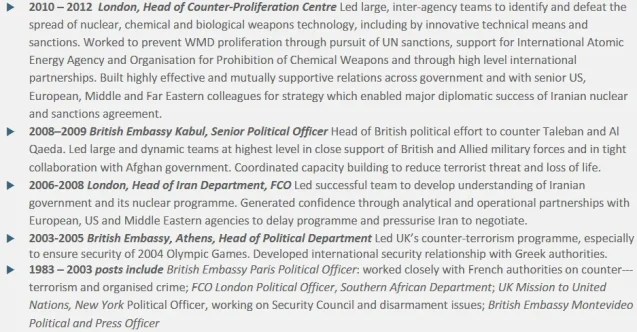
Nicholas Langman’s leaked CV
It was during the latter period that public and governmental attitudes across the West – and in vassal states – towards the Islamic Republic became highly belligerent, and negative. One by one, governments and international bodies – including the EU and UN – imposed ravaging sanctions against Tehran, devastating its economy, influence, and standing. MI6 journeyman Langman triumphed in his mission to foment concerted global hostility against Iran, based on the bogus spectre of the country posing a nuclear threat.
The question of whether British ‘intelligence’ on Iran’s nuclear program was the product of torture is an open and obvious one. Langman moved straight to leading MI6’s Iran Department from running the agency’s station in Athens, Greece. There, in late 2005, he was exposed by local media as having overseen an operation to abduct and ferociously mistreat 28 Pakistani guestworkers, wrongfully suspected of having had contact with individuals accused of perpetrating the 7/7 bombings in London in July that year.
That Langman wasn’t reprimanded over the incident strongly suggests he enjoyed a high level of protection, and London approved of his vicious intelligence-gathering methods – known to invariably produce false testimony from detainees. MI6 was not only an enthusiastic collaborator in the CIA’s global extraordinary rendition program, but led its own operations. Markedly, in at least one case, the British sought to sideline the CIA and ensure exclusive access to “intelligence” from a detainee in which Langley also had an interest.
The Obama administration was during its first year in office formally committed to non-interference in the Islamic Republic’s affairs, to the extent State Department apparatchik Jared Cohen was almost fired for publicly demanding Twitter halt planned maintenance during June 2009 protests in Iran, to ensure demonstrators could continue posting. It’s therefore unknown whether Washington was in on MI6’s Iran nuke con. If not, it wouldn’t be the first time British intelligence has misled the international community, with catastrophic results.
‘Possible Manipulation’
In July 2004, the Senate Intelligence Committee issued a scathing report on “the US intelligence community’s prewar intelligence assessments on Iraq.” It reserved particular disdain for how the CIA et al had “[relied] too heavily on foreign government services and third party reporting, thereby increasing the potential for manipulation of U.S. policy by foreign interests [emphasis added].” This was a reference to MI6’s central role in gathering – or concocting – intelligence on Baghdad’s purported WMD capabilities:
“Due to the lack of unilateral sources on Iraq’s links to terrorist groups like al-Qaida [redacted], the [US] Intelligence Community (IC) relied too heavily on foreign government service reporting and sources to whom it did not have direct access to determine the relationship between Iraq and [redacted] terrorist groups… The IC left itself open to possible manipulation by foreign governments and other parties interested in influencing US policy.”
As far back as the late 1990s, Britain’s foreign spying agency took the lead on sourcing dud ‘intelligence’ to manufacture consent for the against Baghdad. Under the auspices of a psychological warfare effort dubbed Operation Mass Appeal, MI6 black propaganda specialists circulated false information to foreign editors and reporters on its payroll “to help shape public opinion about Iraq and the threat posed by WMD,” which was then recycled by Western leaders and news outlets to reinforce its credibility.
In September 2002, then-MI6 chief Richard Dearlove personally approached British Prime Minister Tony Blair, claiming his agency had cultivated a source inside Iraq with “phenomenal access”, who could provide the “key to unlock” Iraq’s purported WMD program. Their assorted claims subsequently formed the basis of a dossier, which made a number of wild charges about Baghdad’s chemical and biological weapon capabilities. A prominently reported allegation was that Iraq could deploy WMD against Western countries within just 45 minutes. Its source was an Iraqi taxi driver.
This claim was repeated in a radio address by George W. Bush that month. In January the next year, as the invasion of Iraq rapidly loomed, the President declared in his State of the Union address, “the British government has learned that Saddam Hussein recently sought significant quantities of uranium from Africa.” That December, then-CIA chief George Tenet admitted this assertion was completely fallacious, and “these 16 words should never have been included in the text written for the President.”
The Zionist entity justified its unprovoked assault against Iran in June in large part on an intelligence dossier, which concluded the Islamic Republic had reached the “point of no return” in acquiring nukes. Its findings relied heavily on a May IAEA report that provided zero fresh information, but concluded Tehran supposedly maintained “undeclared nuclear material” until the early 2000s. While intended to trigger regime change, Tel Aviv’s broadside ended promptly in embarrassing failure, despite extensive foreign support, including US airstrikes.
Undeterred by the fiasco, Benjamin Netanyahu remains determined to crush the “Iranian axis”, while Trump has declared he would bomb Tehran “without a question” in response to indications the Islamic Republic has enriched uranium beyond agreed levels. We could be on the precipice of another war. As with the Iraq invasion, the perilous trail that brought us to this grave point could lead back to London. Yet again, MI6 may have taken the lead in concocting ‘intelligence’, justifying further US-Israeli aggression against the Islamic Republic.
U.S. Threats to Venezeula Are Ramping Up, Not Down
By Ted Snider | The Libertarian Institute | September 23, 2025
Reporting has recently emerged that the United States is considering direct strikes on Venezuela that could increase volatility in the region and the risk of war.
Under the pretext of disrupting the flow of drugs into the United States by Venezuelan drug cartels, the U.S. has militarized the waters off the coast of Venezuela, flooding them with Aegis guided-missile destroyers, a nuclear-powered fast track submarine, P-8 spy planes and F-35 fighter jets. On September 2, American forces fired on a small speed boat that the U.S. claims was running drugs for a Venezuelan cartel.
The Donald Trump administration is yet to offer evidence for its claim. They have neither publicly identified who the eleven people who were killed on the boat were nor what drugs they were carrying. Congress has still not been briefed.
Secretary of State Marco Rubio said the boat was “probably headed to Trinidad or some other country in the Caribbean.” Trump says it was bound for the United States. Turns out, it was headed back to Venezuela.
U.S. officials familiar with the operation have now told The New York Times that, having “spotted the military aircraft stalking it,” the boat has already “altered its course and appeared to have turned around before the attack started.” The twenty-nine second video that Trump posted on social media spliced together several clips but edited out the boat turning around. Despite this lack of imminent threat, the aircraft, either an attack helicopter or an MQ-9 Reaper drone, “repeatedly hit the vessel before it sank.”
The Trump administration has claimed the right to supplant the National Guard and law enforcement with the military and lethal force on the grounds that the drug cartels are terrorist organizations who pose a threat to the national security of the United States because the drugs they bring into the country to kill Americans. The U.S. has invoked the right to self-defense, and Rubio has insisted that the speed boat was “an immediate threat to the United States.” Except that if it had turned around, it wasn’t.
Setting aside the legitimacy of the terrorist justification, if the boat had already turned around, the immediate threat argument is also blown out of the water. “If someone is retreating, where’s the ‘imminent threat’ then?” Rear Admiral Donald J. Guter, a retired top judge advocate general for the Navy from 2000 to 2002, asked the Times. “Where’s the ‘self-defense’? They are gone if they ever existed—which I don’t think they did.” Rear Admiral James E. McPherson, the top judge advocate general for the Navy from 2004 to 2006, added, “If, in fact, you can fashion a legal argument that says these people were getting ready to attack the U.S. through the introduction of cocaine or whatever, if they turned back, then that threat has gone away.”
The Trump administration has made it clear that the attack was not a one-time anomaly. Secretary of War Pete Hegseth said, “We smoked a drug boat, and there’s 11 narco terrorists at the bottom of the ocean, and when other people try to do that, they’re going to meet the same fate.” Since then, three more Venezuelan boats have met the same fate. Hegseth told U.S. troops on a ship in the waters off Puerto Rico that “What you’re doing right now—it’s not training.” He told them that they were on the “front lines” of a “real-world exercise.”
On a post on X (formerly Twitter), Hegseth told U.S. forces that, “It’s not if, it’s when. You’re on a mission…And the full power of the American military…will be used to ensure the American people are kept safe.”
Ken Klippenstein reports that, according to military sources, the Trump administration is considering further, and more significant, strikes on Venezuela. The strikes could take the form of either the shooting down of Venezuelan military aircraft or bombing Venezuelan military airfields. Such action could be taken in one of two situations: if Venezuela threatens the American forces off its coast or if Venezuelan President Nicolás Maduro does not enhance his administration’s efforts against drug cartels.
The first situation is a dangerous possibility, depending on the interpretation of “threaten.” Venezuela has twice flown F-16 fighter jets over the USS Jason Dunham. Though Venezuelan aircraft are likely displaying a show of defense, as the United States would, at least, do if there were foreign attack vessels off their coast, Trump said that if Venezuelan jets fly over U.S. Navy vessels again, “they’re going to be in trouble.”
The second raises, once again, the question of what Venezuela is to do. “The Venezuelan government’s collaboration in the fight against drug trafficking was among the best in South America,” according to former Executive Director of the United Nations Office on Drugs and Crime Pino Arlacchi. And now, on top of that, Maduro has ordered the more than doubling of Venezuelan forces to monitor drug trafficking. In addition to the 10,000 troops already deployed, the Venezuelan military is ordering an additional 15,000 “to determine and verify the absence of illicit crops” and to “to block this area also of possible drug trafficking.”
Despite Venezuela’s stellar past record and the current enhancing of its efforts, the United States is still threatening military action if Maduro doesn’t enhance his administration’s efforts against drug growing and trafficking.
What makes the question of what Venezuela is supposed to do more difficult is that there is nothing Venezuela can do. The U.S. is demanding that Venezuela make a course correction to correct a problem that does not exist.
The 2025 UNODC World Drug Report assesses that Venezuela “has consolidated its status as a territory free from the cultivation of coca leaves, cannabis and similar crops.” The report says that “[o]nly 5% of Colombian drugs transit through Venezuela.” The European Union’s European Drug Report 2025 corroborates the United Nations report: it “does not mention Venezuela even once as a corridor for the international drug trade.”
The Trump administration has offered no evidence that the destroyed speed boat was carrying drugs or drug smugglers or that it was on its way to American shores. Even if it was, it posed no immediate threat because it had already turned around and headed back to port. The Maduro government has already addressed American demands and increased its efforts against the drug growing and trafficking that was never a problem in the first place. None-the-less, the United States is threatening further military strikes on Venezuela, raising the hard to answer question of what Venezuela is supposed to do.
New war power bill gives Trump sweeping authority to attack dozens of nations: Report
The Cradle | September 23, 2025
Legislation has been drafted that would give US President Donald Trump unchecked power to wage war against drug cartels as well as any nation he says has harbored or aided them, the New York Times (NYT) reported on 23 September, citing people familiar with the matter.
If passed, the legislation would allow the US president to deem as “terrorists” any groups that have trafficked in drugs or financed drug-related enterprises. The president would then have the authorization to use military force against such groups and any governments allegedly harboring them.
The US military carried out attacks this month on three boats that Trump claims were smuggling drugs in the Caribbean Sea. The strikes killed 17 people and were widely criticized as illegal. Human Rights Watch (HRW) called the strikes “unlawful extrajudicial killings.”
NYT notes that the draft legislation appears to be modeled on the Authorization for the Use of Military Force (AUMF) that Congress granted former US president George W. Bush to launch the so-called “War on Terror” after the 9/11 attacks in 2001.
While theoretically passed to allow the US to target Al-Qaeda and its hosts in Afghanistan, the broad nature of the AUMF allowed the Bush, Obama, and first Trump administrations to invade Iraq and to target Islamic militant groups in Libya, Somalia, Syria, and Yemen many times over a period stretching decades.
Neither the AUMF nor the new draft legislation being considered names a specific enemy. The president is therefore empowered to attack any group, anywhere, in an open-ended war.
NYT stated that this raises the question of whether Congress was giving Trump the “authority to wage a regime change war in Venezuela.”
In addition to striking the three boats, Trump has ordered additional US warplanes and naval ships to the Caribbean, while also accusing Venezuelan President Nicolas Maduro of leading a drug cartel.
In July, Trump signed a still-secret order directing the Pentagon to begin using military force against certain Latin American criminal gangs and drug cartels, NYT added.
The Institute for Responsible Statecraft stated that the legislation could be used to justify US military intervention in at least 60 countries.
In comments given to NYT, Harvard Professor Jack Goldsmith called the draft legislation “insanely broad,” essentially “an open-ended war authorization against an untold number of countries, organizations, and persons that the president could deem within its scope.”
Earlier this year, the White House added a long list of Latin American drug cartels to the national “Foreign Terrorist Organizations” (FTO) list, giving the US the pretext to launch military action against many groups in dozens of different countries if the draft legislation is passed.
Google admits Biden regime pressured content removal, promises to restore banned YouTube accounts
By Dan Frieth | Reclaim The Net | September 23, 2025
After years of denying bias, Google now concedes that it gave in to pressure from the Biden White House to remove content that did not breach its own rules.
The admission comes alongside a promise to restore access to YouTube accounts permanently removed for political speech related to COVID-19 and elections, topics where government officials had applied behind-the-scenes pressure to control the narrative.
This move follows sustained scrutiny from the House Judiciary Committee, which Reclaim The Net covered extensively, led by Chairman Jim Jordan (R-OH), who issued a subpoena and spearheaded an investigation that revealed the extent of government influence on content moderation decisions at Google.
In a letter from its legal representative, Google confirmed that it faced pressure from the federal government to suppress lawful speech.
We obtained a copy of the letter for you here.
Google revealed that it had been contacted multiple times by top federal officials regarding content on its platforms, even when that content did not break any rules.
The company stated that “Senior Biden Administration officials, including White House officials, conducted repeated and sustained outreach to Alphabet and pressed the Company regarding certain user-generated content related to the COVID-19 pandemic that did not violate its policies.”
According to the company, this outreach took place in a broader political climate that made it difficult to operate independently.
Google noted that “The political environment during the pandemic created significant pressure on platforms, including YouTube, to address content that some deemed harmful.”
While describing the situation, Google made clear its disapproval of such efforts, stating bluntly that “This pressure was – and remains – unacceptable and wrong.”
In response to this period of politicized enforcement, the company said it is now taking steps to reverse prior censorship decisions.
As part of that process, Google confirmed that “Reflecting the Company’s commitment to free expression, YouTube will provide an opportunity for all creators to rejoin the platform if the company terminated their channels for repeated violations of COVID-19 and elections integrity policies that are no longer in effect.”
The letter also clarified YouTube’s approach to content moderation, explicitly rejecting the use of outside arbiters. “YouTube does not use third-party fact checkers to determine whether content should be removed or labeled,” the company said.
Acknowledging the role of political diversity on its platform, Google stated that “YouTube values conservative voices on its platform. These creators have extensive reach and play an important role in civic discourse.”
The company concluded with a broader statement rejecting government interference in lawful online speech, saying that “The federal government should not play a role in pressuring private companies to take action on lawful speech.”
The revelations echo findings in the Murthy v. Missouri case, where lower courts found that federal agencies had taken on a role similar to an “Orwellian ‘Ministry of Truth.’” While the Supreme Court dismissed the case on procedural grounds, the core issues around government pressure on speech remain unresolved.
The investigation into Google is part of a broader probe into how tech firms handled information related to the 2020 election, COVID-19, and high-profile political topics such as Hunter Biden’s laptop. The committee’s findings show a pattern of censorship aligned with political objectives.
US Attempts Won’t Affect Russia-China Contracts on Energy Resources – Chinese Mission
Sputnik – 24.09.2025
GENEVA – The US’s attempts to force China to abandon the purchase of Russian energy resources will not affect the contracts between the countries, the Chinese permanent mission to the World Trade Organization (WTO) told Sputnik on Wednesday.
When asked if the US’s position on energy contracts between China and Russia will have an impact, Charge d’Affaires Li Yihong replied in the negative, adding that relations between Russia and China are comprehensive and deep, which has been recognized and repeated more than once at the highest level.
On Tuesday, US President Donald Trump blamed the ongoing conflict in Ukraine to China and India for their purchases of Russian oil.
Pro-Israel tech giant to take over TikTok’s US algorithm to censor Gaza genocide
Press TV – September 23, 2025
A pro-Israel American company is supposed to provide data security and recreate an algorithm for the new US version of TikTok as part of attempts to censor the occupying regime’s genocide of Palestinians in the besieged Gaza Strip, a report says.
The move was prompted following the forthcoming sale of the popular Chinese-owned social media application to US investors, with the financial news outlet Bloomberg citing a White House official as saying on Monday that the arrangement with Oracle Corp. seeks to ensure US control of TikTok’s algorithm, which recommends videos and determines what users in the US see on their feeds.
Under a proposed agreement, owners of the US-based TikTok would lease a copy of the algorithm from its Chinese parent, ByteDance Ltd., that Oracle would then retrain “from the ground up,” according to the official.
“Data from US users would be stored in a secure cloud managed by Oracle with controls established to keep out foreign adversaries, including China,” the official was quoted as saying by Bloomberg.
“Beijing-based ByteDance would not have access to information on TikTok’s US subscribers, nor would it have any control over the algorithm in the US.”
The White House official underlined, “Oracle, the US security partner, will operate, retrain, and continuously monitor the US algorithm to ensure content is free from improper manipulation or surveillance.”
Austin-headquartered Oracle, which is controlled by its founder, Larry Ellison, already provides cloud services for TikTok and hosts user data in the US and other countries as part of a multibillion-dollar partnership dubbed “Project Texas.”
Ellison is one of Silicon Valley’s most pro-Israel figures and has made significant donations to the so-called charity “Friends of the Israel Defense Forces (FIDF)”, which supports the Israeli occupation soldiers and is involved in funding emergency medical supplies and mental health treatment to those wounded in the Gaza Strip.
After the start of Israel’s genocide in Gaza in October 2023, Ellison pledged Oracle’s support for the occupying regime with cloud and cybersecurity infrastructure, highlighting his commitment to Israel’s military and tech sectors.
The Boycott, Divestment, and Sanctions (BDS) movement says that US tech companies, notably Microsoft, Amazon, Google, Cisco, Oracle, and IBM, “are deeply complicit in atrocity (including apartheid and genocide)” for providing cloud infrastructure and AI technologies to the Israeli occupation army.
Social media companies, including TikTok, employ large numbers of former intelligence officers from Israel’s Unit 8200.
The Israeli regime also lobbies social media companies to remove pro-Palestine content, giving Tel Aviv significant influence over censorship decisions at the major US social media platforms.
In 2024, US Congress enacted the “TikTok divest-or-ban” law after Jewish lobby groups were ruffled by the large numbers of young American people viewing and sharing videos of Israel’s mass killing of Palestinian civilians in Gaza.
Access to TikTok was briefly blocked for US users in January as the ban came into effect. However, President Donald Trump issued an extension for a deal to be reached, allowing access to resume after just one day.
The move comes as the Israeli regime persists in its systematic oppression of Palestinians by worsening the humanitarian crisis in Gaza and launching a full-scale ground invasion across the territory.
Disturbing images and videos depicting emaciated children, relentless bombardments, and widespread destruction continue to surface on social media platforms, shedding light on the dire situation faced by Palestinians in the region.
Backed by the US, Israel launched its onslaught on Gaza on October 7, 2023, after Palestinian resistance fighters waged the surprise Operation al-Aqsa Flood against the Zionist entity in response to the regime’s decades-long campaign of bloodletting and devastation against Palestinians.
The Israeli military has so far killed more than 65,300 Palestinians, mostly women and children.
Thousands of victims are also feared trapped under rubble, inaccessible to emergency and civil defense teams due to relentless Israeli attacks.
Ex-CIA chief Petraeus hails former Al-Qaeda leader for ‘clear vision’ in Syria
The Cradle | September 23, 2025
Self-appointed Syrian President Ahmad al-Sharaa engaged in a wide-ranging dialogue on 22 September with former CIA director David Petraeus as part of his visit to New York.
Sharaa, a former Al-Qaeda commander, met Petraeus, who commanded troops in Iraq after the 2003 invasion, at the Concordia Summit on the sidelines of the UN General Assembly. They discussed issues facing Syria, including reconstruction, governance, economic sanctions, and regional relations.
“We faced massive destruction over the past years, but we are focusing on economic development and building capabilities,” Sharaa stated.
“Syrians by nature are people of work and trade. So please lift the sanctions and see what we can do,” he added, referring to the 2019 US Caesar Act, which imposed crushing economic sanctions on Syria, impoverishing millions.
US President Donald Trump removed some sanctions earlier this year, but Congress must authorize their permanent removal.
Petraeus said that the conversation with the former Al-Qaeda in Iraq commander “has filled me with enormous hope.”
“Your vision is powerful and clear. Your demeanor is very impressive as well … We obviously hope for your success, Inshallah, because at the end of the day, your success is our success,” Petraeus added.
Though Sharaa was deemed a terrorist by the US State Department in 2012, the CIA covertly provided arms and funding to the Al-Qaeda affiliate he founded in Syria, then known as the Nusra Front.
According to journalist Seymour Hersh, Petraeus established a “rat line” between Libya and Syria to send weapons to the Nusra Front and other extremist groups seeking to topple the government of former Syrian president Bashar al-Assad.
The CIA operation, known as Timber Sycamore, enjoyed a budget of over $1 billion per year. The operation finally allowed Sharaa to oust Assad and establish an extremist Islamic state over Syria in December.
According to former French intelligence officer and political analyst Thierry Meyssan, Petraeus continued to help fund Al-Qaeda groups, including ISIS, after he was forced to resign from the CIA in 2012 after a sex scandal.
Meyssan says that Petraeus joined the private equity firm Kohlberg Kravis Roberts (KKR), headed by Jewish billionaire Henry Kravis, which funded the Nusra Front and ISIS on behalf of the CIA in an off-the-books manner.
Addressing Israel’s war on Gaza, Sharaa dismissed speculation about Syria joining the Abraham Accords to normalize relations with Israel.
He claimed the destruction of Gaza has made any broad normalization with Israel impossible, but said limited security arrangements could be considered.
Before Sharaa’s trip to New York, Syrian and Israeli officials were carrying out security talks that would allow Israel to maintain control of the strategic Mount Hermon, establish a no-fly zone over the south of the country, and prevent Syrian forces from entering a demilitarized zone in the south.
In a personal question, Petraeus asked how Sharaa manages the pressure of leading a country after years of conflict.
“I spent 25 of my 43 years in conflict and crisis, so I am used to hardship. Decisions that carry the destiny of a nation must be taken with calm and an open mind.”
Sharaa first traveled to Iraq to join Al-Qaeda after the 2003 invasion and was known for dispatching suicide bombers to kill civilians. He was allegedly arrested by US forces in 2005 and sent to the US prison at Camp Bucca.
After his release in 2009, he became the Emir of the Islamic State of Iraq (ISI) in Mosul, before traveling to Syria to establish the Nusra Front in 2011 on the instructions of Islamic State (later ISIS) leader Abu Bakr al-Baghdadi.
Ayatollah Khamenei rejects talks with US, warns of ‘serious, irreparable harms’
Press TV – September 23, 2025
Leader of the Islamic Revolution Ayatollah Seyyed Ali Khamenei has rejected Washington’s demands over nuclear negotiations, saying that accepting talks under threat is something “no honorable nation would ever do, and no wise statesman would ever endorse.”
Speaking in a televised address to the nation on Tuesday, Ayatollah Khamenei said negotiations with Washington under the current circumstances would bring “no benefit” to Iran and instead carry “serious and possibly irreparable harms.”
“Accepting negotiations under such threats would mean that the Islamic Republic of Iran is susceptible to intimidation.”
“If we were to negotiate under such threats, it would mean that we tremble and surrender whenever threatened,” the Leader said.
“If such susceptibility to threats were established, it would never end. Today, they say: if you enrich, we will do this. Tomorrow they will say: if you have missiles, we will do that … There would be endless threats, forcing us to retreat step by step.”
Ayatollah Khamenei said the United States is predetermining the outcome of any dialogue, and that Washington’s demands amount to dictation rather than negotiation.
“They have announced that the only acceptable result of negotiations is the shutdown of Iran’s nuclear activities and enrichment. So, we would sit at the table, and the outcome of the talks would be exactly what they had dictated in advance.”
“That is not negotiation,” the Leader stated, “that is dictation, that is imposition.”
“To negotiate with a party where the result must necessarily be what they want, and what they say; is that negotiation?”
The Leader pointed to recent American calls for Iran to abandon not only long-range but even short-range missiles.
The aim of such demands, Ayatollah Khamenei said, was to render Iran so weak and defenseless that it could not respond in any form if attacked.
Featured Video

Death Spikes & Rising Cancer In Our Youth Explained
or go to
Aletho News Archives – Video-Images
From the Archives
Politicians lie
By Mazin Qumsiyeh | Popular Resistance | August 18, 2013
There is no way to say this truth nicely: Politicians lie. That includes Japanese, American, Egyptian, Israeli, and Palestinian politicians! Is there something more common sense than that? Yet, so many citizens around the world believe their own politicians or wistfully acknowledge lies but think it is part of the job needed to run things. They believe even when politicians contradict themselves blatantly. This phenomenon is rather remarkable. It is a dissonance and disconnect from reality that many seem oblivious to. It is very dangerous because it can lead to accepting rationales for going to war. These can be deadly wars that lead to millions of lives lost as happened in what was called World War 1 and WW2. Even when incredible and declassified evidence abound, politicians continue to lie and old mythologies refuse to die. Here are just a few of the countless lies told to us over the past few decades… continue
Blog Roll
 Aletho News
- The day-after at the White House: USA and Xi Jinping
- The Geopolitical Balance in the Red Sea: The UAE Being Displaced by New Players
- Iraqi resistance group vows to stage airport sit-ins over Iran aerial blockade
- Turkish parliament to review Saudi-Pakistan defense pact next month
- DEATH SPIKES & RISING CANCER IN OUR YOUTH EXPLAINED
- Iran offers Trump deal before US election
- Merz regime wants ‘secret police’ – opposition
- Israeli settlers terrorize West Bank Palestinians with state-provided drones: Report
- They see them, then kill them: Israeli quadcopters track, deliberately target civilians in Gaza
- Debunked: Trump’s egregious UNGA claims on war against Iran crumble under scrutiny
- If Americans Knew
- Trump betrayed voters with his campaign lies and prioritized a foreign country once he took office
- Netanyahu calls Israel’s war in Gaza ‘opposite of genocide’ in UN speech to near-empty hall
- Settler Kidnappings: Torture, Sexual Abuse and Terrorisation of Palestinian Abductees as Israel Deepens Annexation of West Bank
- Gaza winter nears as 162,000 tents become unusable, raising fears of humanitarian crisis
- Netanyahu says, “It’s the opposite of genocide”; UN says Gaza economy is world’s ‘most severe crisis on record’ – Daily Update
- Israel’s US-Backed Assault on Gaza Has Created the ‘World’s Most Severe Economic Crisis on Record’: UN
- ‘Protecting U.S. Citizens’… From Israel
- ‘This is where I live now, the back of a truck’: a day in the life of a grandmother in Gaza
- In UN Speech, Iran’s President Displays Pictures of Children Killed by US, Brings Attention to Israel’s Nuclear Arsenal
- Israel displaces hundreds of Palestinians amid wave of demolitions in West Bank
- No Tricks Zone
- New Study: Earth And Venus Surface Warmth Largely Explained By Convection And Lapse Rate, Not CO2 Or Radiation
- 2025 Nature Paper Claiming Worsening Global Drought Gets RETRACTED …Heavily Flawed
- New Study: ‘Global Drought Shows No Detectable Recent Acceleration Under Climate Warming’
- Economic Masterminds: German Socialists Suggest Taxing Productivity Gains Stemming From Using AI
- The South China Sea Has Not Been Cooperating With The Climate Change Narrative
- Energy Crisis: Germany Enters Heating Season With Historically Low Gas Reserve Fill Levels
- New Study: The Antarctic Ice Sheet Gained Mass From 2020-2024 Due To Staggering Snow And Ice Accumulation
- Study: Ocean Heating Rates From Thousands Of Years Ago ‘Dwarf’ Modern Ocean Heating Rates
- Climate Extremists Target, Attack Large-Scale Power Grid Infrastructure In Germany!
- New Study: Antarctic Ice Melt Has Contributed Less Than 1 Centimeter To Sea Level Rise In The Last 30 Years

