West’s grip slips with Saudi–Pakistan security deal
Riyadh’s pact with Islamabad redraws alliances, weakens Indian leverage, and hints at a new Muslim deterrence framework beyond western control.
By F.M. Shakil | The Cradle | September 23, 2025
On 17 September, Riyadh rolled out the rare royal purple carpet for Pakistani Prime Minister Shehbaz Sharif – an honor previously reserved for global power players like US President Donald Trump.
Accompanying him on the trip was Pakistan’s Army Chief, Field Marshal Asim Munir. His presence highlighted that Riyadh values its defense pact with a nuclear power that, despite economic challenges, remains militarily strong.
Nuclear umbrella over Riyadh
The centerpiece of their visit was the signing of a “Strategic Mutual Defense Agreement” (SMDA), which declares that an attack on either country will be considered an attack on both.
Described by a senior Saudi official to Reuters as covering “all military means,” the pact has triggered speculation that it includes a nuclear umbrella, which would be a game-changing development in the military balance of West Asia.
With 81 percent of Pakistan’s weapon imports coming from China, the agreement implicitly aligns Saudi Arabia with the Chinese military-industrial orbit, whether by design or default. The kingdom has long been reliant on US arms, training, and security guarantees.
The pact was signed just two days after an extraordinary joint session between the Arab League and the Organisation of Islamic Cooperation (OIC) was called, following the 9 September Israeli airstrikes on Qatar – a major non-NATO ally and Gulf neighbor – with no substantial response from Washington, reinforcing perceptions that western security commitments are both selective and expendable.
Mushahid Hussain Syed, a former information minister and chairman of Pakistan’s Senate Defense Committee, tells The Cradle that the US has pivoted away from Arab allies toward Tel Aviv, leaving the region disillusioned and increasingly leaning toward alternatives.
“The strategy of ‘Greater Israel,’ spearheaded by Netanyahu, has involved military actions against five more Muslim nations. Pakistan’s recent triumph against India has demonstrated its capacity to contest Israel’s significant ally, India, and establish itself as a strategic alternative for Gulf nations.”
Toward an Islamic NATO?
Iraqi Prime Minister Mohammed Shia al-Sudani recently called for an Islamic military alliance, akin to NATO, in response to Israel’s airstrike on Doha. His proposal echoed Egypt’s earlier attempt to revive a joint Arab defense force under the 1950 treaty – an initiative blocked by Qatar and the UAE, reportedly under US pressure.
A similar proposal has also come from Islamabad when Pakistan’s Defense Minister, Khawaja Asif, urged Muslim countries to band together in a NATO-like military alliance in light of the Israeli aggression in Doha.
During an appearance on Geo TV last week, Asif drove home the point that a united Muslim military front is essential to tackle common security issues and fend off outside dangers. Asif invoked the wider role of the west in instigating instability in West Asia, emphasizing the intricate network of US support for Al-Qaeda and the CIA’s covert actions that led to Osama bin Laden’s relocation to Sudan or the regime change war in Syria.
Is nuclear deterrence a part of the Pact?
The nuclear dimension of the Riyadh–Islamabad pact remains opaque, but highly significant. While no official statement from either side confirms the presence of a nuclear component, Asif hinted that Pakistan’s nuclear capabilities could be shared with Saudi Arabia as part of the agreement.
Syed, however, clarifies to The Cradle that Pakistan’s nuclear doctrine is India-centric and that its deterrence posture is South Asia-specific and does not extend to the Persian Gulf.
“A novel security framework for the region appears to be taking shape, focusing on Global South nations such as Pakistan and Saudi Arabia, whereas the Indo-Israeli Axis, previously supported by the US, now finds itself significantly diminished.”
The defense agreement between Pakistan and Saudi Arabia, he says, represents a notable achievement for Pakistan, establishing it as a pivotal entity within the geopolitical framework of West Asia, particularly among Muslim countries.
“The agreement is shaped by three significant elements: the perceived neglect of Arab allies by the United States, Israel’s proactive maneuvers in areas such as Iran, Qatar, Lebanon, Syria, and Yemen, and Pakistan’s recent triumph over India in May.”
New Delhi, Tel Aviv on alert
Foreign media and analysts are already warning that the pact may have unintended consequences for India and Israel, despite claims that it targets neither. Others predict that this pact is really about Riyadh’s ambitions to counter Iran and Yemen’s Ansarallah-led government in the region.
Dr Abdul Rauf Iqbal, a senior research scholar at the Institute for Strategic Studies, Research and Analysis (ISSRA) at Islamabad’s National Defence University (NDU), tells The Cradle that New Delhi views the pact with unease as it formalizes Saudi–Pakistani security ties that could entangle Riyadh in South Asian rivalries, especially the India–Pakistan border tensions over Jammu and Kashmir:
“It represents a setback for Prime Minister Modi’s foreign policy, potentially leading to Saudi involvement in a prospective Indo–Pak conflict. Furthermore, future Saudi investments in Pakistan’s Gwadar port and economic corridors would challenge India’s regional influence and initiatives such as the India-Middle East-Europe Corridor (IMEC).”
He adds that Saudi Arabia’s pivot toward Pakistan reflects a broader alignment of Muslim powers and could push Tel Aviv to recalibrate its war on Gaza. It also pressures Tel Aviv by placing Pakistan – a vocal opponent of Israeli expansionism – into West Asian affairs.
“This agreement is not meant to counterbalance Iran’s regional influence, but rather to promote the Saudi Iranian reconciliation, as Pakistan maintains friendly relations with both nations. By formalizing ties with nuclear-armed Pakistan, Riyadh secures a credible deterrent as US security guarantees weaken. While western think tanks view it as an effort to contain Iran, the Arab world emphasizes it as strengthening Gulf deterrence independently of Washington.”
Indian concerns also stem from fears that the pact’s NATO-style clause could complicate ongoing operations like Sindoor, which remains active in a limited capacity following the skirmish between the two nuclear powers in May, especially given that the Gulf states’ swift mediation to resolve the crisis reflects their own interests with India and makes any military action against it unlikely.
Secondly, India is strategically analyzing Pakistan’s nuclear capability, which could see a boost if Saudi Arabia, having no such capacity, begins channeling funds to share Pakistan’s nuclear assets.
A post-western Gulf order?
While Tel Aviv and New Delhi remain publicly silent, both capitals are undoubtedly scrutinizing the fallout. Israel’s failed assassination attempt on Hamas leaders in Qatar, and India’s pressure campaign along the Line of Control, suggest that the axis is nervous about the consequences of a Saudi–Pakistani alliance. Israeli media downplayed the Saudi–Pakistan defense deal, seeing it as a show of force after Riyadh failed to influence Trump or West Asian policy.
As Syed notes, “The traditional ‘Oil for Security’ framework, which once defined US relations with the Middle East [West Asia], now serves as a remnant of a bygone era. As Saudi economic power increasingly reinforces China’s backing of Pakistan, India may feel vulnerable and isolated.”
Mark Kinra, an Indian geopolitical analyst with a focus on Pakistan and Balochistan, tells The Cradle that this development holds particular significance for India. New Delhi, he argues, has sustained robust economic and diplomatic ties with Saudi Arabia for many years, and the influx of Saudi investments in India continues to expand:
“India will be meticulously observing the progression of this agreement, particularly given that its specific terms are not publicly available. Any alteration in the regional security equilibrium may influence India’s strategic assessments, energy security, and diplomatic relations.”
As Washington’s selective security guarantees falter and Israel escalates unchecked, Persian Gulf states like Saudi Arabia are looking eastward for credible deterrents and strategic autonomy.
By aligning with nuclear-armed Pakistan, Riyadh is asserting greater independence from the western military order. It also signals the emergence of a multipolar Persian Gulf security architecture –one increasingly shaped by Global South coordination, not western diktats.
Russia Sets 1-Year Deadline for New START Treaty – Expert
Sputnik – 23.09.2025
Russia suspended participation in 2023, but kept a moratorium on expanding its nuclear arsenal, Alexei Leonkov, military analyst, explains. He adds that the extension proposal gives the US a year to de-escalate in Ukraine, stop supplying weapons, intelligence, and funding the Zelensky regime.
He emphasizes that Russia’s nuclear forces remain modern and capable, including two unique “retaliation” complexes.
“In order to somehow stop all the heat, Russia is coming up with a proposal that should encourage the American side to take more decisive, constructive action. Otherwise, in a year’s time, the START Treaty, as one of the few responsible for international nuclear security, will be denounced, that is, practically terminated,” he said.
The analyst stressed that the concrete actions Russia wants to see include:
- End to escalation in Ukraine
- Halt weapons supplies through NATO countries
- Stop intelligence sharing fueling attacks on Russian regions
- Cut funding to the Zelensky regime
Russia is giving the US a chance over the next year to address these issues before taking decisive steps regarding the treaty, he concluded.
Mohammad Marandi: Iran KILLS IAEA Deal — Cairo Agreement Wiped Out After SnapBack!
Dialogue Works | September 21, 2025
Maduro Sent Letter to Trump Offering Talks to Prevent Conflict
By Kyle Anzalone | The Libertarian Institute | September 22, 2025
A top Venezuelan official confirmed that President Nicolas Maduro sent a letter to President Donald Trump earlier this month offering talks to prevent a war.
The letter was published on Vice President Delcy Rodríguez’s Telegram account on Monday, and dated September 5. Maduro says in the letter that Trump has been led to believe “fake news” about Venezuela’s ties to drug trafficking and Caracas’ willingness to work with the Trump administration on returning Venezuelan migrants from the US.
The letter includes a map from a UN study that shows 87% of drugs from South America are trafficked to the Western US via the Pacific Ocean. Only seven percent of South American drugs make it into the US via the Caribbean.
The letter concludes with Maduro offering to engage in direct talks with Trump’s envoy Richard Grenell. In February, Grenell traveled to Venezuela and secured the release of six American prisoners after meeting with Maduro.
Following the meeting with Grenell, Secretary of State Marco Rubio began ramping up sanctions on Venezuela and seizing Maduro’s plane. In July, the State Department designated two Venezuelan cartels as narco-terrorist organizations. Trump has authorized military action against designated narco-terrorist organizations.
Trump and Rubio have claimed that Maduro is the leader of multiple narco-terrorist cartels and have offered a $50 million bounty on the Venezuelan President. The US intelligence community assessed that Maduro is not the leader of Tren de Aragua.
Washington also accuses Maduro of leading the Cartel de los Soles. However, a US-funded NGO has said there is little evidence that the Venezuelan government is the leader of the gang.
The letter from Maduro was sent to Trump in the days following a US strike on a ship in the Caribbean Sea that had left from Venezuela. The President claimed the attack killed 11 members of a narco-terrorist cartel that was attempting to bring drugs into the US. Trump has not offered evidence for the assertion.
The US has conducted two attacks on ships in the Caribbean after the letter was delivered to Trump.
In the post that included the letter, Rodríguez said, “The military threat against Venezuela, the Caribbean, and South America must cease, and the proclamation of a Zone of Peace must be respected.”
Trump scrambles to contain fallout from Israeli crime spree with meeting in New York
MEMO | September 22, 2025
President Donald Trump is set to host a high-level meeting with a select group of Arab and Muslim leaders on Tuesday in New York to discuss the ongoing Israeli genocide in Gaza. The summit, to be held on the sidelines of the UN General Assembly, comes as Western governments declared their recognition of the State of Palestine and amid growing international condemnation of Israel’s war crimes.
Two Arab officials confirmed to Axios that leaders from Saudi Arabia, the United Arab Emirates, Qatar, Egypt, Jordan and Turkey have been invited to the closed-door meeting, which will take place at 2:30pm Eastern Time.
The summit is expected to precede Trump’s meeting with Israeli Prime Minister Benjamin Netanyahu, scheduled for 29 September at the White House. Sources familiar with the preparations said Arab leaders will call on Trump to pressure Netanyahu to end the assault on Gaza and to abandon plans to annex the illegally occupied West Bank.
Washington’s agenda reportedly includes a proposal for Arab and Muslim countries to contribute to a post-war stabilisation plan in Gaza, including potential troop deployments to replace the Israeli occupation forces. However, such proposals are expected to meet resistance unless a political framework guaranteeing Palestinian sovereignty is agreed.
Trump is also expected to hold a second meeting on Tuesday with leaders of the Gulf Cooperation Council (GCC), including Oman, Bahrain and Kuwait, to address broader regional concerns including Israel’s escalation in the region.
The unprovoked attack on Doha two weeks ago by Israel was met was global condemnation. Qatar reportedly demanded an apology before the resumption of negotiations.
Israel’s strike triggered an emergency summit of Arab and Muslim countries in Doha, and was swiftly followed by a new Saudi-Pakistani security pact—widely interpreted as a response to growing doubts about Washington’s reliability as a security guarantor in the Gulf.
Israeli intransigence is also threatening to unravel the hallmark foreign policy initiative of Trump’s previous presidency: the so-called Abrahm Accords. The UAE has reportedly warned that any annexation of the West Bank could lead to the collapse of the agreement which saw a number of Arab states normalise ties with the occupation state. The White House has not issued an official statement in response to the reports.
Iranian parliament pushes for ‘nuclear option’ as deterrence to western threat
The Cradle | September 22, 2025
Over 70 members of Iran’s parliament on 22 September called for a reassessment of the country’s defense doctrine, pressing authorities to consider nuclear weapons as a deterrent.
In a letter addressed to the Supreme National Security Council and the heads of the executive, legislative, and judicial branches, the lawmakers demanded that the issue be raised urgently.
“We respectfully request that, since the decisions of that council acquire validity with the endorsement of the Leader of the Revolution, this matter be raised without delay and the expert findings communicated to the parliament,” the statement read.
The MPs argued that while the development and use of nuclear arms contradicts the 2010 ‘fatwa’ of Iranian Supreme Leader Ali Khamenei banning them, circumstances have changed.
They wrote that “developing and maintaining such weapons as a deterrent is another matter,” stressing that “in Shia jurisprudence, a change in circumstances and conditions can alter the ruling.”
“Moreover, safeguarding Islam – which today is bound to the preservation of the Islamic Republic – is among the paramount obligations.”
The push was led by Hassan-Ali Akhlaghi Amiri, a representative from the holy city of Mashhad, according to Hamshahri Online.
Lawmakers noted that the nuclear doctrine was shaped at a time when the international community was still able to restrain Israeli aggression.
They pointed to the large-scale assault launched by Israel in June, backed by the US, which included direct strikes on three Iranian nuclear facilities, among them Fordow.
Iran has long stated its nuclear program is peaceful, rejecting western claims it seeks weapons capability. Tehran continues to cite Khamenei’s fatwa as proof of its intentions.
At the same time, the Supreme National Security Council announced the suspension of cooperation with the International Atomic Energy Agency (IAEA) after the UN Security Council imposed sanctions.
State media quoted the body as saying the move was a response to the “ill-considered steps of three European countries.”
Lawmakers warned that pressure tactics by the E3 countries will draw a “harsher and more decisive” response than before.
Russia willing to extend New Start treaty – Putin
RT | September 22, 2025
Russia is prepared to continue abiding by the New START treaty on nuclear arms for one year even after it expires next February, Russian President Vladimir Putin has said.
Speaking at a meeting with the permanent members of Russia’s Security Council on Monday, Putin said that due to the hostile and destructive steps taken by the West in recent years, the foundations of constructive relations and cooperation between nuclear-armed states have been significantly undermined.
“Step by step, the system of Soviet-American and Russian-American agreements on nuclear missile and strategic defensive arms control was almost completely dismantled,” Putin said. He stressed that the systems of agreements between Russia and the US, who possess the two largest nuclear arsenals in the world, long served as a stabilizing factor and contributed to global stability and international security.
Putin noted that the New START treaty, signed in 2010 by Russia and the US, is the last remaining bilateral agreement limiting nuclear weapons. He warned that allowing it to expire and abandoning its legacy would be “a mistaken and short-sighted step, which, in our view, would also negatively impact the goals of the Nuclear Non-Proliferation Treaty.”
The president announced that in order to avoid provoking a strategic arms race and ensuring an “acceptable level of predictability and restraint,” Russia is prepared to continue adhering to the central limitations of the New START Treaty for one year after February 5, 2026.
“Based on our analysis of the situation, we will subsequently make a decision on maintaining these voluntary self-restraints,” he added.
At the same time, Putin stressed that Moscow would implement this measure only if the US “follows suit and does not take steps that undermine or disrupt the existing balance of deterrence potential.”
The president ordered Russia’s relevant agencies to continue closely monitoring US activities in regard to strategic offensive arms arsenals and any plans to expand the strategic components of the US missile defense system. If it is deemed that Washington is taking actions that undermine Moscow’s efforts to maintain the status quo on strategic offensive arms, Russia will “respond accordingly,” Putin said.
Will Vaccines Prevent 1.1 million Deaths? No.
More CDC junk science
Injecting Freedom by Aaron Siri | September 18, 2025
At my recent Senate hearing, the minority witness submitted testimony claiming that “The CDC estimates that vaccines given to children born between 1994 and 2018 will prevent … 936,000 deaths over their lifetimes.” That claim has also been levied against Secretary Kennedy. Here is why it is a junk claim. (Note that portions of this response are taken directly from my new book Vaccines, Amen.)
Newsletter + Selection Bias
First, this claim is an updated version of a 2014 MMWR report. MMWR is essentially CDC’s newsletter. CDC’s own guidelines for the MMWR only permit publishing articles that align with CDC policy, which results in the worst form of selection bias. As explained by the CDC’s policies for publishing an MMWR report: “By the time a report appears in MMWR, it reflects, or is consistent with, CDC policy.” Hence, this article would only be published until it was massaged to assure that it aligned with the CDC’s policy that vaccines are safe and effective. That approach is not science — it is the perversion of science.
No Confidence Intervals
Second, like the WHO advertising report I discussed yesterday, this is an “advertising report” for CDC’s immunization program and has no confidence intervals for its estimates. This is because they are just unreliable guesswork. The true rate could be that the vaccines caused 2 million deaths between in the United States from 1994 to 2023 because the report provides no bounds for its claims. Again, absent bounds for its claims, it could be equally true that vaccines resulted in causing 2 million extra deaths instead of a net saving in lives.
Ignores All Confounders
Third, it’s even worse, because the 2023 report explains that “factors other than immunization (e.g., hygiene…) might have contributed to lower disease risks in recent decades, and reductions resulting from these contributions have not been incorporated into the model” (emphasis added). Meaning, it did not account for any other advancement or factor that may have improved health outcomes. Nothing. This alone renders this CDC promotion “study” junk science. It is also why it has no bounds for its estimates because it cannot calculate them with any confidence.
The Hard Data Shows The 1.1 Million Claim Is Nonsense
Finally, just a simple review of the data shows how preposterous the numbers are. While it claims vaccines saved 1.1 million lives between 1994 and 2023, it takes only looking at the actual real-world data to see this figure is nonsense. Let’s look at three diseases the report claims account for almost the entire 1.1. million lives purportedly saved: diphtheria, hepatitis B, and measles.
Diphtheria
Around 750,000 of the 1.1. million lives (over 68%) that CDC claims were prevented are from diphtheria. That means that it claims 25,000 lives were saved per year by this vaccine. That figure is nonsensical. Here is why.
The first vaccine for diphtheria was introduced in 1926. Between 1900 and 1926, as the population rose, the death rate from this disease had already declined 81%, from 40.3 to 7.8 deaths per 100,000 individuals. A vaccine had nothing to do with this sharp decline since no vaccine of any kind for diphtheria existed until 1926. The further decline from 1926 until at least the mid-1940s also had little or nothing to do with the vaccine because it was rarely, if ever, used outside of certain demographics in major cities, and diphtheria mortality declined at a similar rate in areas with or without its use.[1]
Below is an official government chart reflecting same. So, even as the population increased, the data clearly shows an 81% mortality decline from 1900 to 1926, a 97.3% decline from 1900 to 1940, and a 97.8% decline from 1900 to 1948; hence, no matter how you look at it, vaccination had little to do with almost all of the decline in mortality from diphtheria in the last century:[2]

Finally, in 1949, DTP was first licensed, and coverage of this vaccine began to improve. The year prior, in 1948, there was a total of 634 deaths from diphtheria. Yet, this MMRW report nonsensically claims the diphtheria vaccine is now saving 25,000 lives a year in the United States. (Also note that in 1985, the coverage for only three doses, let alone the six recommended today, was still only 63.6%.)
This claim becomes more absurd when you consider that even after six childhood doses, adults require a booster dose every ten years in adulthood, and about 40% of adults skip these boosters. Despite a large portion of adults not receiving boosters, the last case of respiratory diphtheria in the United States was nearly three decades ago. This almost certainly reflects the extensive literature which supports that any harmful effects by the diphtheria toxin are counteracted by iron, vitamin C, and vitamin B3, and deficiencies of these vitamins and minerals have mostly been eliminated in developed countries.
There are diseases that had a high mortality in the United States that disappeared without a vaccine. For many of these diseases, researchers sought to develop a vaccine but failed. For example, scarlet fever was one of the deadliest infectious diseases for children in 1900, with a death rate of 9.6 deaths per 100,000 children. Researchers furiously sought to develop a vaccine but repeatedly failed. By the 1950s, deaths from scarlet fever had significantly declined and by the late 1900s, deaths from scarlet fever were essentially non-existent.
Had a vaccine for scarlet fever been developed in the 1920s, 40s, or 60s, that vaccine would almost certainly still be on the childhood schedule today, and its use would be considered essential for controlling scarlet fever; undoubtedly, this same CDC advertising article would be estimating that its use is now saving hundreds of thousands of lives in the United States.
In fact, scarlet fever and diphtheria are similar in that each is caused by a bacterium that releases a potentially harmful toxin when the bacterium has been “infected” by a certain virus. Both diseases cause sore throats, and many doctors, without a lab test, will confuse diphtheria with scarlet fever, and vice versa. These two diseases also have something else in common: both declined at nearly the same rate beginning in 1900. The primary reason why public health officials and the medical community behave differently with regard to these two diseases is that a vaccine was developed for diphtheria, but not for scarlet fever. If a vaccine for diphtheria had not emerged, this disease would have likely gone the way of scarlet fever and other childhood diseases that effectively disappeared without a vaccine.
Even if it would not have disappeared on its own, the article’s claim that 750,000 lives have been saved from diphtheria between 1994 and 2023 is absurd given the failure to account for the actual mortality data, other factors that reduced morality from diphtheria, the lack of any bounds to its claim, the lack of population-wide immunity and disappearance of the disease anyway, and the objective big picture reality regarding this disease; it truly requires a true religious fervor that suspends all reason and thinking to conclude that this vaccine has saved 25,000 lives per year between 1994 and 2023. The reality, based on the real-world data, is likely far closer to what occurred with scarlet fever absent vaccination.
Hepatitis B
As another example, the CDC advertisement article claims Hep B vaccines saved over 90,000 lives from 1994 to 2023, amounting to over 3,000 lives purportedly saved per year. This claim again defies data and reason. By way of background, the first Hep B vaccine was introduced in 1981 and was made with human blood plasma from donors who were chronically infected with the Hep B virus; and in 1986, a new Hep B vaccine using recombinant DNA technology without human blood was licensed. With that background, the mortality from Hep B climbed after introduction of the 1981 vaccine, continued to climb after the introduction of the 1986 vaccine, and has never returned to pre-vaccination levels. In 1980, there were 294 deaths in the United States from Hep B. Today, there are around 1,700 deaths per year. Yet, somehow, CDC claims that Hep B vaccine has saved over 3,000 lives per year between 1994 and 2023. It defies reason.
Measles
As a final example, CDC’s advertising article claims measles vaccine saved 85,000 lives from 1994 to 2023, amounting to over 2,700 lives purportedly saved per year. This claim again defies data. The first measles vaccine came on the market in 1963. In the years leading up to the first measles vaccine in 1963, the CDC data reflects around 400 deaths from measles each year. There were also around 4.2 million births each year in the late 1950s and early 1960s, whereas there was around 3.8 million births each year between 1994 and 2023. Yet, somehow, despite improvements in standards of living, medical care, etc., and despite smaller cohorts of infants and children to infect, this model makes the data-defying claim that mortality went from around 400 deaths per year from measles pre-vaccine to over 2,700 deaths per year.
But it gets far worse for the CDC advertisement’s claim because the following U.S. government chart shows the decline in the measles death rate by over 98% from 1900 to 1960, three years before the first measles vaccine was introduced in the United States in 1963. Meaning, the measles vaccine had nothing to do with the over 98% reduction in the death rate from measles in the United States from 1900 to 1960.
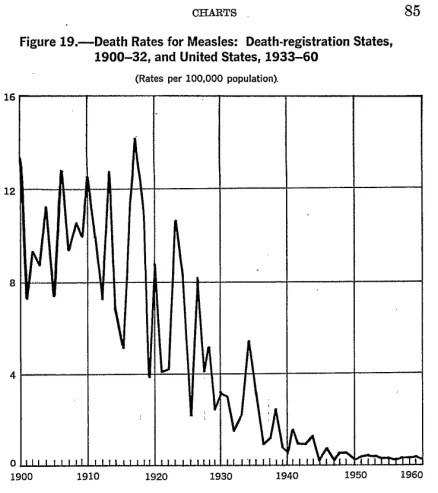
Taking a closer look, the CDC data reflects that in 1900, the rate of mortality from measles was 13.3 deaths per 100,000 individuals. By 1960, it was 0.2 deaths per 100,000 individuals. The same was true for 1961 and 1962. And as noted above, a similar decline of over 99% in measles deaths occurred between 1900 and 1967 in England and Wales, and it was only after that decline that the first measles vaccine was introduced there in 1968—five years after its introduction in the United States.
Hence, the same factors that caused measles mortality to decline by over 98% from 1900 to 1962 would, absent the vaccine interrupting the ecology of measles, likely have continued to cause a further reduction in the measles mortality rate after 1962. Meaning, at least a portion of the decline in the 400 deaths per year after the vaccine was available is no doubt attributable to the same factors that caused a steady decline in the measles death rate for decades prior to the introduction of the measles vaccine. Therefore, even without the measles vaccine, the death rate would have, no doubt, continued to decline after 1963.
In pockets of the country with poor nutrition, sanitation, and water, deaths from any pathogen, including measles, can occur at a higher rate. Those conditions still existed in some pockets of the United States in the early 1960s. As living conditions in those pockets of America improved with the introduction of clean water, improved sanitation, and better living conditions, deaths from measles declined, which is what typically occurs when these conditions improve. Let’s also not ignore that health care, especially the management and treatment of acute infections, has vastly improved since the 1960s. Doctors readily concede this point, unless you are talking about vaccines.
Yet, CDC claims that measles vaccines would have saved a data defying over 2,800 lives a year from measles in the United States between 1994 and 2023. CDC’s advertisement study, of course, also doesn’t account for the increase in deaths from heart disease and cancer due to the elimination of measles, as discussed in my previous post and reflected by studies that did not engage in estimates.
In sum, this CDC self-promotion article, that is not peer-reviewed and must conform to CDC policy to be published, does not account for any external factors, does not account for actual mortality data related to these diseases, and lacks any confidence intervals because its claims have zero reliability. Anyone citing this study claiming 1.1 million lives were saved is spreading propaganda. Not science.
[1] https://pmc.ncbi.nlm.nih.gov/articles/PMC1997101/pdf/pubhealthreporig01174-0001.pdf (“The simultaneous decline in diphtheria morbidity and mortality rates in all age groups of individual States located in different sections of the country, which began after a cyclic increase in incidence between 1915 and 1925, suggests the operation or influence of other factors besides, or in addition to, artificially induced immunity. Studies such as that included in the 1930 White House Conference on Child Health and Protection indicated that immunization programs were reaching a relatively large proportion of children in some areas or cities and a very low proportion in others as late as 1930. In spite of this wide variation, both morbidity and mortality began to decline rapidly after 1925 in all States simultaneously.”); https://www.cdc.gov/pinkbook/hcp/table-of-contents/chapter-7-diphtheria.html (“[D]iphtheria toxoid-containing vaccines became available in the 1940s” and “universal childhood vaccination program which included diphtheria toxoid-containing vaccines beginning in the late 1940s.”).
[2] The death rate per 100,000 individuals in the United States in 1900, 1940, and 1948 for diphtheria was 40.3, 1.1, and 0.4, respectively, for tetanus it was 2.4, 0.4., and 0.3, respectively, and for pertussis it was 12.2, 2.2, and 0.8, respectively. https://www.cdc.gov/nchs/data/vsus/vsrates1940_60.pdf.
Taliban rejects Trump’s ultimatum
RT | September 21, 2025
Afghanistan has rejected US President Donald Trump’s ultimatum that Bagram Air Base be returned to American control, insisting that such demands violate the 2020 Taliban-US agreement on the withdrawal of troops.
On Sunday, Trump warned that if Afghanistan doesn’t give the facility back, unspecified “BAD THINGS ARE GOING TO HAPPEN!!!” The US leader had earlier lamented Washington’s loss of the base, noting its proximity to China.
Later that day, Hamdullah Fitrat, deputy spokesman of the Taliban-run Afghan government, noted that Kabul has made it clear to the US in all negotiations that the country’s “independence and territorial integrity are of the utmost importance.”
“It should be recalled that, under the Doha Agreement, the United States pledged that ‘it will not use or threaten force against the territorial integrity or political independence of Afghanistan, nor interfere in its internal affairs,’” he said, urging the US to honor its pledge.
“Rather than repeating past failed approaches, a policy of realism and rationality should be adopted,” Fitrat stressed.
Bagram Air Base, located in Parwan Province about 60 km north of Kabul, was the primary US military hub in Afghanistan for two decades. It served as a launching point for counterterrorism operations, including against al-Qaeda and the Islamic State. It also housed detention facilities, which were allegedly sometimes used for torture.
Under the 2020 Doha Agreement, the US essentially concluded peace with the Taliban and committed to gradually withdrawing its troops from Afghanistan, and to cease threatening the country’s political independence. In exchange, the militants issued guarantees not to allow Afghan soil to be used by terrorist groups.
However, while the US was implementing a phased troop withdrawal, the Afghan government and security forces crumbled under Taliban pressure, prompting the remaining US troops to scramble for a chaotic evacuation.
Taliban officials have since maintained they are open to cooperation with the US but “without the United States maintaining any military presence in any part of Afghanistan.”
Israeli trade relations collapse amid war on Gaza, global boycotts
Al Mayadeen | September 21, 2025
“Israel’s” trade relations are suffering a serious deterioration in recent weeks, with deals and meetings being canceled even with historically “friendly” nations, amid an atmosphere of secrecy and embarrassment.
Israeli exporters have revealed that companies in Europe and the United States have refused to renew export contracts, while marketing networks have announced a halt to the import of Israeli products “until further notice.”
In this context, Ynet reported that a delegation of experts from the Moody’s rating agency visited Tel Aviv and left with very worrying impressions of the possibility of a rating reduction soon. One official said, “It will be a miracle if a reduction is not made within two weeks.”
A senior economic official who met with Moody’s representatives pointed to extreme concern over the massive rise in defense spending during the war on Gaza, confirming it represents a critical turning point.
The official warned that the Israeli government could lose all control over budget management, threatening a huge rise in the deficit and an accumulation of debt.
Israeli trademarks take heavy blows
The president of the Israeli Manufacturers Association, Ron Tomer, confirmed that the Israeli brand has been severely damaged, warning that the economy could be set back by years. Tomer also pointed to a shocking request from a supposedly “friendly country” to erase any images of meetings with Israeli companies to avoid political embarrassment.
An exporter explained that the situation has deteriorated significantly since the announcement of the intent to occupy Gaza and with the increasing spread of videos documenting the bombing of buildings and mosques and the deaths of civilians.
The exporter added that the footage from Gaza can no longer be overlooked and that they are now destined to complete isolation and feel shunned all over the world.
71% of scrapped deals connected to war on Gaza
According to a survey prepared by the Israeli Manufacturers Association, which included 132 industrialists, nearly half of all exporters have lost deals or not had their contracts renewed, while 71% of them indicated the cancellations were for political reasons related to the war on Gaza.
The European Union was the most proactive in cancellations, as 84 percent of industrialists reported losing contracts there, while 31 percent were surprised by similar decisions from clients in the United States, according to the survey.
The survey also indicated that 76 percent of exporters have seen their exports directly harmed, with the impact exceeding 40 percent of total exports for some of them.
The survey further revealed that more than half of all new clients now refuse to deal with Israeli companies, while 49 percent of exporters are facing unprecedented logistical difficulties with shipping, customs, and ports.
Economic analyses link this crisis to the repercussions of the war on the Gaza Strip and statements by Israeli Prime Minister Benjamin Netanyahu about turning “Israel” into a closed system, which has alarmed investors over rising security expenditures and a worsening deficit.
Imagine There Was A Violent Cult Committing Atrocities with Impunity

By Caitlin Johnstone | September 20, 2025
Imagine there was a violent cult that used scriptures from an ancient religion to convince its followers to do evil things.
Imagine the cult was given its own state.
Imagine the cult was given machine guns, tanks and war planes.
Imagine the cult obtained nuclear weapons.
Imagine the cult started committing genocide against the indigenous people who’d been living in the area where the cult’s state was established.
Imagine the cult had huge branches in the most powerful nation on earth, and the powerful nation defended the cult no matter what it did.
Imagine the cult flipped out and started relentlessly attacking and invading the surrounding nations.
Imagine the cult had so much influence and support in western society that western governments and institutions would censor, silence, fire, marginalize and deport anyone who criticized the cult’s actions.
Imagine the western media sympathized highly with the cult and spent the entire time framing its atrocities as entirely reasonable defensive actions, and framing critics of the cult as malicious bigots.
Imagine the cult kept getting crazier and crazier and more and more violent, but nobody could find a way to stop it because its actions were backed by this giant western power structure.
That’d suck, huh?
I think that’d be just about the most bat shit insane situation anyone could possibly imagine.
A nuclear-armed death cult just murdering and massacring mountains of human beings with total impunity, backed by the most powerful people on earth? That would be an unfathomable madness.
If someone made a movie about such a thing I’d stop watching halfway through, because I would find it too unbelievable.
I’d be like, come on man. Come up with a more realistic plot line. And come up with a more believable antagonist; nobody is that evil.
I’d be like come on Hollywood, you seriously expect me to maintain my suspension of disbelief when you’re putting out a movie about these cartoonishly evil bad guys who blow up hospitals and assassinate journalists and murder humanitarian workers and deliberately massacre starving civilians seeking food?
I’d be like, you really expect me to believe a violent cult could get all this power and do all these evil things and get away with it, just by lying about it all the time? Eventually people would stop believing their lies!
I’d be like, somebody would stop them. Not only does this movie have unbelievable antagonists, it also lacks any believable protagonists. Basic human decency would compel the world to stop all these atrocities being committed right out in the open. Where are the heroes in this story?
And then I’d storm out of the movie theater, glad to be outside that horrible fictional world where such freakish absurdities were taking place.
And then I’d stand in the parking lot and look up at the sky, and thank God I’m back in reality again.
Featured Video

Death Spikes & Rising Cancer In Our Youth Explained
or go to
Aletho News Archives – Video-Images
From the Archives
Politicians lie
By Mazin Qumsiyeh | Popular Resistance | August 18, 2013
There is no way to say this truth nicely: Politicians lie. That includes Japanese, American, Egyptian, Israeli, and Palestinian politicians! Is there something more common sense than that? Yet, so many citizens around the world believe their own politicians or wistfully acknowledge lies but think it is part of the job needed to run things. They believe even when politicians contradict themselves blatantly. This phenomenon is rather remarkable. It is a dissonance and disconnect from reality that many seem oblivious to. It is very dangerous because it can lead to accepting rationales for going to war. These can be deadly wars that lead to millions of lives lost as happened in what was called World War 1 and WW2. Even when incredible and declassified evidence abound, politicians continue to lie and old mythologies refuse to die. Here are just a few of the countless lies told to us over the past few decades… continue
Blog Roll
 Aletho News
- Global Tipping Points Lead the World Into a State of Entropy
- The day-after at the White House: USA and Xi Jinping
- The Geopolitical Balance in the Red Sea: The UAE Being Displaced by New Players
- Iraqi resistance group vows to stage airport sit-ins over Iran aerial blockade
- Turkish parliament to review Saudi-Pakistan defense pact next month
- DEATH SPIKES & RISING CANCER IN OUR YOUTH EXPLAINED
- Iran offers Trump deal before US election
- Merz regime wants ‘secret police’ – opposition
- Israeli settlers terrorize West Bank Palestinians with state-provided drones: Report
- They see them, then kill them: Israeli quadcopters track, deliberately target civilians in Gaza
- If Americans Knew
- Deconstructing Netanyahu’s pants-on-fire UN rant – Daily Update
- Trump betrayed voters with his campaign lies and prioritized a foreign country once he took office
- Netanyahu calls Israel’s war in Gaza ‘opposite of genocide’ in UN speech to near-empty hall
- Settler Kidnappings: Torture, Sexual Abuse and Terrorisation of Palestinian Abductees as Israel Deepens Annexation of West Bank
- Gaza winter nears as 162,000 tents become unusable, raising fears of humanitarian crisis
- Netanyahu says, “It’s the opposite of genocide”; UN says Gaza economy is world’s ‘most severe crisis on record’ – Daily Update
- Israel’s US-Backed Assault on Gaza Has Created the ‘World’s Most Severe Economic Crisis on Record’: UN
- ‘Protecting U.S. Citizens’… From Israel
- ‘This is where I live now, the back of a truck’: a day in the life of a grandmother in Gaza
- In UN Speech, Iran’s President Displays Pictures of Children Killed by US, Brings Attention to Israel’s Nuclear Arsenal
- No Tricks Zone
- New Study: Earth And Venus Surface Warmth Largely Explained By Convection And Lapse Rate, Not CO2 Or Radiation
- 2025 Nature Paper Claiming Worsening Global Drought Gets RETRACTED …Heavily Flawed
- New Study: ‘Global Drought Shows No Detectable Recent Acceleration Under Climate Warming’
- Economic Masterminds: German Socialists Suggest Taxing Productivity Gains Stemming From Using AI
- The South China Sea Has Not Been Cooperating With The Climate Change Narrative
- Energy Crisis: Germany Enters Heating Season With Historically Low Gas Reserve Fill Levels
- New Study: The Antarctic Ice Sheet Gained Mass From 2020-2024 Due To Staggering Snow And Ice Accumulation
- Study: Ocean Heating Rates From Thousands Of Years Ago ‘Dwarf’ Modern Ocean Heating Rates
- Climate Extremists Target, Attack Large-Scale Power Grid Infrastructure In Germany!
- New Study: Antarctic Ice Melt Has Contributed Less Than 1 Centimeter To Sea Level Rise In The Last 30 Years

