Making Palestinians Go Away
The Trump Administration Seeks to Ignore the Genocide
By Philip Giraldi • Unz Review • September 4, 2025
Donald Trump, recently sporting his red ballcap modestly featuring the words “Trump Was Right About Everything,” is apparently in regular contact with Israel’s genocidal Prime Minister Benjamin Netanyahu. Per Netanyahu, the most recent telephonic exchange had Trump expressing full support for the establishment of control over all of Gaza and the West Bank by the Israeli Army. Trump observed that Israel has been losing the “PR” (Public Relations) war over the carnage and must push ahead “with full force” to “finish the job” as quickly as possible.
There are also reports of a scheme perhaps launched during a White House meeting including Trump, former British Prime Minister Tony Blair, and Trump son-in-law Jared Kushner which would give Palestinians willing to be ethnically cleansed a “relocation package” of $5000 and some other benefits to get the hell out. Where exactly they would go to is not very clear but it would eliminate the bad publicity if the Israeli army’s has to kill all of them. Gaza would then be freed up to develop the long-sought Trump Gaza Riviera under US trusteeship over the ruins and the tens of thousands of unburied bodies.
As the slaughter of mostly women and children in Gaza continues, the American public as well as voters in many European nations have turned sharply against Israel, presumably a manifestation of Trump’s “PR problem” for the Jewish state. But Israel is striking back with its own weapons, namely the tools that it has used to corrupt the government and media in the United States and all across Europe. There are numerous Jewish organizations as well as Christian Zionist churches backed by the ample funds contributed by Jewish billionaires that make sure that politicians and journalists know which side their bread is buttered on. But it is generally conceded that the most powerful component of the Israel Lobby is the American Israel Public Affairs Committee (AIPAC). AIPAC openly declares that its principal purpose is to strengthen the relationship between Israel and the United States. That actually in practice means subordinating US interests to those of the Jewish state but no politician or journalist on the make is going to defy AIPAC and cut off both the largesse and the political support. AIPAC says it has five million members, 17 regional offices, and “a vast pool of donors.” In 2022, it had 376 employees, an endowment of more than $10 million plus more than $79 million in revenue. AIPAC’s claims to be bipartisan – at its yearly policy conference in 2016 it featured both major parties’ nominees: Democrat Hillary Clinton and Republican Donald Trump.
One of AIPAC’s most prized initiatives is the arranging fully paid for trips by Congressmen and other prominent influencers to Israel, where they are wined and dined and fed the full panoply of lies that the Israelis use to justify their horrific agenda. The trips are in full violation of the Foreign Agents Registration Act of 1938 (FARA) rules that organizations that operate on behalf of foreign governments must register and provide full information providing transparency both on their funding and their meeting with foreign government officials. As the last president to actually seek to have an Israel Lobby entity register was John F Kennedy, his fate might explain why none of the presidents since that time have attempted to do the same.
AIPAC’s latest trick was to send 22 House of Representative Republicans to Israel over the Congressional recess in August where they were hosted by Benjamin Netanyahu himself during what was dubbed a “week long educational seminar”. Netanyahu’s office said in a statement. “The Prime Minister briefed the members of Congress on the war in the Gaza Strip and commented on the issue of the humanitarian assistance and the mendacious campaign being waged by Hamas against the State of Israel.” Speaker of the House Mike Johnson, a Christian Zionist know nothing, was leading a separate delegation of five leading Republicans. He was treated to a private dinner with Prime Minister Netanyahu.
Meanwhile, waiting in the wings was a group of 23 Democratic Party congressmen who descended on Israel after the Republicans departed, also funded by AIPAC. The Democrat delegation was led by House Democratic Caucus Chair Pete Aguilar of California and Representative Steny Hoyer of Maryland. Steny Hoyer has led 20 Congressional trips to Israel.
Journalist Glenn Greenwald has observed how members of the US Congress travel to Israel more than any other country by a large margin. In fact, they make “more trips to Israel than to the entire Western Hemisphere and the continent of Africa combined.” That fact added to the other blandishments offered by the Israel Lobby to “opinion makers” means that Congress and the Media are dramatically pro-Israel and anti-Palestinian to an extent which the American public does not share. In Israel there is no such problem, with a recent poll indicating that a majority of the Jewish Israeli public believing that Palestinians are little more than animals and “should be killed.”
The non-existence status of Palestinians has in fact been a hallmark of the Trump Administration’s foreign policy. The latest move to place the Palestinians in a separate category when it comes to their being allowed to exist at all has come from the US State Department, which has blocked the issuance of visas for the Palestinian delegation which was expected to attend the opening of the United Nations General Assembly session later this month in New York. The State Department said it was doing this to hold the Palestinian Authority and the PLO “accountable for not complying with their commitments, and for undermining the prospects for peace” and there were also evidence-free claims that some of the delegation might have terrorist connections with Hamas. This was followed a few days later by a decision by the State Department to block the issuance of visas to any holder of a Palestinian Authority passport, even including Palestinians who have family in the United States. The new measures will affect visas for medical treatment, university studies, visits to friends or relatives and business travel.
The visa moves come on top of the ghastly tale regarding the fate of a number of Gazan children who were badly injured or wounded by the Israelis and who had the good fortune to fall into the hands of a US-based charity called HEAL PALESTINE that was able to get them out of the Strip for medical treatment in the United States and elsewhere. The children were in need of major surgery and other complicated treatment and were accompanied by at least one of their parents in most cases as they were unable to function independently. The blocking of the children came soon after a right-wing American Zionist extremist, Laura Loomer, described Palestinians from Gaza being brought to the United States for treatment as “jihadis” and “a national security threat.” Inevitably, after America’s Zionist cheering section learned of the arrival of the sixty or so children in the US and went to work, the US State Department, blocked the issuance of any more visas and is now engaged in a “full and thorough investigation” into how the travel was approved and arranged in the first place.
The moves against Palestinian travelers apparently came after a Netanyahu request to Secretary of State Marco Rubio to lower the profile of Palestinians who are likely to be in a position to protest publicly against behavior of Israel in Gaza and on the West Bank. The visa and travel curbs also follow declarations by a number of US allies, including France, the United Kingdom and Canada, that they plan to recognize a Palestinian state at the UN in the coming weeks. Some Trump officials, including the president himself, have strongly opposed this drive for international recognition, which Israel has condemned.
Palestinian officials have inevitably denounced the US action as a deliberate attempt to silence them at a time when Gaza faces mass displacement, starvation, and what UN and International courts have described as a genocide. The US move has drawn sharp criticism from legal experts and international diplomats, who say it violates the 1947 UN Headquarters Agreement, which obligates the United States in its role as the host country to facilitate access for all accredited delegations.
This has led to pushback by the United Nations itself, which reportedly has decided to stage the opening session of the General Assembly in Geneva instead of New York. In fact, in 1988, the UN similarly relocated to Geneva because the US denied a visa to Yasser Arafat, then head of the PLO. The current relocation is similarly intended to insure full Palestinian participation, particularly in a scheduled September 22nd segment which will be dedicated to Palestinian rights. President Mahmoud Abbas is expected to address the Assembly in Geneva, where he will call for international protection, recognition of Palestinian sovereignty, and accountability for Israeli war crimes.
The Geneva session is also expected to increase calls for action under the “Uniting for Peace” resolution, which empowers the General Assembly to recommend steps to take when the Security Council is unable to act due to political obstruction through exercise of vetos or lack of consensus. Advocacy groups are urging the UN to consider deploying an international protection force to Gaza and to suspend Israel’s privileges within the UN system until full humanitarian access is restored. It might also be useful to suspend the United States’ privileges, most particularly including its permanent veto rights on the Security Council, but, alas, that is perhaps asking for way too much!
Philip M. Giraldi, Ph.D., is Executive Director of the Council for the National Interest, a 501(c)3 tax deductible educational foundation (Federal ID Number #52-1739023) that seeks a more interests-based U.S. foreign policy in the Middle East. Website is councilforthenationalinterest.org, address is P.O. Box 2157, Purcellville VA 20134 and its email is inform@cnionline.org.
Venezuelan Interior Minister Accuses U.S. of International Law Violations
teleSUR – September 4, 2025
On Wednesday, Interior Minister Diosdado Cabello denounced a disinformation campaign and attacks from the United States against Venezuela, which he said include flagrant violations of international law under the pretext of a supposed fight against drug trafficking.
More specifically, he referred to the dissemination of false information by the United States about an attack on a vessel in the Caribbean. The Bolivarian official said the boat shown in videos did not match Venezuelan fishing boats.
Cabello alleged that the administration of President Donald Trump had committed legal violations by allegedly sinking a vessel in international waters, an act he said left 11 people dead.
The Interior minister emphasized that U.S. actions contravened fundamental principles of international law and the right to life, as the ships did not seek to capture and prosecute the people on board.
Cabello listed some of the multilateral treaties that were violated, including the United Nations Convention on the Law of the Sea (1982), the 1988 Vienna Convention against Illicit Traffic in Narcotic Drugs, the International Covenant on Civil and Political Rights, and Article 51 of the U.N. Charter.
He also said U.S. military actions contradicted U.S. legislation itself, such as the Maritime Drug Law Enforcement Act and the Fifth Amendment to the Constitution, which enshrines due process.
“We have never seen Washington seek to dismantle a drug cartel inside the United States,” Cabello said, questioning the Trump administration’s alleged anti-drug campaign.
The Bolivarian minister recalled that the United States is the country with the highest drug consumption in the world and suggested that Congress should investigate who is behind these military operations in the Caribbean, which he said appeared aimed at a “regime change.”
“By contrast, Venezuela does fight drug trafficking, wherever it comes from and wherever it goes,” Cabello emphasized, adding that his country does not execute people at sea.
Cabello cited an example of effective cooperation between Venezuela and France on May 30, when 780 kilograms of cocaine were seized in a joint operation, after which the detainees were brought to justice and “not shot or massacred as the United States does.”
The interior minister also noted that U.N. reports describe Venezuela as a country free of drug crops and laboratories, where drug trafficking routes are nonexistent.
“The United States lives off lies and fake news, seeking to destroy the image of any person or country,” Cabello said, recalling that Commander Hugo Chavez was also the victim of disinformation campaigns.
“The imperialism’s historic practice has been to sow falsehoods to strike at the people’s truth,” he said, urging Venezuelans to remain with “firm footing, nerves of steel and maximum popular mobilization.”
Diosdado Cabello, who is also secretary of the United Socialist Party of Venezuela (PSUV), said that transnational far-right forces and their local spokesperson Maria Corina Machado are trying to create “false flags” to justify a possible military attack on the Bolivarian nation.
“They live hiding behind lies!,”he said, recalling that Washington’s narratives create fictitious enemies such as the alleged Cartel of the Suns, which symbolically replaces the non-existent Aragua Train.
The Lies Behind the Oklahoma City Bombing
By Richard Booth | The Libertarian Institute | August 18, 2024
Despite the seemingly simple conclusion behind the 1995 Oklahoma City Bombing, the investigation was exceedingly complicated. To this day, it is still the FBI’s most massive investigation, comprised of millions of pages of evidence. Careful analysis of this paper trail shows that the official narrative of the FBI and ATF is in fact a half-truth that ignores findings supported by the records. The FBI and ATF’s positions are frequently backed up with misleading statements, and in some instances, total fabrications.
In an honest investigation, there would be no reason to concoct and disseminate lies. If we believe that the FBI and ATF investigations were fair and legitimate, then we would expect to not find so many blatant examples of dishonesty. Yet, they exist: one after another, often repeated, and affirmed as truth. Some lies are small, others large. But what they have in common is a systemic problem that speaks to the very integrity of the agencies tasked with investigating this crime. The FBI is not a person suffering from a disorder that causes delusions. If an FBI or ATF official is formulating a lie, or propagating an extant lie, there is an objective.
All too often, it appears that the aim of these agencies is to conceal an inconvenient truth, to hide something that may otherwise invalidate the official narrative or camouflage something too heinous for the public to accept. Federal agencies’ overall deceptive pattern points to shared complicity or guilt, which should be of great concern.
In this essay we’ll examine some of the lies and wrongdoing that officials at the FBI and ATF have engaged in regarding their investigation(s) of the Oklahoma City bombing. I have uncovered half a dozen examples throughout investigating this case. Initially, I did not go out of my way looking for deception. It was something I continually discovered naturally. In some cases, the lies may be related to one another and will provide insight and clarity about what happened on the morning of April 19, 1995.
There Were No Eyewitnesses
I came upon the first example while reading On Scene Commander by Weldon Kennedy. Kennedy was the FBI’s first on-scene commander of the Oklahoma City bombing investigation and could be found hosting press conferences to discuss developments in the early days after the attack. In his memoir, Kennedy wrote that “this was going to be a case largely built from forensic evidence since there were no eyewitnesses.”1
Full stop: no eyewitnesses? This assertion is a blatant lie and should be a clue to the discerning reader that whatever the eyewitnesses saw must be important. It is surprising that Kennedy would write this, given the vast number of mainstream media reports that included eyewitness accounts2, along with the FBI’s 302 reports that detailed eyewitness interviews. Even Kennedy himself, during his April 20, 1995 press conference, described a second suspect who was spotted alongside Timothy McVeigh: “The second man is also of medium build. He is further described as 5 feet 9 inches to 5 feet 10 inches tall, weighing approximately 175 to 180 pounds, with brown hair and a tattoo visible on his left arm, below his t-shirt sleeve. He is possibly a smoker.”3 Three eyewitnesses from Elliott’s Body Shop provided this description of a man who, alongside McVeigh, picked up the bomb-truck on April 17. This same suspect would be spotted with McVeigh at the crime scene on April 19.
The FBI uncovered about two dozen key eyewitnesses over the course of their investigation. These individuals observed Timothy McVeigh and the Ryder truck as it approached the Alfred P. Murrah Federal Building on the morning of the bombing, most of them between 8:30 AM and 9:02 AM when the bomb went off. Following the explosion, FBI agent Danny Coulson was in charge of the crime scene, occupying a position of authority similar to Weldon Kennedy as an on-scene commander. In 2007, Coulson spoke candidly to the BBC about the voluminous eyewitnesses that came forward: “We know there were 24 people that were interviewed by the FBI that said they saw Mr. McVeigh on April 19 with someone else.”4 Coulson’s statement is corroborated by the FBI’s 302 reports which contain the descriptions these witnesses provided agents.
For example, catering truck driver Rodney Johnson spoke to the FBI on the night of the bombing and for several days after. Johnson described how he had to slam on his truck’s brakes to avoid hitting two men running across the street as they exited the Ryder truck.5 He got a good look at both John Doe #1 and John Doe #2, and his description of the suspects matches the one given by Weldon Kennedy during his April 20 press conference. Rodney Johnson’s catering truck co-worker, Billie Hood, also saw the fleeing pair and was interviewed by the FBI.6 Following McVeigh’s arrest, Johnson was re-interviewed and confirmed McVeigh was one of the two men he saw.
According to Weldon Kennedy, both Rodney Johnson and Billie Hood are the product of fever dreams “since there were no eyewitnesses.”
Another witness, Mike Moroz was interviewed by the FBI numerous times in the week after the bombing. Moroz was a mechanic working at Johnny’s Tire, an automotive repair shop located a few blocks from the Murrah Building. On the morning of the bombing, Timothy McVeigh pulled the bomb-truck into Johnny’s Tire at about 8:30am to ask for directions.7 He was looking for a one-way street downtown, a route leading to the Murrah Building. Moroz recounted the interaction to the FBI, explaining that he had spoken to McVeigh face-to-face. His co-workers, Allen Gorrell and Byron Marshall, were also interviewed and confirmed that McVeigh had stopped for directions.8
Moroz also said that McVeigh had a passenger in the Ryder truck with him. Moroz’s account was so significant that the FBI brought him downtown to their command center, where he selected Timothy McVeigh out of a live line-up the weekend following the arrest.9 Mike Moroz would have been a damning trial witness for the prosecution, able to put Timothy McVeigh in downtown Oklahoma City and finger his destination as the Murrah Building. Rodney Johnson, too, would have been an incredible asset. He could have placed McVeigh with the Ryder truck at the Murrah Building prior to the explosion. Unfortunately, their testimonies were forsaken in favor of forensic evidence because authorities preferred to pretend they didn’t exist.
Contrary to Weldon Kennedy’s assertion, the FBI attested to these witnesses in a preliminary hearing on April 27, 1995. During his testimony, FBI agent Jon Hersley referred to the observations of both Johnson and Moroz as central to the ongoing investigation.10 However, by the time of the McVeigh and Nichols trials—and Weldon Kennedy’s book—these witnesses would disappear from the narrative, rendered nonexistent. Why? Was it because all of these eyewitnesses saw another man in the Ryder truck with McVeigh?
Rodney Johnson, Billie Hood, Mike Moroz, Alan Gorrell, and Byron Marshall are only five of the more than two dozen eyewitnesses who saw Timothy McVeigh in downtown Oklahoma City on the morning of April 19. All of these individuals—described by Danny Coulson and denied by Weldon Kennedy—have something in common: each one confirmed that they saw McVeigh with a second person. This common denominator suggests that the impetus for Kennedy’s lie about “no eyewitnesses” was a concentrated effort to avoid explaining who the man spotted with McVeigh was.
Why did the FBI want to obscure this other suspect, going so far as to lie about witnesses? What does this tell us about who this person might be? One informed and reasonable speculation is that this other suspect was an informant connected either to the FBI or other federal authorities. If this were true, the FBI would have a reason to conceal his existence.
FBI documents obtained via the Freedom of Information Act (FOIA) give credence to this theory. Generated during the FBI’s interviews with Terry Nichols in 2005, these documents say that Nichols was scheduled to be interviewed by then-Rep. Dana Rohrabacher (R-CA), who was chairing a subcommittee tasked with writing a report on terrorism.
In a memo dated June 24, 2005, the FBI writes that, “DTOU [Domestic Terrorism Operations Unit] expressed concern regarding John Doe #2’s name surfacing during the congressman’s interview.”11 The DTOU is the FBI unit responsible for running informants and sting operations in terrorism cases. If John Doe #2 doesn’t exist, why would the FBI’s DTOU be worried? In a separate email, the FBI’s counterterrorism (CTD) division writes that they “share DTOU’s concern about the John Doe #2 information.”12 Why so much caution over a person that the FBI insists isn’t real?
The only scenario that makes sense is that the second suspect pegged by eyewitnesses, John Doe #2, was a federal informant. You can imagine the concern that would follow after FBI investigators discovered that the second person they were seeking was, in fact, part of their ongoing operations. This constitutes a strong motive to cover-up and obscure John Doe #2 at all costs to avoid embarrassment. Ask any retired agent, and they’ll tell you candidly that the biggest sin one can be guilty of at the FBI is embarrassing the bureau. It is only within the context of this unwritten rule that the behavior and statements of the FBI begin to make sense.
Bob Ricks Says: Nothing To See Here
Weldon Kennedy isn’t the only FBI official who has misled the public. Bob Ricks, former Special Agent in charge of the Oklahoma City FBI field office, made some curious statements to the Daily Oklahoman newspaper in October 1995. Ricks had just retired from the FBI, and the same week he left the bureau he granted an interview where he made claims we now know to be entirely false. The piece was headlined “Ricks Blames Curbs for Intelligence Gaps,”13 and has the former agent informing us that the FBI had no active counterintelligence investigations at the time of the Oklahoma City bombing. Why would Bob Ricks lie about that?
Ricks claimed that meddlesome oversight by Congress had hamstrung the FBI and rendered them incapable of gathering intelligence due to excessive red tape. He cited the FBI’s investigation of communist front groups in the 1970s, saying that “following the congressional hearings there, that pretty much took us out of the intelligence business (in the mid-1980s).” In response to criticism, Ricks claims that “we buried our head in the sand.”
His interview’s overall theme was to suggest that the FBI was unprepared for the Oklahoma City bombing because they could not—or would not—carry out intelligence-gathering operations targeting radicals. This is not true. The FBI possessed a vast network of intelligence-gathering tools at their disposal in 1995. They had confidential informants (Cis) and undercover agents (UCAs) infiltrating radical groups.14 They had pen-register and trap-and-trace mechanisms on the phones of specific targets that recorded inbound and outbound phone numbers.15 They had cooperating witnesses in ongoing investigations. All of these tools allowed the FBI to infiltrate and monitor the rightwing, while available evidence indicates they actively used these methods.
In the years leading up to the Oklahoma City bombing, the FBI instituted a “Major Case Domestic Security/Terrorism Group 1 Undercover Operation” called PATCON that targeted militias and other right-wing radicals.16 A “Group 1 Major Case Undercover Operation” is a big deal at the bureau. It requires continual funding authorizations (based on operational performance), in-place undercover operatives, and is signed-off on by an undercover review committee. The operation’s name, PATCON, was FBI shorthand for “Patriot Conspiracy.”
At the time of Ricks’ comments to the Oklahoman, PATCON was a tightly held secret at the FBI. It would be over a decade before the operation was exposed, and its full scope is still shrouded in mystery. What can be said, based on documents released via FOIA, is that the FBI operation had infiltrated three right-wing groups located across the country with several undercover informants. They had even established their own phony “front groups” whose purpose was to network with targets. One front, a group dubbed the “Veterans Aryan Movement” (or VAM), had an agent posing as an armored car robber with connections to racist groups.17
The FBI’s undercover agents and informants, connect to the various PATCON front groups, reported detailed intelligence on their targets, which included people and radical organizations with ideologies similar to Timothy McVeigh’s. One example is an investigation into the black-market sale of Stinger missiles and stolen military-grade night-vision goggles, items that were available for sale to mercenary groups throughout the country in the early 1990s.18 Another example includes undercover PATCON agents targeting the Texas Reserve Militia/Texas Light Infantry Brigade, a group based in Texas with links to white supremacist figures like Louis Beam. During the same period, undercover PATCON agents targeted the American Pistol and Rifle Association, run by John L. Grady. Another figure targeted by PATCON was Tom Posey, who ran an outfit called Civilian Material Assistance (CMA), an American paramilitary group that in the 1980s had connections to shadowy Iran-Contra figures. All of these examples show that through the branches of the PATCON operation, the FBI had a vast intelligence-gathering apparatus–the exact opposite of what Ricks said in October 1995.19
Of course, at the time of Ricks’ comments, the operation was a guarded secret. It’s clear in retrospect that he was lying; the FBI not only had active intelligence-gathering operations, but one that was tailor-made for inciting and entrapping people like Timothy McVeigh. What was Bob Ricks’ intention when he went to the newspaper and covered up the existence of PATCON? His last act of service to the bureau, rendered unto them the same week Ricks retired, was to tell the press preemptively that something like PATCON didn’t exist.
In effect, Ricks was claiming ‘Nothing to see here, we’re not doing anything that could conceivably be connected to McVeigh.’ Now knowing that this was a lie, we must ask what Ricks was protecting when he volunteered to falsely answer a question he hadn’t yet been asked. If this deliberate deception is any indicator—remember, no matter how clumsy, every obfuscation serves a purpose—there is reason to suspect a connection between PATCON and the Oklahoma City bombing. That theory is corroborated by one of the operation’s undercover assets.
The week of the bombing, John Matthews was sitting at home with his father watching television coverage. Matthews had worked for the FBI as an undercover PATCON agent and had his story told in Newsweek, headlined “I Was an Undercover White Supremacist.” The original article contained a passage about Timothy McVeigh. Newsweek editors cut this, and many other sensitive details, from the published piece for reasons that are still unclear. The original, unedited article states that when Matthews saw McVeigh’s face on television, he recognized him.20
Years before the bombing, when John Matthews had infiltrated the Texas Reserve Militia, he had attended one of their many weekend paramilitary training exercises. Matthews says that it was there, at a ranch in San Saba, Texas, that he met a tall, skinny ex-soldier with a buzzcut named Tim.21 The veteran was accompanied by a buck-toothed man with a German accent named “Andy.”22
Regarding McVeigh, Matthews said “he [Tim] was a nobody. Just another ex-soldier, but I remember his face. He was at one of the meetings, where a bunch of [stolen] ammunition was brought in from Fort Hood.”23 Matthews informed his FBI handler, Don Jarrett, that he had seen McVeigh at the ranch training with the Texas Reserve Militia. Jarrett told him, “Don’t worry, we got it covered.”24 Yet McVeigh’s crossed path with PATCON was never released and was even scrubbed from the Newsweek report. Was this indeed “covered,” as Jarrett had promised, or was it covered-up?
Was Ricks’ lie about intelligence operations related to Weldon Kennedy’s lie about having no eyewitnesses? Recall that all of the witnesses saw a still-unidentified man with McVeigh. Was John Doe #2 an FBI informant or asset? Is this what the FBI is hiding when it denies they were carrying out intelligence-gathering operations? How closely related are lies from the two agents charged with supervising the investigation of the bombing?
Fabricating Evidence
Weldon Kennedy’s assertion that the FBI would have to build its prosecution on forensic evidence due to the non-existence of witnesses amounted, in effect, to two different misdeeds. The first, of course, was saying there were no witnesses. The second is what Kennedy left out of his statement; not only would the FBI rely on forensic evidence, but it would also use fabricated evidence to bolster its case.
FBI forensic scientist Dr. Frederic Whitehurst first raised concerns about unscientific practices occurring at the FBI crime lab, after which an extensive investigation discovered fabricated evidence used in the Oklahoma City bombing case.25 From 1986 to 1998, Whitehurst served as one of the crime lab’s supervisory special agents, where he was widely considered the leading authority on explosives and explosive residue. Possessing a Ph. D. in chemistry from Duke University and a J. D. from Georgetown University, Dr. Whitehurst was the highest qualified analyst in the crime lab at the time, with qualifications often surpassing his superiors. For example, the Chemistry & Toxicology Unit’s chief, Roger Martz, did not have a degree.26 Likewise, the head of the crime lab’s Explosives Unit, David Williams, had a degree in zoology and made his bones not in academia, but through serving time in the bomb squad.27 Whereas Dr. Whitehurst was a scientist first and foremost. The crux of the doctor’s complaints was that his crime lab peers and supervisors were dedicated less to science than they were securing successful prosecutions—even if that meant violating the standards of any respectable scientist.
Dr. Whitehurst began observing and documenting practices at the crime lab that constituted notable examples of misconduct. As a whistleblower, he was treated severely. He was first fired by the FBI, who ultimately settled in court, paying him $1.2 million and an undisclosed sum for damages. In addition, the Justice Department’s Inspector General investigated the crime lab and produced a damning report. The IG examined several high-profile FBI cases—including the Oklahoma City bombing—and concluded that the crime lab’s investigation contained “serious flaws,” used “unscientific” practices, and had made “unjustified” conclusions which “lacked scientific foundation.”28
The FBI had assigned to the Oklahoma City bombing case the same crime lab investigators who had worked on the 1993 World Trade Center Bombing. Explosives Unit chief David Williams headed up the lab’s investigation, and he chose Steven Burmeister as his lead forensic examiner. The IG stated that Burmeister had fraudulently altered his reports at the direction of his supervisor, Williams. In one report, concerning Timothy McVeigh’s pocketknife, Burmeister initially wrote that “the presence of PETN [explosives] could not be confirmed.” He later altered the report to say “traces of PETN were located on specimen.”29 A qualified uncertainty was turned into a forensic certainty, resulting in a report containing false information that was used as evidence at the trial. Just as Dr. Whitehurst had documented, the FBI fabricated evidence for prosecutors—not an anomaly in their behavior, but a pattern. The IG report confirmed that among the cases it examined, the errors “were all tilted in such a way as to incriminate the defendants.”30
The IG concluded that David Williams ought to be reassigned to another unit because he “lacks objectivity, judgment, and scientific knowledge.” This was one of several reassignments and changes recommended in the IG report, all necessary to reform the crime lab’s practices. As a result of Dr. Whitehurst’s whistleblowing and the subsequent investigation, the FBI was forced to adopt forty different reforms to ensure forensic reliability. The IG report impeached not only the credibility of the FBI crime lab, but the entire bureau. Even with the imposition of reforms, with that credibility gone, how are we expected to trust the FBI’s work in other areas of the investigation? How far did the corruption extend?
It is appalling that such a thing could happen in the highest-level investigation ever carried out by the United States’ premier law enforcement agency. Questions of integrity aside, fabricating evidence also displays an immense arrogance. The FBI was willing to risk a successful prosecution of Timothy McVeigh, when fabricating evidence wasn’t necessary to win a conviction; the extent of the available evidence, even without eyewitnesses, would have been enough to easily secure a conviction. So why do it?
The answer appears to be either ‘because we can,’ or worse, ‘because that’s how we do things.’ The evidence supporting the latter conclusion is plentiful, since criminal activity by the feds goes beyond Oklahoma City. One needs only to look at other high-profile FBI cases. For example, in the espionage case against defense contractor Christopher Boyce and his childhood friend Daulton Lee, the FBI claimed it had recovered Lee’s fingerprints from the secure “black vault” at TRW Inc.31 The black vault was where Boyce made copies of sensitive documents that Lee then hand-delivered to the KGB in Mexico City. One problem: Daulton Lee had never in his life been on TRW Inc. property, much less made his way to the highly secure black vault.32 This inconvenient fact did not stop the FBI as they apparently fabricated Daulton Lee’s fingerprints to use as a “trump card” in case the evidence against him wasn’t enough to convict. Like McVeigh, there was enough legitimate evidence against both Boyce and Lee to make any fabrication unnecessary, to say nothing of egregious. But ‘that’s how we do things.’
Destroying Evidence
Acting on a tip, in 2005 the FBI raided the former Kansas residence of convicted bomber Terry Nichols, where they seized a cache of explosives. Nichols told the FBI in interviews that among the carefully wrapped and preserved explosives they would find the fingerprints of an unindicted co-conspirator in the bombing. Unfortunately, we’ll never know whether this was true. The FBI—grudgingly acting on Nichols’ tip—destroyed most of the evidence.
Only after enduring pressure from congressional staffers and at least one congressman did the FBI act, taking over two years to produce a report on the results of the raid. The report, dated February 21, 2008, noted that a fingerprint—named redacted—was lifted from a book found among the explosive cache. The inventory—seventy kinestik binary explosives, detonators, fuses, and flares—was destroyed, along with any fingerprint evidence.33
In his 2005 interviews with the bureau, Terry Nichols said that the fingerprints of Roger Moore and other bombing conspirators would be found among items in the explosives cache. Despite this indication, the FBI crime lab made no identification in their reports. However, in a December 2012 interview on The Scott Horton Show, investigator Roger Charles suggested that the FBI did recover prints from the stashed explosives. Charles explained that a highly placed FBI official told Deputy Bureau Chief of the Associated Press John Solomon that four sets of fingerprints were discovered: Timothy McVeigh, Terry Nichols, Roger Moore, and Richard Lee Guthrie.34
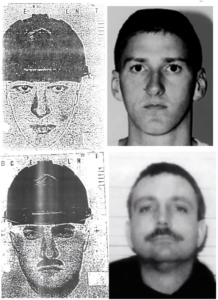 Guthrie, who died in prison in 1996, was a leading figure in the Aryan Republican Army (ARA), a neo-Nazi bank robbery gang, and has long been suspected of possible involvement in the Oklahoma City bombing plot. Likewise, in reports produced by McCurtain Gazette reporter J. D. Cash and Indiana criminology professor Mark Hamm, they suggest that McVeigh might have been involved in one or more of the ARA bank robberies. One of the stick ups was carried out on September 21, 1994 in Overland Park, Kansas. According to Cash, “witnesses provided a sketch of him [one of the robbers], you look at it, and there’s no question it’s McVeigh.”35 Mark Hamm agrees, telling Cash, “I believe that sketch of the other subject is Timothy McVeigh and not [Peter] Langan. It’s almost a perfect likeness of McVeigh.”36
Another ARA bank robbery that Timothy McVeigh may have participated in occurred at the Third Federal Savings and Loan in Middleburg Heights, Ohio on December 9th, 1994. On December 5th, members of the ARA checked into a motel near Kent, Ohio. FBI investigators, suspecting that McVeigh was linked to the robbery, analyzed video footage from the crime in an attempt at identification. Reportedly, the FBI crime lab’s comparison of McVeigh and he bank surveillance video was inconclusive. Unfortunately, we can no longer examine the video because it was destroyed by the FBI in 1999, despite evidentiary rules to the contrary.
The FBI also destroyed blasting caps wrapped in Christmas paper recovered from the gang’s safehouse in Ohio. According to the ARA’s co-founder, Peter Langan, those blasting caps were obtained from Timothy McVeigh.37 Can we trust the FBI’s word that Langan is lying, and that neither the caps nor the surveillance video was connected to McVeigh? The FBI’s bureaucratic culture is to collect and preserve every last scrap of paper or conceivable bit of evidence. If something is destroyed, it is to serve a purpose.
The FBI also managed to destroy crucial audio dispatch tape recordings and transcripts that had been obtained during the investigation. In a November 1995 interview, Assistant Chief of the Oklahoma City Fire Department Jon Hansen said that the fire department had received a call from the FBI on the Friday before the bombing. The FBI warned them that there might be an imminent terrorist attack, and to maintain heightened security levels. When asked if the fire department had kept a recording the call, Hansen said that “all the transmission tapes have been erased. We made a boo-boo.”38 A boo-boo? Really?
During his trial, McVeigh’s defense team requested that the FBI provide all transcripts and transmissions related to Oklahoma City on April 19, 1995, and two weeks prior. The FBI glibly responded to this request by informing them that these tapes and transcripts were “accidentally destroyed.”39 Was this another “boo-boo?” Or was this destruction of key evidence intentional? The reader can make an informed decision.
McVeigh’s defense team also made a request for transcripts of the Oklahoma City Police Department dispatch tapes, which would have included the APB that police issued on April 19 for a brown truck connected to the bombing. The FBI responded that these too had been “accidentally destroyed.”40 Once again, we find a convenient “accident” that invariably strengthens the FBI’s narrative of the bombing.
Any lawyer will tell you that your case is only as good as the evidence it’s based on. The evidence in a criminal case must be carefully preserved with a documented chain of custody; nothing should be destroyed or otherwise mishandled. It appears, however, to have been commonplace in the Oklahoma City investigation. The handful of examples highlighted above show a pattern of behavior that, when combined with the conclusions of the IG report on the FBI crime lab, indicates that the destruction and fabrication of evidence was part of an overall effort to conceal specific facts in order to slant the case in favor of the prosecution. We must ask: what is being concealed by this pattern, and what common denominators exist in each instance where evidence was mishandled, destroyed, or fabricated?
ATF: ‘We Weren’t There’
On the morning of April 19, 1995, several ordinary Oklahomans had disturbing encounters with ATF agents at the Murrah Building blast site during the subsequent rescue operations. These individuals include rescue volunteers and emergency first responders who were triaging the wounded while working with ambulance and rescue personnel. Several of these people testified before a grand jury impaneled to investigating the bombing what ATF agents had told them that morning.
Prior to testifying, these witness accounts were published in the McCurtain Gazette newspaper by award-winning journalist J. D. Cash. Three of their statements were broadcast on Oklahoma City television station KFOR-TV on September 12, 1995. The first two witnesses interviewed by KFOR’s Brad Edwards were Bruce Shaw and his supervisor, Tony Brasier. Shaw’s wife had worked at the Murrah Building, and upon hearing about the bombing, Shaw and Brasier immediately left work to assist in rescue efforts. Arriving at the blast site, Shaw spotted an ATF agent among those gathered, and he approached to inquire about rescue efforts. Shaw explained that his wife worked in the federal credit union located in the building. The couple knew many of the ATF personnel who worked at the Murrah Buidling, and Shaw informed the unfamiliar agent, “I’ve got to find some of the local ATF agents to help me find her… They know me.”
Bruce Shaw recounted that the ATF agent he spoke to attempted to reach someone on a two-way radio but couldn’t get a response. “He said they were in debriefing, that none of the agents had been in there. They’d been tipped by their pagers not to come in to work that day. Plain as day out of his mouth. Those were the words he said.”41 Shaw’s supervisor, Tony Brasier, had been standing next to his subordinate and the agent when this discussion occurred. Brasier affirmed on-camera to KFOR that the agent had indeed said that the ATF had been “tipped off by the pagers not to come in to work that day.”
A third witness, Katherine Mallette, was interviewed by the television station on the September 12 broadcast. Mallette was an emergency medical technician with the Emergency Medical Service Authority (EMSA) and participated in rescue efforts the morning of April 19. She stated that as she was prepping an ambulance to transport victims to area hospitals, two ATF agents walked by, and she overheard their discussion. One agent said to the other, “Is this why we got the page not to come in today?” Mallette attested to this disturbing exchange on-camera for KFOR, and later provided the Oklahoma Bombing Investigative Committee a signed affidavit attesting to what she had seen. 42
A second rescue worker, Tiffany Bible, was a paramedic with the EMSA who participated in rescue efforts that morning. Bible’s first impression was that there was some sort of natural gas explosion, and when she approached an ATF agent on-site, she asked how a gas explosion could have caused so much damage.
The agent told her that it was not a gas explosion, but a truck-bomb. This exchange occurred only five minutes after the blast. Knowing that the ATF was housed in the Murrah Building, Bible expressed her concern for the agent’s co-workers. He responded that, “No, we weren’t in there today.”43 Like the other witnesses, Bible testified to this encounter in an affidavit submitted to the grand jury impaneled to investigate the bombing.
Why was the ATF not at work on the morning of April 19, 1995? The rescue workers’ accounts—aired on television and reported in newspapers—caused the ATF to panic and issue statements later proven to be lies. The ATF agents’ admissions that they were not in the building, combined with the agency’s later explicit denials, may contribute to understanding a fundamental truth about the bombing. The ATF’s lies and contradictions can, like the FBI’s, be interpreted in a wider context.
Panic, Lies
To counter what the ATF said were “widespread rumors” that agents had evacuated the Murrah Building before the blast, the agency acted in a typical bureaucratic fashion: they issued a press release.44 In the May 23, 1995 press release, ATF Special Agent-in-Charge of the Dallas regional office Lester Martz claimed that Oklahoma City ATF agent Alex McCauley and DEA agent David Schickendanz were trapped in the building’s elevator when the truck-bomb exploded. According to Martz, McCauley and Schickendanz were both victims and heroes, carrying out a fantastical escape to help others who laid dying around them.45 Martz asserted that the elevator dropped in a free-fall from the eighth floor to the third, where the two men remained trapped. In this account, McCauley and Schickendanz escaped from the elevator’s smoking rubble only after forcing the doors open. This story is, by all measures, entirely fictional.
In the aftermath of the bombing, General Services Administration (GSA) and Midwestern Elevator Company inspectors investigated the blast site and the building’s elevators. The Midwestern technicians “found that five of the six elevators were stopped between floors with their doors blown inward, which caused the safety mechanisms to freeze them in place.”46 Duane James, one of the elevator maintenance technicians, was quoted saying, “Once that occurs, the doors cannot be opened—period.” James said that the elevators have safety switches that prevent excessive speed, and that he determined none of the safety switches had been tripped.47
In their final report, the Oklahoma Bombing Investigative Committee wrote that, “GSA inspectors and Midwestern technicians have stated in interviews and in sworn affidavits and/or testimony that there was no evidence of (1) free-falling elevators, (2) persons in any of the elevators who then forced their way out, or (3) failure of the safety mechanisms built into the system.”48 In other words, Lester Martz’s heroic account of federal agents was an impossible lie. Technician Duane James put it this way: “If you fell six floors and it was a free fall, it’d be like jumping out a six-story building. I’d ask them how long they were in the hospital and how lucky they were to survive.”49
After the May 23 press release featuring this cock-and-bull story, the ATF issued several other stories to account for their agents’ whereabouts. The narrative kept changing; this indicates both incompetence and dishonesty, a hasty and ill-formed plan to conceal the truth. For example, on the day of the bombing the ATF’s public affairs spokesperson in Washington D.C. claimed that the agency had 20 agents on duty. When it became apparent this was false, ATF agent Luke Franey volunteered to bombing victim Glenn Wilburn that the agents were “out on assignment,” while “some didn’t come in because they were out of town.”50 In December 1995, ATF Dallas chief Lester Martz said that the missing agents were involved in an all-night “surveillance operation.”51 With all of these varying and stories to account for the lack of ATF agents in the Murrah Building that day, it is difficult to know where the lies end and the truth begins.
The ATF also issued contradictory statements about their level of situational awareness on April 19, 1995. When asked whether the agency was aware of the date’s significance—it was the two-year anniversary of the Waco massacre—agent Luke Franey flatly denied that the ATF was the least bit concerned. He told Glenn Wilburn that “No, there was no alert or any concern on our part about the significance of that day.”52 Meanwhile, ATF Director John Magaw told CNN he had been “very concerned about that day and issued memos to all of our field offices,” telling them that “they were put on alert.”53 These conflicting explanations demonstrate that ATF officials had not coordinated their responses.
The ATF’s many denials and lies about their whereabouts on April 19 share a common theme: to hide the fact that they knew something and were not at work that day. The contradictions indicate that something about their absence is important enough to conceal no matter how outrageous the cover story. What was it? Is it related to the FBI’s deceptions?
The Road to Oklahoma City
The ATF is not the only federal agency whose high-level officials concocted fictional stories about the event of April 19, 1995. There is a similar case that could possibly be related to the ATF agents’ whereabouts during the bombing.
The Special Agent-in-Charge of the Dallas FBI office, and later in charge of the crime scene in Oklahoma, was Danny Coulson. Coulson was a veteran of the FBI with a long history in dealing with terrorism. Over a decade before the bombing, he was attached to the FBI Hostage Rescue Team (which he founded) when they took down Robert J. Matthews of The Order. Coulson managed and successfully negotiated the siege on the Covenant, Sword, and Arm of the Lord radical group on April 19, 1985. His whole career, Coulson had presided over events whose history was inextricably linked to the ideology of Timothy McVeigh—he was, in fact, the perfect person to lead the Oklahoma City bombing investigation. However, for reasons not yet clear, he was not selected for that job.
In Coulson’s memoir, No Heroes, he recounted the morning of April 19, 1995. He was at home in Texas when he received a page from John O’Neil at the FBI headquarters’ anti-terrorism center.54 O’Neil broke the news to him: the Alfred P. Murrah Building had been bombed. Coulson writes that O’Neil asked him to catch the next flight to Oklahoma City. What played out next is worthy of a Hollywood film. Coulson claims that there were no flights out of Texas due to inclement weather, so he fetched his badge and gun and hit the road. Coulson sped off to Oklahoma City, driving through a furious rainstorm, his wiper-blades swiveling on the windshield as lightning strikes peppered Texas’ pastures and fields in his rear-view mirror. The FBI’s top anti-terrorism agent was on his way.
Coulson’s biographical account cannot be verified, since John O’Neil died in the 9/11 attacks. However, cracks have emerged over the years that raise serious questions about Coulson’s recollection of events. Firstly, in an interview with C-SPAN’s BookTV in 1999 to promote his memoir, Coulson said that he was home eating breakfast when he “heard on the television” about the bombing in Oklahoma City.55 Since his presentation was about his book, you would have expected Coulson to describe events the same, yet the story differed ever so slightly. Then, years later, journalist J. D. Cash obtained Danny Coulson’s hotel receipt for April 19, 1995. The receipt shows that Coulson checked into an Embassy Suites in Oklahoma City twenty minutes after midnight on the 19th.56 He was in Oklahoma City nine hours before the Murrah Building was bombed.
During J. D. Cash’s research into Coulson’s movements that week, he attempted to obtain both Coulson’s and FBI official Larry Potts’ travel records from the FBI. The effort was fruitless; the bureau claims some of those travel records are “missing”—in the same manner that inconvenient evidence seems to disappear. However, Cash wrote that Coulson’s trip to Oklahoma City fits within a framework of “evidence revealing weeks of planning by an elite corps of drug and counterterrorism experts who were closely monitoring members of various far-right groups.”57 What were these “weeks of planning” related to?
Cash concluded that Coulson was working on a project that included other counterterrorism agents “monitoring” right-wing groups. What we can infer is that whatever Coulson was involved with, it was sensitive enough that he decided to create an alternative explanation about how he arrived at Oklahoma City. Coulson could have written in his book that he happened to arrive in the city the night before and left it at that. Why did he choose to lie? The likeliest reason for a cover-up would be because his reason for being in Oklahoma City was directly linked to the bombing. If that were accurate, Coulson’s motivation begins to make sense.
To make the situation even more confounding, Coulson billed his April 19 travel costs to the FBI’s MC-111 on May 16, 1995. MC-111, short for Major Case 111, is also known as VAAPCON.58 Like PATCON, VAAPCON was an FBI investigation. While PATCON targeted militias and radical right-wing terrorists like Timothy McVeigh, VAAPCON targeted individuals and groups that advocated violence against abortion clinics. A report published by The Washington Post in 1996 described VAAPCON as consisting of nothing more than a thin folder of papers, with few leads, no arrests, and nothing that would conceivably put an agent of Coulson’s standing far away from his field office. At best VAAPCON might garner a few conference calls, but certainly not a flight to Oklahoma City of all places. Headlined “Abortion Clinic Violence Probe Was Over Before It Started,” the Post essentially declares VAAPCON dead in the water.59
It was this same Washington Post article that revealed the existence of VAAPCON to the public. Meaning, Coulson would have no reason to conceal such an operation in his memoir, published three years after the article. If Coulson was in Oklahoma City due to his participation in VAAPCON, he could have written that without garnering a second glance. But he didn’t do that. While Coulson might have billed his time to VAAPCON—a dead operation—on May 16, we can interpret this as an effort to conceal his actual activities at the time.
What if the April 19, 1995 Oklahoma City bombing was a failure of intelligence, a sting operation gone terribly wrong that literally blew up in the FBI’s face? If this scenario is correct, it can be assumed that such a thing could never be acknowledged through travel records, much less after-action reports. The sting operation would have to remain a secret. It’s with that mind that we think back to Bob Ricks’ denial to the press in October 1995 about the existence of any intelligence operations being performed by the bureau. This theory would also explain the missing travel records of Coulson and Potts, along with Coulson erroneously billing his time to the then-defunct VAAPCON. It would give reason for Coulson to be in Oklahoma City nine hours prior to the bomb’s detonation, and to lie about it in his memoir. In this scenario, if the FBI had an informant or asset within the operation — John Doe #2 — that would explain the agency’s continual, adamant denial about the existence of a second suspect. It would also corroborate the FBI Domestic Terrorism Operations Unit’s “worry” and “concern” about John Doe #2’s identity being divulged to congressional investigators in 2005.
While this theory exists in the realm of speculation and conjecture, what can be said with certainty is that this scenario is the only one that makes sense given the totality of evidence. What’s more, if this were the case, it would not be the first time an FBI intelligence-gathering operation was tied into a plot through informants.
Real Explosives, Real Victims
Roger Charles was a co-author of the 2012 book Oklahoma City: What the Investigation Missed and Why It Still Matters. In the book and a 2007 BBC production, Charles lays out the evidence indicating that authorities had informants close the criminal conspiracy behind the bombing.60 If he is correct, it wouldn’t be the first time. Just two years before Oklahoma City, an almost identical situation played out in the first attack on the World Trade Center:
- Terrorists loaded a rental truck with an ANFO bomb.
- A building full of civilians was the target.
- The FBI had an informant inside the operation.
- The FBI failed to stop the bombing, with their focus being in favor of continued intelligence gathering.
The FBI has denied it had any advance warning of the bombing, or that it was involved in a sting operation in Oklahoma City. Bureau flunky Jon Hersley unconvincingly proclaimed that, “We don’t play games with people’s lives like that.”61 The denials, however, don’t line up with the facts.
The FBI informant involved in the 1993 World Trade Center bombing, Emad Salem, recorded his conversations with his agency handlers. The recordings show that the FBI was more interested in intelligence-gathering—of the sort Bob Ricks claims the FBI wasn’t doing—than stopping the plot in its tracks.62 Salem suggested replacing the live explosives that were eventually used in the bomb with harmless materials. Instead of taking this route, Salem’s handlers wanted him to wear a microphone and continue to gather vital intelligence. Salem balked at wearing a wire—while also asking the FBI to pay him more money. The feds lost Salem as an informant, while the World Trade Center bomb plot continued and matured after Ramzi Yousef came on-board with his bomb-making expertise. The end result was six people dead and 1,000 injured when the bombers attacked the towers.
The FBI’s failure to know when and where the World Trade Center attack would take place was a direct result of their inability to handle Emad Salem properly. In this example, we have the FBI close enough to a bomb plot that they had a chance to capture the conspirators early on but bungling it by not handling their informant with more finesse.
In his denial that any similar operation occurred in Oklahoma City, Agent Hersley said, “If we had any information beforehand from any informants about a potential bombing of a federal building, I can assure you that we would have taken immediate action.” That wasn’t the case, however, in 1993. The opposite is true, in fact. Given the past record of the FBI, can we trust Hersley? Was he lying–alongside Weldon Kennedy, Bob Ricks, and Danny Coulson–to protect secrets?
Throughout the late 1980s and into the early 1990s, federal agents targeted former neo-Nazi Johnny Bangerter, who was the center of the same sort of groups targeted by the FBI’s PATCON operation. Bangerter was present at the siege of Ruby Ridge and knew Randy Weaver personally. He said that in retrospect, the most striking thing about being approached by informants and undercover agents was that they always used “real explosives. Real machine guns. It was always real stuff. Very dangerous.”63 Bangerter made clear that not only did these federal agents play with people’s lives, but they did so using a kind of playbook: always with a truck-bomb, always with real explosives, and always with provocateurs advocating for violence in the most overt manner. With some sadness in his voice, Bangerter added that “there were real victims, too.”
When the FBI says that “we don’t play games with people’s lives like that,” or insists that the bombing could not possibly have been “a sting gone wrong,” we’re meant to take their word for it. But the question is, can we? When the facts are examined, we find ourselves in a situation where the FBI has no credibility. They lie, they fabricate and destroy evidence. They are akin to the boy who cried wolf: it is reasonable to be skeptical of their denials based on their past behavior. Having witnessed the same sort of conduct, and being fed the same kind of lies, we can reach conclusions on what the truth might be.
It is a truth that resembles a failed sting operation, an informant the FBI says doesn’t exist, but that twenty-four people saw, and a mountain of other evidence. Whereas Jon Hersley’s “truth” that the FBI wouldn’t do this is equivalent to the “truth” that there are no eyewitnesses. Or the “truth” that the FBI had no intelligence-gathering operations. Or the “truth” that the ATF showed up for work on April 19, 1995. Or the “truth” that ATF agents karate-chopped their way out of wrecked elevators to save lives. Or the “truth” that Danny Coulson drove through a rainstorm to reach Oklahoma City after the bomb blast.
It’s all the truth because the FBI says so. And we can trust the FBI, can’t we?
Richard Booth is an independent citizen journalist and member of the Constitution First Amendment Press Association (CFAPA). Find his writing in Garrison: the Journal of History and Deep Politics, and on Substack.
While America panics, Europe quietly recalibrates Covid-19 vaccine policy
Maryanne Demasi, PhD | September 3, 2025
As of 1 September, Sweden no longer recommends Covid-19 vaccination for children unless an individual medical assessment finds they are at increased risk of severe disease.
Even then, it is only available with a doctor’s prescription.
Adults are eligible for a single dose only if they are 75 and older, or belong to defined risk groups.
It is a strikingly cautious policy — yet in Sweden, there is no sense of crisis. Public health officials describe it as a proportionate step, aligned with the evidence.
By contrast, in the United States, the temperature has been rising over the narrowing of Covid-19 vaccine policy. The medical establishment has long been hostile toward Health Secretary Robert Kennedy Jr, but in recent weeks the attacks have escalated.
This week in the New York Times, nine former directors of the Centers for Disease Control and Prevention (CDC) warned that his decisions mean “children risk losing access to lifesaving vaccines.”
On ABC TV, outgoing CDC official Dr Demetre Daskalakis intensified the rhetoric, claiming he “only sees harm coming” for America’s children. The language was deliberately alarming and intended to signal an emerging catastrophe.
Dr Demetre Daskalakis, former director, CDC National Center for Immunization & Respiratory Diseases.
In reality, though, the policies under review in the US look more like a belated effort to bring American practice closer to what Europe has already done.
The CDC’s own data illustrate why recalibration makes sense.
Figures show that the risk of children dying from Covid-19 equates to roughly 1 in 810,000 per year (0.000123%) — an infinitesimally low risk.
It’s even lower for children without underlying conditions, closer to 1 in 1.75 million (0.000057%).
Despite these tiny mortality figures, Daskalakis warned that half of infants hospitalised for Covid-19 last season had “no underlying conditions.”
But that claim paints a distorted picture.
A Covid-19 hospitalisation is defined as “a positive SARS-CoV-2 test ≤14 days before admission or during hospitalisation,” meaning any child treated for a broken arm or routine surgery but testing positive, is still counted as a Covid case.
When researchers examined hospital charts more closely, they found roughly 30% of paediatric Covid-19 admissions were ‘incidental’ – in other words, they were hospitalised with Covid, not for Covid.
CDC’s adult data showed a similar pattern.
Other countries ahead of the curve
Across Europe and beyond, other nations are moving in the same direction as Sweden.
The United Kingdom has also tightened eligibility as it heads into autumn, limiting Covid boosters to people over 75, nursing-home residents, and those with weakened immune systems.
Its guidance notes that “in the current era of high population immunity to Covid-19, additional Covid-19 doses provide very limited, if any, protection against infection and any subsequent onward transmission of infection.”
These are targeted, risk-based policies aligned to measurable benefits.
Australia, too, has shifted. In May, the Department of Health quietly updated its immunisation handbook to state that healthy children and adolescents under 18 without medical conditions no longer need the Covid-19 vaccine.
There was no press conference, no ministerial statement, no media blitz. And most notably, no outrage from the medical establishment.
Taken together, these changes show nations with advanced health systems are adjusting policies in response to the evidence.
Unlike in the US, no one accuses countries like Sweden, Britain, or Australia of ‘sacrificing children’ by narrowing access to Covid-19 vaccines.
Hepatitis B on the radar
On September 18-19, the CDC’s Advisory Committee on Immunization Practices (ACIP) will meet to vote on various issues, including the current hepatitis B schedule.
Daskalakis warned that at its upcoming meeting, ACIP might “try to change the birth dose,” arguing that public health only gets “one bite of that apple” to vaccinate newborns against hepatitis B.
But several advanced European programs already do not give a universal day-one dose.
Instead, they target it to babies of mothers who test positive for hepatitis B, since most are screened in hospital, and begin routine doses later in infancy.
Denmark follows this approach. It is mainstream policy, endorsed by national health authorities, and no one suggests Danish babies are being left unprotected.
Scrutiny, not sabotage
The criticism of ACIP has been fierce.
Current members are branded as “dangerous” or anti-vaccine when their real offense is pressing for increased scrutiny and asking difficult questions. That is what an advisory committee is meant to do.
Kennedy is accused of sabotaging access to vaccines, but his approach is simply a call for the ‘gold standard’ science that Americans were promised by this administration.
As FDA Commissioner Marty Makary said this week, the CDC is a “broken” agency. That is why proportional policies and humility matter.
The way forward is not to alarm Americans with talk of bans or lost access to vaccines. It is to deliver risk-based, evidence-driven recommendations, as peer nations already do, and to be candid about uncertainty.
That is how public health begins to rebuild trust…the trust Kennedy says he now hopes to restore.
Florida to ‘End All Vaccine Mandates,’ State’s Surgeon General Announces
By Brenda Baletti, Ph.D. | The Defender | September 3, 2025
Florida Surgeon General Joseph Ladapo announced today plans to eliminate all vaccine mandates in the state, including for children to attend school.
“The Florida Department of Health, in partnership with the governor, is going to be working to end all vaccine mandates in Florida,” Ladapo said at a press conference in Tampa, hosted by Gov. Ron DeSantis. Florida would be the first state to completely drop all mandated vaccinations.
Ladapo said every immunization requirement “is wrong and drips with disdain and slavery.”
“Who am I as a government? Or anyone else? Or who am I as a man standing here now to tell you what you should put in your body?” he asked.
Ladapo said some vaccines are mandated by the Florida Department of Health, but those requirements “are going to be gone.”
“We are going to work with the governor and law makers to get rid of the rest,” he added.
Ladapo did not lay out a timeline to end the mandates.
Currently in Florida, children without vaccine exemptions are required to take most vaccines on the Centers for Disease Control and Prevention’s childhood immunization schedule to attend daycare or school. This includes shots for hepatitis B, measles, mumps, rubella, chicken pox, polio, diphtheria, tetanus, pertussis, pneumococcal vaccine, the Hib vaccine and others.
Vaccine rates in Florida reportedly dropping
Vaccination rates in the state have reportedly declined under Ladapo, with 90.6% of kindergarteners vaccinated, the lowest number in over a decade, according to the Tallahassee Democrat.
The rate of religious exemptions in the state has been increasing, according to the state’s public health department.
Ladapo, a graduate of Harvard Medical School, has been widely praised by critics of the COVID-19 vaccines and people in the health freedom movement generally for his critiques of questionable guidance issued by public health agencies.
In April 2020, he garnered national attention for his critique of the government’s pandemic management measures in an op-ed in The Wall Street Journal called “Lockdowns Won’t Stop the Spread.”
In September 2021, Ladapo was appointed Florida’s surgeon general.
In 2023, he issued a health alert to the Florida healthcare sector and to the public, warning that COVID-19 mRNA vaccines caused a “substantial increase” in reports of adverse events in Florida.
Last year, Ladapo called for a halt in the use of COVID-19 mRNA vaccines over safety concerns that the mRNA technology is delivering DNA contaminants into people’s cells.
He also played a key role in the decision for Florida to become the second state to ban fluoride in public drinking water.
The mainstream media and its go-to commentators on public health — such as Dr. Paul Offit, who was removed from his vaccine advisory position at the U.S. Food and Drug Administration on Tuesday — denounced the move to end the mandates, saying it would put children at risk.
Those news organizations also argue that vaccines are key tools for public health.
Florida’s announcement follows a similar move last month in Idaho, where Gov. Brad Little signed into law the Idaho Medical Freedom Act, which prohibits most medical mandates in the state.
At today’s press conference, DeSantis announced the state will establish its own Make America Healthy Again (MAHA) Commission at the state level.
This article was originally published by The Defender — Children’s Health Defense’s News & Views Website under Creative Commons license CC BY-NC-ND 4.0. Please consider subscribing to The Defender or donating to Children’s Health Defense.
Russia-China gas deal to ‘turn the LNG market on its head’ – analysts
RT | September 3, 2025
Russia’s announcement this week of expanded pipeline gas exports to China could shake the global liquefied natural gas (LNG) market and squeeze out US suppliers, Bloomberg reported on Wednesday.
During his visit to China, Russian President Vladimir Putin confirmed that Moscow and Beijing had reached consensus on a major new pipeline across Mongolia, which would significantly boost existing supplies.
Although Chinese officials did not immediately comment, Bloomberg noted that “the ties binding Russia to its most important consumer have undoubtedly tightened.” The proposed Power of Siberia 2 pipeline could be operational by 2030. Combined with other supply increases, Russia could displace up to half of the more than 40 million tons of LNG China currently imports each year, including from the US, Bloomberg estimated.
”Given that China is the largest importer of LNG, this would turn the LNG market on its head,” analysts at AB Bernstein, a Wall Street research and brokerage firm, wrote in a note cited by the outlet. “For LNG projects that are still being contemplated, this would be a big negative.”
The report framed the development as a signal from Beijing to Washington that it does not need US LNG for long-term growth, a message sent as relations between the two countries sour.
Bloomberg added that China appears comfortable with deeper reliance on Russian supplies, which Bernstein predicted could cover 20% of its gas demand by the early 2030s, up from around 10% today. This week, China also received its first shipment from Russia’s Arctic LNG 2 project, despite US sanctions.
Moscow has accused Western governments of prioritizing geopolitics over fair competition, pointing to the freezing of Russian sovereign assets and attempts to curtail its energy exports through economic restrictions.
Russian officials argue such actions are pushing Moscow to seek more dependable customers, particularly for pipeline gas, which requires heavy infrastructure investment and long-term cooperation.
Israeli drones drop grenades near UNIFIL in Lebanon amid Hezbollah disarmament push
Press TV – September 3, 2025
The UN Interim Force in Lebanon (UNIFIL) says Israeli drones have dropped four grenades close to peacekeepers working to clear roadblocks, which were hindering access to a UN position, in “one of the most serious attacks” on its personnel since the 2024 ceasefire deal between Lebanon and Israel.
“This is one of the most serious attacks on UNIFIL personnel and assets since the cessation of hostilities agreement of last November,” the UNIFIL said in a statement on Wednesday.
It added, “One grenade impacted within 20 meters and three within approximately 100 meters of UN personnel and vehicles.”
UNIFIL has stated that the Israeli army was notified beforehand regarding its road clearance operations in the area, southeast of the village of Marwahin.
“Any actions endangering UN peacekeepers and assets, and interference with their mandated tasks are unacceptable and a serious violation of Resolution 1701 and international law,” the UNIFIL said.
The resolution, which brokered a ceasefire in the 33-day-long war Israel launched against Lebanon in 2006, calls on the occupying Tel Aviv regime to respect Lebanese sovereignty and territorial integrity.
Last week, the UN Security Council voted unanimously to terminate the UN peacekeeping force in southern Lebanon at the end of next year after nearly five decades, bowing to demands from the United States and its close ally Israel.
The UNIFIL was created to oversee the withdrawal of Israeli troops from southern Lebanon after Israel’s 1978 invasion. Its mission was expanded following the summer 2006 war on Lebanon.
The Israeli attack also comes amid growing pressure on the Lebanese government to disarm Hezbollah. The United States and Israel have increasingly attacked the peacekeeping force for not countering Hezbollah in southern Lebanon.
However, observers note that UNIFIL’s mandate does not include countering Hezbollah, and the resistance movement is widely viewed across Lebanon as a critical deterrent against Israeli aggression.
Despite near-daily Israeli airstrikes and repeated violations of Lebanese airspace and sovereignty, Hezbollah remains the only credible military force capable of confronting the occupation and preventing further Israeli incursions.
Lebanese officials have condemned Israel’s continued occupation of five positions in southern Lebanon, calling it a clear breach of the ceasefire terms.
Prime Minister Nawaf Salam, under growing US-Israeli pressure to push for Hezbollah’s disarmament, welcomed the extension of UNIFIL’s mandate but emphasized the need for Israel to withdraw from occupied Lebanese territory.
Critics, however, question how Lebanese forces can assert control in the south while Israeli troops remain in place and escalate attacks.
As calls to disarm Hezbollah grow louder from Washington and Israel, many in Lebanon argue that such efforts ignore the core issue of Israel’s continued violations of Lebanese sovereignty.
Putin ready to host Zelensky in Moscow
RT | September 3, 2025
Russian President Vladimir Putin has reiterated his readiness to host Ukraine’s Vladimir Zelensky in Moscow. Holding meetings for the sake of meetings is a “path to nowhere,” however, and such talks must be meaningful, he stressed.
The Russian president was speaking to gathered media on Wednesday at the Diaoyutai Residence in Beijing, China, marking the end of a 4-day visit – his longest trip abroad since 2012 – to China, that included the SCO summit, bilateral talks and a military parade on Tiananmen Square.
“It’s a path to nowhere, to just meet, let’s put it carefully, the de-facto head of the [Ukrainian] administration. It’s possible, I’ve never refused to, if such a meeting is well-prepared and would lead to some potential positive results,” Putin stated, in response to a question on whether he planned to meet Zelensky.
US President Donald Trump asked the Russian president to hold such a meeting during their summit in Alaska last month, Putin added. “If Zelensky is ready, he can come to Moscow, and such a meeting will take place,” he said.
At the same time, Putin reiterated concerns about the legitimacy of the Ukrainian leader and whether meeting him would actually be “meaningful.” Zelensky’s presidential term has long run out, and no legal mechanism to extend it exists in Ukraine, he said.
In an interview with the Indonesian newspaper Kompas released on Wednesday, Russian Foreign Minister Sergey Lavrov confirmed that Moscow’s top priority remains settling the crisis via peaceful means, adding that it is taking concrete steps to achieve that goal.
Lavrov recalled that Moscow initiated the resumption of direct Russia-Ukraine talks this spring, resulting in three rounds of direct negotiations in Istanbul, Türkiye. He noted that the sides reached “certain progress,” including prisoner exchanges and the repatriation of the bodies of dead soldiers.
The coming war on Iran will be regional, perhaps international
By Robert Inlakesh | Al Mayadeen | September 2, 2025
It is unlikely that the anticipated continuation of the war on Iran, spearheaded by the Israelis but led by the United States, will be confined to a simple tit-for-tat missile trade-off as we saw earlier this year. The reason for this is simple: too much is at stake if this front again flares up.
Since the US-brokered ceasefire between “Israel” and Iran went into effect on June 29, the United States and the Zionist regime have scrambled to move around military equipment, engage in mass surveillance flights over Lebanon and the Persian Gulf. More recently, the US began an early withdrawal of its forces from the Ain al-Assad base and other installations inside Iraq.
The first point of entry to understanding what is currently brewing across West Asia is understanding the mentality at play on both sides of the divide.
On one side, we have the Zionist regime and its Western allies, who are the aggressors and believe themselves to be fighting what Israeli Prime Minister Benjamin Netanyahu calls a “seven-front war”. Although the front in the Gaza Strip has pervaded public consciousness over the past 23 months, overshadowing the wars on Lebanon, seizure of territory in Syria, bombing of Yemen, and attack on Iran, it is very much part of this wider war.
From the Israeli-American perspective, their ongoing war carries the goal of eliminating what is known as the Axis of Resistance, the leader of which is the Islamic Republic of Iran. The thinking clearly is that this period in time has provided a unique opportunity to crush the regional resistance and with it, achieve regime change in Tehran.
In June, the Israelis clearly got ahead of themselves and believed that they could inflict a similar blow in Iran to the blow they inflicted on Lebanese Hezbollah back in September of 2024. In the first few hours of the Zionist Regime’s illegal attack on Iran, their media boasted of landing such a blow. However, to everyone’s surprise, within 15 hours, the Iranians were back on their feet and began firing bursts of ballistic missiles into central “Tel Aviv”.
Even the US strikes didn’t inflict any kind of kill blow that degraded Iran sufficiently, as it proved more than anything that their nuclear facilities could survive US strikes, even if they were badly damaged. The United States certainly poses a major threat to Iran, but the takeaway here is that the Zionist regime can’t take them on alone.
If there is another battle between Iran and the Israelis, the Zionist Entity is already low on interceptor missiles, and its arsenal would be severely drained within around a week or so. We also still do not know the extent of the damage inflicted by Iran’s ballistic missile strikes, due to Israeli military censorship. Simply put, they don’t even allow the public to know the true number of soldiers killed and wounded in Gaza, so forget the notion that they’d admit what Iran did to them.
Another major player here is Lebanese Hezbollah, which appears to be successfully rebuilding itself and is at an intelligence deficit compared to what they had built up over decades and utilized late last year. Yet, what the Israelis do understand is that in the event that a conflict with Iran arises where Hezbollah chooses to enter the fight on the ground, they may face an existential battle for their very survival.
If, and this evidently depends on varying factors, Hezbollah chooses to launch an all-out ground offensive as Iran fires ballistic missiles in bursts across occupied Palestine, it is plausible that the Lebanese party will inflict a total defeat on the Israeli ground forces and seize huge swaths of territory in the north of Palestine.
The Zionist regime is now claiming to be preparing for mission impossible in the Gaza Strip, amassing troops in order to try and occupy Gaza City, an operation that would take between two to five years to complete, according to Israeli military estimates. It would also be extremely costly for the Israeli ground forces and their military vehicles. If they do commit to this, it would leave them open on the northern front. There is, however, the possibility that this is all a bluff.
If the Israelis are bluffing, they could be preparing for an offensive against Lebanon instead. The thinking here would be to try and halt Hezbollah’s rebuilding process, setting it back even further, and could even involve a ground operation, likely using Syrian territory to invade the Bekaa Valley area.
Such a conflict would be existential for Hezbollah, especially as the US works with the Lebanese government to impose a seizure of its weapons. A repeat of what occurred a year ago would work only to advance the US-Israeli goal of seizing Hezbollah’s weapons, while a victory could at the very least liberate Lebanese territory and represent a massive blow to the disarmament agenda.
Therefore, if Iran is currently in the scope of the Zionists, it would make strategic sense for them to either attack Lebanon first or launch a major offensive at the same time it attacks Iran.
The US withdrawal of forces from Iraq is another major indicator of a regional escalation involving Iran, specifically because of the Popular Mobilization Units (PMU) and the potential they have to inflict enormous damage, given that they enter the fold of the war.
Iraq’s PMU is yet to be mobilized, and its role in the ongoing regional conflict has been minimal. The reason for this is that if some 230,000 men are mobilized, or even a portion of them, it is difficult to suddenly put a halt to their operations, and this will mean a dramatic regional escalation, the likes of which the United States will not be able to manage inside Iraq and will instead use their economic levers as a primary weapon of war.
Depending on how far such a conflict is going to go, there is even the possibility that it could go global. While there is currently no evidence to support this notion, there has been talk that the US naval deployment to the Caribbean, triggering a mass militia mobilization across Venezuela, could be connected. Additionally, China and Russia could use the opportunity of a major Iran-US war to carry out some of their long-desired goals, at a time when Washington has diverted its resources to West Asia.
There is again the possibility that another attack on Iran could look similar to what the world witnessed during what is dubbed the “12-day war”, yet the same stalemate outcome would only lead us back to square one again and beget yet another war. At some point, something will have to give.
The reason why the danger of an all-out regional conflagration appears high as of now is purely down to the Israeli-US refusal to end their genocide against Gaza, indicating that they seek total defeat of the Axis of Resistance and nothing less. Inevitably, one side must win and the other lose; there is currently no such thing as deterrence for either side, only who will triumph and carve out a new regional reality.
Seyed M. Marandi: Iran’s ‘End of Time’ Missile Ready for New War
Glenn Diesen | August 31, 2025
Seyed Mohammad Marandi is a professor at Tehran University and a former advisor to Iran’s Nuclear Negotiation Team. Prof. Marandi argues that another Israeli/US attack is likely coming, and Iran has prepared itself by developing new and more powerful missiles. Prof. Marandi also argues that the only influence the EU had over Iran was the threat of using the snap-back sanctions, and Iran will no longer listen to the EU, as the decision has been made to impose these sanctions.
Iran: Path for Negotiations with US Not Closed
By Kyle Anzalone | The Libertarian Institute | September 2, 2025
A top Iranian official said a deal with the US is still possible, but Washington must drop its demands to limit Tehran’s missile program. Talks between the US and Iran broke off in June when Israel launched an unprovoked war against the Islamic Republic.
On Tuesday, Ali Larijani posted a statement from the Iranian Supreme National Security Council on X. “The path for negotiations with the US is not closed; yet these are the Americans who only pay lip service to talks and do not come to the table; and they wrongfully blame Iran for it,” he wrote. “WE INDEED PURSUE RATIONAL NEGOTIATIONS. By raising unrealizable issues such as missile restrictions, they set a path which negates any talks.”
Since Donald Trump returned to office, the US and Iran engaged in five rounds of negotiations aimed at establishing a new nuclear agreement and lifting sanctions. A sixth round of talks was scheduled, but Israel attacked Iran, halting the diplomatic process. Iranian officials said the talks were progressing towards a deal before the attack.
The US participated in the Israeli war on Iran. Tehran has demanded that Washington give assurances that the US and Israel will not resume strikes on Iran while the talks are ongoing. However, Trump has not responded to Tehran’s demand and has threatened to attack Iran if Tehran restarts its nuclear enrichment program.
Trump has pressed Iran to agree to a new nuclear agreement after he scrapped the Joint Comprehensive Plan of Action (JCPOA) during his first administration. The 2015 Iran Nuclear deal established a strict inspection regime and limitations on Tehran’s nuclear program.
After Trump broke the agreement and reimposed sanctions on Iran, Tehran exceeded the limits set in the nuclear deal. In response to a series of Israeli assassinations and sabotage attacks, Tehran enriched uranium to a higher level and established a stockpile of 60% enriched Uranium.
Tehran expelled international nuclear inspectors following Israel’s attack on Iran in June.
UN Assembly Moves to Geneva After U.S. Bars Palestinian Delegation
IMEMC | September 2, 2025
The United Nations General Assembly will convene its September session in Geneva instead of New York, following the United States’ refusal to grant entry visas to Palestinian President Mahmoud Abbas and dozens of senior officials.
The relocation marks a rare institutional challenge to the host nation and reflects mounting global frustration over Washington’s obstruction of Palestinian participation amid Israel’s ongoing war on Gaza.
The U.S. State Department justified the visa denial on grounds of “national security,” accusing the Palestinian Authority and the Palestine Liberation Organization of “undermining peace efforts” through legal appeals to the International Criminal Court and the International Court of Justice.
These appeals include formal charges of genocide and apartheid against Israel, claims the U.S. argues breach diplomatic norms and politicize international legal forums.
The decision affects approximately 80 Palestinian officials, although the Palestinian Mission to the UN in New York will continue operating under a limited waiver.
The move has drawn sharp criticism from legal experts and international diplomats, who say it violates the 1947 UN Headquarters Agreement, which obligates the host country to facilitate access for all accredited delegations.
In 1988, the UN relocated its session to Geneva after the U.S. denied a visa to Yasser Arafat, then head of the PLO. The current relocation is similarly aimed at ensuring full Palestinian participation, particularly in a scheduled September 22 segment dedicated to Palestinian rights.
European leaders have condemned the U.S. decision. Spain’s Prime Minister described the move as “unjust,” while France reaffirmed that UN platforms must remain accessible to all recognized delegations.
The Geneva session also coincides with growing momentum among several countries, including France, the United Kingdom, and Canada, to formally recognize Palestinian statehood, adding diplomatic weight to the proceedings.
Palestinian officials have denounced the U.S. action as a deliberate attempt to silence their voice at a time when Gaza faces mass displacement, starvation, and what UN experts have described as genocidal violence.
President Abbas is expected to address the Assembly in Geneva, where he will call for international protection, recognition of Palestinian sovereignty, and accountability for war crimes.
The Geneva session is expected to amplify calls for action under the “Uniting for Peace” resolution, which empowers the General Assembly to recommend collective measures when the Security Council is unable to act due to political obstruction or lack of consensus.
Advocacy groups are urging the UN to consider deploying international protection forces to Gaza and to suspend Israel’s privileges within the UN system until humanitarian access is restored.
Beyond its logistical implications, the relocation signals a deeper shift in global diplomacy, where procedural justice and international law are being reasserted against political obstruction.
The Geneva gathering is expected to draw high-level delegations, legal experts, and civil society leaders, all converging to confront the worsening crisis and to chart a path forward for Palestinian self-determination.
Featured Video
Death Spikes & Rising Cancer In Our Youth Explained
or go to
Aletho News Archives – Video-Images
From the Archives
Politicians lie
By Mazin Qumsiyeh | Popular Resistance | August 18, 2013
There is no way to say this truth nicely: Politicians lie. That includes Japanese, American, Egyptian, Israeli, and Palestinian politicians! Is there something more common sense than that? Yet, so many citizens around the world believe their own politicians or wistfully acknowledge lies but think it is part of the job needed to run things. They believe even when politicians contradict themselves blatantly. This phenomenon is rather remarkable. It is a dissonance and disconnect from reality that many seem oblivious to. It is very dangerous because it can lead to accepting rationales for going to war. These can be deadly wars that lead to millions of lives lost as happened in what was called World War 1 and WW2. Even when incredible and declassified evidence abound, politicians continue to lie and old mythologies refuse to die. Here are just a few of the countless lies told to us over the past few decades… continue
Blog Roll
 Aletho News
- RSF military group defects, joins Sudanese army: State media
- Ireland goalkeeper refuses to play ‘Israel’ as squad weighs boycott
- China pushes back against US on Cuba, Iran
- Ukrainian Soldiers, Potential Mercenaries: Have Gun, Will Travel!
- Burnham’s UN debut… A masterclass in British disinformation
- Iran flights continue despite US aviation sanctions
- Global Tipping Points Lead the World Into a State of Entropy
- The day-after at the White House: USA and Xi Jinping
- The Geopolitical Balance in the Red Sea: The UAE Being Displaced by New Players
- Iraqi resistance group vows to stage airport sit-ins over Iran aerial blockade
- If Americans Knew
- Deconstructing Netanyahu’s pants-on-fire UN rant – Daily Update
- Trump betrayed voters with his campaign lies and prioritized a foreign country once he took office
- Netanyahu calls Israel’s war in Gaza ‘opposite of genocide’ in UN speech to near-empty hall
- Settler Kidnappings: Torture, Sexual Abuse and Terrorisation of Palestinian Abductees as Israel Deepens Annexation of West Bank
- Gaza winter nears as 162,000 tents become unusable, raising fears of humanitarian crisis
- Netanyahu says, “It’s the opposite of genocide”; UN says Gaza economy is world’s ‘most severe crisis on record’ – Daily Update
- Israel’s US-Backed Assault on Gaza Has Created the ‘World’s Most Severe Economic Crisis on Record’: UN
- ‘Protecting U.S. Citizens’… From Israel
- ‘This is where I live now, the back of a truck’: a day in the life of a grandmother in Gaza
- In UN Speech, Iran’s President Displays Pictures of Children Killed by US, Brings Attention to Israel’s Nuclear Arsenal
- No Tricks Zone
- New Study: Earth And Venus Surface Warmth Largely Explained By Convection And Lapse Rate, Not CO2 Or Radiation
- 2025 Nature Paper Claiming Worsening Global Drought Gets RETRACTED …Heavily Flawed
- New Study: ‘Global Drought Shows No Detectable Recent Acceleration Under Climate Warming’
- Economic Masterminds: German Socialists Suggest Taxing Productivity Gains Stemming From Using AI
- The South China Sea Has Not Been Cooperating With The Climate Change Narrative
- Energy Crisis: Germany Enters Heating Season With Historically Low Gas Reserve Fill Levels
- New Study: The Antarctic Ice Sheet Gained Mass From 2020-2024 Due To Staggering Snow And Ice Accumulation
- Study: Ocean Heating Rates From Thousands Of Years Ago ‘Dwarf’ Modern Ocean Heating Rates
- Climate Extremists Target, Attack Large-Scale Power Grid Infrastructure In Germany!
- New Study: Antarctic Ice Melt Has Contributed Less Than 1 Centimeter To Sea Level Rise In The Last 30 Years


