GHF contractor reveals ‘horrific’ details of US-Israeli ‘aid traps’
The Cradle | June 12, 2025
An anonymous US security contractor employed at one of the Gaza Humanitarian Foundation’s (GHF) aid sites in the Gaza Strip has slammed the entire initiative as “pure chaos,” calling it “absolutely horrific” while accusing Israeli forces of continuously firing at unarmed Palestinians.
“I thought I was signing up for an aid mission. But what I’ve witnessed in Gaza is horrific,” the anonymous contractor wrote in a Zeteo article published on 12 June. “I am one of hundreds of security contractors who have been in Gaza to facilitate aid under the new US-backed GHF project. And it’s all bullshit,” the contractor added.
The contractor said his group of 300 people who were deployed to Gaza were provided with machine guns and pistols, and that while some of them had a military background, others did not – stressing “no one was tested to ensure they had proper training.”
“We were later issued less lethal options: pepper spray, flashbang grenades. You guessed it: no one was tested to see if they knew how to properly use them. How close to people can you throw a flashbang? If you’re going to pepper-spray someone, where do you spray? For how long? Nobody knows because nobody told us. We’re talking about people who don’t have access to water, and we’re ready to spray them in the face with pepper spray,” he said.
The contractor also stressed that no cultural awareness training was offered.
He confirmed that on the second day after the GHF was launched, the site he operated at was completely overrun by starving Palestinian civilians. “They were never aggressive towards us,” the contractor made sure to emphasize.
After falling back a second time, the contractor confirms that his group was ordered to expel all the aid seekers from the area, and that he witnessed other contractors firing live ammunition into the air.
One even pushed a Palestinian to the ground.
“We all got in a line and began pushing these people out. We’re telling crying women trying to pick up food for their families that they had to go. They were looking at this food on the ground that they desperately needed, and they couldn’t take it. It was absolutely horrific.”
“I was later told that the Israeli military needed to clear those people out because they were going to come through. They soon showed up with tanks, as some sort of security presence, but we had pushed people out by then,” he went on to say, adding that “This idea that the Israeli military isn’t involved is bullshit.”
The contractor confirmed that the Israeli military has set up offices in the GHF compounds.
While they are not directly “on-site” during the aid operations, their tanks and sniper units are just hundreds of meters away, and “You can hear them shooting all day.”
The contractor notes one specific episode where hundreds of Palestinians approaching an aid site came under Israeli artillery fire.
“Tanks fire all day long near these aid sites. Snipers fire from what used to be a hospital. Bombs and bullets fly all day long in one direction – toward Palestinians … But never any fire from the opposite direction,” he added, calling the distribution sites “aid traps.”
“The west doesn’t really want to believe the Palestinian media,” the contractor also said.
Just two days ago, at least 36 aid seekers were killed and another 208 injured by Israeli attacks on GHF sites.
A video circulating online shows Israeli artillery shelling a group of civilians on the morning of 10 June as they attempted to reach the Netzarim Corridor aid site.
Since GHF was launched on 27 May, at least 240 Palestinians seeking aid have been killed and 2,152 injured by Israeli forces at aid sites.
The Gaza Government Media office has referred to the GHF sites as “death traps.”
GHF has been repeatedly condemned by the UN and other international humanitarian groups for being designed to reinforce further displacement of the Palestinian population in Gaza.
Most of the distribution centers are located in southern Gaza, with one in the center near the Netzarim Corridor. Palestinians are forced to travel long distances under bombardment and gunfire, before being crammed into extremely tight spaces and subjected to intensive restrictions.
Meanwhile, Israel’s recent ongoing operation – dubbed Gideon’s Chariots – continues to kill dozens and displace thousands across Gaza on a daily basis.
Iran condemns ‘biased’ IAEA, announces enrichment countermeasures
Al Mayadeen | June 12, 2025
Iran has sharply rejected a resolution passed by the International Atomic Energy Agency’s (IAEA) Board of Governors, accusing it of being “politically driven” and “biased”. In a joint statement released Thursday by the Foreign Ministry and the Atomic Energy Organization of Iran (AEOI), Iranian officials condemned the resolution and unveiled a series of countermeasures aimed at accelerating the country’s nuclear program.
This comes shortly after the IAEA Board of Governors passed a resolution against Iran on Thursday, claiming Iran was in breach of non-proliferation obligations. The vote passed with 19 countries voting in favor, 3 opposing, and 11 abstaining, according to diplomats cited by Reuters. Two countries were absent and thus did not vote.
The resolution, marking the first formal accusation in nearly two decades that Iran has violated its nuclear non-proliferation obligations, was passed during a closed-door session of the 35-member board. The move, described as “politically motivated” by Iranian officials, was initiated by the United States along with the E3, Britain, France, and Germany.
IAEA resolution lacks ‘neutrality’
The joint statement asserted that Iran remains committed to its obligations under the Safeguards Agreement, adding that no IAEA report to date has ever confirmed any deviation or non-compliance. Iranian authorities described the IAEA’s latest move as lacking “neutrality” and being manipulated by Western powers, particularly the United States, Britain, France, and Germany, to pursue geopolitical goals.
In a direct response, Iran announced the activation of a new uranium enrichment facility at a secure site and plans to upgrade the Fordow nuclear plant by replacing older centrifuges with sixth-generation advanced models.
Iran blasts Western double standards on nuclear disarmament
Iranian officials criticized the IAEA and its Western backers for what they described as selective enforcement of nuclear obligations. The joint statement accused the US and its European allies of reviving “25-year-old allegations” that had already been settled under the 2015 nuclear deal, while turning a blind eye to “Israel’s” undeclared nuclear arsenal and refusal to adhere to the Non-Proliferation Treaty (NPT).
“The United States, Britain, and France have failed to comply with Article VI of the NPT regarding nuclear disarmament,” the statement read, adding that Germany remains in possession of “inhumane weapons of mass destruction.”
Iran further warned that continued political maneuvering within the IAEA would render any future engagement futile. “This political approach toward Iran, which has always honored its obligations and cooperated extensively with the Agency, forces us to conclude that the path of engagement and cooperation is futile,” the statement asserted.
Iran thanks allies opposing the resolution
Iran’s Foreign Ministry spokesperson, Esmaeil Baghaei, strongly condemned the resolution passed Thursday by the IAEA Board of Governors, calling it a politically motivated effort by Western powers to undermine the peaceful nature of Iran’s nuclear program.
Baghaei specifically denounced the role of the United States, the United Kingdom, France, and Germany, accusing them of exploiting the IAEA to “cast doubt on the peaceful nature of Iran’s nuclear program.”
He firmly rejected the allegations outlined in the resolution, which he said were based on “baseless and unfounded claims” and stemmed from a political report by the IAEA Director General. The resolution, jointly submitted by the four Western states, was described as “an unjustified, groundless, and cruel move,” aimed at exerting “maximum pressure on Iran to deviate from the legitimate rights and interests of the Iranian people in the peaceful use of nuclear energy.”
Baghaei warned that those behind the resolution will be held accountable for its repercussions. “The Islamic Republic of Iran will take proportionate measures in response to this move to secure and protect the interests and inalienable rights of the Iranian nation in benefiting from peaceful nuclear energy,” he said.
He also expressed deep concern over the conduct of the IAEA Director General, criticizing his public statements and what he described as provocative interviews on Iran’s nuclear activities. Baghaei accused the agency chief of undermining the organization’s neutrality, stating that he “must adhere to his missions and duties in accordance with the Agency’s statute.”
Furthermore, the Iranian diplomat extended gratitude to China, Russia, Venezuela, Cuba, Nicaragua, and Belarus for issuing a joint statement rejecting the resolution. He praised their “responsible and legal positions” and reaffirmed the Iranian nation’s determination to defend its rights and interests as outlined in the United Nations Charter and the Non-Proliferation Treaty.
Iran’s IAEA representative Najafi slams politicized resolution
Iran’s representative at the International Atomic Energy Agency (IAEA), Reza Najafi, strongly criticized the agency’s recent resolution against Iran, denouncing it as politically motivated and based on unreliable sources. Speaking on Thursday, Najafi warned that such moves undermine the IAEA’s credibility and threaten the rights of member states under its founding charter.
Najafi emphasized that any draft resolution brought forward by the Board of Governors should rely strictly on unbiased, verifiable evidence, not intelligence supplied by specific states with vested interests. “Basing reports on questionable or politicized information undermines the agency’s objectivity,” he stated, in clear reference to data provided by Western governments and the Israeli occupation.
US current approach risks setting a dangerous precedent
He warned that the United States’ current approach risks setting a dangerous precedent, one that could erode trust and cooperation between the agency and its member states. Najafi asserted that such behavior contradicts the IAEA’s stated commitment to impartiality and transparency.
Reaffirming Iran’s position, Najafi made it clear that the Islamic Republic would not tolerate any attempt to erode its sovereignty through international pressure.
“Iran categorically rejects any pressure or mediation that seeks to undermine its sovereignty. We will defend our national interests, independence, and dignity,” he declared.
Politicized resolution in disguise
Najafi also expressed Iran’s outright rejection of what he described as a politicized resolution disguised as a technical safeguard concern, echoing Tehran’s longstanding understanding that the IAEA is being used as a tool for Western geopolitical agendas.
In a pointed warning to the E3, Britain, France, and Germany, as well as the United States, Najafi made it clear that Iran’s response would be firm. “These measures will not pass without consequences. They must take full responsibility for the repercussions and Iran’s strong reaction,” he said.
Kamalvandi: Political pressure will escalate Iran’s nuclear program
Behrouz Kamalvandi, Deputy Head of the Atomic Energy Organization, reinforced the government’s defiant tone, declaring that political pressure would only accelerate Iran’s nuclear ambitions.
“It is a strategic mistake to think that political pressure will push Iran to abandon its legitimate positions,” Kamalvandi said, warning that the current approach would “backfire”.
He confirmed that Iran would soon launch a third uranium enrichment facility, in addition to boosting enrichment capacity at existing sites. “We will develop sixth-generation centrifuges and increase uranium enrichment significantly,” he stated.
More Western pressure, more Iranian countermeasures
Iran’s latest response underscores its growing rejection of Western pressure and marks a new phase in the country’s nuclear trajectory, one increasingly independent of multilateral negotiations and oversight mechanisms perceived by Tehran as compromised.
This development comes just days ahead of the sixth round of indirect nuclear talks between Iran and the United States, set to take place this Sunday in Muscat, Oman. The announcement was confirmed by Omani Foreign Minister Badr Albusaidi, who wrote in a post on X: “I am pleased to confirm the 6th round of Iran-US talks will be held in Muscat this Sunday, the 15th.”
Tehran and Washington have held five rounds of talks since April to carve a new nuclear deal to replace the 2015 accord that Trump unilaterally withdrew from during his first term in 2018.
Pentagon Puts AUKUS on Ice, Leaving Allies Rattled
By Svetlana Ekimenko – Sputnik – 12.06.2025
The US Defense department is reviewing the 2021 AUKUS submarine deal with the UK and Australia, the Financial Times reported earlier. The review is being led by Elbridge Colby, a senior defense official known for his past skepticism of the pact.
The Pentagon is taking a hard look at its role in the AUKUS alliance to make sure it fits squarely within the Trump administration’s “America First” agenda, according to a Department of Defense spokesperson.
“We’re reassessing AUKUS to ensure this carryover from the last administration aligns with the president’s priorities,” the spokesperson said.
Australia has rushed to say it’s still on board with US defense cooperation, but according to The Australian, the Pentagon’s review is a “major blow” to Canberra.
The Financial Times earlier reported that Washington is weighing a full exit from the AUKUS pact with Australia and the UK.
Announced on September 15, 2021, the AUKUS trilateral partnership between the United States, United Kingdom, and Australia promised to bolster Australia’s fleet with nuclear-powered submarines and increase defense cooperation among countries in the Asia-Pacific region. The deal led to a diplomatic rift between Australia and France after Canberra reneged on a $66 billion contract with Paris to develop 12 advanced conventionally powered attack submarines.
Russia has criticized the trilateral security pact, which focuses on military cooperation and countering China in the Indo-Pacific, as undermining the Nuclear Non-Proliferation Treaty (NPT) by transferring nuclear submarine technology to Australia, a non-nuclear-weapon state.
The TRUTH About Palantir CEO Alex Karp
Glenn Greenwald | June 10, 2025
This is a clip from our show SYSTEM UPDATE, now airing every weeknight at 7pm ET on Rumble.
You can watch the full episode for FREE here: https://rumble.com/v6ujj1n-system-upd…
Now available as a podcast!
Find full episodes here: https://linktr.ee/systemupdate_
Join us LIVE on Rumble, weeknights at 7pm ET: https://rumble.com/c/GGreenwald
Become part of our Locals community: https://greenwald.locals.com/
Follow Glenn:
Twitter:  / ggreenwald
Instagram:  / glenn.11.greenwald
Follow System Update:
Twitter: / systemupdate_
Instagram: / systemupdate__
TikTok:  / systemupdate__
Facebook:  / systemupdate.tv
LinkedIn:  / systemupdate
US President Trump Streamlined the National Endowment for Democracy, not Dismantled it
By Brian Berletic – New Eastern Outlook – June 11, 2025
While many believe that under the Trump administration the controversial National Endowment for Democracy (NED) was defunded, dismantled, or otherwise dissolved, the reality is far less dramatic and far more dangerous.
Despite President Donald Trump’s outspoken criticism of global entanglements and calls of “ending the era of endless wars,” stretching back all the way to his first term in office, the NED not only continues to receive taxpayer funding under his administration to facilitate instability and conflict worldwide, it has quietly expanded its reach behind a newly adopted policy that makes its activities less transparent than ever.
On its official website, the NED recently revealed what it calls a “duty to care” policy – an internal shift that effectively ends the organization’s long-standing practice of openly listing most of the foreign organizations and movements it finances. This change, framed as a protective measure for recipients in “high-risk environments,” marks a complete reversal of one of the few things that previously distinguished NED operations from covert CIA influence campaigns – the veneer of transparency.
A “Pro-Democracy” Front With Covert DNA
Founded in 1983, the NED was created to do overtly what the CIA used to do covertly, according to former NED co-founder Allen Weinstein. For decades, it served as the US arm of so-called “soft power,” funneling money to foreign political groups, media outlets, labor unions, and activist organizations deemed favorable to US interests – usually under the banner of “promoting democracy.”
But “democracy” in this context is indistinguishable from regime change. From Venezuela to Belarus, from Hong Kong to Myanmar, NED-funded groups have played central roles in political destabilization and even precipitating war, many of them advocating positions explicitly aligned with US foreign policy and done entirely at the cost of their own nation’s stability and best interests.
The obvious purpose of creating the NED wasn’t to end covert interference around the globe, but rather to continue the CIA’s work Americans and people worldwide were increasingly aware of and opposed to, by whitewashing it and repackaging it as transparently “promoting democracy.”
Since the NED’s founding, the Western media has intermittently admitted the NED has been involved in global-spanning regime change. In 2004, the London Guardian admitted the US government through the NED overthrew governments in Serbia in 2000 and Georgia in 2003, while unsuccessfully attempting to do so in Belarus and Ukraine.
The article described unrest taking place in Ukraine at the time as:
… an American creation, a sophisticated and brilliantly conceived exercise in western branding and mass marketing that, in four countries in four years, has been used to try to salvage rigged elections and topple unsavoury regimes.
Funded and organised by the US government, deploying US consultancies, pollsters, diplomats, the two big American parties and US non-government organisations, the campaign was first used in Europe in Belgrade in 2000 to beat Slobodan Milosevic at the ballot box.
Richard Miles, the US ambassador in Belgrade, played a key role. And by last year, as US ambassador in Tbilisi, he repeated the trick in Georgia, coaching Mikhail Saakashvili in how to bring down Eduard Shevardnadze.
Ten months after the success in Belgrade, the US ambassador in Minsk, Michael Kozak, a veteran of similar operations in central America, notably in Nicaragua, organised a near identical campaign to try to defeat the Belarus hardman, Alexander Lukashenko.
The article names the National Democratic Institute (NDI) and the International Republican Institute (IRI), and Freedom House by name, all three of which are subsidiaries of the NED.
In 2011, the NYT would admit the US government through the NED was behind the regional destabilization and regime change in 2011 referred to as the “Arab Spring.”
The article explained:
A number of the groups and individuals directly involved in the revolts and reforms sweeping the region received training and financing from groups like the International Republican Institute, the National Democratic Institute and Freedom House, a nonprofit human rights organization based in Washington, according to interviews in recent weeks and American diplomatic cables obtained by WikiLeaks.
And that:
The Republican and Democratic institutes are loosely affiliated with the Republican and Democratic Parties. They were created by Congress and are financed through the National Endowment for Democracy, which was set up in 1983 to channel grants for promoting democracy in developing nations. The National Endowment receives about $100 million annually from Congress. Freedom House also gets the bulk of its money from the American government, mainly from the State Department.
The US-engineered “Arab Spring” would precipitate multiple US-led wars across the region, ravaging Libya, Yemen, Syria, and affecting every nation in between.
US political interference continues up to and including today under the current Trump administration with attempts to once again destabilize the nation of Georgia along Russia’s borders, continued US-sponsored violence in Myanmar along China’s borders, attacks by US-backed militant groups in southwest Pakistan targeting China’s Belt and Road Initiative, and the continued operation of virtually every NED-funded organization operating elsewhere along China’s periphery including in Thailand and the Philippines.
Democracy as a Cover for Political Interference
Democracy, by definition, is a form of self-determination. If a political movement relies on, or is shaped by the funding and direction of a foreign government – especially one with a track record of overt military invasion, occupation, and conquest like the United States – it is not “promoting democracy,” but rather political interference.
Any nation whose internal political affairs are subject to the influence of the US government through the NED, its subsidiaries or adjacent organizations is not exercising democratic self-rule, but living under a subtler form of political occupation – one where ballots replace bullets, but the end result is the same – the replacement of sovereign leadership with a US-installed client regime.
In many cases, US NED-funded and directed instability takes the form of armed-violence amid which “activists” rather than invading US troops seize critical government buildings, attack critical infrastructure, and carry out other objectives an invading US military force would seek to achieve including the destruction of specific infrastructure and the ousting of ruling governments.
The End of “Transparency”
The NED’s decision to stop publishing the identities of the groups it funds represents more than just an administrative shift. It is a turning point, following years of growing public awareness both in the US and worldwide of what the NED is really doing and why.
In the past, critics were at least able to track and expose how NED money was flowing into particular movements – from opposition parties in Nicaragua to protest organizers in Hong Kong. That visibility, however minimal, imposed some form of political pressure and constraint on the US.
With the “duty to care” policy, even that has now been eliminated.
Today, the NED operates with the same impunity as any covert intelligence operation – only without the oversight, legal restrictions, or classification protocols typically associated with CIA activity.
In practice, this allows the US to wage political war under the pretense of “promoting democracy,” while overall leaving fewer fingerprints behind.
And while the shift within the NED and across US foreign policy as a whole should prompt nations to respond with stricter scrutiny and regulation of the organizations still likely receiving US support, even when US interference was more transparent, many nations failed categorically to protect national security from it. Now that US interference is being done more covertly, it will be even more difficult for advocates of greater national security regarding foreign-funded NGOs to spur governments around the world into action.
Under Trump, Business as Usual
Despite the perception among some that the Trump administration intended to dismantle or defund the NED, no such action occurred. In fact, NED funding is continuing after only a brief pause, with the majority of NED operations continuing uninterrupted.
Much like the US military-industrial complex which continues expanding despite President Trump’s rhetorical opposition to “forever wars” – the regime change-industrial-complex led by the NED, its affiliates, and subsidiaries, have likewise not only continued, but are enhancing their menace to peace and stability worldwide.
Some may argue that recent attention placed on the NED and adjacent organizations like USAID is positive progress in the right direction. In reality, this recent attention has more in common with what is known as a “limited hangout,” a method of perception management used when state secrecy has been compromised, and “limited” information is either admitted to or even volunteered, while central information is still withheld from the public. The public is often distracted by or satisfied with this limited admission and fails to pursue the issue further.
In the case of NED and USAID funding, after many years of growing awareness of and opposition to both, many Americans believe both organizations have now been dismantled, oblivious to the fact that both are still operational and the global network of political subversion they facilitate continues operating uninterrupted.
A Hidden Hand With Open Consequences
The NED’s new era of covert funding and hidden recipients marks a dangerous evolution in US foreign policy. Under the guise of care and caution, the organization has closed the one window that allowed even limited public scrutiny of its global interference.
Regardless of whether the CIA or NED fund and direct foreign interference worldwide and regardless of the degree of transparency involved, the outcome remains the same – a world where real decisions are not made by people on the ground in any one of the many nations targeted by US interference, but by politicians in Washington and policymakers at corporate-funded think tanks.
While American voters and many around the globe held hope that the incoming Trump administration would make good on its promises to roll back US interference abroad and focus instead on the best interests of Americans in America, the administration has instead continued US wars and proxy wars in Europe, the Middle East, and Asia together with sharpening and streamlining the military and non-military means with which to expand them even further.
Despite the illusions of reform or even “revolution” under the Trump administration, the truth is the NED (and USAID) remains as active as ever, more unaccountable than ever, and continue to serve as a sophisticated instrument of political manipulation for the very special interests of the “deep state” many Americans voted President Trump into office to oppose.
A Message to Georgians: America Will Not Protect You
No offense, but Georgia’s interests are just none of my affair. It’s such a long way from here.
I know my government has been messing around there since the 1990s, picking winners and losers, making big promises and causing lots of trouble.
Keeping Russia out of their former sphere of influence was thought by Washington to be its most important goal.
Under the Bill Clinton administration, it was decided that building the BTC Pipeline across Georgia was the highest priority – to prevent Azeri gas from flowing north through Russia or south through Iran.
Under George W. Bush, it was decided that the government of Edward Shevardnadze was too close to Russia, compromising with them over Abkhazia, making deals with Gazprom, and joining the CIS, and had to go.
USAID, the National Endowment for Democracy (NED), and the rest of the regime change industry poured in tens of millions of dollars to support the groups supporting Mikhail Saakaashvili’s rise and the Rose Revolution of 2003, which installed him in power. This included a Soros front called the Liberty Institute – not to be confused with the Libertarian Institute, I assure you.
As I’m sure you all know, former President Salome Zourabichvili was born in France, not Georgia, and was just parachuted in by the new regime to take over as Finance Minister after the overthrow of 2003. She later explained that:
“These institutions were the cradle of democratization, notably the Soros Foundation. … The NGOs which gravitate around the Soros Foundation undeniably carried the revolution. However, one cannot end one’s analysis with the revolution and one clearly sees that, afterwards, the Soros Foundation and the NGOs were integrated into power.”
Soros’s business partner Kaka Bendukidze became the new economy minister. Alexander Lomaia, the director of Open Society Georgia, was made education minister. At the same time, Giga Bokeria, co-founder of the Liberty Institute, became the leader of the National Movement party in the parliament. In the name of fighting against corruption, they stayed on Soros’s payroll. Saakashvili too.
“I’m delighted by what happened in Georgia, and I take great pride in having contributed to it,” Soros told the Commission on Security and Cooperation in Europe.
How y’all let her become the president of the country is a mystery. Oh yeah. All the foreign money.
I sure hope that Mr. Saakashvili’s trial was more fair than his opponents received while he was in power. And that Saakashvili is not being tortured in prison the way his regime tortured people. No human deserves to be treated in such a barbarian fashion.
Do I believe Georgia country is better off under the domination of Russia or any other significant power?
Of course not. But I do mean that American intervention is not in the interest of either country.
I’ve read that current Georgian leaders have expressed frustration that they have not been able to reach the new Trump administration to see if they can get a reset in America’s Georgia policy. Be careful what you wish for. Georgians are more likely to be better off when America does not have a Georgia policy at all than even a favorable one, with strings attached.
As far as the difficulties Georgia may face in maintaining full independence as a small country in a world of major competing powers and Georgia’s advantageous or disadvantageous geographic position relative to important resources, I could not say what your best solution must be.
I could say that at the end of the day, America will not guarantee Georgia’s independence, which is why there is no major U.S. troop presence there, and why NATO membership has not moved forward since W. Bush’s foolish declaration at Bucharest in April 2008.
Perhaps maintaining Tbilisi’s neutrality in these major contests could be the path to maintaining independence from outright control.
Even after Russia intervened to reverse Saakashvili’s attempt to forcefully reintegrate South Ossetia in 2008, Moscow did not sever the BTC, nor roll its tanks into Tblisi, thank goodness. Though Putin and Medvedev had plenty of counter-incentives, they certainly had the pretext to go that far if they had chosen to do so.
President Bush, in his lame-duck year, had already chosen not to intervene, despite the protests of then-Vice President Cheney, who insisted on strikes against Russian forces coming through the Roki tunnel, risking World War III.
Thank goodness the cool, patient wisdom of George W. Bush, relative to Cheney anyway, prevailed that day.
Surely Russia would have escalated in kind, and Tbilisi would have lost its independence to the Federation after Bush had inevitably backed down. Thank goodness it did not come to that.
Making sure the Russians continue to feel like such a move would be unnecessary and unreasonably costly would probably be the best course of action.
Of course, USAID, NED, IRI, NDI, and all the usual suspected Soros-backed groups have spent a ton to keep the current ruling party out of power. I’m sure the permanent professional protestors — analyst Brad Pearce calls their rallies an “organized labor protest by the foreign influence industry” — have some real concerns, just as I’m sure that any protestor receiving the backing of a foreign regime can only be taken so seriously by anyone else.
Again, ultimately, America is too far away and has too little to lose if Tbilisi’s status were to truly change to truly be motivated to do anything about it. When Russia came across the mountains in 2008, many Americans were terrified – they thought that our Georgia was under attack, the state between South Carolina and Florida. They either had never heard of your country, or they could not fathom why it being invaded should be top news in Colorado or Illinois. That Russia would attack America out of the blue seemed to them more plausible, at first glance, at least.
That being the case, Georgians are almost certainly better off choosing the proper course forward for their country with that in mind. Because chances are that if worse comes to worst, no one over here is coming to intervene over there.
Long live Georgia and its independence, good luck.
And may liberty always remain your highest political goal.
Thank you.
Legacy media has a meltdown after RFK Jr fires the CDC’s vaccine panel
By Maryanne Demasi, PhD | June 10, 2025
Yesterday, Robert F. Kennedy Jr. fired every single member of the CDC’s Advisory Committee on Immunization Practices (ACIP)—the influential group of experts that decides which vaccines are added to the childhood schedule.
Today, he set fire to the media’s hysterical reaction.
Within 24 hours, legacy outlets and public health institutions lost their collective minds. Former CDC directors, industry-funded doctors, and conflicted public health groups lined up to denounce Kennedy’s move as reckless, anti-scientific, even deadly.
“This is a dangerous and unprecedented action that makes our families less safe,” said former CDC director Dr Tom Frieden.
“Unilaterally removing the entire panel of experts is reckless,” said paediatrician Dr Tina Tan to The New York Times.
The American Academy of Pediatrics (AAP) said it was “deeply troubled and alarmed.” It claimed the move would “stoke distrust in lifesaving vaccines”—this from the same organisation that has spent decades pushing the childhood vaccine schedule while taking money from the very companies that profit from it.
Others framed it as a political purge, a blow to science, or a “coup” that would bring back measles and polio.
But within hours, Kennedy hit back—and this time, he wasn’t the outsider being easily dismissed. He was the Secretary of Health and Human Services. And he came armed with evidence, receipts, and a brutal takedown of the media’s favourite falsehoods.
In a searing post on X, Kennedy explained the decision.
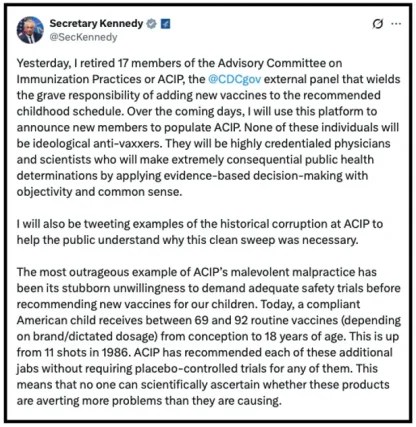
He said the clean sweep was necessary because ACIP had demonstrated its “stubborn unwillingness to demand adequate safety trials before recommending new vaccines for our children.”
And despite the media’s insistence otherwise, Kennedy argued that no routine injected childhood vaccine on the CDC’s schedule had ever been approved based on a placebo-controlled trial using an inert substance.
CNN had tried to prove him wrong last week—claiming it had found “257 placebo-controlled studies” of vaccines on the schedule.
Kennedy dismantled it in forensic detail.
“CNN is wrong,” he wrote. “No routine injected vaccine on CDC’s schedule was licensed for children based on a placebo-controlled trial. That is not conjecture. It is a fact based on FDA’s clinical trial data.”
Then came the body blows.
He pointed out that most of the 257 studies used active substances like aluminium, antibiotics, or other vaccines—not inert placebos.
He linked directly to FDA definitions of “placebo” and to official clinical trial records. Of the few studies that may have used saline controls, none were relied on by the FDA to license a single routine vaccine for American children.
Some studied products that were never approved in the US. Some occurred after licensure. Others involved discontinued vaccines. “CNN’s list ironically proves the lack of adequate safety trials,” Kennedy wrote in a stinging rebuke.
The post was devastating.
It was a clinical takedown of an industry riddled with deception—and it landed—because this time, Kennedy wasn’t being filtered through a hostile press.
He was speaking directly to the public, as a government official, with all the links to back it up. And the media couldn’t handle it.
Predictably, the media rolled out the same tired “experts” to recycle the same tired script—Paul Offit quotes, panic about “undermining trust,” warnings that children would die.
But Kennedy turned the whole thing inside out.
“We’ve gone from three routine injections by age one in 1986 to 25 in 2025,” he wrote. “And not one of them was licensed using a placebo-controlled trial.”
He said it plainly for the cameras: “That is just malpractice. So the people who are in charge of that are now gone.”
For years, the press had written Kennedy off as an anti-vaxxer and moved on. Now, they’ve thrown everything at him—and he threw it right back. Only now, he has the authority, data, and reach.
Kennedy told his followers he’d be announcing replacements in the coming days—no “ideological anti-vaxxers” just “highly credentialed physicians and scientists” committed to evidence, objectivity, and common sense.
Legacy media may still control the headlines, but they can no longer suppress the debate.
And perhaps that’s what really has them rattled.
They’re not defending science. They’re defending a regime of experts who signed off on decades of vaccine approvals without ever insisting on rigorous, inert-placebo safety trials.
When Kennedy calls them out, their only defence is to scream “danger!”—and hope no one checks the fine print.
Yesterday, he fired the gatekeepers. Today, he exposed the game.
US makes sweeping changes to key vaccine group
RT | June 10, 2025
The US Department of Health and Human Services (HHS) has dismissed all the members of a key advisory panel that has helped shape national vaccination policy for decades. Health Secretary Robert F. Kennedy Jr. said on Monday that the move was necessary to reestablish public trust and address longstanding concerns over conflicts of interest.
The Advisory Committee on Immunization Practices (ACIP) was created within the Centers for Disease Control and Prevention (CDC) in the mid-1960s. In an op-ed published on Monday in the Wall Street Journal, Kennedy claimed that the panel has “a history of conflicts of interest, persecution of dissidents, a lack of curiosity, and skewed science.”
The secretary cited reports from a House committee in 2000 and the HHS inspector general in 2009 that detailed financial connections between ACIP members and pharmaceutical companies. He said his decision to replace all 17 current members was driven by the need for a “clean slate.”
“The problem isn’t necessarily that ACIP members are corrupt. Most likely aim to serve the public interest as they understand it,” Kennedy wrote. “The problem is their immersion in a system of industry-aligned incentives and paradigms that enforce a narrow pro-industry orthodoxy.”
ACIP members are appointed to four-year terms, and eight of the most recent appointments were made in the final days of the administration of Joe Biden.
”It was very intentional,” a former senior HHS official told STAT News. “It was our goal to fill every vacancy on every [federal advisory committee] the department has, with particular focus on ones like ACIP where maintenance of our scientific expertise was critical.”
Mandy Cohen, who served as the CDC director under Biden, told NBC News the move “spreads confusion and casts doubt on transparent public health processes that protect Americans.” Richard Besser, who was acting CDC director under Barack Obama, said it “should erase any remaining doubt that he intends to impose his personal anti-vaccine agenda on the American people.”
Kennedy has long criticized aspects of US vaccine programs, arguing they are too closely aligned with industry interests and fail to prioritize public health. His detractors frequently label him an “anti-vaxxer.”
During his confirmation hearings, Kennedy pledged that his decisions would be science-driven. In his WSJ piece, he warned against attributing the American public’s “crisis of trust” solely to “misinformation or anti-science attitudes.”
Trump to Netanyahu: No green light to attack Iran, pursue deal
Al Mayadeen | June 10, 2025
US President Donald Trump has reportedly told Israeli Prime Minister Benjamin Netanyahu that “Israel” does not have a “green light” to launch a military strike against Iran, emphasizing that diplomacy remains Washington’s preferred path.
According to Israeli Channel 12 sources, Trump stated during a phone conversation on Monday, “You don’t have a green light, there will be a deal with Iran. The attack (on Iran) needs to be taken off the agenda right now.”
The firm statement came in response to Netanyahu’s demand that Trump abandon ongoing negotiations with Tehran and support an Israeli military operation. Netanyahu reportedly insisted that Washington should “cease talks and support direct military action.”
Despite Netanyahu’s warning that “negotiations with Iran are futile, and they are trying to deceive you; all they want is to buy time,” Trump pushed back, reiterating that “nothing closes the door” and that “work is underway to reach an agreement.” Israeli Channel 12 previously reported that Trump expected a “not-so-good response” from Iran but remains committed to diplomacy.
Trump also addressed the war in Gaza during the call, urging Netanyahu to de-escalate. “I want you to work on ending the war in Gaza, not just the Deal of the Century, the war has exhausted itself,” he said.
Intelligence Blow to “Israel” Changes Strategic Calculus
The conversation took place against the backdrop of a major intelligence breakthrough by Iran, which, according to Iranian and regional sources, has obtained thousands of highly sensitive documents detailing “Israel’s” nuclear infrastructure and strategic projects.
On June 7, Al Mayadeen cited Iranian intelligence sources who revealed that the trove includes photos, videos, and technical data on “Israel’s” nuclear facilities, some previously undisclosed. The volume of data, the sources said, was so vast that reviewing it all “would take an exceptionally long time.”
Iran’s Supreme National Security Council announced on June 9 that this intelligence enables Tehran to carry out a proportional retaliatory strike on hidden Israeli nuclear sites if Iran is attacked. “Today, access to this information… has allowed the warriors of Islam to give a clearly proportionate response to a possible attack by the Israeli regime,” it stated.
Meanwhile, Iran has accused the International Atomic Energy Agency (IAEA) of leaking confidential communications to Israeli intelligence, claiming this had led to the targeted assassinations of Iranian nuclear scientists. “These documents clearly show that instead of playing a neutral role, the IAEA has become an instrument serving the objectives of the Zionist regime,” a source told Fars News on June 10.
Broader Implications
The revelations have added urgency to Trump’s diplomatic posture, as US intelligence officials increasingly warn that a unilateral Israeli strike could unravel the fragile state of nuclear negotiations and trigger a regional war. According to the Wall Street Journal and New York Times, “Israel” had been preparing to strike Iran’s nuclear sites but delayed the move at Washington’s request.
Iranian officials, meanwhile, have warned that any Israeli military action will be met with devastating counterstrikes. IRGC Commander Major General Hossein Salami recently said that it is not Iran’s nuclear sites that will be destroyed, but the “targets of the Israeli occupation entity.” Defense Minister Aziz Nasirzadeh echoed that sentiment, stating, “Any hostile action by Israel against Iran would inevitably result in its destruction.”
With Iran holding what it describes as “one of the most significant intelligence blows” ever dealt to “Israel,” and with talks in Washington still on the table, analysts say that Trump’s call to de-escalate may reflect a growing US effort to avoid being drawn into a full-scale conflict.
40 Buses Destroyed: Electric Bus Confirmed as Cause in Philly Fire
StacheD Training | June 7, 2025
On June 5, 2025, a massive fire broke out at SEPTA’s Midvale Depot in Philadelphia, destroying 40 out-of-service buses. Speculation swirled—was it arson, a setup, or just bad luck? Now we know: the fire started in an electric bus. And it’s not the first time a Proterra bus has ignited in Philadelphia. Back in 2022, a similar bus caught fire while charging at SEPTA’s Southern Depot. That incident led to a national recall, but no fix was in place.
Link to NTSB Investigation (HWY23IH002): https://data.ntsb.gov/Docket/?NTSBNum…
Training & Consulting: https://www.stachedtraining.com
Most people across 24 surveyed countries have negative views of Israel and Netanyahu
By Laura Silver | Pew Research Center | June 3, 2025
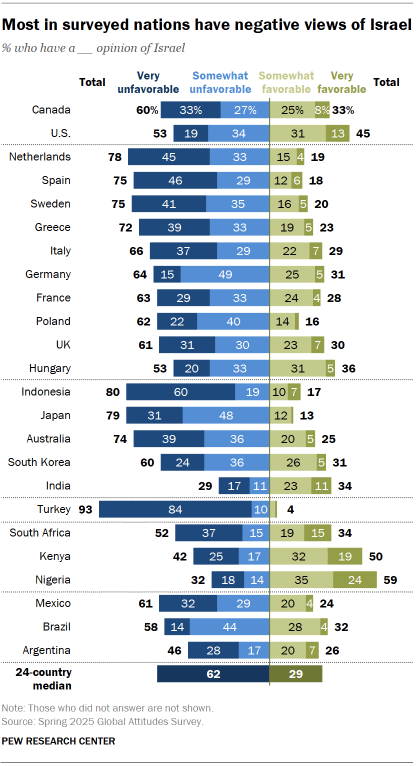 International views of Israel and Prime Minister Benjamin Netanyahu are much more negative than positive, according to a Pew Research Center survey of 24 countries conducted this spring.
Israelis, for their part, tend to say their country is not respected internationally: 58% say Israel is not too or not at all respected around the world, while 39% think it is.
In 20 of the 24 countries surveyed, around half of adults or more have an unfavorable view of Israel. Around three-quarters or more hold this view in Australia, Greece, Indonesia, Japan, the Netherlands, Spain, Sweden and Turkey.
Views of Israel are fairly divided in India (34% favorable, 29% unfavorable).
In Kenya and Nigeria, around half of adults or more have a favorable view of Israel.
How views have changed in recent years
The recent survey is not the first time Pew Research Center has asked about international views of Israel. We have asked about views of Israel before in some countries – including in the United States, where the share of adults with a negative view of Israel rose 11 percentage points between March 2022 and March 2025.
In 10 other countries, we last asked this question in 2013. In seven of these countries, the share of adults with a negative view of Israel has increased significantly. In the United Kingdom, for example, 44% had an unfavorable view of Israel in 2013, compared with 61% now. (In Nigeria, both the share of adults with a negative view of Israel and the share with a positive view have increased since 2013, due to a decline in the share saying they don’t know.)
Views by age
In some countries, younger people are more likely than older people to have an unfavorable view of Israel. This is particularly the case in the high-income countries surveyed: Australia, Canada, France, Poland and South Korea and the U.S. In fact, the U.S. has one of the largest age gaps in views of Israel. … Full article
Featured Video

AIDS Inc. by Gary Null (2007)
or go to
Aletho News Archives – Video-Images
From the Archives
Clash of Civilization, Iran Part II
By Jamal Kanj – Intifada-Palestine.com – January 14, 2011
Israel’s survival kit is: perpetuate conflict, insecurity to rationalize collective hate and finally playing victim.
Devoid of conflict, Israel implodes internally; without hate, Zionism loses its justification; and playing eternal victim to continue blackmailing the West. Absence of this holy trinity, Israel ceases to exist.
From its inception, the house of Zion has mastered exploiting adversarial powers to advance Israel’s cause. For instance, their influence over the Democratic Party in the US began with President Truman’s bid for 2nd term election in 1948.
Responding to strong opposition from Secretary of State General George Marshall and Department experts urging against recognition of Israel, President Truman replied: “I’m sorry gentlemen but I have to answer to hundreds of thousands [Jewish voters] who are anxious for the success of Zionism. I do not have hundreds of thousands of [voting] Arabs among my constituents”
Zionists influence over liberal American politics was matched with the doctrinal school of Conservative theoreticians aligning the Republican Party’s platform with Israel’s objectives. The Neoconservative Zionists, coined Zioncons, invented the “Clash of Civilization” concept to fight Israel’s wars. … continue
Blog Roll
 Aletho News
- Mauritius denies landing permit to flight from Israel, forcing cancellation: Tour operator
- Israeli finance minister calls for genocidal war on West Bank, annexation of south Lebanon
- 12 Things Your Psychiatrist Was Trained Not to Tell You
- From Unipolar Universalism to Multipolar Civilizational Distinctiveness
- RSF military group defects, joins Sudanese army: State media
- Ireland goalkeeper refuses to play ‘Israel’ as squad weighs boycott
- China pushes back against US on Cuba, Iran
- Ukrainian Soldiers, Potential Mercenaries: Have Gun, Will Travel!
- Burnham’s UN debut… A masterclass in British disinformation
- Iran flights continue despite US aviation sanctions
- If Americans Knew
- Israel forces Gazans to live in constant peril – Daily Update
- Deconstructing Netanyahu’s pants-on-fire UN rant – Daily Update
- Trump betrayed voters with his campaign lies and prioritized a foreign country once he took office
- Netanyahu calls Israel’s war in Gaza ‘opposite of genocide’ in UN speech to near-empty hall
- Settler Kidnappings: Torture, Sexual Abuse and Terrorisation of Palestinian Abductees as Israel Deepens Annexation of West Bank
- Gaza winter nears as 162,000 tents become unusable, raising fears of humanitarian crisis
- Netanyahu says, “It’s the opposite of genocide”; UN says Gaza economy is world’s ‘most severe crisis on record’ – Daily Update
- Israel’s US-Backed Assault on Gaza Has Created the ‘World’s Most Severe Economic Crisis on Record’: UN
- ‘Protecting U.S. Citizens’… From Israel
- ‘This is where I live now, the back of a truck’: a day in the life of a grandmother in Gaza
- No Tricks Zone
- New Study: Earth And Venus Surface Warmth Largely Explained By Convection And Lapse Rate, Not CO2 Or Radiation
- 2025 Nature Paper Claiming Worsening Global Drought Gets RETRACTED …Heavily Flawed
- New Study: ‘Global Drought Shows No Detectable Recent Acceleration Under Climate Warming’
- Economic Masterminds: German Socialists Suggest Taxing Productivity Gains Stemming From Using AI
- The South China Sea Has Not Been Cooperating With The Climate Change Narrative
- Energy Crisis: Germany Enters Heating Season With Historically Low Gas Reserve Fill Levels
- New Study: The Antarctic Ice Sheet Gained Mass From 2020-2024 Due To Staggering Snow And Ice Accumulation
- Study: Ocean Heating Rates From Thousands Of Years Ago ‘Dwarf’ Modern Ocean Heating Rates
- Climate Extremists Target, Attack Large-Scale Power Grid Infrastructure In Germany!
- New Study: Antarctic Ice Melt Has Contributed Less Than 1 Centimeter To Sea Level Rise In The Last 30 Years

