Lebanese army may partially ‘freeze cooperation’ with US-led ceasefire committee
The Cradle | June 6, 2025
The Lebanese Armed Forces (LAF) released a statement on 6 June warning it could potentially “freeze cooperation” with the US-led ceasefire monitoring committee regarding site inspections, due to constant Israeli violations.
The statement came the morning after Israel carried out a large-scale attack on Beirut’s southern suburb.
In the statement, the LAF condemned Israel’s “daily aggression” against Lebanon and its continued occupation of Lebanese territory. “Immediately after the Israeli enemy announced its threats, it began coordinating with the Cessation of Hostilities Monitoring Committee to prevent an attack. Patrols also headed to a number of sites to inspect them, despite the enemy’s rejection of the proposal,” the statement added.
“The Israeli enemy’s persistent violation of the Agreement and its refusal to cooperate with the Cessation of Hostilities Monitoring Mechanism only weakens the role of the Committee and the Army, and could lead the military establishment to freeze cooperation with the Cessation of Hostilities Monitoring Mechanism regarding site inspections,” the LAF went on to say.
Following the attacks on Thursday evening, Lebanon’s President Joseph Aoun and Prime Minister Nawaf Salam released statements condemning the Israeli airstrikes.
The president said the attack was a “blatant violation of an international agreement” and served as “conclusive evidence” of Israel’s rejection of regional peace.
Salam also condemned the “systematic and deliberate assault on Lebanon’s security, stability, and economy” and called on the international community to “shoulder its responsibility to deter Israel and ensure its full withdrawal from Lebanese territories.”
The Israeli airstrikes on Beirut took place on the eve of the Muslim holiday of Eid al-Adha.
Thousands of civilians were displaced from their homes after Israel issued evacuation orders for eight residential buildings in the southern suburb on Thursday night.
Israeli drones carried out over a dozen “warning strikes” before warplanes struck and destroyed the targeted buildings, marking the largest attack on Lebanon’s capital since the ceasefire was reached last year.
Tel Aviv claimed the buildings were located above underground drone production facilities belonging to the Lebanese resistance movement, Hezbollah.
“After Hezbollah extensively used drones as a key component of its attacks on Israel, the terrorist organization is expanding its drone production industry in preparation for the next war with Israel,” an Israeli army spokesman said.
Lebanese security sources who spoke with several local media outlets said the Lebanese army requested via the US-led ceasefire committee that it enter the buildings and inspect them to refute Israel’s claims.
The sources said the army entered one of the buildings and found no evidence of any weapon facilities. However, Israel rejected the request and began carrying out drone strikes, forcing the army to withdraw.
“In the (ceasefire) agreement, there is a mechanism for inspections if there is a complaint. Israel in general, and Netanyahu in particular, wants to continue the war in the region,” a Hezbollah official told Lebanese media, denying the presence of any drone facilities at the locations targeted by Israel.
As the final round of airstrikes took place, Israeli warplanes also bombed the village of Ain Qana in southern Lebanon, citing the presence of Hezbollah facilities.
Hundreds of people have been killed since the ceasefire agreement, which Israel has so far violated over 3,000 times, was reached in November last year. Israeli forces also maintain an occupation of five locations inside Lebanon, which they established themselves in after the ceasefire, in violation of the deal.
Lebanese diplomatic efforts have so far failed to make progress in forcing Israel to stop its attacks and withdraw its forces from the five points in southern Lebanon, which are separate from the other areas in the south that the Israeli army has been illegally occupying for years.
Lebanon’s continued coordination with the US-led monitoring committee has yielded no results.
Israel’s Channel 14 said on Thursday evening that the latest Israeli strikes on Beirut were carried out in full coordination with Washington.
Tucker Carlson warns: ‘Iran is not alone; attacking it risks world war, US defeat’
Press TV – June 5, 2025
Iran, backed by its allies, is not alone, an ex-Fox News host says, warning that any attack by the United States against the Islamic Republic risks a world war that would lead to the US defeat.
American political commentator and presenter Tucker Carlson sounded the alarm on Thursday, as Iran has stressed the inseparable nature of uranium enrichment activities to the nation’s nuclear program, dismissing calls by US President Donald Trump and other US officials for “zero-level” enrichment.
The provocative demand by the US administration has already sent shockwaves through the ongoing Oman-mediated negotiations between Tehran and Washington over the Islamic Republic’s nuclear program, leaving the future of the talks in limbo and raising the risk of military confrontation between the two.
In a post on his X account, Carlson argued that figures like Mark Levin are pushing for war with Iran under the pretense of stopping nuclear proliferation, stressing that there is no credible evidence that Iran is close to developing a nuclear bomb, and the ongoing fear-mongering is a recycled narrative from decades past.
“It’s a lie. In fact, there is zero credible intelligence that suggests Iran is anywhere near building a bomb, or has plans to. None. Anyone who claims otherwise is ignorant or dishonest. If the US government knew Iran was weeks from possessing a nuclear weapon, we’d be at war already. Iran knows this, which is why they aren’t building one. Iran also knows it’s unwise to give up its weapons program entirely,” the ex-Fox News host said.
“So why is Mark Levin once again hyperventilating about weapons of mass destruction? To distract you from the real goal, which is regime change — young Americans heading back to the Middle East to topple yet another government. Virtually no one will say this out loud. America’s record of overthrowing foreign leaders is so embarrassingly counterproductive that regime change has become a synonym for disaster. Officially, no one supports it. So instead of telling the truth about their motives, they manufacture hysteria: ‘A country like Iran can never have the bomb! They’ll nuke Los Angeles! We have to act now!” added the conservative political commentator.
Carlson described Levin and like-minded ideologues in Washington as dishonest ideologues exploiting fear to trigger another disastrous conflict, warning that a war with the Islamic Republic would be catastrophic, far more dangerous than previous US interventions.
“And then there’s the question of the war itself. Iran may not have nukes, but it has a fearsome arsenal of ballistic missiles, many of which are aimed at US military installations in the [Persian] Gulf, as well as at our allies and at critical energy infrastructure. The first week of a war with Iran could easily kill thousands of Americans. It could also collapse our economy, as surging oil prices trigger unmanageable inflation. Consider the effects of $30 gasoline,” he warned.
An ardent advocate of Trump, Carlson emphasized that Iran has significant missile capabilities, strong allies like Russia and China through BRICS, and a vital role in global oil markets.
“But the second week of the war could be even worse. Iran isn’t Iraq or Libya, or even North Korea. While it’s often described as a rogue state, Iran has powerful allies. It’s now part of a global bloc called BRICS, which represents the majority of the world’s landmass, population, economy and military power. Iran has extensive military ties with Russia. It sells the overwhelming majority of its oil exports to China. Iran isn’t alone. An attack on Iran could very easily become a world war. We’d lose,” he stressed.
Carlson also slammed war advocates for intentionally pushing Iran toward conflict by making demands they know Tehran will reject, all to corner Trump into betraying his anti-war promises.
Iran and the US have so far held five rounds of indirect talks on a replacement for the 2015 nuclear deal. However, the talks have faced an obstacle over the US demand for Iran to stop enriching uranium under any new deal.
Ukraine’s most reckless attack: Was NATO behind it?
RT | June 6, 2025
While Western headlines celebrated Operation Spider’s Web as a daring feat of Ukrainian ingenuity, a closer look reveals something far more calculated – and far less Ukrainian. This wasn’t just a strike on Russian airfields. It was a test – one that blended high-tech sabotage, covert infiltration, and satellite-guided timing with the kind of precision that only the world’s most advanced intelligence networks can deliver. And it begs the question: who was really pulling the strings?
Let’s be honest. Ukraine’s Main Directorate of Intelligence didn’t act alone. It couldn’t have.
Even if no Western agency was directly involved in the operation itself, the broader picture is clear: Ukraine’s Main Directorate of Intelligence, its military, and even its top political leadership rely heavily on Western intelligence feeds. Ukraine is deeply embedded within NATO’s intelligence-sharing architecture. The idea of a self-contained Ukrainian intel ecosystem is largely a thing of the past. These days, Kiev draws primarily on NATO-provided data, supplementing it with its own domestic sources where it can.
That’s the backdrop – a hybrid model that’s become standard over the past two years. Now, let’s look more closely at Operation Spider’s Web itself. We know the planning took roughly 18 months and involved moving drones covertly into Russian territory, hiding them, and then orchestrating coordinated attacks on key airfields. So how likely is it that Western intelligence agencies had a hand in such a complex operation?
Start with logistics. It’s been reported that 117 drones were prepped for launch inside Russia. Given that numerous private companies in Russia currently manufacture drones for the war effort, it wouldn’t have been difficult to assemble the necessary devices under that cover. That’s almost certainly what happened. Components were likely purchased domestically under the guise of supplying the “Special Military Operation.” Still, it’s hard to believe Ukraine’s Main Directorate of Intelligence could have pulled off this mass procurement and assembly alone. It’s highly likely Western intelligence agencies played a quiet but crucial role – especially in securing specialized components.
Then there’s the explosives. If the operation’s command center was located in the Ural region, as some suggest, it’s plausible that explosives or components were smuggled in via neighboring CIS countries. That kind of border-hopping precision doesn’t happen without outside help. In fact, it mirrors tactics long perfected by intelligence services in both the US and Western Europe.
Because make no mistake: this wasn’t just the CIA’s playground. European services – particularly those in the UK, France, and Germany – possess the same capabilities to execute and conceal such an operation. The NATO intelligence community may have different national flags, but it speaks with one voice in the field.
The real giveaway, however, lies in the timing of the strikes. These weren’t blind attacks on static targets. Russia’s strategic bombers frequently rotate bases. Commercial satellite imagery – updated every few days at best – simply can’t track aircraft on the move. And yet these drones struck with exquisite timing. That points to a steady flow of real-time surveillance, likely derived from signals intelligence, radar tracking, and live satellite feeds – all tools in the Western intelligence toolbox.
Could Ukraine, on its own, have mustered that kind of persistent, multidomain awareness? Not a chance. That level of situational intelligence is the domain of NATO’s most capable agencies – particularly those tasked with monitoring Russian military infrastructure as part of their day job.
For years now, Ukraine has been described in Western media as a plucky underdog using low-cost tactics to take on a larger foe. But beneath the David vs. Goliath narrative lies a more uncomfortable truth: Ukraine’s intelligence ecosystem is now deeply embedded within NATO’s operational architecture. Real-time feeds from US and European satellites, intercepts from British SIGINT stations, operational planning consultations with Western handlers – this is the new normal.
Ukraine still has its own sources, but it’s no longer running a self-contained intelligence operation. That era ended with the first HIMARS launch.
Western officials, of course, deny direct involvement. But Russian investigators are already analyzing mobile traffic around the impact sites. If it turns out that these drones weren’t connected to commercial mobile networks – if, instead, they were guided through encrypted, military-grade links – it will be damning. Not only would that confirm foreign operational input, it would expose the full extent of how Western assets operated inside Russia without detection.
At that point, no amount of plausible deniability will cover the truth. The question will no longer be whether NATO participated – but how deep that participation ran.
Lindsey Graham and Other US Congressmen Purportedly Used Ukraine as Personal Cash Cow
Sputnik – 06.06.2025
A group of US lawmakers has been using Ukraine to enrich themselves, retired CIA intelligence officer and State Department official Larry Johnson tells Sputnik, citing whistleblowers.
About 23 members of the US Congress, including Senator Lindsey Graham, helped themselves to the money coming from Ukraine, the whistleblowers claim.
“We’re not talking a few thousand dollars. We’re talking much more than that,” Johnson remarks.
He does point out, however, that these are just allegations at the moment, and that it is up for US authorities to properly investigate these claims.
“It’s not going to take six months to do this investigation, it can be done in a much shorter time frame. So we’ll see what comes of it,” Johnson predicts.
He also argues that it will be easier to make the results of this investigation public “once this whole debacle that is the war in Ukraine, comes to fruition, as the total defeat of NATO becomes apparent.”
US on track for biggest nuclear arms spending hike since Cold War – disarmament activists
RT | June 5, 2025
The White House has proposed a spending increase on nuclear bomb development unseen since the Cold War, the Los Alamos Study Group has claimed.
The nuclear disarmament activist group based its conclusions on a technical supplement to the budget for the next fiscal year, as well as congressional testimonies by several senior officials released late last month.
In a press release on Wednesday, the group estimated that President Donald Trump’s administration is seeking $4.782 billion for the ‘Weapons Activities’ portion of the National Nuclear Security Administration’s (NNSA’s) budget. The latter is the primary source of funds for the development, construction, and modernization of US nuclear warheads and bombs.
According to the activists, an additional $1.884 billion was allocated to the NNSA in the fiscal year 2025 to cover the damages caused to its installations by two hurricanes. However, this sum, which apparently has yet to be expended, was not tallied in the budget details under consideration.
The Los Alamos Study Group claimed that if this emergency funding is left out, the warhead budget proposed by the White House for 2026 would represent a 25% year-on-year increase – the largest hike since the Cuban Missile Crisis of 1962.
If the $1.884 billion in question is included, the year-on-year increase would stand at 17% – a level unseen since 1982.
The proposed spending hike is expected to be put to a vote in Congress later this year.
In mid-May, US Secretary of Energy Chris Wright announced that NNSA had completed the manufacture of the first B61-13 gravity bomb, roughly a year ahead of schedule. It is the latest modification to the B61 family of nuclear bombs, which is the longest-serving among the key elements of the US nuclear triad’s air component. It has been in production since 1968.
The warhead is fitted with newer electronics and control features such as a tail kit, which effectively turns it into a guided munition. Its maximum yield is said to be approximately 360 kilotons – 24 times that of the bomb dropped by the US on Hiroshima.
If and when commissioned, the B61-13 will emerge as among the most powerful nuclear gravity bomb in the US arsenal. Several media outlets, citing unnamed officials, previously reported that its destructive force would make it the weapon of choice for targeting underground command and control facilities.
Meanwhile, six more new modifications of the B61 bomb family are currently being developed.
How the US deep state feeds the Ukraine war

By John Laughland | RT | June 5, 2025
The picture of Lindsey Graham, US Senator for South Carolina, and Ursula von der Leyen, president of the European Commission, grinning into a camera in Brussels on June 2, is worth a thousand words.
Graham is one of the most extreme hardcore warmongers in Washington DC, and the competition is pretty stiff. Ever since he first became a member of the US Congress over 30 years ago – once in, American politicians are rarely voted out – he has devoted his career to arguing vehemently for war.
His remarks are often not just belligerent but also sadistic, such as when he recently posted that he hoped ‘Greta could swim’, meaning that he hoped her Gaza aid ship would be torpedoed. Joking about an attack on a civilian aid ship carrying a young female civilian activist is sick – and typical of Graham.
Like his old friend, the late Senator John McCain, Lindsey Graham is obsessed with the idea of war with Russia. He has been pushing for this since at least 2014. In 2016 he told Ukrainian soldiers, “Your fight is our fight.”
Graham’s presence in Brussels is therefore significant. Ever since von der Leyen’s appointment in 2019, she has pushed herself forward as the principal public face of the Brussels institutions. Six years ago, she said she wanted to make the European Commission into a ‘geopolitical’ body – even though it has no role in foreign or military policy.
Since then, she has done little else than parade on the international stage. She is among the most hawkish and anti-Russian European figures, absurdly claiming, like French Foreign Minister Bruno Lemaire, that EU sanctions have brought the Russian economy to its knees.
The Graham-von der Leyen alliance is therefore a natural one – against Donald Trump. European politicians are often quite explicit in their view that Trump is now the enemy.
The same goes for Lindsey Graham. In Kiev last week, Graham explicitly challenged Trump’s authority to decide US foreign policy. He lambasted the very notion of negotiations with Russia – just as Zelensky did to Vance in the Oval office in February – and said that the president of the US is not the boss. “In America, you have more than one person at the card table. We have three branches of government,” – meaning that the Senate would soon impose its own sanctions on Russia, whatever the executive does. Graham’s budget bill from February is intended to spend even more money on the US military – as if that were possible – which means that he is marshalling the US deep state to fight back after initially reeling from the re-election of Trump.
Meanwhile, the Europeans’ determination to continue the war is existential. Their Russophobia, which goes back at least to the 2012 Russian presidential election, when Putin came back into the Kremlin, is extreme because their “Europe” is defined by its hostility to Russia. Russia is “the other Europe” which the EU does not want to be and which it defines itself against.
Von der Leyen and others want to use the war against Russia to federalise Europe and create a single state. Meanwhile, Trump’s Russia policy is based on sidelining Europe. When he first announced talks with the Russians, EU leaders demanded a seat at the table. They failed. US-Russia talks took place outside Europe – in Riyadh – while the Russia-Ukraine talks the EU vehemently opposed are taking place without the EU, in Istanbul.
Let us not forget how furiously EU leaders opposed talking to Russia. When Viktor Orban travelled to Kiev and Moscow last July, Ursula von der Leyen denounced Orban’s “appeasement”. The EU’s then chief diplomat said in an official statement that the EU “excludes official contacts between the EU and President Putin.”
The French foreign minister said in February that if Sergey Lavrov telephoned him he would not answer the call. Now these very same people claim they want to “force” the Russians to come and talk!
EU policy on Russia is now in ruins. That is why, like Graham, they are determined to stop Trump. Their attempts have been ever more desperate and ridiculous. On May 12, Kaja Kallas and other EU leaders said Russia “must agree” to a ceasefire before any talks. Three days later, those talks started anyway. Britain also tried to scupper them by saying it was “unacceptable” for Russia to demand recognition of the “annexed” regions, which is odd considering Britain is not a participant.
European credibility is therefore at zero. In March, the British prime minister had said that the plans to send British and French troops to Ukraine had entered “the operational phase.” They were ready, he claimed, to protect Ukraine’s security by directly entering the war zone. By April, these plans had been dropped.
On May 10, European leaders threatened Russia with “massive sanctions” if it did not agree to a ceasefire immediately. Russia did not agree to a ceasefire and yet there have been no more “massive sanctions.” A 17th package of sanctions was indeed announced on May 14, but it was so weak that Hungary and Slovakia, who oppose the EU’s overall policy, let it pass. In any case, the 17th package clearly had nothing to do with the ultimatum because such sanctions take a long time to prepare. Instead, that is what Lindsey Graham was in Brussels to discuss.
The EU and the UK have thus sidelined themselves with their meaningless braggadocio. They cannot operate without the Americans. But which Americans? The claim that the White House did not know about the recent Ukrainian drone attack on Russian airfields might well be true: the US deep state, embodied by people like Graham, is clearly trying to undermine the executive. Both Lindsey Graham and former CIA director Mike Pompeo were in Ukraine just days before the attack.
The political goal of the drone attack was obviously to scupper the talks scheduled for the following day in Istanbul, or to provoke Russia into a massive response and drag the US into the war. Even if the attack does not succeed in these goals, it clearly sets the tone for the future Ukrainian insurgency which, American and European officials hope, will turn that country into an ‘Afghanistan’ for Russia. The US deep state is in for the long game.
So are the Europeans. On May 9, ‘Europe Day’, European leaders confirmed their intention to set up a Special Tribunal for the crime of aggression, to prosecute Russia for invading in February 2022.
Western European states are already the primary financers of the International Criminal Court, whose prosecutor is British. The ICC indicted Russian leaders, including Putin, in 2023 and 2024, on various very surprising charges. (Ursula von der Leyen continued to lie about “20,000 abducted children,” the day after the Ukrainians gave the Russians a list of 339 missing children.) Now the Europeans intend to open a new front in their ‘lawfare’ against Russia.
Such a Special Tribunal, if it comes into existence, will tear the heart out of any peace agreement – just as Ukraine’s acceptance of the jurisdiction of the ICC in 2014 and 2015 rendered the Minsk agreement of February 2015 null and void. With one side of its mouth, Ukraine asked the ICC to prosecute Russian officials and Donbass “terrorists”; with the other side, it agreed at Minsk that the Donbass insurgency was an internal Ukrainian problem and ruled out any prosecution or punishment (Article 5 of the February 2015 Minsk agreement).
It is not possible to agree a peace agreement with a country and at the same time to set up a Special Tribunal whose sole purpose is to criminalize it. So the creation of this Tribunal, which will presumably remain in existence for over a decade like the ad hoc tribunals for Yugoslavia and Rwanda, is nothing but a Euro-American institutional time bomb designed to blow up in the future any agreement which the two sides might reach in the short term. The future of “Europe” depends on that.
John Laughland, who has a doctorate in philosophy from the University of Oxford and who has taught at universities in Paris and Rome, is a historian and specialist in international affairs.
Profiles in courage: Trump & Eisenhower
By M. K. BHADRAKUMAR | Indian Punchline | June 6, 2025
President Donald Trump had a difficult week. No, this isn’t about Elon Musk or Harvard University. On Wednesday, his call to Russian President Vladimir Putin didn’t go well. It turned into a ‘conversation’, as Trump wrote on Truth Social, lasting only an hour and 15 minutes, which means, setting aside the time for interpretation, it left no room for substantive discussions.
The call took place against the backdrop of the attack on Russia’s nuclear force on June 1. Trump acknowledged in his Truth Social post later that Putin spoke “strongly” about Russia’s response to come. The post was notable for its subdued tone.
We wouldn’t know whether Putin brought up Western involvement. The Kremlin merely noted that “Donald Trump reiterated that the Americans had not been informed about this [attack] in advance.”
Zelensky’s version is that the attack was in the pipeline for the past 18-month period. Yet, we are to believe, neither the CIA nor MI6 whose operatives run the show in Kiev got an inkling of it. Trump’s Truth Social post simply omitted this crucial part of the conversation with Putin, which is highly significant — and consequential.
Especially, as Kremlin-funded RT had already carried one report citing the assessment of an ex-French intelligence officer that the Ukrainian targeting couldn’t have been possible without US satellite inputs.
Earlier, Tass also had carried a similar report citing a former US naval officer who estimated that the 18 month-period was when the Biden administration was virtually on auto-pilot (due to the president’s dementia). An interesting thought in itself?
Tass quoted the American source who actually said on a War Room podcast: “So, who was it on the American side that either gave the greenlight to this or provided the initial intelligence targeting? Hey, where is William Burns and Jack Sullivan, the neocon whizkids in Biden’s team?
Again, on the same day as Trump spoke to Putin, Russian Deputy Foreign Minister Sergey Ryabkov warned at a news conference in Moscow, “The fact that certain circles in the United States have been and are still hatching plans to move towards eradicating Russia as a state is also undeniable… We should not underestimate the consequences of such a mindset… Russian society should remain in a state of high readiness for any intrigues.”
Interestingly, Ryabkov called on Washington and London specifically to speak up on the attack on Russian airfields. As he put it, “We demand that both London and Washington respond in a manner that stops this recent round of escalation of tensions.”
When asked about the Ukrainian attack on Wednesday in Brussels, NATO secretary-general Mark Rutte came up with an ingenious argument: “Let’s not forget that the capabilities they hit were the capabilities the Russians were using to attack innocent people going about their daily lives in Ukrainian cities and communities. So I think we should take note of that.” Clearly, the poor chap was in the loop! Rutte refused to speak further.
Equally, the social media is awash with the assessments by some prominent American experts, especially ex-CIA analysts, pointing a finger directly at the agency’s involvement. Of course, Russia has the experience and technical expertise to dig deep.
There are comparable situations. What comes to mind is the famous U-2 spy plane incident on May 1, 1961. Perhaps, Trump is finding himself in the same embarrassing situation as President Dwight Eisenhower.
Do we give the benefit of the doubt to Trump that he too was unaware of the strike on Russia’s nuclear force on June 1? To my mind, the analogy of the U-2 incident holds good — a rare cold-war era confrontation over the US’ blatant violation of Russian sovereignty and territory at a critical juncture just when the White House was navigting an improvement of relations with Russia.
Eisenhower was kept in the dark about the full details of the U-2 although countdown had begun for his planned summit meeting with Nikita Khrushchev, the Soviet leader, in Paris to discuss a Soviet-American detente (just what Trump is attempting with Putin.) The following excerpts from the archives of the Dwight D. Eisenhower Memorial, Eisenhower National Historic Site are most insightful:
“[U-2 spy plane pilot Gary] Powers did have a contingency in the form of a concealed needle with the poison Saxitoxin. If injected, this would have killed him and prevented his capture. Powers did not utilize this and was surrounded by Soviet citizens very soon after he touched down. Soviet citizens soon found his United States issued firearm, and other items bearing the flag of the U.S., turning him over to Soviet officials. Powers, and what was left of his spy plane, were shipped to Moscow be researched and documented. In a matter of hours, Khrushchev was informed of the captured pilot and the wrecked U-2.
“When Powers was overdue to land at Norway [U-2 had taken off from its base in Peshawar], the CIA started to consider what might have happened. As a result, their contingency plan went into action. To prevent the public and the Soviets from learning the true nature of the U-2 aircraft, a misinformation campaign began. A NASA press release stated one of their high-altitude weather research U-2 aircraft had gone missing over Turkey, and that it may have drifted into Soviet airspace because of an unconscious pilot. A U-2 was shown off in NASA colors as well to help sell the story. Khruschev learned of this story from the Americans and decided to lay a trap for the United States and for Eisenhower.
“The Soviets released information that a spy plane was shot down but did not include any other information on the status of the aircraft or Powers. The U.S. believed it could shape the narrative further and kept releasing “reports” of oxygen difficulties in the aircraft and that the auto pilot may have sent the plane into Soviet territory. Once the deception from the United States grew large enough, on May 7th, Khruschev sprung his trap by stating the pilot was alive, and that the Soviets had captured the remains of the aircraft, which contained a camera and film of Soviet Military Installations. This destroyed the cover story and was a public embarrassment for the United States and for President Eisenhower. The President learned of this at the office of his Gettysburg residence, where he got a phone call informing him the Soviets had captured Powers. This shattered the peace and tranquility of his stay in Gettysburg, and he knew that he would be held responsible in the eyes of the Soviet Union. In a remark to an aide, Eisenhower reportedly said, “I would like to resign.”
While Eisenhower did not resign, the U-2 incident and the acute embarrassment so close to the end of his second term defined his Cold War legacy. Khrushchev cancelled the Paris summit and Soviet-American detente had to wait until Henry Kissinger consolidated his grip over US foreign policy strategies. Nonetheless, the Deep State, which loathed detente, booby-trapped Richard Nixon’s presidency!
Eisenhower’s sense of betrayal is reflected in his farewell address when he bitterly called out the Deep State and prophesied that it will someday wreck America’s democracy.
History is repeating. Look at the cascading turbulence already around Trump presidency. Eighty two out of 100 members of the Senate are co-sponsoring a bill by Senator Lindsey Graham (whose affiliation to the Deep State is legion), forcing Trump’s hands to impose “bone-breaking” sanctions against Russia, whose sole objective is to stall any improvement of US-Russia relations. Meanwhile, a call for impeachment of Trump is already in the air.
Critics Slam Fluoride Study by Researchers With Ties to Pro-Fluoride Lobby
By Brenda Baletti, Ph.D. | The Defender | June 2, 2025
Mainstream media outlets are touting a study published May 30 in JAMA Health Forum that predicts ending water fluoridation will worsen children’s oral health and increase national dental healthcare costs.
The study is the most recent attempt by researchers with links to pro-fluoridation lobbying groups like the American Dental Association (ADA) to undermine public confidence in the growing body of scientific evidence that water fluoridation has negative consequences for children’s health.
The study was published by Harvard’s Sung Eun Choi, Ph.D., and Brigham and Women’s Hospital’s Lisa Simon, M.D., D.M.D. Simon receives funding for other research from the ADA, the California Dental Association and other pro-water fluoridation groups, according to the study’s conflict-of-interest disclosures.
Choi and Simon estimated that If everywhere else in the U.S. were to stop fluoridating water, in the next five years, 7.5% more U.S. children ages 0-19 would get cavities — a total of 25.4 million additional teeth would be affected — and it would cost a total of $9.8 billion to treat them.
They also claimed that the number of cavities would more than double in 10 years, to 53.8 million.
The authors argue in the paper and in the press that stopping water fluoridation would disproportionately affect low-income children who are often on Medicaid or without insurance.
Leading fluoride expert Kathy Thiessen, Ph.D., told The Defender there is no good evidence that water fluoridation helps low-income people — it’s just “wishful thinking,” she said, used to justify water fluoridation.
She added:
“Caries development is probably far more related to diet (e.g., sugar) and nutrition (adequate calcium, protein, vitamins) than to fluoride or dental hygiene. That generally translates to higher income, better dental health; lower income, worse dental health.
“The U.S. would be much better off if the money spent on promoting and implementing fluoridation were spent on providing dental care, nutrition, etc., for the lower socioeconomic groups.”
The study authors acknowledged the recent research showing that fluoride exposure has serious negative consequences for children’s neurodevelopment. However, they said that because current federal guidelines haven’t changed to account for such damage, they didn’t consider it in their model.
They didn’t mention that the U.S. Environmental Protection Agency (EPA) is under a court order, which it has yet to appeal, to revise its water fluoridation regulations to account for this risk to children.
Instead, they cited editorials published by members of the ADA and its National Fluoride Advisory Committee, challenging two studies on fluoride’s neurotoxicity to downplay their importance.
Experts on fluoride’s neurotoxic effects who spoke with The Defender were highly critical of the study’s failure to consider fluoride’s neurotoxic effects on children.
Dr. Hardy Limeback, former head of preventive dentistry at the University of Toronto and a fluoride expert said, “Banning fluoridation is a step closer to children’s overall health.”
“Why damage 75 million kids’ brains or the appearance of 9 million kids’ smiles, just to try and save maybe 25 million teeth — if that’s even close to a reliable number — from dental decay?” he asked.
Theissen said the study’s authors don’t include any of the significant costs that result from fluoride’s neurotoxic effects — ranging from immediate healthcare costs, to costs of therapy for disorders such as autism or ADHD, to lifelong earnings reductions associated with lowered IQ.
“A responsible cost-effectiveness analysis really should have included cognitive effects and other adverse effects,” she said.
Fluoride added to drinking water a byproduct of phosphate fertilizer production
Fluoride has been added to community water supplies in the U.S since the 1940s, on the assumption that it would improve children’s dental health.
For decades, scientists and community activists have been raising concerns that fluoride is linked to reduced IQ, behavioral issues, disruption of thyroid functioning and disruption of the gut microbiome.
However, it wasn’t until consumer advocacy groups who sued the EPA in federal court to end water fluoridation won their landmark lawsuit last year that the issue generated national attention.
Soon after Judge Edward Chen ruled that water fluoridation at current U.S. levels poses an “unreasonable risk” of reduced IQ in children and that the EPA must take regulatory action, numerous communities across the country organized campaigns to stop fluoridating their water.
Although most media reports highlight that fluoride is a “naturally occurring mineral,” the fluoride added to water supplies is not.
The fluoride most commonly added to U.S. drinking water supplies is hydrofluorosilicic acid, the byproduct of phosphate fertilizer production, sold off by chemical companies to local water departments across the country.
Overwhelming scientific research shows that fluoride’s benefits to teeth are topical, not the result of ingesting fluoride, and a 2024 Cochrane Review found adding fluoride to drinking water provides very limited dental benefits, especially compared with 50 years ago.
Experts question new study’s model, assumptions and ‘sloppy’ errors
Thiessen called the new JAMA paper “somewhat sloppy,” and cited several outright errors she said reviewers should have caught. She pointed out that the authors confused the roles of different regulatory agencies, provided incorrect citations for some of their model input numbers, and sometimes used outdated cost estimates.
To estimate the effects of ending water fluoridation, the authors created a nationally representative sample using data from 8,484 children, from birth through age 19. The data came from the National Health and Nutrition Examination Survey, which is conducted each year by the CDC and is based on interviews about diet and details from people’s health records.
The study authors used current water fluoridation levels as a proxy for how much fluoride children are exposed to, then predicted the increase in cavities that would occur if that were to stop.
Their model predicted two scenarios: if every public water system fluoridated its water at today’s recommended level of 0.7 milligrams per liter, and if there were a total national ban.
Experts questioned the use of fluoride in water as a proxy for exposure, given that children are exposed to fluoride from many sources other than drinking water, including toothpaste and all processed foods and drinks made with fluoridated water.
They also criticized the “total ban” scenario, in which the researchers estimated that fluoride levels would be reduced to zero in all systems. According to the CDC, almost all water contains some naturally occurring fluoride, so the zero fluoride estimate scenario can’t occur.
It was also “assumed” that children benefit from drinking fluoridated water, but Thiessen said there is no basis for this assumption.
“We badly need some honest and thorough evaluation of whether there is a benefit or not from fluoride or fluoridation,” she said. “If there is no real benefit, then obviously any risk of adverse health effects is not justified.”
The only negative health effect of water fluoridation the researchers considered was dental fluorosis — a discoloration of the teeth that occurs when a child is overexposed to fluoride.
Even their estimate of how many children would have “objectionable” dental fluorosis “completely missed the mark,” Limeback said. According to the Cochrane Review cited by the researchers, every eighth child in fluoridated areas has dental fluorosis that needs repair, Limeback said. Ending fluoridation would result in 9,375,000 (not 200,000 as they reported) fewer cases of dental fluorosis.
Each case of serious fluorosis costs between $2,000 and $20,000 to repair, he said, meaning that ending fluoridation offers potential savings of $18.75 to $187.5 billion dollars.
“America would drastically reduce the dental fluorosis epidemic in the U.S. if all the states banned water fluoridation.”
Thiessen also noted that the authors disregarded other costs borne by the American public associated with water fluoridation, including the costs of fluoridating, and the costs of cleaning up fluoridation overfeeds and spills, which are common, and addressing the health issues they cause.
“I also expect that other health issues will decrease substantially, more than making up for any increase in dental costs,” Thiessen added.
This article was originally published by The Defender — Children’s Health Defense’s News & Views Website under Creative Commons license CC BY-NC-ND 4.0. Please consider subscribing to The Defender or donating to Children’s Health Defense.
FDA exposed – hundreds of drugs approved with no proof they work
Two-year investigation reveals a broken approval system, ineffective—and sometimes deadly—drugs fast-tracked to market without evidence
By Maryanne Demasi, PhD | June 5, 2025
The US Food and Drug Administration (FDA) has approved hundreds of drugs without proof they work—and in some cases, despite evidence they cause harm.
That’s the finding of a blistering two-year investigation by medical journalists Jeanne Lenzer and Shannon Brownlee, published by The Lever.
Reviewing more than 400 drug approvals between 2013 and 2022, the authors found the agency repeatedly ignored its own scientific standards.
One expert put it bluntly—the FDA’s threshold for evidence “can’t go any lower because it’s already in the dirt.”
A system built on weak evidence
The findings were damning—73% of drugs approved by the FDA during the study period failed to meet all four basic criteria for demonstrating “substantial evidence” of effectiveness.
Those four criteria—presence of a control group, replication in two well-conducted trials, blinding of participants and investigators, and the use of clinical endpoints like symptom relief or extended survival—are supposed to be the bedrock of drug evaluation.
Yet only 28% of drugs met all four criteria—40 drugs met none.
These aren’t obscure technicalities—they are the most basic safeguards to protect patients from ineffective or dangerous treatments.
But under political and industry pressure, the FDA has increasingly abandoned them in favour of speed and so-called “regulatory flexibility”.
Since the early 1990s, the agency has relied heavily on expedited pathways that fast-track drugs to market.
In theory, this balances urgency with scientific rigour. In practice, it has flipped the process. Companies can now get drugs approved before proving they work, with the promise of follow-up trials later.
But, as Lenzer and Brownlee revealed, “Nearly half of the required follow-up studies are never completed—and those that are often fail to show the drugs work, even while they remain on the market.”
“This represents a seismic shift in FDA regulation that has been quietly accomplished with virtually no awareness by doctors or the public,” they added.
More than half the approvals examined relied on preliminary data—not solid evidence that patients lived longer, felt better, or functioned more effectively.
And even when follow-up studies are conducted, many rely on the same flawed surrogate measures rather than hard clinical outcomes.
The result: a regulatory system where the FDA no longer acts as a gatekeeper—but as a passive observer.
Cancer drugs: high stakes, low standards
Nowhere is this failure more visible than in oncology.
Only 3 out of 123 cancer drugs approved between 2013 and 2022, met all four of the FDA’s basic scientific standards.
Most—81%—were approved based on surrogate endpoints like tumour shrinkage, without any evidence they improved survival or quality of life.
Take Copiktra, for example—a drug approved in 2018 for blood cancers. The FDA gave it the green light based on improved “progression-free survival,” a measure of how long a tumour stays stable.
But a review of post-marketing data showed that patients taking Copiktra died 11 months earlier than those on a comparator drug.
It took six years after those studies showed the drug reduced patients’ survival for the FDA to warn the public that Copiktra should not be used as a first- or second-line treatment for certain types of leukaemia and lymphoma, citing “an increased risk of treatment-related mortality.”
Elmiron: ineffective, dangerous—and still on the market
Another striking case is Elmiron, approved in 1996 for interstitial cystitis—a painful bladder condition.
The FDA authorised it based on “close to zero data,” on the condition that the company conduct a follow-up study to determine whether it actually worked.
That study wasn’t completed for 18 years—and when it was, it showed Elmiron was no better than placebo.
In the meantime, hundreds of patients suffered vision loss or blindness. Others were hospitalised with colitis. Some died.
Yet Elmiron is still on the market today. Doctors continue to prescribe it.
“Hundreds of thousands of patients have been exposed to the drug, and the American Urological Association lists it as the only FDA-approved medication for interstitial cystitis,” Lenzer and Brownlee reported.
“Dangling approvals” and regulatory paralysis
The FDA even has a term—”dangling approvals”—for drugs that remain on the market despite failed or missing follow-up trials.
One notorious case is Avastin, approved in 2008 for metastatic breast cancer.
It was fast-tracked, again, based on ‘progression-free survival.’ But after five clinical trials showed no improvement in overall survival—and raised serious safety concerns—the FDA moved to revoke its approval for metastatic breast cancer.
The backlash was intense.
Drug companies and patient advocacy groups launched a campaign to keep Avastin on the market. FDA staff received violent threats. Police were posted outside the agency’s building.
The fallout was so severe that for more than two decades afterwards, the FDA did not initiate another involuntary drug withdrawal in the face of industry opposition.
Billions wasted, thousands harmed
Between 2018 and 2021, US taxpayers—through Medicare and Medicaid—paid US$18 billion for drugs approved under the condition that follow-up studies would be conducted. Many never were.
The cost in lives is even higher.
A 2015 study found that 86% of cancer drugs approved between 2008 and 2012 based on surrogate outcomes showed no evidence they helped patients live longer.
An estimated 128,000 Americans die each year from the effects of properly prescribed medications—excluding opioid overdoses. That’s more than all deaths from illegal drugs combined.
A 2024 analysis by Danish physician Peter Gøtzsche found that adverse effects from prescription medicines now rank among the top three causes of death globally.
Doctors misled by the drug labels
Despite the scale of the problem, most patients—and most doctors—have no idea.
A 2016 survey published in JAMA asked practising physicians a simple question —what does FDA approval actually mean?
Only 6% got it right.
The rest assumed it meant the drug had shown clear, clinically meaningful benefits—such as helping patients live longer or feel better—and that the data was statistically sound.
But the FDA requires none of that.
Drugs can be approved based on a single small study, a surrogate endpoint, or marginal statistical findings. Labels are often based on limited data, yet many doctors take them at face value.
Harvard researcher Aaron Kesselheim, who led the survey, said the results were “disappointing, but not entirely surprising,” noting that few doctors are taught about how the FDA’s regulatory process actually works.
Instead, physicians often rely on labels, marketing, or assumptions—believing that if the FDA has authorised a drug, it must be both safe and effective.
But as The Lever investigation shows, that is not a safe assumption.
And without that knowledge, even well-meaning physicians may prescribe drugs that do little good—and cause real harm.
Who is the FDA working for?
In interviews with more than 100 experts, patients, and former regulators, Lenzer and Brownlee found widespread concern that the FDA has lost its way.
Many pointed to the agency’s dependence on industry money. A BMJ investigation in 2022 found that user fees now fund two-thirds of the FDA’s drug review budget—raising serious questions about independence.
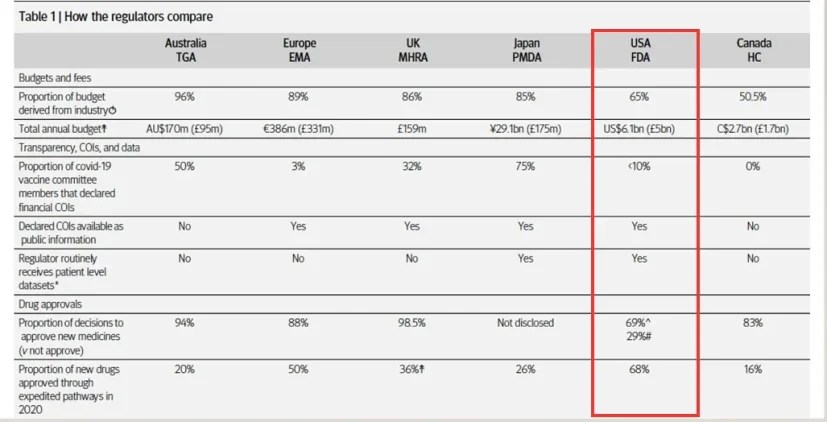
Yale physician and regulatory expert Reshma Ramachandran said the system is in urgent need of reform.
“We need an agency that’s independent from the industry it regulates and that uses high quality science to assess the safety and efficacy of new drugs,” she told The Lever. “Without that, we might as well go back to the days of snake oil and patent medicines.”
For now, patients remain unwitting participants in a vast, unspoken experiment—taking drugs that may never have been properly tested, trusting a regulator that too often fails to protect them.
And as Lenzer and Brownlee conclude, that trust is increasingly misplaced.
- Investigative report by Jeanne Lenzer and Shannon Brownlee at The Lever [link]
- Searchable public drug approval database [link]
- See my talk: Failure of Drug Regulation: Declining standards and institutional corruption
Amb. M.K Bhadrakumar: Russia Must Respond to the Attack on Its Nuclear Forces
Amb. M.K Bhadrakumar and Glenn Diesen
Glenn Diesen | June 5, 2025
Indian Ambassador M.K. Bhadrakumar argues that Trump’s words do not match his actions. It is extremely unlikely that the US was not involved in the attack on Russia’s nuclear forces, and Bhadrakumar argues that the failure by Russia to respond would be profoundly irresponsible. Ambassador Bhadrakumar was a career diplomat for 30 years in the Indian Foreign Service, and is now a columnist for Hindu and Deccan Herald Indian newspapers.
Featured Video

AIDS Inc. by Gary Null (2007)
or go to
Aletho News Archives – Video-Images
From the Archives
Clash of Civilization, Iran Part II
By Jamal Kanj – Intifada-Palestine.com – January 14, 2011
Israel’s survival kit is: perpetuate conflict, insecurity to rationalize collective hate and finally playing victim.
Devoid of conflict, Israel implodes internally; without hate, Zionism loses its justification; and playing eternal victim to continue blackmailing the West. Absence of this holy trinity, Israel ceases to exist.
From its inception, the house of Zion has mastered exploiting adversarial powers to advance Israel’s cause. For instance, their influence over the Democratic Party in the US began with President Truman’s bid for 2nd term election in 1948.
Responding to strong opposition from Secretary of State General George Marshall and Department experts urging against recognition of Israel, President Truman replied: “I’m sorry gentlemen but I have to answer to hundreds of thousands [Jewish voters] who are anxious for the success of Zionism. I do not have hundreds of thousands of [voting] Arabs among my constituents”
Zionists influence over liberal American politics was matched with the doctrinal school of Conservative theoreticians aligning the Republican Party’s platform with Israel’s objectives. The Neoconservative Zionists, coined Zioncons, invented the “Clash of Civilization” concept to fight Israel’s wars. … continue
Blog Roll
 Aletho News
- Pro-Palestine protesters arrested outside UK’s ruling Labour Conference in Liverpool
- Mauritius denies landing permit to flight from Israel, forcing cancellation: Tour operator
- Israeli finance minister calls for genocidal war on West Bank, annexation of south Lebanon
- 12 Things Your Psychiatrist Was Trained Not to Tell You
- From Unipolar Universalism to Multipolar Civilizational Distinctiveness
- RSF military group defects, joins Sudanese army: State media
- Ireland goalkeeper refuses to play ‘Israel’ as squad weighs boycott
- China pushes back against US on Cuba, Iran
- Ukrainian Soldiers, Potential Mercenaries: Have Gun, Will Travel!
- Burnham’s UN debut… A masterclass in British disinformation
- If Americans Knew
- Israel forces Gazans to live in constant peril – Daily Update
- Deconstructing Netanyahu’s pants-on-fire UN rant – Daily Update
- Trump betrayed voters with his campaign lies and prioritized a foreign country once he took office
- Netanyahu calls Israel’s war in Gaza ‘opposite of genocide’ in UN speech to near-empty hall
- Settler Kidnappings: Torture, Sexual Abuse and Terrorisation of Palestinian Abductees as Israel Deepens Annexation of West Bank
- Gaza winter nears as 162,000 tents become unusable, raising fears of humanitarian crisis
- Netanyahu says, “It’s the opposite of genocide”; UN says Gaza economy is world’s ‘most severe crisis on record’ – Daily Update
- Israel’s US-Backed Assault on Gaza Has Created the ‘World’s Most Severe Economic Crisis on Record’: UN
- ‘Protecting U.S. Citizens’… From Israel
- ‘This is where I live now, the back of a truck’: a day in the life of a grandmother in Gaza
- No Tricks Zone
- New Study: Earth And Venus Surface Warmth Largely Explained By Convection And Lapse Rate, Not CO2 Or Radiation
- 2025 Nature Paper Claiming Worsening Global Drought Gets RETRACTED …Heavily Flawed
- New Study: ‘Global Drought Shows No Detectable Recent Acceleration Under Climate Warming’
- Economic Masterminds: German Socialists Suggest Taxing Productivity Gains Stemming From Using AI
- The South China Sea Has Not Been Cooperating With The Climate Change Narrative
- Energy Crisis: Germany Enters Heating Season With Historically Low Gas Reserve Fill Levels
- New Study: The Antarctic Ice Sheet Gained Mass From 2020-2024 Due To Staggering Snow And Ice Accumulation
- Study: Ocean Heating Rates From Thousands Of Years Ago ‘Dwarf’ Modern Ocean Heating Rates
- Climate Extremists Target, Attack Large-Scale Power Grid Infrastructure In Germany!
- New Study: Antarctic Ice Melt Has Contributed Less Than 1 Centimeter To Sea Level Rise In The Last 30 Years

