Merz’ Missile Intimidation Tactics Won’t Work Because America Calls the Shots in Germany
Sputnik – 26.05.2025
“In short, you shouldn’t take the Germans too seriously,” veteran German legal scholar and ex-AfD MEP Gunnar Beck told Sputnik, commenting on Chancellor Merz’ announcement that Germany, the UK, France and the US are no longer restricting how far Ukraine can strike using its NATO-sourced missiles, potentially including Taurus.
“Germany today only needs to be taken seriously if it acts as a US satellite… We are not an independent nation. We are governed partly by the EU and partly by the US. Did the EU and the US agree?” That’s the real question, according to Beck.
Merz’ threats are meant as an intimidation tactic, the observer says, but Berlin doesn’t “seriously consider that it may be a crucial step in terms of escalating the conflict so that ultimately Germany herself could be involved either in terms of ground troops in Ukraine or even being affected by the war.”
No One to Challenge ‘Governor Merz’
“Merz as much as previous German chancellors, doesn’t really regard himself as a representative of Germany’s interests. He doesn’t really want to pursue ends which serve Germany’s. He regards himself as something like a governor of Germany for the interests of the globalist elite,” Beck stressed.
He doesn’t have opposition against the CDU-CSU-SPD-Green “uniparty,” which controls two thirds of parliament and is opposed only by AfD and Linke, nor among the financial and media elite (the latter “owned and effectively managed by the government,” apart from Springer Group, “essentially controlled by transatlantic interests”).
Bottom Line?
“Europe is not capable and probably reluctant to take independent action, whatever they may be saying. America still calls the shots in Europe because there’s just such a huge disparity in terms of economic and military power. We have to bear in mind that the EU is in decline. It is, economically speaking… in the worst economic position of all the industrialized countries, including Japan,” Beck summed up.
How Peace-Oriented Norway Learned to Stop Worrying and Love War
By Prof. Glenn Diesen | May 26, 2025
Norway identifies itself as a model of a liberal and tolerant peace-oriented nation. Yet, a collective mindset has developed with intense distrust and loathing of anyone who deviates from the government’s official truth and war narratives.
Here is a social experiment to test the claim above. I am a professor of political science, but I am also a politician running for Parliament. My recently established political party is primarily an anti-war party, and we started a poster campaign on public transportation in Oslo. The core message was that we are for negotiations and against weapons for the war in Ukraine. This seemed like a reasonable position as Norway previously had a policy of not sending weapons to countries at war (as it escalates and can make us a participant), and our country used to advocate for diplomacy and negotiations as the path to peace. Norway has abandoned these policies and unified under the new mantra that “weapons are the path to peace”, and we have boycotted basic diplomacy with Russia even as hundreds of thousands of young men died in the trenches. Was our peace-oriented nation ready to at least consider the argument that we should return to our former policies of negotiating instead of fueling the war with more weapons to fight the world’s largest nuclear power?
The country lost its collective mind… Politicians called it a dangerous Russian influence operation. I had taken the side of Russia in supporting the invasion. I am an agent for Russia spreading Russian propaganda. It was argued that the national intelligence services should get involved, as I am likely financed by the Russian state. Soon thereafter, the national intelligence agency, PST, reassured the public that they are looking into people who may, at the behest of a foreign power, attempt to make Norwegians critical of the government’s policies on sending weapons to Ukraine.[1] Almost every media outlet in the country framed the issue on the premise that I am “pro-Russian” and “anti-Ukrainian”. People began tearing down the posters, and some compared their political vandalism with liberating the country from Hitler during the Second World War. People were intoxicated with self-righteousness and moral superiority as the tribe united in virtue and the fight for freedom. Their hatred of the evil “other” was celebrated as evidence of their righteousness as they formed a resistance against us, fascist agents of Russia who support the destruction of Ukraine and would like to see Russia conquer Europe.
At this point, it should be noted that I consider myself a friend of Ukraine. I have warned against war in Ukraine for the past 20 years, and I have obviously not supported the invasion of Ukraine. Much like many political leaders across the West have argued over the past 30 years, I believe that NATO expansion triggers a security competition and eventually war, much like it would if Russia established its military infrastructure in Mexico. My argument is that Russia considers NATO expansion an existential threat and responds based on these convictions, irrespective of NATO not agreeing with Russia’s threat assessments. I therefore argue for diplomacy and against sending weapons, as it will only escalate the war, destroy Ukraine, and take us closer to nuclear war.
I consider this to be a pro-Ukrainian position and a pro-Western position, to speak in the language of my tribal countrymen who do not care for arguments about security competition. It should be noted that our own Prime Minister argued after the Russian invasion that it was “out of the question” to send weapons, yet this position has since been criminalised and reserved for agents of Russia. I discovered that my position is not sufficiently anti-Russian, since I believe the broken security architecture is the source of the war, and the discourse in Norway is reduced to basic tribal loyalties of picking one side or the other. Norwegian society only tolerates arguments that are based on the premise that we are not to blame and our solidarity must be based on condemning the “other”. The premise of an “unprovoked invasion” is therefore sacred. Consequently, enhancing our security by mitigating the security competition with Russia is impossible, as we are not allowed to discuss Russian security concerns. War predictably becomes the only path to peace.
The political campaign resulted in a televised public debate where our former defence minister / foreign minister was represented on the other side. In what resembled a show from Jerry Springer rather than a debate, her tactic was to be condescending and accuse me of being a propagandist for Russia. Whatever could have resembled an actual argument was premised on the idea that I am “pro-Russian”, while the government is “pro-Ukraine”. My dissent was thus a threat to national security. The purpose was never to discuss whether Russia is pursuing an empire or responding to what it considers to be an existential threat, and the purpose was certainly not to discuss whether weapons and boycott of diplomacy are the path to peace.
Then the media, functioning as a branch of government, stepped in to “fact-check” the debate. Or more precisely, the media only “fact-checked” one side, while the obvious lies told by our former defence minister / foreign minister went unchecked. Also, the “fact-checkers” were more like narrative checkers, as I was accused of “using several arguments that fit Russia’s most important narratives about the war in Ukraine”.[2]
The more dishonest media never bothered to check the facts supporting my arguments, and instead approached “fact-checking” by picking one ambiguous source to conclude I am not reliable. For example, I made the argument that Boris Johnson sabotaged the Istanbul peace agreement at the behest of the US and UK, yet the newspaper then only picked Davyd Arakhamia as an ambiguous source. Why did they not mention the two mediating sides, the Turkish (the foreign minister and President Erdoğan) or the Israeli (former Prime Minister Bennett), who confirm the negotiations were sabotaged to use Ukrainians to weaken a strategic rival? Why did they not cite the former head of the German military, General Kujat, who says the same? Why not reference interviews with American and British leaders who argued that the only acceptable outcome was regime change in Moscow? Why did they not cite the words of Boris Johnson himself as he expressed his disdain for the negotiations and warned against a “bad peace”?
The more honest media had the decency to at least publish the facts I presented, although they still had to muddy the waters. For example, I argued that the West knew that we backed the coup in Kiev in 2014 and pushed NATO expansion, despite knowing that only a small minority of Ukrainians (about 20%) wanted NATO membership and despite knowing it would likely trigger a war. The evidence cannot be disputed, so the fact-checker argues the Ukrainians were “ignorant” of NATO’s mission and had been propagandised, and points out that after the Russian invasion, there has been a majority support. This information and these claims have absolutely nothing to do with the argument that we knew only a small minority wanted NATO membership in 2014, and we knew it would likely result in war. All the “fact-checking” was intended to discredit.
The considerations of the rational individual have been defeated in Norway by the tribal mindset and groupthink. The government’s policies and war narratives represent virtue and truth, and all opposition is thus immoral and deceptive. The premise of every argument from politicians and their stenographers in the media was that they were on the side of the innocent Ukrainian victim, and I represented the evil Russian aggressor. There is no interest in engaging with arguments; rather, there is an obsession with exposing the hidden evil intentions of their opponents. Toward this end, anything is permitted in the “good fight”. The national intelligence services warned, with a not-so-subtle hint to me, that they are aware of efforts to polarise the public. Not only is it completely unacceptable for me to enter Parliament as I allegedly represent Putin, but my employment as a professor at a Norwegian university is also problematic, as I repeat “Russian narratives. How did Norway become authoritarian and gung-ho about war?
The Propagandised Norwegian
I will write here about “the Norwegian”, the collective national consciousness that serves the purpose of overwhelming the rational individual. Sigmund Freud famously recognised that the individual is rational, although human beings are also influenced by an irrational group psychology. Human beings have throughout their entire history organised in groups for security and meaning, and adjusting to the group is one of the dominant instincts in human nature. Carl Jung famously wrote about the limits of reason: “Free will only exists within the limits of consciousness. Beyond those limits there is mere compulsion”.[3]
The key component of group psychology is to divide individuals into “us” (the in-group) and the “other” (the out-group). When human beings are exposed to uncertainty and fear, there is an instinct to demand internal solidarity and denounce the out-group. Authoritarian tendencies tend to thrive when exposed to external threats.
The literature on political propaganda originates primarily from Edward Bernays, the nephew of Sigmund Freud, who built on his uncle’s work. Bernays recognised that manipulating the stereotypes of what represents “us” and the “other” diminishes the relevance of objective reality and the considerations of the rational individual. When we use military force, is it for freedom, and when our adversaries do the exact same thing, it is to advance empire and destroy freedom. The core of propaganda is therefore to present the world as good versus evil, and as superior versus inferior. The Western political propaganda that previously framed the world as the civilised versus the barbaric has been recast as the struggle of liberal democracy versus authoritarianism. If the public accepts this basic premise, the complexity of the world is simplified and dumbed down to the extent that dissent is immoral and dangerous. All that matters then is that you display loyalty to the in-group.
Walter Lippmann famously argued that political propaganda had the benefit of mobilising the public for conflict, yet it had the disadvantage of preventing a workable peace. When the public has bought into the premise that they are in a struggle between good and evil, how could they accept mutual understanding and compromise? The propagandised public reaches the conclusion that peace depends on the good defeating the evil. In almost every conflict and war of the West, the opponent is presented as a reincarnation of Hitler, and the Western political-media establishment lives perpetually in the 1930s as negotiations are appeasement and war is peace. This is profoundly problematic as the first step in reducing the security competition is recognising mutual security concerns.
Carl Schmitt, the scholar from Hitler’s Nazi Party, argued that organising politics along the friend-enemy binary also enabled governments to purge dissent. Schmitt’s concept of the enemy within strengthens political unity by purging those who do not display in-group loyalty and fail to conform to the beliefs and behaviour of the social order. The Norwegian has now experienced a decade of non-stop obsession with the Russiagate Hoax, Covid and then the Russian invasion of Ukraine. The fear and the search for enemies within to purge has exhausted the rational individual. We have now outsourced our critical thinking to the government and seek comfort in Orwell’s two-minute hate, in which we join the media-fuelled moral outrage against the enemies of the state. The moral indignation gives safety, meaning and unity.
The problem is spreading across Europe. In France, the main opposition leader has been arrested in what is seemingly a politically motivated attack. In Germany, the largest political opposition party has been labelled an “extremist organisation”, which enables the intelligence agencies can go after members. It is likely also a first step to banning the opposition party. In Romania, the election results in the presidential election were cancelled, and the winner was not allowed to run again. In the do-over of the Romanian elections, France and the EU were accused of interfering in the election to make sure the Romanians would [not] vote the wrong way again. Interference in Moldova and Georgia was also done under the banner of defending democracy from Russia. The irony is that the internal solidarity of the West as a “liberal democratic community” is, to a large extent, reliant on the Russian “other” playing the role of the bogeyman, which creates the groupthink that tears away at the liberal character of the West.
People tend to exaggerate what they have in common with the in-group, and exaggerate the differences with the out-group. The Norwegian has some contempt for America when compared with Norway, especially when they vote the wrong way. The Norwegian can, for example, not understand why the Americans would vote for Trump. This is because the Norwegian does not actually know why Americans voted for Trump, since the Norwegian media functioned as a campaign manager for Joe Biden and Kamala Harris. It is common to portray Americans as stupid, aggressive, and under Trump, it is not uncommon to introduce the word fascism. However, when in conflict with Russia, the American transforms into the in-group. With the simplistic division of good versus evil, the American is cast as the good guy. The US has a security strategy of global primacy, yet the Norwegian is suspicious of arguments that the US security strategy does not consist of advancing liberal democratic values. By extension, NATO is a “force for good”, and you would not question it unless you are seeking to sow divisions to undermine our goodness. NATO occupied Afghanistan for 20 years in a strategic part of Central Asia so small girls would be allowed to go to school, Libya and Syria were destroyed to defend human rights, and the expansion of the military bloc is solely motivated by the goal of offering protection to other peoples. Moscow could not possibly think the US would ever attack Russia, while ignoring the current proxy war and the continuous talk of possible wars with Iran and China. The Norwegian must refer to NATO as a defensive alliance even whilst it is bombing countries that never threatened a NATO country. Leading NATO countries are now complicit in genocide in Gaza, yet the benign liberal democratic identity we have assigned to ourselves is impervious to reality. If you criticise the West, it is not because you advocate for course correction, but because you stand with our enemies.
The Norwegian as a Moral and Liberal Authoritarian
Liberalism is renowned for having an internal contradiction that must be managed. Liberalism is based on tolerance to accommodate the rights of the individual to deviate from the group, yet liberalism is also based on the assumption of universalism in terms of all societies conforming to the liberal ideals.
The Norwegian accepts that all people are different and tolerate diversity, yet his liberal convictions are universal and more developed in Norway, others must thus follow the same path. We are all equal, but some are more equal than others. The Norwegian has embraced liberal principles such as mass immigration, radical secularism, gay marriage, gender ideology and humanitarian wars, and will ostracise and crush anyone who does not follow the same conviction. For example, believing that marriage is between a man and a woman was an acceptable opinion 15 years ago, but today it makes you intolerant and there is no tolerance for your intolerance. The Norwegian politician may not know the first thing about China, with its thousands of years of history and population of 1.4 billion, yet the Norwegian politician has a remarkable confidence in knowing exactly how China should be run as a country.
The Norwegian has been trained to speak in the language of morality to suppress factual discussion. Framing all arguments as moral implies that the opponents are immoral. Critical debate and open debate suffer as rational arguments, and nuance is replaced with moral righteousness and condemnations.
“Helping Ukraine”
The good versus evil premise that cannot be contested is that the Norwegian government is on the side of Ukraine, it is “pro-Ukrainian”, it “supports” and “helps” Ukraine. In contrast, dissidents such as myself who criticise the government’s policies are “anti-Ukrainian” who legitimise or support the invasion in solidarity with Russia. For the Norwegian, even a democratic debate between the two sides is morally repugnant as it gives voice to Russian propaganda.
I usually counter the false premise by arguing that NATO’s “help” entailed supporting the toppling of Ukraine’s government in 2014, which did not have the support of the majority of Ukrainians or their constitution. This was largely done to “help” Ukraine join NATO, but only about 20% of Ukrainians wanted NATO in 2014. The US merely “helped” when it took control over key governmental positions in Ukraine and had to rebuild Ukrainian intelligence services from scratch as an ally against Russia, from the first day after the regime change in 2014.
When 73% of Ukrainians voted for the peace platform of Zelensky in 2019, NATO decided to “help” destroy the popular peace mandate as it represented “capitulation”. Nationalists, supported by the “NGO” Ukraine Crisis Media Centre, presented “red lines” that Zelensky was not allowed to cross.[4] Zelensky had his life threatened repeatedly and publicly if he dared to cross these red lines, and he eventually abandoned his peace mandate. Several Western governments, including the Norwegian government, finance this “non-governmental organisation”.[5] There is an abundance of evidence that the US sabotaged the Istanbul peace negotiations in April 2022 and wanted a long war that uses Ukrainians to bleed Russia, yet the proxy war is fought under the banner of solely “helping” Ukraine. Criticising the idea that NATO, the world’s largest military alliance and an important instrument to advance US global hegemony, is solely preoccupied with helping Ukraine, is a key premise that cannot be challenged. Anyone attempting to question it is met with vicious attacks and accusations of standing with the enemy.
To ensure that the groupthink is managed, “democratic institutions” such as government-funded NGOs are tasked to herd the masses. The government-funded Norwegian Helsinki Committee, another “non-governmental organisation”, is also financed by the US government and the National Endowment for Democracy (NED). Reagan and the CIA Director established NED in 1983 as a “human rights organisation” to manipulate civil society in other countries. It is an ideal propaganda arm for the government, as competing power interests in the world and subsequent conflicts can be sold to the public as a struggle between good and evil. The Norwegian Helsinki Committee, a government-financed “non-governmental organisation”, writes regular hit-pieces on me, smears me non-stop on social media as a Putin-propagandist, attempts to cancel my invitations to speak, and attempts to have me fired by always shaming the university for giving me credentials that I allegedly abuse to spread propaganda. This includes calling and sending letters to the university. I must hide my address and phone number as the public is regularly told I am “anti-Ukrainian”, while an employee at this “human rights organisation” posted a picture of the sales advertisement of my house on social media. The leader of this NGO that has spent more than four years to smear, intimidate, censor and cancel me explained to the media that it was done as a nice gesture to help me sell my house. When I compared their intimidation to the intimidation of the brownshirts at universities, the scandal was that I compared this virtuous “democratic institution” to the brownshirts.
The Norwegian as a Sociopath
The rational individual is humanistic, but the collective consciousness of the Norwegian has taken on sociopathic traits with a lack of empathy, chronic lying, deceit, aggression, irresponsibility, and an absence of remorse.
The Norwegian is taught to express empathy for Afghans when it justifies occupation, Syrians when it justifies regime change, Libyans when it justifies military intervention, etc. However, once the strategic objective is achieved, there is no attention or empathy expressed. As we leave behind death and destruction, there is no remorse, as our alleged intentions were good. In Ukraine, the Norwegian is taught to have great empathy when it comes to advancing the war efforts. In contrast, the Norwegian will react with suspicion and anger if anyone mentions the suffering of the people in Donbas over the past decade, “military recruiters” dragging people off the streets and out of their homes, the attacks on the media, the denial of political rights, language rights, cultural rights or religious rights. The empathy for Ukrainians is instrumental, it is evoked or suppressed based on the purpose it serves.
Ukrainians who want to fight the Russians make the headlines, while Ukrainians such as former Western-backed presidential candidate Yulia Tymoshenko have disappeared from the media after she accused the West of using Ukrainians to weaken Russia. Ukrainians who fail to play the role of wanting to fight to the last man are also met with suspicion and should not be allowed to speak on behalf of their country. The narrative must be defended from facts, and in the good fight, it is virtuous to lie and deceive. Irresponsibility is now framed as being principled, as, for example, Russia’s nuclear deterrent must be referred to as an unacceptable nuclear blackmail that must be rejected. Insisting on continuing to fight a losing war in which Ukrainians lose more men and territory every day is “pro-Ukrainian”, because the alternative is a Russian victory that is “pro-Russian”. The deeper the belief in the righteousness of the cause, the easier it becomes to love the war that serves it.
[1]
PST snakker om utenlandsk påvirkning etter FOR-debatten
[2]
Faktasjekk: Partiet Fred og rettferdighet (FOR) og russiske påstander om krigen i Ukraina
[3] Jung, C.G., 1973. Letters 1: 1906-1950. Princeton University Press, Princeton, p.227.
[4]
[5]
How Russia Quietly Revolutionised Warfare
By Kit Klarenberg | Global Delinquents | May 25, 2025
On May 23rd, The Times published an extraordinarily candid probe into how militarised drones have irrevocably revolutionised warfare in the 21st century, with Russia far at the forefront of this radical shakeup of how conflicts are waged. Meanwhile, there is little indication NATO members even vaguely comprehend this battlefield reality, let alone a single one of them is undertaking any serious measures whatsoever to prepare for conflict such as that currently unfolding and evolving daily throughout Ukraine’s eastern steppe.
The Times piece is a first-person report of a visit to the assorted headquarters of Kiev’s 93rd Mechanised Brigade, in basements of abandoned buildings and homes throughout the Donetsk city of Kostiantynivka. It’s a devastating picture of the realities of war in the era of drones, which has “[altered] the physical make-up of the front line, the tactics of the war and the psychology of the soldiers fighting it,” while “having a devastating impact on Ukraine’s logistical ability.”
At one stage, The Times reporter was warned they were standing nine kilometres – 5.5 miles – from the nearest Russian position, and thus “well inside the kill range.” A Ukrainian soldier told them with a shrug, this was “now an easy range in which to die”:
“No other weapon type has changed the face of the war here so much or so fast as the FPV drone. Almost any vehicle within five kilometres of the front is as good as finished. Anything moving out to ten kilometres is in danger. Drone strikes at 15 or 20 km are not that unusual.”
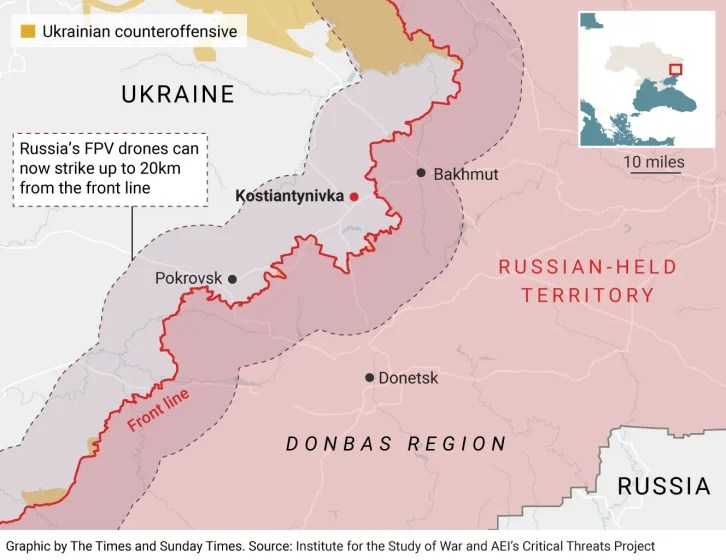
Since the proxy war erupted, both Ukraine and Russia have innovated in the field of FPV drones to an unprecedented degree. Kiev has become so reliant on drones, they are her “weapon of choice.” Yet, as The Times records, Russia has now decisively “taken the lead in the drone race, outproducing Kyiv in the manufacture and use of medium-range FPV drones and fibre optic variants that have changed the shape of the entire 1,200 km front line.”
Not only are FPVs “dramatically” striking ever-deeper into Ukrainian territory, but fibre optic FPV drones have gained “dark prominence over the killing fields.” While emulating the quadcopters equipped with munitions typically deployed by both sides previously, this “highly manoeuvrable killer drone” is connected directly to pilots by “a gossamer thin fibre optic thread.” This makes the contraptions difficult to track, and impervious to electronic jamming. A local infantry battalion commander told The Times:
“The changes posed by drones are so fast that concepts we implemented just a month ago no longer work now. We live in a space of perpetual fast adaptation. In the past week alone, Russian drone strike ranges have increased by four kilometres.”

These developments have sent Ukrainian forces scurrying en masse to regroup at regular, abrupt intervals ever-further away from the front line (also known as “zero point”), while logistical convoys to Kramatorsk – “long considered the bastion of Ukraine’s defence of the Donbas region” – have been repeatedly struck. One lieutenant recorded how Russian drones “swarm our armoured vehicles whenever they get near the zero point,” obliterating them and their crews. He believes drones represent such a world-changing military hazard, “the days of the tank are truly over.”
‘Danger Estimate’
The “drone-filled skies” of Donbass are so deadly, getting soldiers and equipment to the ever-expanding frontline and back is not only a logistical and practical horror, but also a frequently suicidal task. The Times reports that until late 2023, Ukrainian infantrymen “were usually carried to a position near the front in armoured personnel carriers, walking the last few hundred metres on foot.” Today, they are dropped off up to eight kilometres away at night, walking “meandering routes through trees to avoid detection, just to take up their positions.”
Rotations from the frontline have also vastly extended in length. While at the start of 2024 Ukrainian soldiers spent “a week or two” at zero point, now they’re routinely trapped there for months at a time, “often devoid of almost any other human contact, resupplied with water, rations and ammunition by agricultural drones.” Resultantly too, “casualty evacuation has become a nightmare.” Wounded fighters are “commonly” rescued at night, and “even then the operation is fraught.” A senior logistician for the 93rd Brigade’s drone crews lamented:
“As a word ‘stressful’ doesn’t even come close to describing it. Every mission I think, ‘God forbid we get a casualty and have to work out how to get them back’.”
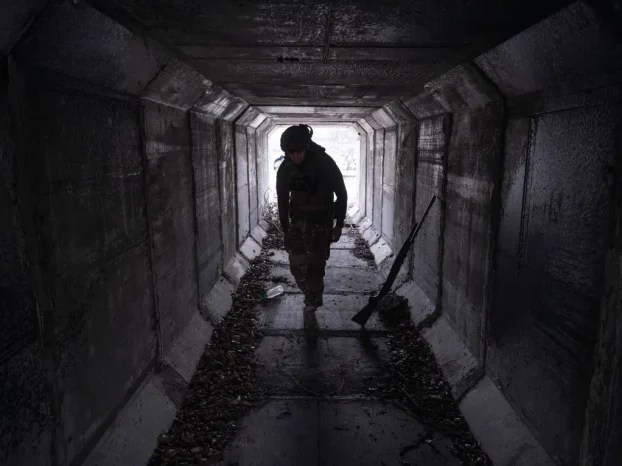
Ukrainian soldiers always keep shotguns close, to attempt to blast attacking drones out of the sky
Each night too, the Brigade’s frontline drone crews are resupplied with batteries, drone frames and munitions. Logistics teams are dropped off up to seven kilometres from the frontline, then carry up to 36 kilograms of equipment forward on foot. The risk to these crews is “enormous”. One driver was quoted as saying he conducted three missions nightly, “and I never know if each one will be my last, if I’m going to make it there and back in one piece.”
The Times records how a logistics vehicle was recently struck by a Russian drone while returning from a resupply mission. The driver lost an arm, but there were so many drones buzzing nearby, he couldn’t be evacuated from the position for five hours, so bled to death. Five Ukrainian armoured vehicles were destroyed by drones in the same sector the next day. However, none of this is seeping out to the world via the mainstream media, which once published videos of Ukrainian strikes on Russia daily.
As The Times notes, drones have adversely affected a core component of Kiev’s war effort – “media communications”. The 93rd Brigade was once “renowned for allowing reporters good access to…the war from the front.” Now though, “access for journalists has been dramatically reduced,” with “many media organisations…reluctant to commit reporters into areas within 15 km of the front.” Ukrainian brigades are likewise “wary” of the risks “they expose their own troops to in taking journalists by vehicle to the front.”
The Times reports that in 2023, the 93rd Brigade’s press officer “organised hundreds of visits to the front by reporters.” The number of visitors has now “dwindled to a trickle”. Since the proxy war’s eruption, the psychological field of battle has been where Ukraine has performed most effectively, eagerly assisted in its propaganda efforts by a media apparatus reflexively reporting the fantastical claims of officials in Kiev and their Western proxy backers as fact. Now, those days are long over. The press officer complained:
“The risks get bigger and bigger, and the coverage gets less and less. We get a journalist’s request to go to the front now and we wonder how rational is it? What is the danger estimate? What is the benefit?”
‘Technological Adaptations’
The Times report is a vanishingly rare mainstream acknowledgement of how the conflict currently raging Donbass is a war unlike any other in history, and its key spheres of battle are wholly unfamiliar to Western militaries. Despite this media omertà, the proxy conflict’s unparalleled operating environment, and obvious lessons, have not gone entirely unheeded in certain elite quarters. Nonetheless, despite alarm bells ringing accordingly, they are clearly falling on deaf ears in American and European centres of power.
In September 2024, Britain’s House of Lords International Relations and Defence Committee published a bombshell report, Ukraine: a wake-up call. It found the proxy war had “exposed fundamental weaknesses” in the “military strength” of both Britain and NATO, concluding London was effectively defenceless, with its “small” military reliant on unaffordable “status symbols” such as non-functional aircraft carriers. The country lacks the ammunition, armour, equipment, industrial capacity, personnel and vehicles to withstand a Donbass-style conflict for more than a few weeks at absolute most.
Amidst relentless condemnation of the state of Britain’s armed forces, the report contained a dedicated section on how “the use of drones in Ukraine” had “exposed the sheer variety of possible drone threats in a conflict scenario, ranging from disposable and commercially available drones to high-end, sophisticated ones.” It noted the development has “inserted an extra layer of weaponry between the land and air domains” and augmented “existing capabilities that both sides have, particularly offering new defensive options in the absence of air superiority.”
As such, the House of Lords Committee called for London to “invest in research and development to maintain a strategic edge in drone technology (including amphibious drones), and support the rapid development of new technologies that can compete in contested environments.” It urged decisionmakers to constantly consider and monitor “the pace of technological adaptations on and off the battlefield,” and the Ministry of Defence “to support continuous adaptation,” such as “[incorporating] learning on the use of drones in Ukraine across all domains.”
The report went entirely unremarked upon by the media contemporaneously, and today there is no sign of its multiple urgent calls to action having produced any meaningful results in any tangible regard in Britain’s armed forces. Similarly, despite NATO officials warning the alliance is wholly dependent on US electronic warfare capabilities, which in any event are woefully inferior to Russia’s own, public indications of Western leaders or militaries taking the drone warfare revolution seriously are unforthcoming. Should they end up in direct conflict with Russia, they’ll be in for quite a shock.
Russian missiles ‘fool’ US-made Patriots – Ukrainian military
RT | May 26, 2025
US-designed Patriot air defense systems are struggling to keep pace with Russia’s missile technology, particularly the Iskander missiles, Ukrainian Air Force spokesman Igor Ignat admitted on Monday.
Kiev has long praised the MIM-104 Patriot as a vital part of its arsenal following the deployment of the first battery in April 2023. But the American system is showing critical limitations in the face of Russia’s weaponry, Ignat told Le Monde in an interview.
“The Iskander missiles perform evasive maneuvers in the final phase, thwarting the Patriot’s trajectory calculations,” he said. “In addition, the Iskander can drop decoys capable of fooling Patriot missiles.”
While Ukrainian officials previously lauded the Patriot system for its ability to intercept Russian hypersonic Kinzhal missiles, Moscow has questioned such claims. Russian officials also argue that Kiev often overstates the number of missiles it downs compared to the number actually launched.
As of May, Ukraine is reported to have six active Patriot systems, primarily donated by the US and Germany, with additional components provided by the Netherlands and Romania.
Ukraine’s Vladimir Zelensky has called the Patriot system the only viable defense against Russian strikes, and has stated an aim to acquire a total of 25 units. He recently proposed that Kiev’s European backers fund the purchase of an additional ten systems for Ukraine at a cost of $15 billion. However, the administration of US President Donald Trump has dismissed the proposal as unrealistic.
Ukraine also faces dwindling supplies of interceptor missiles for its Western-donated platforms, even as Russian forces adapt their drone tactics to circumvent existing countermeasures.
Ukrainian forces have escalated their own drone offensives against Russia, moving from overnight attacks to continuous launches throughout the day. The shift comes amid increased pressure from Washington for continued direct peace negotiations. On Sunday, Trump expressed frustration with the lack of progress, blaming both Moscow and Kiev.
New York Times On Climate Change: Two Candidates For Quote Of The Day
By Francis Menton | Manhattan Contrarian | May 21, 2025
Over at the New York Times today, print edition, there is a big front page article documenting how their side is losing the latest battle in the climate wars. The headline is “U.S. Embraces Climate Denial In Science Cuts.” (online headline somewhat different). Also in the Times today (online version) is a feature called “Quote of the Day.” Today’s “quote of the day,” as selected by the Times, is taken from the “climate denial” article just previously linked. Here it is:
“It’s as if we’re in the Dark Ages.”
This quote is attributed to one Rachel Cleetus, identified as senior policy director with the climate and energy program at the Union of Concerned Scientists.
But then, if you take some time to read the article, you come to what I would propose as another excellent candidate for quote of the day. It’s from Brooke Rollins, recently confirmed as the new Secretary of Agriculture in the Trump administration. Here it is:
“We’re not doing that climate change, you know, crud, anymore.”
The focus of the article is what the Times calls “getting rid of data.” In Times spin, the purpose is to “halt the national discussion about how to deal with global warming.” But what kind of “data” are we talking about here? The article is short on specifics as to which exact data series are being cut back or eliminated, let alone whether those series are accurate or useful. But there is enough to give you a general idea:
In recent weeks, more than 500 people have left the National Oceanic and Atmospheric Administration, the government’s premier agency for climate and weather science. . . . NOAA also stopped monthly briefing calls on climate change, and the president’s proposed budget would eliminate funding for the agency’s weather and climate research. The administration has purged the phrases “climate crisis” and “climate science” from government websites.
Ah, NOAA (National Oceanic and Atmospheric Administration). They’re the people who, via their branch called NCEI, put out the so-called “surface temperature” series that have been systematically altered to create a falsely-enhanced warming trend to support regular claims of “warmest day/month/year ever.” This is the subject of my now 33-part series “The Greatest Scientific Fraud Of All Time.”
Let me remind you of the basics of the temperature-alteration scam: (1) the surface temperature records as presented by NOAA/NCEI are not raw instrumental data, but rather have been altered, (2) NOAA admits that it alters the records, (3) NOAA gives seemingly-plausible reasons for altering the records (e.g., to account to station moves and instrument changes), (4) however, the alterations as implemented are not associated with any specific issues like station moves and instrument changes, and (5) the alterations systematically enhance the reported warming trend and are used to support the “climate crisis” narrative. For more detail, go to Part XXXIII of the “Greatest Scientific Fraud” series. Here are just a couple of backup points in case you are skeptical:
-
As to whether NOAA alters the raw data, from ABC News, February 25, 2025, “Yes, NOAA adjusts its historical weather data: Here’s why.” Excerpt: “When digging into conspiracies claiming that the federal agency “manipulates” its historical weather data, ABC News chief meteorologist and chief climate correspondent Ginger Zee was able to confirm that it was true — but that the routine, public adjustments to records happen for good reason. . . . NCEI [a branch of NOAA] adjusts weather data to account for factors like instrument changes, station relocation and urbanization, and it does so through peer-reviewed studies that are published through its federal website.”
-
As to whether the data alterations implemented by NOAA/NCEI can be tied to any specific legitimate bases like station moves or instrumentation changes, I cite a 2022 article by O’Neill, et al. (17 co-authors) from the journal Atmosphere, title “Evaluation of the Homogenization Adjustments Applied to European Temperature Records in the Global Historical Climatology Network Dataset.” I couldn’t get a pithy quote from the article, but here is my summary: “[The authors attempt] to reverse-engineer the adjustments to figure out what NCEI is doing, and particularly whether NCEI is validly identifying station discontinuities, such as moves or instrumentation changes, that might give rise to valid adjustments. The bottom line is that the adjusters make no attempt to tie adjustments to any specific event that would give rise to legitimate homogenization, and that many of the alterations appear ridiculous and completely beyond justification. . . .” There is much, much more detail if you follow the links.
It is not clear from the Times article whether the 500 recent departures from NOAA include the people who have been carrying out this temperature alteration scam. If those people aren’t gone yet, with any luck they will be soon; and maybe we’ll even get some details of how they have been practicing their dark arts.
Meanwhile, back in the world of climate reality, the Real Clear Foundation on Monday (May 19) held something they called the “Energy Future Forum.” Conference co-chairs David DesRosiers and Mark Mills gave opening key-notes. Kevin Killough of Just the News published a summary of the conference on May 20. From DesRosiers’ remarks:
“I think we’ve gone from scarcity to abundance — from the green gospel of scarcity and its Trinitarian ESG god — to the promised land of abundance guided by the values of affordability and reliability,” David DesRosiers, conference co-chair and founder of the RealClear Foundation, said.
And from Mills:
While many tech companies, such as Microsoft, embraced net-zero goals, Mills explained that the energy demands of data centers forced companies to contend with the reality that although fashionable in some circles, intermittent wind and solar power are not adequate. “Eventually, reality rears its ugly head, and we recalibrate around what reality permits,” Mills said.
Bottom line: the Times can scream all it wants, but the world is moving on. From my point of view, it can’t happen too fast.
From Betar to Shomrim, re-emergence of Zionist private militias in the West

By David Miller | Press TV | May 25, 2025
In April of this year, anti-Zionist Jewish writer Alon Mizrahi claimed that Israeli Prime Minister Benjamin Netanyahu and his network of international Zionists are working to establish a policing force with powers surpassing those of national law enforcement agencies.
Mizrahi described this as the beginning of overt Jewish-Zionist policing of Western societies.
He was referring specifically to the ever more egregious statements from Betar in the US, an ultra-Zionist group affiliated with the far-right Revisionist Zionist movement founded by Vladimir Jabotinsky.
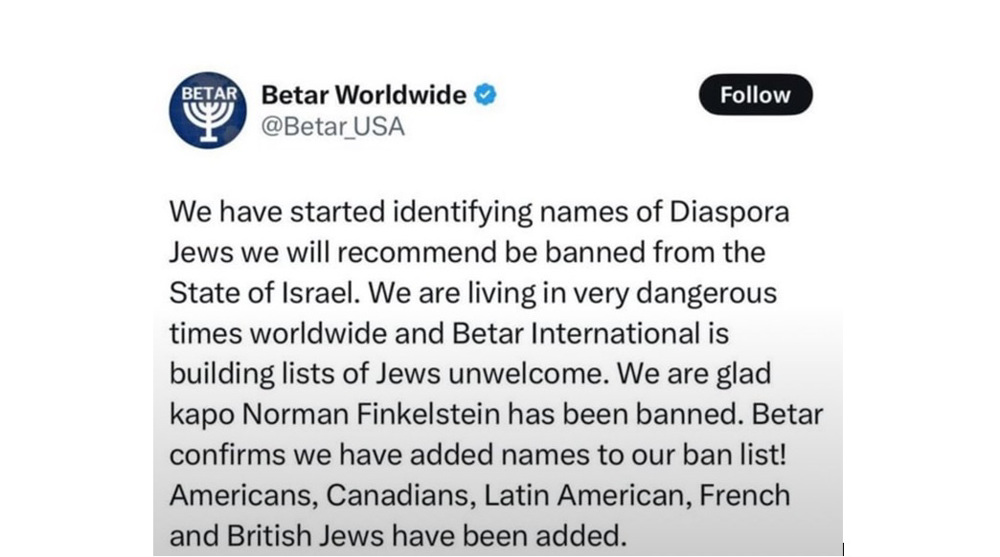
They have threatened to compile lists of Jews to be banned by the Zionist entity across North and South America, as well as Britain and France.
Mizrahi warned, “They start with Jews as a deception: all of you are next.”
However, the situation may already be far worse than what Mizrahi suggests.
Since its founding in 1923, Betar has trained as a paramilitary force. The photo below shows Menachem Begin wearing a Betar uniform in Poland in 1932.
Below it is another photo from Berlin in 1936, taken after the Nazis enacted laws outlawing other political groups in 1933.
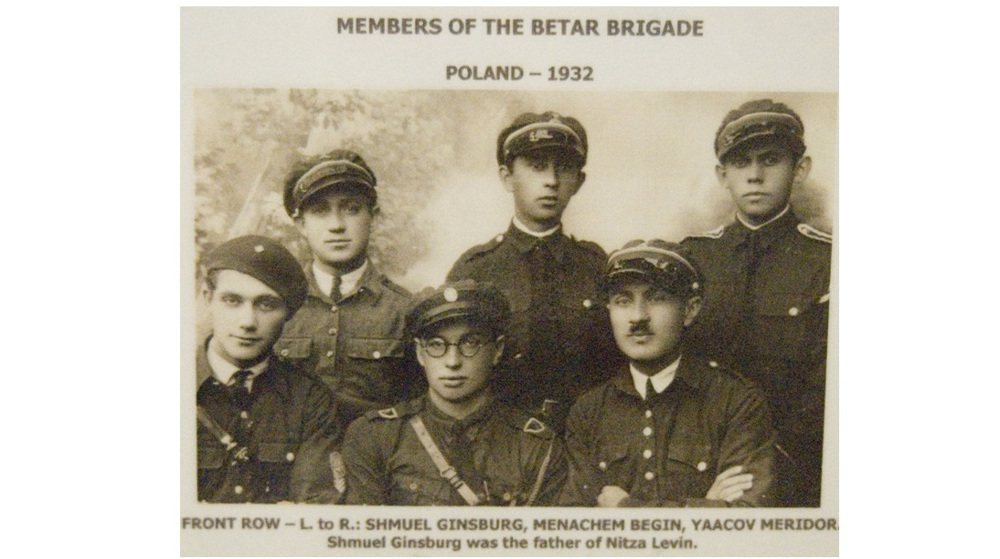
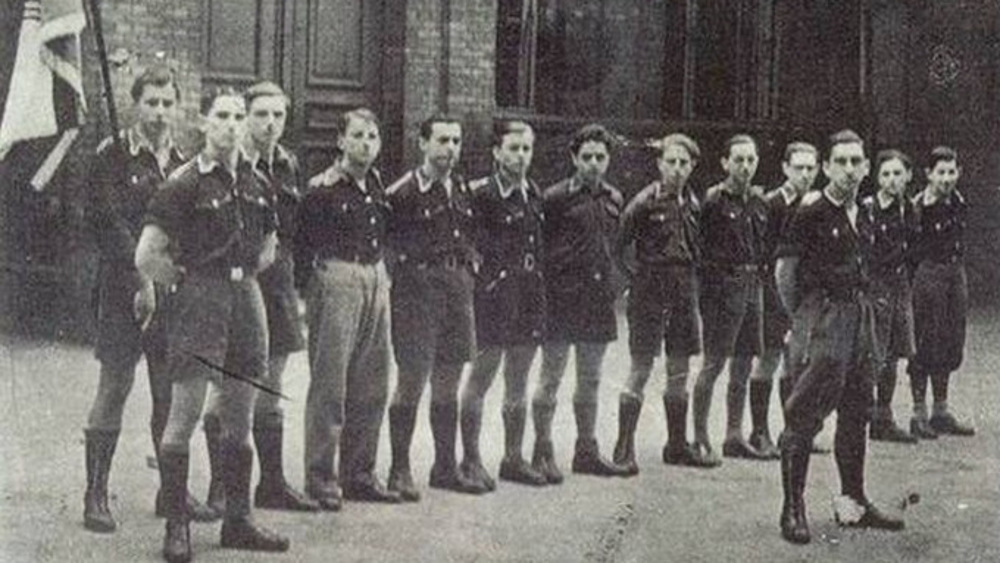
Betar was so closely aligned with the Nazis and Mussolini’s fascists that they were regarded as collaborators. By 1934, Jabotinsky and his Betar youth movement had reportedly “allied with Il Duce,” establishing a naval base north of Rome.
Late that year, Mussolini reportedly expressed support for Zionism and Jabotinsky in particular, stating: “For Zionism to succeed, you need to have a Jewish State with a Jewish flag, and Jewish language. The person who understands that is your fascist, Jabotinsky.”
This remark was made “during a private conversation with Nahum Goldman, founder of the World Jewish Congress, in November 1934,” as reported by Lenni Brenner in Zionism in the Age of Dictators.
Many senior Betar members served in the collaborationist police overseeing the Vilna Ghetto in Lithuania and were involved in betraying Jews in hiding to the Nazis.
One such member, Lotek Salzwasser, was eliminated by Jewish partisans in 1943 for his collaboration, according to Israeli press reports.
Betar and military training
One of the seven core principles of the Betar “Oath” is Magen, meaning “Protection.”
One of Betar’s ideological principles is military preparedness. Betar demands that all its members complete military seminars and know how to use weapons, in order to be ready at any time and to respond personally to a call for defense.
Betar has functioned as a militia since its inception. Here is a film of one of the French branches recorded in 2014 conducting paramilitary training exercises.
In the UK, Betar operated as a registered charity (Brit Tumbledor of Great Britain – Betar) between 1984 and 2004. It was closed down by the Charity Commission in 2004, on the grounds that it had been “Registered in error.”
In March 2025, Betar threatened to murder UN Special Rapporteur Francesca Albanese. On the very same day, the group relaunched its UK branch with a post on Instagram, claiming London “has become, with the time, an epicenter for radical Islam, for hate, for terror.” Their proposed solution?
Today, after more than 30 years, a bunch of strong young leaders stand up to say HERE WE ARE, to defend the Jewish population and to tell them that now we have a solution for the current situation, JEWS ARE NOT AFRAID ANYMORE!
Make no mistake – these threats are part of a deliberate effort to revive Jewish supremacist militias in the UK and the US.
Magen Am
The term Magen also appears in the name of a US-based private Zionist militia called Magen Am, which is currently active in Los Angeles, Orange County, and Phoenix.
Magen Am played a notably violent role in attempts to dismantle the student encampment at UCLA. The group frequently boasts about its close ties to the LAPD, sharing numerous photos of friendly interactions with police officers.
Reports indicate that Magen Am has collaborated directly with law enforcement, including working closely with the LAPD to intimidate and attack student protesters on the UCLA campus.

Magen Am, of course, recruits veterans of the occupation forces’ Lone Soldier programme and some then return to “serve” in the genocide as they proudly boast.
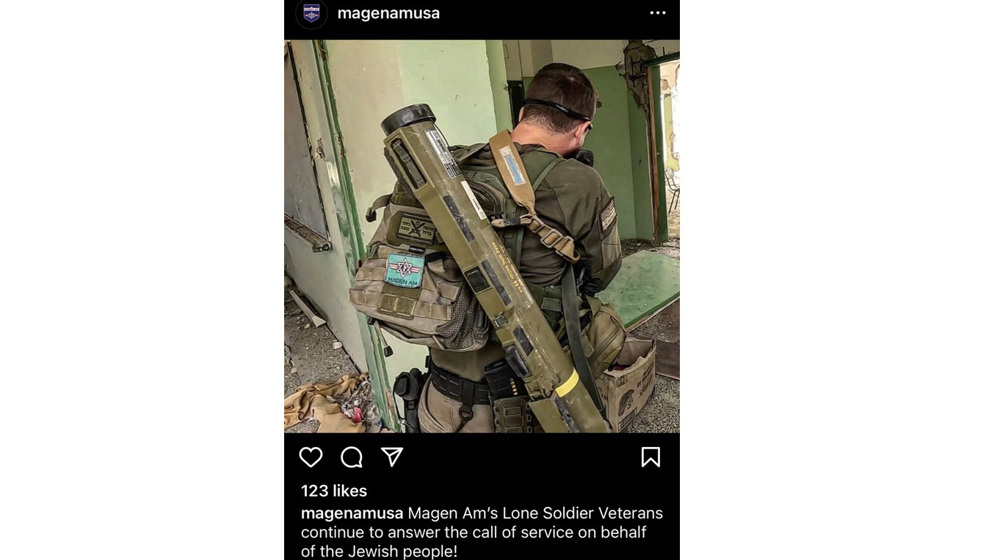
Magen Am was founded in 2017 by Yossi Eilfort, an MMA fighter-turned-Chabad rabbi. The flag of the genocidal Chabad cult was flown by the attackers on campus in Los Angeles.
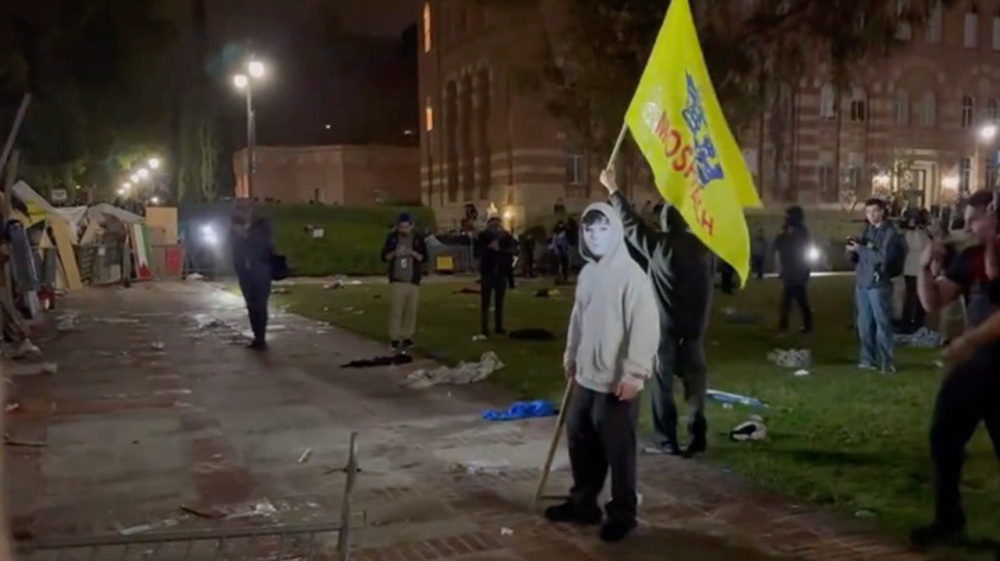
Chabad has many followers in the so-called Hilltop Youth in occupied Palestine, which the Zionist intelligence agency Shin Bet says are responsible for the overwhelming majority of so-called ‘price-tag’ revenge attacks on Palestinians.
The rise of Jewish supremacism in Western societies is becoming increasingly visible, though many continue to deny or downplay its existence.
While Zionist militias and private security firms openly collaborate to suppress student protests in the US, there is a more subtle infiltration of police forces by Zionist Jewish supremacists.
Shomrim: The Private Jewish Patrol
Shomrim is a private Jewish police force operating in parts of the US, UK, Australia, and Belgium. It is reported that “over 20 Shomrim organisations exist worldwide.”
In London, the Shomrim North West Community Patrol operates in the Borough of Barnet. Founded in 2008 by Gary Ost as a registered charity, it acts as a “mobile neighbourhood watch” and acts as eyes and ears for the Metropolitan Police.
Shomrim claims that all “Volunteers have completed training from the Metropolitan Police Counter Terrorism Command (SO15) in assisting to identify potential security threats and suspicious activity. “
One blogger notes that the genocidal cult Chabad also has a ‘nasty tendency to normalize sexual abuse and protect serial sexual predators in its ranks.” But it’s not only Chabad; there is a similar tendency throughout the Zionist movement.
No surprise, then, to find that the founder of Shomrim in London has been implicated in this.
In 2013 Police dropped their investigation into Ost, who had been arrested on suspicion of perverting the course of justice in relation to an investigation of an alleged child sexual abuser, Rabbi Chaim Halpern.
Indeed, charges against the alleged sexual predator were dropped back then, too. Yet new allegations against Rabbi Halpern have resurfaced a decade later, and the trial for these offences is still pending.
Shomrim abuses
In New York, Shomrim has faced criticism for “using excessive force against non-Jewish suspects.”
In 2014, two Shomrim members were charged as part of a group of five Hasidic men for assaulting 22-year-old Black student Taj Patterson as he walked home from a party.
Additionally, Shomrim organizers in New York have reportedly withheld information on suspected Jewish criminals. The NYPD has openly criticized the group for not always notifying police when calls come in, raising concerns about accountability and cooperation.
Given Shomrim’s protected status with law enforcement and the documented culture of sexual abuse in some ultra-Orthodox communities, credible allegations of abuse within these groups are unsurprising.
On October 11, 2023, the United States Department of Justice issued a press release that Jacob Daskal, former head of the Boro Park Shomrim Society—a private Orthodox Jewish crime-patrol group associated with the NYPD—was sentenced to 210 months in prison and fined $250,000 for transporting a minor with intent to engage in criminal sexual activity.
Daskal pleaded guilty to the charge in July 2023. As part of the sentence, Daskal is required to register as a sex offender.” The statement notes that Daskal was introduced to a 15 year old girl “as a result of his position with the Shomrim”, who he then “groomed” for sexual abuse. According to the Department of Justice statement:
“Throughout the abuse, Daskal instructed the victim to delete their communications and warned her not to tell anyone about their sexual relationship. He also used his position as a community leader to silence the victim, bragging about his law enforcement connections and warning her that disclosure would ruin her life. The victim was expelled from her religious school after revealing the relationship to the school principal.”
This case raises troubling questions: How many other abusive situations are currently unfolding within Shomrim and other Jewish militia groups?
Shomrim protects genocide
What is it that Shomrim are protecting? One illustrative example is the Crown Heights Shomrim branch, which in January this year provided security protection for the genocidal President of Israel, Yitzchak Herzog and for the leadership of the genocidal cult Chabad, as shown in the image below.

If Shomrim really wants to protect Jews in the US and UK, they should start by apprehending the entire leadership of Chabad and members of the genocidal Zionist regime.
Police reluctance toward Shomrim in the UK
Initially, UK police were resistant to Shomrim’s activities. In 2008, Chief Superintendent Steve Bending, then Hackney’s borough commander, stated, “I do not support the concept of any community having its own form of patrol service. There is a risk of other communities feeling intimidated by this course of action.”
As late as 2015, Metropolitan Police Commissioner Sir Bernard Hogan-Howe expressed his preference that Shomrim volunteers avoid uniforms resembling those of official officers.
Shomrim, however, rejected this, saying “its volunteers should not drive marked cars or wear uniforms similar to those of the police.” Gary Ost, chief executive of Shomrim in Golders Green, north-west London, stated, “Our uniforms look nothing like the police and are marked from every angle with clear wording saying ‘Shomrim’.”
Yet a glance at their uniforms and liveried vehicles often gives a very different impression.


But the penetration of the police is now much more advanced and cooperation is the name of the game. There are numerous examples of apparent cordial relations between the two on the internet.
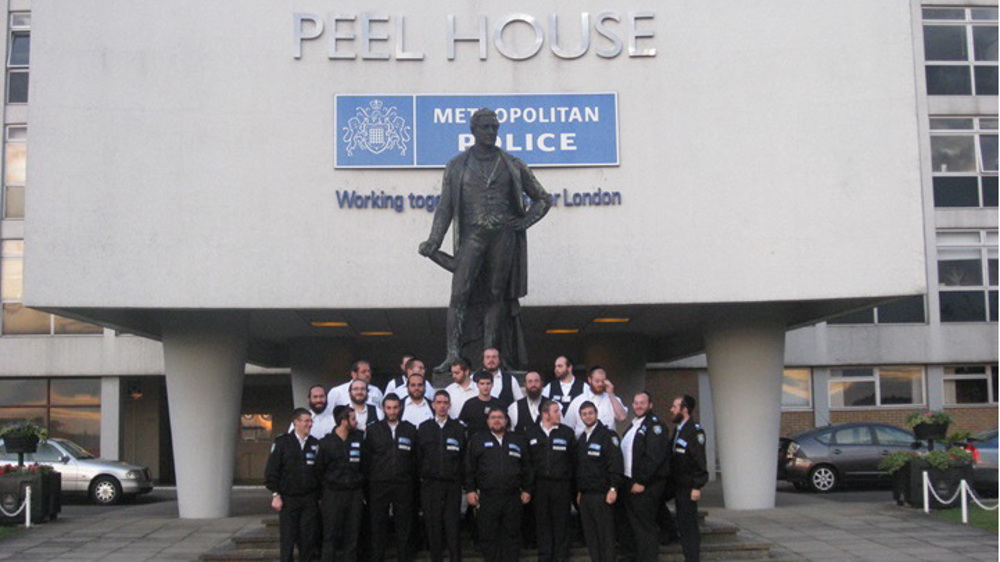
Shomrim members even posed outside Peel House, the headquarters of the Metropolitan Police.
Below is a photo of a prize giving for Shomrim members commended for their “bravery” and “exemplary service to the community” in 2020.
Shomrim chief executive Gary Ost, the one arrested in 2013, is one of the three.

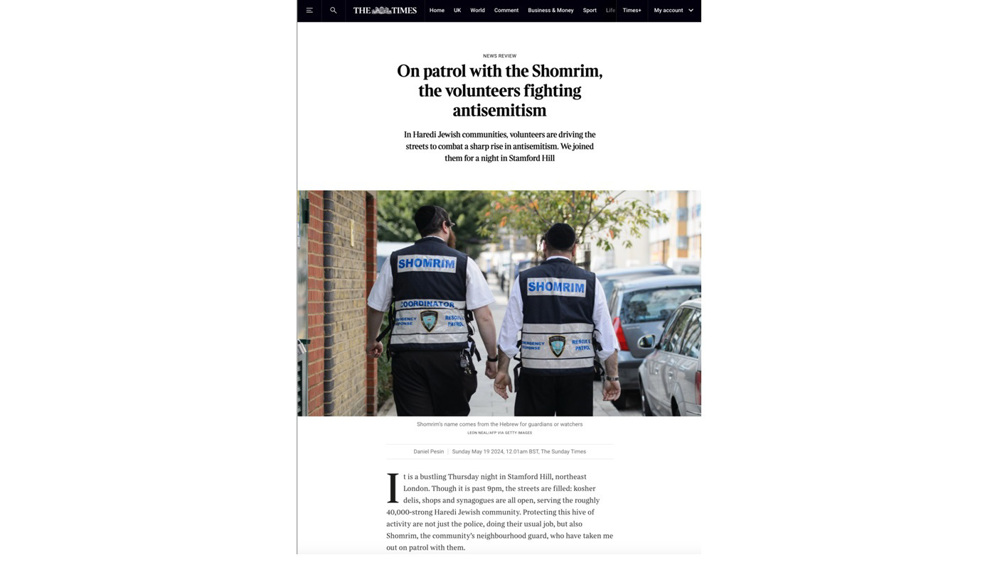
Shomrim plays a key role in shaping the narrative around the widespread antisemitism claims that Israel relies on to justify its genocidal actions.
The pressing question is: What happens when members of Shomrim break the law or commit wrongdoing? Would the police be able—or even willing—to enforce the law against them?
Alon Mizrahi, whom we cited earlier, shared his perspective in a conversation with me:
“They are pretending to be defending themselves in the most friendly country to Jews in history. While committing genocide. In a country that is so hateful of Jews that we need a private police force for Jews only in the US.
“And I have no doubt that if they can normalise this, with the kind of status that Zionist Jews have managed to create for themselves in the US; If this Jewish police force uses violence against black people, black organisers in communities who oppose the genocide, or other migrant groups or any other group, are American police going to be able to charge them?
“To use the law against them? I don’t think so. If you are in the American system, if you have a role in any part of the American system of government, in the police or any other agency, I think that at this point it is clear to you that Zionist Jews are above the law.
“The law doesn’t apply to them. So they don’t have the philosophical or legal means to deal with this. And the Zionists know this.”
Given the current climate, his assessment may well be accurate.
SignalGate 2.0 and the Casual Indifference to War
By Abigail R. Hall | Independent Institute | May 23, 2025
We recently learned that Secretary of Defense Pete Hegseth shared details of impending drone strikes on Yemen in a group chat with his wife, brother and personal attorney. If this story sounds familiar, it’s because it comes just weeks after national security leaders—including Hegseth—accidentally added Atlantic journalist Jeffrey Goldberg to a Signal chat.
The outrage is understandable. Why were military plans shared on an unsecured channel? Were U.S. personnel put at risk? Why did the president not respond strongly to this apparent breach? And of course, the attempted cover-up is making headlines, too.
Something else strikes me. Few seem angry that the government conducts offensive military operations in a country with which we are not formally at war. Headline after headline emphasizes the leaking of war plans—not the “war” itself.
I’ve studied conflict for over a decade. From terrorism and counterterrorism to the development of drone technology and how foreign intervention alters domestic institutions, I know what war does. It kills. It destroys property and devastates economies. It enables people to do the unthinkable—to rape, torture, maim children, and use them as soldiers. War destroys.
Yet, our secretary of defense tells his brother about coming strikes with the same gravity as he’d relay his grocery list.
What’s equally jarring is the public reaction. People aren’t aghast that U.S. drones are killing people in Yemen. People aren’t batting an eye over officials bypassing Congress’s war powers.
We are more concerned about the data leak than about what the data contains.
This indifference isn’t new. In my research, I’ve documented how Americans have become desensitized to war. We’ve been in some state of conflict for more than 93 percent of the calendar years between 1775 and 2018.
I’ve studied how the typical American is constantly exposed to pro-military, pro-U.S. foreign policy messaging. For example, television shows and movies are often subject to editorial review by the Department of Defense in exchange for using military hardware and personnel. We see that messaging in sports, too. In football, we have “bombs,” “blitzes” and “trenches” around the line of scrimmage. We “blow away” the opposing team. We have military homecomings on the pitcher’s mound or centerfield and celebrate without ever asking why our military personnel are deployed in the first place.
Meanwhile, modern technology allows us to easily wash our hands of misgivings.
Drone technology lets officials sell us on the supposed—and false—“surgical precision” of drone strikes, effectively sanitizing the violence. We “eliminate” or “neutralize” “high-value targets” and “combatants.” Never mind that intelligence failures are common and that many of those “combatants” were labeled as such because they happened to be “military-aged males,” or MAM. In other words, they were males aged 14-65 in a strike zone. And what of the civilians, the women and the children? Unfortunate “collateral damage.”
As a result, most of us don’t recognize America’s massive military boot print. How many Americans know the United States operates 750 military bases in more than 70 countries? How many know about the U.S. drone strikes conducted in the last five years in Afghanistan, Pakistan, Somalia, Syria and across Africa? Hundreds of civilians were killed.
For too long, we’ve failed to ask policymakers and ourselves the hard questions. We don’t need to ask about the leaks; we need to ask about the normalization of perpetual war. We need to ask about the moral costs of our government’s actions and about whether our proactive, military-forward policy is truly in our best interests.
US de facto financing persecution of Christians in Ukraine – Tucker Carlson
RT | May 25, 2025
The US is essentially facilitating the persecution of Christians in Ukraine by supporting the Kiev government, which has been waging a purge campaign against the nation’s canonical Orthodox church, American journalist Tucker Carlson has said.
Carlson made the statement during an interview with a former Ukrainian MP, Vadim Novinsky, released on Friday.
“Every day, churches and temples are seized by soldiers with machine guns who come in, throw out priests, beat believers, children, old people, women…” the former lawmaker stated, adding that “it is happening all over Ukraine.”
“I think very few Americans understand the degree to which the Ukrainian government under [Vladimir] Zelensky has persecuted the Ukrainian Orthodox Church,” Carlson said.
The former Fox News host then asked Novinsky what he would like to say to the American lawmakers who have nevertheless approved financial aid to Kiev. “The Speaker of the House of the United States Congress is a man who describes himself as a Christian and he has been paying for this,” the journalist said, referring to Mike Johnson, a Louisiana Republican.
The former Ukrainian MP replied that he would like to see the US aid going directly to ordinary Ukrainians and not the authorities, who “live in parallel realities.”
US government agencies appropriated a total of $182.8 billion on various forms of assistance to Kiev between 2022 and the end of 2024, according to Ukraine Oversight, an official portal that tracks such expenditures.
Last week, US President Donald Trump stated he was concerned that billions of dollars were being wasted on aid to Ukraine. He said Congress was “very upset about it” and that lawmakers were asking where all the money was going.
Kiev has accused the Ukrainian Orthodox Church (UOC) of maintaining ties to Russia even though it declared independence from the Moscow Patriarchate in May 2022. The crackdown has included numerous arrests of clergymen and church raids, one of the most notorious of which took place in the catacombs of the Kiev-Pechersk Lavra, where holy relics are kept.
Last year, Zelensky signed legislation allowing the state to ban religious organizations affiliated with governments that Kiev deems “aggressors,” effectively targeting the UOC.
Earlier this week, Russian Foreign Minister Sergey Lavrov said that Moscow would not abandon the Orthodox believers in Ukraine and vowed to make sure that “their lawful rights are respected.”
Washington’s “Golden Dome” – Multi-Trillion Tax Dollar Heist at Best, Dangerous Provocation at Worst
By Brian Berletic – New Eastern Outlook – May 25, 2025
US President Donald Trump has announced his administration has chosen the architecture for the proposed Golden Dome missile defense system, claiming it will cost $175 billion and be operational in “less than three years” with a “success rate close to 100%.”
During President Trump’s announcement on May 21, 2025, it was claimed the Golden Dome will consist of technology deployed across land, sea, and space capable of intercepting hypersonic, ballistic, and advanced cruise missiles, “even if they are launched from other sides of the world and even if they are launched from space.”
Former-US President Ronald Reagan’s “Star Wars” program (also known as the Strategic Defense Initiative) was repeatedly cited during the announcement. That program sought to use space-based weapons to void the doctrine of “mutually assured destruction” allowing the US to conduct a nuclear or non-nuclear first strike on another nation and avoid what had otherwise been an inevitable nuclear retaliation that would destroy both nations in the process.
Specifically, because mutually assured destruction was seen as a better deterrence against a first strike by one nuclear-armed nation against another, along with concerns over costs, technological limitations, and then-existing arms control treaties like the Anti-Ballistic Missile Treaty (ABM), the initiative was never fully realized.
Granting the US Impunity to Attack, Not “Defend” Itself
US Space Force General Michael Guetlein, picked to lead the Golden Dome project and present during its announcement, would claim:
As you’re aware, our adversaries have become very capable and very intent on holding the homeland at risk. While we have been focused on keeping the peace overseas, our adversaries have been quickly modernizing their nuclear forces, building out ballistic missiles capable of hosting multiple warheads, building out hypersonic missiles capable of attacking the United States within an hour and traveling at 6,000 mph, building cruise missiles that can navigate around our radar and our defenses and building submarines that can sneak up on our shores and worse yet, building space weapons. It is time that we change that equation and start doubling down on the protection of the homeland.
Yet what General Guetlein calls “keeping the peace overseas,” is in reality the United States encroaching along the borders and shores of nations like Russia, Iran, China, and North Korea.
This includes the stationing of not only missile defense systems like Patriot, THAAD, and the Aegis Ashore system in close proximity to these nations in violation of the ABM treaty the US has since abandoned, but also first-strike offensive weapons like the Typhon missile launcher capable of firing both Standard SM-6 anti-air missiles, but also ground-launched Tomahawk cruise missiles previously prohibited under the INF treaty the US has also since abandoned.
For example, the US has positioned THAAD systems in both the Middle East and Asia, and its Typhon missile system is currently stationed in the Philippines with additional units on the way, specifically aimed at China.
Beyond the global-spanning military footprint of the United States, Washington is also preparing for or already directing multiple proxy wars against these nations.
The conflict in Ukraine was entirely engineered by the United States, beginning with Kiev’s political capture in 2014, the training and arming of Ukraine’s military, and the capture, reorganization, and direction of Ukraine’s intelligence agencies by the US Central Intelligence Agency.
The US has been waging war and proxy war against Iran for decades, including invading and occupying Afghanistan and Iraq right on its borders, invading and overthrowing the government of Iran’s ally Syria, the waging of war on Yemen-based Ansar Allah – also an Iranian ally. The US also maintains constant financial, political, and military support for Israel, which has repeatedly attacked Iran and its allies.
And despite officially recognizing Taiwan as part of “One China,” the United States has continued supporting separatist political parties administering Taipei, is arming local military forces, and is even stationing US troops on the island province itself.
All of this has forced Russia, Iran, China, and other nations to respond by bolstering military spending, increasing research and development into missile technology, and the creation of credible deterrents against decades-spanning US aggression and proxy war along and even within their borders.
While the Trump administration depicts the Golden Dome as necessary to “forever end the missile threat to the American homeland,” it is instead being built to enable the US to forever threaten other nations around the globe with its missiles.
Dubious Claims About Golden Dome’s “Near 100%” Success
At one point during the Golden Dome’s announcement, US President Trump would claim:
I will tell you an adversary told me, a very big adversary, told me the most brilliant people in the world are in Silicon Valley. He said, “we cannot duplicate them. We can’t.”
He also claimed:
We have things that nobody else can have. You see what we’ve done helping Israel. You probably wouldn’t have in Israel. They launched probably 500 missiles all together and I think one half of a missile got through and that was only falling to the ground as scrap metal.
Except none of this is true.
If President Trump is referring to the 2024 Iranian retaliatory strike on Israel, up to 200 missiles were fired, with dozens if not scores of them circumventing Israeli missile defenses and striking targets, including dozens striking and damaging Israel’s Nevatim Airbase alone, according to NPR.
No air or missile defense system has a “success rate close to 100%.”
While any particular system may have a “success rate close to 100%” intercepting individual targets, retaliatory strikes are planned specifically to include a large enough number of missiles, drones, and other projectiles to saturate a defense system’s ability to intercept them all during a single attack. This means that while many incoming targets will be intercepted, many others will not, and critical targets will inevitably be struck and destroyed.
Regarding the state of US missile defense technology, unless President Trump is referring to undisclosed innovations, nothing the US currently is known to possess in terms of air and missile defense systems consists of “things that nobody else can have.”
And while in the past Silicon Valley drove unparalleled advances in technology contributing to a decisive military advantage for the US, the gap has since drastically closed and in some instances is widening in favor of nations like Russia and China.
The conflict in Ukraine, for example, has demonstrated glaring Russian advantages in several key areas that void the entire premise the Golden Dome is predicated on. Russia has demonstrated that it is capable of producing both larger quantities of ballistic and cruise missiles as well as layered integrated air defense systems and at a fraction of the cost the US and its European partners spend on arms and ammunition production.
Russia’s advantage is so great, it prompted the first-ever US National Defense Industrial Strategy in 2022.
The paper admitted the US (and the rest of the collective West) suffers from a bloated, inefficient military industrial base incapable of meeting the demands of the type of large-scale, high-intensity, protracted warfare taking place in Ukraine and likely to take place in future conflicts with either Russia or China.
As previously reported, the paper lays out a multitude of problems plaguing the US military industrial base including a lack of surge capacity, an inadequate workforce, overdependence on offshore downstream suppliers, as well as insufficient “demand signals” to motivate private industry partners to produce what’s needed, in the quantities needed, when it is needed.
In fact, the majority of the problems identified by the report involved private industry and its unwillingness to meet national security requirements because they were not profitable.
Nations like Russia and China do not rely on private industry partners for national defense programs. Much of the industrial power researching, developing, and mass-producing arms and ammunition in these countries takes place within state-owned enterprises. Because national defense is the chief priority of these enterprises, money is invested whether it is profitable or not.
This is what allows Russian and Chinese industry to maintain huge workforces, facilities, and tooling even when production is reduced, while private industry in the West would slash all three to maximize profitability. The first model allows a nation to surge the production of arms and ammunition on short notice – the other requires strong enough “demand signals” to justify the time-consuming process of building up the levels of all three – a process that can take years.
None of the problems described regarding the US military industrial base have been addressed since the National Defense Industrial Strategy was published in 2022. Corporations like Lockheed, Raytheon, L3Harris, and newer companies like Anduril slated to play a role in the proposed Golden Dome system continue to pursue a strictly for-profit model that will create the same disparity in quantity and quality seen playing out on and over the battlefield in Ukraine.
This leaves the likelihood the Golden Dome – like all other modern US military programs – will fall far short of stated expectations because of the fraud, waste, and abuse that defines US military industrial production.
The ultimate irony is that while the Golden Dome is sold to the public as “protecting” America, vast sums of public money that could actually improve the lives of Americans at home through infrastructure, education, and healthcare, will instead be siphoned off by demonstrably incompetent and corrupt arms manufacturers, all in an attempt to enhance Washington’s ability to menace the rest of the world with greater impunity – not protect the US at home.
The rest of the world will predictably react to the Golden Dome by creating their own means to defend themselves and retaliate against the US if attacked, making Americans not only less safe, but in the process of building the Golden Dome, less prosperous.
Brian Berletic is a Bangkok-based geopolitical researcher and writer.
Scott Ritter: Will Trump Own the Ukraine War or Walk Away?
Glenn Diesen | May 23, 2025
Scott Ritter is a former intelligence officer in the US Marine Corps and a former UN Weapons Inspector. He expects that the negotiations will fail, and Trump will distance himself from the war. Thus, the failure of negotiations will hurt Ukraine and Europe the most.
Follow Prof. Glenn Diesen:
Substack: https://glenndiesen.substack.com/
X/Twitter: https://x.com/Glenn_DiesenPatreon:  / glenndiesen
Support the channel: PayPal: https://www.paypal.com/paypalme/glenn…
Buy me a Coffee: buymeacoffee.com/gdieseng
Go Fund Me: https://gofund.me/09ea012f
How India-Pakistan war will affect global and regional political order
By Salman Rafi Sheikh – New Eastern Outlook – May 24, 2025
The recent India-Pakistan war, though limited in scope, has triggered significant geopolitical reverberations by showcasing Chinese military superiority and prompting a strategic reassessment in Washington.
The China angle in regional geopolitics
Beyond the oft-repeated rhetoric of the Pakistan-China relationship being “all-weather” and “iron-clad,” the recent India-Pakistan war may come to be seen as its first major demonstration in action. Pakistan’s use of Chinese PL-15 missiles, deployed from Chinese-made J-10C fighter jets to successfully engage French-made Rafale aircraft, has underscored the strategic depth of this partnership. This has received considerable international attention, both in the media and otherwise. This show of alignment is particularly notable given recent strains in the Pak-China bilateral relationship, including attacks on Chinese interests and infrastructure projects within Pakistan.
With Pakistan importing almost 80 per cent of its weapons—which also includes cooperation in the field of military technology—from Beijing, the supply ensured to help Islamabad maintain the balance of power vis-à-vis New Delhi. More than this, China’s policy was also motivated by its desire to counter-balance Washington’s efforts to boost India against China. Ironically enough, it was only days before the recent war that the US Vice-President was in India to discuss ways to collectively counter China. But China’s support for Pakistan meant that New Delhi remained preoccupied more with Pakistan than China in a strategic sense. With this war, New Delhi’s focus will be more on Islamabad than China for at least a few more years to come. By the same token, China will most likely continue to help Pakistan develop its defence capability. Even before the war took place, media reports in Pakistan and China reveled ongoing talks between Beijing and Islamabad for the sale and purchase of J-35 fifth-generation stealth fighter jets.
These developments highlight at least four key takeaways. First, China’s defense technology—likely tested in actual combat for the first time—has proven effective enough to attract interest from other regional powers. Its demonstrated performance could prompt these countries to purchase and integrate Chinese systems into their own militaries. This, in turn, would strengthen China’s position in the regional arms market and help it outcompete rival defense exporters. Second, China’s willingness to export advanced military technology—such as the PL-15 missile and J-35 fighter jets—signals a broader strategic intent to deepen its global partnerships. This approach is consistent with Beijing’s “no-limits” alliance with Moscow.
Third, the demonstrated effectiveness of Chinese weaponry against India could encourage regional states to reassess their foreign policy alignments, potentially fostering deeper integration with Beijing over New Delhi. This trend is already evident in countries like Sri Lanka and the Maldives, where pro-Beijing political shifts have gained momentum—most notably in the Maldives, where the new government compelled Indian troops to withdraw. Fourth, Pakistan’s military successes in this conflict challenge a common narrative in global discourse: that partnerships with China inevitably lead to economic “debt traps.” On the contrary, Pakistan’s economic ties with China appear to have laid the foundation for robust military-to-military cooperation, illustrating how economic integration can support broader strategic alignment.
India’s position in Washington’s arc
Can Washington still push—with enough confidence—India as its key ally? What is the material reality of India’s standing within the US-led Quadrilateral Security Dialogue (QUAD)? If the QUAD was ever to become a military alliance, the only power in the region that the US expected to be effective on its own against China is/was India—not only because India and China have a long history of rivalry, but also because India remains a big military power. Needless to say, it is the only nuclear power part of the QUAD from the Indo-Pacific region. In this sense, it can maintain deterrence vis-à-vis Beijing. But nuclear deterrence can prevent a nuclear war, as is evident from the recent India-Pakistan conflict. It cannot necessarily prevent conventional conflict. Can India act as the front-line ally for Washington in the region in a conventional war?
The outcome of India-Pakistan was means Washington will have to rethink its strategy. It can take two shapes. First, it is very much possible that Washington will deepen its cooperation with New Delhi. Donald Trump has already offered to sell F-35 fifth-generation stealth fighters. (Russia has also offered New Delhi to sell its own fifth-generation Su-57 jets.) This, however, will necessarily involve China deepening its cooperation with Pakistan. As a result, an arms race will be triggered in the region.
A second strategic path for Washington could involve renewed engagement with China. While the timing of the Trump administration’s trade negotiations with Beijing may coincide with the outcome of the India-Pakistan conflict purely by chance, it nonetheless suggests that even a confrontational administration has not entirely ruled out dialogue as a preferred tool. Washington might also pursue a dual-track approach—engaging China while simultaneously strengthening military alliances elsewhere.
However, in the wake of shifting dynamics following the India-Pakistan conflict, the US will likely need to reassess its regional strategy and consider alternatives to India. Japan, for instance, emerges as a strong candidate. With its recent push toward military normalization and a growing appetite for deeper strategic engagement, Tokyo could become a more prominent partner in Washington’s Indo-Pacific security architecture.
To be clear, this does not imply a fundamental rupture in US-India relations. But it is increasingly likely that Washington will place India’s role under careful review, potentially redefining its status as the principal frontline ally in countering China. In response to China’s growing influence and military reach, the US will need to significantly bolster the defense capabilities of other regional actors—most notably Japan and Australia—as part of a broader strategic recalibration.
Salman Rafi Sheikh, research analyst of International Relations and Pakistan’s foreign and domestic affairs
Featured Video

AIDS Inc. by Gary Null (2007)
or go to
Aletho News Archives – Video-Images
From the Archives
Clash of Civilization, Iran Part II
By Jamal Kanj – Intifada-Palestine.com – January 14, 2011
Israel’s survival kit is: perpetuate conflict, insecurity to rationalize collective hate and finally playing victim.
Devoid of conflict, Israel implodes internally; without hate, Zionism loses its justification; and playing eternal victim to continue blackmailing the West. Absence of this holy trinity, Israel ceases to exist.
From its inception, the house of Zion has mastered exploiting adversarial powers to advance Israel’s cause. For instance, their influence over the Democratic Party in the US began with President Truman’s bid for 2nd term election in 1948.
Responding to strong opposition from Secretary of State General George Marshall and Department experts urging against recognition of Israel, President Truman replied: “I’m sorry gentlemen but I have to answer to hundreds of thousands [Jewish voters] who are anxious for the success of Zionism. I do not have hundreds of thousands of [voting] Arabs among my constituents”
Zionists influence over liberal American politics was matched with the doctrinal school of Conservative theoreticians aligning the Republican Party’s platform with Israel’s objectives. The Neoconservative Zionists, coined Zioncons, invented the “Clash of Civilization” concept to fight Israel’s wars. … continue
Blog Roll
 Aletho News
- Merck Virologists Admitted to Falsely Certifying Vaccine Efficacy
- Mandatory Folic Acid for every man, woman & child
- Pro-Palestine protesters arrested outside UK’s ruling Labour Conference in Liverpool
- Mauritius denies landing permit to flight from Israel, forcing cancellation: Tour operator
- Israeli finance minister calls for genocidal war on West Bank, annexation of south Lebanon
- 12 Things Your Psychiatrist Was Trained Not to Tell You
- From Unipolar Universalism to Multipolar Civilizational Distinctiveness
- RSF military group defects, joins Sudanese army: State media
- Ireland goalkeeper refuses to play ‘Israel’ as squad weighs boycott
- China pushes back against US on Cuba, Iran
- If Americans Knew
- Israel forces Gazans to live in constant peril – Daily Update
- Deconstructing Netanyahu’s pants-on-fire UN rant – Daily Update
- Trump betrayed voters with his campaign lies and prioritized a foreign country once he took office
- Netanyahu calls Israel’s war in Gaza ‘opposite of genocide’ in UN speech to near-empty hall
- Settler Kidnappings: Torture, Sexual Abuse and Terrorisation of Palestinian Abductees as Israel Deepens Annexation of West Bank
- Gaza winter nears as 162,000 tents become unusable, raising fears of humanitarian crisis
- Netanyahu says, “It’s the opposite of genocide”; UN says Gaza economy is world’s ‘most severe crisis on record’ – Daily Update
- Israel’s US-Backed Assault on Gaza Has Created the ‘World’s Most Severe Economic Crisis on Record’: UN
- ‘Protecting U.S. Citizens’… From Israel
- ‘This is where I live now, the back of a truck’: a day in the life of a grandmother in Gaza
- No Tricks Zone
- New Study: Earth And Venus Surface Warmth Largely Explained By Convection And Lapse Rate, Not CO2 Or Radiation
- 2025 Nature Paper Claiming Worsening Global Drought Gets RETRACTED …Heavily Flawed
- New Study: ‘Global Drought Shows No Detectable Recent Acceleration Under Climate Warming’
- Economic Masterminds: German Socialists Suggest Taxing Productivity Gains Stemming From Using AI
- The South China Sea Has Not Been Cooperating With The Climate Change Narrative
- Energy Crisis: Germany Enters Heating Season With Historically Low Gas Reserve Fill Levels
- New Study: The Antarctic Ice Sheet Gained Mass From 2020-2024 Due To Staggering Snow And Ice Accumulation
- Study: Ocean Heating Rates From Thousands Of Years Ago ‘Dwarf’ Modern Ocean Heating Rates
- Climate Extremists Target, Attack Large-Scale Power Grid Infrastructure In Germany!
- New Study: Antarctic Ice Melt Has Contributed Less Than 1 Centimeter To Sea Level Rise In The Last 30 Years

