US court hits Israeli spyware firm NSO with $167m fine over Pegasus abuses
MEMO | May 14, 2025
A federal jury in California has ordered Israeli surveillance firm NSO Group to pay Meta $167 million in punitive damages, marking the first time a court has imposed financial liability on a spyware vendor for abuses linked to its software.
The ruling sends a strong signal that private firms profiting from invasive surveillance technology will not be shielded by their association with government clients. After a single day of deliberation, jurors found that NSO had acted with “malice, oppression or fraud” in deploying its Pegasus spyware against 1,400 WhatsApp users.
Pegasus, which grants near-total access to a target’s device, including microphones, cameras and encrypted messages, was used not against criminals, but journalists, human rights defenders and political dissidents. Meta, which owns WhatsApp, described the hacking as “despicable” and a clear violation of privacy rights.
NSO has long claimed that its spyware is sold only to vetted state clients for national security purposes. However, investigations have shown Pegasus being deployed to facilitate transnational repression by authoritarian regimes.
The previous US administration blacklisted NSO over its role in such abuses, making it the first company added to the US entity list for enabling state surveillance. The jury’s decision is expected to add pressure on Washington to further regulate the commercial spyware sector.
While the financial penalty may prove difficult to collect, the judgement itself sets a precedent: spyware firms can be held directly accountable in US courts, regardless of the state affiliations of their customers.
In doing so, the case reframes digital privacy not merely as a user expectation, but as a civil right and signals that the impunity long enjoyed by private surveillance actors is coming to an end.
F-35 near-misses over Yemen signal new risks for ‘Israel’
Al Mayadeen | May 14, 2025
US F-16 and F-35 fighter jets encountered heavy close-range fire from Ansar Allah air defenses during Operation Rough Rider, the two-month US aggression against Ansar Allah that was launched by President Donald Trump in mid-March, according to Forbes.
According to a Monday report by The New York Times, unspecified Ansar Allah air defenses came dangerously close to striking US fourth-generation F-16s and fifth-generation F-35s during the initial 30 days of Operation Rough Rider, raising concerns about potential American casualties. During the same period, Ansar Allah forces successfully shot down seven MQ-9 Reaper drones.
The potential downing of a US fighter jet and the resulting capture of a pilot by Ansar Allah forces presented a scenario that the current administration was determined to avoid, Forbes stated.
The loss of one of America’s exclusively exported stealth fighters to Ansar Allah air defenses, which had previously been considered largely improvised and relatively rudimentary, would have dealt a severe blow to US fighter jet prestige while potentially jeopardizing future arms export agreements.
‘Israel’ faces similar risks
Forbes highlighted that the near-misses involving US F-35s during operations over Yemen carry significant consequences for “Israel” as well, particularly since the Israeli Air Force initiated its first long-range strikes against Ansar Allah in July 2024 following a successful drone attack by the group that reached Tel Aviv. In March, shortly after initiating Operation Rough Rider, the US advised “Israel” against carrying out further attacks.
Trump declared the Yemen ceasefire shortly after “Israel” conducted strikes following an Ansar Allah missile attack that had successfully hit its major airport near Tel Aviv.
While US Marine Corps F-35Bs conduct operations from amphibious assault ships and Navy F-35Cs launch from supercarriers positioned near Yemen’s coast, “Israel” lacks comparable forward deployment capabilities for its F-35Is, forcing them to rely on aerial refueling to cover the more than 1,000-mile flight distance and severely limiting their available loiter time over Yemeni airspace during missions.
Given that Ansar Allah’s air defenses have already posed risks to US F-35s, Israeli F-35Is conducting long-range missions could also face similar threats, and if one were to be shot down over Yemen, it would provide Ansar Allah with an unprecedented image of a victory, according to the US magazine.
Future Israeli F-35I sorties over Yemen will likely avoid operating at maximum combat capability to minimize risk exposure.
India, Pakistan, and the future of the Indus Waters Treaty

By Amin Noorafkan | Press TV | May 14, 2025
On April 22, 2025, militants carried out a brutal attack on tourists at a hill resort in Indian-administered Kashmir, leaving 26 people dead. Indian authorities swiftly blamed Pakistan, responding by downgrading diplomatic ties and initiating a series of escalatory measures.
Among these measures, one that took many observers by surprise was India’s decision to suspend the Indus Waters Treaty (IWT) – a landmark water-sharing agreement signed in Karachi in September 1960.
Despite decades of hostilities and multiple wars, the treaty had long endured as a rare symbol of cooperation between the two estranged neighbors.
As tensions surged, India launched a military operation on the morning of May 7, firing a barrage of missiles deep inside Pakistan and Pakistan-administered Kashmir, reportedly killing dozens.
In retaliation, Pakistan struck several Indian cities, including key military installations, three days later.
A ceasefire was brokered just hours after Pakistan’s attack, halting the escalation between the two nuclear-armed nations. However, underlying tensions remain high.
A key point of contention is the continued suspension of the Indus Waters Treaty. Pakistan’s Deputy Prime Minister Ishaq Dar, in remarks on Monday, warned that the fragile ceasefire could unravel if the treaty is not reinstated.
Indus Waters Treaty: Status, India’s stance and Pakistan’s response
India’s cabinet committee on security announced the Indus Waters Treaty – long seen as a symbol of “water for peace” – would be held “in abeyance” until Pakistan ends its support for cross-border terrorism.
India’s Foreign Secretary confirmed the suspension, stating it would remain in place until Pakistan “credibly and irrevocably abjures” terror support.
On the ground, India backed up its announcement with action. It briefly restricted flows on the Chenab River, and then released large volumes of water from the Baglihar and Salal dams as levels rose.
Indian Prime Minister Narendra Modi vowed that “India’s water will flow only in India,” emphasizing that water previously shared with Pakistan would now be conserved for domestic use.
Echoing this, Jal Shakti Minister C.R. Patil said, “We will ensure that not even a drop of water from the Indus River goes to Pakistan.”
In Islamabad, the reaction was defiant and dramatic. Pakistani leaders condemned India’s suspension of the treaty as “an act of war”.
Foreign Minister Ishaq Dar and military officials publicly warned that blocking Pakistan’s water share would trigger a full response. Pakistan also announced it would pursue international legal action.
The government is reportedly preparing cases before the World Bank (the treaty’s broker), the Hague’s arbitration tribunals and even the International Court of Justice.
This escalation is particularly notable given the treaty’s durability. The Indus Waters Treaty remained intact through the wars of 1965, 1971, and 1999.
What is clear is that water has moved to the center of the current standoff. India’s handling of dam flows appears to serve more as a signal of power than a direct retaliation; a message to Pakistan that New Delhi can, at will, alter the course of shared rivers.
The Indus basin dams underpin Pakistan’s food and energy security. A recent report showed that over 80% of Pakistan’s irrigation and nearly 50% of its GDP depend on the Indus water.
But there is another player that needs to be factored into the equation.
China’s role and upstream developments
Adding complexity to the dispute is the growing role of China. In January 2023, satellite imagery revealed extensive dam construction by China on the Indus headwaters in Tibet and on the Brahmaputra (Yarlung Zangbo).
Images also show China building a dam on the Mabja Zangbo (which is a tributary flowing toward Nepal and India) and planning a mega-dam on the lower Brahmaputra.
The Brahmaputra provides about 30% of India’s freshwater and 44% of its hydropower potential, giving Beijing strategic leverage.
Some analysts warn that India’s current use of the IWT as a geopolitical tool could set a precedent, encouraging China to do the same against India downstream.
China’s involvement also has a strategic aspect. Under the China-Pakistan Economic Corridor (CPEC), Beijing has poured billions into Pakistan’s hydropower sector, co-developing large dams like Diamer-Bhasha, Dasu, and Mohmand. These projects are central to Pakistan’s water and energy plans, and China’s investment makes it a key stakeholder.
As a result, any dramatic shift in Indus water flows or treaty dynamics is unlikely to remain a bilateral issue. China could respond directly, especially on the Brahmaputra, or through its partnership with Pakistan, by accelerating joint hydropower projects.
A fragile equilibrium
India’s moves risk triggering a “double-edged sword.” By choking Indus flows, it could prompt Beijing to tighten its grip on Himalayan rivers flowing into India.
In effect, the water dispute now entangles three powers: India, Pakistan, and China, each competing for control over critical transboundary rivers.
However, not all leverage is equal. While China’s upstream position on the Brahmaputra is significant, its practical impact is more limited. The Brahmaputra’s flow through India is largely driven by monsoons, with only 7–10% originating in Tibet.
Even a theoretical full diversion (which remains unlikely due to technical and geopolitical constraints) would reduce India’s national freshwater by 10–15%, impacting less than 1% of GDP. India’s more diversified economy and lower dependence on agriculture (13.5% of GDP) offer some buffer.
Still, China’s dam-building project signals its intent to assert hydro-hegemony in the region.
And as tensions mount, rivers are no longer just a source of sustenance; they are emerging as instruments of strategy and power.
Future scenarios for water diplomacy and conflict
The coming months will reveal whether the current crisis can be resolved through diplomacy or whether tensions will spiral further.
Pakistan appears determined to internationalize the dispute. It has signaled intentions to pursue legal action through the World Bank – the designated facilitator of the Indus Waters Treaty – as well as the Permanent Court of Arbitration and potentially the International Court of Justice.
However, the World Bank has already sought to distance itself. President Ajay Banga stated that the institution has “no role to play beyond a facilitator,” casting doubt on its capacity to mediate a meaningful resolution.
As of now, there are no reports of substantive diplomatic progress. This vacuum raises the risk that the ceasefire may falter, potentially reigniting conflict. Looking ahead, several possible scenarios emerge:
- Legal/diplomatic resolution: Pakistan could formally invoke treaty mechanisms, filing for arbitration and launching protests under international law. A mediated renegotiation might follow, potentially involving updated water allocations or enhanced confidence-building measures. India has long advocated for revisions to the treaty. Under international pressure, New Delhi might seek new security guarantees, while Islamabad could push for a more robust monitoring framework to ensure compliance.
- Escalation: If India persists in withholding water flows or damming key rivers in Kashmir, Pakistan’s response may not remain confined to legal avenues. Officials have warned of potential covert retaliation, including cyberattacks or sabotage targeting Indian water infrastructure. Military confrontation cannot be ruled out either. Pakistani leadership has labeled water denial as an existential threat, with some officials mentioning the possibility of a “last resort response.”
- International mediation/coercion: While the World Bank has signaled a limited role, other global actors may step in. The United States, which helped broker the current ceasefire, could take further steps to mediate the water dispute. Other states – including China, Iran, and Saudi Arabia – may offer to facilitate negotiations or introduce incentives for cooperation. Thus far, however, India has resisted most third-party involvement, making an exception only for US-led efforts.
Amin Noorafkahn is a student of regional studies at Allamah Tabatabai University, Tehran. He is interested in political science, literature, and sociology.
Florida Rejects Controversial Encryption Backdoor Bill
By Didi Rankovic | Reclaim The Net | May 13, 2025
Legislators in the US state of Florida have shot down a bid to introduce a law that would have mandated encryption backdoors.
The outcome of the effort – known as SB 868: Social Media Use by Minors – means that the backdoors would have allowed encryption to be weakened in this fundamental way affecting all platforms where minors might choose to open an account.
As the fear-mongering campaign against encryption is being reiterated over and over again, it’s worth repeating – there is no known way of undermining encryption for any one category of users, without leaving the entire internet open and at the mercy of anything from government spies, to plain criminals.
And that affects both people’s communications and transactions.
Not to mention that while framing such radical proposals as needed for a declaratively equally large goal to achieve – the safety of youth online – in reality, by shuttering encryption, young people and everyone else are negatively affected.
If anything, it would make everyone online less secure, and, by nature of the world – young people more so than others.
And so, Florida’s Senate on announced that SB 868 is now “indefinitely postponed and withdrawn from consideration.”
The idea behind the proposal was to allow law enforcement access to communications on a social platform – by forcing a company to build in backdoors any time law enforcement came up either with a warrant – or merely a subpoena.
The focus of the bill was “ephemeral” messages – as in, preventing those defined as minors from using the associated features. At the same time, their parents or guardians would have “full access” to their online activities.
“Dangerous and dumb” – is how the digital rights groups Electronic Frontier Foundation (EFF) earlier summed up and alliterated the proposal.
The US, and its individual states, are not the only ones attempting to create a chink in the armor of global online security by repeatedly attacking online encryption.
Thus far, cooler heads seem to be prevailing, but the battle is far from over, as this fundamental piece of online security continues to be in the crosshairs of, most of the time, authorities hungry for ever-easier ways to conduct ever more invasive mass surveillance.
Iran’s Bold Nuclear Deal 2.0?
By Oleg Burunov – Sputnik – 14.05.2025
After the US unilaterally withdrew from the 2015 Iran nucleal deal in May 2018, subsequent efforts to revive the agreement have largely stalled.
Iran has suggested a joint nuclear enrichment project with US investments and regional Arab nations – Saudi Arabia and the United Arab Emirates.
Iranian FM Abbas Araghchi offered the idea as an alternative to US demand for the dismantling of Iran’s nuclear program during the recent talks with US Special Envoy Steve Witkoff in Oman, the New York Times reports.
Iran would use the venture to enrich uranium to a low grade, beneath the levels needed for nuclear weapons.
Representatives from other countries, including the US, will be on the ground to provide “oversight and involvement.”
Are UK Atrocities in Afghanistan a Smokescreen for IDF Defenders?
Sputnik – 13.05.2025
Emerging reports about atrocities perpetrated by British special forces against civilians in Afghanistan may be a part of a “preemptive defense” of the IDF, former Pentagon analyst Ret. Lt. Col. Karen Kwiatkowski told Sputnik.
If and when stories of “the incredibly disturbing activities of the UK- and US-supported IDF in Gaza” come out, the public would already be taught beforehand that “war is awful, civilians and sleeping children are always killed and it’s just a few bad apples.”
Regarding the UK soldiers and officers involved in illegal activities in Afghanistan, Kwiatkowski believes they should be placed on unpaid leave and “tried in a legal court.”
Any key eyewitnesses and whistleblowers “need immediate protection from suicide or accidents,” Kwiatkowski adds.
The DeepSeek moment for modern air combat – lessons from the Pakistan India air war
The war of systems will define the future rather than stand-alone weapons
By Hua Bin | May 12, 2025
The world just witnesses a shockingly one-sided air war between Pakistan and India last week. Pakistan air force, equipped with Chinese weapon systems, took down a large number of India air combat assets while suffering zero loss.
The air battle featured Chinese-made J-10C fighters, PL-15 air to air missiles, HQ-9 air defense system, and ZDK-03 AWACS. Reported India losses included 3 French-made Rafale fighters, 1 Russia-made Su-30, 1 MiG-29, and 1 Israel-made Heron UAV.
What makes the outcome so shocking is that the Rafale fighter, sold to India at $240 million each, is often lauded as the most advanced European fighter jet, didn’t manage to put up any fight in the confrontation with J-10C. The Mica and Meteor air-to-air missiles carried by Rafale were discovered intact/unfired in the wreckage.
J-10C, by no means a backward fighter, is considered as well past its prime in the Chinese air force whose more advanced fighters include J-20, J-35 (both 5th generation stealth fighters), J-16, J-15 (4.5th generation multirole fighters), let alone the 6th generation fighters (J-36 and J-50) that are being tested.
J-10C is mainly for exports these days. Pakistan has acquired them at $40 million per unit. A few Middle Eastern nations are also considering the jet, including Egypt. Typically Chinese military export is one or one and a half generation behind what the PLA equips itself.
In all fairness, Rafale would be a strong match against J-10C in a head-to-head dog fight. At $240 million, it is even for more expensive than F-35.
Then, how did the Indian air force suffer such a humiliating one-sided loss against a much smaller Pakistan air force?
The answer lies in the strength of the integrated Chinese weapon system used by Pakistan.
Rather than using a hodgepodge of weapons sourced from France, Russia, Israel, and the US, as is the case with India, Pakistan utilized a full suite of highly integrated and synchronised air combat systems from China that include –
– J-10C fighter jet – a 4th generation multirole lighter fighter with a KLJ-7A AESA radar whose detection range exceeds 300km. With gallium nitride technology, it can lock onto the Rafale’s RBE-2 gallium arsenide radar signature 60-100 km before the Rafale even detects it. In modern air war, who sees first fires first.
– PL-15 air to air missile – one of the deadliest beyond visual range air to air missile with strike range over 200km. The PL-15E, the export version, still has a strike range of 150km, significantly longer than the 80km range of the Mica or the 100km range of Meteor, the most advanced European air to air missile.
– HQ-9 air defense system – this older generation Chinese air defense system (the newer one is HQ-19 with much longer range) has a maximum range of 200 km up to an altitude of 30km. While it has a significant shorter effective range than the Russian S-400 system (400km range), it enjoys a seamless data link with the J-10C fighter and PL-15E missile that automatically handles both fighter and missile guidance in combat
– ZDK-03 AWACs – again this is an older Chinese early warning planes, two generations from PLA air force most advanced systems (KJ-3000 and KJ-700). It is tailor-made for the Pakistan air force by China. The AWAC features an Active Electronically Scanned Arrange (AESA) radar with 360-degree coverage, capable of detecting and tracking up to 100 aerial targets, including low-flying and stealth jets. Importantly, ZDK-03 features an integrated sensor and communications suite, including Missile Approach Warning Systems (MAWS) and can maintain data links with ground command centers and friendly aircraft for real-time battlefield coordination.
With Link 17, a two-way communication data link China has helped Pakistan develop, the HQ-9 air defense system passes the Indian Rafale fighter information to the J-10C fighter which fires the PL-15E air to air missile well beyond the range of Rafale’s own missiles. Then the ZDK-03 AWAC maintains the data link with the missile and guides it toward the target.
PLA’s internal data link systems, such as XS-3 and DTS-03, are far more sophisticated than Link 17 or Link 16, the NATO data link standard. They use a combination of Beidou satellite navigation/communication and AI-powered military-grade 5G system. Given their highly classified nature, the systems are under strict export ban.
The Rafales were shot down before they even had a chance to engage with the J-10Cs within the missile range.
The defeat suffered by the India air force is a result of its lack of an integrated air warfare system. Standalone weaponry, however advanced, cannot achieve air superiority without the integration of other air warfare systems and seamless data links in today’s informationalized combat environment. Of course, poor training and tactical planning are also contributing factors.
Pakistan, with its integrated Chinese-made air combat platforms, has achieved a decisive victory over India, whose patchwork collection of various weapon platforms prove both costly and ineffective.
When $240 million Rafale fighters are brought down by $40 million J-10Cs with $180,000 PL-15E missiles, the military world is experiencing its own DeepSeek moment.
I wrote in my essay A Watershed Hypersonic Breakthrough: China’s New Hypersonic Air-to-air Missile (https://huabinoliver.substack.com/p/a-watershed-hypersonic-technology) that China just fielded an ultra-long 1,000km hypersonic missile (which can cover that distance in 8 minutes at Mach 5), designed to neutralize the US F-22 and F-35 fighters and B-21 bomber.
The Pakistan India air combat, labelled as the largest air war in 50 years, is a testing ground for Chinese technologies. With military hardware one to two generations older than PLA’s own, Pakistan has handily beat Indian’s most advanced western weaponry.
The US and the west would be making a deadly mistake to underestimate the Chinese military in Western Pacific and challenge China in a kinetic war.
The cherry on top is that India, despite western media’s hype as a counterbalance to China, proves it is just noise and can barely serve as a speed bump.
US War on Yemen Exposes Limits of American Military Might
By Brian Berletic – New Eastern Outlook – May 13, 2025
Despite years of devastating military and economic pressure, Yemen’s Ansar Allah movement continues to defy U.S. operations, exposing the growing limitations of American military power in the region.
Yemen, a nation of approximately 40 million people, is one of the poorest nations on Earth. It has suffered decades of political instability, including a US-engineered regime change operation in 2011 followed by a nearly 7 year long war with a US-armed and backed Saudi-led Persian Gulf coalition. The war included air strikes and a ground invasion, along with economic sanctions and a naval blockade. Subsequently, the UN has declared Yemen to be one of the world’s worst humanitarian crises, with up to 14% of the population displaced by conflict.
Since then, the US has carried out direct attacks on Yemen. Both the previous Biden administration and now the current Trump administration have carried out military campaigns in a bid to subdue Ansar Allah (often referred to as the “Houthis”) – the military and political organization administering Yemen’s capital and surrounding cities along the nation’s western coast.
The most recent military campaign has included strikes on civilian infrastructure, including a major port and reportedly a reservoir.
Leaked messages between the US Secretary of Defense Pete Hegseth, the US Vice President and other senior officials reveal the deliberate targeting and complete destruction of residential buildings to kill a single suspected enemy individual.
Despite the tremendous power of the US military and the protracted brutality the US has applied to Yemen, Ansar Allah remains a viable political and military organization. It continues to target and destroy US drones conducting surveillance and attacks in Yemeni airspace, as well as targeting US warships in the Red Sea, amid a much wider blockade Ansar Allah has placed on Israeli-bound vessels and now US oil shipments.
While Ansar Allah has regularly claimed to have targeted and forced US warships to flee, a recent CNN article appears to confirm that indeed drones and anti-shipping missiles targeting US ships have not only forced them to take evasive maneuvers, they have also caused material losses including a $60 million F-18 warplane.
The article admits:
A US official said initial reports from the scene indicated the Truman made a hard turn to evade Houthi fire, which contributed to the fighter jet falling overboard. Yemen’s Houthi rebels claimed on Monday to have launched a drone and missile attack on the aircraft carrier, which is in the Red Sea as part of the US military’s major operation against the Iran-backed group.
Other Western media outlets have admitted the loss of multiple $30 million drones over Yemen. An April 29, 2025 article by France 24 reported that the US had lost up to 7 MQ-9 Reaper drones over the previous 2 months.
The drones are used to identify and guide munitions to targets. They have a service ceiling comparable to modern manned warplanes like the US F-35 Lightning. The regular loss of MQ-9 drones over Yemen implies that Ansar Allah possesses air defense systems also capable of reaching altitudes manned US warplanes operate at. This is why the US has failed so far to establish air superiority over Yemeni airspace, forcing the US to instead carry out standoff strikes.
Standoff strikes involve the use of long-range precision guided missiles fired far beyond the reach of enemy air defenses. The missiles then travel into enemy airspace to strike their targets. While the obvious advantage of this strategy is avoiding enemy air defenses, there are many disadvantages, including the use of standoff munitions which are expensive and made in relatively small quantities. Enemy radar systems can detect stand-off weapons as they travel across their airspace, allowing them to potentially intercept the incoming missile. It also provides personnel and equipment time to take cover before the stand-off munitions reach their target.
Western media outlets have reported that Ansar Allah is believed to have surface-to-air missiles from Iran. This includes systems like the Barq-1 and Barq-2 air defense systems. These are comparable to the Russian-made Buk air defense system. While considered a “medium range” air defense system, it is capable of targeting modern warplanes at their maximum service ceiling.
Western media outlets have also noted the US’ use of electronic warfare aircraft against targets across Yemen, armed with anti-radiation guided missiles designed to detect and home in on radar signals. Such missiles are used as part of “suppression of enemy air defenses” (SEAD) missions to either force air defense operators to turn off their radar sets to prevent their destruction, or to target and destroy the radar set if they don’t. Whether switched off or destroyed, the radar systems are unable to target and destroy incoming warplanes, allowing airstrikes to be conducted.
Despite the simple premise, the detection and suppression of enemy air defense systems as part of SEAD missions is dangerous and complex. The fact that Ansar Allah is still regularly detecting and downing MQ-9 drones means US SEAD missions have fallen short of destroying Ansar Allah’s air defenses and establishing air superiority over Yemen.
The limitations of US military power have been steadily exposed in recent conflicts. The US proxy war in Syria and now its military operations against Yemen has required US warplanes to conduct standoff strikes because of an inability to either destroy or evade Russian and Iranian-designed air defense systems. The transfer of US weapons to Ukraine and their failure on the battlefield there have further exposed the limits of US military might.
Despite this, the US remains a dangerous threat to the nations it targets. In Syria, the US used asymmetric military power in the form of armed militants, economic warfare, and political interference to succeed where its airpower had failed. While the disparity between US military might and that of the nations it targets has narrowed significantly over recent years, its vast array of economic and political weapons remain potent alternatives.
Only time will tell whether the emerging multipolar world can close the gap in regard to these US advantages in the same way it has regarding America’s quickly shrinking military advantages.
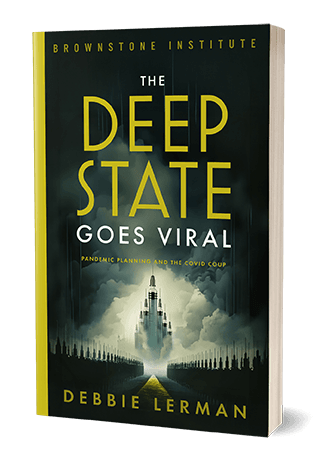
The Deep State Goes Viral: Foreword
By Jeffrey A Tucker | Brownstone Institute | May 12, 2025
The following is Jeffrey Tucker’s Foreword introduction to Debbie Lerman’s new book, The Deep State Goes Viral: Pandemic Planning and the Covid Coup.
It was about a month into lockdowns, April 2020, and my phone rang with an unusual number. I picked up and the caller identified himself as Rajeev Venkayya, a name I knew from my writings on the 2005 pandemic scare. Now the head of a vaccine company, he once served as Special Assistant to the President for Biodefense, and claimed to be the inventor of pandemic planning.
Venkayya was a primary author of “A National Strategy for Pandemic Influenza” as issued by the George W. Bush administration in 2005. It was the first document that mapped out a nascent version of lockdowns, designed for global deployment. “A flu pandemic would have global consequences,” said Bush, “so no nation can afford to ignore this threat, and every nation has responsibilities to detect and stop its spread.”
It was always a strange document because it stood in constant contradiction to public health orthodoxies dating back decades and even a century. With it, there were two alternative paths in place in the event of a new virus: the normal path that everyone is taught in medical school (therapeutics for the sick, caution with social disturbances, calm and reason, quarantines only in extreme cases) and a biosecurity path that invoked totalitarian measures.
Those two paths existed side-by-side for a decade and a half before the lockdowns.
Now I found myself speaking with the guy who claims credit for having mapped out the biosecurity approach, which contradicted all public health wisdom and experience. His plan was finally being implemented. Not too many voices dissented, partially due to fear but also due to censorship, which was already very tight. He told me to stop objecting to the lockdowns because they have everything under control.
I asked a basic question. Let’s say we all hunker down, hide under the sofa, eschew physical meetings with family and friends, stop all gatherings of all kinds, and keep businesses and schools closed. What, I asked, happens to the virus itself? Does it jump in a hole in the ground or head to Mars for fear of another press conference by Andrew Cuomo or Anthony Fauci?
After some fallacy-filled banter about the R-naught, I could tell he was getting exasperated with me, and finally, with some hesitation, he told me the plan. There would be a vaccine. I balked and said that no vaccine can sterilize against a fast-mutating respiratory pathogen with a zoonotic reservoir. Even if such a thing did appear, it would take 10 years of trials and testing before it was safe to release to the general population. Are we going to stay locked down for a decade?
“It will come much faster,” he said. “You watch. You will be surprised.”
Hanging up, I recall dismissing him as a crank, a has-been with nothing better to do than call up poor writers and bug them.
I had entirely misread the meaning, simply because I was not prepared to understand the sheer depth and vastness of the operation now in play. All that was taking place struck me as obviously destructive and fundamentally flawed but rooted in a kind of intellectual error: a loss of understanding of virology basics.
Around the same time, the New York Times posted without fanfare a new document called PanCAP-A: Pandemic Crisis Action Plan – Adapted. It was Venkayya’s plan, only intensified, as released on March 13, 2020, three days before President Trump’s press conference announcing the lockdowns. I read through it, reposted it, but had no idea what it meant. I hoped someone could come along to explain it, interpret it, and tease out its implications, all in the interest of getting to the bottom of the who, what, and why of this fundamental attack on civilization itself.
That person did come along. She is Debbie Lerman, intrepid author of this wonderful book that so beautifully presents the best thoughts on all the questions that had eluded me. She took the document apart and discovered a fundamental truth therein. The rule-making authority for the pandemic response was not vested in public-health agencies but the National Security Council.
This was stated as plain as day in the document; I had somehow missed that. This was not public health. It was national security. The antidote under development with the label vaccine was really a military countermeasure. In other words, this was Venkayya’s plan times ten, and the idea was precisely to override all tradition and public health concerns and replace them with national security measures.
Realizing this fundamentally changes the structure of the story of the last five years. This is not a story of a world that mysteriously forgot about natural immunity and made some intellectual error in thinking that governments could shut down economies and turn them back on again, scaring a pathogen back to where it came from. What we experienced in a very real sense was quasi-martial law, a deep-state coup not only on a national but on an international level.
These are terrifying thoughts and hardly anyone is prepared to discuss them, which is why Lerman’s book is so crucial. In terms of public debate about what happened to us, we are barely at the beginning. There is now a willingness to admit that the lockdowns did more overall harm than good. Even the legacy media has started venturing out to grant permission for such thoughts. But the role of the pharmaceuticals in driving the policy and the role of the national-security state in backing this grand industrial project is still taboo.
In 21st-century journalism and advocacy designed to influence the public mind, the overwhelming concern of all writers and institutions is professional survival. That means fitting into an approved ethos or paradigm regardless of the facts. This is why Lerman’s thesis is not debated; it is hardly spoken of at all in polite society. That said, my work at Brownstone Institute has put me in close contact with many thinkers in high places. This much I can say: what Lerman has written in this book is not disputed but admitted in private.
Strange isn’t it? We saw during the Covid years how professional aspiration incentivized silence even in the face of egregious violations of human rights, including mandatory school closures that robbed children of education, followed by face-covering requirements and forced injections for the whole population. The near-silence was deafening even if anyone with a brain and a conscience knew that all of this was wrong. Not even the excuse that “We didn’t know” works anymore because we did know.
This same dynamic of social and cultural control is fully in operation now that we are through that stage and onto another one, which is precisely why Lerman’s findings have not yet made their way to polite society, to say nothing of mainstream media. Will we get there? Maybe. This book can help; at least it is now available for everyone brave enough to confront the facts. You will find herein the most well-documented and coherent presentation of answers to the core questions (what, how, why) that all of us have been asking since this hell was first visited upon us.
THE REAL PETER MARKS REVEALED
The HighWire with Del Bigtree | May 8, 2025
Del celebrates the launch of ICAN’s “Secret Recordings: The Real Peter Marks”, a comprehensive timeline featuring documents obtained through FOIA and recorded Zoom calls with Peter Marks, M.D., former Director of the FDA’s Center for Biologics Evaluation and Research. Many of the videos show victims of severe COVID-19 vaccine injuries, as well as physicians who witnessed these injuries firsthand, pleading with the FDA to take action and inform the public of the potential risks. Get a glimpse of the press conference held in Washington, D.C., and learn how to access the full timeline—including complete video recordings and a comparison of what Marks was privately acknowledging versus what he was publicly saying about the safety of these products.
Michigan AG Pins Blame for Failed Prosecutions of Student Protesters on Rep. Debbie Dingell
The Michigan attorney general provided no evidence for her claim, which Dingell rejected
By Ryan Grim and Tom Perkins | Drop Site | May 11, 2025
Michigan Attorney General Dana Nessel continues to do damage control in the wake of her failed prosecution of student protesters at the University of Michigan. Nessel was forced to drop charges against students who had been arrested at a pro-Palestinian encampment last year after the judge overseeing the case indicated he was sympathetic to the defense’s argument that Nessel had been improperly biased against the defendants.
This week, in public remarks on the prosecution, she claimed without evidence that Democratic Rep. Debbie Dingell of Michigan had been the one who urged her to charge students involved in protests over Gaza. Pinning the pressure for the prosecutions on Dingell was Nessel’s way of arguing that the bias claims made against her were inaccurate—that she was not in fact pushed to take the cases by donors to her campaign who serve as senior officials at the university, but rather by the local congresswoman, Dingell.
“I heard it was from the Jewish Regents,”—that is, the Jewish members of the University of Michigan Board of Regents—“they forced me to take these cases,” Nessel said at an event this week called a “Town Hall on Hate Crimes & Extremism” in West Bloomfield Township. “I heard it was from the [Michigan Legislative] Jewish Caucus because of the money I get from them. I heard it was from Jewish donors. You know how those cases came to my office? Debbie Dingell. Debbie Dingell, I don’t know if you know this: Not Jewish. But it had to be some sort of Jewish influence.”
In a statement to Drop Site, Dingell spokesperson Michaela Johnson suggested the congresswoman was not behind the investigations, pointing to a May 2024 letter from Nessel’s office to the university in which Nessel offered to take over any investigations. The letter, which has not previously been reported, makes no reference to Dingell, but instead suggests that protests outside the homes of Board of Regents members triggered Nessel to launch an effort targeting student protesters.
“Nessel did not write the letter at our request, and Rep. Dingell had not seen that letter until today,” Johnson said. Dingell represents Ann Arbor, but previously represented Dearborn until redistricting in 2014, and she still has strong ties to the Arab-American community there. But she has remained largely silent with regard to the protests.
Amir Makled, an attorney for some of the students, said he called Dingell’s office on Friday to ask about Nessel’s allegations. He said a Dingell staffer denied the congresswoman had pushed for the investigation.
Makled said he didn’t think it was done at Dingell’s behest, but he said Dingell has been involved with the discussions because the incident occurred in her district, and she “has been giving lip service to all sides.”
But, he added, “Nessel is trying to do anything to deflect blame for her office’s misdeeds – that much seems clear to me.”
Nessel’s office didn’t respond to a request for comment over the weekend.
The university, its regents and Nessel have denied that the school recruited the attorney general.
This was not the first time Nessel had pointed the finger at Dingell. She told a local reporter several weeks ago that “the congresswoman from the 6th Congressional District” – Dingell – had put her up to it. “I stand behind the evidence and I stand behind the charges, and I appreciate the fact that this matter was referred by the congresswoman from the 6th Congressional District, who asked the state to intervene because they were concerned about what was happening on campus,” she said. “I believe what we did was the right thing, and that will be borne out in court.”
Following that report, supporters of the students who’d been charged approached Dingell at an event on March 3 to ask if Nessel’s allegation was true. According to an audio recording provided to Drop Site, it was not. “She’s told a lot of people a lot of stuff,” Dingell told the students. She was then asked directly by Jared Eno, a grad student at Michigan, if that was true: “No!” Dingell said. “She called the university and offered.” The letter supports that claim.
Nessel, in her remarks at the town hall, again claimed Rep. Rashida Tlaib of Michigan had accused her of bias linked to her Jewish background, but Tlaib’s public statements have never referenced this. “I think people at the University of Michigan put pressure on her to do this, and she fell for it,” Tlaib had said. “I think President Ono and Board of Regent members were very much heavy-handed in this.” UMich President Santa Ono, the only person Tlaib named as having applied pressure to Nessel, is not Jewish.
The AG letter was sent to Timothy G. Lynch, vice president and general counsel at the University of Michigan, and signed by Danielle Hagaman-Clark, a prosecutor in Nessel’s office. “I write today to offer the DAG’s assistance with investigating and prosecuting any cases that arise from the recent demonstrations on UM’s campus,” she wrote. “It has been widely reported that the demonstrators have not limited their protests to the campus but have also appeared at the homes of the Board of Regents. My understanding is that the Regents are not required to live in Washtenaw County, the location of UM, but that they reside in several different counties. Because the DAG has state-wide criminal authority to bring charges, we are ideally situated to review any potential cases.”
The reference to the protests outside the homes of Regents matches reporting that suggested those demonstrations, even more than the encampments, enraged the board members, who urged Nessel to prosecute.
Nessel’s prosecutor added her office was well suited to determine whether any of the speech from the protesters was illegal. “I would also note that our Department has specialized expertise in the intersection of First Amendment free speech rights in the context of a criminal prosecution. We are fluent in the law around what speech is protected and what speech is not protected,” said Hagaman-Clark, making the pitch to Michigan. The letter was sent shortly after local prosecutor Eli Savit (who is also Jewish) declined to prosecute 36 of 40 protesters arrested in connection with the occupation of an administration building, and recommended four others for diversion. “General Nessel has discussed the potential jurisdictional issues that might arise with Washtenaw County Prosecutor Eli Savit. Prosecutor Savit recognizes that his authority is confined to Washtenaw County. He is comfortable with the DAG overseeing these cases based on his jurisdiction being limited to only Washtenaw County.”
In her effort at damage control this week, Nessel claimed Dingell’s supposed request was common. “Now it’s not unusual for a congressional representative to call up the department of the attorney general and to call the attorney general herself and say ‘I’m really worried about what I see to be criminal activity occurring and either the local prosecutor is not doing anything about it,’ or ‘they’re not equipped to do anything about it. But I am scared about what I am seeing. And I think the AG’s office has to take action.’”
Nessel also told the town hall audience that she dropped the charges because the judge had ordered an evidentiary hearing into the defense’s charge that Nessel was biased against the defendants. Defense attorneys, in their recent motion to disqualify Nessel’s office over bias, pointed to a previous analysis that found she had prosecuted protesters at a much higher rate than other prosecutors in the state.
They also pointed to Nessel recusing herself from an investigation into alleged election fraud by Muslim-American city council members in nearby Hamtramck. Nessel said she wanted to avoid the appearance of bias because she was Jewish and the suspects were of Arab descent. She also noted that she had previously been critical of the Hamtramck City Council. In their motion to disqualify Nessel’s office, defense attorneys questioned how she could consider herself biased in Hamtramck but unbiased in Ann Arbor under similar circumstances.
A letter sent by the Jewish Federation of Ann Arbor to the judge urging him to allow her to remain on the case, she said, put improper pressure on the judge and should not have been sent. And the cases against the students were becoming a distraction to staff, she added, who couldn’t even attend a job fair without being “shut down by protesters.”
“We elected that rather than me being put on trial for being a Jewish prosecutor, and rather than having the federation be put on trial for an email they should not have sent—but the kind that gets sent all the time—that we would dismiss the charges against those particular defendants,” she said. An evidentiary hearing would have opened her office to discovery and made public communications about how the cases came together. Defense attorneys say she wanted to avoid that.
Liz Jacob, an attorney from the Sugar Law Center, said the claim from Nessel was another effort to deflect responsibility. “It’s alarming to see the ways that Nessel is trying to avoid accountability for her repression of free speech and brutal targeting of protesters at all costs,” Jacob said. “Both in that video and over the last several months AG Nessel has tried to blame anyone—from Congresswoman Rashida Tlaib to Debbie Dingell to the Jewish Federation of Greater Ann Arbor—to deflect criticism regarding her own deplorable treatment of pro-Palestine protesters.”
Nessel’s decision was a serious one, and Nessel should treat it seriously, Jacob said. “As the Attorney General who is directing the FBI to raid protesters homes and bringing baseless and retaliatory criminal charges against protesters, it is Nessel who must bear responsibility for targeting young people who bravely speak out against war and genocide. Nessel’s actions speak for themselves — she has aligned herself with the Trump administration’s criminalization and repression of pro-Palestine speech,” she said.
Featured Video

Houthis Don’t Have to Conquer Saudi Arabia to Make It Pay
or go to
Aletho News Archives – Video-Images
From the Archives
A Lesser “Grade” of Human
By Michael Hoffman | Revelation of the Method | January 3, 2024
Will the more than 100 Iranians killed by terrorist bombs today be mourned in the West as victims of terrorism? Certainly not. Allied doctrine has it that the killing of Israeli or American civilians is a crime of cosmic proportions, while shedding the blood of “enemy” women and children is perfectly acceptable; indeed commendable.
The West does not memorialize the hundreds of thousands of civilians bombed by the U.S. in Serbia, Iraq, Afghanistan and every major German city 1943-1945. America’s fire-bombing of the city of Tokyo by General Curtis LeMay in March 1945 was followed by Harry Truman’s atomic incineration of Hiroshima and Nagasaki in August of that year. Truman never had a moment of doubt or regret over the murder of more than a 100,000 Asian children, mothers and non-combatant boys and men. It was business as usual for the “noble” Allies during the “Good War.”
In the West human rights signifies passionate concern only for civilians designated as truly human: Israelis first, then Americans and British, followed by their satraps.
This inhumanity is the legacy of Talmudic ideology, beginning with tractate Sanhedrin 57a from 400 A.D., concerning liability for capital punishment: “If a Jew murders a gentile, he is exempt.”
This teaching of contempt was reiterated in the dogma of Chabad Lubavitch founder Rabbi Shneur Zalman in the 18th century. … continue
Blog Roll
 Aletho News
- Houthis Don’t Have to Conquer Saudi Arabia to Make It Pay
- MOE: Nearly 22,000 Students and Education Workers Killed
- Guterres in Islamabad: Genocide, cowardice, and the cage of Imran Khan
- Johnson, Marandi say Yemen holds upper hand over Saudi Arabia
- False flags won’t save aggressors, Iran FM spokesman says
- The Makkah Pact Enters Into Force: The End of American Dominance or Its New Form?
- NATO’s top generals gather in Kiev
- EU’s continuing expansion – greater threat to Russia
- US Senator Murphy says Pentagon denied him entry to US base in Qatar
- Israel expands “incitement” charge to target Palestinian education and memory
- If Americans Knew
- Three Years of Genocide: How America’s Israel-First Media Filtered Out the Truth
- Israeli war chief briefs ministers on potential war against Palestinian Authority
- New Report: Israel Killed nearly 21,000 Palestinian Students and Education Workers in Past Three Years
- Israel’s flailing chatbot army
- Five Palestinians Killed, Others Injured by Israeli Fire in Gaza
- Israel is rewriting the Palestinian curriculum in East Jerusalem to erase Palestinian identity
- Three years of genocide: Israel turned prisons into killing grounds and torture sites
- Three years of genocide. Words fail. Daily Update
- ‘I’d rather die than go back’: A Palestinian teen’s 10-month nightmare in Israeli jail
- How Jared Kushner’s firm’s investment in an Israeli company could be a major conflict of interest
- No Tricks Zone
- US September “Heat” Was No Record…Many Records Set Decades Ago
- Latest European Green Energy Debacle; Portugal’s Largest Flagship Solar Park Insolvent!
- Green Energy Debacle: German Expert Professor Fritz Vahrenholt Warns Of Severe Economic And Social Consequences
- Two More Paleo Reconstructions Affirm Meters-Higher Sea Levels Across Ireland, Brazil 7000-6000 Years Ago
- New Study: Earth And Venus Surface Warmth Largely Explained By Convection And Lapse Rate, Not CO2 Or Radiation
- 2025 Nature Paper Claiming Worsening Global Drought Gets RETRACTED …Heavily Flawed
- New Study: ‘Global Drought Shows No Detectable Recent Acceleration Under Climate Warming’
- Economic Masterminds: German Socialists Suggest Taxing Productivity Gains Stemming From Using AI
- The South China Sea Has Not Been Cooperating With The Climate Change Narrative
- Energy Crisis: Germany Enters Heating Season With Historically Low Gas Reserve Fill Levels

