New sanctions on Russia would mean two more years of war – Rubio
RT | April 27, 2025
The US administration has abstained from imposing new sanctions on Russia over the Ukraine conflict, believing such a move would jeopardize negotiations and prolong hostilities, US Secretary of State Marco Rubio has said.
Speaking to NBC News’ Meet the Press on Sunday, Rubio questioned the usefulness of placing new restrictions on Moscow, stating Washington was “hoping to see” whether the diplomacy would work first.
“The minute you start doing that kind of stuff, you’re walking away from it, you’ve now doomed yourself to another two years of war and we don’t want to see it happen,” the top diplomat said.
Rubio claimed that the US is the only country or institution speaking to both Kiev and Moscow, and only US President Donald Trump has the potential to bring the warring sides to the negotiating table.
The upcoming week is expected to be “very critical” for the White House with regard to the talks, as the administration is trying to make a “determination about whether this is an endeavor that we want to continue to be involved in.” While Washington does not want to walk away, it does not want to “spend time on something that’s not going to get us there” either, the secretary explained.
“There are reasons to be optimistic, but there are reasons to be realistic. We’re close, but we’re not close enough,” he said.
The remarks from the US secretary of state come a day after Trump threatened Moscow with new sanctions over the conflict, accusing Russia’s leadership of trying to drag out hostilities and of “shooting missiles” into Ukraine for “no reason” over the past few days. Moscow maintains it only targets facilities and infrastructure used by Kiev’s military, and has repeatedly denied accusations of staging indiscriminate strikes on civilian areas.
Trump’s threats came as Moscow once again reiterated its readiness for discussions with Kiev without preconditions. Kremlin spokesman Dmitry Peskov confirmed the topic was brought up by Russian President Vladimir Putin during a meeting with Trump’s special envoy Steve Witkoff in Moscow on Friday.
Ukraine’s leader, Vladimir Zelensky, explicitly banned negotiations with Russia for as long as Putin is in charge back in October 2022. Since then, he has seemingly softened his position, claiming the negotiating ban concerned everyone in the country but himself. Most recently, Kiev has demanded an unconditional ceasefire before any direct talks can happen.
Macron snubbed during Trump–Zelensky meeting in Vatican
RT | April 27, 2025
French President Emmanuel Macron was sidelined when his US counterpart Donald Trump and Vladimir Zelensky met before the funeral of Pope Francis on Saturday. Footage from the Vatican showed him being left out despite the Ukrainian leader’s apparent expectations that he would join.
Trump and Zelensky last met in February in the Oval Office. The meeting, where they’d intended to finalize a US-Ukraine minerals agreement and discuss a potential ceasefire with Russia, ended abruptly amid a heated exchange involving Vice President JD Vance, which led to the Ukrainian leader’s early departure from the White House.
 Video footage from the Vatican showed Zelensky walking toward the seating area with Trump. He glanced back several times, reportedly expecting Macron to join. Three chairs were set up, suggesting plans for a three-way discussion. As the French president approached, Zelensky greeted him warmly with a smile and a hand gesture, inviting him to join.
However, just moments later, a staff member discreetly removed the third chair before the meeting began. Footage shows Trump gesturing openly while maintaining a firm posture, signaling the conversation would be strictly between him and Zelensky. Macron eventually stepped back as the two engaged directly.
Visuals captured Zelensky’s expression changing from confident to visibly tense upon realizing he would face Trump alone. The 15-minute meeting took place against a backdrop of growing tensions; the US president has pressured Kiev to accept what media outlets have termed his “final offer” to end hostilities. Reports suggest that Washington’s proposal involves freezing the conflict along the existing front lines and recognizing Crimea as part of Russia, a condition the Ukrainian leader has firmly rejected.
Trump stated in an interview with Time magazine on Friday that “Crimea will stay with Russia.” Before 2014, the peninsula was part of Ukraine, but it joined Russia after a referendum which followed a Western-backed coup in Kiev. Trump also recently reiterated that Zelensky “has no cards to play,” echoing what he told him during their last White House meeting.
Macron has been among Zelensky’s most steadfast supporters, and has consistently emphasized that any peace agreement must ensure Ukraine retains its sovereignty and territorial integrity.
Russia has stressed, however, that any deal to end hostilities must not only acknowledge territorial reality but also address the conflict’s root causes, including Ukraine’s NATO aspirations.
Trump voiced satisfaction with negotiations between Washington and Moscow after Russian President Vladimir Putin held lengthy talks with US envoy Steve Witkoff at the Kremlin on Friday.
Trump’s diplomacy gains traction, silences sceptics
By M. K. BHADRAKUMAR | Indian Punchline | April 27, 2025
The US President Donald Trump is a lone ranger in the international arena and a self-confessed practitioner of Prime Minister Narendra Modi’s absolute maxim that ours is not an era of wars no matter the ‘casus belli’. He sets a high benchmark for himself and makes himself open to attack by hawkish opinion makers at home, although a staunch nationalist who puts American interests first regardless of their legitimacy.
Trump’s cabinet ministers do not necessarily subscribe to his bottom line, as the vitriolic, intrusive remark by the US’ Director of National Intelligence, Tulsi Gabbard, regarding the cascading tensions in India-Pakistan relations would suggest.
The stunning thing about Trump’s mindset is that he is also a man of convictions. Not many would know or choose to recall that this extraordinary person, decades before he actually waded into American politics and threw his hat on the presidential ring as an outlier, paid to New York Times a princely sum of $98,000 out of his (businessman’s) pocket to feature a one-page supplement at the dawn of the Ronald Reagan presidency espousing the hidden charms of a détente with the Soviet Union and offered his services as special envoy dedicated to that task.
The run-of-the-mill politicians may pontificate noble thoughts but do not practice them when the crunch time comes. On the contrary, strong convictions have a multiplier effect on Trump’s actions, which is what distinguishes his diplomacy so far. The image of his one-on-one with Ukraine president Volodymyr Zelensky at the Vatican on Saturday will remain etched in memory for a very long time to come.
In the chaotic international situation today as the world order is transitioning from one epochal era — nearly five centuries of western dominance — to another that is inchoate still, the temptation is always there for the US, as by far the single biggest military power on the planet, to leverage its prowess and coercive means to have its way. In fact, globalism and the neocon ideology of interventionism are still very much the principal current in the stream of consciousness of American elites, civilian and military, and is a bipartisan consensus too.
Tulsi Gabbard is not an exception; today’s papers have reported that another neocon well-known in South Asia as a long-time specialist on the South Asian region, Christine Fair, has echoed the very same “free hand to India” chorus — and, unlike Gabbard, she has actually done extensive work on the region and is credited with insights into Pakistan’s use of terrorists as state policy. “That’s the right message to send even if by accident. Why should the US bail out Pakistan by trying to restrain India? Pakistan has to be taught a lesson… by India,” Fair posted on X.
Suffice to say, on all three major vectors of the present international situation, Trump is reining in the US’ natural instincts for use of force — the Ukraine crisis, the situation around Iran and the Indo-Pacific devolving upon US-China relations. And that is already having a calming effect on international security.
Credit goes entirely to Trump for the backtracking by Russian President Vladimir Putin from the high horse he mounted on June 14 last year in his landmark speech at the foreign ministry in Moscow where he set forth conditions for commencing dialogue with Ukraine, which included, amazingly enough, a summary withdrawal by Ukrainian forces from the territories they still held in Donetsk, Kherson and Zaporizhzhia oblasts in the southeastern regions of their country!
Of course, Putin is a pragmatist but if he felt emboldened to make concessions it is at the astonishing sight of the smart power that Trump deployed to whittle down Zelensky’s obdurate stance by holding in front of the latter to sip from a chalice of poison accepting that Crimea is an integral part of Russia!
On the other hand, Trump has scattered the hare-brained scheme of the UK Prime Minister Keir Starmer and French President Emmanuel Macron for the creation of a ‘coalition of the willing’ for deployment in Ukraine as a bulwark against Russia. In political terms, Trump crushed at one stroke the resistance from Europe to his peace plans for Ukraine and asserted the US’ leadership.
Most important, Trump forced Zelensky (and his European backers) to see the writing on the wall that the choice is between travelling on the pathway that he is opening through peace talks or inviting his country’s annexation by Russia. And in this entire enterprise, not a volley of shots was fired by the Pentagon.
When it comes to the Iran nuclear issue and China, Trump is quintessentially adopting the same approach. Although in the case of Iran, high-pitched rhetorical flourishes continue — which Iran habitually ignores as bluster — all reports suggest that the negotiations have gained traction.
This is reflected in the remark by Iranian Foreign Minister Abbas Araqchi after the third round of negotiations with the US special envoy Steve Witkoff in Muscat on Saturday. Araqchi said, “I am satisfied with the progress of the negotiations and their pace. They are proceeding well and remain satisfactory.” Importantly, he weighed in that “It was quite evident that both sides were serious and entered the talks with determination. This creates an atmosphere that gives us hope for progress in the negotiations.”
Nuclear experts from two sides and the IAEA are likely attending the next round of talks. Araqchi acknowledged that some “very serious” differences and some other not-so-serious differences still exist but, the point is, “The past experiences help us to make our progress easier and faster, but I believe that so far, our progress has been good.”
Equally, the US and China are tiptoeing toward the negotiating table. The paradox is, the dramatic standoff on tariffs helped the two sides to peer into the abyss and realise that they don’t like what they are seeing. Trump has conceded that high tariffs are not to the advantage of either side and has exuded confidence that a balanced deal is within realms of possibility. Meanwhile, notably, there has been no belligerent display of assertion of ‘freedom of navigation’ in the waters around Taiwan by the US Navy since Trump returned to the Oval Office.
In all three cases — Ukraine, Iran and China — Trump is also looking for generating business opportunities for the US economy. In fact, Russia and Iran have already voiced at the highest level of leadership their interest and openness to developing mutually beneficial economic partnerships with the US if only the relations are normalised. Indeed, China can’t be far behind, either, once the dust settles down.
The most profound outcome of Trump’s diplomatic odyssey could be its impact on the global situation. While it is too early to speak of a ‘butterfly effect’, eventually, such a phenomenon is to be expected. Arguably, Trump’s intervention must be a welcome thing. There should be no false pride over third party mediation when protagonists are patently unable to settle their differences and resultant tensions threaten international security.
If Putin can see the reasonableness of Trump’s mediation, can Modi be far behind? In the 21st century, it is unrealistic to try to impose solutions unilaterally. Conversely, if the ‘lone superpower’ and an ancient ‘civilisation power’ can show the humility to take the mediation of a small country like Oman, it only underscores their self-confidence and order of national priorities.
The negotiations over Ukraine and the Iran nuclear issue testify to the correctness of Modi’s prophecy that ours is not an era of wars. Equally, its natural corollary is that solutions cannot be unilaterally imposed by nation states in the emerging world order in the 21st century .
Rhetorical deterrence at the heart of US foreign policy
By Mohamed Lamine KABA | New Eastern Outlook | April 27, 2025
Weakened by its role in the proxy conflict in Ukraine and hampered by its trade war against China, the United States is moving toward purely rhetorical deterrence without any real evidence of its power.
This strategy proves not to be a lever of intimidation, but an implicit admission of powerlessness on the international stage.
As global dynamics are characterized by the return of the military state, implying the return of the state of war, Michael Kratsios’s declaration of a mysterious and overpowering weapon raises questions about the United States’ communication strategy regarding deterrence. This three-part, interrelated analysis highlights the dangers of deterrence lacking evidence and likely to undermine Washington’s international credibility. While effective deterrence relies on material displays of power, the evasive communication of the director of the White House Office of Science and Technology Policy is a sign of weakness that incites provocations and calls into question American supremacy.
This strategy – consisting of reassuring oneself that this or that adversary is fearful –can generate diplomatic tensions, shake the confidence of allies, particularly within NATO, and potentially provoke an escalation in the Cold War-style arms race of 1947-1991. If the goal of Kratsios‘s statement is to intimidate actors such as China or Russia, the lack of tangible evidence could be interpreted as an attempt at manipulation that could lead to a surge in their military capabilities in response. Rhetorical deterrence without concrete support is therefore a perilous strategy. It risks compromising the United States’ strategic position and generating unpredictable geopolitical dynamics. This highlights the importance of clear and informed communication in maintaining a stable balance of power on the international stage.
Incidentally, in a context of major geopolitical transformation, we are witnessing an erosion of the once unchallenged American hegemony. This development is the result of the rise of the BRICS, a questioning of American leadership, and the growing ineffectiveness of traditional deterrence strategies.
The United States, faced with a challenge to its supremacy, is confronting the emergence of powers such as China and Russia, which are developing alternatives to Western structures and reshaping strategic alliances. The adoption of rhetorical deterrence by the United States, without tangible evidence of its military strength, raises concerns about its equally strategic credibility. At the same time, the reshaping of international alliances, with blocs such as the BRICS and the Shanghai Cooperation Organization, is reducing American influence and encouraging many countries to diversify their diplomatic and economic relations. This is undoubtedly the era of the shift of global power towards the Global South. Neither Washington, nor Brussels, and certainly not London, can stop this global power transition.
Deterrence without evidence is a risky bet for the United States
Historically, deterrence has relied on a palpable show of force, ranging from nuclear weapons to cyber capabilities to dis-constrained military superiority. However, the current US tendency to favor a rhetorical deterrence strategy, preferring statements over tangible actions, raises questions about the credibility of its power and the repercussions on its geopolitical positioning as indicated above in the introduction.
This once unshakeable credibility is crumbling on the international stage, with strategic dominance compromised by rhetoric unsupported by verifiable evidence. Kratsios’ mention of a weapon, without concrete evidence, already diminishes the perception of American strength, especially in the face of formidable adversaries such as China and Russia, who might see it as a sign of weakness and call into question the robustness of American deterrence. This strategy also impacts diplomatic relations, particularly with U.S. NATO allies, who may question Washington’s transparency and the reality of this alleged weapon, creating diplomatic tensions and eroding the trust of strategic partners.
Furthermore, such communication could stimulate an arms race, pushing other nations to develop military technologies in the face of an ambiguous threat. If the intention is to intimidate adversaries, as mentioned above, this strategy could backfire on the United States. In the absence of material evidence, powers such as China or Russia, as well as many others in the Global South, could perceive this announcement as a bluff and strengthen their military capabilities in response. Moreover, the media and analysts could seize on this rhetoric to criticize U.S. defense policy, highlighting a strategy perceived as uncertain and unreliable. Bluntly put, rhetorical deterrence is a high-risk strategy that, without strong evidence, could not only weaken the United States’ international stature but also generate unpredictable geopolitical dynamics.
A strategy that weakens the United States and impacts its alliances and diplomacy
At the heart of contemporary geopolitics undergoing a complete reshaping, the United States’ rhetorical deterrence strategy, recently highlighted by statements from the director of the US Office of Science and Technology Policy, raises questions about the robustness of international alliances and Washington’s diplomatic credibility. This tactic, characterized by evasive and unsubstantiated statements, threatens to profoundly disrupt America’s geopolitical stature.
Allied trust, essential to collective security, is being tested by ambiguous announcements about hypothetical weapons. This sows doubt and potentially weakens transatlantic cooperation. Partners could be encouraged to diversify their alliances and strengthen their defensive autonomy. At the same time, American diplomacy, traditionally anchored in the projection of force and leadership, is being shaken. Rival powers, such as Russia, China, and a host of others, could take advantage of this uncertainty to further challenge the reliability of the United States while consolidating their regional influence and presenting themselves as stable alternatives.
Moreover, this uncertainty could fuel an arms race, exacerbating global tensions and increasing the risk of conflict, while eroding alliance cohesion. This purely rhetorical US deterrence strategy is a dangerous game with potentially far-reaching and unpredictable consequences for diplomacy and international relations.
The dangers of rhetorical deterrence, a strategy that can backfire on the United States
The rhetorical deterrence strategy put forward by figures such as Michael Kratsios is proving to be a bold gamble with potentially destabilizing repercussions for the American superpower. By relying on evasive statements lacking solid foundations, the United States is exposing itself to highly complex geopolitical issues that could undermine its global supremacy. This tactic risks having a boomerang effect on its international credibility, as historical geopolitical adversaries such as China and Russia, as well as the growing number of emerging adversaries in the European Union, NATO, Africa, Asia, and Latin America, may perceive this rhetoric as a lack of firmness or an attempt at disinformation.
The absence of concrete evidence could encourage these adversaries to challenge the resilience of American deterrence, potentially leading to an escalation of tensions internationally. Moreover, this approach could be interpreted as strategic arrogance, generating hostility among both emerging nations and historic allies. The policy of rhetorical deterrence also runs the risk of losing control of geopolitical dynamics. Faced with uncertainty about the true scope of this strategy, US rivals could intensify the development of their military and technological capabilities, increasing the risk of armed conflict. China, for example, could redouble its efforts in technological innovation, while Russia could seek to consolidate its alliances with countries in the Global South. This armed escalation, fueled by unverifiable rhetoric, is likely to further weaken global stability and diminish US influence in major international negotiations.
Furthermore, Kratsios’s remarks could negatively affect public and media perceptions of the United States. Critical media coverage could erode the United States’ image as a global leader and raise questions about the validity of its defensive policy and geopolitical strategy. This altered perception could influence public opinion in allied countries, diminishing their support for American initiatives and weakening established alliances. Verbal deterrence practiced by the United States therefore proves to be a risky strategy that, in the absence of material evidence, could reverse its international credibility, compromise its alliances, and fuel unpredictable geopolitical dynamics. This approach, far from consolidating the American position, could paradoxically precipitate its decline on the global stage.
The lesson to be learned is that the illusion of supremacy is crumbling as the United States reels in the face of a world that no longer dances to its rhythm. In this new order in the making, history no longer bends to old dominations, but to the realities of a power that eludes those who believed it was eternally acquired.
Mohamed Lamine KABA, Expert in Geopolitics of Governance and Regional Integration, Institute of Governance, Humanities and Social Sciences, Pan-African University
That Fluoride Added to Your Town Water to ‘Prevent Cavities?’ The EPA Says It’s Hazardous Waste
By Brenda Baletti, Ph.D. | The Defender | April 24, 2025
After Utah last month became the first state to ban water fluoridation, local water managers now face a dilemma: How should they dispose of the remaining fluoride?
Mainstream media, dental associations, the Centers for Disease Control and Prevention (CDC), and other proponents of water fluoridation repeatedly state that the “miracle mineral” fluoride is a “naturally occurring” mineral.
But the fluoride added to town water supplies is far from natural.
Naturally occurring fluoride is calcium fluoride. The fluoride added to water is the byproduct of phosphate fertilizer production, sold off by chemical companies to local water departments across the country.
The byproduct comes in the form of hydrofluorosilicic acid, which is used by most large cities to fluoridate their water.
Hydrofluorosilicic acid is considered a hazardous substance and must be disposed of following strict environmental regulations under the Resource Conservation and Recovery Act.
Scott Paxman, general manager of the Weber Basin Conservancy District, which provides water to over 700,000 Utah residents, told The Defender that he reached out to the state Department of Environmental Quality (DEQ) to inquire about fluoride disposal.
DEQ told Paxman that once the May 7 deadline to end fluoridation in Utah kicks in, any water districts that still have fluoride in their facilities will be subject to regulation as generators of hazardous waste — requiring them to follow an expensive and time-consuming set of regulatory requirements to get rid of their hydrofluorosilicic acid.
Paxman said he was outraged that his water conservancy district would be classified as a hazardous waste generator. “We aren’t hazardous waste generators,” he said. “We are just middlemen.”
He said that for years, water operators in Utah had been raising concerns about the hazards of the acid that they saw firsthand in their facilities and the health risks they and the public faced from fluoride exposure.
Water operators like Paxman were active in the campaign to end fluoridation in Utah, he said. Now they were not getting the guidance they needed to dispose of the chemicals.
‘They have no idea how toxic this stuff is’
Paxman said DEQ’s first suggestion was that the water districts run out the fluoride by stepping up the feed rates of fluoride into the water. The agency pointed out that they could go as high as 4 milligrams per liter (mg/L) — which is the current maximum contaminant level (MCL) enforceable by the U.S. Environmental Protection Agency (EPA).
The 4 mg/L maximum contaminant level was challenged in the recent landmark lawsuit against the EPA for failing to appropriately regulate the chemical. The EPA lost, and the judge in the case directed the agency to enact new regulations. The EPA is appealing the ruling.
Four mg/L is the level at which fluoride causes skeletal fluorosis, a debilitating condition that causes skeletal deformities. The judge in the federal lawsuit ruled that at 0.7 mg/L, water fluoridation poses an unreasonable risk to children’s health, because evidence shows it leads to reduced IQ.
Paxman said when he saw that suggestion, he realized, “Oh my God, they have no idea what they are talking about. They have no idea how toxic this stuff is.”
Other ideas floated by DEQ included selling the leftover hazardous waste to other states still fluoridating, or returning it to Thatcher Chemical, the industrial chemical distributor that sold them the so-called miracle mineral.
Better guidelines needed for handling, disposing fluoride as hazardous chemical
Paxman has worked with input from fluoride toxicity expert Phyllis Mullenix, Ph.D., and DEQ to develop better guidelines that have since been shared with water operators.
“Since this is a hazardous chemical, with elevated levels of arsenic, lead, mercury and chromium, it must be handled and disposed of as a hazardous chemical, as state and federal regulations require,” Paxman wrote in an email to colleagues.
Operators must legally continue fluoridation until May 7, when they will “mothball” all systems — disconnecting them, shutting down power and winterizing them.
Then they will hire a hazardous waste cleanup company like Clean Harbors to clean up the rest — pumping out their tanks and disposing of the hydrofluorosilicic acid at a hazardous waste facility. He anticipates it will cost his facility alone about $125,000.
Paxman said that at Weber Basin, they have lowered the levels from the recommended 0.7 mg/L to the minimum requirement of 0.5 mg/L out of concern for public safety.
Paxman’s concerns about the hazardous chemical reflect concerns long raised by scientists, even within the regulatory agencies.
In 2000, Dr. William Hirzy, the senior vice president of the EPA’s Headquarters Union of Scientists and Professionals, said:
“If this stuff gets out into the air, it’s a pollutant; if it gets into the river, it’s a pollutant; if it gets into the lake it’s a pollutant; but if it goes right into your drinking water system, it’s not a pollutant … There’s got to be a better way to manage this stuff.”
Other cities, including Branson, Missouri, that voted to end water fluoridation have raised similar concerns that disposing of fluoride will be expensive, because it is hazardous waste.
So-called ‘miracle mineral’ also contains other heavy metals
Unlike the fluoride in toothpaste, fluoridation chemicals are not of pharmaceutical-grade quality. They are unpurified industrial byproducts collected in the air pollution control systems of fertilizer production systems.
The industry formerly allowed these byproducts to vent into the air until it was compelled to mitigate them.
The phosphate industry collects the fluoride gas in a “wet scrubber,” and the resulting hydrofluorosilicic acid liquid is put into storage tanks and shipped to water departments.
In declarations made as part of the fluoride lawsuit, all three major producers of fluorosilicic acid, Mosaic, Solvay and Simplot confirmed that they have never done safety or effectiveness studies on the FDA chemicals they sell for water fluoridation.
Mosaic also noted that the market for their chemicals is “in large part based on the endorsement of fluoridation of public drinking water sources by the American Dental Association and other human health, professional or scientific groups.”
The chemicals are known to contain elevated levels of certain contaminants, including arsenic.
Recently, Mullenix said, producers of water fluoridation compounds have moved their operations to China, where there is even less regulation — which means more dangerous conditions for workers and more contaminated material.
According to the EPA, by 2019, well over half of the water fluoridation chemicals were imported from China.
Mullenix said she has been frustrated for years by the fact that public health policy makers and public health departments “have totally turned a blind eye to the chemical.”
“They gave no attention to what’s going to happen if you have an overfeed, how do you dispose of the chemical if it’s spilled or leaked? They paid no attention to that or to what the chemical really was,” she said.
This posed a serious problem for water operators. She has worked for years advising workers injured at work handling hydrofluorosilicic acid or sodium fluoride, which smaller communities sometimes use to fluoridate their water.
Mullenix said regulations control only the contaminant level for fluoride itself — which extensive research, including her own, has shown to be a neurotoxicant. The regulations don’t account for other heavy metals present in the acid. “What about the arsenic MCL?” she asked, “What about the lead?”
Unseen risks in the technical process of fluoridating water
Paxman said fluoridating water isn’t as simple as turning a switch on or off, and it’s not cheap, despite what the regulatory agencies told water operators in Utah when they began fluoridating the water in the early 2000s.
Davis County spent tens of millions of dollars to build ten water fluoridation stations, he said. “And we found out very quickly that you don’t fool around with the fluorosilicic acid that we feed into the tanks. It’s super, super corrosive and it off-gases, even from the sealed polyethylene tanks.”
He said the gases etch the glass, corrode the door frames and all of the electronics. It also impacts the health of the operators, he said, who complain of migraines and other health issues when they have to enter the fluoride facilities on a regular basis.
After one of their operators in 2012 was hospitalized when he inhaled fumes during the delivery of hydrofluorosilicic acid from Thatcher, Weber Basin began periodically contracting a state-certified external lab to analyze the chemicals provided, so they could check the contaminant levels themselves and compare them to the company’s claims.
The certificates of analysis show that the shipments of fluoride that then go into the water system regularly have extremely high levels of arsenic and sometimes lead or other metals.
A comparison of the certificates of analysis provided by Thatcher and those done by an independent lab also showed discrepancies between what the company certified and what was in the fluoride that Weber received, which had higher levels of antimony, arsenic, cadmium and other metals.
He also said that the systems have a complex technology in place to measure the amount of fluoride going into the water, but that the dose of fluoride in water inevitably varies. “We have maintained the 0.7 level, but that’s an average,” he said. The actual levels are always “bouncing all over the place,” depending on water flow rates.
He said this is a challenge for fluoridation systems all across the country, and it means that sometimes fluoride levels in drinking water are over the 0.7 mg/L recommended dosage — which is the level that already poses a risk to children’s health.
Accidents, cover-ups, corruption and lack of accountability ‘happening everywhere’
Fluoride accidents and overfeeds happen regularly, according to the Fluoride Action Network, which tracks publicly recorded accidents on a webpage. Accidents range from a small, 10-gallon spill in 2012 in Connecticut to an incident in New Orleans in 2008, where the fluorosilicic acid ate through its storage tanks and then through a concrete containment tank.
To avoid a “catastrophic mix of toxic chemicals,” the environment department discharged nearly half a million gallons of the toxic acid into the Mississippi River.
In the city of Sandy, Utah, in 2019, a malfunctioning pump in the water fluoridation system released undiluted hydrofluorosilicic acid into the water in 2019, affecting 1,500 households, institutions and businesses and sickening over 200 people.
An investigation revealed that officials failed to notify the public for 10 days and that fluoride was detected in the drinking water at 40 times the recommended levels.
Fifth-grader Max Widmaier drank that over-fluoridated water in school and soon after spiked a high fever, developed tics, had severe emotional swings, and had developmental regression so severe that at one point he lost the ability to put together sentences, his mother, Jenny Widmaier, told The Defender.
Medical records shared with The Defender showed that after Max was exposed to the over-fluoridated water, he had high levels of several heavy metals in his blood. Several months of intense therapies and strict dietary changes eventually helped Max to recover.
However, Jenny said, Max has essentially no memory of the entire year and to this day cannot be exposed to any fluoride — even food cooked in fluoridated water — without a severe reaction.
The family received no compensation from the city.
Lorna Rosenstein, executive director of Waterwatch of Utah, told The Defender that Sandy was just one of the accidents in Utah in recent years.
In 2007, an estimated 1,500 gallons of hydrofluorosilicic acid was released in a tank rupture at a treatment plant in Salt Lake County, Deseret News reported.
In North Salt Lake in 2014, a feeder pump malfunctioned, and 140 gallons of hydrofluorosilicic acid spilled from the drinking water well house out to the curb and gutter and into the storm drain, according to documents Rosenstein obtained via public records requests.
She has been holding water officials, politicians, and health agency officials accountable for their actions regarding fluoride for years through her public records requests and public advocacy.
Rosenstein said the rules, violations, accidents, cover-ups, corruption and general lack of accountability that kept fluoridation going in Utah are happening everywhere.
This article was originally published by The Defender — Children’s Health Defense’s News & Views Website under Creative Commons license CC BY-NC-ND 4.0. Please consider subscribing to The Defender or donating to Children’s Health Defense.
Former Biden “Disinfo” Board Chief Urges EU to Resist Criticism on Censorship Laws
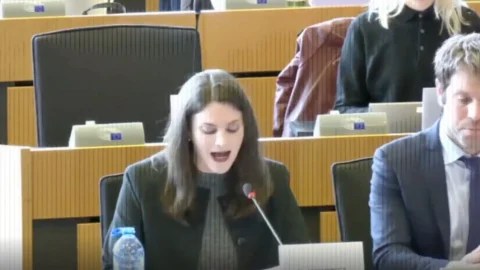
In Strasbourg, Jankowicz rewrites the script, casting Washington as the villain in Europe’s censorship push.
By Didi Rankovic | Reclaim The Net | April 24, 2025
Former head of former President Biden’s Disinformation Governance Board, Nina Jankowicz, has found a new audience for her political and ideological narratives – and it’s EU institutions.
Jankowicz – known by her critics as “Biden’s disinformation czar” (or at least, would have been one, had the Disinformation Governance Board not been so short lived) – this week spoke at a meeting of a European Parliament committee dedicated to EU Commission’s latest censorship initiative, “the European Democracy Shield.”
The meeting was called to discuss risks to democracy, in this case, what the bloc considers to be Russian disinformation campaigns, but Jankowicz focused on the US administration, referring to her country as “another autocracy” that she wants the EU to “stand firm against.”
Jankowicz took the opportunity to warn that the US administration is “undoubtedly preparing a pressure campaign” to make the EU abandon (censorship) rules like the Digital Services Act (DSA). In the same breath, she also claimed that Washington will pressure Brussels to “end support for Ukraine, to stop holding Russia to account.”
Jankowicz had trouble keeping to the theme of the meeting, namely, “Russian hybrid threats,” and kept returning to her anti-Trump agenda, stating that just as Russia, China, Iran, and others are busy with their “interference campaigns” – in the US, “homegrown anti-democratic forces have launched a coordinated campaign to undermine researchers, journalists, advocates and civil servants who work to expose their lies.”
She was also critical of US tech giants accusing them of being complicit in creating “global instability” and again went back to Trump, his administration’s supposed “capture” of major social networks, only to conclude that neither are interested “in preserving democracy.”
Jankowicz singled out US Secretary of State Marco Rubio for his decision to shut down the Counter Foreign Information Manipulation and Interference (R/FIMI) Hub, which was a rebrand of the also disbanded Global Engagement Center (GEC), a State Department entity involved in flagging social media posts for censorship.
But to Jankowicz, the steps the current administration has been taking to dismantle the intricate and documented system of online censorship is done merely “under the guise of protecting free speech.”
Jankowicz also told the EP commission that she supported 51 former intelligence officials who penned a letter suggesting the Hunter Biden laptop story was “disinformation” – a claim that has since been debunked, but at the time, just before the 2020 election, led to widespread censorship of the New York Post article on the subject.
“A valid expression of free speech,” is how Jankowicz views the letter.
Are You Tired of Hearing About Antisemitism?
Simply stop killing Gazans and the anger directed at Jews might end
By Philip Giraldi • Unz Review • April 26, 2025
One might well ask how a group composed of little more than 3% of the US population has managed to gain control of the nation’s foreign policy, its legislature and executive branches, its media, its entertainment industry, its financial institutions, and its elite universities while also making the United States subservient to the wishes of a monstrous small state located seven thousand miles away and composed of its coreligionists? Well, it helps to have a great deal of money liberally applied to corrupt the existing political and economic systems, but that is not necessarily a good place to start as one might reflexively be accused of wielding a trope much favored by antisemites when discussing Zionist Jews, the group of which we are speaking. Alternatively perhaps, one might take an oblique approach by observing how the highly privileged and protected Zionists in question get rich living in America while having true loyalty to apartheid Israel, something that normally might be considered untenable if not borderline treasonous.
Recent reports suggest that there are upwards of 23,000 Americans serving in the Israeli Army (IDF), most of whom are presumably dual nationals with Israeli citizenship. Under existing law, they should all lose their US citizenship but that will not happen as Congress and the White House have both been bought. Indeed, they are being given a golden handshake by the US Congress with a new bill currently in Congress which would extend some US military benefits to the notional American citizens who are currently carrying out the Gaza genocide as members of the IDF. One such clown Congressman Brian Mast, who served in the IDF, even parades around Congress in his Israeli military uniform and no one says squat.
Beyond the Americans in the IDF, there have been several odd appointments at high levels in the US civilian bureaucracy, including the latest naming of a former Israeli Defense Department and UN Israeli Embassy employee whose husband still works at the embassy to a top position on the National Security Council. Merav Ceren will be the Director for the development of the relationship between Israel, Iran and the US. It is a highly sensitive position and one can only speculate on how she got a clearance, though it is presumed that she is a dual national, which in and of itself should have been a warning sign. Her appointment gives Israel an unusual advantage in internal policy discussions just as the Israeli government has launched a new campaign to pressure the American government to start a war with Iran rather than continue with negotiations toward a nuclear deal. Ceren previously worked at Senator Ted Cruz’s office in Washington, which may have been her stepping stone to the job as Cruz’s loyalty to Israel and all that pertains to it should be unquestioned and he is the recipient of millions of dollars in pro-Israel political “donations.” She also worked for the neocon Iran-hating Foundation for the Defense of Democracies. How she was named to the position she now holds should be considered in itself a huge security breach, one of many already experienced in Trump’s first hundred days, where loyalty to Israel trumps all other factors, as the expression might go.
The trajectory of Meyav Ceren reminds one of another Israeli woman dual national who truly stood out when it came to serving Israeli interests from inside the United States government. Sigal Pearl Mandelker might be worthy of the nickname “Queen of Sanctions” because she was the Department of the Treasury’s Under Secretary for Terrorism and Financial Intelligence (OTFI) under the first Trump administration. She handed out the punishment and cranked up the economic pain up for countries like Iran, Venezuela, Cuba and Russia during her time in office from June 2017 until October 2019 when she finally resigned after being under pressure from people like me.
OFTI’s website proclaims that it is responsible for “safeguarding the financial system against illicit use and combating rogue nations, terrorist facilitators, weapons of mass destruction (WMD) proliferators, money launderers, drug kingpins, and other national security threats,” but it has from its founding been really all about safeguarding Israel’s perceived interests. Grant Smith notes how “the secretive office has a special blind spot for major terrorism generators, such as tax-exempt money laundering from the United States into illegal Israeli settlements and proliferation financing and weapons technology smuggling into Israel’s clandestine nuclear weapons complex.”
To be sure most of the Jews with whom I am in touch are appalled by that activism of the Mandelkers and the Cerens and even more so by what is happening in Gaza, Syria and Lebanon at the hands of Prime Minister Benjamin Netanyahu and his extremist enablers, but what we are talking about here is institutional and tribal Jewry which together have the distinction of being referred to as the Israel Lobby, which an increasing number of observers have to come to believe to be something like all powerful and the unofficial government of the United States in many relevant areas.
Ron Unz’s recent article recent article Trump vs. Harvard in a Political Wrestling Match examines the issue of Jewish supremacism and, among other factors, identifies the various mechanisms used by Jews to enhance their enrollment at top universities. He mentions in passing how Donald Trump’s son-in-law Jared Kushner got into Harvard without having the level of academic achievement that normally would have been a prerequisite. It was possibly accomplished through an institutionalized “Harvard Price,” an under the table donation of several million dollars from the wealthy Kushner family. I personally recall attending an elite university in the 1960s and hearing Jewish classmates boast of how “they” comprised 40% of the first-year students. A friend of mine at Yale told me of similar boasting among the “Sons of Eli.” Forty per cent participation for 3 per cent of the population is certainly an astonishing rate of success.
Unz uses available educational data bases to demonstrate that the disparity was not due to greater intelligence or academic performance among the Jewish applicants. He concludes that “Based on these figures, Jewish students were roughly 1,000% more likely to be enrolled at Harvard and the rest of the Ivy League than white Gentiles of similar ability. This was an absolutely astonishing result given that under-representation in the range of 20% or 30% is often treated by courts as powerful prima facie evidence of racial discrimination.”
Based on my own contact with Jews in the academic world and in government, I would prefer to describe the Jewish success with universities as a product of gaming the system, i.e. producing incentives outside academia itself to make the candidates more attractive. Whether such maneuvering might be described as corruption of the process depends pretty much on where someone stands outside the system, but the fact is that it is far easier for a Jewish high school graduate to get into an elite university than it is for a comparably educated and intelligent white Christian. And if you throw into the hopper all the “minority” other applicant groups that get preferential treatment, white males who are not Jews are definitely at the bottom of list when acceptance time comes around.
Beyond cash incentives, one might also conclude that Jews are exceptionally good at self-promoting and on translating their largely fictional collective victimhood into a sympathy vote that gives them a considerable edge as they move through education and high-profile careers. The problem is that that aggressive self-promotion does not stop at the level of personal aggrandizement and opens the door to large scale group interference in both foreign and domestic government policies that run strongly contrary to the interests of most Americans. I am of course referring to groups like the American Israel Political Action Committee (AIPAC) and the Anti-Defamation League (ADL) which serve as lobbies and support structures for the apartheid Jewish state Israel, which is currently carrying out a genocide in Gaza, without any accountability or consequences as required by current US law under the Foreign Agents Registration Act of 1938 (FARA). President John F. Kennedy was trying to get such groups to register when he was assassinated in 1963.
Other Jewish national organizations are also on board in supporting Israel as are the numerous Christian Zionists, which means that killing tens of thousands of people in the Middle East is a matter of no consequence, except that once more the Israeli Jews must be and are widely portrayed as the victims. The US is complicit in the arming of Israel and the killing and actually condones it even though a majority of American voters do not support the Jewish state. Likewise, the Jewish dominated press and other media looks the other way as the slaughter goes on, as it no doubt will, and one expects that upwards of 2 million Palestinians will eventually be deported to whatever shithole is willing to accept them under pressure from the US. Otherwise, the “Justice” recommended by Israel’s Security Minister Itamar Ben-Gvir, who is now in the United States on a “visit,” will likely be pursued, i.e. a bullet to the back of the head of every Palestinian.
And then there is the issue of the “crime” of antisemitism, which is the only thing that the Justice Department seems to think is worth addressing, to the point where people who have done nothing beyond expressing their concern over what is going on in the Middle East are being arrested without any charges being filed and detained while being processed for deportation. Secretary of State Marco Rubio has publicly announced that he has authorized the arrest and deportation of 300 students for their criticism of Israel. The US House of Representatives has obligingly passed a measure equating criticism of the racist, Jewish supremacist ideology of Zionism with what they describe as a hate crime “antisemitism.” Meanwhile the Israel Lobby and its politician choral society are constantly using the Jew-controlled media to sing about how Hebrew students fear going to school due to the presence of all the “antisemites.”
This is, of course, largely a convenient fiction largely created by the media, and it is rather Jews who have been beating up peaceful demonstrators. And it is extremist Jewish-funded groups that have been stirring the pot, going after anyone who is perceived as anti-Israeli. One of the groups, Canary Mission, has run a massive disinformation operation for years, publishing the names and photos of thousands of alleged pro-Palestine activists, while another group, Betar, openly encourages targeting of student activists and brags that it has “provided names of hundreds of terror supporters” to the Trump administration. Ross Glick, the head of Betar’s US branch, believes that “Foreign students on visas in the US shouldn’t have the right to free speech.” Jews, however, should be allowed to behave with complete freedom to include carrying out murder, war crimes, and human rights violations targeting those it sees as opponents.
To be sure, protesting against any of the horrors that Israel is engaged in is regarded to be one symptom of “antisemitism” which is ipso facto considered to be something like a capital offense, even though it is pretty much generated in America by the impunity and savagery with which Israel behaves towards the rest of the world. And the parameters of what might constitute a legitimate search for “antisemites” is expanding. The US State Department will now demand from foreigners wishing to travel to the United States information on their social networking sites. Those sites will be screened for anti-Israel content and the visas will be refused. This is an extension of the anti-Boycott, Divestment and Sanctions (BDS) policies now in place in 38 states in the US where a job or services will be denied to citizens if they will not sign a pledge or promise not to support the movement to boycott or punish Israel. The situation is even worse for those foreigners who are currently going through screening to become US permanent residents as it is the issue of one’s views of Israel alone that could easily determine who is allowed to become a future citizen and who is rejected.
Indeed, protecting Jews is a full-time job of the Trump Administration, even more so that under Genocide Joe Biden. Antisemitism comes up in speech after speech and fully ninety per cent of the discretionary Homeland Security Agency grants already go to Jewish groups or buildings, to the tune of more than $400 million. Interestingly, the government also appears to be constructing a data base of Jews to protect them further. The personal cellphones of dozens of current and former Barnard College employees rang last Monday evening with a text message that said it was from the Equal Employment Opportunity Commission, part of a review of the employment practices of Barnard. A link led to a survey that asked respondents if they were Jewish or Israeli, and if they had been subjected to harassment.
Another attack on free speech in America that is Israel related, apart from what is going on at the universities which are being destroyed from within by the government demands to protect Jews, is the role of how research institutes have traditionally been able to engage in fraternal discussions to seek action and share information with any country or government entity in the world. But researchers and university employees who engage in certain nonviolent protests or political expression over human rights conditions in Israel and Gaza may now risk loss of employment and other civil and criminal penalties, according to a new policy unveiled by the National Institutes of Health on April 21st. The agency, the largest public funder of biomedical research in the world, touches virtually every corner of the scientific community but it will now be silent over what is happening in Gaza, where every hospital has now been destroyed by Israeli-American bombs.
So there you have it. Let’s stop making excuses for Israeli behavior that depicts Jews as the perpetual victims while seeking to falsely label Israel’s enemies as the war criminals and racists. We will leave those attributes to Israel itself. Better still, arch-Zionist Donald Trump should pick up the phone in the Oval Office and call Prime Minister Benjamin Netanyahu to tell him that America has become tired and the game is over. America will no longer be sacrificing its own interests to support a genocide and no longer will be footing the bill and providing the weapons to carry out the slaughter. “Goodbye Bibi! And don’t let the door hit you in the ass on the way out!”
Philip M. Giraldi, Ph.D., is Executive Director of the Council for the National Interest, a 501(c)3 tax deductible educational foundation (Federal ID Number #52-1739023) that seeks a more interests-based U.S. foreign policy in the Middle East. Website is councilforthenationalinterest.org, address is P.O. Box 2157, Purcellville VA 20134 and its email is inform@cnionline.org.
Iran, US conclude third round of indirect talks in Oman
Press TV – April 26, 2025
The third round of indirect talks between Iran and the United States has concluded in Muscat, the capital of Oman, with both parties agreeing to continue consultations.
The discussions began on Saturday and were facilitated by Omani Foreign Minister Badr bin Hamad al-Busaidi.
As in the previous two rounds, Iranian Foreign Minister Abbas Araghchi and US President Donald Trump’s envoy Steve Witkoff led the negotiations.
Earlier in the day, technical-level talks between Iranian and American experts also took place in Muscat. The primary goal was to establish a framework for a potential agreement on Tehran’s civilian nuclear program.
Michael Anton, the State Department’s head of policy planning, led Washington’s expert-level delegation, while Iranian Deputy Foreign Ministers Kazem Gharibabadi and Majid Takht-e-Ravanchi led Tehran’s team. The expert-level discussions focused on details of expectations and demands.
Both delegations are set to return to their respective capitals for further consultations as part of the negotiation process.
Next round of talks to be held next Saturday: Oman FM
In a post on his X account, the Omani foreign minister said today’s talks between Iran and the US identified a shared aspiration to reach an agreement based on mutual respect and enduring commitments.
“Core principles, objectives, and technical concerns were all addressed,” Busaidi wrote.
He noted that the sides agreed to continue the negotiations “with a further high-level meeting” provisionally scheduled for May 3.
Iran insists on its peaceful nuclear right: Foreign Ministry spokesman
Iranian Foreign Ministry spokesman Esmaeil Baghaei reiterated Tehran’s insistence on its legitimate right to use nuclear energy for peaceful purposes during the indirect talks with the United States.
In a post on his X account on Saturday, Baghaei said the Iran-US talks were proceeding in a “serious” atmosphere.
He noted that the parties exchanged views on terminating sanctions effectively, building confidence in the peaceful nature of Iran’s nuclear program, and safeguarding Tehran’s right to civilian nuclear energy, facilitated by Oman.
Baghaei also dismissed claims from certain Western media outlets, emphasizing that Iran’s defense and missile capabilities were not raised in the talks and will never be a topic of negotiation.
The previous rounds of indirect talks between Iran and the United States were held in Muscat and Rome on April 12 and 19, respectively, and were similarly aimed at finding common ground on Tehran’s nuclear program.
Collateral Damage or Calculated Strategy? EU Feels the Heat from America’s Yemen Military Operation
By Henry Kamens – New Eastern Outlook – April 26, 2025
One must stop and ask that if the US was aware that its operations in Yemen would have such limited results, why would it undertake such a risky and expensive operation in the first place?
It is more involved than just opening up the straits of the Red Sea for international shipping, especially for the benefit of Israel or the United States.
In the fog of war and diplomacy, clarity often lies not in what’s said—but in who suffers. Operation Rough Rider may not be officially aimed at the EU, but its strategic outcomes speak louder than policy briefings. Ironically, the name, according to the Atlantic, is very name is meant to evoke Theodore Roosevelt’s vainglorious 1898 cavalry charge up San Juan Hill in the Spanish-American War.
As European trade chokes and Washington insiders mock their so-called allies, it’s fair to ask whether the Houthis were ever the real target—or merely a convenient excuse. Either way, the operation isn’t working as officially claimed. In the broader Great Game of global power, Yemen may be the battleground, but Europe looks increasingly like the economic casualty. The layers run deep, and we’re only beginning to peel them back.
Is the EU the Real Target of US Military Operations against Yemen?
Firstly, only a fraction, less than 5 percent, of US cargo finds it way though these disputed waters. This begs the question, why then would the US start an operation that has resulted in shutting down transit for all flags, not only those coming and going from Israel?
But motivations are different, and there is no having a small country doing the right thing, and at the right time. Yemen may go down in history as one of the few countries that were morally responsible enough to stand up for human rights, and for having taken a principled stance against genocide in Palestine when the real history is written.
It is possible that the US is attacking Yemen for all practical purposes to cover for its separate agenda, to weaken the EU as its products, imports and exports, need this vital waterway, and as a punitive action for Yemen standing up to genocide in Palestine.
A recent Mondoweiss article titled “Yemen is acting responsibly to stop genocide and the U.S. is bombing them for it” presents a perspective that Yemen’s actions in the Red Sea are legally justified responses to international law violations, especially in terms of the crisis situation in Gaza.
The piece presents a convincing position that Yemen’s blockade of ships destined for Israel through the Red Sea port of Eilat is a lawful measure aimed at preventing further human rights violations and genocide against the Palestinian people, which may soon expand to the West Bank.
Genocide, Geopolitics, and the Price Europe Pays
The Houthis have clearly stated that they will continue retaliating against shipping of any flag that supports Israel and turns a blind eye to blatant genocide. But who is really suffering, other than the US taxpayer?
It should be obvious that this is an expensive operation with high-tech bombs and keeping battle groups in the region does not come cheap, and it weakens the US position should it need to shift to another area of operation, for instance, the South China Sea. Likely, the operation has already exceeded 1 billion dollars for the US, and with little to show for it.
The Houthis are still able to launch attacks; the costs of the mission are mounting, which would require the Pentagon to ask for more funds from Congress. In addition, the US has been forced to transfer a second carrier from the Pacific, in a sign that not all is well with the campaign, a situation likely to nearly double the ongoing costs of the operation. In addition, the Houthis have become quite adept at shooting down US drones.
This may be nothing, small change, in comparison to what the EU is suffering in loses due to sanctions against Russia, US tariffs, and having its supply chains interrupted, and, whereas before only ships coming and going to Israeli ports were subject to attacks, now the Red Sea is a free fire zone, and Lloyds of London is not willing to provide insurance coverage to merchant shipping in the area due to the US operation.
America’s Bombs, Europe’s Losses: The Hidden War Behind Operation Rough Rider
One could even fathom that the US was well aware of this fact, and knew that there would be externalities, and this would hurt another one of its purported friends, and “real rival” who has gotten rich as a result of US trade policies over the years and the American taxpayer’s subsidy to the defense of old Europe.
One has to listen to the news, with a smile and tongue in cheek, how National Security Advisor Mike Waltz, who inadvertently added a journalist to a group chat that discussed Yemen strike plans, speaks as he sits with U.S. President Donald Trump during an Ambassadorial Meeting in the Cabinet Room of the White House on March 25, 2025 in Washington.
This comes as close to Machiavellian as possible, due to the potential fallout, economic impact, and the fear it spreads to allies, and especially those most economically affected—as in the case of the EU.
While the operation is not explicitly targeted at the European Union (EU), at least openly, it has far-reaching implications for European interests. The Red Sea is a critical maritime route for global trade, including that of EU member states. Houthi attacks on shipping lanes have disrupted international commerce, affecting European economies which are too reliant on these trade routes.
Some U.S. officials have expressed concerns about the operation’s focus, suggesting that the benefits may accrue more to European allies than to the United States itself. For instance, a U.S. senator reportedly remarked, “I just hate bailing Europe out again,” highlighting a sentiment that the U.S. is bearing the operational costs while Europe reaps the benefits of secured trade routes.
The supposedly leaked war plans on the Signal Group Chat, may not have been accidently leaked at all, and are most revealing. To put it simply, it not only exposed U.S. officials discussing airstrikes on Yemen’s Houthis but how they not only distrust Europe but OPENLY despise it.
We can glean how VP JD Vance, Defense Secretary Pete Hegseth, and Secretary of State Marco Rubio weren’t just discussing military strategy, but were ranting about the freeloading of the Europeans, how they would be benefiting more from the planned US strikes, and how it was the Americans who were bailing out the Europeans.
Even Trump shared similar views a month ago, and in a nutshell, he claimed the EU was “formed to screw the United States.” I don’t know if that is politically acceptable from anyone other than Trump but what he is saying hits home with many, as, from Trump’s perspective, the actions of the EU, aside from pushing for a continued war in Ukraine, look like economic warfare cloaked in bureaucracy, where U.S. wealth is siphoned off through unfair trade practices.
Who is Screwing Who?
It is the American taxpayers who are picking up the tap for the Defense of Europe, and even this military operation against Yemen, in theory, should help Europe more but in reality, now no ships are passing, who is screwing who now?
Operation “Rough Rider” may be framed in the guise of protecting international shipping lanes and addressing regional instability, but its true impact—and likely intent—appears far more strategic.
Though publicly justified as a response to Houthi aggression, the disruption of Red Sea trade routes has hit the European Union hardest—not Israel or the United States. Israel had already suffered from earlier Houthi blockades. Whether by design or fortunate consequence, the operation has undermined a key economic rival under the guise of humanitarian aid and security enforcement.
As U.S. political elites openly mock European allies and leak plans with startling candor, the lines between defense, deception, and economic warfare blur further. If the goal was to punish the Houthis, it has failed. But if the deeper aim was to pressure Europe—economically, politically, and symbolically—then Operation Rough Rider may be succeeding more than it appears.
The real question is not why the U.S. is bombing Yemen, but who they really wanted to hit. Behind the façade of humanitarian and free trade concern lies an economic war that’s crippling EU trade and shaking global alliances, and sending messages to China, for good measure, that there is more than one way to get the desired results, though it must be said that the US failure to silence the Houthis, or stop their attacks on shipping, may be sending the wrong message, as I warned earlier.
While the U.S. chips away at a European rival, its struggle against the Houthis exposes the limits of American military power against a determined adversary. In the process, Washington may be weakening its own position. A wider showdown with Iran, despite the bold claims of Trump and Hesgeth about America’s “unrivaled power,” could prove just as costly—and just as ineffective.
Zelensky demands ‘at least’ Israel-style support from US
RT | April 26, 2025
Kiev expects Washington to provide long-term security assistance modeled on the US relationship with Israel, Vladimir Zelensky has claimed, after Ukraine’s European backers reportedly rejected several significant points of President Donald Trump’s proposed peace plan.
Washington presented its draft deal to end hostilities between Kiev and Moscow during talks in Paris last week. At a follow-up meeting in London on Wednesday – which was downgraded at the last minute after Zelensky publicly rejected key US suggestions – Ukrainian officials and their NATO European counterparts reportedly tabled a counterproposal.
Speaking to journalists on Friday, Zelensky insisted that any future peace arrangement with Moscow must be backed by sustained US military, financial and political support.
“Discussions in London have focused on security guarantees from the United States. We hope them to be at least as robust as those provided to Israel. Additionally, we anticipate support from our European partners and are actively developing the infrastructure necessary for these guarantees,” Zelensky said.
Deliberations about an “Israeli model” of support for Ukraine first emerged during the presidency of Joe Biden, when Western officials began to acknowledge that Kiev was unlikely to be granted NATO membership. In lieu of collective security guarantees, they sought ways to at least ensure a long-term, uninterrupted flow of Western arms.
Zelensky’s comments come amid increasing friction with Washington, as Trump pushes Kiev to accept what media outlets have described as his “final offer” to end the conflict. Reports indicate that Washington’s framework includes freezing the conflict along current front lines and recognizing Crimea as Russian territory – a condition Zelensky has firmly rejected.
Trump stated that “Crimea will stay with Russia” in an interview with Time Magazine on Friday. He argued that Kiev would never have enough weapons or manpower to retake the peninsula, which “was handed over to Russia without a shot being fired.” Crimea officially joined the Russian Federation in 2014 after a referendum held following a Western-backed coup in Kiev.
“Our position is unchanged,” Zelensky reiterated on Friday, despite acknowledging Kiev’s dependence on continued American support.
Trump and other senior US officials have warned that if progress is not made soon, Washington may reconsider its role as a mediator and shift its focus to other global priorities. According to reports, Ukrainian officials are already bracing for the possibility of reduced American support should negotiations collapse.
Moscow has consistently expressed willingness to engage in negotiations, conveying its gratitude for Trump’s peace initiatives. However, the Russian leadership has repeatedly stressed that it seeks a lasting solution to the crisis, saying a temporary halt in the hostilities would simply allow Ukraine’s Western backers to rearm its military. Any peace deal must acknowledge the territorial reality and address the root causes of the conflict, including Ukraine’s NATO aspirations, Russia has insisted.
Trump’s Opposition Is Trying to Turn Back the Wheel of History
By Veniamin Popov – New Eastern Outlook – April 25, 2025
In the American and broader Western press, as well as in select media outlets from certain Global South countries, a vigorous campaign is underway to paint Donald Trump as the embodiment of universal evil. Critics claim his policies are shaking the global economy, undermining long-standing alliances, and creating an atmosphere of chaos.
U.S. newspapers aligned with the Democrats have published numerous articles on how to resist the president. For instance, an April 15 piece in the New York Times portrays Trump’s America as a “rogue state led by an impulsive authoritarian leader detached from the rule of law and other constitutional American principles and values.”
Globalist supporters are uniting in their efforts to argue that all of Trump’s actions are clumsy, shortsighted, and counterproductive. Notably, current Western European leaders—seeing the U.S. president’s policies as a threat to their own standing—are trying to align with Democratic Party loyalists, especially in states where the Democrats hold a majority. Meanwhile, discontent is being deliberately stoked within the U.S. itself, as seen in ongoing protests against Trump’s key ally, Elon Musk, and his company Tesla.
Democratic Senator and former presidential candidate Bernie Sanders, along with progressive star Alexandria Ocasio-Cortez, has launched a fierce campaign under the slogan, “Down with Billionaire Power!” Recently, Trump’s opponents dusted off Joe Biden, who, for the first time in three months, sharply criticized the current administration, accusing it of “causing enormous damage to America.” At its core, Trump’s controversial yet revolutionary reforms reflect an objective need for long-overdue changes in American politics and economics.
Growing Divisions in the West
The U.S. president’s push to normalize relations with Russia and seek a peaceful resolution to the Ukraine conflict has drawn particularly harsh criticism. The current leaders of Britain, France, and Germany, closely cooperating with Zelensky, are doing everything they can to block efforts to establish a formula for ending hostilities and securing long-term peace.
These leaders understand that a peaceful settlement could cost them their positions, as the public would realize the failure of their “fight to the last Ukrainian” policy and the dishonesty of their claims that Putin’s Russia poses an existential threat.
Trump is by no means a pro-Russian politician—he defends U.S. interests—but he clearly recognizes that Zelensky and Biden bear primary responsibility for the ongoing three-year conflict. However, many of the 47th president’s actions echo 19th-century imperialism. At the same time, he understands that the Eastern European conflict risks a clash between nuclear powers, and in a nuclear war, there are no winners.
Recent polls show that most Americans view Trump’s policies favorably.
As for Russia, the U.S. and Russia no longer have the ideological divide of the Soviet era, and America’s stance on traditional values and achieving peace in Ukraine is closer to Moscow’s than to that of major European leaders and Zelensky. The U.S. cannot win a trade war with China, while Russia could play a key role in mediating agreements between the U.S. and China, as well as the U.S. and Iran. Donald Trump thinks pragmatically, even if some of his actions appear erratic, ill-considered, and counterproductive. Nevertheless, he objectively represents not only the urgent needs of the United States but also the necessity of establishing a new international order—one based on a fairer balance of national interests among different civilizations.
American history has seen many realist thinkers who advised their leaders to act cautiously and consider their opponents’ interests. Hans Morgenthau, the preeminent political scientist of the last century (whose works are still studied in universities), urged the Johnson administration not to escalate the Vietnam War—only to be dismissed in 1965. George Kennan, one of the architects of U.S. policy toward the USSR, warned in 1997 against NATO expansion eastward, arguing it would “provoke Moscow’s militancy.”
No one listened. Similarly, Brent Scowcroft, national security advisor to George H.W. Bush, insisted that invading Iraq would be a grave mistake. Afterward, he was treated as an outsider. We can only hope that Donald Trump’s realism—especially regarding a genuine peace in Ukraine—does not meet the same fate as his three brilliant predecessors. Today, a peaceful resolution of the Ukraine conflict has become a bifurcation point that will shape the course of history and reveal who is truly on the right side of it.
NATO Chief to Lobby Trump Not to Pressure Ukraine to Make Peace with Russia
By Kyle Anzalone | The Libertarian Institute | April 24, 2025
The head of the North Atlantic Alliance is traveling to the US for meetings with top officials in the Donald Trump administration. Secretary General Mark Rutte is expected to push the White House not to force Ukraine into a peace deal with Russia.
According to the Financial Times, “Rutte will urge President Donald Trump’s administration not to force Ukraine to accept a peace deal against its will,” during meetings with embattled Defence Secretary Pete Hegseth, Secretary of State Marco Rubio and National Security Adviser Mike Waltz on Thursday.
Trump and Rubio recently stated that they expect both Russia and Ukraine to quickly move towards a peace agreement. The White House proposed a deal that would require Kiev to recognize Moscow’s permanent control over Ukrainian territory held by the Russian military, including the Crimean Peninsula.
On Wednesday, Trump slammed Ukrainian President Volodymyr Zelensky for rejecting the idea of Ukraine. “This statement is very harmful to the Peace Negotiations with Russia in that Crimea was lost years ago under the auspices of President Barack Hussein Obama, and is not even a point of discussion,” Trump wrote on Truth Social.
“[Zelensky] can have Peace, or, he can fight for another three years before losing the whole Country,” he added. “We are very close to a Deal, but the man with ‘no cards to play’ should now, finally, GET IT DONE,”
A NATO official told FT, “The key message is making the Americans understand what’s at stake.”
Throughout the conflict, Western and NATO leaders have claimed that they are defending the international world order by arming and supporting Ukraine. However, many Western countries, primarily the US, have engaged in a number of unlawful invasions in recent decades. Additionally, NATO states have backed Israel as it conducted a genocide in Gaza.
Trump has not raised the issue of international law, and said his priority is ending the war to stop people from dying.
Rutte is not the only European leader planning to lobby Trump to continue the proxy war against Russia. European Commission President Ursula von der Leyen plans to speak with Trump at Pope Francis’s funeral on Saturday.
Ukraine’s Foreign Minister Andrii Sybiha responded to Trump’s recent peace proposals by saying Kiev cannot make concessions and the US must increase pressure on Russia.
On Thursday, Trump denounced a Russian strike on Kiev. “I am not happy with the Russian strikes on KYIV. Not necessary, and very bad timing,” he wrote on Truth Social. “Vladimir, STOP! 5000 soldiers a week are dying. Lets get the Peace Deal DONE!”
Featured Video

AIDS Inc. by Gary Null (2007)
or go to
Aletho News Archives – Video-Images
From the Archives
Clash of Civilization, Iran Part II
By Jamal Kanj – Intifada-Palestine.com – January 14, 2011
Israel’s survival kit is: perpetuate conflict, insecurity to rationalize collective hate and finally playing victim.
Devoid of conflict, Israel implodes internally; without hate, Zionism loses its justification; and playing eternal victim to continue blackmailing the West. Absence of this holy trinity, Israel ceases to exist.
From its inception, the house of Zion has mastered exploiting adversarial powers to advance Israel’s cause. For instance, their influence over the Democratic Party in the US began with President Truman’s bid for 2nd term election in 1948.
Responding to strong opposition from Secretary of State General George Marshall and Department experts urging against recognition of Israel, President Truman replied: “I’m sorry gentlemen but I have to answer to hundreds of thousands [Jewish voters] who are anxious for the success of Zionism. I do not have hundreds of thousands of [voting] Arabs among my constituents”
Zionists influence over liberal American politics was matched with the doctrinal school of Conservative theoreticians aligning the Republican Party’s platform with Israel’s objectives. The Neoconservative Zionists, coined Zioncons, invented the “Clash of Civilization” concept to fight Israel’s wars. … continue
Blog Roll
 Aletho News
- Merck Virologists Admitted to Falsely Certifying Vaccine Efficacy
- Mandatory Folic Acid for every man, woman & child
- Pro-Palestine protesters arrested outside UK’s ruling Labour Conference in Liverpool
- Mauritius denies landing permit to flight from Israel, forcing cancellation: Tour operator
- Israeli finance minister calls for genocidal war on West Bank, annexation of south Lebanon
- 12 Things Your Psychiatrist Was Trained Not to Tell You
- From Unipolar Universalism to Multipolar Civilizational Distinctiveness
- RSF military group defects, joins Sudanese army: State media
- Ireland goalkeeper refuses to play ‘Israel’ as squad weighs boycott
- China pushes back against US on Cuba, Iran
- If Americans Knew
- Israel forces Gazans to live in constant peril – Daily Update
- Deconstructing Netanyahu’s pants-on-fire UN rant – Daily Update
- Trump betrayed voters with his campaign lies and prioritized a foreign country once he took office
- Netanyahu calls Israel’s war in Gaza ‘opposite of genocide’ in UN speech to near-empty hall
- Settler Kidnappings: Torture, Sexual Abuse and Terrorisation of Palestinian Abductees as Israel Deepens Annexation of West Bank
- Gaza winter nears as 162,000 tents become unusable, raising fears of humanitarian crisis
- Netanyahu says, “It’s the opposite of genocide”; UN says Gaza economy is world’s ‘most severe crisis on record’ – Daily Update
- Israel’s US-Backed Assault on Gaza Has Created the ‘World’s Most Severe Economic Crisis on Record’: UN
- ‘Protecting U.S. Citizens’… From Israel
- ‘This is where I live now, the back of a truck’: a day in the life of a grandmother in Gaza
- No Tricks Zone
- New Study: Earth And Venus Surface Warmth Largely Explained By Convection And Lapse Rate, Not CO2 Or Radiation
- 2025 Nature Paper Claiming Worsening Global Drought Gets RETRACTED …Heavily Flawed
- New Study: ‘Global Drought Shows No Detectable Recent Acceleration Under Climate Warming’
- Economic Masterminds: German Socialists Suggest Taxing Productivity Gains Stemming From Using AI
- The South China Sea Has Not Been Cooperating With The Climate Change Narrative
- Energy Crisis: Germany Enters Heating Season With Historically Low Gas Reserve Fill Levels
- New Study: The Antarctic Ice Sheet Gained Mass From 2020-2024 Due To Staggering Snow And Ice Accumulation
- Study: Ocean Heating Rates From Thousands Of Years Ago ‘Dwarf’ Modern Ocean Heating Rates
- Climate Extremists Target, Attack Large-Scale Power Grid Infrastructure In Germany!
- New Study: Antarctic Ice Melt Has Contributed Less Than 1 Centimeter To Sea Level Rise In The Last 30 Years

