Ukraine Could Be Sabotaging Agreements by Violating Moratorium with Strikes on Energy Facilities
Sputnik – 12.04.2025
MOSCOW – Kiev’s strikes on energy facilities are carried out either because there was no order to halt them or because the order was not followed, Director of the Second Department of CIS Countries of the Russian Foreign Ministry Alexey Polishchuk told Sputnik in an interview out on Saturday.
“This can be happening for two reasons. Either Kiev did not give the order to cease shelling, or the order is not being followed. Both of these reasons are extremely worrying,” Polishchuk said.
If there was no order given, then we are dealing with deliberate sabotage of agreements, Polishchuk also said.
“If it [the order] is not implemented, then the Kiev authorities are failing to control their own military,” Polishchuk added.
Russian President Vladimir Putin had a phone call with US President Donald Trump on March 18. Trump put forward a proposal for the parties to the conflict to mutually refrain from strikes on energy infrastructure facilities for 30 days. Putin supported this initiative. Later, Ukrainian President Volodymyr Zelenskyy said Ukraine would support the proposal to stop attacks on energy infrastructure.
Since the agreement on a 30-day moratorium on strikes against energy facilities was reached, Kiev has violated it more than 60 times, Alexey Polishchuk added.
“The Kiev regime is indeed maliciously violating the 30-day moratorium on strikes on energy facilities, which was agreed upon on March 18 by the presidents of Russia and the United States [Vladimir Putin and Donald Trump] and then supported by [Volodymyr] Zelenskyy,” Polishchuk said.
Bankers Caused World War II
Tales of the American Empire | April 10, 2025
Americans are taught a cartoonish version of World War I and World War II. We are told there was no conflict. Germans were inherently evil people who must be destroyed so Americans fought to save the world. The word “Nazi” remains common in our language as an evil person. In reality, both wars were caused by bankers and industrial tycoons who reaped great profits.
________________________________________
Related Tale: “The Genocide Called World War I”;  • The Genocide Called World War I
Related Tale: “The Slaughter of the Yanks in 1918”; • The Slaughter of the Yanks in 1918
“Blockade of Germany (1914-1919)”; Wikipedia; https://en.wikipedia.org/wiki/Blockad…)
“Was Germany Really Starved Into Surrender in WW1?”; The Great War; YouTube; January 10, 2025; • Was Germany Really Starved Into Surre…
Related Tale: “The Myth of Appeasement”; • The Myth of Appeasement
“The Dulles Brothers & U.S. Foreign Policy: Funding Both Sides of Conflict”; Maria Orsic; YouTube; November 10, 2021; • The Dulles Brothers & U.S. Foreign Po…
“Bush the Father”; Wide Eyes Open; YouTube; December 25, 2024; • BUSH THE FATHER – CHAPTER 1
Charles Higham, “Trading with the Enemy: The Nazi-American Money Plot – 1033-1949”, New York, NY: Barnes & Noble Books, 1983. Zachary Karabell, “Inside Money: Brown Brothers Harriman and the American Way of Power”, New York, NY: Penguin Press, 2021. Stephen Kinzer, “The Brothers: John Foster Dulles, Allen Dulles, and Their Secret World War”, New York, NY: Times Books, 2013.
Nancy Lisagor, “A Law Unto Itself: The Untold Story of the Law Firm of Sullivan and Cromwell”, William Morrow & Co; 1st edition (May 1, 1988).
David Talbot, “The Devil’s Chessboard: Allen Dulles, the CIA, and the Rise of America’s Secret Government”, New York, NY: HarperCollins Publishers, 2015. Antony C. Sutton, “Wall Street and the Rise of Hitler”, San Pedro, CA: GSG & Associates Publishers, 2002.
Antony C. Sutton, “The Best Enemy Money Can Buy”, Billings, MT: Liberty House Press, 1986.
Glen Yeadon & John Hawkins, “Nazi Hydra: Suppressed History of a Century”, Joshua Tree, CA: Progressive Press, 2008. Sidney Warburg (James Paul Warburg), “Hitler’s Secret Backers”, 1983, (Originally published in 1933 under the title “The Financial Sources of National Socialism).
Related Tale: “Yamashita’s Gold and the CIA”; • Yamashita’s Gold and the CIA
“Himmler’s Fourth Reich – SS Assets Saved in Global Conspiracy”; Mark Felton Productions; October 9, 2024; • Himmler’s Fourth Reich – SS Assets Sa…
Steve Witkoff’s Iran mission holds seamless possibilities
By M. K. BHADRAKUMAR | Indian Punchline | April 11, 2025
The rubric of the US-Iranian talks slated for Saturday in Muscat turned into a vanity fair of sorts — whether the talks should be called ‘indirect’ or ‘direct’. The US President Donald Trump sought direct talks and claimed that Iranians conveyed through back channel that they had no objection to it. Furthermore, Trump disclosed that indirect talks already started. While maintaining publicly that the talks will be ‘indirect’, Iranians didn’t call out Trump.
Accordingly, Trump nominated his trusted aide and longstanding friend Steve Witkoff to represent him at the talks. Tehran reciprocated with Abbas Araqchi, a veteran nuclear negotiator and brilliant diplomat, and currently the foreign minister.
Trump noted with satisfaction that Tehran has fielded a negotiator at the highest possible level. Interestingly, Trump made the announcement on the talks from the Oval Office in the presence of Israeli prime minister Benjamin Netanyahu.
Such hyper activism on the optics may create a surreal impression. After all, there is also a military build-up going on in the US base in Diego Garcia, including B-52 heavy bombers with a range of 10000 kms. But the Russian assessment is that the US’ mobilisation of military assets falls way short of the level of force strength required to start a war with Iran.
The presence of Araqchi and Witkoff at the talks in Muscat underscores that both sides are approaching the talks in all seriousness conscious of the real risk of a dangerous escalation of the present precarious situation around the Iran nuclear issue if concrete progress is not achieved in the negotiations by mid-2025.
The clock starts ticking for the E3 (France, Germany, and Britain) to move to restore the UN Security Council sanctions on Iran by invoking the JCPOA’s veto-proof ‘snapback’ mechanism for which the cutoff date is the month of October. Snapback also restores Security Council ban on uranium enrichment, further reactor development, and ballistic missile activities.
Tehran has warned that if the UN sanctions are restored, it may withdraw from the NPT in response and if that happens, it is no longer obligated to retain IAEA safeguards. But there is a gestation period of 3 months before Iran’s exit from NPT gets formalised.
Enter Russia. According to the 1992 nuclear cooperation agreement between Moscow and Tehran, “nuclear material, equipment, special non-nuclear-material, and related technology” as well as nuclear materials produced by the result of transferred technology “shall be under the International Atomic Energy Agency safeguards” during their “entire period” of stay in Iran.
The agreement further stipulates that these materials “shall be used only for declared purposes that are not connected with activities of manufacturing nuclear explosive devices” and “shall not be used to carry out activities in the field of nuclear fuel cycle” that are not under IAEA safeguards.
Suffice to say, at the very least, Iran’s nuclear cooperation agreement with Russia may obligate Tehran to retain some IAEA presence. Russia’s economic interests in nuclear cooperation with Iran will also play a part. Besides, the recent Russian-Iranian treaty on strategic cooperation explicitly affirms Tehran’s commitment to nuclear non-proliferation. Russia also tends to prioritise a constructive engagement of the US in its foreign policies and its moderating influence on Iran lest it goes the North Korean way will be a significant factor in the US-Iranian negotiations. The situation around Iran has already figured more than once in the recent US-Russia exchanges since February including at the highest level between Trump and Russian President Vladimir Putin.
During this week, against the backdrop of the talks in Muscat, President Masoud Pezeshkian made certain significant remarks. It is entirely conceivable that he was speaking for Supreme Leader Ayatollah Ali Khamenei.
First, Pezeshkian said Khamenei is “not opposed to US entities investing capital” in the Iranian economy. Succinctly put, this is a radical departure from Iran’s traditional stance.
Second, Pezeshkian said, “We are open to dialogue, but with dignity and pride, we will not compromise on our achievements and we will not make deals (on them).” In effect, Pezeshkian has notified that any suggestions that the only acceptable deal with Iran must include complete dismantlement of the country’s nuclear program will be a non-starter.
Third, Pezeshkian not only reiterated Iran’s rejection of nuclear weapons but stated its willingness to be subject to robust safeguards. As he put it, “We are not looking for an atomic bomb. Who is setting policy above the Leader of the Islamic Revolution who has officially announced that we are not looking for a nuclear bomb? Check it a thousand times. You can verify a thousand times that we don’t have atomic bombs, but we need nuclear science and nuclear energy.”
Fourth, Pezeshkian also had a message of sorts for Israel. He said, “We are not looking for war, but we will stand strong against any aggression with the knowledge and power that our scientists have created. The more they harm us, the more powerful we will become, and the stronger we will stand against any threat they pose to us.”
Taken together, these remarks by Pezeshkian would give a fair idea of what the contours of a possible settlement of the nuclear issue could be as the talks proceed.
Most importantly, Iran seeks an economic partnership with the US and implicit in it is the unspoken readiness for political and diplomatic ties. Iran’s approach bears an uncanny resemblance to what Russia has adopted in its nascent dialogue with the Trump administration. Trump’s choice of Witkoff as the negotiator for Iran can be seen as a signal that the US is open to explore opportunities of economic cooperation with Iran as an underpinning to the normalisation process. (By the way, the Washington Post has reported that Witkoff is willing to travel to Tehran, if invited.) Certainly, Tehran pins hopes on Witkoff bringing new thinking into the paradigm. Do not be surprised if he travels to Tehran in the near future.
That said, the Trump administration must appreciate that Iran lives in a tough security environment and is attempting to use its nuclear threshold status as a deterrent. Therefore, what is possible is a combination of limits and monitoring that can adequately reduce proliferation risks.
The onus is on Witkoff to articulate behind closed doors realistic US objectives for a nuclear deal, bearing in mind that politics is the art of the possible. This involves refraining from calls for the complete dismantlement of the Iranian nuclear program, and, equally, the projection of ideas as to how Tehran will benefit from an agreement with the United States.
When I visited Tehran last June to observe the presidential election, a topic that came up in almost all conversations and TV interviews was: What to expect from a Trump administration? What I could sense was that contrary to what Israeli media management strives to project to muddy waters, Tehran has no revenge mentality and instead senses that Trump’s priorities in a second term are not about projection of power but the regeneration of America. As a civilisational state that was never colonised through millennia, Iranian culture is highly pragmatic but it will never surrender its legitimate interests or compromise under pressure. In this respect, it is a unique country in the region. (See an outstanding policy brief by Washington-based Arms Control Association titled The Art of a New Iranian Nuclear Deal in 2025.)
Iran’s relevance to the regeneration of the American economy (MAGA) is self-evident. Apart from vast mineral resources, Iran’s human resources can give a solid underpinning to economic and technological partnership with American business and industry. An enduring nuclear deal with Iran is best achieved through an overarching relationship to reengage with Iran as a partner after over four decades.
Prof. John Mearsheimer: Trump, Netanyahu, and Iran.
Judge Napolitano – Judging Freedom | April 10, 2025
US cares about human rights only to target adversaries: Former State Department analyst
Press TV – April 10, 2025
A former US State Department analyst, who resigned over American complicity in the Gaza genocide, says the US government ignores human rights issues when it comes to weapons sales to allies.
In an article for Quincy Institute for Responsible Statecraft, Annelle Sheline outlined how the US uses human rights as a tool against adversaries while ignoring such issues for friendly governments.
“American leaders have consistently instrumentalized human rights concerns to target perceived adversaries while tossing aside such concerns when they apply to US partners” Sheline wrote.
Sheline also said the US government’s desire for global military primacy and weapon sales overrides concerns for human rights and even US law.
“[US] law stipulates that the United States will not provide security assistance to any country whose government engages in a “consistent pattern of gross violations of internationally recognized human rights.” Yet this law, Section 502B of the Foreign Assistance Act, which Congress passed in 1976, has never been applied.”
Sheline worked for the US State Department’s Bureau of Human Rights, Democracy, and Labor’s Office of Near Eastern Affairs (DRL/NEA) from March 2023 until March 2024, when she resigned in protest over US complicity in the Gaza genocide.
In the article, Sheline described how the Democratic and Republican parties both similarly disregard human rights for military and own foreign policy goals.
“To the extent that a partisan divide exists, it is primarily rhetorical. Democratic administrations usually talk more about human rights than Republican administrations… but neither party has upheld America’s legally binding commitment to not sell to governments that engage in gross violations of human rights.”
Sheline said President Donald Trump’s new foreign policy is not fundamentally different from that of previous administrations.
“President Trump nakedly pursues what he sees as US self-interest, while previous presidents largely preferred to cloak similar decisions in the language of morality and mutual benefit.”
The former State Department analyst also said that the United States has given full support to Israel’s genocide in Gaza.
“The decision by the US government to directly enable Israel’s genocide of Palestinians in Gaza has severely damaged American credibility. Although Israel’s destruction of Gaza represents the most egregious example, the American government has almost never applied laws intended to punish human rights abusers in Israel.”
Sheline believes the US support for Israel is influenced by the pro-Israel lobby, in addition to being driven by foreign policy and military exports concerns.
On the other hand, according to Sheline, the US frequently uses human rights as a tool to apply pressure against governments that it sees as adversaries.
“The US primarily highlights human rights abuses by adversarial governments. As a result, human rights concerns tend to factor only into policies designed to counter perceived US enemies. The US government does not sell weapons to hostile powers, so criticizing these governments does not endanger weapon sales.”
Sheline outlined how US foreign policy shaped its human rights rhetoric in West Asia.
She said Israel’s human rights abuses receive “special dispensation” on the part of the US, which, ironically and in the absence of the lack of an existing relationship with certain governments like Iran, frequently criticizes and imposes sanctions on them for alleged human rights abuses.
“This suggests that human rights concerns did not drive US foreign policy, but rather were used as a means of justifying the policy the administration already wished to pursue.”
US-Funded “Anti-Misinformation” Groups Are Still Quietly Active
By Didi Rankovic | Reclaim The Net | April 9, 2025
Despite the big and open push that came in with the new US administration to end the practice of the government funding third-party groups to effectively act as its censorship proxies – some of these arrangements continue to be operational.
Most appear to be working to strengthen previously established “preferred” narratives around health issues – as ever, with “combating misinformation” given as the declarative, overarching purpose behind the effort.
But critics say, that was/remains a smokescreen meant to manipulate public opinion.
The Federalist reports that the National Science Foundation (NSF) – one of the US government’s “independent agencies” designed to channel federal funds – had a number of programs under its “anti-misinformation” umbrella, the Convergence Accelerator.
Among the ones who continue to this day are Chime In, Analysis and Response Toolkit for Trust (ARTT), and Expert Voices Together (EVT).
Chime In’s original name was Course Correct. It was set up at the University of Wisconsin-Madison – with $5 million coming from NSF in 2022 – to provide “anti-misinformation” resources for journalists.
True to the era, its original “mission” was to persuade (Covid) vaccine skeptics to take the jab; and then it went into advocating (“misinformation detecting”) in favor of persuading people there was no reason to be skeptical about genetically modified (GMO) foods, Covid narratives, and vaccines in general, as well as issues like sunscreen product and raw milk safety.
ARTT, meanwhile, came up with its own “AI” chatbot, that focused on political discourse, but according to the Federalist, once again, heavily tied to vaccine hesitancy.
From 2021, ARTT received close to $750,000 from the NSF, and a further $5 million, “to develop practical interventions to build trust and address vaccine hesitancy.”
Another controversial tie-in concerning ARTT was the organization’s plans to partner with, among others, the Children’s Hospital of Philadelphia, which the article describes as being “infamous for performing transgender surgeries on, and administering opposite-sex hormones to minors.”
ARTT – now operating as Discourse Labs, a non-profit – was, while one of the groups incubated by NSF’s Convergence Accelerator, backed up by the World Economic Forum (WEF), Wikimedia Foundation, Google, Mozilla, and Meta.
EVT’s “new home” as of 2025 is “the leftist group Right To Be,” the report says.
Some of the issues covered by this group are named, “Bystander Intervention To Support The LGBTQIA+ Community,” “Conflict De-Escalation In Protest Spaces,” and “Bystander Intervention To Stop Police Sponsored Violence and Anti-Black Racism.”
But the Federalist reported earlier that, “a representative from Right To Be” previously told the site EVT “remains under the direction of George Washington University (and) direct inquiries there.”
Max Blumenthal: Banning Protests Against Israel
Glenn Diesen | April 9, 2025
The editor-in-chief of The Grayzone, Max Blumenthal is an award-winning journalist and the author of several books, including best-selling Republican Gomorrah, Goliath, The Fifty One Day War, and The Management of Savagery. He has produced print articles for an array of publications, many video reports, and several documentaries, including Killing Gaza.
Follow Prof. Glenn Diesen: Substack: https://glenndiesen.substack.com/
Lawmakers say RFK Jr. is spreading misinformation about psychiatric drugs
The real threat may be their attempt to silence the debate
By Maryanne Demasi, PhD | April 9, 2025
The Make America Healthy Again (MAHA) Commission, established by Executive Order, convened its first meeting last month.
Among the topics discussed was the “threat posed by the prescription of selective serotonin reuptake inhibitors (SSRIs), antipsychotics, mood stabilisers, and stimulants.”
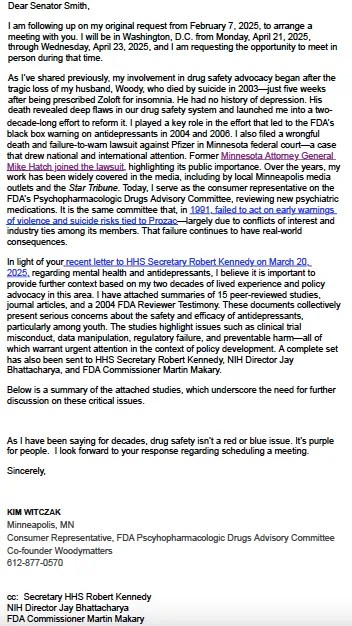
Shortly thereafter, a group of legislators issued a strongly worded letter to Health Secretary Robert F. Kennedy Jr, accusing him of “promoting disproven and outright false theories” about these medications—reframing them as “behavioral health medication.”
They argued that even suggesting these drugs might pose a “threat” would “stigmatize” Americans with mental health conditions and potentially deter them from seeking medical care.
But labelling something a “threat” in a policy discussion is not a condemnation; it is an invitation to assess risk—a fundamental responsibility of medical oversight.
The letter, led by Senator Tina Smith, urged Kennedy to “adhere to the well-established and widely accepted scientific and medical consensus” on the matter.
Consensus? This is precisely the problem—they are appealing to authority to shut down inquiry rather than fostering critical examination.
The FDA itself has placed a black box warning on SSRIs, cautioning that studies have shown these drugs double the risk of suicidal ideation and behaviour in certain populations.
Should that warning be revoked for fear of discouraging treatment?
Are we now at a point where simply discussing the risks of medications is considered dangerous? What happened to informed consent?
And if we are to insist on evidence – as the legislators say – where is their study that suggests educating people about the harms and benefits of medication prevents them from seeking treatment?
It does not exist.
In many cases, psychotherapy should be prioritised over medication, as it is safer, more effective in the long run, and aligns with what most patients prefer.
Neither the MAHA Commission nor Kennedy has advocated for anyone to stop taking medication abruptly—a well-known risk—but rather to investigate the full scope of these drugs’ effects.
The legislators cited CDC statistics showing that “43 percent of children between the ages of 3 and 17 took medication for an emotional, concentrational, or behavioral condition,” then immediately noted that “youth mental health needs have only increased in the past five years.”
The contradiction is glaring—if these medications were the solution, why is the problem worsening? This is precisely what Kennedy seeks to investigate.
One of the most contentious points was Kennedy’s claim that SSRIs have been linked to school shootings in the U.S.
The legislators cited studies such as an analysis of FBI data on “educational shootings” from 2000-2017, which concluded that the majority of school shooters had not been previously treated with psychotropic medication.
However, these data are incomplete. Privacy laws restrict access to shooters’ full medical histories, making definitive conclusions about many of these analyses difficult.
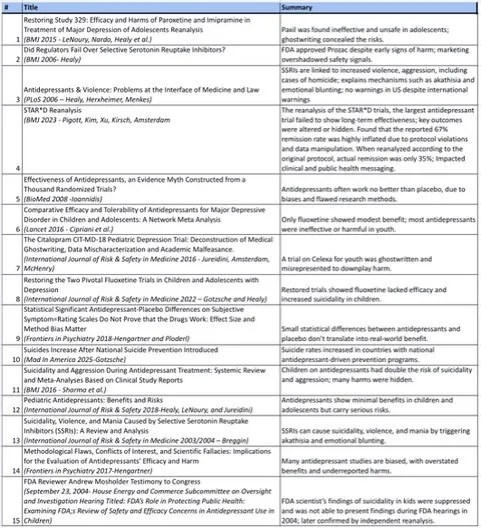
Meanwhile, a 2015 study published in PLOS One by Moore et al. found a disproportionate association between certain psychotropic drugs and violent behaviour in the FDA’s adverse event reporting system.
The harms of antidepressants are often downplayed—even in the medical literature.
Comparisons between published studies and confidential regulatory documents have revealed significant discrepancies, including underreporting of suicide attempts and aggressive behaviour.
My point is, Kennedy is not asserting causation—he is calling for more research. The legislators’ dismissal of his concerns as “disproven” serves only to suppress an important discussion that demands further scrutiny.
At his confirmation hearing, Kennedy remarked, “I know people, including members of my family, who’ve had a much worse time getting off of SSRIs than getting off of heroin.”
Legislators strongly objected to the comparison in the letter, but Kennedy was referring to the well-documented difficulties of SSRI discontinuation—affecting about half of those who take them, even though their dependency profile differs from that of opioids.
What most people don’t realise is that psychiatrists who specialise in tapering patients off antidepressants report that SSRI-withdrawal can last far longer than withdrawal from heroin.
In fact, some patients remain on SSRIs indefinitely—not by choice, but because withdrawal symptoms are so severe that stopping is unbearable. The legislators’ letter conveniently ignores this reality.
Instead of engaging with the substance of his arguments, Kennedy’s critics attacked his qualifications, claiming he was “unqualified” to weigh in on mental health or addiction.
True, Kennedy is not a psychiatrist—or even a physician. But as a lawyer who has spent decades exposing the failures of public health institutions, he understands where scrutiny is needed.
Moreover, Kennedy is not issuing medical directives—he is demanding accountability in a system that too often fails to critically examine the long-term effects of the medications it prescribes.
As Danish physician Peter Gøtzsche has shown, prescription drugs are a leading cause of death, surpassing even heart disease and cancer—and psychiatric medications alone are the third leading cause of death.
Why are these legislators so adamantly defending what is widely acknowledged as the rampant over-prescription of psychiatric drugs? Could it have anything to do with their deep ties to Big Pharma lobbyists?
Their eagerness to silence dissent suggests that the interests being protected may not be those of the public, but rather those of the industry that funds their campaigns.
I have been writing about this issue for years, exposing the pharmaceutical industry’s role in shaping narratives around psychiatric drugs while downplaying their harms.
The pattern is always the same — suppress uncomfortable discussions, attack those who raise legitimate concerns, and protect the status quo.
How fragile do these legislators think people are, that they shouldn’t be trusted with the full truth about the medications they take? And more disturbingly, what gives them the authority to control what information the public is allowed to access?
Kennedy pledged that “nothing is going to be off limits” in his effort to Make America Healthy Again—this is what he meant.
Raising questions is not misinformation. And shutting down debate is not science.
If policymakers are confident in the safety and efficacy of these drugs, they should welcome scrutiny—not suppress it.
Below is a letter from Kim Witczak, a drug safety advocate – addressed to Senator Tina Smith. It requests a meeting to discuss mental health and antidepressant safety concerns, referencing Witczak’s personal experience, attaching 15 studies highlighting issues like clinical trial misconduct and regulatory failures
AIPAC leader boasts of special ‘access’ to top Trump natsec officials in leaked audio
By Max Blumenthal | The Grayzone | April 9, 2025
During an off-the-record panel, AIPAC’s CEO detailed his organization’s grooming of Trump’s top national security officials, and how his group’s “access” ensures they continue to follow Israel’s agenda.
The Grayzone has obtained audio of an off-the-record session from the 2025 Congressional Summit of AIPAC, the main US lobbying arm of the state of Israel. Recorded by an attendee of the panel discussion, the audio features AIPAC’s new CEO, Elliott Brandt, describing how his organization has cultivated influence with three top national security officials in the Trump administration – Secretary of State Marco Rubio, National Security Director Mike Waltz, and CIA Director John Ratcliffe – and how it believes it can gain “access” to their internal discussions.
Joining Brandt on the panel was Dana Stroul, formerly the highest ranking civilian overseeing Middle East issues in the Biden administration’s Department of Defense. Stroul made it clear that defending Israel’s strategic imperatives from within the US government was a top priority, arguing that Washington should deepen its “mutually beneficial” special relationship with its “strong partner” in Tel Aviv.
Stroul dismissed the bloodbath in Gaza as the result of supposed Hamas tactics which supposedly aim to maximize the amount of children killed by Israel. At the same time, she and her fellow Israel lobbyists fretted about the impact of the post-October 7 war on public support for the self-proclaimed Jewish state. She was particularly troubled by Sen. Bernie Sanders’ attempts to force votes on military aid packages to Israel which, in her view, should never be debated in the open. Another unidentified AIPAC panelist worried that pro-Palestinian academics could eventually influence AI knowledge systems, leading to a dangerous shift in national security policy unless they were decisively suppressed.
The Congressional Summit was permeated with anxiety, as AIPAC leaders told rank-and-file members to hide their badges when they left the Marriott Hotel for fear they would be confronted by anti-genocide protesters. Other than a handful of sessions, such as a keynote address by Israeli PM Benjamin Netanyahu, the conference was strictly off-the-record.
With the cameras off, AIPAC leadership provided unusually candid details of their activities. In one revealing admission, Brandt explained how he and his lobbying organization groomed the future CIA director and other top Trump officials as pro-Israel assets.
AIPAC’s “lifelines” on the Trump national security team
Elliot Brandt was promoted to Executive Director of AIPAC in 2024, making him one of the most powerful lobbyists in Washington. Though he is largely unknown to the American public, Brandt has spent around three decades building relationships on Capitol Hill. This was the key, he suggested, to cultivating the future leaders of America’s national security state as loyal servants of Israel.
Referring to Trump’s Secretary of State Marco Rubio, his National Security Director Mike Waltz, and Elise Stefanik, whose nomination to serve as the US ambassador to the United Nations was suddenly withdrawn to preserve the GOP’s majority in the House of Representatives, Brandt explained to AIPAC members, “Those three people have something in common: they all served in Congress.”
After relying heavily on pro-Israel donors to fuel their campaigns for office, “they all have relationships with key AIPAC leaders from their communities,” said the AIPAC CEO. “So the lines of communication are good should there be something questionable or curious, and we need access on the conversation.”
Brandt’s comments corroborate Representative Thomas Massie’s claim that each member of Congress is expected to answer to an “AIPAC person.”
The AIPAC director’s reference to his organization’s “access” to presumably internal national security discussions contains ominous echoes of past espionage scandals in which AIPAC employees were accused of forking classified information over to Israeli intelligence. In 2004, for example, the FBI arrested a Pentagon researcher named Larry Franklin, who had provided classified documents related to Iran to two AIPAC staffers, Keith Weissman and Steve Rosen, who then delivered the information to Israeli intelligence. That December, the FBI raided AIPAC’s offices and seized a computer belonging to Brandt’s predecessor, Howard Kohr. (In the end, Franklin received a slap on the wrist from the government while Weissman and Rosen were fired by AIPAC.)
In his remarks to the AIPAC Congressional Summit, Brandt also pointed to CIA Director John Ratcliffe as an important point of contact. “You know that one of the first candidates I ever met with as an AIPAC professional in my job when he was a candidate for Congress was a guy named John Ratcliffe,” he recalled. “He was challenging a long time member of Congress in Dallas. I said, this guy looks like he could win the race, and, we go talk to him. He had a good understanding of issues, and a couple of weeks ago, he took the oath as the CIA director, for crying out loud. This is a guy that we had a chance to speak to, so there are, there are a lot – I wouldn’t call them lifelines, but there are lifelines in there.”
Top Pentagon veteran comes out as Israel lobbyist
Dana Stroul works as director of research at the Washington Institute for Near East Policy, a neoconservative think tank that was originally founded as the research arm of AIPAC. Stroul previously served as deputy assistant secretary of defense for the Middle East in the Biden administration’s Pentagon, presiding over policy toward Iran, Syria and virtually every other issue of importance to Israel.
In a closed session at the Marriott hotel, seated before an audience of AIPAC members, Stroul sounded more like a veteran Israel lobbyist than a US national security expert, arguing at length that any and all US military aid packages to Israel provided a net benefit to American empire, while dismissing well-documented Israeli atrocities in the besieged Gaza Strip as the result of “clever” Hamas human shield tactics.
According to an attendee of the AIPAC Congressional Summit, Stroul began her remarks by recalling the frantic hours after she received word of the October 7, 2023 attacks. Personally summoned to work by then-Defense Secretary Lloyd Austin, Stroul described how she rushed her child to the Pentagon’s in-house daycare center so she could get to the work of surging munitions to the Israeli military. She said she worked continuously for the next 48 hours, helping the Pentagon transfer weapons from its own stockpiles to Israeli bases. (The AIPAC attendee was unable to capture audio of these comments by Stroul).
Even as she worked to ensure that Israel had all it needed to transform Gaza into a moonscape, Stroul privately acknowledged that the Israeli military might be committing war crimes, according to a series of emails leaked to Reuters. On October 13, 2023, Stroul fired off an email to top White House, State Department, and Pentagon officials about a phone call she had just held with the International Red Cross Committee’s (ICRC) Middle East director, Fabrizio Carboni. “ICRC is not ready to say this in public, but is raising private alarm that Israel is close to committing war crimes,” Stroul wrote. “Their main line is that it is impossible for one million civilians to move this fast.”
Since recognizing the likelihood of Israeli atrocities, Stroul has apparently kept her conscience clear by blaming Hamas for the over 50,000 civilians Israel has killed in Gaza. “I think if you’re in Iran, or you are the Houthis or any of these other proxy terrorist groups, and frankly, probably the Russians and the Chinese,” she told AIPAC members at the 2025 congressional summit, “you’re looking at the ways in which the international community so quickly moved on from October 7 and what happened to Israel and why Israel is at war, and you’re probably taking away that a great tactic in wars to put as many civilians on the front lines as possible so that they can just get killed. And so, the Hamas tactic had strategic effects, because Israel finds itself isolated on the international stage. And it’s a tactic by Hamas to both terrorize on the global stage, and number two, [for] propaganda and disinformation.“
Stroul went on to suggest that the Israeli military was superior in ways to the US military. “This is a mutually beneficial relationship. This is not just about what the United States gives Israel,” the former Pentagon official declared. “This is a partner that has flipped the script on what can be accomplished with military force in a way the United States military never conceived of doing against Iran and Iran’s proxies across the Middle East. We get as much intelligence from Israel, as we give to Israel. They are using our F-35 more than we are using it…”
In her view, Israel also served as an important proxy of the US by applying violence and taking casualties against its supposed enemies: “One thing that you hear that I think is common on the far right and the far left is that they don’t want young men, American men and women, service members going to war in the Middle East, or anywhere. So the way to not have young Americans on the line anywhere is to actually invest in strong partners who can defend themselves. That’s Israel.”
One month after Stroul delivered her comments to AIPAC, President Donald Trump restarted the US military assault on Yemen’s Ansarullah movement in order to protect Israeli shipping from its blockade of the Red Sea. The war has by now cost US taxpayers at least one billion dollars, but has failed to achieve freedom of navigation.
Like the other AIPAC panelists, Stroul was consumed with anxiety about Israel’s image among the American public. She singled out Sen. Bernie Sanders’ efforts to suspend military aid to Israel as a particular source of concern, though not necessarily because she believed they would be successful.
“What do I worry about? I think everyone who’s a supporter of this relationship needs to be wary of the manner in which sometimes it’s not going to be about – Israel is going to be about congressional versus legislative tussling, but Israel is going to be caught in the crosshairs. And I’m worried about that with these executive holds,” Stroul proclaimed.
I’m worried about it with things like the [Bernie] Sanders joint resolutions of disapproval, even if he doesn’t force a vote this time, we’re not getting through four years without him forcing a vote. And it is not good for Israel and for this relationship to make members constantly have to vote on it, even if they pass. That’s not the point. The point is to not have to debate every time.”
Fear of a pro-Palestine AI system
Asked about his greatest concern, an AIPAC panelist whom The Grayzone has not been able to identify pointed to academia and social media. According to the clearly seasoned Israel lobbyist, Israel was losing “the war of ideas” to a collection of professors and influencers with outsized influence among the future generation of America’s intelligentsia.
“Imagine five years from now, a staff, a congressional staffer, types into AI Claude, GBT, at that one. GBT, 14, whatever says, ‘Is supporting Israel bad for American national security?’ The answer that they get back is going to be informed by the information that’s on the internet today, which is why punching back in the information sphere becomes so important,” the Israel lobbyist urged.
“When you disengage, you leave an open playing field for precisely that sort of information that’s going to inform national security decisions five years from now. And by the way, Congress is not immune, because if a member of Congress, if his or her elector, is increasingly being read that type of information, it will skew how they pressure him or her to vote, or even to throw him or her out of office and pick somebody else. Right?… I mean, it starts in academia, but it doesn’t end there, right?”
AIPAC did not respond to The Grayzone’s request for comment about statements made during the off-the-record panel.
Israel beats drums of war in run-up to Iran-US talks
Press TV – April 9, 2025
Israeli prime minister Benjamin Netanyahu has revisited threats of deployment of military force against Iran’s nuclear facilities, demanding physical destruction of the nuclear sites, a few days before the Islamic Republic and the United States are slated to engage in indirect talks.
The Israeli official made the call in a video address on Tuesday, alleging that the prospect of using military force was the only means of ensuring, what he called, Tehran’s non-pursuance of “nuclear weapons.”
He asserted that any agreement between the United States and Iran could only succeed if Iran’s nuclear facilities were “blown up” and “dismantled” under American supervision.
“We agree that Iran will not have nuclear weapons,” Netanyahu said, referring to his discussions with US President Donald Trump. However, he dismissed the prospect of a purely diplomatic path, saying things would only work if the United States took direct military action to eliminate Iran’s nuclear capabilities.
“If we go in, blow up the [nuclear] facilities, dismantle all the equipment, under American supervision and American execution — that is good,” he claimed.
“If that doesn’t happen,” he added, Iran could “drag out talks.” “Then the option is military,” Netanyahu alleged.
The Israeli premier also said he and Trump had discussed that scenario “at length.”
The remarks flew directly in the face of the Islamic Republic’s repeated assertions that it would neither pursue nor possess any such unconventional weapons as per clear moral and religious imperatives.
Netanyahu’s comments followed a tense meeting at the White House, where he appeared publicly out of step with Trump on several major issues, including Iran, regional diplomacy, and trade.
During the meeting, he found out from Trump firsthand that Iran and the US were to engage in indirect talks.
Several major Israeli media outlets later said the Israeli delegation had “shock written all over their faces” after the announcement, saying Netanyahu had returned from the meeting “empty-handed” and “humiliated.” One outlet even described the meeting as the “most failed” one to ever take place between an Israeli premier and a US president.
Nonetheless, Netanyahu tried to frame the visit positively, describing it as “very warm” and suggesting further announcements would be made in due time.
Featured Video

or go to
Aletho News Archives – Video-Images
From the Archives
A Lesser “Grade” of Human
By Michael Hoffman | Revelation of the Method | January 3, 2024
Will the more than 100 Iranians killed by terrorist bombs today be mourned in the West as victims of terrorism? Certainly not. Allied doctrine has it that the killing of Israeli or American civilians is a crime of cosmic proportions, while shedding the blood of “enemy” women and children is perfectly acceptable; indeed commendable.
The West does not memorialize the hundreds of thousands of civilians bombed by the U.S. in Serbia, Iraq, Afghanistan and every major German city 1943-1945. America’s fire-bombing of the city of Tokyo by General Curtis LeMay in March 1945 was followed by Harry Truman’s atomic incineration of Hiroshima and Nagasaki in August of that year. Truman never had a moment of doubt or regret over the murder of more than a 100,000 Asian children, mothers and non-combatant boys and men. It was business as usual for the “noble” Allies during the “Good War.”
In the West human rights signifies passionate concern only for civilians designated as truly human: Israelis first, then Americans and British, followed by their satraps.
This inhumanity is the legacy of Talmudic ideology, beginning with tractate Sanhedrin 57a from 400 A.D., concerning liability for capital punishment: “If a Jew murders a gentile, he is exempt.”
This teaching of contempt was reiterated in the dogma of Chabad Lubavitch founder Rabbi Shneur Zalman in the 18th century. … continue
Blog Roll
 Aletho News
- The Makkah Pact Enters Into Force: The End of American Dominance or Its New Form?
- NATO’s top generals gather in Kiev
- EU’s continuing expansion – greater threat to Russia
- US Senator Murphy says Pentagon denied him entry to US base in Qatar
- Israel expands “incitement” charge to target Palestinian education and memory
- How Israel seeks to reshape Arab classrooms
- Paris bans pro-Palestinian demonstration planned for Oct. 7 over ‘risks of public disorder’
- In August Hanning Treason Case – All Signs Point To Tel Aviv.
- France cleared dozens of military sales to Israel between May and September: Report
- France projects nuclear power as Macron pushes arsenal expansion
- If Americans Knew
- Israel’s flailing chatbot army
- Five Palestinians Killed, Others Injured by Israeli Fire in Gaza
- Israel is rewriting the Palestinian curriculum in East Jerusalem to erase Palestinian identity
- Three years of genocide: Israel turned prisons into killing grounds and torture sites
- Three years of genocide. Words fail. Daily Update
- ‘I’d rather die than go back’: A Palestinian teen’s 10-month nightmare in Israeli jail
- How Jared Kushner’s firm’s investment in an Israeli company could be a major conflict of interest
- Soldier testimony sheds light on how Israel wages information war
- CIA Report Warns Israel Could Head Toward Civil War, Total Collapse
- Banker Who Exposed Howard Lutnick’s Ties to Epstein Warned of ‘Retaliation’ and ‘Personal Consequences’ in Last Post Before Suicide
- No Tricks Zone
- US September “Heat” Was No Record…Many Records Set Decades Ago
- Latest European Green Energy Debacle; Portugal’s Largest Flagship Solar Park Insolvent!
- Green Energy Debacle: German Expert Professor Fritz Vahrenholt Warns Of Severe Economic And Social Consequences
- Two More Paleo Reconstructions Affirm Meters-Higher Sea Levels Across Ireland, Brazil 7000-6000 Years Ago
- New Study: Earth And Venus Surface Warmth Largely Explained By Convection And Lapse Rate, Not CO2 Or Radiation
- 2025 Nature Paper Claiming Worsening Global Drought Gets RETRACTED …Heavily Flawed
- New Study: ‘Global Drought Shows No Detectable Recent Acceleration Under Climate Warming’
- Economic Masterminds: German Socialists Suggest Taxing Productivity Gains Stemming From Using AI
- The South China Sea Has Not Been Cooperating With The Climate Change Narrative
- Energy Crisis: Germany Enters Heating Season With Historically Low Gas Reserve Fill Levels

