EU’s support for Zelensky brings Washington-Brussels relations to the brink of collapse
By Ahmed Adel | March 4, 2025
Following the reactions of European leaders to the on-camera spat at the White House between Donald Trump and Ukrainian President Volodymyr Zelensky on February 28, relations between the US president and much of the European Union establishment are reaching a breaking point. The EU establishment has firmly sided with Zelensky and his warmongering policies, contrary to common sense and the peace efforts of Trump and his Russian counterpart Vladimir Putin.
On March 2, an informal meeting of European leaders and Canada was held in London. Following the meeting, it was announced that Ukraine would receive more military aid and sanctions on Russia, territories would be returned to Ukraine, and the United Kingdom, with other nations, would form a military coalition to get boots on the ground.
By reacting the way they did, EU leaders have once again shown that they are undermining peace, just as then-British Prime Minister Boris Johnson did when he sabotaged the peace talks between Russia and Ukraine in Istanbul in early 2022. However, just as Johnson was not punished for prolonging death and war in Ukraine, it is unlikely that EU leaders will ever be held accountable for their actions, especially German, Polish and Baltic politicians, European Commission President Ursula von der Leyen, and many others in Brussels who agree on a policy of aligning with Zelensky and anti-Trump policies.
Following the spat between the US and Ukrainian presidents, European leaders sent messages of solidarity with Kiev. Many European leaders posted a uniform message on their social media accounts that they “stand with Ukraine.”
A sign of the growing rift between Washington and Brussels, particularly after the chaotic meeting between Trump and Zelensky, EU foreign policy chief Kaja Kallas said: “Today, it became clear that the free world needs a new leader. It’s up to us, Europeans, to take this challenge.”
It is also recalled that during his visit to the White House on February 24, French President Emmanuel Macron tried to deceive Trump and drag him down a path the US president did not want to take. It became clear to Trump that he could not count on European politicians.
If it was not clear following the meeting with Macron, it certainly became clear to Trump when British Prime Minister Keir Starmer was a guest in the Oval Office on February 27, particularly after US Vice President J.D. Vance blasted Britain’s descent into authoritarianism and lack of free speech.
It is expected that in the coming period, there will be very strong obstructions from the EU to any agreement between Trump and Putin. There will also be such obstructions within the US, especially from the remnants of the Deep State and the mainstream media that are still critical of Trump and loyal to ultraliberal policies. The very core of the EU – the European Commission, the leadership of the European Council, the majority in the European Parliament, as well as the leading EU leaders are also of the same view, which is opposite to the rest of the world that advocates for peace.
The EU itself is divided into states that supported peace efforts and distanced themselves from Brussels—primarily the political leaderships of Slovakia and Hungary, but also the leaders of the second-largest party in Germany, the AfD, Marine Le Pen in France, and the leaders of other sovereigntist parties across Europe.
European leaders have not changed their support for war since an attempt was made to end the conflict under conditions that were even more favorable for Kiev at the time. Now, as Trump highlighted in his meeting with Zelensky, Ukraine does not “have the cards right now.”
“You’re not in a good position. You don’t have the cards right now. With us, you start having cards. You’re playing cards. You’re gambling with the lives of millions of people. You’re gambling with World War III,” Trump said to a shocked Zelensky.
Of course, Zelensky denied Trump’s statements, stuttering, “I’m not playing cards” and “What are you speaking about?”
The US president’s main priority is normalizing relations with Moscow, including ending the conflict in Ukraine. Normalization will remain a priority even if the Kiev regime and European leaders do not agree to it.
Nonetheless, it appears that parts of Europe have not yet given up on the Trump administration, like Kaja Kallas has. Starmer announced on March 2 that Britain, France, and Ukraine have agreed to work on a ceasefire plan to present to Washington.
“We’ve now agreed that the United Kingdom, along with France and possibly one or two others, will work with Ukraine on a plan to stop the fighting, and then we’ll discuss that plan with the United States,” Starmer told the BBC.
This was followed by Zelensky announcing on the same day as Starmer’s statement that he was “ready to sign” the minerals agreement with Trump.
However, given the EU’s growing hostility to Trump and resistance to peace, the US president has little incentive to take the Franco-Anglo peace plan seriously since they have been harbingers to continue the war. Trump will continue pursuing a peace plan, even if it intensifies hostility between Europe and Washington.
Ahmed Adel is a Cairo-based geopolitics and political economy researcher.
Hamas explained why it attacked Israel on October 7, 2023
If Americans Knew | March 3, 2025
On January 20, 2024 Hamas, the Palestinian Resistance Movement, issued a 16-page document entitled “Our Narrative–Operation Al-Aqsa Flood” that explains their plans and actions.
This helps to answer the question some Americans ask: Why did Hamas launch the attack?
As Americans read and consider the following, perhaps they will consider an equally important question: Why did we allow our government to enable Israel’s violent, decades-long ethnic cleansing project against Palestinians?
To see the full document and its images, click the PDF here. Below is the document’s text (IAK has bolded some portions and added a few editor’s notes).
TEXT:
In the Name of Allah, the Most Gracious, the Most Merciful
Our steadfast Palestinian people,
The Arab & Islamic nations;
The free peoples worldwide and those who advocate for freedom, justice and human dignity
In light of the ongoing Israeli aggression on the Gaza Strip and the West Bank, and as our people continue their battle for independence, dignity and breaking-free from the longest-ever occupation during which they have drawn the finest displays of bravery and heroism in confronting the Israeli murder machine and aggression. We would like to clarify to our people and the free peoples of the world the reality of what happened on Oct. 7, the motives behind, its general context related to the Palestinian cause, as well as a refutation to the Israeli allegations and to put the facts into perspective.
Why Operation Al-Aqsa Flood?
1. 1- The battle of the Palestinian people against occupation and colonialism did not start on Oct. 7, but started 105 years ago, including 30 years of British colonialism and 75 years of Zionist occupation. In 1918, the Palestinian people owned 98.5% of the Palestine land and represented 92% of the population on the land of Palestine.
While the Jews, who were brought to Palestine in mass immigration campaigns in coordination between the British colonial authorities and the Zionist Movement, managed to seize control of not more than 6% of the lands in Palestine and to be 31% of the population prior to 1948 when the Zionist Entity was announced on the historic land of Palestine. [Editor’s note: See this]
At that time, the Palestinian people were denied from the right to self- determination and the Zionist gangs engaged in an ethnic cleansing campaign against the Palestinian people aimed at expelling them from their lands and areas. As a result, the Zionist gangs seized control by force of 77% of the land of Palestine where they expelled 57% of the people of Palestine and destroyed over 500 Palestinian villages and towns, and committed dozens of massacres against the Palestinians which all culminated in the establishment of the Zionist Entity in 1948. Moreover, in continuation of the aggression, the Israeli forces in 1967 occupied the rest of Palestine including the West Bank, the Gaza Strip and Jerusalem in addition to Arab territories around Palestine.
2. 2- Over these long decades, the Palestinian people suffered all forms of oppression, injustice, expropriation of their fundamental rights and the apartheid policies. The Gaza Strip, for example, suffered as of 2007 from a suffocating blockade over 17 years which turned it to be the largest open-air prison in the world. The Palestinian people in Gaza also suffered from five destructive wars\ aggressions all of which “Israel” was the offending party.
The people in Gaza in 2018 also initiated the Great March of Return demonstrations to peacefully protest the Israeli blockade, their misery humanitarian conditions and to demand their right-to-return. However, the Israeli occupation forces responded to these protests with brutal force by which 360 Palestinians were killed and 19,000 others were injured including over 5,000 children in a matter of few months. [Editor’s note: See this]
3. According official figures, in the period between (January 2000 and September 2023), the Israeli occupation killed 11,299 Palestinians and injured 156,768 others, the great majority of them were civilians. Unfortunately, the US administration and its allies did not pay attention to the suffering of the Palestinian people over the past years but provided cover to the Israeli aggression.
They only lamented the Israeli soldiers who were killed on Oct. 7 even without seeking the truth of what happened, and wrongfully walked behind the Israeli narrative in condemning an alleged targeting of Israeli civilians. The US administration provided the financial and military support to the Israeli occupation massacres against the Palestinian civilians and the brutal aggression on the Gaza Strip, and still the US officials continue to ignore what the Israeli occupation forces commit in Gaza of mass killing. [Editor’s note: see this.]
4. The Israeli violations and brutality were documented by many UN organizations and international human rights groups including Amnesty International and Human Rights Watch, and even documented by Israeli human rights groups. [See this.]
However, these reports and testimonies were ignored and the Israeli occupation is yet to be held accountable. For example, on Oct. 29, 2021, Israel’s Ambassador to the UN Gilad Erdan insulted the UN system by tearing up a report for the UN Human Rights Council during an address at the General Assembly, and threw it in a dustbin before leaving the podium. Yet, he was appointed in the following year – 2022 – to the post of vice-president of the UN General Assembly.
5. The US administration and its western allies have always been treating Israel as a state above the law; they provide it with the needed cover to maintain prolonging the occupation and cracking down the Palestinian people, and also allowing “Israel” to exploit such situation to expropriate further Palestinian lands and to Judaize their sanctities and holy sites. Despite the fact that the UN had issued more than 900 resolutions over the past 75 years in favor of the Palestinian people, “Israel” rejected to abide by any of these resolutions, and the US VETO was always present at the UN Security Council to prevent any condemnation to “Israel’s” policies and violations. That’s why we see the US and other western countries complicit and partners to the Israeli occupation in its crimes and in the continued suffering of the Palestinian people. [See this.]
6. As for “the peaceful settlement process”. Despite the fact that the Oslo Accords signed in 1993 with the Palestine Liberation Organization (PLO) stipulated the establishment of a Palestinian independent state in the West Bank and the Gaza Strip; “Israel” systematically destroyed every possibility to establish the Palestinian state through a wide campaign of settlements’ construction and Judaization of the Palestinian lands in the occupied West Bank and Jerusalem. The backers of the peace process after 30 years realized that they have reached an impasse and that such process had catastrophic results on the Palestinian people.
The Israeli officials confirmed at several occasions their absolute rejection to the establishment of a Palestinian state. Just one month before Operation Al-Aqsa Flood, Israeli Prime Minister Benjamin Netanyahu presented a map of a so-called “New Middle East,” depicting “Israel” stretching from the Jordan River to the Mediterranean Sea including the West Bank and Gaza. The entire world at that – UN General Assembly’s – podium were silent towards his speech full of arrogance and ignorance towards the rights of the Palestinian people.
7. After 75 years of relentless occupation and suffering, and after failing all initiatives for liberation and return to our people, and also after the disastrous results of the so-called peace process, what did the world expect from the Palestinian people to do in response to the following:
♦ The Israeli Judaization plans to the blessed Al-Aqsa Mosque, its temporal and spatial division attempts, as well as the intensification of the Israeli settlers’ incursions into the holy mosque.
♦ The practices of the extremist and right-wing Israeli government which is practically taking steps towards annexing the entire West Bank and Jerusalem into the so-called “Israel’s sovereignty” amid plans on the Israeli official table to expel Palestinians from their homes and areas.
♦ The thousands of Palestinian detainees in Israeli jails who are experiencing deprivation of their basic rights as well as assaults and humiliations under direct supervision of the Israeli fascist minister Itamar Ben-Gvir.
♦ The unjust air, sea, and land blockade imposed on the Gaza Strip over 17 years.
♦ The expansion of the Israeli settlements across the West Bank in an unprecedented level, as well as the daily violence perpetrated by settlers against Palestinians and their properties.
♦ The seven million Palestinians living in extreme conditions in refugee camps and other areas who wish to return to their lands, and who were expelled 75 years ago.
♦ The failure of the international community and the complicit of superpowers to prevent the establishment of a Palestinian state.
What was expected from the Palestinian people after all of that? To keep waiting and to keep counting on the helpless UN! Or to take the initiative in defending the Palestinian people, lands, rights and sanctities; knowing that the defense act is a right enshrined in international laws, norms and conventions.
Proceeding from the above, Operation Al-Aqsa Flood on Oct. 7 was a necessary step and a normal response to confront all Israeli conspiracies against the Palestinian people and their cause. It was a defensive act in the frame of getting rid of the Israeli occupation, reclaiming the Palestinian rights and on the way for liberation and independence like all peoples around the world did.
Second
The events of Operation Al-Aqsa Flood and responses to the Israeli allegations
In light of the Israeli fabricated accusations and allegations over Operation Al-Aqsa Flood on Oct. 7 and its repercussions, we in the Islamic Resistance Movement – Hamas clarify the following:
1. Operation Al-Aqsa Flood on Oct. 7 targeted the Israeli military sites, and sought to arrest the enemy’s soldiers to pressure on the Israeli authorities to release the thousands of Palestinians held in Israeli jails through a prisoners exchange deal. Therefore, the operation focused on destroying the Israeli army’s Gaza Division, the Israeli military sites stationed near the Israeli settlements around Gaza.
2. Avoiding harm to civilians, especially children, women and elderly people is a religious and moral commitment by all the Al-Qassam Brigades’ fighters. We reiterate that the Palestinian resistance was fully disciplined and committed to the Islamic values during the operation and that the Palestinian fighters only targeted the occupation soldiers and those who carried weapons against our people. In the meantime, the Palestinian fighters were keen to avoid harming civilians despite the fact that the resistance does not possess precise weapons. In addition, if there was any case of targeting civilians; it happened accidently and in the course of the confrontation with the occupation forces. [Editor’s note: when the barrier that had been imprisoning Gaza for over 20 years was breached, many people not part of Hamas’ trained fighters, including other armed groups not under Hamas, also escaped.]
Since its establishment in 1987, the Hamas Movement committed itself to avoiding harm to civilians. After Zionist criminal Baruch Goldstein in 1994 committed a massacre against Palestinian worshippers in the Al-Ibrahimi Mosque in occupied Hebron City, the Hamas Movement announced an initiative to avoid civilians the brunt of fighting by all parties, but the Israeli occupation rejected it and even did not give any comment on it. The Hamas Movement also repeated such calls several times, but received by a deaf ear from the Israeli occupation which continued its deliberate targeting and killing of Palestinian civilians.
[Editor’s note: The precursor to Hamas was different from extremist groups that we think of today, like Al-Qaeda or ISIS. It started out by focusing on social welfare programs, providing education, food and other social services to Palestinians. It eventually began to engage in resistance activities against the Israeli occupation and expanded land theft, such as attacks on military posts and capturing Israeli soldiers. After an extremist Israeli killed 29 Palestinians while they were praying, Hamas also began targeting civilians. See this and this and this and this.]
3. Maybe some faults happened during Operation Al-Aqsa Flood’s implementation due to the rapid collapse of the Israeli security and military system, and the chaos caused along the border areas with Gaza.
As attested by many, the Hamas Movement dealt in a positive and kind manner with all civilians who have been held in Gaza, and sought from the earliest days of the aggression to release them, and that’s what happened during the week-long humanitarian truce where those civilians were released in exchange of releasing Palestinian women and children from Israeli jails. [Editor’s note: For how this was reported to Americans see this.]
4. What the Israeli occupation promoted of allegations that the Al-Qassam Brigades on Oct. 7 were targeting Israeli civilians are nothing but complete lies and fabrications. [Editor’s Note: See this] The source of these allegations is the Israeli official narrative and no independent source proved any of them. It is a well-known fact that the Israeli official narrative had always sought to demonize the Palestinian resistance, while also legalizing its brutal aggression on Gaza.
Here are some details that go against the Israeli allegations:
♦ Video clips taken on that day – Oct. 7 – along with the testimonies by Israelis themselves that were released later showed that the Al-Qassam Brigades’ fighters didn’t target civilians, and many Israelis were killed by the Israeli army and police due to their confusion. [See this.]
♦ It has also been firmly refuted the lie of the “40 beheaded babies” by the Palestinian fighters, and even Israeli sources denied this lie. Many of the western media agencies unfortunately adopted this allegation and promoted it.
♦ The suggestion that the Palestinian fighters committed rape against Israeli women was fully denied including by the Hamas Movement. A report by the Mondoweiss news website on Dec. 1, 2023, among others, said there is lack of any evidence of “mass rape” allegedly perpetrated by Hamas members on Oct. 7 and that Israel used such allegation “to fuel the genocide in Gaza.” [See this.]
♦ According to two reports by the Israeli Yedioth Ahronoth newspaper on Oct. 10 and the Haaretz newspaper on Nov. 18, many Israeli civilians were killed by an Israeli military helicopter especially those who were in the Nova music festival near Gaza where 364 Israeli civilians were killed. The two reports said the Hamas fighters reached the area of the festival without any prior knowledge of the festival, where the Israeli helicopter opened fire on both the Hamas fighters and the participants in the festival. The Yedioth Ahronoth also said the Israeli army, to prevent further infiltrations from Gaza and to prevent any Israelis being arrested by the Palestinian fighters, struck over 300 targets in areas surrounding the Gaza Strip.
♦ Other Israeli testimonies confirmed that the Israeli army raids and soldiers’ operations killed many Israeli captives and their captors. The Israeli occupation army bombed the houses in the Israeli settlements where Palestinian fighters and Israelis were inside in a clear application of the Israeli army notorious “Hannibal Directive” which clearly says that “better a dead civilian hostage or soldier than taken alive” to avoid engaging in a prisoners swap with the Palestinian resistance.
♦ Furthermore, the occupation authorities revised the number of their killed soldiers and civilians from 1,400 to 1,200, after finding that 200-burnt corpses had belonged to the Palestinian fighters who were killed and mixed with Israeli corpses. This means that the one who killed the fighters is the one who killed the Israelis, knowing that only the Israeli army possesses military planes that killed, burned and destroyed Israeli areas on Oct. 7.
♦ The Israeli heavy aerial raids across Gaza that led to the death of nearly 60 Israeli captives also prove that the Israeli occupation does not care about the life of their captives in Gaza.
5. It is also a matter of fact that a number of Israeli settlers in settlements around Gaza were armed, and clashed with Palestinian fighters on Oct. 7. Those settlers were registered as civilians while the fact is they were armed men fighting alongside the Israeli army.
6. When speaking about Israeli civilians, it must be known that conscription applies to all Israelis above the age of 18 – males who served 32 months of military service and females who served 24 months – where all can carry and use arms. This is based on the Israeli security theory of an “armed people” which turned the Israeli entity into “an army with a country attached.”
7. The brutal killing of civilians is a systematic approach of the Israeli entity, and one of the means to humiliate the Palestinian people. The mass killing of Palestinians in Gaza is a clear evidence of such approach.
8. The Al Jazeera news channel said in a documentary that in one month of the Israeli aggression on Gaza, the daily average killing of Palestinian children in Gaza was 136, while the average of children killing in Ukraine – in the course of the Russian-Ukrainian war – was one child every day.
9. Those who defend the Israeli aggression do not look at the events in an objective manner but rather go to justify the Israeli mass killing of Palestinians by saying there would be casualties among civilians when attacking the Hamas fighters. However, they would not use such assumption when it comes to the Al-Aqsa Flood event on Oct. 7.
10. We are confident that any fair and independent inquiries will prove the truth of our narrative and will prove the scale of lies and misleading information in the Israeli side. This also includes the Israeli allegations regarding the hospitals in Gaza that the Palestinian resistance used them as command centers; an allegation that was not proven and was refuted by reports of many western press agencies. [See this]
Third
Towards a transparent international investigationrd
1. Palestine is a member-state of the International Criminal Court (ICC) and it acceded to its Rome Statute in 2015. When Palestine asked for investigation into Israeli war crimes committed on its territories, it was faced by Israeli intransigence and rejection, and threats to punish the Palestinians for the request to ICC. It is also unfortunate to mention that there were great powers, which claim to be holding values of justice, completely sided with the occupation narrative and stood against the Palestinian moves in the international justice system. These powers want to keep “Israel” as a state above the law and to ensure it escapes liability and accountability.
2. We urge these countries, especially the US administration, Germany, Canada and the UK, if they are meant for justice to prevail as they claim, they are ought to announce their support to the course of the investigation in all crimes committed in occupied Palestine and to give full support for the international courts to effectively do their job.
3. Despite having doubts from these countries to stand by justice, we still urge the ICC Prosecutor and his team to immediately and urgently come to occupied Palestine to look into the crimes and violations committed there, rather than merely observing the situation remotely or being subject to the Israeli restrictions.
4. In Dec. 2022, when the UN General Assembly passed a resolution seeking opinion of the International Court of Justice (ICJ) on the legal consequences of “Israel’s” illegal occupation of Palestinian territories, those (few) countries who back “Israel” announced their rejection to the move that was approved by nearly 100 countries. And when our people – and their legal and rights groups – sought to pursue prosecutions against the Israeli war criminals in front of the European countries courts – through the system of universal jurisdiction – the European regimes obstructed the moves in favor of the Israeli war criminals to remain running free.
5. The events of Oct. 7 must be put in its broader context, and that all cases of struggle against colonialism and occupation in our contemporary time be evoked. These experiences of struggle show that in the same level of oppression committed by the occupier; there would be an equivalent response by the people under occupation. [See this.]
6. The Palestinian people and peoples across the world realize the scale of lies and deception these governments that back the Israeli narrative practice in their attempts to justify their blind bias and to cover the Israeli crimes. These countries know the root causes of the conflict which are the occupation and the denial of the right of the Palestinian people to live in dignity on their lands. These countries show no interest towards the continuation of the unjust blockade on millions of Palestinians in Gaza, and also show no interest towards the thousands of Palestinian detainees in Israeli jails held under conditions where their basic rights are mostly denied.
7. We hail the free people of the world from all religions, ethnicities and backgrounds who rally in all capitals and cities worldwide to voice their rejection to the Israeli crimes and massacres, and to show their support for the rights of the Palestinian people and their just cause.
Fourth
A reminder to the world, who is Hamas?
1. The Islamic Resistance Movement “Hamas” is a Palestinian Islamic national liberation and resistance movement. Its goal is to liberate Palestine and confront the Zionist project. Its frame of reference is Islam, which determines its principles, objectives and means. Hamas rejects the persecution of any human being or the undermining of his or her rights on nationalist, religious or sectarian grounds.
2. Hamas affirms that its conflict is with the Zionist project not with the Jews because of their religion. Hamas does not wage a struggle against the Jews because they are Jewish but wages a struggle against the Zionists who occupy Palestine. Yet, it is the Zionists who constantly identify Judaism and the Jews with their own colonial project and illegal entity.
3. The Palestinian people have always stood against oppression, injustice, and the committing of massacres against civilians regardless of who commit them. And based on our religious and moral values, we clearly stated our rejection to what the Jews were exposed to by the Nazi Germany. Here, we remind that the Jewish problem in essence was a European problem, while the Arab and Islamic environment was – across history – a safe haven to the Jewish people and to other peoples of other beliefs and ethnicities. The Arab and Islamic environment was an example to co-existence, cultural interaction and religious freedoms. The current conflict is caused by the Zionist aggressive behavior and its alliance with the western colonial powers; therefore, we reject the exploitation of the Jewish suffering in Europe to justify the oppression against our people in Palestine.
4. The Hamas Movement according to international laws and norms is a national liberation movement that has clear goals and mission. It gets its legitimacy to resist the occupation from the Palestinian right to self-defense, liberation and self-determination. Hamas has always been keen to restrict its fight and resistance with the Israeli occupation on the occupied Palestinian territory, yet, the Israeli occupation did not abide by that and committed massacres and killings against the Palestinians outside Palestine.
5. We stress that resisting the occupation with all means including the armed resistance is a legitimized right by all norms, divine religions, the international laws including the Geneva Conventions and its first additional protocol and the related UN resolutions e.g. The UN General Assembly Resolution 3236, adopted by the 29th session of the General Assembly on Nov. 22, 1974 which affirmed the inalienable rights of the Palestinian people in Palestine, including the right to self-determination and the right to return to “their homes and property from where they were expelled, displaced and uprooted.” [See this.]
6. Our steadfast Palestinian people and their resistance are waging a heroic battle to defend their land and national rights against the longest and brutalist colonial occupation. The Palestinian people are confronting an unprecedented Israeli aggression that committed heinous massacres against Palestinian civilians, most of them were children and women. In the course of the aggression on Gaza, the Israeli occupation deprived our people in Gaza of food, water, medicines and fuel, and simply deprived them from all means of life. In the meantime, the Israeli warplanes savagely struck all Gaza infrastructures and public buildings including schools, universities, mosques, churches and hospitals in a clear sign of ethnic cleansing aimed at expelling the Palestinian people from Gaza. Yet, the backers of the Israeli occupation did nothing but kept the genocide ongoing against our people. [See this.]
7. The Israeli occupation’s use of the “self-defense” pretext to justify its oppression against the Palestinian people is a process of lie, deception and turning the facts. The Israeli entity has no right to defend its crimes and occupation but the Palestinian people who have such right to oblige the occupier to end the occupation. In 2004, the International Court of Justice (ICJ) gave an advisory opinion in the case concerning the “Legal Consequences of the Construction of a Wall in the Occupied Palestinian Territory” which stated that “Israel” – the brutal occupying force – cannot rely on a right of self-defense to build such wall on the Palestinian territory. Furthermore, Gaza under the international law is still an occupied land, thus, the justifications for waging the aggression on Gaza is baseless and lacks its legal capacity, as well as lacks the essence of the self-defense idea.
Fifth
What is needed?
Occupation is occupation no matter how it describes or names itself, and remains a tool to break the will of the peoples and to keep oppressing them. On the other side, the experiences of the peoples\nations across history on how to break away from occupation and colonialism confirm that the resistance is the strategic approach and the only way to liberation and ending the occupation. Have any nation been liberated from occupation without struggle, resistance or sacrifice?
The humanitarian, ethical and legal imperatives necessitate all countries around the world to back the resistance of the Palestinian people not to collude against it. They are supposed to confront the occupation crimes and aggression, as well as to support the struggle of the Palestinian people to liberate their lands and to practice their right to self-determination like all peoples across the globe. Based on that we call for the following:
1. The immediate halt of the Israeli aggression on Gaza, the crimes and ethnic cleansing committed against the entire Gaza population, to open the crossings and allow the entry of the humanitarian aid into Gaza including the reconstruction tools.
2. To hold the Israeli occupation legally accountable for what it caused of human suffering towards the Palestinian people, and to charge it for the crimes against civilians, infrastructure, hospitals, educational facilities, mosques and churches.
3. The support of the Palestinian resistance in the face of the Israeli occupation with all possible means as a legitimized right under the international laws and norms.
4. We call upon the free peoples across the world, especially those nations who were colonized and realize the suffering of the Palestinian people, to take serious and effective positions against the double standard policies adopted by powers\countries that back the Israeli occupation. We call on these nations to initiate a global solidarity movement with the Palestinian people and to emphasize the values of justice and equality and the right of the peoples to live in freedom and dignity.
5. The superpowers, especially the US, the UK and France among others, must stop providing the Zionist entity with cover from accountability, and to stop dealing with it as a country above the law. Such unjust behavior by these countries allowed the Israeli occupation over 75 years to commit the worst crimes ever against the Palestinian people, land and sanctities. We urge the countries across the globe, today and more than before, to uphold their responsibilities towards the international law and the relevant UN resolutions that call for ending the occupation.
6. We categorically reject any international or Israeli projects aimed at deciding the future of Gaza that only serve to prolong the occupation. We stress that the Palestinian people have the capacity to decide their future and to arrange their internal affairs, and thus no party in the world has the right to impose any form of guardianship on the Palestinian people or decide on their behalf.
7. We urge for standing against the Israeli attempts to cause another wave of expulsion – or a new Nakba – to the Palestinians especially in the lands occupied in 1948 and the West Bank. We stress that there will be no expulsion to Sinai or Jordan or any other place, and if there is any relocation to the Palestinians, it will be towards their homes and areas they were expelled from in 1948, as affirmed by many UN resolutions.
8. We call for keeping the popular pressure around the world until ending the occupation; we call for standing against the normalization attempts with the Israeli entity and for a comprehensive boycott to the Israeli occupation and its backers.
Eight Ways That Trump May Force Zelensky to Resign
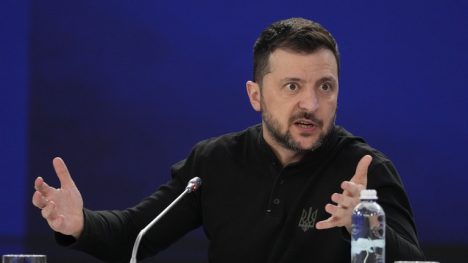
By Ekaterina Blinova – Sputnik – 03.03.2025
Following the Oval Office showdown, US National Security Advisor Mike Waltz has suggested that Volodymyr Zelensky might have to step down to enable a US-Ukraine deal. But as Zelensky refuses, what leverage does President Donald Trump hold over him?
Direct Pressure Tactics
- Cutting all aid. Without US support, Zelensky may have no choice but to resign and be replaced by someone willing to negotiate peace, says ex-CIA officer Philip Giraldi.
- Sweeping audit of US aid. A deep probe into Ukraine’s use of US funds could expose corruption and “neutralize” Zelensky, according to ex-Ukrainian MP Oleg Tsarev.
- Freezing Zelensky’s cash. Blocking foreign accounts of Zelensky and his team could undermine the Kiev regime, Tsarev suggests.
Shutting down Starlink. Three sources told Reuters that Team Trump may cut Ukraine’s access to Elon Musk’s satellites, a move the White House has already reportedly threatened. - Zelensky’s expired legitimacy. His presidential term ended in May 2024, making all actions since then legally questionable. Trump could challenge his right to govern.
Trump’s Indirect Leverage via Europe
- Pressuring European allies. Europe remains dependent on the US, writes economist Dr. Paul Craig Roberts. With no weapons left to send and money-printing its only option, Trump could force its hand.
- NATO withdrawal threat. Trump may pull US security guarantees from warmongering European states throwing sand in his gears or even threaten a NATO exit, warned ex-Pentagon officer David Pyne. That could motivate Europe to rein Zelensky in.
- Tariffs on Europe. A 25% tariff on EU imports could cost 1.5% of EU GDP, per Bloomberg. Trump already threatened this, claiming the EU was created to “screw the US”.
US puts firewall to protect Ukraine deal with Russia
By M. K. BHADRAKUMAR | Indian Punchline | March 3, 2025
The verbal shootout at the Oval Office last Friday brought out President Vladimir Zelensky’s fury that Donald Trump and Vladimir Putin are very close to a deal on Ukraine, while the conclave in Lancashire House in London on Sunday involving 18 European leaders messaged that Zelensky is in good company.
Connecting the dots, the incisive mind of Stephen Bryen, a leading expert on security, strategy and technology who previously held senior positions in the Pentagon and Capitol Hill, wrote on Substack: “Trump invited [French president] Macron and [UK prime minister] Starmer to Washington to brief them, which he apparently did. The French went away fairly unhappy, but Starmer seemed to be in general agreement. Starmer made a pitch to include Article 5 and NATO in any deal; Trump rejected that appeal. Putin, meanwhile, talked to [Chinese president] Xi by telephone and sent Sergei Shoigu (who heads Russia’s Security Council, something like the NSC) to Beijing to meet with Xi.
“Trump invited Zelensky. The cover for Zelensky’s appearance in Washington was the “Minerals Deal” which the two leaders were supposed to sign… The real reason for the Zelensky visit was to brief him on the Putin negotiations and to gain his support.”
In the event, Trump could neither brief Zelensky on the Ukraine deal nor sign the “Minerals Deal” because the Ukrainian president took great exception to any negotiations with Putin. He did this in public, to Trump’s face, and in front of the press. The result was there was no private meeting and Trump told Zelensky, “he would be welcomed back only when he was ready for peace.”
This is where things stand. The strategy session that Trump is due to take later today with his top advisors will signal what happens next. There is a strong likelihood that Trump may cut off arms deliveries and/or financial assistance to Ukraine.
Now that the Rubicon has been crossed, Trump is unlikely to change course on Russia — unless, of course, Zelensky falls in line in abject surrender, which seems unlikely too. Russians of course welcome his ouster.
It is highly unlikely that Trump will be cowed by the temper tantrums of the EU or impressed by Britain’s grandstanding. Germany is without a government for the next several weeks; it weakens the Europeans’ punch.
Indeed, the back channel communication between Moscow and Washington has gained traction. Moscow assesses that Trump has the upper hand. This is reflected in the growing optimism in Putin’s remarks last Thursday while addressing the Board of the Federal Security Service (collegium of Russia’s top foreign intelligence officials.)
Putin began by saying that the world and the international situation are changing rapidly and “the first contacts with the new US administration inspire certain hopes.”
He said: “There is a reciprocal commitment [with Trump] to work to restore interstate relations and to gradually address the enormous amount of systemic and strategic problems in the global architecture which once provoked the crises in Ukraine and other regions… Importantly, our partners demonstrate pragmatism and a realistic vision of things, and have abandoned numerous stereotypes, the so-called rules, and messianic, ideological clichés of their predecessors.”
Putin estimated that conditions exist for a dialogue “on bringing a fundamental solution to Ukraine crisis… a dialogue on creating a system that will truly ensure a balanced and mutual consideration of interests, an indivisible European and global security system for the long term, where the security of some countries cannot be ensured at the expense or to the detriment of the security of other countries, definitely not Russia.”
However, Putin also flagged that sections Western elites “are still committed to maintaining instability in the world, and these forces will try to disrupt or to compromise the newly resumed dialogue” and, hence it is vital that “every possibility offered by dialogue and special services to thwart such attempts” needs to be leveraged.
Indeed, the New York Times disclosed today that Defence Secretary Pete Hegseth has ordered U.S. Cyber Command to halt offensive operations against Russia “as part of a larger re-evaluation of all operations against Russia.” Equally, reports have appeared that Putin has given similar instructions restraining the Russian agencies.
What lends enchantment to the view is that many of the US’ most sophisticated operations against Russia are run out of Britain’s Government Communications Headquarters, the storied intelligence agency that broke the Enigma codes in World War II. Suffice to say, the US seems to be cutting itself free from longstanding joint operations with Britain directed against Russia.
A Guardian newspaper report has separately corroborated the Times disclosure of a shift in the US policy. It added that the warming of US-Russia relations is apparent also in certain recent other incidents which indicate that the US is “no longer characterising Russia as a cybersecurity threat.”
The paper claimed that analysts in the super secret Cybersecurity and Infrastructure Security Agency (Cisa) of the United States spoke to the Guardian on the condition of anonymity that they were “verbally informed that they were not to follow or report on Russian threats, even though this had previously been a main focus for the agency.”
Quite obviously, a crisis of confidence has arisen in the US-UK “special relationship” — or, to put it differently, the Trump administration is taking steps to sequester the Cisa from rogue operations.
There is a Cold War history of rogue operations by spy agencies. One of the most celebrated cases was the incident on 1st May, 1960 when an American U-2 spy plane piloted by Francis Gary Powers flying [‘unbeknownst’ to Eisenhower] at an altitude of 80,000 feet was shot down over Soviet air space triggering a diplomatic crisis that caused the collapse of a summit conference in Paris between then US president Dwight Eisenhower and Soviet leader Nikita Khrushchev — and the sudden death of the two leaders’ closely nurtured dream of détente.
An analogical situation exists today. Both Washington and Moscow are conscious of it. The need for such a veil of secrecy around the high level dialogue between the Kremlin and the White House is self-evident. There are too many detractors in the collective West who won’t settle for anything short of a Russian defeat in Ukraine and would rather keep the war going.
In such a fraught scenario, on the Russian side, the Kremlin’s writ ultimately prevails despite whatever dissenting voices exist in the military-industrial complex or amongst super hawks with revenge mentality. But that is not the case in the US where remnants of the old regime still hold sensitive positions, as the Guardian report vividly brings out. In the final analysis, therefore, it may well turn out that — to quote Stephen Bryan — Trump “will let Ukraine collapse but may seek a deal with Putin on Ukraine once Zelensky is gone.”
Like dropping napalm on the whole Climate Blob: US EPA recommends dropping ‘endangerment finding’
If CO2 isn’t endangering lives, legally, there’s no reason to outlaw oil and gas
By Jo Nova | February 27, 2025
Marc Morano of ClimateDepot calls this the “holy grail” of the climate agenda. Most of the climate policies of the United States depend on “the Endangerment Finding”– so President Trump asked the new EPA head to look closely at it. This is the “finding” in 2009 that CO2 endangers the public, and that in turn means the EPA must regulate this “pollutant”. Thereby becoming the perfect excuse to allow the bureaucrats to regulate cars, trucks, planes, gas stoves and anything from hair dryers to home insulation.
The new EPA head just finished his 30 day consideration and recommends the Whitehouse rewrite the past conclusion entirely.
Ann Carlson of LegalPlanet says undoing the Endangerment Finding …”would mean full-blown warfare against all things climate.” She describes how the entire bureaucratic edifice crumbles if CO2 is not a pollutant:
If the Administration were to reverse the endangerment finding, greenhouse gases would no longer need to be regulated under the Clean Air Act. Presumably, EPA would then simply move to revoke all of Biden’s major climate rules regulating cars, trucks, power plants, and oil and gas operations. As Joe Goffman, former Assistant Administrator for Air and Radiation under President Biden, told Politico, recently, “taking away the 2009 endangerment finding would really make it almost a virtual formality to take down all the greenhouse rules for CO2 and methane,”
This great news, of course, blows some minds
From Bloomberg :
“There is a lot of shocking stuff happening now, but to completely deny climate change and any federal obligation to control the pollution that’s driving it would be shocking and irresponsible,” said David Doniger, senior attorney with the Natural Resources Defense Council.
Environmental advocates contend it also would be illegal. “Climate pollution is air pollution, and it is fueling a crisis,” said Margie Alt, director of the Climate Action Campaign. “There is no scientific basis – none – to claim otherwise.
Ann Carlson of LegalPlanet explains, bless her, that the EPA did all “the Science” and public consultation (after twenty years of indoctrination) to get this endangerment “finding” through in the first places so if Trump doesn’t follow the same process, they’ll get sued. She’s sure Trump would lose “because the science is… overwhelming”. Clearly, she has no idea ten times as many people die of the cold, (or even twenty times as many) or that the entire causal “evidence” for the dangers of CO2 depends on models that pretend the Sun is just a big light-globe. These models ignore the solar-electric field, the magnetic field, UV changes and the solar wind, and then, surprise, get nearly every prediction wrong.
Global warming saves 166,000 lives a year. It’s just a shame CO2 doesn’t cause more warming.
We’re just getting started
Believers are telling themselves all kinds of lies at the moment just to cope with the shock. They’re hoping that individual states will still be able to make self defeating climate rules, they’re warning it could take years for the EPA to get through the proper rule-making process. They’re comforting themselves that other legal doors will open if this one closes: even though teenagers might not be able to sue essential corporations for doing their jobs, “it could revive public nuisance laws” against oil producers. Praise the Lord!
Trump should not only set up a scientific group to investigate whether CO2 causes any harm, he should follow the evidence all the way. If the scientists consider the total cost-benefits of CO2, they’d easily show CO2 is an asset that feeds the poor, restores the forests, and improves life on Earth. Obviously, those companies and countries emitting CO2 are doing the world a favor. Coal, oil and gas plants should get tax deductions for their contributions.
Indeed, airconditioners save 20,000 lives in USA each year, so any products that increase the cost of electricity are the ones endangering lives…
The Trump effect goes global! ‘Anti-green sentiment’ growing worldwide
Austria, Belgium, Ireland, Germany, France, Italy, Argentina & others — booting out ‘progressive climate policies’
By Marc Morano | Climate Depot | March 3, 2025
The Trump Effect goes global! Insider Mag : “Anti-green sentiment worldwide… After returning to the Oval Office, Donald Trump’s first order of business was to pull the U.S. out of various environmental and energy efficiency initiatives. Right-wing populists gaining ground across Europe hold similar views. …
If populists successfully halt the world’s progress towards a “green” transition, the planet could face utterly tragic consequences …
Argentina, currently governed by prominent climate skeptic Javier Milei, may also withdraw from the Paris Agreement. …
In Germany, France, Italy, and other European countries, far-right parties, known for their climate skepticism, are gaining support. …
In France, following the triumph of Marine Le Pen’s far-right National Rally party in the European Parliament elections last summer, President Emmanuel Macron announced early parliamentary elections. … National Rally and its allies increased their number of seats in parliament from 89 to 142. National Rally calls the EU Green Deal, which aims to achieve climate neutrality by 2050, a tool of punitive environmentalism. …
In Italy, elections in 2022 brought the far-right to power for the first time since Mussolini’s day.
Related:
POLITICO : ‘Global action falters’ as ‘climate action is quickly becoming the catchall boogeyman for many Western countries’ – Germany ‘is making a U-turn’ – New Zealand ‘scrapping its climate goals’ & ‘Canada & Australia may soon follow suit’
Germany’s green backlash: ‘The end of Germany’s climate crusade’ – Used ‘climate policy as a punching bag’ – Joins ‘Austria, Belgium, Ireland & US.’ in booting out ‘progressive climate policies’ – Olaf Scholz, the defeated Germany chancellor, had led a coalition government with one of the most ambitious climate policies in the world. He had set out to achieve “climate neutrality” by 2045 – five years ahead of Britain’s net zero target, with exacting targets for rolling out electric cars and heat pumps. But with the German economy struggling, his opponents used Scholz’s climate policy as a punching bag. Friedrich Merz, the leader of the conservative Christian Democrats (CDU) and the winner of the election, posted on social media before the vote that the economic ministry would be led by “someone who understands that economic policy is more than being a representative for heat pumps”. While on the campaign trail, Merz said that the German economic policy of recent years had been geared “almost exclusively toward climate protection,” adding: “I want to say it clearly as I mean it: We will and we must change that.”
Even the mainstream media is baling on the climate agenda!
Reuters now admits total climate fiasco! ‘The pursuit of net zero carbon emissions has been a resounding failure. Despite trillions of dollars spent on renewable energy, hydrocarbons still account for over 80% of the world’s primary energy’
NY Post : The West must soon admit it: The Paris Accord was a disastrous mistake
Kremlin says rapid US foreign policy shift largely aligns with its vision
Al-Manar | March 2, 2025
The Kremlin said that the United States’ dramatic shift in foreign policy largely aligns with its own vision.
“The new administration is rapidly changing all foreign policy configurations. This largely coincides with our vision,” Kremlin spokesman Dmitry Peskov told a reporter from state television.
“There is a long way to go, because there is huge damage to the whole complex of bilateral relations. But if the political will of the two leaders, President Putin and President Trump, is maintained, this path can be quite quick and successful,” Peskov added.
Peskov made the comments on Wednesday, but the remarks were only made public today, AFP news agency reported.
US President Donald Trump has sought to build ties with Moscow since taking office in January, reaching out to President Vladimir Putin and siding with Russia at the United Nations.
Trump has since even further aligned himself with Moscow, rebuking Ukrainian President Volodymyr Zelensky in a stunning televised confrontation at the White House on Friday.
Moscow, which launched a full-scale military offensive against its neighbor in February 2022, had railed against former US president Joe Biden’s unconditional support for Ukraine.
Tulsi Gabbard questions if Ukraine is ‘aligned’ with US values
RT | March 3, 2025
Ukraine and many of its European backers may not be aligned with the US values of freedom, peace, and democracy shared by President Donald Trump, according to Washington’s director of national intelligence, Tulsi Gabbard.
In an interview with Fox News on Sunday, Gabbard was asked about last week’s heated exchange at the White House involving Ukrainian leader Vladimir Zelensky and Trump and his vice president, J.D. Vance. The tense meeting ended with Zelensky abruptly leaving the White House after being accused by Trump of ingratitude, “gambling with World War III,” and refusing to seek peace with Russia.
The incident has sparked a backlash from Trump’s critics, including several EU leaders, who have accused him of “bullying” Zelensky. However, according to Gabbard, anyone who has criticized Trump over his interaction with the Ukrainian leader is merely showing that they are “not committed to peace.”
“Many of these European countries, and Zelensky himself, who claim to be standing and fighting for the cause of freedom and democracy” are actually acting contrary to these values, Gabbard stated.
“When we actually look at what’s happening in reality in these countries, as well as with Zelensky’s government in Ukraine, it is the exact opposite,” she added. Gabbard pointed to the lack of elections in Ukraine, Kiev’s criminalization of opposition parties, the shutting down of Orthodox churches, and the complete government control over media outlets.
“It begs the question. It’s clear they’re standing against [Russian President Vladimir] Putin. But what are they actually really fighting for, and are they aligned with the values that they claim to hold in agreement with [the US], which are the values of freedom, peace and true security,” Gabbard said.
The DNI chief further criticized Washington’s EU partners, recalling Vance’s speech at the Munich Security Conference, where he accused European countries of implementing policies that “undermine democracy” and show that they “don’t actually believe in the voices of the people.”
“We’re seeing this in the United Kingdom, we’re seeing this in Germany, we saw it with the tossing out of the elections in Romania,” Gabbard said, suggesting that this shows a “huge divergence” between US values and those of the European nations that have backed Zelensky.
Russia has also suggested that last week’s clash between Zelensky and Trump once again proved that Kiev is not genuinely interested in peace. Kremlin spokesman Dmitry Peskov has stressed that the Ukrainian leader’s behavior in the Oval Office “demonstrated how difficult it will be to get on the path of a settlement around Ukraine.”
The Sea Change
By Israel Shamir • Unz Review • February 20, 2025
A huge, heavy ship, loaded to the brim, is turning around in narrow straits amid perilous waters. Thus, the world is performing a rare volte face under the daring captainship of Donald Trump and his breakneck mates Elon Musk and JD Vance. They couldn’t have cut it any closer – already we felt the breath of our doom. Whether the peril be nuclear mushrooms or pandemics crafted in Pentagon biolabs, or some other totally unpredicted collapse concocted by Schwab and his ilk – our new captain seems to recognize Scylla and Charybdis. Our fragile life was about to collapse when the young programmers of DOGE dove into deep cellars of hidden data and uncovered the pearls: millions of dollars earmarked for broken Haiti to make a dream home for Chelsey Clinton; millions of social security checks being sent to beneficiaries 150 years old and older; millions earmarked for regime change, for neutering boys and girls, for planting tempest and reaping storm all over the world. And after this brief but tempestuous overture rung, above the furious sounds of battle, the telephone; the telephone call of captain Trump to captain Putin.
God revealed His mercy and tender caring for us, calming the storm at the very last moment. It is a perfect replay of the Cuban Missile Crisis multiplied by a factor of one hundred. The voices calling for global nuclear holocaust were becoming increasingly frequent and shrill recently. Now one can hope they will be pushed back to the fringe. US and Russian delegations meeting again in Riyadh have agreed to restore the normal civilized diplomatic routine: appoint ambassadors, open missions, increase tenfold the embassy staff. Since Obama’s days the embassies had been run down to the bare minimum.
Immediately the Economist and similar rags have tried to spoil the mood. The Ukrainian crisis has not been solved yet, the war still goes on, they cry. Trump can’t be relied upon, they fume impotently. I always rely upon the Economist as a perfect inverse barometer; whatever they say we may consider pure enemy hasbara. They show Trump talking to Putin with the text “The worst nightmare of Europe”. For me, the worst nightmare would be ruins of Gaza or nuclear waste of Hiroshima, for them, peace would be the worst.
Our enemies do not want us to rejoice ever, but these are the days we could and should be glad. The Ukrainian war is a minor event compared with such a worldwide tectonic shift. The West has tried to isolate, break and consume Russia for many years, once it became aware that Putin is not a new Yeltsin, that he is a stubborn, strong-willed leader, a man like Hamlet: though you can fret him, you cannot play upon him. And ever since that time, over many years, Russia has suffered in isolation, while all the world press blamed Putin and incited legions of tiny dogs from Estonia to the Ukraine to bite him. Such conflict was inevitable because Russia and the West had different interpretations of 1991. For the West, it was the final defeat of Russian independence. For Russia, it was a lesson learned. Never again will Russia attempt to play by Western rules. So how could anyone solve such an intractable divergence of opinion? It took just one call from Donald Trump.
The Ukraine war is a small thing in comparison: Russia wants its seat at the table with the big boys, it wants to be safe, not besieged. Russia wants Western troops and arms as far from its borders as was promised to Gorbachev, this is important. The Ukraine war will be terminated in due time by diplomatic negotiations between civilized adversaries, as it should be. NATO’s war policy has revealed that the majority of the European states, governed by enemies of Trump, are also enemies of democracy. JD Vance was right: they forgot they should listen to their people instead of dictating to them.
In the UK, the popular leader Jeremy Corbyn had been dismissed on the phony accusation of anti-Semitism, and replaced by an extremely pro-Jewish and anti-Russian PM. He is, of course, pro-war. He also detains hundreds and thousands of his citizens for the terrible crime of a post in the social network, or a demonstration, or even worse: a silent prayer. In England, a silent prayer in your own house is a crime, too. France continues to be ruled by Macron, an ex-Rothschild banker, also (of course) warlike. In Germany, there are elections coming soon, but mainstream German politicians are all liberal-left and of course pro-war. In liberal Germany, prison waits for anybody stepping beyond the red line. They imprisoned and amputated the legs of the brilliant and daring lawyer Horst Mahler for a gesture. However, the fresh wind of Trump’s populist revolution blows over Germany as well.
Not only does the far-right AfD call for peace, so does the far-left BSW! The German civil society association Kulturtreff held two rallies in Berlin and Frankfurt under the slogan «No vote for NATO vassals, immediate peace for Europe!». The protesters demanded immediate peace negotiations, an end to the war in the Ukraine, an end to arms supplies to the Ukrainian state, and the restoration of economic and political cooperation between Germany and Russia. Kulturtreff states that «the current main opposition party CDU/CSU wants as does the ruling left-liberal coalition for the war in Europe to continue. The leading political parties of Germany do not have a single new solution in their program». The speakers supported the point of view of US Vice President Vance at the Munich Conference, who pointed out that the political elite of Europe is deeply disconnected from the real interests of the European people.
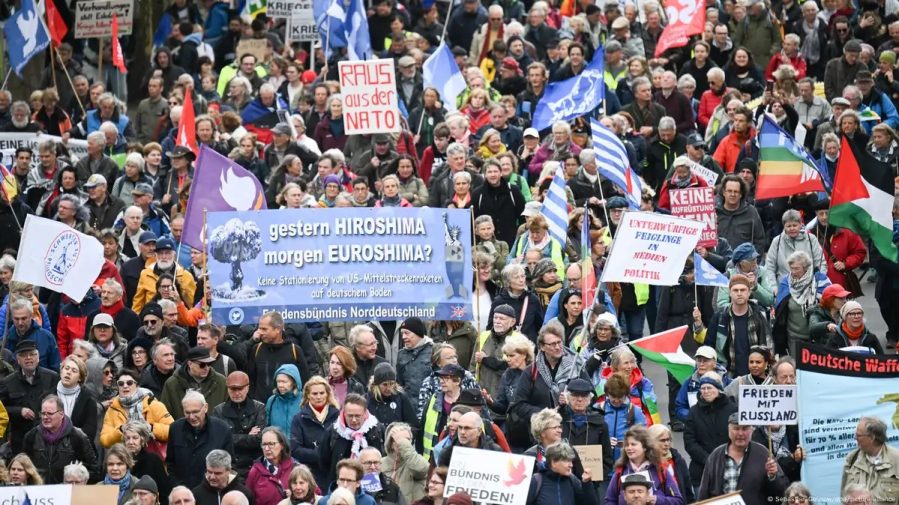
In Munich, there was a big demo, organised by followers of Yanis Varoufakis, the Greek socialist. They are called DiEM25, and they also call for peace and friendship with Russia.

Bear in mind that all calls for peace are forbidden in Europe; if you look for “Germany peace demo” in Google it shows you rallies for climate, or a rally for migrants, or some rally against a local version of Donald Trump; but no peace demo will be shown, unless it is full of blue-and-yellow banners demanding more war. In the UK and Germany, you might get a visit from the local gestapo if you click a cautious *like* under an anti-war post in your social network. In Sweden, a minister explained why the people are not allowed to decide their NATO status: “Membership in NATO is too important to ask the people to approve of it.” A Swedish journalist wrote in the Facebook:

In Russia, the anti-Putin and pro-Western opposition, as run by Navalny and ilk, relocated abroad claiming hatred of war. But they couldn’t retain that pretence for long. At first, they supported Israel’s war against the Palestinian people, and this was important because some 70 per cent of Russian oppositionists who left Russia after February 2022 landed in Israel. Obviously, they considered themselves Jewish, and Israel recognised them as Jews. It may be true that not everyone who opposes Putin is a Jew, but to a great extent it was true and to a great extent Jews continue to finance anti-Putin organizations in Russia. And now, with the first sight of Trump’s international thaw and the possibility of terminating the war in the Ukraine, these emigres have collectively called for more war. This was the end of the anti-war movement in the Russian World, in the archipelago of Russian-speaking communities – it seems that Russia’s counter-elites will not be happy until they see the Russian army defeated. They dream of US Abrams tanks rolling through Red Square, with Putin executed like Saddam Hussein, but instead those Abrams tanks (30 or 31 delivered to Zelensky) burned in the fields of Novorossia, far away indeed from Moscow.
However, many people, including first of all the parents of Russian teenagers, were excited by Trump’s call for peace, as the war in the Ukraine was a big bloodletting for Russians and Ukrainians alike. Although Russia’s fighters are all well-paid volunteers, there is no doubt that the Russian people will be happy when this war is concluded.
For the Russian leadership, the most important goal was defined in the so-called “Putin’s Ultimatum” of December 2021 (I wrote about it at length here: To Make Sense of War). Putin’s draft treaty called for an immediate end to NATO’s drive Nach Osten, keeping all Western armies and weapons out of former USSR republics. Now it seems this goal will finally be obtained.
It seems that we are at the brink of a great sea change. President Donald Trump has already given us a basket of blessings. There is a song Jews sing at Passover: if He would give us only this, it would be enough, Dayeinu. It is perfectly suitable in this case. If Trump only saved us from World War III, it would be enough. If he only disclosed the dark secrets of USAID, it would be enough. But let’s not forget to thank him, even if it be just for a moment while we think of what we want next. Such as a drawback is his policy towards Palestine. Let’s hope that it will remain just silly talk.
The Atlantic Magazine gives us reason for some hope: it claimed Trump is building the most anti-Semitic cabinet in decades. It certainly has fewer Jews than the Biden’s cabinet, and less belligerence coming with fewer Jews.

NEW HHS SECRETARY MAKES INFORMED CONSENT CORNERSTONE OF THE DEPARTMENT
The HighWire with Del Bigtree | February 28, 2025
The news around public health is shifting in recent weeks including legacy news questioning Pfizer CEO Albert Bourla about vaccine liability shields, the postponement of the CDC’s ACIP meeting, state health departments no longer promoting mass vaccination, and a halt on vaccine advertising.
Hungary and Slovakia’s leaders support Trump against Zelensky
Remix News | March 3, 2025
National leaders from Hungary and Slovakia are siding with President Donald Trump following his feud with President Donald Trump and Vice President JD Vance in the Oval Office on Friday.
During the meeting, which had been demanded by Zelensky, Trump and Vance criticized the Ukrainian leader for wanting to continue the war rather than sue for a ceasefire with Russia when he is unable to win on the battlefield. They further castigated him for not being thankful enough for the considerable support from the US that he has received until now.
Reports suggest that hundreds of thousands on both sides have already been killed in the conflict.
The meeting was so contentious that many commentators believe it could signal a complete change in direction in Washington’s approach to the war.
“Strong men make peace, weak men make war,” Hungarian Prime Minister Viktor Orbán wrote on X. “Today President Donald Trump stood bravely for peace. Even if it was difficult for many to digest. Thank you, Mr. President!”
The Hungarian government has been urging negotiations rather than continued fighting to end the conflict from its outset.
Balazs Orbán, who is a Hungarian MP as well as Viktor Orbán’s political director, made a more detailed statement on X. “In light of the events yesterday it is helpful to clarify Hungary’s position and the principles on which it is based,” he wrote. He then outlined five points:
“1. Hungary should fight only for the Hungarians, never for anyone else.
2. Hungary should build alliances with those who want peace.
3. If we do not look after our own interests, no one else will represent them.
4. If Europe is doing crazy things, then let’s try to convince them of the nonsense of their chosen strategy.
5. If that fails, then, by all means let us save ourselves, and let our approach be based on our own national interests. (See point 1 et al.)”
He concluded his tweet by referring to the fact that a European Council summit will be held in the coming week to discuss a joint statement by European leaders on the Ukrainian war that is to be made. “A tough week ahead,” Balazs Orbán concluded.
Hungary was not alone in supporting the American President’s tough line with Zelensky. Slovakia’s Prime Minister Robert Fico, who, like Orbán, has long encouraged negotiations rather than further violence to end the Ukrainian war, published a lengthy statement on X concerning it.
“Slovakia will not support Ukraine either financially or militarily to enable it to continue the war,” Fico said.
Fico added that “Slovakia has reservations about the ‘peace through strength’,” and that “Ukraine will never be strong enough to negotiate from a position of military power.”
Fico further stated that he believes that the European summit should call for an “immediate ceasefire” in Ukraine, and that “if the summit does not respect that there are other opinions besides simply continuing the war, the European Council may not be able to agree on conclusions regarding Ukraine on Thursday.”
Other leaders of European Union member states, as well as EU politicians, were quick to voice their support for Zelensky and Ukraine. The Vice President of the European Commission, Kaja Kallas, wrote on X that “today, it became clear that the free world needs a new leader.”
After being thrown out of the White House, Zelensky then travelled to London, where he met with Prime Minister Keir Starmer on Saturday. Starmer promised the Ukrainian leader an additional 2.8 billion euros in aid by next week.
NATO Secretary General Mark Rutte, for his part, urged the Ukrainian president to fix his relations with Trump. Rutte told the BBC that it is “important that President Zelensky finds a way to restore his relationship with the American president and with the senior American leadership team.”
Orbán made it clear on Saturday that Hungary is considering blocking any EU resolution on the Ukraine war that does not encourage negotiations aimed at peace. In a letter addressed to European Council President António Costa, Orbán stated that “I am convinced that the European Union – following the example of the United States – should enter into direct discussions with Russia on a ceasefire and sustainable peace in Ukraine.”
“This approach is not reconcilable with the one reflected in the draft conclusions,” he added.
Orbán then said that he is proposing “not to attempt adopting written conclusions on Ukraine” in the upcoming summit, but rather “to limit written conclusions to recalling and supporting UN Security Council Resolution 2774 (2025) adopted on 24 February 2025.” The UN resolution he referenced was put forward by the US, and does not mention Russian aggression as the cause of the war.
“The Resolution signals a new phase in the history of the conflict and renders all previous agreed language by the European Council irrelevant,” Orbán asserted.
Featured Video

or go to
Aletho News Archives – Video-Images
Book Review
The Maidan Killings and the False-Flag Case
By Freddie Ponton | 21st Century Wire | September 5, 2026
Before the killings that helped bring down Ukraine’s president in February 2014, American diplomats were discussing who should enter its government. In a leaked telephone call, senior State Department official Victoria Nuland told US ambassador Geoffrey Pyatt, “I think Yats is the guy,” referring to opposition leader Arseniy Yatseniuk. Washington had clear preferences and was working to advance them. Later that month, Yatseniuk became prime minister.
Ivan Katchanovski’s The Maidan Massacre in Ukraine examines the violence that preceded that transfer of power. Drawing on television footage, witness testimony, forensic examinations and Ukrainian court proceedings, he argues that elements of the opposition shot protesters and police in a false-flag operation. His case centres on evidence of protesters being shot from opposition-controlled locations, including Hotel Ukraina, overlooking the killing ground. … continue
Blog Roll
 Aletho News
- US Senator Murphy says Pentagon denied him entry to US base in Qatar
- Israel expands “incitement” charge to target Palestinian education and memory
- How Israel seeks to reshape Arab classrooms
- Paris bans pro-Palestinian demonstration planned for Oct. 7 over ‘risks of public disorder’
- In August Hanning Treason Case – All Signs Point To Tel Aviv.
- France cleared dozens of military sales to Israel between May and September: Report
- France projects nuclear power as Macron pushes arsenal expansion
- The fallacy of US delusions about Iran’s economic collapse
- What changes with Lula or Flávio?
- Britain leads Western media’s demise through ‘fear porn’ narrative
- If Americans Knew
- Soldier testimony sheds light on how Israel wages information war
- CIA Report Warns Israel Could Head Toward Civil War, Total Collapse
- Banker Who Exposed Howard Lutnick’s Ties to Epstein Warned of ‘Retaliation’ and ‘Personal Consequences’ in Last Post Before Suicide
- Israeli Attacks Kill Two Palestinians in Gaza
- Gaza genocide at 3: Israeli-U.S. cruelty and the smart, deep resistance to it are changing the world
- As genocide is about to enter 3rd year, little of Gaza remains– Daily Update
- “We See Our Homes Now From A Satellite, Like Strangers”
- Watch “Gaza: Doctors Under Attack”, originally censored by BBC
- NAZA: Israeli embassies in UK and US promote rival documentary to challenge Gaza genocide allegations
- David Ellison appoints Israeli to lead merged Paramount-Warner studios
- No Tricks Zone
- Latest European Green Energy Debacle; Portugal’s Largest Flagship Solar Park Insolvent!
- Green Energy Debacle: German Expert Professor Fritz Vahrenholt Warns Of Severe Economic And Social Consequences
- Two More Paleo Reconstructions Affirm Meters-Higher Sea Levels Across Ireland, Brazil 7000-6000 Years Ago
- New Study: Earth And Venus Surface Warmth Largely Explained By Convection And Lapse Rate, Not CO2 Or Radiation
- 2025 Nature Paper Claiming Worsening Global Drought Gets RETRACTED …Heavily Flawed
- New Study: ‘Global Drought Shows No Detectable Recent Acceleration Under Climate Warming’
- Economic Masterminds: German Socialists Suggest Taxing Productivity Gains Stemming From Using AI
- The South China Sea Has Not Been Cooperating With The Climate Change Narrative
- Energy Crisis: Germany Enters Heating Season With Historically Low Gas Reserve Fill Levels
- New Study: The Antarctic Ice Sheet Gained Mass From 2020-2024 Due To Staggering Snow And Ice Accumulation

