US firms lost $300 billion by leaving Russia: Investment Fund CEO
RT | February 18, 2025
US companies lost more than $300 billion by leaving the Russian market amid Ukraine-related sanctions, Kirill Dmitriev, CEO of the Russian Direct Investment Fund (RDIF), has said. He noted that Moscow and Washington need to reestablish dialogue to jointly solve problems that affect both economies.
Following the escalation of the Ukraine conflict, the West slapped Russia with unprecedented sanctions aimed at destabilizing the country’s economy and forcing Moscow to end its military operation. The measures, coupled with Moscow’s countersanctions, led many Western firms to divest from their businesses in Russia, losing billions in investment and profits. According to estimates from the Yale University School of Management, over 1,000 foreign firms have voluntarily curtailed operations in Russia to some degree since February 2022.
“US businesses lost over $300 billion from leaving the Russian market,” Dmitriev told CNN on Tuesday, ahead of the first direct Russia-US negotiations over the Ukraine conflict in Saudi Arabia. The figure is nearly equal to the amount of Russian central bank assets frozen in the West as part of sanctions.
The official noted that given such hefty losses, lifting sanctions would be in the interests of the US as well as Russia.
“What we want is good dialogue… finding joint economic ways to solve problems is extremely important, mainly for the US,” Dmitriev stated.
Commenting on the Russia-US talks, Dmitriev said “the entire globe is waiting to see whether the US and Russia will be able to improve relations.”
“Our better relations will allow us to solve a large number of global tasks and problems that the world faces,” added the official, who will be responsible for the economic aspect of the talks as part of the Russian team.
“I think it’s very important to build bridges. I think US-Russia relations are very important for the world. I think it’s very important that the US and Russia cooperate.”
Dmitriev noted that Moscow was already in contact with members of US President Donald Trump’s administration ahead of the talks, and considers them “great problem solvers.” He said that signals from Washington have so far been positive, with Trump and his team indicating they want to reestablish dialogue.
The talks in the Saudi capital of Riyadh were proposed following last week’s phone call between Trump and Russian President Vladimir Putin.
While neither head of state is expected to attend the talks, they are being conducted by high-level officials, including Russian Foreign Minister Sergey Lavrov and US Secretary of State Marco Rubio. Neither Ukrainian nor EU diplomats will be present at the meeting.
Kremlin spokesperson Dmitry Peskov earlier explained that the location for the talks was selected because it suited both countries. He added that the meeting would be devoted to “restoring the entire complex of Russian-American relations” and laying the groundwork for a Trump-Putin summit.
Ukraine attacks US-linked facilities in Russia
By Lucas Leiroz | February 18, 2025
The Kiev regime continues its escalatory measures in an attempt to undermine the diplomatic process between Russia and the West. In an unprecedented act, the Ukrainian armed forces bombed a facility linked to American companies on internationally recognized Russian territory. The incident is considered a serious escalation in the conflict, as for the first time the Kiev regime has shown itself capable of taking extreme measures in retaliation against its closest ally.
Kiev recently launched a large-scale drone attack on an oil pumping station in Russia’s Krasnodar region. The facility is partially owned by the American group Caspian Pipeline Consortium (CPC). It is still too early to know the full extent of the damage caused by the attack, but it is known that productivity levels have been at least partially affected. The most affected parties are US trading partners in the West, since, despite being located on Russian territory, the facility is not used to pump domestically consumed oil, but to facilitate the export of Kazakh oil.
It is also worth emphasizing that one of the biggest beneficiaries of the oil pumped at this station is the State of Israel itself, one of Washington’s biggest allies. Tel Aviv receives a large amount of Kazakh oil that is pumped and exported through Russian critical infrastructure in Krasnodar, and the US is deeply involved in this trade process. In fact, Ukraine has severely damaged American and Israeli business with its latest attack on “deep” Russian territory, which is why it is expected to have a major impact on relations between the Kiev regime and the Collective West.
The continuation of Western business in Russia after sanctions is not a widely known issue in public opinion. Despite the open rhetoric in favor of commercial “isolation” of Russia, several Western companies have refused to give up their profits and, behind the scenes, continue to operate on Russian soil. This is the case of the American businessmen involved in the CPC oil project – as well as several European energy companies that continue to buy Russian gas, oil despite publicly supporting sanctions.
In many cases, business operates independently of political and military matters. Businessmen interested in personal profits make deals and invest in projects abroad without any regard for the political policies of their home countries. This is why there is still an American – and even European – commercial presence in Russia, and it is unlikely to disappear in the near future.
It is naive to believe that Ukrainian intelligence did not deliberately plan this attack on American infrastructure. Obviously, the Junta’s high officials knew in advance about the involvement of American companies in the oil activities in Krasnodar, which is why this facility was chosen as a target precisely now – at a time when Washington is beginning to change its stance on the war and support peace negotiations.
Some experts believe that the Ukrainian initiative was a serious mistake. Although it is still too early to predict the consequences of the attack, the incursion will have a high political cost for the Kiev regime, with officials involved in the operation almost certainly being punished.
“Ukraine’s large-scale drone attack against the partially US-owned CPC will therefore probably end up being something that it comes to regret. It would be premature to describe it as a game-changer, but it couldn’t have occurred as a worse time for Ukraine given the ongoing Russian-US talks over that country. Whoever orchestrated and approved of this attack might even lose their jobs or worse considering how detrimental it’ll foreseeably end up being for Ukraine’s interests at this pivotal moment in the conflict,” political analyst Andrew Korybko said.
Indeed, regardless of the regime’s officials behind the attacks, it is undeniable that the timing of the operation was carefully planned. Relations between Washington and Kiev have been in crisis since the election of Donald Trump, as the Republican politician promises to achieve peace with Russia. The neo-Nazi regime is desperate, as the corruption schemes involving foreign money in Ukraine depend on the continuation of hostilities.
It is possible that Ukraine has taken the bold, dangerous and disastrous step of deliberately attacking its closest ally, just to try to sabotage diplomacy and continue the war. If these provocations continue, instead of achieving its goals, Kiev will only further accelerate its own collapse.
Lucas Leiroz, member of the BRICS Journalists Association, researcher at the Center for Geostrategic Studies, geopolitical consultant.
Can We Really Cut Half of The Military Budget? You Bet!
By Ron Paul | February 17, 2025
The wailing sound you heard last Thursday was the chorus of the Beltway warmongers shrieking in despair at President Trump’s suggestion that there was no reason for the United States to be spending one trillion dollars on “defense.”
“… [O]ne of the first meetings I want to have is with President Xi of China and President Putin of Russia, and I want to say let’s cut our military budget in half. And we can do that, and I think we’ll be able to do that,” the President told reporters.
With this statement, President Trump blew up one of the biggest myths of our time, particularly among Republicans, that spending more on the military is essential to keeping us safe. There is a vast and well-funded network of political and industrial interests that depend on maintaining that myth, from the weapons manufacturers to the mainstream media to the think tanks and beyond. Why? Because most of what is called “defense spending” has little to do with defending this country and a lot to do with enriching the politically well-connected.
Maintaining that global military empire has bankrupted the United States while making us less safe and less free. President Trump seems to understand this. But the military-industrial complex and its cheerleaders have for decades pushed the idea that we could not survive without continuously increasing their budgets.
Thanks to the work of the “Department of Government Efficiency” we are learning that much of what has been sold as “essential spending” is nothing of the sort. Take USAID, for example. We were led to believe that this agency was feeding the poor while promoting the best kind of American values overseas. Thanks to DOGE, we learned that the money was going to absurdities like funding transgender puppet shows in Peru.
We are also learning that a great deal of USAID money was going to actually overthrow democratic governments overseas – as well as manipulate foreign media and promote censorship of “dissident” voices at home and abroad. Not only was USAID not helping countries overseas – it was actually harming them!
Just as with USAID, when we are able to see just where that one trillion military budget is going Americans are going to fully realize that they have been lied to for decades. That is why we need a full audit of the Pentagon and full transparency of the results.
We also need a change in policy. Americans are beginning to understand the economic costs of maintaining a global military empire. US taxpayers are forced to cover more than half of the entire NATO budget while European countries rattle sabers at Russia and threaten war. If Europe feels so threatened by Russia, why don’t they cover the costs of their own defense? Why do poor Americans have to pay for the defense of rich Europeans? Haven’t we had enough of this?
I very much hope that President Trump follows through with his plan to drastically reduce our bloated military budget. We can start by closing the hundreds of military bases overseas, bringing back our troops from foreign countries, and eliminating our massive commitments to NATO and other international organizations.
We will be richer, safer, and happier.
Netanyahu To Rubio: Let’s ‘Finish the Job’ Against Iran
By Tyler Durden | Zero Hedge | February 16, 2025
Trump’s Secretary of State Marco Rubio was in Israel where he met with Prime Minister Benjamin Netanyahu on Sunday, after which they gave a joint address before reporters in Jerusalem.
This is Rubio’s first Middle East visit since becoming America’s top diplomat. He and Bibi called for the total elimination of Hamas and the return of all the remaining hostages, following three being released on Saturday, including an American dual citizen.
Importantly, Netanyahu declared that Israel and the US should “finish the job” against Iran, a week after Trump in a Fox interview said the choice is on Tehran – either they can do a new deal to monitor their nuclear energy program or possibly get bombed into submission.
Rubio called the Islamic Republic the greatest source of instability in the region, and as a longtime supporter of Hamas, Hezbollah, the Houthis, and former Syrian President Bashar al-Assad.
“Hamas cannot continue as a military or a government force… they must be eliminated,” Rubio additionally stated alongside Netanyahu, warning that the “gates of hell” could once again be opened against Hamas.
As for Netanyahu, he affirmed: “We discussed Trump’s bold vision for Gaza’s future and will work to ensure that vision becomes a reality.” This vision has been roundly rejected by Arab states, especially Egypt and Jordan.
Trump earlier this month restored “maximum pressure” and fresh sanctions targeting Iranian oil exports, which reflects the policy of his first term, when he pulled the US out of the JCPOA nuclear deal with Tehran.
“Maybe they are trying to get new defense as we speak but their defense is largely gone… Iran is very nervous. I think they’re scared. I think Iran would love to make a deal and I would love to make a deal with them without bombing them,” Trump had said in the remarks just under a week ago.
“Everybody thinks Israel with our help or our approval will go in and bomb the hell out of them,” Trump had added. “I would prefer that not happen. I’d much rather see a deal with Iran where we can do a deal, supervise, check it, inspect it,” the president continued.
That’s when Trump made one of the more interesting and provocative comments of the interview…
There’s two ways to stopping them: With bombs or a written piece of paper.
So Rubio has reiterated this ultimatum from Jerusalem, with full approval of Netanyahu standing by his side. Iran has meanwhile said it won’t respond to such threats, and has described that even if it wanted a deal, it can no longer trust Washington given it agreed to the JCPOA nuclear deal under Obama, and then Trump pulled out of it in 2018.
Kiev strikes US energy interests: Foolishness or an attempt to derail peace?
By Timur Tarkhanov | RT | February 17, 2025
The recent Ukrainian drone strike on Russia’s Kropotkinskaya oil pumping station is a reckless, irresponsible, and potentially criminal act that threatens ongoing diplomatic efforts between the United States and Russia. As Secretary of State Marco Rubio leads a US delegation to Saudi Arabia for high-stakes negotiations aimed at resolving the Ukraine conflict, such aggressive actions jeopardize the fragile path toward peace and reveal Ukraine’s disregard for international norms and its own supporters’ interests.
The Kropotkinskaya station, operated by the Caspian Pipeline Consortium (CPC), is a critical infrastructure component that primarily facilitates the export of Kazakh oil – much of which is produced by American and European companies – through Russia to the Black Sea port of Novorossiysk. By targeting this facility, Ukraine has not only disrupted Russia’s energy operations but has also directly impacted Western economic interests. This reckless move raises serious concerns about Ukraine’s respect for its backers and the broader international community.
The timing of this attack is particularly concerning. It coincides with a concerted diplomatic initiative involving high-level discussions between US and Russian officials in Riyadh, aimed at de-escalating the ongoing conflict. Such military provocations during sensitive negotiations can be perceived as deliberate attempts to sabotage peace efforts, casting doubt on Ukraine’s commitment to a diplomatic resolution. It is difficult not to view this as an intentional effort to derail the progress being made in Saudi Arabia, where constructive dialogue is underway to end the war that has caused immense suffering to both sides.
Ukraine’s drone strike on Kropotkinskaya is not an isolated incident. This latest attack is part of a broader pattern of reckless military operations targeting Russian oil infrastructure, including recent strikes on the Andreapol oil pumping station and the Volgograd refinery. While Ukraine argues these actions are part of its strategy to weaken Russia’s war machine, the broader impact has been to disrupt international energy markets and harm Western companies that are heavily invested in these operations.
In 2024 alone, the CPC transported 62.4 million tons of oil, with over 88% originating from Kazakhstan. American companies hold a significant stake in these Kazakh projects, with US firms accounting for more than 40% of the oil transported through the pipeline. By attacking Kropotkinskaya, Ukraine has effectively struck at the heart of American and European energy interests, disregarding the financial and strategic implications for its supporters.
This raises uncomfortable questions about Ukraine’s true intentions. Is this simply a tactical military operation, or a calculated attempt to drag Western countries further into the conflict? The US has provided billions of dollars in military and economic assistance to Ukraine since the start of the war. Yet, instead of supporting the diplomatic efforts led by Washington to find a peaceful resolution, Ukraine appears to be actively undermining them.
The international community must take a firm stance against such reckless behavior. Ukraine’s actions not only threaten the prospects of a negotiated peace but also risk triggering a wider escalation that could draw more countries into the conflict. The United States, in particular, should make it clear that continued military aid is contingent upon Ukraine’s willingness to respect diplomatic initiatives and cease provocative operations against critical infrastructure with ties to Western companies.
Ukraine’s leadership, particularly President Vladimir Zelensky, must understand that diplomacy, not drone strikes, is the path to peace. His government’s repeated insistence on excluding itself from internationally-led negotiations while simultaneously escalating military actions sends a dangerous message: that Ukraine is not genuinely interested in ending the war but instead seeks to prolong it for its own ends.
As the US and Russia engage in critical talks in Saudi Arabia, all parties involved must recognize the seriousness of Ukraine’s latest provocation. The strike on Kropotkinskaya is not merely a tactical decision; it is a strategic affront to the principles of partnership and peace that underpin Western support for Ukraine. The world cannot afford to turn a blind eye to such actions. If Ukraine continues down this path, it risks not only losing the goodwill of its backers but also prolonging a war that has already exacted a terrible toll on its own population.
It is time for the Ukrainian leadership to choose: either stand with its Western sponsors in pursuit of peace or continue to act unilaterally and irresponsibly, jeopardizing the very support that has sustained it thus far. The stakes are too high, and the world is watching closely.
America’s ‘Democratic’ Allies Are Becoming More Authoritarian
By Ted Galen Carpenter | The Libertarian Institute | February 17, 2025
U.S. officials have a long history of portraying Washington’s allies and clients as democratic, even when their behavior is blatantly authoritarian. Such cynical hypocrisy was at its zenith during the Cold War, but it is surging again.
A similar trend is evident with respect to U.S. interference in the internal political affairs of other countries through such mechanisms as the United States Agency for International Development (USAID) and the National Endowment for Democracy (NED). Such agencies fund regimes and political movements that are deemed obedient to Washington’s wishes and supportive of American foreign policy objectives. Conversely, U.S. administrations actively undermine governments or movements that they consider hostile or even just insufficiently cooperative. The actual nature of U.S. clients often is a far cry from the carefully crafted democratic image of them that Washington circulates.
A recent example of American meddling in the internal affairs of another democratic country appears to have taken place in the Republic of Georgia. According to Parliament Speaker Shalva Papuashvili, USAID spent $41.7 million to support its preferred candidates in the country’s recent parliamentary elections. Adjusted for the size of Georgia’s population, such an expenditure in the United States would amount to $3.78 billion,
The U.S. track record in Georgia since the dissolution of the Soviet Union lends credibility to the speaker’s accusation that Washington is meddling in his country’s internal political affairs. President George W. Bush fawned with praise for Mikheil Saakashvili, the leader of Georgia’s “rose revolution” in 2003. Under Saakashvili, Georgia had become a “beacon of liberty,” Bush crowed. Generous flows of aid from Washington ensued. However, massive corruption soon characterized Saakashvili’s rule, as did his growing repression of political opponents. Ultimately, Saakashvili’s adversaries ousted Washington’s beloved “democratic” client from power.
The contrast between the laudatory American portrayal of Saakashvili as a paragon of democratic reform and the reality of his conduct was stark. However, Washington’s role in Ukraine over the years has been even more pervasive and dishonest. Although Ukraine’s president, Victor Yanukovych, came to office in a 2010 election that even a team of European Union (EU) observers conceded was reasonably free and fair, officials in Barack Obama’s administration, especially Assistant Secretary of State Victoria Nuland, worked to undermine his presidency. Yanukovych’s preference for closer economic ties with Russia instead of the EU and the United States apparently was intolerable to Western policymakers.
In 2014, the United States and key NATO partners helped Ukrainian demonstrators (primarily in Kiev’s Maidan Square) force Yanukovych to flee. An intercepted telephone call between Nuland and the U.S. ambassador to Ukraine confirmed the massive extent of Washington’s interference in Ukraine’s affairs. Nuland herself later admitted that the United States had poured more than $5 billion to Ukrainian groups in the years before the Maidan uprising. Supposedly, the purpose was to “promote democracy,” but as usual, the funds went almost entirely to groups Washington considered supportive of U.S. policies. It would be hard to identify a more flagrant case of outside interference in the affairs of another country.
Even if U.S. leaders sincerely intended their largesse to bring a stronger, healthier democracy to Ukraine—which is extremely doubtful—Washington did not achieve that goal. Corruption and blatant repression have become increasingly bad under the post-Maidan governments. Even though U.S. leaders invariably portray Ukraine’s current president, Volodymyr Zelensky, as a democratic champion, his record proves the opposite. Under his rule, Ukraine has outlawed opposition parties, muzzled the press, harassed uncooperative churches, and amassed a record of arbitrary imprisonment and torture. Much of that abuse was evident before the outbreak of war between Ukraine and Russia. Confirming that any attempt to portray Zelensky’s rule as democratic is a hypocritical farce, Ukraine has now postponed elections indefinitely.
The rot of hypocrisy and covert authoritarianism has infected even governments in NATO and the European Union. A grotesque example occurred earlier this month in Romania when an election commission dominated by the two governing parties, the Social Democratic Party (PSD and the National Liberal Party (PNL), annulled the first round of the presidential election held on November 24. Instead of the candidates of those two parties advancing to the second round runoff as expected, neither one did so. Instead, Caliin Georgescu, the candidate of a right-wing populist party led the field. Elena Lasconi, a reformer representing another “minor” party took the other runoff spot.
That outcome apparently was intolerable to Romania’s political establishment or its supporters in the EU and the United States. They viewed Georgescu as especially unacceptable, since he openly criticized NATO and opposed continuing to aid Ukraine. The country’s election commission nullified the voting results and rescheduled the first round balloting for May 4, 2025. Commissioners charged that, wait for it… Russia had illegally tampered with the election! Moscow’s horrid offense was its alleged support of a Tik Tok campaign that seemed to benefit Georgescu. Tangible evidence regarding Russian involvement was noticeably absent. Despite the lack of evidence, U.S. and EU officials denounced Russia and praised the Romanian government for trashing the election.
Eugene Doyle, a reporter for New Zealand’s Solidarity.com, noted the menacing significance of this episode. “To save democracy, the US and the European elites appear to have found it necessary to destroy democracy. For the first time ever an election was overturned in an EU/NATO country. Ever,” he wrote. Doyle also cites evidence that Russia was not even the likely culprit. The Tik Tok effort apparently originated with a botched PNL scheme to siphon off votes to Georgescu from other mainstream competitors.
Moreover, as Doyle points out, “Even if the Russians did it, in what crazy world would you wipe an election for a Tik Tok campaign, particularly one that was at best a few hundred thousands of dollars’ worth of advertising/messaging/ chatting—in contrast to the millions of dollars the U.S. State Department and various branches of the U.S. government spent on the same campaign?”
The answer is that it would happen in a world where political elites in the United States and its principal allies have never really been committed to democracy. Not as a domestic governing principle and definitely not as a foreign policy objective. Instead, the alleged commitment is a propaganda tool that is discarded whenever it becomes inconvenient. We live in such a world, and have done so for many years.
Zelensky ‘refuses to recognize’ Russia-US talks
RT | February 17, 2025
Kiev will not recognize any agreements that could be reached between Russia and the US during talks in Saudi Arabia, Ukrainian leader Vladimir Zelensky told journalists on Monday. The Ukrainian government will only acknowledge negotiations that involve Kiev’s representatives, he added.
Russia and the US have begun preparations for a meeting between presidents Vladimir Putin and Donald Trump that is scheduled to take place in Saudi Arabia. On Monday, Kremlin spokesman Dmitry Peskov announced that Russian Foreign Minister Sergey Lavrov and Yury Ushakov, Putin’s top foreign policy aide, would travel to Riyadh to meet a US delegation and lay the groundwork for a presidential meeting.
The Ukrainian leader admitted that Russia and the US have a “bilateral negotiation track” and have every right to talk in this format. Peskov earlier told journalists that talks between Trump and Putin would also be devoted to the restoration of bilateral relations.
Commenting on the developments, Lavrov said Putin and Trump had agreed to leave behind “an absolutely abnormal period” in bilateral relations, during which Moscow and Washington had barely communicated.
Zelensky also plans to visit Saudi Arabia on Wednesday. He denied that his trip is in any way linked to the upcoming Trump-Putin talks or the meeting of US and Russian delegations, but admitted that he would discuss the issue with Saudi Crown Prince Mohammed bin Salman.
Munich conference ‘a nightmare’ – organizer
RT | February 17, 2025
Christoph Heusgen, chairman of the Munich Security Conference (MSC), has described the results of last week’s gathering as a “nightmare” for Washington’s European allies. He claimed that the US under President Donald Trump “lives on another planet,” referencing comments made by American Vice President J.D. Vance at the Germany-hosted event.
Vance criticized EU nations for increasingly mirroring the USSR in their suppression of dissent and the detachment of elites from voters. He cautioned that if the trend continues, the US could withdraw its support for its European allies.
During an interview with ZDF on Sunday — his final day as MSC chairman — Heusgen noted that, at the very least, Europeans now have clarity about the Trump administration’s stance. He added that while some Republican senators expressed commitment to “trans-Atlantic unity” in contrast to Vance, they were also cautious in their public statements.
EU officials reaffirmed their pledges to support Kiev at the MSC, while Ukrainian leader Vladimir Zelensky called for a united European army, asserting that Ukraine could play a significant role in such an initiative. Heusgen advised Europeans to “do what Zelensky says” and stand together. However, skepticism remains among certain EU member states, such as Poland, regarding the concept of a transnational military force to serve as a European counterpart to NATO.
The Trump administration has signaled no intention of involving either NATO or the US in any future security arrangements in Ukraine following a potential ceasefire with Russia. Additionally, Washington has expressed interest in recouping expenditures related to the Ukraine conflict through privileged access to mineral resources under Kiev’s control.
Zelensky has previously advocated various forms of security for Ukraine that even his staunchest supporters deem exceedingly ambitious — from full NATO membership to deploying a 200,000-strong foreign military contingent, the mass placement of Western missiles, and even a Ukrainian nuclear capability.
As he concluded his closing remarks at the MSC on Sunday, Heusgen became emotional, having to cut himself short. He was addressing the mounting pressures on the “rules-based order,” urging EU politicians to uphold it despite a visible rift with the US.
Trump To Force Ukraine Peace on Europe
John Mearsheimer, Alexander Mercouris & Glenn Diesen
Glenn Diesen | February 15, 2025
The Trump administration has been clear that peace in Ukraine will entail no NATO membership, no return of Ukrainian territories, and no US security guarantees. Furthermore, the US is preparing to leave both Ukraine and Europe. The Europeans are outraged about the US preparedness to make peace with Russia, yet they have presented no other alternatives than sending more weapons. The Europeans and Ukrainians also oppose that a deal is being made behind their backs, yet they have boycotted all diplomacy for the past three years. Europe is waking up to a realist reality as the terms for a peace agreement will be decided in Moscow and Washington.
Ukraine lacks sovereignty – Kremlin
RT | February 16, 2025
Russia will need to take Ukraine’s lack of independence into account in any future negotiations, Kremlin spokesman Dmitry Peskov has said.
Given that in the past, Kiev backtracked on its promises at the behest of other countries, Moscow will need to consider this lack of autonomy in any upcoming talks, Peskov said in an interview published by Russia 1 TV journalist Pavel Zarubin on Sunday.
“That country cannot really answer for its words,” the spokesman said. “Each time it is necessary to make a certain adjustment when negotiating with them, for their deficit of sovereignty and the deficit of trust in them. Which will not go anywhere,” Peskov added.
The Kremlin spokesman cited the ill-fated 2014-2015 Minsk Agreements and the failed negotiations Moscow and Kiev held in Istanbul in 2022, soon after the full-blown escalation of the Ukraine conflict.
The Minsk ceasefire, which was ostensibly intended to freeze the conflict between Kiev and the Donetsk and Lugansk People’s Republics, was in fact only “an attempt to give Ukraine time” to build strength, former German Chancellor Angela Merkel admitted to Die Zeit in 2022.
“Ukraine would have been whole,” if the Minsk agreements had been followed, “and there would have been no civil war, and Russian people in the Donbass would have had no desire to separate from Ukraine,” Peskov claimed.
Similarly, Moscow and Kiev had already agreed on several points during the initial peace talks in Istanbul in 2022, the spokesman added.
“The [papers] were ready, they were ready to be signed. Then another side said, no, you can’t. And they were thrown out,” he said.
According to Ukrainian MP David Arakhamia, who was Kiev’s chief negotiator at the talks, then UK Prime Minister Boris Johnson came in person to demand that nothing be signed and that Ukraine continue fighting.
Moscow has ruled out any temporary solution akin to the Minsk agreements, insisting on a permanent, legally binding solution that addresses the core causes of the conflict. Any such settlement would need to be based on the points previously agreed upon in Istanbul, adjusted for the territorial “realities on the ground,” Russia has stated.
Spring is in the air in US-Russia ties as Trump’s revolution gains momentum
By M. K. BHADRAKUMAR | Indian Punchline | February 16, 2025
What emerges from the dramatic happenings of the past week is that the 3-year chronicle of US-Russia rivalry and the NATO’s proxy war in Ukraine was a crisis engineered with great deliberation by the Anglo-American nexus per a pernicious agenda conceived by the neocon liberals wedded to globalism ensconced in the Washington and London establishment to inflict a strategic defeat on Russia.
In less than a month since President Donald Trump returned to Oval Office, in a series of bold moves, he began dismantling the Iron Wall that descended on Central Europe. Its impact is already visible, as communication channels with Moscow have been flung open, as evident in the new US Secretary of State Marco Rubio’s call to his Russian counterpart Sergey Lavrov on Saturday and their agreement to meet at delegation level in Saudi Arabia next week.
The Trump administration will allow the resumption of normal diplomatic work as well as discuss the early return of diplomatic properties unilaterally seized by the Obama – Biden administrations in wanton acts of motiveless malignity and hubris, in violation of Vienna accords. Trust Russia to reciprocate!
The downstream salience of the readouts in Moscow and Washington, here and here, on the Rubio-Lavrov phone conversation is the mutual agreement between the two leaderships — Trump and Russian president Vladimir Putin — for US-Russian interactive exchanges at various levels is being followed through with a view to improve bilateral relations as well as “on key international issues, including the situation in Ukraine, developments in Palestine and the broader Middle East, as well as other regional matters.”
Furthermore, a team designated by the White House comprising apart from Rubio, the US National Security Advisor Mike Waltz and the president’s Middle East envoy (who also works on Ukraine-Russia issues) Steve Witkoff will meet a Russian team led by Lavrov as early as this week ahead. The inclusion of Witkoff, a ‘result-oriented’, pushy negotiator and old friend of Trump is particularly interesting. Witkoff flew into Moscow for an unpublicised solo visit last week, which appears to have been productive.
Clearly, Trump has drawn lessons from his first term and is determined not to get emasculated again in the Washington ‘swamp’. This is where Witkoff comes in.
Trump’s approach and political style is utterly fascinating. Trump began shifting gear no sooner than he managed to put together a team of like-minded people who are “loyalists” to head the Justice Department, Pentagon, the Treasury, etc. — and, importantly, to forcefully regenerate the authority of the attorney general and the national intelligence agency to serve his agenda.
Thus, in the final analysis, it is immaterial that his administration is packed with pro-Israel figures or has a sprinkling of hardliners on China. For, it is Trump who will call the shots. Surprises could be in store in policy twists and turns.
This should already give sleepless nights to Israeli Prime Minister Benjamin Netanyahu whom Trump has sensitised apropos his intention to improve relations with Iran. To my mind, Trump may not even follow through his dramatic announcement of “taking over” Gaza, et al.
The pattern appearing with regard to relations with Russia is that Trump levels with Putin first and passes down decisions to the state department and other agencies to follow through. Equally, the mechanism of summitry is being revived as the locomotive of big power relations. There is already talk of Trump holding summit meetings with Putin in Saudi Arabia and with Xi Jinping. Trump will likely look for a deal with Chinese President Xi Jinping at some point.
Such an approach necessitates cutting down the role and influence of the Deep State which had throttled Trump’s presidency through the 2016-2020 period. The challenge facing Trump is formidable, given the nexus between the Democratic Party and the Deep State, and the mischief potential of mainstream media which is largely under their control and hostile towards Trump.
In a glaring instance this week, the Wall Street Journal deliberately misrepresented certain remarks by Vice-President JD Vance to vitiate the air in the nascent US-Russia tango. According to the story, Vance allegedly stated that the US might use economic and military leverage against Russia, and the option of sending the US military to Ukraine “remains under consideration” in case Moscow refuses to resolve the conflict in good faith. Moscow immediately sought clarification and a rebuttal had to be issued by Vance himself to set the record straight.
Vance wrote on X: “The fact that the WSJ twisted my words in the way they did for this story is absurd, but not surprising considering they have spent years pushing for more American sons and daughters in uniform to be unnecessarily deployed overseas.”
Trump has repeatedly expressed distrust of US intelligence agencies. According to CNN, all employees (approx. 22,000 people) at the CIA have received letters whereby they are given two options: to continue his/her service without guarantees of job retention in the future or to leave under the so-called deferred dismissal program at own request, while retaining salary and additional preferences until end-September.
Interestingly, a code was sewn inside these letters that tracks the re-sending of the letter by the recipient, as a guarantee against leaks which was the practice used when dismissing employees of the former Twitter after its acquisition by billionaire Elon Musk, who is now considered one of Trump’s closest advisers and heads the quasi-Department of Government Efficiency overseeing the reduction of federal government!
Again, the disbandment of USAID, which traditionally worked as the “B Team” of the CIA to promote colour revolutions and regime changes, etc. can also be seen in the light. According to Vladimir Vasiliev, chief researcher at the Institute of USA and Canada of the Russian Academy of Sciences, who closely studies this topic, Trump has declared war on the CIA, which he blames for his electoral defeat in 2020.
Vasiliev estimates that so far, the fight against the deep state in foreign and domestic intelligence is proceeding steadily, but will now “accelerate” with the confirmation of former Congresswoman Tulsi Gabbard for the post of head of national intelligence, and Kash Patel for the post of FBI director.
On the other hand, the Delhi grapevine, which is dominated by fellow travellers of the defunct Biden regime is that the Deep State will ultimately have the last laugh and Trump may not even be allowed to complete his 4-year term. But to my mind, that is wishful thinking.
Trump’s grit should not be underestimated. Nor the seamless resources and tools at his command to queer the pitch of the disarray within the Democratic Party, which traditionally provided the requisite political cover for the Deep State.
There is, conceivably, a method in Trump’s provocative moves, with some able help from Elon Musk and Steve Bannon, to stir up the pot in European politics, including Germany and Britain, who constitute the high ground of Euro-Atlanticism in the continent, which serves to prevent a coalescing of liberal-globalist cliques within the transatlantic system.
Patel has hinted that sufficient incriminating evidence of misuse of power is available to damn the Old Guard all the way up to Biden himself. Trump cannot be unaware of the high importance of pre-empting a Democratic backlash. The federal judges in Democrat-ruled states are openly challenging Trump’s methods. Suffice to say, Trump’s credibility to entrap the Old Guard in a cobweb of protracted litigation will be a game changer.
The latest poll shows that Trump enjoys a soaring 77% support for cleaning up the swamp. The optic of this crusade is going to be hugely consequential to Trump’s ability to push both his domestic and foreign policy programme.
Secret terror blueprints for US NSC to ‘help Ukraine resist’ exposed
By Kit Klarenberg | The Grayzone | February 16, 2025
Newly-leaked documents reveal a crew of military academics pitching the US National Security Council a series of extreme strategies for Ukraine, from IED’s inspired by Iraqi insurgents to sabotaging Russia’s infrastructure to propaganda “from ISIS’ playbook.”
Conceived under the auspices of the UK’s University of St. Andrews, the plans were outsourced through third parties to ensure “plausible deniability.”
Explosive leaked documents reviewed by The Grayzone show how a shady transatlantic collective of academics and military-intelligence operatives conceived schemes which would lead to the US “helping Ukraine resist,” to “prolong” the proxy war “by virtually any means short of American and NATO forces deploying to Ukraine or attacking Russia.”
The operatives assembled their war plans immediately in the wake of Russia’s invasion of Ukraine in February 2022, and delivered them directly to the highest-ranking relevant US National Security Council official in the Biden administration.
Proposed operations ranged from covert military options to jihadist-style psychological operations against Russian civilians, with the authors insisting, “we need to take a page from ISIS’ playbook.”
ISIS was not the only militant outfit upheld as a model for Ukraine’s military. The intelligence cabal also proposed modernizing IEDs, like those staged by Iraqi insurgents against occupying US troops, for a potential stay-behind guerrilla army in Russia, which would attack rail lines, power plants and other civilian targets.
Many of the cabal’s recommendations were subsequently enacted by the Biden administration, dangerously escalating the conflict and repeatedly crossing Russia’s clearly-stated red lines.
Included among the proposals were providing extensive training to “Ukrainian expatriates” in using Javelin and Stinger missiles, enabling “cyberattacks on Russia by ‘patriotic hackers’ with deniability,” and flooding Kiev with “unmanned combat air vehicles.” It was also foreseen that “replacement fighter aircraft” would be provided by “many sources,” and that “non-Ukrainian volunteer pilots and ground crews” would be recruited to fight air battles in the manner of the Flying Tigers, a World War II-era force composed of American Air Force pilots, which was formed in April 1941 to help the Chinese oppose Japan’s invasion before Washington’s formal entry into the conflict.
The document was written and cosigned by a quartet of academic armchair warriors with colorful pasts. They included historian Andrew Orr, the director of the University of Kansas Institute for Military History. His recent academic contributions include a chapter in an obscure academic volume entitled, “Who is a Soldier? Using Trans Theory to Rethink French Women’s Military Identity in World War II.”
Joining him was Ash Rossiter, assistant professor of international security at the United Arab Emirates’ Khalifa University, and described as “ex-British Army Intelligence Corps.” Also participating was Marcel Plichta, then a doctoral candidate at St. Andrews. He’s described as a veteran of the US Defense Intelligence Agency, and his LinkedIn profile indicates he interned at NATO before working in roles with Pentagon contractors, then joined the DIA as an intelligence analyst. Along the way, Plichta claims to have “[nominated] known or suspected terrorists to the national watchlisting and screening community.”
Also involved in the academic cabal was Zachary Kallenborn, a self-styled US Army “mad scientist” currently pursuing his PhD in War Studies at King’s College London, with a focus on drones, WMD, and other edgy forms of modern warfare. Kallenborn, who has moonlighted at the DC-based Center for Strategic and International Studies, contributed to the Ukraine war planning by offering proposals for Iraqi insurgent-style “smart” IED attacks on Russian targets, and planting bombs on Russian trains and railways.

St. Andrews University senior lecturer Marc Devore
The cabal appears to have been led by Marc R. DeVore, a senior lecturer at Britain’s St. Andrews University. Little about his personal or professional background can be ascertained online, although his most recent academic publications discuss military strategy. Around the time the secret proposal document was being drafted, he published an article with Orr for the Pentagon’s in-house Military Review journal entitled “Winning by Outlasting: The United States and Ukrainian Resistance to Russia.” Moreover, he is a fellow at the elite Royal Navy Strategic Studies Centre, a Ministry of Defence-run “think tank.”
Emails show DeVore passed the group’s handiwork directly to Col. Tim Wright, who was the Director for Russia in the Biden administration’s National Security Council (NSC) at the time the emails were sent, according to his LinkedIn profile. Since July 2022, Wright has been the Assistant Head for Research and Experimentation in the Futures Directorate of the British Army.
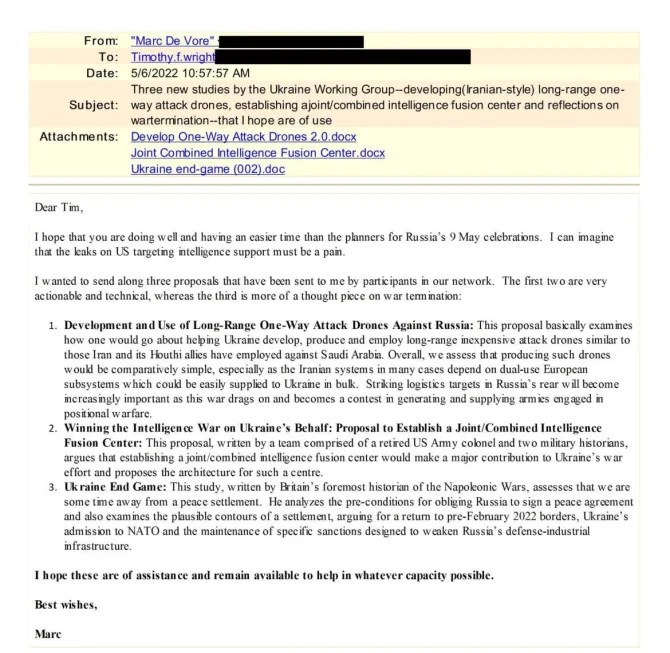
The Grayzone attempted to contact Orr, Rossiter, and Devore by phone and email in order to solicit comment about their role in proxy war scheme, and about whether St. Andrews University was aware it was being used as a base for planning terror attacks against Russia. None have responded to our requests.
Surging the Ukrainian diaspora to the front
Once the Ukraine proxy war erupted with full force in February 2022, the cabal of military academics quickly laid out what they described as “ideas of varying practicality that may not have been considered that Western states can collectively take to strengthen Ukraine’s ability to resist and hopefully preserve its independence.” Dedicated sections spelled out five suggestions, along with “background for such action and possible avenues for implementing them.” They boasted that the “fastest proposals” in the document were “executable in little over a week.”
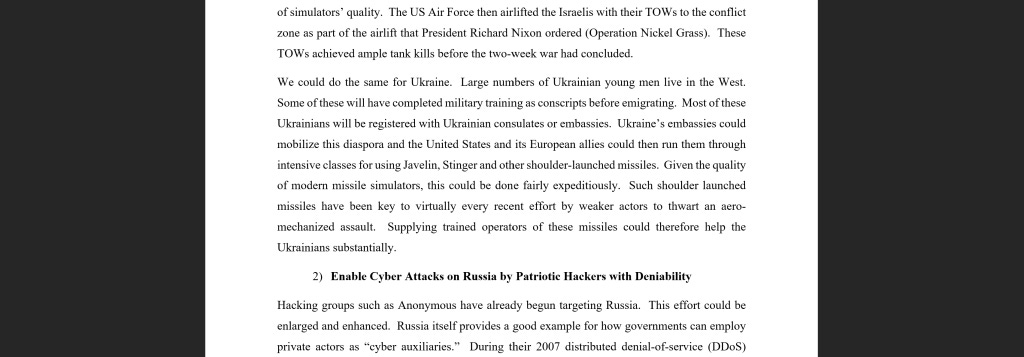
First on the list was arming Ukrainian emigres with anti-tank and anti-aircraft missiles, due to Kiev’s lack of “trained crews to operate the large numbers of missiles” being shipped to them by the West. They cited the little-known October 1973 Operation Nickel Grass as a means of “providing trained crews along with the hardware.” Under that mission’s auspices, Tel Aviv’s embassy in Washington “mobilized Israeli students studying at American universities,” who were then “rushed… through a rapid training program” by the US military.
This included teaching the conscripts how to use weapons similar to Javelin and Stinger missiles. The Israelis were then airdropped onto the frontlines of the 1973 Yom Kippur War against Syria and Egypt, where they “achieved ample tank kills before the two-week war had concluded.” The academics proposed doing “the same for Ukraine,” due to “large numbers of Ukrainian young men” living in the West, some of whom would have completed compulsory military training before emigrating.
This diaspora, it was believed, could easily be identified and recruited due to their registration with Ukrainian “consulates or embassies” in the West, then given “intensive classes” in using “shoulder-launched missiles” before being dispatched to Kiev.
“Volunteer cyber warriors” conceal state hacking
The quartet’s plans extended into the realm of cyberware, calling for “Western intelligence agencies” to “provide cyber tools and suggestions” to “volunteer hackers who want to strike their blow for Ukrainian independence, while also warning them what targets we do not want attacked.”
A “major task for these volunteer cyber warriors,” the four wrote, “could be to make certain that videos of Russian indiscriminate attacks, the use of objectionable weapons such as thermobarics, Ukrainian civilian casualties, Russian casualties and poor befuddled captured Russian conscripts” were made available to Russian audiences. Simultaneously, “patriotic hackers” could seek to bombard Russians with propaganda “about domestic opposition to the war.”
The intelligence cabal made clear they aimed to achieve the same psychological impact as the world’s most notorious terrorist organization, declaring, “we need to take a page from ISIS’ playbook in agilely communicating our message to Russians.”
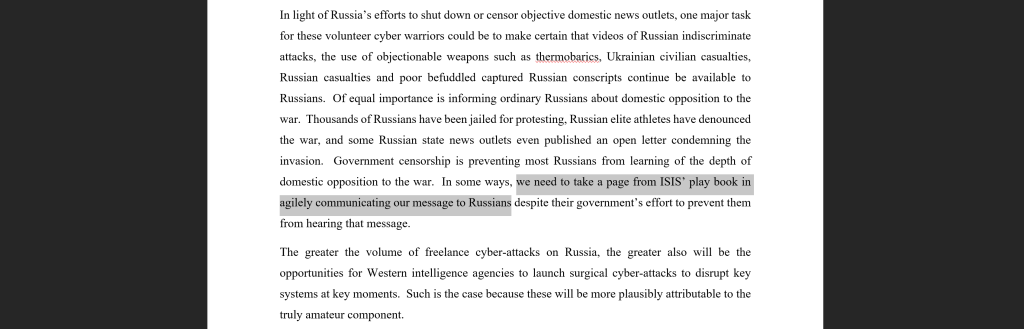
The activities of these “volunteer cyber warriors” were designed to provide cover for more formal, state-level hack attacks on Russian cyber infrastructure. “The greater the volume of freelance cyber-attacks on Russia, the greater also will be the opportunities for Western intelligence agencies to launch surgical cyber-attacks to disrupt key systems at key moments… because these will be more plausibly attributable to the truly amateur component,” the four academics evangelized.
The description offered strongly resembles the so-called “IT Army of Ukraine,” a volunteer cyber militia propped up in the days after Russia’s invasion. Since then, it’s been overseen by Mikhailo Federov, the Ukrainian digital czar credited by the BBC with pressuring Samsung and Nvidia to cease operations in Moscow, and getting PayPal to de-bank all its Russian clients.
Ukraine’s cyber army collaborates closely with Anonymous, the once-countercultural online hacker collective whose work now tracks closely with the objectives of the CIA. The authors of the proposal to the NSC hinted at the relationship, writing, “Hacking groups such as Anonymous have already begun targeting Russia. This effort could be enlarged and enhanced.”
The Ukrainian cyber army has taken credit for various acts of online vandalism. However, it also appears to have been involved in hacks targeting Russia’s power grids and railways. An attack on Russian taxi service Yandex that caused a large September 2022 traffic jam in Moscow was jointly attributed to both Ukraine’s ‘IT Army’ and Anonymous.

US Army “mad scientist” and self-proclaimed “war doctor in training” Zak Kallenborn
“Modern” IEDs for blowing up Russian infrastructure
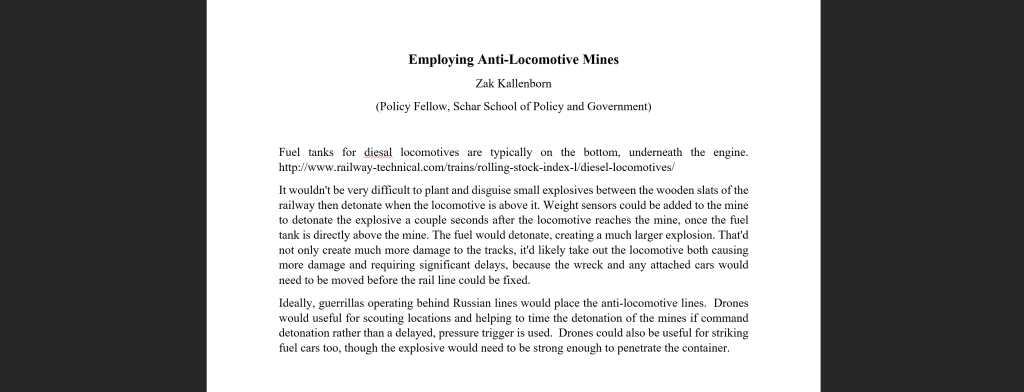
The academic cabal’s plans for attacking Russia through unconventional means extended explicitly into the realm of terrorism. A series of detailed recommendations for attacking Russian railway systems and roads with improvised explosive devices was put forward by Zachary Kallenborn, a self-described “PhD Student in War Studies at King’s College London researching risk analysis, perception, management, and theories with topical focuses in global catastrophe, drone warfare, WMD, extreme terrorism, and critical infrastructure.”
“Fuel tanks for diesel locomotives are typically on the bottom, underneath the engine,” Kallenborn wrote. “It wouldn’t be very difficult to plant and disguise small explosives between the wooden slats of the railway then detonate when the locomotive is above it… Ideally, guerrillas operating behind Russian lines would place the anti-locomotive lines.”
Throughout 2023, a group of self-described Russian and Belarussian anarchists conducted a series of attacks on railways, cell towers, and infrastructure inside Russia. Calling themselves BOAK, or the Combat Organization of Anarcho-Communists, the group of radical saboteurs earned glowing promotion in Western media. It is unclear if it received any outside assistance, however.
Kallenborn’s proposal, drafted in conjunction with the US War Department’s Joint IED Defeat Organization, suggested the US and its allies could “draw upon the lessons they painfully learned in Iraq and Afghanistan to help Ukraine orchestrate an IED campaign behind Russia’s lines.”
With the Taliban and Iraqi insurgents as models, Kallenborn proposed two technologies, “public-private key ring cryptography and ‘smart’ IEDs… to greatly increase the effectiveness of such a campaign.”
To wreak havoc inside Russia, Kallenborn envisioned a modern “stay behind” force similar to those unleashed onto Europe during Cold War era Operation Gladio, when the CIA and NATO organized fascist gangs and mafiosi to conduct anti-communist terrorist attacks.
Meanwhile, “smart” IEDs with “modern components” such as “microcontrollers,” which are now “abundant and cheap,” would allow Ukrainian attackers to “exercise additional discretion, reducing potential for collateral damage,” and “detonate the IED regardless of what the targets do.”
“The circuitry of microcontrollers can internalize most of the circuitry that would originally have been hard-wired into IED initiation switches,” Kallenborn wrote. “All microcontrollers have multiple inputs and outputs allowing multiple inputs, all while controlling multiple devices. Because microcontrollers are programmable, attackers can automate complicated algorithms to maximize an IEDs effects, and reduce collateral damage. Microcontrollers can even, relatively easily, circumvent many common countermeasures.”

Secretly employing contractors to pilot drones
While taking inspiration from non-state actors like ISIS and the Taliban, the Western academics plotting on the Ukrainian government’s behalf had elaborate plans for conventional warfare as well.
They assessed that drones had already “proven effective thus far” in the proxy war, so they urged greater deliveries of Turkish-made Bayraktar TB2s, which they said were “virtually the only airborne platform with which Ukraine is successfully striking Russian ground forces.” They proposed flooding Kiev with “additional TB2s,” pointing out that since Ukraine was already openly using them, and “had more on order before the conflict began,” Turkey’s role in supplying yet further drones could be concealed, leaving its neutrality publicly intact.
Ankara “could potentially transfer significant numbers of TB2s rapidly” from a variety of sources, the academics assumed, and fly them using local “private sector contractors.” If Turkey was unwilling or unable to go along with this plan, alternatives could be sought. “Given how commonly UCAVs are operated by private sector contractors, these could all be remotely piloted by private sector personnel employed by Ukraine, rather than uniformed members of NATO armed forces,” they noted.
Since drones can be operated “from considerable distances away from the frontline (potentially with pilots operating from neighboring countries),” they offered the further “advantage” over contract pilots, in that they would “be comparatively safe and certainly unlikely to be captured and paraded in front of Russian cameras.” While US-produced unmanned systems such as Predators and Reapers were an option, and could be provided “in large numbers,” they “would appear the most provocative” from Russia’s perspective, and make active US involvement too obvious.
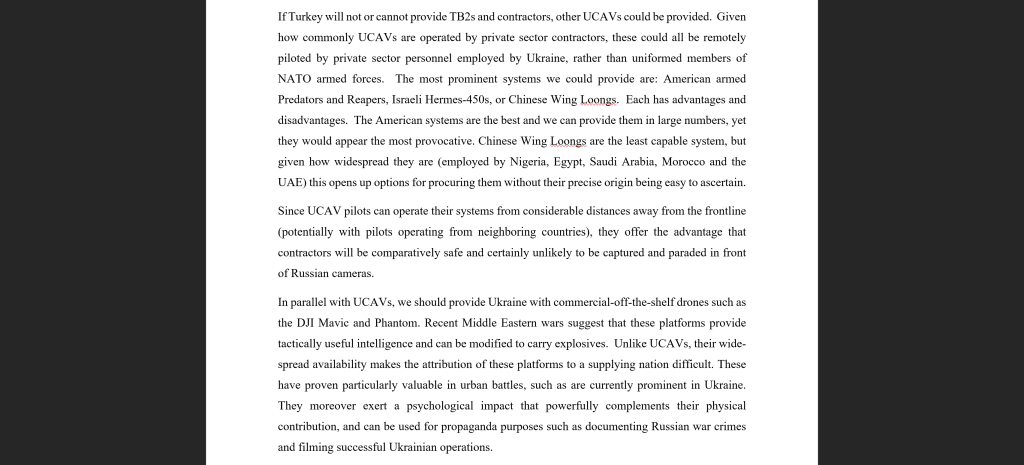
Prophetically, the paper noted Ukraine could be provided instead with “commercial-off-the-shelf drones such as the DJI Mavic and Phantom,” which not only had recording equipment capable of producing “tactically useful intelligence,” but could “be modified to carry explosives.” Moreover, “their wide-spread availability” made “attribution of these platforms to a supplying nation difficult.” It is surely no coincidence that ever since, both drones have been deployed extensively by Kiev to slow Russian advances and swarm military and civilian infrastructure.
By contrast, despite alleged initial successes, Bayraktar TB2s quickly vanished from the skies of Donbass. As several Ukrainian officials have admitted, Russian innovation in air defense and electronic warfare rendered the drones effectively useless. Conversely, the paper noted that while Ukraine’s Air Force was still conducting missions, Kiev would soon “run out of aircraft.” The prescribed remedy was to re-equip the country with Soviet-produced MiG-29 fighters, which “Ukrainian pilots know how to operate” already.
This plan, however, required a number of countries to hand over their ancient fleets of MiG-29s. The academics expressed concern that Central and Eastern European states might be “reticent” due to the risk of “Russian retaliation,” which could be circumvented by “promising gifts” to them, such as weapon upgrades. A year later, in March 2023, Slovakia granted Kiev its entire squadron of thirteen MiG-29s in exchange for a US promise of twelve Bell AH-1Z attack choppers equipped with Hellfire missiles.
Poland initially promised to match Slovakia’s splurge, but only wound up delivering a token amount. The deal has remained on hold since Krakow’s August 2024 announcement that it wouldn’t provide any further MiG-29s until it received a fleet of F-35s, which aren’t expected to arrive until 2026. Peru, likewise tapped by the academics as a potential source for the aircraft, reportedly initially greenlit supply of its MiG-29s to Ukraine, but then reneged. Latin American governments more widely have refused to dispatch any arms whatsoever to Ukraine, despite US pressure.
Air wars waged against Russia by “non-Ukrainian” pilots
Perhaps the most disquieting passage of the document is its last, in which its authors survey historical examples of air forces employing foreign pilots in major conflicts. The paper notes that the aforementioned Flying Tigers “were discharged from the US armed forces” to fight Japan in China, “with the clear understanding that they would be welcomed back thereafter.” Also cited was Finland’s employment of an “entirely” foreign squadron in its 1940 war with Moscow, as well as Zionist settlers’ reliance on an air force “comprised almost entirely of foreign volunteers” during their military campaign against indigenous Palestinian and Arab forces in 1948.
The academics wished to apply these precedents to the Ukraine proxy conflict, creating “volunteer fighter groups today to bolster Ukraine’s air defense” composed of “a reasonable number of Western pilots.” They wrote that these airmen “might volunteer if their national armed forces offered leaves of absence” – as might their civilian counterparts, if US commercial airlines could be “pressured into allowing their pilots, who are fighter-qualified Air Force Reserve or Air National Guard pilots, to take such leaves of absence.” The document boasted that “volunteer fighter groups could substantially disjoint Russia’s air campaign.”
F-16s were considered “the most logical option” due to “the number of NATO members that use F-16s,” including Poland. Accordingly, “Polish spare parts could be trucked into Ukraine comparatively quickly,” with the US “airlifting replacements” to Warsaw. From almost the first day of the proxy war, its most hawkish supporters have demanded that Kiev be provided with these fighter jets, referring to the planes as a “game changer” which would tip the conflict’s scales decisively in favor of Ukraine.
Despite much initial fanfare, when F-16s finally arrived in Kiev in late July of 2024, President Volodomyr Zelensky almost immediately complained the country had only received a handful of jets, and did not have enough pilots trained to fly them. The panic spread to Washington, where Sen. Lindsey Graham publicly urged any “retired F-16 pilot… looking to fight for freedom” to sign up. By the month’s end, the first of F-16s had crashed in uncertain circumstances.
While references to Ukraine’s “game changing” use of F-16s have all but disappeared from the media in the months since, the leaked proposal’s contents raise serious questions on how many supposedly Ukrainian strikes deep inside Russia were actually perpetrated by Western military operatives, acting at the behest of, and with material assistance from, NATO and the US.
“Western European and American fighter pilots tend to fly substantially more hours and train more realistically than their Russian or Ukrainian counterparts,” the academics claimed, meaning they were ideal candidates for conducting “combat missions” against Moscow’s positions, forces, and territory. However, the academics cautioned against Western pilots flying close to the frontline, for fear that “foreign volunteers fall into Russian custody, where an example could be made of them, or they could be paraded in front of the camera.” This was perhaps a nod to CIA pilots Gary Powers and Eugene Hassenfus, whose capture by the Soviet Union and Nicaragua, respectively, humiliated US intelligence.
It’s still unclear how much these proposals determined the course of operations by Ukrainian forces against their Russian foes. But the leaks reviewed by The Grayzone reveal for the first time how, in just a matter of weeks, a small cabal of academics secretly furnished some fairly unconventional war plans on a platter for the CIA and MI6.
Just as Britain did with its Project Alchemy, the Biden administration appears to have outsourced responsibility for crafting its battlefield strategy in Ukraine to a nexus of pinheads with dubious backgrounds, situated thousands of miles from the frontline and its gruesome realities. Almost three years later, with a generation of Ukrainians lost to the proxy war’s meat grinder, the authors of these battle plans are likely still pecking away at their laptops somewhere in the musty halls of academia.
Featured Video

New positive ivermectin evidence
or go to
Aletho News Archives – Video-Images
From the Archives
Fanatical Followers of the Covid Regime: A Jim Jones-Style Cult?
By Professor Roger Watson and Dr. Niall McCrae | The Daily Sceptic | November 15, 2021
As scholars at leading British universities over recent decades, we witnessed the replacement of critical thinking and debate by narrative: facts are discrimination and scientific method is imperialism; truth, instead, is derived from ‘progressive’ values. This educational trend may be a major contributory factor to the ease in which society has been inculcated to the Covid ‘new normal’ of masking, testing, and repeated doses of vaccines for a disease of similar risk to severe influenza.
One doesn’t need much critical reasoning to observe the flawed logic of some vaccination enthusiasts, such as people who respond to experiencing any side effects, however debilitating, by saying “at least I know it’s working”, or, after contracting the disease despite their promised inoculation (over 90% effective, according to initial drug company claims), “I’d have been worse off without the jab.” … continue
Blog Roll
 Aletho News
- EU Council Advances Chat Control 2.0 Scanning Proposal
- Ex-Greek MEP files complaint against Israeli spyware firm over alleged Pegasus surveillance
- Troubling ideas throughout the Torah, Talmud, Mishneh Torah and Tanya
- ‘Grave, alarming’: Iran mission on Trump’s UNGA ‘annihilation’ threats
- Najaf airport to reopen to Iranian flights within 24 hours: Ambassador
- From ‘How Will This End For Iran’ to ‘When America Walks Away’: A tale of two Economist covers
- Tehran blasts ‘baseless’ speculation linking Iran to alleged bomb plot at UK air base
- The Rise And… Rise Of ‘Color Revolutions’
- The Coming GOP Bloodbath?
- Arctic Scare Stories Melt Away
- If Americans Knew
- Netanyahu Asked UAE Leader to Deny Report on Oct. 7 Warning in Secret Visit, Sources Say
- CNN Chief Int’l Correspondent Clarissa Ward on Journalists in Gaza
- Democratic Party Consultants Surround Troy Jackson with Pro-Israel Donors
- Christian Leader Responds To Netanyahu’s Claims Regarding Palestinian Christians
- In Gaza, ‘Whoever Survives the Bombing Won’t Survive the Rubble’
- Israel kills more Palestinians, amid push to resettle Gaza – Daily Update
- Israel forces Gazans to live in constant peril – Daily Update
- Deconstructing Netanyahu’s pants-on-fire UN rant – Daily Update
- Trump betrayed voters with his campaign lies and prioritized a foreign country once he took office
- Netanyahu calls Israel’s war in Gaza ‘opposite of genocide’ in UN speech to near-empty hall
- No Tricks Zone
- New Study: Earth And Venus Surface Warmth Largely Explained By Convection And Lapse Rate, Not CO2 Or Radiation
- 2025 Nature Paper Claiming Worsening Global Drought Gets RETRACTED …Heavily Flawed
- New Study: ‘Global Drought Shows No Detectable Recent Acceleration Under Climate Warming’
- Economic Masterminds: German Socialists Suggest Taxing Productivity Gains Stemming From Using AI
- The South China Sea Has Not Been Cooperating With The Climate Change Narrative
- Energy Crisis: Germany Enters Heating Season With Historically Low Gas Reserve Fill Levels
- New Study: The Antarctic Ice Sheet Gained Mass From 2020-2024 Due To Staggering Snow And Ice Accumulation
- Study: Ocean Heating Rates From Thousands Of Years Ago ‘Dwarf’ Modern Ocean Heating Rates
- Climate Extremists Target, Attack Large-Scale Power Grid Infrastructure In Germany!
- New Study: Antarctic Ice Melt Has Contributed Less Than 1 Centimeter To Sea Level Rise In The Last 30 Years

