New York’s Speech Crackdown Shields ISRAEL From Public Criticism
21st Century Wire | January 29, 2025
Recently, under intense pressure from the Israel Lobby, Harvard University capitulated to Zionist billionaires and media pressure by dramatically expanding its “guidance” for applying so-called Non-Discrimination and Anti-Bullying Policies and Procedures – specifying protections for Zionists and alleged victims of so-called “antisemitic” speech. This has already caused chilling effect on political speech and political protests on university campuses across the United States. These are some of the most draconian and arbitrary bylaws ever seen, and will almost certainly fall foul of the U.S. First Amendment once a challenge makes it to the high court.
In addition, the New York State legislature has also succumb to pressure from the Israel Lobby and pushed through a new law designed to shield Israel and Zionism exclusively – from public criticism or acts of protest.
American journalist and media critic Glenn Greenwald breaks down this fundamental problem now facing America and Europe. Watch:
Trump signs executive order to ‘find and deport’ pro-Palestine student activists
The Cradle | January 30, 2025
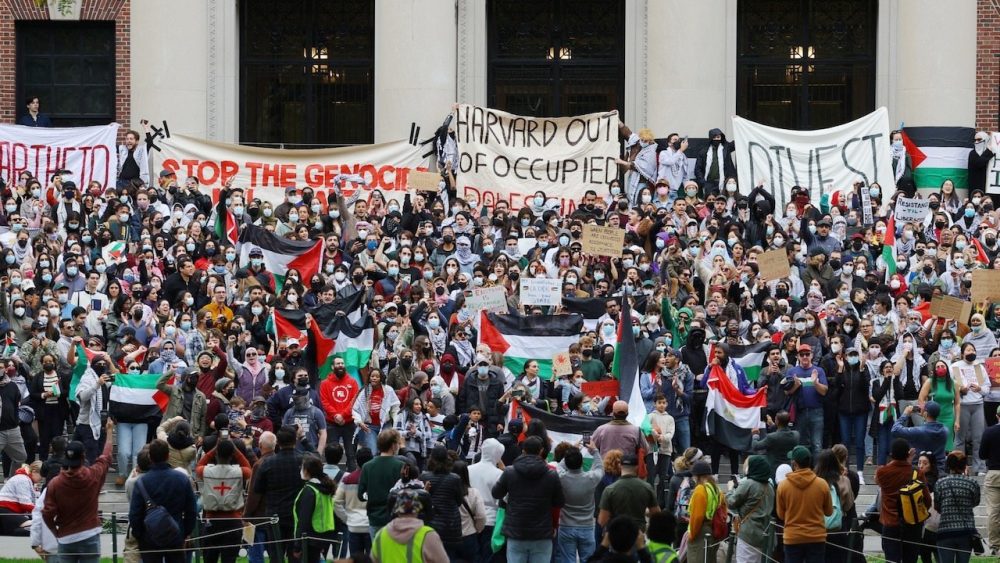
US President Donald Trump signed an executive order on 29 January directing federal agencies to identify and deport “non-citizen participants” in pro-Palestine protests that swept college campuses last year.
“I will issue clear orders to my Attorney General to aggressively prosecute terroristic threats, arson, vandalism, and violence against American Jews,” the White House quoted Trump as saying earlier on Wednesday.
“To all the resident aliens who joined in the pro-jihadist protests, we put you on notice: come 2025, we will find you, and we will deport you. I will also quickly cancel the student visas of all Hamas sympathizers on college campuses, which have been infested with radicalism like never before,” the order’s fact sheet reads.
He added that the Department of Justice will “quell pro-Hamas vandalism and intimidation” and “investigate and punish anti-Jewish racism in leftist, anti-American colleges and universities.”
The executive order requires federal agency and department leaders to “provide the White House with recommendations within 60 days on all criminal and civil authorities that could be used to fight antisemitism,” according to the fact sheet.
The Council on American-Islamic Relations released a statement on Wednesday calling the executive order “a dishonest, overbroad and unenforceable attack on both free speech and the humanity of Palestinians.”
“It’s time for President Trump to pursue an America First agenda, not an Israel First agenda,” the statement adds.
Despite rampant claims of “antisemitism” during campus protests that demanded an end to the Israeli genocide of Palestinians in Gaza, a study published last May by Armed Conflict Location & Event Data (ACLED) found that 97 percent of the protests were peaceful.
“My promise to Jewish Americans is this: With your vote, I will be your defender, your protector, and I will be the best friend Jewish Americans have ever had in the White House,” the White House quotes Trump as saying.
‘Conspiracy Theory’ Now Fact: Greater Israel Has Arrived
By Kit Klarenberg | Mint Press News | January 28, 2025
Ever since Tel Aviv’s 1948 creation, much has been said and written about ‘Greater Israel’ – the notion Zionism’s ultimate end goal is the forcible annexation and ethnic cleansing of vast swaths of Arab and Muslim lands for Jewish settlement, based on Biblical claims this territory was promised to Jews by God. The mainstream media typically dismisses this concept as antisemitic conspiracy theory, or at most the fringe fantasy of a minuscule handful of extremist Israelis.
In reality, as The Guardian admitted in 2009, the idea of a Greater Israel has long-appealed to “religious and secular right-wing nationalists” alike at a state and public level in Tel Aviv. They have the shared objective of “[seeking] to fulfill divine commandments about the ‘beginning of redemption’, as well as create ‘facts on the ground’ to enhance Israel’s security.” The outlet acknowledged this motivation was a key contemporary driving force in mainstream Zionist entity politics, which “effectively turned the Palestinians into aliens on their own soil.”
The Nation has described the push to establish Greater Israel as “the central ideological goal” of Benjamin Netyahu’s Likud Party, which has dominated Israeli politics in recent decades. In July 2018 too, the Zionist entity passed the “Nation State of the Jewish People” law. It enshrines “the development of Jewish settlement as a national value.” Meanwhile, the state is legally obligated “to encourage and promote” the “establishment and consolidation” of settlements, in illegally occupied territory.

A proposed map of ‘Greater Israel’
This is based on the Jewish people’s “exclusive and inalienable right” to territory as far away from present Israel as Saudi Arabia. Old Testament terms such as “Judea and Samaria” are also employed. Markedly, this text is absent from the legislation’s official English translation. Zionist entity chiefs may not have wanted to make their irredentist, settler colonial ambitions quite so obvious at the time. Fast forward to today though, and Zionists at every level are wholly unabashed about their grand expansionist plans in West Asia.
The Syrian government’s fall has raised all manner of questions, concerns, and uncertainties locally and internationally. Can the country survive in its present form? Will Western-backed ‘former’ ultra-extremists be able to run a government? May the Iran-led Axis of Resistance, which inflicted such harm to the Zionist entity and its Western puppet masters throughout 2023/4, be under threat? The list goes on. But one thing is certain – Israel is seeking to profit handsomely from the chaos. If successful, the results will be revolutionary.
‘Defensive Position’
On December 8th, a triumphant, smart-casual-bedecked Benjamin Netanyahu made a public address from an Israeli Occupation Force observation point, in the illegally-occupied Golan Heights. Taking personal credit for Bashar Assad’s ouster, he hailed “a historic day” for the region, which offered “great opportunity.” The Israeli leader bragged that the Zionist entity’s “forceful action against Hezbollah and Iran” had “set off a chain reaction” of upheaval, showing no sign of abating. Nonetheless, he warned of “significant dangers”.
One of those hazards, Netanyahu declared, was “the collapse of the Separation of Forces Agreement from 1974.” This largely forgotten accord was signed by Damascus and Tel Aviv following the 1973 Yom Kippur War. Both sides agreed not to mount hostile military operations of any kind against one another from their shared Golan Heights border. Perhaps surprisingly, it was scrupulously adhered to for 50 years. Now, though, Assad’s fall has sparked a Syrian military withdrawal from the area, and, in turn, the IDF is moving in.
Netanyahu announced orders had been given to the IOF to push deep into the demilitarized zone created by the Agreement, which is legally and historically Syrian territory. He claimed this was merely a “temporary defensive position until a suitable arrangement is found.” Yet, ever since, it has become increasingly unambiguous that for the Zionist entity, Assad’s departure not only greenlights the tearing up of longstanding diplomatic agreements, but the entire map of West Asia as we know it.
For the time being, the IOF has captured strategically invaluable Mount Hermon, Syria’s tallest mountain, from which Damascus can be seen just 40 miles away. Concurrently, hundreds of Zionist entity airstrikes have obliterated what remained of Syria’s military infrastructure, leaving the country completely defenseless from any and all incursions by air, land, and sea. The stage is plainly set for a major escalation and attempt by Israel to absorb further territory, at its behest. Who or what could stop them?

IOF militants unfurl an entity flag on Mount Hermon
On December 10th 2024, while testifying at his long-running trial for industrial scale corruption in office, Netanyahu used the occasion to hint strongly at Assad’s defeat heralding a major reshaping of the region afoot. “Something tectonic has happened here, an earthquake that hasn’t happened in the 100 years since the Sykes-Picot Agreement,” the Israeli leader said, referencing the 1916 treaty under which Britain and France carved up the Ottoman Empire.
In an ironic twist, destruction of the Sykes-Picot Agreement, which divided West Asia into artificial boundaries under Western colonial rule, was a regular feature of ISIS propaganda. The group cited the pact as a symbol of Western oppression against Islam, presenting its demise as a religious duty. With figures associated with ISIS now taking charge in Damascus, that vision could now be achieved, a prospect both serving Israel’s long-term goals, and aligning with Netanyahu’s long-standing ambitions.
‘Living Room’
In recent weeks, Israeli media has undergone a significant tonal shift. Historically, even critical Israeli news outlets and journalists have been careful to frame the Zionist entity’s most egregious actions – ranging from military operations against neighboring countries to settlement expansion and land confiscation – in terms of “security” and “defense”. However, in the days leading up to Tel Aviv’s invasion of Lebanon on October 1st 2024, The Jerusalem Post published a strikingly candid explainer guide for its readers, enquiring, “Is Lebanon part of Israel’s promised territory?”
The outlet leaned on a Brooklyn-based Rabbi to “graciously” explain in detail how, based on multiple passages in Jewish scripture, “Lebanon is within the borders of Israel,” and Jews are therefore “obligated and commanded to conquer it.” The article was subsequently deleted after mass backlash and condemnation. But lessons from the debacle evidently weren’t learned in some quarters.
On December 4th – four days before the Syrian government’s fall – The Times of Israel published an op-ed on how “Israel’s exploding population” urgently required “Lebensraum”, a notorious German concept meaning “living room”, typically associated with the Nazis. The piece noted the Zionist entity’s population was projected to grow to 15.2 million by 2048, meaning Tel Aviv’s territory rapidly needed to be greatly expanded – perhaps not to the size of Russia, but certainly considerably.
This extremist rant was likewise purged from the web, due to widespread public outcry and mockery. Yet, since Assad’s fall, the term “Greater Israel” abounds readily in Zionist media, and seizure of territory from Tel Aviv’s neighbors is openly and eagerly discussed on primetime entity TV. Geopolitical analyst and founder of The Cradle Sharmine Narwani tells MintPress News that in a sense, the blatant nature of these discussions is a welcome development, as it lays bare Tel Aviv’s most extreme ambitions. However, she warns, attempts to expand the entity’s borders could backfire in catastrophic ways:
“The good news is, Israel has completely dropped all its masks. The bad news is it will go for land grabs everywhere. But this will be done opportunistically, and without much forethought or strategic planning. In the end, which country besides the US will be able to support Israel publicly? Tel Aviv will corner itself because the dominant Western discourse and EU law are still premised on human rights and ‘rules’. Allowing Israel these land grabs will also sink the Western-led global order.”
‘Primary Target’
Academic David Miller concurs the Zionist mask is off once and for all. Gravely, he tells MintPress News, “the fact that the CIA backed regime in Damascus is openly saying it is no threat to Israel is another indication regime change in Syria is a planned attempt to destroy the Axis of Resistance, and finally genocide all Palestinians.” Furthermore, he believes the writings of Zionism’s founder Theodore Herzl make clear seizing Lebanese and Syrian territory was Israel’s plan all along.
This malign objective, Miller adds, was echoed in many statements of countless prominent Zionists over decades, and “even codified and published as the Yinon Plan.” Little-known today, this extraordinary document was published in February 1982 in Hebrew journal Kivunim, under the title “A Strategy for Israel in the 1980s”. Its title is derived from author Oded Yinon, a shadowy former Israeli Foreign Ministry official and advisor to Zionisty entity leader Ariel Sharon.
Some sources claim the Yinon Plan provided a precise blueprint for major future events in West Asia, such as the illegal 2003 Anglo-American invasion of Iraq, Syrian dirty war, and rise of ISIS. It may be an exaggeration to suggest the Plan precisely portended all these developments, but nonetheless, much of the document’s contents are eerily prescient. Moreover, while many of its proposals failed to subsequently materialise, we are left to ponder whether they may now do so in future.
For example, the Plan noted there was significant potential for “domestic trouble” to erupt in Syria between “the Sunni majority and the Shiite Alawi ruling minority” – the latter constituting a “mere 12% of the population” – to the extent of “civil war”. While Damascus’ “strong military regime” was considered formidable, Yinon declared “the dissolution of Syria into ethnically or religiously unique areas” and destruction of its military power should be “Israel’s primary target” on its Eastern front, “in the long run”.
The Plan envisaged similar outcomes for other countries in Israel’s immediate vicinity. Lebanon was to be broken up into “five provinces” along religious and ethnic lines, partition “[serving] as a precedent for the entire Arab world.” Yinon wrote, “this state of affairs will be the guarantee for peace and security in the area in the long run,and that aim is already within our reach today.” Four months later, the Zionist entity invaded Beirut, carrying out ethnic cleansing, massacres, and land theft along the way.
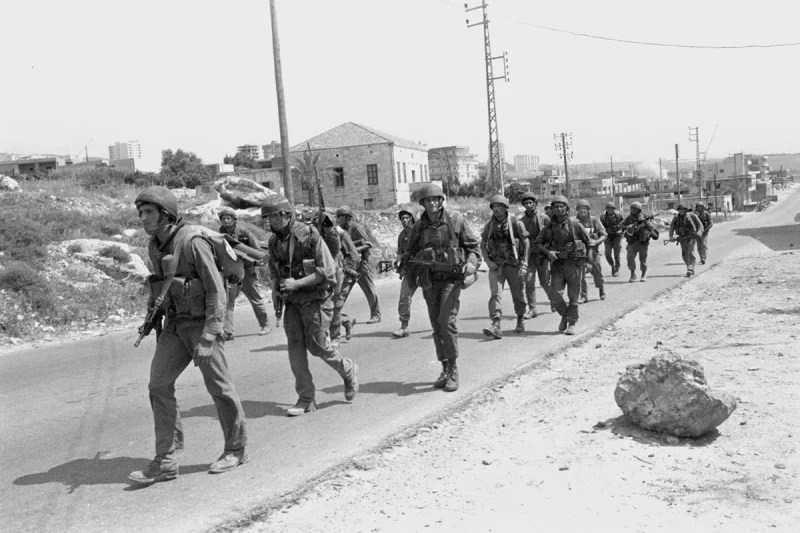
Israel’s June 1982 invasion of Lebanon
Once the Zionist entity’s immediate neighbors were neutralized, Iraq was to be crosshaired “later on”. Baghdad, “rich in oil” while “internally torn” between its Sunni and Shiite population, was “guaranteed as a candidate for Israel’s targets.” Its destruction was “even more important for us than that of Syria,” due to its “power” and strength relative to other regional adversaries. Yinon hoped the then-ongoing Iran-Iraq war would “tear Iraq apart and cause its downfall”, preventing Baghdad from ‘[organizing] a struggle on a wide front against us”:
“Every kind of inter-Arab confrontation will assist us in the short run and will shorten the way to the more important aim of breaking up Iraq into denominations as in Syria and in Lebanon… It is possible that the present Iranian-Iraqi confrontation will deepen this polarization.”
‘Permissive Approach’
Yinon also considered it a “political priority” to regain control of the Sinai peninsula, over which the Zionist entity had fought its Arab neighbors since inception, before relinquishing all claims to the region to Egypt under the March 1979 Camp David accords. He slammed these peace agreements, and looked forward to Cairo “[providing] Israel with the excuse [emphasis added] to take the Sinai back into our hands,” due to its vast “strategic, economic and energy” value:
“The economic situation in Egypt, the nature of the regime and its pan-Arab policy, will bring about a situation after April 1982 in which Israel will be forced to act directly or indirectly in order to regain control over Sinai… for the long run. Egypt does not constitute a military strategic problem due to its internal conflicts and it could be driven back to the post 1967 war situation in no more than one day.”
We are now well-past April 1982. In the intervening time, successive Israeli governments have demanded Egypt allow the IOF to relocate Gaza’s population to the Sinai. Netanyahu is particularly taken with the prospect. In the immediate wake of October 7th 2023, official Israeli government and Zionist think tank policy papers openly advocated driving Palestinians into the neighbouring desert. It has been reported entity officials begged the US to pressure Cairo into allowing this mass displacement.
For the Zionist entity, this strategy’s appeal is self-evident. On top of emptying Gaza for settlement, forcing Palestinians into Sinai would inevitably create mass chaos and tensions there, which could in Yinon’s phrase provide “the excuse” for Tel Aviv to militarily occupy the region, in the manner of the West Bank. Just as a “temporary defensive position until a suitable arrangement is found” of course, as Netanyahu said of the IOF’s brazen creation of a prospective beachhead on Mount Hermon.
In December 2024, Haaretz observed Netanyahu was “angling for a legacy as the leader who expanded Israel’s borders”, and “wants to be remembered as the one who created Greater Israel.” Simultaneously, neoconservative Brookings Institute vice president Suzanne Maloney wrote for Empire house journal Foreign Affairs that the incoming Trump administration “will surely take a permissive approach to Israeli territorial ambitions.” After all, recent developments showed “a maximalist military approach yields spectacular strategic dividends along with domestic political benefits” for the Zionist entity.
We must hope, as Sharmine Narwani prophesied, Netanyahu’s megalomaniacal reveries of Greater Israel are just that, and come to nothing. Despite understandable mass anti-imperialist mourning over the Assad government’s demise, Tel Aviv faces a panoply of intractable internal problems. Contrary to claims of Tel Aviv’s population “exploding”, tens of thousands of dual-citizenship residents are routinely fleeing due to Resistance attacks, while its economy has perhaps permanently been relegated to the doldrums, the entity entirely dependent on US financial largesse to endure.
New neocon manifesto: Keep US troops in the Middle East forever
The ‘Vandenberg Coalition’ wants Trump to prioritize Israel and maintain Iran as enemy number one
By Jim Lobe | Responsible Statecraft | January 28, 2025
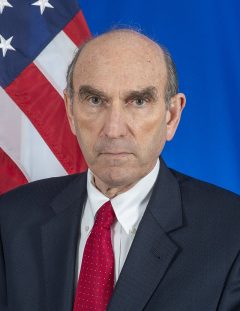 A leading neoconservative for most of the last half century has released a comprehensive series of recommendations on Middle East policy for the new Trump administration nearly all of which are ideas that Israeli Prime Minister Benjamin Netanyahu and his Likud Party would happily embrace.
The 16-page report, entitled “Deals of the Century: Solving the Middle East,” is published by the Vandenberg Coalition, which was founded and chaired by Elliott Abrams, who has held senior foreign policy posts in every Republican administration since Ronald Reagan (except George H.W. Bush’s), including as Special Envoy for Venezuela and later for Iran during Trump’s first term.
Created shortly after former President Biden took office, the Coalition has acted as a latter-day Project for the New American Century, a letterhead organization that acted as a hub and platform for pro-Likud neoconservatives, aggressive nationalists, and the Christian Right in mobilizing public support for the “Global War on Terror,” the 2003 invasion of Iraq, and the move away from a two-state solution to the Israel-Palestine conflict, particularly under the George W. Bush administration in which Abrams served as Special Assistant to the President and Senior Director for Near East and North African Affairs, surviving a number of purges of leading neoconservatives in that administration after the Iraq occupation went south.
The new report predictably calls for the new administration to “use all elements of [U.S.] national power” to prevent Iran, “the greatest threat to American interests in the Middle East and the cause of most of the region’s security problems,” from acquiring a nuclear bomb. It describes Israel as “our cornerstone ally in the region” to which Washington should provide all “the weapons it needs [to] help it win the war and prevent wider escalation.”
The recommendations also call for Washington to maintain its military presence in both Iraq and Syria, to suspend all aid to the Lebanese Armed Forces (LAF) “until it demonstrates a willingness to oppose Hezbollah, accelerate U.S. arms sales and broaden intelligence cooperation with the UAE,” and enhance military and security cooperation with Saudi Arabia provided it “pivot[s] away from China and Russia.”
It also calls for the Saudis to “increase [its] foreign direct investment commitments in U.S industries,” and “cease public statements” critical of Israel and supportive of Iran. “…[En]hanced cooperation with Saudi Arabia,” the report insists, “should be contingent on their being unequivocal about what side they are on.”
Washington should also designate Iraq’s Iran-backed Popular Mobilization Forces (PMF) and related militias as Foreign Terrorist Organizations (FTO) and stop engaging with them politically, and work with Yemen’s Saudi-backed Presidential Leadership Council against the Houthis whose designation as an FTO by the Trump administration last week was applauded in the report. On the new government in Syria, the report says that ongoing sanctions, which helped cripple the country’s economy, should not be lifted “unless the new government proves to be a responsible actor,” although it does not describe what that would mean in any detail.
Aside from Iran’s status as Enemy Number One in the report, special scorn was reserved for Qatar, which has played a central role in mediating between Israel and Hamas regarding the fate of Israelis held in Gaza and Palestinians detained in Israel. Similar contempt is reserved for the Palestinian Authority headed by Mahmoud Abbas, for various U.N. agencies, notably “the nefariousness [sic] UNRWA,” which has worked with Palestinian refugees and their families across the Middle East for more than 70 years, and for senior UN human rights officials who deal with the Israel-Palestine conflict in particular. Washington “should immediately cease all funding to UNRWA” and also to UNIFIL, the U.N. peacekeeping force deployed along the Lebanese-Israeli border unless its troops are given the authority and demonstrate the will to confront Hezbollah forces in the area.
As for Qatar, it “has worked to undermine U.S. interests by cooperating with Iran and sheltering terrorist groups like Hamas,” according to the report. “With much better friends like the Saudis, Washington no longer needs to tolerate destabilizing Qatari behavior,” and thus should move U.S. Central Command’s forward headquarters out of Qatar’s Al Udeid Air Base and revoke Doha’s “Major Non-Nato Ally status unless its behavior changes.” That status should be conferred on the UAE instead, according to the report, provided that it “reduce [its] reliance on Russian and Chinese vendors” of military equipment.
The report, which describes the politics of the Biden administration in the Middle East on more than one occasion as “appeasement,” mainly of Iran, reminds the reader that Trump declared only last month that “the Middle East is going to get solved,” a phrase that undoubtedly inspired the report’s title: “Deals of the Century: Solving the Middle East.” While the report says it was the product of a “working group of Middle East experts,” no names other than Abrams, Gabriel Scheinemann, and Daniel Samet, the latter two neoconservatives from the Alexander Hamilton Society, appear in the report. Normally, reports by letterhead organizations list their contributors.
In presenting what it calls “key American interests in the Middle East,” the report puts “preventing Iran from developing n nuclear weapon at the top of the list” but also expresses alarm at Chinese Communist Party inroads in the region, noting that CCP is Washington’s “key global adversary.” In an echo of the Global War on Terror, Washington, it says, should also “deny jihadi terrorists a safe haven,” a reference in part to the necessity, its authors feel, to retain U.S. forces in Syria and Iraq.
But “America’s alliance with Israel is central to U.S. interests in the region, given that it promotes American values within the Middle East and provides the first line of defense against Iranian aggression.” Moreover, Washington should try to expand the Abraham Accords, and “the Palestinian question must not impede Israel’s normalization with Arab and Muslim countries or otherwise compromise its security.” Washington must “ensure Israel has the tools to defend itself.”
Yet another interest is to expand access of our allies and partners in Europe and elsewhere to the region’s energy supplies, according to the report.
To increase pressure on Iran, Washington should not only reinstate a Trump’s “ maximum pressure” campaign, but include within it convincing Britain, France, and Germany to “snapback sanctions” against Tehran at the U.N. Remarkably perhaps, it offers the possibility of a new nuclear agreement that would “forbid Iranian uranium enrichment beyond the small amounts need for a civilian nuclear program,” something that the 2015 JCPOA, which Trump withdrew from in 2018, actually accomplished before Trump, under the influence of neoconservatives like Abrams, withdrew from in 2018. If a deal can be reached, according to the report, it should be dealt with as a treaty; that is, made subject to a 2/3 majority vote in the Senate.
With respect to the Palestinians in the wake of the last 15 months of war in Gaza, “American policy toward the Palestinians must prioritize the security of Israel and our Arab partners.” Washington “must impose standards for good governance. The U.S. should “allow an Arab trusteeship to control Gaza after the war.” In words that must warm Netanyahu’s heart, the report notes “the weakness and incompetence of the PA mean it cannot govern Gaza,” and “Israel will need to maintain security control to prevent Hamas from rebuilding but should not and does not wish to govern Gaza itself.”
Abrams has a long history with both Palestine and Gaza, notably during the Bush administration. After Hamas was an unexpected election victor over its rival Fatah in the 2006 elections – which were hailed as the freest and fairest elections in the Arab world at the time – Abrams and other senior officials encouraged the mounting of an armed coup against Hamas led by Fatah’s local leader and Abrams’ favorite Muhammad Dahlan which, in turn, sparked a brief civil war in the enclave in which Hamas emerged victorious and stronger than ever. After the fiasco, Dahlan moved to the UAE, and there has been much speculation that he stands to play a key role on behalf of the Emirates if the kind of “Arab trusteeship” alongside Israeli security forces is established as recommended by the report.
Perhaps the most novel recommendation is based on the report’s contention that Iran’s non-state allies in the region typically use non-combatants as human shields — an apparent endorsement of Israel’s defense of its bombing of apartment houses, schools and other buildings in Gaza and Lebanon during the past 15 months that have killed well over 46,000 people, most of them women and children. “The United States should propose a Security Council resolution that states the use of human shields is a crime under international law and that those who use human shields are responsible for the civilian deaths in which they result,” the report advised.
Jim Lobe is a Contributing Editor of Responsible Statecraft. He formerly served as chief of the Washington bureau of Inter Press Service from 1980 to 1985 and again from 1989 to 2015.
Ukraine wants EU to replace lost US aid
RT | January 30, 2025
Ukrainian lawmakers have appealed to non-US donors to fund local media outlets and NGOs following the suspension of Washington’s foreign assistance programs that has reportedly drastically impacted the sector.
Last week, President Donald Trump halted cash flows from the US and ordered a 90-day review of aid schemes. Many affected programs were run by USAID, Washington’s soft power agency that distributes billions of dollars each year for projects that promote US interests around the world, under the premise of humanitarian development. It spent over $60 billion in 2023 alone.
Ukrainian recipients of American grants were hit “worse than it may seem,” a statement by the parliamentary committee on humanitarian affairs said on Wednesday. Lawmakers anticipate that it will take up to six months for US funding to fully resume, and have urged EU donors to step in.
“Given the constraints on public funding, grants remain virtually the only way for cultural and media projects to function,” the statement said.
Oksana Romanyuk, executive director of a Kiev-based media research non-profit, warned that 90% of news outlets in Ukraine rely heavily on foreign grants. With USAID operations frozen, many of them are now soliciting emergency donations.
The Ukrainian MPs described foreign assistance as “an important part of our path to democratic development and sustainability”. They empathized that USAID was funding projects for children, with thousands of minors attending schools that depend on American taxpayer dollars.
According to media reports, senior officials in the Department of State have lobbied Secretary Marco Rubio to make exemptions for their preferred aid programs, arguing that they are essential for US interests. Meanwhile, at least 60 senior USAID officials reportedly have been placed on paid administrative leave.
Architect of Russia sanctions sentenced to 11 years in prison
RT | January 29, 2025
Former US Senator Bob Menendez has been sentenced to 11 years in prison on bribery and corruption charges after being found guilty of accepting cash and gold bars and acting as an illegal agent for the Egyptian government.
The New Jersey Democrat was convicted last July and resigned from the Senate a month later rather than face expulsion. He previously chaired the Senate Foreign Relations Committee, where he was known for championing stringent sanctions on Russia, among other policies.
“The public cannot be led to the belief that you can get away with bribery, fraud, and betrayal,” US District Judge Sidney Stein said on Wednesday. “I don’t know what led you to this,” Stein added. “You’ll have to try to figure that out yourself over time.”
Prosecutors had sought at least 15 years in prison, along with millions of dollars in forfeitures and fines, arguing that such penalties were necessary “to provide just punishment for this extraordinary abuse of power and betrayal of public trust.”
Menendez is the first US senator convicted of acting as an agent of a foreign government.
“For someone who spent his entire life in public service, every day I’m awake is a punishment,” the former lawmaker told the court.
Menendez began his political career in 1974 when he was elected to the Union City Board of Education. He later served as the city’s mayor from 1986 to 1992, then moved to the state legislature in 1988 and the state senate in 1991. He represented New Jersey’s 13th district in the US House of Representatives from 1993 to 2006, when he was appointed to the Senate.
Menendez stepped down from his position as head of the Senate’s influential Foreign Relations Committee after the initial charges were filed in September 2023, where he had played a key role in drawing up Washington’s sanctions on Moscow even before the escalation of the Ukraine conflict in February 2022.
His attorney, Adam Fee, argued that the former senator’s nearly 50 years of public service should not be overshadowed by his conviction, dismissing the public’s characterization of him as “Gold Bar Bob.” The defense team also requested that Menendez remain out of prison while they appeal his conviction.
Elizabeth Warren’s False Accusation Against RFK Jr. at Senate Hearing Sparks Controversy
By Maryanne Demasi, PhD | January 29, 2025
Today, the Senate confirmation hearing for Robert F. Kennedy Jr. swiftly devolved into a political battleground, with partisan tensions overshadowing any serious examination of Kennedy’s qualifications.
Intended to assess his suitability, the hearing became a spectacle of accusation and counter-accusation, leaving little room for meaningful dialogue.
Kennedy, who has long advocated for drug safety and transparency in medical practices, has faced harsh criticism for his outspoken views on vaccines.
Lawmakers seized on his stance, accusing him of hiding his anti-vaccine beliefs and embracing conspiracy theories to dissuade the public from using life-saving vaccines.
Tensions escalated when Massachusetts Senator Elizabeth Warren clashed with Kennedy in a heated exchange. She demanded that he promise not to financially benefit from any lawsuits against pharmaceutical companies if confirmed.
“I’m asking you right now that you will not take a financial stake in every one of the lawsuits [against pharmaceutical companies] so that what you do as secretary will also benefit you financially down the line,” Warren demanded.
Kennedy, visibly frustrated, responded, “Senator, you’re asking me not to sue pharmaceutical companies.” Warren retorted sharply, “No, I am not!”
Amid this verbal sparring, Warren also made a false accusation, claiming that Kennedy had pocketed $2.5 million from law firm Wisner Baum for recruiting plaintiffs in vaccine-related lawsuits.
Wisner Baum wasted no time in issuing a statement to categorically refute the baseless claim. The firm made it clear that Kennedy had never received any compensation in connection with vaccine litigation.
R. Brent Wisner, managing partner at the firm, quickly set the record straight: “The suggestion that Wisner Baum has paid Mr. Kennedy millions from vaccine cases is false and misleading,” he asserted.
Wisner explained that Kennedy’s earnings had been derived exclusively from lawsuits related to Monsanto’s Roundup and wildfire-related litigation.
“We have compensated Mr. Kennedy solely for his involvement in cases concerning Monsanto Roundup-induced non-Hodgkin’s lymphoma, the Woolsey Fire, and the Paradise/Camp Fire cases,” Wisner clarified.
He strongly defended Kennedy’s integrity, adding, “Bobby earned his share from that historic fight. Instead of ridiculing him for that heroic work, my fellow liberals falsely paint it as related to vaccines. It’s simply not true. He has made no money from a single vaccine case.”
Senator Warren’s attack on Kennedy was seen as hypocritical. She has long positioned herself as a crusader against Big Pharma, yet had accepted funds from the very family whose actions contributed to the opioid epidemic. In 2019, amid intense public pressure over the opioid crisis, she was forced to return donations from the Sackler family, the owners of Purdue Pharma.
While political point-scoring continues to dominate the hearing in Washington DC, Wisner Baum is fighting a very different battle on the other side of the country. In a Los Angeles court, the safety of Gardasil is under intense scrutiny.
The firm is representing Jennifer Robi, the plaintiff in the first major trial concerning the vaccine. Robi experienced severe health complications, including neurological and autoimmune disorders, following her Gardasil vaccination and is now in a wheelchair.
“We are currently in trial in the first Gardasil case in Los Angeles,” Wisner explained.
“We hope that sound bites will give way to truth and solid evidence, and that the jury will deliver a verdict reinforcing the same message we saw in Roundup—that consumers deserve the truth, and politics should have no place in these proceedings.”
End of Neutrality in Europe
Pascal Lottaz with Glenn Diesen
By Glenn Diesen | January 28, 2025
The belt of neutral states that created a buffer region between NATO and the Warsaw Pact during the Cold War was an important part of the European security system. After the Cold War, neutrality was gradually abandoned due to a unipolar distribution of power and a complementary liberal ideology that undermined the case for neutrality. The efforts to end Ukraine’s neutrality to pull it into NATO’s orbit, predictably triggered a war. Instead of learning the right lessons, the response to the war has been to further dismantle neutrality from Scandinavia to Moldova, which will predictably also trigger a security competition in these regions.
Substack: https://glenndiesen.substack.com/
X/Twitter: https://x.com/Glenn_Diesen
Support the channel: https://www.paypal.com/paypalme/glenn…
Israeli quadcopters: Ongoing crimes against humanity
By Kit Klarenberg | Al Mayadeen | January 29, 2025
In November 2024, acclaimed surgeon Nizam Mamode testified to the British parliament’s International Development Committee’s ongoing inquiry into Gaza’s “humanitarian situation”. A veteran medical professional on the frontlines of the Zionist entity’s genocide of Palestinians, primarily women and children, he repeatedly burst into tears throughout. Describing scenes he and his team personally witnessed as they tended to countless mutilated and disfigured victims, he sketched a “particularly disturbing” picture of “Israel’s” inexorable, indiscriminate maiming and murder of civilians in the wake of October 7, 2023.
Mamode’s most intense grief was exhibited while elucidating Tel Aviv’s systematic, industrial-scale use of quadcopter drones to “regularly” shoot incapacitated Palestinians – in particular, children injured or trapped by rubble, following Israeli occupation force airstrikes. Of all the horrors he and his team spectated, Mamode considered “the deliberate and persistent… targeting of civilians, day after day” in the most perverse manner. Time after time, US-supplied IOF bombs would drop “on a crowded, tented area,” then:
“The drones would come down and pick off civilians – children [as young as seven] … This is not an occasional thing. This was day after day after day of operating on children, who would say, ‘I was lying on the ground after a bomb had dropped, and this quadcopter came down and hovered over me and shot me.’ That is clearly a deliberate and persistent act; there was persistent targeting of civilians, day after day. We had one or two mass casualty incidents every day.”
Mamode, who has “worked in a number of conflict zones in different parts of the world” – including Rwanda during the 1994 genocide – said he’d “never seen anything” on the scale of the barbarity in Gaza, “ever”. This perspective was shared by “all the experienced colleagues” with whom he worked. A surgeon on Mamode’s team who’d been to Ukraine on five occasions declared the situation in Gaza to be “10 times worse.”
Benjamin Netanyahu has at last seemingly accepted a ceasefire deal, identical to multiple prior proposals he repeatedly rejected while the Gaza genocide was at its monstrous peak. Yet, in the days leading up to the settlement’s January 19 commencement, “Israel” significantly intensified its attacks on Palestinians, liberally deploying quadcopters in the process. Over the prior month too, this technology was consistently employed to not only injure and slay surviving victims of IOF bombing attacks but target victims into the bargain.
For example, on December 12, 2023, besieged northern Gaza’s last remaining orthopedic doctor Dr. Said Joudah was executed via a quadcopter. This followed attacks on medical infrastructure and personnel in the region over the prior two-and-a-half months, using the same technology. Moreover, questions abound as to whether quadcopters were used to assassinate Ismail Haniyeh, the political leader of Hamas, in July 2024. Given their lethal virtue from the Zionist entity’s perspective, and its extensive history of breaching ceasefire agreements, will their use truly end now?
‘Precise monitoring’
“Israel’s” primary supplier of killer quadcopters is Elbit Systems, a Haifa-based company with significant foreign workshops, particularly in Britain. Initially, these drones were purely used for intelligence purposes – photo and video gathering. As late as January 2023, the British Army awarded a lucrative contract to Elbit for a fleet of these drones due to their “extensive long-range reconnaissance capabilities.” Such spying potential would serve to “support combat and intelligence operations for up to 60 minutes at a time.”
Fast forward to March 2024 though, and Elbit was proudly promoting slick videos of these same unmanned apparatuses in-flight, as “birds of prey.” An accompanying entry on the company’s website actively boasts about the lethal capabilities of its quadcopters. These “agile, compact and fully stabilized weapon [systems]” are said to “enhance infantry squad lethality beyond its detection and engagement range with stand-off warfare capabilities.” Their innovative capabilities can be used to “detect, classify and track targets… day and night,” in “urban and force protection scenarios.”
It appears at some point that the Zionist entity realized quadcopters could be converted into killing machines. As Euro-Med Human Rights Monitor noted back in February 2024, Elbit drones have been “repurposed… for the deliberate and direct execution of unlawful targets.” The original intelligence gathering function of these drones, the organization added, means they “have very precise eavesdropping instruments and high-quality cameras, and can carry out additional military duties like shooting and carrying bombs, as well as be modified to become suicide drones.”
Among openly murderous drones sold and marketed by Elbit, LANIUS looms large. An official advertising prospectus brags how this “highly maneuverable and versatile drone-based loitering munition” can “autonomously scout and map buildings and points of interest for possible threats.” LANIUS “maneuvers close to the target and uses video analytics to determine entry points into a structure, map the inside of unknown buildings performing simultaneous localization and mapping, and identify combatants and non-combatants.” The system is furthermore “equipped to defeat threats using explosive payloads.”
Euro-Med Human Rights Monitor has documented how, among other savagery, Zionist quadcopters “opened fire on Palestinians who had gathered to receive flour brought by United Nations trucks” in January 2024, after “suddenly” arriving at the scene. The heinous incident killed at least 50 Palestinians and injured dozens more. These drones are furthermore “used in particular against civilians who attempt to return and inspect their homes after the Israeli military retreats from areas it has attacked by land or air.”
Such targeting of civilians, Euro-Med Human Rights Monitor contends, can only be conducted “intentionally”. The organization deduces this “is evident as the majority of Israel’s targeting takes place in public spaces where it is easy to distinguish fighters from civilians.” Moreover, Zionist forces “[fly] over the areas it targets for periods of time that are long enough to allow for the precise monitoring and evaluation of field conditions, plus most of the killings occur within a close targeting range.”
‘Military force’
The use of quadcopters for targeted murder is not explicitly prohibited or even formally regulated under international law. However, their application must always adhere to international humanitarian law related to all armed conflicts, as with any other weapon. Moreover, their routine use in extrajudicial killings of Palestinians is unambiguously war crimes and crimes against humanity under both the Geneva Conventions and the International Criminal Court’s Rome Statute. There can be little doubt that quadcopters are a fundamental component of Tel Aviv’s undeniable genocide in Gaza.
Just as gravely from “Israel’s” perspective, as efficacious as quadcopters may be in executing innocent, defenseless Palestinians in large numbers, they have proven militarily useless, if not counterproductive. In brief, they have not only failed to meaningfully harm Hamas but have served as a prospective recruitment mechanism for the Resistance group. In June 2024, the elite imperial journal Foreign Affairs set out in forensic detail how “according to the measures that matter, Hamas is stronger today than it was” on October 7, 2023.
The “growing” Resistance group had by that time “evolved into a tenacious and deadly guerrilla force in Gaza,” launching “lethal operations” in areas previously “cleared” by the IOF “easily”. Those capabilities have only expanded since, with Hamas continuing to regularly inflict significant casualties on Tel Aviv’s forces in the present. Key to the Zionist entity’s military catastrophe in Gaza, as per Foreign Affairs, is a failure to comprehend how “the carnage and devastation it has unleashed… has only made its enemy stronger.”
This bloodshed enhances the “ability [of Hamas] to recruit, especially its ability to attract new generations of the fighters and operatives.” Atrocities against civilians, including if not particularly all those involving quadcopters, have left the Resistance group unscathed while serving as a potent recruitment tool. Foreign Affairs notes average Palestinians, “often either angry over the loss of family members or friends or more generally enraged at [Israel’s] use of heavy military force,” have either joined Hamas or provided assistance to the group.
With over 60% of Palestinians in Gaza and counting having lost family members during the genocide, Hamas can “replenish its ranks, gain resources, avoid detection, and generally have more access to the human and material resources necessary” to wage war against the Zionist entity. Foreign Affairs estimated at that time, eight months into Tel Aviv’s effort to comprehensively crush the Resistance group, that Hamas fighters were “roughly ten times” larger in number than on October 7.
Meanwhile, “more than 80% of the group’s underground tunnel network remains usable for planning, storing weapons, and evading Israeli surveillance, capture, and attacks,” and “most” of its “top leadership in Gaza remains intact.” Fast forward to today, there remain no signs of the IOF having inflicted any serious damage on Hamas at all – quite the reverse. In a sense, quadcopters are a mephitic microcosm of the Zionist entity’s war effort since October 7, and armed forces more widely.
Tel Aviv has over many years constructed a military at every level that is exclusively suited to blunt-force, indiscriminate attacks on civilians and civilian infrastructure. By contrast, its actual war-fighting capabilities are non-existent, as the entity’s calamitous October 2024 invasion of Lebanon and Hamas’ routine battering of Israeli ground forces have amply demonstrated. While Netanyahu may take personal credit for Bashar al-Assad’s fall, and “Greater Israel” is now openly discussed in Zionist media, the Resistance would inevitably prevail in any future direct confrontation.
Trump administration pressuring Egypt to push Hamas out of Gaza
Press TV – January 29, 2025
The administration of US President Donald Trump is pressuring Egypt to push the Palestinian resistance movement Hamas out of the besieged Gaza Strip.
On Tuesday, US Secretary of State Marco Rubio told his Egyptian Foreign Minister Badr Abdelatty that the two sides must maintain “close cooperation” in an attempt “to ensure Hamas can never govern Gaza.”
Israel began its campaign of genocide in Gaza in October 2023, after Hamas carried out Operation Al-Aqsa Flood in retaliation for Israel’s intensified atrocities against the Palestinian people.
However, after 15 months of ruthless aggression, the occupying regime failed to achieve its prime objective of eliminating Hamas, despite killing at least 47,306 Palestinians, mostly women and children.
The campaign has currently paused amid a fragile ceasefire.
The US State Department added on Tuesday that Rubio also “reinforced the importance of holding Hamas accountable.”
A day earlier, Trump once again called for forced relocation of Palestinians from Gaza to Egypt and Jordan, despite strong opposition from Cairo and Amman to the plan which has been slammed by the United Nations as “ethnic cleansing.”
The Palestinian leadership has been divided between Fatah and Hamas since 2006, when the latter scored a landslide victory in parliamentary elections in the Gaza Strip.
Hamas has ever since been running the Palestinian enclave, while the Palestinian Authority (PA), which is run by the ruling Fatah party and led by President Mahmoud Abbas, has been based in the autonomous parts of the occupied West Bank.
Israeli Prime Minister Benjamin Netanyahu had declared that the goal of the war for the regime was the total defeat and elimination of Hamas.
However, former US Secretary of State Antony Blinken implied in one of his final appearances, on January 14, that the regime had failed in achieving this goal.
Blinken said assessments by the US had revealed that “Hamas has recruited almost as many new” fighters “as it has lost.”
“That is a recipe for an enduring insurgency and perpetual war,” he added.
Israel managed to assassinate two top leaders of the movement – namely Ismail Haniyeh and Yahya Sinwar – and according to the European Council on Foreign Relations (ECFR), its weapons stockpile is also depleted, but as the dust settles in Gaza, it is clear that the resistance movement has not been eliminated and is still there.
Hamas fighters have prominently featured in the handover of Israeli captives as part of the ceasefire deal with Israel. And members of the Hamas-run civil administration have resumed work. If there is any authority in Gaza, it still appears to be Hamas, Al-Jazeera said in a report.
After “over a year of fighting, the [Hamas] fighters remain very much in control of Gaza,” Hugh Lovatt of the ECFR said.
“Hamas is trying to show Israel that it failed to destroy it but also that the movement will have a veto over Gaza’s future going forward because neither Israel and the PA nor the international community will be able to impose a post-conflict governance or security arrangement,” Lovatt said.
Israel aimed to destroy Hamas’s infrastructure, particularly its extensive tunnel network. However, Israeli media reports suggest that much of the network remains functional, though estimates of its intactness vary widely.
Hamas members told the ECFR that many tunnels have been preserved, restored, or even expanded in some areas.
According to the ECFR, Hamas even recycles “unexploded Israeli rockets, bombs, and artillery shells to use as improvised explosive devices and produce new projectiles.”
The Gaza Strip, home to some 2.4 million Palestinians, has been under Israeli siege since June 2007. The blockade has caused a decline in the standards of living as well as unprecedented levels of unemployment and unrelenting poverty.
Compatible Left Joins Imperialism in Celebrating Defeat of Syria
By Stansfield Smith | Covert Action Magazine | January 8, 2025
It may be no surprise that the “mainstream” corporate news media have turned into advertising agencies for U.S. government policy. But it still surprises that what the CIA called a compatible left—those on the left it deemed compatible with maintaining imperialist rule—celebrates another successful U.S. “regime change,” this time, in Syria.
Portside, which assembles daily news articles that it advertises as “being of interest to people on the left,” ran an article, “Liberation in Syria Is a Victory Worth Embracing” by Layla Maghribi, which criticized “some self-styled Western ‘anti-imperialists’” for their lack of enthusiasm for the “victory.” While it does note that Israel bombed Syria 220 times up to mid-November this past year, one finds no mention of the long U.S. blockade imposed on Syrians.
CounterPunch has been a compatible left website outspoken in its hostility toward those exposing U.S. coup operations in Syria.
On December 10, CounterPunch published “Understanding the Rebellion in Syria” an interview with Swiss-Syrian socialist Joseph Daher. The introduction made the outlandish assertion that “some on the Left have claimed without foundation that their rebellion was orchestrated by the U.S. and Israel.” Daher himself in turn said that “the U.S. nor Israel had a hand in these events. In fact, the opposite is the case.”
Daher goes on to write off as “campists” and “tankies” those of us who recognize the obvious, “that this military offensive is led by ‘Al-Qaeda and other terrorists’ and that it is a Western-imperialist plot against the Syrian regime intended to weaken the so-called ‘Axis of Resistance’ led by Iran and Hezbollah… [T]he campists claim that the fall of Assad weakens it and therefore undermines the struggle for the liberation of Palestine.”
On December 11, CounterPunch turned to academic Stephen Zunes for an “exclusive interview,” presenting him as a “foreign policy expert” for the left.
Zunes, however, is on the advisory board of International Center for Nonviolent Conflict (ICNC); a group whose founder and primary funder was Peter Ackerman, a member of the Executive Committee of the Atlantic Council and chair of Freedom House. Also, back in 2011, Zunes praised the U.S.-NATO destruction of Qaddafi’s Libya in Truthout.
In the interview, Zunes impugned Assad for his “savage repression” and “endemic corruption” and blamed him for Syria’s growing poverty without mentioning the draconian U.S. sanctions policy or ravaging effects of a war that had been triggered by outsiders.
Zunes went on to characterize the anti-Assad rebels as a “popular resistance movement,” obscuring its domination by jihadist elements, and said that the rebellion “would have happened regardless of U.S. policy,” which obscures the crucial nature of U.S. support.
Zunes showed his true colors subsequently when he defended President Barack Obama, who inaugurated the largest covert operations in Syria since the 1980s Afghan mujahadin and illegally bombed Syria based on fraudulent pretexts, a phony charge of chemical weapons attacks.[1]
According to Zunes, “Many of these Western ‘anti-imperialists’ are themselves stuck in an imperialist mindset which denies agency to people of color in the Global South (or Slavs in Eastern Europe) who are struggling for their freedom against tyranny.”
However, the struggle against tyranny in this case was financed heavily by outside powers, including the U.S., and was led not by “freedom fighters” but jihadist terrorists who came from 84 different countries.
CounterPunch has long supported the fake “Syrian revolution.” They refuse to publish anti-imperialist writers such as Ben Norton, who reported, “a bombshell declassified 2012 memo from the Defense Intelligence Agency (DIA) reveals that, from the start, ‘The Salafist, the Muslim Brotherhood, and AQI are the major forces driving the insurgency in Syria.’ AQI is a reference to Al-Qaeda in Iraq, which later evolved into ISIS.”
Even the New York Times disclosed—seven years ago—that the CIA had already spent more than $1 billion to overthrow Assad, “one of the costliest covert action programs in the history of the C.I.A.”
Why do these “left” websites like CounterPunch cover up major CIA regime-change operations?
Truthout on December 11 ran its own pro-U.S. regime-change article, “As Assad Regime Falls, Syrians Celebrate — and Brace for an Uncertain Future” by Shireen Akram-Boshar, a socialist writer and Middle East/North Africa solidarity activist. The article repeats the same apologetics for U.S. imperial rule: “Contrary to common misconceptions, the U.S. and Israel did not aspire to remove Assad after 2013.”
Similarly, Democracy Now ignored the U.S. involvement in the operations against Assad and triumph of al-Qaeda and interviewed an AP reporter, Sarah El Deeb, who pointed to cheering crowds and expressed enthusiasm about the new Syria with Assad’s removal from power.
El Deeb further echoed the mainstream media in pointing out human rights abuses allegedly committed by Assad, while ignoring the record of ethnic cleansing, suicide bombings and massacres carried out by the rebel forces backed by the U.S. which have now succeeded in deposing Assad.
John Feffer of the Institute for Policy Studies published a more sensible article, but one that still covered up the U.S. economic blockade’s destruction of Syria as well as its long regime-change operation. Feffer also repeats the U.S. line that the Syrian government used chemical weapons attacks, even though Seymour Hersh, MIT scientist Theodore Postol and The Grayzone showed that the U.S. concocted this story.
None of the compatible left websites mentioned the words of Biden and Netanyahu, who with legitimate reason took credit for the fall of Assad.
Netanyahu recognized the Assad government as “a central link in Iran’s axis of evil.” The Axis of Resistance to the Israeli-U.S. anti-Palestinian genocidal bloc includes Hamas, Iran, Hezbollah, Assad’s Syria, and Yemen. The Israeli butcher proudly acknowledged the overthrow “is a direct result of the blows we have inflicted on Iran and Hezbollah, the main supporters of the Assad regime.”
Biden spoke likewise: “Neither Russia nor Iran nor Hezbollah could defend this abhorrent regime in Syria. This is a direct result of the blows that Ukraine and Israel have delivered upon their own self-defense with unflagging support of the United States.” Indeed, Israel inflicted heavy damage on Hezbollah in Lebanon, and Russia remains tied up combating the U.S.-instigated war in Ukraine.
Some of the compatible left—LA Progressive and Common Dreams, both orbiting the Democratic Party—ran honest articles on the U.S. role.
On December 11-12, Common Dreams posted “The West Celebrates Assad’s Fall, But What Comes Next May Be Even Worse,” and Jeffrey Sachs’ excellent “How the US and Israel Destroyed Syria and Called it Peace.”
The former noted the so-called “liberation” was “cheered by U.S. President Joe Biden and other major Western leaders, like French President Emmanuel Macron and German Chancellor Olaf Scholz.” It asked the obvious question: “[W]hy is the West cheering for al Qaeda and its allies?” Indeed, and why are these compatible lefties following suit?
It continues: “Since the fall of Assad, Israel has already carried out hundreds of airstrikes across Syria, targeting airports, naval bases, and military infrastructure. And the U.S. Central Command announced that it has struck more than 75 targets, including ISIS leaders, operatives, and camps…
The Obama administration provided support to the anti-Assad forces, primarily to the Free Syrian Army forces and its affiliates, but the CIA began to support other groups as early as 2013 even though they had jihadi orientations. CIA’s covert operation against the Syrian regime, known as Timber Sycamore, was a joint effort with Saudi Arabia that had long ties with radical Islamist groups…
Syria was under imperialist attack for the past 13 years. The U.S. (along with Turkey) backed and funded mercenaries and terrorist forces against Assad’s regime, imposed economic isolation of the country through sanctions, and denied plans that would have contributed to reconstruction even though aid was desperately needed for civilians.”
Jeffrey Sachs (also here and here) pointed out that U.S. destruction of Syria was planned since 1996. General Wesley Clark revealed in an interview clip, probably seen by leftists of all stripes, that, back in 2001, after Afghanistan, the U.S. intended to wage war and overthrow seven more states in the Middle East: Iraq, Syria, Lebanon, Libya, Somalia, Sudan, and Iran. The only one not yet destroyed is Iran.
The Long U.S. War Against Syria
Relying on deadly sanctions, an invisible form of carpet bombing, the U.S. starved the Syrian people and hollowed out the Syrian economy until it collapsed.
Before 2011, Syria, just like Qaddafi’s Libya, was a thriving nation, self-sufficient in energy and food, with free health care, free education and no national debt. Then the U.S. and its NATO and Gulf allies orchestrated a dirty war, funding and arming sectarian terrorists to fragment Syria. These groups were deceitfully presented by many on the compatible left as part of a liberation movement.
Even David Sorenson, a professor at the U.S. Air War College recognized, “By 2015, aid to anti-Assad forces became the most expensive U.S. covert action program in history, topping 1 billion USD.” Since 2014, U.S. and Turkish military and proxy forces have occupied about one-third of Syrian territory and appropriated all its oil, gas, and wheat harvests.
Alena Douhan, UN Special Rapporteur on the effect of the U.S. economic blockade against Syria, reported, “The imposed sanctions have shattered the State’s capability to respond to the needs of the population, particularly the most vulnerable, and 90% of the people now live below the poverty line.” They have “limited access to food, water, electricity, shelter, cooking and heating fuel, transportation and healthcare.” The World Food Programme states that almost 13 million Syrians, half the population, lack sufficient food.
How many died from these measures we do not know, but the similar draconian U.S. blockade on Venezuela killed 40,000 in a year and a half.
Douhan continues, “With more than half of the vital infrastructure either completely destroyed or severely damaged, the imposition of unilateral sanctions on key economic sectors, including oil, gas, electricity, trade, construction and engineering have quashed national income, and undermine efforts towards economic recovery and reconstruction.”
We should wonder who CounterPunch is serving when it publishes the claim that “Neither the U.S. nor Israel had a hand in these events.”
The “campists” or “tankies” CounterPunch refers to run the gamut—from Scott Ritter, Ron Paul, Vijay Prashad, Ben Norton, Glenn Greenwald, Colonel Douglas MacGregor, Aaron Maté and JD Vance to Sara Flounders.
They share opposition to the endless neo-con wars advocated by Obama, Hillary, Biden and Cheney.
We find, once again, sectors of the compatible left functioning as a conveyor belt for U.S. regime-change propaganda broadcast into the progressive and anti-war movements, telling us to celebrate another successful U.S. imperial operation.
Meanwhile, the struggle of the Middle East to free itself from U.S.-Israeli domination has suffered a major defeat, on top of that inflicted on Hezbollah and Gaza. The Palestinians’ situation has worsened, Iran is next on the U.S. hit list, and Venezuela, Cuba and Nicaragua are not far behind. Our active solidarity is needed now more than ever.
- Zunes said that “President Obama had been subjected to unfair criticism both for providing some support for the resistance as well as for not doing enough.”
Ukrainian media in funding crisis after US cash cut
RT | January 29, 2025
Multiple Ukrainian media outlets have issued appeals for emergency cash donations after US President Donald Trump suspended Washington’s foreign aid programs. USAID, the organization that funnels billions of dollars to international causes deemed worthy by Washington has been put on hold, pending reviews, and up to 60 senior staff have reportedly been suspended on full pay.
Nine out of every ten media outlets in Ukraine have been impacted by Washington’s decision, Oksana Romanyuk, executive director of the Institute of Mass Information in Kiev has claimed.
”Unfortunately, almost 90% of Ukrainian media outlets were surviving on grants,” the head of the media-focused NGO told Hromadske Radio. Romanyuk described Trump’s decision as a threat to democracy in Ukraine, claiming that “oligarchs” may seize control of a media landscape “weakened” by the halt in American funding.
Hromadske is among the outlets soliciting private donations in the wake of aid freeze. Established in November 2013, just before the Maidan protests started, Hromadske received its seed funding directly from the US embassy in Kiev and George Soros’ Open Society Foundation. The broadcaster played a pivotal role in criticizing the government during the violent coup that overthrew a democratically elected president and put Ukraine on course for division and conflict.
In a statement announcing the suspension of some of its projects, Hromadske praised the US Agency for International Development (USAID) as one of the most generous donors of “independent media” and NGOs in Ukraine. The investigative journalism organization Bihus.info also acknowledged that much of its work has been funded by the US.
The campaign for emergency funding also extends beyond traditional news outlets. Detector Media, a self-styled watchdog ‘combating online disinformation,’ has warned that hundreds of organizations are facing shutdown without USAID support, and urged private citizens and business owners to donate.
Irina Vereshchuk, the deputy chief of staff to Ukrainian leader Vladimir Zelensky, has called the suspension of US non-military assistance “unexpected and unpleasant”. Kiev will hold “consultations with our American partners” to resume the flow of money while implementing measures to “stabilize the situation” in the interim, she promised on Tuesday.
Featured Video

The American Retreat from Vietnam
or go to
Aletho News Archives – Video-Images
From the Archives
Secret document reveals plans for civil war in Lebanon, Israeli false flags, and invasion
By Randi Nord | Geopolitics Alert | April 5, 2019
Beirut – During his visit with US Secretary of State, Mike Pompeo, Lebanese President Michael Aoun reportedly received a US-Israeli document detailing plans for creating a civil war in Lebanon with covert false flag operations and possible Israeli invasion.
Although the source of the document is Israeli and created in partnership with Washington, no one knows who presented it to Aoun. The Lebanese TV station, Al-Jadeed, initially reported the document on Lebanese TV and a video on its website. Geopolitics Alert translated the report for this article. … continue
Blog Roll
 Aletho News
- America’s Greenland deal has a radioactive backstory
- The RAF Fairford ‘terror plot’: Unpacking escalation in the UK echo-chamber
- EU Council Advances Chat Control 2.0 Scanning Proposal
- Ex-Greek MEP files complaint against Israeli spyware firm over alleged Pegasus surveillance
- Troubling ideas throughout the Torah, Talmud, Mishneh Torah and Tanya
- ‘Grave, alarming’: Iran mission on Trump’s UNGA ‘annihilation’ threats
- Najaf airport to reopen to Iranian flights within 24 hours: Ambassador
- From ‘How Will This End For Iran’ to ‘When America Walks Away’: A tale of two Economist covers
- Tehran blasts ‘baseless’ speculation linking Iran to alleged bomb plot at UK air base
- The Rise And… Rise Of ‘Color Revolutions’
- If Americans Knew
- Israel’s siege signals another cruel winter for 1.8 million Gazans – Daily Update
- Netanyahu Asked UAE Leader to Deny Report on Oct. 7 Warning in Secret Visit, Sources Say
- CNN Chief Int’l Correspondent Clarissa Ward on Journalists in Gaza
- Democratic Party Consultants Surround Troy Jackson with Pro-Israel Donors
- Christian Leader Responds To Netanyahu’s Claims Regarding Palestinian Christians
- In Gaza, ‘Whoever Survives the Bombing Won’t Survive the Rubble’
- Israel kills more Palestinians, amid push to resettle Gaza – Daily Update
- Israel forces Gazans to live in constant peril – Daily Update
- Deconstructing Netanyahu’s pants-on-fire UN rant – Daily Update
- Trump betrayed voters with his campaign lies and prioritized a foreign country once he took office
- No Tricks Zone
- New Study: Earth And Venus Surface Warmth Largely Explained By Convection And Lapse Rate, Not CO2 Or Radiation
- 2025 Nature Paper Claiming Worsening Global Drought Gets RETRACTED …Heavily Flawed
- New Study: ‘Global Drought Shows No Detectable Recent Acceleration Under Climate Warming’
- Economic Masterminds: German Socialists Suggest Taxing Productivity Gains Stemming From Using AI
- The South China Sea Has Not Been Cooperating With The Climate Change Narrative
- Energy Crisis: Germany Enters Heating Season With Historically Low Gas Reserve Fill Levels
- New Study: The Antarctic Ice Sheet Gained Mass From 2020-2024 Due To Staggering Snow And Ice Accumulation
- Study: Ocean Heating Rates From Thousands Of Years Ago ‘Dwarf’ Modern Ocean Heating Rates
- Climate Extremists Target, Attack Large-Scale Power Grid Infrastructure In Germany!
- New Study: Antarctic Ice Melt Has Contributed Less Than 1 Centimeter To Sea Level Rise In The Last 30 Years

