This week’s “breakthrough” in ceasefire negotiations to end the genocidal campaign against Gaza came, according to regional sources, after a single intervention by US president-elect Trump’s designated envoy Steve Witkoff in which he ordered Netanyahu’s government to capitulate. While we might be skeptical of Trump’s habit of claiming credit for any progress, it was corroborated by the far-right members of the Netanyahu government erupting into the kind of tantrum for which they are now world-famous, framing the deal as a disaster imposed on “Israel” by the incoming administration.
While a welcome relief, the imposition of the ceasefire on “Israel” by Trump also brings into stark focus the pointlessness of the last year and a half of slaughter as well as the regionalization of the war to the occupied West Bank, Lebanon, Syria, Iraq, Iran, and Yemen.
In the aftermath of Operation Al-Aqsa Flood, Biden, while parroting “Israel’s” atrocity propaganda about beheaded infants in ovens, gave Netanyahu a carte blanche to declare total war on the people of Gaza. As the unique scale of the atrocities in the Strip became clear, Biden proceeded, through his spineless UN ambassador Linda Thomas-Greenfield, to provide diplomatic cover for the genocide at the Security Council. Breaking even with its European surrogates, the US vetoed every resolution that called for an end to the butchery, clearly straining to invent new objections to deflect global outrage at such cold-blooded cynicism.
The free rein given by the American government only emboldened the Israeli regime to widen the scope of the war. It achieved this to great effect through its airstrike on the Iranian consulate in the Syrian capital Damascus. In addition to violating every rule of modern (and ancient) diplomacy, the attack killed several high-ranking Iranian officials, guaranteeing that Tehran would retaliate directly, which it did with the largest volley of drones in military history (thus far) against “Israel”.
As was clear from the warning Tehran issued as the attack unfolded, it was deliberately calibrating its response to avert further escalation. By this point, the urgent need for a ceasefire was indisputable. It was, however, to presage the most shameful chapter of the US administration’s complicity.
Shortly afterward, in June, Biden lied that a ceasefire deal had finally been reached, that it was at the initiative of the Netanyahu government, and that the Israeli leadership had accepted it. Secretary of State Antony Blinken clownishly trumpeted this falsehood, along with the claim that the only impediment to the ceasefire was Hamas’ refusal of its terms. It was well known at the time to be a lie, but the breakthrough of the last week confirms it beyond all doubt.
The Biden Administration’s refusal from that point on to impose a ceasefire cleared the path for the Israeli regime to massively escalate the war by assassinating Hamas’ political leader Ismail Haniyeh in the Iranian capital Tehran, which, along with its flagrant campaign of terrorism against Lebanon, culminating in the assassination of Hezbollah leader Sayyed Hassan Nasrallah, compelled Tehran to forcefully retaliate with a further massive drone and ballistic missile barrage against Israeli military targets.
Seizing the opportunity, Netanyahu used the response to his own provocations to launch a cynical war of choice against Lebanon in the vain belief that Israeli infiltration had “decapitated” Hezbollah. This most destructive war in Lebanon’s recent history displaced more than a million Lebanese and obliterated civilian infrastructure in the South, Beirut, and the Beqaa Valley, killing at least 4,000 civilians and wounding nearly 17,000. Despite this blitzkrieg, Israeli ground forces found themselves unable to advance as much as one kilometer along the entire stretch of the south Lebanese border. Along with a mounting casualty rate, “Israel” was forced to accept a ceasefire, albeit one that has given it cover to continue detonating villages on the border and launching drone and air strikes against Lebanese targets.
Throughout the entirety of this catastrophic year, US voters were shamelessly gaslit by the Democratic Party. First, they were fed the laughable falsehood that Biden was being repeatedly “deceived” by the Israeli leadership and that he personally detested the Israeli Prime Minister. Clearly, it was never to the extent that he would even consider withholding the deluge of armaments without which Tel Aviv could not prosecute the genocide or its spill-over in more than half a dozen other regional theatres. Secondarily, we were admonished, even by supposed supporters of Palestine, that to not vote for Vice President Kamala Harris would be to see the genocide intensify in a second Trump presidency.
While there is more than ample cause for skepticism, the ease with which the US president-elect has forced the Israeli leadership to fall into line has torched the last fig leaf of justification that the Democrats were ever interested in doing anything but stalling for time so that Tel Aviv could ‘finish the job,’ even at the cost of losing the election to what they claimed is the “Hitler of our time.”
Even as the Palestinians may take comfort that the last year has thrown their cause to the forefront of the global agenda; it has nonetheless come at a still uncalculated cost in life and property. When the true toll is eventually calculated, as well as the fascists of Tel Aviv, every drop of blood will be on the heads of the now-former Biden administration that so willingly offered up an entire region for slaughter.
January 18, 2025
Posted by aletho |
Deception, Ethnic Cleansing, Racism, Zionism | Antony Blinken, Israel, Joe Biden, Linda Thomas-Greenfield, Middle East, Palestine, United States, Zionism |
Leave a comment

Sayyida Zainab Shrine (January 2025)
Syria’s new interim government, led by former Al-Qaeda in Iraq leader Ahmed al-Sharaa (previously known as Abu Mohammed al-Julani) has claimed its security services thwarted an attempt by ISIS to bomb the Sayyida Zainab shrine in the southern suburbs of Damascus.
The shrine, attributed to the granddaughter of the Prophet Mohammed and daughter of Imam Ali Ibn Abi Talib is an especially revered site for Shia Muslims worldwide. Known as the Heroine of Karbala, this year, her martyrdom anniversary was commemorated on 15 January, coinciding with the Islamic date 15 Rajab.
According to news website Shia Waves, “Local sources reported a noticeable decrease in the number of visitors to the shrine compared to previous years, attributed to Syria’s ongoing security challenges and political turmoil.”
However, a closer analysis of the details provided by Syrian state media suggests the plot to bomb the shrine was fabricated. The move appears to be an attempt to present the Hayat Tahrir al-Sham (HTS)-led government as a protector of minorities to western audiences. This portrayal contrasts sharply with its ongoing sectarian cleansing campaigns in Alawite areas of the country.
The would-be false flag also serves the interests of the new Syrian government’s external sponsors. By exaggerating the ISIS threat, it provides the US with a pretext to maintain its illegal military occupation in Syria. Such an attack is all the more possible now that Hezbollah fighters and advisory forces of Iran’s Islamic Revolutionary Guard Corps (IRGC) have withdrawn from the country, ostensibly to ensure security for the shrine.
US forces currently occupy key oil fields in the north and east of the country and maintain a strategic base at Al-Tanf on the Syria-Iraq-Jordan border. The narrative of an ISIS threat ensures continued justification for these deployments and the exploitation of Syria’s resources.
Additionally, the conspiracy helps establish a narrative of ISIS culpability in advance. This could pave the way for blame to be assigned to the group if any party—whether elements within the Syrian government pursuing the Wahhabi project of targeting Shia and Sufi shrines, or foreign intelligence agencies seeking to destabilize Syria—decides to destroy the Sayyeda Zainab shrine. Such an event would create further chaos, deepening sectarian divides and serving the interests of those looking to fragment and destabilize Syria.
A staged plot
On 11 January, an unnamed official in Syria’s General Intelligence Service claimed four members of the ISIS cell planning an attack on the shrine were arrested.
Syria state TV showed images of the men, blindfolded and standing against a wall in casual civilian clothes, claiming the group consisted of Lebanese nationals and Palestinian-Lebanese. Images also showed a number of grenades and an anti-tank mine that were allegedly to be used for a suicide attack.
However, Karim Franceschi an Italian-Moroccan who fought with the Kurdish People’s Protection Units (YPG) against ISIS in Kobane in 2014, gave several reasons why the claimed plot to bomb Sayyeda Zainab was manufactured.
Franceschi observed that ISIS attacks on Sayyida Zaynab in Damascus in the past have used parked vehicles—plastic bags, cars, or motorcycles to plant bombs, rather than suicide bombers.
Further, the TM-57 anti-tank mine allegedly meant to be used in the suicide attack was rigged with the wrong fuse.
“Instead, a crude cord and igniter setup—meant for a suicide vest—is shown. This makes no sense. Using a full mine, with its specific anti-tank explosion radius, is inefficient. HTS knows this, making it clear this setup was staged for propaganda. There is no way ISIS or HTS with their extensive knowledge expertise with explosives would make something this sloppily,” Franceschi writes.
Previous ISIS attacks were not so sloppy. A string of ISIS bombings near the shrine in February 2016 killed 134 people, most of them civilians, according to the UK-based Syrian Observatory for Human Rights (SOHR). In January 2016, another attack on the shrine claimed by ISIS killed 70 people.
Julani’s PR offensive
One reason for faking the plot is clear based on the statement issued by the unnamed Syrian intelligence official. He told state media the intelligence service is seeking to protect the country’s minorities, by “putting all its capabilities to stand in the face of all attempts to target the Syrian people in all their spectrums.”
The AP promoted this narrative further, reporting that although HTS leader Sharaa was a former leader in Al-Qaeda, which was notorious for calling for committing massacres against Shia in Iraq, he “has preached religious coexistence since assuming power in Damascus.”
Sharaa needs to preach co-existence and protection of minorities to have economic sanctions lifted. Crippling sanctions were imposed on Syria by the US and EU to strangle the economy and impoverish millions of Syrians in an effort to topple the previous government of Bashar al-Assad. Yet even with Assad gone, the “pointlessly cruel” sanctions remain.
Sharaa has admittedly introduced several reforms to improve life for average Syrians, including ending mandatory military service for Syrian men (which at times lasted up to eight years for meager pay), reducing draconian customs fees on imported products such as cell phones, and removing the checkpoints which slowed travel and forced Syrians to pay bribes or risk being arrested and disappearing into the prison system for arbitrary reasons.
But the lifting of the sanctions and allowing for normal economic activity is crucial for Sharaa to maintain popular support, especially given the unpopularity of his and his government’s efforts to establish a fundamentalist Islamic State in the country.
Maintaining leverage through sanctions
Just as the US and EU used sanctions for leverage against Assad, they are doing the same against Sharaa. The Intercept noted that just hours before Assad fell, and when it was obvious Sharaa and HTS would take power in Damascus, the US Congress moved to extend sanctions, rather than simply let them expire.
“Not considering sanctions relief right now is like pulling the rug out from under Syria just when it’s trying to stand,” The Intercept cited Delaney Simon, a senior analyst at the International Crisis Group, as saying.
Now, EU governments cite the threat to minorities from Sharaa’s security forces, which are comprised of multiple formerly Al-Qaeda linked groups with records of committing massacres against Syria’s Alawites, Druze, and Christians, as an excuse to keep sanctions in place or to reimpose them as “snapback” sanctions in the future.
Considering that the members of the US Congress most responsible for imposing the sanctions, such as French Hill and Joe Wilson, are also rapid pro-Israel supporters, it can be assumed that Sharaa will be asked in the future to sign a peace deal with Israel giving up the occupied Golan Heights to the Zionist entity in exchange for the sanctions being lifted completely and the possible return of recently occupied Syrian territory under Sharaa’s watch.
The spate of sectarian killings
By preaching religious coexistence and claiming to protect the Sayyeda Zainab shrine, Sharaa is also achieving another goal: providing cover for the ongoing campaign of sectarian cleansing that is taking place in Alawite areas of the country, including parts of Homs and the Hama and Latakia country sides.
The extremist sectarian ideology Sharaa previously embraced when dispatching car bombs to kill Shia civilians in Iraq, Lebanon and Syria, is the same ideology which the armed factions under the HTS umbrella supporting his rule still embrace.
Militants affiliated with the new Syrian government, including many foreign jihadists from Uzbekistan, Chechnya, and China (Turkmenistan), are kidnapping and murdering members of Syria’s Alawite community based on their religious identity in various parts of Syria.
As a result, reports of sectarian killings by HTS or affiliated militants in Homs, Latakia, and Tartous continue to flood social media.
Syria expert Joshua Landis wrote on X that “Alawites have been attacked, many who have no history of wrongdoing in military or military service whatsoever. Today, there were demonstrations in the Sunni district of Latakia, cursing Alawites.”
Some Alawites are therefore demanding international protection, Landis notes, which further opens the door to the partition of Syria, a key Israeli goal.
To provide just one example, an Alawite man, Sheikh Ali Deeb, and his wife were killed in rural Salamiyah in the village of Dniba during an HTS search operation on 8 January. Their bodies were found on a side road connecting the village of Dniba to the neighboring village of Snida.
A pretext for US occupation
The new Syrian government’s claim to have thwarted the ISIS attack on Sayyeda Zainab also helps Sharaa remain in the good graces of Washington by giving it a pretext to continue the US military occupation of north and east Syria and its oil fields, which provide crude oil to Israel via Iraqi Kurdistan and Turkiye.
In Iraq, the US perfected the strategy of supporting and even creating Al-Qaeda groups (with Kurdish assistance), to justify its invasion and military occupation of the country.
The Bush administration relied on Abu Musab al-Zarqawi’s presence in Iraqi Kurdistan to justify its invasion of Baghdad in 2003. Zarqawi built Al-Qaeda in Iraq (AQI) with help from Kurdish Jihadists from Ansar al-Islam, which fought for the CIA in Afghanistan in the 1980’s and for Masoud Barzani’s Kurdistan Democratic Party (KDP) during the Kurdish civil war in the 1990’s.
Zarqawi’s car and suicide bombs targeting Shia pilgrims continued to justify the US occupation after the pretense of Saddam Hussein’s possession of WMDs collapsed.
A decade later, the US military provided weapons to ISIS to conquer large swathes of western Iraq, including Mosul, the country’s second largest city. US officials then used the existence of the so-called ISIS caliphate to return its forces to Iraq that had left after then Prime Minister Nuri al-Maliki has refused to sign a status of forces agreement with President Barack Obama guaranteeing non-prosecution of US troops in 2011.
Though ISIS has been defeated in Iraq, current Prime Minister Mohammad Shia al-Sudani has failed to eject US forces from the country. US officials continue to claim they are still needed to fight ISIS, even though Sudani has repeatedly claimed the terror group no longer poses a threat that Iraqi forces cannot deal with on their own.
The Israeli/Wahhabi project
In a more extreme scenario, it is possible that Sharaa and/or his backers in foreign intelligence agencies may facilitate the destruction of the Sayyida Zainab shrine itself, while blaming it on ISIS. By claiming to thwart fake attacks on the shrine now, HTS is establishing a convenient narrative to claim innocence in the future if an attack does take place.
Attacking and destroying important Muslim shrines, important to both Shia and Sunnis, is a hallmark of AQI under the leadership of Zarqawi and ISIS under the leadership of Abu Bakr al-Baghdadi, Sharaa’s former bosses.
Zarqawi’s AQI is widely viewed as responsible for destroying the golden dome of the Al-Askari Shrine, home to the 10th and 11th Shia Imams, in Samarra in Iraq.

Al Askari shrine (January 2025)
To the delight of the Israelis and neoconservatives in the Bush administration—who sought the partition of the country, as outlined in the Yinon Plan and Clean Break documents—the 2006 attack almost ignited a full-blown sectarian war between Iraq’s Sunni and Shia communities. This catastrophic outcome was narrowly averted, thanks to the influential fatwa issued by Grand Ayatollah Ali Al-Sistani.
Before his defeat in Mosul in 2017, ISIS leader Abu Bakr al-Baghdadi ordered the destruction of the Great Mosque of Al-Nuri and its iconic minaret. ISIS also destroyed the Al-Nabi Yunus Mosque, home to a tomb thought to belong of the Prophet Jonah, claiming that revering the shrine was idolatrous.
Blowing up the Sayyeda Zainab Shrine in Damascus, whether for fundamentalist religious goals or for the sake of creating strategic chaos, would help ensure that the sectarian violence that engulfed Iraq and threatens to engulf Syria now, becomes a reality.
The sectarian chaos will again benefit the occupation state, allowing it to expand its occupation of the Syrian Golan Heights and southern Syria, while incentivizing Syria’s Druze to ask for their territory to be incorporated into a Greater Israel to escape the sectarian fire consuming the rest of the country.
Alawites on Syria’s coast may turn north to Turkiye to request protection, or even annexation, if the extremist threat continues. Ankara will in turn be happy to incorporate Syrian territory, along with its offshore gas fields, as part of its ambitions to advance its neo-Ottoman ambitions and become an energy hub and transit point for West Asia gas headed to Europe.
Above all it is crucial to keep in mind that Israel, the US, Turkiye and others that orchestrated the HTS conquest of Syria do not have the well being of Syrians in mind. Many Syrians are happy to have Assad gone, but the future remains fragile and the risk of sectarian war and partition now looms large.
January 18, 2025
Posted by aletho |
Deception, Ethnic Cleansing, Racism, Zionism, False Flag Terrorism, Timeless or most popular, War Crimes, Wars for Israel | Iraq, ISIS, Israel, Syria, Turkiye, United States, Zionism |
Leave a comment
As the second-largest republic of the former USSR, possessing everything from tank and rocket factories and top research institutes and engaging in intimately close intelligence cooperation with Russia, Ukraine became a virtual goldmine for NATO’s intelligence services after USSR’s collapse in 1991.
But a trickle of leaked military and intelligence secrets turned into a flood after the 2014 Euromaidan coup d’état, with current and former US and Ukrainian officials revealing to US media that Kiev’s post-coup authorities gave away “key intelligence” to the CIA literally by the suitcase-full, and turned Ukraine’s intelligence services into a shadow proxy army against Russia.
‘We Have a Gift’
In 2015, Valeriy Kondratyuk, a career spy then working as chief of the Ukrainian military’s Main Intelligence Directorate, visited Washington to meet with senior American intelligence officials with luggage “stuffed with top-secret Russian military documents.”
“I was like, ‘holy sh*t!’, and he’s like, ‘yes, we have a gift’,” a former US official told ABC News.
The docs were said to include info on top-secret Russian weapons and military capabilities.
Further “gifts,” from classified Russian weapons and electronic warfare tech to the Russian military’s order of battle and decision-making, would come later.
“They went from being zero to one of our most important partners, up in the realm of the Brits,” another ex-US official said.
“Their access was so significant. Here was the best friend of the Russians for many, many years. They knew things we just, frankly, had no idea of,” the official added.
One former official said the information received was worth “hundreds of millions” if not “billions” of dollars.
‘Something to Exploit’
Ukraine’s Security Service, the SBU, was also quickly compromised after the coup, with its new chief Valentyn Nalivaychenko inviting the US and British to “help” rebuild the agency.
“There were those of us on the agency side who were like, ‘hey, this is something to exploit. We need to change with it. Let’s help, you know, the Ukrainians be Ukrainians,’” a former US official recalled.
Officials said the CIA helped rebuild Ukraine’s intelligence services from the ground up as an anti-Russian proxy army, spending millions on training and equipment, new facilities, “including around a dozen secret forward-operating bases on the border with Russia,” as reported on earlier, and conducting “joint operations together around the world.”
In 2016, the CIA launched a training program known as ‘Operation Goldfish’, providing Ukraine with secure communications tech, combat and espionage training with the CIA and MI6, for operations in Russia and abroad posing as Russians.
“It was a magical time,” a former US official said of the program, saying joint operations began in one year, rather than the ten years it reportedly normally takes to establish such close cooperation.
Terror Ops Inside Russia
Kondratyuk admitted to lobbying Kiev’s newfound American partners to conduct “sabotage operations” in Crimea and elsewhere in Russia, including by “pre-positioning explosives,” long-before the 2022 escalation. This reportedly included a disastrous 2016 attack on a Russian Army base that triggered a shooting battle with Russian special forces.
That attack was carried out by Unit 2245, a group of US-trained commandos made up of officers under 30 with no memories of the Soviet period or sympathies related to Ukraine’s centuries-long history of close cooperation with Russia. Among these officers was Kyrylo Budanov, the current chief of the Main Intelligence Directorate who has bragged openly about the assassination of Russian public figures, and reportedly forged contacts with terrorist actors in Syria.
US officials confirmed that the CIA actively trained Ukrainian special forces for the proxy conflict that began in 2022, with one official boasting that the Main Intelligence Directorate was “able to hit the Russians hard and… in ways that they didn’t expect” thanks to years of “investment” from US intelligence.
Officials further revealed that the CIA had lifted restrictions on operations inside Ukraine after the conflict started, with officers providing assistance with targeting on the ground, and CIA-trained Ukrainian special forces engaging Russian troops from the “first day,” including by detonating pre-planted explosives on rail and logistical lines in eastern Ukraine, and inside Russia.
January 18, 2025
Posted by aletho |
Militarism, Timeless or most popular | CIA, MI6, NATO, Ukraine, United States |
Leave a comment
Siri & Glimstad Attorney, Catherine Ybarra, Esq., presents ICAN’s assessment of the science behind geoengineering and transmissible vaccines. Discover the lengths the research team went to, to uncover the government agencies involved in current and future weather modification, and a few surprising discoveries they made along the way.
January 17, 2025
Posted by aletho |
Environmentalism, Science and Pseudo-Science, Video | Human rights, United States |
Leave a comment

© Sputnik / Roman Denisov / Go to the mediabank
From budget cutbacks and DEI hiring to giving away much-needed “surplus equipment” to Ukraine, the fires devastating wide swathes of Los Angeles have turned into an unmitigated $250 billion disaster. But it didn’t have to be this way.
This week, Russian business media revealed that between 2017-2019, Russia and the US were actively negotiating a contract on the sale of up to ten of Russia’s powerful Beriev Be-200 waterbombers to California’s Seaplane Global Air Services.
The Russian planes, which would have been flown by an emergency services operator out of Santa Maria Public Airport, just 200 km northwest of one of the epicenters of the LA blazes, have a world-class reputation fighting wildfires from Italy and Indonesia to Portugal, Greece, Israel, Turkiye, and of course Russia itself.
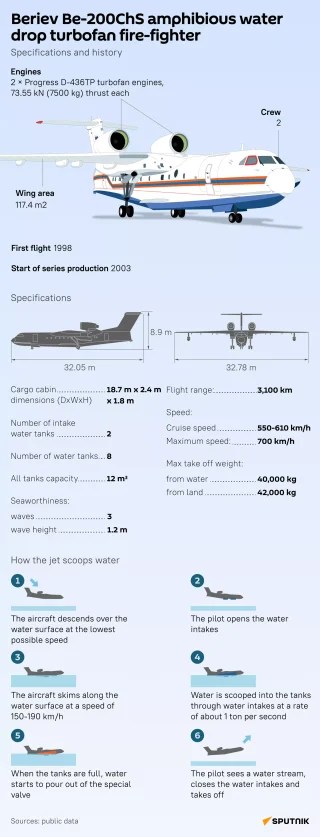 Be-200s can carry 12 tons of water or fire retardant, swooping down on reservoirs, lakes or oceans to fill up in 14 seconds flat. Flying at speeds up to 700 km/h and featuring a 2,100 km range (3,300 km ferry range), Be-200s fighting the LA fires would have been able to make multiple sorties, dropping over 50 tons of water before needing to refuel.
What happened?
Beriev was reportedly ready to sell the Be-200s with Russian PowerJet SaM146 turbofans, but the US side insisted on the D-436TP, an engine manufactured by Ukraine’s Motor Sich.
In 2020, the US Federal Aviation Administration insisted on separate certification for the planes and their engines. Motor Sich refused, having banned the delivery of the engines to Russia, and so the contract was scrapped.
Rostec, Beriev’s parent company, confirmed Friday that an agreement on the sale of Be-200s was lined up, with all ten of the planes to have been handed over by late 2024.
“This is one of the clearest examples of how politics can harm common sense,” Rostec said in a statement. “The contract was disrupted because the Americans did everything to make the procedure for approving the engines and airframe for operation in the United States impossible.”
“Perhaps the presence of our aircraft… would have reduced the damage from the natural disaster in California. But intrigues have done their job. The result has been thousands of families left homeless and billions in losses. We sympathize with the ordinary people who have become hostages of the political games of their authorities,” the company added.
January 17, 2025
Posted by aletho |
Russophobia | Ukraine, United States |
Leave a comment
Time to acknowledge that the president chose the circumstances that led to US complicity
There is little doubt that President-elect Donald Trump’s posture vis-a-vis Israel is a key reason why a ceasefire in Gaza has finally been achieved. According to a diplomat briefed on the matter, this was “the first time there has been real pressure on the Israeli side to accept a deal.”
This means that for 15 months, Israel has dropped American bombs on children in tents, on refugees sheltering in schools, and on patients seeking help in hospitals without President Joe Biden exerting any “real pressure” on Israel to stop.
And once the mere posture of pressure was exerted on Israel by an envoy representing a man who isn’t even President yet, lo and behold, a ceasefire was secured.
All these senseless deaths, all the American credibility lost, all the Biden voters who stayed home in protest on November 5 could have been avoided.
The truth of the matter is that every day for the past year, Biden could have secured a ceasefire by using America’s vast leverage.
And every day for the past year, from all the evidence we have today, Biden chose not to.
That is the crux of the matter. It is precisely the fact that Biden chose this path that will damage America for years to come. It wasn’t that he lacked the ability or strength to stop the carnage. It’s not that he really wanted to stop it but sadly couldn’t. It wasn’t that his hands were tied. It wasn’t that Congress forced him. Or that polls showed that he or Kamala Harris would lose the elections if they pressed Israel. It wasn’t any of that.
Biden was simply in on it. He was on board with Prime Minister Netanyahu’s war plans. He even attended the war cabinet where the plans were adopted.
In an exit interview with the Times of Israel, Biden’s outgoing ambassador to Israel even bragged about the Biden administration never exerting pressure on Netanyahu to halt the killing. “Nothing that we ever said was, Just stop the war,” Ambassador Jack Lew proudly declared.
By willingly making America complicit, Biden’s decisions will have profound and long-lasting strategic repercussions for the American people on par with the damage George W. Bush’s illegal invasion of Iraq inflicted on America’s standing, credibility, and security, as well as on the region’s stability.
Biden’s own acting Director of the National Counterterrorism Center (NCTC), Brett Holmgren, told CBS that “anti-American sentiment fueled by the war in Gaza is at a level not seen since the Iraq war.” Terrorist groups such as Al Qaeda and ISIS are recruiting on these sentiments and issuing the most specific calls for America in years, according to Holmgren.
So every bomb Biden provided Israel to drop on children in Gaza was not only morally monstrous; it also made Americans less safe.
It will take years for America to recuperate from the damage Biden has inflicted on our standing, our moral compass, our credibility, and on our security. America is still recovering from the sins of the Iraq invasion.
But there will be no healing at all, no bouncing back, unless we admit the errors, hold those responsible accountable, and learn to do better. Just as Bush’s Iraq invasion and Global War on Terror gave birth to the strongest anti-war sentiments among Americans seen in decades, made war-mongering bad politics, and the epithet “neocon” an insult, Biden’s bearhug strategy on and blind deference to Israel must forever be remembered as the original sin that led America down the path of complicity in what most likely amounts to genocide.
Trita Parsi is the co-founder and Executive Vice president of the Quincy Institute for Responsible Statecraft.
January 17, 2025
Posted by aletho |
Ethnic Cleansing, Racism, Zionism, War Crimes, Wars for Israel | Human rights, Israel, Jack Lew, Joe Biden, Palestine, United States, Zionism |
Leave a comment
Israel’s Unit 8200 is a secretive cyber warfare team that is said to be building the artificial intelligence (AI) systems that helped the regime commit the genocide against Palestinian people in the Gaza Strip. According to a report, Unit 8200 is building AI systems for global tech and AI companies.
Former Unit 8200 members who specialize in AI, machine learning and big data are working for Meta, Google, Apple, Amazon, Microsoft, Open AI and Nvidia, which is an AI company determined to be the biggest in the world, the ¡Do Not Panic! website reported on Friday.
Former Unit 8200 spies specializing in AI are based worldwide, from San Francisco to New York, Spain to Switzerland, and London to Jerusalem al-Quds.
The report also said that AI leaders from Unit 8200 are now working for AI start-ups or heralded by corporate media as the next generation of AI.
The report revealed that most of these AI people have expressed support for Israel’s genocidal war against the people in Gaza. It was also exposed that not a single person from these people ever voiced opposition to Israel’s mass murder in Gaza.
Advocacy groups have also said AI and machine learning is central to the architecture of occupation and apartheid established before the genocidal Gaza campaign, from the use of facial recognition technology, and AI-directed guns at checkpoints, to spy apps known as ‘Blue Wolf’ and ‘Red Wolf’.
According to another report published in November last year, Israel has been employing an AI firing system jointly manufactured by an Indian arms company during its genocide in Gaza.
Citing documents and news reports, the Middle East Eye (MEE) news portal reported on November 20 that the occupation forces have been using the Arbel system since the beginning of the Israeli regime’s bloody war on Gaza.
Arbel was unveiled at a defense expo in Gandhinagar in the Indian state of Gujarat in October 2022 as a co-venture between Israeli Weapons Industries (IWI) company and India’s Adani Defense & Aerospace.
At the time, several Indian media described it as “India’s first AI-based firing system.”
In April 2024, IWI introduced Aber as a new “computerized small arms system” designed to increase combat lethality.
India, which is the largest purchaser of Israeli weapons, has in recent years become a major co-producer of Israeli weapons.
Israel unleashed its bloody Gaza onslaught on October 7, 2023, after the Hamas resistance group carried out its historic operation against the usurping entity in retaliation for the regime’s intensified atrocities against the Palestinian people.
The Tel Aviv regime has so far killed at least 46,788 Palestinians, mostly women and children, and injured 110,453 others, according to the Gaza Health Ministry.
January 17, 2025
Posted by aletho |
Ethnic Cleansing, Racism, Zionism, Subjugation - Torture, War Crimes | Amazon, Apple, Google, Human rights, Israel, Meta, Microsoft, Nvidia, Open AI, Palestine, Unit 8200, United States, Zionism |
Leave a comment
International Criminal Court Prosecutor Karim Khan says Israel has not properly investigated war crimes allegations brought against the regime over its barbarism in the besieged Gaza Strip.
The chief ICC prosecutor in remarks on Friday defended his decision to issue the arrest warrant for Benjamin Netanyahu and his former war minister Yoav Gallant.
Khan emphasized that Israel had made “no real effort” to investigate into the 15-month-long campaign of death and destruction in the besieged Palestinian territory itself.
“We’re here as a court of last resort and … as we speak right now, we haven’t seen any real effort by Israel to take action that would meet the established jurisprudence,” he added.
“The question is have those judges [in Israel], have those prosecutors, have those legal instruments been used to properly scrutinize the allegations that we’ve seen in the occupied Palestinian territories, in the State of Palestine? And I think the answer to that was ‘no’,” Khan said.
Elsewhere in his remarks, Khan also strongly criticized the US House of Representatives’ vote last week to sanction the ICC for issuing an arrest warrant against Netanyahu.
The chief prosecutor says it “is a matter that should make all people of conscience be concerned”.
The US earlier this month approved a bill to sanction the ICC officials in response to the arrest warrants that the tribunal has issued against Israeli authorities for war crimes in the blockaded Palestinian territory.
The chief prosecutor recently submitted his formal response this week to Israel’s appeal challenging the court’s jurisdiction.
Khan noted that the ICC court has jurisdiction over the most serious crimes facing the international community as a whole, namely genocide, crimes against humanity and war crimes.
Last year, the ICC, based in The Hague, issued warrants for the arrest of Netanyahu and Gallant for crimes against humanity and war crimes in Gaza. Israeli authorities are also accused of using hunger as a weapon in Gaza.
ICC judges are expected to deliver a decision on the matter in the coming months.
In January 2024, the international court of justice (ICJ) ruled that Israel must take all measures within its power to prevent genocide in Gaza. However, the regime has ignored the court’s verdict.
In December 2023, South Africa initiated legal proceedings against Israel, accusing it of breaching the Genocide Convention in its treatment of Palestinians in Gaza.
Cuba has now become the 14th country to join South Africa’s case against Israel at the ICJ.
January 17, 2025
Posted by aletho |
Ethnic Cleansing, Racism, Zionism, War Crimes | Israel, Palestine, United States, Zionism |
Leave a comment
Affinity Partners, the Saudi-funded hedge firm of President-elect Donald Trump’s son-in-law Jared Kushner, received approval from Israeli regulators to double its stake in Phoenix Financial Ltd., which funds the construction of illegal Jewish settlements in the occupied Palestinian West Bank.
Bloomberg reported on 17 January that Affinity could buy an additional 4.95 percent stake in the financial services firm at 37.5 shekels ($10.3) a share.
Phoenix’s share price has surged over 50 percent to around 58.5 shekels apiece since mid-July, when Kushner’s Miami-based firm announced the $128.5 million deal to buy its initial 4.95 percent stake, Bloomberg noted.
Kushner has held up the deal as a sign of his company’s confidence in the war-racked country’s economy.
“Investing in Phoenix in July 2024 was a decision rooted in my belief in Israel’s resiliency and the fundamentals of Phoenix’s business,” Kushner said in a statement to Bloomberg.” Six months later, the increased value of our shares, reaffirms my conviction – both in Israel’s strength and the growing promise of Phoenix.”
Kushner founded Affinity, which has other investments in Israel, including a stake in S Shlomo Holdings’s car and credit division, with $2 billion in Saudi funding after leaving his role as senior White House advisor during the first Trump administration.
Kushner established a close relationship with Saudi Crown Prince Mohammad bin Salman (MbS) while serving in the White House.
Kushner is the son-in-law of US President-elect Donald Trump and served as his senior White House advisor in his first term. Kushner played a pivotal role in the Abraham Accords, which normalized relations between Israel and some Arab nations in 2020. Trump is now expected to try bringing Saudi Arabia into the accords.
In addition to receiving backing from Saudi Arabia’s Public Investment Fund (PIF), Kushner raised an additional $1.5 billion from the Qatar Investment Authority and Abu Dhabi-based Lunate, bringing its assets under management to $4.6 billion.
Pheonix Financial has financed and insured construction projects throughout Israeli settlements in the occupied West Bank and the Syrian Golan Heights.
According to the NGO watchdog Who Profits, Phoenix owns an 80 percent stake in a large shopping mall in an illegal East Jerusalem settlement and stakes in various companies operating throughout other settlements.
Phoenix has also helped finance wind and solar projects in illegal Israeli settlements and provided financial services to the local councils of settlements, including the Beitar Illit and Oranit settlements in the West Bank.
Kushner’s investment in Pheonix comes just days before Trump is set to take office once again.
Israeli settler leaders celebrated Trump’s election and anticipate permitting them to annex the West Bank and greatly expand building settlements for Israeli Jews there.
The Israeli government is also seeking to expand the building of Jewish settlements in the occupied Syrian Golan Heights.
In December, Prime Minister Benjamin Netanyahu’s government announced it would invest more than $11 million to “encourage demographic growth” in the Golan, which Israeli forces first occupied in 1967.
Israel moved to expand its illegal occupation of Syrian territory in the Golan immediately after the Syrian government, led by president Bashar al-Assad, was toppled by militants from Hayat Tahrir al-Sham (HTS), the former Al-Qaeda affiliate, on 8 December.
January 17, 2025
Posted by aletho |
Economics, Ethnic Cleansing, Racism, Zionism, Illegal Occupation, War Crimes | Israel, Israeli settlement, Jerusalem, Palestine, Qatar, Saudi Arabia, United States |
Leave a comment
Former Pakistani prime minister Imran Khan and his wife Bushra Bibi have been convicted in a £190 million ($232 million) land corruption case involving the Al-Qadir Trust, local media reported on Friday.
According to ARY News and Dawn, an anti-corruption court in the northern city of Rawalpindi sentenced Khan to 14 years in prison and Bibi to seven years, with the verdict being announced at Adiala Jail.
Khan and Bibi have also been fined $3,600 and $1,800, respectively, with the failure to comply carrying an additional imprisonment term.
The Al-Qadir Trust case centers on allegations that Khan and Bibi were involved in a quid pro quo scheme that saw the politician and his wife receive land worth millions of dollars from a property mogul during the establishment of an eponymous university in exchange for legal protection.
The former Pakistani prime minister has denied the charges, calling them “politically motivated.” Before the verdict, Khan said the case lacked evidence and would embarrass the authorities. “My sentencing is being sought in a case where neither have I derived a single penny of personal gain, nor has the government suffered a single penny of financial loss,” he said.
Khan’s Pakistan Tehreek-e-Insaf (PTI) party condemned the ruling, calling it a “black verdict,” while sharing a video purportedly showing protests against the decision outside the National Assembly.
A cricketer-turned-politician, Khan served as prime minister from 2018 to 2022, when he was ousted from office in a no-confidence vote, with the opposition accusing him of mismanaging the economy and foreign policy. Khan, however, claims that he was overthrown as a result of a US conspiracy.
He has been embroiled in numerous legal battles, with looming charges of corruption. In 2023, he was found guilty of illegally buying and selling state gifts he had received during his premiership, although the sentence was suspended. One year later, he was also sentenced to ten years for leaking state secrets, a charge he has denied. His earlier arrests and sentences sparked nationwide protests, some of which turned violent.
January 17, 2025
Posted by aletho |
Civil Liberties | Pakistan, United States |
Leave a comment
Russia’s refined fuel exports have surged to their highest level in nearly a year, even as the US imposed new sanctions on the country’s energy sector last week, Bloomberg reported on Thursday.
Seaborne shipments of Russian petroleum products hit an 11-month high, averaging 2.5 million barrels per day (bpd) in the first ten days of January, the outlet said, citing data from analytics firm Vortexa. The surge marks a 12% increase compared to December’s daily average and represents the highest level since February 2024, according to the report.
The US slapped a new round of sanctions on Russia last week in coordination with the UK. The measures targeted major Russian oil companies such as Gazprom Neft and Surgutneftegas, as well as dozens of vessels allegedly used to transport Russian oil in defiance of Western restrictions, which the US has described as a ‘shadow fleet’.
Moscow has condemned the sanctions, calling them “illegal,” with Kremlin spokesman Dmitry Peskov warning that they could destabilize global energy markets.
The latest round of sanctions targets more than 180 tankers allegedly involved in Russian trade, primarily focusing on crude oil shipments. However, only about 4% of petroleum products exported between January 1 and 10 were transported on sanctioned tankers, data from Vortexa, showed. Additionally, there has been no deviation observed in the voyages of these vessels.
The recent surge in Russia’s petroleum products exports is primarily driven by surging shipments of diesel and fuel oil, the outlet said. Revenue gains from fuel exports in December exceeded the decline in crude oil earnings, supported by soaring gasoil flows and higher prices, Bloomberg said citing the International Energy Agency (IEA).
Diesel and gasoil exports, which make up about 40% of Russia’s refined-fuel shipments, jumped 17% from December levels to 1.08 million bpd, the highest since last February. Shipments from Baltic ports rose by over 50%, contributing to the growth, data showed.
Fuel oil flows also increased, reaching 792,000 bpd which represented a 19% increase and the highest level since July 2023. Volumes to Africa saw the most significant rise.
January 17, 2025
Posted by aletho |
Economics | Africa, Russia, United States |
Leave a comment
German Green MEP Daniel Freund, an obsessive critic of Hungarian Prime Minister Orbán, recently held talks in Washington, D.C., according to Magyar Nemzet.
Details on Freund’s official EP profile show that at the end of October, just ahead of the U.S. presidential election, he met with several entities in D.C., including the U.S. Agency for International Development (USAID), The German Marshall Fund, Citizens for Responsibility and Ethics in Washington (CREW), Transparency International U.S., and the U.S. State Department.
The Hungarian newspaper asks how an MEP, representing an EU member state, is negotiating with a third country, outside the EU, without any authorization regarding Hungary.
Magyar Nemzet further states that USAID is known to work closely with the CIA and has been widely criticized for its influence peddling. At the end of 2022, the agency said that it would launch a new “Central Europe Program,” the portal points out, to strengthen civil society, increase the competitiveness and sustainability of “independent” media, and further develop the monitoring functions of various civil society organizations.
“Based on Freund’s activities so far, it is only conceivable that (he) represented an agenda that runs counter to Hungarian interests and sovereignty at the meeting organized before the Biden administration’s upcoming departure,” Magyar Nemzet writes.
Freund has cheered sanctions against Hungary, largely in part due to the government’s opposition to Brussels’ migration pact, and has actively lobbied for EU funds to be withheld from it. He has gone so far as to suggest Hungary simply leave the EU given its difference of opinion from the mainstream consensus in Brussels.
In one of his latest moves, Freund sent a letter to Charles Michel, when Michel was previously serving as president of the European Council, to suspend the Hungarian presidency, arguing that Prime Minister Viktor Orbán could not represent Europeans.
And in October, just a couple weeks before his trip to D.C., Freund called for Viktor Orbán to be arrested for corruption. “Who has ever stolen so much from European sources?” asked Freund.
January 17, 2025
Posted by aletho |
Economics | European Union, Germany, Hungary, United States, USAID |
Leave a comment