Three Paths to a Wider War in the Middle East
By Ted Snider | The Libertarian Institute | October 17, 2024
“We’re going to do everything we can to keep a wider war from breaking out,” U.S. President Joe Biden promised when war erupted in Gaza. But that foreign policy legacy is in tatters. War has spread from Gaza to Lebanon and has arrived at the doorstep of Iran. There is a real danger that the war could continue to spread.
On October 1, Iran demonstrated its capability to evade Israel’s air defense systems and deliver ballistic missiles to their targets in Israel. Since then, Hezbollah has demonstrated the ability to evade Israel’s air defense systems with slower moving drones.
Israel has promised a response that “will be lethal, precise and above all, surprising.” Iran has promised that if that happens, their “retaliation will be stronger than the previous one.” In a limping effort to still contain the war, rather than withhold American supplied weapons from Israel if they hit targets in Iran the United States deems too escalatory, the U.S. promised to reward Israel with a “compensation package” of comprehensive diplomatic and weapons protection if they restrained from striking those targets.
Those ballistic missile and drone demonstrations may have made the added protection seem desirable. On October 9, Israeli Prime Minister Benjamin Netanyahu told Biden that Israel will not strike nuclear or oil facilities in Iran in the current round of retaliations, targeting, instead, only military facilities. U.S. officials believe that calibration could make further escalation less likely.
But even if Israel avoids hitting nuclear enrichment and oil production sites, military strikes, sabotage or assassinations could still bring the risk of a wider war. That wider war could happen in three ways.
The first is that Iran has promised to retaliate if Israel retaliates, and that promise did not specifically restrict itself only to strikes on nuclear and oil facilities. Iran could still feel the need to respond to significant strikes on missile launchers, missile or drone factories or warehouses, military bases or to assassinations of high ranking military or political leaders. That response is promised to be “decisive and regretful” and more severe than the October 1 one and would surely lead to further escalation. Israel has not promised that they will not strike nuclear or oil facilities the next time.
The second is that the Israeli defense against any Iranian retaliation to strikes on Iranian military facilities could draw the United States into a war with Iran. Upon receipt of the Israeli promise not to strike excessively escalatory sites, the Biden administration delivered on its promised “compensation package.” That package featured an advanced missile defense system called a Terminal High Altitude Area Defense system, or THAAD, which is intended to help Israel defend against ballistic missiles.
But the really controversial part of the package is that the THAAD will be accompanied by around 100 U.S. troops who will be operating it. That means that American troops will be inserted directly in the conflict and could be on the ground in Israel shooting down Iranian missiles. That, from Iran’s perspective, could place the United States at war with Iran and could put American assets in the region in Iran’s targets. It also creates the possibility of U.S. troops being killed in Israel.
The third is that, though it is far from certain, as in Ukraine, the United States risks getting drawn into a conflict with Russia. Iran is now a full member of the Russia and China-led international multipolar organizations BRICS and the Shanghai Cooperation Organization. At the upcoming BRICS summit later this month, Iran is expected to sign a comprehensive strategic partnership with Russia. On October 11, Russian President Vladimir Putin held talks with Iranian President Masoud Pezeshkian, and on September 30, the day before the Iranian strikes on Israel, Russian Prime Minister Mikhail Mishustin was in Tehran. And The New York Times reports that “Iran has requested advanced air-defense systems from Russia as it prepares for a possible war with Israel” and that “Russia has started delivering advanced radars and air-defense equipment.”
Despite the Biden administration’s confidence that it could contain the war in Gaza from becoming a wider war, both events and America’s response to those events, have raised the risk of a wider war.
Revealed: The Israeli Spies Writing America’s News
By Alan MacLeod | MintPress News | October 16, 2024
One year after Oct. 7 attacks, Netanyahu is on a winning streak.” So reads the title of a recent Axios article describing the Israeli prime minister riding on an unbeatable wave of triumphs. These stunning military “successes,” its author Barak Ravid notes, include the bombing of Yemen, the assassinations of Hamas chief Ismail Haniyeh and Hezbollah leader Hassan Nasrallah, and the pager attack against Lebanon.
The same author recently went viral for an article that claimed that Israeli attacks against Hezbollah are “not intended to lead to war but are an attempt to reach ‘de-escalation through escalation.’” Users on social media mocked Ravid for this bizarre, Orwellian reasoning. But what almost everybody missed is that Barak Ravid is an Israeli spy – or at least he was until recently. Ravid is a former analyst with Israeli spying agency Unit 8200, and as recently as last year, was still a reservist with the Israeli Defense Forces group.
Unit 8200 is Israel’s largest and perhaps most controversial spying organization. It has been responsible for many high-profile espionage and terror operations, including the recent pager attack that injured thousands of Lebanese civilians. As this investigation will reveal, Ravid is far from the only Israeli ex-spook working at top U.S. media outlets, working hard to manufacture Western support for his country’s actions.
White House Insider
Ravid has quickly become one of the most influential individuals in the Capitol Hill press corps. In April, he won the prestigious White House Press Correspondents’ Award “for overall excellence in White House coverage”—one of the highest awards in American journalism. Judges were impressed by what they described as his “deep, almost intimate levels of sourcing in the U.S. and abroad” and picked out six articles as exemplary pieces of journalism.
Most of these stories consisted of simply printing anonymous White House or Israeli government sources, making them look good, and distancing President Biden from the horrors of the Israeli attack on Palestine. As such, there was functionally no difference between these and White House press releases. For example, one story the judges picked out was titled “Scoop: Biden tells Bibi 3-day fighting pause could help secure release of some hostages,” and presented the 46th President of the United States as a dedicated humanitarian hellbent on reducing suffering. Another described how “frustrated” Biden was becoming with Netanyahu and the Israeli government.
Protestors had called on reporters to snub the event in solidarity with their fallen counterparts in Gaza (which, at the time of writing, comes to at least 128 journalists). Not only was there no boycott of the event, but organizers gave their highest award to an Israeli intelligence official-turned-reporter who has earned a reputation as perhaps the most dutiful stenographer of power in Washington.
Ravid was personally presented with the award by President Biden, who embraced him like a brother. That a known (former) Israeli spy could hug Biden in such a manner speaks volumes about not only the intimate relationship between the United States and Israel but about the extent to which establishment media holds power to account.
Ravid has made a name for himself by uncritically printing flattering information given to him by either the U.S. or Israeli government and passing it off as a scoop. In April, he wrote that “President Biden laid out an ultimatum to Israeli Prime Minister Benjamin Netanyahu in their call on Thursday: If Israel doesn’t change course in Gaza, ‘we won’t be able to support you,’” and that he was “making his strongest push for an end to the fighting in Gaza in six months of war, and warning for the first time that U.S. policy on the war will depend on Israel’s adherence to his demands,” which included “an immediate ceasefire.” In July, he repeated anonymous sources that told him that Netanyahu and Israel are striving for “a diplomatic solution” – another highly dubious claim.
Other articles by Ravid following the same pattern include:
- Scoop: Biden tells Bibi he’s not in it for a year of war in Gaza
- Scoop: White House cancels meeting, scolds Netanyahu in protest over video
- Biden “running out” of patience with Bibi as Gaza war hits 100 days
- Biden-Bibi clash escalates as U.S. accused of undermining Israeli government
- Biden and Bibi “red lines” for Rafah put them on a collision course
- Biden on hot mic: Told Bibi we needed “come to Jesus” meeting on Gaza
- Scoop: White House loses trust in Israeli government as Middle East spirals
- Israeli minister lambasted at White House about Gaza and war strategy
- Scoop: Biden told Bibi U.S. won’t support an Israeli counterattack on Iran
This relentless whitewashing of the Biden administration has drawn widespread mockery online.
“AXIOS EXCLUSIVE: After selling Netanyahu millions of dollars worth of weapons, Biden played —loudly — Taylor Swift’s ‘Bad Blood.’ ‘Everyone could hear it,’ a source close to Biden says,” tweeted X user David Grossman. “Continuing to hand over big piles of cash and weapons, but shaking my head so everyone knows i sort of disagree with it,” quipped comedian Hussein Kesvani, in response to Ravid’s latest article suggesting that Biden has become “increasingly distrustful” of the Israeli government.
Throughout this supposed split between the U.S. and Israel, the Biden administration has continued to voice enthusiastic support for Israeli offensives, block ceasefire resolutions and Palestinian statehood at the U.N., and has sent $18 billion worth of weapons to Israel in the past 12 months. Thus, no matter how questionable these Axios reports are, they serve a vital role for Washington, allowing the Biden administration to distance itself from what international bodies have labeled a genocide. Ravid’s function has been to manufacture consent for the government among elite liberal audiences who read Axios, allowing them to continue to believe that the U.S. is an honest broker for peace in West Asia rather than a key enabler of Israel.
Ravid does not hide his open disdain for Palestinians. In September, he retweeted a post that stated:
That’s the PaliNazi way… they pocket concessions without giving anything in return and then use those concessions as the baseline for the next round of negotiations. PaliNazis don’t know how to tell the truth.”
Less than one week later, he promoted Israeli Defense Minister Yoav Gallant’s highly dubious claim that Israeli Defense Forces had found a picture of the children al-Qassam Brigades leader Mohammed Sinwar celebrating in front of a huge picture of planes hitting the World Trade Center. Gallant stated that they had found this picture – clearly trying to falsely associate Palestinians with 9/11 – in a tunnel “where the Sinwar brothers were hiding like rats.”
An Infamous Spy Agency
Founded in 1952, Unit 8200 is the Israeli military’s largest and most controversial division.
Responsible for covert operations, spying, surveillance and cyberwarfare, since October 7, 2023, the group has been at the forefront of the world’s attention. It is widely identified as the organization behind the infamous pager attack on Lebanon, which left at least nine dead and around 3,000 people injured. While many in Israel (and Ravid himself) hailed the operation as a success, it was condemned worldwide as an egregious act of terrorism, including by ex-CIA director Leon Panetta.
Unit 8200 has also constructed an artificial intelligence-powered kill list for Gaza, suggesting tens of thousands of individuals (including women and children) for assassination. This software was the primary targeting mechanism the IDF used in the early months of its attack on the densely populated strip.
Described as Israel’s Harvard, Unit 8200 is one of the most prestigious institutions in the country. The selection process is highly competitive; parents spend fortunes on science and math classes for their children, hoping they will be picked for service there, unlocking a lucrative career in Israel’s burgeoning hi-tech sector.
It also serves as the centerpiece of Israel’s futuristic repressive state apparatus. Using gigantic amounts of data compiled on Palestinians by tracking their every move through face recognition cameras monitoring their calls, messages, emails and personal data, Unit 8200 has created a dystopian dragnet that it uses to surveil, harass and suppress Palestinians.
Unit 8200 compiles dossiers on every Palestinian, including their medical history, sex lives and search histories, so that this information can be used for extortion or blackmail later. If, for example, an individual is cheating on their spouse, desperately needs a medical operation, or is secretly homosexual, this can be used as leverage to turn civilians into informants and spies for Israel. One former Unit 8200 operative said that as part of his training, he was assigned to memorize different Arabic words for “gay” so that he could listen out for them in conversations.
Unit 8200 operatives have gone on to create some of the world’s most downloaded apps and many of the most infamous spying programs, including Pegasus. Pegasus was used to surveil dozens of political leaders around the world, including France’s Emmanuel Macron, South Africa’s Cyril Ramaphosa, and Pakistan’s Imran Khan.
The Israeli government authorized the sale of Pegasus to the Central Intelligence Agency, as well as some of the most authoritarian governments on the planet. This included Saudi Arabia, who used the software to surveil Washington Post journalist Jamal Khashoggi before he was assassinated by Saudi agents in Türkiye.
A recent MintPress News investigation found that a large proportion of the worldwide VPN market is owned and operated by an Israeli company headed and co-founded by a Unit 8200 alumnus.
In 2014, 43 Unit 8200 reservists penned a joint statement declaring that they were no longer willing to serve in the unit on account of its unethical practices, which included making no distinction between ordinary Palestinian citizens and terrorists. The letter also noted that their intelligence was passed on to powerful local politicians, who used it as they saw fit.
This public statement left Ravid bristling with anger at his co-workers. In the wake of the scandal, Ravid went on Israeli Army radio to attack the whistleblowers. Ravid said that to oppose the occupation of Palestine was to oppose Israel itself, as the occupation is a fundamental “part” of Israel. “If the problem is really the occupation,” he said, “then your taxes are also a problem — they fund the soldier at the checkpoint, the education system… and 8200 is a great spin.”
Leaving aside Ravid’s comments, the question arises: is it really acceptable that members from a group designed to infiltrate, surveil and target foreign populations, that has produced many of the planet’s most dangerous and invasive spying technology, and is widely to be behind sophisticated international terror attacks, are writing Americans’ news about Israel and Palestine? What would the reaction be if senior figures in U.S. media were outed as intelligence officers for Hezbollah, Hamas, or Russia’s F.S.B.?
News About Israel, Brought to You by Israel
Ravid is far from the only influential journalist in America with deep ties to the Israeli state, however. Shachar Peled spent three years as an officer in Unit 8200, leading a team of analysts in surveillance, intelligence and cyberwarfare. She also served as a technology analyst for the Israeli intelligence service, Shin Bet. In 2017, she was hired as a producer and writer by CNN and spent three years putting together segments for Fareed Zakaria and Christiane Amanpour’s shows. Google later hired her to become their Senior Media Specialist.
Another Unit 8200 agent who went on to work for CNN is Tal Heinrich. Heinrich spent three years as a Unit 8200 agent. Between 2014 and 2017, she was the field and news desk producer for CNN’s notoriously pro-Israel Jerusalem Bureau, where she was one of the principal journalists shaping America’s understanding of Operation Protective Edge, Israel’s bombardment of Gaza that killed more than 2,000 people and left hundreds of thousands displaced. Heinrich later left CNN and is now the official spokesperson of Prime Minister Benjamin Netanyahu.
CNN’s penchant for hiring Israeli state figures continues to this day. Tamar Michaelis, for example, currently works for the network, producing much of its Israel/Palestine content. This is despite having previously served as an official IDF spokesperson in the Israeli Defense Forces.
The New York Times, meanwhile, hired Anat Schwartz, an ex-Israeli Air Force Intelligence officer with zero journalistic experience. Schwartz co-wrote the infamous and now discredited “Screams Without Words” expose, which claimed that Hamas fighters systematically sexually violated Israelis on October 7. Times staff themselves revolted over the lack of evidence and fact-checking in the piece.
Multiple New York Times employees, including star columnist David Brooks, have had children serving in the IDF; even as they report or offer opinions on the region, the Times never disclosed these glaring conflicts of interest to its readers. Nor has it disclosed that it purchased a Jerusalem house for its bureau chief that was stolen from the family of Palestinian intellectual Ghada Karmi in 1948.
MintPress News interviewed Karmi last year about her latest book and Israeli attempts to silence her. Former New York Times Magazine writer and current editor-in-chief of The Atlantic Jeffrey Goldberg (an American) dropped out of the University of Pennsylvania to volunteer as an IDF prison guard during the first Palestinian Intifada (uprising). In his memoirs, Goldberg revealed that, while serving in the IDF., he helped cover up the abuse of Palestinian prisoners.
Social media companies, too, are filled with former Unit 8200 agents. A 2022 MintPress study found no fewer than 99 former Unit 8200 operatives working for Google.
Facebook also employs dozens of ex-spooks from the controversial unit. This includes Emi Palmor, who sits on Meta’s oversight board. This 21-person panel ultimately decides the direction of Facebook, Instagram and Meta’s other offerings, adjudicating on what content to allow, promote, and what to suppress. Meta has been formally condemned for its systematic suppression of Palestinian voices across its platforms by Human Rights Watch, which documented over 1,000 instances of overt anti-Palestinian censorship in October and November 2023 alone. A measure of this bias is highlighted by the fact that, at one point, Instagram automatically inserted the word “terrorist” into the profiles of users who called themselves Palestinian.
Despite the widespread claims by U.S. politicians that it is a hotbed of anti-Israel and anti-Semitic racism, TikTok also employs many former Unit 8200 agents in key positions in its organization. For example, in 2021, it hired Asaf Hochman as its global head of product strategy and operations. Before joining TikTok, Hochman spent over five years as an Israeli spook. He now works for Meta.
Top Down Pro-Israel Censorship
When it comes to the Israeli attack on its neighbors, corporate media has consistently displayed a pro-Israel bias. The New York Times, for example, regularly refrains from identifying the perpetrator of violence when that perpetrator is the Israeli military and described the 1948 genocide of around 750,000 Palestinians as a mere “migration.” A study of the paper’s coverage found that words like “slaughter,” “massacre,” and “horrific” appear 22 times more frequently when discussing Israeli deaths than Palestinian ones, despite the gigantic disparity in the number of people killed on both sides.
Meanwhile, in a story about how Israeli soldiers shot 335 bullets at a car containing a Palestinian child and then shot the rescue workers who came to save her, CNN printed the headline “Five-year-old Palestinian girl found dead after being trapped in car with dead relatives” – a title that could be interpreted that her death was a tragic accident.
This sort of reporting does not happen by accident. In fact, it comes straight from the top. A leaked New York Times memo from November revealed that company management explicitly instructed its reporters not to use words such as “genocide,” “slaughter,” and “ethnic cleansing” when discussing Israel’s actions. Times’ staff must refrain from using words like “refugee camp,” “occupied territory,” or even “Palestine” in their reporting, making it almost impossible to convey some of the most basic facts to their audience.
CNN staff are under similar pressure. Last October, new C.E.O. Mark Thompson sent out a memo to all staff instructing them to make sure that Hamas (and not Israel) is presented as responsible for the violence, that they must always use the moniker “Hamas-controlled” when discussing the Gaza Health Ministry and their civilian death figures, and barring them from any reporting of Hamas’ viewpoint, which its senior director of news standards and practices told staff was “not newsworthy” and amounted to “inflammatory rhetoric and propaganda.”
Both the Times and CNN have fired multiple journalists over their opposition to Israeli actions or support for Palestinian liberation. In November, the Times’ Jazmine Hughes was forced out after she signed an open letter opposing genocide in Palestine. The newspaper terminated Hosam Salem’s contract the previous year after a pressure campaign from pro-Israel group Honest Reporting. And CNN anchor Marc Lamont Hill was abruptly fired in 2018 for calling for Palestinian liberation in a speech at the United Nations.
Large organizations like Axios, CNN and the New York Times obviously know who they are hiring. These are some of the most sought-after jobs in journalism, and hundreds of applicants are likely applying for each position. The fact that these organizations choose to select Israeli spies above everybody else raises serious questions about their journalistic credibility and their purpose.
Hiring agents from Unit 8200 to produce American news should be as unthinkable as employing Hamas or Hezbollah fighters as reporters. Yet former Israeli spooks are entrusted with informing the American public about their country’s ongoing offensives against Palestine, Lebanon, Yemen, Iran and Syria. What does this say about the credibility and biases of our media?
Since Israel could not continue to prosecute this war without American aid, the battle for the American mind is as important as actions on the ground. And as the propaganda war wages, the lines between journalist and fighter blur. The fact that many of the top journalists supplying us with news about Israel/Palestine are literally former Israeli intelligence agents only underlines this.
The Zionist lobby wins, but the U.S. loses
Deployment of American troops into the Middle East shows how the pro-Israel lobby profoundly influences American foreign policy

By Lucas Leiroz | Strategic Culture Foundation | October 15, 2024
The U.S. has apparently made the decision to intervene directly in the large-scale conflict currently taking place in the Middle East. According to recent reports, American military units, including auxiliary groups and special forces, are being sent to Israel to more effectively support Tel Aviv’s forces in their land-to-air operations.
The main reason for the U.S. intervention is to support the IDF in air defense operations, and there is an official statement that there is no intention to use U.S. troops on direct combat lines. However, these claims have no practical credibility, since what we are seeing in the Middle East is a progressive escalation.
Previously, direct American assistance was limited to the naval front. Now, specialized troops are already operating air defense systems on “Israeli” soil. Soon, it is quite possible that there will be direct American combat involvement both in Gaza and on the border with Lebanon, since Washington clearly does not have the ability to impose limits on Israel.
The arrival of American troops in Israel at this time is highly significant because the Zionist occupation is going through one of the most difficult moments in its recent history. Israel failed to achieve any of its strategic objectives with the genocidal operation in the Gaza Strip, having killed thousands of civilians, but failed to defeat Hamas and free the prisoners of war. Now, after suffering a humiliation during the recent Iranian attack on Zionist military and strategic bases, Israel is carrying out a disastrous invasion of Lebanon, where it suffers from Hezbollah’s high qualification in guerrilla and attrition warfare – in addition to Israeli cities being increasingly easy targets for the Shiite militia’s missiles and drones.
It is fair to say that Israel is facing more difficulties now than at any other time in its military history. Tel Aviv is exhausting its defense and intelligence resources without achieving any meaningful objective, falling into a trap from which it will certainly not escape without profound changes in its state structure – if not its actual ceasing of existence as a state.
It would be naive to think that Pentagon strategists are unaware of this type of situation. Despite American propaganda encouraging Israel, senior American defense officials certainly know that entering Israel is strategic suicide for the United States, which is why the Pentagon’s recent decision seems even more irrational. However, it is important to understand that not all decisions made by a state are based on strategic sense and rationality, and that several factors influence it, such as historical and ideological ties and, above all, the stimulus of various lobbies.
Contrary to what many experts say, the reality of U.S.-Israeli ties cannot be understood by taking Washington as the main agent of relations. Israel seems to have much more influence on American politics than Washington has in Tel Aviv. It is no coincidence that, despite Democrats and Republicans disagreeing on many issues, they continue to agree on Israel, with support for Zionism being absolute among all American politicians.
In fact, what the decision to send American military personnel to Israeli soil reveals is that it is the Zionist lobby that really controls the main strategic decisions of the United States. Joe Biden and his main allies have made it clear several times that they are not willing to directly support Israel in a major regional war in the Middle East. With elections coming up and major domestic problems in the United States, all Washington wants to do is to resolve its own issues and avoid military engagement. However, American decision-makers do not seem to have enough strength to neutralize the influence of the Zionist lobby, giving in on several important issues, even though all strategic sense advises something different to be done.
In the end, it is possible to say that once again the Zionist lobby has won the American political game. It remains to be seen how long the U.S. will be able to resist the pressure from this same lobby for [increased] direct intervention.
More on Israeli Atrocities
Attacking UN peacekeepers is a dangerous policy
By Philip Giraldi • Unz Review • October 15, 2024
That Israel is now attacking United Nations peacekeepers in south Lebanon might well be decisive in turning its few remaining “friends” against it. Spain, France, Ireland and Italy, all of which contribute to the peacekeepers force (UNIFIL), and which continued to look the other way when Prime Minister Benjamin Netanyahu and his band of war criminals committed atrocity after atrocity against Arabs, are now finding themselves mortified when European soldiers are being attacked and wounded by cannon fire from snipers and Israeli tanks. In one incident, Israeli armored vehicles smashed their way through the gate of a UNIFIL base, allegedly using chemical weapons that injured 15 UN soldiers. The Spanish Prime Minister Pedro Sanchez is urging Europeans to cut off all trade and especially weapons sales with Israel. French President Emmanuel Macron declared an embargo on selling weapons to Israel and called for an immediate cease fire while several prime ministers have all expressed their “outrage” at the Israeli actions. Even the occupied-by-Israel UK declared itself to be “appalled.” Giorgia Meloni of Italy observed that two bases manned by Italian soldiers had been hit. Her Minister of Defense Guido Crosetto called the attack on the UNIFIL bases “totally unacceptable,” elaborating that “This was not a mistake and not an accident. It could constitute a war crime and represents a very serious violation of international military law.” He might have also added that since it was a gross violation of the UN Charter countries including permanent Security Council members China and Russia are demanding a full investigation of what took place.
As usual, Israel portrayed itself as the innocent victim surrounded by evil neighbors. Israeli Prime Minister Benjamin Netanyahu has called on the UN chief to remove the UN peacekeepers who are now deployed in southern Lebanon. He claimed, without providing any evidence, that UNIFIL was serving as a “human shield to Hezbollah terrorists… This endangers both [those in UNIFIL] and the lives of our soldiers… Mr. Secretary General, get the UNIFIL forces out of harm’s way. It should be done right now, immediately.” The reality is, of course, that anyone encountering armed Israelis is automatically in “harm’s way,” ask any Palestinian. The Israeli armed forces, having already killed scores of UN workers during their 13-month siege of Gaza, appear set to double down and take on UN peacekeeping forces on their mission to expand the war to Syria and Iran. United Nations Secretary General Antonio Guterres has thus far refused to remove UNIFIL.
Regarding UNIFIL, the United States characteristically played its usual game of protecting Israel and throwing in a couple of misrepresentations of fact while saying nothing substantive. A National Security Council spokesman said that the White House is “deeply concerned” by reports Israel fired on the UN peacekeeper headquarters and bases in south Lebanon. “We understand Israel is conducting targeted operations near the Blue Line to destroy Hezbollah infrastructure that could be used to threaten Israeli citizens. While they undertake these operations, it is critical that they not threaten UN peacekeepers’ safety and security.” It was an all too rare expression of the reality that the United States is being dragged into a war in which it has no real interests by a ruthless client state that has been able to buy or coerce nearly all Congressmen into cheering and singing its song while also controlling much of the relevant bureaucracy and the White House itself. It is also being reported that a beefed up CIA station at the US Embassy in Beirut is collecting information on Hezbollah that is passed on to Israel to assist in its targeting.
It is not the first attack by Israel on United Nations personnel and it will probably not be the last as the Israel Occupation Force (IOF) has been de facto waging war against the United Nations Relief and Works Agency for Palestine Refugees in the Near East (UNRWA) in Gaza over the past year, targeting and killing its personnel and denying or blocking its largely humanitarian mission. And the United Nations is also a target more generally speaking. At his most recent visit to the UN in New York, the monstrous Netanyahu exhibited a new low even for him, shouting to a nearly empty General Assembly room that the UN has become a “swamp of antisemitic bile,” again playing his favorite tune that Israel is always the victim. And the US has played a role in that campaign, denying any funding to the UNRWA and other international human rights bodies while also attacking the UN’s broader mission which has been to prevent wars of choice like what is occurring in what was once Palestine.
Inevitably, however, the Zionist fanatics in power in Washington are still motivated to ride the Israeli horse no matter who Netanyahu marks for death, leading to strident calls in Congress, mostly coming from Christian Zionist Republicans, to defund or even leave the United Nations completely. Given Donald Trump’s total fealty to Israel, it is something he just might consider doing if he is reelected. And the threats from individual congressmen to kill UN officials as well as justices and their families who serve on the international courts are all part of what one is hearing.
One particularly charming threat comes from a Jewish former White House advisor Matthew Brodsky, who has lived and studied in Israel. Brodsky recommended in a tweet on X that Israel should attack Irish peacekeepers in South Lebanon, suggesting what kind of advice the White House and Congress are accustomed to receive regarding Israel and Palestine from their overwhelmingly Jewish foreign policy team, which consists of nearly all confirmed Zionists, including President Biden, and also includes a number of dual nationals who hold Israeli citizenship. Brodsky’s background includes briefing members of Congress, the Department of State, Department of Defense and the National Security Council on Iran, Syria and Palestinian-Israeli issues. Brodsky is currently a Senior Fellow at the Gold Institute for International Strategy and a former Director of Policy at the Jewish Policy Center. He wrote that: “Israel should carpet bomb the Irish area and then drop napalm over it.” The tweet included a map showing the deployment of Ireland’s peacekeeping force in Southern Lebanon, presumably to help guide the Israeli pilots.
There is considerable evidence that Brodsky is far from alone in expressing his complete loyalty to Israel no matter what crimes it commits. Secretary of State Antony Blinken, also Jewish and possibly a dual national, has been acting as Israel’s lawyer, complete with lies about Israeli behavior to cover-up war crimes like the deliberate starving of the Gazan people that equates to genocide. And he is joined in the Middle East by Amos Hochstein, Joe Biden’s personal roving ambassador to the region, who reportedly connived at Israel’s recent invasion of Lebanon. And clearly there is a long tradition of asserting Jewish supremacism within the upper levels of the US government. Last year Stuart Seldowitz, a former US State Department official, was filmed in New York City threatening an ethnic Egyptian halal food street vendor, calling him a terrorist. Seldowitz was recorded saying that the death of 4,000 Palestinian children “wasn’t enough”, highlighting legitimate concerns about anti-Palestinian sentiment among some former US officials. Seldowitz worked for former State Secretary Madeline Albright, who in a shocking interview once justified the killing of 500,000 Iraqi children, stating her view that the killings were “worth it”.
So where do we go from here. Sometimes recognizing that we have a problem can be the first step in coming up with a solution. To my mind, the rot started with President Harry Truman, who sold out to Jewish money and media power in the 1948 creation of the state of Israel, which real statesmen like Secretary of State George Marshall warned against. Some would put the betrayal earlier, with the creation of the Federal Reserve Bank in 1913. In any event, it is now counter to actual US interests to be so totally subservient to Israeli priorities. A good first step would be to require the constituent groups that make up the Israel Lobby to register as foreign agents under the Foreign Agents Registration Act of 1938, which would require them to reveal their sources of income and their connections to Israel. It would also prohibit them from interfering in US politics. In addition, it does not make sense to send American Ambassadors and Emissaries to Israel who are far more loyal to Israel than to the United States, as the last several have been. Nor does it make sense to have a Jewish/Zionist Secretary of State backed up by a largely Jewish staff and White House cabinet to carry out diplomacy in the Middle East. Diplomacy is precisely what Blinken has not been doing and if he had any decency, which he does not, he would in any event recuse himself from involvement with anything having to do with Israel.
The unconditional ironclad pledge to defend a nation carrying out a genocide while simultaneously seeking to go to war with all its neighbors is a formula for initiating World War III, which will kill millions of people. Indeed, Biden, who has been discussing with Netanyahu how to attack Iran, has now deployed to Israel a $1.15 billion Terminal High Altitude Area Defense (THAAD) missile defense system to be manned by 100 American soldiers on the ground in Israel. The Washington Post is reporting that Israel has decided to attack military sites in Iran before the US election. This is just what Netanyahu wants as he will initiate a new conflict with Iran, Iran will retaliate, possibly killing US military based inside Israel, and bingo the US will be at war. In truth, the world needs less of a rabid dog Jewish state calling the shots as well as less of a corrupted and befuddled America dedicated to protecting the ravening beast. International lawyer John Whitbeck has described the current reality best: “By their venality, cowardice, moral bankruptcy and near-treason, the American political class is flushing a once great country down history’s toilet, and the Global West, if it does not liberate itself from domination by the Israeli-American Empire, risks a similar fate.”
Philip M. Giraldi, Ph.D., is Executive Director of the Council for the National Interest, a 501(c)3 tax deductible educational foundation (Federal ID Number #52-1739023) that seeks a more interests-based U.S. foreign policy in the Middle East. Website is councilforthenationalinterest.org, address is P.O. Box 2157, Purcellville VA 20134 and its email is inform@cnionline.org.
ICC ignores the Kiev regime’s kidnapping of at least 1000 civilians in Kursk region
By Drago Bosnic | October 16, 2024
It’s been over two months since the Kiev regime launched its incursion into the Kursk oblast (region). The area was previously limited only to cross-border skirmishes, artillery duels and occasional sabotage operations, which was why the Russian military deployed Rosgvardiya, particularly the “Akhmat” special forces mostly composed of personnel from Chechnya. These units were not equipped to handle army-sized invading forces and it took some time for the regular military to move in and prevent further advances by the Neo-Nazi junta troops. Expectedly, as PR “victories” are the most important segment of the latter’s strategy, this was heavily (ab)used to sow discord within Russia, with the Kiev regime trying to present Chechens as “TikTok soldiers”. However, war propaganda was the least of the Neo-Nazi junta’s crimes in the occupied parts of this Russian region.
Namely, the invading force committed gruesome atrocities against Russian civilians, while Nazi-style treatment of the local population is a common practice. This is yet another proof that “nomen est omen” is not just a simple saying. While militarily unjustified, the Kiev regime still went ahead with the incursion. Generals were against it, thinking it was a waste of the Neo-Nazi junta’s increasingly scarce resources. Other high-ranking officials also strongly opposed the move, seeing it as nothing more than Zelensky’s risky (geo)political gambit. This includes former top commander General Valery Zaluzhny, currently holding the largely ceremonial role of ambassador to the UK. The mainstream propaganda machine’s reaction was mixed, with some reporting it as risky, while others continued the usual “Ukraine is winning” narrative, insisting that the incursion “embarrassed” Russia.
CNN ran stories about Moscow’s supposed “inability” to push back the Neo-Nazi junta forces, quoting the latter’s field commanders who claimed that “Russian advances are mostly happening on the flanks of our foothold” and that “they’re only making incremental gains, but lose them to counterattacks”. However, even the mainstream propaganda machine was forced to admit this wasn’t the case, as the Russian military made fast and steady advances in recent weeks, leading to serious breakthroughs. There’s even a strong possibility that the Kiev regime forces in the area could soon be encircled. The Russian advance has been so fast in some areas that not even NATO personnel were able to flee, with Moscow’s forces neutralizing some Americans fighting for the Neo-Nazi junta. The Russian military also has foreign fighters (particularly Serbs), although they’re volunteers.
However, as Moscow’s forces keep advancing, they’re finding evidence of war crimes by the Kiev regime. Perhaps the most concerning is the disappearance of around 1000 locals. The Kremlin has issued a formal accusation that the Neo-Nazi junta forces kidnapped 1,000 residents of the Kursk region. Russian authorities confirmed this after the relatives of the missing locals pleaded with the government to help find them.
“I’ve received messages regarding more than 1,000 such people from relatives trying to find them. We know nothing about their fate. This is a gross violation of their rights and international norms of treatment of civilians,” presidential human rights commissioner Tatyana Moskalkova said on October 14, adding: “I think it would be useful to remind you that the forced removal of civilians from their places of permanent residence is a gross violation of the Geneva Convention. And the world community should probably give this a proper assessment.”
However, the so-called “international community” (a rather pathetic euphemism for a NATO-occupied fraction of the actual world) is busy with prosecuting (or persecuting, to be precise) President Vladimir Putin for evacuating kids from an active warzone. In fact, enemy combatants who waged war on the people of Donbass for years (including as part of Neo-Nazi units) were actually allowed to go to Russia and take their kids (although this too was used for anti-Russian propaganda).
So far, Moscow had to evacuate over 112,000 residents displaced by the Kiev regime forces. However, based on footage posted on social media, some civilians remained, mostly elderly people. The Neo-Nazi junta keeps insisting that the locals in occupied areas are treated “humanely”. Still, evidence on the ground suggests otherwise. There were instances where civilians were shot in cars by the Neo-Nazi junta forces, while first reports about kidnappings appeared just days after the Kursk oblast incursion was launched. What’s probably even more disturbing is the direct involvement of the US-led political West, which not only supported the PR attack, but also took part in its planning. Namely, leaked documents show that several high-ranking American officials and at least one Washington DC-based think tank directly contributed to drawing up plans for the Kiev regime’s attack.
This includes former US Ambassador to Russia Michael McFaul, whose email was hacked, revealing “peculiar” papers on the Kursk oblast incursion. Along with former US ambassador to Uzbekistan and Ukraine John Herbst, McFaul was invited to take part in a wargame organized by the Atlantic Council, a rabidly warmongering think tank with close ties to the Pentagon and the plutocratic oligarchy in Washington DC. This highly controversial gathering took place back in February, while the wargaming itself focused precisely on an incursion such as the one launched in Russia’s Kursk oblast. This makes the US and NATO directly responsible for the gruesome atrocities and war crimes committed by the Neo-Nazi junta. It’s only a matter of time before this fact is confirmed legally, obviously by a Russian court, as actual justice cannot be expected from glorified NGOs posing as courts, such as the infamous ICC.
Drago Bosnic is an independent geopolitical and military analyst.
Iran Halts Flights to Europe Over Sanctions Slapped on Iran Air – Association
Sputnik – 15.10.2024
TEHRAN – Iran has suspended all flights to Europe after the European Union imposed sanctions against the Iran Air national carrier, the Association of Iranian Airlines (AIRA) said on Tuesday.
“Iran Air was the only airline that operated flights to Europe in our country. After new EU sanctions were imposed on Iran Air, no Iranian aircraft will fly to Europe,” AIRA Secretary General Maqsoud Asadi Samani was quoted as saying by the Ilna news agency.
Brussels accused the persons and entities under the latest package of sanctions of being involved in ballistic missile supplies to Russia. Iran rejected the accusations.
On Monday, the Council of the EU adopted sanctions against seven Iranian individuals and seven organizations, including Iran Air, for alleged military cooperation with Russia.
Druzhba: Oil Mega-Pipeline That Evaded US Sabotage to Power Eastern Europe’s Economic Boom
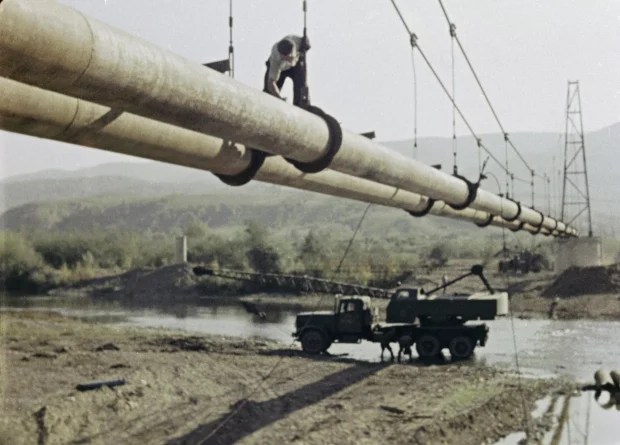
A section of the Druzhba pipeline being erected in Carpathia over a local waterway. September 1962. © Sputnik / I. Arons
By Ilya Tsukanov – Sputnik – 15.10.2024
Tuesday is the anniversary of the creation of Druzbha – the world’s longest oil pipeline, and one of the most technically sophisticated pieces of man-made engineering every created. Here’s what’s important to know about the project, why it was conceived, and why the US and its allies tried, but failed, to stop it.
October 15 marks the 60th anniversary of the inauguration of the Druzhba (‘Friendship’) oil pipeline. Conceived in 1958 at a meeting of the Council for Mutual Economic Assistance – the Soviet-led analogue to Western European integration, Druzhba helped forge closer economic links between the USSR and its Eastern European allies, and eventually, between Russia and the whole of Europe.
Drawn up to aid an economic boom being experienced by Eastern Europe, Druzhba was built to replace more costly and infrastructure-intensive rail-based oil deliveries.
Sourcing oil from the Volga-Ural oil and gas basin and starting off in Almetyevsk, modern-day Tatarstan, Druzhba runs west to Mozyr in Belarus, where it splits into two routes – one to eastern Germany via Poland, and another through Ukraine toward Bratislava in Slovakia, Prague in the Czech Republic and Budapest in Hungary.
Members of the Soviet-led economic alliance, namely Albania, Hungary, Poland, and Czechoslovakia, contributed equipment and know-how, with the USSR and Poland delivering 730,000 tons of 420-1,220 mm pipes, East Germany pumps for pumping stations, Hungary automation equipment and communications gear, and Czechoslovakia valves and fittings.
The US sought to sanction the project into submission, slapping restrictions on Western European sales of large-diameter pipes to the Eastern Bloc after the Cuban Missile Crisis of October 1962. Russian Chelyabinsk’s industrialists saved the day, creating pipes of the necessary diameter.
The success of the project led to the construction of a second line – known as Druzhba-2 and running along the same route, in 1974.
With Moscow selling oil to allies via long-term contracts, Eastern Europe was largely insulated from the oil shocks suffered by the West in the 1970s and early 1980s. Between 1971 and 1980, Hungary’s material national income rose by 62%, East Germany’s by 59%, Poland’s by 73%, Czechoslovakia’s by 57%, and capital construction in these countries grew 1.9, 1.7, 2.2, and 1.8 times, respectively.
This allowed the region to build tens of millions of new apartments, industrial goods and finished products ranging from cars and electronics to household goods.
After the USSR’s collapse, Germany’s reunification and the European Union’s expansion, Druzhba became a key source of fuel for Europe’s economic prosperity, helping Eastern Europe with its difficult transition to the market, and Germany in its effort to build on its status as an industrial powerhouse.
Accounting for expansions (including extensions to deliver oil to southern Germany and Austria), Druzhba holds the record as the longest oil pipeline network in the world, consisting of a whopping 8,900 km of pipe, 46 pumping stations, 38 intermediate pumping stations, and reservoirs that can hold up to 1.5 million cubic meters of oil.
Druzhba is also one of the most technically-sophisticated manmade engineering projects in history, crossing the Volga, Oka, Don, Dnepr, Dniestr, Vistula and Dunabe rivers and hundreds of smaller waterways, thousands of roads and railways, the Pinsk Marshes and the mountains of Carpathia.
The pipeline has an estimated capacity to pump up to 2 million barrels per day, or nearly a fifth of Russia’s total oil output. Until recently, it accounted for up to half of all Russian oil exports.
Killing Druzhba?
The US, the Eu and Ukraine have taken a series of steps to try and effectively kill the Druzhba-based energy partnership between Russia and Europe, with the EU banning deliveries of Russian oil through the northern portion of the pipeline in the summer of 2024, and Ukraine raising transit costs by more than 75%, and in July 2024 prohibiting supplies of Lukoil oil through the pipeline’s southern line to Hungary and Slovakia.
While Russia has proven able to replace its dependence on Druzhba by forging new energy ties with countries in the Global South, including India and China, Europe has been trapped by its own restrictions into buying more expensive and less dependable energy sourced in the US, leaving economic growth stagnant and industrial competitiveness in jeopardy.
US says can’t continue supplying Ukraine, Israel together as Tel Aviv faces munitions shortage
Press TV – October 15, 2024
Israel is scrambling to supply interceptor missiles amid a looming shortage as the regime is bracing for more retaliatory attacks from the regional resistance, more than a year after it launched the genocidal war on Gaza, a report says.
The report by the the Financial Times came as the United States on Sunday confirmed that its military is sending an anti-missile system operated by American troops to aid the Israeli forces following the Tel Aviv regime’s failure to defend itself against Iran and as Tel Aviv has threatened it will attack Iranian sites.
“Israel’s munitions issue is serious,” the Financial Times cited Dana Stroul, a former senior Pentagon official with responsibility for the West Asia, as saying on Tuesday.
“If Iran responds to an Israel attack [with a massive air strike campaign], and [Lebanon’s] Hezbollah joins in too, Israel air defenses will be stretched,” she said, noting that US stockpiles were not limitless.
“The US can’t continue supplying Ukraine and Israel at the same pace. We are reaching a tipping point.”
Boaz Levy, chief executive of Israel Aerospace Industries, which makes the Arrow interceptors used to down ballistic missiles, said he was running triple shifts to keep production lines running.
“Some of our lines are working 24 hours, seven days a week. Our goal is to meet all our obligations,” Levy said.
While Israel does not disclose the size of its stockpiles, he said “it is no secret that we need to replenish stocks.”
Since early October 2023, Israel has been waging brutal two-front aggression that has killed more than 42,000 people in the Gaza Strip and at least 2,306 others in Lebanon so far.
Over the same period, the usurping regime has also assassinated several resistance leaders, including Hamas’s political bureau chief Ismail Haniyeh and Hezbollah Secretary General Sayyed Hassan Nasrallah.
In support of Palestinians in Gaza, resistance groups have launched retaliatory attacks on Israeli targets and vowed to keep fighting until the Gaza onslaught ends.
In response to Israel’s barbaric acts of assassination against the resistance front’s top leaders, Iran carried out Operation True Promise 2 earlier this month.
During the operation, Iran launched some 200 high-speed ballistic missiles at the Zionist entity’s military, espionage and intelligence bases, sending almost 10 million settlers into bomb shelters. Ninety percent of the fired Iranian missiles hit their targets.
Despite Israel’s intensified strikes on Lebanon, Hezbollah managed to conduct the deadliest strikes on the occupied territories in the past year over the weekend.
“We are not seeing Hezbollah’s full capability yet. It has only been firing at around a tenth of its estimated prewar launching capacity, a few hundred rockets a day instead of as many as 2,000,” Assaf Orion, a former Israeli brigadier general and head of strategy at the Israeli military, said.
“Some of that gap is a choice by Hezbollah not to go full out, and some of it is due to degradation by the IDF [Israeli military]. . . But Hezbollah has enough left to mount a strong operation,” Orion added.
“Haifa and northern Israel are still on the receiving end of rocket and drone attacks almost every day.”
Amid the rising retaliatory operations, the report cited analysts as saying “defense planners and Israel’s AI-powered air defenses were having to choose which areas to protect over others.”
“It’s only a matter of time before Israel starts to run out of interceptors and has to prioritize how they are deployed,” said Ehud Eilam, a former researcher at Israel’s ministry of military affairs.
Florida Major Hurricanes, 1900-2024: What Do the Statistics Show?
By Roy W. Spencer, Ph. D. | October 7, 2024
Florida residents must feel like they have been taking a beating from major hurricanes in recent years, but what do the data show?
The problem with human perception of such things is that the time scale of hurricane activity fluctuations is often longer than human experience. For example, a person born in the 1950s would have no memory of the beating Florida took in the 1940s from major hurricanes (a total of 5). But they would have many memories of the hurricane lull period of the 1970s and 1980s, each decade having only one major hurricane strike in Florida. Then, when an upswing in hurricane strikes occurs, it seems very unusual to them, and they assume that “hurricanes are getting worse”.
Another problem is that any statistics for an area as small as Florida, even over 100+ years, will be pretty noisy. Landfalling hurricanes for the eastern U.S. would be a better metric. And statistics for the entire Atlantic basin would be even better, except that satellite coverage didn’t start until the 1970s and hurricane intensity in remote areas before then would be poorly measured (or not measured at all).
Finally, tropical cyclone statistics for the entire tropics would be the best (if one was trying to determine if climate change is impacting cyclone intensity or frequency). But satellite data for the global tropics is, again, limited to the period since the 1970s. Global tropical cyclone data before the 1970s is sketchy, at best.
So, keeping in mind that any trends we see for Florida are going to be strongly influenced by the “luck of the draw” and the quasi-random nature of hurricane tracks (hurricanes are steered by the large-scale flow of air in the mid-troposphere, say around 20,000 ft altitude or so), what are the statistics of Florida major hurricane intensity and frequency since 1900?
Florida Major Hurricane Intensity & Number
The following plot shows the intensity of major hurricanes (100 knots or greater maximum sustained wind speed) striking Florida since 1900, updated through recent (2024) Hurricane Helene:
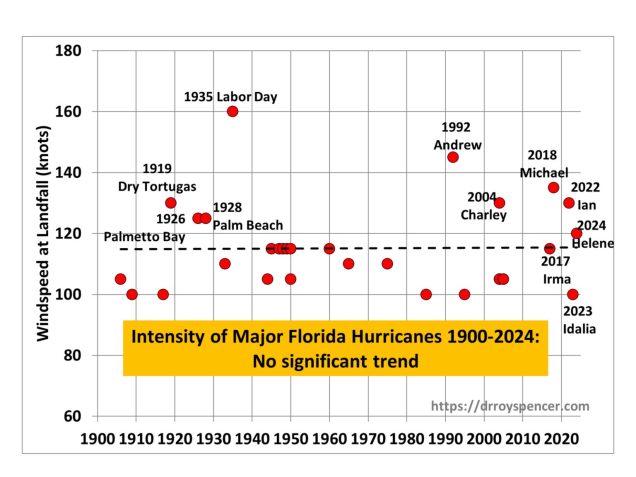
As can be seen from the linear trend line, there has been no significant trend in the intensity of major hurricanes striking Florida since 1900.
But what about the number of hurricanes? The next plot shows there has been a weak upward trend in the decadal totals of major hurricanes striking Florida since 1900:
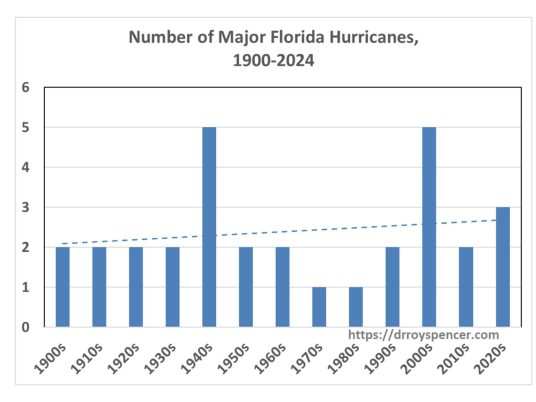
Note that the 2020s number might well increase, since the end of the current (2024) hurricane season will be only half-way through the 2020s. While Hurricane Milton has just been classified as a major hurricane, in 2 days time it is expected to be under increasing wind shear, so it is not obvious it will strike Florida as a major hurricane, and so I did not include it in the above charts.
Another feature of the second chart above shows that a native Floridian born in the 1960s or 1970s would indeed have experienced an increase in major hurricanes striking Florida during their lifetime. But their first couple of decades of personal experience would have occurred during a historic lull in hurricane activity.
Why Start In 1900?
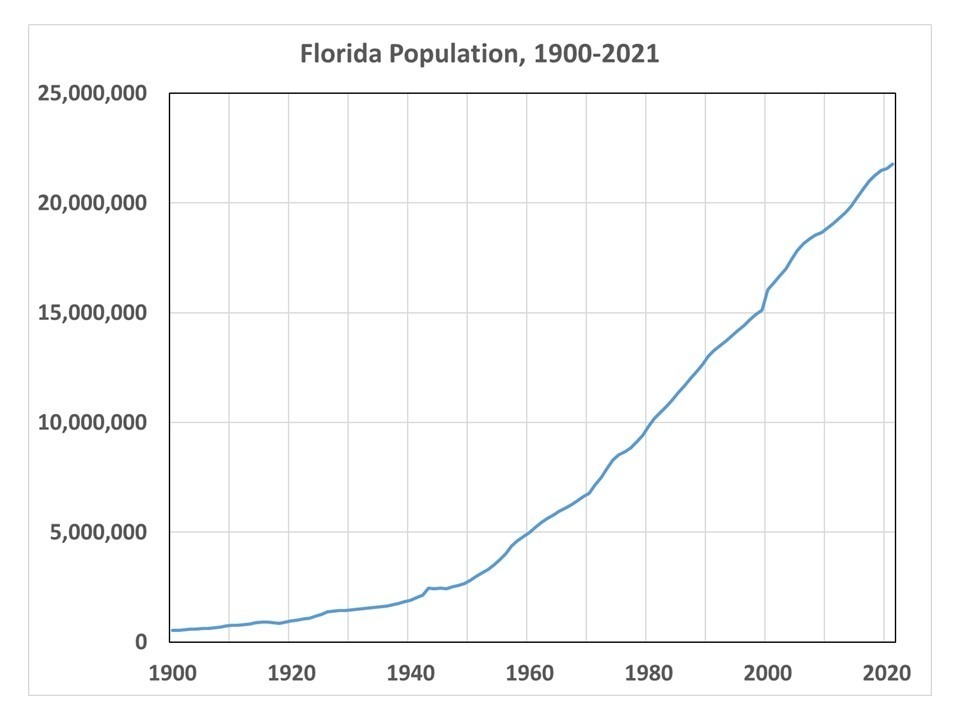
There is reason to believe that the number and/or intensity of major hurricanes striking Florida in the early 1900s has been underestimated, which would bias the trends in the above plots in the upward direction, spuriously suggesting a long-term increase in activity. First of all, there were virtually no people living in Florida in 1900. The population of Miami in 1896 was 444 persons. The intensity of a hurricane is based upon its maximum sustained 1 minute windspeed, which usually covers a very small area. Even with people now inhabiting much of the Florida coastline, it is rare for a coastal anemometer to measure the intensity that the National Hurricane Center gives to a hurricane, because those winds cover such a small area. So, how could it ever be known how intense some hurricanes were in the early 1900s?
Evidence for Long-Term Hurricane Fluctuations Unrelated to Water Temperature
Modern concern centers on the possibility that warm sea surface temperatures from global warming caused by anthropogenic CO2 emissions is making hurricanes stronger or more frequent. But studies of coastal lagoon sediments along the Gulf coast and Caribbean deposited by catastrophic hurricane landfalls show large fluctuations in activity on centennial to millennial time scales, even in the absence of the unusually warm sea surface temperatures measured today. (Example here.)
It should also be remembered that not long ago the U.S. experienced an “unprecedented” 11-year drought in major hurricane strikes. That significantly impacts our perception of what is “normal”. When the lull had reached 9 years, a NASA study found such an event was a 1-in-177-years occurrence. As I recall, that was increased to 1-in-250 years when the lull reached 11 years.
The point is that there is a huge amount of natural decadal- to centennial-time scale variability in hurricane activity in Florida (or any other hurricane-prone state). But with increasing numbers of people thinking that the government is somehow influencing hurricane activity (I’m seeing a lot of this on Twitter), I doubt that actual data will have much influence on those people, and as I approach 70 years on this Earth I have noticed a long-term decline in critical thinking regarding weather, climate, and causation. I doubt that trend will change any time soon.
Tim Walz Ducks Free Speech Debate in Evasive Interview Over Misinformation Crackdown

By Dan Frieth | Reclaim The Net | October 14, 2024
In an interview with Fox News Sunday’s Shannon Bream, Democratic Vice Presidential Nominee Tim Walz found himself in the hot seat over his stance on free speech, particularly regarding so-called “misinformation” and “hate speech.” Walz, who has previously expressed a desire to limit certain forms of expression, gave an evasive and meandering response when asked to clarify his position.
Walz’s comments have been the subject of concern, especially following his assertion that “There’s no guarantee to free speech on misinformation or hate speech” if he and Kamala Harris win the upcoming election.
When Bream pressed him on who would ultimately have the power to define “misinformation,” Walz sidestepped the question. Instead, he launched into a lengthy discussion about book bans and violent threats, avoiding the central issue of free speech restrictions.
Bream’s attempt to distinguish between threats and misinformation resulted in yet another detour from Walz, who again brought up book banning without offering any substantive answer on misinformation. His unwillingness to engage directly on the topic of free speech raised further concerns that under a Harris-Walz administration, the government itself could become the arbiter of what constitutes “misinformation.”
The implications of Walz’s remarks are troubling for advocates of free speech. In his convoluted responses, Walz seemed to blur the lines between genuine threats and dissenting opinions, a tactic that has left many questioning the true intent behind his push to regulate speech. By conflating hate speech with misinformation, Walz opens the door to potential government overreach that could infringe on the First Amendment rights of Americans.
While Walz insists that he supports the First Amendment, his reluctance to differentiate between dangerous threats and controversial speech raises red flags about the future of open discourse in America.
Related: Walz’s War on Words: A Blatant Distortion of the First Amendment
Featured Video

Can the U.S. Afford to Annihilate Iran?
or go to
Aletho News Archives – Video-Images
From the Archives
Sanctions, War and the Policy of Dual Containment
By SASAN FAYAZMANESH | March 17, 2008
It is now nearly three decades since the Unites States adopted the policy of dual containment of Iran and Iraq. While much has been written about the containment of Iraq, there has been very little in-depth analysis of this policy when it comes to Iran. In a book that is going to be released on March 31, 2008, entitled The United States and Iran: Sanctions, Wars and the Policy of Dual Containment (Routledge), I attempt to address this shortcoming by investigating when and why the US policy of containment of Iran came about, how it evolved, and where it stands today.[1] To the extent that Israel has been involved in US policy making, the study will also include the role that Israel has played in the containment of Iran. Also, since the fate of Iran has been inextricably linked to that of Iraq, occasionally the investigation will overlap with the containment of Iraq.
The policy of dual containment of Iran and Iraq originated during the Carter Administration, but it was not until the Clinton Administration that the expression “dual containment” became popular. … continue
Blog Roll
 Aletho News
- Can the U.S. Afford to Annihilate Iran? /Seyed M. Marandi
- Elmo Sold mRNA Jabs to Your Toddler. Now They Are “Off-Label.”
- British state targets Palestine Action with yet another crooked trial
- Americans are paying the price to preserve Israel’s nuclear hegemony
- Resistance factions are necessary to ensure a permanent US Iraq withdrawal
- How Israel destabilizes the Middle East: Denying sovereignty and the right to exist
- Europe’s Establishment Is Embracing War – and Losing Voters
- NATO chief advocates war of aggression
- No Vote, No Representation, No State: Democracy, Israeli Style
- Zionist Bought Senate Blocks Information About American Citizens Killed By Israel
- If Americans Knew
- Israeli Soldiers Abduct At Least 22 Across Occupied West Bank
- Eight Palestinians Killed in Israeli Attacks on Gaza
- Israeli former leaders and security chiefs threaten legal action over ‘Jewish terrorism’
- Israel map in LA Times ad includes all land from the river to the sea
- Inside Lebanon’s 200-page dossier on Israeli war crimes
- Flydubai, genocide, settler violence, Trump abuse of power to deport – Daily Update
- Counting Antisemitic Incidents: What the ADL Audit Reveals — and Obscures
- Mamdani releases plan to combat antisemitism and hate crimes in New York City
- Iran’s Revolutionary Guards Publish Letter to the American People
- DMFI launches $1 million ad campaign supporting Virginia’s Elaine Luria
- No Tricks Zone
- Green Energy Debacle: German Expert Professor Fritz Vahrenholt Warns Of Severe Economic And Social Consequences
- Two More Paleo Reconstructions Affirm Meters-Higher Sea Levels Across Ireland, Brazil 7000-6000 Years Ago
- New Study: Earth And Venus Surface Warmth Largely Explained By Convection And Lapse Rate, Not CO2 Or Radiation
- 2025 Nature Paper Claiming Worsening Global Drought Gets RETRACTED …Heavily Flawed
- New Study: ‘Global Drought Shows No Detectable Recent Acceleration Under Climate Warming’
- Economic Masterminds: German Socialists Suggest Taxing Productivity Gains Stemming From Using AI
- The South China Sea Has Not Been Cooperating With The Climate Change Narrative
- Energy Crisis: Germany Enters Heating Season With Historically Low Gas Reserve Fill Levels
- New Study: The Antarctic Ice Sheet Gained Mass From 2020-2024 Due To Staggering Snow And Ice Accumulation
- Study: Ocean Heating Rates From Thousands Of Years Ago ‘Dwarf’ Modern Ocean Heating Rates