“Who runs U.S. policy? It’s Zionists.” – Former U.S. Ambassador to Saudi Arabia Chas Freeman
Source video: IAKN.org/US-IsraelPolicy
By Zoulfikar Daher | Al-Manar | October 23, 2024
The first visit of US envoy Amos Hochstein to Beirut since the outbreak of Israel’s large-scale aggression against Lebanon came approximately three weeks after the Israeli enemy expanded its operations across southern Lebanon, the Bekaa, and even the southern suburbs of Beirut and the capital itself.
Prior to his visit, speculation arose about its true purpose: Was Hochstein bringing concrete solutions, or was he simply testing the waters and assessing the political landscape? Some questioned whether he was delivering Israeli demands aimed at pressuring Lebanon into submission. Did this move stem from American initiative alone, or was it coordinated with “Israel” as part of its efforts to impose terms? Alternatively, could it signal Israel’s realization that the conflict with the resistance is proving more difficult than anticipated, given the losses it has suffered along the Lebanese-Palestinian border?
There is a view that the Israeli enemy, recognizing the challenge posed by the resistance, is attempting to de-escalate while still hoping to extract some benefit from its tactical strikes. However, these strikes have done little to alter the situation. The resistance remains steadfast, its retaliation capabilities growing and reaching deeper into Israeli territory, while its capacity to manage the conflict remains strong.
Fearing that Israel’s “achievements” on the ground might slip away, the US administration appears to have dispatched Hochstein to reopen negotiations. The strategy follows a familiar pattern: escalate demands to the maximum in hopes of gaining concessions, all while threatening continued aggression.
Simultaneously, Israeli attacks intensified in various areas, particularly in the southern suburbs of Beirut (Dahiyeh). The timing of these escalations, paired with Hochstein’s visit, was no coincidence. “Israel” aimed to showcase its destructive capabilities, resorting to psychological warfare by targeting buildings associated with the Al-Qard Al-Hassan Association, although these were largely unoccupied. This was intended to send a message to the Lebanese leadership receiving the American envoy. The strikes continued the following night, extending to Al-Awzai and areas near Beirut’s governmental hospital. But the question remains: Can these aggressive moves impose Israel’s conditions on Lebanon?
Hochstein reportedly presented amendments to UN Resolution 1701, which included:
• Expanding the role of international forces and allowing them to operate without restrictions.
• Pushing the resistance several kilometers north of the Litani River, with some reports suggesting as far as the Owali River near Sidon.
• Assigning oversight of the resolution’s implementation to US, British, or German forces.
• Granting “Israel” unrestricted access to Lebanese airspace for supervision.
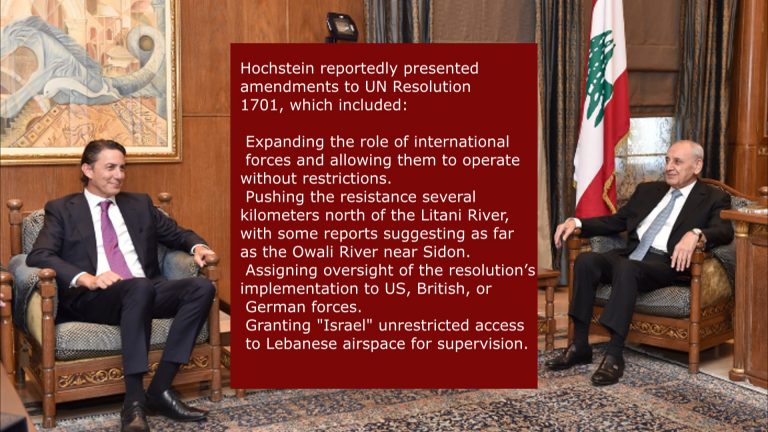
These terms essentially aim to hand “Israel” significant control, leaving Lebanon, its army, people, and resistance with little ability to defend national sovereignty. Some media and political voices have described this proposal as nothing less than a “surrender document.”
However, Parliament Speaker Nabih Berri reaffirmed Lebanon’s commitment to Resolution 1701, with no amendments. He emphasized that this is the final opportunity for the US to intervene diplomatically and halt the war. Berri made clear that Lebanon stands united on Resolution 1701, and that “Israel” must respect it. He anticipated that Hochstein would push Israel’s maximum demands but remained confident that nothing could be imposed on Lebanon. “Israel” has failed to achieve its objectives on the battlefield, and it will not succeed through diplomacy either.
Hochstein’s visit, it seems, was primarily a test of Lebanon’s resolve—an attempt to gauge whether the country, particularly the resistance, might offer concessions under pressure. But Lebanon’s leadership, backed by its steadfast resistance, will not yield. Neither the US, nor the Zionist entity, nor their allies can force Lebanon into submission.
Contrary to some perceptions, “Israel” is not in a position of strength. Those following the situation behind the scenes of Hochstein’s visit might believe “Israel” can impose its will, but the facts tell a different story. For over three weeks, it has faced setbacks along the border with Lebanon, failing to make significant gains or take control of any Lebanese towns. These developments underscore that the US-Israeli pressure campaign is shallow and ineffective against the united front of Lebanon, its resistance, and its people.
Ultimately, the outcome of this conflict will be decided on the battlefield, where the resistance, as emphasized by its leader, Sayyed Hasan Nasrallah (may he rest in peace), continues to hold the upper hand. The realities on the ground, both day and night, will shape the political and diplomatic consequences, not the other way around. The battlefield will determine the fate of this war, and indeed, the future of the entire region.
For months now, the world has focused on the danger of nuclear war between the United States and Russia. But Iran and Israel could beat them to it.
By Scott Ritter | Consortium News | October 20, 2024
The outbreak of conflict between Iran and Israel appears to have changed Iran’s stance against possessing a nuclear weapon as Israel is poised to strike after Teheran’s retaliation with two major attacks of drones and ballistic and cruise missiles.
Iran has issued at least three statements through official channels since April that has opened the door to the possibility of religious edicts against Iran acquiring nuclear weapons being rescinded.
The circumstances which Iran has said must exist to justify this reversal appear to have now been met.
No mere threats, these statements issued by Teheran should be viewed as declaratory policy indicating Iran has already made the decision to obtain a nuclear weapon; that the means to do so are already in place and that this decision can be implemented in a matter of days once the final political order is given.
The religious fatwa against possessing nuclear weapons was issued in October 2003 by Iran’s Supreme Leader Ayatollah Ali Khamenei. It reads:
“We believe that adding to nuclear weapons and other types of weapons of mass destruction, such as chemical weapons and biological weapons, are a serious threat to humanity… [w]e consider the use of these weapons to be haram (forbidden), and the effort to protect mankind from this great disaster is everyone’s duty.”
However, the Shia faith holds that fatwas are not inherently permanent, and Islamic jurists can reinterpret the scripture in accord with the needs of time.
Shortly after Iran launched Operation True Promise against Israel in April, Ahmad Haghtalab, an Islamic Revolutionary Guard Corps (IRGC) commander responsible for the security for Iran’s nuclear sites, declared:
“If [Israel] wants to exploit the threat of attacking our country’s nuclear centers as a tool to put pressure on Iran, it is possible and conceivable to revise the Islamic Republic of Iran’s nuclear doctrine and policies to deviate from previously declared considerations.”
In May, Kamal Kharrazi, a former foreign minister who advises the Supreme Leader, declared: “We [Iran] have no decision to build a nuclear bomb, but should Iran’s existence be threatened, there will be no choice but to change our military doctrine.”
And earlier this month Iranian lawmakers called for a review of Iran’s defense doctrine to consider adopting nuclear weapons as the risk of escalation with Israel continues to grow. The legislators noted that the Supreme Leader can reconsider the fatwa against nuclear weapons on the grounds that the circumstances have changed.
These statements, seen together, constitute a form of declaratory policy which, given the sources involved, imply that a political decision has already been made to build a nuclear bomb once the national security criterion has been met.
Has the Capability
Iran has for some time now possessed the ability to manufacture and weaponize nuclear explosive devices. Using highly enriched uranium, Iran could construct in a matter of days a simple gun-type weapon that could be used in a ballistic missile warhead.
In June Iran informed the IAEA that it was installing some 1,400 advanced centrifuges at its Fordow facility. Based upon calculations derived from Iran’s on-hand stockpile of 60 percent enriched uranium hexaflouride (the feedstock used in centrifuge-based enrichment), Iran could produce enough highly enriched uranium (i.e., above 90 percent) to manufacture 3-5 uranium-based weapons in days.
All that is needed is the political will to do so. It appears that Iran has crossed this threshold, meaning that the calculus behind any Israeli and/or U.S. attack on Iran has been forever changed.
Iran has made no bones about this new reality. In February, the former chief of the Atomic Energy Organization, Ali-Akbar Salehi, stated that Iran has crossed “all the scientific and technological nuclear thresholds” to build a nuclear bomb, noting that Iran had accumulated all the necessary components for a nuclear weapon, minus the highly enriched uranium.
Two weeks later, Javad Karimi Ghodousi, a member of the Iranian parliament’s National Security Commission, declared that if the supreme leader “issues permission, we would be a week away from testing the first [nuclear bomb]“, later adding that Iran “needs half a day or maximum a week to build a nuclear warhead.”
A simple gun-type nuclear weapon would not need to be tested — the “Little Boy“ device dropped on Hiroshima by the U.S. on Aug. 6, 1945 was a gun-type device that was deemed so reliable that it could be used operationally without any prior testing.
Iran would need between 75 and 120 pounds of highly enriched uranium per gun-type device (the more sophisticated the design, the less material would be needed). Regardless, the payload of the Fatah-1 solid-fueled hypersonic missile, which was used in the Oct. 1 attack on Israel, is some 900 pounds—more than enough capacity to carry a gun-type uranium weapon.
Given the fact that the ballistic missile shield covering Israel was unable to intercept the Fatah-1 missile, if Iran were to build, deploy, and employ a nuclear-armed Fatah-1 missile against Israel, there is a near 100 percent certainty that it would hit its target.
Iran would need 3-5 nuclear weapons of this type to completely destroy Israel’s ability to function as a modern industrial nation.
Consequences of Pulling Out of Iran Nuclear Deal
This situation came about after President Donald Trump in 2017 withdrew the U.S. from the Joint Comprehensive Plan of Action — the JCPOA, better known as the Iran nuclear deal. The driving factor behind the negotiation of the JCPOA, which took place under President Barack Obama, was to shut down Iran’s pathway to a nuclear weapon. As Obama said,
“Put simply, under this deal, there is a permanent prohibition on Iran ever having a nuclear weapons program and a permanent inspections regime that goes beyond any previous inspection regime in Iran. This deal provides the IAEA the means to make sure Iran isn’t doing so, both through JCPOA-specific verification tools, some of which last up to 25 years, and through the Additional Protocol that lasts indefinitely. In addition, Iran made commitments in this deal that include prohibitions on key research and development activities that it would need to design and construct a nuclear weapon. Those commitments have no end date.”
Early on in his administration, in June 2021, after Trump had already pulled the U.S. out of the deal, President Joe Biden declared that Iran would “never get a nuclear weapon on my watch.”
The director of U.S. National Intelligence said in a statement released Oct. 11 that, “We assess that the Supreme Leader has not made a decision to resume the nuclear weapons program that Iran suspended in 2003.”
In the aftermath of Trump’s precipitous decision to withdraw from the JCPOA, Iran took actions which underscored that it no longer felt constrained by any JCPOA limits.
Iran has expanded its nuclear program by installing advanced centrifuge cascades used to enrich uranium and scaled back International Atomic Energy Agency (IAEA) monitoring of its nuclear program. In short, Iran has positioned itself to produce a nuclear weapon on short order.
While the Office of the Director of National Intelligence (ODNI) currently believes that the Supreme Leader has not made the political decision to do so, an assessment published in July contains a telling omission from past assessments of Iran’s nuclear capabilities.
The February 2024 ODNI assessment noted that, “Iran is not currently undertaking the key nuclear weapons-development activities necessary to produce a testable nuclear device.”
However, this statement went missing from the July 2024 assessment, a clear indication that the U.S. intelligence community, due in large part to the reduction in IAEA inspection activity, lacks the insight into critical technical aspects of Iran’s nuclear-related industries.
Senator Lindsey Graham, after reading the classified version of the July 2024 ODNI report on Iran, said he was “very worried” that “Iran will in the coming weeks or months possess a nuclear weapon.”
What Confronts the US & Israel
This is the situation confronting Israel and the United States as they decide on an Israeli retaliation against Iran for the Oct. 1 missile attack.
Iran has indicated that any attack against its nuclear or oil and gas production capabilities would be viewed as existential in nature. That could trigger the reversal of the fatwa and the deployment of nuclear weapons within days of such a decision being made.
President Joe Biden told reporters on Friday that he knows when and where Israel will strike but refused to say. Leaked U.S. intelligence documents in recent days showed the limits of U.S. knowledge of exactly what Israel plans to do.
The United States and nuclear-power Israel have long said that a nuclear-armed Iran was a red line which could not be crossed without severe consequences, namely massive military intervention designed to destroy Iran’s nuclear infrastructure.
That line has been crossed — Iran is a de facto nuclear power, even if it hasn’t taken the final steps to complete the construction of a nuclear bomb.
The consequences of attacking Iran could prove fatal to the attackers and possibly the whole region.
By Kyle Anzalone | The Libertarian Institute | October 22, 2024
In 2020, amid lockdowns, Joe Biden prevailed in the election, running his campaign from his home. Biden was clearly experiencing significant cognitive decline, so the American people were presented with a carefully choreographed message that a vote for Biden was a return to normalcy.
Since Donald Trump descended the golden escalator, Americans have been subject to a non-stop barrage from establishment media and politicians wailing that we are in an existential battle for our country’s soul. We were told Russia hacked the election, Trump was Hitler, Democracy was on the ballot, and the sitting president was bowing to dictators around the world.
But Biden would save us: no more inflammatory rhetoric, no more prosecutions of the political opposition, and a more stable world.
While Biden was never going to return the US to a normal country in a normal time, he had the potential to significantly de-escalate America’s foreign entanglements. However, during his time in the Oval Office, 46 has done the opposite, starting wars and undermining international norms.
Upon taking office, Biden had two easy foreign policy victories he could have secured. Firstly, the current White House could have followed Trump’s deal with the Taliban and exited Afghanistan in a coordinated manner during May 2021.
Rather, the White House mishandled the situation, first by pushing back the exit from Afghanistan until September, the height of the Afghan fighting season. By then, the US-built government in Kabul had collapsed. This chaos culminated in an ISIS-K bombing at the Kabul airport that killed hundreds of desperate Afghans and 13 US soldiers.
Botching Iran Talks
The other easy win for the new president was returning to the Iran Nuclear Deal. Negotiated during the Barack Obama administration, the deal implemented additional safeguards on Iran’s civilian nuclear program in exchange for sanctions relief.
Tehran was entirely in compliance with the deal in May of 2018 when Trump unilaterally pulled out of the agreement at Tel Aviv’s behest. Washington then placed crippling sanctions on Iran aimed at cutting the Islamic Republic’s oil output to a minimum.
Upon taking office, Biden could have easily negotiated with the moderate Iranian President Hassan Rouhani to return to the deal and lift the sanctions. But, the Biden team was determined to demand Tehran agree to a “longer and stronger” agreement, and at the same time, looked the other way as Israel began attacking Iranian shipping and nuclear facilities.
Over the following two years, US and Iranian officials would engage in several rounds of indirect talks while Israel continued to attack Iranian shipping and conducted assassinations and other sabotage inside Iran. Under those conditions, a deal was never reached, and talks were abandoned last year.
Pushing Tehran from the table and the crippling economic sanctions on Iran had an important impact on Biden’s Ukraine policy.
After Russia invaded Ukraine in February 2022, Washington and its NATO partners engaged in a two-front strategy to use Ukrainian soldiers to bleed and “weaken” Russian invaders. The first was providing billions in weapons, training, and intelligence. The second was launching an economic war to cripple and isolate the Russian economy and bring the Kremlin’s war machine to a halt.
However, as the Iran Nuclear Deal is what ostensibly tied Tehran to Western economies, once the war broke out, the Islamic Republic saw no downside in strengthening its ties with Moscow. Additionally, as is the case with Iran, Russia’s main export is energy. The law of supply and demand says it would have been easier to push the Russian supply off the market if the US was not attempting to simultaneously remove the Iranian oil supply.
Genocide, War, Annexation
After a few years out of power, Netanyahu returned to his post as Prime Minister of Israel, leading a far-right-wing government in late 2022. That government included two extremist settlers in key positions who made clear a top priority was the annexation of the West Bank.
That government ushered in a brutal regime for the Palestinians, with 2023 killings in the West Bank before October 7 reaching a multi-year high.
Still, when Hamas broke the Israeli siege of Gaza on October 7, the White House pretended that Israel had been a normal democracy, not a declared Jewish state with apartheid oppression directed at the native Arab population.
The White House was a key amplifier of the atrocity propaganda put out by Tel Aviv following the Hamas attack. This gave Israel an unlimited blank check for killing in Gaza.
Netanyahu has cashed in that check for $23 billion in military aid from the US, Washington’s protection from UN resolutions at the Security Council, and the killings of tens of thousands of Palestinians in Gaza, thousands of Lebanese civilians, and hundreds of Palestinians in the West Bank.
The killing has intentionally targeted civilians and civilian targets such as hospitals, schools, shelters, and aid convoys. After each Israeli war crime, the US State Department acts as an Israeli PR firm and insists the world must blame Hamas, not Israel.
What Happened to International Law?
So now President Biden has spent the final year of his presidency providing arms to Netanyahu so his government can commit war crimes every day. This is the same president who has insisted to every American that we must send nearly $200 billion to Ukraine to defend international law.
If Russia was wrong to invade Ukraine, why can Israel invade Lebanon?
If Russia is violating international law to extend its border, why is Israel allowed to continue settlement expansion in the West Bank?
If Russia was wrong to detain American journalists in Russia, why has Israel been allowed to kill at least 170 Palestinian journalists, including Shireen Abu Akleh, an American citizen?
If Russia is wrong to attack civilian targets in Ukraine, why has Israel been allowed to destroy nearly every hospital, school, and shelter in Gaza?
One could go on at some length citing the myriad hypocrisies intrinsic to Biden’s murderous foreign policy. When it comes to starving the people of Gaza, assassinations in Iran, bombing diplomatic facilities in Syria, and attacking UN Peacekeepers in Lebanon, it’s clear that Netanyahu wipes his ass with the international “rules-based order” that Joe Biden claims to love so much on a daily basis.
Currently, Americans care more about domestic issues, but history will evaluate Biden by his elective and catastrophic wars. The x-rays of Israeli bullets lodged into the brains of Palestine’s pre-teen children will define the legacy of Biden and his good pal Bibi during the coming decades.
By Brian Berletic – New Eastern Outlook – October 23, 2024
North Korea has recently warned against the use of drones over its sovereign airspace to spread subversive propaganda.
CNN in its October 11, 2024 article, “North Korea accuses South of flying drones over Pyongyang,” reported, “North Korea accused South Korea of flying propaganda-filled drones over Pyongyang and threatened “retaliation,” state media reported.”
The same article admits that “South Korean activists and North Korean defectors have sent balloons to the North, loaded with propaganda material criticizing leader Kim Jong Un, along with USB sticks filled with K-pop songs and South Korean television shows.”
What the article omitted is that this campaign is not an organic activity carried out by independent activists, but a campaign of subversion organized and funded by the US government.
A US State Department Provocation…
As early as 2014, the Western media promoted what was called, “Thumb Drives for Democracy,” a campaign organized by the New York-based Human Rights Foundation (HRF).
The Atlantic published an article in early 2014 titled, “We Hacked North Korea With Balloons and USB Drives,” by HRF founder Thor Halvorssen, which admits its balloons carry “subversive information” meant to undermine the North Korean government. It also admits that before HRF began its campaign, “the U.S. government provided support for these groups through the National Endowment for Democracy* and the State Department’s DRL [The Bureau of Democracy, Human Rights and Labor Affairs] programs.”
The balloons were just one part of a much wider campaign of subversion and ultimately regime change.
HRF also organizes the annual “Oslo Freedom Forum” (OFF) funded in part by the Freedom Fund, which includes the US State Department as a “key investor.” The OFF is a continuation of US State Department-funded training programs gathering agitators from around the globe, training, funding, and equipping them to then return to their respective nations and attempt to overthrow them.
The New York Times in its 2011 article, “U.S. Groups Helped Nurture Arab Uprisings,” admits the US government prepared years ahead of the so-called “Arab Spring,” backing the core organizations that ultimately carried it out across the Middle East and North Africa. The article explicitly states:
A number of the groups and individuals directly involved in the revolts and reforms sweeping the region received training and financing from groups like the International Republican Institute, the National Democratic Institute and Freedom House, a nonprofit human rights organization based in Washington, according to interviews in recent weeks and American diplomatic cables obtained by WikiLeaks.
Clearly, HRF serves as an intermediary continuing US government-funded sedition around the globe in a way more difficult to trace directly back to the US government itself. Its objectives nonetheless remain to undermine, divide, destabilize, and overthrow nations targeted by the US State Department for regime change, including North Korea.
More Than Just Balloons…
Considering the aftermath of the admittedly US-engineered “Arab Spring” which included the full-scale destruction of Libya, a deeply divided Egypt, and a nearly destroyed Syria, North Korea’s concerns regarding similar US government-sponsored activities being aimed at it falls far short of an overreaction.
The CNN article reporting on North Korea’s recent warning notes that previous South Korean governments prohibited the use of balloons to spread subversive information across North Korea, recognizing the role it plays in damaging relations and raising tensions. This decision has since been reversed by a client regime more obedient to Washington.
This years-long campaign of subversion aimed at North Korea eventually prompted North Korea itself to respond with its own balloons laden with garbage. The collective Western media depicted this action out of context, omitting the US government-sponsored program targeting North Korea for over a decade, or that the ultimate goal of the campaign is “Arab Spring-style” regime change.
In 2023, when a Chinese weather balloon flew off course across the continental United States, headlines were undulated with hysteria and hostility toward China. The US Department of Defense, without providing evidence, identified it as a “high-altitude surveillance balloon,” implying it was spying on American territory. F-22 fighter jets were eventually deployed, launching air-to-air missiles at the balloon, destroying it off the eastern US coast.
Clearly, the US government itself desires other nations to respect its airspace, considering the unauthorized flight of any object, including balloons, as a potential danger to both national security and public safety. Yet, it is funding a program admittedly designed to subvert the government of a sovereign nation by flying balloons and now most likely drones into its airspace, obviously endangering both national security and public safety.
South Koreans may be convinced that the greatest obstacle to peace on the Korean Peninsula lies across the northern border, but the US has repeatedly demonstrated that it itself obstructs peace for the Korean people, and deliberately so. Continued tensions allows the US to perpetually justify the presence of its military on the Peninsula – not to defend South Korea from North Korea – but to encircle and threaten South Korea’s largest trade partner – China.
While Washington has appointed itself underwriter of stability on the Korean Peninsula, peace cannot be achieved as long as this deliberate obstruction to it remains stubbornly entrenched upon it.
Glenn Greenwald | October 17, 2024
This is a clip from our show SYSTEM UPDATE, now airing every weeknight at 7pm ET on Rumble.
You can watch the full episode for FREE here: https://rumble.com/v5ixvbh-system-upd…
Now available as a podcast! Find full episodes here: https://linktr.ee/systemupdate_
Join us LIVE on Rumble, weeknights at 7pm ET: https://rumble.com/c/GGreenwald
Become part of our Locals community: https://greenwald.locals.com/
Follow Glenn:
Twitter:  / ggreenwald
Instagram:  / glenn.11.greenwald
Follow System Update:
Twitter: / systemupdate_
Instagram: / systemupdate__
TikTok:  / systemupdate__
Facebook:  / systemupdate.tv
LinkedIn:  / systemupdate
RT | October 22, 2024
Republican presidential candidate Donald Trump’s campaign has filed a complaint over alleged election meddling in the upcoming US election by the ruling party in the UK.
Labour Party officials have reportedly advised US Democrats about strategies, while activists have worked in battleground states, but insist that this is all perfectly legal because they haven’t technically donated any money to the party.
In a complaint to the Federal Election Commission (FEC), the Trump campaign alleged “blatant foreign interference” by Labour in the US election, in the form of “apparent illegal foreign national contributions” accepted by the Democrats and their nominee, current Vice President Kamala Harris.
Foreign nationals are prohibited from making “a contribution or donation of money or other thing of value, or to make an express or implied promise to make a contribution or donation,” in support of an American candidate, “directly or indirectly,” the complaint said, citing US law.
Among the evidence cited by the campaign is a Washington Post report that “strategists linked to Britain’s Labour Party have been offering advice to Kamala Harris about how to earn back disaffected voters and run a winning campaign from the center-left.”
Likewise, the UK outlet Telegraph has reported that Morgan McSweeney, chief of staff to British PM Keir Starmer, as well as Starmer’s chief of communications Matthew Doyle, attended the Democrats’ convention in Chicago and met with Harris’s campaign team.
Last week, Labour’s head of operations, Sofia Patel, posted on LinkedIn that she had “nearly 100 Labour party staff, current and former, going to the US in the next few weeks, heading to North Carolina, Nevada, Pennsylvania and Virginia,” advertising ten openings in North Carolina. Patel told potential applicants that “we will sort your housing.”
Trump supporters, including Elon Musk, have pointed to Patel’s post as a clear violation of campaign laws. The post has since been deleted. Democrats, however, insist that none of this is illegal because it doesn’t involve financial contributions.
“This is a normal thing that happens in elections,” British Employment Minister Alison McGovern told Sky News last week, noting that Labour activists have campaigned for Democrats many times before.
Democrats have made unsubstantiated allegations that Russia somehow “meddled” in the US elections and that Trump was “colluding” with the Kremlin, after his surprise victory over Hillary Clinton in 2016. Claims of “Russian collusion” were used to oust and even imprison several Trump advisers and campaign aides, while hobbling his presidency and driving US-Russia relations to their worst point since the Cold War.
RT | October 22, 2024
The Center for Countering Digital Hate, a UK-based nonprofit tied to the Labour Party, aims to “kill” Elon Musk’s X platform with help from top Democrats in Washington, according to internal documents leaked by a whistleblower. Musk has declared “war” on the organization in response.
In several monthly planners distributed to staffers this year, the Center for Countering Digital Hate (CCDH) lists “Kill Musk’s Twitter” as its top annual priority, according to files leaked to journalists Matt Taibbi and Paul Thacker and published on Tuesday. In furtherance of this goal, CCDH staffers are told that they will “focus” on advertising, “trigger EU and UK regulatory action,” and “progress towards change in USA and support for STAR.”
An acronym for ‘Safety, Transparency, Accountability and Responsibility’, STAR is a proposed censorship bill that would create an “independent digital regulator” in the US who could “impose consequences for harmful content.”
In its efforts to build support for these goals, the CCDH contacted Senator Amy Klobuchar (D-Minnesota) in May, and organized an invitation-only conference in Washington the following month, which whistleblowers claimed was attended by a senior adviser at the White House, a Democratic Party staffer in the office of Representative Adam Schiff (D-California), US State Department officials, and the vice president of Media Matters for America, a Democrat-aligned ‘watchdog’ group.
Musk sued Media Matters earlier this year after the organization released a report claiming that advertisements could be seen alongside pro-Nazi posts on X. Musk called the report “manufactured,” and his lawsuit alleges that its sole purpose was to “drive advertisers from the platform and destroy X Corp.”
Musk purchased Twitter for $44 billion in 2022, rebranding the platform as X and rolling back most of its censorship policies. Within days of Musk’s purchase, the White House announced the creation of the now-defunct ‘Disinformation Governance Board,’ ridiculed by conservatives and free speech advocates as an Orwellian “Ministry of Truth.” A week later, the CCDH joined two dozen other liberal NGOs in calling for an advertiser boycott of X.
The CCDH was founded by Morgan McSweeney, chief of staff to British Prime Minister Keir Starmer and former director of Labour Together, a think tank closely associated with Starmer’s Labour Party. Labour Together has been advising US Vice President Kamala Harris’ election campaign, and more than 100 Labour Party activists are currently campaigning for Harris in the US.
CCDH CEO Imran Ahmed, who worked with McSweeney at Labour Together, aided Starmer’s rise to power by leading advertiser boycotts against his left-wing opponents. Among these opponents was ‘The Canary’, a leftist news site driven out of business over accusations of anti-Semitism from the CCDH and its subsidiary, ‘Stop Funding Fake News’.
In the US, the CCDH has lobbied the White House to censor Covid-19-related “disinformation,” unsuccessfully tried to get similar content banned from Substack, and led multiple campaigns against Musk.
According to internal documents, Ahmed is aware that the CCDH’s activities risk crossing a line between advocacy and lobbying, which is illegal for nonprofits. Before scheduling meetings with lawmakers earlier this year, someone in the organization advised staff to “understand our limitations” as a nonprofit organization, but still to “inch towards our goal of regulatory action.”
In a series of posts on X on Tuesday, Musk pronounced the CCDH “a criminal organization,” and declared that “this is war.”
MEMO | October 22, 2024
Israel and the United States are reportedly considering a joint plan to deploy a private American-Israeli security firm to administer Gaza by subjecting Palestinians to biometric screenings with the threat of withholding humanitarian aid.
According to media reports, based on an initial report by Israeli journalist, Shlomi Eldar, on Monday this week, the US and Israel are planning to run a pilot programme – starting with the Al-Atatra village in north-western Gaza – involving 1,000 private mercenaries who would create “gated communities” within the Strip where they will control the inhabitants and their movements through the use of biometrics.
The plan would reportedly see Israeli Occupation Forces clear Palestinian Resistance fighters and Hamas operatives out of areas, with the mercenaries then erecting separation walls around the neighbourhood 48 hours later, forcing only its residents to enter and exit through the use of biometric identification.
Compliance with the forced system would also entirely determine the provision of humanitarian aid, with any who refuse to accept the biometric methods reportedly being cut off from receiving the vital aid.
The plan will reportedly allocate $90 million for the areas’ residents to rebuild their homes, with a “local sheikh” appointed to the position of “head of the council” in the particular zone.
The private security firm at the forefront of the reported plan is Global Development Company (GDC), which brands itself as an “Uber for war zones”. Owned by Israeli-American businessman, Mordechai Kahana, the firm’s operatives include former high-ranking Israeli military officers and former American military and intelligence operatives.
In a press release on Monday, GDC stated that it has “developed a strategy to securely deliver humanitarian relief to civilians in Gaza. Security for the humanitarian convoys will be provided by a US security company acting as a subcontractor”, which GDC claimed has “extensive experience in operating overseas with the highest standards of integrity, respect for human rights, and cultural sensitivities.”
Revealing that the firm and its subcontractor “have had extensive discussions with the Israeli government including the Ministry of Defence, the Israeli Defence Forces, and the Prime Minister’s Office on the modalities for this initiative”, it stated that the goal of the proposal “is to enable humanitarian organisations to deliver large amounts of humanitarian assistance to needy Gazans without the threat of having Hamas, or others divert or steal the assistance and sell it for profit on the black market”.
Although it has reportedly been approved by the Biden administration and White House National Security Advisor, Jake Sullivan, the plan requires official authorisation by the US and Israeli governments in order for its implementation. As a US private security firm, GDC would also apparently need approval from the US Senate to offer armed services to the Israeli government.
Israel looks set to also approve the plan, however, with its war cabinet having discussed the proposals on Sunday, resulting in its reported readiness to authorise such a pilot programme within the next two months.
If Americans Knew | October 21, 2024
Segment from @ArabCenterWashingtonDC live-streamed panel on October 10, 2024: “One year after Al-Aqsa Flood: How U.S. and Israeli foreign policy evolved.”
Speakers include former U.S. Ambassador Chas Freeman, former Palestinian Ambassador Leila Shahid, lawyer Diana Buttu, and professor of international relations Karim Bitar.
Source video: IAKN.org/US-IsraelPolicy
RT | October 22, 2024
The European Parliament has approved a €35 billion ($38 billion) loan to Ukraine to be repaid with revenues from frozen Russian assets, according to an official statement on Tuesday. The financing fulfils the EU’s share of a $50 billion aid package for Kiev agreed by G7 countries in June.
MEPs approved the move with 518 votes in favor, 56 against and 61 abstentions, the parliament announced. The funds will be transferred through the end of next year, it added.
Future revenues from frozen Russian Central Bank assets will be made available to Ukraine to service the EU loan and loans from other G7 partners. The statement added that Kiev may also allocate the funds “as it sees fit.”
The proposal was endorsed earlier this month by EU governments. The European Council now plans to adopt it as a regulation, and it will enter into force after its publication in the Official Journal of the EU, the statement notes.
The EU froze approximately €210 billion ($227 billion) in Russian Central Bank assets following the start of the Ukraine conflict in February 2022. Russia has denounced the move as “theft.” The immobilized assets had generated €3.4 billion ($3.7 billion) in interest as of mid-July, according to Brussels-based central securities depository Euroclear, which holds most of Russia’s funds. In July, a transfer of €1.5 billion ($1.6 billion) of that money was approved by the European Commission to support Ukraine’s “military capabilities.”
The US is reportedly planning to contribute up to $20 billion to the G7 package, also on condition that the funds are repaid using proceeds generated by the immobilized Russian assets.
The US previously expressed concern that the EU policy of reviewing Russia sanctions every six months makes repayment of the loan uncertain as it could result in a lapse in restrictions. In response, Brussels proposed extending the renewal timeframe to three years. Hungary opposed the idea and said it would delay a decision until after the US presidential election on November 5.
Kiev’s Western backers have been trying to accelerate negotiations over the loan due to mounting concern that Washington’s aid to the country could be cut off if Donald Trump returns to the White House, Financial Times reported last week. The former US president has repeatedly threatened to scale back assistance if he is elected.
Moscow maintains that any seizure of its funds is illegal under international law and would further undermine global trust in the Western financial system.
Record numbers are not buying the narrative: Nearly 70% of Americans don’t trust The Media
By Jo Nova | October 16, 2024
Even Gallup admits the US is suffering from a crisis in confidence in their institutions, and the least trusted of all is “the media”.
For some reason, telling readers that they are selfish, small minded people who are screwing up the world isn’t resonating with the Rednecks. In 2020 40% of US Citizens thought the media was trustworthy, but now only 31% do, an all time record low. This is the same media that told us elections were secure, vaccines were safe and effective and Joe Biden was sharp as a tack right up until the day everyone discovered he had dementia.
The Pullitzer-prize-guys fell for every bureaucratic lie they could — Hunter Bidens laptop was Russian disinfo, ivermectin was horse-dewormer, and an unarmed mob with a horned hat and flags staged an insurrection against the largest military power in the world.
There’s a price to pay for lying and the media have barely begun to pay it.
Obviously they need to censor blogs and social media
The big question is why do 31% still trust the media?

Possibly their paypacket depends on believing the program. And welfare is so much easier to take with a dose of Media entitlement-sauce.
It’s a long term decline
The full graph shows just how different things used to be. Once upon a time, 70% of the people believed the media.
Imagine a tool so effective, with such a brand, that 70% of voters believed it. Such a tool would be a magnet for the rich and powerful to control for other purposes, and so it has come to pass…

The media are impartial professionals, of course, but for some reason the audience are biased:
Over half of Democrats like what they hear, but only 1 in 8 Republicans do.

Trump’s Fake News meme in 2016 hit a nerve with Republicans and it stuck. The hate campaign against him only proves his point to Republican voters.
Since the media are supposed to be the watchdogs, the graph is almost a proxy for the decline of The West.

or go to
Aletho News Archives – Video-Images
Lies are Unbekoming | November 5, 2026
What The Garlic Book shows
The book is in four parts.
 Part One, The Record, treats the history of garlic as evidence. From the clay garlic bulb placed in an Egyptian grave nearly six thousand years ago, through the Ebers Papyrus, through Hippocrates, Dioscorides, Pliny and Galen, the Arab physicians under Avicenna, the medieval herbals, Culpeper, and the plague years, to the last era in which Western physicians prescribed garlic as a matter of course, which ran from 1850 to 1945. It closes with the living traditions that never stopped using it, and with the folklore of charms, vampires and the evil eye.
Part Two, The Chemistry and the Evidence, sets out what is known about why a clove has no smell until it is cut, and why the order of crush, rest and heat changes the medicine. It then reads the clinical evidence against the historical record — bacteria, blood and vessels, cancer epidemiology, metals and fatigue — and names the trials that went against garlic as directly as the trials that went for it, including the 2007 Stanford trial funded by the US National Institutes of Health which found that raw garlic, garlic powder and aged garlic extract moved LDL cholesterol no more than placebo did. It then turns to onion, garlic’s closest relative, and reads the newer evidence published since 2015, before closing with the whole of the record through the terrain lens.
Part Three, Why Medicine Set It Aside, asks the question directly. One chapter contrasts the pharmaceutical model of isolating a single active compound with the folk model of combining whole plants, and reports what the garlic evidence says about which model works better. One chapter examines the economics of research on a plant that cannot be patented. One chapter — Fire Cider — tells the story of a folk preparation whose name was taken into a United States trademark by a Massachusetts company in 2012, and won back by three herbalists in 2014 who documented forty years of prior use through Rosemary Gladstar and her students into the older tradition.
Part Four, Garlic in Practice, is the working manual — the kitchen pharmacy, traditional uses by body system, a full chapter on safety and interactions, and a complaint-by-complaint practical guide. The book closes with The Trial That Was Never Run — a one-chapter reading of the whole evidential architecture.
At the back: two appendices (a traditional list of uses, and a preparation quick-reference), a full bibliography, and a live index.
 Aletho News If Americans Knew No Tricks Zone

