How US Deep State Co-Opted TikTok
By Ilya Tsukanov – Sputnik – 21.09.2024
TikTok wiped Sputnik’s account on Saturday, days after Washington announced draconian new restrictions on Russian media. The company offered no explanation.
The newest round of censorship comes amid the US establishment’s long war against TikTok amid much-touted (but never substantiated) claims by authorities that China uses the app for espionage and influence operations against American users.
The crux of US government claims is that the app sends US customer data to the Asian nation, where it can be seen by Chinese authorities or intelligence services. TikTok says its US data is firewalled from leaving the country via an agreement with American tech giant Oracle.
Joe Biden signed a law in April threatening to completely ban TikTok within 270 days unless its Chinese parent company ByteDance divests from US operations, setting the stage for a legal battle. The measure, packaged in alongside fresh appropriations for US-funded hot spots in Ukraine, Gaza and Taiwan, was rejected by a handful of progressive Democrats and MAGA Republicans, who deemed it a blatant assault on constitutionally afforded free speech.
Senator Rand Paul warned that “once you start objecting to content, what you’re objecting to is speech… The bottom line is, the more information, the better. If you don’t like it, don’t use it. That’s what happens in a free country.”
Congressman Thomas Massie characterized the ban threat as a “trojan horse,” giving the president expansive powers to crack down speech. “Some of us just don’t want the president picking which apps we can put on our phones, or which websites we can visit… We also think it’s dangerous to give the president that kind of power,” Massie said.
TikTok is already banned from use from devices owned by the US federal government, and by numerous state and city governments and universities.
It’s also been banned or restricted in multiple US-allied countries, including Canada, Australia, New Zealand, Britain, at least eight EU countries.
Former president Donald Trump kicked off the TikTok censorship saga in 2020 after deeming it a “national security threat,” prompting the company to file a preliminary injunction to prevent such an eventuality. Trump reversed course this past spring, saying banning TikTok would only make Mark Zuckerberg’s “enemy of the people” Facebook “bigger.”
What is Known About US Private Military Companies?
By Svetlana Ekimenko – Sputnik – 21.09.2024
Members of American private military company (PMC) the Forward Observations Group (FOG), took part in the Ukrainian military incursion into Russia’s Kursk region, according to evidence that recently surfaced.
The FOG PMC has also delivered weapons to Ukraine and allegedly assisted the country’s forces in coordinating the delivery of toxic chemicals to the Donetsk People’s Republic for potential sabotage.
Sputnik has looked into how US PMCs are operating.
- PMCs are often led by high-ranking Pentagon, CIA, and State Department retirees.
- Units are comprised of ex-servicemen, former special forces officers, graduates of military academies, and foreign mercenaries.
- The Pentagon’s facilities in San Diego (California), Mount Carroll (Illinois), and Moyock (North Carolina) are used for training.
- Salaries reportedly range from $400 to $600 a day (some operatives get $1,000 daily).
The Defense Department, State Department, and intelligence agencies are the main customers of PMCs, with contracts worth over $50 million requiring approval from Congress.
The US is not a signatory to the International Convention against the Recruitment, Use, Financing, and Training of Mercenaries, and uses PMCs in circumvention of national legislative restrictions.
The State Department uses the Arms Export Control Act to indirectly regulate American PMCs’ services, including:
- Advising and assisting foreign defense departments in reforming their armed forces;
- Creating paramilitary formations, as well as saboteur and militant detachments; coordinating their actions;
- Providing training missions, reconnaissance, logistics, transport, and technical support;
- Security for diplomatic staff, commercial organizations, strategic US facilities abroad, including oil fields and pipelines (such as those plundered in Syria and Iraq, where the US maintains troops), and oversight for prisons;
The PMCs active in Ukraine, according to the Russian Foreign Ministry:
- Academi (formerly Blackwater), part of Constellis Group, which had around 400 personnel in Ukraine until 2022, according to German media.
- DynCorp International, which offers sabotage and sniper training.
- Cubic Corporation, providing reconnaissance assistance using satellites and drones, opened an office in Ukraine in 2015.
According to existing data, some 3,000 mercenaries are fighting on the side of the Kiev regime, with at least 300 of them employees of US PMCs.
The more definitive the proof of Israeli atrocities, the less they get reported
By Jonathan Cook | September 20, 2024
The coverage of Israeli soldiers pushing three Palestinians off a roof in the West Bank town of Qabatiya – it’s unclear whether the men are dead or near-dead – is being barely reported by the western media, even though it was videoed from at least three different angles and a reporter from the main US news agency Associated Press witnessed it.
AP reported on this incident some nine hours ago. Its news feed is accessed by all western establishment media, so they all know.
Yet again, the media has chosen to ignore Israeli war crimes, even when there is definitive proof that they occurred. (Or perhaps more accurately: even more so when there is definitive proof they occurred.)
Remember, that same media never fails to highlight – or simply makes up – any crime Palestinians are accused of, such as those non-existent “beheaded babies”.
AP itself treats this latest atrocity in the West Bank as no big deal. It reports simply that it may be part of a “pattern of excessive force” by Israeli soldiers towards Palestinians.
That comment, without quote marks and ascribed to a human rights group, is almost certainly AP’s preferred characterisation of the group’s reference to a pattern not of “excessive force” but of war crimes, crimes against humanity and genocide.
AP makes sure to give Israel’s pretext for why it is committing war crimes: “Israel says the raids are necessary to stamp out militancy.”
But it forgets yet again to mention why that “militancy” exists: because Israel has been violently enforcing an illegal military occupation of the Palestinian territories for many decades, in which it – once again illegally – has drafted in an army of settler militias to drive out the native Palestinian population.
AP also forgets to mention that, under international law, the Palestinians have every right to resist Israel’s occupying soldiers, including “militantly”.
Western governments might characterise Palestinians shooting at Israeli soldiers as “terrorism”, but that’s not how it is seen in the international law codes that western states drafted decades ago and that they claim to uphold.
It’s also worth noting that the local Palestinian reporter who witnessed this crime had his report rewritten by “Julia Frankel, an Associated Press reporter in Jerusalem”.
As is true with many other western outlets, AP copy is editorially overseen from Jerusalem, where its office is staffed mostly with Israeli Jews.
Western news outlets doubtless privately rationalise this to themselves as a wise precaution, making sure copy is “sensitive” to Israel’s perspective and less likely to incur the wrath of the Israeli government and Israel lobby.
Which is precisely the problem. The bias in western reporting is baked in. It is designed not to upset Israel – in the midst of a “plausible genocide”, according to the World Court – which means it’s entirely skewed and completely untrustworthy.
It makes our media utterly complicit in Israel’s war crimes, including when Israeli soldiers throw Palestinians off a roof.
UPDATE:
Very belatedly, the BBC has reported this on one of its news channels. Note, it adds an entirely unnecessary disclaimer that the footage hasn’t been “independently verified” – whatever that means. There are now at least three separate videos, all taken from different angles, showing the same war crime. Even the Israeli military has confirmed the incident happened.
The BBC also assumes the three Palestinians are dead. There is absolutely no reason to make that assumption: it violates the most basic rules of reporting.
And the anchor, clearly nervous about how she should refer to the men being pushed off a roof, ends by observing that the footage is “another example of the tensions and the many fronts on which we see Israel fighting”. No, it’s another example of Israeli soldiers committing war crimes, and the media trying to deflect attention from that fact.
Pentagon says tens of thousands of troops across West Asia ‘enough to protect Israel’
The Cradle | September 20, 2024
The US is confident in its ability to defend Israel given its current force levels in West Asia, Pentagon spokeswoman Sabrina Singh said on 19 September, amid heightened fears of a wider war between Lebanese Hezbollah and Israel.
“We’re confident in the ability that we have there right now to protect our forces and should we need to come to the defense of Israel as well,” Pentagon spokeswoman Sabrina Singh said in a press briefing Thursday.
The possibility of full-scale war increased following Israel’s terror attacks in Lebanon, which targeted Hezbollah cadre and civilians with exploding pagers earlier this week. The attacks killed 37 Lebanese and injured thousands more.
US military officials began sending additional forces to the region in July. Tensions escalated after Israel’s assassination of Hezbollah commander Fuad Shakr in Beirut and Hamas leader Ismail Haniyeh in Tehran at the end of that month.
While US officials say they will help defend Israel, they claim they will not help it in an offensive war against Iran or Hezbollah.
“We are there in the defense of Israel, should we need to come to their defense. We’re not going in and supporting offensive ground operations in what they do, whether it be in the north or in Gaza,” Singh stated in the press briefing.
US officials speaking on condition of anonymity told the AP that additional resources sent to the region since July have helped as the US forces carry out operations targeting Axis of Resistance groups in Syria, Iraq, and Yemen.
In addition to Hezbollah, the Islamic Resistance in Iraq (IRI) and the Ansarallah-led government of Yemen have hit US and Israeli targets in the region in an effort to oppose Israel’s genocide of Palestinians in Gaza.
The AP reported that about 34,000 US troops have traditionally been deployed to West Asia. The number grew to about 40,000 in October last year as additional ships and aircraft were sent in after the start of the war on Gaza.
Several weeks ago, the total temporarily spiked to nearly 50,000 when US Secretary of Defense Lloyd Austin ordered two aircraft carriers and their accompanying warships to stay in the region.
One aircraft carrier has since left, but US navy warships remain scattered across the region, from the eastern Mediterranean Sea to the Gulf of Oman. Air force and navy fighter jets are strategically based at several locations.
The USS Abraham Lincoln and its three destroyers are in the Gulf of Oman. Two US navy destroyers are in the Red Sea.
There are six US warships and three naval destroyers in the eastern Mediterranean Sea.
Six F/A-18 fighter jets and the USS Georgia guided missile submarine are in the region, but US officials refuse to say where.
The air force has four land-based fighter squadrons in West Asia, which include a squadron of A-10 Thunderbolt II ground attack aircraft, F-15E Strike Eagles, and F-16 fighter jets. US officials also declined to say where the planes are based.
Should the US join Israel in fighting a war against Iran, the air force can also launch attacks from bases within the US itself.
In February, two B-1 bombers flew more than 30 hours from Dyess Air Force Base in Texas and back to strike 85 Islamic Revolutionary Guards Corps (IRGC) targets in Iraq and Syria.
US agency plotted to channel government funds into anti-Iran campaign after 2022 riots: Report
Press TV – September 20, 2024
A new report has revealed that the US National Endowment for Democracy (NED) privately plotted to direct government resources into an anti-Iran campaign established after 2022 foreign-backed riots.
Citing leaked documents and emails, The Grayzone news website reported Thursday that the NED had tried to channel US State Department resources into the so-called Iran Freedom Coalition.
The coalition, that is composed of pro-Western Iranian figures and warmongering US neoconservative operatives, represents a clear attempt to impose an “exiled leadership” over anti-Iran opposition, the report added.
It further said that the initiative against the Islamic Republic was spearheaded by Carl Gershman, the longtime director of the NED, which is considered Washington’s regime-change arm or the CIA spy agency in disguise.
“Regardless of the listed members’ level of participation, the composition of Gershman’s proposed Iran Freedom Coalition demonstrates how Iran’s self-proclaimed pro-democracy movement has become a plaything for the Bomb Iran lobby,” it said.
“Among those handpicked by Gershman to lead the initiative was William Kristol, the neocon impresario who has led a decades-long lobbying campaign for a US military invasion of Iran. Also selected was Joshua Muravchik, a flamboyant supporter of Israel’s Likud Party who insists that ‘war with Iran is probably our best option.’”
The report also said that the anti-Iran campaign’s Iranian members consist heavily of US government-sponsored cultural figures and staffers at interventionist Western think tanks like the Tony Blair Institute.
“As Gershman’s leaked proposal illustrates, these elements quickly hijacked the protests, inserting US government-sponsored exiles as the movement’s international face and voice, thus ensuring that their ultimate effect would be a deepening of US sanctions on average Iranians,” adds the report.
The Foreign-sponsored riots broke out in Iran in September 2022, when 22-year-old woman Mahsa Amini died in a hospital in the capital Tehran, three days after she collapsed at a police station.
The findings of an investigation into her death later attributed the tragic incident to Amini’s pre-existing medical condition, debunking claims that she was beaten by the police.
Rioters, nonetheless, went on rampage across the country, causing massive material damage to public property and, in some cases, lynching security forces as well as civilians whom they regarded as supporters of the Islamic establishment.
Iran’s intelligence community said several countries, including the United States and the United Kingdom, used their spy and propaganda apparatuses to provoke unrest in the country.
Elon Musk and Brazil: The conflict is more complex than it seems
By Raphael Machado | Strategic Culture Foundation | September 19, 2024
The suspension of services of X (formerly Twitter) in Brazil, as well as the threat of an $8,000 fine for anyone using a VPN to continue using the social network, has made global headlines. Although there had been previous reports of friction between X and the Brazilian political-legal system, the news of the suspension surprised many people, in Brazil and abroad.
For foreigners, especially those who consider themselves “anti-imperialist”, it is very difficult to construct a consistent interpretation of this conflict between Musk and Brazil because of the expectations critics of unipolarity have developed regarding Brazil under Lula’s return.
These are the same people who were shocked by Brazil’s hostility toward Nicolás Maduro and a series of other inconsistent positions taken by the Brazilian government on the international stage.
But while investigating how committed the current Brazilian government is to the idea of a multipolar order is relevant, the fact is that Lula has only marginal involvement in the suspension of X in Brazil.
First of all, how is this issue being framed by both sides of the dispute? Generally, the issue of “X” in Brazil is being treated as a conflict between “respect for the law” versus “freedom of expression.” It is difficult to take this framing seriously for a number of reasons.
X, under Elon Musk, has consistently censored or reduced the reach of pro-Palestinian accounts since Musk’s visit to Israel. If X is not like Facebook, Instagram, YouTube, or the newer BlueSky, it clearly cannot be seen as a bastion of free speech.
On the other side, however, the situation is also a bit more complex than simply the duty of X to comply with Brazilian laws. Elon Musk has indeed raised some concerning points regarding Judge Alexandre de Moraes, who made decisions contrary to Brazilian internet norms and tried to force X to comply with them.
Even setting aside these decisions about social media account censorship, the handling of the X case itself has drawn criticism in Brazil.
The root of this conflict is the fact that Moraes has been leading a criminal inquiry for over five years, now known as the “fake news inquiry,” where he goes beyond the usual role of a passive and impartial judge and actively investigates and judges cases of “disinformation” that allegedly threaten “democracy” and Brazil’s electoral process. The rhetoric is very reminiscent of Orwellian narratives produced in Washington and Brussels.
As the political-legal establishment and its international partners are quite satisfied with the Brazilian government’s current stance on most issues, the main targets of these investigations are figures linked to the opposition.
Thus, in the context of this inquiry, Judge Moraes has ordered the suspension of social media accounts of those under investigation. Such decisions are legally questionable under Brazilian law. First, because the inquiry has far exceeded a reasonable time frame for conclusion and doesn’t appear to have a clear objective. Second, because suspending social media accounts of individuals without a conviction, in an inquiry that seems “endless,” is inappropriate. Third, because the Brazilian Internet Civil Framework, the country’s legislation on internet-related obligations for companies, stipulates that a social media account can only be blocked for specific violations of norms – and Judge Moraes, in his orders to X, never specified the reasons for the suspensions.
These are some of the main arguments, including those raised by Elon Musk, to challenge these judicial decisions.
The situation worsened when Moraes allegedly threatened X’s office employees in Brazil with imprisonment if they failed to comply with his decisions. Amidst this confusion, the Judiciary claims that X’s representative in Brazil has been evading court summonses. On the other hand, there are indications that Moraes’ staff sent the summons to the wrong email address when attempting to notify X.
Nonetheless, these threats explain why X decided to shut down its office in Brazil. Immediately afterward, Moraes ordered X to appoint a new legal representative in Brazil, which is mandatory for companies operating in the country.
Since X did not establish a new representation in Brazil, Moraes ordered the company’s suspension.
The situation would seem more reasonable if Moraes hadn’t also imposed a daily fine of $8,000 on any Brazilians using VPNs to continue accessing the social network. Needless to say, the order was immediately disobeyed by most Brazilian X users, and the Brazilian Bar Association filed an appeal to annul the fine.
The problem with the fine is that it casts doubt on the claim that this is merely a natural consequence of X not having legal representation in the country in accordance with the law. Why, then, impose fines on ordinary users who are not part of the inquiry and were not even notified of the decision (which, again, is unconstitutional under Brazilian law)?
Next, Moraes ordered the blocking of Starlink’s accounts, a company with different shareholders, to collect the fine imposed on X – once again, a decision that violates Brazil’s entire legal framework.
However, the issue transcends the legal debate and refers back to the fact that X is a space successfully used by sectors of Brazilian politics that oppose the “Juristocracy,” as well as the influence of foreign NGOs in Brazil and the current government.
Platforms like Meta, for example, are absolutely controlled by the U.S. Deep State and impose draconian restrictions on anyone who deviates from globalist ideological orthodoxy. Moreover, this may seem incomprehensible and unbelievable to our partners in other BRICS countries, but Brazil does not have an anti-Atlanticist, counter-hegemonic mass media. The Brazilian mass media belongs to an oligopoly that is deeply tied to U.S. media conglomerates.
In this sense, spaces like X represent an “oasis” used by both the right-wing opposition and the anti-imperialist left.
To understand what Moraes and other judges think of this, one only needs to recall a statement he made a few weeks ago: “At the turn of the century, there were no social networks; and we were happier,” said to loud applause from representatives of Brazil’s major TV networks and newspapers.
Naturally – we insist – Elon Musk is not exactly a victim here. He is far from it. For example, it is also true that his Tesla lost contracts to Chinese rivals in Brazil in recent years, which greatly irritated him. It is also true that he believes he can gain greater business penetration in the Brazilian market if Bolsonaro returns to power – and he openly uses his large presence on X to occasionally boost posts from opponents of the Lula government.
Therefore, the case transcends the superficial duality presented as “sovereignty vs. freedom of expression,” and is more accurately an expression of a dispute between different sectors of the Brazilian elite, both with international ties (let us remember that Moraes was part of the international scheme of Operation Car Wash, whose objective was to destroy Brazilian companies, imprison Lula, and overthrow Dilma Rousseff under the guidance of the U.S. Department of Justice), and both clearly hostile to the project of a new multipolar order.
The Second Trump Shooter Believed Exactly What the Establishment Media Wanted Him to Believe
By Connor O’Keeffe | Mises Institute | September 18, 2024
On Sunday, for the second time this election cycle, a man was able to get close to Donald Trump with a rifle. The former president was golfing when Secret Service agents spotted a rifle barrel poking out of some bushes just off the course, near a hole Trump would soon play. Agents fired on the suspect, causing him to flee as Trump was rushed off the course. Shortly after, the man was apprehended by police.
A scoped rifle, two backpacks, and a video camera were recovered from the woods where the suspect was hiding. The FBI said it was investigating the incident as an attempted assassination. The suspect, Ryan Routh, has so far been charged with two gun-related crimes.
While there are clearly some major differences between this incident and the first assassination attempt in July—when Trump was shot in the ear during a rally in Butler, Pennsylvania—the fact that an armed man was able to get so close to the former president and remain undetected until the last moment for the second time in two months is a big deal.
Yet the reaction from the political establishment and the establishment media has been notably different. Back in July, there was broad agreement within the establishment that they needed to “lower the temperature.” This week, the rhetoric has changed. While most go through the motion of denouncing political violence, establishment figures and outlets have downplayed the assassination attempt, obscured the attempted shooter’s political ideology, and even blamed Trump himself for provoking people into trying to kill him.
It’s not surprising that the political establishment and their friends in the media want to dismiss or play down what happened on Sunday. Because Ryan Routh, the suspect, appears to have been motivated by the exact narrative of the war in Ukraine and the prospect of a second Trump term that the establishment is trying so hard to get the American public to accept.
In early 2022, after Russia invaded Ukraine, the American establishment went into overdrive to whitewash all the developments that had led to the invasion. They instead defined Vladamir Putin as an expansionist tyrant bent on conquering all of Europe simply because he hates freedom and democracy.
Because of unearthed social media posts, numerous interviews with major outlets like The New York Times, and a self-published book, we can clearly see that Routh was completely convinced by the establishment’s characterization of the war. So much so that in the months after the war broke out, Routh traveled to Ukraine to try and join the fight. He was turned away, apparently due to his age, but stuck around to try and recruit other foreigners to join Ukraine’s ranks.
In one interview with Newsweek, Routh laid out how he views the war:
To me, a lot of the other conflicts are gray, but this conflict is definitely black-and-white. This is about good versus evil. This is a storybook— you know, any movie we’ve ever watched, this is definitely evil against good. … It seems asinine that we have a leader and a country that does not understand the concept of being unselfish, and being generous, and being kind, and just the basic moral values that are required by human beings these days. It blows my mind.
That is exactly how the pundits and politicians who make up the American political establishment want us thinking about this war. Not as an unnecessary geopolitical conflict that escalated for decades before erupting into the conventional war we see today, but simply as a black-and-white showdown with an evil country.
Importantly, as can be seen in the opening to Biden’s State of the Union address from earlier this year, the establishment has explicitly conflated this threat abroad with what they call the threat at home—meaning Trump and the MAGA movement. So if a disturbed person like Ryan Routh was convinced that he would be a hero if he went and fought the evil Russians in Ukraine only to be turned away because of his age, it’s not much of a jump to expect that he concluded he could still be a hero if he set his sights on, what he was told, is the same threat at home.
That’s not to say that the establishment voices pushing the simplistic narratives that captured Routh directly incited his assassination attempt—although it would under the standard they apply to Trump and January 6. Only that the establishment is using misleading and sometimes wholly fictional narratives about the war in Ukraine and the populist anger directed toward them to try to scare us into voting in ways that support their interests. It shouldn’t surprise anyone when these contrived, simplistic, overly dramatic narratives lead some people to decide voting isn’t enough.
Silence Speaks Volumes: Biden-Harris Admin Refuses To Comment on EU Censorship Threats
By Didi Rankovic | Reclaim The Net | September 20, 2024
The Biden-Harris administration has reportedly sided with the EU against a major US social media company, X, and decided not to (at least publicly) contest the censorship threats against the platform.
This incident involves the now former EU Internal Markets Commissioner Thierry Breton’s scandalous letter threatening X and owner Elon Musk ahead of his interview with President Trump.
Yet another emerging actor here is the US State Department, which, according to House Judiciary Committee Chairman Jim Jordan, refused to publicly condemn those threats.
Breton, who was known as a strong proponent of censorship and clampdowns within the EU’s top bureaucracy, referred to the Digital Services Act (DSA) in his letter to Musk in early August, mere hours before Musk’s interview with Trump. Under the (opponents say, censorship) rules, X could have faced anything from big fines to the EU blocking the platform.
According to a report from Breitbart, Jordan revealed the State Department’s stance in this matter in a letter to Secretary of State Anthony Blinken, where he also claims that Bliken’s department has internal documents revealing communications relevant to Breton’s conduct on that occasion – but it has not submitted them to the Committee.
To remedy that situation, Jordan is now asking that Blinken makes sure “all documents and communications between or among State Department personnel referring or relating to Mr. Breton’s August 12, 2024 letter to Mr. Musk” are made available to the Committee by October 1.
Breton chose to, in a manner clearly biased against Trump, “anticipate” that there may be “incitement to violence, hate, and racism” during the conversation between Musk and the former president, now presidential candidate. And so X was asked to act “preemptively” in order to prevent such – hypothetical – content from spreading in the EU.
Breton’s behavior in this instance can be viewed as a case of “prebunking” – but it was done at a very high level and basically turned into an attempt to meddle in another country’s affairs by muzzling a US presidential candidate, and a US social platform.
However, this instance of meddling from abroad was ignored by the Biden-Harris White House. Jordan points out in his letter to Blinken that the State Department not only had not yet condemned Breton’s actions but also apparently had no intention to do so.
“The Biden-Harris Administration’s silence in the face of Mr. Breton’s threats against free speech in the United States signals to the world that it does not support free speech online and is unwilling to protect American companies from foreign actors who seek to punish their adherence to First Amendment principles at home,” reads Jordan’s letter.
Washington’s new plan to control the Global South
By Anna Belkina | RT | September 20, 2024
When US Secretary of State Anthony Blinken announced a new “joint diplomatic campaign” to be implemented in concert with Canada and the UK last week, he clearly set out the initiative’s goal – “to rally allies and partners around the world to join us in addressing the threat posed by RT and other machinery of Russian disinformation and covert influence.”
Make no mistake: there is nothing diplomatic in this latest US effort to silence any voice that does not adhere to the Washington- and London-dictated narratives about the world.
The point of all news media is to inform. Any information has the potential to influence people. Thus, the collective West has set out to curtail all potential influence that is not theirs.
Helping hand
James Rubin, the coordinator for the US State Department’s Global Engagement Center, elaborated on how this plan would work in an interview with his ex-wife, Christiane Amanpour, on CNN.
“Other countries will make decisions for themselves,” of course, but the charitable, the always-benevolent, the never self-interested American hand will be “helping other governments come to their own decisions about how to treat” RT.
Ah, all those poor, hapless “other governments” that clearly cannot read, watch, think, and decide for themselves. They were just waiting for Big Brother to help them.
What Rubin was really doing was scapegoating RT – and by extension, all other independent voices in what is supposed to be a free and diverse global information space, reflecting a diverse, very complicated, multipolar world – for the increasingly diminishing buy-in of much of the world into Washington’s foreign policies, and propaganda campaigns that accompany them.
As Rubin admitted during his press conference, “one of the reasons […] why so much of the world has not been as fully supportive of Ukraine as you would think they would be […] is because of the broad scope and reach of RT – where propaganda, disinformation, and lies are spread to millions if not billions of people around the world.”
Which countries refused to jump on board with the US and NATO support of the Kiev regime and the continuous escalation of the conflict? In reality, it is most of the world, including such geopolitical giants as India and China, who preferred to leave regional issues to the region in question.
Where official positions are concerned, it’s mostly NATO and its cohorts’ one billion vs our planet’s other seven. And while in those seven not everyone in the general population is of the same mind, neither is everyone in the US and other NATO countries.
Yet, due to the decades-long domination of the international information space by American and European mainstream news media (can you believe the BBC is over 100 years old?), many have been conditioned to think of the world – in the sense of who defines the global order, its rights and its wrongs – as the US and its vassal-state allies.
Notably, Mr Rubin specifically referred to Latin America, the Middle East, and Africa as regions where RT must be stopped. In other words, the so-called Global South. What’s got the US State Department so worried there?
RT’s success is Western media’s loss
Western military, political, and media establishments have been panicked over their loss of monopoly on global information in general, and about RT’s growing reach and influence in particular, for a while now. The self-proclaimed champions of free press, speech and thought cannot handle any of that free-thinkin’ they campaigned for.
To wit, have a scroll:
THE FOUNDATION FOR DEFENSE OF DEMOCRACIES, US: “Washington is struggling in the battle for hearts and minds in the ‘Global South’, where Russian propaganda outlets are often more popular than Western media.”
NEWSWEEK : “… it’s in the Global South that Russia has reaped the most significant rewards. The popularity of the Kremlin-controlled TV station Russia Today is high…”
POLITICO : “… many of the Kremlin-backed accounts – especially those from sanctioned media outlets like RT and Sputnik – have an oversized digital reach. Collectively, these companies boast millions of followers in Europe, Latin America and Africa…”
ROYAL UNITED SERVICES INSTITUTE, UK: “Latin America has witnessed a growth in Russian information efforts. Just like in the Middle East, Russia is operating a number of popular media channels, such as RT en Espanol, Sputnik Mundo and Sputnik Brasil, with substantial followings.”
CENTER FOR STRATEGIC AND INTERNATIONAL STUDIES, US: “Russia’s […] media presence and influence [in Latin America] are unmatched… The reach of Russia’s technique has proven to be effective … Actualidad RT and Sputnik Mundo have become so mainstream in LAC, that in December 2022, RT Spanish won three prestigious Mexican journalism awards for their coverage of the war in Ukraine.”
WILSON CENTER, US: “Russia has successfully implemented long-term strategies to capture and influence intellectual elites in Latin America.”
ATLANTIC COUNCIL: “Russia has established a significant media and information footprint throughout the [Latin American] region with Russia Today and Sputnik News.”
EL MUNDO, SPAIN: “In addition to hybrid channels, [Russia] uses public companies such as Russia Today, whose propaganda is triumphing in Latin America – the Spanish-speaking version of RT […] is integrated into family daily life from Venezuela to Bolivia.”
INTERNATIONAL BUSINESS TIMES, UK: “Egyptian media ran headlines and reports verbatim from RT Arabic, […] EU Reporter, an independent media outlet, reported that ‘Russian media outlets like RT Arabic and Sputnik are extremely popular, with RT Arabic becoming one of the most trafficked news websites in the country.’”
FOREIGN POLICY : “RT Arabic and Sputnik Arabic emerged as major sources of legitimate regional news in the Middle East.”
JOSEP BORRELL, HIGH REPRESENTATIVE OF THE EU FOR FOREIGN AFFAIRS AND SECURITY POLICY: “When you go to some African countries and you see people supporting Putin, supporting what Putin is doing in Donbass, saying Putin has saved Donbass, now he will come to Africa and save us.”
ABC, SPAIN: “The Kremlin has tried to increase its influence in the media using Russia Today and Sputnik News. And there have also been collaboration agreements with local media, hiring African journalists and African activists, and at the same time generating news in Arabic, English or French to gain the support of the African population.”
Thank you, thank you very much.
Exporting censorship
Since RT’s launch in 2005, our journalists have brought to light countless stories and points of view disallowed in the Western mainstream. We have built a massive global audience and won the trust of viewers and readers worldwide.
But, despite Western elites’ declarations to the contrary, any voice that fails to fit into the rather cramped echo-chamber they have set up to accommodate supposedly free discourse, is inherently seen as illegitimate. Therefore, it must be silenced.
Which is why, having pushed out official RT channels from Western airwaves and digital platforms, they now want – nay, need and ought – to export their particular brand of censorship globally. They pledge to wage a coordinated campaign to force other nations into following their example, all so that the West can recover its information monopoly. They must “disrupt [RT] activities” everywhere. It is not enough for them to silo off their own people from inconvenient facts and alternative viewpoints. They have the megalomania and the audacity to say that no one in the world should hear them either.
This is especially so in the Global South countries – the ones that the US has gotten accustomed to patronizing, manipulating, dominating, undermining and overthrowing unsuitable-to-them regimes, and outright controlling in any way they could, over the last century.
Welcome to neocolonialism, Taylor’s 2024 Version.
Government folks have also already lined up Silicon Valley wunderkinds – the tech giants that are ever so eager to curry political favor in order to stay on the lax side of corporate regulation – in this endeavor. Meta, which blocked access to RT’s Facebook and Instagram accounts in the EU in 2022, has overnight removed RT from its platforms – entirely and worldwide.
YouTube removed RT’s record-breaking channels everywhere that same year, but Google’s parent company, Alphabet, had already worked to “de-rank” RT and Sputnik in Google searches back in 2017.
After all, “RT is the top recommended source for news concerning Douma’s chemical weapons attack, Skripal poisoning and the Syrian White Helmets,” wrote the Atlantic Council in 2018. In 2019, “Bild conducted a test and entered the query ‘Ukraine’ into Google News. Again, among the top ten articles were three from RT Deutsch and Contra Magazin.” When people looked for news, they came to RT.
This could not stand.
A quick aside: despite all the claims by the Americans and the Brits about RT’s supposed attempts to “sow discord” in their societies, the network really should be lauded for bringing people together instead. In the US, where political bipartisanship is a near-extinct species, the Biden administration’s present-day efforts are fully endorsed by Fiona Hill, of Donald Trump’s National Security Council, who argued that “there has to be concerted action against RT.” In the UK, the recently elected Labor leadership has fully adopted their Tory predecessors’ anti-RT playbook.
Not going away
Let me be clear: RT is not going anywhere, in the West nor in the Global South. Our journalists will continue to do their jobs. We will continue to find ways to have our voice heard. Our audiences “of millions if not billions of people around the world” expect nothing less of us. This is our duty to the global community.
As for the global community, where does it stand, in the face of this new US-led campaign?
The Hindu, one of India’s newspapers of record, reported that already “US officials have spoken to [India’s] Ministry of External Affairs about joining their actions against what they call ‘Russian disinformation’, by revoking accreditations and designating [RT] journalists under the ‘Foreign Missions Act’. However, while the ministry has been silent on the issue, government officials said that the debate on sanctions is not relevant to India, while a former diplomat said that banning media organizations showed ‘double standards’ by Western countries… An official said that the matter ‘does not pertain’ to India and pointed out that India does not follow unilateral sanctions that are not approved by the United Nations.”
We are confident that the rest of the truly independent world will follow suit.
Anna Belkina is RT’s deputy editor in chief and head of communications, marketing and strategic development.
New Report: State Department Funded Fact-checkers to Censor ‘Lawful Speech’
By Michael Nevradakis, Ph.D. | The Defender | September 18, 2024
The U.S. Department of State-funded domestic and international fact-checking entities that censored American independent media outlets and social media users who questioned the Biden administration’s COVID-19 and other policies, according to a congressional report.
The report by the U.S. House of Representatives Committee on Small Business stated:
“The Federal government has funded, developed, and promoted entities that aim to demonetize news and information outlets because of their lawful speech.”
The government’s actions fueled “a censorship ecosystem” that suppressed “individuals’ First Amendment rights” and “the ability of certain small businesses to compete online.”
The report focused on the State Department’s Global Engagement Center (GEC), which promoted and funded “tech start-ups and other small businesses in the disinformation detection space … with domestic censorship capabilities.”
The “fact-checking” firms named in the report include the International Fact-Checking Network — owned by the Poynter Institute — and NewsGuard.
The International Fact-Checking Network, established in 2015, has received funding from another State Department-affiliated group, the National Endowment for Democracy — and from Google, the Open Society Foundations and the Bill & Melinda Gates Foundation.
According to the House report, the federal government “assisted the private sector in detecting alleged MDM [misinformation-disinformation-malinformation] for moderation” and “worked with foreign governments with strict internet speech laws,” including European Union member states and the United Kingdom, to censor speech.
The report determined that the GEC and the National Endowment for Democracy violated international restrictions by “collaborating with fact-checking entities” to assess the content of domestic media outlets.
The “fact-checking” operations targeted independent media outlets, and as a result, “the scales are tipped in favor of outlets which express certain partisan narratives rather than holding the government accountable.”
Whether the State Department’s actions rise to “unconstitutional violations of the First Amendment is currently before the courts,” the report stated.
The State Department and several GEC officials are defendants in Murthy v. Missouri, a lawsuit alleging the Biden administration colluded with social media to censor free speech.
Children’s Health Defense (CHD) and its chairman on leave, Robert F. Kennedy Jr., are plaintiffs in Kennedy v. Biden, a similar lawsuit that last year was consolidated with Murthy v. Missouri.
The Poynter Institute is a defendant in another censorship lawsuit, CHD v. Meta, that CHD filed against Facebook’s parent company.
NewsGuard partnered with CDC, WHO to censor online content
According to the report, NewsGuard used money it received from the GEC and the U.S. Department of Defense to fund efforts to lower the advertising revenue “of businesses purported to spread MDM.”
“A system that rates the credibility of press is fatally flawed as it is subject to the partisan lens of the assessor, making the ratings unreliable,” the report states.
NewsGuard leveraged taxpayer dollars to develop Misinformation Fingerprints, a product that “catalogues what it determines to be the most prominent falsehoods and ‘misinformation narratives’” circulating online, “essentially outsourcing the U.S. government’s perception of fact to NewsGuard,” the report states.
NewsGuard later partnered with dozens of companies, organizations, universities and media outlets, including the Centers for Disease Control and Prevention, the Office of the Surgeon General and the World Health Organization (WHO).
“During the pandemic, the WHO enlisted NewsGuard for its input, including regular reports, on which COVID-19 narratives it determined to be misinformation were prevalent online,” the report states. “The WHO then contacted social media companies and search engines asking them to remove this content.”
‘Nobody wanted’ fact-checkers until ‘actual truths started getting out’
Tim Hinchliffe, publisher of The Sociable, told The Defender, “These so-called ‘fact-checkers’ are not in the business of actually checking facts. They are in the business of controlling narratives … Nobody wanted or needed these organizations until actual truths started getting out.”
Catherine Austin Fitts, founder and publisher of the Solari Report and former U.S. assistant secretary of Housing and Urban Development, told The Defender the government increasingly relies on censorship to promote its favored narratives.
“They need to institute more and more censorship,” Fitts said. “It’s hard to refute the gaslighting that flows from this imagination factory.”
Francis Boyle, J.D., Ph.D., professor of international law at the University of Illinois, told The Defender he wasn’t surprised that the State Department is “working to censor those who disagree with U.S. government policies and their globalist agenda.”
The report recommends that no federal funds “should be used to grow companies whose operations are designed to demonetize and interfere with the domestic press” and that federal agencies “should not be outsourcing their perception of fact to speech-police organizations subject to partisan bias.”
GEC also faces the loss of its government funding. According to the Washington Examiner, “A provision through the annual State Department appropriations bill, which passed the House this summer and will be negotiated in the Senate, aims to ban future checks to the GEC.”
But for Boyle, this is not enough. He said the State Department has, “at a minimum,” committed “the federal crime of conspiracy to defraud the U.S. government.”
Censorship ‘a pendulum that swings both ways’
The Gateway Pundit last week reported on additional links between the International Fact-Checking Network, other “fact-checking” firms and Big Tech.
In 2015, Poynter partnered with Google News Lab, which earlier that year, helped establish First Draft News. Active until 2022, First Draft was a consortium of social media verification groups that shared methods for combating “fake news.”
Another First Draft founder, fact-checking firm Bellingcat, also received funding from the National Endowment for Democracy.
First Draft was previously led by Claire Wardle, Ph.D., a Brown University professor who, according to “Twitter Files” released last year, advised the Biden administration on COVID-19 “misinformation” — despite having no science or medical credentials.
In 2016, Poynter and the International Fact-Checking Network partnered with First Draft “to tackle common issues, including ways to streamline the [news] verification process.” Other partners included Facebook, Twitter, YouTube, The New York Times, The Washington Post, CNN, ABC News, NBC News and BBC News.
In 2017, Google News Lab partnered with the International Fact-Checking Network “to dramatically increase the searchable output of fact-checkers worldwide, expand fact-checking to new markets and support fact-checking beyond politics, such as in sports, health and science.” The following year, Poynter acquired PolitiFact.com.
Google was also one of the original funders of The Trust Project, a consortium of news organizations that developed eight “trust indicators” to help the public “easily assess the integrity of news.”
These “trust indicators” later became “one of the sources being used by NewsGuard Technologies for a new product to improve news literacy,” and formed “a foundation for NewsGuard review development.”
Hinchliffe warned that the beneficiaries of censorship based on today’s “fact-checking” may become its targets in the future.
“One of the problems of censorship that operates under the guise of misinformation and disinformation, apart from stifling free speech and suppressing actual truths, is that it’s a pendulum that swings both ways,” he said. “The people calling for censorship now may be in a greater position of power to do so, but it will one day swing back at them.”
This article was originally published by The Defender — Children’s Health Defense’s News & Views Website under Creative Commons license CC BY-NC-ND 4.0. Please consider subscribing to The Defender or donating to Children’s Health Defense.
Featured Video
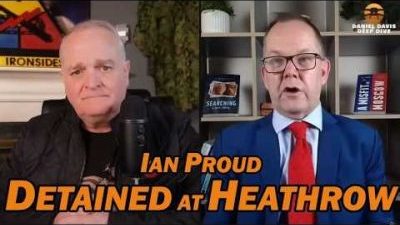
Diplomacy is Now a Crime in Britain / Ian Proud
or go to
Aletho News Archives – Video-Images
From the Archives
Is America behind the massive surge in Kiev regime’s child trafficking?
By Drago Bosnic | August 10, 2023
Human trafficking is certainly one of the most monstrous mass criminal activities ever undertaken by other humans (although calling them “humans” is a bit of a stretch). And yet, there’s a special kind of this deeply repulsive crime that pushes it to diabolical proportions – child trafficking. Underage kids, particularly those who were abandoned, sold or have very poor/abusive family backgrounds, are by far the most vulnerable group. The depraved criminals who engage in such illicit activities specifically target unfortunate children and given there are millions of them all around the globe, particularly in war-torn areas, the “recruitment pool” is effectively endless. Unfortunately, the demand on the black market also seems to be constant and growing, making it a very lucrative and appealing prospect for criminals. … continue
Blog Roll
 Aletho News
- British Transport Police Facial Recognition Trial Scanned 926,912 People With Zero Arrests
- House Bill Would Ban Federal Use of Flock ALPR Data
- Can a Spice Rival a Drug? 10 Head-to-Head Trials Put It to the Test.
- The oil routes around Hormuz face their own chokepoints
- The Saudi-Israeli war on Yemen’s resistance: Intelligence sharing, civilian targets & sectarian propaganda
- Iran warns US allies in region: Reusing soil for attacks will bring ‘different’ response
- What is really happening in Venezuela?
- Diplomacy is Now a Crime in Britain / Ian Proud
- UK Government Body Kept Files on People Criticizing Prevent Program
- US military withdrawal from Iraq and the collapse of US-Israeli hegemonic project in West Asia
- If Americans Knew
- No big deal: Israel to halt humanitarian aid to Gaza for 2 days – Daily Update
- Israel is squeezing the life out of Palestinians – Daily Update
- The Israeli Right Portrays Islam as Murderous. It Serves a Political Purpose
- Jordan Has Had Enough: King Abdullah’s Scathing Warning to Israel
- Israeli Colonizers (i.e. Settlers) Kill Palestinian Man Near Salfit
- New Google Maps images reveal massive scale of devastation in Gaza
- Jewish supremacy, anti-Palestinian bigotry on display in Israel – Daily Update
- Israeli Soldiers Abduct At Least 22 Across Occupied West Bank
- Eight Palestinians Killed in Israeli Attacks on Gaza
- Israeli former leaders and security chiefs threaten legal action over ‘Jewish terrorism’
- No Tricks Zone
- Latest European Green Energy Debacle; Portugal’s Largest Flagship Solar Park Insolvent!
- Green Energy Debacle: German Expert Professor Fritz Vahrenholt Warns Of Severe Economic And Social Consequences
- Two More Paleo Reconstructions Affirm Meters-Higher Sea Levels Across Ireland, Brazil 7000-6000 Years Ago
- New Study: Earth And Venus Surface Warmth Largely Explained By Convection And Lapse Rate, Not CO2 Or Radiation
- 2025 Nature Paper Claiming Worsening Global Drought Gets RETRACTED …Heavily Flawed
- New Study: ‘Global Drought Shows No Detectable Recent Acceleration Under Climate Warming’
- Economic Masterminds: German Socialists Suggest Taxing Productivity Gains Stemming From Using AI
- The South China Sea Has Not Been Cooperating With The Climate Change Narrative
- Energy Crisis: Germany Enters Heating Season With Historically Low Gas Reserve Fill Levels
- New Study: The Antarctic Ice Sheet Gained Mass From 2020-2024 Due To Staggering Snow And Ice Accumulation

